World Future
2014
#WFS14
Pathways for
Foresight
Careers
Dr. Jay Gary
Download slides: http://www.jaygary.com/foresightcareers14.pdf #WFS14 @drjaygary
Jay Gary
Longview, Texas
• Associate Professor, Graduate Sch. of Business, LETU
• Graduate Program Director, MBA, MHA, MSL, MEM
• Founder of Regent University’s Foresight Programs
• 15 yrs in Mgt Consulting, 10 yrs academic
• Research is in Foresight, Strategy & Leadership
• http://www.jaygary.com
Abstract
1. How has your futurist work intersected with your career?
2. What is the present state and future prospects of building a
career in foresight?
3. What competencies will tomorrow’s futurists demonstrate,
whether as trend analysts, project managers, facilitators or
consultants?
This session present findings from the “Certification of Professional Futurists 2030,”
a Real-Time Delphi conducted among 142 experts from 29 countries on how 6
interlocking systems will shape how the futurists of tomorrow will build their careers:
knowledge base, competency maps, interactive training, participatory networks,
continuing education, and code of ethics.
Age of Jobs
https://www.linkedin.com/today/post/article/20140620100222-22726740-jobs-are-over-the-future-is-income-generation-part-1?trk=mp-reader-card
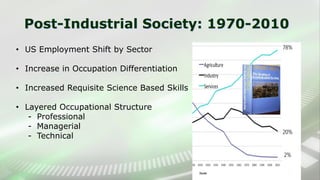
Post-Industrial Society: 1970-2010
• US Employment Shift by Sector
• Increase in Occupation Differentiation
• Increased Requisite Science Based Skills
• Layered Occupational Structure
- Professional
- Managerial
- Technical
78%
20%
2%
Rise of Productivity & GDP Low
Wage Growth, Decline of Jobs
Job Movement
https://www.linkedin.com/today/post/article/20140620100222-22726740-jobs-are-over-the-future-is-income-generation-part-1?trk=mp-reader-card
“Jobs have moved Up,
Out and Fragmented”
Age of Income Generation
https://www.linkedin.com/today/post/article/20140620100222-22726740-jobs-are-over-the-future-is-income-generation-part-1?trk=mp-reader-card
Professional Futurists
Actors, Levels & Identity
Strategic
Foresight
Organizational
Futurist
End User
Client
Consulting
Futurist
Champion
Client
Hines, A. (2012, December). The role of an organizational futurist in integrating foresight into organizations.
Unpublished doctoral dissertation, Leeds Metropolitan University, Faculty of Business and Law; p. 9
Our approach in this session:
1. Review Six Practices of Strategic Foresight
2. Discuss results of a
• 2013 Survey of Professional Futurists
• 2012 Delphi on Professionalizing Foresight
Strategic Foresight
is the ability to create and maintain a high-
quality, coherent and functional forward view
and to use the insights in useful ways eg. to
reach new markets, to guide policy, to reinvent
companies, to launch strategic alliances.
Richard Slaughter, AFI
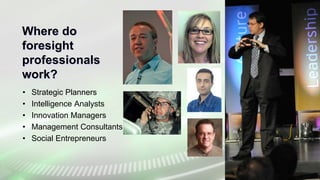
Where do
foresight
professionals
work?
• Strategic Planners
• Intelligence Analysts
• Innovation Managers
• Management Consultants
• Social Entrepreneurs
Horizon 3: Foresight
Foresight
Practices
Framing
1
Scanning
2
Forecasting
3
Visioning4
Planning
5
Source: Hines & Bishop, Thinking About the Future, 2007
6
Acting
Strategic Foresight
Activity
How Existing Methods Fit
Certificate in Foresight
Our approach in this session:
1. Review Six Practices of Strategic Foresight
2. Discuss results of a
• 2013 Survey of Professional Futurists
• 2012 Delphi on Professionalizing Foresight
APF 2013 Survey
0 10 20 30 40 50 60 70
Sole Proprietor
Small Team < 5
Type of Company
61 %
27 %
N = 40; 3-5 Projects a Year,
0 2 4 6 8 10 12 14 16
Int'l Companies
Governments
Non-Profits
Type of Client
11 %
12 %
14 %
0 5 10 15 20 25 30
$1,000 - $5,000
$15,000-$30,000
Fee Per Project
0 5 10 15 20 25 30 35
60-90 Days
1-3 Days
Project Duration
22 %
28%
21%
29 %
Projects mostly internal supported (60%)
What has been changing for “Futurists”?
Daheim, C., & Uerz, G. (2008, May). Corporate foresight in Europe: From trend based logics to open foresight. Technology Analysis & Strategic Management, 20(3), 321-336.
Annual Revenue of Foresight Firms
60% of Revenue, just 5 Firms
The Foresight Market
The results suggest a specialized
market with many small, fragmented
providers and a handful of large firms.
– Noah Raford, PhD, APF 2013 Survey
APF Questions
1. Will small consultancies and sole traders be
able to compete against large, consolidated
industry players?
2. Will advances in IT enable small players to
compete more effectively, or will they
enable large firms to extend their reach
and consolidate their dominance in a global
market place?
3. Is the industry shrinking, growing, or
staying the same overall?
Our approach in this session:
1. Review Six Practices of Strategic Foresight
2. Discuss results of a
• 2013 Survey of Professional Futurists
• 2012 Delphi on Professionalizing Foresight
School of Business & Leadership | Jay Gary, PhD
Certifying Professional Futurists
2030
The Future of the Foresight Profession
Results from a Delphi Survey
Jay Gary, PhD • July 2013
Twitter: DrJayGary
jaygary.com/profession2030.pdf
Note: This research has been submitted for publication to Futures journal
School of Business & Leadership | Jay Gary, PhD
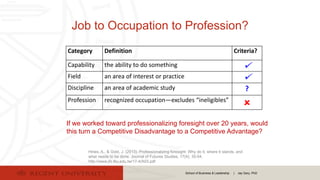
Job to Occupation to Profession?
Hines, A., & Gold, J. (2013). Professionalizing foresight: Why do it, where it stands, and
what needs to be done. Journal of Futures Studies, 17(4), 35-54.
http://www.jfs.tku.edu.tw/17-4/A03.pdf
Category Definition Criteria?
Capability the ability to do something 
Field an area of interest or practice 
Discipline an area of academic study ?
Profession recognized occupation—excludes “ineligibles”

If we worked toward professionalizing foresight over 20 years, would
this turn a Competitive Disadvantage to a Competitive Advantage?
School of Business & Leadership | Jay Gary, PhD
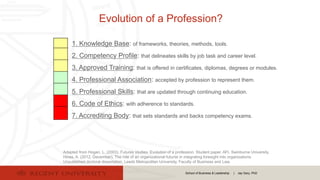
Evolution of a Profession?
Adapted from Hogan, L. (2003). Futures studies: Evolution of a profession. Student paper. AFI, Swinburne University.
Hines, A. (2012, December). The role of an organizational futurist in integrating foresight into organizations.
Unpublished doctoral dissertation, Leeds Metropolitan University, Faculty of Business and Law.
1. Knowledge Base: of frameworks, theories, methods, tools.
2. Competency Profile: that delineates skills by job task and career level.
3. Approved Training: that is offered in certificates, diplomas, degrees or modules.
4. Professional Association: accepted by profession to represent them.
5. Professional Skills: that are updated through continuing education.
6. Code of Ethics: with adherence to standards.
7. Accrediting Body: that sets standards and backs competency exams.
School of Business & Leadership | Jay Gary, PhD
Porter’s Five Forces
What was the Conceptual Framework?
Porter, M. E. (1979). How competitive forces shape strategy. Harvard Business Review, 57(2), 137-145.
School of Business & Leadership | Jay Gary, PhD
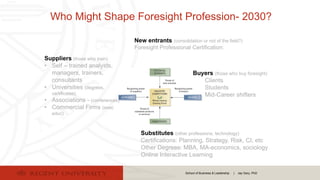
Who Might Shape Foresight Profession- 2030?
New entrants (consolidation or not of the field?)
Foresight Professional Certification:
Suppliers (those who train)
• Self – trained analysts,
managers, trainers,
consultants
• Universities (degrees,
certificates)
• Associations - (conferences)
• Commercial Firms (exec
educ)
Buyers (those who buy foresight)
Clients
Students
Mid-Career shifters
Substitutes (other professions, technology)
Certifications: Planning, Strategy, Risk, CI, etc
Other Degrees: MBA, MA-economics, sociology
Online Interactive Learning
School of Business & Leadership | Jay Gary, PhD
Delphi Study on the Foresight Profession
“Real-Time Delphi “ Survey
Dec 11th -
Jan 31st
School of Business & Leadership | Jay Gary, PhD
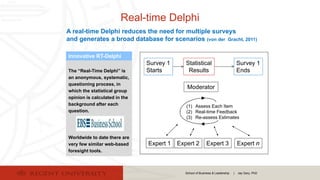
Real-time Delphi
A real-time Delphi reduces the need for multiple surveys
and generates a broad database for scenarios (von der Gracht, 2011)
Survey 1
Starts
Expert 1 Expert 2 Expert 3
Survey 1
Ends
Expert n
Moderator
Statistical
Results
(1) Assess Each Item
(2) Real-time Feedback
(3) Re-assess Estimates
The “Real-Time Delphi” is
an anonymous, systematic,
questioning process, in
which the statistical group
opinion is calculated in the
background after each
question.
Worldwide to date there are
very few similar web-based
foresight tools.
Innovative RT-Delphi
School of Business & Leadership | Jay Gary, PhD
Consensus Portal
Grad Programs – Certification Advantage
Commercial Firms Offer Foresight Training
School of Business & Leadership | Jay Gary, PhD
0% 5% 10% 15% 20% 25% 30%
Who Responded to this RTDelphi?
142 Respondents, 1,226 Invitations, 11.6% response
Age
Location Gender
Profession
Consultants
31.7%
Academics
31.0%
Applied
Research
13.4%
Industry
13.4%
Association / Politics
10.6%
Europe 43.7%
N. America 36.6%
Oceania 7.7%
Asia 6.3%
L.America 3.5%
Africa 2.1%
Female
22%
Male
79%
0
5
10
15
20
25
30
35
40
25-34 35-44 45-54 55-64 65-74 75-84
39
38
28
17
15
5
APF
Other
WFS
MP
WFSF
ST Associations
School of Business & Leadership | Jay Gary, PhD
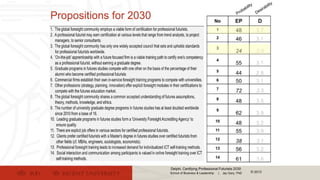
Propositions for 2030 No EP D
1
2
3
4
5
6
7
8
9
10
11
12
13
14
Delphi, Certifying Professional Futurists 2030
© 2013
School of Business & Leadership | Jay Gary, PhD
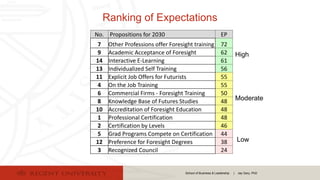
Ranking of Expectations
High
Moderate
No. Propositions for 2030 EP
7 Other Professions offer Foresight training 72
9 Academic Acceptance of Foresight 62
14 Interactive E-Learning 61
13 Individualized Self Training 56
11 Explicit Job Offers for Futurists 55
4 On the Job Training 55
6 Commercial Firms - Foresight Training 50
8 Knowledge Base of Futures Studies 48
10 Accreditation of Foresight Education 48
1 Professional Certification 48
2 Certification by Levels 46
5 Grad Programs Compete on Certification 44
12 Preference for Foresight Degrees 38
3 Recognized Council 24
Low
School of Business & Leadership | Jay Gary, PhD
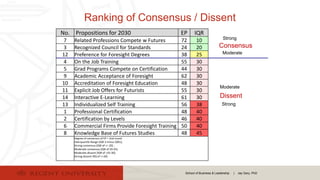
Ranking of Consensus / Dissent
No. Propositions for 2030 EP IQR
7 Related Professions Compete w Futures 72 10
3 Recognized Council for Standards 24 20
12 Preference for Foresight Degrees 38 25
4 On the Job Training 55 30
5 Grad Programs Compete on Certification 44 30
9 Academic Acceptance of Foresight 62 30
10 Accreditation of Foresight Education 48 30
11 Explicit Job Offers for Futurists 55 30
14 Interactive E-Learning 61 30
13 Individualized Self Training 56 38
1 Professional Certification 48 40
2 Certification by Levels 46 40
6 Commercial Firms Provide Foresight Training 50 40
8 Knowledge Base of Futures Studies 48 45
Degree of consensus of EP = 2nd round
Interquartile Range (IQR 3 minus IQR1);
Strong consensus (IQR of <= 20) ;
Moderate consensus (IQR of 20-25);
Moderate dissent (IQR of >25-30);
Strong dissent IRQ of >=30)
Strong
Moderate
Consensus
Dissent
Strong
Moderate
School of Business & Leadership | Jay Gary, PhD
Three Scenarios for 2030
3. New entrants: 39%, certification
Organizational Futurists
2. Suppliers: 49%, academicisation
Academic Futurists
-Connected Foresight Value Chain;
-Low Differentiation to other Occupations
1. Substitutes: 61%, assimilation
External Professions
-Fragmented Foresight Value Chain
-Low Differentiation to other Occupations
-Connected Foresight Value Chain
-Hi Differentiation to other Occupations
8. Consolidation of knowledge base
9. Academic acceptance of foresight
12. No preference for certified futurists
with foresight degrees over MBA.
6. Commercial Firms offer foresight training
7. Related professions offer foresight training
13. Individualized Self-Training thru ICT
1. Viable professional certification
2. Certification by levels or sector
3. Single Council setting standards
School of Business & Leadership | Jay Gary, PhD
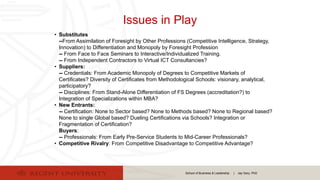
Issues in Play
• Substitutes
--From Assimilation of Foresight by Other Professions (Competitive Intelligence, Strategy,
Innovation) to Differentiation and Monopoly by Foresight Profession
-- From Face to Face Seminars to Interactive/Individualized Training.
-- From Independent Contractors to Virtual ICT Consultancies?
• Suppliers:
-- Credentials: From Academic Monopoly of Degrees to Competitive Markets of
Certificates? Diversity of Certificates from Methodological Schools: visionary, analytical,
participatory?
-- Disciplines: From Stand-Alone Differentiation of FS Degrees (accreditation?) to
Integration of Specializations within MBA?
• New Entrants:
-- Certification: None to Sector based? None to Methods based? None to Regional based?
None to single Global based? Dueling Certifications via Schools? Integration or
Fragmentation of Certification?
Buyers:
-- Professionals: From Early Pre-Service Students to Mid-Career Professionals?
• Competitive Rivalry: From Competitive Disadvantage to Competitive Advantage?
School of Business & Leadership | Jay Gary, PhD
Pathways for the Foresight Profession
Scenario
Dominant
Actor
Value Chain
Competitive
Position
Likelihood Desirability
1. Substitutes
External
Professions
Fragmented
Low
Differentiation
61% 3.5
2. Suppliers
Academic
Futurists
Connected
Low
Differentiation
49% 3.4
3. New
Entrants
Organizational
Futurists
Connected
High
Differentiation
39% 3.1
The scenario of professional certification by 2030
was deemed least likely and less desirable by
experts. Yet if implemented in a co-joined manner
with a consortium of clients, its could yield
favorable gains for foresight professionals.
School of Business & Leadership | Jay Gary, PhDSchool of Business & Leadership | Dr. Gary
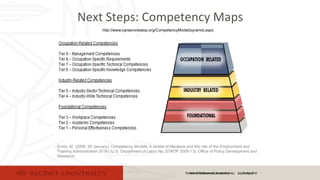
Ennis, M. (2008, 29 January). Competency Models: A review of literature and the role of the Employment and
Training Administration (ETA) (U.S. Department of Labor No. ETAOP 2008-13). Office of Policy Development and
Research.
http://www.careeronestop.org/CompetencyModel/pyramid.aspx
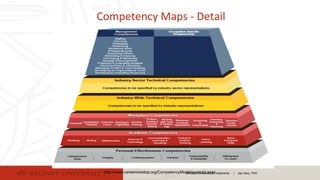
Next Steps: Competency Maps
School of Business & Leadership | Jay Gary, PhD
Competency Maps - Detail
http://www.careeronestop.org/CompetencyModel/pyramid.aspx
School of Business & Leadership | Jay Gary, PhD
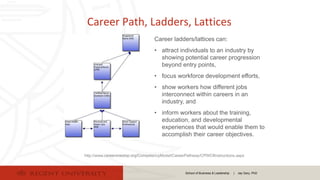
Career Path, Ladders, Lattices
http://www.careeronestop.org/CompetencyModel/CareerPathway/CPWCllInstructions.aspx
Career ladders/lattices can:
• attract individuals to an industry by
showing potential career progression
beyond entry points,
• focus workforce development efforts,
• show workers how different jobs
interconnect within careers in an
industry, and
• inform workers about the training,
education, and developmental
experiences that would enable them to
accomplish their career objectives.
School of Business & Leadership | Jay Gary, PhD
Discussion
1. What questions do you have on the Delphi
Method?
2. How do these potential pathways for
foresight professionals affect your work?
Pathways for
Foresight
Careers
Dr. Jay Gary
Download slides: http://www.jaygary.com/foresightcareers14.pdf #WFS14 @drjaygary

Pathways to Foresight Careers

  • 1.
  • 2.
    Pathways for Foresight Careers Dr. JayGary Download slides: http://www.jaygary.com/foresightcareers14.pdf #WFS14 @drjaygary
  • 3.
    Jay Gary Longview, Texas •Associate Professor, Graduate Sch. of Business, LETU • Graduate Program Director, MBA, MHA, MSL, MEM • Founder of Regent University’s Foresight Programs • 15 yrs in Mgt Consulting, 10 yrs academic • Research is in Foresight, Strategy & Leadership • http://www.jaygary.com
  • 4.
    Abstract 1. How hasyour futurist work intersected with your career? 2. What is the present state and future prospects of building a career in foresight? 3. What competencies will tomorrow’s futurists demonstrate, whether as trend analysts, project managers, facilitators or consultants? This session present findings from the “Certification of Professional Futurists 2030,” a Real-Time Delphi conducted among 142 experts from 29 countries on how 6 interlocking systems will shape how the futurists of tomorrow will build their careers: knowledge base, competency maps, interactive training, participatory networks, continuing education, and code of ethics.
  • 5.
  • 6.
    Post-Industrial Society: 1970-2010 •US Employment Shift by Sector • Increase in Occupation Differentiation • Increased Requisite Science Based Skills • Layered Occupational Structure - Professional - Managerial - Technical 78% 20% 2%
  • 7.
    Rise of Productivity& GDP Low Wage Growth, Decline of Jobs
  • 8.
  • 9.
    Age of IncomeGeneration https://www.linkedin.com/today/post/article/20140620100222-22726740-jobs-are-over-the-future-is-income-generation-part-1?trk=mp-reader-card
  • 10.
    Professional Futurists Actors, Levels& Identity Strategic Foresight Organizational Futurist End User Client Consulting Futurist Champion Client Hines, A. (2012, December). The role of an organizational futurist in integrating foresight into organizations. Unpublished doctoral dissertation, Leeds Metropolitan University, Faculty of Business and Law; p. 9
  • 11.
    Our approach inthis session: 1. Review Six Practices of Strategic Foresight 2. Discuss results of a • 2013 Survey of Professional Futurists • 2012 Delphi on Professionalizing Foresight
  • 12.
    Strategic Foresight is theability to create and maintain a high- quality, coherent and functional forward view and to use the insights in useful ways eg. to reach new markets, to guide policy, to reinvent companies, to launch strategic alliances. Richard Slaughter, AFI
  • 13.
    Where do foresight professionals work? • StrategicPlanners • Intelligence Analysts • Innovation Managers • Management Consultants • Social Entrepreneurs
  • 14.
  • 15.
  • 16.
  • 17.
  • 18.
  • 19.
    Our approach inthis session: 1. Review Six Practices of Strategic Foresight 2. Discuss results of a • 2013 Survey of Professional Futurists • 2012 Delphi on Professionalizing Foresight
  • 20.
    APF 2013 Survey 010 20 30 40 50 60 70 Sole Proprietor Small Team < 5 Type of Company 61 % 27 % N = 40; 3-5 Projects a Year, 0 2 4 6 8 10 12 14 16 Int'l Companies Governments Non-Profits Type of Client 11 % 12 % 14 % 0 5 10 15 20 25 30 $1,000 - $5,000 $15,000-$30,000 Fee Per Project 0 5 10 15 20 25 30 35 60-90 Days 1-3 Days Project Duration 22 % 28% 21% 29 % Projects mostly internal supported (60%)
  • 21.
    What has beenchanging for “Futurists”? Daheim, C., & Uerz, G. (2008, May). Corporate foresight in Europe: From trend based logics to open foresight. Technology Analysis & Strategic Management, 20(3), 321-336.
  • 22.
    Annual Revenue ofForesight Firms 60% of Revenue, just 5 Firms
  • 23.
    The Foresight Market Theresults suggest a specialized market with many small, fragmented providers and a handful of large firms. – Noah Raford, PhD, APF 2013 Survey
  • 24.
    APF Questions 1. Willsmall consultancies and sole traders be able to compete against large, consolidated industry players? 2. Will advances in IT enable small players to compete more effectively, or will they enable large firms to extend their reach and consolidate their dominance in a global market place? 3. Is the industry shrinking, growing, or staying the same overall?
  • 25.
    Our approach inthis session: 1. Review Six Practices of Strategic Foresight 2. Discuss results of a • 2013 Survey of Professional Futurists • 2012 Delphi on Professionalizing Foresight
  • 26.
    School of Business& Leadership | Jay Gary, PhD Certifying Professional Futurists 2030 The Future of the Foresight Profession Results from a Delphi Survey Jay Gary, PhD • July 2013 Twitter: DrJayGary jaygary.com/profession2030.pdf Note: This research has been submitted for publication to Futures journal
  • 27.
    School of Business& Leadership | Jay Gary, PhD Job to Occupation to Profession? Hines, A., & Gold, J. (2013). Professionalizing foresight: Why do it, where it stands, and what needs to be done. Journal of Futures Studies, 17(4), 35-54. http://www.jfs.tku.edu.tw/17-4/A03.pdf Category Definition Criteria? Capability the ability to do something  Field an area of interest or practice  Discipline an area of academic study ? Profession recognized occupation—excludes “ineligibles”  If we worked toward professionalizing foresight over 20 years, would this turn a Competitive Disadvantage to a Competitive Advantage?
  • 28.
    School of Business& Leadership | Jay Gary, PhD Evolution of a Profession? Adapted from Hogan, L. (2003). Futures studies: Evolution of a profession. Student paper. AFI, Swinburne University. Hines, A. (2012, December). The role of an organizational futurist in integrating foresight into organizations. Unpublished doctoral dissertation, Leeds Metropolitan University, Faculty of Business and Law. 1. Knowledge Base: of frameworks, theories, methods, tools. 2. Competency Profile: that delineates skills by job task and career level. 3. Approved Training: that is offered in certificates, diplomas, degrees or modules. 4. Professional Association: accepted by profession to represent them. 5. Professional Skills: that are updated through continuing education. 6. Code of Ethics: with adherence to standards. 7. Accrediting Body: that sets standards and backs competency exams.
  • 29.
    School of Business& Leadership | Jay Gary, PhD Porter’s Five Forces What was the Conceptual Framework? Porter, M. E. (1979). How competitive forces shape strategy. Harvard Business Review, 57(2), 137-145.
  • 30.
    School of Business& Leadership | Jay Gary, PhD Who Might Shape Foresight Profession- 2030? New entrants (consolidation or not of the field?) Foresight Professional Certification: Suppliers (those who train) • Self – trained analysts, managers, trainers, consultants • Universities (degrees, certificates) • Associations - (conferences) • Commercial Firms (exec educ) Buyers (those who buy foresight) Clients Students Mid-Career shifters Substitutes (other professions, technology) Certifications: Planning, Strategy, Risk, CI, etc Other Degrees: MBA, MA-economics, sociology Online Interactive Learning
  • 31.
    School of Business& Leadership | Jay Gary, PhD Delphi Study on the Foresight Profession “Real-Time Delphi “ Survey Dec 11th - Jan 31st
  • 32.
    School of Business& Leadership | Jay Gary, PhD Real-time Delphi A real-time Delphi reduces the need for multiple surveys and generates a broad database for scenarios (von der Gracht, 2011) Survey 1 Starts Expert 1 Expert 2 Expert 3 Survey 1 Ends Expert n Moderator Statistical Results (1) Assess Each Item (2) Real-time Feedback (3) Re-assess Estimates The “Real-Time Delphi” is an anonymous, systematic, questioning process, in which the statistical group opinion is calculated in the background after each question. Worldwide to date there are very few similar web-based foresight tools. Innovative RT-Delphi
  • 33.
    School of Business& Leadership | Jay Gary, PhD Consensus Portal Grad Programs – Certification Advantage Commercial Firms Offer Foresight Training
  • 34.
    School of Business& Leadership | Jay Gary, PhD 0% 5% 10% 15% 20% 25% 30% Who Responded to this RTDelphi? 142 Respondents, 1,226 Invitations, 11.6% response Age Location Gender Profession Consultants 31.7% Academics 31.0% Applied Research 13.4% Industry 13.4% Association / Politics 10.6% Europe 43.7% N. America 36.6% Oceania 7.7% Asia 6.3% L.America 3.5% Africa 2.1% Female 22% Male 79% 0 5 10 15 20 25 30 35 40 25-34 35-44 45-54 55-64 65-74 75-84 39 38 28 17 15 5 APF Other WFS MP WFSF ST Associations
  • 35.
    School of Business& Leadership | Jay Gary, PhD Propositions for 2030 No EP D 1 2 3 4 5 6 7 8 9 10 11 12 13 14 Delphi, Certifying Professional Futurists 2030 © 2013
  • 36.
    School of Business& Leadership | Jay Gary, PhD Ranking of Expectations High Moderate No. Propositions for 2030 EP 7 Other Professions offer Foresight training 72 9 Academic Acceptance of Foresight 62 14 Interactive E-Learning 61 13 Individualized Self Training 56 11 Explicit Job Offers for Futurists 55 4 On the Job Training 55 6 Commercial Firms - Foresight Training 50 8 Knowledge Base of Futures Studies 48 10 Accreditation of Foresight Education 48 1 Professional Certification 48 2 Certification by Levels 46 5 Grad Programs Compete on Certification 44 12 Preference for Foresight Degrees 38 3 Recognized Council 24 Low
  • 37.
    School of Business& Leadership | Jay Gary, PhD Ranking of Consensus / Dissent No. Propositions for 2030 EP IQR 7 Related Professions Compete w Futures 72 10 3 Recognized Council for Standards 24 20 12 Preference for Foresight Degrees 38 25 4 On the Job Training 55 30 5 Grad Programs Compete on Certification 44 30 9 Academic Acceptance of Foresight 62 30 10 Accreditation of Foresight Education 48 30 11 Explicit Job Offers for Futurists 55 30 14 Interactive E-Learning 61 30 13 Individualized Self Training 56 38 1 Professional Certification 48 40 2 Certification by Levels 46 40 6 Commercial Firms Provide Foresight Training 50 40 8 Knowledge Base of Futures Studies 48 45 Degree of consensus of EP = 2nd round Interquartile Range (IQR 3 minus IQR1); Strong consensus (IQR of <= 20) ; Moderate consensus (IQR of 20-25); Moderate dissent (IQR of >25-30); Strong dissent IRQ of >=30) Strong Moderate Consensus Dissent Strong Moderate
  • 38.
    School of Business& Leadership | Jay Gary, PhD Three Scenarios for 2030 3. New entrants: 39%, certification Organizational Futurists 2. Suppliers: 49%, academicisation Academic Futurists -Connected Foresight Value Chain; -Low Differentiation to other Occupations 1. Substitutes: 61%, assimilation External Professions -Fragmented Foresight Value Chain -Low Differentiation to other Occupations -Connected Foresight Value Chain -Hi Differentiation to other Occupations 8. Consolidation of knowledge base 9. Academic acceptance of foresight 12. No preference for certified futurists with foresight degrees over MBA. 6. Commercial Firms offer foresight training 7. Related professions offer foresight training 13. Individualized Self-Training thru ICT 1. Viable professional certification 2. Certification by levels or sector 3. Single Council setting standards
  • 39.
    School of Business& Leadership | Jay Gary, PhD Issues in Play • Substitutes --From Assimilation of Foresight by Other Professions (Competitive Intelligence, Strategy, Innovation) to Differentiation and Monopoly by Foresight Profession -- From Face to Face Seminars to Interactive/Individualized Training. -- From Independent Contractors to Virtual ICT Consultancies? • Suppliers: -- Credentials: From Academic Monopoly of Degrees to Competitive Markets of Certificates? Diversity of Certificates from Methodological Schools: visionary, analytical, participatory? -- Disciplines: From Stand-Alone Differentiation of FS Degrees (accreditation?) to Integration of Specializations within MBA? • New Entrants: -- Certification: None to Sector based? None to Methods based? None to Regional based? None to single Global based? Dueling Certifications via Schools? Integration or Fragmentation of Certification? Buyers: -- Professionals: From Early Pre-Service Students to Mid-Career Professionals? • Competitive Rivalry: From Competitive Disadvantage to Competitive Advantage?
  • 40.
    School of Business& Leadership | Jay Gary, PhD Pathways for the Foresight Profession Scenario Dominant Actor Value Chain Competitive Position Likelihood Desirability 1. Substitutes External Professions Fragmented Low Differentiation 61% 3.5 2. Suppliers Academic Futurists Connected Low Differentiation 49% 3.4 3. New Entrants Organizational Futurists Connected High Differentiation 39% 3.1 The scenario of professional certification by 2030 was deemed least likely and less desirable by experts. Yet if implemented in a co-joined manner with a consortium of clients, its could yield favorable gains for foresight professionals.
  • 41.
    School of Business& Leadership | Jay Gary, PhDSchool of Business & Leadership | Dr. Gary Ennis, M. (2008, 29 January). Competency Models: A review of literature and the role of the Employment and Training Administration (ETA) (U.S. Department of Labor No. ETAOP 2008-13). Office of Policy Development and Research. http://www.careeronestop.org/CompetencyModel/pyramid.aspx Next Steps: Competency Maps
  • 42.
    School of Business& Leadership | Jay Gary, PhD Competency Maps - Detail http://www.careeronestop.org/CompetencyModel/pyramid.aspx
  • 43.
    School of Business& Leadership | Jay Gary, PhD Career Path, Ladders, Lattices http://www.careeronestop.org/CompetencyModel/CareerPathway/CPWCllInstructions.aspx Career ladders/lattices can: • attract individuals to an industry by showing potential career progression beyond entry points, • focus workforce development efforts, • show workers how different jobs interconnect within careers in an industry, and • inform workers about the training, education, and developmental experiences that would enable them to accomplish their career objectives.
  • 44.
    School of Business& Leadership | Jay Gary, PhD Discussion 1. What questions do you have on the Delphi Method? 2. How do these potential pathways for foresight professionals affect your work?
  • 45.
    Pathways for Foresight Careers Dr. JayGary Download slides: http://www.jaygary.com/foresightcareers14.pdf #WFS14 @drjaygary