MAKING RESEARCH
GENERALIZATIONS
NELMAR T. BACOL
MS- GENERAL SCIENCE EDUCATION
Republic of the Philippines
COLLEGE OF EDUCATION
Central Mindanao University
University Town, Musuan, Bukidnon
PART I
Objectives
It is an act of reasoning
that involves drawing
broad inferences from
particular observations.
- Beck C. and Polit DF (2010)
It is an act or process of
forming opinions that
are based on a small
amount of information
- Merriam-Webster
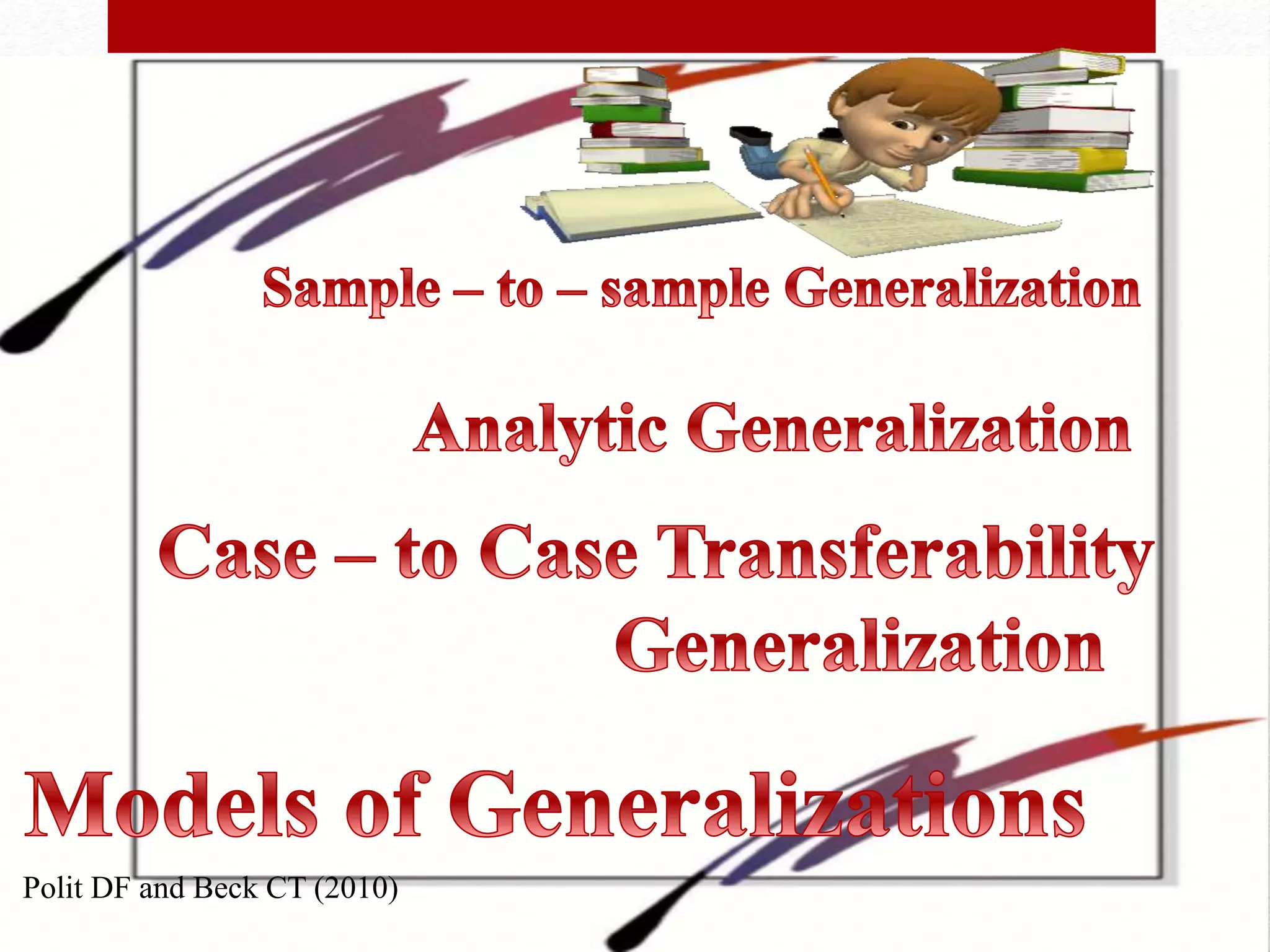
Polit DF and Beck CT (2010)
The process of Sample-to-sample
generalization or statistical generalization is
an integral part of the scientific process. From a
limited number of observations, called the
sample, we extend conclusions to a whole
population, which contains all the units which
we could observe.
- Tindal A. (2000)
Also called theoretical elaboration, this is a type
of generalization in which the inquirer attempts to
link findings from a particular case to a theory.
Here theory means something more like a set of
theoretical tools or models.
- Schwandt T. (2007)
Case-to-case transferability does not involve broad
claims, but invites readers of research to make
connections between elements of a study and their own
experience. For instance, teachers at the high school level
might selectively apply to their own classrooms results
from a study demonstrating that heuristic writing
exercises help students at the college level.
CONSIDERATIONS FOR GENERALIZATION
OF RESULTS
1.Generalizations must only be based
from the samples of the populations.
2.Generalizations must only be drawn
from the circumstances for which
evidences/data have been collected.
3.Speculations and assumptions not
supported by findings must be
avoided.
CONSIDERATIONS FOR GENERALIZATION
OF RESULTS
4. Opinionated statements or
inconclusive statements not supported
by research evidences must be avoided.
5. Research results that only describe or
explain cannot be used to predict future
outcomes or to directly identify the
cause of the findings.
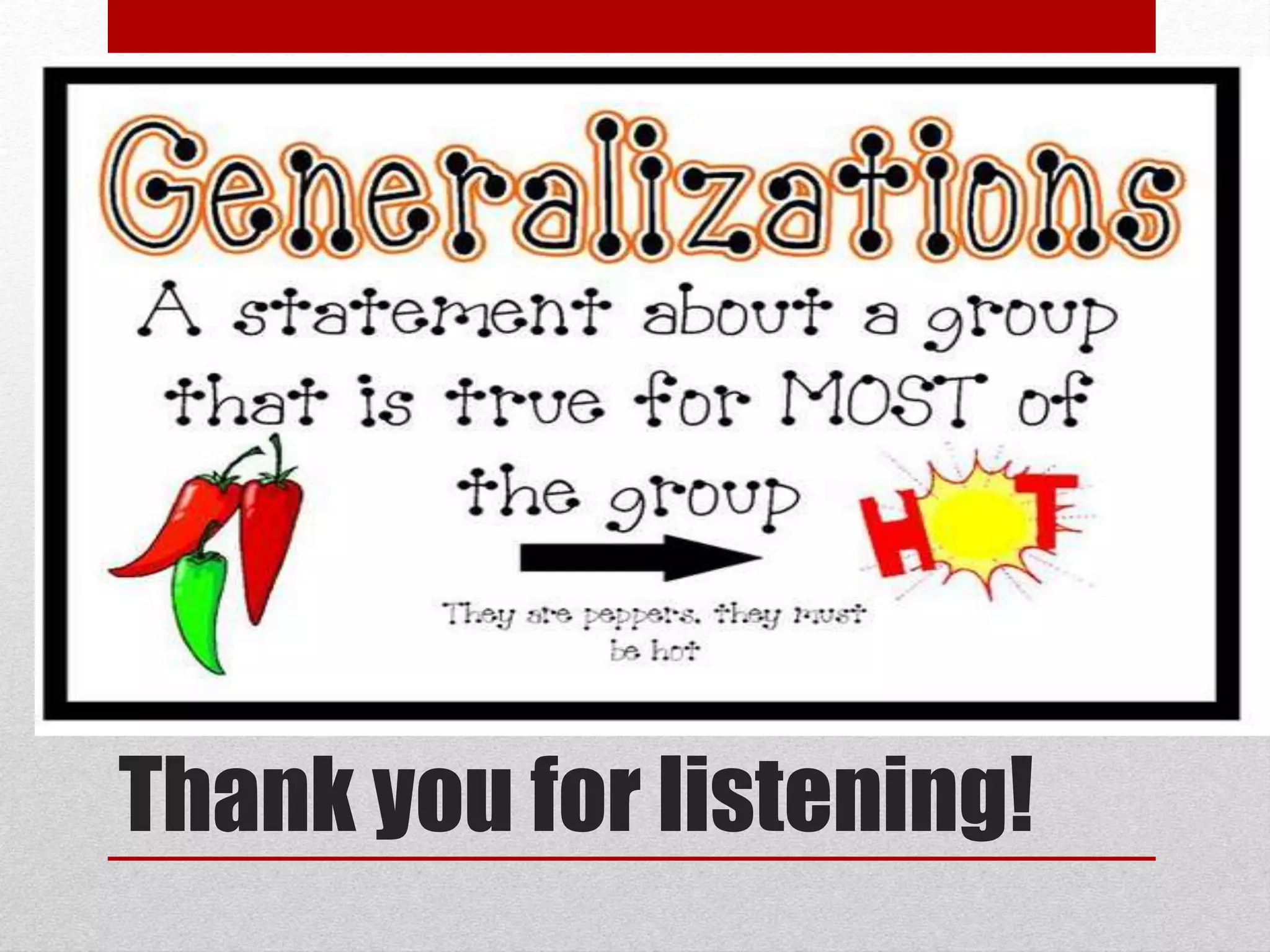
Thank you for listening!

Making research generalizations

  • 1.
    MAKING RESEARCH GENERALIZATIONS NELMAR T.BACOL MS- GENERAL SCIENCE EDUCATION Republic of the Philippines COLLEGE OF EDUCATION Central Mindanao University University Town, Musuan, Bukidnon PART I
  • 2.
  • 3.
    It is anact of reasoning that involves drawing broad inferences from particular observations. - Beck C. and Polit DF (2010) It is an act or process of forming opinions that are based on a small amount of information - Merriam-Webster
  • 4.
    Polit DF andBeck CT (2010)
  • 5.
    The process ofSample-to-sample generalization or statistical generalization is an integral part of the scientific process. From a limited number of observations, called the sample, we extend conclusions to a whole population, which contains all the units which we could observe. - Tindal A. (2000)
  • 6.
    Also called theoreticalelaboration, this is a type of generalization in which the inquirer attempts to link findings from a particular case to a theory. Here theory means something more like a set of theoretical tools or models. - Schwandt T. (2007)
  • 7.
    Case-to-case transferability doesnot involve broad claims, but invites readers of research to make connections between elements of a study and their own experience. For instance, teachers at the high school level might selectively apply to their own classrooms results from a study demonstrating that heuristic writing exercises help students at the college level.
  • 8.
    CONSIDERATIONS FOR GENERALIZATION OFRESULTS 1.Generalizations must only be based from the samples of the populations. 2.Generalizations must only be drawn from the circumstances for which evidences/data have been collected. 3.Speculations and assumptions not supported by findings must be avoided.
  • 9.
    CONSIDERATIONS FOR GENERALIZATION OFRESULTS 4. Opinionated statements or inconclusive statements not supported by research evidences must be avoided. 5. Research results that only describe or explain cannot be used to predict future outcomes or to directly identify the cause of the findings.
  • 10.
    Thank you forlistening!