
Making connections
Infographics
Book: Alive High
vbengezen@gmail.com
www.bengezen.blogspot.com
About the text
1. What does it seem to be?
2. What is the purpose of this text?
3. Who is the intended audience for this text?
4. What does it represent?
5. How is this similar to or different from a
world map?
1. What does it seem to be?
A world map.
2. What is the purpose of this text?
To inform, with visual elements.
3. Who is the intended audience for this text?
Internet users.
4. What does it represent?
The popularity of social networks in 2010.
5. How is this similar to or different from a world
map?
It is similar because it represents social networks’
number of users as geographic formations. It is
different because the size and distribution of these
geographic formations depend on the number of
users for each social network.
Read the text again...
Which social networks seem to be on
the rise and which ones are in decline?
The size of the fictitious countries HABBO,
Google, Facebook, and Twitter suggests they are
on the rise. The expressions “Receding glaciers
of AOL and Windows Live” and “Land of defunct
social networks” suggest decline.
What is better: to make friends in real
life or in social networks?
• 5 groups
• Take a look at the comic strip.
Which is better? Making friends in real
life or in social networks?
• Discuss the questions and report your group
opinion to the class.
• Do social networks change our lives for better
or for worse?
• What are the advantages and disadvantages
of making friends in real life and in social
networks?
Useful language
• I (we) think that...
• I (we) somewhat disagree...
• I (we) totally disagree...
• From my (our) point of view...
• I (we) agree...
• I (we) consider both...
In real life
I am for making friends in real
life, because making friends in
real life you know who is this
person, but in social networks
it is impossible to know person
as well as you can do it in real
life. There is no guarantee that
this person is really good. May
be he at that moment sit in
prison or may be he is a
asexual maniac and etc. Social
networks are not reliable way
to make friends.
In social networks
True indeed if your parents are
strict or if you can't go out to see
your actual friends you could get
on a social network. But the
problem is that nowadays most
of the people you meet on a
network if you haven't ever met
them in real life are fake, pervs,
or predators. Not saying that all
networks are like that or that all
people on there are like that but
you never know. A predator can
play the role of a trust worthy
person for a while and get your
information and who knows what
else. It's just more safe to make
friends in real life.
http://www.createdebate.com/
In social networks
Nowadays we have more friends in social network
rather than in real life. Sometimes you have
problems, but you can`t share it with friends in real
life,so in network you don`t know the person and
easily you can share everything what you have in
your mind. Also it`s good if your friend from
another country, you become more open-minded,
you will get new information, you will know their
traditions, i think that`s sound is really nice. We
spend a lot of time for internet and chatting, but
also we have to have close friends in real life.
Conducting a survey
• Group 1: go around the class and invite two
classmates to answer your survey. Add up
your results and figure out the yes and no
percentages. Report your results to the class.
Topics
Broadband internet
Do you subscribe for a paid broadband service?
Do you ever use a broadband wireless connection?
Social networking
Do you buy things online?
Do you share something online that you created yourself?
Mobile learning
Do you ever use your cell phone to access a social network
site?
Do you ever use your cell phone to send or receive e-mails?
• Use the words in the box to write sentences
describing what the people are doing in the
cartoon on the previous slide.
a)
b)
c)
d)
carry read eat type drink text pizza books web juice soda cell phone
• Use the words in the box to write sentences
describing what the people are doing in the
cartoon on the previous slide.
a) A young woman is carrying some books.
b) A boy is reading a book.
c) A young woman is texting.
d) A young man is typing.
carry read eat type drink text pizza books web juice soda cell phone
Verbs ending with -e
Drop the -e and add ING
hope - hoping
ride - riding
make - making
write - writing
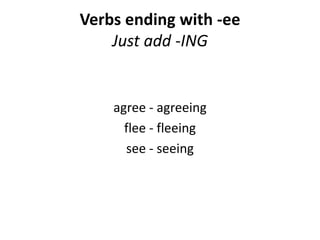
Verbs ending with -ee
Just add -ING
agree - agreeing
flee - fleeing
see - seeing
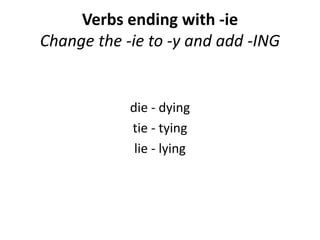
Verbs ending with -ie
Change the -ie to -y and add -ING
die - dying
tie - tying
lie - lying
Verbs ending CVC
(with the exception of w, x, and y)
• For one syllable verbs - double the consonant and add -ING
jog – jogging sit – sitting run – running stop – stopping
• For two syllable verbs
a) If the 1st syllable is stressed, just add ING
answer – answering offer – offering listen – listening visit – visiting
b) If the 2nd syllable is stressed , double the consonant and add ING
admit – admitting prefer – preferring begin – beginning
Miming
Let’s divide the class into two groups: Group A
and Group B; one student from Group A comes
up to the front of the class and is given a card
with a sentence containing the Present
Continuous. The student has to mime this
activity and the members of his group have to
guess, exactly, the same words written on the
card. The student is given one minute to mimic.
Match the names of the following internet
careers to their corresponding definitions. The
first is done for you.
blogger
Internet judge
network engineer
social media consultant
user operations analyst
web designer
web developer
webmaster
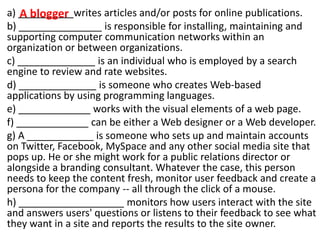
a) __________writes articles and/or posts for online publications.
b) _______________ is responsible for installing, maintaining and
supporting computer communication networks within an
organization or between organizations.
c) ______________ is an individual who is employed by a search
engine to review and rate websites.
d) ______________ is someone who creates Web-based
applications by using programming languages.
e) _____________ works with the visual elements of a web page.
f) _____________ can be either a Web designer or a Web developer.
g) A ____________ is someone who sets up and maintain accounts
on Twitter, Facebook, MySpace and any other social media site that
pops up. He or she might work for a public relations director or
alongside a branding consultant. Whatever the case, this person
needs to keep the content fresh, monitor user feedback and create a
persona for the company -- all through the click of a mouse.
h) ___________________ monitors how users interact with the site
and answers users' questions or listens to their feedback to see what
they want in a site and reports the results to the site owner.
A blogger
a) A blogger writes articles and/or posts for online publications.
b) A network engineer is responsible for installing, maintaining and
supporting computer communication networks within an
organization or between organizations.
c) An Internet judge is an individual who is employed by a search
engine to review and rate websites.
d) A web developer is someone who creates Web-based applications
by using programming languages.
e) A web designer works with the visual elements of a web page.
f) A webmaster can be either a Web designer or a Web developer.
g) A social media consultant is someone who sets up and maintain
accounts on Twitter, Facebook, MySpace and any other social media
site that pops up. He or she might work for a public relations
director or alongside a branding consultant. Whatever the case, this
person needs to keep the content fresh, monitor user feedback and
create a persona for the company -- all through the click of a mouse.
h) An user operations analyst monitors how users interact with the
site and answers users' questions or listens to their feedback to see
what they want in a site and reports the results to the site owner.
Building
a
company
with
social
media
Simple steps
to podcast
optimization
According to the two infographics,
a) What elements do they have in common?
b) Why were they developed?
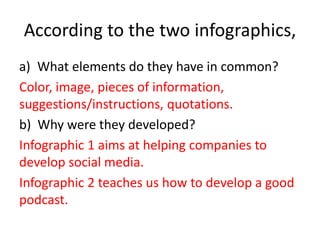
According to the two infographics,
a) What elements do they have in common?
Color, image, pieces of information,
suggestions/instructions, quotations.
b) Why were they developed?
Infographic 1 aims at helping companies to
develop social media.
Infographic 2 teaches us how to develop a good
podcast.

Making connections

  • 1.
    Making connections Infographics Book: AliveHigh vbengezen@gmail.com www.bengezen.blogspot.com
  • 3.
    About the text 1.What does it seem to be? 2. What is the purpose of this text? 3. Who is the intended audience for this text? 4. What does it represent? 5. How is this similar to or different from a world map?
  • 4.
    1. What doesit seem to be? A world map. 2. What is the purpose of this text? To inform, with visual elements. 3. Who is the intended audience for this text? Internet users. 4. What does it represent? The popularity of social networks in 2010. 5. How is this similar to or different from a world map? It is similar because it represents social networks’ number of users as geographic formations. It is different because the size and distribution of these geographic formations depend on the number of users for each social network.
  • 5.
    Read the textagain...
  • 6.
    Which social networksseem to be on the rise and which ones are in decline? The size of the fictitious countries HABBO, Google, Facebook, and Twitter suggests they are on the rise. The expressions “Receding glaciers of AOL and Windows Live” and “Land of defunct social networks” suggest decline.
  • 7.
    What is better:to make friends in real life or in social networks? • 5 groups • Take a look at the comic strip.
  • 9.
    Which is better?Making friends in real life or in social networks? • Discuss the questions and report your group opinion to the class. • Do social networks change our lives for better or for worse? • What are the advantages and disadvantages of making friends in real life and in social networks?
  • 10.
    Useful language • I(we) think that... • I (we) somewhat disagree... • I (we) totally disagree... • From my (our) point of view... • I (we) agree... • I (we) consider both...
  • 11.
    In real life Iam for making friends in real life, because making friends in real life you know who is this person, but in social networks it is impossible to know person as well as you can do it in real life. There is no guarantee that this person is really good. May be he at that moment sit in prison or may be he is a asexual maniac and etc. Social networks are not reliable way to make friends. In social networks True indeed if your parents are strict or if you can't go out to see your actual friends you could get on a social network. But the problem is that nowadays most of the people you meet on a network if you haven't ever met them in real life are fake, pervs, or predators. Not saying that all networks are like that or that all people on there are like that but you never know. A predator can play the role of a trust worthy person for a while and get your information and who knows what else. It's just more safe to make friends in real life. http://www.createdebate.com/
  • 12.
    In social networks Nowadayswe have more friends in social network rather than in real life. Sometimes you have problems, but you can`t share it with friends in real life,so in network you don`t know the person and easily you can share everything what you have in your mind. Also it`s good if your friend from another country, you become more open-minded, you will get new information, you will know their traditions, i think that`s sound is really nice. We spend a lot of time for internet and chatting, but also we have to have close friends in real life.
  • 13.
    Conducting a survey •Group 1: go around the class and invite two classmates to answer your survey. Add up your results and figure out the yes and no percentages. Report your results to the class.
  • 14.
    Topics Broadband internet Do yousubscribe for a paid broadband service? Do you ever use a broadband wireless connection? Social networking Do you buy things online? Do you share something online that you created yourself? Mobile learning Do you ever use your cell phone to access a social network site? Do you ever use your cell phone to send or receive e-mails?
  • 16.
    • Use thewords in the box to write sentences describing what the people are doing in the cartoon on the previous slide. a) b) c) d) carry read eat type drink text pizza books web juice soda cell phone
  • 17.
    • Use thewords in the box to write sentences describing what the people are doing in the cartoon on the previous slide. a) A young woman is carrying some books. b) A boy is reading a book. c) A young woman is texting. d) A young man is typing. carry read eat type drink text pizza books web juice soda cell phone
  • 18.
    Verbs ending with-e Drop the -e and add ING hope - hoping ride - riding make - making write - writing
  • 19.
    Verbs ending with-ee Just add -ING agree - agreeing flee - fleeing see - seeing
  • 20.
    Verbs ending with-ie Change the -ie to -y and add -ING die - dying tie - tying lie - lying
  • 21.
    Verbs ending CVC (withthe exception of w, x, and y) • For one syllable verbs - double the consonant and add -ING jog – jogging sit – sitting run – running stop – stopping • For two syllable verbs a) If the 1st syllable is stressed, just add ING answer – answering offer – offering listen – listening visit – visiting b) If the 2nd syllable is stressed , double the consonant and add ING admit – admitting prefer – preferring begin – beginning
  • 23.
    Miming Let’s divide theclass into two groups: Group A and Group B; one student from Group A comes up to the front of the class and is given a card with a sentence containing the Present Continuous. The student has to mime this activity and the members of his group have to guess, exactly, the same words written on the card. The student is given one minute to mimic.
  • 24.
    Match the namesof the following internet careers to their corresponding definitions. The first is done for you. blogger Internet judge network engineer social media consultant user operations analyst web designer web developer webmaster
  • 25.
    a) __________writes articlesand/or posts for online publications. b) _______________ is responsible for installing, maintaining and supporting computer communication networks within an organization or between organizations. c) ______________ is an individual who is employed by a search engine to review and rate websites. d) ______________ is someone who creates Web-based applications by using programming languages. e) _____________ works with the visual elements of a web page. f) _____________ can be either a Web designer or a Web developer. g) A ____________ is someone who sets up and maintain accounts on Twitter, Facebook, MySpace and any other social media site that pops up. He or she might work for a public relations director or alongside a branding consultant. Whatever the case, this person needs to keep the content fresh, monitor user feedback and create a persona for the company -- all through the click of a mouse. h) ___________________ monitors how users interact with the site and answers users' questions or listens to their feedback to see what they want in a site and reports the results to the site owner. A blogger
  • 26.
    a) A bloggerwrites articles and/or posts for online publications. b) A network engineer is responsible for installing, maintaining and supporting computer communication networks within an organization or between organizations. c) An Internet judge is an individual who is employed by a search engine to review and rate websites. d) A web developer is someone who creates Web-based applications by using programming languages. e) A web designer works with the visual elements of a web page. f) A webmaster can be either a Web designer or a Web developer. g) A social media consultant is someone who sets up and maintain accounts on Twitter, Facebook, MySpace and any other social media site that pops up. He or she might work for a public relations director or alongside a branding consultant. Whatever the case, this person needs to keep the content fresh, monitor user feedback and create a persona for the company -- all through the click of a mouse. h) An user operations analyst monitors how users interact with the site and answers users' questions or listens to their feedback to see what they want in a site and reports the results to the site owner.
  • 27.
  • 28.
  • 29.
    According to thetwo infographics, a) What elements do they have in common? b) Why were they developed?
  • 30.
    According to thetwo infographics, a) What elements do they have in common? Color, image, pieces of information, suggestions/instructions, quotations. b) Why were they developed? Infographic 1 aims at helping companies to develop social media. Infographic 2 teaches us how to develop a good podcast.

Editor's Notes

  • #20 Flee – fugir - fled