Some thoughts on our ‘product
  hacking incubator’ process
        Version 0.1. Prepared by Nick. 28th Jan 2013.
Contents

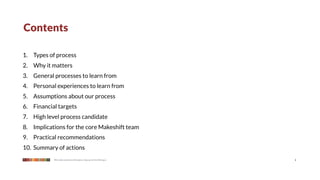
1. Types of process
2. Why it matters
3. General processes to learn from
4. Personal experiences to learn from
5. Assumptions about our process
6. Financial targets
7. High level process candidate
8. Implications for the core Makeshift team
9. Practical recommendations
10. Summary of actions
           We make products that give a leg up to the little guy   2
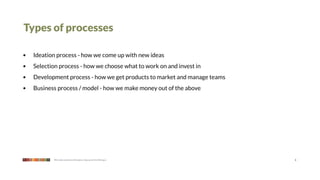
Types of processes

•   Ideation process - how we come up with new ideas
•   Selection process - how we choose what to work on and invest in
•   Development process - how we get products to market and manage teams
•   Business process / model - how we make money out of the above


           We make products that give a leg up to the little guy           3
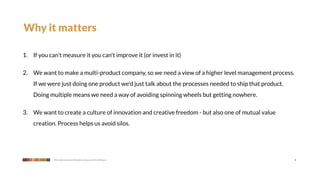
Why it matters

1. If you can't measure it you can't improve it (or invest in it)

2. We want to make a multi-product company, so we need a view of a higher level management process.
    If we were just doing one product we'd just talk about the processes needed to ship that product.
    Doing multiple means we need a way of avoiding spinning wheels but getting nowhere.

3. We want to create a culture of innovation and creative freedom - but also one of mutual value
    creation. Process helps us avoid silos.


            We make products that give a leg up to the little guy                                       4
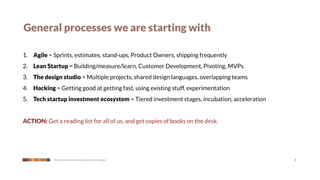
General processes we are starting with

1. Agile = Sprints, estimates, stand-ups, Product Owners, shipping frequently
2. Lean Startup = Building/measure/learn, Customer Development, Pivoting, MVPs
3. The design studio = Multiple projects, shared design languages, overlapping teams
4. Hacking = Getting good at getting fast, using existing stuff, experimentation
5. Tech startup investment ecosystem = Tiered investment stages, incubation, acceleration


ACTION: Get a reading list for all of us, and get copies of books on the desk.


            We make products that give a leg up to the little guy                           5
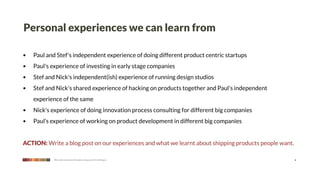
Personal experiences we can learn from

•   Paul and Stef's independent experience of doing different product centric startups
•   Paul's experience of investing in early stage companies
•   Stef and Nick's independent(ish) experience of running design studios
•   Stef and Nick's shared experience of hacking on products together and Paul's independent
    experience of the same
•   Nick's experience of doing innovation process consulting for different big companies
•   Paul’s experience of working on product development in different big companies


ACTION: Write a blog post on our experiences and what we learnt about shipping products people want.

            We make products that give a leg up to the little guy                                      6
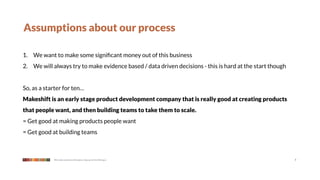
Assumptions about our process

1. We want to make some significant money out of this business
2. We will always try to make evidence based / data driven decisions - this is hard at the start though


So, as a starter for ten…
Makeshift is an early stage product development company that is really good at creating products
that people want, and then building teams to take them to scale.
= Get good at making products people want
= Get good at building teams


            We make products that give a leg up to the little guy                                         7
Financial targets

•   We'll make money in two ways: Revenue from software sales to end users, or, one off sales of whole
    products to investors / acquirers, or, both.
•   If Paul wants 10x on his £400k we need to create a business that could be sold for £16M with no
    additional investment. This implies a business that reliably turns over £5-6M and is growing fast.
•   Making money through model one we need products that make £100,000 a month = £1.2M a year.
    We need to get three of these to get over our £16M valuation. Could be done in 3 years?
•   Making money through model two we need to be selling whole products for £5-6M and need to have
    done it three times? Could be done in 3 years?
ACTION: Create a credible three year business plan with revenue targets

            We make products that give a leg up to the little guy                                        8
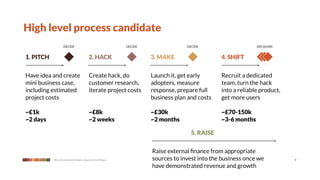
High level process candidate
                    DECIDE                                         DECIDE                DECIDE                     DECISIONS


1. PITCH                                      2. HACK                       3. MAKE                   4. SHIFT


Have idea and create                          Create hack, do               Launch it, get early      Recruit a dedicated
mini business case,                           customer research,            adopters, measure         team, turn the hack
including estimated                           iterate project costs         response, prepare full    into a reliable product,
project costs                                                               business plan and costs   get more users

~£1k                                          ~£8k                          ~£30k                     ~£70-150k
~2 days                                       ~2 weeks                      ~2 months                 ~3-6 months

                                                                                           5. RAISE


                                                                            Raise external finance from appropriate
           We make products that give a leg up to the little guy            sources to invest into the business once we          9


                                                                            have demonstrated revenue and growth
Implications for the core Makeshift team

•   Product guys - takes responsibility for product vision and getting product shipped within the agreed
    resources. Should be able to do some design, tech or marketing work, and be very comfortable and
    able to support specialists doing this.
•   Tech guys (hackers) - take responsibility for developing complete end to end software product. Needs
    to conform to our shared software stack so we can get more than one person working on the product.
•   Marketing guys - support product design from a marketing perspective and the early stage marketing
    of the products
•   Graphic guys - we need lots of freelance branding / graphics guys who can swoop in and add polish
•   IMPORTANT - I think that product guys have to be separate from tech guys. Debate.

            We make products that give a leg up to the little guy                                          10
Practical recommendations

•   Two week rhythm
•   Get good at making decisions
•   Get good at holding product leads accountable


           We make products that give a leg up to the little guy   11
Practical recommendations

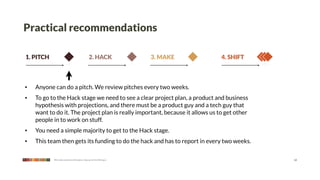
1. PITCH                                      2. HACK              3. MAKE     4. SHIFT


•   Anyone can do a pitch. We review pitches every two weeks.
•   To go to the Hack stage we need to see a clear project plan, a product and business
    hypothesis with projections, and there must be a product guy and a tech guy that
    want to do it. The project plan is really important, because it allows us to get other
    people in to work on stuff.
•   You need a simple majority to get to the Hack stage.
•   This team then gets its funding to do the hack and has to report in every two weeks.

           We make products that give a leg up to the little guy                             12
Practical recommendations

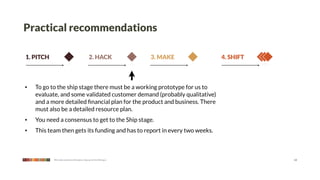
1. PITCH                                      2. HACK              3. MAKE   4. SHIFT


•   To go to the ship stage there must be a working prototype for us to
    evaluate, and some validated customer demand (probably qualitative)
    and a more detailed financial plan for the product and business. There
    must also be a detailed resource plan.
•   You need a consensus to get to the Ship stage.
•   This team then gets its funding and has to report in every two weeks.


           We make products that give a leg up to the little guy                        13
Practical recommendations

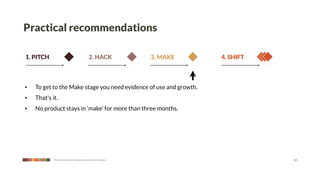
1. PITCH                                       2. HACK              3. MAKE   4. SHIFT


•   To get to the Make stage you need evidence of use and growth.
•   That's it.
•   No product stays in ‘make’ for more than three months.


            We make products that give a leg up to the little guy                        14
Practical recommendations

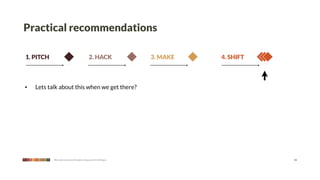
1. PITCH                                      2. HACK              3. MAKE   4. SHIFT


•   Lets talk about this when we get there?


           We make products that give a leg up to the little guy                        15
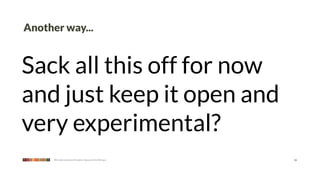
Another way...


Sack all this off for now
and just keep it open and
very experimental?
      We make products that give a leg up to the little guy   16
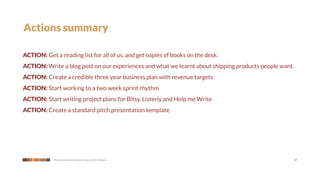
Actions summary

ACTION: Get a reading list for all of us, and get copies of books on the desk.
ACTION: Write a blog post on our experiences and what we learnt about shipping products people want.
ACTION: Create a credible three year business plan with revenue targets
ACTION: Start working to a two week sprint rhythm
ACTION: Start writing project plans for Bitsy, Listerly and Help me Write
ACTION: Create a standard pitch presentation template


            We make products that give a leg up to the little guy                                      17

Makeshift Process v0.1

  • 1.
    Some thoughts onour ‘product hacking incubator’ process Version 0.1. Prepared by Nick. 28th Jan 2013.
  • 2.
    Contents 1. Types ofprocess 2. Why it matters 3. General processes to learn from 4. Personal experiences to learn from 5. Assumptions about our process 6. Financial targets 7. High level process candidate 8. Implications for the core Makeshift team 9. Practical recommendations 10. Summary of actions We make products that give a leg up to the little guy 2
  • 3.
    Types of processes • Ideation process - how we come up with new ideas • Selection process - how we choose what to work on and invest in • Development process - how we get products to market and manage teams • Business process / model - how we make money out of the above We make products that give a leg up to the little guy 3
  • 4.
    Why it matters 1.If you can't measure it you can't improve it (or invest in it) 2. We want to make a multi-product company, so we need a view of a higher level management process. If we were just doing one product we'd just talk about the processes needed to ship that product. Doing multiple means we need a way of avoiding spinning wheels but getting nowhere. 3. We want to create a culture of innovation and creative freedom - but also one of mutual value creation. Process helps us avoid silos. We make products that give a leg up to the little guy 4
  • 5.
    General processes weare starting with 1. Agile = Sprints, estimates, stand-ups, Product Owners, shipping frequently 2. Lean Startup = Building/measure/learn, Customer Development, Pivoting, MVPs 3. The design studio = Multiple projects, shared design languages, overlapping teams 4. Hacking = Getting good at getting fast, using existing stuff, experimentation 5. Tech startup investment ecosystem = Tiered investment stages, incubation, acceleration ACTION: Get a reading list for all of us, and get copies of books on the desk. We make products that give a leg up to the little guy 5
  • 6.
    Personal experiences wecan learn from • Paul and Stef's independent experience of doing different product centric startups • Paul's experience of investing in early stage companies • Stef and Nick's independent(ish) experience of running design studios • Stef and Nick's shared experience of hacking on products together and Paul's independent experience of the same • Nick's experience of doing innovation process consulting for different big companies • Paul’s experience of working on product development in different big companies ACTION: Write a blog post on our experiences and what we learnt about shipping products people want. We make products that give a leg up to the little guy 6
  • 7.
    Assumptions about ourprocess 1. We want to make some significant money out of this business 2. We will always try to make evidence based / data driven decisions - this is hard at the start though So, as a starter for ten… Makeshift is an early stage product development company that is really good at creating products that people want, and then building teams to take them to scale. = Get good at making products people want = Get good at building teams We make products that give a leg up to the little guy 7
  • 8.
    Financial targets • We'll make money in two ways: Revenue from software sales to end users, or, one off sales of whole products to investors / acquirers, or, both. • If Paul wants 10x on his £400k we need to create a business that could be sold for £16M with no additional investment. This implies a business that reliably turns over £5-6M and is growing fast. • Making money through model one we need products that make £100,000 a month = £1.2M a year. We need to get three of these to get over our £16M valuation. Could be done in 3 years? • Making money through model two we need to be selling whole products for £5-6M and need to have done it three times? Could be done in 3 years? ACTION: Create a credible three year business plan with revenue targets We make products that give a leg up to the little guy 8
  • 9.
    High level processcandidate DECIDE DECIDE DECIDE DECISIONS 1. PITCH 2. HACK 3. MAKE 4. SHIFT Have idea and create Create hack, do Launch it, get early Recruit a dedicated mini business case, customer research, adopters, measure team, turn the hack including estimated iterate project costs response, prepare full into a reliable product, project costs business plan and costs get more users ~£1k ~£8k ~£30k ~£70-150k ~2 days ~2 weeks ~2 months ~3-6 months 5. RAISE Raise external finance from appropriate We make products that give a leg up to the little guy sources to invest into the business once we 9 have demonstrated revenue and growth
  • 10.
    Implications for thecore Makeshift team • Product guys - takes responsibility for product vision and getting product shipped within the agreed resources. Should be able to do some design, tech or marketing work, and be very comfortable and able to support specialists doing this. • Tech guys (hackers) - take responsibility for developing complete end to end software product. Needs to conform to our shared software stack so we can get more than one person working on the product. • Marketing guys - support product design from a marketing perspective and the early stage marketing of the products • Graphic guys - we need lots of freelance branding / graphics guys who can swoop in and add polish • IMPORTANT - I think that product guys have to be separate from tech guys. Debate. We make products that give a leg up to the little guy 10
  • 11.
    Practical recommendations • Two week rhythm • Get good at making decisions • Get good at holding product leads accountable We make products that give a leg up to the little guy 11
  • 12.
    Practical recommendations 1. PITCH 2. HACK 3. MAKE 4. SHIFT • Anyone can do a pitch. We review pitches every two weeks. • To go to the Hack stage we need to see a clear project plan, a product and business hypothesis with projections, and there must be a product guy and a tech guy that want to do it. The project plan is really important, because it allows us to get other people in to work on stuff. • You need a simple majority to get to the Hack stage. • This team then gets its funding to do the hack and has to report in every two weeks. We make products that give a leg up to the little guy 12
  • 13.
    Practical recommendations 1. PITCH 2. HACK 3. MAKE 4. SHIFT • To go to the ship stage there must be a working prototype for us to evaluate, and some validated customer demand (probably qualitative) and a more detailed financial plan for the product and business. There must also be a detailed resource plan. • You need a consensus to get to the Ship stage. • This team then gets its funding and has to report in every two weeks. We make products that give a leg up to the little guy 13
  • 14.
    Practical recommendations 1. PITCH 2. HACK 3. MAKE 4. SHIFT • To get to the Make stage you need evidence of use and growth. • That's it. • No product stays in ‘make’ for more than three months. We make products that give a leg up to the little guy 14
  • 15.
    Practical recommendations 1. PITCH 2. HACK 3. MAKE 4. SHIFT • Lets talk about this when we get there? We make products that give a leg up to the little guy 15
  • 16.
    Another way... Sack allthis off for now and just keep it open and very experimental? We make products that give a leg up to the little guy 16
  • 17.
    Actions summary ACTION: Geta reading list for all of us, and get copies of books on the desk. ACTION: Write a blog post on our experiences and what we learnt about shipping products people want. ACTION: Create a credible three year business plan with revenue targets ACTION: Start working to a two week sprint rhythm ACTION: Start writing project plans for Bitsy, Listerly and Help me Write ACTION: Create a standard pitch presentation template We make products that give a leg up to the little guy 17