A C R O S S - C A M P U S C O L L A B O R AT I O N
KENT STATE UNIVERSITY’S
MAKERSPACE
KENT STATE UNIVERSITY’S
MAKERSPACE
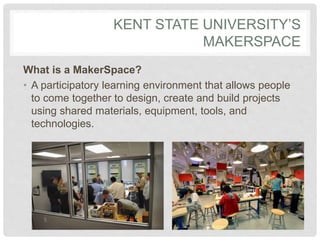
What is a MakerSpace?
• A participatory learning environment that allows people
to come together to design, create and build projects
using shared materials, equipment, tools, and
technologies.
KENT STATE UNIVERSITY’S
MAKERSPACE
Significant Outcomes of MakerSpaces ?
• Supports the development of a user’s critical thinking and
problem solving skills through deliberate experimentation
(providing an educational environment often not met in the
classroom alone)
• Promotes innovation by encouraging students/faculty to explore
fields/equipment outside their traditional university departmental
'silos'
• Links STEM focused disciplines to the creative arts (STEAM) to
encourage true innovation
• Encourages users to explore and get familiar with technologies
they may never have been exposed to before providing new
knowledge and the opportunity for the user to develop new
marketable skills
• Catalyst to promote community educational outreach
KENT STATE UNIVERSITY’S
MAKERSPACE
Why Kent State University’s MakerSpace will offer
additional value ?
• Facilitates interdisciplinary collaboration between the highest
profile programs at KSU to develop innovative research,
products and services
• Provides an experimental learning space for KSU faculty to
explore new teaching methodologies including new
pedagogical models that support active learning
• Provides a direct channel for users to monetize MakerSpace
inventions/innovations through the Blackstone
LaunchPad program
MAKERSPACE LOCATION:
FIRST FLOOR,
UNIVERSITY LIBRARY
 Centrally located
on campus
 Space open to
all majors to
access
 3,000+ square
feet for first
phase
KENT STATE UNIVERSITY’S
MAKERSPACE
What will this MakerSpace look like?
• Space will be divided into four key areas that will
suggest openness and accessibility through light and
windows that allow one to view the interactions in
each individual space, from every corner of the
environment. These key areas will include:
1. Central communal lounge: open space with
movable furniture that allow students to collaborate
and generate ideas with one another
KENT STATE UNIVERSITY’S
MAKERSPACE
What will this MakerSpace look like?
2. ‘Tech’ space: computer lab with ultra-
high-speed fiber-optic broadband network
KENT STATE UNIVERSITY’S
MAKERSPACE
What will this MakerSpace look like?
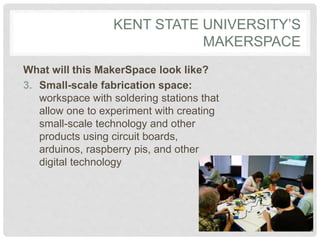
3. Small-scale fabrication space:
workspace with soldering stations that
allow one to experiment with creating
small-scale technology and other
products using circuit boards,
arduinos, raspberry pis, and other
digital technology
KENT STATE UNIVERSITY’S
MAKERSPACE
What will this MakerSpace look like?
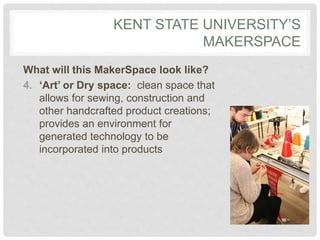
4. ‘Art’ or Dry space: clean space that
allows for sewing, construction and
other handcrafted product creations;
provides an environment for
generated technology to be
incorporated into products
KENT STATE UNIVERSITY’S
MAKERSPACE
Suggested list of tools & equipment:
• Ultra-high-speed fiber-optic broadband network
• iMacs
• 3D printers
• laser printers
• laser cutter
• Arduinos, Raspberry Pis, circuit boards (other electrical/digital
equipment)
• sodering stations
• sewing machines
• Expresso Book Machine (on-the-spot printing of books)
KENT STATE UNIVERSITY’S
MAKERSPACE
Staff support:
• Trained staff member will facilitate user exploration of the
space and offer targeted workshops that will provide users
with marketable, hard-skill set development
• Additional assistance provided by MakerSpace student
fellows
KENT STATE UNIVERSITY’S
MAKERSPACE
Future Plans / 3-Phase Innovation Plan:
1. Securing minimal equipment to support basic prototyping
development (proposed MakerSpace)
2. Developing a full-blown fabrication space (75,000+ square
feet) that would be available for KSU entrepreneurs and that
could be supported through revenue generated by opening
the lab to the community (future Sandbox)
3. Developing a Mobile FabLab that could be transported to all
eight KSU regional campuses to support entrepreneurial
pursuits.
KENT STATE UNIVERSITY’S
MAKERSPACE
Questions?

Kent State University Makerspace (proposal)

  • 1.
    A C RO S S - C A M P U S C O L L A B O R AT I O N KENT STATE UNIVERSITY’S MAKERSPACE
  • 2.
    KENT STATE UNIVERSITY’S MAKERSPACE Whatis a MakerSpace? • A participatory learning environment that allows people to come together to design, create and build projects using shared materials, equipment, tools, and technologies.
  • 3.
    KENT STATE UNIVERSITY’S MAKERSPACE SignificantOutcomes of MakerSpaces ? • Supports the development of a user’s critical thinking and problem solving skills through deliberate experimentation (providing an educational environment often not met in the classroom alone) • Promotes innovation by encouraging students/faculty to explore fields/equipment outside their traditional university departmental 'silos' • Links STEM focused disciplines to the creative arts (STEAM) to encourage true innovation • Encourages users to explore and get familiar with technologies they may never have been exposed to before providing new knowledge and the opportunity for the user to develop new marketable skills • Catalyst to promote community educational outreach
  • 4.
    KENT STATE UNIVERSITY’S MAKERSPACE WhyKent State University’s MakerSpace will offer additional value ? • Facilitates interdisciplinary collaboration between the highest profile programs at KSU to develop innovative research, products and services • Provides an experimental learning space for KSU faculty to explore new teaching methodologies including new pedagogical models that support active learning • Provides a direct channel for users to monetize MakerSpace inventions/innovations through the Blackstone LaunchPad program
  • 5.
    MAKERSPACE LOCATION: FIRST FLOOR, UNIVERSITYLIBRARY  Centrally located on campus  Space open to all majors to access  3,000+ square feet for first phase
  • 6.
    KENT STATE UNIVERSITY’S MAKERSPACE Whatwill this MakerSpace look like? • Space will be divided into four key areas that will suggest openness and accessibility through light and windows that allow one to view the interactions in each individual space, from every corner of the environment. These key areas will include: 1. Central communal lounge: open space with movable furniture that allow students to collaborate and generate ideas with one another
  • 7.
    KENT STATE UNIVERSITY’S MAKERSPACE Whatwill this MakerSpace look like? 2. ‘Tech’ space: computer lab with ultra- high-speed fiber-optic broadband network
  • 8.
    KENT STATE UNIVERSITY’S MAKERSPACE Whatwill this MakerSpace look like? 3. Small-scale fabrication space: workspace with soldering stations that allow one to experiment with creating small-scale technology and other products using circuit boards, arduinos, raspberry pis, and other digital technology
  • 9.
    KENT STATE UNIVERSITY’S MAKERSPACE Whatwill this MakerSpace look like? 4. ‘Art’ or Dry space: clean space that allows for sewing, construction and other handcrafted product creations; provides an environment for generated technology to be incorporated into products
  • 10.
    KENT STATE UNIVERSITY’S MAKERSPACE Suggestedlist of tools & equipment: • Ultra-high-speed fiber-optic broadband network • iMacs • 3D printers • laser printers • laser cutter • Arduinos, Raspberry Pis, circuit boards (other electrical/digital equipment) • sodering stations • sewing machines • Expresso Book Machine (on-the-spot printing of books)
  • 11.
    KENT STATE UNIVERSITY’S MAKERSPACE Staffsupport: • Trained staff member will facilitate user exploration of the space and offer targeted workshops that will provide users with marketable, hard-skill set development • Additional assistance provided by MakerSpace student fellows
  • 12.
    KENT STATE UNIVERSITY’S MAKERSPACE FuturePlans / 3-Phase Innovation Plan: 1. Securing minimal equipment to support basic prototyping development (proposed MakerSpace) 2. Developing a full-blown fabrication space (75,000+ square feet) that would be available for KSU entrepreneurs and that could be supported through revenue generated by opening the lab to the community (future Sandbox) 3. Developing a Mobile FabLab that could be transported to all eight KSU regional campuses to support entrepreneurial pursuits.
  • 13.