Synthetic Insulin – R&D and Industrial level
Manufacturing process & requirement (overall idea)
Krishnasalini Gunanathan | Research Trainee|
Insulin
• Insulin –
• A hormone that regulates the amount of glucose in the blood
• Produced by cells in pancreas- islets of Langerhans
• types – Ultra short acting, short acting, intermediate acting, long acting
• History of synthetic insulin
• 1921 by Canadian sci Frederick G.Banting & Charles H.Best from Dog’s pancreas
• 1982 Eli lilly corp., produced genetically engineered human insulin
Structure - Insulin
• Insulin gene – a protein consist of two amino acid chains A above chain B held together
with bonds
• Chain A - 21 amino acid , Chain B – 30 amino acids
• Formation of insulin –
• Preproinsulin proinsulin single chain without signaling sequence Active
protein insulin without link between A & B
Types Insulin Production
• Type -1
• Two insulin chains are grown separately and inserted into plasmids and grown in E.coli
• Two chains are linked by oxidation-reduction reaction using lysosomes and cyanogen bromide
• Purified by chromatographic methods
• Type- 2
• Known proinsulin process
• Coded sequence are inserted to non-pathogenic E.coli bacteria & fermentation is carried out
• Zn2+ (additives) are added to delay the absorption in the body
• Type – 3
• Analog insulin is produced by changing its amino acid sequence & creating an analog, which
clumps less & disperses more readily into the blood. Eg: Glargine insulin
Materials Required (R&D level)
• Mother culture – Escherichia coli
• UV-Chamber
• Human protein with 20 amino acids which produce insulin
• Enzymes, antibiotics and primer
• PCR – cloning
• Fermentation flasks – bacterial culture growth
• Culture medium / nutrients – LB broth or any for the culture
• Centrifuge – screening process
• Culture shaker
• Chromatography (electrophoresis and paper chrom kit) – isolation and screening process
• X-ray crystallography – isolation and screening process
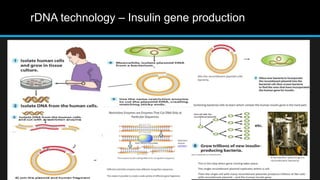
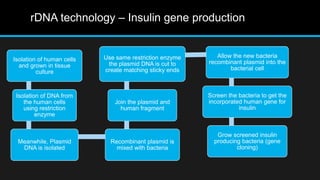
rDNA technology – Insulin gene production
Isolation of human cells
and grown in tissue
culture
Isolation of DNA from
the human cells
using restriction
enzyme
Meanwhile, Plasmid
DNA is isolated
Recombinant plasmid is
mixed with bacteria
Join the plasmid and
human fragment
Use same restriction enzyme
the plasmid DNA is cut to
create matching sticky ends
Allow the new bacteria
recombinant plasmid into the
bacterial cell
Screen the bacteria to get the
incorporated human gene for
insulin
Grow screened insulin
producing bacteria (gene
cloning)
Insulin production – Industrial level
Involves two process
Upstream Process -
Cell Line preparation (Obtaining human insulin gene by complementary DNA from mRNA of the two
chains using enzyme reverse transcriptase or cloning of cDNA of both chains using PCR with amplification of
cDNA seq) , insertion of cDNA in plasmids, transfection (electroporation – transferred cells )
Downstream Process –
Fermentation, Cell separation, Centrifugation, Analysis
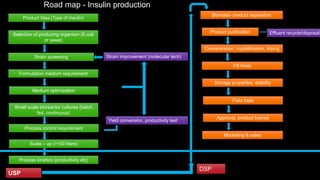
Road map - Insulin production
Product Idea (Type of insulin)
Selection of producing organism (E.coli
or yeast)
Strain screening
Formulation medium requirement
Medium optimization
Small scale bioreactor cultures (batch
fed, continuous)
Process control requirement
Scale – up (>100 liters)
Process kinetics (productivity etc)
Strain improvement (molecular tech)
Yield conversion, productivity test
Biomass- product separation
Product purification
Concentration, crystallization, drying
Fill finish
Storage properties, stability
Field trials
Approval, product license
Marketing & sales
Effluent recycle/disposal
USP
DSP
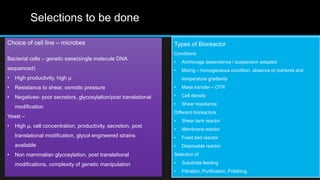
Selections to be done
Choice of cell line – microbes
Bacterial cells – genetic ease(single molecule DNA
sequenced)
• High productivity, high µ
• Resistance to shear, osmotic pressure
• Negatives- poor secretors, glycosylation/post translational
modification
Yeast –
• High µ, cell concentration, productivity, secretion, post
translational modification, glycol engineered strains
available
• Non mammalian glycosylation, post translational
modifications, complexity of genetic manipulation
Types of Bioreactor
Conditions
• Anchorage dependence / suspension adapted
• Mixing – homogeneous condition, absence of nutrients and
temperature gradients
• Mass transfer – OTR
• Cell density
• Shear resistance
Different bioreactors
• Shear tank reactor
• Membrane reactor
• Fixed bed reactor
• Disposable reactor
Selection of
• Substrate feeding
• Filtration, Purification, Polishing
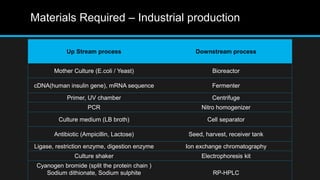
Materials Required – Industrial production
Up Stream process Downstream process
Mother Culture (E.coli / Yeast) Bioreactor
cDNA(human insulin gene), mRNA sequence Fermenter
Primer, UV chamber Centrifuge
PCR Nitro homogenizer
Culture medium (LB broth) Cell separator
Antibiotic (Ampicillin, Lactose) Seed, harvest, receiver tank
Ligase, restriction enzyme, digestion enzyme Ion exchange chromatography
Culture shaker Electrophoresis kit
Cyanogen bromide (split the protein chain )
Sodium dithionate, Sodium sulphite RP-HPLC
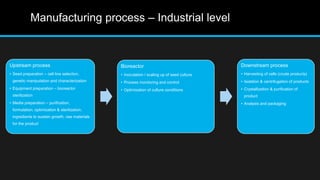
Manufacturing process – Industrial level
Upstream process
• Seed preparation – cell line selection,
genetic manipulation and characterization
• Equipment preparation – bioreactor
sterilization
• Media preparation – purification,
formulation, optimization & sterilization,
ingredients to sustain growth, raw materials
for the product
Bioreactor
• Inoculation / scaling up of seed culture
• Process monitoring and control
• Optimization of culture conditions
Downstream process
• Harvesting of cells (crude products)
• Isolation & centrifugation of products
• Crystallization & purification of
product
• Analysis and packaging
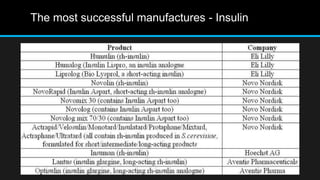
The most successful manufactures - Insulin
Conclusion
Upon the fulfillment of the mentioned materials and equipment's manufacturing
of synthesized insulin using rDNA technology is very much possible and will be
successful .
Thank You 

Human insulin production process & requirement

  • 1.
    Synthetic Insulin –R&D and Industrial level Manufacturing process & requirement (overall idea) Krishnasalini Gunanathan | Research Trainee|
  • 2.
    Insulin • Insulin – •A hormone that regulates the amount of glucose in the blood • Produced by cells in pancreas- islets of Langerhans • types – Ultra short acting, short acting, intermediate acting, long acting • History of synthetic insulin • 1921 by Canadian sci Frederick G.Banting & Charles H.Best from Dog’s pancreas • 1982 Eli lilly corp., produced genetically engineered human insulin
  • 3.
    Structure - Insulin •Insulin gene – a protein consist of two amino acid chains A above chain B held together with bonds • Chain A - 21 amino acid , Chain B – 30 amino acids • Formation of insulin – • Preproinsulin proinsulin single chain without signaling sequence Active protein insulin without link between A & B
  • 4.
    Types Insulin Production •Type -1 • Two insulin chains are grown separately and inserted into plasmids and grown in E.coli • Two chains are linked by oxidation-reduction reaction using lysosomes and cyanogen bromide • Purified by chromatographic methods • Type- 2 • Known proinsulin process • Coded sequence are inserted to non-pathogenic E.coli bacteria & fermentation is carried out • Zn2+ (additives) are added to delay the absorption in the body • Type – 3 • Analog insulin is produced by changing its amino acid sequence & creating an analog, which clumps less & disperses more readily into the blood. Eg: Glargine insulin
  • 5.
    Materials Required (R&Dlevel) • Mother culture – Escherichia coli • UV-Chamber • Human protein with 20 amino acids which produce insulin • Enzymes, antibiotics and primer • PCR – cloning • Fermentation flasks – bacterial culture growth • Culture medium / nutrients – LB broth or any for the culture • Centrifuge – screening process • Culture shaker • Chromatography (electrophoresis and paper chrom kit) – isolation and screening process • X-ray crystallography – isolation and screening process
  • 6.
    rDNA technology –Insulin gene production
  • 7.
    rDNA technology –Insulin gene production Isolation of human cells and grown in tissue culture Isolation of DNA from the human cells using restriction enzyme Meanwhile, Plasmid DNA is isolated Recombinant plasmid is mixed with bacteria Join the plasmid and human fragment Use same restriction enzyme the plasmid DNA is cut to create matching sticky ends Allow the new bacteria recombinant plasmid into the bacterial cell Screen the bacteria to get the incorporated human gene for insulin Grow screened insulin producing bacteria (gene cloning)
  • 8.
    Insulin production –Industrial level Involves two process Upstream Process - Cell Line preparation (Obtaining human insulin gene by complementary DNA from mRNA of the two chains using enzyme reverse transcriptase or cloning of cDNA of both chains using PCR with amplification of cDNA seq) , insertion of cDNA in plasmids, transfection (electroporation – transferred cells ) Downstream Process – Fermentation, Cell separation, Centrifugation, Analysis
  • 9.
    Road map -Insulin production Product Idea (Type of insulin) Selection of producing organism (E.coli or yeast) Strain screening Formulation medium requirement Medium optimization Small scale bioreactor cultures (batch fed, continuous) Process control requirement Scale – up (>100 liters) Process kinetics (productivity etc) Strain improvement (molecular tech) Yield conversion, productivity test Biomass- product separation Product purification Concentration, crystallization, drying Fill finish Storage properties, stability Field trials Approval, product license Marketing & sales Effluent recycle/disposal USP DSP
  • 10.
    Selections to bedone Choice of cell line – microbes Bacterial cells – genetic ease(single molecule DNA sequenced) • High productivity, high µ • Resistance to shear, osmotic pressure • Negatives- poor secretors, glycosylation/post translational modification Yeast – • High µ, cell concentration, productivity, secretion, post translational modification, glycol engineered strains available • Non mammalian glycosylation, post translational modifications, complexity of genetic manipulation Types of Bioreactor Conditions • Anchorage dependence / suspension adapted • Mixing – homogeneous condition, absence of nutrients and temperature gradients • Mass transfer – OTR • Cell density • Shear resistance Different bioreactors • Shear tank reactor • Membrane reactor • Fixed bed reactor • Disposable reactor Selection of • Substrate feeding • Filtration, Purification, Polishing
  • 11.
    Materials Required –Industrial production Up Stream process Downstream process Mother Culture (E.coli / Yeast) Bioreactor cDNA(human insulin gene), mRNA sequence Fermenter Primer, UV chamber Centrifuge PCR Nitro homogenizer Culture medium (LB broth) Cell separator Antibiotic (Ampicillin, Lactose) Seed, harvest, receiver tank Ligase, restriction enzyme, digestion enzyme Ion exchange chromatography Culture shaker Electrophoresis kit Cyanogen bromide (split the protein chain ) Sodium dithionate, Sodium sulphite RP-HPLC
  • 12.
    Manufacturing process –Industrial level Upstream process • Seed preparation – cell line selection, genetic manipulation and characterization • Equipment preparation – bioreactor sterilization • Media preparation – purification, formulation, optimization & sterilization, ingredients to sustain growth, raw materials for the product Bioreactor • Inoculation / scaling up of seed culture • Process monitoring and control • Optimization of culture conditions Downstream process • Harvesting of cells (crude products) • Isolation & centrifugation of products • Crystallization & purification of product • Analysis and packaging
  • 13.
    The most successfulmanufactures - Insulin
  • 14.
    Conclusion Upon the fulfillmentof the mentioned materials and equipment's manufacturing of synthesized insulin using rDNA technology is very much possible and will be successful . Thank You 

Editor's Notes

  • #9 This is the question that your experiment answers
  • #10 Write hypothesis before you begin the experiment. This should be your best educated guess based on your research.
  • #11 List all of the steps used in completing your experiment. Remember to number your steps. Include photos of your experiment.