MAKE A GENOGRAM AND TRACE
CERTAIN PHYSICAL, PERSONALITY,
OR BEHAVIORAL ATTRIBUTES
THROUGH GENERATIONS
MAKING FAMILY GENOGRAM
• “When a picture depicts thousand words.”
• Grandfather, grandmother, father, mother, son, daughter,
aunt, uncle, cousin, niece, and nephew are but just of the
few words you will use in making family genogram.
• You will be able to identify various family members in your
family as well as other members of your kin when
illustrating your family genogram.
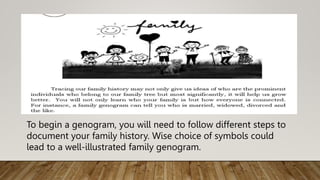
• Tracing our family history may not only give us ideas of who are the
prominent individuals who belong to our family tree but most
significantly, it will help us grow better.
• You will not only learn who your family is but how everyone is
connected. For instance, a family genogram can tell you who is
married, widowed, divorced and the like.
• To begin a genogram, you will need to follow different steps to
document your family history. Wise choice of symbols could lead to
a well-illustrated family genogram.
GENOGRAM DEFINED
• A genogram (pronounced: jen-uh-gram) is a graphic
representation of a family tree that displays detailed data on
relationships among individuals.
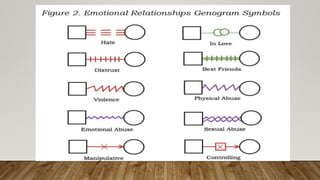
• A genogram is a more complex family tree because it describes
not only the family physical and social relationships but also
the emotional connections and other family attributes are
described.
GENOGRAM
• Genograms were first developed and popularized
in clinical settings by Monica McGoldrick and
Randy Gerson through the publication of a book in
1985.
• Genograms are now used by various groups of
people in a variety of fields such as medicine,
psychology, social work, genealogy, genetic
research, and education.
• A genogram also known as a McGoldrick–Gerson
study, Jolly, W.; Froom, J.; Rosen, M. G. (1980). It
beyond a traditional family tree by allowing the user
to visualize hereditary patterns and psychological
factors that punctuate relationships. It can be used
identify repetitive patterns of behavior and to
recognize hereditary tendencies. (Friedman, H.;
Rohrbaugh, M.; Krakauer, S. (1988), Murray
• Murray Bowen invented the concept of the genogram as part
of his family systems model in the 1970s.
• Genograms were later developed and popularized in clinical
settings by Monica McGoldrick and Randy Gerson through the
the publication of a book titled Genograms: Assessment and
Intervention in 1985
• Genograms are now used by various groups of people in a
variety of fields such as medicine, psychiatry, psychology, social
social work, genetic research, education, and many more.
• Some practitioners in personal and family therapy use
genograms for personal records and/or to explain family
dynamics to the client.
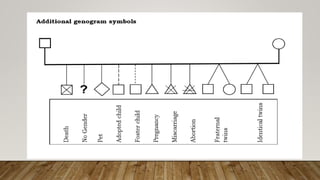
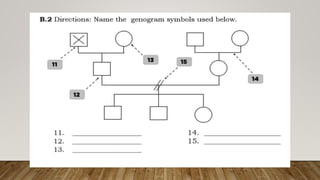
GENOGRAM SYMBOLS
•A genogram is a family tree or map or history
that uses special symbols to describe
relationships of family members over
multiple generations. Like any other graphic
organizer, genogram makes it easy for a
person to present and comprehend certain
information.
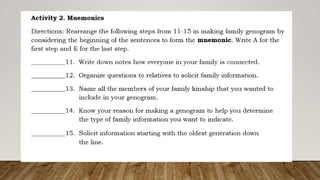
To begin a genogram, you will need to follow different steps to
document your family history. Wise choice of symbols could
lead to a well-illustrated family genogram.
Make a Genogram and Trace Certain Physical,.pptx

Make a Genogram and Trace Certain Physical,.pptx

  • 1.
    MAKE A GENOGRAMAND TRACE CERTAIN PHYSICAL, PERSONALITY, OR BEHAVIORAL ATTRIBUTES THROUGH GENERATIONS
  • 2.
    MAKING FAMILY GENOGRAM •“When a picture depicts thousand words.” • Grandfather, grandmother, father, mother, son, daughter, aunt, uncle, cousin, niece, and nephew are but just of the few words you will use in making family genogram. • You will be able to identify various family members in your family as well as other members of your kin when illustrating your family genogram.
  • 3.
    • Tracing ourfamily history may not only give us ideas of who are the prominent individuals who belong to our family tree but most significantly, it will help us grow better. • You will not only learn who your family is but how everyone is connected. For instance, a family genogram can tell you who is married, widowed, divorced and the like. • To begin a genogram, you will need to follow different steps to document your family history. Wise choice of symbols could lead to a well-illustrated family genogram.
  • 4.
    GENOGRAM DEFINED • Agenogram (pronounced: jen-uh-gram) is a graphic representation of a family tree that displays detailed data on relationships among individuals. • A genogram is a more complex family tree because it describes not only the family physical and social relationships but also the emotional connections and other family attributes are described.
  • 5.
    GENOGRAM • Genograms werefirst developed and popularized in clinical settings by Monica McGoldrick and Randy Gerson through the publication of a book in 1985. • Genograms are now used by various groups of people in a variety of fields such as medicine, psychology, social work, genealogy, genetic research, and education.
  • 6.
    • A genogramalso known as a McGoldrick–Gerson study, Jolly, W.; Froom, J.; Rosen, M. G. (1980). It beyond a traditional family tree by allowing the user to visualize hereditary patterns and psychological factors that punctuate relationships. It can be used identify repetitive patterns of behavior and to recognize hereditary tendencies. (Friedman, H.; Rohrbaugh, M.; Krakauer, S. (1988), Murray
  • 7.
    • Murray Boweninvented the concept of the genogram as part of his family systems model in the 1970s. • Genograms were later developed and popularized in clinical settings by Monica McGoldrick and Randy Gerson through the the publication of a book titled Genograms: Assessment and Intervention in 1985 • Genograms are now used by various groups of people in a variety of fields such as medicine, psychiatry, psychology, social social work, genetic research, education, and many more. • Some practitioners in personal and family therapy use genograms for personal records and/or to explain family dynamics to the client.
  • 8.
    GENOGRAM SYMBOLS •A genogramis a family tree or map or history that uses special symbols to describe relationships of family members over multiple generations. Like any other graphic organizer, genogram makes it easy for a person to present and comprehend certain information.
  • 9.
    To begin agenogram, you will need to follow different steps to document your family history. Wise choice of symbols could lead to a well-illustrated family genogram.