“Financial viability of Renewable Power projects:
A comparative analysis and advisory options
amongst solar, wind, biomass and small hydro in
India”
Ramya Emandi
MBA Infrastructure
Internal Guide
Capt. Rajiv Seth
External Guide
Mr. Nitin Naveen Singh
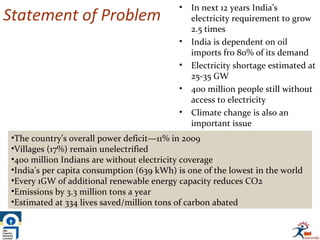
Statement of Problem
• In next 12 years India’s
electricity requirement to grow
2.5 times
• India is dependent on oil
imports fro 80% of its demand
• Electricity shortage estimated at
25-35 GW
• 400 million people still without
access to electricity
• Climate change is also an
important issue
•The country’s overall power deficit—11% in 2009
•Villages (17%) remain unelectrified
•400 million Indians are without electricity coverage
•India’s per capita consumption (639 kWh) is one of the lowest in the world
•Every 1GW of additional renewable energy capacity reduces CO2
•Emissions by 3.3 million tons a year
•Estimated at 334 lives saved/million tons of carbon abated
Statement of Problem
• In next 12 years India’s
electricity requirement to grow
2.5 times
• India is dependent on oil
imports fro 80% of its demand
• Electricity shortage estimated at
25-35 GW
• 400 million people still without
access to electricity
• Climate change is also an
important issue
•The country’s overall power deficit—11% in 2009
•Villages (17%) remain unelectrified
•400 million Indians are without electricity coverage
•India’s per capita consumption (639 kWh) is one of the lowest in the world
•Every 1GW of additional renewable energy capacity reduces CO2
•Emissions by 3.3 million tons a year
•Estimated at 334 lives saved/million tons of carbon abated
Objective
• To promote renewable power
projects and hence making a viable
report on it.
• An advisory option to the client by
giving a holistic view in terms of
financials, approvals, incentives,
CDM’s and risks involved with each
of solar, wind, biomass and Small
hydro.
• Creating a hypothetical 10 MW
power plant by solar, wind, biomass
and others and making a
comparative study under certain
parameters.
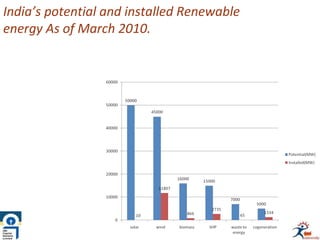
India’s potential and installed Renewable
energy As of March 2010.
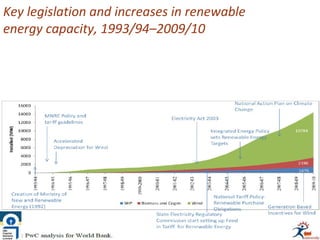
Key legislation and increases in renewable
energy capacity, 1993/94–2009/10
Applicability of policy instruments at various stages
of renewable energy market development
CERC Re Tariff regulations 2009
• First RE specific tariff regulation by central electricity
regulatory commission
• Based on cost plus method
Methodology • A thorough reading of policies, CERC
tariff guidelines, regulations, power
ministry, MNRE, CDMs, rural
electrification, anything and
everything related to solar, wind,
biomass and others.
• Collection of all secondary data
available on internet especially the
government websites, SBI caps
database & reports and segregating
the appropriate required data to be
used for the project
• Preparing the brief overview report
on each sector for the developer
• Giving a basic financial model
assuming a 10MW renewable power
plant of each sector, so that the
developer gets a fair idea about the
costs and the related information
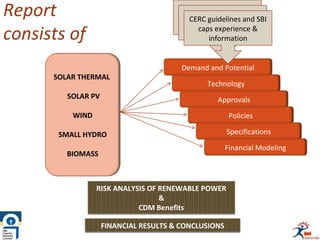
Report
consists of
SOLAR THERMAL
SOLAR PV
WIND
SMALL HYDRO
BIOMASS
Demand and Potential
Technology
Approvals
Policies
Specifications
Financial Modeling
RISK ANALYSIS OF RENEWABLE POWER
&
CDM Benefits
Reports of CRISIL, PwC,
etc ant Internet sources
Government websites
MNRE, IREDA, CERC, etc
CERC guidelines and SBI
caps experience &
information
FINANCIAL RESULTS & CONCLUSIONS
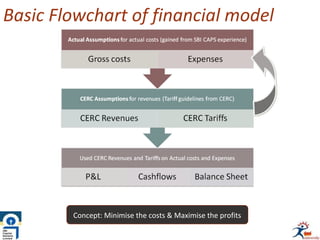
Basic Flowchart of financial model
Concept: Minimise the costs & Maximise the profits
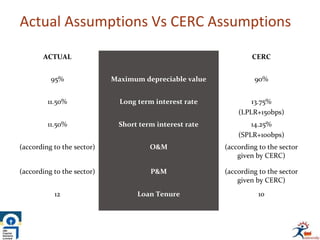
Actual Assumptions Vs CERC Assumptions
ACTUAL CERC
95% Maximum depreciable value 90%
11.50% Long term interest rate 13.75%
(LPLR+150bps)
11.50% Short term interest rate 14.25%
(SPLR+100bps)
(according to the sector) O&M (according to the sector
given by CERC)
(according to the sector) P&M (according to the sector
given by CERC)
12 Loan Tenure 10
Financial modeling• Actual Assumptions (page1)
• Gross capital costs (page2)
– IDC (page3)
• Revenues (page4)
– Cost of generation (page5)
• CERC Assumptions (page6)
• Total costs (page7)
– IDC (page8)
• CERC Revenues (page9)
– Cost of generation (page10)
• P&L (page11)
• Cashflows (page12)
• Balance sheet (page13)
Project Cost
Generation Units
CDM Benefits
Tariffs
Project IRR
NPV
Payback
Equity IRR
DSCR
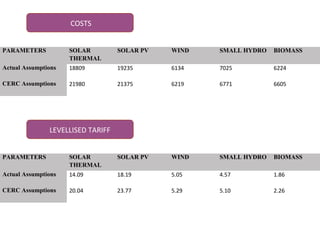
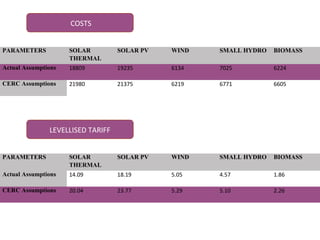
Actual Assumptions 18809 19235 6134 7025 6224
PARAMETERS SOLAR
THERMAL
SOLAR PV WIND SMALL HYDRO BIOMASS
CERC Assumptions 21980 21375 6219 6771 6605
COSTS
LEVELLISED TARIFF
PARAMETERS SOLAR
THERMAL
SOLAR PV WIND SMALL HYDRO BIOMASS
Actual Assumptions 14.09 18.19 5.05 4.57 1.86
CERC Assumptions 20.04 23.77 5.29 5.10 2.26
Actual Assumptions 18809 19235 6134 7025 6224
PARAMETERS SOLAR
THERMAL
SOLAR PV WIND SMALL HYDRO BIOMASS
CERC Assumptions 21980 21375 6219 6771 6605
COSTS
LEVELLISED TARIFF
PARAMETERS SOLAR
THERMAL
SOLAR PV WIND SMALL HYDRO BIOMASS
Actual Assumptions 14.09 18.19 5.05 4.57 1.86
CERC Assumptions 20.04 23.77 5.29 5.10 2.26
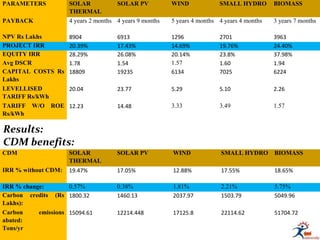
PARAMETERS SOLAR
THERMAL
SOLAR PV WIND SMALL HYDRO BIOMASS
PAYBACK 4 years 2 months 4 years 9 months 5 years 4 months 4 years 4 months 3 years 7 months
NPV Rs Lakhs 8904 6913 1296 2701 3963
PROJECT IRR 20.39% 17.43% 14.69% 19.76% 24.40%
EQUITY IRR 28.29% 26.08% 20.14% 23.8% 37.98%
Avg DSCR 1.78 1.54 1.57 1.60 1.94
CAPITAL COSTS Rs
Lakhs
18809 19235 6134 7025 6224
LEVELLISED
TARIFF Rs/kWh
20.04 23.77 5.29 5.10 2.26
TARIFF W/O ROE
Rs/kWh
12.23 14.48 3.33 3.49 1.57
CDM SOLAR
THERMAL
SOLAR PV WIND SMALL HYDRO BIOMASS
IRR % without CDM: 19.47% 17.05% 12.88% 17.55% 18.65%
IRR % change: 0.57% 0.38% 1.81% 2.21% 5.75%
Carbon credits (Rs
Lakhs):
1800.32 1460.13 2037.97 1503.79 5049.96
Carbon emissions
abated:
Tons/yr
15094.61 12214.448 17125.8 22114.62 51704.72
Results:
CDM benefits:
PARAMETERS SOLAR
THERMAL
SOLAR PV WIND SMALL HYDRO BIOMASS
PAYBACK 4 years 2 months 4 years 9 months 5 years 4 months 4 years 4 months 3 years 7 months
NPV Rs Lakhs 8904 6913 1296 2701 3963
PROJECT IRR 20.39% 17.43% 14.69% 19.76% 24.40%
EQUITY IRR 28.29% 26.08% 20.14% 23.8% 37.98%
Avg DSCR 1.78 1.54 1.57 1.60 1.94
CAPITAL COSTS Rs
Lakhs
18809 19235 6134 7025 6224
LEVELLISED
TARIFF Rs/kWh
20.04 23.77 5.29 5.10 2.26
TARIFF W/O ROE
Rs/kWh
12.23 14.48 3.33 3.49 1.57
CDM SOLAR
THERMAL
SOLAR PV WIND SMALL HYDRO BIOMASS
IRR % without CDM: 19.47% 17.05% 12.88% 17.55% 18.65%
IRR % change: 0.57% 0.38% 1.81% 2.21% 5.75%
Carbon credits (Rs
Lakhs):
1800.32 1460.13 2037.97 1503.79 5049.96
Carbon emissions
abated:
Tons/yr
15094.61 12214.448 17125.8 22114.62 51704.72
Results:
CDM benefits:
Risk Analysis:
RISK HEAD DESCRIPTION RISK RATING RATIONALE
RISK MITIGATION /
ALLOCATION
Promoter Risk
Capability to
implement
projects
Low-Med Risk
The Promoter has promoted &
implemented successfully 4
power projects in the past.
The EPC contractors are experienced
in project implementation and
have a good track record
Ability to bring in
Equity
Low Risk
Promoter's personal net worth >
Equity required to be brought
in.
The promoter will bring in a substantial
portion of equity upfront;
suitable conditions would be
incorporated
Market Risk Price of Power High Risk
Guarantee market through a specified
renewable portfolio standard in
some states, as decided by the
state electricity regulator by
way of power purchase
agreements
To get CDM or CER to enhance more
revenues and to meet breakeven
faster before the government
withdraws its support
Demand Risk Low-Med Risk
There is high potential and neccesity
for power in India. There is
scope of 62 GW of renewable
energy which India needs to
explore.
Enter into medium and long term
PPA’s
Construction Risk Capability to construct Low Risk
The promoter has experience in
implementing projects.
The Promoters and EPC contractors
have the adequate experience and
expertise in power projects
execution
Equipment Quality Low Risk
The key equipment (the EPC
contractor) which has sufficient
experience in construction.
The EPC contractor is having the
proven technology for the power
plant and safe guards are taken in
EPC aggrements in terms of
warranties and LD’s
Delays Low-Med Risk
Most of the clearances required
(except environmental
clearance) have been obtained.
Environmental clearance is
expected within 3 weeks. The
Suitable conditions are proposed to
ensure that all clearances are
obtained prior to disbursement.
Technology Low Risk The technology is a proven technology
EPC contractor is providing the proven
technology
Realistic Budget Low Risk
very necessary to avoid unnecessary
speculations.
The budgets are based on the EPC and
other proven cost estimates as per the
industry norms
Environmental Risks Low Risk
Renewable energy would be
encouraged and less hindrances would
there for such projects. (such as R&R)
Suitable conditions are being
stipulated wrt compliance with
environmental guidelines / standards &
obtaining necessary clearances prior to
disbursement.
Regulatory
Risk of not getting
approvals
Low Risk
All approvals obtained except
environmental clearance. Renewable
power hence approvals are easy to
obtain.
The pre- commintment and pre-
disbursement conditions are stipulated
Risk of changes in
renewable power
policy
Low Risk
Long term agreements and contracts
executed
Operations &
Maintenance
Risk of unsatisfactory
operations &
maintenance
Low Risk
The scope of the O & M contract
covers & guarantees performance wrt
key parameters. LDs are sufficient.
O&M operator is experienced
Offtaker Risk
Risk that the offtaker
cannot receive the
power
Low - Med Risk
The offtaker's ability to receive the
power would depend on the market for
its products. Some of the purchasers
are in cyclical industries and any
downturn in the cycle would affect
offtake.
The off-takers portfolio is fairly well -
diversified.
Risk that the offtaker
cannot pay
high Risk
All the larger offtakers are well-known
profitable companies with a good track
record.
The –payment mechanism like L/c and
Escrow accounts are in place with the
offtakers .
RISK HEAD DESCRIPTION RISK RATING RATIONALE
RISK MITIGATION /
ALLOCATION
Relevance of the
findings : Industry/
Developer) • Report gives the holistic
understanding of the renewable
power generation in India
• Developer's preliminary
research for setting up a
renewable plant is satisfied
through this report
• Risk appetite of renewable
power in India
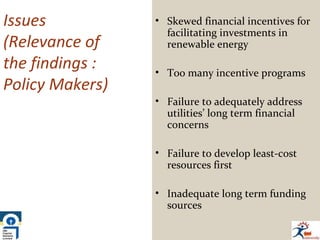
Issues
(Relevance of
the findings :
Policy Makers)
• Skewed financial incentives for
facilitating investments in
renewable energy
• Too many incentive programs
• Failure to adequately address
utilities’ long term financial
concerns
• Failure to develop least-cost
resources first
• Inadequate long term funding
sources
Thank You!!

Fixed and
Variable costs
• Fixed costs
– O&M
– Depreciation
– Interest on term loans
– Interest on working
capital
– Return on equity
• Variable costs
– Fuel costs (if applicable)
BACK
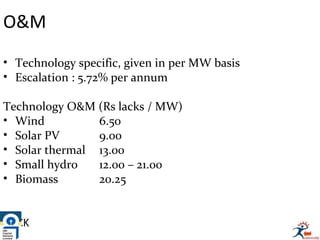
O&M
• Technology specific, given in per MW basis
• Escalation : 5.72% per annum
Technology O&M (Rs lacks / MW)
• Wind 6.50
• Solar PV 9.00
• Solar thermal 13.00
• Small hydro 12.00 – 21.00
• Biomass 20.25
BACK
Depreciation
• 90% of project cost can be depreciated ; 10% is salvage
value
Rate of depreciation:
BACK
For first 10 years 7% of project cost
Remaining Period (Life minus 10 yrs) Remaining depreciable amount
equally distributed
Interest on term loan
• Loan tenure : 10 Years
• Moratorium period : Zero
• Rate of interest : SBI PLR (of previous year) plus 150
basis point (e.g. 12.25% + 1.50% = 13.75%)
• Repayment schedule : yearly / half-yearly / quarterly /
monthly/ daily
BACK
Interest on working capital
• Working capital components are (Wind, Solar, SHP): 1
month O&M , Receivables of 2 months ,
• Maintenance spares @ 15% of O&M
• Working capital components are (Biomass and Co –
gen): 4 months fuel costs, 1 month O&M , Receivables
of 2 months , Maintenance spares @ 15% of O&M
• Interest rate is SBI short term PLR (of previous year) +
100 basis points
BACK
Return on Equity
• Return on equity (per annum) = Amount of equity *
Rate of return
• Rate of return:
 Pre-tax 19% per annum for the first 10 years.
 Pre-tax 24% per annum 11th years onwards.
 e.g. Project cost = Rs 500; Equity = Rs 150; Return
on equity (in first 10 years) = Rs 28.5 and for
remaining years = Rs 36
BACK

Major_Proj_Ramya

  • 1.
    “Financial viability ofRenewable Power projects: A comparative analysis and advisory options amongst solar, wind, biomass and small hydro in India” Ramya Emandi MBA Infrastructure Internal Guide Capt. Rajiv Seth External Guide Mr. Nitin Naveen Singh
  • 2.
    Statement of Problem •In next 12 years India’s electricity requirement to grow 2.5 times • India is dependent on oil imports fro 80% of its demand • Electricity shortage estimated at 25-35 GW • 400 million people still without access to electricity • Climate change is also an important issue •The country’s overall power deficit—11% in 2009 •Villages (17%) remain unelectrified •400 million Indians are without electricity coverage •India’s per capita consumption (639 kWh) is one of the lowest in the world •Every 1GW of additional renewable energy capacity reduces CO2 •Emissions by 3.3 million tons a year •Estimated at 334 lives saved/million tons of carbon abated
  • 3.
    Statement of Problem •In next 12 years India’s electricity requirement to grow 2.5 times • India is dependent on oil imports fro 80% of its demand • Electricity shortage estimated at 25-35 GW • 400 million people still without access to electricity • Climate change is also an important issue •The country’s overall power deficit—11% in 2009 •Villages (17%) remain unelectrified •400 million Indians are without electricity coverage •India’s per capita consumption (639 kWh) is one of the lowest in the world •Every 1GW of additional renewable energy capacity reduces CO2 •Emissions by 3.3 million tons a year •Estimated at 334 lives saved/million tons of carbon abated
  • 4.
    Objective • To promoterenewable power projects and hence making a viable report on it. • An advisory option to the client by giving a holistic view in terms of financials, approvals, incentives, CDM’s and risks involved with each of solar, wind, biomass and Small hydro. • Creating a hypothetical 10 MW power plant by solar, wind, biomass and others and making a comparative study under certain parameters.
  • 5.
    India’s potential andinstalled Renewable energy As of March 2010.
  • 6.
    Key legislation andincreases in renewable energy capacity, 1993/94–2009/10
  • 7.
    Applicability of policyinstruments at various stages of renewable energy market development
  • 8.
    CERC Re Tariffregulations 2009 • First RE specific tariff regulation by central electricity regulatory commission • Based on cost plus method
  • 9.
    Methodology • Athorough reading of policies, CERC tariff guidelines, regulations, power ministry, MNRE, CDMs, rural electrification, anything and everything related to solar, wind, biomass and others. • Collection of all secondary data available on internet especially the government websites, SBI caps database & reports and segregating the appropriate required data to be used for the project • Preparing the brief overview report on each sector for the developer • Giving a basic financial model assuming a 10MW renewable power plant of each sector, so that the developer gets a fair idea about the costs and the related information
  • 10.
    Report consists of SOLAR THERMAL SOLARPV WIND SMALL HYDRO BIOMASS Demand and Potential Technology Approvals Policies Specifications Financial Modeling RISK ANALYSIS OF RENEWABLE POWER & CDM Benefits Reports of CRISIL, PwC, etc ant Internet sources Government websites MNRE, IREDA, CERC, etc CERC guidelines and SBI caps experience & information FINANCIAL RESULTS & CONCLUSIONS
  • 11.
    Basic Flowchart offinancial model Concept: Minimise the costs & Maximise the profits
  • 12.
    Actual Assumptions VsCERC Assumptions ACTUAL CERC 95% Maximum depreciable value 90% 11.50% Long term interest rate 13.75% (LPLR+150bps) 11.50% Short term interest rate 14.25% (SPLR+100bps) (according to the sector) O&M (according to the sector given by CERC) (according to the sector) P&M (according to the sector given by CERC) 12 Loan Tenure 10
  • 13.
    Financial modeling• ActualAssumptions (page1) • Gross capital costs (page2) – IDC (page3) • Revenues (page4) – Cost of generation (page5) • CERC Assumptions (page6) • Total costs (page7) – IDC (page8) • CERC Revenues (page9) – Cost of generation (page10) • P&L (page11) • Cashflows (page12) • Balance sheet (page13) Project Cost Generation Units CDM Benefits Tariffs Project IRR NPV Payback Equity IRR DSCR
  • 14.
    Actual Assumptions 1880919235 6134 7025 6224 PARAMETERS SOLAR THERMAL SOLAR PV WIND SMALL HYDRO BIOMASS CERC Assumptions 21980 21375 6219 6771 6605 COSTS LEVELLISED TARIFF PARAMETERS SOLAR THERMAL SOLAR PV WIND SMALL HYDRO BIOMASS Actual Assumptions 14.09 18.19 5.05 4.57 1.86 CERC Assumptions 20.04 23.77 5.29 5.10 2.26
  • 15.
    Actual Assumptions 1880919235 6134 7025 6224 PARAMETERS SOLAR THERMAL SOLAR PV WIND SMALL HYDRO BIOMASS CERC Assumptions 21980 21375 6219 6771 6605 COSTS LEVELLISED TARIFF PARAMETERS SOLAR THERMAL SOLAR PV WIND SMALL HYDRO BIOMASS Actual Assumptions 14.09 18.19 5.05 4.57 1.86 CERC Assumptions 20.04 23.77 5.29 5.10 2.26
  • 16.
    PARAMETERS SOLAR THERMAL SOLAR PVWIND SMALL HYDRO BIOMASS PAYBACK 4 years 2 months 4 years 9 months 5 years 4 months 4 years 4 months 3 years 7 months NPV Rs Lakhs 8904 6913 1296 2701 3963 PROJECT IRR 20.39% 17.43% 14.69% 19.76% 24.40% EQUITY IRR 28.29% 26.08% 20.14% 23.8% 37.98% Avg DSCR 1.78 1.54 1.57 1.60 1.94 CAPITAL COSTS Rs Lakhs 18809 19235 6134 7025 6224 LEVELLISED TARIFF Rs/kWh 20.04 23.77 5.29 5.10 2.26 TARIFF W/O ROE Rs/kWh 12.23 14.48 3.33 3.49 1.57 CDM SOLAR THERMAL SOLAR PV WIND SMALL HYDRO BIOMASS IRR % without CDM: 19.47% 17.05% 12.88% 17.55% 18.65% IRR % change: 0.57% 0.38% 1.81% 2.21% 5.75% Carbon credits (Rs Lakhs): 1800.32 1460.13 2037.97 1503.79 5049.96 Carbon emissions abated: Tons/yr 15094.61 12214.448 17125.8 22114.62 51704.72 Results: CDM benefits:
  • 17.
    PARAMETERS SOLAR THERMAL SOLAR PVWIND SMALL HYDRO BIOMASS PAYBACK 4 years 2 months 4 years 9 months 5 years 4 months 4 years 4 months 3 years 7 months NPV Rs Lakhs 8904 6913 1296 2701 3963 PROJECT IRR 20.39% 17.43% 14.69% 19.76% 24.40% EQUITY IRR 28.29% 26.08% 20.14% 23.8% 37.98% Avg DSCR 1.78 1.54 1.57 1.60 1.94 CAPITAL COSTS Rs Lakhs 18809 19235 6134 7025 6224 LEVELLISED TARIFF Rs/kWh 20.04 23.77 5.29 5.10 2.26 TARIFF W/O ROE Rs/kWh 12.23 14.48 3.33 3.49 1.57 CDM SOLAR THERMAL SOLAR PV WIND SMALL HYDRO BIOMASS IRR % without CDM: 19.47% 17.05% 12.88% 17.55% 18.65% IRR % change: 0.57% 0.38% 1.81% 2.21% 5.75% Carbon credits (Rs Lakhs): 1800.32 1460.13 2037.97 1503.79 5049.96 Carbon emissions abated: Tons/yr 15094.61 12214.448 17125.8 22114.62 51704.72 Results: CDM benefits:
  • 18.
    Risk Analysis: RISK HEADDESCRIPTION RISK RATING RATIONALE RISK MITIGATION / ALLOCATION Promoter Risk Capability to implement projects Low-Med Risk The Promoter has promoted & implemented successfully 4 power projects in the past. The EPC contractors are experienced in project implementation and have a good track record Ability to bring in Equity Low Risk Promoter's personal net worth > Equity required to be brought in. The promoter will bring in a substantial portion of equity upfront; suitable conditions would be incorporated Market Risk Price of Power High Risk Guarantee market through a specified renewable portfolio standard in some states, as decided by the state electricity regulator by way of power purchase agreements To get CDM or CER to enhance more revenues and to meet breakeven faster before the government withdraws its support Demand Risk Low-Med Risk There is high potential and neccesity for power in India. There is scope of 62 GW of renewable energy which India needs to explore. Enter into medium and long term PPA’s Construction Risk Capability to construct Low Risk The promoter has experience in implementing projects. The Promoters and EPC contractors have the adequate experience and expertise in power projects execution Equipment Quality Low Risk The key equipment (the EPC contractor) which has sufficient experience in construction. The EPC contractor is having the proven technology for the power plant and safe guards are taken in EPC aggrements in terms of warranties and LD’s Delays Low-Med Risk Most of the clearances required (except environmental clearance) have been obtained. Environmental clearance is expected within 3 weeks. The Suitable conditions are proposed to ensure that all clearances are obtained prior to disbursement.
  • 19.
    Technology Low RiskThe technology is a proven technology EPC contractor is providing the proven technology Realistic Budget Low Risk very necessary to avoid unnecessary speculations. The budgets are based on the EPC and other proven cost estimates as per the industry norms Environmental Risks Low Risk Renewable energy would be encouraged and less hindrances would there for such projects. (such as R&R) Suitable conditions are being stipulated wrt compliance with environmental guidelines / standards & obtaining necessary clearances prior to disbursement. Regulatory Risk of not getting approvals Low Risk All approvals obtained except environmental clearance. Renewable power hence approvals are easy to obtain. The pre- commintment and pre- disbursement conditions are stipulated Risk of changes in renewable power policy Low Risk Long term agreements and contracts executed Operations & Maintenance Risk of unsatisfactory operations & maintenance Low Risk The scope of the O & M contract covers & guarantees performance wrt key parameters. LDs are sufficient. O&M operator is experienced Offtaker Risk Risk that the offtaker cannot receive the power Low - Med Risk The offtaker's ability to receive the power would depend on the market for its products. Some of the purchasers are in cyclical industries and any downturn in the cycle would affect offtake. The off-takers portfolio is fairly well - diversified. Risk that the offtaker cannot pay high Risk All the larger offtakers are well-known profitable companies with a good track record. The –payment mechanism like L/c and Escrow accounts are in place with the offtakers . RISK HEAD DESCRIPTION RISK RATING RATIONALE RISK MITIGATION / ALLOCATION
  • 20.
    Relevance of the findings: Industry/ Developer) • Report gives the holistic understanding of the renewable power generation in India • Developer's preliminary research for setting up a renewable plant is satisfied through this report • Risk appetite of renewable power in India
  • 21.
    Issues (Relevance of the findings: Policy Makers) • Skewed financial incentives for facilitating investments in renewable energy • Too many incentive programs • Failure to adequately address utilities’ long term financial concerns • Failure to develop least-cost resources first • Inadequate long term funding sources
  • 22.
  • 23.
    Fixed and Variable costs •Fixed costs – O&M – Depreciation – Interest on term loans – Interest on working capital – Return on equity • Variable costs – Fuel costs (if applicable) BACK
  • 24.
    O&M • Technology specific,given in per MW basis • Escalation : 5.72% per annum Technology O&M (Rs lacks / MW) • Wind 6.50 • Solar PV 9.00 • Solar thermal 13.00 • Small hydro 12.00 – 21.00 • Biomass 20.25 BACK
  • 25.
    Depreciation • 90% ofproject cost can be depreciated ; 10% is salvage value Rate of depreciation: BACK For first 10 years 7% of project cost Remaining Period (Life minus 10 yrs) Remaining depreciable amount equally distributed
  • 26.
    Interest on termloan • Loan tenure : 10 Years • Moratorium period : Zero • Rate of interest : SBI PLR (of previous year) plus 150 basis point (e.g. 12.25% + 1.50% = 13.75%) • Repayment schedule : yearly / half-yearly / quarterly / monthly/ daily BACK
  • 27.
    Interest on workingcapital • Working capital components are (Wind, Solar, SHP): 1 month O&M , Receivables of 2 months , • Maintenance spares @ 15% of O&M • Working capital components are (Biomass and Co – gen): 4 months fuel costs, 1 month O&M , Receivables of 2 months , Maintenance spares @ 15% of O&M • Interest rate is SBI short term PLR (of previous year) + 100 basis points BACK
  • 28.
    Return on Equity •Return on equity (per annum) = Amount of equity * Rate of return • Rate of return:  Pre-tax 19% per annum for the first 10 years.  Pre-tax 24% per annum 11th years onwards.  e.g. Project cost = Rs 500; Equity = Rs 150; Return on equity (in first 10 years) = Rs 28.5 and for remaining years = Rs 36 BACK

Editor's Notes

  • #3 In next 12 years India’s electricity requirement to grow 2.5 times India is dependent on oil imports fro 80% of its demand Electricity shortage estimated at 25-35 GW 400 million people still without access to electricity Climate change is also an important issue
  • #4 In next 12 years India’s electricity requirement to grow 2.5 times India is dependent on oil imports fro 80% of its demand Electricity shortage estimated at 25-35 GW 400 million people still without access to electricity Climate change is also an important issue
  • #7 The country’s overall power deficit—11 percent in 2009—has risen steadily, from 8.4 percent in 2006. About 100,000 villages (17 percent) remain unelectrified, and almost 400 million Indians are without electricity coverage. India’s per capita consumption (639 kWh) is one of the lowest in the world. The government plans to provide universal access and to increase per capita consumption to 1,000 kWh by 2012. This translates into a required generation capacity of 800GW compared to 160GW today. The need to bring on new generation capacity—and to improve operational efficiency in transmission and distribution—is clear. On average, every 1GW of additional renewable energy capacity reduces CO2 emissions by 3.3 million tons a year. Local ancillary benefits in terms of reduced mortality and morbidity from lower particulate concentrations are estimated at 334 lives saved/million tons of carbon abated. The country’s overall power deficit—11 percent in 2009 villages (17 percent) remain unelectrified 400 million Indians are without electricity coverage India’s per capita consumption (639 kWh) is one of the lowest in the world every 1GW of additional renewable energy capacity reduces CO2 emissions by 3.3 million tons a year estimated at 334 lives saved/million tons of carbon abated
  • #10 Collection of all secondary data available on internet especially the government websites and segregating the appropriate required data to be used for the project Preparing the brief overview report on each sector for the developer who is interested to put up a plant Giving a basic financial model assuming a 10MW renewable power plant of each sector, so that the developer gets a fair idea about the costs and the related information