Springer Series in Reliability Engineering
Series Editor
Professor Hoang Pham
Department of Industrial Engineering
Rutgers
The State University of New Jersey
96 Frelinghuysen Road
Piscataway, NJ 08854-8018
USA
Other titles in this series
Universal Generating Function in Reliability Analysis and Optimization
Gregory Levitin
Warranty Management and Product Manufacture
D.N.P. Murthy and Wallace R. Blischke
System Software Reliability
H. Pham
Toshio Nakagawa
Maintenance Theory
of Reliability
With 27 Figures
Professor Toshio Nakagawa
Aichi Institute of Technology, 1247 Yachigusa, Yaguasa-cho,
Toyota 470-0392, Japan
British Library Cataloguing in Publication Data
Nakagawa, Toshio
Maintenance theory of reliability. — (Springer series in
reliability engineering)
1. Maintainability (Engineering) 2. Reliability (Engineering)
3. Maintenance
I. Title
620′.0045
ISBN 185233939X
Library of Congress Cataloging-in-Publication Data
Nakagawa, Toshio, 1942–
Maintenance theory of reliability/Toshio Nakagawa.
p. cm.
Includes bibliographical references and index.
ISBN 1-85233-939-X
1. Reliability (Engineering) I. Title.
TA169.N354 2005
620′.00452—dc22 2005042766
Apart from any fair dealing for the purposes of research or private study, or criticism or review, as
permitted under the Copyright, Designs and Patents Act 1988, this publication may only be repro-
duced, stored or transmitted, in any form or by any means, with the prior permission in writing of
the publishers, or in the case of reprographic reproduction in accordance with the terms of licences
issued by the Copyright Licensing Agency. Enquiries concerning reproduction outside those terms
should be sent to the publishers.
Springer Series in Reliability Engineering series ISSN 1614-7839
ISBN-10: 1-85233-939-X
ISBN-13: 978-1-85233-939-5
Springer Science+Business Media
springeronline.com
© Springer-Verlag London Limited 2005
The use of registered names, trademarks, etc., in this publication does not imply, even in the absence
of a specific statement, that such names are exempt from the relevant laws and regulations and
therefore free for general use.
The publisher makes no representation, express or implied, with regard to the accuracy of the infor-
mation contained in this book and cannot accept any legal responsibility or liability for any errors
or omissions that may be made.
Typesetting: Output-ready by the author
Printed in the United States of America (SBA)
9 8 7 6 5 4 3 2 1 Printed on acid-free paper
Preface
Many serious accidents have happened in the world where systems have been
large-scale and complex, and have caused heavy damage and a social sense of
instability. Furthermore, advanced nations have almost finished public infra-
structure and rushed into a maintenance period. Maintenance will be more im-
portant than production, manufacture, and construction, that is, more main-
tenance for environmental considerations and for the protection of natural
resources. From now on, the importance of maintenance will increase more
and more. In the past four decades, valuable contributions to maintenance
policies in reliability theory have been made. This book is intended to sum-
marize the research results studied mainly by the author in the past three
decades.
The book deals primarily with standard to advanced problems of mainte-
nance policies for system reliability models. System reliability can be mainly
improved by repair and preventive maintenance, and replacement, and relia-
bility properties can be investigated by using stochastic process techniques.
The optimum maintenance policies for systems that minimize or maximize
appropriate objective functions under suitable conditions are discussed both
analytically and practically.
The book is composed of nine chapters. Chapter 1 is devoted to an intro-
duction to reliability theory, and briefly reviews stochastic processes needed
for reliability and maintenance theory. Chapter 2 summarizes the results of
repair maintenance, which is the most basic maintenance in reliability. The
repair maintenance of systems such as the one-unit system and multiple-unit
redundant systems is treated. Chapters 3 through 5 summarize the results of
three typical maintenance policies of age, periodic, and block replacements.
Optimum policies of three replacements are discussed, and their several modi-
fied and extended models are proposed. Chapter 6 is devoted to optimum pre-
ventive maintenance policies for one-unit and two-unit systems, and the useful
modified preventive policy is also proposed. Chapter 7 summarizes the results
of imperfect maintenance models. Chapter 8 is devoted to optimum inspec-
tion policies. Several variant inspection models with approximate inspection
v
vi Preface
policies, inspection policies for a standby unit, a storage system and inter-
mittent faults, and finite inspection models are proposed. Chapter 9 presents
five maintenance models such as discrete replacement and inspection mod-
els, finite replacement models, random maintenance models, and replacement
models with spares at continuous and discrete times.
This book gives a detailed introduction to maintenance policies and pro-
vides the current status and further studies of these fields, emphasizing math-
ematical formulation and optimization techniques. It will be helpful for reli-
ability engineers and managers engaged in maintenance work. Furthermore,
sufficient references leading to further studies are cited at the end of each
chapter. This book will serve as a textbook and reference book for graduate
students and researchers in reliability and maintenance.
I wish to thank Professor Shunji Osaki, Professor Kazumi Yasui and all
members of the Nagoya Computer and Reliability Research Group for their
cooperation and valuable discussions. I wish to express my special thanks to
Professor Fumio Ohi and Dr. Bibhas Chandra Giri for their careful reviews
of this book, and Dr. Satoshi Mizutani for his support in writing this book.
Finally, I would like to express my sincere appreciation to Professor Hoang
Pham, Rutgers University, and editor Anthony Doyle, Springer-Verlag, Lon-
don, for providing the opportunity for me to write this book.
Toyota, Japan Toshio Nakagawa
June 2005
Contents
1 Introduction . . . . . . . . . . . . . . . . . . . . . . . . . . . . . . . . . . . . . . . . . . . . . . . 1
1.1 Reliability Measures . . . . . . . . . . . . . . . . . . . . . . . . . . . . . . . . . . . . . 4
1.2 Typical Failure Distributions . . . . . . . . . . . . . . . . . . . . . . . . . . . . . . 13
1.3 Stochastic Processes . . . . . . . . . . . . . . . . . . . . . . . . . . . . . . . . . . . . . 19
1.3.1 Renewal Process . . . . . . . . . . . . . . . . . . . . . . . . . . . . . . . . . . 20
1.3.2 Alternating Renewal Process . . . . . . . . . . . . . . . . . . . . . . . . 24
1.3.3 Markov Processes . . . . . . . . . . . . . . . . . . . . . . . . . . . . . . . . . 26
1.3.4 Markov Renewal Process with Nonregeneration Points . 30
References . . . . . . . . . . . . . . . . . . . . . . . . . . . . . . . . . . . . . . . . . . . . . . . . . . 35
2 Repair Maintenance . . . . . . . . . . . . . . . . . . . . . . . . . . . . . . . . . . . . . . . 39
2.1 One-Unit System . . . . . . . . . . . . . . . . . . . . . . . . . . . . . . . . . . . . . . . . 40
2.1.1 Reliability Quantities . . . . . . . . . . . . . . . . . . . . . . . . . . . . . . 40
2.1.2 Repair Limit Policy . . . . . . . . . . . . . . . . . . . . . . . . . . . . . . . . 51
2.2 Standby System with Spare Units . . . . . . . . . . . . . . . . . . . . . . . . . 55
2.2.1 Reliability Quantities . . . . . . . . . . . . . . . . . . . . . . . . . . . . . . 56
2.2.2 Optimization Problems. . . . . . . . . . . . . . . . . . . . . . . . . . . . . 59
2.3 Other Redundant Systems . . . . . . . . . . . . . . . . . . . . . . . . . . . . . . . . 62
2.3.1 Standby Redundant System . . . . . . . . . . . . . . . . . . . . . . . . 63
2.3.2 Parallel Redundant System . . . . . . . . . . . . . . . . . . . . . . . . . 65
References . . . . . . . . . . . . . . . . . . . . . . . . . . . . . . . . . . . . . . . . . . . . . . . . . . 66
3 Age Replacement . . . . . . . . . . . . . . . . . . . . . . . . . . . . . . . . . . . . . . . . . . 69
3.1 Replacement Policy . . . . . . . . . . . . . . . . . . . . . . . . . . . . . . . . . . . . . . 70
3.2 Other Age Replacement Models . . . . . . . . . . . . . . . . . . . . . . . . . . . 76
3.3 Continuous and Discrete Replacement . . . . . . . . . . . . . . . . . . . . . . 83
References . . . . . . . . . . . . . . . . . . . . . . . . . . . . . . . . . . . . . . . . . . . . . . . . . . 92
4 Periodic Replacement . . . . . . . . . . . . . . . . . . . . . . . . . . . . . . . . . . . . . 95
4.1 Definition of Minimal Repair . . . . . . . . . . . . . . . . . . . . . . . . . . . . . . 96
4.2 Periodic Replacement with Minimal Repair . . . . . . . . . . . . . . . . . 101
vii
viii Contents
4.3 Periodic Replacement with Nth Failure . . . . . . . . . . . . . . . . . . . . 104
4.4 Modified Replacement Models. . . . . . . . . . . . . . . . . . . . . . . . . . . . . 107
4.5 Replacements with Two Different Types . . . . . . . . . . . . . . . . . . . . 110
References . . . . . . . . . . . . . . . . . . . . . . . . . . . . . . . . . . . . . . . . . . . . . . . . . . 114
5 Block Replacement . . . . . . . . . . . . . . . . . . . . . . . . . . . . . . . . . . . . . . . . 117
5.1 Replacement Policy . . . . . . . . . . . . . . . . . . . . . . . . . . . . . . . . . . . . . . 117
5.2 No Replacement at Failure . . . . . . . . . . . . . . . . . . . . . . . . . . . . . . . 120
5.3 Replacement with Two Variables . . . . . . . . . . . . . . . . . . . . . . . . . . 121
5.4 Combined Replacement Models . . . . . . . . . . . . . . . . . . . . . . . . . . . 125
5.4.1 Summary of Periodic Replacement. . . . . . . . . . . . . . . . . . . 125
5.4.2 Combined Replacement . . . . . . . . . . . . . . . . . . . . . . . . . . . . 126
References . . . . . . . . . . . . . . . . . . . . . . . . . . . . . . . . . . . . . . . . . . . . . . . . . . 132
6 Preventive Maintenance . . . . . . . . . . . . . . . . . . . . . . . . . . . . . . . . . . . 135
6.1 One-Unit System with Repair . . . . . . . . . . . . . . . . . . . . . . . . . . . . . 136
6.1.1 Reliability Quantities . . . . . . . . . . . . . . . . . . . . . . . . . . . . . . 136
6.1.2 Optimum Policies . . . . . . . . . . . . . . . . . . . . . . . . . . . . . . . . . 139
6.1.3 Interval Reliability . . . . . . . . . . . . . . . . . . . . . . . . . . . . . . . . 140
6.2 Two-Unit System with Repair. . . . . . . . . . . . . . . . . . . . . . . . . . . . . 144
6.2.1 Reliability Quantities . . . . . . . . . . . . . . . . . . . . . . . . . . . . . . 145
6.2.2 Optimum Policies . . . . . . . . . . . . . . . . . . . . . . . . . . . . . . . . . 150
6.3 Modified Discrete Preventive Maintenance Policies . . . . . . . . . . . 154
6.3.1 Number of Failures . . . . . . . . . . . . . . . . . . . . . . . . . . . . . . . . 155
6.3.2 Number of Faults. . . . . . . . . . . . . . . . . . . . . . . . . . . . . . . . . . 160
6.3.3 Other PM Models . . . . . . . . . . . . . . . . . . . . . . . . . . . . . . . . . 165
References . . . . . . . . . . . . . . . . . . . . . . . . . . . . . . . . . . . . . . . . . . . . . . . . . . 167
7 Imperfect Preventive Maintenance . . . . . . . . . . . . . . . . . . . . . . . . . 171
7.1 Imperfect Maintenance Policy . . . . . . . . . . . . . . . . . . . . . . . . . . . . . 173
7.2 Preventive Maintenance with Minimal Repair . . . . . . . . . . . . . . . 175
7.3 Inspection with Preventive Maintenance . . . . . . . . . . . . . . . . . . . . 182
7.3.1 Imperfect Inspection . . . . . . . . . . . . . . . . . . . . . . . . . . . . . . . 183
7.3.2 Other Inspection Models . . . . . . . . . . . . . . . . . . . . . . . . . . . 185
7.3.3 Imperfect Inspection with Human Error . . . . . . . . . . . . . . 187
7.4 Computer System with Imperfect Maintenance . . . . . . . . . . . . . . 188
7.5 Sequential Imperfect Preventive Maintenance . . . . . . . . . . . . . . . 191
References . . . . . . . . . . . . . . . . . . . . . . . . . . . . . . . . . . . . . . . . . . . . . . . . . . 197
8 Inspection Policies . . . . . . . . . . . . . . . . . . . . . . . . . . . . . . . . . . . . . . . . . 201
8.1 Standard Inspection Policy . . . . . . . . . . . . . . . . . . . . . . . . . . . . . . . 202
8.2 Asymptotic Inspection Schedules . . . . . . . . . . . . . . . . . . . . . . . . . . 207
8.3 Inspection for a Standby Unit . . . . . . . . . . . . . . . . . . . . . . . . . . . . . 212
8.4 Inspection for a Storage System . . . . . . . . . . . . . . . . . . . . . . . . . . . 216
8.5 Intermittent Faults . . . . . . . . . . . . . . . . . . . . . . . . . . . . . . . . . . . . . . 220
Contents ix
8.6 Inspection for a Finite Interval . . . . . . . . . . . . . . . . . . . . . . . . . . . . 224
References . . . . . . . . . . . . . . . . . . . . . . . . . . . . . . . . . . . . . . . . . . . . . . . . . . 229
9 Modified Maintenance Models . . . . . . . . . . . . . . . . . . . . . . . . . . . . . 235
9.1 Modified Discrete Models . . . . . . . . . . . . . . . . . . . . . . . . . . . . . . . . . 236
9.2 Maintenance Policies for a Finite Interval . . . . . . . . . . . . . . . . . . . 241
9.3 Random Maintenance Policies . . . . . . . . . . . . . . . . . . . . . . . . . . . . . 245
9.3.1 Random Replacement . . . . . . . . . . . . . . . . . . . . . . . . . . . . . . 246
9.3.2 Random Inspection . . . . . . . . . . . . . . . . . . . . . . . . . . . . . . . . 253
9.4 Replacement Maximizing MTTF . . . . . . . . . . . . . . . . . . . . . . . . . . 258
9.5 Discrete Replacement Maximizing MTTF . . . . . . . . . . . . . . . . . . 261
9.6 Other Maintenance Policies . . . . . . . . . . . . . . . . . . . . . . . . . . . . . . . 263
References . . . . . . . . . . . . . . . . . . . . . . . . . . . . . . . . . . . . . . . . . . . . . . . . . . 264
Index . . . . . . . . . . . . . . . . . . . . . . . . . . . . . . . . . . . . . . . . . . . . . . . . . . . . . . . . . . 267
1
Introduction
Reliability theory has grown out of the valuable experiences from many de-
fects of military systems in World War II and with the development of modern
technology. For the purpose of making good products with high quality and
designing highly reliable systems, the importance of reliability has been in-
creasing greatly with the innovation of recent technology. The theory has
been actually applied to not only industrial, mechanical, and electronic engi-
neering but also to computer, information, and communication engineering.
Many researchers have investigated statistically and stochastically complex
phenomena of real systems to improve their reliability.
Recently, many serious accidents have happened in the world where sys-
tems have been large-scale and complex, and they not only caused heavy
damage and a social sense of instability, but also brought an unrecoverable
bad influence on the living environment. These are said to have occurred from
various sources of equipment deterioration and maintenance reduction due to
a policy of industrial rationalization and personnel cuts.
Anyone may worry that big earthquakes in the near future might happen
in Japan and might destroy large old plants such as chemical and power plants,
and as a result, inflict serious damage to large areas.
Most industries at present restrain themselves from making investments in
new plants and try to run current plants safely and efficiently as long as possi-
ble. Furthermore, advanced nations have almost finished public infrastructure
and will now rush into a maintenance period [1]. From now on, maintenance
will be more important than redundancy, production, and construction in
reliability theory, i.e., more maintenance than redundancy and more mainte-
nance than production. Maintenance policies for industrial systems and public
infrastructure should be properly and quickly established according to their
occasions. From these viewpoints, reliability researchers, engineers, and man-
agers have to learn maintenance theory simply and throughly, and apply them
to real systems to carry out more timely maintenance.
The book considers systems that perform some mission and consist of
several units, where unit means item, component, part, device, subsystem,
1
2 1 Introduction
equipment, circuit, material, structure, or machine. Such systems cover a very
wide class from simple parts to large-scale space systems. System reliability
can be evaluated by unit reliability and system configuration, and can be
improved by adopting some appropriate maintenance policies. In particular,
the following three policies are generally used.
(1) Repair of failed units
(2) Provision of redundant units
(3) Maintenance of units before failure
The first policy is called corrective maintenance and adopted in the case
where units can be repaired and their failures do not adversely affect a whole
system. If units fail then they may begin to be repaired immediately or may
be scrapped. After the repair completion, units can operate again.
The second policy is adopted in the case where system reliability can be
improved by providing redundant and spare units. In particular, standby and
parallel systems are well known and used in practice.
Maintenance of units after failure may be costly, and sometimes requires
a long time to effect corrective maintenance of the failed units. The most im-
portant problem is to determine when and how to maintain preventively units
before failure. However, it is not wise to maintain units with unnecessary fre-
quency. From this viewpoint, the commonly considered maintenance policies
are preventive replacement for units without repair and preventive mainte-
nance for units with repair on a specific schedule. Consequently, the object of
maintenance optimization problems is to determine the frequency and timing
of corrective maintenance, preventive replacement, and/or preventive mainte-
nance according to costs and effects.
Units under age replacement and preventive maintenance are replaced or
repaired at failure, or at a planned time after installation, whichever occurs
first. Units under periodic and block replacements are replaced at periodic
times, and undergo repair or replacement of failure between planned replace-
ments. It is assumed throughout Chapters 3 to 6 that units after any mainte-
nance become as good as new; i.e., maintenance is perfect, unless otherwise
stated. But, units after maintenance in Chapter 7 might be younger, however,
they do not become new; i.e., maintenance is imperfect. In either case, it may
be wise to carry out some maintenance of operating units to prevent failures
when the failure rate increases with age.
In the above discussions, we have concentrated on the behavior of operat-
ing units. Another point of interests is that of failed units undergoing repair.
We obtain in Chapter 2 reliability quantities of repairable units such as mean
time to failure, availability, and expected number of failures. If the repair of
a failed unit takes a long time, it may be better to replace it than to repair
it. This policy is achieved by stopping the repair if it is not completed within
a specified time, and by replacing a failed unit with a new one. This policy
is called a repair limit policy, and is a striking contrast to the preventive
maintenance policy.
1 Introduction 3
We need to check units such as standby and storage units whose failures
can be detected only through inspection, which is called inspection policy.
For example, consider the case where a standby unit may fail. It may be
catastrophic and dangerous that a standby unit has failed when an original
unit fails. To avoid such a situation, we should check a standby unit to see
whether it is good. If the failure is detected then the maintenance suitable for
the unit should be done immediately.
Most systems in offices and industry are successively executing jobs and
computer processes. For such systems, it would be impractical to do mainte-
nance on them at planned times. Random replacement and inspection policies,
in which units are replaced and checked, respectively, at random times, are
proposed in Chapter 9.
For systems with redundant or spare units, we have to determine how
many units should be provided initially. It would not be advantageous to hold
too many units in order to improve reliability, or to hold too few units in order
to reduce costs. As one technique of determining the number of units, we may
compute an optimum number of units that minimize the expected cost, or the
minimum number such that the probability of failure is less than a specified
value. If the total cost is given, we may compute the maximum number of
units within a limited cost. Furthermore, we are interested in an optimization
problem: when to replace units with spare ones in order to lengthen the time
to failure.
Failures occur in several different types of failure modes such as wear,
fatigue, fracture, crack, breaking, corrosion, erosion, instability, and so on.
Failure is classified into intermittent failure and extended failure [2, 3]. Fur-
thermore, extended failure is divided into complete failure and partial failure,
both of which are classified into sudden failure and gradual failure. Extended
failure is also divided into catastrophic failure which is both sudden and com-
plete, and degraded failure which is both partial and gradual.
In such failure studies, the time to failure is mostly observed on operating
time or calendar time, however, it is often measured by the number of cycles
to failure and combined scales. A good time scale of failure maintenance mod-
els was discussed in [4, 5]. Furthermore, alternative time scales for cars with
random usage were defined and investigated in [6]. In other cases, the lifetimes
are sometimes not recorded at the exact instant of failure and are collected
statistically at discrete times. Rather some units may be maintained preven-
tively in their idle times, and intermittently used systems maintained after
a certain number of uses. In any case, it would be interesting and possibly
useful to solve optimization problems with discrete times.
It is supposed that the planning time horizon for most units is infinite. In
this case, as the measures of reliability, we adopt the mean time to failure, the
availability, and the expected cost per unit of time. It is appropriate to adopt
as objective functions the expected cost from the viewpoint of economics, the
availability from overall efficiency, and the mean time to failure from reliability.
Practically, the working time of units may be finite. The total expected cost
4 1 Introduction
until maintenance is adopted for a finite time interval as an objective function,
and optimum policy that minimizes it is discussed by using the partition
method derived in Chapter 8.
The known results of maintenance and associated optimization problems
were summarized in [7–11]. Since then, many papers have been published
and reviewed in [12–19]. The recently published books [20–25] collected many
reliability and maintenance models, discussed their optimum policies, and
applied them to actual systems.
Most of the contents of this book are our original work based on the book of
Barlow and Proschan: reliability measures, failure distributions, and stochas-
tic processes needed for learning reliability theory are summarized briefly in
Chapter 1. These results are introduced without detailed explanations and
proofs. However, several examples are given to help us to understand them
easily.
Some fundamental repair models in reliability theory are analyzed in Chap-
ter 2, and useful reliability quantities of such repairable systems are analyti-
cally obtained, using the techniques in Chapter 1. Several replacement policies
are contained systematically from elementary knowledge to advanced studies
in Chapters 3 through 5. Several preventive maintenance and imperfect poli-
cies are introduced and analyzed in Chapters 6 and 7. The results and methods
presented in Chapters 3 through 7 can be applied practically to real systems
by modifying and extending them according to circumstances. Moreover, they
might include scholarly research materials for further studies. The most im-
portant thing in reliability engineering is when to check units suitably and
how to seek fitting maintenance for them. Many inspection models based on
the results of Barlow and Proschan are summarized in Chapter 8, and would
be useful for us to plan maintenance schemes and to carry them into execu-
tion. Finally, several modified maintenance models are surveyed in Chapter 9,
and give further topics of research.
1.1 Reliability Measures
We are interested in certain quantities for analyzing reliability and mainte-
nance models. The first problem is that of how long a unit can operate without
failure, i.e., reliability, which is defined as the probability that it will perform
a required function under stated conditions for a stated period of time [26].
Failure might be defined in many ways, and usually means mechanical break-
down, deterioration beyond a threshold level, appearance of certain defects
in system performance, or decrease in system performance below a critical
level [4]. Failure rate is a good measure for representing the operating charac-
teristics of a unit that tends to frequency as it ages. When units are replaced
upon failure or are preventively maintained, we are greatly concerned with
the ratio at which units can operate, i.e., availability, which is defined as the
1.1 Reliability Measures 5
probability that it will be able to operate within the tolerances at a given
instant of time [27].
This section defines reliability function, failure rate, and availability, and
obtains their properties needed for solving future optimization problems of
maintenance policies, which are treated in the sequel chapters.
(1) Reliability
Suppose that a nonnegative random variable X (X ≥ 0) which denotes
the failure time of a unit, has a cumulative probability distribution F(t) ≡
Pr{X ≤ t} with right continuous, and a probability density function f(t)
(0 ≤ t < ∞); i.e., f(t) = dF(t)/dt and F(t) =
 t
0
f(u)du. They are called
failure time distribution and failure density function in reliability theory, and
are sometimes called simply a failure distribution F(t) and a density function
f(t).
The survival distribution of X is
R(t) ≡ Pr{X  t} = 1 − F(t) =
 ∞
t
f(u) du ≡ F(t) (1.1)
which is called the reliability function, and its mean is
µ ≡ E{X} =
 ∞
0
tf(t) dt =
 ∞
0
R(t) dt (1.2)
if it exists, which is called MTTF (mean time to failure) or mean lifetime. It is
usually assumed throughout this book that 0  µ  ∞, F(0−) = F(0+) = 0,
and F(∞) = limt→∞ F(t) = 1; i.e., R(0) = 1 and R(∞) = 0, unless otherwise
stated. Note that F(t) is nondecreasing from 0 to 1 and R(t) is nonincreasing
from 1 to 0.
(2) Failure Rate
The notion of aging, which describes how a unit improves or deteriorates
with its age, plays a role in reliability theory [28]. Aging is usually measured
based on the term of a failure rate function. That is, failure rate is the most
important quantity in maintenance theory, and important in many different
fields, e.g., statistics, social sciences, biomedical sciences, and finance [29–31].
It is known by different names such as hazard rate, risk rate, force of mortality,
and so on [32]. In particular, Cox’s proportional hazard model is well known
in the fields of biomedical statistics and default risk [33, 34]. The existing
literature on this model was reviewed in [35].
We define instant failure rate function h(t) as
h(t) ≡
f(t)
F(t)
= −
1
F(t)
dF(t)
dt
for F(t)  1 (1.3)
6 1 Introduction
which is called simply the failure rate or hazard rate. This means physically
that h(t)∆t ≈ Pr{t  X ≤ t+∆t|X  t} represents the probability that a unit
with age t will fail in an interval (t, t + ∆t] for small ∆t  0. This is generally
drawn as a bathtub curve. Recently, the reversed failure rate is defined by
f(t)/F(t) for F(t)  0, where f(t)∆t/F(t) represents the probability of a
failure in an interval (t − ∆t, t] given that it has occurred in (0, t] [36,37].
Furthermore, H(t) ≡
 t
0
h(u)du is a cumulative hazard function, and has
the relation
R(t) = exp

−
 t
0
h(u) du

= e−H(t)
; i.e., H(t) = − log R(t). (1.4)
Thus, F(t), R(t), f(t), h(t), and H(t) determine one another. In addition,
because ea
≥ 1 + a, we have the inequalities
H(t)
1 + H(t)
≤ F(t) ≤ H(t) ≤
F(t)
1 − F(t)
which would give good inequalities for small t  0.
In particular, a random variable Y ≡ H(X) has the following distribution
Pr{Y ≤ t} = Pr{H(X) ≤ t} = Pr{X ≤ H−1
(t)} = 1 − e−t
,
where H−1
is the inverse function of H. Thus, Y has an exponential distribu-
tion with mean 1, and E{H(X)} = 1. Moreover, x1 which satisfies H(x1) = 1
is called characteristic life in the probability paper of a Weibull distribution.
This represents the mean lifetime that about 63.2% of units have failed until
time x1. Moreover, H(t) is called the mean value function and has a close re-
lation to nonhomogeneous Poisson processes in Section 1.3. In this process, xk
which satisfies H(xk) = k (k = 1, 2, . . . ) represents the time that the expected
number of failures is k when failures occur at a nonhomogeneous Poisson pro-
cess. The property of H(t)/t, which represents the expected number of failures
per unit of time, was investigated in [38].
We denote the following failure rates of a continuous failure distribution
F(t) and compare them [39,40].
(1) Instant failure rate h(t) ≡ f(t)/F(t).
(2) Interval failure rate h(t; x) ≡
 t+x
t
h(u) du/x = log[F(t)/F(t + x)]/x for
x  0.
(3) Failure rate λ(t; x) ≡ [F(t + x) − F(t)]/F(t) for x  0.
(4) Average failure rate Λ(t; x) ≡ [F(t + x) − F(t)]/
 t+x
t
F(u)du for x  0.
Definition 1.1. A distribution F is IFR (DFR) if and only if λ(t; x) is
increasing (decreasing) in t for any given x  0 [7], where IFR (DFR) means
Increasing Failure Rate (Decreasing Failure Rate).
By this definition, we investigate the properties of failure rates.
1.1 Reliability Measures 7
Theorem 1.1.
(i) If one of the failure rates is increasing (decreasing) in t then the others
are increasing (decreasing), and if F is exponential, i.e., F(t) = 1 − e−λt
,
then all failure rates are constant in t, and h(t) = h(t; x) = Λ(t; x) = λ.
(ii) If F is IFR then Λ(t−x; x) ≤ h(t) ≤ Λ(t; x) ≤ h(t+x), where Λ(t−x; x) =
Λ(0; t) for x  t.
(iii) If F is IFR then Λ(t; x) ≤ h(t; x).
(iv) h(t; x) ≥ λ(t; x)/x and Λ(t; x) ≥ λ(t; x)/x.
(v) h(t) = limx→0 h(t; x) = limx→0 λ(t; x)/x = limx→0 Λ(t; x).
Proof. The property (v) easily follows from the definition of h(t). Hence,
we can prove property (i) if we show that h(t) is increasing (decreasing) in
t implies h(t; x), λ(t; x), and Λ(t; x) all are increasing (decreasing) in t. For
example, for t1 ≤ t2,
F(t1 + x)
F(t1)
= exp

−
 t1+x
t1
h(u) du

≥ (≤) exp

−
 t2+x
t2
h(u) du

=
F(t2 + x)
F(t2)
implies that λ(t; x) is increasing (decreasing) if h(t) is increasing (decreasing).
Similarly, we can prove the other properties.
Suppose that F is IFR. Because
f(v)
F(v)
≤ h(t) ≤
f(u)
F(u)
≤ h(t + x) for v ≤ t ≤ u ≤ t + x
we easily have property (ii).
Furthermore, letting
Q(x) ≡
 t+x
t
h(u) du
 t+x
t
F(u) du − x[F(t + x) − F(t)]
we have Q(0) = 0, and
dQ(x)
dx
=
 t+x
t
[h(t + x) − h(u)][F(t + x) − F(u)] du ≥ 0
because both h(t) and F(t) are increasing in t. This proves property (iii).
Finally, from the property that F(t) is decreasing in t, we have
 t+x
t
F(u) du ≤ xF(t),
 t+x
t
f(u)
F(u)
du ≥
1
F(t)
 t+x
t
f(u) du
which imply property (iv). All inequalities in results (ii) and (iii) are reversed
when F is DFR.
Hereafter, we may call the four failure rates simply the failure rate or
hazard rate. Furthermore, properties of failure rates have been investigated
in [8,28,41].
8 1 Introduction
Example 1.1. Consider a unit such as a scale and production system that
is maintained preventively only at time T (0 ≤ T ≤ ∞). It is supposed that
an operating unit has some earnings per unit of time and does not have any
earnings during the time interval if it fails before time T. The average time
during (0, T] in which we have some earnings is
l0(T) = 0 × F(T) + TF(T) = TF(T)
and l0(0) = l0(∞) = 0. Differentiating l0(T) with respect to T and setting it
equal to zero, we have
F(T) − Tf(T) = 0; i.e., h(T) =
1
T
.
Thus, an optimum time T0 that maximizes l0(T) is given by a unique solution
of equation h(T) = 1/T when F is IFR. For example, when F(t) = 1 − e−λt
,
T0 = 1/λ; i.e., we should do the preventive maintenance at the interval of
mean failure time.
Next, consider a unit with one spare where the first operating unit is
replaced before failure at time T (0 ≤ T ≤ ∞) with the spare one which
will be operating to failure. Suppose that both units have the identical failure
distribution F(t) with finite mean µ. Then, the mean time to either failure of
the first or spare unit is
l1(T) =
 T
0
t dF(t) + F(T)(T + µ) =
 T
0
F(t) dt + F(T)µ
and l1(0) = l1(∞) = µ, and
dl1(T)
dT
= F(T)[1 − µh(T)].
Thus, an optimum time T1 that maximizes l1(T) when h(t) is strictly increas-
ing is given uniquely by a solution of equation h(T) = 1/µ. When the failure
rate of parts and machines is statistically estimated, T0 and T1 would be a
simple barometer for doing their maintenance.
A generalized model with n spare units is discussed in Section 9.4. A prob-
ability method of provisioning spare parts and several models for forecasting
spare requirements and integrating logistics support were provided and dis-
cussed in [42,43].
Example 1.2. Suppose that X denotes the failure time of a unit. Then, the
failure distribution of a unit with age T (0 ≤ T  ∞) is F(t; T) ≡ Pr{T 
X ≤ t + T|X  T} = λ(T; t) = [F(t + T) − F(T)]/F(T), and its MTTF is
 ∞
0
F(t; T) dt =
1
F(T)
 ∞
T
F(t) dt (1.5)
1.1 Reliability Measures 9
which is decreasing (increasing) from µ to 1/h(∞) when F is IFR (DFR), and
is called mean residual life.
Furthermore, suppose that a unit with age T has been operating without
failure. Then, the relative increment of the mean time µ when the unit is
replaced with a new spare one and
 ∞
T
F(t)dt/F(T) when it keeps on operat-
ing [44] is
L(T) ≡ F(T)

µ −
1
F(T)
 ∞
T
F(t) dt

= µF(T) −
 ∞
T
F(t) dt
dL(T)
dT
= F(T)[1 − µh(T)].
Thus, an optimum time that maximizes L(T) is given by the same solution
of equation h(T) = 1/µ in Example 1.1.
Next, consider a unit with unlimited spare units in Example 1.1, where
each unit has the identical failure distribution F(t) and is replaced before
failure at time T (0  T ≤ ∞). Then, from the renewal-theoretic argument
(see Section 1.3.1), its MTTF is
l(T) =
 T
0
t dF(t) + F(T)[T + l(T)]; i.e., l(T) =
1
F(T)
 T
0
F(t) dt
(1.6)
which is decreasing (increasing) from 1/h(0) to µ when F is IFR (DFR). When
F is IFR, we have from property (ii),
F(T)
 ∞
T
F(t) dt
≥ h(T) ≥
F(T)
 T
0
F(t) dt
. (1.7)
From these inequalities, it is easy to see that h(0) ≤ 1/µ ≤ h(∞).
Similar properties of the failure rate for a discrete distribution {pj}∞
j=0 can
be shown. In this case, the instant failure rate is defined as hn ≡ pn/[1 − Pn]
(n = 0, 1, 2, . . . ) and hn ≤ 1, where 1 − Pn ≡ Pn ≡
∞
j=n pj. A modified
failure rate is defined as λn ≡ − log(Pn+1/Pn) = − log(1 − hn), and it is
shown that this failure rate is additive for a series system [45].
(3) Availability
Availability is one of the most important measures in reliability theory. Some
authors have defined various kinds of availabilities. Earlier literature on avail-
abilities was summarized in [7, 46]. Later, a system availability for a given
length of time [47], and a single-cycle availability incorporating a probabilis-
tic guarantee that its value will be reached in practice [48] were defined. By
modifying Martz’s definition, the availability for a finite interval was defined
in [49]. A good survey and a systematic classification of availabilities were
given in [50].
10 1 Introduction
We present the definition of availabilities [7]. Let
Z(t) ≡

1 if the system is up at time t
0 if the system is down at time t.
(a) Pointwise availability is the probability that the system will be up at a
given instant of time [27]. This availability is given by
A(t) ≡ Pr{Z(t) = 1} = E{Z(t)}. (1.8)
(b) Interval availability is the expected fraction of a given interval that the
system will be able to operate, which is given by
1
t
 t
0
A(u) du. (1.9)
(c) Limiting interval availability is the expected fraction of time in the long
run that the system will be able to operate, which is given by
A ≡ lim
t→∞
1
t
 t
0
A(u) du. (1.10)
In general, the interval availability is defined as
A(x, t + x) ≡
1
t
 t+x
x
A(u) du
and its limiting interval availability is
A(x) ≡ lim
t→∞
1
t
 t+x
x
A(u) du for any x ≥ 0.
The above three availabilities (a), (b), and (c) were expressed as instan-
taneous, average uptime, and steady-state availability, respectively [46].
Next, consider n cycles, where each cycle consists of the beginning of up
state to the terminating of down state.
(d) Multiple cycle availability is the expected fraction of a given cycle that
the system will be able to operate [47], which is given by
A(n) ≡ E
 n
i=1 Xi
n
i=1(Xi + Yi)

, (1.11)
where Xi (Yi) represents the uptime (downtime) (see Section 1.3.2).
(e) Multiple cycle availability with probability is the value Aν(n) that satisfies
the following equation [48]
Pr
 n
i=1 Xi
n
i=1(Xi + Yi)
≥ Aν(n)

= ν for 0 ≤ ν  1. (1.12)
1.1 Reliability Measures 11
Let U(t) (D(t)) be the total uptime (downtime) in an interval (0, t]; i.e.,
U(t) = t − D(t).
(f) Limiting interval availability with probability is the value Aν(t) that sat-
isfies
Pr

U(t)
t
≥ Aν(t)

= ν for 0 ≤ ν  1. (1.13)
The above availabilities of a one-unit system with repair maintenance and
their concrete expressions are given in Section 2.1.1. The availabilities of mul-
ticomponent systems were given in [51].
A multiple availability which presents the probability that a unit should
be available at each instant of demand was defined in [52, 53]. Several other
kinds of availabilities such as random-request availability, mission availability,
computation availability, and equivalent availability for specific application
systems were proposed in [54].
Furthermore, interval reliability is the probability that at a specified time,
a unit is operating and will continue to operate for an interval of duration [55].
Repair and replacement are permitted. Then, the interval reliability R(x; t)
for an interval of duration x starting at time t is
R(x; t) ≡ Pr{Z(u) = 1, t ≤ u ≤ t + x} (1.14)
and its limit of R(x; t) as t → ∞ is called the limiting interval reliability. This
becomes simply reliability when t = 0 and pointwise availability at time t as
x → 0. The interval reliability of a one-unit system with repair maintenance
is derived in Section 2.1, and an optimum preventive maintenance policy that
maximizes it is discussed in Section 6.1.3.
(4) Reliability Scheduling
Most systems usually perform their functions for a job by scheduling time. A
job in the real world is done in random environments due to many sources of
uncertainty [56]. So, it would be reasonable to assume that a scheduling time
is a random variable, and define the reliability as the probability that the job
is accomplished successfully by a system.
Suppose that a random variable S (S  0) is the scheduling time of a job,
and X is the failure time of a unit. Furthermore, S and X are independent of
each other, and have their respective distributions W(t) and F(t) with finite
means; i.e., W(t) ≡ Pr{S ≤ t} and F(t) ≡ Pr{X ≤ t}.
We define the reliability of the unit with scheduling time S as
R(W) ≡ Pr{S ≤ X} =
 ∞
0
W(t) dF(t) =
 ∞
0
R(t) dW(t) (1.15)
which is also called expected gain with some weight function W(t) [7].
We have the following results on R(W).
12 1 Introduction
(1) When W(t) is the degenerate distribution placing unit mass at time t, we
have R(W) = R(t) which is the reliability function. Furthermore, when
W(t) is a discrete distribution
W(t) ≡
⎧
⎪
⎨
⎪
⎩
0 for 0 ≤ t  T1
j
i=1 pi for Tj ≤ t  Tj+1 (j = 1, 2, . . . , N − 1)
1 for t ≥ TN
we have
R(W) =
N
j=1
pjR(Tj).
(2) When W(t) = F(t) for all t ≥ 0, R(W) = 1/2.
(3) When W(t) = 1 − e−ωt
, R(W) = 1 − F∗
(ω), and inversely, when F(t) =
1 − e−λt
, R(W) = W∗
(λ), where G∗
(s) is the Laplace–Stieltjes transform
of any function G(t); i.e., G∗
(s) ≡
 ∞
0
e−st
dG(t) for s  0.
(4) When both S and X are normally distributed with mean µ1 and µ2, and
variance σ2
1 and σ2
2, respectively, R(W) = Φ[(µ2 − µ1)/

σ2
2 + σ2
1], where
Φ(u) is a standard normal distribution with mean 0 and variance 1.
(5) When S is uniformly distributed on (0, T], R(W) =
 T
0
R(t)dt/T, which
represents the interval availability during (0, T] and is decreasing from 1
to 0.
Example 1.3. Some work needs to have a job scheduling time set up. If the
work is not accomplished until the scheduled time, its time is prolonged, and
this causes some losses to the scheduling.
Suppose that the job scheduling time is L (0 ≤ L  ∞) whose cost is sL.
If the work is accomplished up to time L, it needs cost c1, and if it is not
accomplished until time L and is done during (L, ∞), it needs cost cf , where
cf  c1. Then, the expected cost until the completion of work is
C(L) ≡ c1 Pr{S ≤ L} + cf Pr{S  L} + sL
= c1W(L) + cf [1 − W(L)] + sL. (1.16)
Because limL→0 C(L) = cf and limL→∞ C(L) = ∞, there exists a finite job
scheduling time L∗
(0 ≤ L∗
 ∞) that minimizes C(L).
We seek an optimum time L∗
that minimizes C(L). Differentiating C(L)
with respect to L and setting it equal to zero, we have w(L) = s/(cf − c1),
where w(t) is a density function of W(t). In particular, when W(t) = 1−e−ωt
,
ωe−ωL
=
s
cf − c1
. (1.17)
Therefore, we have the following results.
(i) If ω  s/(cf − c1) then there exists a finite and unique L∗
(0  L∗
 ∞)
that satisfies (1.17).
1.2 Typical Failure Distributions 13
(ii) If ω ≤ s/(cf − c1) then L∗
= 0; i.e., we should not make a schedule for
the job.
1.2 Typical Failure Distributions
It is very important to know properties of distributions typically used in relia-
bility theory, and to identify what type of distribution fits the observed data.
It helps us in analyzing reliability models to know what properties the failure
and maintenance time distributions have. In general, it is well known that
failure distributions have the IFR property and maintenance time distribu-
tions have the DFR property. Some books of [57,58] extensively summarized
and studied this problem deeply.
This section briefly summarizes discrete and continuous distributions re-
lated to the analysis of reliability systems. The failure rate with the IFR
property plays an important role in maintenance theory. At the end, we give
a diagram of the relationship among the extreme distributions, and define
their discrete extreme distributions, including the Weibull distribution. Note
that geometric, negative binomial, and discrete Weibull distributions at dis-
crete times correspond to exponential, gamma and Weibull ones at continuous
times, respectively.
(1) Discrete Time Distributions
Let X be a random variable that denotes the failure time of units which
operate at discrete times. Let the probability function be pk (k = 0, 1, 2, . . . )
and the moment-generating function be P∗
(θ); i.e., pk ≡ Pr{X = k} and
P∗
(θ) ≡
∞
k=0 eθk
pk for θ  0 if it exists.
(i) Binomial distribution
pk =

n
k

pk
qn−k
for 0  p  1, q ≡ 1 − p
E{X} = np, V {X} = npq, P∗
(θ) = (peθ
+ q)n
n
i=k+1

n
i

pi
qn−i
=
n!
(n − k − 1)!k!
 p
0
xk
(1 − x)n−k−1
dx,
where the right-hand side function is called the incomplete beta function
[7, p. 39].
(ii) Poisson distribution
pk =
λk
k!
e−λ
for λ  0
14 1 Introduction
E{X} = V {X} = λ, P∗
(θ) = exp[−λ(1 − eθ
)].
Units are statistically independent and their failure distribution is F(t) =
1 − e−λt
. Let N(t) be a random variable that denotes the number of
failures during (0, t]. Then, N(t) has a Poisson distribution Pr{N(t) =
k} = [(λt)k
/k!]e−λt
in Section 1.3.1.
(iii) Geometric distribution
pk = pqk
for 0  q  1
E{X} =
q
p
, V {X} =
q
p2
, P∗
(θ) =
p
1 − qeθ
hk = p.
The failure rate is constant, and it has a memoryless property, i.e., the
Markov property in Section 1.3.
(iv) Negative binomial distribution
pk =

−α
k

pα
(−q)k
for q ≡ 1 − p  0, α  0
E{X} =
αq
p
, V {X} =
αq
p2
, P∗
(θ) =

p
1 − qeθ
α
.
The failure rate is increasing (decreasing) for α  1 (α  1) and coincides
with the geometric distribution for α = 1.
(2) Continuous Time Distributions
Let F(t) be the failure distribution with a density function f(t). Then, its LS
transform is given by F∗
(s) ≡
 ∞
0
e−st
dF(t) =
 ∞
0
e−st
f(t) dt for s  0.
(i) Normal distribution
f(t) =
1
√
2πσ
exp

−
(t − µ)2
2σ2

for −∞  µ  ∞, σ  0
E{X} = µ, V {X} = σ2
.
(ii) Log normal distribution
f(t) =
1
√
2πσt
exp

−
1
2σ2
(log t − µ)2

for −∞  µ  ∞, σ  0
E{X} = exp

µ +
1
2
σ2

, V {X} = exp[2(µ + σ2
)] − exp(2µ + σ2
).
The failure rate is decreasing in a long time interval, and hence, it is fitted
for most maintenance times, and search times for failures.
1.2 Typical Failure Distributions 15
(iii) Exponential distribution
f(t) = λe−λt
, F(t) = 1 − e−λt
for λ  0
E{X} =
1
λ
, V {X} =
1
λ2
, F∗
(s) =
λ
s + λ
h(t) = λ.
When a unit has a memoryless property, the failure rate is constant [59,
p. 74]. Thus, a unit with some age x has the same exponential distribution
(1 − e−λt
), irrespective of its age; i.e., the previous operating time does
not affect its future lifetime.
(iv) Gamma distribution
f(t) =
λ(λt)α−1
Γ(α)
e−λt
for λ, α  0
E{X} =
α
λ
, V {X} =
α
λ2
, F∗
(s) =

λ
s + λ
α
where Γ(α) ≡
 ∞
0
xα−1
e−x
dx for α  0. The failure rate is increasing
(decreasing) for α  1 (α  1) and this coincides with the exponential
distribution for α = 1. If failures of each unit occur at a Poisson process
with rate λ, i.e., each unit fails according to an exponential distribution
and is replaced instantly upon failure, the total time until the nth failure
has f(t) = [λ(λt)n−1
/(n − 1)!]e−λt
(n = 1, 2, . . . ) which is the n-fold con-
volution of exponential distribution, and is called the Erlang distribution.
(v) Weibull distribution
f(t) = λαtα−1
exp(−λtα
), F(t) = 1 − exp(−λtα
) for λ, α  0
E{X} = λ−1/α
Γ

1 +
1
α

,
V {X} = λ−2/α

Γ

1 +
2
α

−

Γ

1 +
1
α
2

h(t) = λαtα−1
.
The failure rate is increasing (decreasing) for α  1 (α  1) and this
coincides with the exponential distribution for α = 1.
(3) Extreme Distributions
The Weibull distribution is the most popular distribution of failure times for
various phenomena [45, 60], and also is applied in many different fields. The
literature on Weibull distributions was integrated, reviewed, and discussed,
16 1 Introduction
(The smallest extreme)
Type I
λα exp(αt − λeαt
)
t x
x = −t
(The largest extreme)
Type I
λα exp(−αt − λe−αt
)
x
t
x = log t
Type III (Weibull)
λαtα−1
e−λtα
t x
x = 1/t
x
t
x = log t
Type II
λαt−α−1
e−λt−α
t
x
x = −1/t
Type II
λα(−t)−α−1
e−λ(−t)−α
t x
x = 1/t
t
x
x = −1/t
Type III
λα(−t)α−1
e−λ(−t)α
Fig. 1.1. Flow diagram among extreme distributions
and how to formulate Weibull models was shown in [61]. It is also called
the Type III asymptotic distribution of extreme values [29], and hence, it is
important to investigate the properties of their distributions.
Figure 1.1 shows the flow diagram among extreme density functions [62].
For example, transforming x = log t, i.e., t = ex
, in a Type I distribution of
the smallest extreme value, we have the Weibull distribution:
λα exp(αx − λeαx
) dx = λαtα−1
exp(−λtα
) dt.
The failure rate of the Weibull distribution is λαtα−1
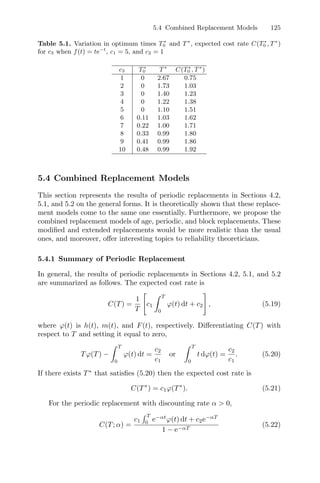
, which increases with
t for α  1. Let us find the distribution for which the failure rate increases
exponentially. Substituting h(t) = λαeαt
in (1.3) and (1.4), we have
f(t) = h(t) exp

−
 t
0
h(u) du

= λαeαt
exp

−λ(eαt
− 1)

which is obtained by considering the positive part of Type I of the smallest
extreme distribution and by normalizing it.
In failure studies, the time to failure is often measured in the number
of cycles to failure, and therefore becomes a discrete random variable. It has
1.2 Typical Failure Distributions 17
already been shown that geometric and negative binomial distributions at dis-
crete times correspond to exponential and gamma distributions at continuous
times, respectively. We are interested in the following question: what discrete
distribution corresponds to the Weibull distribution?
Consider the continuous exponential survival function F(t) = e−λt
. Sup-
pose that t takes only the discrete values 0, 1, . . . . Then, replacing e−λ
by
q, and t by k formally, we have the geometric survival distribution qk
for
k = 0, 1, 2, . . . . This could happen when failures of a unit with an exponen-
tial distribution are not revealed unless a specified test has been carried out
to determine the condition of the unit and the probability that its failures are
detected at the kth test is geometric.
In a similar way, from the survival function F(t) = exp[−(λt)α
] of a
Weibull distribution, we define the following discrete Weibull survival func-
tion [63].
∞
j=k
pj = (q)kα
for α  0, 0  q  1 (k = 0, 1, 2, . . . ).
The probability function, the failure rate, and the mean are
pk = (q)kα
− (q)(k+1)α
, hk = 1 − (q)(k+1)α
−kα
E{X} =
∞
k=1
(q)kα
.
The failure rate is increasing (decreasing) for α  1 (α  1) and coincides
with the geometric distribution for α = 1.
When a random variable X has a geometric distribution, i.e., Pr{X ≥
k} = qk
, the survival function distribution of a random variable Y ≡ X1/α
for α  0 is
Pr{Y ≥ k} = Pr{X ≥ kα
} = (q)kα
which is the discrete Weibull distribution. The parameters of a discrete
Weibull distribution were estimated in [64]. Furthermore, modified discrete
Weibull distributions were proposed in [65].
Failures of some units often depend more on the total number of cycles
than on the total time that they have been used. Such examples are switching
devices, railroad tracks, and airplane tires. In this case, we believe that a
discrete Weibull distribution will be a good approximation for such devices,
materials, or structures. A comprehensive survey of discrete distributions used
in reliability models was presented in [66].
Figure 1.2 shows the graph of the probability function pk for q = 0.6
and α = 0.5, 1.0, 1.5, and 2.0, and Figure 1.3 gives the survival functions of
discrete extreme distributions as those in Figure 1.1.
Example 1.4. Consider an n-unit parallel redundant system (see Exam-
ple 1.6) in a random environment that generates shocks at mean interval
18 1 Introduction
α = 0.5
α
=
1.0
α
=
1.5
α = 2.0
k
p
k
0
0.1
0.2
0.3
0.4
0.5
1 2 3 4 5
Fig. 1.2. Discrete Weibull probability function pk = qkα
for q = 0.6
Type The smallest extreme The largest extreme
I qαk
(α  1, −∞  k  ∞) 1 − qα−k
(α  1, −∞  k  ∞)
II q(−k)−α
(α  0, −∞  k ≤ 0) 1 − qk−α
(α  0, 0 ≤ k  ∞)
III qkα
(α  0, 0 ≤ k  ∞) 1 − q(−k)α
(α  0, −∞ ≤ k ≤ 0)
Fig. 1.3. Survival functions of discrete extreme for 0  q  1
θ [67]. Each unit fails with probability pk at the kth shock (k = 1, 2, . . . ),
independently of other units. Then, the mean time to system failure is
µn = θ
∞
k=1
k
⎧
⎨
⎩
⎡
⎣
k
j=1
pj
⎤
⎦
n
−
⎡
⎣
k−1
j=1
pj
⎤
⎦
n⎫
⎬
⎭
= θ
∞
k=0
⎧
⎨
⎩
1 −
⎡
⎣
k
j=1
pj
⎤
⎦
n⎫
⎬
⎭
= θ
n
i=1

n
i

(−1)i+1
∞
k=0
⎡
⎣
∞
j=k+1
pj
⎤
⎦
i
,
where
0
j=1 ≡ 0. For example, when shocks occur according to a discrete
Weibull distribution
∞
j=k pj = (q)(k−1)α
(k = 1, 2, . . . ),
µn = θ
n
i=1

n
i

(−1)i+1
∞
k=0
qikα
.
In particular, when α = 1,
1.3 Stochastic Processes 19
µn = θ
n
i=1

n
i

(−1)i+1 1
1 − qi
.
1.3 Stochastic Processes
In this section, we briefly present some kinds of stochastic processes for sys-
tems with maintenance. Let us sketch the simplest system as an example. It
is a one-unit system with repair or replacement whose time is negligible; i.e.,
a unit is operating and is repaired or replaced when it fails, where the time
required for repair or replacement is negligible. When the repair or replace-
ment is completed, the unit becomes as good as new and begins to operate.
The system forms a renewal process, i.e., a renewal theory arises from the
study of self-renewing aggregates, and plays an important role in the analysis
of probability models with sums of independent nonnegative random vari-
ables. We summarize the main results of a renewal theory for future studies
of maintenance models in this book.
Next, consider a one-unit system where the repair or replacement time
needs a nonnegligible time; i.e., the system repeats up and down alternately.
The system forms an alternating renewal process that repeats two different
renewal processes alternately. Furthermore, if the duration times of up and
down are multiples of a period of time, then the system can be described by a
discrete time parameter Markov chain. If the duration times of up and down
are distributed exponentially, then the system can be described by a contin-
uous time parameter Markov process. In general, Markov chains or processes
have the Markovian property: the future behavior depends only on the present
state and not on its past history. If the duration times of up and down are
distributed arbitrarily, then the system can be described by a semi-Markov
process or Markov renewal process.
Because the mechanism of failure occurrences may be uncertain in complex
systems, we have to observe the behavior of such systems statistically and
stochastically. It would be very effective in the reliability analysis to deal with
maintenance problems underlying stochastic processes, which justly describe
a physical phenomenon of random events. Therefore, this section summarizes
the theory of renewal processes, Markov chains, semi-Markov processes, and
Markov renewal processes for future studies of maintenance models. More
general theory and applications of renewal processes are found in [68,69].
Markov chains are essential and fundamental in the theory of stochastic
processes. On the other hand, semi-Markov processes or Markov renewal pro-
cesses are based on a marriage of renewal processes and Markov chains, which
were first studied by [70]. Pyke gave a careful definition and discussions of
Markov renewal processes in detail [71,72]. In reliability, these processes are
one of the most powerful mathematical techniques for analyzing maintenance
20 1 Introduction
and random models. A table of applicable stochastic processes associated with
repairman problems was shown in [7].
State space is usually defined by the number of units that is functioning
satisfactorily. As far as the applications are concerned, we consider only a finite
number of states. We mention only the theory of stationary Markov chains
with finite-state space for analysis of maintenance models. It is shown that
transition probabilities, first-passage time distributions, and renewal functions
are given in terms of one-step transition probabilities. Furthermore, some
limiting properties are summarized when all states communicate.
We omit the proofs of results and derivations. For more detailed discussions
and applications of Markov processes, we refer readers to the books [59,73–75].
1.3.1 Renewal Process
Consider a sequence of independent and nonnegative random variables {X1, X2,
. . . }, in which Pr{Xi = 0}  1 for all i because of avoiding the triviality. Sup-
pose that X2, X3, . . . have an identical distribution F(t) with finite mean
µ, however, X1 possibly has a different distribution F1(t) with finite mean
µ1, in which both F1(t) and F(t) are not degenerate at time t = 0, and
F1(0) = F(0) = 0.
We have three cases according to the following types of F1(t).
(1) If F1(t) = F(t), i.e., all random variables are identically distributed, the
process is called an ordinary renewal process or renewal process for short.
(2) If F1(t) and F(t) are not the same, the process is called a modified or
delayed renewal process.
(3) If F1(t) is expressed as F1(t) =
 t
0
[1 − F(u)]du/µ which is given in (1.30),
the process is called an equilibrium or stationary renewal process.
Example 1.5. Consider a unit that is replaced with a new one upon fail-
ure. A unit begins to operate immediately after the replacement whose time
is negligible. Suppose that the failure distribution of each new unit is F(t).
If a new unit is installed at time t = 0 then all failure times have the same
distribution, and hence, we have an ordinary renewal process. On the other
hand, if a unit is in use at time t = 0 then X1 represents its residual lifetime
and could be different from the failure time of a new unit, and hence, we have
a modified renewal process. In particular, if the observed time origin is suffi-
ciently large after the installation of a unit and X1 has a failure distribution
 t
0
[1 − F(u)]du/µ, we have an equilibrium renewal process.
Letting Sn ≡
n
i=1 Xi (n = 1, 2, . . . ) and S0 ≡ 0, we define N(t) ≡
maxn{Sn ≤ t} which represents the number of renewals during (0, t]. Renewal
theory is mainly devoted to the investigation into the probabilistic properties
of N(t).
Denoting
1.3 Stochastic Processes 21
F(0)
(t) ≡

1 for t ≥ 0
0 for t  0
F(n)
(t) ≡
 t
0
F(n−1)
(t − u) dF(u) (n = 1, 2, . . . );
i.e., letting F(n)
be the n-fold Stieltjes convolution of F with itself, represents
the distribution of the sum X2 + X3 + · · · + Xn+1. Evidently,
Pr{N(t) = 0} = Pr{X1  t} = 1 − F1(t)
Pr{N(t) = n} = Pr{Sn ≤ t and Sn+1  t}
= F1(t) ∗ F(n−1)
(t) − F1(t) ∗ F(n)
(t) (n = 1, 2, . . . ), (1.18)
where the asterisk denotes the pairwise Stieltjes convolution; i.e., a(t)∗b(t) ≡
 t
0
b(t − u) da(u).
We define the expected number of renewals in (0, t] as M(t) ≡ E{N(t)},
which is called the renewal function, and m(t) ≡ dM(t)/dt, which is called
the renewal density. From (1.18), we have
M(t) =
∞
k=1
k Pr{N(t) = k} =
∞
k=1
F1(t) ∗ F(k−1)
(t). (1.19)
It is fairly easy to show that M(t) is finite for all t ≥ 0 because Pr{Xi = 0} 
1. Furthermore, from the notation of convolution,
M(t) = F1(t) +
∞
k=1
 t
0
F(k)
(t − u) dF1(u) =
 t
0
[1 + M0(t − u)] dF1(u) (1.20)
m(t) = f1(t) +
 t
0
m0(t − u)f1(u) du,
where M0(t) is the renewal function of an ordinary renewal process with dis-
tribution F; i.e., M0(t) ≡
∞
k=1 F(k)
(t), m0(t) ≡ dM0(t)/dt =
∞
k=1 f(k)
(t),
and f and f1 are the respective density functions of F and F1. The LS trans-
form of M(t) is given by
M∗
(s) ≡
 ∞
0
e−st
dM(t) =
F∗
1 (s)
1 − F∗(s)
, (1.21)
where, in general, Φ∗
(s) is the LS transform of Φ(t); i.e., Φ∗
(s) ≡
 ∞
0
e−st
dΦ(s)
for s  0. Thus, M(t) is determined by F1(t) and F(t). When F1(t) = F(t),
M0(t) = M(t), and Equation (1.21) implies F∗
(s) = M∗
(s)/[1 + M∗
(s)],
and hence, F(t) is also determined by M(t) because the LS transform deter-
mines the distribution uniquely. The Laplace inversion method is referred to
in [76,77].
We summarize some important limiting theorems of renewal theory for
future references.
22 1 Introduction
Theorem 1.2.
(i) With probability 1,
N(t)
t
→
1
µ
as t → ∞.
(ii)
M(t)
t
→
1
µ
as t → ∞. (1.22)
It is well known that when F1(t) = F(t) = 1 − e−t/µ
, M(t) = t/µ for all
t ≥ 0, and hence, M(t + h) − M(t) = h/µ. Furthermore, when the process is
an equilibrium renewal process, we also have that M(t) = t/µ.
Before mentioning the following theorems, we define that a nonnegative
random X is called a lattice if there exists d  0 such that
∞
n=0 Pr{X =
nd} = 1. The largest d having this property is called the period of X. When
X is a lattice, the distribution F(t) of X is called a lattice distribution. On
the other hand, when X is not a lattice, F is called a nonlattice distribution.
Theorem 1.3.
(i) If F is a nonlattice distribution,
M(t + h) − M(t) →
h
µ
as t → ∞. (1.23)
(ii) If F(t) is a lattice distribution with period d,
Pr{Renewal at nd} →
d
µ
as t → ∞. (1.24)
Theorem 1.4. If µ2 ≡
 ∞
0
t2
dF(t)  ∞ and F is nonlattice,
M(t) =
t
µ
+
µ2
2µ2
− 1 + o(1) as t → ∞. (1.25)
From this theorem, M(t) and m(t) are approximately given by
M(t) ≈
t
µ
+
µ2
2µ2
− 1, m(t) ≈
1
µ
(1.26)
for large t. Furthermore, the following inequalities of M(t) when F is IFR are
given [7],
t
µ
− 1 ≤
t
 t
0
F(u) du
− 1 ≤ M(t) ≤
tF(t)
 t
0
F(u) du
≤
t
µ
. (1.27)
Next, let δ(t) ≡ t − SN(t) and γ(t) ≡ SN(t)+1 − t, which represent the
current age and the residual life, respectively. In an ordinary renewal process,
we have the following distributions of δ(t) and γ(t) when F is not a lattice.
1.3 Stochastic Processes 23
Theorem 1.5.
Pr{δ(t) ≤ x} =

F(t) −
 t−x
0
[1 − F(t − u)] dM(u) for x ≤ t
1 for x  t
(1.28)
Pr{γ(t) ≤ x} = F(t + x) −
 t
0
[1 − F(t + x − u)] dM(u) (1.29)
and their limiting distribution is
lim
t→∞
Pr{δ(t) ≤ x} = lim
t→∞
Pr{γ(t) ≤ x} =
1
µ
 x
0
[1 − F(u)] du. (1.30)
It is of interest that the mean of the above limiting distribution is
1
µ
 ∞
0
x[1 − F(x)] dx =
µ
2
+
µ2 − µ2
2µ
(1.31)
which is greater than half of the mean interval time µ [68]. Moreover, the
stochastic properties of γ(t) were investigated in [78,79].
If the number N(t) of some event during (0, t] has the following distribution
Pr{N(t) = n} =
[H(t)]n
n!
e−H(t)
(n = 0, 1, 2, . . . ) (1.32)
and has the property of independent increments, then the process {N(t), t ≥
0} is called a nonhomogeneous Poisson process with mean value function H(t).
Clearly, E{N(t)} = H(t) and h(t) ≡ dH(t)/dt, i.e., H(t) =
 t
0
h(u)du, is
called an intensity function.
Suppose that a unit fails and undergoes minimal repair; i.e., its failure
rate remains undisturbed by any minimal repair (see Section 4.1). Then, the
number N(t) of failures during (0, t] has a Poisson distribution in (1.32). In
this case, we say that failures of a unit occur at a nonhomogeneous Poisson
process, and H(t) and h(t) correspond to the cumulative hazard function and
failure rate of a unit with itself, respectively.
Finally, we introduce a renewal reward process [73] or cumulative process
[69]. For instance, if we consider the total reward produced by the successive
production of a machine, then the process forms a renewal reward process,
where the successive production can be described by a renewal process and
the total rewards caused by production may be additive.
Define that a reward Yn is earned at the nth renewal time (n = 1, 2, . . . ).
When a sequence of pairs {Xn, Yn} is independent and identically distributed,
Y (t) ≡
N(t)
n=1 Yn is denoted by the total reward earned during (0, t]. When
successive shocks of a unit occur at time interval Xn and each shock causes
an amount of damage Yn to a unit, the total amount of damage is given by
Y (t) [69,80].
24 1 Introduction
Down state
Up state
X1
Y1
X2
Y2
X3
Y3
Fig. 1.4. Realization of alternating renewal process
Theorem 1.6. Suppose that E{Y } ≡ E{Yn} are finite.
(i) With probability 1,
Y (t)
t
→
E{Y }
µ
as t → ∞. (1.33)
(ii)
E{Y (t)}
t
→
E{Y }
µ
as t → ∞. (1.34)
In the above theorems, we interpret a/µ = 0 whenever µ = ∞ and |a|  ∞.
Theorem 1.6 can be easily proved from Theorem 1.2 and the detailed proof
can be found in [73]. This theorem shows that if one cycle is denoted by the
time interval between renewals, the expected reward per unit of time for an
infinite time span is equal to the expected reward per one cycle, divided by
the mean time of one cycle. This is applied throughout this book to many
optimization problems that minimize cost functions.
1.3.2 Alternating Renewal Process
Alternating renewal processes are the processes that repeat on and off or
up and down states alternately [69]. Many redundant systems generate alter-
nating renewal processes. For example, we consider a one-unit system with
repair maintenance in Section 2.1. The unit begins to operate at time 0, and
is repaired upon failure and returns to operation. We could consider the time
required for repair as the replacement time. It is assumed in any event that the
unit becomes as good as new after the repair or maintenance completion. It is
said that the system forms an ordinary alternating renewal process or simply
an alternating renewal process. If we take the time origin a long way from the
beginning of an operating unit, the system forms an equilibrium alternating
renewal process.
Furthermore, consider an n-unit standby redundant system with r repair-
persons (1 ≤ r ≤ n) and one operating unit supported by n−1 identical spare
units [7, p. 150; 81]. When each unit fails randomly and the repair times are
exponential, the system forms a modified alternating renewal process.
1.3 Stochastic Processes 25
We are concerned with only the off time properties and apply them to reli-
ability systems. Consider an alternating renewal process {X1, Y1, X2, Y2, . . . },
where Xi and Yi (i = 1, 2, . . . ) are independent random variables with dis-
tributions F and G, respectively (see Figure 1.4). The alternating renewal
process assumes on and off states alternately with distributions F and G.
Let N(t) and D(t) be the number of up states and the total amount of
time spent in down states during (0, t], respectively. Then, from a well-known
formula of the sum of independent random variables,
Pr{Y1 + Y2 + · · · + Yn ≤ x|N(t) = n} Pr{N(t) = n}
= Pr{Y1 + Y2 + · · · + Yn ≤ x} Pr{X1 + · · · + Xn ≤ t − x X1 + · · · +Xn+1}
= G(n)
(x)[F(n)
(t − x) − F(n+1)
(t − x)]
we have [82]
Pr{D(t) ≤ x} =
∞
n=0 G(n)
(x)[F(n)
(t − x) − F(n+1)
(t − x)] for t  x
1 for t ≤ x.
(1.35)
Thus, the distribution of Tδ ≡ mint{D(t)  δ} for a specified δ  0, which
is the first time that the total amount of off time has exceeded δ, is given by
Pr{D(t)  δ}.
Next, consider the first time that an amount of off time exceeds a fixed
time c  0, where c is called a critically allowed time for maintenance [83].
In general, it is assumed that c is a random variable U with distribution
K. Let 
Yi ≡ {Yi; Yi ≤ U} and 
Ui ≡ {U; U  Yi}. If the process ends
with the first event of {U  YN } then the terminating process of interest
is {X1, 
Y1, X2, 
Y2, . . . , XN−1, 
YN−1, XN , 
UN }, the sum of random variables
W ≡
N−1
i=1 (Xi + 
Yi) + XN + 
UN , and its distribution L(t) ≡ Pr{W ≤ t}.
The probability that Yi is not greater than U and Yi ≤ t is
B(t) ≡ Pr{Yi ≤ U, Yi ≤ t} =
 t
0
K(u) dG(u)
and Yi is greater than U and U ≤ t is

B(t) ≡ Pr{U  Yi, U ≤ t} =
 t
0
G(u) dK(u).
Thus, from the formula of the sum of independent random variables,
L(t) =
∞
N=1
Pr
N−1
i=1
(Xi + 
Yi) + XN + 
UN ≤ t

=
∞
n=0
F(n)
(t) ∗ B(n)
(t) ∗ F(t) ∗ 
B(t). (1.36)
26 1 Introduction
Therefore, the LS transform of L(t) is
L∗
(s) =
F∗
(s) 
B∗
(s)
1 − F∗(s)B∗(s)
(1.37)
and its mean time is
l ≡ lim
s→0
1 − L∗
(s)
s
=
µ +
 ∞
0
G(t)K(t) dt
 ∞
0
K(t) dG(t)
. (1.38)
In particular, when c is constant, the corresponding results of (1.37) and
(1.38) are, respectively,
L∗
(s) =
F∗
(s)e−sc
G(c)
1 − F∗(s)
 c
0
e−st dG(t)
(1.39)
l =
µ +
 c
0
G(t) dt
G(c)
. (1.40)
1.3.3 Markov Processes
When we analyze complex systems, it is essential to learn Markov processes.
This section briefly explains the theory of Markov chains, semi-Markov pro-
cesses, and Markov renewal processes.
(1) Markov Chain
Consider a discrete time stochastic process {Xn, n = 0, 1, 2, . . . } with a finite
state set {0, 1, 2, . . . , m}. If we suppose that
Pr{Xn+1 = in+1|X0 = i0, X1 = i1, . . . , Xn = in}=Pr{Xn+1 = in+1|Xn = in}
for all states i0, i1, . . . , in, and all n ≥ 0, then the process {Xn, n = 0, 1, . . . }
is said to be a Markov chain. This property shows that, given the value of Xn,
the future value of Xn+1 does not depend on the value of Xk for 0 ≤ k ≤ n−1.
If the probability of Xn+1 being in state j, given that Xn is in state i, is
independent of n, i.e.,
Pr{Xn+1 = j|Xn = i} = Pij (1.41)
then the process has a stationary (one-step) transition probability. We re-
strict ourselves to discrete time Markov chains with stationary transition
probabilities. Manifestly, the transition probabilities Pij satisfy Pij ≥ 0, and
m
j=0 Pij = 1.
A Markov chain is completely specified by the transition probabilities Pij
and an initial probability distribution of X0 at time 0. Let Pn
ij denote the
1.3 Stochastic Processes 27
probability that the process goes from state i to state j in n transactions; or
formally,
Pn
ij ≡ Pr{Xn+k = j|Xk = i}.
Then,
Pn
ij =
m
k=0
Pr
ikPn−r
kj (r = 0, 1, . . . , n), (1.42)
where P0
ii = 1 and otherwise P0
ij = 0 for convenience. This equation is known
as the Chapman–Kolmogorov equation.
We define the first-passage time distribution as
Fn
ij ≡ Pr{Xn = j, Xk = j, k = 1, 2, . . . , n − 1|X0 = i} (1.43)
which is the probability that starting in state i, the first transition into state
j occurs at the nth transition, where we define F0
ij ≡ 0 for all i, j. Then,
Pn
ij ≡
n
k=0
Fk
ijPn−k
jj (n = 1, 2, . . . ) (1.44)
and hence, the probability Fk
ij of the first passage from state i to state j at
the kth transition is determined uniquely by the above equation.
Furthermore, let Mn
ij denote the expected number of visits to state j in
the nth transition if the process starts in state i, not including the first at
time 0. Then,
Mn
ij =
n
k=1
Pk
ij (n = 1, 2, . . . ), (1.45)
where we define M0
ij ≡ 0 for all i, j.
We next introduce the following generating functions.
P∗
ij(z) ≡
∞
n=0
zn
Pn
ij, F∗
ij(z) ≡
∞
n=0
zn
Fn
ij, M∗
ij(z) ≡
∞
n=0
zn
Mn
ij
for |z|  1. Then, forming the generating operations of (1.44) and (1.45), we
have [59]
P∗
ii(z) =
1
1 − F∗
ii(z)
, P∗
ij(z) = F∗
ij(z)P∗
jj(z) (i = j) (1.46)
M∗
jj(z) =
P∗
jj(z) − 1
1 − z
, M∗
ij(z) =
P∗
ij(z)
1 − z
(i = j). (1.47)
Two states i and j are said to communicate if and only if there exist
integers n1 ≥ 0 and n2 ≥ 0 such that Pn1
ij  0 and Pn2
ji  0. The period d(i)
of states i is defined as the greatest common divisor of all integers n ≥ 1 for
which Pn
ii  0. If d(i) = 1 then state i is said to be nonperiodic.
28 1 Introduction
Consider a Markov chain in which all states communicate. Such a chain is
called irreducible. We only consider the nonperiodic case. Then, the following
limiting results of such a Markov chain are known.
∞
n=1
Fn
ij = 1, µjj =
∞
n=1
nFn
jj  ∞ (1.48)
lim
n→∞
Mn
ij =
∞
n=1
Pn
ij = ∞, lim
n→∞
Mn
ij
n
= lim
n→∞
Pn
ij =
1
µjj
 ∞ (1.49)
for all i, j. Furthermore, limn→∞ Pn
ij = πj (j = 0, 1, 2, . . . , m) are uniquely
determined by a set of equations:
πj =
m
i=0
πiPij (j = 0, 1, 2, . . . , m),
m
j=0
πj = 1. (1.50)
(2) Semi-Markov and Markov Renewal Processes
Consider a stochastic process with a finite state set {0, 1, 2, . . . , m} that makes
transitions from state to state in accordance with a Markov chain with station-
ary transition probabilities. However, in the process the amount of time spent
in each state until the next transition is not always constant but random.
Let Qij(t) denote the probability that after making a transition into state
i, the next process makes a transition into state j, in an amount of time less
than or equal to t. Clearly, we have Qij(t) ≥ 0 and
m
j=0 Qij(∞) = 1, where
Qij(∞) represents the probability that the next process makes a transition
into state j, given that the process goes into state i. We call the probability
Qij(t) a mass function. Letting
Gij(t) =
Qij(t)
Qij(∞)
for Qij(∞)  0
then Gij(t) represents the conditional probability that the process makes a
transition in an amount of time less than or equal to t, given that the process
goes from state i to state j at the next transition.
Let Jn denote the state of the process immediately after the nth transition
has occurred for n ≥ 1 and let J0 denote the initial state of the process.
Then, the stochastic process {Jn, n = 0, 1, 2, . . . } is called an embedded Markov
chain. If the process makes a transition from one state to another with one
unit of time, i.e., Gij(t) = 0 for t  1, and 1 for t ≥ 1, then an embedded
Markov chain becomes a Markov chain. Furthermore, if an amount of time
spent in state i depends only on state i and is exponential independent of the
next state; Gij(t) = 1 − e−λit
for constant λi  0, the process is said to be a
continuous time parameter Markov process. In addition, the process becomes
a renewal process if it is only one state. If we let Z(t) denote the state of
1.3 Stochastic Processes 29
the process at time t, then the stochastic process {Z(t), t ≥ 0} is called a
semi-Markov process. Let Ni(t) denote the number of times that the process
visits state i in (0, t]. It follows from renewal theory that with probability 1,
Ni(t)  ∞ for t ≥ 0. The stochastic process {N0(t), N1(t), N2(t), . . . , Nm(t)}
is called a Markov renewal process.
An embedded Markov chain records the state of the process at each tran-
sition point, a semi-Markov process records the state of the process at each
time point, and a Markov renewal process records the total number of times
that each state has been visited.
Let Hi(t) denote the distribution of an amount of time spent in state i
until the process makes a transition to the next state;
Hi(t) ≡
m
j=0
Qij(t)
which is called the unconditional distribution for state i. We suppose that
Hi(0)  1 for all i. Denoting
ηi ≡
 ∞
0
t dHi(t), µij ≡
 ∞
0
t dGij(t)
it is easily seen that
ηi =
m
j=0
Qij(∞)µij
which represents the mean time spent in state i.
We define transition probabilities, first-passage time distributions, and re-
newal functions as, respectively,
Pij(t) ≡ Pr{Z(t) = j|Z(0) = i}
Fij(t) ≡ Pr{Nj(t)  0|Z(0) = i}
Mij(t) ≡ E{Nj(t)|Z(0) = i}.
We have the following relationships for Pij(t), Fij(t), and Mij(t) in terms of
the mass functions Qij(t).
Pii(t) = 1 − Hi(t) +
m
k=0
 t
0
Pki(t − u) dQik(u) (1.51)
Pij(t) =
m
k=0
 t
0
Pkj(t − u) dQik(u) for i = j (1.52)
Fij(t) = Qij(t) +
m
k=0
k=j
 t
0
Fkj(t − u) dQik(u) (1.53)
Mij(t) = Qij(t) +
m
k=0
 t
0
Mkj(t − u) dQik(u). (1.54)
30 1 Introduction
Therefore, the mass functions Qij(t) determine Pij(t), Fij(t), and Mij(t)
uniquely. Furthermore, we have
Pii(t) = 1 − Hi(t) +
 t
0
Pii(t − u) dFii(u) (1.55)
Pij(t) =
 t
0
Pjj(t − u) dFij(u) for i = j (1.56)
Mij(t) = Fij(t) +
 t
0
Mjj(t − u) dFij(u). (1.57)
Thus, forming the LS transforms of the above equations,
P∗
ii(s) =
1 − H∗
i (s)
1 − F∗
ii(s)
(1.58)
P∗
ij(s) = F∗
ij(s)P∗
jj(s) for i = j (1.59)
M∗
ij(s) = F∗
ij(s)[1 + M∗
jj(s)], (1.60)
where the asterisk denotes the LS transform of the function with itself.
Consider the process in which all states communicate, Gii(∞) = 1, and
µii  ∞ for all i. It is said that the process consists of one positive recurrent
class. Further suppose that each Gjj(t) is a nonlattice distribution. Then, we
have
Gij(∞) = 1, µij  ∞
µij = ηi +
k=j
Qik(∞)µkj. (1.61)
Furthermore,
lim
t→∞
Mij(t) =
 ∞
0
Pij(u) du = ∞
lim
t→∞
Mij(t)
t
=
1
µjj
 ∞, lim
t→∞
Pij(t) =
ηj
µjj
 ∞.
(1.62)
In this case, because there exist limt→∞ Mij(t)/t and limt→∞ Pij(t), we also
have, from a Tauberian theorem that if for some nonnegative integer n,
lims→0 sn
Φ∗
(s) = C then limt→∞ Φ(t)/tn
= C/n!,
lim
t→∞
Mij(t)
t
= lim
s→0
sM∗
ij(s)
lim
t→∞
Pij(t) = lim
t→∞
1
t
 t
0
Pij(u) du = lim
s→0
P∗
ij(s).
(1.63)
1.3.4 Markov Renewal Process with Nonregeneration Points
This section explains unique modifications of Markov renewal processes and
applies them to redundant repairable systems including some nonregeneration
1.3 Stochastic Processes 31
points [84]. It has already been shown that such modifications give powerful
plays for analyzing two-unit redundant systems [85] and communication sys-
tems [86]. In this book, this is used for the one-unit system with repair in
Section 2.1, and the two-unit standby system with preventive maintenance in
Section 6.2.
It is assumed that the Markov renewal process under consideration has
only one positive recurrent class, because we restrict ourselves to applications
to reliability models. Consider the case where epochs at which the process
enters some states are not regeneration points. Then, we partition a state
space S into S = S∗

S†
(S∗

S†
= φ), where S∗
is the portion of the state
space such that the epoch entering state i (i ∈ S∗
) is not a regeneration point,
and S†
is such that the epoch entering state i (i ∈ S†
) is a regeneration point,
where S∗
and S†
are assumed not to be empty.
Define the mass function Qij(t) from state i (i ∈ S†
) to state j (j ∈ S) by
the probability that after entering state i, the process makes a transition into
state j, in an amount of time less than or equal to t. However, it is impossible
to define mass functions Qij(t) for i ∈ S∗
, because the epoch entering state i
is not a regeneration point. We define the new mass function Q
(k1,k2,...,km)
ij (t)
which is the probability that after entering state i (i ∈ S†
), the process next
makes transitions into states k1, k2, . . . , km (k1, k2, . . . , km ∈ S∗
), and finally,
enters state j (j ∈ S), in an amount of time less than or equal to t. Moreover,
we define that Hi(t) ≡

j∈S Qij(t) for i ∈ S†
, which is the unconditional
distribution of the time elapsed from state i to the next state entered, possibly
i itself.
(1) Type 1 Markov Renewal Process
Consider a Markov renewal process with m+1 states, that consists of S†
= {0}
and S∗
= {1, 2, . . . , m} in Figure 1.5. The process starts in state 0, i.e.,
Z(0) = 0, and makes transitions into state 1, 2, . . . , m, and comes back to
state 0. Then, from straightforward renewal arguments, the first-passage time
distributions are
F01(t) = Q01(t)
F0j(t) = Q
(1,2,...,j−1)
0j (t) (j = 2, 3, . . . , m)
F00(t) = Q
(1,2,...,m)
00 (t),
(1.64)
the renewal functions are
M01(t) = Q01(t) + Q
(1,2,...,m)
00 (t) ∗ M01(t) = Q01(t) + F00(t) ∗ M01(t)
M0j(t) = Q
(1,2,...,j−1)
0j (t) + F00(t) ∗ M0j(t) (j = 2, 3, . . . , m)
M00(t) = F00(t) + F00(t) ∗ M00(t),
(1.65)
and the transition probabilities are
32 1 Introduction
P01(t) = Q01(t) − Q
(1)
02 (t) + Q
(1,2,...,m)
00 (t) ∗ P01(t)
= Q01(t) − Q
(1)
02 (t) + F00(t) ∗ P01(t)
P0j(t) = Q
(1,2,...,j−1)
0j (t) − Q
(1,2,...,j)
0j+1 (t) + F00(t) ∗ P0j(t) (j = 2, 3, . . . , m)
P00(t) = 1 − Q01(t) + F00(t) ∗ P00(t), (1.66)
where Q
(1,2,...,m)
0m+1 (t) = Q
(1,2,...,m)
00 (t).
Taking the LS transforms on both sides of (1.65) and (1.66),
M∗
01(s) =
Q∗
01(s)
1 − F∗
00(s)
M∗
0j(s) =
Q
(1,2,...,j−1)
0j (s)
1 − F∗
00(s)
(j = 2, 3, . . . , m)
M∗
00(s) =
F∗
00(s)
1 − F∗
00(s)
(1.67)
P∗
01(s) =
Q∗
01(s) − Q
∗(1)
02 (s)
1 − F∗
00(s)
P∗
0j(s) =
Q
∗(1,2,...,j−1)
0j (s) − Q
∗(1,2,...,j)
0j+1 (s)
1 − F∗
00(s)
(j = 2, 3, . . . m)
P∗
00(s) =
1 − Q∗
01(s)
1 − F∗
00(s)
,
(1.68)
where note that
m
j=0 P∗
0j(s) = 1. From (1.67) and (1.68), the renewal func-
tions and the transition probabilities are computed explicitly upon inversion,
however, this might not be easy except in simple cases.
Example 1.6. Consider an n-unit parallel redundant system: When at least
one of n units is operating, the system is operating. When all units are down
simultaneously, the system fails and will begin to operate again immediately
by replacing all failed units with new ones. Each unit operates independently
and has an identical failure distribution F(t). The states are denoted by the
total number of failed units. When all units begin to operate at time 0, the
mass functions are
Q01(t) = 1 − [F(t)]n
Q
(1,2,...,j−1)
0j (t) =
n
i=j

n
i

[F(t)]i
[F(t)]n−i
(j = 2, 3, . . . , n). (1.69)
Thus, substituting the above equations into (1.67) and (1.68), we can obtain
the renewal functions and the transition probabilities.
1.3 Stochastic Processes 33
1
2
m
0
State with regeneration point
States with nonregeneration point
Fig. 1.5. State transition diagram for Type 1 Markov renewal process
1
2
j
m
0
State with regeneration point
States with nonregeneration point
Fig. 1.6. State transition diagram for Type 2 Markov renewal process
(2) Type 2 Markov Renewal Process
Consider a Markov renewal process with S†
= {0} and S∗
= {1, 2, . . . , m}
in Figure 1.6. The process starts in state 0 and only is permitted to make a
transition into one state j ∈ S∗
, and then return to 0.
The LS transforms of the first-passage time distributions, the renewal func-
tions, and the transition probabilities are
34 1 Introduction
F∗
00(s) =
m
i=1
Q
∗(i)
00 (s)
F∗
0j(s) = Q∗
0j(s)

⎡
⎢
⎣1 −
m
i=1
i=j
Q
∗(i)
00 (s)
⎤
⎥
⎦ (j = 1, 2, . . . m) (1.70)
M∗
00(s) =
F∗
00(s)
1 − F∗
00(s)
M∗
0j(s) =
Q∗
0j(s)
1 − F∗
00(s)
(j = 1, 2, . . . , m) (1.71)
P∗
00(s) =
1 −
m
j=1 Q∗
0j(s)
1 − F∗
00(s)
P∗
0j(s) =
Q∗
0j(s) − Q
∗(j)
00 (s)
1 − F∗
00(s)
(j = 1, 2, . . . , m). (1.72)
The process corresponds to a special one of Type 1 when m = 1. That is,
it is the simplest state space with one nonregeneration point. The process
takes two alternate states 0 and 1. When the epoch entering state 1 is also a
regeneration point, the process becomes an alternating renewal process (see
Section 1.3.2).
Example 1.7. Consider a two-unit standby redundant system with repair
maintenance [85]. The failure distribution of an operating unit is F(t) and
the repair distribution of a failed unit is G(t). When an operating unit fails
and the other unit is on standby, the failed unit undergoes repair immediately
and the unit on standby takes over the operation. However, when an operating
unit fails while the other unit is under repair, the failed unit has to wait for
repair until a repairperson is free.
Define the following states.
State 0: One unit is operating and other unit is under repair.
State 1: One unit is operating and the other unit is on standby.
State 2: One unit is under repair and the other unit waits for repair.
The system generates a Markov renewal process with S†
= {0} and S∗
=
{1, 2}. Then, the mass functions are
Q01(t) =
 t
0
F(u) dG(u), Q02(t) =
 t
0
G(u) dF(u)
Q
(1)
00 (t) =
 t
0
G(u) dF(u), Q
(2)
00 (t) =
 t
0
F(u) dG(u).
Thus, we can obtain the reliability quantities of the system by using the results
of the Type 2 process.
References 35
Many redundant systems and stochastic models can be described by the
Type 1 or Type 2 process, or mixtures and linkages of Type 1 and Type 2,
and the usual Markov renewal processes.
References
1. Hudson WR, Haas R, Uddin W (1997) Infrastructure Management. McGraw-
Hill, New York.
2. Blanche KM, Shrisvastava AB (1994) Defining failure of manufacturing ma-
chinery and equipment. In: Proceedings Annual Reliability and Maintainability
Symposium:69–75.
3. Rausand M, Høyland A (2004) System Reliability Theory. J Wiley  Sons,
Hoboken, NJ.
4. Gertsbakh I (2000) Reliability Theory with Applications to Preventive Mainte-
nance. Springer, New York.
5. Duchesne T, Lawless JF (2000) Alternative time scales and failure time models.
Life Time Data Analysis 6:157–179.
6. Finkelstein MS (2004) Alternative time scales for systems with random usage.
IEEE Trans Reliab 53:261–264.
7. Barlow RE, Proschan F (1965) Mathematical Theory of Reliability. J Wiley 
Sons, New York.
8. Barlow RE, Proschan F (1975) Statistical Theory of Reliability and Life Testing
Probability Models. Holt, Rinehart  Winston, New York.
9. Jorgenson DW, McCall JJ, Radner R (1967) Optimal Replacement Policy.
North-Holland, Amsterdam.
10. Gnedenko BV, Belyayev YK, Solovyev AD (1969) Mathematical Methods of
Reliability Theory. Academic, New York.
11. Gertsbakh I (1977) Models of Preventive Maintenance. North-Holland, Amster-
dam.
12. Osaki S, Nakagawa T (1976) Bibliography for reliability and availability of
stochastic systems. IEEE Trans Reliab R-25:284–287.
13. Pierskalla WP, Voelker JA (1976) A survey of maintenance models: The control
and surveillance of deteriorating systems. Nav Res Logist Q 23:353–388.
14. Sherif YS, Smith ML (1981) Optimal maintenance models for systems subject
to failure – A review. Nav Res Logist Q 28:47–74.
15. Thomas LC (1986) A survey of maintenance and replacement models for main-
tainability and reliability of multi-item systems. Reliab Eng 16:297–309.
16. Valdez-Flores C, Feldman RM (1989) A survey of preventive maintenance mod-
els for stochastically deteriorating single-unit system. Nav Res Logist Q 36:419–
446.
17. Cho DI, Palar M (1991) A survey of maintenance models for multi-unit systems.
Eur J Oper Res 51:1–23.
18. Dekker R (1996) Applications of maintenance optimization models: A review
and analysis. Reliab Eng Syst Saf 51:229–240.
19. Wang H (2002) A survey of maintenance policies of deteriorating systems. Eur
J Oper Res 139:469–489.
36 1 Introduction
20. Özekici S (ed) (1996) Reliability and Maintenance of Complex Systems.
Springer, Berlin.
21. Christer AH, Osaki S, Thomas LC (eds) (1997) Stochastic Modelling in Inno-
vative Manufacturing. Lecture Notes in Economics and Mathematical Systems
445, Springer, Berlin.
22. Ben-Daya M, Duffuaa SO, Raouf A (eds) (2000) Maintenance, Modeling and
Optimization. Kluwer Academic, Boston.
23. Rahin MA, Ben-Daya M (2001) Integrated Models in Production Planning,
Inventory, Quality, and Maintenance. Kluwer Academic, Boston.
24. Osaki S (ed) (2002) Stochastic Models in Reliability and Maintenance. Springer,
New York.
25. Pham H (2003) Handbook of Reliability Engineering. Springer, London.
26. Naresky JJ (1970) Reliability definitions. IEEE Trans Reliab R-19:198–200.
27. Hosford JE (1960) Measures of dependability. Oper Res 8:53–64.
28. Lai CD, Xie M (2003) Concepts and applications of stochastic aging in reliability.
In: Pham H (ed) Handbook of Reliability Engineering. Springer, London:165–
180.
29. Gumbel EJ (1958) Statistics of Extremes. Columbia University Press, New York.
30. Bartholomew DJ (1973) Stochastic Models for Social Processes. J Wiley  Sons,
New York.
31. Gross AJ, Clark VA (1975) Survival Distributions: Reliability Applications in
the Biomedical Sciences. J Wiley  Sons, New York.
32. Badenius D (1970) Failure rate/MTBF. IEEE Trans Reliab R-19:66–67.
33. Kalbfleisch JD, Prentice RL (1980) The Statistical Analysis of Failure Time
Data. J Wiley  Sons, New York.
34. Lane WR, Looney ST, Wansley JW (1986) An application of the Cox propor-
tional hazard model to bank failure. J Banking Insurance 10:511–532.
35. Kumar D, Klefsjö B (1994) Proportional hazard model: A review. Reliab Eng
Syst Saf 44:177–188.
36. Block HW, Savits TH, Singh H (1998) The reversed hazard rate function. Prob
Eng Inform Sci 12:69–90.
37. Finkelstein MS (2002) On the reversed hazard rate. Reliab Eng Syst Saf 78:71–
75.
38. Berg M (1996) Towards rational age-based failure modelling. In: Özekici S (ed)
Reliability and Maintenance of Complex Systems. Springer, New York:107–113.
39. Ichida T (1968) Introduction to Maintainability Engineering. Nikkagiren, Tokyo.
40. Nakagawa T (1978) Some inequalities for failure distributions. IEEE Trans Re-
liab R-27:58–59.
41. Shaked M, Shanthikumar JG (1994) Stochastic Orders and Their Applications.
Academic, Boston.
42. Sheikh AK, Younas M, Raouf A (2000) Reliability based spare parts forecast-
ing and procurement strategies. In: Ben-Daya M, Duffuaa SO, Raouf A (eds)
Maintenance, Modeling and Optimization. Kluwer Academic, Boston:81–110.
43. Kumar UD, Crocker J, Knezevic J, El-Haram M (2000) Reliability, Maintenance
and Logistics Support. Kluwer Academic, Boston.
44. Jiang R, Ji P (2002) Age replacement policy: A multi-attribute value model.
Reliab Eng Syst Saf 76:311–318.
45. Xie M, Gaudoin O, Bracquemond C (2002) Redefining failure rate function for
discrete distributions. Inter J Reliab Qual Saf Eng 9:275–285.
References 37
46. Sandler GH (1963) System Reliability Engineering. Prentice-Hall, Englewood
Cliffs, NJ.
47. Kabak IW (1969) System availability and some design implications. Oper Res
17:827–837.
48. Martz Jr HF (1971) On single-cycle availability. IEEE Trans Reliab R-20:21–23.
49. Nakagawa T, Goel AL (1973) A note on availability for a finite interval. IEEE
Trans Reliab R-22:271–272.
50. Lie CH, Hwang CL, Tillman FA (1977) Availability of maintained systems: A
state-of-the-art survey. AIIE Trans 9:247–259.
51. Aven T (1996) Availability analysis of monotone systems. In: Özekichi S (ed)
Reliability and Maintenance of Complex Systems. Springer, New York:206–223.
52. Finkelstein MS, Zarudnij VI (2002) Laplace-transforms and fast-repair approxi-
mations for multiple availability and its generations. IEEE Trans Reliab 51:168–
176.
53. Finekelstein MS (2003) Modeling the observed failure rate. In: Pham H (ed)
Handbook of Reliability Engineering. Springer, London:117–139.
54. Lee KW (2003) Random-request availability. In: Pham (ed) Handbook of Reli-
ability Engineering. Springer, London:643–652.
55. Barlow RE, Hunter LC (1961) Reliability analysis of a one-unit system. Oper
Res 9:200–208.
56. Pinedo M (2002) Scheduling Theory, Algorithms, and Systems. Prentice-Hall,
Upper Saddle River NJ.
57. Johnson NL, Kotz S (1972) Distributions in Statistics. Vols I, II, III. J Wiley 
Sons, New York.
58. Tsokos CP (1972) Probability Distributions: An Introduction to Probability
Theory with Applications. Duxbury, Belmont CA.
59. Osaki S (1992) Applied Stochastic System Modeling. Springer, New York.
60. Lawless JF (1983) Statistical methods in reliability. Technometrics 25:305–316.
61. Murthy DNP, Xie M, Jiang R (2004) Weibull Models. J Wiley  Sons, Hoboken,
NJ.
62. Nakagawa T, Yoda H (1977) Relationships among distributions. IEEE Trans
Reliab R-26:352–353.
63. Nakagawa T, Osaki S (1975) The discrete Weibull distribution. IEEE Trans
Reliab R-24:300–301.
64. Ali Khan MS, Khalique A, Abouammoh AM (1989) On estimating parameters
in a discrete Weibull distribution. IEEE Trans Reliab 38:348–350.
65. Stein WE, Dattero R (1984) A new discrete Weibull distribution. IEEE Trans
Reliab 33:196–197.
66. Padgett WJ, Spurrier JD (1985) Discrete failure models. IEEE Trans Reliab
34:253–256.
67. Råde L (1976) Reliability systems in random environment. J Appl Prob 13:407–
410.
68. Feller W (1957) An Introduction to Probability Theory and Its Applications
Vol 1. J Wiley  Sons, New York.
69. Cox DR (1962) Renewal Theory. Methuen, London.
70. Smith WL (1958) Renewal theory and its ramifications. J Roy Statist Soc Ser
B 20:243–302.
71. Pyke R (1961) Markov renewal processes: Definitions and preliminary proper-
ties. Ann Math Statist 32:1231–1242.
38 1 Introduction
72. Pyke R (1961) Markov renewal processes with finitely many states. Ann Math
Statist 32:1243–1259.
73. Ross SM (1970) Applied Probability Models with Optimization Applications.
Holden-Day, San Francisco.
74. Karlin S, Taylor HM (1975) A First Course in Stochastic Processes. Academic,
New York.
75. Çinlar E (1975) Introduction to Stochastic Processes. Prentice-Hall, Englewood
Cliffs, NJ
76. Davies B, Martin BL (1979) Numerical inversion of the Laplace transform: A
survey and comparison of methods. J Comput Physics 33:1–32.
77. Abate J, Whitt W (1995) Numerical inversion of Laplace transforms of proba-
bility distributions. ORSA J Comput 7:36–43.
78. Lorden G (1970) On excess over the boundary. Ann Math Statist 41:520–527.
79. Belzunce F, Ortega EM, Ruiz JM (2001) A note on stochastic comparisons of
excess lifetimes of renewal processes. J Appl Prob 38:747–753.
80. Esary JD, Marshall AW, Proschan F (1973) Shock models and wear processes.
Ann Prob 1:627–649.
81. Nakagawa T (1974) The expected number of visits to state k before a total
system failure of a complex system with repair maintenance. Oper Res 22:108–
116.
82. Takács L (1957) On certain sojourn time problems in the theory of stochastic
processes. Acta Math Acad Sci Hungary 8:161–191.
83. Calabro SR (1962) Reliability Principles and Practices. McGraw-Hill, New York.
84. Nakagawa T, Osaki S (1976) Markov renewal processes with some non-
regeneration points and their applications to reliability theory. Microelectron
Reliab 15:633–636.
85. Nakagawa T (2002) Two-unit redundant models. In: Osaki S (ed) Stochastic
Models in Reliability and Maintenance. Springer, New York:165–185.
86. Yasui K, Nakagawa T, Sandoh H (2002) Reliability models in data communica-
tion systems. In: Osaki S (ed) Stochastic Models in Reliability and Maintenance.
Springer, New York:281–306.
2
Repair Maintenance
The most basic maintenance policy for units is to do some maintenance of
failed units which is called corrective maintenance; i.e., when units fail, they
may undergo repair or may be scrapped and replaced. After the repair comple-
tion, units can operate again. A system with several units forms semi-Markov
processes and Markov renewal processes in stochastic processes. Such relia-
bility models are called repairman problems [1], and some useful expressions
of reliability measures of many redundant systems were summarized in [2,3].
Early results of two-unit systems and their maintenance (see Section 6.2) were
surveyed in [4]. Furthermore, imperfect repair models that do not always be-
come like new after repair were proposed in [5,6] (see Chapter 7).
In this chapter, we are concerned only with reliability characteristics of
repairable systems such as mean time to system failure, availability, and ex-
pected number of system failures. Such reliability measures are obtained by
using the techniques of stochastic processes as described in Section 1.3.
In Section 2.1, we consider the most fundamental one-unit system and
survey its reliability quantities such as transition probabilities, downtime dis-
tribution, and availabilities. Another point of interest is the repair limit policy
where the repair of a failed unit is stopped if it is not completed within a
planned time T [7]. It is shown that there exists an optimum repair limit time
T∗
that minimizes the expected cost rate when the repair cost is proportional
to time. In Section 2.2, we consider a system with a main unit supported by
n spare units, and obtain the mean time to system failure and the expected
number of failed spare units [8]. Using these results, we propose several opti-
mization problems. Finally, in Section 2.3, we consider (n + 1)-unit standby
and parallel systems, and derive transition probabilities and first-passage time
distributions.
39
40 2 Repair Maintenance
2.1 One-Unit System
An operating unit is repaired or replaced when it fails. When the failed unit
undergoes repair, it takes a certain time which may not be negligible. When
the repair is completed, the unit begins to operate again. If the failed unit
cannot be repaired and spare units are not on hand, it takes a replacement
time which may not be negligible.
We consider one operating unit that is repaired immediately when it fails.
The failed unit is returned to the operating state when its repair is completed
and becomes as good as new. It is assumed that the switchover time from the
operating state to the repair state and from the repair state to the operating
state are instantaneous. The successive operating times between failures are
independently and identically distributed. The successive repair times are also
independently, identically distributed and independent of the operating times.
Of course, we can consider the repair time as the time required to make a
replacement. In this case, the failed unit is replaced with a new one, and its
unit operates as same as the failed one.
This system is the most fundamental system that repeats up and down
states alternately. The process of such a system can be described by a Markov
renewal process with two states, i.e., an alternating renewal process given in
Section 1.3 [9]. Many of the known results were summarized in [1,10].
This section surveys the reliability quantities of a one-unit system and
considers a repair limit policy in which the unit under repair is replaced with
a new one when the repair is not completed by a fixed time.
2.1.1 Reliability Quantities
(1) Renewal Functions and Transition Probabilities
In the analysis of stochastic models, we are interested in the expected number
of system failures during (0, t] and the probability that the system is operating
at time t. We obtain the stochastic behavior of a one-unit system by using
the techniques in Markov renewal processes.
Assume that the failure time of an operating unit has a general distribution
F(t) with finite mean µ and the repair time of failed units has a general
distribution G(t) with finite mean β, where Φ ≡ 1 − Φ for any function Φ,
where, in general, µ and β are referred to as mean time to failure (MTTF)
and mean time to repair (MTTR), respectively. To analyze the system, we
define the following states.
State 0: Unit is operating.
State 1: Unit is under repair.
Suppose that the unit begins to operate at time 0. The system forms a Markov
renewal or semi-Markov process with two states of up and down as shown in
Figure 1.4 of Section 1.3.2.
2.1 One-Unit System 41
Define the mass function Qij(t) from state i to state j by the probability
that after making a transition into state i, the system next makes a transition
into state j (i, j = 0, 1), in an amount of time less than or equal to time t.
Then, from a Markov renewal process, we can easily have
Q01(t) = F(t), Q10(t) = G(t).
Let Mij(t) denote the expected number of occurrences of state j during
(0, t] when the system goes into state i at time 0, where the first visit to state
j is not counted when i = j. Then, from Section 1.3, we have the following
renewal equations:
M01(t) = Q01(t) ∗ [1 + M11(t)], M10(t) = Q10(t) ∗ [1 + M00(t)],
and M11(t) = Q10(t) ∗ M01(t), M00(t) = Q01(t) ∗ M10(t), where the asterisk
denotes the pairwise Stieltjes convolution; i.e., a(t) ∗ b(t) ≡
 t
0
a(t − u)db(u).
Thus, forming the Laplace–Stieltjes (LS) transforms of both sides of these
equations and solving them, we have
M∗
01(s) =
Q∗
01(s)
1 − Q∗
01(s)Q∗
10(s)
=
F∗
(s)
1 − F∗(s)G∗(s)
(2.1)
M∗
10(s) =
Q∗
10(s)
1 − Q∗
01(s)Q∗
10(s)
=
G∗
(s)
1 − F∗(s)G∗(s)
(2.2)
and M∗
11(s) = G∗
(s)M∗
01(s) = M∗
00(s) = F∗
(s)M∗
10(s), where the asterisk of
the function denotes the LS transform with itself; i.e., Φ∗
(s) ≡
 ∞
0
e−st
dΦ(t)
for any function Φ(t).
Furthermore, let Pij(t) denote the probability that the system is in state
j at time t if it starts in state i at time 0. Then, from Section 1.3,
P00(t) = 1 − Q01(t) + Q01(t) ∗ P10(t)
P11(t) = 1 − Q10(t) + Q10(t) ∗ P01(t)
and P10(t) = Q10(t) ∗ P00(t), P01(t) = Q01(t) ∗ P11(t). Thus, again forming
the LS transforms,
P∗
00(s) =
1 − Q∗
01(s)
1 − Q∗
01(s)Q∗
10(s)
=
1 − F∗
(s)
1 − F∗(s)G∗(s)
(2.3)
P∗
11(s) =
1 − Q∗
10(s)
1 − Q∗
01(s)Q∗
10(s)
=
1 − G∗
(s)
1 − F∗(s)G∗(s)
(2.4)
and P∗
10(s) = G∗
(s)P∗
00(s), P∗
01(s) = F∗
(s)P∗
11(s). Thus, from (2.1) to (2.4),
we have the following relations.
P01(t) = M01(t) − M00(t), P10(t) = M10(t) − M11(t).
Moreover, we have
42 2 Repair Maintenance
P∗
01(s) =
F∗
(s)[1 − G∗
(s)]
1 − F∗(s)G∗(s)
=
 ∞
0
e−st
G(t − u) dM01(u)
P∗
10(s) =
G∗
(s)[1 − F∗
(s)]
1 − F∗(s)G∗(s)
=
 ∞
0
e−st
F(t − u) dM10(u);
i.e.,
P01(t) =
 t
0
G(t − u) dM01(u), P10(t) =
 t
0
F(t − u) dM10(u).
These relations with renewal functions and transition probabilities would be
useful for the analysis of more complex systems.
Next, let h(t) and r(t) be the failure rate and the repair rate of the unit,
respectively; i.e., h(t) ≡ f(t)/F(t) and r(t) ≡ g(t)/G(t), where f and g are
the respective density functions of F and G. Then, from (2.1) to (2.4), we also
have
min
x≤t
h(x)
 t
0
P00(u) du ≤ M01(t) ≤ max
x≤t
h(x)
 t
0
P00(u) du
min
x≤t
r(x)
 t
0
P11(u) du ≤ M10(t) ≤ max
x≤t
r(x)
 t
0
P11(u) du.
All inequalities equal when both F and G are exponential, which is shown in
Example 2.1.
There exist Pj ≡ limt→∞ Pij(t) and Mj ≡ limt→∞ Mij(t)/t, independent
of an initial state i, because the system forms a Markov renewal process with
one positive recurrent. Thus, from (1.63) we have
M0 = lim
s→0
sM∗
00(s) =
1
µ + β
= M1 (2.5)
P0 = lim
s→0
P∗
00(s) =
µ
µ + β
= 1 − P1. (2.6)
In general, it is often impossible to invert explicitly the LS transforms of
M∗
ij(s) and P∗
ij(s) in (2.1) to (2.4), and it is very difficult even to invert them
numerically [11,12]. However, we can state the following asymptotic describing
behaviors for small t and large t.
First, we consider the approximation calculation for small t. Reliability
calculations for small t are needed in considering the near-term future security
of an operating bulk power system [13]. We can rewrite (2.3) as
P∗
00(s) = 1 − F∗
(s) + F∗
(s)G∗
(s) − [F∗
(s)]2
G∗
(s) + · · · .
Because the probability that the process makes more than two transitions in
a short time is very small, by dropping the terms with higher degrees than
F∗
(s)G∗
(s), we have
P∗
00(s) ≈ 1 − F∗
(s) + F∗
(s)G∗
(s);
2.1 One-Unit System 43
i.e.,
P00(t) ≈ F(t) +
 t
0
G(t − u) dF(u). (2.7)
Similarly,
P01(t) ≈
 t
0
G(t − u) dF(u) (2.8)
M00(t) ≈
 t
0
G(t − u) dF(u), M01(t) ≈ F(t). (2.9)
Next, we obtain the asymptotic forms for large t [9]. By expanding e−st
in
a Taylor series on the LS transforms of F∗
(s) and G∗
(s) as s → 0, it follows
that
F∗
(s) = 1 − µs +
1
2
(µ2
+ σ2
µ)s2
+ o(s2
)
G∗
(s) = 1 − βs +
1
2
(β2
+ σ2
β)s2
+ o(s2
),
where σ2
µ and σ2
β are the variances of F and G, respectively, and o(s) is an
infinite decimal higher than s. Thus, substituting these equations into (2.1),
we have
M∗
01(s) =
1
µ + β
1
s
−
µ
µ + β
+
1
2
+
σ2
µ + σ2
β
2(µ + β)2
+ o(1).
Formal inversion of M∗
01(s) gives that for large t,
M01(t) =
t
µ + β
−
µ
µ + β
+
1
2
+
σ2
µ + σ2
β
2(µ + β)2
+ o(1). (2.10)
Similarly,
M00(t) =
t
µ + β
−
1
2
+
σ2
µ + σ2
β
2(µ + σ)2
+ o(1) (2.11)
P00(t) =
µ
µ + β
+ o(1), P01(t) =
β
µ + β
+ o(1). (2.12)
Example 2.1. Suppose that F(t) = 1 − e−λt
and G(t) = 1 − e−θt
(θ = λ).
Then, it is easy to invert the LS transforms of P∗
01(s) and M∗
01(s),
P01(t) =
λ
λ + θ
[1 − e−(λ+θ)t
]
M01(t) =
λθt
λ + θ
+

λ
λ + θ
2
[1 − e−(λ+θ)t
].
Furthermore, for small t,
P01(t) ≈
λ
θ − λ
(e−λt
− e−θt
), M01(t) ≈ 1 − e−λt
44 2 Repair Maintenance
P01(t)
P01(t) for small t
P01(t) for large t
0
6.25 × 10⁻²
100 200 300 400 500 600
Fig. 2.1. Comparisons of P01(t)
and for large t,
P01(t) ≈
λ
λ + θ
, M01(t) ≈
λθt
λ + θ
+

λ
λ + θ
2
.
Figure 2.1 shows the value of P01(t) and the approximate values of P01(t)
for small t and large t when 1/λ = 1500 hours and 1/θ = 100 hours. In this
case, we can use these approximate values for about fewer than 100 hours and
more than 500 hours. This indicates that these approximations are compara-
tively fitted for a long interval of time t.
Example 2.2. When F(t) = 1 − (1 + λt)e−λt
and the time for repair is
constant β,
P∗
01(s) =
λ2
(1 − e−βs
)
(s + λ)2 − λ2e−βs
.
Furthermore, for small t,
P01(t) ≈ 1 − (1 + λt)e−λt
−

0 for t  β
1 − [1 + λ(t − β)]e−λ(t−β)
for t ≥ β
and for large t,
P01(t) ≈
β
2/λ + β
.
2.1 One-Unit System 45
(2) Downtime Distribution
A quantity of most interest is the behavior of system down or system failure.
It is of great importance to know how long and how many times the system
is down during (0, t], because the system down is sometimes costly and/or
dangerous. It was shown in [10] that the downtime distribution of a one-unit
system is given from the result of a stochastic process [14]. The excess time
which is the time spent in t due to failures was proposed and its stochastic
properties were reviewed in [15,16]. Furthermore, the downtime distribution
was derived in the case where failure and repair times are dependent [17].
We have already derived in (1): the probability P01(t) that the system is
down at time t, the mean downtime
 t
0
P01(u)du during (0, t], and the expected
number M01(t) of system down during (0, t]. Of other interest is to show (i)
the downtime distribution, (ii) the mean time that the total downtime during
(0, t] exceeds a specified level δ  0 for the first time, and (iii) the first time
that an amount of downtime exceeds a specified level c.
Suppose that the unit begins to operate at time 0. Let D(t) denote the
total amount of downtime during (0, t]. Then, the distribution of downtime
D(t) is, from (1.35) in Section 1.3,
Ω(t, x) ≡ Pr{D(t) ≤ x}
=
⎧
⎪
⎨
⎪
⎩
∞
n=0
G(n)
(x)[F(n)
(t − x) − F(n+1)
(t − x)] for t  x
1 for t ≤ x,
(2.13)
where F(n)
(t) (G(n)
(t)) denotes the n-fold Stieltjes convolution of F (G) with
itself, and F(0)
(t) = G(0)
(t) ≡ 1 for t ≥ 0 and 0 for t  0. Equation (2.13) can
also be written as
Ω(t + x, x) = Pr{D(t + x) ≤ x}
=
∞
n=0
G(n)
(x)[F(n)
(t) − F(n+1)
(t)] (2.14)
which is called excess time [15]. Furthermore, the survival distribution of
downtime is
1 − Ω(t, x) = Pr{D(t)  x}
=
⎧
⎪
⎨
⎪
⎩
∞
n=0
[G(n)
(x) − G(n+1)
(x)]F(n+1)
(t − x) for t  x
0 for t ≤ x.
(2.15)
Takács also proved the following important theorem.
Theorem 2.1. Suppose that µ, β and σ2
µ, σ2
β are the means and variances
of distributions F(t) and G(t), respectively. If σ2
µ  ∞ and σ2
β  ∞ then
46 2 Repair Maintenance
lim
t→∞
Pr

D(t) − βt/(µ + β)

[(βσµ)2 + (µσβ)2]t/(µ + β)3
≤ x

=
1
√
2π
 x
−∞
e−u2
/2
du. (2.16)
That is, if the means and variances of F and G are statistically estimated then
the probability of the amount of D(t) is approximately obtained for large t,
by using a standard normal distribution.
Next, let Tδ ≡ mint{D(t)  δ} be the first time that the total downtime
exceeds a specified level δ  0. Then, from (2.15),
Jδ(t) ≡ Pr{Tδ ≤ t} = Pr{D(t)  δ}
=
∞
n=0
[G(n)
(δ) − G(n+1)
(δ)]F(n+1)
(t − δ) for t  δ. (2.17)
The mean time that the total time first exceeds δ is
lδ ≡
 ∞
0
Jδ(t) dt = δ + µ
∞
n=0
G(n)
(δ). (2.18)
Example 2.3. Suppose that F(t) = 1 − e−λt
and the time for repair is
constant β [1, pp. 78–79]. Then, the downtime distribution is
Ω(t, x) =
[x/β]
n=0
[λ(t − x)]n
n!
e−λ(t−x)
for t  x
and
lδ = δ +
1
λ

δ
β

+ 1

,
where [x] denotes the greatest integer contained in x. In addition, the expected
number of systems down during (0, t] is
M01(t) =

t
β

+ 1 −
[t/β]
j=0
j
k=0
λk
(t − βj)k
e−λ(t−βj)
k!
and the probability that the system is down at time t is
P01(t) = 1 −
[t/β]
j=0
λj
(t − βj)j
e−λ(t−βj)
j!
.
Finally, we consider the first time that an amount of a single downtime
exceeds a fixed time c  0, where c is considered to be a critically allowed
time for repair [18]. For example, we can give a fuel charge and discharge
system for a nuclear reactor that shuts down spontaneously when the system
2.1 One-Unit System 47
has failed more than time c [19]. The distribution L(t) of the first time that
an amount of downtime first exceeds time c is given by applying a terminating
renewal process. Then, from (1.39) and (1.40), the LS transform of L(t) and
its mean time l are, respectively,
L∗
(s) =
F∗
(s)e−sc
G(c)
1 − F∗(s)
 c
0
e−st dG(t)
, l =
µ +
 c
0
G(t) dt
G(c)
. (2.19)
(3) Availability
We derive the exact expressions of availabilities for a one-unit system with
repair introduced in Section 1.1. Suppose that the unit begins to operate at
time 0.
(i) Pointwise availability: From (2.3),
A(t) = P00(t) = F(t)∗[1+F(t)∗G(t)+F(t)∗G(t)∗F(t)∗G(t)+· · · ]; (2.20)
i.e.,
A(t) = F(t) +
 t
0
F(t − u) dM00(u)
and its LS transform is
A∗
(s) =
1 − F∗
(s)
1 − F∗(s)G∗(s)
. (2.21)
Furthermore, when m01(t) ≡ dM01(t)/dt exists, from the results (1) of
Section 2.1.1, we have
min
x≤t
h(x)A(t) ≤ m01(t) ≤ max
x≤t
h(x)A(t)
A(t) ≡ 1 − A(t) =
 t
0
G(t − u)m01(u) du.
Thus, we have the inequality [20, p. 107]
A(t) ≤ max
x≤t
h(x)
 t
0
G(t − u)A(u) du
≤ max
x≤t
h(x)
 t
0
G(u) du ≤ max
x≤t
h(x)β (2.22)
which give the upper bounds of the unavailability at time t.
(ii) Interval availability:
1
t
 t
0
A(u) du =
1
t
 t
0
P00(u) du. (2.23)
48 2 Repair Maintenance
(iii) Limiting interval availability:
A = lim
t→∞
P00(t) =
µ
µ + β
=
MTTF
MTTF + MTTR
(2.24)
which is sometimes called simply availability.
(iv) Multiple cycle availability:
A(n) =
 ∞
0
 ∞
0
x
x + y
dF(n)
(x) dG(n)
(y) (n = 1, 2, . . . ). (2.25)
(v) Multiple cycle availability with probability: Because
Pr

a
n
i=1
Xi ≥
n
i=1
Yi

=
 ∞
0
G(n)
(ax) dF(n)
(x) for a  0
Pr
 n
i=1 Xi
n
i=1(Xi + Yi)
≥ y

=
 ∞
0
G(n)
!x
y
− x

dF(n)
(x) for 0  y ≤ 1.
Thus, putting y = Aν(n) in the above equation,
 ∞
0
G(n)
! x
Aν(n)
− x

dF(n)
(x) = ν (n = 1, 2, . . . ). (2.26)
(vi) Interval availability with probability: Let U(t) denote the total amount
of uptime during (0, t]; i.e., U(t) ≡ t − D(t). Then, from the downtime
distribution in (2.13),
Pr

U(t)
t
≥ y

= Pr{D(t) ≤ t − ty}
=
∞
n=0
G(n)
(t − ty)[F(n)
(ty) − F(n+1)
(ty)] for 0  y ≤ 1.
Thus, it is given by solving
∞
n=0
G(n)
(t − tAν(t))[F(n)
(tAν(t)) − F(n+1)
(tAν(t))] = ν. (2.27)
Furthermore, the interval reliability is, from (1.14),
R(x; t) = F(t + x) +
 t
0
F(t + x − u) dM00(u) (2.28)
and its Laplace transform is
R∗
(x; s) =
 ∞
0
e−st
R(x; t) dt =
esx
 ∞
x
e−st
F(t) dt
1 − F∗(s)G∗(s)
. (2.29)
Thus, the limiting interval reliability is [21,22]
R(x) ≡ lim
t→∞
R(x; t) = lim
s→0
sR∗
(x; s) =
 ∞
x
F(t)dt
µ + β
. (2.30)
2.1 One-Unit System 49
We give the exact expressions of the above availabilities for two particular
cases [10,23–26].
Example 2.4. When F(t) = 1 − e−λt
and G(t) = 1 − e−θt
, the availabilities
are given as follows.
(i) A(t) =
θ
λ + θ
+
λ
λ + θ
e−(λ+θ)t
A(t) =
λ
λ + θ
(1 − e−(λ+θ)t
) ≤
λ
λ + θ

λ
θ
.
(ii)
1
t
 t
0
A(u) du =
θ
λ + θ
+
λ
(λ + θ)2t
(1 − e−(λ+θ)t
)
1
t
 t
0
A(u) du =
λ
λ + θ
−
λ
(λ + θ)2t
(1 − e−(λ+θ)t
) ≤
λt
2
.
(iii) A =
θ
λ + θ
.
(iv) A(n) =
 ∞
0
n(λθ)n
(n − 1)!
y2n−1
Γ(−n, λy)e(λ−θ)y
dy,
where Γ(α, x) ≡
 ∞
x
uα−1
e−u
du. In particular,
A(1) =
⎧
⎪
⎨
⎪
⎩
θ
θ − λ
+
λθ
(θ − λ)2
log
λ
θ
for λ = θ
1
2
for λ = θ.
(v) Aν(n) is given by solving
n−1
j=0

n + j − 1
j

θ[(1/Aν(n))−1]
λ+θ[(1/Aν(n))−1]
j
λ
λ+θ[1/(Aν(n))−1]
n
= 1 − ν.
In particular,
Aν(1) =
(1 − ν)θ
λν + (1 − ν)θ
.
(vi) Aν(t) is given by solving
e−λtAν (t)
#
1+

λθtAν(t)
 t(1−Aν (t))
0
e−θy
y−1/2
I1(2

λθyAν(t)) dy
$
= ν,
where I1(x) ≡
∞
j=0(x/2)2j+1
/ [j!(j + 1)!].
The interval reliability is
R(x; t) =

θ
λ + θ
+
λ
λ + θ
e−(λ+θ)t

e−λx
= A(t)F(x)
and its limiting interval reliability is
50 2 Repair Maintenance
R(x) =
θ
λ + θ
e−λx
= AF(x).
Example 2.5. Suppose that F(t) = 1 − e−λt
and the time for repair is
constant β.
(i) A(t) =
[t/β]
j=0
λj
(t − βj)j
j!
e−λ(t−βj)
.
(ii)
1
t
 t
0
A(u) du =
1
λt
⎧
⎨
⎩

t
β

+ 1 −
[t/β]
j=0
j
k=0
λk
(t − βj)k
k!
e−λ(t−βj)
⎫
⎬
⎭
.
(iii) A =
1/λ
1/λ + β
.
(iv) A(n) = n(nλβ)n
enλβ
Γ(−n, nλβ).
In particular,
A(1) = 1 − λβeλβ
 ∞
λβ
u−1
e−u
du.
(v) Aν(n) is given by solving
n−1
j=0
[nλβAν(n)/(1 − Aν(n))]j
j!
exp[−nλβAν(n)/(1 − Aν(n))] = ν.
In particular,
Aν(1) =
log(1/ν)
λβ + log(1/ν)
.
(vi) Aν(t) is given by solving
[t(1−Aν (t))/β]
j=0
[λtAν(t)]j
j!
exp[−λtAν(t)] = ν.
Finally, we give the example of asymptotic behavior shown in [1,26].
Example 2.6. We wish to compute the time T when the probability that the
system is down more than T in t = 10, 000 hours of operation is given by 0.90,
and the availability Aν(t) when ν = 0.90. The failure and repair distributions
are unknown, but from the sample data, the estimates of means and variances
are:
µ = 1, 000, σ2
µ = 100, 000, β = 100, σ2
β = 400.
Then, from Theorem 2.1, when t = 10, 000,
D(t) − βt/(µ + β)

[(βσµ)2 + (µσβ)2]t/(µ + β)3
=
D(10, 000) − 909.09
102.56
2.1 One-Unit System 51
is approximately normally distributed with mean 0 and variance 1. Thus,
Pr{D(t)  T} = Pr

D(10, 000) − 909.09
102.56

T − 909.09
102.56

≈
1
√
2π
 ∞
(T −909.09)/102.56
e−u2
/2
du = 0.90.
Because u0 = −1.28 such that (1/
√
2π)
 ∞
u0
e−u2
/2
du = 0.90, we have
T = 909.09 − 102.56 × 1.28 = 777.81.
Moreover, from the relation U(t) = t − D(t), we have
Pr

U(t)/t − µ/(µ + β)

[(βσµ)2 + (µσβ)2]/[t(µ + β)3]
 −y

≈
1
√
2π
 y
−∞
e−u2
/2
du
= 0.90.
Thus, we have approximately
Aν(t) =
µ
µ + β
+ u0
%
(βσµ)2 + (µσβ)2
t(µ + β)3
= 0.896.
In this case, it can be said that with probability 0.90 the system will operate
for at least 89.6 percent of the time interval 10, 000 hours.
2.1.2 Repair Limit Policy
Until now, we have analyzed a one-unit system which is repaired upon failure
and then returns to operation without having any preventive maintenance
(PM). The first PM policy for an operating unit, in which it is repaired at
failure or at time T, whichever occurs first, was defined in [27]. The optimum
PM policy that maximizes the availability was derived in [10]. We discuss
some PM policies in Chapters 6 and 7.
An alternative considered here is to repair a failed unit if the repair time
is short or to replace it if the repair time is long. This is achieved by stopping
the repair if it is not completed within a repair limit time, and the unit is
replaced. This policy is optimum over both deterministic and random repair
limit time policies [28]. We discuss optimum repair limit policies that minimize
the expected cost rates for an infinite time span. An optimum repair limit time
is analytically obtained in the case where the repair cost is proportional to
time.
Similar repair limit problems can be applied to army vehicles [29–33].
When a unit requires repair, it is first inspected and its repair cost is estimated.
If the estimated cost exceeds a certain amount, the unit is not repaired but
52 2 Repair Maintenance
is replaced. The authors further derived the repair limiting value, in which
the expected future cost per vehicle-year when the failed vehicle is repaired
is equal to the cost when the failed vehicle is scrapped and a new one is
substituted. They used three methods of optimizing the repair limit policies
such as simulation, hill-climbing, and dynamic programming. More general
forms of repair costs were given in [34]. Using the nonparametric and graphical
methods, several problems were solved in [35,36].
Consider a one-unit system that is repaired or replaced if it fails. Let µ
denote the finite mean failure time of the unit and G(t) denote the repair
distribution of the failed unit with finite mean β. It is assumed that a failure
of the unit is immediately detected, and it is repaired or replaced and becomes
as good as new upon repair or replacement.
When the unit fails, its repair is started immediately, and when the repair
is not completed within time T (0 ≤ T ≤ ∞), which is called the repair limit
time, it is replaced with a new one. Let c1 be the replacement cost of a failed
unit that includes all costs caused by failure and replacement. Let cr(t) be the
expected repair cost during (0, t], which also includes all costs incurred due
to repair and downtime during (0, t], and be bounded on a finite interval.
Consider one cycle from the beginning of an operative unit to the repair
or replacement completion. Each cycle is independently and identically dis-
tributed, and hence, a sequence of cycles forms a renewal process. Then, the
expected cost of one cycle is
[c1 + cr(T)]G(T) +
 T
0
cr(t) dG(t) = c1G(T) +
 T
0
G(t) dcr(t)
and the mean time of one cycle is
µ + TG(T) +
 T
0
t dG(t) = µ +
 T
0
G(t) dt.
Thus, from Theorem 1.6, the expected cost rate for an infinite span (see (3.3)
in Chapter 3) is
C(T) =
c1G(T) +
 T
0
G(t) dcr(t)
µ +
 T
0
G(t) dt
. (2.31)
It is evident that
C(0) ≡ lim
T →0
C(T) =
c1
µ
(2.32)
C(∞) ≡ lim
T →∞
C(T) =
 ∞
0
G(t) dcr(t)
µ + β
(2.33)
which represent the expected cost rates with only replacement and only repair
maintenance, respectively.
Consider the special case where the repair cost is proportional to time;
i.e., cr(t) = atb
for a  0 and b ≥ 0. The repair cost would be dependent on
2.1 One-Unit System 53
downtime and repairpersons, both of which are approximately proportional
to time. In this case, the expected cost rate is
C(T) =
c1G(T) + ab
 T
0
tb−1
G(t) dt
µ +
 T
0
G(t) dt
. (2.34)
If
 ∞
0
tb
dG(t) ≡ βb  ∞ then
C(∞) =
aβb
µ + β
. (2.35)
We find an optimum repair limit time T∗
that minimizes C(T). It is as-
sumed that there exists a density function g(t) of G(t) and let r(t) ≡ g(t)/G(t)
be the repair rate. Then, differentiating C(T) with respect to T and setting
it equal to zero yield
r(T)
#
µ +
 T
0
G(t) dt
$
+ G(T)
=
ab
c1

Tb−1
#
µ +
 T
0
G(t) dt
$
−
 T
0
tb−1
G(t) dt

. (2.36)
If there exists a finite and positive T∗
that minimizes C(T), it has to sat-
isfy (2.36). Otherwise, an optimum repair limit time is T∗
= 0 or T∗
= ∞.
Consider the particular case of b = 1; i.e., cr(t) = at. Let
k ≡
aµ − c1
c1µ
, K ≡
aµ
c1(µ + β)
,
where k might be negative. Substituting b = 1 into (2.36),
r(T)
#
µ +
 T
0
G(t) dt
$
+ G(T) =
aµ
c1
. (2.37)
Letting Q(T) be the left-hand side of (2.37), we have
Q(0) ≡ µr(0) + 1, Q(∞) = (µ + β)r(∞)
and furthermore, Q(T) and r(T) are monotonic together. Hence, if r(t) is
strictly decreasing and Q(0)  aµ/c1  Q(∞); i.e., r(0)  k and r(∞)  K,
there exists uniquely a finite and positive T∗
that minimizes C(T), and
C(T∗
) = a − c1r(T∗
). (2.38)
If r(0) ≤ k then Q(T)  aµ/c1 and dC(T)/dT  0 for any T  0. Thus,
the optimum time is T∗
= 0; i.e., no repair should be made. If r(∞) ≥ K
then Q(T)  aµ/c1 and dC(T)/dT  0 for any T  ∞. Thus, the optimum
time is T∗
= ∞; i.e., no replacement should be made.
From the above discussions, we have the following optimum policy when
r(t) is continuous and strictly decreasing.
54 2 Repair Maintenance
Table 2.1. Optimum repair limit time T ∗
and expected cost rate C(T ∗
) when a = 3,
µ = 10, and c1 = 10
θ T ∗
C(T ∗
)
0.1 0.062 0.989
0.2 0.239 0.953
0.3 0.510 0.900
0.4 0.854 0.836
0.5 1.252 0.766
0.6 1.693 0.694
0.7 2.170 0.624
0.8 2.682 0.557
0.9 3.229 0.496
1.0 3.813 0.439
(i) If r(0)  k and r(∞)  K then there exists a finite and unique T∗
(0  T∗
 ∞) that satisfies (2.37), and the resulting cost rate is given
in (2.38).
(ii) If r(0) ≤ k then T∗
= 0 and the expected cost rate is given in (2.32).
(iii) If r(∞) ≥ K then T∗
= ∞ and the expected cost rate is given in (2.35).
It is evident in the above result that if r(t) is not decreasing then T∗
= 0
or T∗
= ∞. In this case, if a/c1  1/µ + 1/β then T∗
= 0, and conversely,
if a/c1  1/µ + 1/β then T∗
= ∞. In other cases of b = 1, it is, in general,
difficult to discuss an optimum repair limit policy. However, it could compute
an optimum time T∗
that satisfies (2.36) if the parameters a, b, and G(t) are
specified.
Example 2.7. Suppose that cr(t) = at and G(t) = 1 − e−θ
√
t
. Then, r(t) =
θ/(2
√
t) which is strictly decreasing from infinity to zero. Then, from (2.37),
there exists a unique solution T∗
that satisfies
aµ
c1
√
T −
1
θ
(1 − e−θ
√
T
) =
θµ
2
and from (2.38), the expected cost rate is C(T∗
) = a−c1θ/(2
√
T∗). Table 2.1
shows a numerical example of the optimum repair limit time T∗
and the
resulting cost rate C(T∗
) for θ = 0.1 ∼ 1.0 when a = 3, µ = 10, and c1 = 10.
Example 2.8. Suppose that cr(t) = at2
and G(t) = 1 − e−θt
. Then,
from (2.36), there exists a unique solution T∗
that satisfies
T −
1 − e−θT
θ(µθ + 1)
=
c1θ
2a
because the left-hand side is strictly increasing from 0 to ∞, and from (2.34),
the expected cost rate is C(T∗
) = 2aT∗
− c1θ. Table 2.2 shows a numerical
example of T∗
and C(T∗
) for θ when a = 3, µ = 10, and c1 = 10.
2.2 Standby System with Spare Units 55
Table 2.2. Optimum repair limit time T ∗
and expected cost rate C(T ∗
) when a = 3,
µ = 10, and c1 = 10
θ T ∗
C(T ∗
)
0.1 0.330 0.981
0.2 0.489 0.931
0.3 0.647 0.883
0.4 0.804 0.826
0.5 0.961 0.763
0.6 1.116 0.697
0.7 1.272 0.632
0.8 1.428 0.568
0.9 1.584 0.507
1.0 1.742 0.450
Until now, we have discussed the case where the repair cost is not estimated
when an operating unit fails. However, if the repair cost can be previously
estimated when an operating unit fails and the decision can be made as to
whether the failed unit should be repaired or replaced, the expected cost rate
is easily given by
C(T) =
c1G(T) +
 T
0
cr(t) dG(t)
µ +
 T
0
t dG(t)
. (2.39)
Finally, we introduce the following earnings in specifying the repair limit
policy. Let e0 be a net earning per unit of time made by the production of an
operating unit, e1 be an earning gained for replacing a failed unit, and e2 be
an earning rate per unit of time while the unit is under repair, where both
e1 and e2 would usually be negative. Then, by the similar method to that of
obtaining (2.31), the expected earning rate is
C(T) =
e0µ + e1G(T) + e2
 T
0
G(t) dt
µ +
 T
0
G(t) dt
. (2.40)
Checking up on these models with actual systems, modifying, and extend-
ing them, we could get an optimum repair limit policy.
2.2 Standby System with Spare Units
Most standby systems with spare units have been discussed only for the case
where any failed units are repaired and become as good as new upon the repair
completion. In the real world, it may be worthwhile to scrap some failed units
without repairing, depending on the nature of the failed units. For instance,
we have scrapped failed units according to the repair limit policy proposed in
Section 2.1.2.
56 2 Repair Maintenance
Consider the system with a main unit and n spare subunits that are statis-
tically not identical to each other, but any spare ones have the same function
as the main unit if they take over operation. The system functions as follows.
When the main unit fails, it undergoes repair immediately and one of the
spare units replaces it. As soon as the repair of the main unit is completed,
it begins to operate and the operating spare unit is available for further use.
Any failed spare units are scrapped. The system functions until the nth spare
unit fails; i.e., system failure occurs when the last spare unit fails while the
main unit is under repair. This model often occurs when something is broken
or lost, and we temporarily use a substitute until it is repaired or replaced.
We believe that this could be applicable to other practical fields.
We are interested in the following operating characteristics of the system.
(i) The distribution and the mean time to first system failure, given that n
spare units are provided at time 0.
(ii) The probability that the number of failed spare units is exactly equal to
n and its expected number during (0, t].
These quantities are derived by forming renewal equations, and using them,
two optimization problems to determine an initial number of spares to stock
are considered.
We adopt the expected cost per unit of time for an infinite time span; i.e.,
the expected cost rate (see Section 3.1) as an appropriate objective function.
First, we compare two systems with (1) both main and spare units and (2)
only unrepairable spare units. Secondly, we do the preventive maintenance
(PM) of the main unit. When the main unit works for a specified time T
(0 ≤ T ≤ ∞) without failure, its operation is stopped and one of the spare
units takes over operation. The main unit is serviced on failure or its age T,
whichever occurs first. The costs incurred for each failed unit and each PM
are introduced. Then, we derive an optimum PM policy that minimizes the
expected cost rate under suitable conditions.
2.2.1 Reliability Quantities
Suppose that the failure time of the main unit has a general distribution
F(t) with finite mean µ and its repair time has a general distribution G(t)
with finite mean β, where Φ ≡ 1 − Φ for any function. The failure time of
each spare unit also has a general distribution Fs(t) with finite mean µs,
even if it has been used before; i.e., the life of spare units is not affected by
past operation. It is assumed that all random variables considered here are
independent, and all units are good at time 0. Furthermore, any failures are
instantly detected and repaired or scrapped, and each switchover is perfect
and its time is instantaneous.
Let Lj(t) (j = 1, 2, . . . , n) denote the first-passage time distribution to sys-
tem failure when j spares are provided at time 0. Then, we have the following
renewal equation.
2.2 Standby System with Spare Units 57
Ln(t) = F(t) ∗
 t
0
G(u) dF(n)
s (u)
+
n−1
j=0
Ln−j(t) ∗
 t
0
[F(j)
s (u) − F(j+1)
s (u)] dG(u)

(n = 1, 2, . . . ), (2.41)
where the asterisk represents the Stieltjes convolution, and F
(j)
s (t) (j =
1, 2, . . . ) represents the j-fold Stieltjes convolution of Fs(t) with itself and
F
(0)
s (t) ≡ 1 for t ≥ 0. The first term of the bracket on the right-hand side
is the time distribution that all of n spares have failed before the first repair
completion of the failed main unit, and the second term is the time distri-
bution that j (j = 0, 1, . . . , n − 1) spares fail exactly before the first repair
completion, and then, the main unit with n − j spares operates again.
The first-passage time distribution Ln(t) to system failure can be calcu-
lated recursively and determined from (2.41). To obtain Ln(t) explicitly, we
introduce the notation of the generating function of LS transforms;
L∗
(z, s) ≡
∞
j=1
zj
 ∞
0
e−st
dLj(t) for |z|  1.
Then, taking the LS transform on both sides of (2.41) and using the generating
function L∗
(z, s), we have
L∗
(z, s) =
F∗
(s)
∞
j=1 zj
 ∞
0
e−st
G(t) dF
(j)
s (t)
1 − F∗(s)
∞
j=0 zj
 ∞
0
e−st[F
(j)
s (t) − F
(j+1)
s (t)] dG(t)
, (2.42)
where F∗
(s) ≡
 ∞
0
e−st
dF(t).
Moreover, let ln denote the mean first-passage time to system failure.
Then, by a similar method to that of (2.41), we easily have
ln = µ +
 ∞
0
[1 − F(n)
s (t)]G(t) dt +
n−1
j=0
ln−j
 ∞
0
[F(j)
s (t) − F(j+1)
s (t)] dG(t)
(n = 1, 2, . . . ) (2.43)
and hence, the generating function is
l∗
(z) ≡
∞
j=1
zj
lj =
µ[z/(1 − z)] +
∞
j=1 zj
 ∞
0
[1 − F
(j)
s (t)]G(t) dt
1 −
∞
j=0 zj
 ∞
0
[F
(j)
s (t) − F
(j+1)
s (t)] dG(t)
. (2.44)
In a similar way, we obtain the expected number of failed spares during
(0, t]. Let pn(t) be the probability that the total number of failed spares during
(0, t] is exactly n. Then, we have
58 2 Repair Maintenance
p0(t) = F(t) + F(t) ∗

Fs(t)G(t) + p0(t) ∗
 t
0
Fs(u) dG(u)

(2.45)
pn(t) = F(t) ∗


F(n)
s (t) − F(n+1)
s (t)
'
G(t)
+
n
j=0
pn−j(t) ∗
 t
0

F(j)
s (u) − F(j+1)
s (u)
'
dG(u)

(n = 1, 2, . . . ).
(2.46)
Introducing the notation
p∗
(z, s) ≡
∞
n=0
zn
 ∞
0
e−st
dpn(t) for |z|  1
we have, from (2.45) and (2.46),
p∗
(z, s) =
1 − F∗
(s)

1 −
∞
j=0 zj
 ∞
0
e−st
d{[F
(j)
s (t) − F
(j+1)
s (t)]G(t)}
'
1 − F∗(s)
∞
j=0 zj
 ∞
0
e−st[F
(j)
s (t) − F
(j+1)
s (t)] dG(t)
,
(2.47)
where note that p∗
(1, s) ≡ limz→1 p∗
(z, s) = 1. Thus, the LS transform of the
expected number M(t) ≡
∞
n=1 npn(t) of failed spares during (0, t] is
M∗
(s) ≡
∞
n=1
 ∞
0
e−st
dM(t) = lim
z→1
∂p∗
(z, s)
∂z
=
F∗
(s)
 ∞
0
e−st
G(t) dMs(t)
1 − F∗(s)G∗(s)
, (2.48)
where Ms(t) ≡
∞
j=1 F
(j)
s (t) is the renewal function of Fs(t). Furthermore,
the limit of the expected number of failed spares per unit of time is
M ≡ lim
t→∞
M(t)
t
= lim
s→0
sM∗
(s) =
 ∞
0
Ms(t) dG(t)
µ + β
. (2.49)
The result of M can be intuitively derived because the numerator represents
the total expected number of failed spares during the repair time of the main
unit and the denominator represents the mean time from the operation to the
repair completion of the main unit.
Example 2.9. Suppose that G(t) = 1 − e−θt
. In this case, from (2.44), when
n spares are provided at time 0, the mean time to system failure is
ln = µ + n

µ +
1
θ

1 − F∗
s (θ)
F∗
s (θ)
.
2.2 Standby System with Spare Units 59
Note that by adding one spare unit to the system, the mean time increases a
constant α ≡ (µ + 1/θ)[1 − F∗
s (θ)]/F∗
s (θ). Furthermore, the LS transform of
the expected number of failed spares during (0, t] is
M∗
(s) =
F∗
(s)F∗
s (s + θ)
{1 − [θ/(s + θ)]F∗(s)}[1 − F∗
s (s + θ)]
and its limit per unit of time is
M =
F∗
s (θ)
(µ + 1/θ)[1 − F∗
s (θ)]
which is equal to 1/α; i.e., ln = µ + n/M.
2.2.2 Optimization Problems
First, we obtain the expected cost rate, by introducing costs incurred for each
failed main unit and spare unit. This expected cost rate is easily deduced from
the expected number of failed units. We compare two expected costs of the
system with both main unit and spares and the system with only spares, and
determine which of the systems is more economical.
Cost c1 is incurred for each failed main unit, which includes all costs re-
sulting from its failure and repair, and cost cs is incurred for each failed spare,
which includes all costs resulting from its failure, replacement, and cost of it-
self. Let C(t) be the total expected cost during (0, t]. Then, the expected cost
rate is, from Theorems 1.2 and 1.6 in Section 1.3,
C ≡ lim
t→∞
C(t)
t
= c1M1 + csM, (2.50)
where M1 is the expected number of the failed main unit per unit of time,
and from (2.5), M1 = 1/(µ + β).
Thus, from (2.49) the expected cost rate is
C =
c1 + cs
 ∞
0
Ms(t) dG(t)
µ + β
(2.51)
which is also equal to the expected cost per one cycle from the beginning of
the operation to the repair completion of the main unit. If only spare units
are allowed then the expected cost rate is
Cs ≡
cs
µs
. (2.52)
Therefore, comparing (2.51) and (2.52), we have C ≤ Cs if and only if
c1 ≤ cs

µ + β
µs
−
 ∞
0
Ms(t) dG(t)
60 2 Repair Maintenance
and vice versa.
In general, it is hard to compute the above costs directly. However, simple
results that would be useful in practical fields can be obtained in the following
particular cases. Because Ms(t) ≥ t/µs − 1 [1, p. 53], if c1  cs(µ/µs + 1)
then C  Cs. In the case of Example 2.9, we have the relation C ≤ Cs if and
only if
c1 ≤ cs

µ + 1/θ
µs
−
F∗
s (θ)
1 − F∗
s (θ)

and vice versa.
Next, consider the PM policy where the operating main unit is preven-
tively maintained at time T (0 ≤ T ≤ ∞) after its installation or is repaired
at failure, whichever occurs first. The several PM policies are discussed fully
in Chapter 6. In this model, spare units work temporarily during the interval
of repair or PM time of the main unit. It is assumed that the PM time has the
same distribution G(t) with finite mean β as the repair time. The main unit
becomes as good as new upon repair or PM, and begins to operate immedi-
ately. The costs incurred for each failed main unit and each failed spare are
the same as c1 and cs, respectively, as those in the previous model. The PM
cost c2 with c2  c1 incurs for each nonfailed main unit that is preventively
maintained.
The total expected cost of one cycle from the operation to the repair or
PM completion of the main unit is
F(T)

c1 + cs
 ∞
0
Ms(t) dG(t)

+ F(T)

c2 + cs
 ∞
0
Ms(t) dG(t)

and the mean time of one cycle is
 T
0
(t + β) dF(t) + F(T)(T + β) =
 T
0
F(t) dt + β.
Thus, in a similar way to that of obtaining (2.51), the expected cost rate is
C(T) =
c̃1F(T) + c̃2F(T)
 T
0
F(t) dt + β
, (2.53)
where c̃1 ≡ c1 + cs
 ∞
0
Ms(t) dG(t) and c̃2 ≡ c2 + cs
 ∞
0
Ms(t) dG(t), and
c̃1  c̃2 from c1  c2.
We find an optimum PM time T∗
that minimizes C(T). Clearly, C(0) =
c̃2/β is the expected cost in the case where the main unit is always under
PM, and C(∞) is the expected cost of the main unit with no PM and is
given in (2.51). Let h(t) ≡ f(t)/F(t) be the failure rate of F(t) with h(0) ≡
limt→0 h(t) and h(∞) ≡ limt→∞ h(t), and k ≡ c̃2/[β(c̃1 − c̃2)] and K ≡
c̃1/[(µ + β)(c̃1 − c̃2)]. Then, we have the following optimum policy.
Theorem 2.2. Suppose that the failure rate h(t) is continuous and strictly
increasing.
2.2 Standby System with Spare Units 61
(i) If h(0)  k and h(∞)  K then there exists a finite and unique T∗
(0  T∗
 ∞) that satisfies
h(T)
# T
0
F(t) dt + β
$
− F(T) =
c̃2
c̃1 − c̃2
(2.54)
and the resulting expected cost rate is
C(T∗
) = (c1 − c2)h(T∗
). (2.55)
(ii) If h(0) ≥ k then T∗
= 0.
(iii) If h(∞) ≤ K then T∗
= ∞.
Proof. Differentiating C(T) in (2.53) with respect to T and putting it equal
to zero, we have (2.54). Letting Q(T) be the left-hand side of (2.54), it is easily
proved that Q(0) = βh(0), Q(∞) = (µ + β)h(∞) − 1, and Q(T) is strictly
increasing because h(t) is strictly increasing. Thus, if h(0)  k and h(∞)  K
then Q(0)  c̃2/(c̃1 − c̃2)  Q(∞), and hence, there exists a finite and unique
T∗
that satisfies (2.54) and minimizes C(T). Furthermore, from (2.54), we
have (2.55).
If h(0) ≥ k then Q(0) ≥ c̃2/(c̃1 − c̃2). Thus, C(T) is strictly increasing,
and hence, T∗
= 0. Finally, if h(∞) ≤ K then Q(∞) ≤ c̃2/(c̃1 − c̃2). Thus,
C(T) is strictly decreasing, and T∗
= ∞.
It is easily noted in Theorem 2.2 that if the failure rate h(t) is non-
increasing then T∗
= 0 or T∗
= ∞. Similar theorems are derived in Sec-
tion 3.1.
Until now, it has been assumed that the time to the PM completion has
the same repair distribution G(t). In reality, the PM time might be smaller
than the repair time. So that, suppose that the repair time is G1(t) with mean
β1 and the PM time is G2(t) with mean β2. Then, the expected cost rate is
similarly given by
C(T) =

c1 + cs
 ∞
0
Ms(t) dG1(t)

F(T)
+

c2 + cs
 ∞
0
Ms(t) dG2(t)

F(T)
 T
0
F(t) dt + β1F(T) + β2F(T)
. (2.56)
Example 2.10. Consider the optimization problem of ensuring that sufficient
numbers of spares are initially provided to protect against shortage. If the
probability α of occurrences of no shortage during (0, t] is given a priori, we
can find a minimum number of spares to maintain this level of confidence. One
solution of this problem can be shown by computing a minimum n such that
n
i=0 pi(t) ≥ α. If we need a minimum number of initial stocks during (0, t] on
the average without probabilistic guarantee, we might compute a minimum n
such that ln ≥ t, or M(t) ≤ n.
62 2 Repair Maintenance
Table 2.3. Optimum PM time T ∗
, its cost rates C(T ∗
), and C when 1/λs = 1,
1/θ = 5, c1 = 10, c2 = 1, and cs = 2
2/λ T ∗
C(T ∗
) C
1 0.06 2.18 3.33
2 0.31 2.13 2.86
3 0.78 2.06 2.50
4 1.54 1.94 2.22
5 2.63 1.84 2.00
6 4.08 1.72 1.82
7 5.91 1.61 1.67
8 8.14 1.50 1.54
9 10.78 1.41 1.43
10 13.88 1.32 1.33
Next, compare two systems with main and spare units, and with only
spares, when F(t) = 1 − (1 + λt)e−λt
, Fs(t) = 1 − exp(−λst) and G(t) =
1 − e−θt
. Then, from (2.51) and (2.52), the expected cost rates are
C =
c1 + cs(λs/θ)
2/λ + 1/θ
, Cs = λscs.
Thus, C ≤ Cs if and only if c1 ≤ cs (2λs/λ) and vice versa.
Furthermore, when F(t) = 1 − (1 + λt)e−λt
, the failure rate is h(t) =
λ2
t/(1 + λt) which is strictly increasing from 0 to λ. Thus, from (i) of Theo-
rem 2.2, if λ(c̃1 − c̃2)  θ(2c̃2 − c̃1) then there exists a finite and unique T∗
(0  T∗
 ∞) that satisfies
1
1 + λT

λ2
T
θ
+ λT − (1 − e−λT
)

=
c̃2
c̃1 − c̃2
and the expected cost rate is
C(T∗
) =
λ2
T∗
1 + λT∗
(c1 − c2).
Table 2.3 gives the optimum PM time T∗
, its cost rates C(T∗
), and C
with no PM for 2/λ when 1/λs = 1, 1/θ = 5, c1 = 10, c2 = 1, and cs = 2.
This indicates that when the mean failure time 2/λ is small, the PM time T∗
is small and it is very effective. In this case, because Cs = 2, we have that
C ≥ Cs for 2/λ ≤ 5 and C(T∗
)  Cs for 2/λ ≤ 3.
2.3 Other Redundant Systems
In this section, we briefly mention redundant systems with repair maintenance
without detailed derivations [37–40]. For the analysis of redundant systems,
2.3 Other Redundant Systems 63
it is of great importance to know the behavior of system failure; i.e., the
probability that the system will be in system failure, the mean time to system
failure, and the expected number of system failures. For instance, if the system
failure is catastrophic, we have to make the time to system failure as long as
possible, by doing the PM and providing standby units.
2.3.1 Standby Redundant System
Consider an (n + 1)-unit standby redundant system with n + 1 repairpersons
and one operating unit supported by n identical spares (refer to [40] for s (1 ≤
s ≤ n + 1) repairpersons). Each unit fails according to a general distribution
F(t) with finite mean µ and undergoes repair immediately. When the repair is
completed, the unit rejoins the spares. It is also assumed that the repair time
of each failed unit is an independent random variable with an exponential
distribution (1 − e−θt
) for 0  θ  ∞. Let ξ(t) denote the number of units
under repair at time t. The system is said to be in state k at time t if ξ(t) = k.
In particular, it is also said that system failure occurs when the system is in
state n + 1. Furthermore, let 0 ≡ t0  t1  · · ·  tm . . . be the failure
times of an operating unit. If we define ξm ≡ ξ(tm − 0) (m = 0, 1, . . . ) then
ξm represents the number of units under repair immediately before the mth
failure occurs. Then, we present only the results of transition probabilities
and first-passage time distributions.
The Laplace transform of the binomial moment of transition probabilities
pik(t) ≡ Pr{ξ(t) = k|ξ0 = i} (i = 0, 1, . . . , n; k = 0, 1, . . . , n + 1) is
Ψir(s) ≡
n+1
k=r

k
r
  ∞
0
e−st
pik(t) dt
=
Br−1(s)
s + rθ
 r
j=0

i + 1
j

1
Bj−1(s)
−
i+1
j=0

i + 1
j

1
Bj−1(s)
×
r−1
j=0
(n+1
j
)
(s + jθ)/Bj−1(s)
n+1
j=0
(n+1
j
)
(s + jθ)/Bj−1(s)

(r = 0, 1, . . . , n + 1)
and the limiting probability pk ≡ limt→∞ pik (k = 0, 1, . . . , n + 1) is
Ψr ≡
n+1
k=r

k
r

pk
=
(n+1)Br−1(0)
r
n
j=r−1
(n
j
)
/Bj(0)
1+(n+1)(µθ)
n
j=0
(n
j
)
/Bj(0)
(r = 1, 2, . . . , n + 1)
and Ψ0 ≡ 1, where
−1
j=0 ≡ 0, B−1(s) = B0(0) ≡ 1 and
64 2 Repair Maintenance
Br(s) ≡
r
*
j=0
F∗
(s + jθ)
1 − F∗(s + jθ)
(r = 0, 1, 2, . . . )
Br(0) ≡
r
*
j=1
F∗
(jθ)
1 − F∗(jθ)
(r = 1, 2, . . . ).
Thus, by the inversion formula of binomial moments,
p∗
ik(s) ≡
 ∞
0
e−st
pik(t) dt =
n+1
r=k
(−1)r−k

r
k

Ψir(s)
(i = 0, 1, . . . , n; k = 0, 1, . . . , n + 1) (2.57)
pk =
n+1
r=k
(−1)r−k

r
k

Ψr (k = 0, 1, . . . , n + 1). (2.58)
It was shown in [41] that there exists the limiting probability pk for µ  ∞.
Next, the LS transform of the first-passage time distribution Fik(t) ≡
∞
m=1 Pr{ξm = k, ξj = k for j = 1, 2, . . . , m − 1, tm ≤ t | ξ0 = i} is, for i  k,
F∗
ik(s) ≡
 ∞
0
e−st
dFik(t) =
i+1
j=0
(i+1
j
)
/Bj−1(s)
k+1
j=0
(k+1
j
)
/Bj−1(s)
(k = 0, 1, . . . , n) (2.59)
and its mean time is
lik ≡
 ∞
0
t dFik(t) = µ
k+1
j=1

k + 1
j

−

i + 1
j

1
Bj−1(0)
(k = 0, 1, . . . , n), (2.60)
where
(i
j
)
≡ 0 for j  i. The mean time lik when i = −1 and k = n agrees
with the result of [37], where state −1 means the initial condition that one
unit begins to operate and n units are on standby at time 0.
The expected number Mk (k = 0, 1, . . . , n − 1) of visits to state k before
system failure is
Mk =
n
r=k
(−1)r−k

r
k

Br(0)
n+1
j=r+1

n + 1
j

1
Bj−1(0)
(k = 0, 1, . . . , n − 1).
(2.61)
Thus, the total expected number M of unit failures before system failure from
state 0 is
M ≡ 1 +
n−1
k=0
Mk =
n+1
j=1

n + 1
j

1
Bj−1(0)
(2.62)
and the expected number of repairs before system failure is M − (n + 1). It is
noted that µM is also the mean time to system failure l−1 n in (2.60).
2.3 Other Redundant Systems 65
In the case of one repairperson, the first-passage time from state i to state
k for i  k coincides with that of queue G/M/1. Thus, for i  k [42],
F∗
ik(s) =
1 + [1 − F∗
(s)][Ai+1(s) − δi+1 0]
1 + [1 − F∗(s)]Ak+1(s)
(k = 0, 1, . . . , n), (2.63)
where δik = 1 for i = k and 0 for i = k,
∞
j=0
Aj(s)zj
≡ z2

(1 − z){F∗
[s + θ(1 − z)] − z}
'
for |z|  1.
From the relation of transition probability and first-passage time distribution,
we easily have
pik(t) =
 t
0
pk−1 k(t − u) dFi k−1(u)
pn n+1(t) = e−θt
+
 t
0
pn n+1(t − u) dFnn(u)
Fn n(t) =
 t
0
Fn−1 n(t − u)θe−θu
du.
Thus, forming the Laplace transforms of the above equations and using the
result of F∗
ik(s),
p∗
i n+1(s) =
1 + [1 − F∗
(s)][Ai+1(s) − δi+1 0]
s + [1 − F∗(s)]{sAn+1(s) + θ[An+1(s) + δn 0 − An(s)]}
(2.64)
pn+1 =
1
1 + (µθ)[An+1(0) + δn 0 − An(0)]
. (2.65)
2.3.2 Parallel Redundant System
Consider an (n + 1)-unit parallel redundant system with one repairperson.
Then, it can be easily seen that this system is equivalent to a standby system
with n+1 repairpersons as described in Section 2.3.1 wherein the notations of
failure and repair change one another. For instance, the transition probability
pik in (2.57) becomes the transition probability for the number of units under
operation. The LS transform of the busy period of a repairperson is
F∗
n−1 n(s) =
n
j=0
(n
j
)
/Bj−1(s)
n+1
j=0
(n+1
j
)
/Bj−1(s)
(2.66)
and its mean time is
ln−1 n = µ
n
j=0

n
j

1
Bj(0)
. (2.67)
66 2 Repair Maintenance
In addition, when a system has n + 1 repairpersons (i.e., there are as
many repairpersons as the number of units), we may consider only n one-unit
systems [1, p. 145]. In this model, we have
pik(t) =
j1 j2

i
j1

n − i
j2

[P11(t)]j1
[P10(t)]i−j1
[P01(t)]j2
[P00(t)]n−i−j2
,
(2.68)
where the summation takes over j1 +j2 = k, j1 ≤ i, and j2 ≤ n−i, and Pij(t)
(i, j = 0, 1) are given in (2.3) and (2.4).
Finally, consider n parallel units in which system failure occurs where k
(1 ≤ k ≤ n) out of n units are down simultaneously. The LS transform of the
distribution of time to system failure and its mean time were obtained in [43],
by applying a birth and death process, and 2-out-of-n systems were discussed
in [4].
References
1. Barlow RE and Proschan F (1965) Mathematical Theory of Reliability. J Wiley
 Sons, New York.
2. Ushakov IA (1994) Handbook of Reliability Engineering. J Wiley  Sons, New
York.
3. Birolini A (1999) Reliability Engineering Theory and Practice. Springer, New
York.
4. Nakagawa T (2002) Two-unit redundant models. In: Osaki S (ed) Stochastic
Models in Reliability and Maintenance. Springer, New York:165–185.
5. Brown M, Proschan F (1983) Imperfect repair. J Appl Prob 20:851–859.
6. Fontenot RA, Proschan F (1984) Some imperfect maintenance models. In:
Abdel-Hameed MS, Çinlar E, Quinn J (eds) Reliability Theory and Models.
Academic, Orlando, FL:83–101.
7. Nakagawa T, Osaki S (1974) The optimum repair limit replacement policies.
Oper Res Q 25:311–317.
8. Nakagawa T, Osaki S (1976) Reliability analysis of a one-unit system with unre-
pairable spare units and its optimization applications. Oper Res Q 27:101–110.
9. Cox DR (1962) Renewal Theory. Methuen, London.
10. Barlow RE, Hunter LC (1961) Reliability analysis of a one-unit system. Oper
Res 9:200–208.
11. Bellman R, Kalaba RE, Lockett J (1966) Numerical Inversion of the Laplace
Transform. American Elsevier, New York.
12. Abate J, Choudury G, Whitt W (1999) An introduction to numerical transform
inversion and its application to probability models. In: Grassmann WK (ed)
Commutational Probability. Kluwer Academic, The Netherlands:257–323.
13. Patton AD (1972) A probability method for bulk power system security assess-
ment, I-basic concepts. IEEE Trans Power Apparatus Syst PAS-91:54–61.
14. Takács L (1957) On certain sojourn time problems in the theory of stochastic
processes. Acta Math Acad Sci Hungary 8:169–191.
15. Muth EJ (1968) A method for predicting system downtime. IEEE Trans Reliab
R-17:97–102.
References 67
16. Muth EJ (1970) Excess time, a measure of system repairability. IEEE Trans
Reliab R-19:16–19.
17. Suyona, Van der Weide JAM (2003) A method for computing total downtime
distributions in repairable systems. J Appl Prob 40:643–653.
18. Calabro SR (1962) Reliability Principles and Practices. McGraw-Hill, New York.
19. Buzacott JA (1973) Reliability analysis of a nuclear reactor fuel charging system.
IEEE Trans Reliab R-22:88–91.
20. Aven T, Jensen U (1999) Stochastic Models in Reliability. Springer, New York.
21. Baxter LA (1981) Availability measures for a two-state system. J Appl Prob
18:227–235.
22. Mi J (1998) Some comparison results of system availability. Nav Res Logist
45:205–218.
23. Welker EL (1966) System effectiveness. In: Ireson WG (ed) Reliability Handbook
Section 1. McGraw-Hill, New York.
24. Kabak IW (1969) System availability and some design implications. Oper Res
17:827–837.
25. Martz Jr HF (1971) One single-cycle availability. IEEE Trans Reliab R-20:21–
23.
26. Nakagawa T and Goel AL (1973) A note on availability for a finite interval.
IEEE Trans Reliab R-22:271–272.
27. Morse PM (1958) Queues, Inventories, and Maintenance. J Wiley  Sons, New
York.
28. Nguyen DG, Murthy DNP (1980) A note on the repair limit replacement policy.
J Oper Res Soc 31:103–104.
29. Drinkwater RW, Hastings NAJ (1967) An economic replacement model. Oper
Res Q 18:121–138.
30. Hastings NAJ (1968) Some notes on dynamic programming and replacement.
Oper Res Q 19:453–464.
31. Hastings NAJ (1969) The repair limit replacement method. Oper Res Q 20:337–
349.
32. Love CE, Rodger R, Blazenko G (1982) Repair limit policies for vehicle replace-
ment. INFOR 20:226–237.
33. Love CE, Guo R (1996) Utilizing Weibull failure rates in repair limit analysis
for equipment replacement/preventive maintenance decision. J Oper Res Soc
47:1366–1376.
34. Choi CH, Yun WY (1998) A note on pseudodynamic cost limit replacement
model. Int J Reliab Qual Saf Eng 5:287–292.
35. Dohi T, Matsushima N, Kaio N, Osaki S (1996) Nonparametric repair limit
replacement policies with imperfect repair. Eur J Oper Res 96:260–273.
36. Dohi T, Takeshita K, Osaki S (2000) Graphical methods for determin-
ing/estimating optimal repair-limit replacement policies. Int J Reliab Qual Saf
Eng 7:43–60.
37. Srinivasan VS (1968) First emptiness in the spare parts problem for repairable
components. Oper Res 16:407–415.
38. Natarajan R (1968) A reliability problem with spares and multiple repair facil-
ities. Oper Res 16:1041–1057.
39. Bhat UN (1973) Reliability of an independent component, s-spare system with
exponential life times and general repair times. Technometrics 15:529–539.
68 2 Repair Maintenance
40. Nakagawa T (1974) The expected number of visits to state k before a total
system failure of a complex system with repair maintenance. Oper Res 22:108–
116.
41. Takács, L (1962) Introduction to the Theory of Queues. Oxford University Press,
New York.
42. Cohen JW (1969) The Single Server Queue. North-Holland, Amsterdam.
43. Downton F (1966) The reliability of multiplex systems with repair. J Roy Stat
Soc B 28:459–476.
3
Age Replacement
Failures of units are roughly classified into two failure modes: catastrophic
failure in which a unit fails suddenly and completely, and degraded failure
in which a unit fails gradually with time by its performance deterioration.
In the former, failures during actual operation might sometimes be costly
or dangerous. It is an important problem to determine when to replace or
preventively maintain a unit before failure. In the latter, maintenance costs
of a unit increase with its age, and inversely, its performance suffers some
deterioration. In this case, it is also required to measure some performance
parameters and to determine when to replace or preventively maintain a unit
before it has been degraded into failure state.
In this chapter, we consider the replacement of a single unit with catas-
trophic failure mode, where its failure is very serious, and sometimes may
incur a heavy loss. Some electronic and electric parts or equipment are typi-
cal examples. We introduce a high cost incurred for failure during operation
and a low cost incurred for replacement before failure. The replacements af-
ter failure and before failure are called corrective replacement and preventive
replacement, respectively. It is assumed that the distribution of failure time
of a unit is known a priori by investigating its life data, and the planning
horizon is infinite. It is also assumed that an operating unit is supplied with
unlimited spare units. In Section 9.4 we discuss the optimization problem of
maximizing the mean time to failure in the case of limited spare units. We
may consider the age of a unit as the real operating time or the number of
uses.
The most reasonable replacement policy for such a unit is based on its
age, which is called age replacement [1]. A unit is always replaced at failure
or time T if it has not failed up to time T, where T (0  T ≤ ∞) is constant.
In this case, it is appropriate to adopt the expected cost per unit of time
as an objective function because the planning horizon is infinite. Of course,
it is reasonable to adopt the total expected cost for a finite time span (see
Sections 8.6 and 9.2) and in consideration of discounted cost. It is theoretically
69
70 3 Age Replacement
shown in Chapter 6 that the policy maximizing the availability is the same
one as formally minimizing the expected cost.
Age replacement policies have been studied theoretically by many author.
The known results were summarized and the optimum policies were studied
in detail in [1]. First, a sufficient condition for a finite optimum time to exist
was shown in [2]. The replacement times for the cases of truncated normal,
gamma, and Weibull failure distributions were computed in [3]. Furthermore,
more general models and cost structures were provided successively in [4–12].
An age replacement with continuous discounting was proposed in [13,14], and
the comparison between age and block replacements was made in [15]. For
the case of unknown failure distribution, the statistical confidence interval of
the optimum replacement time was shown in [16–18]. Fuzzy set theory was
applied to age replacement policies in [19]. The time scale that combines the
age and usage times was given in [20,21]. Some chapters [22–24] of the recently
published books summarized the basic results of age and the other replacement
policies. Opportunistic replacement policies [1], in which a maintenance action
is taken to depend on states of systems, are needed for the maintenance of
complex systems. This area is omitted in this book (for example, see [25]).
In Section 3.1, we consider an age replacement policy in which a unit is
replaced at failure or at age T, whichever occurs first. When the failure rate is
strictly increasing, it is shown that there exists an optimum replacement time
that minimizes the expected cost [26]. Furthermore, we give the upper and
lower limits of the optimum replacement time [27]. Also, the optimum time is
compared with other replacement times in a numerical example. In Section 3.2,
we show three modified models of age replacement with discounting [26], age
replacement in discrete time [28], and age replacement of a parallel system [29].
In Section 3.3, we suggest extended age replacement policies in which a unit
is replaced at time T and at number N of uses, and discuss their optimum
policies [30]. Furthermore, some replacement models where a unit is replaced
at discrete times, and is replaced at random times are proposed in Sections. 9.1
and 9.3, respectively.
3.1 Replacement Policy
Consider an age replacement policy in which a unit is replaced at constant time
T after its installation or at failure, whichever occurs first. We call a specified
time T the planned replacement time which ranges over (0, ∞]. Such an age
replacement policy is optimum among all reasonable policies [31, 32]. The
event {T = ∞} represents that no replacement is made at all. It is assumed
that failures are instantly detected and each failed unit is replaced with a
new one, where its replacement time is negligible, and so, a new installed unit
begins to operate instantly. Furthermore, suppose that the failure time Xk
(k = 1, 2, . . . ) of each unit is independent and has an identical distribution
3.1 Replacement Policy 71
Planned replacement at time T Replacement at failure
Z1 Z2 Z3 Z4
T X2 X3 T
X1 X4
Fig. 3.1. Process of age replacement with planned time T
F(t) ≡ Pr{Xk ≤ t} with finite mean µ, where F ≡ 1 − F throughout this
chapter; i.e., µ ≡
 ∞
0
F(t)dt  ∞.
A new unit is installed at time t = 0. Then, an age replacement procedure
generates a renewal process as follows. Let {Xk}∞
k=1 be the failure times of
successive operating units. Define a new random variable Zk ≡ min{Xk, T}
(k = 1, 2, . . . ). Then, {Zk}∞
k=1 represents the intervals between replacements
caused by either failures or planned replacements such as shown in Figure 3.1.
A sequence of random variables {Zk}∞
k=1 is independently and identically
distributed, and forms a renewal process as described in Section 1.3, and has
an identical distribution
Pr{Zk ≤ t} =

F(t) for t  T
1 for t ≥ T.
(3.1)
We consider the problem of minimizing the expected cost per unit of time
for an infinite time span. Introduce the following costs. Cost c1 is incurred for
each failed unit that is replaced; this includes all costs resulting from a failure
and its replacement. Cost c2 ( c1) is incurred for each nonfailed unit that
is exchanged. Also, let N1(t) denote the number of failures during (0, t] and
N2(t) denote the number of exchanges of nonfailed units during (0, t]. Then,
the expected cost during (0, t] is given by
+
C(t) ≡ c1E{N1(t)} + c2E{N2(t)}. (3.2)
When the planning is infinite, it is appropriate to adopt the expected cost per
unit of time limt→∞
+
C(t)/t as an objective function [1].
We call the time interval from one replacement to the next replacement as
one cycle. Then, the pairs of time and cost on each cycle are independently and
identically distributed, and both have finite means. Thus, from Theorem 1.6,
the expected cost per unit of time for an infinite time span is
C(T) ≡ lim
t→∞
+
C(t)
t
=
Expected cost of one cycle
Mean time of one cycle
. (3.3)
We call C(T) the expected cost rate and generally adopt it as the objective
function of an optimization problem.
72 3 Age Replacement
When we set a planned replacement at time T (0  T ≤ ∞) for a unit
with failure time X, the expected cost of one cycle is
c1 Pr{X ≤ T} + c2 Pr{X  T} = c1F(T) + c2F(T)
and the mean time of one cycle is
 T
0
t dPr{X ≤ t} + T Pr{X  T} =
 T
0
t dF(t) + TF(T)
=
 T
0
F(t) dt.
Thus, the expected cost rate is, from (3.3),
C(T) =
c1F(T) + c2F(T)
 T
0
F(t) dt
, (3.4)
where c1 = cost of replacement at failure and c2 = cost of replacement at
planned time T with c2  c1.
If T = ∞ then the policy corresponds to the replacement only at failure,
and the expected cost rate is
C(∞) ≡ lim
T →∞
C(T) =
c1
µ
. (3.5)
The expected cost rate is generalized on the following form,
C(T) =
 T
0
c(t) dF(t) + c2
 T
0
F(t) dt
, (3.6)
where c(t) =marginal cost of replacement at time t [33,34].
Furthermore, the expected cost per the operating time in one cycle is
[35,36]
C(T) =
 T
0
c1
t
dF(t) +
 ∞
T
c2
T
dF(t). (3.7)
In this case, an optimum time that minimizes C(T) is given by a solution of
Th(T) = c2/(c1 − c2), where h(t) is the failure rate of F(t).
Putting that F(Tp) = p (0  p ≤ 1), i.e., denoting Tp by a pth percentile
point, the expected cost rate in (3.4) is rewritten as
C(p) =
c1p + c2(1 − p)
 F −1(p)
0
F(t) dt
, (3.8)
where F−1
(p) is the inverse function of F(Tp) = p. Then, the problem of
minimizing C(T) with respect to T becomes the problem of minimizing C(p)
with respect to a pth percentile point [37]. Using a graphical method based
3.1 Replacement Policy 73
T ∗
T
(c1 −c2)h(T ∗
)
c1
µ
C(T )
0
Fig. 3.2. Expected cost rate C(T ) of age replacement with planned time T
on the total time on test (TTT) plot, an optimum time that minimizes C(p)
was derived in [38–41].
Our aim is to derive an optimum planned replacement time T∗
that mini-
mizes the expected cost rate C(T) in (3.4) as shown in Figure 3.2. It is assumed
that there exists a density function f(t) of the failure distribution F(t) with
finite mean µ. Let h(t) ≡ f(t)/F(t) be the failure rate and K ≡ c1/[µ(c1 −c2)].
Theorem 3.1. Suppose that there exists the limit of the failure rate h(∞) ≡
limt→∞ h(t), possibly infinite, as t → ∞. A sufficient condition that C(∞) 
C(T) for some T is that h(∞)  K.
Proof. Differentiating log C(T) with respect to T yields
d log C(T)
dT
= F(T)
#
(c1 − c2)h(T)
c1F(T) + c2F(T)
−
1
 T
0
F(t) dt
$
≈ F(T)

(c1 − c2)h(∞)
c1
−
1
µ

for large T.
Thus, if the quantity within in the bracket of the right-hand side is positive,
i.e., h(∞)  K, then there exists at least some finite T such that C(∞) 
C(T) [2, p. 119].
In the above theorem, it has been assumed that there exists only the limit
of the failure rate. Next, consider the case that the failure rate h(t) is strictly
increasing.
Theorem 3.2. Suppose that the failure rate h(t) is continuous and strictly
increasing.
(i) If h(∞)  K then there exists a finite and unique T∗
(0  T∗
 ∞) that
satisfies
74 3 Age Replacement
h(T)
 T
0
F(t) dt − F(T) =
c2
c1 − c2
(3.9)
and the resulting expected cost rate is
C(T∗
) = (c1 − c2)h(T∗
). (3.10)
(ii) If h(∞) ≤ K then T∗
= ∞; i.e., a unit is replaced only at failure, and the
expected cost rate is given in (3.5).
Proof. Differentiating C(T) in (3.4) with respect to T and putting it equal
to zero imply (3.9). Letting
Q1(T) ≡ h(T)
 T
0
F(t) dt − F(T)
it is proved that limT →0 Q1(T) = 0, Q1(∞) ≡ limT →∞ Q1(T) = µh(∞) − 1,
and Q1(T) is strictly increasing because for any ∆T  0,
h(T + ∆T)
 T +∆T
0
F(t) dt − F(T + ∆T) − h(T)
 T
0
F(t) dt + F(T)
≥ h(T + ∆T)
 T +∆T
0
F(t) dt − h(T + ∆T)
 T +∆T
T
F(t) dt − h(T)
 T
0
F(t) dt
= [h(T + ∆T) − h(T)]
 T
0
F(t) dt  0
because h(T + ∆T) ≥ [F(T + ∆T) − F(T)]/
 T +∆T
T
F(t)dt.
If h(∞)  K then Q1(∞)  c2/(c1 −c2). Thus, from the monotonicity and
the continuity of Q1(T), there exists a finite and unique T∗
(0  T∗
 ∞)
that satisfies (3.9) and it minimizes C(T). Furthermore, from (3.9), we easily
have (3.10).
If h(∞) ≤ K then Q1(∞) ≤ c2/(c1 −c2), i.e., Q1(T)  c2/(c1 −c2), which
implies dC(T)/dT  0 for any finite T. Thus, the optimum time is T∗
= ∞;
i.e., a unit is replaced only at failure.
It is easily noted from Theorem 3.2 that if the failure rate is nonincreasing
then the optimum replacement time is T∗
= ∞. It is intuitively apparent
because a used unit tends to have a longer remaining life than its replacement
unit. Such an intuition is made in the case of c1 ≤ c2.
In the case (i) of Theorem 3.2, we can get the following upper and lower
limits of the optimum replacement time T∗
.
Theorem 3.3. Suppose that the failure rate h(t) is continuous, strictly
increasing, and h(∞)  K. Then, there exists a finite and unique T that
satisfies h(T) = K, and a finite and unique T that satisfies
Th(T) −
 T
0
h(t) dt =
c2
c1 − c2
3.1 Replacement Policy 75
and consequently, T  T∗
 T.
Proof. It is evident that h(T)  F(T)/
 ∞
T
F(t)dt for 0 ≤ T  ∞ from (1.7)
because h(t) is strictly increasing. Thus, we have
Q1(T)  µh(T) − 1. (3.11)
If h(t) is continuous, strictly increasing, h(0)  K, and h(∞)  K, then
there exists a finite and unique T that satisfies µh(T) − 1 = c2/(c1 − c2); i.e.,
h(T) = K. Therefore, we have T∗
 T from (3.11). If h(0) ≥ K then we may
put that T = ∞.
Also, letting
Q2(T) ≡ Th(T) −
 T
0
h(t) dt
we have that Q2(0) = 0 and
Q2(T) − Q1(T) = Th(T) −
 T
0
h(t) dt − h(T)
 T
0
F(t) dt + F(T)
=
 T
0
[h(T)F(t) − h(t) + f(t)] dt

 T
0
[f(t) − h(t)F(t)] dt = 0
and hence, Q2(T)  Q1(T) for 0  T  ∞. Thus, there exists a finite and
unique T that satisfies Q2(T) = c2/(c1 − c2), and T∗
 T.
Note that the function Q2(T) plays an important role in analyzing the
periodic replacement with minimal repair (see Section 4.2).
We have two advantages of introducing two such limits of T and T: One is
to use a suboptimum replacement time instead of T∗
, and T becomes sharp
if T goes to large. Furthermore, if the failure rate were estimated from actual
data, we might replace a unit approximately before its failure rate reaches a
level K. The other is to use an initial guess for computing an optimum T∗
in
Newton’s method or the successive approximations.
Next, let H(t) be the cumulative hazard function of F(t); i.e., H(t) ≡
 t
0
h(u)du. Then, from Figure 4.2 in Chapter 4 and Theorem 3.3, we have
approximately H(T) = c2/(c1 − c2). Thus, if 
T is a solution of H(T) =
c2/(c1 − c2) then it might be one approximation of optimum time T∗
.
Another simple method of age replacement is to balance the cost of re-
placement at failure against that at nonfailure; i.e., c1F(T) = c2F(T). In this
case,
F(T) =
c2
c1 + c2
(3.12)
and a solution Tp to satisfy it represents a p (= c2/(c1 + c2))th percentile
point of distribution F(t).
76 3 Age Replacement
Example 3.1. In this numerical example, we show how two limits give better
approximations and compare them with other replacement times. When the
failure time has a Weibull distribution with a shape parameter m (m  1),
i.e., F(t) ≡ exp[−(λt)m
], we have
µ =
1
λ
Γ
! 1
m
+ 1

, h(t) = mλm
tm−1
which is strictly increasing from 0 to ∞. Thus, an optimum replacement time
T∗
is given by unique solution of the equation:
mλm
Tm−1
 T
0
exp[−(λt)m
] dt + exp[−(λT)m
] =
c1
c1 − c2
and
T =
1
λ

1
mΓ(1/m + 1)
c1
c1 − c2
1/(m−1)
T =
1
λ

1
m − 1
c2
c1 − c2
1/m

T =
1
λ

c2
c1 − c2
1/m
.
It can be easily seen that 
T  T for m  2, 
T = T for m = 2, and 
T  T for
m  2.
Table 3.1 gives an optimum time T∗
and its upper limit T, lower limit T, 
T
and Tp for m = 1.2, 1.6, 2.0, 2.4, 3.0, 3.4 when 1/λ = 100. This indicates that
T becomes much better when m and c1/c2 are large. On the other hand, T is
good when m and c1/c2 are small. It is of great interest that the computation
of Tp is very simple, however, it is a good approximation to T∗
for 2 ≤ m ≤ 3
and c1/c2 ≥ 6. Near m = 2.4, it might be sufficient in actual fields to replace
a unit at a c2/(c1 + c2)th percentile point for c1/c2 ≥ 4. When the failure
distribution is uncertain, if the failure rate h(t), cumulative hazard H(t), or
pth percentile is statistically estimated, we should usually examine whether
such approximations can be used in practice.
Furthermore, when F(t) is a gamma distribution; i.e., f(t) = [λ(λt)α
/Γ(α)]
× e−λt
, optimum T∗
and the expected cost rate C(T∗
) are given in Table 9.1
of Chapter 9.
3.2 Other Age Replacement Models
We show the following three modified models of age replacement: (1) age
replacement with discounting, (2) age replacement in discrete time, and (3)
age replacement of a parallel system. The detailed derivations are omitted and
optimum policies are given directly.
3.2 Other Age Replacement Models 77
Table 3.1. Comparative table of optimum time T ∗
and F (T ∗
), its approximate
values T , T , 
T , and percentile Tp when 1/λ = 100
m = 1.2
F (T ∗
)
c1/c2
T ∗
×100
T T 
T Tp
2 1746 100 1746 382 100 47
4 227 93 230 153 40 28
6 124 73 136 100 26 21
10 68 47 92 61 16 14
20 35 24 71 33 9 8
40 19 12 62 18 5 5
60 13 8 59 13 3 3
100 8 5 57 8 2 2
m = 1.6
F (T ∗
)
c1/c2
T ∗
×100
T T 
T Tp
2 173 91 174 138 100 57
4 74 46 89 69 50 39
6 53 30 74 50 37 31
10 36 18 65 35 25 23
20 22 9 60 22 16 15
40 14 4 57 14 10 10
60 11 3 56 11 8 8
100 8 2 56 8 6 6
m = 2.0
F (T ∗
)
c1/c2
T ∗
×100
T T 
T Tp
2 110 70 113 100 100 64
4 59 30 75 58 58 47
6 46 19 68 45 45 39
10 34 11 63 33 33 31
20 23 5 59 23 23 22
40 16 3 58 16 16 16
60 13 2 57 13 13 13
100 10 1 57 10 10 10
(continued on next page)
78 3 Age Replacement
(Table 3.1 continued)
m = 2.4
F (T ∗
)
c1/c2
T ∗
×100
T T 
T Tp
2 91 55 96 87 100 69
4 56 22 72 55 63 54
6 45 14 67 44 51 46
10 35 8 63 35 40 38
20 26 4 60 25 29 28
40 19 2 59 19 22 21
60 16 1 59 16 18 18
100 13 1 59 13 15 15
m = 3.0
F (T ∗
)
c1/c2
T ∗
×100
T T 
T Tp
2 81 41 87 79 100 74
4 55 16 71 55 69 61
6 47 10 67 46 58 54
10 38 5 64 38 48 46
20 30 3 63 30 37 37
40 23 1 62 23 29 29
60 20 1 62 20 26 25
100 17 1 61 17 22 21
m = 3.4
F (T ∗
)
c1/c2
T ∗
×100
T T 
T Tp
2 78 35 84 77 100 77
4 56 13 71 56 72 64
6 48 8 68 48 62 57
10 41 5 66 41 52 50
20 33 2 64 33 42 41
40 26 1 64 26 34 34
60 23 1 63 23 30 30
100 20 0 63 20 26 26
(1) Age Replacement with Discounting
When we adopt the total expected cost as an appropriate objective function
for an infinite time span, we should evaluate the present values of all replace-
ment costs by using an appropriate discount rate. Suppose that a continuous
discounting with rate α (0  α  ∞) is used for the cost incurred at replace-
ment time. That is, the present value of cost c at time t is ce−αt
at time 0.
Then, the cost on one cycle starting at time t is
c1e−α(t+X)
I(XT ) + c2e−α(t+T )
I(X≥T ), (3.13)
3.2 Other Age Replacement Models 79
where X is a random variable that denotes the failure time of an operating
unit on that stage and IA is an indicator. The expected cost at each cycle
is the same, except for a discount rate, and hence, the total expected cost is
equal to the sum of discounted costs incurred on the individual stages.
We use the same notation as in the preceding policy except for a discount
rate α. Let C(T; α) be the total expected cost for an infinite time span when
the planned replacement time is set by T (0  T ≤ ∞) at each stage. Then,
from (3.13), we have the following renewal equation.
C(T; α) = E{[c1 + C(T; α)]e−αX
I(XT ) + [c2 + C(T; α)]e−αT
I(X≥T )}
= [c1 + C(T; α)]
 T
0
e−αt
dF(t) + [c2 + C(T; α)]e−αT
F(T); (3.14)
i.e.,
C(T; α) =
c1
 T
0
e−αt
dF(t) + c2e−αT
F(T)
α
 T
0
e−αtF(t) dt
(3.15)
C(∞; α) ≡ lim
T →∞
C(T; α) =
c1F∗
(α)
1 − F∗(α)
, (3.16)
where F∗
(s) is the Laplace–Stieltjes transform of F(t); i.e., F∗
(s)≡
 ∞
0
e−st
dF(t)
for s  0. It is easy to see that limα→0 αC(T; α) = C(T) which represents the
expected cost rate in (3.4).
Letting
K(α) ≡
c1F∗
(α) + c2[1 − F∗
(α)]
(c1 − c2)[1 − F∗(α)]/α
similar theorems corresponding to Theorems 3.1, 3.2, and 3.3 are given as
follows.
Theorem 3.4. There exists the limit of the failure rate h(∞) ≡ limt→∞ h(t),
possibly infinite, as t → ∞. A sufficient condition that C(∞; α)  C(T; α) for
some finite T is that h(∞)  K(α).
Theorem 3.5. Suppose that the failure rate h(t) is continuous and strictly
increasing.
(i) If h(∞)  K(α) then there exists a finite and unique T∗
(0  T∗
 ∞)
that satisfies
h(T)
 T
0
e−αt
F(t) dt −
 T
0
e−αt
dF(t) =
c2
c1 − c2
(3.17)
and the total expected cost is
C(T∗
; α) =
1
α
(c1 − c2)h(T∗
) − c2. (3.18)
80 3 Age Replacement
(ii) If h(∞) ≤ K(α) then T∗
= ∞, and the total expected cost is given
in (3.16).
It is noted in (3.17) that its left-hand side is strictly decreasing in α, and
hence, T∗
is greater than an optimum time in Theorem 3.2 for any α  0. This
means that the replacement time becomes larger for consideration of discount
rates on future costs.
Theorem 3.6. Suppose that the failure rate h(t) is continuous, strictly
increasing, and h(0)  K(α)  h(∞). Then, there exists a finite and unique
T that satisfies h(T) = K(α), and a finite and unique T that satisfies
1 − e−αT
α
h(T) −
 T
0
e−αt
h(t) dt =
c2
c1 − c2
and T  T∗
 T.
Example 3.2. Consider a gamma distribution F(t) = (1 + λt)e−λt
. Then,
h(t) =
λ2
t
1 + λt
, K(α) =
c1λ2
+ c2(α2
+ 2λα)
(c1 − c2)(α + 2λ)
.
The failure rate h(t) is strictly increasing from 0 to λ. From Theorem 3.5, if
λ  K(α), i.e., c1λ  c2(α + 2λ), we make the planned replacement at time
T∗
which uniquely satisfies
(α + λ)T − 1 + e−(α+λ)T
1 + λT
=
c2
c1 − c2

α + λ
λ
2
and
C(T∗
; α) =
c1 − c2
α
λ2
T∗
1 + λT∗
− c2.
Also from Theorem 3.6, we have the inequality
λT∗

c1λ2
+ c2(α2
+ 2λα)
(α + λ)[c1λ − c2(α + 2λ)]
.
For example, when α = 0.1, λ = 1, c1 = 10, and c2 = 1, T = 1.17,
T∗
= 0.69, C(T∗
; 0.1) = 35.75, and C(∞; 0.1) = 47.62. Thus, we have 25%
reduction in cost by adopting the age replacement.
(2) Age Replacement in Discrete Time
In failure studies for parts of airplanes, the time to unit failure is often mea-
sured by the number of cycles to failure. In actual situations, tires of jet
fighters are replaced preventively at 4 ∼ 14 number of times of flights, which
3.2 Other Age Replacement Models 81
may depend on the kind of uses. In other cases, the lifetimes are sometimes
not recorded at the exact instant of failure and are collected statistically per
day, per month, or per year. For example, failure data of electric switching
devices in electric power companies are recorded as the number of failures [23].
In any case, it would be interesting and possibly useful to consider discrete
time processes [42].
Consider the time over an indefinitely long cycle n (n = 1, 2, . . . ) that a
single unit should be operating. A unit is replaced at cycle N (N = 1, 2, . . . )
after its installation or at failure, whichever occurs first. Let {pn}∞
n=1 denote
the discrete failure distribution that a unit fails at cycle n. Cost c1 is in-
curred for each failed unit that is replaced and cost c2 ( c1) is incurred for
each nonfailed unit that is exchanged. Then, in a similar method to that of
obtaining (3.4), the expected cost rate is given by
C(N) =
c1
N
j=1 pj + c2
∞
j=N+1 pj
N
j=1
∞
i=j pi
(N = 1, 2, . . . ). (3.19)
Let hn ≡ pn/
∞
j=n pj (n = 1, 2, . . . ) be the failure rate of the discrete
distribution and µ be the mean failure cycle; i.e., µ ≡
∞
n=1 npn  ∞. Then,
Theorem 3.2 in continuous time process is rewritten as the discrete time one
of age replacement.
Theorem 3.7. Suppose that hn is strictly increasing.
(i) If h∞  K then there exists a finite and unique minimum N∗
(1 ≤ N∗

∞) that satisfies
hN+1
N
j=1
∞
i=j
pi −
N
j=1
pj ≥
c2
c1 − c2
(N = 1, 2, . . . ) (3.20)
and the resulting cost rate is
(c1 − c2)hN∗ ≤ C(N∗
)  (c1 − c2)hN∗+1. (3.21)
(ii) If h∞ ≤ K then N∗
= ∞.
Note that 0  hn ≤ 1 from the definition of the failure rate in discrete
time. Thus, if K ≥ 1, i.e., µ ≤ c1/(c1 − c2), then we do not need to consider
any planned replacement.
Example 3.3. Suppose that the failure distribution is a negative binomial one
with a shape parameter 2; i.e., pn = np2
qn−1
(n = 1, 2, . . . ), where q ≡ 1 − p
(0  p  1). Then, µ = (1 + q)/p, hn = np2
/(np + q) which is strictly
increasing from p2
to p. From Theorem 3.7, if c1q  c2(1+q), we should make
the replacement cycle N∗
(1 ≤ N∗
 ∞) which is a unique minimum such
that
82 3 Age Replacement
(N + 1)p(1 + q) + qN+2
Np + 1
≥
c1
c1 − c2
.
For example, when c1 = 10, c2 = 1 and µ = 9; i.e., p = 1/5, N∗
= 4. In
this case, the expected cost rate is C(N∗
) = 0.92 and that of no planned
replacement is C(∞) = 1.11.
(3) Age Replacement of a Parallel System
Consider a parallel redundant system that consists of N (N ≥ 2) identical
units and fails when all units fail. Each unit has a failure distribution F(t)
with finite mean µ.
Suppose that the system is replaced at system failure or at planned time
T (0  T ≤ ∞), whichever occurs first. Then, we give the expected cost rate
as
C(T; N) =
c1F(T)N
+ c2[1 − F(T)N
] + Nc0
 T
0
[1 − F(t)N ] dt
, (3.22)
where c1 = cost of replacement at system failure, c2 = cost of replacement at
planned time T with c2  c1, and c0 = acquisition cost of one unit. When
N = 1, this corresponds to the expected cost rate C(T) in (3.4), formally
replacing c1 with c1 + c0 and c2 with c2 + c0.
Let h(t) be the failure rate of each unit, which is increasing and h(∞) ≡
limt→∞ h(t). We seek an optimum time T∗
that minimizes C(T; N) for N ≥ 2.
Differentiating C(T; N) with respect to T and setting it equal to zero, we have
λ(T; N)
 T
0
[1 − F(t)N
] dt − F(T)N
=
c2 + Nc0
c1 − c2
, (3.23)
where
λ(t; N) ≡
Nh(t)[F(t)N−1
− F(t)N
]
1 − F(t)N
.
It is easy to see that λ(t; N) is strictly increasing when h(t) is increasing, and
limt→∞ λ(t; N) = h(∞) because
N[F(t)N−1
− F(t)N
]
1 − F(t)N
=
N[F(t)]N−1
N
j=1[F(t)]j−1
.
Furthermore, it is clear from this result that the left-hand side of (3.23) is
strictly increasing from 0 to µN h(∞)−1, where µN ≡
 ∞
0
[1−F(t)N
]dt is the
mean time to system failure.
Therefore, we have the following optimum policy.
(i) If µN h(∞)  (c1 + Nc0)/(c1 − c2) then there exists a finite and unique
T∗
(0  T∗
 ∞) that satisfies (3.23) and the resulting cost rate is
C(T∗
; N) = (c1 − c2)λ(T∗
; N). (3.24)
3.3 Continuous and Discrete Replacement 83
(ii) If µN h(∞) ≤ (c1+Nc0)/(c1−c2) then T∗
= ∞; i.e., the system is replaced
only at system failure, and
C(∞; N) =
c1 + Nc0
µN
. (3.25)
Moreover, the maintenance of k-out-of-n systems was analyzed in [43–45].
3.3 Continuous and Discrete Replacement
Almost all units deteriorate with age and use, and eventually, fail from either
cause. If their failure rates increase with age and use, it may be wise to replace
units when they reach a certain age or are used a certain number of times. This
policy would be effective where units suffer great deterioration with both age
and use, and are applied to the maintenance of some parts of large complex
systems such as switching devices, car batteries, railroad pantographs, and
printers.
This section suggests an extended age replacement model that combines
the continuous replacement as described in Section 3.1 and the discrete re-
placement in (2) of Section 3.2 as follows. A unit should operate for an infinite
time span and is replaced at failure. Furthermore, a unit begins to operate
at time 0, and is used according to a renewal process with an arbitrary dis-
tribution G(t) with finite mean 1/θ ≡
 ∞
0
[1 − G(t)]dt  ∞. The probability
that a unit is used exactly j times during (0, t] is G(j)
(t) − G(j+1)
(t), where
G(j)
(t) (j = 1, 2, . . . ) denotes the j-fold Stieltjes convolution of G(t) with
itself and G(0)
(t) ≡ 1 for t ≥ 0. The continuous distribution of failures due
to deterioration with age is F(t), and the discrete distribution of failures due
to use is {pj}∞
j=1, where F(t) and pj are independent of each other, and the
failure rates of both distributions are h(t) ≡ f(t)/F(t) and hj ≡ pj/(1−Pj−1)
(j = 1, 2, . . . ), respectively, where Pj ≡
j
i=1 pi (j = 1, 2, . . . ) and P0 ≡ 0.
It is assumed that a unit is replaced before failure at time T (0  T ≤ ∞)
of age or at number N (N = 1, 2, . . . ) of uses, whichever occurs first. Then,
the probability that a unit is replaced at time T is
F(T)
N−1
j=0
(1 − Pj)[G(j)
(T) − G(j+1)
(T)] (3.26)
because the probability that the number of uses occurs exactly j times (j =
0, 1, . . . , N − 1) until time T is G(j)
(T) − G(j+1)
(T), and the probability that
it is replaced at number N is
(1 − PN )
 T
0
F(t) dG(N)
(t). (3.27)
84 3 Age Replacement
Thus, by adding (3.26) and (3.27), and rearranging them, the probability that
a unit is replaced before failure is
(1 − PN )

1 −
 T
0
[1 − G(N)
(t)] dF(t)

+ F(T)
N
j=1
pj[1 − G(j)
(T)]. (3.28)
The probability that a unit is replaced at time t (0  t ≤ T) by the failure
due to continuous deterioration with age is
N−1
j=0
(1 − Pj)
 T
0
[G(j)
(t) − G(j+1)
(t)] dF(t) (3.29)
and the probability that it is replaced at number j of uses (j = 1, 2, . . . , N) is
N
j=1
pj
 T
0
F(t) dG(j)
(t). (3.30)
Thus, the probability that a unit is replaced at failure is
N−1
j=0

(1 − Pj)
 T
0
[G(j)
(t) − G(j+1)
(t)] dF(t) + pj+1
 T
0
F(t) dG(j+1)
(t)

.
(3.31)
It is evident that (3.28) + (3.31) = 1 because we have the relation
(1 − PN )[1 − G(N)
(t)] +
N
j=1
pj[1 − G(j)
(t)]=
N−1
j=0
(1 − Pj)[G(j)
(t) − G(j+1)
(t)].
The mean time to replacement is, referring to (3.26), (3.27), and (3.31),
TF(T)
N−1
j=0
(1 − Pj)[G(j)
(T) − G(j+1)
(T)] + (1 − PN )
 T
0
t F(t) dG(N)
(t)
+
N−1
j=0

(1 − Pj)
 T
0
t [G(j)
(t) − G(j+1)
(t)] dF(t) + pj+1
 T
0
t F(t) dG(j+1)
(t)

=
N−1
j=0
(1 − Pj)
 T
0
[G(j)
(t) − G(j+1)
(t)]F(t) dt. (3.32)
Therefore, the expected cost rate is, from (3.3),
C(T, N) =
(c1 − c2)
N−1
j=0
,
(1 − Pj)
 T
0
[G(j)
(t) − G(j+1)
(t)] dF(t)
+ pj+1
 T
0
F(t) dG(j+1)
(t)
-
+ c2
N−1
j=0 (1 − Pj)
 T
0
[G(j)(t) − G(j+1)(t)]F(t) dt
, (3.33)
3.3 Continuous and Discrete Replacement 85
where c1 = cost of replacement at failure and c2 = cost of planned replacement
at time T or at number N with c2  c1.
This includes some basic replacement models: when a unit is replaced
before failure only at time T,
C(T) ≡ lim
N→∞
C(T, N) =
c1 − (c1 − c2)F(T)
∞
j=1 pjG
(j)
(T)
∞
j=1 pj
 T
0
[1 − G(j)(t)]F(t) dt
. (3.34)
In particular, when pj ≡ 0 (j = 1, 2, . . . ), i.e., a unit fails only by continuous
deterioration with age, the expected cost rate C(T) agrees with (3.4) of the
standard age replacement.
On the other hand, when a unit is replaced before failure only at number
N,
C(N) ≡ lim
T →∞
C(T, N) =
c1 − (c1 − c2)(1 − PN )
 ∞
0
G(N)
(t) dF(t)
N−1
j=0 (1 − Pj)
 ∞
0
[G(j)(t) − G(j+1)(t)]F(t) dt
.
(3.35)
When F(t) ≡ 1 for t ≥ 0, i.e., a unit fails only from use, C(N)/θ agrees
with (3.19) of the discrete age replacement. Finally, when T = ∞ and N = ∞,
i.e., a unit is replaced only at failure,
C ≡ lim
N→∞
C(N) =
c1
∞
j=1 pj
 ∞
0
[1 − G(j)(t)]F(t) dt
. (3.36)
(1) Optimum T ∗
Suppose that G(t) = 1 − e−θt
and G(j)
(t) = 1 −
j−1
i=0 [(θt)i
/i!] e−θt
(j =
1, 2, . . . ). Then, the expected cost rate C(T) in (3.34) is rewritten as
C(T) =
c1 − (c1 − c2)F(T)
∞
j=0(1 − Pj)[(θT)j
/j!] e−θT
∞
j=0(1 − Pj)
 T
0
[(θt)j/j!] e−θtF(t) dt
. (3.37)
We seek an optimum T∗
that minimizes C(T) when the failure rate h(t)
of F(t) is continuous and strictly increasing with h(∞) ≡ limt→∞ h(t), and
the failure rate hj of {pj}∞
j=1 is increasing with h∞ ≡ limj→∞ hj, where h(∞)
may possibly be infinity.
Lemma 3.1. If the failure rate hj is strictly increasing then
N
j=0 pj+1[(θT)j
/j!]
N
j=0(1 − Pj)[(θT)j/j!]
(3.38)
is strictly increasing in T and converges to hN+1 as T → ∞ for any integer
N.
86 3 Age Replacement
Proof. Differentiating (3.38) with respect to T, we have
θ
{
N
j=0(1 − Pj)[(θT)j/j!]}2
⎧
⎨
⎩
N
j=1
pj+1
(θT)j−1
(j − 1)!
N
j=0
(1 − Pj)
(θT)j
j!
−
N
j=0
pj+1
(θT)j
j!
N
j=1
(1 − Pj)
(θT)j−1
(j − 1)!
⎫
⎬
⎭
.
The expression within the bracket of the numerator is
N
j=1
(θT)j−1
(j − 1)!
N
i=0
(θT)i
i!
(1 − Pi)(1 − Pj)(hj+1 − hi+1)
=
N
j=1
(θT)j−1
(j − 1)!
j−1
i=0
(θT)i
i!
(1 − Pi)(1 − Pj)(hj+1 − hi+1)
+
N
j=1
(θT)j−1
(j − 1)!
N
i=j
(θT)i
i!
(1 − Pi)(1 − Pj)(hj+1 − hi+1)
=
N
j=1
(θT)j−1
j!
j−1
i=0
(θT)i
i!
(1 − Pi)(1 − Pj)(hj+1 − hi+1)(j − i)  0
which implies that (3.38) is strictly increasing in T. Furthermore, it is evident
that this tends to hN+1 as T → ∞.
Lemma 3.2. If the failure rate h(t) is continuous and strictly increasing
then  T
0
(θt)N
e−θt
dF(t)
 T
0
(θt)N e−θtF(t) dt
(3.39)
is strictly increasing in N and converges to h(T) as N → ∞ for all T  0.
Proof. Letting
q(T) ≡
 T
0
(θt)N+1
e−θt
dF(t)
 T
0
(θt)N
e−θt
F(t) dt
−
 T
0
(θt)N
e−θt
dF(t)
 T
0
(θt)N+1
e−θt
F(t) dt,
it is easy to show that limT →0 q(T) = 0, and
dq(T)
dT
= (θT)N
e−θT
F(T)
 T
0
(θt)N
e−θt
F(t)(θT − θt)[h(T) − h(t)] dt  0
3.3 Continuous and Discrete Replacement 87
because h(t) is strictly increasing. Thus, q(T) is a strictly increasing function
of T from 0, and hence, q(T)  0 for all T  0, which shows that the quantity
in (3.39) is strictly increasing in N.
Next, from the assumption that h(t) is increasing,
 T
0
(θt)N
e−θt
dF(t)
 T
0
(θt)N e−θtF(t) dt
≤ h(T).
On the other hand, we have, for any δ ∈ (0, T),
 T
0
(θt)N
e−θt
dF(t)
 T
0
(θt)N e−θt F(t) dt
=
 T −δ
0
(θt)N
e−θt
dF(t) +
 T
T −δ
(θt)N
e−θt
dF(t)
 T −δ
0
(θt)N e−θtF(t) dt +
 T
T −δ
(θt)N e−θtF(t) dt
≥
h(T − δ)
 T
T −δ
(θt)N
e−θt
F(t) dt
 T −δ
0
(θt)N e−θtF(t) dt +
 T
T −δ
(θt)N e−θtF(t) dt
=
h(T − δ)
1 +
 T −δ
0
(θt)N e−θtF(t) dt
. T
T −δ
(θt)N e−θtF(t) dt
'.
The quantity in the bracket of the denominator is
 T −δ
0
(θt)N
e−θt
F(t) dt
 T
T −δ
(θt)N e−θtF(t) dt
≤
eθT
δF(T)
 T −δ
0

t
T − δ
N
dt → 0 as N → ∞.
Therefore, it follows that
h(T − δ) ≤ lim
N→∞
 T
0
(θt)N
e−θt
dF(t)
 T
0
(θt)N e−θtF(t) dt
≤ h(T)
which completes the proof because δ is arbitrary and h(t) is continuous.
Letting
Q(T) ≡

h(T) +
θ
∞
j=0 pj+1[(θT)j
/j!]
∞
j=0(1 − Pj)[(θT)j/j!]
 ∞
j=0
(1 − Pj)
 T
0
(θt)j
j!
e−θt
F(t) dt
−
⎡
⎣1 − F(T)
∞
j=0
(1 − Pj)
(θT)j
j!
e−θT
⎤
⎦
we have the following optimum policy that minimizes C(T) in (3.37).
Theorem 3.8. Suppose that the failure rate h(t) is strictly increasing and
hj is increasing.
88 3 Age Replacement
(i) If
Q(∞) ≡ lim
T →∞
Q(T)
= [h(∞) + θh∞]
∞
j=0
(1 − Pj)
 ∞
0
(θt)j
j!
e−θt
F(t) dt − 1

c2
c1 − c2
(3.40)
then there exists a finite and unique T∗
(0  T∗
 ∞) that satisfies
Q(T) =
c2
c1 − c2
(3.41)
and the resulting cost rate is
C(T∗
) = (c1 − c2)

h(T∗
) +
θ
∞
j=0 pj+1[(θT∗
)j
/j!]
∞
j=0(1 − Pj)[(θT∗)j/j!]

. (3.42)
(ii) If Q(∞) ≤ c2/(c1 − c2) then T∗
= ∞; i.e., we should make no planned
replacement and the expected cost rate is
C(∞) ≡ lim
T →∞
C(T) =
c1
∞
j=0(1 − Pj)
 ∞
0
[(θt)j/j!]e−θtF(t) dt
. (3.43)
Proof. Differentiating C(T) in (3.37) with respect to T and setting it equal
to zero, we have (3.41). First, we note from Lemma 3.1 that when hj is
increasing, {θ
∞
j=0 pj+1[(θT)j
/j!]}/{
∞
j=0(1−Pj)[(θT)j
/j!]} is increasing in
T and converges to θh∞ as T → ∞. Thus, it is clearly seen that dQ(T)/dT 
0, and hence, Q(T) is strictly increasing from 0 to Q(∞).
Therefore, if Q(∞)  c2/(c1 − c2) then there exists a finite and unique
T∗
(0  T∗
 ∞) that satisfies (3.41), and the expected cost rate is given
in (3.42). Conversely, if Q(∞) ≤ c2/(c1 − c2) then C(T) is strictly decreasing
to C(∞), and hence, we have (3.43) from (3.37).
In particular, suppose that the discrete distribution of failure times is
geometric; i.e., pj = pqj−1
(j = 1, 2, . . . ), and the Laplace–Stieltjes transform
of F(t) is F∗
(s) ≡
 ∞
0
e−st
dF(t). In this case, if
h(∞)  pθ

c1
c1 − c2
1
1 − F∗(pθ)
− 1

then there exists a finite and unique T∗
that satisfies
h(T)
 T
0
e−pθt
F(t) dt −
 T
0
e−pθt
dF(t) =
c2
c1 − c2
and the resulting cost rate is
C(T∗
) = (c1 − c2)[h(T∗
) + pθ]
which correspond to (3.9) and (3.10) in Section 3.1, respectively.
3.3 Continuous and Discrete Replacement 89
(2) Optimum N∗
The expected cost rate C(N) in (3.35) when G(t) = 1 − e−θt
is
C(N) =
c1 − (c1 − c2)(1 − PN )
∞
j=N
 ∞
0
[(θt)j
/j!]e−θt
dF(t)
N−1
j=0 (1 − Pj)
 ∞
0
[(θt)j/j!]e−θtF(t) dt
(N = 1, 2, . . . ). (3.44)
Letting
L(N) ≡
 ∞
0
(θt)N
e−θt
dF(t)
 ∞
0
(θt)N e−θtF(t) dt
+θhN+1
N−1
j=0
(1 − Pj)
 ∞
0
(θt)j
j!
e−θt
F(t) dt
−
⎡
⎣1 − (1 − PN )
∞
j=N
 ∞
0
(θt)j
j!
e−θt
dF(t)
⎤
⎦ (N = 1, 2, . . . )
we have the following optimum policy that minimizes C(N).
Theorem 3.9. Suppose that h(t) is increasing and hj is strictly increasing.
(i) If
L(∞) ≡ lim
N→∞
L(N)
= [h(∞) + θh∞]
∞
j=0
(1 − Pj)
 ∞
0
(θt)j
j!
e−θt
F(t) dt − 1

c2
c1 − c2
then there exists a finite and unique minimum N∗
that satisfies
L(N) ≥
c2
c1 − c2
(N = 1, 2, . . . ). (3.45)
(ii) If L(∞) ≤ c2/(c1 − c2) then N∗
= ∞, and the expected cost rate is given
in (3.43).
Proof. From the inequality C(N +1) ≥ C(N), we have (3.45). Recalling that
from Lemma 3.2 when h(t) is increasing, [
 ∞
0
(θt)N
e−θt
dF(t)]/[
 ∞
0
(θt)N
e−θt
F(t) dt] is increasing in N and converges to h(∞) as N → ∞, we can clearly
see that L(N) strictly increases to L(∞).
Therefore, if L(∞)  c2/(c1 − c2) then there exists a finite and unique
minimum N∗
(N∗
= 1, 2, . . . ) that satisfies (3.45). Conversely, if L(∞) ≤
c2/(c1 − c2) then C(N) is decreasing in N, and hence, N∗
= ∞.
It is of great interest that the limit L(∞) is equal to Q(∞) in (3.40).
90 3 Age Replacement
In particular, suppose that the failure distribution F(t) is exponential, i.e.,
F(t) = 1 − e−λt
, and the probability generating function of {pj} is p∗
(z) ≡
∞
j=1 pjzj
for |z|  1. In this case, if
h∞ 
λ
θ

c1
c1 − c2
1
1 − p∗[θ/(θ + λ)]
− 1

then there exists a finite and unique minimum that satisfies
hN+1
N−1
j=0
(1 − Pj)

θ
θ + λ
j+1
−
N
j=1
pj

θ
θ + λ
j
≥
c2
c1 − c2
(N = 1, 2, . . . )
and the resulting cost rate is
θhN∗ ≤
C(N∗
)
c1 − c2
− λ  θhN∗+1
which corresponds to (3.20) and (3.21) in (2) of Section 3.2.
(3) Optimum T ∗
and N∗
When G(t) = 1 − e−θt
, the expected cost rate C(T, N) in (3.33) is rewritten
as
C(T, N) =
(c1 − c2)
N−1
j=0
,
(1 − Pj)
 T
0
[(θt)j
/j!]e−θt
dF(t)
+ pj+1
 T
0
θ[(θt)j
/j!]e−θt
F(t) dt
-
+ c2
N−1
j=0 (1 − Pj)
 T
0
[(θt)j/j!]e−θtF(t) dt
. (3.46)
We seek both optimum T∗
and N∗
that minimize C(T, N) when h(t) is contin-
uous and strictly increasing to ∞ and hj is strictly increasing. Differentiating
C(T, N) with respect to T and setting it equal to zero for a fixed N, we have
Q(T; N) =
c2
c1 − c2
, (3.47)
where
Q(T; N) ≡

h(T) +
θ
N−1
j=0 pj+1[(θT)j
/j!]
N−1
j=0 (1 − Pj)[(θT)j/j!]
N−1
j=0
(1 − Pj)
 T
0
(θt)j
j!
e−θt
F(t) dt
−
N−1
j=0

(1 − Pj)
 T
0
(θt)j
j!
e−θt
dF(t) + pj+1
 T
0
θ(θt)j
j!
e−θt
F(t) dt

.
It is evident that limT →0 Q(T; N) = 0 and limT →∞ Q(T; N) = ∞. Further-
more, we can easily prove from Lemma 3.1 that Q(T; N) is strictly increasing
3.3 Continuous and Discrete Replacement 91
in T. Hence, there exists a finite and unique T∗
that satisfies (3.47) for any
N ≥ 1, and the resulting cost rate is
C(T∗
, N) = (c1 − c2)

h(T∗
) +
θ
N−1
j=0 pj+1[(θT∗
)j
/j!]
N−1
j=0 (1 − Pj)[(θT∗)j/j!]

. (3.48)
Next, from the inequality C(T, N + 1) − C(T, N) ≥ 0 for a fixed T  0,
L(N; T) ≥
c2
c1 − c2
, (3.49)
where
L(N; T) ≡

θhN+1 +
 T
0
(θt)N
e−θt
dF(t)
 T
0
(θt)N e−θtF(t) dt
 N−1
j=0
(1 − Pj)
 T
0
(θt)j
j!
e−θt
F(t) dt
−
N−1
j=0

(1 − Pj)
 T
0
(θt)j
j!
e−θt
dF(t) + pj+1
 T
0
θ(θt)j
j!
e−θt
F(t) dt

(N = 1, 2, . . . ).
From Lemma 3.2, L(N; T) is strictly increasing in N because
L(N + 1; T) − L(N; T) =
N
j=0
(1 − Pj)
 T
0
(θt)j
j!
e−θt
F(t) dt
×

θ(hN+2 − hN+1) +
 T
0
(θt)N+1
e−θt
dF(t)
 T
0
(θt)N+1e−θtF(t) dt
−
 T
0
(θt)N
e−θt
dF(t)
 T
0
(θt)N e−θtF(t) dt

 0.
In addition, because T and N have to satisfy (3.47), the inequality (3.49) can
be rewritten as
θ

hN+1 −
N−1
j=0 pj+1[(θT)j
/j!]
N−1
j=0 (1 − Pj)[(θT)j/j!]

+
 T
0
(θt)N
e−θt
dF(t)
 T
0
(θt)N e−θtF(t) dt
≥ h(T). (3.50)
It is noted that the left-hand side of (3.50) is greater than h(T) as N → ∞
from Lemma 3.2. Thus, there exists a finite N∗
that satisfies inequality (3.50)
for all T  0.
From the above discussions, we can specify the computing procedure for
obtaining optimum T∗
and N∗
.
1. Compute a minimum N1 to satisfy (3.45).
2. Compute Tk to satisfy (3.47) for Nk (k = 1, 2, . . . ).
3. Compute a minimum Nk+1 to satisfy (3.50) for Tk (k = 1, 2, . . . ).
4. Continue the computation until Nk = Nk+1, and put Nk = N∗
and
Tk = T∗
.
92 3 Age Replacement
Table 3.2. Optimum time T ∗
and its cost rate C(T ∗
), optimum number N∗
and
its cost rate C(N∗
), optimum (T ∗
, N∗
) and its cost rate C(T ∗
, N∗
) when F (t) =
1 − exp(−λt2
), pj = jp2
qj−1
, and λ = πp2
/[4(1 + q)2
]
p T ∗
C(T ∗
) N∗
C(N∗
) ( T ∗
, N∗
) C(T ∗
, N∗
)
0.1 5.0 0.5368 5 0.5370 ( 6.1, 5 ) 0.5206
0.05 9.8 0.2497 10 0.2495 ( 11.5, 10 ) 0.2457
0.02 24.3 0.0955 24 0.0954 ( 26.8, 25 ) 0.0947
0.01 48.3 0.0470 48 0.0470 ( 52.0, 50 ) 0.0469
0.005 96.5 0.0233 96 0.0233 ( 101.6, 99 ) 0.0233
Example 3.4. We give a numerical example when G(t) = 1 − e−t
, F(t)
is a Weibull distribution [1 − exp(−λt2
)], and {pj} is a negative binomial
distribution pj = jp2
qj−1
(j = 1, 2, . . . ), where q ≡ 1 − p. Furthermore,
suppose that λ = πp2
/[4(1 + q)2
]; i.e., the mean time to failure caused by use
is equal to that caused by deterioration with age.
Table 3.2 shows the optimum T∗
, C(T∗
), N∗
, C(N∗
) and (T∗
, N∗
),
C(T∗
, N∗
) for c1 = 10, c2 = 1, and p = 0.1, 0.05, 0.02, 0.01, 0.005. This
indicates that expected cost rates C(T∗
) and C(N∗
) are almost the same,
C(T∗
, N∗
) is a little lower than these costs, and (T∗
, N∗
) are equal to or
greater than each value of T∗
and N∗
, respectively. If failures due to contin-
uous deterioration with age and discrete deterioration with use occur at the
same mean time, we may make the planned replacement according to a time
policy of either age or number of uses.
References
1. Barlow RE and Proschan F (1965) Mathematical Theory of Reliability. J Wiley
 Sons, New York.
2. Cox DR (1962) Renewal Theory. Methuen, London.
3. Glasser GJ (1967) The age replacement problem. Technometrics. 9:83–91.
4. Scheaffer RL (1971) Optimum age replacement policies with an increasing cost
factor. Technometrics 13:139–144.
5. Cléroux R, Hanscom M (1974) Age replacement with adjustment and depreci-
ation costs and interest charges. Technometrics 16:235–239.
6. Cléroux R, Dubuc S, Tilquin C (1979) The age replacement problem with min-
imal repair and random repair costs. Oper Res 27:1158–1167.
7. Subramanian R, Wolff MR (1976) Age replacement in simple systems with in-
creasing loss functions. IEEE Trans on Reliab R-25:32–34.
8. Bergman B (1978) Optimal replacement under a general failure model. Adv
Appl Prob 10:431–451.
9. Block HW, Borges WS, Savits TH (1988) A general age replacement model with
minimal repair. Nav Res Logist 35:365–372.
10. Sheu SH, Kuo CM, Nakagawa T (1993) Extended optimal age replacement
policy with minimal repair. RAIRO Oper Res 27:337–351.
References 93
11. Sheu SH, Griffith WS, Nakagawa T (1995) Extended optimal replacement model
with random minimal repair costs. Eur J Oper Res 85:636–649.
12. Sheu SH, Griffith WS (2001) Optimal age-replacement policy with age-
dependent minimal-repair and random-leadtime. IEEE Trans Reliab 50:302–
309.
13. Fox B (1966) Age replacement with discounting. Oper Res 14:533–537.
14. Ran A, Rosenland SI (1976). Age replacement with discounting for a continuous
maintenance cost model. Technometrics 18:459–465.
15. Berg M, Epstein B (1978) Comparison of age, block, and failure replacement
policies. IEEE Trans Reliab R-27:25–28.
16. Ingram CR, Scheaffer RL (1976) On consistent estimation of age replacement
intervals. Technometrics 18:213–219.
17. Frees EW, Ruppert D (1985) Sequential non-parametric age replacement poli-
cies. Ann Stat 13:650–662.
18. Léger C, Cléroux R (1992) Nonparametric age replacement: Bootstrap confi-
dence intervals for the optimal costs. Oper Res 40:1062–1073.
19. Popova E, Wu HC (1999) Renewal reward processes with fuzzy rewards and
their applications to T -age replacement policies. Eur J Oper Res 117:606–617.
20. Kordonsky KB, Gertsbakh I (1994) Best time scale for age replacement. Int J
Reliab Qual Saf Eng 1:219–229.
21. Frickenstein SG, Whitaker LR (2003) Age replacement policies in two time
scales. Nav Res Logist 50:592–613.
22. Dohi T, Kaio N, Osaki S (2000) Basic preventive maintenance policies and their
variations. In: Ben-Daya M, Duffuaa SO, Raouf A (eds) Maintenance, Modeling
and Optimization. Kluwer Academic, Boston:155–183.
23. Kaio N, Doshi T, Osaki S (2002) Classical maintenance models. In: Osaki S (ed)
Stochastic Models in Reliability and Maintenance. Springer, New York:65–87.
24. Dohi T, Kaio N, Osaki S (2003) Preventive maintenance models: Replacement,
repair, ordering, and inspection. In: Pham H (ed) Handbook of Reliability En-
gineering. Springer, London:349–366.
25. Zheng X (1995) All opportunity-triggered replacement policy for multiple-unit
systems. IEEE Trans Reliab 44:648–652.
26. Osaki S, Nakagawa T (1975) A note on age replacement. IEEE Trans Reliab
R-24:92–94.
27. Nakagawa T, Yasui K (1982) Bounds of age replacement time. Microelectron
Reliab 22:603–609.
28. Nakagawa T, Osaki S (1977) Discrete time age replacement policies. Oper Res
Q 28:881–885.
29. Yasui K, Nakagawa T, Osaki S (1988) A summary of optimum replacement
policies for a parallel redundant system. Microelectron Reliab 28:635–641.
30. Nakagawa T (1985) Continuous and discrete age-replacement policies. J Oper
Res Soc 36:147–154.
31. Berg M (1976) A proof of optimality for age replacement policies. J Appl Prob
13:751–759.
32. Bergman B (1980) On the optimality of stationary replacement strategies. J
Appl Prob 17:178–186.
33. Berg M (1995) The marginal cost analysis and its application to repair and
replacement policies. Eur J Oper Res 82:214–224.
94 3 Age Replacement
34. Berg M (1996) Economics oriented maintenance analysis and the marginal cost
approach. In: Özekici S (ed) Reliability and Maintenance of Complex Systems.
Springer, New York:189–205.
35. Christer AH (1978) Refined asymptotic costs for renewal reward processes. J
Oper Res Soc 29:577–583.
36. Ansell J, Bendell A, Humble S (1984) Age replacement under alternative cost
criteria. Manage Sci 30:358–367.
37. Love CE, Guo R (1991) Using proportional hazard modelling in plant mainte-
nance. Qual Reliab Eng Inter 7:7–17.
38. Bergman B, Klefsjö B (1982) A graphical method applicable to age replacement
problems. IEEE Trans Reliab R-31:478–481.
39. Bergman B, Klefsjö B (1984) The total time on test concept and its use in
reliability theory. Oper Res 32:596–606.
40. Bergman B (1985) On reliability theory and its applications. Scand J Statist
12:1–41.
41. Kumar D, Westberg U (1997) Maintenance scheduling under age replacement
policy using proportional hazard model and TTT-policy. Eur J Oper Res 99:507–
515.
42. Munter M (1971) Discrete renewal processes. IEEE Trans Reliab R-20:46–51.
43. Nakagawa T (1985) Optimization problems in k-out-of-n systems. IEEE Trans
Reliab R-34:248–250.
44. Pham H (1992) On the optimal design of k-out-of-n: G subsystems. IEEE Trans
Reliab R-41:572–574.
45. Kuo W, Zuo MJ (2003) Optimal Reliability Modeling. J Wiley  Sons, Hoboken
NJ.
4
Periodic Replacement
When we consider large and complex systems that consist of many kinds of
units, we should make only minimal repair at each failure, and make the
planned replacement or do preventive maintenance at periodic times. We con-
sider the following replacement policy which is called periodic replacement
with minimal repair at failures [1]. A unit is replaced periodically at planned
times kT (k = 1, 2, . . . ). Only minimal repair after each failure is made so
that the failure rate remains undisturbed by any repair of failures between
successive replacements.
This policy is commonly used with complex systems such as computers
and airplanes. A practical procedure for applying the policy to large motors
and small electrical parts was given in [2]. More general cost structures and
several modified models were provided in [3–11]. On the other hand, the policy
regarding the version that a unit is replaced at the Nth failure and (N −
1)th previous failures are corrected with minimal repair proposed in [12]. The
stochastic models to describe the failure pattern of repairable units subject
to minimal maintenance are dealt with [13].
This chapter summarizes the periodic replacement with minimal repair
based on our original work with reference to the book [1]. In Section 4.1, we
make clear the theoretical definition of minimal repair, and give some use-
ful theorems that can be applied to the analysis of optimum policies [14].
In Section 4.2, we consider the periodic replacement policy in which a unit
is replaced at planned time T and any failed units undergo minimal repair
between replacements. We obtain the expected cost rate as an objective func-
tion and analytically derive an optimum replacement time T∗
that minimizes
it [15]. In Section 4.3, we propose the extended replacement policy in which a
unit is replaced at time T or at the Nth failure, whichever occurs first. Using
the results in Section 4.1, we derive an optimum number N∗
that minimizes
the expected cost rate for a specified T [16–18]. Furthermore, in Section 4.4,
we show five models of replacement with discounting and replacement in dis-
crete time [15], replacement of a used unit [15], replacement with random and
wearout failures, and replacement with threshold level [19]. Finally, in Sec-
95
96 4 Periodic Replacement
tion 4.5, we introduce periodic replacements with two types of failures [16]
and with two types of units [20].
4.1 Definition of Minimal Repair
Suppose that a unit begins to operate at time 0. If a unit fails then it undergoes
minimal repair and begins to operate again. It is assumed that the time for
repair is negligible. Let us denote by 0 ≡ Y0 ≤ Y1 ≤ · · · ≤ Yn ≤ · · · the
successive failure times of a unit. The times between failures Xn ≡ Yn − Yn−1
(n = 1, 2, . . . ) are nonnegative random variables.
We define to make minimal repair at failure as follows.
Definition 4.1. Let F(t) ≡ Pr{X1 ≤ t} for t ≥ 0. A unit undergoes minimal
repair at failures if and only if
Pr{Xn ≤ x|X1+X2+· · ·+Xn−1 =t} =
F(t + x)−F(t)
F(t)
(n = 2, 3, . . . ) (4.1)
for x  0, t ≥ 0 such that F(t)  1, where F ≡ 1 − F.
The function [F(t+x)−F(t)]/F(t) is called the failure rate and represents
the probability that a unit with age t fails in a finite interval (t, t + x]. The
definition means that the failure rate remains undisturbed by any minimal
repair of failures; i.e., a unit after each minimal repair has the same failure
rate as before failure.
Assume that F(t) has a density function f(t) and h(t) ≡ f(t)/F(t), which
is continuous. The function h(t) is also called the instantaneous failure rate
or simply the failure rate and has the same monotone property as [F(t + x) −
F(t)]/F(t) as shown in Section 1.1. Moreover, H(t) ≡
 t
0
h(u)du is called the
cumulative hazard function and satisfies a relation F(t) = e−H(t)
.
Theorem 4.1. Let Gn(x) ≡ Pr{Yn ≤ x} and Fn(x) ≡ Pr{Xn ≤ x}
(n = 1, 2, . . . ). Then,
Gn(x) = 1 −
n−1
j=0
[H(x)]j
j!
e−H(x)
(n = 1, 2, . . . ) (4.2)
Fn(x) = 1 −
 ∞
0
F(t + x)
[H(t)]n−2
(n − 2)!
h(t) dt (n = 2, 3, . . . ). (4.3)
Proof. By mathematical induction, we have
4.1 Definition of Minimal Repair 97
G1(x) = F1(x) = F(x)
Gn+1(x) =
 ∞
0
Pr{Xn+1 ≤ x − t|Yn = t} dGn(t)
=
 x
0
F(x) − F(t)
F(t)
[H(t)]n−1
(n − 1)!
f(t) dt
= 1 −
n−1
j=0
[H(x)]j
j!
e−H(x)
− e−H(x)
 x
0
[H(t)]n−1
(n − 1)!
h(t) dt
= 1 −
n
j=0
[H(x)]j
j!
e−H(x)
(n = 1, 2, . . . ).
Similarly,
Fn+1(x) =
 ∞
0
Pr{Xn+1 ≤ x|Yn = t} dGn(t)
=
 ∞
0
F(t + x) − F(t)
F(t)
[H(t)]n−1
(n − 1)!
f(t) dt
= 1 −
 ∞
0
F(t + x)
[H(t)]n−1
(n − 1)!
h(t) dt (n = 1, 2, . . . ).
It easily follows from Theorem 4.1 that
E{Yn} ≡
 ∞
0
Gn(x)dx =
n−1
j=0
 ∞
0
[H(x)]j
j!
e−H(x)
dx (n = 1, 2, . . . ) (4.4)
E{Xn} = E{Yn} − E{Yn−1} =
 ∞
0
[H(x)]n−1
(n − 1)!
e−H(x)
dx (n = 1, 2, . . . ).
(4.5)
In particular, when F(t) = 1 − e−λt
, i.e., H(t) = λt,
Fn(x) = 1 − e−λx
, Gn(x) = 1 −
n−1
j=0
(λx)j
j!
e−λx
(n = 1, 2, . . . )
E{Xn} =
1
λ
, E{Yn} =
n
λ
.
Let N(t) be the number of failures of a unit during [0, t]; i.e., N(t) ≡
maxn{Yn ≤ t}. Clearly,
pn(t) ≡ Pr{N(t) = n} = Pr{Yn ≤ t  Yn+1} = Gn(t) − Gn+1(t)
=
[H(t)]n
n!
e−H(t)
(n = 0, 1, 2, . . . ) (4.6)
98 4 Periodic Replacement
and moreover,
E{N(t)} = V {N(t)} = H(t); (4.7)
that is, failures occur at a non-homogeneous Poisson process with mean-value
function H(t) in Section 1.3 [21].
Next, assume that the failure rate [F(t+x)−F(t)]/F(t) or h(t) is increasing
in t for x  0, t ≥ 0. Then, there exists limt→∞ h(t) ≡ h(∞), which may
possibly be infinity.
Theorem 4.2. If the failure rate is increasing then E{Xn} is decreasing
in n, and converges to 1/h(∞) as n → ∞, where 1/h(∞) = 0 whenever
h(∞) = ∞.
Proof. Let
γ(t) ≡
 ∞
0

1 −
F(t + x) − F(t)
F(t)

dx
which represents the mean residual lifetime of a unit with age t. Then, γ(t) is
decreasing in t from the assumption that [F(t + x) − F(t)]/F(t) is increasing,
and
lim
t→∞
γ(t) = lim
t→∞
1
F(t)
 ∞
t
F(x)dx =
1
h(∞)
.
Furthermore, noting from (4.1) that
E{Xn+1} = E{γ(Yn)}
and using the relation Yn+1 ≥ Yn, we have the inequality
E{Xn+1} = E{γ(Yn)} ≤ E{γ(Yn−1)} = E{Xn} (n = 1, 2, . . . ).
Therefore, because Yn → ∞ as n → ∞, we have, by monotone convergence,
lim
n→∞
E{γ(Yn)} =
1
h(∞)
which completes the proof.
Theorem 4.3. If failure rate h(t) is increasing then
 T
0
{[H(t)]n
/n!}f(t) dt
 T
0
{[H(t)]n/n!}F(t) dt
(4.8)
is increasing in n and converges to h(T) as n → ∞ for any T  0.
Proof. Letting
4.1 Definition of Minimal Repair 99
q(T) ≡
 T
0
[H(t)]n+1
f(t) dt
 T
0
[H(t)]n
F(t) dt
−
 T
0
[H(t)]n
f(t) dt
 T
0
[H(t)]n+1
F(t) dt
we obviously have that limT →0 q(T) = 0, and because h(t) is increasing,
dq(T)
dT
= [H(T)]n
F(T)
 T
0
[H(t)]n
F(t)[H(T) − H(t)][h(T) − h(t)] dt ≥ 0.
Thus, q(T) is increasing in T from 0, and hence, q(T) ≥ 0 for all T  0, which
implies that the function (4.8) is increasing in n.
Next, to prove that the function (4.8) converges to h(T) as n → ∞, we
introduce the following result. If φ(t) and ψ(t) are continuous, φ(b) = 0 and
ψ(b) = 0, then for 0 ≤ a  b,
lim
n→∞
 b
a
tn
φ(t) dt
 b
a
tnψ(t) dt
=
φ(b)
ψ(b)
. (4.9)
For, putting t = bx, c = a/b, φ(bx) = f(x), and ψ(bx) = g(x), Equation (4.9)
is rewritten as
lim
n→∞
 1
c
xn
f(x) dx
 1
c
xng(x) dx
=
f(1)
g(1)
.
This is easily shown from the fact that
lim
n→∞
(n + 1)
 1
c
xn
f(x) dx = f(1)
for any c (0 ≤ c  1). Thus, letting H(t) = x in (4.8) and using (4.9), it
follows that
lim
n→∞
 T
0
{[H(t)]n
/n!}f(t) dt
 T
0
{[H(t)]n/n!}F(t) dt
= lim
n→∞
 H(T )
0
xn
e−x
dx
 H(T )
0
xne−x/h(H−1(x)) dx
= h(T),
where H−1
(x) is the inverse function of x = H(t).
In particular, when F(t) = 1 − e−λt
,
 T
0
{[H(t)]n
/n!}f(t) dt
 T
0
{[H(t)]n/n!}F(t) dt
= λ (n = 0, 1, 2, . . . ).
Let G(t) represent any distribution with failure rate r(t) ≡ g(t)/G(t) and
finite mean, where g(t) is a density function of G(t) and G ≡ 1 − G.
Theorem 4.4. If both h(t) and r(t) are continuous and increasing then
100 4 Periodic Replacement
 ∞
0
{[H(t)]n−1
/(n − 1)!}G(t)f(t) dt
 ∞
0
{[H(t)]n/n!}G(t)F(t) dt
(4.10)
is increasing in n and converges to h(∞) + r(∞) as n → ∞.
Proof. Integrating by parts, we have
 ∞
0
[H(t)]n−1
(n − 1)!
G(t)f(t) dt =
 ∞
0
[H(t)]n
n!
G(t)f(t) dt +
 ∞
0
[H(t)]n
n!
F(t)g(t) dt.
First, we show
 ∞
0
[H(t)]n
G(t)f(t) dt
 ∞
0
[H(t)]nG(t)F(t) dt
(4.11)
is increasing in n when h(t) is increasing. By a similar method to that of
proving Theorem 4.3, letting
q(T) ≡
 T
0
[H(t)]n+1
G(t)f(t) dt
 T
0
[H(t)]n
G(t)F(t) dt
−
 T
0
[H(t)]n
G(t)f(t) dt
 T
0
[H(t)]n+1
G(t)F(t) dt
for any T  0, we have limT →0 q(T) = 0 and dq(T)/dT ≥ 0. Thus, q(T) ≥ 0
for all T  0, and hence, the function (4.11) is increasing in n. Similarly,
 ∞
0
[H(t)]n
F(t)g(t) dt
 ∞
0
[H(t)]nF(t)G(t) dt
(4.12)
is also increasing in n. Therefore, from (4.11) and (4.12), the function (4.10)
is also increasing in n.
Next, we show that
lim
n→∞
 ∞
0
[H(t)]n
G(t)f(t) dt
 ∞
0
[H(t)]nG(t)F(t) dt
= h(∞). (4.13)
Clearly,
 ∞
0
[H(t)]n
G(t)f(t) dt
 ∞
0
[H(t)]nG(t)F(t) dt
≤ h(∞).
On the other hand, we have, for any T  0,
 ∞
0
[H(t)]n
G(t)f(t) dt
 ∞
0
[H(t)]nG(t)F(t) dt
=
 T
0
[H(t)]n
G(t)f(t) dt +
 ∞
T
[H(t)]n
G(t)f(t) dt
 T
0
[H(t)]nG(t)F(t) dt +
 ∞
T
[H(t)]nG(t)F(t) dt
≥
h(T)
 ∞
T
[H(t)]n
G(t)F(t) dt
 T
0
[H(t)]nG(t)F(t) dt +
 ∞
T
[H(t)]nG(t)F(t) dt
=
h(T)
1 + {
 T
0
[H(t)]nG(t)F(t) dt /
 ∞
T
[H(t)]nG(t)F(t) dt}
.
4.2 Periodic Replacement with Minimal Repair 101
Furthermore, the bracket of the denominator is, for T  T1,
 T
0
[H(t)]n
G(t)F(t) dt
 ∞
T
[H(t)]nG(t)F(t) dt
≤
[H(T)]n
 T
0
G(t)F(t) dt
 ∞
T1
[H(t)]nG(t)F(t) dt
≤
[H(T)]n
[H(T1)]n
 T
0
G(t)F(t) dt
 ∞
T1
G(t)F(t) dt
→ 0 as n → ∞.
Thus, we have
h(∞) ≥ lim
n→∞
 ∞
0
[H(t)]n
G(t)f(t) dt
 ∞
0
[H(t)]nG(t)F(t) dt
≥ h(T)
which implies (4.13) because T is arbitrary. Similarly,
lim
n→∞
 ∞
0
[H(t)]n
F(t)g(t) dt
 ∞
0
[H(t)]nF(t)G(t) dt
= r(∞). (4.14)
Therefore, combining (4.13) and (4.14), we complete the proof.
From Theorems 4.3 and 4.4, we easily have that for any function φ(t) that
is continuous and φ(t) = 0 for any t  0, if the failure rate h(t) is increasing
then
 T
0
{[H(t)]n
/n!}φ(t)f(t) dt
 T
0
{[H(t)]n/n!}φ(t)F(t) dt
(4.15)
is increasing in n and converges to h(T) as n → ∞ for any T  0.
In all results of Theorems 4.2 through 4.4 it can easily be seen that if the
failure rates are strictly increasing then E{Xn}, the functions (4.8), (4.10),
and (4.15) are also strictly increasing.
4.2 Periodic Replacement with Minimal Repair
A new unit begins to operate at time t = 0, and when it fails, only minimal
repair is made. Also, a unit is replaced at periodic times kT (k = 1, 2, . . . )
independent of its age, and any unit becomes as good as new after replace-
ment (Figure 4.1). It is assumed that the repair and replacement times are
negligible. Suppose that the failure times of a unit have a density function
f(t) and a distribution F(t) with finite mean µ ≡
 ∞
0
F(t)dt  ∞ and its
failure rate h(t) ≡ f(t)/F(t).
Consider one cycle with constant time T (0  T ≤ ∞) from the planned
replacement to the next one. Let c1 be the cost of minimal repair and c2 be
the cost of the planned replacement. Then, the expected cost of one cycle is,
from (3.2),
102 4 Periodic Replacement
Planned replacement Minimal repair at failure
(k − 1)T kT (k + 1)T
Fig. 4.1. Process of periodic replacement with minimal repair
c1E{N1(T)} + c2E{N2(T)} = c1H(T) + c2
because the expected number of failures during one cycle is E{N1(T)} =
 T
0
h(t)dt ≡ H(T) from (4.7). Therefore, from (3.3), the expected cost rate
is [1, p. 99],
C(T) =
1
T
[c1H(T) + c2]. (4.16)
If a unit is never replaced (i.e., T = ∞) then limT →∞ H(T)/T = h(∞) if it
exists, which may possibly be infinite, and C(∞) ≡ limT →∞ C(T) = c1h(∞).
Furthermore, suppose that a unit is replaced when the total operating time
is T. Then, the availability is given by
A(T) =
T
T + β1H(T) + β2
, (4.17)
where β1 = time of minimal repair and β2 = time of replacement. Thus, the
policy maximizing A(T) is the same as minimizing the expected cost rate
C(T) in (4.16) by replacing βi with ci.
We seek an optimum planned time T∗
that minimizes the expected cost
rate C(T) in (4.16). Differentiating C(T) with respect to T and setting it
equal to zero, we have
Th(T) − H(T) =
c2
c1
or
 T
0
t dh(t) =
c2
c1
. (4.18)
Suppose that the failure rate h(t) is continuous and strictly increasing.
Then, the left-hand side of (4.18) is also strictly increasing because
(T + ∆T)h(T + ∆T) − H(T + ∆T) − Th(T) + H(T)
= T[h(T + ∆T) − h(T)] +
 T +∆T
T
[h(T + ∆T) − h(t)] dt  0
for any ∆T  0. Thus, if a solution T∗
to (4.18) exists then it is unique, and
the resulting cost rate is
C(T∗
) = c1h(T∗
). (4.19)
In addition, if
 ∞
0
tdh(t)  c2/c1 then there exists a finite solution to (4.18).
Also, from (4.18),
4.2 Periodic Replacement with Minimal Repair 103
c2
c1
T
h(T ∗
)
h(T )
0 T ∗
H(T ∗
)
Fig. 4.2. Optimum T ∗
for failure rate h(T )
Th(T) − H(T)  T1h(T) − H(T1)
for any T  T1. Thus, if h(t) is strictly increasing to infinity then there exists
a finite and unique T∗
that satisfies (4.18).
When h(t) is strictly increasing, we have, from Theorem 3.3,
Th(T) −
 T
0
h(t) dt ≥ h(T)
 T
0
F(t) dt − F(T)
whose right-hand side agrees with (3.9). That is, an optimum T∗
is not greater
than that of an age replacement in Section 3.1. Thus, from Theorem 3.2, if
h(∞)  (c1 + c2)/(µc1) then a finite solution to (4.18) exists.
Figure 4.2 shows graphically an optimum time T∗
given in (4.18) for the
failure rate h(T). If h(T) were roughly drawn then T∗
could be given by the
time when the area covered with slash lines becomes equal to the ratio of
c2/c1. So that, when h(T) is a concave function, H(T∗
)  c2/c1, and when
h(T) is a convex function, H(T∗
)  c2/c1. For example, when the failure
distribution is Weibull, i.e., F(t) = 1−exp(−tm
) (m  1), H(T∗
)  c2/c1 for
1  m  2, = c2/c1 for m = 2 and  c2/c1 for m  2. If the cumulative hazard
function H(t) were statistically estimated, the replacement time that satisfies
H(T) = c2/c1 could be utilized as one indicator of replacement time [22] (see
Example 3.1 in Chapter 3).
If the cost of minimal repair depends on the age t of a unit and is given
by c1(t), the expected cost rate is
C(T) =
1
T
# T
0
c1(t)h(t) dt + c2
$
. (4.20)
Finally, we consider a system consisting of n identical units that operate
independently of each other. It is assumed that all are replaced together at
104 4 Periodic Replacement
times kT (k = 1, 2, . . . ) and each failed unit between replacements undergoes
minimal repair. Then, the expected cost rate is
C(T; n) =
1
T
[nc1H(T) + c2], (4.21)
where c1 = cost of minimal repair for one failed unit, and c2 = cost of planned
replacement for all units at time T.
4.3 Periodic Replacement with Nth Failure
A unit is replaced at time T or at the Nth (N = 1, 2, . . . ) failure after its
installation, whichever occurs first, where T is a positive constant and pre-
viously specified. A unit undergoes only minimal repair at failures between
replacements. This policy is called Policy IV [12].
From Theorem 4.1, the mean time to replacement is
T Pr{YN  T} +
 T
0
t dPr{YN ≤ t} =
 T
0
Pr{YN  t} dt
=
N−1
j=0
 T
0
pj(t) dt,
where pj(t) is given in (4.6), and the expected number of failures before re-
placement is
N−1
j=0
j Pr{N(T) = j} + (N − 1) Pr{YN ≤ T}
= N − 1 −
N−1
j=0
(N − 1 − j)pj(T).
Therefore, from (3.3), the expected cost rate is
C(N; T) =
c1

N − 1 −
N−1
j=0 (N − 1 − j)pj(T)
'
+ c2
N−1
j=0
 T
0
pj(t) dt
(N = 1, 2, . . . ),
(4.22)
where c1 = cost of minimal repair and c2 = cost of planned replacement at
time T or at number N. It is evident that
C(∞; T) ≡ lim
N→∞
C(N; T) =
1
T
[c1H(T) + c2]
which agrees with (4.16) for the periodic replacement with planned time T.
4.3 Periodic Replacement with Nth Failure 105
Let T∗
be the optimum time that minimizes C(∞; T) and is given by
a unique solution to (4.18) if it exists, or T∗
= ∞ if it does not. We seek
an optimum number N∗
such that C(N∗
; T) = minN C(N; T) for a fixed
0  T ≤ ∞, when the failure rate h(t) is continuous and strictly increasing.
Theorem 4.5. Suppose that 0  T∗
≤ ∞.
(i) If T  T∗
then there exists a finite and unique minimum N∗
that satisfies
L(N; T) ≥
c2
c1
(N = 1, 2, . . . ), (4.23)
where
L(N; T) ≡
∞
j=N pj(T)
N−1
j=0
 T
0
pj(t) dt
 T
0
pN (t) dt
−
⎡
⎣N − 1 −
N−1
j=0
(N − 1 − j)pj(T)
⎤
⎦ (N = 1, 2, . . . ).
(ii) If T ≤ T∗
or T∗
= ∞ then no N∗
satisfying (4.23) exists.
Proof. For simplicity of computation, we put C(0; T) = ∞. To find an
N∗
that minimizes C(N; T) for a fixed T, we form the inequality C(N +
1; T) ≥ C(N; T), and have (4.23). Hence, we may seek a minimum N∗
that
satisfies (4.23).
Using the relation
∞
j=N+1
[H(T)]j
j!
e−H(T )
=
 T
0
[H(t)]N
N!
dF(t) (N = 0, 1, 2, . . . )
we have, from Theorem 4.3,
L(N + 1; T) − L(N; T)
=
N
j=0
 T
0
pj(t) dt
#∞
j=N+1 pj(T)
 T
0
pN+1(t) dt
−
∞
j=N pj(T)
 T
0
pN (t) dt
$
 0
and
L(∞; T) ≡ lim
N→∞
L(N; T) = Th(T) − H(T)
which is equal to the left-hand side of (4.18) and is strictly increasing in T.
Suppose that 0  T∗
 ∞. If L(∞; T)  c2/c1, i.e., T  T∗
, then there
exists a finite and unique minimum N∗
that satisfies (4.23). On the other
hand, if L(∞; T) ≤ c2/c1, i.e., T ≤ T∗
, then C(N; T) is decreasing in N, and
no solution satisfying (4.23) exists. Finally, if T∗
= ∞ then no solution to
(4.23) exists inasmuch as L(∞; T)  c2/c1 for all T.
106 4 Periodic Replacement
This theorem describes that when a unit is planned to be replaced at time
T  T∗
for some reason, it also should be replaced at the N∗
th failure before
time T.
If c2 is the cost of planned replacement at the Nth failure and c3 is the
cost at time T, then the expected cost rate in (4.22) is rewritten as
C(N; T) =
c1

N − 1 −
N−1
j=0 (N − 1 − j)pj(T)
'
+ c2
∞
j=N pj(T) + c3
N−1
j=0 pj(T)
N−1
j=0
 T
0
pj(t) dt
. (4.24)
Similar replacement policies were discussed in [23–33].
Next, suppose that a unit is replaced only at the Nth failure. Then, the
expected cost rate is, from (4.22),
C(N) ≡ lim
T →∞
C(N; T) =
c1(N − 1) + c2
N−1
j=0
 ∞
0
pj(t) dt
(N = 1, 2, . . . ). (4.25)
In a similar way to that of obtaining Theorem 4.5, we derive an optimum
number N∗
that minimizes C(N).
Theorem 4.6. If h(∞)  c2/(µc1) then there exists a finite and unique
minimum N∗
that satisfies
L(N) ≥
c2
c1
(N = 1, 2, . . . ) (4.26)
and the resulting cost rate is
c1
 ∞
0
pN∗−1(t) dt
 C(N∗
) ≤
c1
 ∞
0
pN∗ (t) dt
, (4.27)
where
L(N) ≡ lim
T →∞
L(N; T) =
N−1
j=0
 ∞
0
pj(t) dt
 ∞
0
pN (t) dt
− (N − 1) (N = 1, 2, . . . ).
Proof. The inequality C(N +1) ≥ C(N) implies (4.26). It is easily seen that
L(N + 1) − L(N)  0 from Theorem 4.2. Thus, if a solution to (4.26) exists
then it is unique.
Furthermore, we have the inequality
L(N) ≥
µ
 ∞
0
pN (t) dt
(4.28)
because
 ∞
0
pN (t)dt is decreasing in N from Theorem 4.2. Therefore, if
lim
N→∞
µ
 ∞
0
pN (t) dt

c2
c1
,
4.4 Modified Replacement Models 107
i.e., if h(∞)  c2/(µc1), then a solution to (4.26) exists, and it is unique.
Also, we easily have (4.27) from the inequalities L(N∗
− 1)  c2/c1 and
L(N∗
) ≥ c2/c1.
Suppose that h(∞)  c2/(µc1). Then, from (4.28), there exists a finite and
unique minimum N that satisfies
 ∞
0
pN (t) dt ≤
µc1
c2
(N = 1, 2, . . . ) (4.29)
and N∗
≤ N.
Example 4.1. Suppose that the failure time of a unit has a Weibull distribu-
tion; i.e., F(t) = exp(−tm
) for m  1. Then, h(t) is strictly increasing from
0 to infinity, and
 ∞
0
[H(t)]N
N!
e−H(t)
dt =
1
m
Γ(N + 1/m)
Γ(N + 1)
N−1
j=0
 ∞
0
[H(t)]j
j!
e−H(t)
dt =
Γ(N + 1/m)
Γ(N)
.
Thus, there exists a finite and unique minimum that satisfies (4.26), which is
given by
N∗
=

c2 − c1
(m − 1)c1

+ 1,
where [x] denotes the greatest integer contained in x.
4.4 Modified Replacement Models
We show the following modified models of periodic replacement with mini-
mal repair at failures: (1) replacement with discounting, (2) replacement in
discrete time, (3) replacement of a used unit, (4) replacement with random
and wearout failures, and (5) replacement with threshold level. The detailed
derivations are omitted and optimum policies for each model are directly
given.
(1) Replacement with Discounting
Suppose that all costs are discounted with rate α (0  α  ∞). In a similar
way to that for obtaining (3.14) in (1) of Section 3.2, the total expected cost
for an infinite time span is
C(T; α) =
c1
 T
0
e−αt
h(t) dt + c2e−αT
1 − e−αT
. (4.30)
108 4 Periodic Replacement
Differentiating C(T; α) with respect to T and setting it equal to zero
1 − e−αT
α
h(T) −
 T
0
e−αt
h(t) dt =
c2
c1
(4.31)
and the resulting cost rate is
C(T∗
; α) =
c1
α
h(T∗
) − c2. (4.32)
Note that limα→0 αC(T; α) = C(T) in (4.16), and (4.31) agrees with (4.18)
as α → 0.
(2) Replacement in Discrete Time
A unit is replaced at cycles kN (k = 1, 2, . . . ) and a failed unit between
planned replacements undergoes only minimal repair. Then, using the same
notation and methods in (2) of Section 3.2, the expected cost rate is
C(N) =
1
N
⎡
⎣c1
N
j=1
hj + c2
⎤
⎦ (N = 1, 2, . . . ) (4.33)
and an optimum number N∗
is given by a minimum solution that satisfies
NhN+1 −
N
j=1
hj ≥
c2
c1
(N = 1, 2, . . . ). (4.34)
(3) Replacement of a Used Unit
Consider the periodic replacement with minimal repair at failures for a used
unit. A unit is replaced at times kT (k = 1, 2, . . . ) by the same used unit with
age x, where x (0 ≤ x  ∞) is previously specified. Then, the expected cost
rate is, from (4.16),
C(T; x) =
1
T
#
c1
 T +x
x
h(t) dt + c2(x)
$
, (4.35)
where c1 = cost of minimal repair and c2(x) = acquisition cost of a used unit
with age x which may be decreasing in x. In this case, (4.18) and (4.19) are
rewritten as
Th(T + x) −
 T +x
x
h(t) dt =
c2(x)
c1
(4.36)
C(T∗
; x) = c1h(T∗
+ x). (4.37)
Next, consider the problem that it is most economical to use a unit of a
certain age. Suppose that x is a variable, and inversely, T is constant and c2(x)
4.4 Modified Replacement Models 109
is differentiable. Then, differentiating C(T; x) with respect to x and setting it
equal to zero imply
h(T + x) − h(x) = −
c2(x)
c1
(4.38)
which is a necessary condition that a finite x minimizes C(T; x) for a fixed T.
(4) Replacement with Random and Wearout Failures
We consider a modified replacement policy for a unit with random and wearout
failure periods, where an operating unit enters a wearout failure period at a
fixed time T0, after it has operated continuously in a random failure period. It
is assumed that a unit is replaced at planned time T +T0, where T0 is constant
and previously given, and it undergoes only minimal repair at failures between
replacements [34,35].
Suppose that a unit has a constant failure rate λ for 0  t ≤ T0 in a
random failure period and λ+h(t−T0) for t  T0 in a wearout failure period.
Then, the expected cost rate is
C(T; T0) = c1λ +
c1H(T) + c2
T + T0
. (4.39)
Thus, if h(t) is strictly increasing and there exists a solution T∗
that satisfies
(T + T0)h(T) − H(T) =
c2
c1
(4.40)
then it is unique and the resulting cost rate is
C(T∗
; T0) = c1[λ + h(T∗
)]. (4.41)
Furthermore, it is easy to see that T∗
is a decreasing function of T0 because
the left-hand side of (4.40) is increasing in T0 for a fixed T. Thus, an optimum
time T∗
is less than the optimum one given in (4.18) as we have expected.
(5) Replacement with Threshold Level
Suppose that if more failures have occurred between periodic replacements
then the total cost would be higher than expected. For example, if more than
K failures have occurred and the number of K parts is needed for providing
against K − 1 spares during a planned interval, an extra cost would result
from the downtime, the ordering and delivery of spares, and repair. Let N(T)
be the total number of failures during (0, T] and K be its threshold number.
Then, from (4.16) and (4.6), the expected cost rate is
110 4 Periodic Replacement
C(T; K) =
1
T
[c1H(T) + c2 + c3 Pr{N(T) ≥ K}]
=
1
T
⎡
⎣c1H(T) + c2 + c3
∞
j=K
pj(T)
⎤
⎦ , (4.42)
where c3 = additional cost when the number of failures has exceeded a thresh-
old level K.
4.5 Replacements with Two Different Types
Periodic replacement with minimal repair is modified and extended in several
ways. We show typical models of periodic replacement with (1) two types of
failures and (2) two types of units.
(1) Two Types of Failures
We may generally classify failure into failure modes: partial and total failures,
slight and serious failures, minor and major failures, or simply faults and
failures. Generalized replacement models of two types of failures were proposed
in [36–40].
Consider a unit with two types of failures. When a unit fails, type 1 failure
occurs with probability p (0 ≤ p ≤ 1) and is removed by minimal repair, and
type 2 failure occurs with probability 1 − p and is removed by replacement.
Type 1 failure is a minor failure that is easily restored to the same operating
state by minimal repair, and type 2 failure incurs a total breakdown and needs
replacement or repair.
A unit is replaced at the time of type 2 failure or Nth type 1 failure,
whichever occurs first. Then, the expected number of minimal repairs, i.e.,
type 1 failures before replacement, is
(N − 1)pN
+
N
j=1
(j − 1)pj−1
(1 − p) =
⎧
⎨
⎩
p − pN
1 − p
for 0 ≤ p  1
N − 1 for p = 1.
Thus, the expected cost rate is, from (4.25),
C(N; p) =
c1[(p − pN
)/(1 − p)] + c2
N−1
j=0 pj
 ∞
0
pj(t) dt
(N = 1, 2, . . . ) (4.43)
for 0 ≤ p  1, where c1 = cost of minimal repair for type 1 failure and
c2 = cost of replacement at the Nth type 1 or type 2 failure. When p → 1,
C(N; 1) ≡ limp→1 C(N; p) is equal to (4.25) and the optimum policy is given
in Theorem 4.6. When p = 0, C(N; 0) = c2/µ, which is constant for all N,
4.5 Replacements with Two Different Types 111
and a unit is replaced only at type 2 failure. Therefore, we need only discuss
an optimum policy in the case of 0  p  1 when the failure rate h(t) is
strictly increasing. To simplify equations, we denote µp ≡
 ∞
0
[F(t)]p
dt =
 ∞
0
e−pH(t)
dt. When p = 1, µ1 = µ which is the mean time to failure of a
unit.
Theorem 4.7. (i) If h(∞)  [c1p + c2(1 − p)]/[c1(1 − p)µ1−p] then there
exists a finite and unique minimum N∗
(p) that satisfies
L(N; p) ≥
c2
c1
(N = 1, 2, . . . ), (4.44)
where
L(N; p) ≡
N−1
j=0 pj
 ∞
0
pj(t) dt
 ∞
0
pN (t) dt
−
p − pN
1 − p
(N = 1, 2, . . . ).
(ii) If h(∞) ≤ [c1p + c2(1 − p)]/[c1(1 − p)µ1−p] then N∗
(p) = ∞, and the
resulting cost rate is
C(∞; p) ≡ lim
N→∞
C(N; p) =
c1[p/(1 − p)] + c2
µ1−p
. (4.45)
Proof. The inequality C(N + 1; p) ≥ C(N; p) implies (4.44). Furthermore,
it is easily seen from Theorem 4.2 that L(N; p) is an increasing function of N,
and hence, limN→∞ L(N; p) = µ1−ph(∞)−[p/(1−p)]. Thus, in a similar way
to that of obtaining Theorem 4.6, if h(∞)  [c1p + c2(1 − p)]/[c1(1 − p)µ1−p]
then there exists a finite and unique minimum N∗
(p) that satisfies (4.44). On
the other hand, if h(∞) ≤ [c1p+c2(1−p)]/[c1(1−p)µ1−p] then L(N; p)  c2/c1
for all N, and hence, N∗
(p) = ∞, and we have (4.45).
It is easily noted that ∂L(N; p)/∂p  0 for all N. Thus, if h(∞)  [c1p +
c2(1 − p)]/[c1(1 − p)µ1−p] for 0  p  1 then N∗
(p) is decreasing in p, and
N ≥ N∗
(p) ≥ N∗
, where both N∗
and N exist and are given in (4.26) and
(4.29), respectively.
Until now, it has been assumed that the replacement costs for both the
Nth type 1 failure and type 2 failure are the same. In reality, they may be
different from each other. It is supposed that c2 is the replacement cost of the
Nth type 1 failure and c3 is the replacement cost of the type 2 failure. Then,
the expected cost rate in (4.43) is rewritten as
C(N; p) =
c1[(p − pN
)/(1 − p)] + c2pN
+ c3(1 − pN
)
N−1
j=0 pj
 ∞
0
pj(t) dt
(N = 1, 2, . . . ).
(4.46)
Example 4.2. We compute an optimum number N∗
(p) that minimizes the
expected cost rate C(N; p) in (4.46) when F(t) = exp(−tm
) for m  1. When
112 4 Periodic Replacement
c2 = c3, it is shown from Theorem 4.7 that N∗
(p) exists uniquely and is
decreasing in p for 0  p  1. Furthermore, when p = 1, N∗
(p) is given in
Example 4.1. If c1 + (c3 − c2)(1 − p)  0 then N∗
(p) is given by a minimum
value such that
(1 − p)Γ(N + 1)
Γ(N + 1/m)
N−1
j=0
pj
Γ(j + 1/m)
Γ(j + 1)
+ pN
≥
c1p + c3(1 − p)
c1 + (c3 − c2)(1 − p)
.
It is easily seen that N∗
(p) is small when c1/c2 or c3/c2 for c2  c1 is large.
Conversely, if c1 + (c3 − c2)(1 − p) ≤ 0 then N∗
(p) = ∞.
Table 4.1. Variation in the optimum number N∗
(p) for probability p of type 1
failure and ratio of c3 to c2 when m = 2 and c1/c2 = 0.1
c3/c2
p
0.8 0.9 1.0 1.2 1.5 2.0 3.0
0.1 ∞ ∞ 30 6 2 1 1
0.2 ∞ ∞ 27 6 3 1 1
0.3 ∞ 220 24 6 3 2 1
0.4 ∞ 112 22 7 3 2 1
0.6 288 39 17 7 4 2 1
0.7 64 25 15 8 5 3 2
0.8 26 17 13 8 6 4 2
0.9 14 12 11 9 7 5 4
1.0 10 10 10 10 10 10 10
Table 4.1 gives the optimum number N∗
(p) for probability p of type 1
failure and the ratio of cost c3 to cost c2 when m = 2 and c1/c2 = 0.1. It
is of great interest that N∗
(p) is increasing in p for c3  c2, however, it is
decreasing for c3 ≤ c2. We can explain the reason why N∗
(p) is increasing in
p for c3/c2. If c3  c2 then the replacement cost for type 1 failure is cheaper
than that for type 2 failure and the number of its failures increases with p, and
so, N∗
(p) is large when p is large. This situation reflects a real situation. On
the other hand, if c3 ≤ c2 then it is not useful to replace the unit frequently
before type 2 failure, however, the total cost of minimal repairs for type 1
increases as the number of its failures does with p. Thus, it may be better to
replace the unit preventively at some number N when p is large. Evidently,
N∗
(p) is rapidly increasing when c1 is small enough.
(2) Two Types of Units
Most systems consist of vital and nonvital parts or essential and nonessen-
tial units. If vital parts fail then a system becomes dangerous or incurs high
cost. It would be wise to make replacements or overhauls before failure at
4.5 Replacements with Two Different Types 113
periodic times. The optimum replacement policies for systems with two units
were derived in [42–48]. Furthermore, the optimum inspection schedule of a
production system [49] and a storage system [50] with two types of units was
studied.
Consider a system with two types of units that operate statistically in-
dependently. When unit 1 fails, it undergoes minimal repair instantaneously
and begins to operate again. When unit 2 fails, the system is replaced with-
out repairing unit 2. Unit 1 has a failure distribution F1(t), the failure rate
h1(t) and H1(t) ≡
 t
0
h1(u)du, which have the same assumptions as those in
Section 4.2, whereas unit 2 has a failure distribution F2(t) with finite mean
µ2 and the failure rate h2(t), where Fi ≡ 1 − Fi (i = 1, 2).
Suppose that the system is replaced at the time of unit 2 failure or Nth
unit 1 failure, whichever occurs first. Then, the mean time to replacement is
N−1
j=0
 ∞
0
tpj(t) dF2(t) +
 ∞
0
tF2(t)pN−1(t)h1(t) dt =
N−1
j=0
 ∞
0
F2(t)pj(t) dt,
where pj(t) = {[H1(t)]j
/j!}e−H1(t)
(j = 0, 1, 2, . . . ), and the expected number
of minimal repairs before replacement is
N−1
j=0
j
 ∞
0
pj(t) dF2(t) + (N − 1)
 ∞
0
F2(t)pN−1(t)h1(t) dt
=
N−2
j=0
 ∞
0
F2(t)pj(t)h1(t) dt,
where
−1
j=0 ≡ 0. Thus, the expected cost rate is
C(N) =
c1
N−2
j=0
 ∞
0
F2(t)pj(t)h1(t) dt + c2
N−1
j=0
 ∞
0
F2(t)pj(t) dt
(N = 1, 2, . . . ). (4.47)
When F2(t) ≡ 1 for t ≥ 0, C(N) is equal to (4.25), and when F2(t) ≡ 1 for
t ≤ T and 0 for t  T, this is equal to (4.22).
We have the following optimum number N∗
that minimizes C(N).
Theorem 4.8. Suppose that h1(t) is continuous and increasing. If there
exists a minimum N∗
that satisfies
L(N) ≥
c2
c1
(N = 1, 2, . . . ) (4.48)
then it is unique and it minimizes C(N), where
114 4 Periodic Replacement
L(N) ≡
 ∞
0
F2(t)pN−1(t)h1(t) dt
 ∞
0
F2(t)pN (t) dt
N−1
j=0
 ∞
0
F2(t)pj(t) dt
−
N−2
j=0
 ∞
0
F2(t)pj(t)h1(t) dt (N = 1, 2, . . . ).
Proof. The inequality C(N + 1) ≥ C(N) implies (4.48). In addition,
L(N + 1) − L(N) =
N
j=0
 ∞
0
F2(t)pj(t) dt
×
# ∞
0
F2(t)pN (t)h1(t) dt
 ∞
0
F2(t)pN+1(t) dt
−
 ∞
0
F2(t)pN−1(t)h1(t) dt
 ∞
0
F2(t)pN (t) dt
$
≥ 0
because
 ∞
0
F2(t)pN (t)h1(t)dt/
 ∞
0
F2(t)pN+1(t)dt is increasing in N from
Theorem 4.4, when h1(t) is increasing. Thus, if a minimum solution to (4.48)
exists then it is unique.
Furthermore, we also have, from Theorem 4.4,
L(∞) ≡ lim
N→∞
L(N) = µ2[h1(∞) + h2(∞)] −
 ∞
0
F2(t)h1(t) dt.
Thus, if h1(t)+h2(t) is strictly increasing and h1(∞)+h2(∞)  (1/µ2)[(c2/c1)
+
 ∞
0
F2(t)h1(t) dt] then there exists a finite and unique minimum N∗
that
satisfies (4.48). For example, suppose that h2(t) is strictly increasing and h1(t)
is increasing. Then, because L(∞) ≥ µ2h2(∞), if h2(∞)  c2/(µ2c1) then a
finite minimum to (4.48) exists uniquely.
If c2 is the replacement cost of the Nth failure of unit 1 and c3 is the
replacement cost of unit 2 failure, then the expected cost rate C(N) in (4.47)
is rewritten as
C(N) =
c1
N−2
j=0
 ∞
0
F2(t)pj(t)h1(t) dt + c2
 ∞
0
F2(t)pN−1(t)h1(t) dt
+ c3

1 −
 ∞
0
F2(t)pN−1(t)h1(t) dt

N−1
j=0
 ∞
0
F2(t)pj(t) dt
(N = 1, 2, . . . ). (4.49)
References
1. Barlow RE and Proschan F (1965) Mathematical Theory of Reliability. J Wiley
 Sons, New York.
2. Holland CW, McLean RA (1975) Applications of replacement theory. AIIE
Trans 7:42–47.
References 115
3. Tilquin C, Cléroux R (1975) Periodic replacement with minimal repair at failure
and adjustment costs. Nav Res Logist Q 22:243–254.
4. Boland PJ (1982) Periodic replacement when minimal repair costs vary with
time. Nav Res Logist Q 29:541–546.
5. Boland PJ, Proschan F (1982) Periodic replacement with increasing minimal
repair costs at failure. Oper Res 30:1183–1189.
6. Chen M, Feldman RM (1997) Optimal replacement policies with minimal repair
and age-dependent costs. Eur J Oper Res 98:75–84.
7. Aven T (1983) Optimal replacement under a minimal repair strategy–A general
failure model. Adv Appl Prob 15:198–211.
8. Makis V, Jardine AKS (1991) Optimal replacement in the proportional hazard
model. INFOR 30:172–183.
9. Makis V, Jardine AKS (1992) Optimal replacement policy for a general model
with imperfect repair. J Oper Res Soc 43:111–120.
10. Makis V, Jardine AKS (1993) A note on optimal replacement policy under
general repair. Eur J Oper Res 69:75–82.
11. Bagai I, Jain K (1994) Improvement, deterioration, and optimal replacement
under age-replacement with minimal repair. IEEE Trans Reliab 43:156–162.
12. Morimura H (1970) On some preventive maintenance policies for IFR. J Oper
Res Soc Jpn 12:94–124.
13. Pulcini G (2003) Mechanical reliability and maintenance models. In: Pham H
(ed) Handbook of Reliability Engineering. Springer, London:317–348.
14. Nakagawa T, Kowada M (1983) Analysis of a system with minimal repair and
its application to replacement policy. Eur J Oper Res 12:176–182.
15. Nakagawa T (1981) A summary of periodic replacement with minimal repair at
failure. J Oper Res Soc Jpn 24:213–227.
16. Nakagawa T (1981) Generalized models for determining optimal number of min-
imal repairs before replacement. J Oper Res Soc Jpn 24:325–337.
17. Nakagawa T (1983) Optimal number of failures before replacement time. IEEE
Trans Reliab R-32:115–116.
18. Nakagawa T (1984) Optimal policy of continuous and discrete replacement with
minimal repair at failure. Nav Res Logist Q 31:543–550.
19. Nakagawa T, Yasui K (1991) Periodic-replacement models with threshold levels.
IEEE Trans Reliab 40:395–397.
20. Nakagawa T (1987) Optimum replacement policies for systems with two types
of units. In: Osaki S, Cao JH (eds) Reliability Theory and Applications Pro-
ceedings of the China-Japan Reliability Symposium, Shanghai, China.
21. Murthy DNP (1991) A note on minimal repair. IEEE Trans Reliab 40:245–246.
22. Kumar D (2000) Maintenance scheduling using monitored parameter values. In:
Ben-Daya M, Duffuaa SO, Raouf A (eds) Maintenance, Modeling and Optimiza-
tion. Kluwer Academic, Boston:345–374.
23. Park KS (1979) Optimal number of minimal repairs before replacement. IEEE
Trans Reliab R-28:137–140.
24. Tapiero CS, Ritcken P (1985) Note on the (N, T ) replacement rule. IEEE Trans
Reliab R-34:374–376.
25. Stadje W, Zuckerman D (1990) Optimal strategies for some repair replacement
models. Adv Appl Prob 22:641–656.
26. Lam Y (1988) A note on the optimal replacement problem. Adv Appl Prob
20:479–482.
116 4 Periodic Replacement
27. Lam Y (1990) A repair replacement model. Adv Appl Prob 22:494–497.
28. Lam Y (1991) An optimal repairable replacement model for deteriorating sys-
tem. J Appl Prob 28:843–851.
29. Lam Y (1999) An optimal maintenance model for a combination of secondhand-
new or outdated-updated system. Eur J Oper Res 119:739–752.
30. Lam Y, Zhang YL (2003) A geometric-process maintenance model for a deteri-
orating system under a random environment. IEEE Trans Reliab 52:83–89.
31. Zhang YL (2002) A geometric-process repair-model with good-as-new preventive
repair. IEEE Trans Reliab 51:223–228.
32. Ritchken P, Wilson JG (1990) (m, T ) group maintenance policies. Manage Sci
36:632–639.
33. Sheu SH (1993) A generalized model for determining optimal number of minimal
repairs before replacement. Eur J Oper Res 69:38–49.
34. Mine H, Kawai H (1974) Preventive replacement of a 1-unit system with a
wearout state. IEEE Trans Reliab R23:24–29.
35. Maillart LM, Pollock SM (2002) Cost-optimal condition-monitoring for predic-
tive maintenance of 2-phase systems. IEEE Trans Reliab 51:322–330.
36. Beichelt F, Fischer K (1980) General failure model applied to preventive main-
tenance policies. IEEE Trans Reliab R-29:39–41.
37. Beichelt F (1981) A generalized block-replacement policy. IEEE Trans Reliab
R-30:171–172.
38. Murthy DNP, Maxwell MR (1981) Optimal age replacement policies for items
from a mixture. IEEE Trans Reliab R-30:169–170.
39. Block HW, Borges WS, Savitz TH (1985) Age-dependent minimal repair. J Appl
Prob 22:370–385.
40. Block HW, Borges WS, Savitz TH (1988) A general age replacement model with
minimal repair. Nav Res Logist Q 35:365–372.
41. Berg M (1995) The marginal cost analysis and its application to repair and
replacement policies. Eur J Oper 82:214–224.
42. Scheaffer RL (1975) Optimum age replacement in the bivariate exponential case.
IEEE Trans Reliab R-24: 214–215.
43. Berg M (1976) Optimal replacement policies for two-unit machines with increas-
ing running costs I. Stoch Process Appl 4:80–106.
44. Berg M (1978) General trigger-off replacement procedures for two-unit systems.
Nav Res Logist Q 25:15–29.
45. Yamada S, Osaki S (1981) Optimum replacement policies for a system composed
of components. IEEE Trans Reliab R-30:278–283.
46. Bai DS, Jang JS, Kwon YI (1983) Generalized preventive maintenance policies
for a system subject to deterioration. IEEE Trans Reliab R-32:512–514.
47. Murthy DNP, Nguyen DG (1985) Study of two-component system with failure
interaction. Nav Res Logist Q 32:239–247.
48. Pullen KW, Thomas MU (1986) Evaluation of an opportunistic replacement
policy for a 2-unit system. IEEE Trans Reliab R-35:320–324.
49. Makis V, Jiang X (2001) Optimal control policy for a general EMQ model with
random machine failure. In: Rahim MA, Ben-Daya M (eds) Integrated Models in
Production, Planning, Inventory, Quality, and Maintenance. Kluwer Academic,
Boston:67–78.
50. Ito K, Nakagawa T (2000) Optimal inspection policies for a storage system with
degradation at periodic tests. Math Comput Model 31:191–195.
5
Block Replacement
If a system consists of a block or group of units, their ages are not observed
and only their failures are known, all units may be replaced periodically in-
dependently of their ages in use. The policy is called block replacement and
is commonly used with complex electronic systems and many electrical parts.
Such block replacement was studied and compared with other replacements
in [1, 2]. Furthermore, the n-stage block replacement was proposed in [3, 4].
The adjustment costs, which are increasing with the age of a unit, were intro-
duced in [5]. More general replacement policies were considered and summa-
rized in [6–10]. The block replacement of a two-unit system with failure de-
pendence was considered in [11]. The optimum problem of provisioning spare
parts for block replacement was discussed in [12] as an example of railways.
The question, “Which is better, age or block replacement?”, was answered
in [13].
This chapter summarizes the block replacement from the book [1] based
mainly on our original work: In Sections 5.1 and 5.2, we consider two periodic
replacement policies with planned time T in which failed units are always
replaced at each failure and a failed unit remains failed until time T. We ob-
tain the expected cost rates for each policy and analytically discuss optimum
replacement times that minimize them [14]. In Section 5.3, we propose the
combined model of block replacement and no replacement at failure in Sec-
tions 5.1 and 5.2, and discuss the optimization problem with two variables [15].
In Section 5.4, we first summarize the periodic replacements in Section 4.1 and
Sections 5.1 and 5.2, and show that they are written theoretically on general
forms [14]. Next, we introduce four combined models of age, periodic, and
block replacements [16,17].
5.1 Replacement Policy
A new unit begins to operate at time t = 0, and a failed unit is instantly
detected and is replaced with a new one. Furthermore, a unit is replaced
117
118 5 Block Replacement
Replacement at failure Planned replacement
(k − 1)T kT (k + 1)T
Fig. 5.1. Process of block replacement
at periodic times kT (k = 1, 2, . . . ) independent of its age. Suppose that
each unit has an identical failure distribution F(t) with finite mean µ, and
F(n)
(t) (n = 1, 2, . . . ) is the n-fold Stieltjes convolution of F(t) with itself;
i.e., F(n)
(t) ≡
 t
0
F(n−1)
(t − u)dF(u) (n = 1, 2, . . . ) and F(0)
(t) ≡ 1 for t ≥ 0.
Consider one cycle with constant time T from the planned replacement to
the next one (see Figure 5.1). Let c1 be the cost of replacement for a failed unit
and c2 be the cost of the planned replacement. Then, because the expected
number of failed units during one cycle is M(T) ≡
∞
n=1 F(n)
(T) from (1.19),
the expected cost in one cycle is, from (3.2) in Chapter 3,
c1E{N1(T)} + c2E{N2(T)} = c1M(T) + c2.
Therefore, from (3.3), the expected cost rate is
C(T) =
1
T
[c1M(T) + c2]. (5.1)
If a unit is replaced only at failures, i.e., T = ∞, then limT →∞ M(T)/T = 1/µ
from Theorem 1.2, and the expected cost rate is
C(∞) ≡ lim
T →∞
C(T) =
c1
µ
.
Next, compare the expected costs between age replacement and block re-
placement. Letting A(T) ≡ c1F(T) + c2F(T) and B(T) ≡ c1M(T) + c2, we
have the renewal equations [18],
B(T) = A(T) +
 T
0
B(T − t) dF(t) or B(T) = A(T) +
 T
0
A(T − t) dM(t);
i.e., A(T) and B(T) determine each other.
We seek an optimum planned replacement time T∗
that minimizes C(T) in
(5.1). It is assumed that M(t) is differentiable and define m(t) ≡ dM(t)/dt,
where M(t) is called the renewal function and m(t) is called the renewal
density in Section 1.3. Then, differentiating C(T) with respect to T and setting
it equal to zero, we have
Tm(T) − M(T) =
c2
c1
. (5.2)
5.1 Replacement Policy 119
c2
c1
T
m(T ∗
)
m(T )
0 T ∗
M(T ∗
)
Fig. 5.2. Optimum T ∗
for renewal density m(T )
This equation is a necessary condition that there exists a finite T∗
, and the
resulting cost rate is
C(T∗
) = c1m(T∗
). (5.3)
Figure 5.2 shows graphically an optimum time T∗
on the horizontal axis
given in (5.2) for the renewal density m(T), and the expected cost rate
m(T∗
) = C(T∗
)/c1 on the vertical axis.
Let σ2
be the variance of F(t). Then, from (1.25), there exists a large T
such that C(T)  C(∞) if c2/c1  [1 − (σ2
/µ2
)]/2 [19].
In general, it might be difficult to compute explicitly a renewal func-
tion M(t). In this case, because F(n)
(t) ≤ [F(t)]n
, we may use the following
upper and lower bounds [13].
1
T
{c1[F(1)
(T) + F(2)
(T)] + c2}  C(T) ≤
1
T
{c1[F(1)
(T) + F(2)
(T)
+ F(T)3
/F(T)] + c2}. (5.4)
Next, consider a system with n identical units that operate independently
of each other. It is assumed that all units together are replaced immediately
upon failure. Then, the expected cost rate is
C(T; n) =
1
T
[c1nM(T) + c2], (5.5)
where c1 = cost of replacement at each failure and c2 = cost of planned
replacement for all n units at time T.
Suppose that all costs are discounted with rate α (0  α  ∞). In similar
ways to those of obtaining (3.15) in (1) of Section 3.2 and (4.30) in (1) of
Section 4.4, the total expected cost for an infinite time span is
C(T; α) =
c1
 T
0
e−αt
m(t) dt + c2e−αT
1 − e−αT
. (5.6)
120 5 Block Replacement
Planned replacement Unit remains failed state
(k − 1)T kT (k + 1)T
Fig. 5.3. Process of no replacement at failure
Differentiating C(T; α) with respect to T and setting it equal to zero,
1 − e−αT
α
m(T) −
 T
0
e−αt
m(t) dt =
c2
c1
(5.7)
and the resulting cost rate is
C(T∗
; α) =
c1
α
m(T∗
) − c2. (5.8)
5.2 No Replacement at Failure
A unit is always replaced at times kT (k = 1, 2, . . . ), but it is not replaced at
failure, and hence, it remains in failed state for the time interval from a failure
to its detection (see Figure 5.3). This can be applied to the maintenance model
where a unit is not monitored continuously, and its failures can be detected
only at times kT and some maintenance is done [20].
Let c1 be the downtime cost per unit of time elapsed between a failure and
its replacement, and c2 be the cost of planned replacement. Then, the mean
time from a failure to its detection is
 T
0
(T − t) dF(t) =
 T
0
F(t) dt (5.9)
and the expected cost rate is
C(T) =
1
T
#
c1
 T
0
F(t) dt + c2
$
. (5.10)
Differentiating C(T) with respect to T and setting it equal to zero,
TF(T) −
 T
0
F(t) dt =
c2
c1
or
 T
0
t dF(t) =
c2
c1
. (5.11)
Thus, if µ  c2/c1 then there exists an optimum time T∗
that uniquely satisfies
(5.11), and the resulting cost rate is
C(T∗
) = c1F(T∗
). (5.12)
Figure 5.4 graphically shows an optimum time T∗
on the horizontal axis
given in (5.11) for the distribution F(T), and the expected cost rate F(T∗
) =
C(T∗
)/c1 on the vertical axis.
5.3 Replacement with Two Variables 121
c2
c1
T
F(T ∗
)
F(T )
0 T ∗
 T ∗
0
F(t) dt
Fig. 5.4. Optimum T ∗
for distribution F (T )
5.3 Replacement with Two Variables
In the block replacement model, it may be wasteful to replace a failed unit
with a new one just before the planned replacement. Three modifications of
the model from this viewpoint have been suggested. When a failure occurs
just before the planned replacement, it remains failed until the replacement
time [19,21,22] or it is replaced with a used one [23–26]. An operating unit with
young age is not replaced at planned replacement and remains in service [27,
28].
We consider the combined model of block replacement in Section 5.1 and
no replacement at failure in Section 5.2. Failed units are replaced with a new
one during (0, T0], and after T0, if a failure occurs in an interval (T0, T), then
the replacement is not made in this interval and the unit remains failed until
the planned time T. Using the results of a renewal theory in Section 1.3, the
expected cost rate is obtained, and the optimum T∗
0 and T∗
to minimize it
are analytically derived. This is a problem of minimizing an objective func-
tion with two dependent variables, which extends the standard replacement
problem. This is transformed into a problem with one variable and is solved
by the usual calculus method.
A unit is replaced at planned time T. If a unit fails during (0, T0] for
0 ≤ T0 ≤ T then it is replaced with a new one, whereas if it fails in an interval
(T0, T) then it remains failed for the time interval from its failure to time
T. Let γ(x) denote the residual life of a unit at time x in a renewal process.
Then, from (1.29) in Section 1.3, the distribution of γ(x) is given by
G(t; x) ≡ Pr{γ(x) ≤ t} = F(x + t) −
 x
0
F(x + t − u) dM(u). (5.13)
Thus, the mean time from a failure to replacement time T in an interval
(T0, T) is
122 5 Block Replacement
 T −T0
0
(T − T0 − t) dG(t; T0) =
 T −T0
0
G(t; T0) dt.
Therefore, in similar ways to those of obtaining (5.1) and (5.10), the expected
cost rate is
C(T0, T) =
1
T
#
c1M(T0) + c2 + c3
 T −T0
0
G(t; T0) dt
$
, (5.14)
where c1 = cost of replacement at failure, c2 = cost of planned replacement,
and c3 = downtime cost from a failure to its detection. This is equal to (5.1)
when T = T0, and to (5.10) when T0 = 0 by replacing c3 with c1.
We seek optimum times T∗
0 and T∗
that minimize C(T0, T). Differentiating
C(T0, T) with respect to T0 for a fixed T and setting it equal to zero,
 T −T0
0
F(t) dt =
c1
c3
. (5.15)
We consider the following three cases.
Case 1. If c3 ≤ c1/µ then C(T0, T) is increasing in T0, and hence, T∗
0 = 0
and the expected cost rate is
C(0, T) =
1
T
#
c2 + c3
 T
0
F(t) dt
$
. (5.16)
Replacing c1 with c3 in Section 5.2, we can obtain an optimum policy.
Case 2. If c3  c1/µ then there exists a unique a (0  a  ∞) that satisfies
 a
0
F(t)dt = c1/c3. Thus, T∗
0 = T − a (a ≤ T  ∞) and the problem of mini-
mizing C(T0, T) for both T0 and T corresponds to the problem of minimizing
C(T − a, T) as follows.
C(T − a, T) =
1
T

c1M(T − a) + c2 + c3
 a
0
G(t; T − a) dt

. (5.17)
Differentiating C(T − a, T) with respect to T and setting it equal to zero,
TG(a; T − a) −
 a
0
G(t; T − a) dt − M(T − a)
 a
0
F(t) dt =
c2
c3
, (5.18)
which is a necessary condition that a finite T∗
minimizes C(T − a, T). In
general, it is very difficult to discuss whether a solution T to (5.18) exists.
Case 3. Suppose that c3  c1/µ and m(t) is strictly increasing. Let Q(T; a)
be the left-hand side of (5.18). Then, using the renewal equation of m(t):
5.3 Replacement with Two Variables 123
m(t) = f(t) +
 t
0
f(t − u)m(u) du
we have the inequality
dQ(T; a)
dT
= T
#
f(T) − F(a)m(T − a) +
 T −a
0
f(T − u)m(u) du
$
= T
#
m(T) −
 T
0
f(T − u)m(u) du − F(a)m(T − a)
+
 T −a
0
f(T − u)m(u) du
$
 TF(a)[m(T) − m(T − a)]  0.
Furthermore, from (1.30) in a renewal process,
G(t; T) →
1
µ
 t
0
F(u) du as T → ∞
and from (1.25),
M(T) =
T
µ
+
µ2
2µ2
− 1 + o(1) as T → ∞,
where µ2 is the second moment of F(t); i.e., µ2 ≡
 ∞
0
t2
dF(t). Thus,
Q(a; a) =
 a
0
[F(a) − F(t)] dt ≥ 0
Q(∞; a) ≡ lim
T →∞
Q(T; a)
=
 a
0
F(t) dt

a
µ
−
µ2
2µ2
+ 1

−
1
µ
 a
0
 t
0
F(u) dudt.
From the above discussion, we can obtain the following optimum policy.
(i) If Q(a; a) ≥ c2/c3 then a solution to (5.18) does not exist, and C(T −a; T)
is increasing in T. Hence, T∗
0 = 0 by putting T = a, and T∗
is given by a
solution of equation
TF(T) −
 T
0
F(t) dt =
c2
c3
and
C(0; T∗
) = c3F(T∗
).
(ii) If Q(a; a)  c2/c3  Q(∞; a) then there exists a unique T∗
(a  T∗
 ∞)
that satisfies (5.18), and hence, T∗
0 = T∗
− a and
C(T∗
0 , T∗
) = c3G(a; T∗
0 ).
124 5 Block Replacement
(iii) If Q(∞, a) ≤ c2/c3 then T∗
0 = ∞; i.e., a unit is replaced only at failure
and C(∞, ∞) = c1/µ.
Example 5.1. Suppose that f(t) = te−t
. Then, the renewal density is m(t) =
(1 − e−2t
)/2 which is strictly increasing, and hence, Q(T; a) is also strictly
increasing from 2 − (2 + 2a + a2
)e−a
to 2 − [2 + (7a/4) + (a2
/2)]e−a
. Thus, we
have the following optimum policy.
(i) If c3 ≤ c2/2 then T∗
0 = 0 and T∗
= ∞, and C(0, ∞) = c3.
(ii) If c2/2  c3 ≤ c1/2, or c3  c1/2 and (c1 − c2)/c3 ≥ (1 + a)ae−a
then
T∗
0 = 0 and T∗
is given by a solution of the equation
(2 + 2T + T2
)e−T
= 2 −
c2
c3
and
C(0, T∗
) = c3[1 − (1 + T∗
)e−T ∗
],
where a satisfies uniquely the equation
2 − (2 + a)e−a
=
c1
c3
.
(iii) If c3  c1/2 and [(3/4) + (a/2)]ae−a
 (c1 − c2)/c3  (1 + a)ae−a
, then
T∗
0 = T∗
− a and T∗
(a  T∗
 ∞) is given by
2(1−e−a
)+
a
2
e−a

T −a− 2−(1+T)(1+e−2(T −a)
)−
1
2
(1−e−2(T −a)
)

=
c2
c3
and
C(T∗
0 , T∗
) = c3
,
1 − e−a

1 +
a
2
(1 + e−2T ∗
0 )
'-
.
(iv) If c3  c1/2 and (c1 − c2)/c3 ≤ [(3/4) + (a/2)]ae−a
then T∗
0 = T∗
= ∞,
and C(∞, ∞) = c1/2.
Table 5.1 gives the optimum times T∗
0 and T∗
, and the expected cost rate
C(T∗
0 , T∗
) for c1 = 5, c2 = 1, c3 = 1, 2, . . . , 10. For the standard replacement
policy in Section 5.1, when c1  4c2, the optimum time uniquely satisfies
1 − (1 + 2T)e−2T
=
4c2
c1
and the resulting cost rate is
C(T∗
) =
c1
2
(1 − e−2T ∗
).
In this case, T∗
= 1.50 and C(T∗
) = 2.38. This indicates that the maintenance
with two variables becomes more effective as cost c3 is smaller.
5.4 Combined Replacement Models 125
Table 5.1. Variation in optimum times T ∗
0 and T ∗
, expected cost rate C(T ∗
0 , T ∗
)
for c3 when f(t) = te−t
, c1 = 5, and c2 = 1
c3 T ∗
0 T ∗
C(T ∗
0 , T ∗
)
1 0 2.67 0.75
2 0 1.73 1.03
3 0 1.40 1.23
4 0 1.22 1.38
5 0 1.10 1.51
6 0.11 1.03 1.62
7 0.22 1.00 1.71
8 0.33 0.99 1.80
9 0.41 0.99 1.86
10 0.48 0.99 1.92
5.4 Combined Replacement Models
This section represents the results of periodic replacements in Sections 4.2,
5.1, and 5.2 on the general forms. It is theoretically shown that these replace-
ment models come to the same one essentially. Furthermore, we propose the
combined replacement models of age, periodic, and block replacements. These
modified and extended replacements would be more realistic than the usual
ones, and moreover, offer interesting topics to reliability theoreticians.
5.4.1 Summary of Periodic Replacement
In general, the results of periodic replacements in Sections 4.2, 5.1, and 5.2
are summarized as follows. The expected cost rate is
C(T) =
1
T
#
c1
 T
0
ϕ(t) dt + c2
$
, (5.19)
where ϕ(t) is h(t), m(t), and F(t), respectively. Differentiating C(T) with
respect to T and setting it equal to zero,
Tϕ(T) −
 T
0
ϕ(t) dt =
c2
c1
or
 T
0
t dϕ(t) =
c2
c1
. (5.20)
If there exists T∗
that satisfies (5.20) then the expected cost rate is
C(T∗
) = c1ϕ(T∗
). (5.21)
For the periodic replacement with discounting rate α  0,
C(T; α) =
c1
 T
0
e−αt
ϕ(t) dt + c2e−αT
1 − e−αT
(5.22)
126 5 Block Replacement
1 − e−αT
α
ϕ(T) −
 T
0
e−αt
ϕ(t) dt =
c2
c1
(5.23)
C(T∗
; α) =
c1
α
ϕ(T∗
) − c2. (5.24)
Moreover, the expected cost rate is rewritten on a general form
C(T) =
1
T
[Φ(T) + c2],
where Φ(T) is the total expected cost during (0, T], and the optimum policies
were discussed under several conditions in [29–31]. Furthermore, if the main-
tenance cost depends on time t and is given by c(t), the expected cost rate
is [32]
C(T) =
1
T
# T
0
c(t)ϕ(t) dt + c2
$
.
Finally, we consider a system consisting of n units that operate indepen-
dently of each other and have parameter function ϕi(t) (i = 1, 2, . . . , n). It is
assumed that all units are replaced together at times kT (k = 1, 2, . . . ). Then,
the expected cost rate is
C(T) =
1
T
# n
i=1
ci
 T
0
ϕi(t) dt + c2
$
,
where ci = cost of maintenance for each failed unit. Such group maintenance
policies for multiunit systems were analyzed in [33–36], and their overviews
were presented in [37,38].
If the failure rate h(t), renewal density m(t), and failure distribution F(t)
are statistically estimated and graphically drawn, we could derive roughly
optimum replacement T∗
on the horizontal axis and the expected cost rate
C(T∗
)/c1 on the vertical axis from Figures 4.2, 5.2, and 5.4.
5.4.2 Combined Replacement
This section summarizes the combined replacement models of age, periodic,
and block replacements.
(1) Periodic and No Replacement at Failure
We propose the combined model of periodic replacement with minimal repair
at failures in Section 4.2 and no replacement at failure in Section 5.2: A unit
is replaced at planned time T, where T is given by a solution to (4.18) and
minimizes C(T) in (4.16). If a unit fails during (0, T0] (0 ≤ T0 ≤ T) then
it undergoes only minimal repair at failures, whereas if it fails in an interval
5.4 Combined Replacement Models 127
(T0, T) then the minimal repair is not made and it remains failed until the
planned time T.
Consider one cycle from time t = 0 to the time that a unit is replaced at
planned time T. Then, the total expected cost in one cycle is given by the
sum of the minimal repair cost during (0, T0], the planned replacement cost,
and the downtime cost when a unit fails in an interval (T0, T). The mean
downtime from a failure to the replacement is
1
F(T0)
 T
T0
(T − t) dF(t) = T − T0 −
1
F(T0)
 T
T0
F(t) dt.
Thus, from (4.16) in Section 4.2, the expected cost rate is
C(T0; T) =
1
T

c1H(T0) + c2 + c3
#
T − T0 −
1
F(T0)
 T
T0
F(t) dt
$
, (5.25)
where c1 = cost of minimal repair at failure, c2 = cost of planned replacement
at time T, and c3 = downtime cost per unit of time from a failure to its
replacement. This is equal to (4.16) when T = T0, and (5.10) when T0 = 0 by
replacing c3 with c1.
We seek an optimum T∗
0 that minimizes C(T0; T) for a fixed T when the
failure rate h(t) is strictly increasing. Differentiating C(T0; T) with respect to
T0 and setting it equal to zero, we have
1
F(T0)
 T
T0
F(t) dt =
c1
c3
. (5.26)
It is easy to see that the left-hand side of (5.26) is strictly decreasing in T0
from
 T
0
F(t)dt to 0, because h(t) is strictly increasing. Thus, we have the
following optimum policy.
(i) If
 T
0
F(t)dt  c1/c3 then there exists a finite and unique T∗
0 that satisfies
(5.26). In this case, optimum T∗
0 is an increasing function of T because
the left-hand side of (5.26) is increasing in T.
(ii) If
 T
0
F(t)dt ≤ c1/c3 then T∗
0 = 0; i.e., no minimal repair is made.
(2) Periodic and Age Replacements
We consider two combined models of periodic and age replacements and obtain
optimum replacement policies. First, suppose that if a unit fails during (0, T0]
then it undergoes minimal repair at failures. However, if a unit fails in an
interval (T0, T) then it is replaced with a new one before time T, whereas if
it does not fail in an interval (T0, T) then it is replaced at time T.
Because the probability that a unit fails in an interval (T0, T) is [F(T) −
F(T0)]/F(T0), the mean time from T0 to replacement is
128 5 Block Replacement
1
F(T0)
#
(T − T0)F(T) +
 T
T0
(t − T0) dF(t)
$
=
1
F(T0)
 T
T0
F(t) dt
and the expected cost rate is
C(T0, T) =
c1H(T0) + c2 + c3[F(T) − F(T0)]/F(T0)
T0 +
 T
T0
F(t) dt/F(T0)
, (5.27)
where c1 and c2 are given in (5.25) and c3 = additional cost of no planned
replacement at failure. This corresponds to periodic replacement in Section 4.2
when T0 = T, and age replacement in Section 3.1 when T0 = 0.
We seek an optimum T∗
0 that minimizes C(T0; T), where a finite T satisfies
(4.18) when h(t) is strictly increasing. Differentiating C(T0, T) in (5.27) with
respect to T0 and setting it equal to zero,
Q1(T0; T) = c2 + c3 − c1, (5.28)
where
Q1(T0; T) ≡
T0
 T
T0
F(t) dt
[c1F(T0) − c3F(T)] − c1H(T0).
Also, we have Q1(0; T) = 0, and differentiating Q1(T0; T) with respect to T0,
dQ1(T0; T)
dT0
=
#
1 +
T0F(T0)
 T
T0
F(t) dt
$#
c1F(T0) − c3F(T)
 T
T0
F(t) dt
− c1h(T0)
$
.
First, suppose that c3 ≥ c1. Then, Q1(0; T)  c2 + c3 − c1, limT0→T
Q1(T0; T) = −∞ for c3  c1 and limT0→T Q1(T0; T) = c2 for c3 = c1. Fur-
thermore, putting dQ1(T0; T)/dT0 = 0 and arranging it, we have
h(T0)
 T
T0
F(t) dt − F(T0) = −
c3
c1
F(T). (5.29)
Thus, if c3F(T) ≥ c1[1−h(0)
 T
0
F(t)dt] then dQ1(T0; T)/dT0 ≤ 0. Conversely,
if c3F(T)  c1[1−h(0)
 T
0
F(t)dt] then (5.29) has one solution in 0  T0  T,
and its extreme value is
Q1(T0; T) = c1[T0h(T0) − H(T0)]  c2
inasmuch as th(t) − H(t) is an increasing function of t and Th(T) − H(T) =
c2/c1. In both cases, Q1(T0; T) ≤ c2 + c3 − c1 for all T0(0 ≤ T0 ≤ T); i.e.,
C(T0; T) is decreasing in T0, and hence, T∗
0 = T.
Next, suppose that c3  c1. Then, Q1(T0; T) is strictly increasing in T0 be-
cause dQ1(T0; T)/dT0  0 from (ii) of Theorem 1.1 and limT0→T Q1(T0; T) =
∞. If c2 + c3  c1 then Q1(0; T)  c2 + c3 − c1, and hence, there exists a
unique T∗
0 (0  T∗
0  T) that satisfies (5.28), and it minimizes C(T0; T). On
the other hand, if c2 + c3 ≤ c1 then Q1(0; T) ≥ c2 + c3 − c1. Thus, C(T0; T)
is increasing in T0, and hence, T∗
0 = 0.
From the above discussion, we have the following optimum policy.
5.4 Combined Replacement Models 129
(i) If c3 ≥ c1 then T∗
0 = T; i.e., a unit undergoes only minimal repair until
the replacement time comes.
(ii) If c2 + c3  c1  c3 then there exists a unique T∗
0 (0  T∗
0  T) that
satisfies (5.28), and the resulting cost rate is
C(T∗
0 ; T) =
c1F(T∗
0 ) − c3F(T)
 T
T ∗
0
F(t) dt
(5.30)
and the expected cost rate is between two costs:
c1h(T∗
0 )  C(T∗
0 ; T)  c1h(T).
(iii) If c1 ≥ c2 + c3 then T∗
0 = 0; i.e., a unit is replaced at failure or at time T,
whichever occurs first.
This policy was called the (T0, T) policy, and it was proved that if c2 +c3 
c1  c3 and h(t) is strictly increasing to infinity then there exist finite and
unique T∗
0 and T∗
(0  T∗
0  T∗
 ∞) that minimize C(T0; T) in (5.27) [39].
Some modified models of this policy were proposed in [40–44].
Next, suppose that if a unit fails during (0, T] then it undergoes minimal
repair at failures. However, a unit is not replaced at time T and is replaced
at the first failure after time T or at time T1 (T1  T), whichever occurs first,
where T satisfies (4.18).
Changing T0 and T into T and T1 in (5.27), the expected cost rate is
C(T1; T) =
c1H(T) + c2 + c3[F(T1) − F(T)]/F(T)
T +
 T1
T
F(t) dt/F(T)
. (5.31)
This corresponds to periodic replacement when T = T1, and age replacement
when T = 0. We seek an optimum T∗
1 that minimizes C(T1; T) for a fixed T
given in (4.18) when h(t) is strictly increasing. Differentiating C(T1; T) with
respect to T1 and putting it to zero,
Q2(T1; T) =
c1
c3
Th(T), (5.32)
where
Q2(T1; T) ≡ h(T1)
#
T +
 T1
T
F(t) dt
F(T)
$
−
F(T1) − F(T)
F(T)
.
From the assumption that h(t) is strictly increasing, Q2(T1; T) is also strictly
increasing with Q2(T; T) = Th(T) and
Q2(∞; T) ≡ lim
T1→∞
Q2(T1; T) = h(∞)
#
T +
 ∞
T
F(t) dt
F(T)
$
− 1.
Thus, if c3 ≥ c1 then Q2(T; T) ≥ (c1/c3)Th(T), and T∗
1 = T. Conversely, if
c3  c1 and h(∞)  K(T) then Q2(T; T)  (c1/c3)Th(T)  Q2(∞; T), where
130 5 Block Replacement
K(T) ≡
(c1/c3)Th(T) + 1
T +
 ∞
T
F(t) dt/F(T)
.
Hence, there exists a finite and unique T∗
1 that satisfies (5.32), and it min-
imizes C(T1; T). Finally, if c3  c1 and h(∞) ≤ K(T) then Q2(∞; T) ≤
(c1/c3)Th(T), and T∗
1 = ∞.
Therefore, we have the following optimum policy.
(i) If c1 ≤ c3 then T∗
1 = T; i.e., a unit is replaced only at time T.
(ii) If c1  c3 and h(∞)  K(T) then there exists a finite and unique T∗
1
(T  T∗
1  ∞) that satisfies (5.32) and the resulting cost rate is
C(T∗
1 ; T) = c3h(T∗
1 ). (5.33)
(iii) If c1  c3 and h(∞) ≤ K(T) then T∗
1 = ∞; i.e., a unit is replaced at the
first failure after time T, and the expected cost rate is C(∞; T) = c3K(T).
We compare C(T0; T) and C(T1; T) when c2 + c3  c1  c3 and h(∞) 
K(T). From (5.30) and (5.33), if
c1
c3

1
F(T∗
0 )
#
F(T) + h(T∗
1 )
 T
T ∗
0
F(t) dt
$
then the replacement after time T is better than the replacement before time
T; i.e., a unit should be replaced late rather than early, and vice versa.
We consider the cases of T1 = ∞ and c3 = 0; i.e., a unit undergoes
minimal repair at failures until time T, and after that, it is replaced at the
first failure [45]. In this case, the expected cost rate is, from (5.31),
C(T) ≡ lim
T1→∞
C(T1; T) =
c1H(T) + c2
T +
 ∞
T
F(t) dt/F(T)
. (5.34)
By a similar method to the previous models, we have the following results.
(i) If c1 ≥ c2 then T∗
= 0; i.e., a unit is replaced at each failure.
(ii) If c1  c2 and Q3(∞)  (c2 − c1)/c1 then there exists a finite and unique
T∗
that satisfies
Q3(T) =
c2 − c1
c1
, (5.35)
where
Q3(T) ≡
TF(T)
 ∞
T
F(t) dt
− H(T)
and the expected cost rate is
C(T∗
) =
c1F(T∗
)
 ∞
T ∗ F(t) dt
. (5.36)
5.4 Combined Replacement Models 131
(iii) If c1  c2 and Q3(∞) ≤ (c2 − c1)/c1 then T∗
= ∞; i.e., a unit undergoes
only minimal repair at any failure.
Note that when the failure rate h(t) is strictly increasing, Q3(T) is also strictly
increasing and
TF(T)
 ∞
T
F(t) dt
− H(T)  Th(T) − H(T) ≥ T1h(T) − H(T1)
for any T ≥ T1. Thus, if h(t) is strictly increasing to infinity then Q3(∞) = ∞
and there exists a finite and unique T∗
that satisfies (5.35).
(3) Block and Age Replacement
We consider two combined models of block and age replacements. First, sup-
pose that if a unit fails during (0, T0] then it is replaced at each failure. How-
ever, if a unit fails in an interval (T0, T) then it is replaced with a new one
before time T, whereas if it does not fail in (T0, T) then it is replaced at time
T.
From (5.13) in Section 5.3, the probability that a unit fails in an interval
(T0, T) is
G(T − T0; T0) = F(T) −
 T0
0
F(T − t) dM(t)
and the mean time to replacement after time T0 is
 T −T0
0
(t + T0) dG(t; T0) + TG(T − T0; T0) = T0 +
 T −T0
0
G(t; T0) dt.
Thus, the expected cost rate is
C(T0; T) =
c1M(T0) + c2 + c3G(T − T0; T0)
T0 +
 T −T0
0
G(t; T0) dt
. (5.37)
This corresponds to age replacement when T0 = 0 and block replacement
when T = T0.
Next, suppose that if a unit fails during (0, T] then it is replaced at each
failure. However, a unit is not replaced at time T, and is replaced at the first
failure after time T or at time T1 (T1 ≥ T), whichever occurs first. Then,
changing T0 and T into T and T1 in (5.37), the expected cost rate is
C(T1; T) =
c1M(T) + c2 + c3G(T1 − T; T)
T +
 T1−T
0
G(t; T) dt
. (5.38)
This corresponds to age replacement when T = 0 and block replacement when
T1 = T.
Moreover, if a unit is replaced at the first failure after time T and c3 = 0,
the expected cost rate is
C(T) ≡ lim
T1→∞
C(T1; T) =
c1M(T) + c2
T +
 ∞
T
F(t) dt +
 T
0
[
 ∞
T −t
F(u) du] dM(t)
. (5.39)
132 5 Block Replacement
(4) Block and Periodic Replacements
A unit is replaced at each failure during (0, T0] and at planned time T (T0 ≤
T). However, if a unit fails in an interval (T0, T) then it undergoes minimal
repair. Then, from (1.28) in Section 1.3, the expected number of failures in
(T0, T) is
 T0
0
[H(T − t) − H(T0 − t)] dPr{δ(T0) ≤ T0 − t}
= F(T0)[H(T) − H(T0)] +
 T0
0
[H(T − t) − H(T0 − t)]F(T0 − t) dM(t),
where δ(t) = age of a unit at time t in a renewal process. Thus, the expected
cost rate is
C(T0; T) =
1
T
#
c1M(T0) + c2 + c3{F(T0)[H(T) − H(T0)]
+
 T0
0
[H(T − t) − H(T0 − t)]F(T0 − t) dM(t)}
$
, (5.40)
where c1 = cost of replacement at failure, c2 = cost of planned replacement
at time T, and c3 = cost of minimal repair. This corresponds to periodic
replacement when T0 = 0 and block replacement when T = T0.
References
1. Barlow RE and Proschan F (1965) Mathematical Theory of Reliability. J Wiley
 Sons, New York.
2. Schweitzer PJ (1967) Optimal replacement policies for hyperexponentially and
uniformly distributed lifetimes. Oper Res 15:360–362.
3. Marathe VP, Nair KPK (1966) Multistage planned replacement strategies. Oper
Res 14:874–887.
4. Jain A, Nair KPK (1974) Comparison of replacement strategies for items that
fail. IEEE Trans Reliab R-23:247–251.
5. Tilquin C, Cléroux R (1975) Block replacement policies with general cost struc-
tures. Technometrics 17:291–298.
6. Archibald TW, Dekker R (1996) Modified block-replacement for multi-
component systems. IEEE Trans Reliab R-45:75–83.
7. Sheu SH (1991) A generalized block replacement policy with minimal repair and
general random repair costs for a multi-unit system. J Oper Res Soc 42:331–341.
8. Sheu SH (1994) Extended block replacement policy with used item and general
random minimal repair cost. Eur J Oper Res 79:405–416.
9. Sheu SH (1996) A modified block replacement policy with two variables and
general random repair cost. J Appl Prob 33:557–572.
10. Sheu SH (1999) Extended optimal replacement model for deteriorating systems.
Eur J Oper Res 112:503–516.
11. Scarf PA, Deara M (2003) Block replacement policies for a two-component sys-
tem with failure dependence. Nav Res Logist 50:70–87.
References 133
12. Brezavšček A, Hudoklin A (2003) Joint optimization of block-replacement and
periodic-review spare-provisioning policy. IEEE Trans Reliab 52:112–117.
13. Gertsbakh I (2000) Reliability Theory with Applications to Preventive Mainte-
nance. Springer, New York.
14. Nakagawa T (1979) A summary of block replacement policies. RAIRO Oper Res
13:351–361.
15. Nakagawa T (1982) A modified block replacement with two variables. IEEE
Trans Reliab R-31:398–400.
16. Nakagawa T (1981) A summary of periodic replacement with minimal repair at
failure. J Oper Res Soc Jpn 24:213–227.
17. Nakagawa T (1983) Combined replacement models. RAIRO Oper Res 17:193–
203.
18. Savits TH (1988) A cost relationship between age and block replacement poli-
cies. J Appl Prob 25:789–796.
19. Cox DR (1962) Renewal Theory. Methuen, London.
20. Sandoh H, Nakagawa T (2003) How much should we reweigh? J Oper Res Soc
54:318–321.
21. Crookes PCI (1963) Replacement strategies. Oper Res Q 14:167–184.
22. Blanning RW (1965) Replacement strategies. Oper Res Q 16:253-254.
23. Bhat BR (1969) Used item replacement policy. J Appl Prob 6:309–318.
24. Tango T (1979) A modified block replacement policy using less reliable items.
IEEE Trans Reliab R-28:400–401.
25. Murthy DNP, Nguyen DG (1982) A note on extended block replacement policy
with used items. J Appl Prob 19:885–889.
26. Ait Kadi D, Cléroux R (1988) Optimal block replacement policies with multiple
choice at failure. Nav Res Logist 35:99–110.
27. Berg M, Epstein B (1976) A modified block replacement policy. Nav Res Logist
Q 23:15–24.
28. Berg M, Epstein B (1979) A note on a modified block replacement policy for
units with increasing marginal running costs. Nav Res Logist Q 26:157–160.
29. Dekker R (1996) A framework for single-parameter maintenance activities and
its use in optimisation, priority setting and combining. In: Özekici S (ed) Reli-
ability and Maintenance of Complex Systems. Springer, New York:170–188.
30. Dekker R (1995) A general framework for optimisation priority setting, planning
and combining of maintenance activities. Eur J Oper Res 82:225–240.
31. Aven T, Dekker R (1997) A useful framework for optimal replacement models.
Reliab Eng Syst Saf 58:61–67.
32. Boland PJ (1982) Periodic replacement when minimal repair costs vary with
time. Nav Res Logist Q 29:541–546.
33. Sivazlian BD, Mahoney JF (1978) Group replacement of a multicomponent sys-
tem which is subject to deterioration only. Adv Appl Prob 10:867–885.
34. Okumoto K, Elsayed EA (1983) An optimum group maintenance policy. Nav
Res Logist Q 30:667–674.
35. Assaf D, Shanthikumar G (1987) Optimal group maintenance policies with con-
tinuous and periodic inspections. Manage Sci 33:1440–1452.
36. Dekker R, Roelvink IFK (1995) Marginal cost criteria for preventive replacement
of a group of components. Eur J Oper Res 84:467–480.
37. Van der Duyn Schouten FA (1996) Maintenance policies for multicomponent
systems: An overview. In: Özekici S (ed) Reliability and Maintenance of Com-
plex Systems. Springer, New York:117–136.
134 5 Block Replacement
38. Van Dijkhuizen GC (2000) Maintenance grouping in multi-step multi-
component production systems. In: Ben-Daya M, Duffuaa SO, Raouf A (eds)
Maintenance, Modelling and Optimization. Kluwer Academic, Boston:283–306.
39. Tahara A, Nishida T (1975) Optimal replacement policy for minimal repair
model. J Oper Res Soc Jpn 18:113–124.
40. Phelps RI (1981) Replacement policies under minimal repair. J Oper Res Soc
32:549–554.
41. Phelps RI (1983) Optimal policy for minimal repair. J Oper Res Soc 34:425–427.
42. Park KS, Yoo YK (1993) (τ, k) block replacement policy with idle count. IEEE
Trans Reliab 42:561–565.
43. Bai DS, Yun WY (1986) An age replacement policy with minimal repair cost
limit. IEEE Trans Reliab R-35:452–454.
44. Pham H, Wang H (2000) Optimal (τ, T ) opportunistic maintenance of a k-out-
of-n: G system with imperfect PM and partial failure. Nav Res Logist 47:223–
239.
45. Muth E (1977) An optimal decision rule for repair vs. replacement. IEEE Trans
Reliab 26:179–181.
6
Preventive Maintenance
An operating unit is repaired or replaced when it fails. If a failed unit under-
goes repair, it needs a repair time which may not be negligible. After the repair
completion, a unit begins to operate again. If a failed unit cannot be repaired
and spare units are not on hand, it takes a replacement time that might not
be negligible. A unit forms an alternating renewal process that repeats up and
down states alternately in Section 1.3.2. Some reliability quantities such as
availabilities, expected number of failures, and repair limit times have already
been derived in Chapter 2.
When a unit is repaired after failure, i.e., corrective maintenance is done,
it may require much time and high cost. In particular, the downtime of such
systems as computers, plants, and radar should be made as short as possible
by decreasing the number of system failures. In this case, to maintain a unit
to prevent failures, we need to do preventive maintenance (PM), but not to
do it too often from the viewpoints of reliability and cost.
The optimum PM policy that maximizes the availability was first derived
in [1]. Optimum PM policies for more general systems were discussed in [2–6].
The PM policies for series systems by modifying the opportunistic replacement
[7] and for a system with spare units [8, 9] were studied. The PM model
where the failure distribution is uncertain was considered in [10]. Furthermore,
several maintenance models in Europe were presented and a good survey of
applied PM models was given in [11]. The PM programs of plants and aircraft
were given in [12–15]. Several imperfect PM policies where a unit may not be
new at PM are discussed in Chapter 7.
In this chapter, we summarize appropriate PM policies that are suitable
for some systems: In Section 6.1, we consider the PM of a one-unit system and
obtain the reliability quantities such as renewal functions and transition prob-
abilities [2]. Using these results, we derive optimum PM policies that maximize
the availabilities, the expected earning rate, and the interval reliability [16]. In
Section 6.2, we consider the PM of a two-unit standby system and analytically
derive optimum policies that maximize the mean time to system failure and
the availability [17–19]. In Section 6.3, we propose the modified PM policy
135
136 6 Preventive Maintenance
which is planned at periodic times, and when the total number of failures has
exceeded a specified number, the PM is done at the next planned time [20].
This is applied to the analysis of restarts for a computer system, the number
of uses, the number of shocks for a cumulative damage model, and the number
of unit failures for a parallel system.
6.1 One-Unit System with Repair
Consider a one-unit system. When a unit fails, it undergoes repair immedi-
ately, and once repaired, it is returned to the operating state. It is assumed
that the failure distribution of a unit is a general distribution F(t) with finite
mean µ ≡
 ∞
0
F(t)dt, where F ≡ 1 − F, and the repair distribution G1(t) is
also a general distribution with finite mean β1.
We discuss a preventive maintenance policy for a one-unit system with
repair. When a unit operates for a planned time T (0  T ≤ ∞) without
failure, we stop its operation for PM. The distribution of time to the PM
completion is assumed to be a general distribution G2(t) with finite mean β2,
which may be different from the repair distribution G1(t).
It was pointed out [2] that the optimum PM policy maximizing the avail-
ability of the system is reduced to the standard age replacement problem as
described in Section 3.1 if the mean time β1 to repair is replaced with the
replacement cost c1 of a failed unit and the mean time β2 to PM with the
cost c2 of exchanging a nonfailed unit.
6.1.1 Reliability Quantities
We derive renewal functions and transition probabilities of a one-unit system
with repair and PM, using the same regeneration-point techniques found in
Section 1.3.3 on Markov renewal processes. The expected number of system
failures and the availability are easily given by these functions and probabili-
ties, respectively.
To analyze the above system, we define the following system states.
State 0: Unit is operating.
State 1: Unit is under repair.
State 2: Unit is under PM.
These system states represent the continuous states of the system and the
system makes a Markov renewal process (see Figure 6.1). We can obtain re-
newal functions and transition probabilities by using the same techniques as
those in Section 1.3.
Let Mij(t) (i, j = 0, 1, 2) be the expected number of visits to state j
during (0, t], starting from state i. For instance, M02(t) represents the expected
number of exchanges of nonfailed units during (0, t], given that a unit began
to operate at time 0.
6.1 One-Unit System with Repair 137
1
2
0
Fig. 6.1. Process of one-unit system
For convenience, we define D(t) as the distribution of a degenerate random
variable placing unit mass at T (0  T ≤ ∞); i.e., D(t) ≡ 0 for t  T and 1
for t ≥ T. Then, by considering the transitions between the system states, we
have the following renewal-type equations of Mij(t).
M00(t) =
 t
0
D(u) dF(u) ∗ M10(t) +
 t
0
F(u) dD(u) ∗ M20(t)
M01(t) =
 t
0
D(u) dF(u) ∗ [1 + M11(t)] +
 t
0
F(u) dD(u) ∗ M21(t)
M02(t) =
 t
0
D(u) dF(u) ∗ M12(t) +
 t
0
F(u) dD(u) ∗ [1 + M22(t)]
Mi0(t) = Gi(t) ∗ [1 + M00(t)] (i = 1, 2)
M1j(t) = G1(t) ∗ M0j(t), M2j(t) = G2(t) ∗ M0j(t) (j = 1, 2),
where the asterisk represents the Stieltjes convolution; i.e., a(t) ∗ b(t) ≡
 t
0
b(t − u)da(u) for any a(t) and b(t), and Ψ ≡ 1 − Ψ for any distribution Ψ.
Let Ψ∗
(s) be the Laplace–Stieltjes (LS) transform of any function Ψ(t);
i.e., Ψ∗
(s) ≡
 ∞
0
e−st
dΨ(t) for s  0. Forming the LS transforms of the above
equations, we have
M∗
00(s) =
 T
0
e−st
dF(t)M∗
10(s) + e−sT
F(T)M∗
20(s)
M∗
01(s) =
 T
0
e−st
dF(t)[1 + M∗
11(s)] + e−sT
F(T)M∗
21(s)
M∗
02(s) =
 T
0
e−st
dF(t)M∗
12(s) + e−sT
F(T)[1 + M∗
22(s)]
M∗
i0(s) = G∗
i (s)[1 + M∗
00(s)] (i = 1, 2)
M∗
1j(s) = G∗
1(s)M∗
0j(s), M∗
2j(s) = G∗
2(s)M∗
0j(s) (j = 1, 2).
Thus, solving the equations for M∗
0j(s) (j = 0, 1, 2), we have
138 6 Preventive Maintenance
M∗
00(s) =
G∗
1(s)
 T
0
e−st
dF(t) + G∗
2(s)e−sT
F(T)
1 − G∗
1(s)
 T
0
e−st dF(t) − G∗
2(s)e−sT F(T)
(6.1)
M∗
01(s) =
 T
0
e−st
dF(t)
1 − G∗
1(s)
 T
0
e−st dF(t) − G∗
2(s)e−sT F(T)
(6.2)
M∗
02(s) =
e−sT
F(T)
1 − G∗
1(s)
 T
0
e−st dF(t) − G∗
2(s)e−sT F(T)
. (6.3)
Furthermore, from (1.63), the limiting values Mj ≡ limt→∞ M0j(t)/t =
lims→0 sM∗
0j(s); i.e., the expected numbers of visits to state j per unit of
time in the steady-state are
M0 =
1
 T
0
F(t) dt + β1F(T) + β2F(T)
(6.4)
M1 =
F(T)
 T
0
F(t) dt + β1F(T) + β2F(T)
(6.5)
M2 =
F(T)
 T
0
F(t) dt + β1F(T) + β2F(T)
. (6.6)
Next, let Pij(t) (i, j = 0, 1, 2) be the transition probability that the system
is in state j at time t, starting from state i at time 0. Then, in a similar way,
we have the following renewal equations of the transition probabilities.
P00(t) = F(t)D(t) +
 t
0
D(u) dF(u) ∗ P10(t) +
 t
0
F(u) dD(u) ∗ P20(t)
P0j(t) =
 t
0
D(u) dF(u) ∗ P1j(t) +
 t
0
F(u) dD(u) ∗ P2j(t) (j = 1, 2)
Pi0(t) = Gi(t) ∗ P00(t) (i = 1, 2)
Pjj(t) = Gj(t) + Gj(t) ∗ P0j(t) (j = 1, 2)
P12(t) = G1(t) ∗ P02(t), P21(t) = G2(t) ∗ P01(t).
Thus, forming the LS transforms and solving them for P∗
0j(s) (j = 0, 1, 2),
P∗
00(s) =
1 −
 T
0
e−st
dF(t) − e−sT
F(T)
1 − G∗
1(s)
 T
0
e−st dF(t) − G∗
2(s)e−sT F(T)
(6.7)
P∗
01(s) =
[1 − G∗
1(s)]
 T
0
e−st
dF(t)
1 − G∗
1(s)
 T
0
e−st dF(t) − G∗
2(s)e−sT F(T)
(6.8)
P∗
02(s) =
[1 − G∗
2(s)]e−sT
F(T)
1 − G∗
1(s)
 T
0
e−st dF(t) − G∗
2(s)e−sT F(T)
. (6.9)
Furthermore, the limiting probabilities Pj ≡ limt→∞ Pij(t) = lims→0 P∗
ij(s)
are
6.1 One-Unit System with Repair 139
P0 =
 T
0
F(t) dt
 T
0
F(t) dt + β1F(T) + β2F(T)
(6.10)
P1 =
β1F(T)
 T
0
F(t) dt + β1F(T) + β2F(T)
(6.11)
P2 =
β2F(T)
 T
0
F(t) dt + β1F(T) + β2F(T)
, (6.12)
where P0 + P1 + P2 = 1. It is of great interest to have the relation that
Pj = βjMj (j = 1, 2).
Also, note that the probability P00(t) represents the pointwise availability
of the system at time t, given that a unit began to operate at time 0, and
P01(t) + P02(t) is the pointwise unavailability at time t. It is also noted that
the limiting probability P0 represents the steady-state availability, and P1 +P2
is the steady-state unavailability.
6.1.2 Optimum Policies
(1) Availability
We derive an optimum PM time T∗
maximizing the availability P0 that is a
function of T. From (6.10), P0 is rewritten as
P0 = 1
#
1 +
β1F(T) + β2F(T)
 T
0
F(t) dt
$
. (6.13)
Thus, the policy maximizing P0 is the same as minimizing the expected cost
rate C(T) in (3.4) by replacing βi with ci (i = 1, 2). We have the same
theorems as those in Section 3.1 under the assumption that β1  β2.
(2) Expected Earning Rate
Introduce the following earnings in specifying the PM policy. Let e0 be a
net earning per unit of time made by the production of an operating unit.
Furthermore, let e1 be an earning rate per unit of time while a unit is under
repair and e2 be an earning rate per unit of time while a unit is under PM.
Both e1 and e2 are usually negative, and may be e0  e2  e1. Then, from
(6.10) to (6.12), the expected earning rate is
E(T) ≡ e0P0 + e1P1 + e2P2 =
e0
 T
0
F(t) dt + e1β1F(T) + e2β2F(T)
 T
0
F(t) dt + β1F(T) + β2F(T)
.
(6.14)
We can also obtain an optimum policy that maximizes E(T) by a similar
method. If e0 = 0, i.e., we consider no earning of the operating unit, then
E(T) agrees with that of [22, p. 42].
140 6 Preventive Maintenance
(3) Emergency Event
Suppose that a unit is required for operation when an emergency event oc-
curs. A typical example of such a model is standby generators in hospitals
or buildings whenever the electric power stops. In any case, it is catastrophic
and dangerous that the unit has failed when an emergency event occurs. We
wish to lessen the probability of such an event by adopting the PM policy.
It is assumed that an emergency event occurs randomly in time; i.e., it
occurs according to an exponential distribution (1 − e−αt
) (0  α  ∞) [23].
Then, the probability 1 − A(T) that the unit has failed when an emergency
event occurs is
1 − A(T) =
 ∞
0
[P01(t) + P02(t)] d(1 − e−αt
)
= P∗
01(α) + P∗
02(α).
Thus, from (6.8) and (6.9), we have
A(T) =
 T
0
αe−αt
F(t) dt
1 − G∗
1(α)
 T
0
e−αt dF(t) − G∗
2(α)e−αT F(T)
. (6.15)
We can derive an optimum policy that maximizes A(T) by a similar method,
under the assumption that G∗
2(α)  G∗
1(α); i.e., the PM rate of a nonfailed
unit is greater than the repair rate of a failed unit.
6.1.3 Interval Reliability
Interval reliability R(x, T0) is defined in Chapter 1 as the probability that at
a specified time T0, a unit is operating and will continue to operate for an
interval of time x. In this section, we consider the case where T0 is distributed
exponentially. A typical model is a standby generator, in which T0 is the time
until the electric power stops and x is the required time until the electric
power recovers. In this case, the interval reliability represents the probability
that a standby generator will be able to operate while the electric power is
interrupted.
Consider a one-unit system that is repaired upon failure and brought back
to operation after the repair completion. The failure time has a general distri-
bution F(t) with finite mean µ and the repair time has a general distribution
G(t) with finite mean β. We set the PM time T (0  T ≤ ∞) for the operating
unit. However, the PM of the operating unit is not done during the interval
[T0, T0 + x] even if it is time for PM. It is assumed that the distribution of
time to the PM completion is the same as the repair distribution G(t).
Similar to (2.28) in Section 2.1, we obtain the interval reliability R(T; x, T0):
R(T; x, T0) = F(T0 + x)D(T0) +
 T0
0
F(T0 + x − u)D(T0 − u) dM00(u),
6.1 One-Unit System with Repair 141
where M00(t) represents the expected number of occurrences of the recovery
of operating state during (0, t], and its LS transform can be given by putting
G1 = G2 = G in (6.1). Thus, forming the Laplace transform of the above
equation, we have
R∗
(T; x, s) ≡
 ∞
0
e−sT0
R(T; x, T0) dT0
=
esx
 T +x
x
e−st
F(t) dt
1 − G∗(s) + sG∗(s)
 T
0
e−stF(t) dt
. (6.16)
Thus, the limiting interval reliability is
R(T; x) ≡ lim
T0→∞
R(T; x, T0) = lim
s→0
sR∗
(T; x, s)
=
 T +x
x
F(t) dt
 T
0
F(t) dt + β
(6.17)
and the interval reliability when T0 is a random variable with an exponential
distribution (1 − e−αt
) (0  α  ∞) is
R(T; x, α) ≡
 ∞
0
R(T; x, T0) d(1 − e−αT0
) = αR∗
(T; x, α). (6.18)
It is noted that R(T; x) and R(T; x, α)/α agree with (2.30) and (2.29), re-
spectively, in the case of no PM; i.e., T = ∞.
First, we seek an optimum PM time that maximizes the interval reliability
R(T; x) in (6.17) for a fixed x  0. Let λ(t; x) ≡ [F(t + x) − F(t)]/F(t) for
t ≥ 0. Then, both λ(t; x) and h(t) ≡ f(t)/F(t) are called the failure rate and
have the same properties as mentioned in Section 1.1. It is noted that h(t)
has already played an important role in analyzing the replacement models in
Chapters 3 and 4. Let
K1 ≡
 x
0
F(t) dt + β
µ + β
= 1 − R(∞; x).
Then, we have the following optimum policy.
Theorem 6.1. Suppose that the failure rate λ(t; x) is continuous and strictly
increasing in t for x  0.
(i) If λ(∞; x)  K1 then there exists a finite and unique T∗
(0  T∗
 ∞)
that satisfies
λ(T; x)
# T
0
F(t) dt + β
$
−
 T
0
[F(t) − F(t + x)] dt = β (6.19)
and the resulting interval reliability is
R(T∗
; x) = 1 − λ(T∗
; x). (6.20)
142 6 Preventive Maintenance
(ii) If λ(∞; x) ≤ K1 then T∗
= ∞; i.e., no PM is done.
Proof. Differentiating R(T; x) in (6.17) with respect to T and putting it
equal to zero, we have (6.19). Letting Q1(T) be the left-hand side of (6.19),
it is easy to prove that Q1(T) is strictly increasing,
Q1(0) ≡ lim
T →0
Q1(T) = βF(x)
Q1(∞) ≡ lim
T →∞
Q1(T) = λ(∞; x)(µ + β) −
 x
0
F(t) dt.
If λ(∞; x)  K1 then Q1(∞)  β  Q1(0). Thus, from the monotonicity and
the continuity of Q1(T), there exists a finite and unique T∗
that satisfies (6.19)
and maximizes R(T; x). Furthermore, from (6.19), we clearly have (6.20).
If λ(∞; x) ≤ K1 then Q1(∞) ≤ β; i.e., R(T; x) is strictly increasing. Thus,
the optimum PM time is T∗
= ∞.
It is of interest that 1 − λ(T∗
; x) in (6.20) represents the probability that
a unit with age T∗
does not fail in a finite interval (T∗
, T∗
+ x].
In the case (i) of Theorem 6.1, we can get the following upper limit of the
optimum PM time T∗
.
Theorem 6.2. Suppose that the failure rate λ(t; x) is continuous and strictly
increasing, λ(0; x)  K1  λ(∞; x). Then, there exists a finite and unique T
that satisfies λ(T; x) = K1 and T∗
 T.
Proof. From the assumption that λ(t; x) is strictly increasing, we have
λ(T; x) 
 ∞
T
[F(t) − F(t + x)] dt
 ∞
T
F(t) dt
for 0 ≤ T  ∞.
Thus, we have the inequality
Q1(T)  λ(T; x)(µ + β) −
 x
0
F(t) dt for 0 ≤ T  ∞.
Therefore, if there exists T that satisfies
λ(T; x)(µ + β) −
 x
0
F(t) dt = β,
i.e., λ(T; x) = K1, then T∗
 T. It can be seen that T is finite and unique
inasmuch as λ(T; x) is strictly increasing, and λ(0; x)  K1  λ(∞; x). If
λ(0; x) ≥ K1 then we may take T = ∞.
If the time for PM has a distribution G2(t) with mean β2 and the time
for repair has a distribution G1(t) with mean β1, then the limiting interval
reliability is given by
6.1 One-Unit System with Repair 143
R(T; x) =
 T +x
x
F(t) dt
 T
0
F(t) dt + β1F(T) + β2F(T)
. (6.21)
Next, we consider the optimum PM policy that maximizes the interval
reliability when T0 is distributed exponentially. From (6.16) and (6.18),
R(T; x, α) =
αeαx
 T +x
x
e−αt
F(t) dt
αG∗(α)
 T
0
e−αtF(t) dt + 1 − G∗(α)
. (6.22)
Let
K2(α) ≡
1 − F∗
(α)G∗
(α) − αG∗
(α)eαx
 ∞
x
e−αt
F(t) dt
1 − F∗(α)G∗(α)
= 1−G∗
(α)R(∞; x, α).
Then, in similar ways to those of obtaining Theorems 6.1 and 6.2, we can get
the following theorems without proof.
Theorem 6.3. Suppose that the failure rate λ(t; x) is continuous and strictly
increasing.
(i) If λ(∞; x)  K2(α) then there exists a finite and unique T∗
(0  T∗
 ∞)
that satisfies
λ(T; x)
#
1 − G∗
(α) + αG∗
(α)
 T
0
e−αt
F(t) dt
$
− αG∗
(α)
 T
0
e−αt
[F(t) − F(t + x)] dt = 1 − G∗
(α) (6.23)
and the resulting interval reliability is
R(T∗
; x, α) =
1
G∗(α)
[1 − λ(T∗
; x)]. (6.24)
(ii) If λ(∞; x) ≤ K2(α) then T∗
= ∞.
Theorem 6.4. Suppose that the failure rate λ(t; x) is continuous and strictly
increasing, λ(0; x)  K2(α)  λ(∞; x). Then, there exists a finite and unique
T that satisfies λ(T; x) = K2(α), and T∗
 T.
Example 6.1. We compute the PM time T∗
that maximizes the limiting
interval reliability R(T; x) in (6.17) numerically when F(t) = 1−(1+λt)e−λt
;
that is,
λ(t; x) = 1 −

1 +
λx
1 + λt

e−λx
K1 =
(2/λ)(1 − e−λx
) − xe−λx
+ β
2/λ + β
.
144 6 Preventive Maintenance
Table 6.1. Dependence of interval of time x in the optimum time T ∗
, the upper
bound T , the interval reliabilities R(T ∗
; x) and R(∞; x) when β = 1 and 2/λ = 10
x T ∗
T R(T ∗
; x) R(∞; x)
1 ∞ ∞ 0.819 0.819
2 16.64 17.00 0.732 0.731
3 10.60 11.50 0.654 0.649
4 8.43 9.66 0.583 0.572
5 7.30 8.75 0.517 0.502
6 6.60 8.20 0.457 0.438
7 6.12 7.83 0.402 0.381
8 5.77 7.57 0.352 0.330
9 5.50 7.38 0.307 0.286
10 5.30 7.22 0.267 0.246
11 5.13 7.10 0.231 0.211
The failure rate λ(t; x) is strictly increasing with λ(0; x) ≡ F(x) and λ(∞; x) =
1 − e−λx
. From (i) of Theorem 6.1, if x ≤ β then we should do no PM of the
operating unit. Otherwise, the optimum time T∗
is a unique solution of the
equation
λT(x − β) − x(1 − e−λT
) = (1 + λx)β
and
R(T∗
; x) =

1 +
λx
1 + λT∗

e−λx
.
From Theorem 6.2, we have the upper limit T of T∗
:
λT∗

x + (λx + 1)β
x − β
.
Table 6.1 presents T∗
, R(T∗
; x), R(∞; x), and T for x = 1, 2, . . . , 11 when
µ = 2/λ = 10 and β = 1.
6.2 Two-Unit System with Repair
We discuss a system that consists of one operating unit with one standby unit,
where the repair and PM are considered. Such a system is called a two-unit
standby redundant system with repair and PM. Two PM policies, strict PM
and slide PM were considered and the method of approximating the optimum
PM policy that maximizes the mean time to system failure (MTTF) was
obtained in [24]. It was shown in [25] that the MTTF of the same system with
PM is greater than that of a similar system with only repair maintenance.
6.2 Two-Unit System with Repair 145
The replacement of a two-unit system was considered in [26–28], where at
the failure points of one unit, the other unit is replaced if its age exceeds a
control limit. The maintenance strategy for a two-unit standby system with
waiting time for repair was obtained in [29]. The opportunistic replacement
policies for two-unit systems [30,31] and imperfectly monitored two-unit par-
allel systems [32] were examined. The early results of two-unit systems were
extensively surveyed in [33].
We adopt a slide PM policy which is explained below, and derive optimum
PM policies that maximize the MTTF and the availability. It is noted that in
this section, the availability refers to the steady-state availability.
6.2.1 Reliability Quantities
Consider a standby redundant system that consists of two identical units. The
failure time of an operating unit has a general distribution F(t) with finite
mean µ, and its repair time also has a general distribution G1(t) with finite
mean β1. When an operating unit fails and the other unit is in standby state,
a failed unit undergoes repair immediately and a standby unit takes over its
operation. However, when an operating unit fails while the other unit is still
under repair, a new failed unit has to wait until a failed unit under repair is
completed by a repairperson. This situation means system failure.
It is assumed that a failed unit recovers its functioning as good as new
upon the repair completion, and that a standby unit neither deteriorates nor
fails during the standby interval. Furthermore, each switchover is perfect and
instantaneous, where each switchover is made when an operating unit fails,
a failed unit undergoes repair, and the other standby unit takes over its op-
eration. Two units are alternately used for its operation as described above.
Even if system failure occurs, the system can operate again upon the repair
completion. Thus, the system assumes up and down states repeatedly.
Next, we adopt the same PM policy as in Section 6.1. When a unit operates
for a planned time T (0 ≤ T ≤ ∞) without failure, we stop the operation of a
working unit for PM. It is assumed that the time to the PM completion has a
general distribution G2(t) with finite mean β2, and after PM, a unit recovers
its operation as good as new.
Also, the following two assumptions are made.
(1) The PM of an operating unit is done only if the other unit is on standby.
(2) An operating unit, which forfeited the PM due to assumption (1), un-
dergoes PM just upon the repair completion of a failed unit or the PM
completion.
Assumption (1) can be thought of as avoiding the situation when the PM of
an operating unit causes system failure. Another reason is that the PM of an
operating unit can be done only when a repairperson is free. However, if we
make only assumption (1), an operating unit, which forfeited the PM because
of assumption (1), undergoes no PM forever. This contradicts the concept of
146 6 Preventive Maintenance
−1 0
1
2
3
Fig. 6.2. State-transition diagram of a two-unit standby system with PM
the PM policy. Thus, we make assumption (2) which seems to be reasonable
in practice.
To analyze the above system, we define the following system states.
State −1: One unit begins to operate and the other unit is on standby.
State 0: One unit is operating and the other unit is on standby.
State 1: One unit is operating and the other unit is under repair.
State 2: One unit is operating and the other unit is under PM.
State 3: One unit is under repair or PM and the other unit waits for
repair.
We consider the epochs or time instants at which the system makes a
transition into the states. State −1 represents an initial state and transits
to State 0 in the time zero. The epochs for States 1 and 2 are regeneration
points. However, the epoch for State 0 is not a regeneration point except for
the transition from State −1, and represents that the repair or PM of one unit
is completed while the other unit is operating. The epoch for State 3 is also
not a regeneration point and represents that an operating unit fails while the
other unit is under repair or PM, and means that system failure occurs.
The system states defined above are regarded as those of Markov renewal
processes with finite-state space as described in Section 1.3 (see Figure 6.2).
Let us define the mass function Qij(t) from state i (i = −1, 1, 2) to state j
(j = 0, 1, 2, 3) as the probability that after making a transition into state i,
the system next makes a transition into j in an amount of time less than or
equal to time t. Then, from the method similar to that of Section 1.3.4, we
have the following mass functions.
Q−11(t) =
 t
0
D(u) dF(u) (6.25)
Q−12(t) =
 t
0
F(u) dD(u) (6.26)
6.2 Two-Unit System with Repair 147
Qi0(t) =
 t
0
F(u) dGi(u), Qi3(t) =
 t
0
Gi(u) dF(u) (i = 1, 2), (6.27)
where D(t) is the distribution of a degenerate random variable placing unit
mass at T, and Φ ≡ 1 − Φ for any function.
Noting that epochs for States 0 and 3 are not regeneration points, we
define new mass functions Q
(k)
ij (t) from state i to state j (i, j = 1, 2) via state
k (k = 0, 3). That is, Q
(k)
ij (t) represents the probability that after making a
transition into state i, the system next makes a transition into state k and
finally into state j, in an amount of time less than or equal to time t.
The following cases in State 1 are considered.
(1) After the repair completion of a failed unit, an operating unit fails.
(2) An operating unit is stopped operating for PM.
(3) After the failure of an operating unit, the repair of the other failed unit
is completed.
In the case (1), the system comes back to state 1 via state 0:
Q
(0)
11 (t) =
 t
0
D(u)G1(u) dF(u). (6.28)
In the case (2), two exclusive cases are further considered. (a) After the repair
completion of a failed unit, the PM of an operating unit begins or (b) the
PM of an operating unit comes before the repair completion of a failed unit.
In this case, the PM is not done from assumption (1). After that, when the
repair of a failed unit is completed and an operating unit has not yet failed,
the PM of an operating unit is done from assumption (2). In either case, the
system goes to State 2 via 0:
Q
(0)
12 (t) =
 t
0
F(u)G1(u) dD(u) +
 t
0
F(u)D(u) dG1(u). (6.29)
In the case (3), the system comes back to State 1 via State 3, irrespective of
the PM:
Q
(3)
11 (t) =
 t
0
F(u) dG1(u). (6.30)
In a similar fashion, substituting G1(t) into G2(t) in (6.28), (6.29), and
(6.30), respectively, we have
Q
(0)
21 (t) =
 t
0
D(u)G2(u) dF(u) (6.31)
Q
(0)
22 (t) =
 t
0
F(u)G2(u) dD(u) +
 t
0
F(u)D(u) dG2(u) (6.32)
Q
(3)
21 (t) =
 t
0
F(u) dG2(u). (6.33)
Note that we do not need to consider Q
(3)
12 (t) from Assumption (1).
148 6 Preventive Maintenance
(1) First-Passage Time Distribution
We derive the first-passage time distribution to system failure and its MTTF,
using the above mass functions. Let Fij(t) (i = −1, 1, 2; j = 1, 2, 3) denote
the first-passage time distribution from the epoch for state i to the epoch for
state j.
First, consider the first-passage time distribution Fij(t) (i, j = 1, 2). Recall
that the epochs for States 1 and 2 are the regeneration points, but the epochs
for States 0 and 3 are not. Then, from the renewal-theoretic arguments,
Fi1(t) = Q
(0)
i1 (t) + Q
(3)
i1 (t) + Q
(0)
i2 (t) ∗ F21(t) (i = 1, 2)
Fi2(t) = Q
(0)
i2 (t) + [Q
(0)
i1 (t) + Q
(3)
i1 (t)] ∗ F12(t) (i = 1, 2),
where the asterisk denotes the Stieltjes convolution.
Next, consider the first-passage time distribution Fi3(t) (i = 1, 2). Then,
we have the following renewal-type equation.
Fi3(t) = Qi3(t) + Q
(0)
i1 (t) ∗ F13(t) + Q
(0)
i2 (t) ∗ F23(t) (i = 1, 2).
If the system starts from State −1 then
F−13(t) = Q−11(t) ∗ F13(t) + Q−12(t) ∗ F23(t).
Taking the LS transform of the above equations and solving them for F∗
−13(s),
we have
F∗
−13(s) =
Q∗
−11(s){Q∗
13(s)[1 − Q
∗(0)
22 (s)] + Q
∗(0)
12 (s)Q∗
23(s)}
+ Q∗
−12(s){Q∗
23(s)[1 − Q
∗(0)
11 (s)] + Q
∗(0)
21 Q∗
13(s)}
[1 − Q
∗(0)
22 (s)][1 − Q
∗(0)
11 (s)] − Q
∗(0)
12 (s)Q
∗(0)
21 (s)
(6.34)
which is the LS transform of the first-passage time distribution to system
failure, starting from State −1.
Therefore, the mean time to system failure is
l−13(T) ≡
 ∞
0
t dF−13(t) = − lim
s→0
dF∗
−13(s)
ds
= lim
s→0
1 − F∗
−13(s)
s
=
{γ1 +
 T
0
[q1 + G1(t)]F(t) dt}
 T
0
[q2 + G2(t)] dF(t)
+ {γ2 +
 T
0
[q2 + G2(t)]F(t) dt}{1 −
 T
0
[q1 + G1(t)] dF(t)}
q1
 T
0
[q2 + G2(t)] dF(t) + q2{1 −
 T
0
[q1 + G1(t)] dF(t)}
(6.35)
or
l−13(T) =
{µ(1 + q1) −
 ∞
T
[q1 + G1(t)]F(t) dt}{1 −
 ∞
T
[q2 + G2(t)] dF(t)}
+ {µ(1 + q2) −
 ∞
T
[q2 + G2(t)]F(t) dt}
 ∞
T
[q1 + G1(t)] dF(t)
q1{1 −
 ∞
T
[q2 + G2(t)] dF(t)} + q2
 ∞
T
[q1 + G1(t)] dF(t)
,
(6.36)
6.2 Two-Unit System with Repair 149
where
qi ≡
 ∞
0
Gi(t) dF(t), γi ≡
 ∞
0
Gi(t)F(t) dt (i = 1, 2).
Consider some special cases of PM policies. In the first case, an operating
unit undergoes the PM immediately upon the repair or PM completion. In
this case, setting T = 0 in (6.35), we have
l−13(0) =
1
q2
 ∞
0
G2(t)F(t) dt. (6.37)
In the second case where no PM is done, setting T = ∞ in (6.36),
l−13(∞) = µ

1 +
1
q1

. (6.38)
(2) Transition Probabilities
We derive transition probability from state i to state j by the method similar
to that of obtaining Fij(t). Let Pij(t) denote the transition probability that
the system is in state j (j = 0, 1, 2, 3) at time t, starting from the epoch for
state i (i = −1, 1, 2) at time 0. From the renewal-theoretic arguments,
Pi0(t) = Qi0(t) − Q
(0)
i1 (t) − Q
(0)
i2 (t) + Fi1(t) ∗ P10(t) + Fi2(t) ∗ P20(t)
Pii(t) = 1 − Qi0(t) − Qi3(t) + Fii(t) ∗ Pii(t)
Pi3(t) = Qi3 − Q
(3)
11 (t) + Fi1(t) ∗ P13(t) + Fi2(t) ∗ P23(t) (i = 1, 2)
P12(t) = F12(t) ∗ P22(t), P21(t) = F21(t) ∗ P11(t).
If the system starts from State −1 then
P−10(t) = 1 − Q−11(t) − Q−12(t) + Q−11(t) ∗ P10(t) + Q−12(t) ∗ P20(t)
P−1j(t) = Q−11(t) ∗ P1j(t) + Q−12(t) ∗ P2j(t) (j = 1, 2, 3).
We can explicitly obtain the LS transforms P∗
ij(s) of transition probabilities
Pij(t).
In particular, the limiting probabilities Pj ≡ limt→∞ Pij(t) = lims→0 P∗
ij(s)
are:
P0 =
1
γ11
 T
0
G1(t)F(t) dt +
1
γ22
 T
0
G2(t)F(t) dt (6.39)
Pj =
1
γjj
 ∞
0
Gj(t)F(t) dt (j = 1, 2) (6.40)
P3 =
1
γ11
 ∞
0
G1(t)F(t) dt +
1
γ22
 ∞
0
G2(t)F(t) dt, (6.41)
150 6 Preventive Maintenance
where
γ11 ≡ β1 +
 T
0
G1(t)F(t) dt +
#
β2 +
 T
0
G2(t)F(t) dt
$  ∞
T
G1(t) dF(t)
1 −
 ∞
T
G2(t) dF(t)
γ22 ≡ β2 +
 T
0
G2(t)F(t) dt +
#
β1 +
 T
0
G1(t)F(t) dt
$
1 −
 ∞
T
G2(t) dF(t)
 ∞
T
G1(t) dF(t)
.
It is evident that P0 + P1 + P2 + P3 = 1, P0 + P1 + P2 represents the steady-
state availability and P3 represents the steady-state unavailability.
6.2.2 Optimum Policies
It is interesting to derive optimum PM times T∗
that maximize the mean time
l(T) ≡ l−13(T) in (6.35) and the availability A(T) ≡ P0 +P1 +P2 in (6.39) and
(6.40). It is assumed that G1(t)  G2(t) for 0  t  ∞; i.e., the probability
that the repair is completed up to time t is less than the probability that the
PM is completed up to time t. Let h(t) ≡ f(t)/F(t) be the failure rate with
h(∞) ≡ limt→∞ h(t).
First, we give the optimum PM policy that maximizes l(T) in (6.35). Let
L1(t) ≡
q1G2(t) − q2G1(t)
q1 − q2
k1 ≡
q2
q1γ2 − q2γ1
, K1 ≡
q1
µ(q1 − q2)
.
Theorem 6.5. Suppose that G1(t)  G2(t) for 0  t  ∞, and the failure
rate h(t) is continuous and strictly increasing.
(i) If h(∞)  K1, q1γ2  q2γ1, and h(0)  k1, or h(∞)  K1 and q1γ2 ≤
q2γ1, then there exists a finite and unique T∗
(0  T∗
 ∞) that satisfies
h(T)
# T
0
L1(t)F(t) dt +
 ∞
0
L1(t)F(t) dt
$
−
 T
0
L1(t) dF(t)
=
q1
 ∞
0
L1(t) dF(t) + q2
 ∞
0
L1(t) dF(t)
q1 − q2
. (6.42)
(ii) If h(∞)  K1 then T∗
= ∞; i.e., no PM is done, and the mean time is
given in (6.38).
(iii) If q1γ2  q2γ1 and h(0)  k1 then T∗
= 0; i.e., the PM is done just upon
the repair or PM completion.
Proof. First note that q1  q2, γ1  γ2, and L1(t)  0 from the assumption
G1(t)  G2(t) for 0  t  ∞. Further note that
6.2 Two-Unit System with Repair 151
 ∞
0
L1(t)F(t) dt =
q1γ2 − q2γ1
q1 − q2
.
Differentiating l(T) in (6.35) with respect to T and putting it equal to zero
imply (6.42). Letting the left-hand side of (6.42) be denoted by Q1(T), we
have
dQ1(T)
dT
=
dh(T)
dT
# T
0
L1(t)F(t) dt +
 ∞
0
L1(t)F(t) dt
$
Q1(0) ≡ lim
T →0
Q1(T) = h(0)
 ∞
0
L1(t)F(t) dt
Q1(∞) ≡ lim
T →∞
Q1(T) = µh(∞) −
 ∞
0
L1(t) dF(t).
Thus, if q1γ2  q2γ1 then Q1(T) is continuous and positive for T  0, and is
strictly increasing. Furthermore, let
K0 ≡
q1
 ∞
0
L1(t) dF(t) + q2
 ∞
0
L1(t) dF(t)
q1 − q2
 0.
If h(0)  k1 and h(∞)  K1 then Q1(0)  K0  Q1(∞). Therefore, there
exists a finite and unique T∗
(0  T∗
 ∞) that satisfies (6.42), and it
maximizes l(T). If h(0) ≥ k1 then Q1(0) ≥ 0. Thus, l(T) is strictly decreasing
in T, and hence, T∗
= 0. If h(∞) ≤ K1 then Q1(∞) ≤ 0. Thus, l(T) is strictly
increasing in T, and hence, T∗
= ∞; i.e., no PM is done.
On the other hand, if q1γ2  q2γ1 then Q1(0)  0, Q1(0) ≤ 0, and
Q1(∞)  0. Furthermore, it is easy to see that there exists a unique solu-
tion T1 to dQ1(T)/dT = 0 for 0  T  ∞, Thus, Q1(T) is a unimodal
function, and hence, Q1(T) is strictly increasing during the interval [T1, ∞).
If q1γ2 = q2γ1 then Q1(0) = 0 and Q1(T) is strictly increasing. In both
cases, i.e., q1γ2 ≤ q2γ1, if h(∞)  K1 then there exists a finite and unique T∗
(0  T∗
 ∞) that satisfies (6.42). Conversely, if h(∞) ≤ K1 then Q1(T) ≤ K0
for any finite T. Thus, the optimum PM time is T∗
= ∞.
By a similar method to that of Theorem 6.4, if there exists T that satisfies
h(T) = K1 then T∗
 T.
Next, we derive the optimum PM policy that maximizes the availability.
From (6.39) and (6.40), the availability is given by
A(T) ≡ P0 + P1 + P2
=
[γ1 +
 T
0
G1(t)F(t) dt][1 −
 ∞
T
G2(t) dF(t)]
+ [γ2 +
 T
0
G2(t)F(t) dt]
 ∞
T
G1(t) dF(t)
[β1 +
 T
0
G1(t)F(t) dt][1 −
 ∞
T
G2(t) dF(t)]
+ [β2 +
 T
0
G2(t)F(t) dt]
 ∞
T
G1(t) dF(t)
. (6.43)
152 6 Preventive Maintenance
When an operating unit undergoes PM immediately upon the repair or
PM completion, the availability is
A(0) =
q2γ1 + (1 − q1)γ2
q2β1 + (1 − q1)β2
. (6.44)
When no PM is done, the availability is
A(∞) =
µ
µ + β1 − γ1
. (6.45)
Let
ρi ≡
 ∞
0
Gi(t)F(t) dt = βi − γi (i = 1, 2)
L2(t) ≡
ρ1G2(t) − ρ2G1(t)
ρ1 − ρ2
k2 ≡
ρ1q2 + ρ2(1 − q1)
ρ1β2 − ρ2β1
, K2 ≡
ρ1
µ(ρ1 − ρ2)
.
Theorem 6.6. Suppose that G1(t)  G2(t) for 0  t  ∞, and the failure
rate h(t) is continuous and strictly increasing.
(i) If h(∞)  K2, ρ1β2  ρ2β1, and h(0)  k2, or h(∞)  K2 and ρ1β2 ≤
ρ2β1, then there exists a finite and unique T∗
(0  T∗
 ∞) that satisfies
h(T)
# T
0
L2(t)F(t) dt +
 ∞
0
L2(t) dt
$
−
 T
0
L2(t) dF(t)
=
ρ1
 ∞
0
L2(t) dF(t) + ρ2
 ∞
0
L2(t) dF(t)
ρ1 − ρ2
. (6.46)
(ii) If h(∞) ≤ K2 then T∗
= ∞; i.e., no PM is done, and the availability is
given in (6.45).
(iii) If ρ1β2  ρ2β1 and h(0) ≥ k2 then T∗
= 0, and the availability is given in
(6.44).
Proof. Differentiating A(T) in (6.43) with respect to T and putting it equal
to zero imply (6.46). In a similar method to that of proving Theorem 6.5, we
can prove this theorem.
By a similar method to that of Theorem 6.4, if there exists T that satisfies
h(T) = K2 then T∗
 T.
It has been shown that the problem of maximizing the availability is for-
mally coincident with that of minimizing the expected cost [19].
Example 6.2. We give two numerical problems: to maximize the mean time
to system failure, and to maximize the availability. For the two problems, we
6.2 Two-Unit System with Repair 153
assume that Gi(t) = 1 − exp(−θit) (θ2  θ1) and F(t) = 1 − (1 + λt)e−λt
.
It is noted that the failure distribution is a gamma distribution with a shape
parameter 2, and the failure rate h(t) = λ2
t/(1+λt) which is strictly increasing
from 0 to λ.
Consider the first problem of maximizing the mean time to system failure.
Then, we have
qi =

λ
λ + θi
2
(i = 1, 2)
L1(t) =
(λ + θ2)2
e−θ2t
− (λ + θ1)2
e−θ1t
(λ + θ2)2 − (λ + θ1)2
.
From Theorem 6.5, if λ ≤ K1; i.e., (λ + θ2)2
≤ 2(λ + θ1)2
, we should do no
PM of the operating unit. If (λ + θ2)2
 2(λ + θ1)2
, we should adopt a finite
and unique PM time T∗
that satisfies
1
1 + λT
{(2λT + e−λT
)[(λ + θ2)2
− (λ + θ1)2
]
−λ2
(e−(λ+θ2)T
− e−(λ+θ1)T
)} = (λ + θ2)2
.
The above equation is derived from (6.42). In this case, the mean time to
system failure is
l(T∗
) =
1
λ4T∗
{(2λT∗
+ e−λT ∗
)[(λ + θ1)2
+ λ2
] − λ2
e−(λ+θ1)T ∗
}.
Furthermore, from the inequality T∗
 T, we have
λT∗

(λ + θ2)2
(λ + θ2)2 − 2(λ + θ1)2
which is useful in computing T∗
.
Table 6.2 shows the numerical examples of the dependence of the mean PM
time 1/θ2 in the optimum PM time T∗
and the other quantities when λ = 2
and θ1 = 1. For instance, if θ2 = 8 then T∗
= 0.292, and its associated mean
time is l(T∗
) = 4.447. If we do no PM, i.e., T = ∞, we have l(∞) = 3.250.
Thus, we have [l(T∗
) − l(∞)]/l(∞) × 100% = 36.8% gain in time by adopting
the optimum PM policy.
Let us now consider the second problem of maximizing the availability.
Then, we have
ρi =
λ2
θi(λ + θi)2
(i = 1, 2)
L2(t) =
θ2(λ + θ2)2
e−θ2t
− θ1(λ + θ1)2
e−θ1t
θ2(λ + θ2)2 − θ1(λ + θ1)2
.
154 6 Preventive Maintenance
Table 6.2. Dependence of the mean PM time 1/θ2 in the optimum time T ∗
when
2/λ = 1 hr, 1/θ1 = 1 hr, and l(∞) = 3.250 hr
θ2 T ∗
l(T ∗
) l(T ∗
)−l(∞)
l(∞)
×100%
3.0 1.750 3.263 0.4
4.0 0.857 3.398 4.6
5.0 0.557 3.618 11.3
6.0 0.435 3.876 19.2
7.0 0.349 4.156 27.9
8.0 0.292 4.447 36.8
9.0 0.251 4.745 46.0
10.0 0.219 5.047 55.3
From Theorem 6.6, if λ ≤ K2, i.e., θ2(λ + θ2)2
≤ 2θ1(λ + θ1)2
, we should do
no PM of the operating unit. If θ2(λ + θ2)2
 2θ1(λ + θ1)2
, we should adopt
PM with finite and unique time T∗
that satisfies
1
1 + λT
{(2λT + e−λT
)[θ2(λ + θ2)2
− θ1(λ + θ1)2
]
−λ2
(θ2e−(λ+θ2)T
− θ1e−(λ+θ1)T
)} = θ2(λ + θ2)2
which is derived from (6.46). In this case, the availability is
A(T∗
) =
θ1(λ + θ1)2
(2λT∗
+ e−λT ∗
) − λ2
θ1e−(λ+θ1)T ∗
λ4T∗ + θ1(λ + θ1)2(2λT∗ + e−λT ∗
) − λ2θ1e−(λ+θ1)T ∗ .
Furthermore, from the inequality T∗
 T, we have
λT∗

θ2(λ + θ2)2
θ2(λ + θ2)2 − 2θ1(λ + θ1)2
.
Table 6.3 shows the numerical examples of the dependence of the mean
PM time 1/θ2 in the optimum time T∗
and the other quantities when λ = 2
and θ1 = 1.
6.3 Modified Discrete Preventive Maintenance Policies
This section proposes a new preventive maintenance policy which is more
practical in the real world than the usual PM policies [20]. Failures of a unit
occur at a nonhomogeneous Poisson process and the PM is planned at periodic
times kT (k = 1, 2, . . . ) to prevent failures, where T meaning a day, a week, a
month, and so on, is given. If the total number of failures equals or exceeds a
specified number N, the PM should be done only at the next planned time,
and otherwise, no PM would be done; i.e., we postpone PM until more than
N failures have occurred. Of course, we may consider PM as replacement.
6.3 Modified Discrete Preventive Maintenance Policies 155
Table 6.3. Dependence of the mean PM time 1/θ2 in the optimum time T ∗
when
2/λ = 1 hr, 1/θ1 = 1 hr, and A(∞) = 0.643
θ2 T ∗
A(T ∗
) A(T ∗
)−A(∞)
A(∞)
×100%
2.0 1.038 0.698 8.5
3.0 0.402 0.729 13.4
4.0 0.257 0.757 17.7
5.0 0.191 0.779 21.2
6.0 0.153 0.797 24.0
7.0 0.128 0.812 26.4
8.0 0.110 0.825 28.4
9.0 0.096 0.837 30.2
10.0 0.086 0.847 31.7
This is a modification of the policy where a unit undergoes replacement at
the number of N failures in Section 4.3, and would be practical in many cases
because the PM is done only when an operating unit is idle. For example, when
T = 6 days, the PM is done at the next Sunday if more than N failures have
occurred from the previous PM to the end of this week. Moreover, this would
be more economical than the usual periodic policy in Section 4.2, inasmuch
as we employ PM only if some failures have occurred.
We derive the expected cost rate of a unit, using the theory of Poisson
processes, and determine an optimum number N∗
of failures before PM that
minimizes the expected cost rate. It is given by a unique solution of the equa-
tion when the intensity function h(t) of a Poisson process is strictly increasing
to infinity. Furthermore, we consider the model where a unit fails with a cer-
tain probability due to faults and the PM is done if more than N faults have
occurred, and discuss an optimum policy. Finally, we suggest three PM models
where the PM is done by counting the number of occurrences of use, shock,
and unit failure.
These models are actually applied to the PM of a computer system: the sys-
tem stops because of intermittent faults of transient failures [34] due to noise,
temperature, power supply variations, and poor electric contacts. The PM
should be done on weekends if more than N faults or failures have occurred.
For similar reasons, these could be applied to equipment with microcomput-
ers such as numerical control motors and machines, and more extensively to
some machines in the factories of manufacturing companies. This policy was
applied to the PM of hard disks [35] and a phased array radar [36].
6.3.1 Number of Failures
Consider a unit that should operate for an infinite time span. It is assumed
that:
(1) Failures occur at a nonhomogeneous Poisson process with an inten-
sity function h(t), and a mean-value function H(t) ≡
 t
0
h(u) du rep-
156 6 Preventive Maintenance
resents the expected number of failures during (0, t], and pj[H(t)] ≡
{[H(t)]j
/j!}e−H(t)
(j = 0, 1, 2, . . . ) is the probability that j failures ex-
actly occur during (0, t].
(2) The PM is planned at times kT (k = 1, 2, . . . ) where a positive T (0 
T  ∞) is given. A unit becomes like new by PM; i.e., the time returns
to zero after PM.
(3) If the total number of failures exceeds a specified number N (N =
1, 2, . . . ), the PM is done at the next planned time. Otherwise, a unit
is left as it is.
(4) A unit undergoes minimal repair at each failure in Section 4.1. The repair
and PM times are negligible; i.e., the time considered here is measured
only by the total operating time of a unit.
(5) An intensity function h(t) is continuous and strictly increasing.
The probability that the PM is done at time (k + 1)T (k = 0, 1, 2, . . . ),
because more than N failures have occurred during (0, (k + 1)T] when the
number of failures was less than N until time kT, is
N−1
j=0
pj[H(kT)]
∞
i=N−j
pi[H((k + 1)T) − H(kT)]
=
N−1
j=0
pj[H(kT)] −
N−1
j=0
pj[H(kT)]
N−j−1
i=0
pi[H((k + 1)T) − H(kT)]
=
N−1
j=0
{pj[H(kT)] − pj[H((k + 1)T)]}
because
∞
i=N−j pi[·] = 1 −
N−j−1
i=0 pi[·], and
N−1
j=0 pj(a)
N−j−1
i=0 pi(b) =
N−1
j=0 pj(a+b) by the property of a Poisson process in Section 1.3. Thus, the
mean time to PM is
∞
k=0
[(k + 1)T]
N−1
j=0
{pj[H(kT)] − pj[H((k + 1)T)]}
= T
⎧
⎨
⎩
∞
k=0
(k + 1)
N−1
j=0
pj[H(kT)] −
∞
k=0
(k + 1)
N−1
j=0
pj[H((k + 1)T)]
⎫
⎬
⎭
= T
∞
k=0
N−1
j=0
pj[H(kT)]. (6.47)
Furthermore, the expected number of failures when the PM is done at time
(k + 1)T is
6.3 Modified Discrete Preventive Maintenance Policies 157
N−1
j=0
pj[H(kT)]
∞
i=N−j
(i + j)pi[H((k + 1)T) − H(kT)]
=
N−1
j=0
pj[H(kT)]
∞
i=N
ipi−j[H((k + 1)T) − H(kT)].
Exchanging the summations and noting that
(i
j
)
≡ 0 for i  j, we can show
that this is equal to
∞
i=N
N−1
j=0
i
i!

i
j

[H(kT)]j
[H((k + 1)T) − H(kT)]i−j
e−H((k+1)T )
=
∞
i=N
i
i!
e−H((k+1)T )

[H((k + 1)T)]i
−
∞
j=N

i
j

[H(kT)]j
[H((k + 1)T) − H(kT)]i−j

= H((k + 1)T)
∞
j=N−1
pj[H((k + 1)T)] − H(kT)
∞
j=N−1
pj[H(kT)]
− [H((k + 1)T) − H(kT)]
∞
j=N
pj[H(kT)].
Using the relation
∞
j=N pj[·] = 1 −
N−1
j=0 pj[·] and summing it over k from
0 to ∞, the expected number of failures, i.e., minimal repairs before PM, is
∞
k=0
[H((k + 1)T) − H(kT)]
N−1
j=0
pj[H(kT)]. (6.48)
Therefore, from Theorem 1.6 in Chapter 1 and (3.3), the expected cost rate
is
C1(N) =
c1
∞
k=0[H((k + 1)T) − H(kT)]
N−1
j=0 pj[H(kT)] + c2
T
∞
k=0
N−1
j=0 pj[H(kT)]
(N = 1, 2, . . . ), (6.49)
where c1 = cost of minimal repair and c2 = cost of planned PM.
We find an optimum number N∗
that minimizes C1(N). Let
q1(N) =
∞
k=0[H((k + 1)T) − H(kT)]pN [H(kT)]
∞
k=0 pN [H(kT)]
(N = 1, 2, . . . ).
Then, we have the following theorem.
158 6 Preventive Maintenance
Theorem 6.7. When h(t) is strictly increasing, q1(N) is also strictly in-
creasing and limN→∞ q1(N) = h(∞).
Proof. From the notation of q1(N), we have
q1(N + 1) − q1(N)
=
∞
k=0[H((k + 1)T) − H(kT)]pN+1[H(kT)]
∞
j=0 pN [H(jT)]
−
∞
k=0[H((k + 1)T) − H(kT)]pN [H(kT)]
∞
j=0 pN+1[H(jT)]
∞
k=0 pN+1[H(kT)]
∞
j=0 pN [H(jT)]
.
The numerator on the right-hand side is
1
N +1
⎧
⎨
⎩
∞
k=0
[H((k+1)T)−H(kT)]pN [H(kT)]
∞
j=0
pN [H(jT)][H(kT)−H(jT)]
⎫
⎬
⎭
=
1
N +1
⎧
⎨
⎩
∞
k=0
[H((k+1)T)−H(kT)]pN[H(kT)]
k
j=0
pN[H(jT)][H(kT)−H(jT)]
−
∞
k=0
pN [H(kT)]
k
j=0
[H((j+1)T) − H(jT)]pN [H(jT)][H(kT) − H(jT)]
⎫
⎬
⎭
=
1
N +1
⎧
⎨
⎩
∞
k=0
pN [H(kT)]
k
j=0
pN [H(jT)][H(kT) − H(jT)]
× [H((k + 1)T) − H(kT) − H((j + 1)T) + H(jT)]

 0
because h(t) is strictly increasing.
Next, prove that limN→∞ q1(N) = h(∞). We easily obtain q1(N) ≤ h(∞)
for any finite N, and hence, we need only to show that limN→∞ q1(N) ≥ h(∞).
For any positive number n, q1(N) is rewritten as
q1(N) =
n
k=0[H((k + 1)T) − H(kT)]pN [H(kT)]
+
∞
k=n+1[H((k + 1)T) − H(kT)]pN [H(kT)]
n
k=0 pN [H(kT)] +
∞
k=n+1 pN [H(kT)]
≥
h(nT)
1 + {
n
k=0 pN [H(kT)]/
∞
k=n+1 pN [H(kT)]}
and
lim
N→∞
n
k=0 pN [H(kT)]
∞
k=n+1 pN [H(kT)]
≤ lim
N→∞
n
k=0

H(kT)
H((n + 1)T)
N
e[H((n+1)T )−H(nT )]
= 0.
6.3 Modified Discrete Preventive Maintenance Policies 159
Therefore,
lim
N→∞
q1(N) ≥ h(n)
which completes the proof, because n is arbitrary.
From Theorem 6.7, it is easy to see that
C1(∞) ≡ lim
N→∞
C1(N) =
c1h(∞)
T
. (6.50)
Thus, if an intensity function h(t) tends to infinity as t → ∞, there exists a
finite N∗
to minimize C1(N).
We derive an optimum number N∗
that minimizes the expected cost rate
C1(N) in (6.49) when h(t) is strictly increasing.
Theorem 6.8. Suppose that h(t) is continuous and strictly increasing.
(i) If L1(∞)  c2/c1 then there exists a finite and unique minimum that
satisfies
L1(N) ≥
c2
c1
(N = 1, 2, . . . ) (6.51)
and the resulting expected cost rate is given by
c1q1(N∗
− 1)  TC1(N∗
) ≤ c1q1(N∗
), (6.52)
where
L1(N) ≡ q1(N)
∞
k=0
N−1
j=0
pj[H(kT)]
−
∞
k=0
[H((k + 1)T) − H(kT)]
N−1
j=0
pj[H(kT)] (N = 1, 2, . . . ).
(ii) If L1(∞) ≤ c2/c1 then N∗
= ∞; i.e., the PM is not done and the expected
cost rate is given in (6.50).
Proof. Forming the inequality C1(N + 1) ≥ C1(N), we have
c1
 ∞
k=0
[H((k + 1)T)−H(kT)]
N
j=0
pj[H(kT)]
∞
k=0
N−1
j=0
pj[H(kT)]
−
∞
k=0
[H((k + 1)T)−H(kT)]
N−1
j=0
pj[H(kT)]
∞
k=0
N
j=0
pj[H(kT)]

≥ c2
∞
k=0
pN [H(kT)].
160 6 Preventive Maintenance
Dividing both sides by c1
∞
k=0 pN [H(kT)] and arranging them,
q1(N)
∞
k=0
N−1
j=0
pj[H(kT)] −
∞
k=0
[H((k + 1)T) − H(kT)]
N−1
j=0
pj[H(kT)] ≥
c2
c1
which implies (6.51). Furthermore, from Theorem 6.7,
L1(N + 1) − L1(N) = [q1(N + 1) − q1(N)]
∞
k=0
N−1
j=0
pj[H(kT)]  0
and hence, L1(N) is also strictly increasing. Therefore, if L1(∞)  c2/c1 then
there exists a finite and unique minimum N∗
that satisfies (6.51), and from
L1(N∗
− 1)  c2/c1 and L1(N∗
) ≥ c2/c1, we have (6.52).
Next, we investigate the limit of L1(N). In a similar way to that of proving
Theorem 6.7, we can easily have
q1(N) ≥
∞
k=0[H((k + 1)T) − H(kT)]
N−1
j=1 pj[H(kT)]
∞
k=0
N−1
j=1 pj[H(kT)]
.
Thus,
L1(N)  q1(N)
∞
k=0
p0[H(kT)]
−
∞
k=0
[H((k + 1)T) − H(kT)]p0[H(kT)] (N = 2, 3, . . . )
which implies
lim
N→∞
L1(N) ≥ h(∞)
∞
k=0
p0[H(kT)]
−
∞
k=0
[H((k + 1)T) − H(kT)]p0[H(kT)].
Therefore, if h(∞)  TC1(1)/c1 then (6.51) has a finite solution in N.
From the above discussion, we can conclude that if h(t) is strictly in-
creasing to infinity, then there exists a unique minimum N∗
such that
L1(N) ≥ c2/c1 and it minimizes C1(N) in (6.49).
6.3.2 Number of Faults
Faults of a unit occur at a nonhomogeneous Poisson process with an intensity
function h(t). A unit stops its operation due to faults and the restart is made
6.3 Modified Discrete Preventive Maintenance Policies 161
instantaneously by the detection of these faults. The restart succeeds with
probability α (0  α  1) and the unit returns to a normal condition. On the
other hand, the restart fails with probability β ≡ 1 − α, and the unit needs
repair. Then, if the total number of successes of restart is more than N, the
PM can be done at the next scheduled time. A unit becomes like new by PM
or repair, and the times for faults, restarts, PMs and repairs are negligible.
The other assumptions are the same as those in Section 6.3.1.
Let Fβ(t) be the probability that a unit survives because all restarts are
successful during (0, t]. Then,
Fβ(t) =
∞
j=0
Pr{unit survives to time t | j faults} × Pr{j faults in (0, t]}
=
∞
j=0
αj
pj[H(t)] = e−βH(t)
. (6.53)
Furthermore, the probability that the PM is done at time (k + 1)T (k =
0, 1, 2, . . . ), because more than N restarts have succeeded until (k +1)T when
j (j = 0, 1, 2, . . . , N − 1) successful restarts were made during (0, kT], is
N−1
j=0
αj
pj[H(kT)]
∞
i=N−j
αi
pi[H((k + 1)T) − H(kT)]
=
N−1
j=0
αj
{pj[H(kT)]e−β[H((k+1)T )−H(kT )]
− pj[H((k + 1)T)]}.
Thus, the probability that the PM is done before failure is
∞
k=0
N−1
j=0
αj
{pj[H(kT)]e−β[H((k+1)T )−H(kT )]
− pj[H((k + 1)T)]}
= 1 −
∞
k=0
[Fβ(kT) − Fβ((k + 1)T)]
N−1
j=0
pj[αH(kT)]. (6.54)
Similarly, the probability that a unit undergoes repair before PM is
∞
k=0
N−1
j=0
αj
pj[H(kT)]
∞
i=0
(1 − αi
)pi[H((k + 1)T) − H(kT)]
=
∞
k=0
[Fβ(kT) − Fβ((k + 1)T)]
N−1
j=0
pj[αH(kT)]. (6.55)
It is evident that (6.54) + (6.55) = 1. Similarly, the mean time to PM or
repair is
162 6 Preventive Maintenance
∞
k=0
[(k + 1)T]
N−1
j=0
αj
{pj[H(kT)]e−β[H((k+1)T )−H(kT )]
− pj[H((k + 1)T)]}
+
∞
k=0
N−1
j=0
αj
pj[H(kT)]
∞
i=0
αi
β
 (k+1)T
kT
tpi[H(t) − H(kT)]h(t) dt
=
∞
k=0
 (k+1)T
kT
Fβ(t) dt
N−1
j=0
pj[αH(kT)]. (6.56)
Therefore, if we neglect all costs resulting from restarts then the expected
cost rate is, from (6.54), (6.55), and (6.56),
C2(N) =
(c1 − c2)
∞
k=0[Fβ(kT) − Fβ((k + 1)T)]
N−1
j=0 pj[αH(kT)] + c2
∞
k=0
 (k+1)T
kT
Fβ(t) dt
N−1
j=0 pj[αH(kT)]
(N = 1, 2, . . . ), (6.57)
where c1 = cost of repair and c2 = cost of PM.
It is assumed that c1  c2 because the repair cost would be higher than
the PM cost in the actual field, and µβ ≡
 ∞
0
Fβ(t) dt  ∞ is the finite mean
time to need repair. Let
q2(N) ≡
∞
k=0[Fβ(kT) − Fβ((k + 1)T)]pN [αH(kT)]
∞
k=0
 (k+1)T
kT
Fβ(t) dt pN [αH(kT)]
(N = 1, 2, . . . ).
Theorem 6.9. When h(t) is strictly increasing, q2(N) is also strictly in-
creasing and limN→∞ q2(N) ≡ βh(∞).
Proof. We use the following notations.
Bk ≡ e−αH(kT )
 (k+1)T
kT
Fβ(t) dt (k = 0, 1, 2, . . . )
Ck ≡ e−αH(kT )
[Fβ(kT) − Fβ((k + 1)T)]. (k = 0, 1, 2, . . . ).
Then, q2(N) is written as
q2(N) =
∞
k=0[H(kT)]N
Ck
∞
k=0[H(kT)]N Bk
.
In a similar way to that of Theorem 6.7, it is easy to prove that when h(t) is
strictly increasing,
βh(kT) 
Ck
Bk
 βh((k + 1)T), q2(N + 1) − q2(N)  0.
Thus, we have
6.3 Modified Discrete Preventive Maintenance Policies 163
lim
k→∞
Ck
Bk
= βh(∞)
and for any positive number n,
βh(nT) ≤ lim
N→∞
q2(N) ≤ βh(∞)
which completes the proof.
From this theorem, it is easy to see that
C2(∞) ≡ lim
N→∞
C2(N) =
c1
µβ
. (6.58)
We derive an optimum number N∗
that minimizes C2(N) in (6.57).
Theorem 6.10. Suppose that h(t) is continuous and strictly increasing.
(i) If βµβh(∞)  c1/(c1 − c2) then there exists a finite and unique minimum
that satisfies
L2(N) ≥
c2
c1 − c2
(N = 1, 2, . . . ) (6.59)
and the resulting cost rate is
(c1 − c2)q2(N∗
− 1)  C2(N∗
) ≤ (c1 − c2)q2(N∗
), (6.60)
where
L2(N) ≡ q2(N)
∞
k=0
 (k+1)T
kT
Fβ(t) dt
N−1
j=0
pj[αH(kT)]
−
∞
k=0
[Fβ(kT) − Fβ((k + 1)T)]
N−1
j=0
pj[αH(kT)] (N = 1, 2, . . . ).
(ii) If βµβh(∞) ≤ c1/(c1 − c2) then N∗
= ∞; i.e., we should do no PM, and
C2(∞) is given in (6.58).
Proof. From the inequality C2(N + 1) ≥ C2(N), we have
(c1 − c2)
⎡
⎣
∞
k=0
/
Fβ(kT) − Fβ((k + 1)T)
0 N
j=0
pj[αH(kT)]
×
∞
k=0
 (k+1)T
kT
Fβ(t) dt
N−1
j=0
pj[αH(kT)]
164 6 Preventive Maintenance
−
∞
k=0
[Fβ(kT) − Fβ((k + 1)T)]
N−1
j=0
pj[αH(kT)]
×
∞
k=0
 (k+1)T
kT
Fβ(t) dt
N
j=0
pj[αH(kT)]
⎤
⎦
≥ c2
∞
k=0
 (k+1)T
kT
Fβ(t) dt pN [αH(kT)].
Dividing both sides by (c1 − c2)
∞
k=0
 (k+1)T
kT
Fβ(t) dt pN [αH(kT)] implies
L2(N) ≥
c2
c1 − c2
.
Using Theorem 6.9,
L2(N + 1) − L2(N)
= [q2(N + 1) − q2(N)]
∞
k=0
 (k+1)T
kT
Fβ(t) dt
N
j=0
pj[αH(kT)]  0
lim
N→∞
L2(N) = βµβh(∞) − 1.
Therefore, similar to Theorem 6.8, we have the results of Theorem 6.10.
Example 6.3. A computer system stops at certain faults according to a
Weibull distribution with shape parameter 2; i.e., H(t) = λt2
. The restart
succeeds with probability α and fails with probability β [37]. If the total
number of successes of restarts exceeds a specified number N, the PM can be
done at the next planned time. Then, from Theorem 6.10, there always exists
an optimum number N∗
(1 ≤ N∗
 ∞) that satisfies (6.59).
Table 6.4 gives N∗
for T = 24 hours, 48 hours, α = 0.8, 0.85, 0.90, 0.95,
and c1/c2 = 1.5, 2.0, 3.0 when 1/λ = 720 hours. Also, the mean time to N
faults is given by
µN ≡
 ∞
0
tpN−1[H(t)]h(t) dt =
Γ(N + 1
2 )
√
λ
.
For example, when T = 24 and α = 0.9, µN∗ = 133, 84, 52 hours for N∗
= 25,
10, 4 hours, respectively, and on the average, we may employ PM at about
1 time per 6 days, 1 time per 4 days, and 1 time per 3 days for cost rates
c1/c2 = 1.5, 2.0, and 3.0.
Up to now, we have assumed that the times for repairs and PMs are negli-
gible. If the PM and the repair require the mean times θ2 and θ1, respectively,
then the expected cost rate in (6.57) can be rewritten as
6.3 Modified Discrete Preventive Maintenance Policies 165
Table 6.4. Optimum number N∗
that minimizes C2(N) when H(t) = λt2
and
1/λ = 720 hours
T = 24 hours T = 48 hours
α c1/c2 c1/c2
1.5 2.0 3.0 1.5 2.0 3.0
0.80 12 5 1 9 5 1
0.85 18 7 3 18 7 1
0.90 25 10 4 21 8 1
0.95 52 20 9 42 19 7
C2(N) =
(c1θ1 − c2θ2)
∞
k=0[F(kT) − F((k + 1)T)]
×
N−1
j=0 pj[αH(kT)] + c2θ2
∞
k=0
 (k+1)T
kT
Fβ(t) dt
N−1
j=0 pj[αH(kT)]
+ (θ1 − θ2)
∞
k=0[F(kT) − F((k + 1)T)]
N−1
j=0 pj[αH(kT)] + θ2
(N = 1, 2, . . . ), (6.61)
where c1 = cost per unit of time for repair and c2 = cost per unit of time for
PM.
6.3.3 Other PM Models
(1) Number of Uses
Uses of a unit occur at a nonhomogeneous Poisson process with an intensity
function h(t). A unit deteriorates with use and fails at a certain number of
uses. The probability that a unit does not fail at use j is αj (0  αj  1)
(j = 1, 2, . . . ). Then, if the total number of uses exceeds N, the PM of a unit
is done at the next planned time (k + 1)T.
By the method similar to that of Section 6.3.2, the probability that the
PM is done before failure is
∞
k=0
N−1
j=0
pj[H(kT)]
∞
i=N−j
Φi+j(α)pi[H((k + 1)T) − H(kT)]
and the probability that a unit fails is
∞
k=0
N−1
j=0
pj[H(kT)]
∞
i=0
[Φj(α) − Φi+j(α)]pi[H((k + 1)T) − H(kT)],
where Φi(α) ≡ α1α2 . . . αi (i = 1, 2, . . . ) and Φ0(α) ≡ 1. Furthermore, the
mean time to PM or failure is
166 6 Preventive Maintenance
∞
k=0
[(k + 1)T]
N−1
j=0
pj[H(kT)]
∞
i=N−j
Φi+j(α)pi[H((k + 1)T) − H(kT)]
+
∞
k=0
N−1
j=0
pj[H(kT)]
∞
i=0
[Φi+j(α) − Φi+j+1(α)]
 (k+1)T
kT
t pi[H(t) − H(kT)]h(t) dt
=
∞
k=0
N−1
j=0
pj[H(kT)]
∞
i=0
Φi+j(α)
 (k+1)T
kT
pi[H(t) − H(kT)] dt.
Therefore, the expected cost rate is
C3(N) =
(c1 − c2)
∞
k=0
N−1
j=0 pj[H(kT)]
∞
i=0[Φj(α) − Φi+j(α)]
× pi[H((k + 1)T) − H(kT)] + c2
∞
k=0
N−1
j=0 pj[H(kT)]
∞
i=0 Φi+j(α)
 (k+1)T
kT
pi[H(t) − H(kT)] dt
(N = 1, 2, . . . ), (6.62)
where c1 = cost of failure and c2 = cost of PM. In particular, when Φi(α) = αi
,
C3(N) agrees with C2(N) in (6.57).
(2) Number of Shocks
Shocks occur at a nonhomogeneous Poisson process with an intensity function
h(t) [38]. A unit fails at a certain number of shocks due to damage done by
shocks. When the total amount of damage has exceeded a failure level Z
(0  Z  ∞), a unit fails. If the total number of shocks exceeds N before
failure, the PM is done at the next planned time (k + 1)T [20].
Let G(x) be the distribution of an amount of damage produced by each
shock. Then, the probability that a unit fails at shock j is G(j−1)
(Z)−G(j)
(Z),
where G(j)
(Z) denotes the j-fold Stieltjes convolution of G with itself. Thus,
replacing Φi(α) in (6.62) with G(i)
(Z) formally, the expected cost rate can be
derived as
C4(N) =
(c1 − c2)
∞
k=0
N−1
j=0 pj[H(kT)]
∞
i=0[G(j)
(Z) − G(i+j)
(Z)]
× pi[H((k + 1)T) − H(kT)] + c2
∞
k=0
N−1
j=0 pj[H(kT)]
∞
i=0 G(i+j)(Z)
 (k+1)T
kT
pi[H(t)−H(kT)] dt
(N = 1, 2, . . . ). (6.63)
(3) Number of Unit Failures
Consider a parallel redundant system with n (n ≥ 2) units in which each unit
has an identical failure distribution F(t). The system fails when all of n units
have failed. If the total number of unit failures exceeds N (1 ≤ N ≤ n − 1)
before system failure, the PM is done at time (k + 1)T. The probability that
the system fails before PM is
References 167
∞
k=0
N−1
j=0

n
j

[F(kT)]j
[F((k + 1)T) − F(kT)]n−j
and the probability that the PM is done before system failure is
∞
k=0
N−1
j=0

n
j

[F(kT)]j
n−j−1
i=N−j

n − j
i

[F((k+1)T) − F(kT)]i
[F((k+1)T)]n−j−i
.
Furthermore, the mean time to system failure or PM is
∞
k=0
[(k + 1)T]
N−1
j=0

n
j

[F(kT)]j
n−j−1
i=N−j

n − j
i

[F((k + 1)T) − F(kT)]i
× [F((k + 1)T)]n−j−i
+
∞
k=0
N−1
j=0

n
j

[F(kT)]j
 (k+1)T
kT
t d[F(t) − F(kT)]n−j
=
∞
k=0
N−1
j=0

n
j

[F(kT)]j
 (k+1)T
kT
{[F(kT)]n−j
− [F(kT) − F(t)]n−j
} dt.
Therefore, the expected cost rate is
C5(N) =
(c1 −c2)
∞
k=0
N−1
j=0
(n
j
)
[F(kT)]j
[F((k+1)T)−F(kT)]n−j
+ nc0 + c2
∞
k=0
N−1
j=0
(n
j
)
[F(kT)]j
×
 (k+1)T
kT
{[F(kT)]n−j
− [F(kT) − F(t)]n−j
} dt
(N = 1, 2, . . . , n − 1), (6.64)
where c0 = cost of one unit, c1 = cost of system failure, and c2 = cost of PM.
It is very difficult to discuss analytically optimum policies for the above
models, however, it would be easy to calculate Ci(N) (i = 3, 4, 5) with a
computer and obtain optimum numbers N∗
numerically. By making some
modifications in these models, they could be applied to actual models and
become interesting theoretical studies as well.
References
1. Morse PM (1958) Queues, Inventories, and Maintenance. J Wiley  Sons, New
York.
2. Nakagawa T (1977) Optimum preventive maintenance policies for repairable
systems. IEEE Trans Reliab R-26:168–173.
3. Okumoto K, Osaki S (1977) Optimum policies for a standby system with pre-
ventive maintenance. Oper Res Q 28:415–423.
168 6 Preventive Maintenance
4. Sherif YS, Smith ML (1981) Optimal maintenance models for systems subject
to failure – A review. Nav Res Logist Q 28:47–74.
5. Jardine AKS, Buzacott JA (1985) Equipment reliability and maintenance. Eur
J Oper Res 19:285–296.
6. Reineke DM, Murdock Jr WP, Pohl EA, Rehmert I (1999) Improving availability
and cost performance for complex systems with preventive maintenance. In:
Proceedings Annual Reliability and Maintainability Symposium:383–388.
7. Liang TY (1985) Optimum piggyback preventive maintenance policies. IEEE
Trans Reliab R-34:529–538.
8. Aven T (1990) Availability formulae for standby systems of similar units that
are preventively maintained. IEEE Trans Reliab R-39:603–606.
9. Smith MAJ, Dekker R (1997) Preventive maintenance in a 1 out of n systems:
the uptime, downtime and costs. Eur J Oper Res 99:565–583.
10. Silver EA, Fiechter CN (1995) Preventive maintenance with limited historical
data. Eur J Oper Res 82:125-144.
11. Scarf PA (1997) On the application of mathematical models in maintenance.
Eur J Oper Res 99:493–506.
12. Chockie A, Bjorkelo K (1992) Effective maintenance practices to manage system
aging. In: Proceedings Annual Reliability and Maintainability Symposium:166–
170.
13. Smith AM (1992) Preventive-maintenance impact on plant availability. In: Pro-
ceedings Annual Reliability and Maintainability Symposium:177–180.
14. Susova GM, Petrov AN (1992) Markov model-based reliability and safety eval-
uation for aircraft maintenance-system optimization. In: Proceedings Annual
Reliability and Maintainability Symposium:29–36.
15. Kumar UD, Crocker J (2003) Maintainability and maintenance – A case study
on mission critical aircraft and engine components. In: Blischke WR, Murthy
DNP (eds) Case Studies in Reliability and Maintenance. J Wiley  Sons, Hobo-
ken, NJ:377–398
16. Mine H, Nakagawa T (1977) Interval reliability and optimum preventive main-
tenance policy. IEEE Trans Reliab R-26:131–133.
17. Nakagawa T, Osaki S (1974) Optimum preventive maintenance policies for a
2-unit redundant system. IEEE Trans Reliab R-23:86–91.
18. Nakagawa T, Osaki S (1974) Optimum preventive maintenance policies maxi-
mizing the mean time to the first system failure for a two-unit standby redundant
system. Optim Theor Appl 14:115–129.
19. Nakagawa T, Osaki S (1976) A summary of optimum preventive maintenance
policies for a two-unit standby redundant system. Z Oper Res 20:171–187.
20. Nakagawa T (1986) Modified discrete preventive maintenance policies. Nav Res
Logist Q 33:703–715.
21. Barlow RE, Hunter LC (1961) Reliability analysis of a one-unit system. Oper
Res 9:200–208.
22. Jardine AKS (1970) Equipment replacement strategies. In: Jardine AKS (ed)
Operational Research in Maintenance. Manchester University Press, New York.
23. Nakagawa T (1978) Reliability analysis of standby repairable systems when an
emergency occurs. Microelectron Reliab 17:461–464.
24. Rozhdestvenskiy DV, Fanarzhi GN (1970) Reliability of a duplicated system
with renewal and preventive maintenance. Eng Cybernet 8:475–479.
25. Osaki S, Asakura T (1970) A two-unit standby redundant system with preven-
tive maintenance. J Appl Prob 7:641–648.
References 169
26. Berg M (1976) Optimal replacement policies for two-unit machines with increas-
ing running costs I. Stoch Process Appl 4:89–106.
27. Berg M (1977) Optimal replacement policies for two-unit machines with running
costs II. Stoch Process Appl 5:315–322.
28. Berg M (1978) General trigger-off replacement procedures for two-unit systems.
Nav Res Logist Q 25:15–29.
29. Teixeira de Almedia A, Campello de Souza FM (1993) Decision theory in main-
tenance strategy for a 2-unit redundant standby system. IEEE Trans Reliab
R-42:401–407.
30. Gupta PP, Kumar A (1981) Operational availability of a complex system with
two types of failure under different repair preemptions. IEEE Trans Reliab R-
30:484–485.
31. Pullen KW, Thomas MU (1986) Evaluation of an opportunistic replacement
policy for a 2-unit system. IEEE Trans Reliab R-35:320–324.
32. Barros A, Bérenguer C, Grall A (2003) Optimization of replacement times using
imperfect monitoring information. IEEE Trans Reliability 52:523–533.
33. Nakagawa T (2002) Two-unit redundant models. In: Osaki S (ed) Stochastic
Models in Reliability and Maintenance. Springer, New York:165–191.
34. Castillo X, McConner SR, Siewiorek DP (1982) Derivation and calibration of a
transfer error reliability model. IEEE Trans Comput C31:658–671.
35. Sandoh H, Hirakoshi H, Nakagawa T (1998) A new modified discrete preventive
maintenance policy and its application to hard disk management. J Qual Maint
Eng 4:284–290.
36. Ito K, Nakagawa T (2004) Comparison of cyclic and delayed maintenance for a
phased array radar. J Oper Res Soc Jpn 47:51–61.
37. Nakagawa T, Nishi K, Yasui K (1984) Optimum preventive maintenance policies
for a computer system with restart. IEEE Trans Reliab R-33:272–276.
38. Esary JD, Marshall AW, Proschan F (1973) Shock models and wear processes.
Ann Prob 1:627–649.
7
Imperfect Preventive Maintenance
The maintenance of an operating unit after failure is costly, and sometimes, it
requires a long time to repair failed units. It would be an important problem
to determine when to maintain preventively the unit before it fails. However,
it would be not wise to maintain the unit too often. From this viewpoint, com-
monly considered maintenance policies are preventive replacement for units
with no repair as described in Chapters 3 through 5 and preventive mainte-
nance for units with repair discussed in Chapter 6. It may be wise to maintain
units to prevent failures when their failure rates increase with age.
The usual preventive maintenance (PM) of the unit is done before failure
at a specified time T after its installation. The mean time to failure (MTTF),
the availability, and the expected cost are derived as the reliability measures
for maintained units. Optimum PM policies that maximize or minimize these
measures have been summarized in Chapter 6. All models have assumed that
the unit after PM becomes as good as new. Actually, this assumption might
not be true. The unit after PM usually might be younger at PM, and occa-
sionally, it might be worse than before PM because of faulty procedures, e.g.,
wrong adjustments, bad parts, and damage done during PM. Generally, the
improvement of the unit by PM would depend on the resources spent for PM.
It was first assumed in [1] that the inspection to detect failures may not be
perfect. Similar models such that inspection, test, and detection of failures are
uncertain were treated in [2, 3]. The imperfect PM where the unit after PM
is not like new with a certain probability was considered, and the optimum
PM policies that maximize the availability or minimize the expected cost were
discussed in [4–7]. In addition, the PM policies with several reliability levels
were presented in [8].
It is imperative to check a computer system and remove as many unit
faults, failures, and degradations as possible, by providing fault-tolerant tech-
niques. Imperfect maintenance for a computer system was first treated in [9].
The MTTF and availability were obtained in [10–12] in the case where al-
though the system is usually renewed after PM, it sometimes remains un-
171
172 7 Imperfect Preventive Maintenance
changed. The imperfect test of intermittent faults incurred in digital systems
was studied in [13].
Two imperfect PM models of the unit were considered [14, 15]: the age
becomes x units of time younger at each PM and the failure rate is reduced
in proportion to that before PM or to the PM cost. The improvement factor
in failure rate after maintenance [16, 17] and the system degradation with
time where the PM restores the hazard function to the same shape [18] were
introduced. Furthermore, the PM policy that slows the degradation rate was
considered in [19].
On the other hand, it was assumed in [20–22] that a failed unit becomes
as good as new after repair with a certain probability, and some properties
of its failure distribution were investigated. Similar imperfect repair models
were generalized by [23–31]. Also, the stochastic properties of imperfect re-
pair models with PM were derived in [32,33]. Multivariate distributions and
their probabilistic quantities of these models were derived in [34–36]. The
improvement factors of imperfect PM and repair were statistically estimated
in [37–40]. The PM was classified into four terms of its effect [41]: perfect
maintenance, minimal maintenance, imperfect maintenance, and worse main-
tenance. Some chapters [42–44] of recently published books summarized many
results of imperfect maintenance.
This chapter summarizes our results of imperfect maintenance models that
could be applied to actual systems and would be helpful for further studies in
research fields. It is assumed in Section 7.1 that the operating unit is replaced
at failure or is maintained preventively at time T. Then, the unit after PM
has the same failure rate as before PM with a certain probability. The ex-
pected cost rate is obtained and an optimum PM policy that minimizes it is
discussed analytically [5]. Section 7.2 considers several imperfect PM models
with minimal repair at failures: (1) the unit after PM becomes as good as new
with a certain probability; (2) the age becomes younger at each PM; and (3)
the age or failure rate after PM reduces in proportion to that before PM. The
expected cost rates of four models are obtained and optimum policies for each
model are derived [15].
Section 7.3 considers a modified inspection model where the unit after in-
spection becomes like new with a certain probability. The MTTF, the expected
number of inspections, and the total expected cost are obtained [45,46]. Fur-
thermore, an imperfect inspection model with two human errors is proposed.
Section 7.4 considers the imperfect PM of a computer system that is main-
tained at periodic times [12]. The MTTF and the availability are obtained,
and optimum policies that maximize them are discussed. Finally, Section 7.5
suggests a sequential imperfect PM model where the PM is done at successive
times and the age or failure rate reduces in proportion to that before PM. The
expected cost rates are obtained and optimum policies that minimize them
are discussed [47]. It is shown in numerical examples that optimum intervals
are uniquely determined when the failure time has a Weibull distribution.
7.1 Imperfect Maintenance Policy 173
The following notation is used throughout this chapter. A unit begins to
operate at time 0, and has the failure distribution F(t) (t ≥ 0) with finite
mean µ and its density function f(t) ≡ dF(t)/dt. Furthermore, the failure
rate h(t) ≡ f(t)/F(t) and the cumulative hazard function H(t) ≡
 t
0
h(u)du,
where Φ ≡ 1 − Φ.
7.1 Imperfect Maintenance Policy
All models have assumed until now that a unit after any PM becomes as good
as new. Actually, this assumption might not be true. It sometimes occurs
that a unit after PM is worse than before PM because of faulty procedures,
e.g., wrong adjustments, bad parts, and damage done during PM. To include
this, it is assumed that the failure rate after PM is the same as before PM
with a certain probability, and a unit is not like new. This section derives the
expected cost rate of the model with imperfect PM, and discusses an optimum
policy that minimizes it.
Consider the imperfect PM policy for a one-unit system that should oper-
ate for an infinite time span.
1. The operating unit is repaired at failure or is maintained preventively
at time T (0  T ≤ ∞), whichever occurs first, after its installation or
previous PM.
2. The unit after repair becomes as good as new.
3. The unit after PM has the same failure rate as it had before PM with
probability p (0 ≤ p  1) and becomes as good as new with probability
q ≡ 1 − p.
4. Cost of each repair is c1 and cost of each PM is c2.
5. The repair and PM times are negligible.
Consider one cycle from time t = 0 to the time that the unit becomes as
good as new by either repair or perfect PM. Then, the expected cost of one
cycle is given by the sum of the repair cost and PM cost;
+
C(T; p) = c1 Pr{unit is repaired at failure}
+ c2 Pr{expected number of PMs per one cycle}. (7.1)
The probability that the unit is repaired at failure is
∞
j=1
pj−1
 jT
(j−1)T
dF(t) = 1 − q
∞
j=1
pj−1
F(jT) (7.2)
and the expected number of PMs including perfect PM per one cycle is
∞
j=1
(j − 1)pj−1
 jT
(j−1)T
dF(t) + q
∞
j=1
jpj−1
F(jT) =
∞
j=1
pj−1
F(jT). (7.3)
174 7 Imperfect Preventive Maintenance
Furthermore, the mean time of one cycle is
∞
j=1
pj−1
 jT
(j−1)T
t dF(t) + q
∞
j=1
pj−1
(jT)F(jT) =
∞
j=1
pj−1
 jT
(j−1)T
F(t) dt.
(7.4)
Thus, substituting (7.2) and (7.3) into (7.1), and dividing it by (7.4), the
expected cost rate is, from (3.3),
C(T; p) =
c1

1 − q
∞
j=1 pj−1
F(jT)
'
+ c2
∞
j=1 pj−1
F(jT)
∞
j=1 pj−1
 jT
(j−1)T
F(t) dt
. (7.5)
We clearly have
C(0; p) ≡ lim
T →0
C(T; p) = ∞, C(∞; p) ≡ lim
T →∞
C(T; p) =
c1
µ
(7.6)
which is the expected cost for the case where no PM is done and the unit is
repaired only at failure.
We seek an optimum PM time T∗
that minimizes C(T; p). Let
H(t; p) ≡
∞
j=1 pj−1
jf(jt)
∞
j=1 pj−1jF(jt)
. (7.7)
Then, differentiating C(T; p) with respect to T and setting it equal to zero,
H(T; p)
∞
j=1
pj−1
 jT
(j−1)T
F(t) dt − q
∞
j=1
pj−1
F(jT) =
c2
c1q − c2
, (7.8)
where c1q − c2 = 0. Denoting the left-hand side of (7.8) by Q(T; p), we easily
have that if H(t; p) is strictly increasing then Q(T; p) is also strictly increasing
from 0 and
Q(∞; p) ≡ lim
T →∞
Q(T; p) = µH(∞; p) − 1. (7.9)
It is assumed that H(t; p) is strictly increasing in t for any p. Then, we
have the following optimum policy.
(i) If c1q  c2 and H(∞; p)  c1q/[µ(c1q − c2)] then there exists a finite and
unique T∗
that satisfies (7.8), and the resulting cost rate is
C(T∗
; p) =

c1 −
c2
q

H(T∗
; p). (7.10)
(ii) If c1q  c2 and H(∞; p) ≤ c1q/[µ(c1q − c2)], or c1q ≤ c2 then T∗
= ∞;
i.e., no PM should be done, and the expected cost is given in (7.6).
7.2 Preventive Maintenance with Minimal Repair 175
Table 7.1. Optimum PM time T ∗
and expected cost rate C(T ∗
; p) for p when c1 = 5
and c2 = 1
p T ∗
C(T ∗
; p)
0.00 1.31 2.27
0.01 1.32 2.27
0.05 1.36 2.30
0.10 1.43 2.34
0.15 1.52 2.37
0.20 1.64 2.40
0.25 1.80 2.43
0.30 2.02 2.45
0.35 2.33 2.47
0.40 2.79 2.49
When p = 0, i.e., the PM is perfect, the model corresponds to a standard age
replacement policy, and the above results agree with those of Chapter 3.
Example 7.1. Suppose that F(t) is a gamma distribution with order 2; i.e.,
F(t) = 1 − (1 + t)e−t
. Then, H(t; p) in (7.7) is
H(t; p) =
t(1 + pe−t
)
1 − pe−t + t(1 + pe−t)
which is strictly increasing from 0 to 1. Thus, if c1q  2c2 then there exists a
finite and unique T∗
that satisfies (7.8), and otherwise, T∗
= ∞.
Table 7.1 gives the optimum PM time T∗
and the expected cost rate
C(T∗
; p) for p = 0.0 ∼ 0.4 when c1 = 5 and c2 = 1. Both T∗
and C(T∗
; p)
are increasing when the probability p of imperfect PM is large. The reason is
that it is better to repair a failed unit than to perform PM when p is large.
7.2 Preventive Maintenance with Minimal Repair
Earlier results of optimum PM policies have been summarized in Chapter 6.
However, almost all models have assumed that a unit becomes as good as new
after any PM. In practice, this assumption often might not be true. A unit
after PM usually might be younger at PM, and occasionally, it might become
worse than before PM because of faulty procedures.
This section considers the following four imperfect PM models with mini-
mal repair at failures.
(1) The unit after PM has the same failure rate as before PM or becomes as
good as new with a certain probability q.
(2) The age becomes x units of time younger at each PM.
(3) The age or failure rate after PM reduces to at or bh(t) when it was t or
h(t) before PM, respectively.
176 7 Imperfect Preventive Maintenance
(4) The age or failure rate is reduced to the original one at the beginning of
all PMs in proportion to the PM cost.
For each model, we obtain the expected cost rates and discuss optimum PM
policies that minimize them. A numerical example is finally given when the
failure time has a Weibull distribution.
(1) Model A – Probability
Consider the periodic PM policy for a one-unit system that should operate
for an infinite time span.
1. The operating unit is maintained preventively at times kT (k = 1, 2, . . . ),
and undergoes only minimal repair at failures between PMs (see Chap-
ter 4).
2. The failure rate h(t) remains undisturbed by minimal repair.
3. The unit after PM has the same failure rate as it had before PM with
probability p (0 ≤ p  1) and becomes as good as new with probability
q ≡ 1 − p.
4. Cost of each minimal repair is c1 and cost of each PM is c2.
5. The minimal repair and PM times are negligible.
6. The failure rate h(t) is strictly increasing.
Consider one cycle from time t = 0 to the time that the unit becomes as
good as new by perfect PM. Then, the total expected cost of one cycle is
∞
j=1
pj−1
q
#
c1
 jT
0
h(t) dt + jc2
$
= c1q
∞
j=1
pj−1
 jT
0
h(t) dt +
c2
q
(7.11)
and its mean time is
∞
j=1
jTpj−1
q =
T
q
. (7.12)
Thus, dividing (7.11) by (7.12) and arranging them, the expected cost rate is
CA(T; p) =
1
T
⎡
⎣c1q2
∞
j=1
pj−1
 jT
0
h(t) dt + c2
⎤
⎦ . (7.13)
We seek an optimum PM time T∗
that minimizes CA(T; p). Differentiating
CA(T; p) with respect to T and setting it equal to zero,
∞
j=1
pj−1
 jT
0
t dh(t) =
c2
c1q2
(7.14)
whose left-hand side is strictly increasing from 0 to
 ∞
0
tdh(t), which may be
possibly infinity. It is clearly seen that
 ∞
0
t dh(t) → ∞ as h(t) → ∞.
Therefore, we have the following optimum policy.
7.2 Preventive Maintenance with Minimal Repair 177
Age
x
x
x
x
T 2T 3T · · · · · · · · · (N − 1)T NT
Replacement time
PM time
Fig. 7.1. Process of Model B
(i) If
 ∞
0
t dh(t)  c2/(c1q2
) then there exists a finite and unique T∗
that
satisfies (7.14), and the resulting cost rate is
CA(T∗
; p) = c1q2
∞
j=1
pj−1
jh(jT∗
). (7.15)
(ii) If
 ∞
0
t dh(t) ≤ c2/(c1q2
) then T∗
= ∞, and the expected cost rate is
CA(∞; p) ≡ lim
T →∞
CA(T; p) = c1q2
h(∞).
(2) Model B – Age
The process in Model B is shown in Figure 7.1.
3. The age becomes x units younger at each PM, where x (0 ≤ x ≤ T) is
constant and previously specified. Furthermore, the unit is replaced if it
operates for the time interval NT (N = 1, 2, . . . , ∞).
4. Cost of each minimal repair is c1, cost of each PM is c2, and cost of
replacement at time NT is c3 with c3  c2.
1, 2, 5, 6. Same as the assumptions of Model A.
The expected cost rate is easily given by
CB(N; T, x) =
1
NT
⎡
⎣c1
N−1
j=0
 T +j(T −x)
j(T −x)
h(t) dt + (N − 1)c2 + c3
⎤
⎦
(N = 1, 2, . . . ). (7.16)
178 7 Imperfect Preventive Maintenance
It is trivial that the expected cost rate is decreasing in x because the failure
rate h(t) is increasing.
We seek an optimum replacement number N∗
(1 ≤ N∗
≤ ∞) that
minimizes CB(N; T, x) for specified T  0 and x. From the inequality
CB(N + 1; T, x) ≥ CB(N; T, x), we have
L(N; T, x) ≥
(c3 − c2)
c1
(N = 1, 2, . . . ), (7.17)
where
L(N; T, x) ≡ N
 T +N(T −x)
N(T −x)
h(t) dt −
N−1
j=0
 T +j(T −x)
j(T −x)
h(t) dt
=
N−1
j=0
 T
0
{h[t + N(T − x)] − h[t + j(T − x)]} dt (N = 1, 2, . . . ).
In addition, we have
L(N + 1; T, x) − L(N; T, x)
= (N + 1)
 T
0
{h[t + (N +1)(T −x)] − h[t + N(T −x)]} dt  0.
Therefore, we have the following optimum policy.
(i) If L(∞; T, x) ≡ limN→∞ L(N; T, x)  (c3 − c2)/c1 then there exists a
finite and unique minimum N∗
that satisfies (7.17).
(ii) If L(∞; T, x) ≤ (c3 − c2)/c1 then N∗
= ∞, and the expected cost rate is
CB(∞; T, x) ≡ lim
N→∞
CB(N; T, x) = c1h(∞) +
c2
T
.
We clearly have N∗
 ∞ if h(t) → ∞ as t → ∞.
(3) Model C – Rate
It is assumed that:
3. The age after PM reduces to at (0  a ≤ 1) when it was t before PM; i.e.,
the age becomes t(1 − a) units of time younger at each PM. Furthermore,
the unit is replaced if it operates for NT.
1, 2, 4, 5, 6. Same as the assumptions of Model B.
The expected cost rate is
CC(N; T, a) =
1
NT
⎡
⎣c1
N−1
j=0
 (Aj +1)T
Aj T
h(t) dt + (N − 1)c2 + c3
⎤
⎦
(N = 1, 2, . . . ), (7.18)
7.2 Preventive Maintenance with Minimal Repair 179
where Aj ≡ a + a2
+ · · · + aj
(j = 1, 2, . . . ) and A0 ≡ 0.
We can have similar results to Model B. From the inequality CC(N +
1; T, a) ≥ CC(N; T, a),
L(N; T, a) ≥
c3 − c2
c1
(N = 1, 2, . . . ), (7.19)
where
L(N; T, a) ≡ N
 (AN +1)T
AN T
h(t) dt −
N−1
j=0
 (Aj +1)T
Aj T
h(t) dt (N = 1, 2, . . . )
which is strictly increasing in N.
Therefore, we have the following optimum policy.
(i) If L(∞; T, a)  (c3 −c2)/c1 then there exists a finite and unique minimum
N∗
that satisfies (7.19).
(ii) If L(∞; T, a) ≤ (c3 − c2)/c1 then N∗
= ∞.
If the age after the jth PM reduces to ajt when it was t before the jth PM,
we have the expected cost Cc(N; T, aj) by denoting that Aj ≡ a1 + a1a2 +
· · · + a1a2 . . . aj (j = 1, 2, . . . ) and A0 ≡ 0.
Next, it is assumed that:
3. The failure rate after PM reduces to bh(t) (0  b ≤ 1) when it was h(t)
before PM.
The expected cost rate is
CC(N; T, b) =
1
NT
⎡
⎣c1
N−1
j=0
bj
 (j+1)T
jT
h(t) dt + (N − 1)c2 + c3
⎤
⎦
(N = 1, 2, . . . ) (7.20)
and (7.19) is rewritten as
L(N; T, b) ≥
c3 − c2
c1
(N = 1, 2, . . . ), (7.21)
where
L(N; T, b) ≡ NbN
 (N+1)T
NT
h(t) dt −
N−1
j=0
bj
 (j+1)T
jT
h(t) dt (N = 1, 2, . . . )
which is strictly increasing in N.
If the failure rate becomes hj(t) for jT ≤ t  (j + 1)T between the jth
and (j + 1)th PMs, the expected cost rate in (7.20) is written in the general
form
Cc(N; T) =
1
NT
⎡
⎣c1
N−1
j=0
 (j+1)T
jT
hj(t) dt + (N − 1)c2 + c3
⎤
⎦.
180 7 Imperfect Preventive Maintenance
(4) Model D – Cost
Models B and C have assumed that the age reduced by PM is independent of
PM cost. In this model, it is assumed that:
3. The age or failure rate after PM is reduced in proportion to PM cost c2.
4. Cost of each minimal repair is c1 and cost of each PM is c2. Furthermore,
the cost c0 with c0 ≥ c2 is the initial cost of the unit.
1, 2, 5, 6. Same as the assumptions of Model A.
First, suppose that the age after PM reduces to [1 − (c2/c0)](x + T) at
each PM when it was x + T immediately before PM. If the operation of the
unit enters into the steady-state then we have the equation

1 −
c2
c0

(x + T) = x, i.e., x =

c0
c2
− 1

T. (7.22)
Thus, the expected cost rate is
CD(T; c0) =
1
T
#
c1
 T
0
h(t + x) dt + c2
$
=
1
T
#
c1
 (c0/c2)T
[(c0/c2)−1]T
h(t) dt + c2
$
. (7.23)
Differentiating CD(T; c0) with respect to T and setting it equal to zero,
 (c0/c2)T
[(c0/c2)−1]T
t dh(t) =
c2
c1
. (7.24)
Next, suppose that the failure rate after PM reduces to [1−(c2/c0)]h(x+T)
at each PM where it was h(x + T) before PM. In the steady-state, we have

1 −
c2
c0

h(x + T) = h(x) (7.25)
and the expected cost rate is

CD(T; c0) =
1
T
#
c1
 T
0
h(t + x) dt + c2
$
. (7.26)
Thus, the age after PM is computed from (7.25), and hence, an optimum PM
time T∗
is computed by substituting x into (7.26) and changing T to minimize
it.
We have considered four imperfect PM models and have obtained the
expected cost rates. It is noted that all models are identical and agree with
the standard model in Section 4.2 when p = 0 in Model A, N = 1 in Models B
and C, and c0 = c2 in Model D.
7.2 Preventive Maintenance with Minimal Repair 181
Example 7.2. We finally consider an example when the failure time has a
Weibull distribution and show how to determine optimum PM times. When
F(t) = 1 − exp(−λtm
) (λ  0, m  1), we have the following results for each
model.
(1) Model A
The expected cost rate is, from (7.13),
CA(T; p) =
1
T
[c1qλTm
g(m) + c2] ,
where g(m) ≡ q
∞
j=1 pj−1
jm
which represents the mth moment of the geo-
metric distribution with parameter p. The optimum PM time is, from (7.14),
T∗
=

c2
c1qλ(m − 1)g(m)
1/m
.
(2) Model B
The expected cost rate is, from (7.16),
CB(N; T, x)
=
1
NT
⎡
⎣c1λ
N−1
j=0
{[T + j(T − x)]m
− [j(T − x)]m
} + (N − 1)c2 + c3
⎤
⎦
and from (7.17),
N−1
j=0
{[T + N(T − x)]m
− [T + j(T − x)]m
− [N(T − x)]m
+ [j(T − x)]m
}
≥
c3 − c2
λc1
whose left-hand side is strictly increasing in N to ∞ for 0 ≤ x  T. Thus,
there exists a finite and unique minimum N∗
(1 ≤ N∗
 ∞).
(3) Model C
The expected cost rate is, from (7.18),
CC(N; T, a) =
1
NT
⎡
⎣c1λTm
N−1
j=0
[(Aj + 1)m
− (Aj)m
] + (N − 1)c2 + c3
⎤
⎦
182 7 Imperfect Preventive Maintenance
and from (7.19),
Tm
N−1
j=0
[(AN + 1)m
− (Aj + 1)m
− (AN )m
+ (Aj)m
] ≥
c3 − c2
λc1
whose left-hand side is strictly increasing in N to ∞ because m  1. Thus,
there exists a finite and unique minimum N∗
(1 ≤ N∗
 ∞). Furthermore,
the left-hand side of the above equation is increasing in T for a fixed N and
m, and hence, the optimum N∗
is a decreasing function of T.
(4) Model D
The expected cost rate is, from (7.23),
CD(T; c0) =
1
T

c1λTm

c0
c2
m
−

c0
c2
− 1
m
+ c2

and the optimum PM time is, from (7.24),
T∗
=

c2
c1λ(m − 1) {(c0/c2)m − [(c0/c2) − 1]
m
}
1/m
.
Similarly, the expected cost rate in (7.26) is

CD(T; c0) =
1
T
{c1λTm
[Dm
− (D − 1)m
] + c2}
and hence, the optimum PM time is
T∗
=

c2
c1λ(m − 1)[Dm − (D − 1)m]
1/m
,
where
D ≡
1
1 − [1 − (c2/c0)]
1/(m−1)
.
7.3 Inspection with Preventive Maintenance
In this section, we check a unit periodically to see whether it is good, and
at the same time, provide preventive maintenance. For example, we test a
unit, and if needed, we make the overhaul and the repair or replacement of
bad parts. This policy could actually be applied to the models of production
machines, standby units, and preventive medical checks for diseases [23]. The
standard inspection policy is explained in detail in Chapter 8.
7.3 Inspection with Preventive Maintenance 183
We consider a modified inspection model in which the unit after inspection
has the same age as before with probability p and becomes as good as new
with probability q. Then, we obtain the following reliability quantities: (1)
the mean time to failure and (2) the expected number of inspections until
failure detection. When the failure rate is increasing, we investigate some
properties of these quantities. Furthermore, we derive the total expected cost
and the expected cost rate until failure detection. Optimum inspection times
that minimize the expected costs are given numerically where the failure time
has a Weibull distribution. Moreover, we propose two extended cases where
the age becomes younger at each inspection; i.e., the age becomes x units
of time younger at each inspection and the age after inspection reduces to at
when it was t before inspection. Finally, we consider two types of human error
at inspection and obtain the total expected cost.
7.3.1 Imperfect Inspection
Consider the periodic inspection policy with PM for a one-unit system that
should operate for an infinite time span.
1. The operating unit is inspected and maintained preventively at times kT
(k = 1, 2, . . . ) (0  T  ∞).
2. The failed unit is detected only through inspection.
3. The unit after inspection has the same failure rate as it had before in-
spection with probability p (0 ≤ p ≤ 1) and becomes as good as new with
probability q ≡ 1 − p.
4. Cost of each inspection is c1 and cost of time elapsed between a failure
and its detection per unit of time is c2.
5. Inspection and PM times are negligible.
Let l(T; p) be the mean time to failure of a unit. Then, we can form the
renewal-type equation:
l(T; p) =
∞
j=1

pj−1
 jT
(j−1)T
t dF(t) + pj−1
qF(jT)[jT + l(T; p)]

. (7.27)
The first term in the bracket on the right-hand side is the mean time until it
fails between (j−1)th and jth inspections, and the second term is the mean
time until it becomes new at the jth inspection, and after that, it fails. By
solving (7.27) and arranging it,
l(T; p) =
∞
j=0 pj
 (j+1)T
jT
F(t) dt
∞
j=0 pj{F(jT) − F[(j + 1)T]}
. (7.28)
In particular, when p = 0, i.e., the unit always becomes as good as new
at each inspection,
184 7 Imperfect Preventive Maintenance
l(T; 0) =
1
F(T)
 T
0
F(t) dt (7.29)
which agrees with (1.6) in Chapter 1. When p = 1, i.e., the unit after inspec-
tion has the same failure rate as before inspection, l(T; 1) = µ which is the
mean failure time of the unit.
Next, let M(T; p) be the expected number of inspections until failure de-
tection. Then, by a similar method to that of obtaining (7.27),
M(T; p) =
∞
j=1

pj−1
j{F[(j−1)T]−F(jT)}+ pj−1
qF(jT)[j+M(T; p)]
'
;
i.e.,
M(T; p) =
∞
j=0 pj
F(jT)
∞
j=0 pj
/
F(jT) − F[(j + 1)T]
0. (7.30)
In particular,
M(T; 0) =
1
F(T)
, M(T; 1) =
∞
j=0
F(jT). (7.31)
It is easy to see that
TF[(j + 1)T] ≤
 (j+1)T
jT
F(t) dt ≤ TF(jT)
because F(t) is a nonincreasing function of t. Thus, from (7.28) and (7.30),
T[M(T; p) − 1] ≤ l(T; p) ≤ TM(T; p). (7.32)
Furthermore, it has been proved in [16] that if the failure rate is increasing
then both l(T; p) and M(T; p) are decreasing functions of p for a fixed T. From
this result, we have the inequalities
µ ≤ l(T; p) ≤
1
F(T)
 T
0
F(t) dt (7.33)
∞
j=0
F(jT) ≤ M(T; p) ≤
1
F(T)
, (7.34)
where all equalities hold when F is exponential.
The total expected cost until failure detection is (see Equation (8.1) in
Chapter 8),
7.3 Inspection with Preventive Maintenance 185
Table 7.2. Optimum inspection time T ∗
for p and m when c1 = 10 and c2 = 1
m
p
1.0 1.5 2.0 2.5 3.0
0.00 97 171 236 289 330
0.01 97 170 234 286 328
0.05 97 168 228 275 314
0.10 97 164 219 262 295
0.20 97 158 204 237 260
0.30 97 151 189 214 231
0.40 97 144 175 195 207
C(T; p) =
∞
j=1

pj−1
 jT
(j−1)T
[c1j + c2(jT − t)] dF(t)
+ pj−1
qF(jT)[c1j + C(T; p)]

.
Solving the above renewal equation with respect to C(T; p), we have
C(T; p) =
(c1 + c2T)
∞
j=0 pj
F(jT) − c2
∞
j=0 pj
 (j+1)T
jT
F(t) dt
∞
j=0 pj{F(jT) − F[(j+1)T]}
= (c1 + c2T)M(T; p) − c2l(T; p). (7.35)
It is easy to see that limT →0 C(T; p) = limT →∞ C(T; p) = ∞. Thus, there
exists a finite and positive T∗
that minimizes the expected cost C(T; p). Also,
from the relation of (7.32), we have
c1l(T; p)
T
≤ C(T; p) ≤ c1M(T; p) + c2T. (7.36)
Example 7.3. We give a numerical example when the failure time has a
Weibull distribution with shape parameter m (m ≥ 1). Suppose that F(t) =
exp[−(λt)m
], 1/λ = 500, c1 = 10, and c2 = 1. Table 7.2 presents the optimum
inspection time T∗
that minimizes the expected cost C(T; p) for several values
of p and m. It is noted that optimum times T∗
are independent of p for the
particular case of m = 1. Except for m = 1, they are small when p is large.
The reason is that when the failure rate increases with age, it is better to
inspect early for large p.
7.3.2 Other Inspection Models
Consider two inspection models with PM where the age becomes younger at
each inspection. It is assumed that the age becomes x (0 ≤ x ≤ T) units of
186 7 Imperfect Preventive Maintenance
time younger at each inspection. Then, the probability that the unit does not
fail until time t is
S(t; T, x) = λ[k(T −x); t−kT]
k−1
*
j=0
λ[j(T −x); T] for kT ≤t(k+1)T,
(7.37)
where λ(t; x) ≡ [F(t + x) − F(t)]/F(t) is the probability that the unit with
age t fails during (t, t + x]. Thus, the mean time to failure is
l(T; x) =
∞
k=0
 (k+1)T
kT
S(t; T, x) dt
=
∞
k=0
⎧
⎨
⎩
k−1
*
j=0
λ[j(T − x); T]
⎫
⎬
⎭
 k(T −x)+T
k(T −x)
F(t) dt
F[k(T − x)]
, (7.38)
where
1−1
0 ≡ 1, and the expected number of inspections until failure detection
is
M(T; x) =
∞
k=0
kλ[k(T − x); T]
k−1
*
j=0
λ[j(T − x); T]
=
∞
k=0
k
*
j=0
λ[j(T − x); T]. (7.39)
Next, it is assumed that the age after inspection reduces to at (0 ≤ a ≤ 1)
where it was t before inspection. Then, in similar ways to those of obtaining
(7.38) and (7.39),
l(T; a) =
∞
k=0
⎧
⎨
⎩
k−1
*
j=0
λ[AjT; T]
⎫
⎬
⎭
 (Ak+1)T
AkT
F(t) dt
F(AkT)
(7.40)
M(T; a) =
∞
k=0
k
*
j=0
λ[AjT; T], (7.41)
where Aj ≡ a + a2
+ · · · + aj
(j = 1, 2, . . . ) and A0 ≡ 0.
Note that the mean times l(T; ·) and the expected numbers M(T; ·) of three
models are equal in both cases of p = a = 0 and x = T (i.e., the unit becomes
as good as new by perfect inspection), and p = a = 1 and x = 0 (i.e., the unit
has the same age by imperfect inspection). Furthermore, substituting (7.38),
(7.39) and (7.40), (7.41) into (7.35), respectively, we obtain two expected costs
until failure detection.
7.3 Inspection with Preventive Maintenance 187
7.3.3 Imperfect Inspection with Human Error
It is well known that a high percentage of failures in most systems is directly
due to human error [48]. There are the following types of human error when
we inspect a standby unit at periodic times kT (k = 1, 2, . . . ) [2,49–51]:
1. Type A human error: The unit in a good state, i.e., in a normal condition,
is judged to be bad and is repaired.
2. Type B human error: The unit in a bad state, i.e., in a failed state, is
judged to be good.
It is assumed that the probabilities of type A error and type B error are
α and β, respectively, where 0 ≤ α + β  1. Then, the expected number of
inspections until a failed unit is detected is
∞
j=0
jβj−1
(1 − β) =
1
1 − β
.
Consider one cycle from time t = 0 to the time when a failed unit is
detected by perfect inspection or a good unit is repaired by type A error,
whichever occurs first. Then, the total expected cost of one cycle is given by
C(T; α, β) =
∞
j=0
(1 − α)j
# (j+1)T
jT
c1

j +
1
1 − β

dF(t)
+ αc1(j + 1)F((j + 1)T) +
 (j+1)T
jT
c2

jT +
T
1 − β
− t

dF(t)
$
= (c1 + c2T)
⎧
⎨
⎩
1
1 − β
∞
j=0
(1 − α)j
[F(jT) − F((j + 1)T)]
+
∞
j=0
(1 − α)j
F((j + 1)T)
⎫
⎬
⎭
− c2
∞
j=0
(1 − α)j
 (j+1)T
jT
F(t) dt. (7.42)
When α = β = 0, i.e., the inspection is perfect, Equation (7.42) is equal to
that of a standard periodic inspection policy (see Section 8.1).
In particular, when F(t) = 1 − e−λt
, the expected cost is rewritten as
C(T; α, β) = (c1 + c2T)
(1 − e−λT
)/(1 − β) + e−λT
1 − (1 − α)e−λT
−
c2
λ
1 − e−λT
1 − (1 − α)e−λT
.
(7.43)
Differentiating C(T; α, β) with respect to T and setting it equal to zero,
eλT
− 1
λ
[1 − β(1 − α)e−λT
] − (1 − α − β)T =
c1
c2
(1 − α − β). (7.44)
Note that the left-hand side of (7.44) is strictly increasing from 0 to ∞. There-
fore, there exists a finite and unique T∗
that satisfies (7.44).
188 7 Imperfect Preventive Maintenance
7.4 Computer System with Imperfect Maintenance
Periodic maintenance of a computer system is imperative in order to inspect
and remove as many component faults, failures, and degradations as possible.
In most cases, it has been assumed that the system becomes like new and op-
erates normally after maintenance. However, the system occasionally becomes
worse for one or more of the following reasons:
(1) Hidden faults and failures that are not detected during maintenance;
(2) Human errors such as wrong adjustments and further damage done during
maintenance; or
(3) Replacement with faulty parts.
It is useful to develop an imperfect maintenance strategy for a computer
system.
This section considers a system that is maintained at periodic times kT
(k = 1, 2, . . . ). Due to imperfect PM, one of the following results occurs:
the system is not changed, is renewed, or is put in a failed state and needs
repair. The MTTF and availability of the system are derived by the usual
probability calculations. Furthermore, we calculate an optimum PM time T∗
that maximizes the availability, and show that T∗
is determined by a unique
solution of an equation under certain conditions. A numerical example is given
for a triple redundant system that fails when two or more units have failed.
A computer system begins to operate at time 0 and should operate for an
infinite time span.
1. The system is maintained preventively at periodic times kT (k = 1, 2, . . . )
(0  T ≤ ∞).
2. The failed system is repaired immediately when it fails, and becomes as
good as new after repair.
3. One of the following cases after PM results.
(a) The system is not changed with probability p1; viz, PM is imperfect.
(b) The system becomes as good as new with probability p2; viz, PM is
perfect.
(c) The system fails with probability p3; viz, PM fails, where p1+p2+p3 =
1 and p2  0.
4. The mean times to repair actual failure in case 2 and maintenance failure
in (c) are β1 and β2 with β1 ≥ β2, respectively.
5. The PM time is negligible.
The probability that the system is renewed by repair upon actual failure
is
∞
j=1
pj−1
1
 jT
(j−1)T
dF(t) = (1 − p1)
∞
j=1
pj−1
1 F(jT), (7.45)
the probability that the system is renewed by perfect maintenance is
7.4 Computer System with Imperfect Maintenance 189
p2
∞
j=1
pj−1
1 F(jT), (7.46)
and the probability that the system is renewed by repair after maintenance
failure is
p3
∞
j=1
pj−1
1 F(jT), (7.47)
where (7.45) + (7.46) + (7.47) = 1.
Furthermore, the mean time of one cycle from time t = 0 to the time when
the system is renewed by either repair or perfect maintenance is
∞
j=1
pj−1
1
 jT
(j−1)T
t dF(t) + (p2 + p3)
∞
j=1
jTpj−1
1 F(jT)
= (1 − p1)
∞
j=1
pj−1
1
 jT
0
F(t) dt. (7.48)
Therefore, the mean time to failure is
l(T; p1, p2, p3) =
∞
j=1

pj−1
1
 jT
(j−1)T
t dF(t)
+ pj−1
1 F(jT) [p2(jT + l(T; p1, p2, p3)) + p3jT]

;
i.e.,
l(T; p1, p2, p3) =
(1 − p1)
∞
j=1 pj−1
1
 jT
0
F(t) dt
1 − p2
∞
j=1 pj−1
1 F(jT)
(7.49)
which agrees with (5) of [11] when p3 = 0, and (9) of [13].
The availability is, from (6.10) in Chapter 6,
A(T; p1, p2, p3) =
(1 − p1)
∞
j=1 pj−1
1
 jT
0
F(t) dt
#
(1 − p1)
∞
j=1 pj−1
1
 jT
0
F(t) dt + β2p3
∞
j=1 pj−1
1 F(jT)
+β1(1 − p1)
∞
j=1 pj−1
1 F(jT)
$
(7.50)
which agrees with (10) of [11] when p3 = 0.
First, we seek an optimum PM time T∗
1 that maximizes MTTF l(T; p1, p2, p3)
in (7.49). It is evident that
190 7 Imperfect Preventive Maintenance
l(0; p1, p2, p3) ≡ lim
T →0
l(T; p1, p2, p3) = 0
l(∞; p1, p2, p3) ≡ lim
T →∞
l(T; p1, p2, p3) = µ. (7.51)
Thus, there exists some positive T∗
1 (0  T∗
1 ≤ ∞) that maximizes l(T; p1, p2, p3).
Differentiating l(T; p1, p2, p3) with respect to T and setting it equal to zero,
we have
H(T; p1)
∞
j=1
pj−1
1
 jT
0
F(t) dt +
∞
j=1
pj−1
1 F(jT) =
1
p2
, (7.52)
where
H(T; p1) ≡
∞
j=1 pj−1
1 jf(jT)
∞
j=1 pj−1
1 jF(jT)
.
It can be shown that the left-hand side of (7.52) is strictly increasing from
1/(1 − p1) to µH(∞; p1)/(1 − p1) when H(t; p1) is strictly increasing. Thus,
the optimum policy is:
(i) If H(T; p1) is strictly increasing and H(∞; p1)  (1−p1)/(µp2) then there
exists a finite and unique T∗
1 that satisfies (7.52), and the resulting MTTF
is
l(T∗
1 ; p1, p2, p3) =
1 − p1
p2H(T∗
1 ; p1)
. (7.53)
(ii) If H(T; p1) is nonincreasing, or H(T; p1) is strictly increasing and H(∞; p1) ≤
(1 − p1)/(µp2), then T∗
1 = ∞; viz, no PM should be done, and the MTTF
is given in (7.51).
Next, we seek an optimum PM time T∗
2 that maximizes the availability
A(T; p1, p2, p3) in (7.50). Differentiating A(T; p1, p2, p3) with respect to T and
setting it equal to zero imply
H(T; p1)
∞
j=1
pj−1
1
 jT
0
F(t) dt +
∞
j=1
pj−1
1 F(jT) =
β1
β1(1 − p1) − β2p3
. (7.54)
Note that β1(1 − p1)  β2p3 because β1 ≥ β2.
Thus, we have a similar optimum policy to the previous case. Also, it is of
interest that T∗
1 ≥ T∗
2 because β1/[β1(1 − p1) − β2p3] ≤ 1/p2.
Example 7.4. Consider a triple redundant system that consists of three units,
and fails when two or more units have failed. This system is a 2-out-of-3 system
and is applied to the design of a fail-safe system. The failure distribution of
the system is F(t) = 3e−2t
− 2e−3t
, and the mean time to failure is µ = 5/6.
In addition, we have
7.5 Sequential Imperfect Preventive Maintenance 191
H(t; p1) =
6
∞
j=1 pj−1
1 j(e−2jt
− e−3jt
)
∞
j=1 pj−1
1 j(3e−2jt − 2e−3jt)
H(0; p1) = 0, H(∞; p1) = 2
dH(t; p1)
6 dt
=
1
D
⎡
⎣6
∞
j=1
pj−1
1 j2
(e−2jt
− e−3jt
)
∞
j=1
pj−1
1 j(e−2jt
− e−3jt
)
−
∞
j=1
pj−1
1 j2
(2e−2jt
− 3e−3jt
)
∞
j=1
pj−1
1 j(3e−2jt
− 2e−3jt
)
⎤
⎦
=
1
D
⎡
⎣
∞
j=1
∞
i=1
pi+j−2
1 (i2
j)(3e−it
− 2e−jt
)e−2(i+j)t
⎤
⎦  0,
where
D ≡
⎡
⎣
∞
j=1
pj−1
1 j(3e−2jt
− 2e−3jt
)
⎤
⎦
2
.
Thus, H(t; p1) is strictly increasing from 0 to 2.
Therefore, if 1 − p1  (5/2)(β2/β1)p3 then there exists a finite and unique
T∗
2 that satisfies
H(T; p1)
6
⎧
⎨
⎩
∞
j=1
pj−1
1 [9(1 − e−2jT
) − 4(1 − e−3jT
)]
⎫
⎬
⎭
+
∞
j=1
pj−1
1 (3e−2jT
− 2e−3jT
) =
β1
β1(1 − p1) − β2p3
and otherwise, T∗
2 = ∞.
Table 7.3 shows the optimum PM time T∗
2 (×102
) for p1 = 10−3
, 10−2
,
10−1
, p3 = 10−4
, 10−3
, 10−2
, 10−1
, and β2/β1 = 0.1, 1.0. For example, when
p1 = 0.1, p3 = 0.01, and β2/β1 = 0.1, T∗
2 = 1.72 × 10⁻²
. If the MTTF of
each unit is 104
hours then T∗
2 = 172 hours. These results indicate that the
system should be maintained about once a week. Furthermore, it is of great
interest that the optimum T∗
2 depends considerably on the product of β2/β1
and p3, but depends little on p1. When (β2/β1)p3 = 10−4
, 10−3
, 10−2
, 10−1
,
the approximate optimum times T∗
2 are 0.005, 0.018, 0.06, 0.28, respectively.
7.5 Sequential Imperfect Preventive Maintenance
We consider the following two PM policies, by introducing improvement fac-
tors [15,52] in failure rate and age for a sequential PM policy [53,54]: the PM
192 7 Imperfect Preventive Maintenance
Table 7.3. Optimum PM time T ∗
2 (×102
) to maximize availability A(T ; p1, p2, p3)
for p1, p2 and β2/β1
β2/β1 = 0.1 β2/β1 = 1.0
p3 p1
10−3
10−2
10−1
10−3
10−2
10−1
10−4
0.183 0.181 0.166 0.582 0.578 0.529
10−3
0.582 0.578 0.529 1.88 1.87 1.72
10−2
1.88 1.87 1.72 6.42 6.37 5.98
10−1
6.42 6.37 5.98 28.1 28.1 27.6
is done at fixed intervals Tk (k = 1, 2, . . . , N − 1) and is replaced at the Nth
PM; if the system fails between PMs, it undergoes only minimal repair. The
PM is imperfect as follows.
(1) The age after the kth PM reduces to akt when it was t before PM.
(2) The failure rate after the kth PM becomes bkh(t) when it was h(t) in the
period of the kth PM.
The imperfect PM model that combines two policies was considered in [55].
The expected cost rates of two models are obtained and optimum sequences
{T∗
k } are derived. When the failure time has a Weibull distribution, optimum
policies are computed explicitly.
(1) Model A – Age
Consider the sequential PM policy for a one-unit system for an infinite time
span. It is assumed that (see Figure 7.2):
1. The PM is done at fixed intervals Tk (k = 1, 2, . . . , N − 1) and is replaced
at the Nth PM; i.e., the unit is maintained preventively at successive
times T1  T1 + T2  · · ·  T1 + T2 + · · · + TN−1 and is replaced at time
T1 + T2 + · · · + TN , where T0 ≡ 0.
2. The unit undergoes only minimal repair at failures between replacements
and becomes as good as new at replacement.
3. The age after the kth PM reduces to akt when it was t before PM; i.e.,
the unit with age t becomes t(1 − ak) units of time younger at the kth
PM, where 0 = a0  a1 ≤ a2 ≤ · · · ≤ aN  1.
4. Cost of each minimal repair is c1, cost of each PM is c2, and cost of
replacement at the Nth PM is c3.
5. The times for PM, repair, and replacement are negligible.
The unit is aged from ak−1(Tk−1 + ak−2Tk−2 + · · · + ak−2ak−3 . . . a2a1T1)
after the (k−1)th PM to Tk+ak−1(Tk−1+ak−2Tk−2+· · ·+ak−2ak−3 . . . a2a1T1)
before the kth PM, i.e., from ak−1Yk−1 to Yk, where Yk ≡ Tk +ak−1Tk +· · ·+
ak−1ak−2 + · · · + a2a1T1 (k = 1, 2, . . . ), which is the age immediately before
the kth PM. Thus, the expected cost rate is
7.5 Sequential Imperfect Preventive Maintenance 193
CA(Y1, Y2, . . . , YN ) =
c1
N
k=1
 Yk
ak−1Yk−1
h(t) dt + (N −1)c2 + c3
N−1
k=1 (1 − ak)Yk + YN
(N = 1, 2, . . . ) (7.55)
because Tk = Yk − ak−1Yk−1 and
N
k=1 Tk =
N−1
k=1 (1 − ak)Yk + YN .
To find an optimum sequence {Yk} that minimizes CA(Y1, Y2, . . . , YN ),
differentiating CA(Y1, Y2, . . . , YN ) with respect to Yk and setting it equal to
zero,
h(Yk) − akh(akYk)
1 − ak
= h(YN ) (k = 1, 2, . . . , N − 1) (7.56)
c1h(YN ) = CA(Y1, Y2, . . . , YN ). (7.57)
Suppose that YN (0  YN  ∞) is fixed. If h(t) is strictly increasing then
there exists some Yk (0  Yk  YN ) that satisfies (7.56), because
h(0) − akh(0)
1 − ak
 h(YN ),
h(YN ) − akh(akYN )
1 − ak
 h(YN ).
Furthermore, if dh(t)/dt is also strictly increasing then a solution to (7.56) is
unique.
Thus, substituting each Yk into (7.57), its equation becomes a function of
YN only which is
h(YN )
#N−1
k=1
(1 − ak)Yk + YN
$
−
N
k=1
 Yk
ak−1Yk−1
h(t) dt =
(N − 1)c2 + c3
c1
,
(7.58)
where each Yk (k = 1, 2, . . . , N − 1) is given by some function of YN . If there
exists a solution YN to (7.58) then a sequence {Yk} minimizes the expected
cost CA(Y1, Y2, . . . , YN ).
Finally, suppose that Y1, Y2, . . . , YN are determined from (7.56) and (7.58).
Then, from (7.57), the resulting cost rate is c1h(YN ), which is a function of
N. To complete an optimum PM schedule, we may seek an optimum number
N∗
that minimizes h(YN ).
From the above discussion, we can specify the computing procedure for
obtaining the optimum PM schedule.
1. Solve (7.56) and express Yk (k = 1, 2, . . . , N − 1) by a function of YN .
2. Substitute Yk into (7.58) and solve it with respect to YN .
3. Determine N∗
that minimizes h(YN ).
4. Compute T∗
k (k = 1, 2, . . . , N∗
) from Tk = Yk − ak−1Yk−1.
194 7 Imperfect Preventive Maintenance
(2) Model B – Failure rate
3. The failure rate after the kth PM becomes bkh(t) when it was h(t) before
PM; i.e., the unit has the failure rate Bkh(t) in the kth PM period, where
1 = b0  b1 ≤ b2 ≤ · · · ≤ bN−1, Bk ≡
1k−1
j=0 bj (k = 1, 2, . . . , N) and
1 = B1  B2  · · ·  BN .
1, 2, 4, 5. Same as the assumptions of Model A.
The expected cost rate is
CB(T1, T2, . . . , TN ) =
c1
N
k=1 Bk
 Tk
0
h(t) dt + (N − 1)c2 + c3
T1 + T2 + · · · + TN
(N = 1, 2, . . . ). (7.59)
Differentiating CB(T1, T2, . . . , TN ) with respect to Tk and setting it equal to
zero, we have
B1h(T1) = B2h(T2) = · · · = BN h(TN ) (7.60)
c1Bkh(Tk) = CB(T1, T2, . . . , TN ) (k = 1, 2, . . . , N). (7.61)
When the failure rate is strictly increasing to infinity, we can specify the
computing procedure for obtaining an optimum schedule.
1. Solve Bkh(Tk) = D and express Tk (k = 1, 2, . . . , N) by a function of D.
2. Substitute Tk into (7.60) and solve it with respect to D.
3. Determine N∗
that minimizes D.
Example 7.5. Suppose that the failure time has a Weibull distribution; i.e.,
h(t) = mtm−1
for m  1. From the computing procedure of Model A, by
solving (7.56), we have
Yk =

1 − ak
1 − am
k
1/(m−1)
YN (k = 1, 2, . . . , N − 1). (7.62)
Substituting Yk into (7.58) and arranging it,
YN =
#
(N − 1)c2 + c3
(m − 1)c1
N−1
k=0 dk
$1/m
, (7.63)
where
dk ≡ (1 − ak)

1 − ak
1 − am
k
1/(m−1)
(k = 0, 1, 2, . . . , N − 1).
Next, we consider the problem that minimizes
7.5 Sequential Imperfect Preventive Maintenance 195
CA(N) ≡
(N −1)c2 + c3
N−1
k=0 dk
(N = 1, 2, . . . ) (7.64)
which is the same problem as minimizing h(YN ), i.e., CA(Y1, Y2, . . . , YN ).
From the inequality CA(N + 1) ≥ CA(N), we have
LA(N) ≥
c3
c2
(N = 1, 2, . . . ), (7.65)
where
LA(N) ≡
N−1
k=0
dk
dN
− (N − 1) (N = 1, 2, . . . ). (7.66)
If dk is decreasing in k then LA(N) is increasing in N. Thus, there exists a
finite and unique minimum N∗
that satisfies (7.65) if LA(∞)  c3/c2.
We show that dk is decreasing in k from the assumption that ak  ak+1.
Let g(x) ≡ (1−x)m
/(1−xm
) (0  x  1) for m  1. Then, g(x) is decreasing
from 1 to 0, and hence,
(1 − ak)m
1 − am
k

(1 − ak+1)m
1 − am
k+1
which follows that dk  dk+1. Furthermore, if ak → 1 as k → ∞ then
lim
k→∞
dk = lim
x→1
[g(x)]1/(m−1)
= 0;
i.e., LA(N) → ∞ as N → ∞, and a finite N∗
exists uniquely.
Therefore, if ak → 1 as k → ∞ then an N∗
is a finite and unique minimum
that satisfies (7.65), and the optimum intervals are T∗
k = Yk − ak−1Yk−1
(k = 1, 2, . . . , N∗
), where Yk and YN are given in (7.62) and (7.63).
For Model B, by solving Bkh(Tk) = D, we have
Tk =

D
mBk
1/(m−1)
(k = 1, 2, . . . , N). (7.67)
Substituting Tk into (7.61) and arranging it,
D =
#
(N − 1)c2 + c3
c1
(
1 − 1
m
) N
k=1 [(1/mBk)]
1/(m−1)
$(m−1)/m
(7.68)
which is a function of N. Let us denote D by D(N). Then, from the inequality
D(N + 1) ≥ D(N), an N∗
to minimize D is given by a unique minimum that
satisfies
LB(N) ≥
c3
c2
(N = 1, 2, . . . ), (7.69)
196 7 Imperfect Preventive Maintenance
Table 7.4. Optimum N∗
and PM intervals of Model A when c1/c2 = 3
c3/c2 2 5 10 20 40
N∗
1 2 4 7 11
T1 0.54 0.82 1.07 1.40 1.84
T2 0.82 0.43 0.56 0.74
T3 0.28 0.36 0.48
T4 0.92 0.27 0.35
T5 0.21 0.28
T6 0.18 0.23
T7 1.13 0.20
T8 0.17
T9 0.15
T10 0.14
T11 1.45
Table 7.5. Optimum N∗
and PM intervals of Model B when c1/c2 = 3
c3/c2 2 5 10 20 40
N∗
2 3 4 5 6
T1 0.77 1.06 1.37 1.82 2.45
T2 0.52 0.71 0.92 1.21 1.64
T3 0.43 0.55 0.73 0.98
T4 0.31 0.42 0.56
T5 0.23 0.31
T6 0.17
where
LB(N) ≡
N
k=1

BN+1
Bk
1/(m−1)
− (N − 1) (N = 1, 2, . . . )
which is increasing in N because Bk is increasing in k. Also, if Bk → ∞ as
k → ∞ then LB(N) → ∞ as N → ∞, and hence, a finite N∗
exists uniquely
in (7.69), and the optimum intervals T∗
k (k = 1, 2, . . . , N∗
) are given in (7.67)
and (7.68).
Tables 7.4 and 7.5 present the optimum number N∗
and the PM intervals
T∗
1 , T∗
2 , . . . , T∗
N for c3/c2 = 2, 5, 10, 20, 40, where c1/c2 = 3, m = 2, and
ak = k/(k + 1), bk = 1 + k/(k + 1) (k = 0, 1, 2, . . . ). These examples show
that T∗
1  T∗
2  · · ·  T∗
N for Model B, but T∗
1  T∗
N  T∗
2 for c3/c2 = 10, 20,
40 of Model A. This indicates that it would be reasonable to do frequent PM
with age, but it would be better to do the last PM as late as possible because
the system should be replaced at the next PM. Figure 7.2 shows the graph of
Model A for time and age when c3/c2 = 10.
References 197
Age
0.535
0.643
0.693
0.923
0.965
1.07
1.61
1.07 0.43 0.28 0.92
t
Replacement time
PM time
Fig. 7.2. Graph of Model A when c3/c2 = 10
References
1. Weiss GH (1962) A problem in equipment maintenance. Manage Sci 8:266–277.
2. Coleman JJ, Abrams IJ (1962) Mathematical model for operational readiness.
Oper Res 10:126–133.
3. Noonan GC, Fain CG (1962) Optimum preventive maintenance policies when
immediate detection of failure is uncertain. Oper Res 10:407–410.
4. Chan PKW, Downs T (1978) Two criteria for preventive maintenance. IEEE
Trans Reliab R-27:272–273.
5. Nakagawa T (1979) Optimal policies when preventive maintenance is imperfect.
IEEE Trans Reliab R-28:331–332.
6. Nakagawa T (1979), Imperfect preventive-maintenance, IEEE Trans Reliab R-
28:402.
7. Murthy DNP, Nguyen DG (1981) Optimal age-policy with imperfect preventive
maintenance. IEEE Trans Reliab R-30:80–81.
8. Zhao YX (2003) On preventive maintenance policy of a critical reliability level
for system subject to degradation. Reliab Eng Syst Saf 79:301–308.
198 7 Imperfect Preventive Maintenance
9. Ingle AD, Siewiorek DP (1977) Reliability models for multiprocess systems with
and without periodic maintenance. 7th International Symposium Fault-Tolerant
Computing:3–9.
10. Helvic BE (1980) Periodic maintenance on the effect of imperfectness. 10th
International Symposium Fault-Tolerant Computing:204–206.
11. Yak YW, Dillon TS, Forward KE (1984) The effect of imperfect periodic mainte-
nance of fault-tolerant computer system. 14th International Symposium Fault-
Tolerant Computing:66–70.
12. Nakagawa T, Yasui K (1987) Optimum policies for a system with imperfect
maintenance. IEEE Trans Reliab R-36:631–633.
13. Chung KJ (1995) Optimal test-times for intermittent faults. IEEE Trans Reliab
44:645–647.
14. Nakagawa T (1980) Mean time to failure with preventive maintenance. IEEE
Trans Reliab R-29:341.
15. Nakagawa T (1980) A summary of imperfect preventive maintenance policies
with minimal repair. RAIRO Oper Res 14:249–255.
16. Lie CH, Chun YH (1986) An algorithm for preventive maintenance policy. IEEE
Trans Reliab R-35:71–75.
17. Zhang F, Jardine AKS (1998) Optimal maintenance models with minimal repair,
periodic overhaul and complete renewal. IIE Trans 30:1109-1119.
18. Canfield RV (1986) Cost optimization of periodic preventive maintenance. IEEE
Trans Reliab R-35:78–81.
19. Park DH, Jung GM, Yum JK (2000) Cost minimization for periodic maintenance
policy of a system subject to slow degradation. Reliab Eng Syst Saf 68:105-112.
20. Brown M, Proschan F (1983) Imperfect repair. J Appl Prob 20:851–859.
21. Fontenot RA, Proschan F (1984) Some imperfect maintenance models. In:
Abdel-Hameed MS, Çinlar E, Quinn J (eds) Reliability Theory and Models.
Academic, Orlando, FL:83–101.
22. Bhattacharjee MC (1987) New results for the Brown–Proschan model of imper-
fect repair. J Statist Plan Infer 16:305–316.
23. Ebrahimi N (1985) Mean time to achieve a failure-free requirement with imper-
fect repair. IEEE Trans Reliab R-34:34–37.
24. Natvig B (1990) On information based minimal repair and the reduction in
remaining system lifetime due to the failure of a specific module. J Appl Prob
27:365–375.
25. Zhao M (1994) Availability for repairable components and series systems. IEEE
Trans Reliab 43:329–334.
26. Block HW, Borges WS, Savits TH (1985) Age-dependent minimal repair. J Appl
Prob 22:370–385.
27. Abdel-Hameed MS (1987) An imperfect maintenance model with block replace-
ments. Appl Stoch Models Data Analysis 3:63–72.
28. Kijima M (1989) Some results for repairable systems with general repair. J Appl
Prob 26:89–102.
29. Stadje W, Zuckerman D (1991) Optimal maintenance strategies for repairable
systems with general degree of repair. J Appl Prob 28:384–396.
30. Makis V, Jardine AKS (1993) A note on optimal replacement policy under
general repair. Eur J Oper Res 69:75–82.
31. Doyen L, Gaudoin O (2004) Classes of imperfect repair models based on reduc-
tion of failure intensity or virtual age. Reliab Eng Syst Saf 84:45–46.
References 199
32. Wang H, Pham H (1996) Optimal age-dependent preventive maintenance poli-
cies with imperfect maintenance. Int J Reliab Qual Saf Eng 3:119–135.
33. Li HJ, Shaked M (2003) Imperfect repair models with preventive maintenance.
J Appl Prob 40:1043–1059.
34. Shaked M, Shanthikumar JG (1986) Multivariate imperfect repair. Oper Res
34:437–448.
35. Sheu SH, Griffith WS (1991) Multivariate age-dependent imperfect repair. Nav
Res Logist 38:839–850.
36. Sheu SH, Griffith WS (1992) Multivariate imperfect repair. J Appl Prob 29:947–
956.
37. Malik MAK (1979) Reliable preventive maintenance scheduling. AIIE Trans
11:221–228.
38. Whitaker LR, Samaniego FJ (1989) Estimating the reliability of systems subject
to imperfect repair. J Amer Statist Assoc 84:301–309.
39. Guo R, Love CE (1992) Statistical analysis of an age model for imperfectly
repaired systems. Qual Reliab Eng Inter 8:133–146.
40. Shin I, Lin TJ, Lie CH (1996) Estimating parameters of intensity function and
maintenance effect for reliable unit. Reliab Eng Syst Saf 54:1-10.
41. Pulcini G (2003) Mechanical reliability and maintenance models. In: Pham H
(ed) Handbook of Reliability Engineering. Springer, London:317–348.
42. Nakagawa T (2000) Imperfect preventive maintenance models. In: Ben-Daya M,
Duffuaa SO, Raouf A (eds) Maintenance, Modeling and Optimization. Kluwer
Academic, Boston:201–214.
43. Nakagawa T (2002) Imperfect preventive maintenance models. In: Osaki S (ed)
Stochastic Models in Reliability and Maintenance. Springer, New York:125–143.
44. Wang H, Pham H (2003) Optimal imperfect maintenance models. In: Pham H
(ed) Handbook of Reliability Engineering. Springer, London:397–414.
45. Nakagawa T (1980) Replacement models with inspection and preventive main-
tenance. Microelectron Reliab 20:427–433.
46. Nakagawa T (1984) Periodic inspection policy with preventive maintenance.
Nov Res Logist Q 31:33–40.
47. Nakagawa T (1988) Sequential imperfect preventive maintenance policies. IEEE
Trans Reliab 37:295–298.
48. Dhillon BS (1986) Human Reliability with Human Factors. Pergamon, New
York.
49. Gertsbakh I (1977) Models of Preventive Maintenance. North-Holland, Amster-
dam.
50. Badia FG, Berrade MD, Campos CA (2001) Optimization on inspection inter-
vals based on cost. J Appl Prob 38:872–881.
51. Badia FG, Berrade MD, Campos CA (2002) Optimal inspection and preventive
maintenance of units with revealed and unrevealed failures. Reliab Eng Syst Saf
78:157–163.
52. Ng YW, Avizienis A (1980) A unified reliability model for fault-tolerant com-
puters. IEEE Trans Comp C-29:1002–1011.
53. Nakagawa T (1986) Periodic and sequential preventive maintenance policies. J
Appl Prob 23:536–542.
54. Nguyen DC, Murthy DN (1981) Optimal preventive maintenance policies for
repairable systems. Oper Res 29:1181–1194.
55. Lin D, Zuo MJ, Yam RCM (2001) Sequential imperfect preventive maintenance
models with two categories of failure modes. Nav Res Logist 48:172–183.
8
Inspection Policies
System reliability can be improved by providing some standby units. Espe-
cially, even a single standby unit plays an important role in the case where
failures of an operating unit are costly and/or dangerous. A typical example is
the case of standby electric generators in nuclear power plants, hospitals, and
other public facilities. It is, however, extremely serious if a standby generator
fails at the very moment of electric power supply stoppage. Hence, frequent
inspections are necessary to avoid such unfavorable situations.
Similar examples can be found in army defense systems, in which all
weapons are on standby, and hence, must be checked at suitable times. For
example, missiles are stored for a great part of their lifetimes after delivery.
However, their reliabilities are known to decrease with time because some
parts deteriorate with time. Thus, it would be important to test the functions
of missiles as to whether they can operate normally. We need to check them
periodically to monitor their reliabilities and to repair them if necessary.
Earlier work has been done on the problem of checking a single unit. The
optimum schedules of inspections that minimize two expected costs until fail-
ure detection and per unit of time were summarized in [1]. The modified
models where checking times are nonnegligible, a unit is inoperative during
checking times, and checking hastens failures and failure symptoms, were con-
sidered in [2–5]. Furthermore, the availability of a periodic inspection model [6]
and the mean duration of hidden faults [7,8] were derived. The downtime cost
of checking intervals for a continuous production process [9,10] and two types
of inspection [11,12] were proposed. The optimum inspection policies for more
complicated systems were discussed in [13–20]. A good survey of optimization
problems for inspection models was made in [21].
It was difficult to compute an optimum solution of the algorithm presented
by [1] before high-power computers were popular. Nearly optimum inspection
policies were considered in [22–28]. A continuous inspection intensity was in-
troduced and the approximate checking interval was derived in [29,30]. Using
these approximate methods, some modified inspection models were discussed
and compared with other methods [31–37].
201
202 8 Inspection Policies
All failures cannot be detected upon inspection. The imperfect inspection
models were treated in [38–41], and the parameter of an exponential failure
distribution was estimated in [42]. Furthermore, optimum inspection models
for a unit with hidden failure [43] were discussed in [44]. In such models, even
if a unit fails, it continues to operate in hidden failure, and then, it fails. Such
a type of failure is called unrevealed fault [45], pending failure [25], or fault
latency [47].
Most faults occur intermittently in digital systems. The optimum periodic
tests for intermittent faults were discussed in [48–50]. A simple algorithm to
compute an optimum time was developed in [51], and random test for fault
detection in combinational circuits was introduced in [52].
It is especially important to check and maintain standby and protective
units. The optimum inspection models for standby units [53–57] and protec-
tive devices [59–61] were presented. Also, the following inspection maintenance
to actual systems was done: building, industrial plant, and underwater struc-
ture [62–64]; combustion turbine units and standby equipment in dormant
systems and nuclear generating stations [65–67]; productive equipment [68];
fail-safe structure [69]; manufacturing station [70]; automatic trips and warn-
ing instruments [71]; bearing [72]; and safety-critical systems [73]. Moreover,
the delay time models were reviewed in [74,75], where a defect arises and be-
comes a failure after its delay time, and were applied to plant maintenance [76].
This chapter reviews the results of [1] and mainly summarizes our own
results of inspection models. In Section 8.1, we briefly mention the results
of [1], and consider the inspection model with finite number of checks [77].
In Section 8.2, we summarize four approximate inspection policies [31–35,78].
In Section 8.3, we derive two optimum inspection policies for a standby unit
as an example of an electric generator [53]. In Section 8.4, we consider the
inspection policy for a storage system required to achieve a high reliability,
and derive an optimum checking number until overhaul that minimizes the
expected cost rate [80–83]. In Section 8.5, we discuss optimum testing times
for intermittent faults [49, 50]. Finally, in Section 8.6, we rewrite the results
of a standard model for inspection policies for units that have to be operating
for a finite interval [84,85]. It is shown that the proposed partition method is
a useful technique for analyzing maintenance policies for a finite interval. The
inspection with preventive maintenance and random inspection is covered in
Sections 7.3 and 9.3, respectively.
8.1 Standard Inspection Policy
A unit should operate for an infinite time span and is checked at successive
times Tk (k = 1, 2, . . . ), where T0 ≡ 0 (see Figure 8.1). Any failure is detected
at the next checking time and is replaced immediately. A unit has a failure
distribution F(t) with finite mean µ whose failure rate h(t) is not unchanged
by any check. It is assumed that all times needed for checks and replacement
8.1 Standard Inspection Policy 203
Failure Detection of failure
Downtime from failure to detection
0
T1 T2 T3 Tk−1 Tk
Fig. 8.1. Process of sequential inspection with checking time Tk
are negligible. Let c1 be the cost of one check and c2 be the loss cost per unit
of time for the time elapsed between a failure and its detection at the next
checking time, and c3 be the replacement cost of a failed unit. Then, the total
expected cost until replacement is
C1(T1, T2, . . . ) ≡
∞
k=0
 Tk+1
Tk
[c1(k + 1) + c2(Tk+1 − t)] dF(t) + c3
=
∞
k=0
[c1 + c2(Tk+1 − Tk)]F(Tk) − c2µ + c3, (8.1)
where throughout this chapter, we use the notation Φ ≡ 1 − Φ.
Differentiating the expected cost C1(T1, T2, . . . ) with Tk and putting it
equal to zero,
Tk+1 − Tk =
F(Tk) − F(Tk−1)
f(Tk)
−
c1
c2
(k = 1, 2, . . . ), (8.2)
where f is a density function of F. The optimum checking intervals are de-
creasing when f is PF2 (Pólya frequency function of order 2), and Algorithm
1 for computing the optimum inspection schedule is given in [1].
Algorithm 1
1. Choose T1 to satisfy c1 = c2
 T1
0
F(t)dt.
2. Compute T2, T3, . . . recursively from (8.2).
3. If any δk  δk−1, reduce T1 and repeat, where δk ≡ Tk+1 − Tk. If any
δk  0, increase T1 and repeat.
4. Continue until T1  T2  . . . are determined to the degree of accuracy
required.
Clearly, because the mean time to replacement time is
∞
k=0(Tk+1 −
Tk)F(Tk), the expected cost rate is, from (3.3) in Chapter 3,
C2(T1, T2, . . . ) ≡
c1
∞
k=0 F(Tk) − c2µ + c3
∞
k=0(Tk+1 − Tk)F(Tk)
+ c2. (8.3)
In particular, when a unit is checked at periodic times and the failure time
is exponential, i.e., Tk = kT (k = 0, 1, 2, . . . ) and F(t) = 1 − e−λt
, the total
expected cost is
204 8 Inspection Policies
C1(T) =
c1 + c2T
1 − e−λT
−
c2
λ
+ c3. (8.4)
The optimum checking time T∗
to minimize (8.4) is given by a unique solution
that satisfies
eλT
− (1 + λT) =
λc1
c2
. (8.5)
Similarly, the expected cost rate is
C2(T) =
c1 − (c2/λ − c3)(1 − e−λT
)
T
+ c2. (8.6)
When c2/λ  c3, the optimum T∗
is given by solving
1 − (1 + λT)e−λT
=
c1
c2/λ − c3
. (8.7)
The following total expected cost for a continuous production system was
proposed in [9].

C1(T1, T2, . . . ) ≡
∞
k=0
 Tk+1
Tk
[c1(k + 1) + c2(Tk+1 − Tk)] dF(t) + c3
= c1
∞
k=0
F(Tk) + c2
∞
k=0
(Tk+1 − Tk)[F(Tk) − F(Tk+1)] + c3.
(8.8)
In this case, Equation (8.2) can rewritten as
Tk+1 − 2Tk + Tk−1 =
F(Tk+1) − 2F(Tk) + F(Tk−1)
f(Tk)
−
c1
c2
(k = 1, 2, . . . ). (8.9)
In general, it would be important to consider the availability more than the
expected cost in some production systems [86,87]. Let β1 be the time of one
check and β3 be the replacement time of a failed unit. Then, the availability
is, from (3) of Section 2.1.1,
A(T1, T2, . . . ) ≡
 ∞
0
F(t) dt
∞
k=0[β1 + Tk+1 − Tk]F(Tk) + β3
.
Thus, the policy maximizing A(T1, T2, . . . ) is the same one as minimizing
C1(T1, T2, . . . ) in (8.1) by replacing ci = βi (i = 1, 3) and c2 = 1.
Next, we consider the inspection model with a finite number of checks,
because a system such as missiles involves some parts that have to be replaced
when the total operating times of checks have exceeded a prespecified time
of quality warranty. A unit is checked at times Tk (k = 1, 2, . . . , N − 1) and
8.1 Standard Inspection Policy 205
is replaced at time TN (N = 1, 2, . . . ). The periodic inspection policy was
suggested in [86], where a system is maintained preventively at the Nth check
or is replaced at failure, whichever occurs first. We may consider replacement
as preventive maintenance or overhaul.
In the above finite inspection model, the expected cost when a failure is
detected and a unit is replaced at time Tk (k = 1, 2, . . . , N) is
N
k=1
 Tk
Tk−1
[c1k + c2(Tk − t) + c3] dF(t)
and the expected cost when a unit is replaced without failure at time TN is
(c1N + c3)F(TN ).
Thus, the total expected cost until replacement is
N−1
k=0
[c1 + c2(Tk+1 − Tk)]F(Tk) − c2
 TN
0
F(t) dt + c3.
Similarly, the mean time to replacement is
N
k=1
 Tk
Tk−1
Tk dF(t) + TN F(TN ) =
N−1
k=0
(Tk+1 − Tk)F(Tk).
Therefore, the expected cost rate is
C2(T1, T2, . . . , TN ) =
c1
N−1
k=0 F(Tk) − c2
 TN
0
F(t) dt + c3
N−1
k=0 (Tk+1 − Tk)F(Tk)
+ c2. (8.10)
In particular, when Tk = kT (k = 1, 2, . . . , N) and F(t) = 1 − e−λt
, the
expected cost rate is
C2(T) =
c1
T
−
1
λT
(1 − e−λT
)

c2 −
c3λ
1 − e−λNT

+ c2. (8.11)
Differentiating C2(T) with respect to T and putting it to 0, we have

c2
λ
−
c3
1−e−λNT

[1−(1+λT)e−λT
] −
c3λNTe−λNT
(1 − e−λT
)
(1−e−λNT )2
= c1. (8.12)
Denoting the left-hand side of (8.12) by QN (T), limT →0 QN (T) = −c3/N
and limT →∞ QN (T) = c2/λ − c3. First, we prove that QN (T) is an increasing
function of T for c2/λ  c1 + c3. It is noted that the first term in QN (T)
is strictly increasing in T. Differentiating −Te−λNT
(1 − e−λT
)/(1 − e−λNT
)2
with respect to T,
206 8 Inspection Policies
A[λNT(1 − e−λT
)(1 + e−λNT
) − (1 − e−λNT
)(1 − e−λT
+ λTe−λT
)],
where A ≡ e−λNT
/(1 − e−λNT
)3
 0 for T  0. Denoting the quantity in the
bracket of the above equation by LN (T),
L1(T) = (1 − e−λT
)(λT − 1 + e−λT
)  0
LN+1(T) − LN (T) = (1 − e−λT
)[λT(1 − Ne−λNT
+ Ne−λ(N+1)T
)
− (1 − e−λT
)e−λNT
]
 (1 − e−λT
)2
[1 − (N + 1)e−λNT
+ Ne−λ(N+1)T
]  0.
Hence, LN (T) is strictly increasing in N. Thus, LN (T) is always positive
for any N, and the second term of QN (T) is an increasing function of T,
which completes the proof. Therefore, there exists a finite and unique T∗
N
(0  T∗
N  ∞) that satisfies (8.12) for c2/λ  c1 + c3, and it minimizes C2(T)
in (8.11).
Next, we investigate properties of T∗
N . We prove that QN (T) is also an
increasing function of N as follows. From (8.12),
QN+1(T) − QN (T) = c3(1 − e−λT
)[1 − EN (T)]
×

1 − (1 + λT)e−λT
EN (T)EN+1(T)
+ λT

N
EN (T)2
−
(N + 1)e−λT
EN+1(T)2

,
where EN (T) ≡ 1−e−λNT
. The first term in the bracket of the above equation
is positive. The second term can be rewritten as
N
EN (T)2
−
(N + 1)e−λT
EN+1(T)2
=
NEN+1(T)2
− (N + 1)e−λT
EN (T)2
EN (T)2EN+1(T)2
and the numerator of the right-hand side is
NEN+1(T)2
− (N + 1)e−λT
EN (T)2
= e−λT
[N(eλT
− 1)(1 − e−λ(2N+1)T
) − (1 − e−λNT
)2
]  0.
Hence, QN (T) is a strictly increasing function of N because QN+1(T) −
QN (T)  0. Thus, T∗
N decreases when N increases. When N = 1, we have
from (8.12),
1 − (1 + λT)e−λT
=
(c1 + c3)λ
c2
(8.13)
and when N = ∞,
1 − (1 + λT)e−λT
=
c1λ
c2 − c3λ
. (8.14)
Because [(c1 + c3)λ]/c2  c1λ/(c2 − c3λ), we easily find that T∗
∞  T∗
N ≤ T∗
1 ,
where T∗
1 and T∗
∞ are the respective solutions of (8.13) and (8.14).
8.2 Asymptotic Inspection Schedules 207
Table 8.1. Optimum checking time T ∗
N when c1 = 10, c2 = 1, and c3 = 100
λ = 1.0 × 10⁻³
λ = 1.1 × 10⁻³
λ = 1.2 × 10⁻³
N m
1.0 1.1 1.2 1.3 1.0 1.1 1.2 1.3 1.0 1.1 1.2 1.3
1 564 436 355 309 543 423 347 307 526 412 341 307
2 396 315 259 223 380 304 251 219 367 294 245 217
3 328 268 224 193 314 258 216 188 303 249 210 185
4 289 243 206 178 277 233 198 173 267 225 192 169
5 264 228 195 170 253 218 188 165 243 210 181 161
6 246 217 189 165 236 208 181 160 226 200 174 156
7 233 210 184 162 223 200 176 157 214 192 170 154
8 222 204 181 161 212 194 173 156 204 186 167 153
9 214 200 179 160 204 190 171 155 196 182 165 152
10 207 196 178 160 197 187 170 155 189 179 163 152
The condition of c2/λ  c1 + c3 means that the total loss cost until the
whole life of a unit is higher than the sum of costs of checks and replacements.
This would be realistic in the actual field.
Example 8.1. We compute the optimum checking time T∗
N that minimizes
C2(T) in (8.11) when F(t) = 1 − exp(−λtm
) (m ≥ 1). When m = 1, it
corresponds to an exponential case. Table 8.1 shows the optimum time T∗
N
for λ = 1.0 × 10⁻³
, 1.1 × 10⁻³
, 1.2 × 10⁻³
/hour, m = 1.0, 1.1, 1.2, 1.3 and
N = 1, 2, . . . , 10 when c1 = 10, c2 = 1, and c3 = 100. This indicates that T∗
N
decreases when λ, m, and N increase, and that a unit should be checked once
every several weeks.
8.2 Asymptotic Inspection Schedules
The computing procedure for obtaining the optimum inspection schedule was
specified in [1]. Unfortunately, it is difficult to compute Algorithm 1 numeri-
cally, because the computations are repeated until the procedures are deter-
mined to the required degree by changing the first checking time. To avoid
this, a nearly optimum inspection policy that depends on a single parameter
p was suggested in [22]. This policy was used for Weibull and gamma distri-
bution cases [23,24]. Furthermore, the procedure of introducing a continuous
intensity n(t) of checks per unit of time was proposed in [29,30]. This section
summarizes four approximate calculations of optimum checking procedures.
(1) Periodic Inspection
When a unit is checked at periodic times kT (k = 1, 2, . . . ), the total expected
cost is, from (8.1),
208 8 Inspection Policies
C1(T) =
c1
T
[E{D} + µ] + c2E{D} + c3, (8.15)
where E{D} ≡
∞
k=0
 T
0
[F(t + kT) − F(kT)] dt, which is the mean duration
of time elapsed between a failure and its detection.
Suppose that F(t) has the piecewise linear approximation:
F(t + kT) − F(kT) =
t
T
[F((k + 1)T) − F(kT)] (0 ≤ t ≤ T). (8.16)
Then, E{D} = T/2; i.e., the mean duration of undetected failure is half the
time between the checking times. The result is also given when the failure
times between successive checking times are independent and distributed uni-
formly. In this case, the optimum checking time is 
T1 =

(2c1µ)/c2. This time
is also derived from (8.5) by putting eλT
≈ 1 + λT + (λT)2
/2 approximately
and λ = 1/µ.
(2) Munford and Shahani’s Method
The asymptotic method for computing the optimum schedule was proposed
in [22]. When a unit is operating at time Tk−1, the probability that it fails in
an interval (Tk−1, Tk] is constant for all k; i.e.,
F(Tk) − F(Tk−1)
F(Tk−1)
≡ p (k = 1, 2, . . . ). (8.17)
This represents that the probability that a unit with age Tk−1 fails in interval
(Tk−1, Tk] is given by a constant p. Noting that F(T1) = p, Equation (8.17)
can be solved for Tk, and we have
F(Tk) = qk
or Tk = F
−1
(qk
) (k = 1, 2, . . . ), (8.18)
where q ≡ 1 − p (0  p  1). Thus, from (8.1), the total expected cost is
C1(p) =
c1
p
+ c2
∞
k=1
Tkqk−1
p − c2µ + c3. (8.19)
We seek p that minimizes C1(p) in (8.19). It was assumed in [28] that p is not
constant and is an increasing function of the checking number.
(3) Keller’s Method
An inspection intensity n(t) is defined as follows [29]: n(t)dt denotes the prob-
ability that a unit is checked at interval (t, t + dt) (see Figure 8.2). From this
definition, when a unit is checked at times Tk, we have the relation
 Tk
0
n(t) dt = k (k = 1, 2, . . . ). (8.20)
8.2 Asymptotic Inspection Schedules 209
any size is 1
t
n(t)
0 T1 T2 T3 T4 T5
Fig. 8.2. Inspection intensity n(t)
Furthermore, suppose that the mean time from the failure at time t to its
detection at time t + a is half of a checking interval, the same as obtained in
case (1). Then, we have
 t+a
t
n(u) du =
1
2
which can be approximately written as
 t+a
t
n(u) du ≈ an(t) =
1
2
and hence, a = 1/[2n(t)]. By the same arguments, we can easily see that
the next checking interval, when a unit was checked at time Tk, is 1/n(Tk)
approximately.
Therefore, the total expected cost in (8.1) is given by
C(n(t)) =
 ∞
0

c1
 t
0
n(u) du +
c2
2n(t)

dF(t) + c3
=
 ∞
0
F(t)

c1n(t) +
c2h(t)
2n(t)

dt + c3, (8.21)
where h(t) ≡ f(t)/F(t) which is the failure rate. Differentiating C(n(t)) with
n(t) and putting it to zero,
n(t) =
%
c2h(t)
2c1
. (8.22)
Thus, from (8.20), the optimum checking time is given by the equation:
210 8 Inspection Policies
k =
 Tk
0
2
c2
2c1
h(t) dt (k = 1, 2, . . . ). (8.23)
The inspection intensity n(t) was also obtained in [36] by solving the Eu-
ler equation in (8.21), and using n(t), the optimum policies for models with
imperfect inspection were derived in [88].
In particular, when F(t) = 1−e−λt
, the interval between checks is constant,
and is

2c1/(λc2) which agrees with the result of case (1). It is of great
interest that a function

2c1/(λc2) evolves into the same form as an optimum
order time of a classical inventory control model [89], by denoting c1 and c2
as the ordering cost per order and holding cost per unit of time, respectively,
and λ as the constant demand rate for an inventory unit.
(4) Nakagawa and Yasui’s Method
When Tn is sufficiently large, we may assume approximately [79]
Tn+1 − Tn + ε = Tn − Tn−1. (8.24)
It is easy to see that if f is PF2 then ε ≥ 0 because the optimum checking
intervals are decreasing [1]. Further substituting the relation (8.24) into (8.2),
c1
c2
− ε =
 Tn
Tn−1
[f(t) − f(Tn)] dt
f(Tn)
≥ 0 (8.25)
because f(t) ≥ f(Tn) for t ≤ Tn and large Tn. Thus, we have 0 ≤ ε ≤ c1/c2.
From the above discussion, we can specify the computation for obtaining
the asymptotic inspection schedule.
Algorithm 2
1. Choose an appropriate ε from 0  ε  c1/c2.
2. Determine a checking time Tn after sufficient time for required accuracy.
3. Compute Tn−1 to satisfy
Tn − Tn−1 − ε =
F(Tn) − F(Tn−1)
f(Tn)
−
c1
c2
.
4. Compute Tn−1  Tn−2  . . . recursively from (8.2).
5. Continue until Tk  0 or Tk+1 − Tk  Tk.
Example 8.2. Suppose that the failure time has a Weibull distribution with
a shape parameter m; i.e., F(t) = 1 − exp[−(λt)m
].
(1) Periodic inspection. The optimum checking time is
λ 
T1 =

2λc1
c2
Γ
!
1 +
1
m
1/2
.
8.2 Asymptotic Inspection Schedules 211
Table 8.2. Comparisons of Nakagawa, Barlow, Munford, and Keller policies when
F (t) = 1 − exp[−(λt)2
], 1/λ = 500, and c1/c2 = 10
Nakagawa Barlow Munford Keller
k Tn = 1500 p = 0.215
ε = 5 ε = 4.5
1 219.6 207.1 205.6 205.6 246.0 177.8
2 318.7 308.9 307.6 307.6 347.9 282.3
3 402.0 393.5 392.3 392.3 426.1 369.9
4 476.4 468.7 467.5 467.5 492.0 448.1
5 544.8 537.6 536.4 536.5 550.1 520.0
6 608.7 601.9 600.7 600.8 602.6 587.2
7 669.1 662.6 661.5 661.6 650.9 650.8
8 726.6 720.4 719.2 719.4 695.8 711.4
9 781.7 775.8 774.6 774.8 738.0 769.5
10 834.8 829.1 827.8 828.2 777.9 825.5
11 886.1 880.6 879.3 879.7 815.9 879.6
12 935.8 930.5 929.1 929.7 852.2 932.2
13 984.1 979.0 977.4 978.3 887.0 983.3
14 1031.1 1026.2 1024.5 1025.6 920.5 1033.1
(2) Munford and Shahani’s method. From (8.19), we obtain p that minimizes
g(p) =
λc1
pc2
+

log
1
q
1/m ∞
k=1
k1/m
qk−1
p
and the optimum checking intervals are
λTk =

k log
1
q
1/m
(k = 1, 2, . . . ).
(3) Keller’s method. From (8.23),
Tk =

(m + 1)k
2
c1
2mλmc2
2/(m+1)
(k = 1, 2, . . . ).
In particular, when m = 1, Tk = k

2c1/(λc2).
Table 8.2 shows the comparisons of the methods of Barlow et al., Munford
et al., Keller, and Nakagawa et al., when m = 2, 1/λ = 500, c1/c2 = 10.
Nakagawa and Yasui’s method gives a fairly good approximation of Barlow’s
one. In particular, when we choose ε = 4.5, the results are almost the same as
the sequence of optimum checking times. The computation of Keller’s method
is very easy, and this method would be very useful for obtaining checking times
in the actual field.
212 8 Inspection Policies
8.3 Inspection for a Standby Unit
In this section, we consider an inspection policy for a single standby electric
generator. We check a standby generator frequently to guarantee the upper
bound of the probability that it has failed at the time of the electric power
supply stoppage, but to reduce unnecessary costs do not check it too fre-
quently.
The details of the model are described as follows.
(1) The failure time of a standby generator has a general distribution F(t)
and its failure is detected only at the next checking time.
(2) A failed standby generator, which was detected at some check, undergoes
repair immediately and its repair time has a general distribution G(t).
(3) The time required for the check is negligible and a standby generator
becomes as good as new upon inspection or repair.
(4) The next checking time is scheduled at constant time T (0  T ≤ ∞)
after either the prior check or the repair completion.
(5) Costs c0 and c1 are incurred for each repair and check, respectively, and
cost c2 is incurred for the failure of a generator when the electric power
supply stops, where c2  c0 ≥ c1.
(6) The policy terminates with the time of electric power supply stoppage,
which occurs according to an exponential distribution (1 − e−αt
).
Under the assumptions above, we consider two optimization problems: (a)
an optimum checking time T∗
that minimizes the expected cost until the
time of electric power supply stoppage, and (b) the largest T such that the
probability that a generator has failed at the time of electric power supply
stoppage is not greater than a prespecified value ε.
To obtain the expected cost of the inspection model as described above,
we derive the expected numbers of checks and repairs of a standby electric
generator, and the probability that it has failed at the time of electric power
supply stoppage.
As an initial condition, it is assumed for convenience that a generator goes
into standby and is good at time 0. Furthermore, for simplicity of equations,
we define D(t) ≡ 0 for t  T and ≡ 1 for t ≥ T; i.e., D(t) is a degenerate
distribution at time T.
Let H(t) be the distribution of the recurrence time to the state that a
standby generator is good upon inspection or repair completion. Then, we
have
H(t) =
 t
0
F(u) dD(u) +
 t
0
F(u) dD(u)

∗ G(t), (8.26)
where the asterisk represents the Stieltjes convolution. Equation (8.26) can be
explained by the first term on the right-hand side being the probability that a
standby generator is good upon inspection until time t, and the second term
the probability that a failed generator is detected at a check and its repair is
completed until time t.
8.3 Inspection for a Standby Unit 213
In addition, let M0(t) and M1(t) be the expected numbers of repairs of a
failed generator and of checks of a standby generator during (0, t], respectively.
Then, the following renewal-type equations are given by
M0(t) =
 t
0
F(u) dD(u) + H(t) ∗ M0(t) (8.27)
M1(t) = D(t) + H(t) ∗ M1(t). (8.28)
Thus, forming the Laplace–Stieltjes (LS) transforms of (8.26), (8.27), and
(8.28), respectively, we have
H∗
(s) = e−sT
[F(T) + F(T)G∗
(s)] (8.29)
M∗
0 (s) =
e−sT
F(T)
1 − H∗(s)
, M∗
1 (s) =
e−sT
1 − H∗(s)
, (8.30)
where throughout this section, we denote the LS transform of the function by
the corresponding asterisk; e.g., G∗
(s) ≡
 ∞
0
e−st
dG(t) for s  0.
Next, let P(t) denote the probability that a standby generator has failed
at time t; i.e., a standby generator, which is not good, will be detected at the
next check or a failed generator, which was detected at the prior check, is now
under repair. Then, the probability that a standby generator is good at time
t is given by
P(t) = F(t)D(t) + H(t) ∗ P(t).
Forming the LS transform of P(t), we have
1 − P∗
(s) =
 T
0
se−st
F(t) dt
1 − H∗(s)
. (8.31)
We consider the total expected cost until the time of electric power supply
stoppage. Note that the inspection model of a standby generator may involve
at least the following three costs: the costs c0 and c1 incurred by each repair
and each check, respectively, and the cost c2 incurred by failure of a standby
generator when the electric power supply stops.
Suppose that the electric power supply stops at time t. Then, the total
expected cost during (0, t] is given by

C(t) = c0M0(t) + c1M1(t) + c2P(t).
Thus, dropping the condition that the electric power supply stops at time t
from assumption (6), we have the expected cost:
C1(T) ≡
 ∞
0

C(t)αe−αt
dt = c0M∗
0 (α) + c1M∗
1 (α) + c2P∗
(α)
which is a function of T. Using (8.30) and (8.31), C1(T) can be written as
214 8 Inspection Policies
C1(T) =
e−αT
[c0F(T) + c1] − c2
 T
0
αe−αT
F(t) dt
1 − e−αT [F(T) + F(T)G∗(α)]
+ c2. (8.32)
It is evident that
C1(0) ≡ lim
T →0
C1(T) = ∞, C1(∞) ≡ lim
T →∞
C1(T) = c2F∗
(α)
which represents the expected cost for the case where no inspection is made.
We seek an optimum checking time T∗
1 that minimizes the expected cost
C1(T) given in (8.32). Differentiating log C1(T) with respect to T, we have,
for large T,
d[log C1(T)]
dT
≈ αe−αT

c2G∗
(α) − c0 − c1
c2F∗(α)
− G∗
(α)

.
Thus, if the quantity in the bracket on the right-hand side is positive; i.e.,
c2G∗
(α)[1 − F∗
(α)]  c0 + c1, (8.33)
then there exists at least some finite T such that C1(∞)  C1(T), and hence,
it is better to check a standby generator at finite time T.
In general, it is difficult to discuss analytically an optimum checking time
T∗
that minimizes C1(T). In particular, consider the case where F(t) = 1 −
e−λt
and G(t) ≡ 1 for t ≥ 0; i.e., the failure time is exponential and the repair
time is negligible. Then, the resulting cost is
C1(T) =
e−αT
[c0(1−e−λT
) + c1] + c2[1−e−αT
− α
α+λ (1−e−(α+λ)T
)]
1 − e−αT
. (8.34)
Differentiating C1(T) with respect to T and setting it equal to zero,
c0e−λT

1+
λ
α
(1 − e−αT
)

+ c2

1 − e−λT
−
λ
α+λ
(1 − e−(α+λ)T
)

= c0 + c1,
(8.35)
where the left-hand side is strictly increasing in the case of c2  [(α+λ)/α]c0,
and conversely, nonincreasing in the case of c2 ≤ [(α + λ)/α]c0. Further note
that the left-hand side is c0 as T → 0 and [α/(α + λ)]c2 as T → ∞.
Therefore, we have the following results from the above discussion.
(i) If c2  [(α + λ)/α](c1 + c0) then there exists a finite checking time T∗
1
that satisfies (8.35), and the resulting cost is
C1(T∗
) = c2 − c1 − c0 −

c2 − c0
α + λ
α

e−λT ∗
. (8.36)
(ii) If c2 ≤ [(α + λ)/α](c1 + c0) then T∗
1 = ∞; i.e., no inspection is made, and
C1(∞) = c2[λ/(α + λ)].
8.3 Inspection for a Standby Unit 215
Note that the inequality of c2  [(α + λ)/α](c1 + c0) has been already derived
from (8.33).
It is also of interest to make the probability as small as possible by checks,
that a standby generator has failed at the time of electric power supply stop-
page. If the probability is prespecified, we can compute a checking time T1
such that P∗
(α) ≤ ε; i.e.,
 T
0
e−αt
dF(t) − e−αT
F(T)G∗
(α)
1 − e−αT [F(T) + F(T)G∗(α)]
≤ ε. (8.37)
For instance, if the repair time is negligible, i.e., G∗
(α) = 1, then the left-hand
side of (8.37) is strictly increasing in T. Hence, there exists a unique checking
time T that satisfies  T
0
F(t)αe−αt
dt
1 − e−αT
= ε (8.38)
for sufficiently small ε  0.
Until now, we have assumed that a standby generator becomes as good as
new upon inspection. Next, we make the same assumption as the previous ones
except that the failure rate of a standby generator remains undisturbed by
any inspection. This assumption would be more plausible than the previous
model in practice, however, the analysis becomes more difficult. Then, the
expected cost until the time of electric power supply stoppage is [53]
C2(T) =
c0
∞
k=1 e−αkT
[F((k − 1)T) − F(kT)]
+ c1
∞
k=1 e−αkT
F((k − 1)T) − c2[1 − F∗
(α)]
1 − G∗(α)
∞
k=1 e−αkT [F((k − 1)T) − F(kT)]
+ c2. (8.39)
It is evident that C2(0) = ∞ and C2(∞) = c2F∗
(α). Furthermore, for large T,
d[log C2(T)]
dT
≈ αe−αT

c2G∗
(α) − c0 − c1
c2F∗(α)
− G∗
(α)

.
Thus, if c2G∗
(α)[1 − F∗
(α)]  c0 + c1, then there exists at least some finite
T such that C2(∞)  C2(T), which agrees with the results of the previous
model.
It is very difficult to obtain analytically an optimum time T∗
2 that min-
imizes C2(T) in (8.39). It is noted, however, that the expected cost C2(T)
agrees with (8.34) in the special case of F(t) = 1 − e−λt
and G(t) ≡ 1 for
t ≥ 0.
Example 8.3. We give a numerical example where F(t) = (1 + λt)e−λt
and
G(t) = (1 + θt)e−θt
, both of which are the gamma distribution with shape
parameter 2. Table 8.3 shows the optimum checking times T∗
1 and T∗
2 for the
mean failure time 2/λ and cost c2, when c0 = 30 dollars, c1 = 3 dollars,
1/θ = 12 hours, and 1/α = 1460 hours; i.e., the electric power supply stops
6 times a year on the average. It has been shown that both of the checking
216 8 Inspection Policies
Table 8.3. Dependent of mean failure time 2/λ and cost c2 in optimum checking
times T ∗
1 and T ∗
2 when c0 = 30, c1 = 3, 1/θ = 12, and 1/α = 1460
c2 = 150 c2 = 250 c2 = 350
2/λ T ∗
1 T ∗
2 T ∗
1 T ∗
2 T ∗
1 T ∗
2
1200 292 480 249 308 224 241
1600 368 535 311 354 279 280
2000 439 594 369 399 330 318
2400 507 656 424 445 379 356
2800 572 720 477 491 425 393
3200 635 783 528 537 469 430
3600 697 848 578 582 512 467
4000 757 914 626 628 554 503
times are increasing if 2/λ is increasing and are decreasing if c2 is increasing.
In addition, T∗
1 becomes greater than T∗
2 when c2 and 2/λ are large enough.
8.4 Inspection for a Storage System
A system such as missiles is in storage for a long time from delivery to the
actual usage and has to hold a high mission reliability when it is used [90].
After a system is transported to each firing operation unit via the depot, it
is installed on a launcher and is stored in a warehouse for a great part of
its lifetime, and waits for its operation. Therefore, missiles are often called
dormant systems.
However, the reliability of a storage system goes down with time because
some kinds of electronic and electric parts of a system degrade with time
[91–95]. The periodic inspection of stored electronic equipment was studied
and how to compute its reliability after ten years of storage was shown in [96].
We should test and maintain a storage system at periodic times to hold a
high reliability, because it is impossible to check whether a storage system
can operate normally.
In most inspection models, it has been assumed that the function test can
clarify all system failures. However, a missile is exposed to a very severe flight
environment and some kinds of failures are revealed only in such severe con-
ditions. That is, some failures of a missile cannot be detected by the function
test on the ground. To solve this problem, we assume that a system is divided
into two independent units: Unit 1 becomes new after every test because all
failures of unit 1 are detected by the function test and are removed com-
pletely by maintenance, but unit 2 degrades steadily with time from delivery
to overhaul because all failures of unit 2 cannot be detected by any test. The
reliability of a system deteriorates gradually with time as the reliability of
unit 2 deteriorates steadily.
8.4 Inspection for a Storage System 217
This section considers a system in storage that is required to achieve a
higher reliability than a prespecified level q (0  q ≤ 1). To hold the reliability,
a system is tested and is maintained at periodic times NT (N = 1, 2, . . . ), and
is overhauled if the reliability becomes equal to or lower than q. A test number
N∗
and the time N∗
T +t0 until overhaul, are derived when a system reliability
is just equal to q. Using them, the expected cost rate C(T) until overhaul is
obtained, and an optimum test time T∗
that minimizes it is computed. Finally,
numerical examples are given when failure times of units have exponential
and Weibull distributions. Two extended models were considered in [82, 97],
where a system is also replaced at time (N + 1)T, and may be degraded at
each inspection, respectively.
A system consists of unit 1 and unit 2, where the failure time of unit i
has a cumulative hazard function Hi(t) (i = 1, 2). When a system is tested at
periodic times NT (N = 1, 2, . . . ), unit 1 is maintained and is like new after
every test, and unit 2 is not done; i.e., its hazard rate remains unchanged by
any tests.
From the above assumptions, the reliability function R(t) of a system with
no inspection is
R(t) = e−H1(t)−H2(t)
. (8.40)
If a system is tested and maintained at time t, the reliability just after test is
R(t+0) = e−H2(t)
.
Thus, the reliabilities just before and after the Nth test are, respectively,
R(NT−0) = e−H1(T )−H2(NT )
, R(NT+0) = e−H2(NT )
. (8.41)
Next, suppose that the overhaul is performed if a system reliability is equal
to or lower than q. Then, if
e−H1(T )−H2(NT )
 q ≥ e−H1(T )−H2[(N+1)T ]
(8.42)
then the time to overhaul is NT + t0, where t0 (0  t0 ≤ T) satisfies
e−H1(t0)−H2(NT +t0)
= q. (8.43)
This shows that the reliability is greater than q just before the Nth test and
is equal to q at time NT + t0.
Let c1 and c2 be the test and the overhaul costs, respectively. Then, de-
noting the time interval [0, NT + t0] as one cycle, the expected cost rate until
overhaul is given by
C(T, N) =
Nc1 + c2
NT + t0
. (8.44)
We consider two particular cases where the cumulative hazard functions
Hi(t) are exponential and Weibull ones. A test number N∗
that satisfies (8.42),
and t0 that satisfies (8.43), are computed. Using these quantities, we compute
the expected cost C(T, N) until overhaul and seek an optimum test time T∗
that minimizes it.
218 8 Inspection Policies
(1) Exponential Case
When the failure time of units has an exponential distribution, i.e., Hi(t) =
λit (i = 1, 2), Equation (8.42) is rewritten as
1
Na + 1
log
1
q
≤ λT 
1
(N − 1)a + 1
log
1
q
, (8.45)
where λ ≡ λ1 +λ2 and a ≡ H2(T)/[H1(T)+H2(T)] = λ2/λ (0  a  1) which
represents an efficiency of inspection [90], and is widely adopted in practical
reliability calculation of a storage system.
When a test time T is given, a test number N∗
that satisfies (8.45) is
determined. Particularly, if log(1/q) ≤ λT then N∗
= 0, and N∗
diverges as
λT tends to 0. In this case, Equation (8.43) is
N∗
λ2T + λt0 = log
1
q
. (8.46)
From (8.46), we can compute t0 easily. Thus, the total time to overhaul is
N∗
T + t0 = N∗
(1 − a)T +
1
λ
log
1
q
(8.47)
and the expected cost rate is
C(T, N∗
) =
N∗
c1 + c2
N∗(1 − a)T + 1
λ log 1
q
. (8.48)
When a test time T is given, we compute N∗
from (8.45) and N∗
T + t0
from (8.47). Substituting these values into (8.48), we have C(T, N∗
). Changing
T from 0 to log(1/q)/[λ(1 − a)], because λT is less than log(1/q)/(1 − a) from
(8.45), we can compute an optimum T∗
that minimizes C(T, N∗
). In the
particular case of λT ≥ log(1/q)/(1 − a), N∗
= 0 and the expected cost rate
is C(T, 0) = c2/t0 = λc2/ log(1/q).
Example 8.4. Table 8.4 presents the optimum number N∗
and the total
time λ(N∗
T + t0) to overhaul for λT when a = 0.1 and q = 0.8. For example,
when λT increases from 0.203 to 0.223, N∗
= 1 and λ(N∗
T + t0) increases
from 0.406 to 0.424. In accordance with the decrease in λT, both N∗
and
λ(N∗
T + t0) increase as shown in (8.45) and (8.47), respectively.
Table 8.5 gives the optimum number N∗
and time λT∗
that minimize
the expected cost C(T, N) for c2/c1, a and q, and the resulting total time
λ(N∗
T∗
+ t0) and the expected cost rate C(T∗
, N∗
)/λ for c1 = 1. These
indicate that λT∗
increases and λ(N∗
T∗
+ t0) decreases when c1/c2 and a
increase, and both λT∗
and λ(N∗
T∗
+ t0) decrease when q increases.
8.4 Inspection for a Storage System 219
Table 8.4. Optimum inspection number N∗
and total time to overhaul λ(N∗
T +t0)
for λT when a = 0.1 and q = 0.8
λT N∗
λ(N∗
T + t0)
[0.223, ∞) 0 [0.223, ∞)
[0.203, 0.223) 1 [0.406, 0.424)
[0.186, 0.203) 2 [0.558, 0.588)
[0.172, 0.186) 3 [0.687, 0.725)
[0.159, 0.172) 4 [0.797, 0.841)
[0.149, 0.159) 5 [0.893, 0.940)
[0.139, 0.149) 6 [0.976, 1.026)
[0.131, 0.139) 7 [1.050, 1.102)
[0.124, 0.131) 8 [1.116, 1.168)
[0.117, 0.124) 9 [1.174, 1.227)
[0.112, 0.117) 10 [1.227, 1.280)
Table 8.5. Optimum inspection time λT ∗
, total time to overhaul λ(N∗
T + t0), and
expected cost rate C(T ∗
)/λ
c2/c1 a q N∗
λT ∗
λ(N∗
T ∗
+ t0) C(T ∗
, N∗
)/λ
10 0.1 0.8 8 0.131 1.168 15.41
50 0.1 0.8 19 0.080 1.586 43.51
10 0.5 0.8 2 0.149 0.372 32.27
10 0.1 0.9 7 0.062 0.552 32.63
(2) Weibull Case
When the failure time of units has a Weibull distribution; i.e., Hi(t) = (λit)m
(i = 1, 2), Equations (8.42) and (8.43) are rewritten as

1
a[(N + 1)m − 1] + 1
log
1
q
1/m
≤ λT 

1
a[Nm − 1] + 1
log
1
q
1/m
(8.49)
(1 − a)tm
0 + a(NT + t0)m
=
1
λm
log
1
q
, (8.50)
respectively, where λm
≡ λm
1 + λm
2 and
a ≡
H2(T)
H1(T) + H2(T)
=
λm
2
λm
1 + λm
2
.
When an inspection time T is given, N∗
and t0 are computed from (8.49)
and (8.50). Substituting these values into (8.44), we have C(T, N∗
), and chang-
ing T from 0 to [log(1/q)/(1−a)]1/m
/λ, we can compute an optimum T∗
that
minimizes C(T, N∗
).
220 8 Inspection Policies
Inspection time λT
0.00 0.10 0.20 0.30 0.40
0.230
10
15
20
25
30
11.19
C(T, N∗
)
λ
Fig. 8.3. Relation between λT and C(T )/λ in the exponential case
Example 8.5. When the failure time of unit i has Weibull distribution {1 −
exp[−(λit)1.5
]} and c1 = 1, c2 = 10, a = 0.1, and q = 0.8, Figure 8.3 shows
the relationship between λT and C(T, N∗
)/λ, and that the optimum time is
λT∗
= 0.230 and the resulting cost rate is C(T∗
, N∗
)/λ = 11.19. In this case,
the optimum number is N∗
= 5 and the total time is λ(N∗
T∗
+ t0) = 1.34.
8.5 Intermittent Faults
Digital systems have two types of faults from the viewpoint of operational
failures: permanent faults due to hardware failures or software errors, and
intermittent faults due to transient failures [98, 99]. Intermittent faults are
automatically detected by the error-correcting code and corrected by the er-
ror control [100, 101] or the restart [102, 103]. However, some faults occur
repeatedly, and consequently, will be permanent faults. Some tests are ap-
plied to detect and isolate faults, but it would waste time and money to do
more frequent tests.
Continuous and repetitive tests for a continuous Markov model with inter-
mittent faults were considered in [48]. Redundant systems with independent
modules were treated in [46]. Furthermore, they were extended for non-Markov
models [98] and redundant systems with dependent modules [104].
This section applies the inspection policy to intermittent faults where the
test is planned at periodic times kT (k = 1, 2, . . . ) to detect these faults (see
Figure 8.4). We obtain the mean time to detect a fault and the expected
8.5 Intermittent Faults 221
Operating state Fault state Detection of fault
0
T T T
Fig. 8.4. Process of periodic inspection for intermittent faults
number of tests. In addition, we discuss optimum times T∗
that minimize the
expected cost until fault detection, and maximize the probability of detect-
ing the first fault. An imperfect test model where faults are detected with
probability p was treated in [50].
Suppose that faults occur intermittently; i.e., a unit repeats the operating
state (State 0) and fault state (State 1) alternately. The times of respective
operating and fault states are independent and have identical exponential
distributions (1 − e−λt
) and (1 − e−θt
) with θ  λ. The periodic test to detect
faults is planned at times kT (k = 1, 2, . . . ). It is assumed that the faults of a
unit are investigated only through test which is perfect; i.e., faults are always
detected by test when they occur and are isolated. The time required for test
is negligible.
The transition probabilities P0j(t) from state 0 to state j (j = 0, 1) are,
from Section 2.1,
P00(t) =
θ
λ + θ
+
λ
λ + θ
e−(λ+θ)t
, P01(t) =
λ
λ + θ
(1 − e−(λ+θ)t
).
Using the above equations, we have the following reliability quantities. The
expected number M(T) of tests to detect a fault is
M(T) =
∞
j=0
(j + 1)[P00(T)]j
P01(T) =
1
P01(T)
, (8.51)
the mean time l(T) to detect a fault is
l(T) =
∞
j=0
(j + 1)T[P00(T)]j
P01(T) =
T
P01(T)
, (8.52)
the probability P0(T) that the first occurrence of faults is detected at the first
test is
P0(T) =
 T
0
e−θ(T −t)
λe−λt
dt =
λ
θ − λ
(e−λT
− e−θT
), (8.53)
the probability P1(T) that the first occurrence of faults is detected at some
test is
P1(T) = P0(T) + e−λT
P1(T),
222 8 Inspection Policies
i.e.,
P1(T) =
λ
θ − λ
e−λT
− e−θT
1 − e−λT
, (8.54)
and the probability QN (T) that some fault is detected until the Nth test is
QN (T) = 1 − [P00(T)]N
. (8.55)
Using the above quantities, we consider the following four optimum poli-
cies. The expected cost until fault detection is, from (8.51) and (8.52),
C(T) ≡ c1M(T) + c2l(T) =
c1 + c2T
P01(T)
, (8.56)
where c1 = cost of one test and c2 = operational cost rate of a unit. We seek
an optimum time T∗
1 that minimizes C(T). Differentiating C(T) with respect
to T and setting it equal to zero imply
1
λ + θ
(e(λ+θ)T
− 1) − T =
c1
c2
. (8.57)
The left-hand side of (8.57) is strictly increasing from 0 to infinity. Thus, there
exists a finite and unique T∗
1 that satisfies (8.57).
We derive an optimum time T∗
2 that maximizes the probability P0(T).
From (8.53), it is evident that limT →0 P0(T) = 0, and
dP0(T)
dT
=
λ
θ − λ
(θe−θT
− λe−λT
).
Thus, by putting dP0(T)/dT = 0 because θ  λ, an optimum T∗
2 is
T∗
2 =
log θ − log λ
θ − λ
. (8.58)
Furthermore, we derive a maximum time T∗
3 that satisfies P1(T) ≥ q1; i.e.,
the probability that the first occurrence of faults is detected at some test is
greater than a specified q1 (0  q1  1). It is evident that limT →0 P1(T) = 1,
limT →∞ P1(T) = 0, and
dP1(T)
dT
=
λ
θ − λ
e−(λ+θ)T
(1 − e−λT )2
[θ(eλT
− 1) − λ(eθT
− 1)]  0.
Thus, P1(T) is strictly decreasing from 1 to 0, and hence, there exists a finite
and unique T∗
3 that satisfies P1(T) = q1.
Next, suppose that the testing times Ti (i = 1, 2, 3) are determined from
the above results. The probability that a fault is detected until the Nth test
is greater than q2 (0  q2  1) is QN (T) ≥ q2. Thus, a minimum number N∗
that satisfies [P00(T∗
i )]N
≤ 1 − q2 is
8.5 Intermittent Faults 223
Table 8.6. Optimum time T ∗
1 to minimize C(T ) and maximum time T ∗
3 to satisfy
P1(T ) ≥ q1
T ∗
1 T ∗
3
θ/λ c1/c2 q1 (%)
1 5 10 50 100 50 60 70 80 90
1.2 0.80 1.39 1.70 2.50 2.87 1.29 0.96 0.68 0.43 0.20
1.5 0.85 1.49 1.82 2.70 3.10 1.33 0.99 0.69 0.44 0.20
2.0 0.90 1.60 1.97 2.93 3.37 1.38 1.02 0.71 0.44 0.21
5.0 1.03 1.86 2.30 3.49 4.03 1.49 1.07 0.74 0.45 0.21
10.0 1.09 1.97 2.45 3.73 4.32 1.54 1.10 0.75 0.46 0.21
50.0 1.14 2.07 2.59 3.95 4.59 1.58 1.12 0.76 0.46 0.21
Table 8.7. Optimum time T ∗
2 to maximize P0(T ) and minimum number N∗
such
that QN (T ∗
2 ) ≥ q2
N∗
θ/λ T ∗
2 q2 (%)
50 60 70 80 90
1.2 1.09 2 2 3 4 5
1.5 1.22 2 2 3 4 6
2.0 1.39 3 3 4 5 7
5.0 2.01 5 6 8 10 14
10.0 2.56 8 11 14 19 26
50.0 4.00 36 48 62 83 119
N∗
=

log(1 − q2)
log P00(T∗
i )

+ 1 (8.59)
where [x] denotes the greatest integer contained in x.
Example 8.6. Suppose that θ/λ = 1.2, 1.5, 2.0, 5.0, 10.0, 50.0; i.e., all times
are relative to the mean fault time 1/θ. Table 8.6 presents the optimum time
T∗
1 that minimizes the expected cost C(T) in (8.56) for c1/c2 = 1, 5, 10, 50,
100, and the maximum time T∗
3 that satisfies P1(T) ≥ q1 for q1 = 50, 60, 70,
80, 90 (%). Table 8.7 shows the optimum time T∗
2 that maximizes P0(T) and
minimum number N∗
that satisfies QN (T∗
2 ) ≥ q2.
For example, when θ/λ = 10 and c1/c2 = 10, the optimum time is T∗
1 =
2.45. In particular, when 1/λ = 24 hours and 1/θ = 2.4 hours, the test should
be done at about every 6 ( 2.45×2.4) hours. To maximize the probability of
detecting the first fault at the first test, T∗
2 = 2.01 for θ/λ = 5.0. If the same
test in this case is repeated ten times, a fault is detected with more than 80%
probability from Table 8.7. Furthermore, if the test is done at T∗
3 = 0.45, the
probability of detecting the first fault is more than 80% from Table 8.6.
We have adopted the testing time T∗
1 in cost, and T∗
2 and T∗
3 in probabilities
of detecting the first occurrence of faults. In particular, the result of T∗
2 =
224 8 Inspection Policies
(log θ − log λ)/(θ − λ) is quite simple. If λ and θ vary a little, we can compute
T∗
2 easily and should make the next test at time T∗
2 . These testing strategies
could be applied to real digital systems by suitable modifications.
8.6 Inspection for a Finite Interval
Most units would be operating for a finite interval. Practically, the working
time of units is finite in actual fields. Very few papers treated with replace-
ments for a finite time span. The optimum sequential policy [1] and the asymp-
totic costs [105,106] of age replacement for a finite interval were obtained.
This section summarizes inspection policies for an operating unit for a
finite interval (0, S] (0  S  ∞) in which its failure is detected only by
inspection. Generally, it would be more difficult to compute optimum inspec-
tion policies in a finite case than those in an infinite one. We consider three
inspection models of periodic and sequential inspections in Section 8.1, and
asymptotic inspection in Section 8.2.
In periodic inspection, an interval S is divided equally into N parts and a
unit is checked at periodic times kT (k = 1, 2, . . . , N) where NT ≡ S. When
the failure time is exponential, we first compute a checking time in an infinite
case, and using the partition method, we derive an optimum policy that shows
how to compute an optimum number N∗
of checks in a finite case.
In sequential inspection, we show how to compute optimum checking times.
Such computations might be troublesome, because we have to solve some
simultaneous equations, however, they would be easier than those of Algo-
rithm 1 in Section 8.1 as recent personal computers have developed greatly.
In asymptotic inspection, we introduce an inspection intensity and show
how to compute approximate checking times by a simpler method than that
of the sequential one. Finally, we give numerical examples and show that the
asymptotic inspection has a good approximation to the sequential one.
(1) Periodic Inspection
Suppose that a unit has to be operating for a finite interval (0, S] and fails
according to a general distribution F(t) with a density function f(t). To detect
failures, a unit is checked at periodic times kT (k = 1, 2, . . . , N). Then, from
(8.1), the total expected cost until failure detection or time S is
C(N) =
N−1
k=0
 (k+1)T
kT
{c1(k + 1) + c2[(k + 1)T − t]} dF(t) + c1NF(NT) + c3
=

c1 +
c2S
N
N−1
k=0
F
!kS
N

− c2
 S
0
F(t) dt + c3 (N = 1, 2, . . . ). (8.60)
8.6 Inspection for a Finite Interval 225
Table 8.8. Approximate time 
T , optimum number N∗
, and time T ∗
= S/N∗
, and
expected cost 
C(N∗
) for S = 100, 50 and c1/c2 = 2, 5, 10 when λ = 0.01
S c1/c2

T N∗
T ∗ 
C(N∗
)/c2
2 19.355 5 20.0 76.72
100 5 30.040 3 33.3 85.48
10 41.622 2 50.0 96.39
2 19.355 3 16.7 47.85
50 5 30.040 2 25.0 53.36
10 41.622 1 50.0 60.00
It is evident that limN→∞ C(N) = ∞ and
C(1) = c1 + c2
 S
0
F(t) dt + c3.
Thus, there exists a finite number N∗
(1 ≤ N∗
 ∞) that minimizes C(N).
In particular, assume that the failure time is exponential; i.e., F(t) =
1 − e−λt
. Then, the expected cost C(N) in (8.60) can be rewritten as
C(N) =

c1 +
c2S
N

1 − e−λS
1 − e−λS/N
−
c2
λ
(1−e−λS
)+c3 (N = 1, 2, . . . ). (8.61)
To find an optimum number N∗
that minimizes C(N), we put T = S/N.
Then, Equation (8.61) becomes
C(T) = (c1 + c2T)
1 − e−λS
1 − e−λT
−
c2
λ
(1 − e−λS
) + c3. (8.62)
Differentiating C(T) with respect to T and setting it equal to zero, we have
eλT
− (1 + λT) =
λc1
c2
(8.63)
which agrees with (8.5). Thus, there exists a finite and unique 
T (0  
T  ∞)
that satisfies (8.63).
Therefore, we show the following partition method.
(i) If 
T  S then we put [S/ 
T] ≡ N and calculate C(N) and C(N + 1) from
(8.61), where [x] denotes the greatest integer contained in x. If C(N) ≤
C(N + 1) then N∗
= N, and conversely, if C(N)  C(N + 1) then N∗
=
N + 1.
(ii) If 
T ≥ S then N∗
= 1.
Note that 
T gives the optimum checking time for an infinite time span in an
exponential case.
Example 8.7. Table 8.8 presents the approximate checking time 
T, the
optimum checking number N∗
, and time T∗
= S/N∗
, and the expected cost
226 8 Inspection Policies

C(N∗
) ≡ C(N∗
) + (c2/λ)(1 − e−λS
) − c3 for S = 100, 50 and c1/c2 = 2,
5, 10 when λ = 0.01. If S is large then it would be sufficient to compute
approximate checking times 
T.
T1
S
T2 T3 TN−1 TN
Fig. 8.5. Process of sequential inspection in a finite interval
(2) Sequential Inspection
An operating unit is checked at successive times 0  T1  T2  · · ·  TN ,
where T0 ≡ 0 and TN ≡ S (see Figure 8.5). In a similar way to that of
obtaining (8.60), the total expected cost until failure detection or time S is
C(N) =
N−1
k=0
 Tk+1
Tk
[c1(k + 1) + c2(Tk+1 − t)] dF(t) + c1NF(TN ) + c3
(N = 1, 2, . . . ). (8.64)
Putting that ∂C(N)/∂Tk = 0, which is a necessary condition for minimizing
C(N), we have
Tk+1 − Tk =
F(Tk) − F(Tk−1)
f(Tk)
−
c1
c2
(k = 1, 2, . . . , N − 1) (8.65)
and the resulting minimum expected cost is

C(N) ≡ C(N) + c2
 S
0
F(t) dt − c3 =
N−1
k=0
[c1 + c2(Tk+1 − Tk)]F(Tk)
(N = 1, 2, . . . ). (8.66)
For example, when N = 3, the checking times T1 and T2 are given by the
solutions of equations
S − T2 =
F(T2) − F(T1)
f(T2)
−
c1
c2
T2 − T1 =
F(T1)
f(T1)
−
c1
c2
8.6 Inspection for a Finite Interval 227
Table 8.9. Checking time Tk and expected cost 
C(N) for N = 1, 2, . . . , 8 when
S = 100, c1/c2 = 2, and F (t) = 1 − e−λt2
N 1 2 3 4 5 6 7 8
T1 100 64.14 50.9 44.1 40.3 38.1 36.8 36.3
T2 100 77.1 66.0 60.0 56.2 54.3 53.3
T3 100 84.0 75.4 70.5 67.8 66.6
T4 100 88.6 82.3 78.9 77.3
T5 100 91.1 87.9 85.9
T6 100 94.9 92.5
T7 100 97.2
T8 100

C(N)/c2 102.00 93.55 91.52 91.16 91.47 92.11 92.91 93.79
and the expected cost is

C(3) = c1 + c2T1 + [c1 + c2(T2 − T1)]F(T1) + [c1 + c2(S − T2)]F(T2).
From the above discussion, we compute Tk (k = 1, 2, . . . , N − 1) which
satisfies (8.65), and substituting them into (8.66), we obtain the expected
cost C(N). Next, comparing C(N) for all N ≥ 1, we can get the optimum
checking number N∗
and times T∗
k (k = 1, 2, . . . , N∗
).
Example 8.8. Table 8.9 gives the checking time Tk (k = 1, 2, . . . , N) and the
expected cost 
C(N) for S = 100 and c1/c2 = 2 when F(t) = 1 − exp(−λt2
).
In this case, we set that the mean failure time is equal to S; i.e.,
 ∞
0
e−λt2
dt =
1
2
2
π
λ
= S.
Comparing 
C(N) for N = 1, 2, . . . , 8, the expected cost is minimum at N = 4.
That is, the optimum checking number is N∗
= 4 and optimum checking times
are 44.1, 66.0, 84.0, 100.
(3) Asymptotic Inspection
Suppose that n(t) is an inspection intensity defined in (3) of Section 8.2.
Then, from (8.21) and (8.64), the approximate total expected cost is
C(n(t)) =
 S
0

c1
 t
0
n(u) du +
c2
2n(t)

dF(t) + c1F(S)
 S
0
n(t) dt + c3.
(8.67)
Differentiating C(n(t)) with n(t) and setting it equal to zero, we have (8.22).
228 8 Inspection Policies
We compute approximate checking times 
Tk (k = 1, 2, . . . , N − 1) and
checking number 
N, using (8.22). First, we put that
 S
0
%
c2h(t)
2c1
dt ≡ X
and [X] ≡ N, where [x] is defined in policy (i) in (1). Then, we obtain AN
(0  AN ≤ 1) such that
AN
 S
0
%
c2h(t)
2c1
dt = N
and define an inspection intensity as

n(t) = AN
%
c2h(t)
2c1
. (8.68)
Using (8.68), we compute checking times Tk that satisfy
 Tk
0

n(t) dt = k (k = 1, 2, . . . , N), (8.69)
where T0 = 0 and TN = S. Then, the total expected cost is given in (8.66).
Next, we put N by N + 1 and do a similar computation. At last, we
compare C(N) and C(N + 1), and choose the small one as the total expected
cost C( 
N) and the corresponding checking times 
Tk (k = 1, 2, . . . , 
N) as an
asymptotic inspection policy.
Example 8.9. Consider a numerical example when the parameters are the
same as those of Example 8.8. Then, because λ = π/4 × 104
, n(t) =

λt/2,
[X] = N = 4, and AN = (12/100)/

π/200, we have that 
n(t) = 6
√
t /103
.
Thus, from (8.69), checking times are
 Tk
0
6
1000
√
t dt =
1
250
T
3/2
k = k (k = 1, 2, 3).
Also, when N = 5, AN = (15/100)/

π/200, and 
n(t) = 3
√
t /4 × 102
. In this
case, checking times are
 Tk
0
3
400
√
t dt =
1
200
T
3/2
k = k (k = 1, 2, 3, 4).
Table 8.10 shows the checking times and the resulting costs for N = 4 and
5. Because 
C(4)  
C(5), the approximate checking number is 
N = 4 and its
checking times 
Tk are 39.7, 63.0, 82.5, 100. These checking times are a little
smaller than those in Table 8.9, however, they are closely approximate to the
optimum ones.
References 229
Table 8.10. Checking time 
Tk and expected cost 
C(N) for N = 4, 5 when S = 100,
c1/c2 = 2, and F (t) = 1 − e−λt2
N 4 5
1 39.7 34.2
2 63.0 54.3
3 82.5 71.1
4 100.0 86.2
5 100.0

C(N)/c2 91.22 91.58
References
1. Barlow RE, Proschan F (1965) Mathematical Theory of Reliability. J Wiley 
Sons, New York.
2. Luss H, Kander Z (1974) Inspection policies when duration of checkings is non-
negligible. Oper Res Q 25:299–309.
3. Luss H (1976) Inspection policies for a system which is inoperative during in-
spection periods. AIIE Trans 9:189–194.
4. Wattanapanom N, Shaw L (1979) Optimal inspection schedules for failure de-
tection in a model where tests hasten failures. Oper Res 27:303–317.
5. B. Sengupta (1980) Inspection procedures when failure symptoms are delayed.
Oper Res 28:768–776.
6. Platz O (1976) Availability of a renewable, checked system. IEEE Trans Reliab
R-25:56–58.
7. Schneeweiss WG (1976) On the mean duration of hidden faults in periodically
checked systems. IEEE Trans Reliab R-25:346–348.
8. Schneeweiss WG (1977) Duration of hidden faults in randomly checked systems.
IEEE Trans Reliab R-26:328–330.
9. Munford AG (1981) Comparison among certain inspection policies. Manage Sci
27:260–267.
10. Luss H (1983) An inspection policy model for production facilities. Manage Sci
29:1102–1109.
11. Parmigiani G (1993) Optimal inspection and replacement policies with age-
dependent failures and fallible tests. J Oper Res Soc 44:1105–1114.
12. Parmigiani G (1996) Optimal scheduling of fallible inspections. Oper Res
44:360–367.
13. Zacks S, Fenske WJ (1973) Sequential determination of inspection epochs for
reliability systems with general lifetime distributions. Nav Res Logist Q 20:377–
386.
14. Luss H, Kander Z (1974) A preparedness model dealing with N systems oper-
ating simultaneously. Oper Res 22:117–128.
15. Anbar D (1976) An asymptotically optimal inspection policy. Nav Res Logist Q
23:211–218.
16. Teramoto T, Nakagawa T, Motoori M (1990) Optimal inspection policy for a
parallel redundant system. Microelectron Reliab 30:151–155.
17. Kander Z (1978) Inspection policies for deteriorating equipment characterized
by N quality levels. Nav Res Logist Q 25:243–255.
230 8 Inspection Policies
18. Zuckerman D (1980) Inspection and replacement policies. J Appl Prob 17:168–
177.
19. Zuckerman D (1989) Optimal inspection policy for a multi-unit machine. J Appl
Prob 26:543–551.
20. Qiu YP (1991) A note on optimal inspection policy for stochastically deterio-
rating series systems. J Appl Prob 28:934–939.
21. Valdez-Flores C, Feldman RM (1989) A survey of preventive maintenance mod-
els for stochastically deteriorating single-unit systems. Nav Logist Q 36:419–446.
22. Munford AG, Shahani AK (1972) A nearly optimal inspection policy. Oper Res
Q 23:373–379.
23. Munford AG, Shahani AK (1973) An inspection policy for the Weibull case.
Oper Res Q 24:453–458.
24. Tadikamalla PR (1979) An inspection policy for the gamma failure distributions.
J Oper Res Soc 30:77–80.
25. Sherwin DJ (1979) Inspection intervals for condition-maintained items which
fail in an obvious manner. IEEE Trans Reliab R-28:85–89.
26. Schultz CR (1985) A note on computing periodic inspection policies. Manage
Sci 31:1592–1596.
27. Senna V, Shahani AK (1986) A simple inspection policy for the detection of
failure. Eur J Oper Res 23:222–227.
28. Chelbi A, Ait-Kadi D (1999) An optimal inspection strategy for randomly failing
equipment. Reliab Eng Sys Saf 63:127–131.
29. Keller JB (1974) Optimum checking schedules for systems subject to random
failure. Manage Sci 21:256–260.
30. Keller JB (1982) Optimum inspection policies. Manage Sci 28:447–450.
31. Kaio N, Osaki S (1984) Some remarks on optimum inspection policies. IEEE
Trans Reliab R-33:277–279.
32. Kaio N, Osaki S (1986) Optimal inspection policies: A review and comparison.
J Math Anal Appl 119:3–20.
33. Kaio N, Osaki S (1986) Optimal inspection policy with two types of imperfect
inspection probabilities. Microelectron Reliab 26:935–942.
34. Kaio N, Osaki S (1988) Inspection policies: Comparisons and modifications.
RAIRO Oper Res 22:387–400.
35. Kaio N, Osaki S (1989) Comparison of inspection policies. J Oper Res Soc
40:499–503.
36. Viscolani B (1991) A note on checking schedules with finite horizon. RAIRO
Oper Res 25:203–208.
37. Kaio N, Dohi T, Osaki S (1994) Inspection policy with failure due to inspection.
Microelectron Reliab 34:599–602.
38. Weiss GH (1962) A problem in equipment maintenance. Manage Sci 8:266–277.
39. Coleman JJ, Abrams IJ (1962) Mathematical model for operational readiness.
Oper Res 10:126–138.
40. Morey RC (1967) A criterion for the economic application of imperfect inspec-
tions. Oper Res 15:695–698.
41. Apostolakis GE, Bansal PP (1977) Effect of human error on the availability of
periodically inspected redundant systems. IEEE Trans Reliab R-26:220–225.
42. Srivastava MS, Wu YH (1993) Estimation  testing in an imperfect-inspection
model. IEEE Trans Reliab 42:280–286.
43. Gertsbakh I (1977) Models of Preventive Maintenance. North-Holland, New
York.
References 231
44. Nakagawa T (1982) Reliability analysis of a computer system with hidden fail-
ure. Policy Inf 6:43–49.
45. Phillips MJ (1979) The reliability of a system subject to revealed and unrevealed
faults. Microelectron Reliab 18:495–503.
46. Koren I, Su SYH (1979) Reliability analysis of N-modular redundancy systems
with intermittent and permanent faults. IEEE Trans Comput C-28:514–520.
47. Shin KG, Lee YH (1986) Measurement and application of fault latency. IEEE
Trans Comput C-35:370–375.
48. Su SYH, Koren I, Malaiya YK (1978) A continuous-parameter Markov model
and detection procedures for intermittent faults. IEEE Trans Comput C-27:567–
570.
49. Nakagawa T, Motoori M, Yasui K (1990) Optimal testing policy for a computer
system with intermittent faults. Reliab Eng Sys Saf 27:213–218.
50. Nakagawa T, Yasui K (1989) Optimal testing-policies for intermittent faults.
IEEE Trans Reliab 38:577–580.
51. Chung KJ (1995) Optimal test-times for intermittent faults. IEEE Trans Reliab
44:645–647.
52. Ismaeel AA, Bhatnagar R (1997) Test for detection  location of intermittent
faults in combinational circuits. IEEE Trans Reliab 46:269–274.
53. Nakagawa T (1980) Optimum inspection policies for a standby unit. J Oper Res
Soc Jpn 23:13–26.
54. Thomas LC, Jacobs PA, Gaver DP (1987) Optimal inspection policies for
standby systems. Commun Stat Stoch Model 3:259–273.
55. Sim SH (1987) Reliability of standby equipment with periodic testing. IEEE
Trans Reliab R-36:117–123.
56. Parmigiani G (1994) Inspection times for stand-by units. J Appl Prob 31:1015–
1025.
57. Vaurio JK (1995) Unavailability analysis of periodically tested standby compo-
nents. IEEE Trans Reliab 44:512–517.
58. Chay SC, Mazumdar M (1975) Determination of test intervals in certain re-
pairable standby protective systems. IEEE Trans Reliab R-24:201–205.
59. Inagaki T, Inoue K, Akashi H (1979) Improvement of supervision schedules for
protective systems. IEEE Trans Reliab R-28:141–144.
60. Inagaki T, Inoue K, Akashi H (1980) Optimization of staggered inspection sched-
ules for protective systems. IEEE Trans Reliab R-29:170–173.
61. Shima E, Nakagawa T (1984) Optimum inspection policy for a protective device.
Reliab Eng 7:123–132.
62. Christer AH (1982) Modelling inspection policies for building maintenance. J
Oper Res Soc 33:723–732.
63. Christer AH, Waller WM (1984) Delay time models of industrial inspection
maintenance problems. J Oper Res Soc 35:401–406.
64. Christer AH, MacCallum KL, Kobbacy K, Bolland J, Hessett C (1989) A system
model of underwater inspection operations. J Oper Res Soc. 40:551–565.
65. Sim SH (1984) Availability model of periodically tested standby combustion
turbine units. IIE Trans 16:288–291.
66. Sim SH, Wang L (1984) Reliability of repairable redundant systems in nuclear
generating stations. Eur J Oper Res 17:71–78.
67. Sim SH (1985) Unavailability analysis of periodically tested components of dor-
mant systems. IEEE Trans Reliab R-34:88–91.
232 8 Inspection Policies
68. Turco F, Parolini P (1984) A nearly optimal inspection policy for productive
equipment. Inter J Product Res 22:515–528.
69. Young PJ (1984) Inspection intervals for fail-safe structure. IEEE Trans Reliab
R-33:165–170.
70. Cassandras CG, Han Y (1992) Optimal inspection policies for a manufacturing
station. Eur J Oper Res 63:35–53.
71. Sherwin DJ (1995) An inspection model for automatic trips  warning instru-
ments. In: Proceedings Annual Reliability and Maintainability Symposium:271–
274.
72. Garnero MA, Beaudouin F, Delbos JP (1998) Optimization of bearing-
inspection intervals. In: Proceedings Annual Reliability and Maintainability
Symposium:332–338.
73. Bukowski JV (2001) Modeling and analyzing the effects of periodic inspection
on the performance of safety-critical systems. IEEE Trans Reliab 50:321–329.
74. Baker R (1996) Maintenance optimisation with the delay time model. In:
Özekici S (ed) Reliability and Maintenance of Complex Systems. Springer, New
York:550–587.
75. Christer AH (2002) A review of delay time analysis for modelling plant main-
tenance. In: Osaki S (ed) Stochastic Models in Reliability and Maintenance.
Springer, New York:89–123.
76. Jia X, Christer AH (2003) Case experience comparing the RCM approach
to plant maintenance with a modeling approach. In: Blischke WR, Murthy
DNP (eds) Case Studies in Reliability and Maintenance. J Wiley  Sons, New
York:477–494.
77. Ito K, Nakagawa T (1997) An optimal inspection policy for a storage system
with finite number of inspections. J Reliab Eng Assoc Jpn 19:390–396.
78. Nakagawa T, Yasui K (1979) Approximate calculation of inspection policy with
Weibull failure times. IEEE Trans Reliab R-28:403–404.
79. Nakagawa T, Yasui K (1980) Approximate calculation of optimal inspection
times. J Oper Res Soc 31:851–853.
80. Ito K, Nakagawa T (1992) Optimal inspection policies for a system in storage.
Comput Math Appl 24:87–90.
81. Ito K, Nakagawa T (1995) An optimal inspection policy for a storage system
with high reliability. Microelectron Reliab 35:875–886.
82. Ito K, Nakagawa T (1995) Extended optimal inspection policies for a system in
storage. Math Comput Model 22:83–87.
83. Ito K, Nakagawa T (1995) An optimal inspection policy for a storage system
with three types of hazard rate functions. J Oper Res Soc Jpn 38:423–431.
84. Nakagawa T, Mizutani S, Igaki N (2002) Optimal inspection policies for a fi-
nite interval. The Second Euro-Japan Workshop on Stochastic Risk Modelling,
Insurance, Production and Reliability:334–339.
85. Mizutani S, Teramoto K, Nakagawa T (2004) A survey of finite inspection mod-
els. In: Tenth ISSAT International Conference on Reliability and Quality in
Design:104–108.
86. Vaurio JK (1999) Availability and cost functions for periodically inspected pre-
ventively maintained units. Reliab Eng Sys Saf 63:133–140.
87. Biswas A, Sarkar J, Sarkar S (2003) Availability of a periodically inspected
system, maintained under an imperfect-repair policy. IEEE Trans Reliab 52:311–
318.
References 233
88. Leung FK (2001) Inspection schedules when the lifetime distribution of a single-
unit system is completely unknown. Eur J Oper Res 132:106–115.
89. Harris FW (1915) Operations and Costs. AW Shaw Company, Chicago.
90. Bauer J et al. (1973) Dormancy and power on-off cycling effects on electronic
equipment and part reliability. RADC-TR-73-248 (AD/A-768619).
91. Cottrell DF et al. (1974) Effects of dormancy on nonelectonic components and
materials. RADC-TR-74-269 (AD/A-002838).
92. Malik DF, Mitchell JC (1978) Missile material reliability prediction handbook–
Parts count prediction (AD/A-053403).
93. Trapp RD et al. (1981) An approach for assessing missile system dormant reli-
ability. BDM/A-81-016-TR(AD/A-107519).
94. Smith Jr HB, Rhodes Jr C (1982) Storage reliability of missile material program-
Storage reliability prediction handbook for part count prediction (AD/A-
122439).
95. Menke JT (1983) Deterioration of electronics in storage. In: Proceedings Na-
tional SAMPE Symposium:966–972.
96. Martinez EC (1984) Storage reliability with periodic test. In: Proceedings An-
nual Reliability and Maintainability Symposium:181–185.
97. Ito K, Nakagawa T (2000) Optimal inspection policies for a storage system with
degradation at periodic tests. Math and Comput Model 31:191–195.
98. Malaiya YK, Su SYH (1981) Reliability measures for hardware redundancy
fault-tolerant digital systems with intermittent faults. IEEE Trans Comput C-
30:600–604.
99. Castillo X, McConnel SR, Siewiorek DP (1982) Derivation and calibration of a
transient error reliability model. IEEE Trans Comput C-31:658–671.
100. Rao TRN (1968) Use of error correcting codes on memory words for improved
reliability. IEEE Trans Reliab R-17:91–96.
101. Cox GW, Carroll BD (1978) Reliability modeling and analysis of fault-tolerant
memories. IEEE Trans Reliab R-27:49–54.
102. Castillo X, Siewiorek DP (1980) A performance-reliability model for computing
systems. 10 th International Symposium Fault-Tolerant Comput:187–192.
103. Nakagawa T, Nishi K, Yasui K (1984) Optimum preventive maintenance poli-
cies for a computer system with restart. IEEE Trans Reliab R-33:272–276.
104. Malaiya YK (1982) Linearly corrected intermittent failures. IEEE Trans Reliab
R-31:211–215.
105. Christer AH (1978) Refined asymptotic costs for renewal reward processes. J
Oper Res Soc 29:577–583.
106. Ansell J, Bendell A, Humble S (1984) Age replacement under alternative cost
criteria. Manage Sci 30:358–367.
9
Modified Maintenance Models
Until now, we have dealt primarily with the basic maintenance models and
their combined models. This chapter introduces modified and extended main-
tenance models proposed mainly by the author and our co-workers. These
models further reflect the real world and present more interesting topics to
theoretical researchers.
In Section 9.1, we convert the continuous models of age, periodic, and
block replacements and inspection to discrete ones [1]. These would be useful
for the cases where: (i) an operating unit sometimes cannot be maintained at
the exact optimum time for some reason such as shortage of spare units, lack
of money or workers, or inconvenience of time required to complete the main-
tenance, and (ii) a unit is usually maintained in idle times. We have already
discussed the optimum inspection policies for a finite interval in Section 8.6.
In Section 9.2, we propose the models of periodic and block replacements for
a finite interval because the working times of most units would be finite in
the actual field. It is shown that the optimum policies are easily given by
the partition method obtained in Section 8.6, using the results of optimum
policies for basic models [2,3].
In Section 9.3, we suggest the extended models of age, periodic, and block
replacements in which a unit is replaced at either a planned or random time.
Furthermore, we consider the random inspection policy in which a unit is
checked at both periodic and random times. These random maintenance poli-
cies would be useful for units in which maintenance should be done at the
completion of their work or in their idle times [4, 5]. In Section 9.4, we con-
sider the optimization problems of when to replace a unit with n spares,
and derive an optimum replacement time that maximizes the mean time to
failure [6]. In Section 9.5, we apply the modified age replacement policy in
Section 9.1 to a unit with n spares; i.e., we convert the continuous optimiza-
tion problem in Section 9.4 to the discrete one. Finally, other maintenance
policies are collected concisely in Section 9.6.
235
236 9 Modified Maintenance Models
9.1 Modified Discrete Models
An operating unit sometimes cannot be replaced at the exact optimum times
for some reason: shortage of spare units, lack of money or workers, or incon-
venience of time required to complete the replacement. Units may be rather
replaced in idle times, e.g., weekend, month-end, or year-end. An intermit-
tently used system would be preventively replaced after a certain number of
uses [7,8].
This section proposes modified replacement policies that convert the stan-
dard age, periodic, block replacement, and inspection models treated in Chap-
ters 3, 4, 5, and 8 to discrete ones. The replacement is planned only at times
kT (k = 1, 2, . . . ), where T (0  T  ∞) is previously given and refers to
a day, a week, a month, a year, and so on. Then, the following replacement
policies are considered.
(1) Age replacement: A unit is replaced at time NT or at failure.
(2) Periodic replacement: A unit is replaced at time NT and undergoes only
minimal repair at failures.
(3) Block replacement: A unit is replaced at time NT and at failure.
(4) Inspection: A unit is replaced at time NT or at failure that is detected
only through inspection.
The above four discrete replacement models are one modification of the con-
tinuous ones. These would be more economical than the usual ones if a re-
placement cost at time NT is less than that of the replacement time.
Suppose that the failure time of each unit is independent and has an
identical distribution F(t) with finite mean µ and the failure rate h(t) ≡
f(t)/F(t), where f is a density function of F and F ≡ 1 − F. We obtain
the expected cost rates of each model, using the usual calculus methods of
replacement models, and derive optimum numbers N∗
that minimize them.
These are given by unique solutions of equations when the failure rate h(t) is
strictly increasing.
(1) Age Replacement
The time is measured only by the total operating time of a unit. It is assumed
that the replacement is planned at times kT (k = 1, 2, . . . ) for a fixed T  0;
i.e., the replacement is allowed only at periodic times kT. This would be more
useful than the continuous-time models if replacement at the weekend is more
convenient and economical than that during weekdays. A unit is replaced at
time NT or at failure, whichever occurs first, where any failure is detected
immediately when it fails.
From (3.4) in Chapter 3, the expected cost rate is given by
C1(N) =
c1F(NT) + c2F(NT)
 NT
0
F(t) dt
(N = 1, 2, . . . ), (9.1)
9.1 Modified Discrete Models 237
where c1 = cost of replacement at failure, and c2 = cost of planned replace-
ment at time NT with c2  c1.
Suppose that the failure rate h(t) is continuous and strictly increasing
with h(∞) ≡ limt→∞ h(t). We seek an optimum number N∗
that minimizes
C1(N). Forming the inequality C1(N + 1) ≥ C1(N), we have
F((N + 1)T) − F(NT)
 (N+1)T
NT
F(t) dt
 NT
0
F(t) dt − F(NT) ≥
c2
c1 − c2
(N = 1, 2, . . . ). (9.2)
From the assumption that the failure rate h(t) is strictly increasing,
h((N +1)T) 
F((N +1)T)−F(NT)
 (N+1)T
NT
F(t) dt
 h(NT) 
F(NT)−F((N −1)T)
 NT
(N−1)T
F(t) dt
.
Thus, denoting the left-hand side of (9.2) by L1(N),
L1(N) − L1(N − 1) =
 NT
0
F(t) dt
⎡
⎣F((N + 1)T) − F(NT)
 (N+1)T
NT
F(t) dt
−
F(NT) − F((N − 1)T)
 NT
(N−1)T
F(t) dt
⎤
⎦ 0
lim
N→∞
L1(N) = µh(∞) − 1.
Therefore, the optimum policy is as follows.
(i) If h(∞)  c1/[(c1 − c2)µ] then there exists a finite and unique minimum
N∗
that satisfies (9.2).
(ii) If h(∞) ≤ c1/[(c1 − c2)µ] then N∗
= ∞; i.e., a unit is replaced only at
failure and C1(∞) = c1/µ.
Example 9.1. Suppose that F(t) is a gamma distribution; i.e., its density
function is f(t) = [λ(λt)α
/Γ(α)]e−λt
for α  1 whose failure rate h(t) is
strictly increasing from 0 to λ. Then, Table 9.1 presents the optimum time
T∗
that minimizes the expected cost rate C(T) in (3.4) of age replacement
in Chapter 3, and the resulting cost rate C(T∗
), and the optimum number
N∗
and C1(N∗
) for α = 2, 3, 4, T = 8, 48, 192, 2304 when c1 = 10, c2 = 1,
1/λ = 103
, 104
. It can be easily seen that N∗
and C1(N∗
) are approximately
equal to T∗
/T and C(T∗
), respectively, when T is small. For example, a
unit works for 8 hours a day for 6 days, and is idle on Sunday. Then, when
1/λ = 103
hours and α = 3, a unit should be replaced at 20 weeks, i.e., 5
months, if it has not failed.
238 9 Modified Maintenance Models
Table 9.1. Comparisons with optimum time T ∗
, expected cost rate C(T ∗
)/λ, and
optimum number N∗
, expected cost rate C1(N∗
)/λ when c1 = 10, c2 = 1
1/λ = 103
α = 2 α = 3 α = 4
T ∗
C(T ∗
)/λ T ∗
C(T ∗
)/λ T ∗
C(T ∗
)/λ
680.13 3.643 983.18 1.764 1400.7 1.074
T N∗
C1(N∗
)/λ N∗
C1(N∗
)/λ N∗
C1(N∗
)/λ
8 85 3.643 123 1.764 175 1.074
48 14 3.643 20 1.764 29 1.074
192 4 3.657 5 1.764 7 1.075
2304 1 4.478 1 2.352 1 1.292
1/λ = 104
α = 2 α = 3 α = 4
T ∗
C(T ∗
)/λ T ∗
C(T ∗
)/λ T ∗
C(T ∗
)/λ
6801.3 3.643 9831.8 1.764 14007 1.074
T N∗
C1(N∗
)/λ N∗
C1(N∗
)/λ N∗
C1(N∗
)/λ
8 850 3.643 1229 1.764 1751 1.074
48 142 3.643 205 1.764 292 1.074
192 35 3.643 51 1.764 73 1.074
2304 3 3.644 4 1.768 6 1.074
(2) Periodic Replacement
A unit is replaced at time NT and undergoes only minimal repair at failures
between replacements; namely, its failure rate remains undisturbed by minimal
repair. It is assumed that the repair and replacement times are negligible. The
other assumptions are the same ones as age replacement.
Let H(t) be a cumulative hazard function of a unit; i.e., H(t) ≡
 t
0
h(u)du.
Then, from (4.16) in Chapter 4, the expected cost rate is
C2(N) =
1
NT
[c1H(NT) + c2] (N = 1, 2, . . . ), (9.3)
where c1 = cost of minimal repair at failure, and c2 = cost of planned replace-
ment at time NT.
Suppose that h(t) is continuous and strictly increasing. Then, from the
inequality C2(N + 1) ≥ C2(N),
NH((N + 1)T) − (N + 1)H(NT) ≥
c2
c1
(N = 1, 2, . . . ). (9.4)
Denoting the left-hand side of (9.4) by L2(N) and L2(0) ≡ 0,
L2(N) − L2(N − 1) = N
 T
0
[h(t + NT) − h(t + (N − 1)T)] dt  0
L2(N)  T[h(NT) − h(T)].
9.1 Modified Discrete Models 239
Thus, L2(N) is also strictly increasing and
lim
N→∞
L2(N) ≥ T[h(∞) − h(T)].
If h(t) is strictly increasing to infinity then there exists a finite and unique
minimum N∗
(1 ≤ N∗
 ∞) that satisfies (9.4).
For example, when F(t) = 1 − exp[−(λt)m
] and H(t) = (λt)m
for m  1,
an optimum N∗
(1 ≤ N∗
 ∞) is given by a unique minimum integer such
that
N(N + 1)m
− (N + 1)Nm
≥
c2
c1(λT)m
.
(3) Block Replacement
A unit is replaced at time NT and at each failure. Failures of a unit are
detected immediately when it fails. The other assumptions are the same ones
as age replacement.
Let M(t) be the renewal function of F(t); i.e., M(t) ≡
∞
j=1 F(j)
(t),
where F(j)
(t) is the j-fold Stieltjes convolution of F(t). Then, from (5.1) in
Chapter 5, the expected cost rate is
C3(N) =
1
NT
[c1M(NT) + c2] (N = 1, 2, . . . ), (9.5)
where c1 = cost of replacement at each failure, and c2 = cost of planned
replacement at time NT. From the inequality C3(N + 1) ≥ C3(N),
NM((N + 1)T) − (N + 1)M(NT) ≥
c2
c1
(N = 1, 2, . . . ). (9.6)
Suppose that a density function of F(t) is f(t) = λ2
te−λt
and M(t) =
(λt/2) − (1/4) + (1/4)e−2λt
. Denoting the left-hand side of (9.6) by L3(N),
L3(N) =
1
4
[1 + Ne−2λ(N+1)T
− (N + 1)e−2λNT
], lim
N→∞
L3(N) =
1
4
L3(N) − L3(N − 1) =
N
4
e−2λ(N−1)T
(1 − e−2λT
)2
 0.
Therefore, the optimum policy is as follows:
(i) If c2/c1  1/4 then there exists a finite and unique minimum N∗
(1 ≤
N∗
 ∞) that satisfies
1 − (N + 1)e−2λNT
+ Ne−2λ(N+1)T
≥
4c2
c1
.
(ii) If c2/c1 ≥ 1/4 then N∗
= ∞; i.e., a unit is replaced only at failure.
240 9 Modified Maintenance Models
Next, suppose that a unit is replaced only at time NT and remains failed
until the next replacement time. Then, from (5.10) in Section 5.2,
C4(N) =
1
NT
#
c1
 NT
0
F(t) dt + c2
$
(N = 1, 2, . . . ), (9.7)
where c1 = downtime cost per unit of time for the time elapsed between a
failure and its replacement and c2 = cost of planned replacement at time NT.
From the inequality C4(N + 1) − C4(N) ≥ 0,
N
 (N+1)T
0
F(t) dt − (N + 1)
 NT
0
F(t) dt ≥
c2
c1
(N = 1, 2, . . . ). (9.8)
Denoting the left-hand side of (9.8) by L4(N), it is evident that L4(N) is
increasing and
L4(N) ≥ TF(NT) −
 T
0
F(t) dt.
Thus, if
 T
0
F(t)dt  c2/c1 then there exists a finite and unique minimum N∗
(1 ≤ N∗
 ∞) that satisfies (9.8).
(4) Inspection
The inspection is planned at times kT (k = 1, 2, . . . ) for a fixed T  0 and
a failed unit is detected only by inspection. Then, a unit is replaced at time
NT or at failure detection, whichever occurs first. It is assumed that both
inspection and replacement times are negligible. The other assumptions are
the same ones as age replacement.
From (8.3) in Chapter 8, the expected cost rate is
C5(N) =
c1
N−1
j=0
 (j+1)T
jT
[(j + 1)T − t] dF(t) + c2
T
N−1
j=0 F(jT)
(N = 1, 2, . . . ),
(9.9)
where c1 = downtime cost per unit of time for the time elapsed between a
failure and its detection, and c2 = cost of planned replacement at time NT.
Suppose that the failure rate h(t) is continuous and strictly increasing.
Then, from the inequality C5(N + 1) ≥ C5(N),
 NT
0
F(t) dt −
 (N+1)T
NT
F(t) dt
F(NT)
N−1
j=0
F(jT) ≥
c2
c1
(N = 1, 2, . . . ). (9.10)
Denoting the left-hand side of (9.10) by L5(N), we have
9.2 Maintenance Policies for a Finite Interval 241
L5(N) − L5(N − 1) =
N−1
j=0
F(jT)
 T
0

F(t+NT)−F(NT)
F(NT)
−
F(t+(N −1)T)−F((N −1)T)
F((N −1)T)

dt  0.
If limN→∞[F(t+NT)−F(NT)]/F(NT) = 1 for any t  0 then limN→∞ L5(N) =
µ. Therefore, the optimum policy is
(i) If µ  c2/c1 then there exists a finite and unique minimum N∗
(1 ≤ N∗

∞) that satisfies (9.10).
(ii) If µ ≤ c2/c1 then N∗
= ∞.
In particular, the failure time is uniformly distributed on (0, nT); i.e.,
f(t) = 1/(nT) for 0  t ≤ nT. Then, the expected cost rate is
C5(N) =
c1(NT/2n) + c2
NT[1 − (N − 1)/2n]
(N = 1, 2, . . . , n).
The optimum number N∗
is given by a unique minimum such that
N(N + 1)T
n(n − N)
≥
4c2
c1
(N = 1, 2, . . . , n − 1).
The optimum policy is as follows.
(i) If (n − 1)T ≥ 4c2/c1 then 1 ≤ N∗
≤ n − 1.
(ii) If (n − 1)T  4c2/c1 then N∗
= n; i.e., a unit should be replaced after
failure.
For example, when n = 10 and T = 10, N∗
= 1, 2, 4, 5, 7, 8, 9, 9, 10,
respectively, for c2/c1 = 0.05, 0.1, 0.5, 1, 3, 5, 10, 20, 30.
9.2 Maintenance Policies for a Finite Interval
It is important to consider practical maintenance policies for a finite interval,
because the working times of most units are finite in the actual field. This
section converts the standard replacement models to the models for a finite
interval, and derives optimum policies for each model, using the partition
method derived in Section 8.6. Very few papers treated with replacements
for a finite interval. In this section, we have considered the inspection model
for a finite working time and given the optimum policies, by partitioning the
working time into equal parts.
This section proposes modified replacement policies that convert three
standard models of periodic replacement in Chapter 4, block replacement,
and no replacement at failure in Chapter 5 to replacement models for a finite
interval. The optimum policies for three replacements are analytically derived,
242 9 Modified Maintenance Models
using the partition method. Furthermore, it is shown that all equations for
the three replacements can be written on general forms.
A unit has to be operating for a finite interval [0, S]; i.e., its working time
is given by a specified value S (0  S  ∞). To maintain a unit, an interval
S is partitioned equally into N parts in which it is replaced at periodic times
kT (k = 1, 2, . . . , N) as shown in Figure 8.5, where NT = S. Then, we
consider the replacement with minimal repair, the block replacement, and no
replacement at failure.
(1) Periodic Replacement
A unit is replaced at periodic times kT (k = 1, 2, . . . , N) and any unit becomes
as good as new at each replacement. When a unit fails between replacements,
only minimal repair is made. It is assumed that the repair and replacement
times are negligible.
Suppose that the failure times of each unit are independent, and have the
failure rate h(t) and the cumulative hazard function H(t). Then, from (4.16)
in Chapter 4, the expected cost of one interval [0, T] is

C1(1) ≡ c1H(T) + c2 = c1H
! S
N

+ c2,
where c1 = cost of minimal repair at failure, and c2 = cost of planned replace-
ment at time kT. Thus, the total expected cost until time S is
C1(N) ≡ N 
C1(1) = N

c1H
! S
N

+ c2

(N = 1, 2, . . . ). (9.11)
We find an optimum partition number N∗
that minimizes C1(N) in (9.11).
Evidently,
C1(1) = c1H(S) + c2, C1(∞) ≡ lim
N→∞
C1(N) = ∞.
Thus, there exists a finite N∗
(1 ≤ N∗
 ∞) that minimizes C1(N). Forming
the inequality C1(N + 1) − C1(N) ≥ 0, we have
1
NH( S
N ) − (N + 1)H( S
N+1 )
≥
c1
c2
(N = 1, 2, . . . ). (9.12)
When the failure time has a Weibull distribution, i.e., H(t) = λtm
(m 
1), Equation (9.12) becomes
1
1
Nm−1 − 1
(N+1)m−1
≥
λc1
c2
Sm
(N = 1, 2, . . . ). (9.13)
Because it is easy to prove that [1/x]α
−[1/(x+1)]α
is strictly decreasing in x
for 1 ≤ x  ∞ and α  0, the left-hand side of (9.13) is strictly increasing in
9.2 Maintenance Policies for a Finite Interval 243
N to ∞. Thus, there exists a finite and unique minimum N∗
(1 ≤ N∗
 ∞)
that satisfies (9.13).
To obtain simply an optimum N∗
in another method, putting that T =
S/N in (9.11), we have
C1(T) = S

c1H(T) + c2
T

. (9.14)
Thus, the problem of minimizing C1(T) corresponds to the problem of the
standard replacement with minimal repair given in Section 4.2. Let 
T be a so-
lution to (4.18) in Chapter 4. Then, using the partition method in Section 8.6,
we have the following optimum policy.
(i) If 
T  S then we put [S/ 
T] ≡ N and calculate C1(N) and C1(N + 1)
from (9.11). If C1(N) ≤ C1(N + 1) then N∗
= N, and conversely, if
C1(N)  C1(N + 1) then N∗
= N + 1.
(ii) If 
T ≥ S then N∗
= 1.
(2) Block Replacement
A unit is replaced at periodic times kT (k = 1, 2, . . . , N) and is always replaced
at any failure between replacements. This is called block replacement and was
already discussed in Chapter 5.
Let M(t) be the renewal function of F(t); i.e., M(t) ≡
∞
j=1 F(j)
(t). Then,
from (5.1), the expected cost of one interval (0, T] is

C2(1) ≡ c1M(T) + c2 = c1M
! S
N

+ c2,
where c1 = cost of replacement at each failure, and c2 = cost of planned
replacement at time kT. Thus, the total expected cost until time S is
C2(N) ≡ N 
C(1) = N

c1M
! S
N

+ c2

(N = 1, 2, . . . ). (9.15)
From the inequality C2(N + 1) − C2(N) ≥ 0,
1
NM( S
N ) − (N + 1)M( S
N+1 )
≥
c1
c2
(N = 1, 2, . . . ) (9.16)
and putting that T = S/N in (9.15),
C2(T) = S

c1M(T) + c2
T

(9.17)
which corresponds to the standard block replacement in Section 5.1.
Therefore, by obtaining 
T which satisfies (5.2) and applying it to the
optimum policy (i) or (ii), we can get an optimum replacement number N∗
that minimizes C2(N).
244 9 Modified Maintenance Models
(3) No Replacement at Failure
A unit is replaced only at times kT (k = 1, 2, . . . ) as described in Section 5.2.
When the failure distribution F(t) is given, the expected cost of one interval
(0, T] is, from (5.9),

C3(1) ≡ c1
 T
0
F(t) dt + c2 = c1
 S/N
0
F(t) dt + c2,
where c1 = downtime cost per unit of time for the time elapsed between a
failure and its replacement. Thus, the total expected cost until time S is
C3(N) ≡ N 
C3(1) = N
#
c1
 S/N
0
F(t) dt + c2
$
(N = 1, 2, . . . ). (9.18)
Because
C3(1) = c1
 S
0
F(t) dt + c2, C3(∞) ≡ lim
N→∞
C3(N) = ∞
there exists a finite N∗
(1 ≤ N∗
 ∞) that minimizes C3(N). Forming the
inequality C3(N + 1) − C3(N) implies
1
N
 S/N
0
F(t) dt − (N + 1)
 S/(N+1)
0
F(t) dt
≥
c1
c2
(N = 1, 2, . . . ). (9.19)
Putting T = S/N in (9.18),
C3(T) = S
#
c1
 T
0
F(t) dt + c2
T
$
. (9.20)
Therefore, by obtaining 
T which satisfies (5.11) and applying it to the op-
timum policy, we can get an optimum replacement number N∗
that minimizes
C3(N).
In general, the above results of three replacements are summarized as
follows: The total expected cost until time S is
C(N) = N

c1Φ
! S
N

+ c2

(N = 1, 2, . . . ), (9.21)
where Φ(t) is H(t), M(t), and
 t
0
F(u)du for the respective models. Forming
the inequality C(N + 1) − C(N) ≥ 0 yields
1
NΦ( S
N ) − (N + 1)Φ( S
N+1 )
≥
c1
c2
(N = 1, 2, . . . ). (9.22)
Putting T = S/N,
9.3 Random Maintenance Policies 245
C(T) = S

c1Φ(T) + c2
T

(9.23)
and differentiating C(T) with respect to T and setting it equal to zero,
TΦ (T) − Φ(T) =
c2
c1
. (9.24)
If there exists a solution 
T to (9.24) then we can get an optimum number N∗
for each replacement, using the optimum partition method.
9.3 Random Maintenance Policies
Most systems in offices and industry successively execute jobs and computer
processes. For such systems, it would be impossible or impractical to maintain
them in a strictly periodic fashion. For example, when a job has a variable
working cycle and processing time, it would be better to do some mainte-
nance after it has completed its work and process. The reliability quantities
of the random age replacement policy were obtained analytically [9], using a
renewal theory. Furthermore, when a unit is replaced only at random times,
the properties of replacement times between two successive failed units were
investigated in [10]. The various schedules of jobs that have random processing
times were summarized in [11].
This section proposes random replacement policies in which a unit is re-
placed at the same random times as its working times. However, it would be
necessary to replace a working unit at planned times in the case where its
working time becomes large. Thus, we suggest the extended models of age
replacement, periodic replacement, and block replacement in Chapters 3, 4,
and 5: a unit is replaced at either planned time T or at a random time that is
statistically distributed according to a general distribution G(x). Then, the ex-
pected cost rates of each model are obtained and optimum replacement times
that minimize them are analytically derived by similar methods to those of
Chapters 3, 4, and 5. Also, we consider the random inspection policy in which
a unit is checked at the same random times as its working times. At first, we
obtain the total expected cost of a unit with random checking times until fail-
ure detection. Next, we consider the extended inspection model where a unit
is checked at both random and periodic times. Then, the total expected cost is
derived, and optimum inspection policies that minimize it are analytically de-
rived. Of course, we may consider the replacement as preventive maintenance
(PM) in Chapter 6, where a unit becomes like new after PM. The replacement
models with the Nth random times and the inspection model with random
and successive checking times are introduced. Finally, numerical examples are
given.
246 9 Modified Maintenance Models
Replacement at planned or random time
Replacement at failure
T T T T T
Y Y Y Y
Fig. 9.1. Process of random and age replacement
9.3.1 Random Replacement
Suppose that the failure time X of each unit is independent and has an iden-
tical distribution F(t) with finite mean µ and the failure rate h(t), where,
in general, Φ ≡ 1 − Φ. A unit is replaced at planned time T or at random
time Y which has a general distribution G(x) and is independent of X. Then,
we consider the random and periodic policies of age replacement, periodic re-
placement and block replacement, and obtain the expected cost rates of each
model. Furthermore, we derive optimum replacement policies that minimize
these cost rates.
(1) Age Replacement
A unit is replaced at time T, Y , or at failure, whichever occurs first, where T
(0  T ≤ ∞) is constant and Y is a random variable with distribution G(x)
in Figure 9.1.
The probability that a unit is replaced at time T is
Pr{T  X, T  Y } = F(T)G(T), (9.25)
the probability that it is replaced at random time Y is
Pr{Y ≤ T, Y ≤ X} =
 T
0
F(t) dG(t), (9.26)
and the probability that it is replaced at failure is
Pr{X ≤ T, X ≤ Y } =
 T
0
G(t) dF(t). (9.27)
Note that the summation of (9.25), (9.26), and (9.27) is equal to 1. Thus, the
mean time to replacement is
TG(T)F(T) +
 T
0
t F(t) dG(t) +
 T
0
t G(t) dF(t) =
 T
0
G(t)F(t) dt.
9.3 Random Maintenance Policies 247
From (3.3) in Chapter 3, the expected cost rate is
C1(T) =
(c1 − c2)
 T
0
G(t) dF(t) + c2
 T
0
G(t)F(t) dt
, (9.28)
where c1 = cost of replacement at failure, and c2 = cost of replacement at a
planned or random time with c2  c1. When G(x) ≡ 1 for any x ≥ 0, C1(T)
agrees with the expected cost rate in (3.4), and when T = ∞, this represents
only the random age replacement [9, p. 94; 12], whose cost rate is given by
C1(∞) =
(c1 − c2)
 ∞
0
G(t) dF(t) + c2
 ∞
0
G(t)F(t) dt
. (9.29)
In addition, the mean time that a unit is replaced at failure for the first
time is given by a renewal function
l(T) =
 T
0
t G(t) dF(t) + [T + l(T)]G(T)F(T) +
 T
0
[t + l(T)]F(t) dG(t);
i.e.,
l(T) =
 T
0
G(t)F(t) dt
 T
0
G(t) dF(t)
which agrees with (1.6) of Chapter 1 when G(x) ≡ 1 for any x ≥ 0.
Suppose that the failure rate h(t) is continuous and strictly increasing with
h(∞) ≡ limt→∞ h(t). Then, we seek an optimum T∗
that minimizes C1(T) in
(9.28). It is first noted that there exists an optimum T∗
(0  T∗
≤ ∞) because
limT →0 C1(T) = ∞. Differentiating C1(T) with respect to T and putting it
equal to zero, we have
h(T)
 T
0
G(t)F(t) dt −
 T
0
G(t) dF(t) =
c2
c1 − c2
. (9.30)
Letting Q1(T) be the left-hand side of (9.30), we see that limT →0 Q1(T) = 0,
Q1(∞) ≡ lim
T →∞
Q1(T) = h(∞)
 ∞
0
G(t)F(t) dt −
 ∞
0
G(t) dF(t)
and for any ∆T  0,
Q1(T +∆T)−Q1(T) = h(T + ∆T)
 T +∆T
0
G(t)F(t) dt−
 T +∆T
0
G(t) dF(t)
− h(T)
 T
0
G(t)F(t) dt +
 T
0
G(t) dF(t)
248 9 Modified Maintenance Models
≥ h(T + ∆T)
 T +∆T
0
G(t)F(t) dt − h(T + ∆T)
×
 T +∆T
T
G(t)F(t) dt − h(T)
 T
0
G(t)F(t) dt
= [h(T + ∆T) − h(T)]
 T
0
G(t)F(t) dt  0
because h(T + ∆T) ≥
 T +∆T
T
G(t) dF(t)/
 T +∆T
T
G(t)F(t) dt. Thus, Q1(T)
is strictly increasing from 0 to Q1(∞). Therefore, if Q1(∞)  c2/(c1 − c2)
then there exists an optimum T∗
1 (0  T∗
1  ∞) that satisfies (9.30), and its
resulting cost rate is
C1(T∗
) = (c1 − c2)h(T∗
). (9.31)
Conversely, if Q1(∞) ≤ c2/(c1 − c2) then T∗
= ∞, and the expected cost rate
is given in (9.29).
In particular, when G(x) = 1− e−θx
, the expected cost rates in (9.28) and
(9.29) are, respectively,
C1(T) =
(c1 − c2)
 T
0
e−θt
dF(t) + c2
 T
0
e−θtF(t) dt
(9.32)
C1(∞) =
(c1 − c2)F∗
(θ) + c2
[1 − F∗(θ)]/θ
, (9.33)
where F∗
(θ) is the Laplace–Stieltjes transform of F(t); i.e., F∗
(θ) ≡
 ∞
0
e−θt
dF(t) for θ  0. Furthermore, Equation (9.30) can be rewritten as
h(T)
 T
0
e−θt
F(t) dt −
 T
0
e−θt
dF(t) =
c2
c1 − c2
(9.34)
and
Q1(∞) = h(∞)
1 − F∗
(θ)
θ
− F∗
(θ).
Therefore, if h(∞)/θ  [c1/(c1 − c2)]/[1 − F∗
(θ)] − 1 then there exists a finite
and unique T∗
(0  T∗
 ∞) that satisfies (9.34), and it minimizes C1(T). It
is easy to see that if θ increases then T∗
increases, and tends to ∞ as θ → ∞,
because the left-hand side of (9.34) is a decreasing function of θ. That is, the
smaller the mean random time is, the larger the planned replacement time is.
Finally, suppose that the replacement cost at planned time T is different
from that at a random time. In this case,
C1(T) =
(c1 − c2)
 T
0
G(t) dF(t) + (c3 − c2)
 T
0
F(t) dG(t) + c2
 T
0
G(t)F(t) dt
, (9.35)
9.3 Random Maintenance Policies 249
Table 9.2. Optimum replacement time T ∗
when 1/λ = 100 and c1 = 5, c2 = 1
T ∗
1/θ
m = 1 m = 2 m = 3
1 ∞ 13.704 3.177
5 ∞ 6.148 2.476
10 ∞ 5.584 2.403
20 ∞ 5.335 2.367
50 ∞ 5.196 2.347
∞ ∞ 5.107 2.333
where c1 = cost of replacement at failure, c2 = cost of replacement at planned
time, and c3 = cost of replacement at a random time.
We seek an optimum T∗
1 that minimizes C1(T) in (9.35). Differentiating
C1(T) with respect to T and setting it equal to zero,
(c1 − c2)
#
h(T)
 T
0
G(t)F(t) dt −
 T
0
G(t) dF(t)
$
+ (c3 − c2)
#
r(T)
 T
0
G(t)F(t) dt −
 T
0
F(t) dG(t)
$
= c2 (9.36)
and the minimum expected cost rate is
C1(T∗
1 ) = (c1 − c2)h(T∗
1 ) + (c3 − c2)r(T∗
1 ), (9.37)
where r(t) ≡ g(t)/G(t) and g(t) is a density function of G(t). It can be easily
seen from (9.36) that when the random time is exponential, i.e., G(x) =
1−e−θx
, T∗
1 is equal to T∗
given in (9.30). Furthermore, when r(t) is increasing,
if c2 ≥ c3 then T∗
1 ≥ T∗
and vice versa. This justifies a natural conclusion
that if the periodic replacement cost is higher than the random one, then the
planned replacement should be done later than the optimum T∗
.
Example 9.2. Suppose that the failure time has a Weibull distribution and
the random replacement is exponential; i.e., F(t) = 1−exp(−λtm
) and G(x) =
1 − e−θx
. Table 9.2 shows the optimum replacement time T∗
for m = 1, 2,
3 and 1/θ = 1, 5, 10, 20, 50, ∞ when 1/λ = 100, c1 = 5, and c2 = 1.
This indicates that the optimum times are decreasing with parameters 1/θ
and m. However, if the mean time 1/θ exceeds some level, they do not vary
remarkably for given m. Thus, it would be useful to replace a system at least
at the smallest time T∗
for large 1/θ. In particular, when m = 1, i.e., the
failure time is exponential, T∗
is infinity for any 1/θ.
250 9 Modified Maintenance Models
Replacement at planned or random time
Minimal repair at failure
T T T T
T
Y Y Y Y
Fig. 9.2. Process of periodic replacement
(2) Periodic Replacement
A unit is replaced at planned time T or at random time Y , whichever occurs
first, and undergoes only minimal repair at failures between replacements as
described in Chapter 4.
Let H(t) be the cumulative hazard function of a unit; i.e., H(t) ≡
 t
0
h(u)du. By a similar method to that of Section 4.2, the expected cost
until replacement is
 T
0
[c1H(t) + c2] dG(t) + [c1H(T) + c2]G(T) = c1
 T
0
G(t) dH(t) + c2
and the mean time to replacement is
 T
0
t dG(t) + TG(T) =
 T
0
G(t) dt.
Thus, the expected cost rate is
C2(T) =
c1
 T
0
G(t) dH(t) + c2
 T
0
G(t) dt
, (9.38)
where c1 = cost of minimal repair at failure, and c2 = cost of replacement at
a planned or random time. When G(x) ≡ 1 for any x ≥ 0, C2(T) agrees with
the expected cost rate given in (4.16) in Chapter 4.
Suppose that h(t) is continuous and strictly increasing. Then, differenti-
ating C2(T) with respect to T and setting it equal to zero,
h(T)
 T
0
G(t) dt −
 T
0
G(t) dH(t) =
c2
c1
. (9.39)
Letting Q2(T) be the left-hand side of (9.39), we have limT →0 Q2(T) = 0,
Q2(∞) ≡ lim
T →∞
Q2(T) = h(∞)
 ∞
0
G(t) dt −
 ∞
0
G(t) dH(t)
9.3 Random Maintenance Policies 251
and for any ∆T  0,
Q2(T + ∆T) − Q2(T)
= h(T + ∆T)
 T +∆T
0
G(t) dt − h(T)
 T
0
G(t) dt −
 T +∆T
T
G(t) dH(t)
≥ [h(T + ∆T) − h(T)]
 T +∆T
T
G(t) dt +
 T +∆T
T
[h(T) − h(t)]G(t) dt  0.
Therefore, if Q2(∞)  c2/c1 then there exists an optimum T∗
(0  T∗
 ∞)
that satisfies (9.39), and its resulting cost rate is
C2(T∗
) = c1h(T∗
). (9.40)
If the replacement costs at planned time T and at a random time are
different from each other, then the expected cost rate is
C2(T) =
c1
 T
0
G(t) dH(t) + c2G(T) + c3G(T)
 T
0
G(t) dt
, (9.41)
where c2 and c3 are given in (9.35). We seek an optimum T∗
2 that minimizes
C2(T) in (9.41). Differentiating C2(T) with respect to T and setting it equal
to zero,
c1
#
h(T)
 T
0
G(t) dt −
 T
0
G(t) dH(t)
$
+(c3 −c2)
#
r(T)
 T
0
G(t)dt − G(T)
$
= c2
(9.42)
and the resulting cost rate is
C2(T∗
2 ) = c1h(T∗
2 ) + (c3 − c2)r(T∗
2 ), (9.43)
where r(t) is given in (9.36) and (9.37). From these equations, we have T∗
2 =
T∗
in (9.39) when G(x) = 1−e−θx
. Also, when r(t) is increasing, if c2 ≥ c3 then
T∗
2 ≥ T∗
and vice versa. In particular, when the failure time is exponential,
i.e., H(t) = t/µ, Equation (9.42) takes the same form as (3.9) in Chapter 3.
In this case, if c2 ≥ c3 then T∗
2 = ∞.
(3) Block Replacement
A unit is replaced at planned time T or at a random time and also at each
failure. Let M(t) be the renewal function of F(t); i.e., M(t)≡
∞
j=1F(j)
(t).
Then, by a similar method to that of Section 5.1, the expected cost until
replacement is
 T
0
[c1M(t) + c2] dG(t) + [c1M(T) + c2]G(T) = c1
 T
0
G(t) dM(t) + c2
252 9 Modified Maintenance Models
and the mean time to replacement is given by
 T
0
G(t)dt which is the same as
the periodic replacement. Thus, the expected cost rate is
C3(T) =
c1
 T
0
G(t) dM(t) + c2
 T
0
G(t) dt
, (9.44)
where c1 = cost of replacement at each failure, and c2 = cost of replacement
at a planned or random time.
If the replacement costs at planned time T and at a random time are
different from each other, then the expected cost rate is
C3(T) =
c1
 T
0
G(t) dM(t) + c2G(T) + c3G(T)
 T
0
G(t) dt
, (9.45)
where c2 and c3 are given in (9.35).
Next, if a unit is not replaced at failure, and hence, it remains failed for
the time interval from a failure to its replacement as described in Section 5.2,
then, because the expected cost until replacement is
 T
0

c1
 x
0
(x − t) dF(t) + c2

dG(x) + G(T)
#
c1
 T
0
(T − t) dF(t) + c2
$
= c1
 T
0
G(t)F(t) dt + c2
the expected cost rate is
C4(T) =
c1
 T
0
G(t)F(t) dt + c2
 T
0
G(t) dt
, (9.46)
where c1 = downtime cost per unit of time for the time elapsed between a
failure and its replacement, and c2 = cost of replacement at a planned or
random time.
Furthermore, the mean time that a unit is replaced after failure for the
first time is given by a renewal function
l(T) = TG(T)F(T) +
 T
0
t F(t) dG(t)
+ [T + l(T)]G(T)F(T) +
 T
0
[t + l(T)]F(t) dG(t);
i.e.,
l(T) =
1
 T
0
G(t) dF(t)
 T
0
G(t) dt
9.3 Random Maintenance Policies 253
which agrees with the result of [10] when T = ∞.
Differentiating C4(T) with respect to T and setting it equal to zero,
F(T)
 T
0
G(t) dt −
 T
0
G(t)F(t) dt =
c2
c1
. (9.47)
It is easy to prove that the left-hand side of (9.47) is strictly increasing from
0 to
 ∞
0
G(t)F(t)dt. Therefore, if
 ∞
0
G(t)F(t)dt  c2/c1 then there exists a
finite and unique T∗
that satisfies (9.47), and its resulting cost rate is
C4(T∗
) = c1F(T∗
). (9.48)
In particular, when G(x) ≡ 1 for any x ≥ 0, the above results correspond to
those of Section 5.2.
Until now, it has been assumed that a unit is replaced at one random time.
Next, we suppose that a unit is replaced at either planned time T (0  T ≤ ∞)
or at the Nth random time (N = 1, 2, . . . ). Then, the expected cost rates of
each model can be rewritten as
C1(T, N) =
(c1 − c2)
 T
0
[1 − G(N)
(t)] dF(t) + c2
 T
0
[1 − G(N)(t)]F(t) dt
(9.49)
C2(T, N) =
c1
 T
0
[1 − G(N)
(t)] dH(t) + c2
 T
0
[1 − G(N)(t)] dt
(9.50)
C3(T, N) =
c1
 T
0
[1 − G(N)
(t)] dM(t) + c2
 T
0
[1 − G(N)(t)] dt
(9.51)
C4(T, N) =
c1
 T
0
[1 − G(N)
(t)]F(t) dt + c2
 T
0
[1 − G(N)(t)] dt
. (9.52)
9.3.2 Random Inspection
Suppose that a unit works for an infinite time span and is checked at succes-
sive times Yj (j = 1, 2, . . . ), where Y0 ≡ 0 and Zj ≡ Yj − Yj−1 (j = 1, 2, . . . )
are independently and identically distributed random variables, and also, in-
dependent of its failure time. It is assumed that each Zj has an identical
distribution G(x) with finite mean; i.e., {Zj}∞
j=1 form a renewal process in
Section 1.3, and the distribution of Yj is represented by the j-fold convolution
G(j)
of G with itself.
Furthermore, a unit has a failure distribution F(t) with finite mean µ, and
its failure is detected only by some check. It is assumed that the failure rate of
a unit is not changed by any check, and times needed for checks are negligible.
A unit is checked at successive times Yj (j = 1, 2, . . . ) and also at periodic
times kT (k = 1, 2, . . . ) for a specified T  0 (see Figure 9.3). The failure is
detected by either random or periodic inspection, whichever occurs first.
254 9 Modified Maintenance Models
Inspection at periodic or random time
Detection of failure
T T T
Yj Yj+1
T T T
Yj Yj+1
Fig. 9.3. Process of random and periodic inspections
The probability that the failure is detected by periodic check is
∞
k=0
 (k+1)T
kT
⎡
⎣
∞
j=0
 t
0
G[(k + 1)T − x] dG(j)
(x)
⎤
⎦ dF(t) (9.53)
and the probability that it is detected by random check is
∞
k=0
 (k+1)T
kT
⎡
⎣
∞
j=0
 t
0
{G[(k + 1)T − x] − G(t − x)} dG(j)
(x)
⎤
⎦ dF(t), (9.54)
where note that the summation of (9.53) and (9.54) is equal to 1.
Let cpi be the cost of the periodic check, cri be the cost of the random check
and c2 be the downtime cost per unit of time for the time elapsed between a
failure and its detection at the next check. Then, the total expected cost until
failure detection is
C(T) =
∞
k=0
 (k+1)T
kT
⎡
⎣
∞
j=0
{(k + 1)cpi + jcri + c2[(k + 1)T − t]}
⎤
⎦ dF(t)
×
 t
0
G[(k + 1)T − x] dG(j)
(x) +
∞
k=0
 (k+1)T
kT
dF(t)
×
∞
j=0
 t
0
 (k+1)T −x
t−x
[kcpi +(j+1)cri +c2(x+y−t)] dG(y)

dG(j)
(x)
9.3 Random Maintenance Policies 255
= cpi
∞
k=0
F(kT) + cri
∞
j=0
j
 ∞
0
[G(j)
(t) − G(j+1)
(t)] dF(t)
− (cpi −cri)
∞
k=0
 (k+1)T
kT

G[(k + 1)T] − G(t)
+
 t
0
{G[(k+1)T −x]−G(t−x)} dM(x)

dF(t)
+ c2
∞
k=0
 (k+1)T
kT
 (k+1)T
t
G(y) dy+
# t
0
3 (k+1)T −x
t−x
G(y) dy
4
dM(x)
$
dF(t),
(9.55)
where M(x) ≡
∞
j=1 G(j)
(x) represents the expected number of checks during
(0, x].
We consider the following two particular cases.
(i) Random inspection. If T = ∞, i.e., a unit is checked only by random
inspection, then the total expected cost is
lim
T →∞
C(T) = cri
∞
j=0
(j + 1)
 ∞
0
[G(j)
(t) − G(j+1)
(t)] dF(t)
+ c2
 ∞
0
F(t)G(t) dt +
 ∞
0
 ∞
0
[F(x + t) − F(x)]G(t) dt

dM(x)

.
(9.56)
(ii) Periodic and random inspections. When G(x) = 1 − e−θx
, the total ex-
pected cost C(T) in (9.55) can be rewritten as
C(T) =cpi
∞
k=0
F(kT) + criθµ −
!
cpi − cri −
c2
θ

×
∞
k=0
 (k+1)T
kT
{1 − e−θ[(k+1)T −t]
} dF(t). (9.57)
We find an optimum checking time T∗
that minimizes C(T). Differentiat-
ing C(T) with respect to T and setting it equal to zero,
∞
k=0(k + 1)
 (k+1)T
kT
θe−θ[(k+1)T −t]
dF(t)
∞
k=0 kf(kT)
− (1 − e−θT
) =
cpi
cri − cpi + c2/θ
(9.58)
for cri + c2/θ  cpi. This is a necessary condition that an optimum T∗
mini-
mizes C(T).
In particular, when F(t) = 1 − e−λt
for λ  θ, the expected cost C(T) in
(9.57) becomes
256 9 Modified Maintenance Models
C(T) =
cpi
1 − e−λT
+ cri
θ
λ
−
!
cpi − cri −
c2
θ
 
1 −
λ
θ − λ
e−λT
− e−θT
1 − e−λT

.
(9.59)
Clearly, we have limT →0 C(T) = ∞,
C(∞) ≡ lim
T →∞
C(T) = cri

θ
λ
+ 1

+
c2
θ
. (9.60)
Equation (9.58) can be simplified as
θ
θ − λ
[1 − e−(θ−λ)T
] − (1 − e−θT
) =
cpi
cri − cpi + c2/θ
(9.61)
whose left-hand side is strictly increasing from 0 to λ/(θ − λ).
Therefore, if λ/(θ − λ)  cpi/(cri − cpi + c2/θ), i.e., cri + c2/θ  (θ/λ)cpi,
then there exists a finite and unique T∗
(0  T∗
 ∞) that satisfies (9.61),
and it minimizes C(T). The physical meaning of the condition cri + c2/θ 
[(1/λ)/(1/θ)]cpi is that the total of the checking cost and the downtime cost
of the mean interval between random checks is greater than the periodic cost
for the expected number of random checks until failure detection. Conversely,
if cri + c2/θ ≤ (θ/λ)cpi then periodic inspection is not needed.
Furthermore, using the approximation of e−at
≈ 1− at + (at)2
/2 for small
a  0, we have, from (9.61),

T =
%
2
λθ
cpi
cri − cpi + c2/θ
(9.62)
which gives the approximate time of optimum T∗
.
Example 9.3. Suppose that the failure time has a Weibull distribution and
the random inspection is exponential; i.e., F(t) = 1−exp(−λtm
) and G(x) =
1 − e−θx
. Then, from (9.58), an optimum checking time T∗
satisfies
∞
k=0(k + 1)
 (k+1)T
kT
θe−θ[(k+1)T −t]
λmtm−1
e−λtm
dt
∞
k=0 kλm(kT)m−1e−λ(kT )m −(1 − e−θT
)
=
cpi
cri − cpi + c2/θ
. (9.63)
In particular, when m = 1, i.e., the failure time is exponential, Equation
(9.63) is identical to (9.61). Also, when 1/θ tends to infinity, Equation (9.63)
reduces to
∞
k=0 e−λ(kT )m
∞
k=0 kλm(kT)m−1e−λ(kT )m − T =
cpi
c2
(9.64)
which corresponds to the periodic inspection with Weibull failure time in
Section 8.1.
9.3 Random Maintenance Policies 257
Table 9.3. Optimum checking time T ∗
when 1/λ = 100 and cpi/c2 = 2, cri/c2 = 1
T ∗
1/θ 
T m = 1 m = 2 m = 3
1 ∞ ∞ ∞ ∞
5 22.361 ∞ 12.264 6.187
10 21.082 ∞ 8.081 5.969
20 20.520 32.240 6.819 5.861
50 20.203 22.568 6.266 5.794
∞ 20.000 19.355 5.954 5.748
Table 9.4. Value of 
T = 1/
θ in Equation (9.63)
1/
θ
m = 1 m = 2 m = 3
26.889 11.712 6.687
Table 9.3 shows the optimum checking time T∗
for m = 1, 2, 3 and 1/θ = 1,
5, 10, 20, 50, ∞, and approximate time 
T in (9.62) when 1/λ = 100, cpi/c2 = 2,
and cri/c2 = 1. This indicates that the optimum times are decreasing with
parameters 1/θ and m. However, if the mean time 1/θ exceeds some level,
they do not vary remarkably for given m. Thus, it would be useful to check
a unit at least at the smallest time T∗
for large 1/θ, which satisfies (9.58).
Approximate times 
T give a good approximation for large 1/θ when m = 1.
Furthermore, it is noticed from Table 9.3 that values of T∗
are larger than
1/θ for some +
θ  θ, and vice versa. Hence, there would exist numerically a
unique +
T that satisfies T = 1/θ in (9.63), and it is given by a solution of the
following equation:

cri
c2
−
cpi
c2

1
T
+ 1

×
∞
k=0(k + 1)
 (k+1)T
kT
e−[(k+1)−t/T ]
λmtm−1
e−λtm
dt
∞
k=0 kλm(kT)m−1e−λ(kT )m

−(1−e−1
)=
cpi
c2
.
(9.65)
The values of +
T = 1/+
θ for m = 1, 2, 3 are shown in Table 9.4 when cpi/c2 = 2
and cri/c2 = 1. If the mean working time 1/θ is previously estimated and is
smaller than 1/+
θ, then we may check a unit at a larger interval than 1/+
θ, and
vice versa.
Until now, we have considered the random inspection policy and discussed
the optimum checking time that minimizes the expected cost. If a working
unit is checked at successive times Tk (k = 1, 2, . . . ), where T0 ≡ 0 and at
random times, the expected cost in (9.55) can be easily rewritten as
258 9 Modified Maintenance Models
C(T1, T2, . . . ) = cpi
∞
k=0
F(Tk)+cri
∞
j=0
j
 ∞
0
[G(j)
(t)−G(j+1)
(t)] dF(t)
− (cpi −cri)
∞
k=0
 Tk+1
Tk

G(Tk+1) − G(t)
+
 t
0
[G(Tk+1 − x) − G(t − x)] dM(x)

dF(t)
+ c2
∞
k=0
 Tk+1
Tk
 Tk+1
t
G(y) dy +
# t
0
3 Tk+1−x
t−x
G(y) dy
4
dM(x)
$
dF(t).
(9.66)
In particular, when G(x) = 1 − e−θx
,
C(T1, T2, . . . ) = cpi
∞
k=0
F(Tk) + criθµ
−
!
cpi −cri −
c2
θ
 ∞
k=0
 Tk+1
Tk
[1−e−θ(Tk+1−t)
] dF(t). (9.67)
9.4 Replacement Maximizing MTTF
System reliability can be improved by providing spare units. When failures of
units during actual operation are costly or dangerous, it is important to know
when to replace or to do preventive maintenance before failure.
This section suggests the following replacement policy for a system with
n spares: If a unit fails then it is replaced immediately with one of the spares.
Furthermore, to prevent failures in operation, a unit may be replaced before
failure at time Tk when there are k spares (k = 1, 2, . . . , n). The mean time
to failure (MTTF) is obtained and the optimum replacement time T∗
k that
maximizes it is derived. It is of interest that T∗
k is decreasing in k; i.e., a unit
should be replaced earlier as many times as the system has spares, and MTTF
is approximately given by 1/h(T∗
k ), where h(t) is the failure rate of each unit.
A unit begins to operate at time 0 and there are n spares, which are
statistically independent and have the same function as the operating unit.
Suppose that each unit has an identical distribution F(t) with finite mean µ
and the failure rate h(t), where F ≡ 1 − F. An operating unit with k spares
(k = 1, 2, . . . , n) is replaced at failure or at time Tk from its installation,
whichever occurs first. When there is no spare, the last unit has to operate
until failure.
When there are unlimited spares and each unit is replaced at failure or at
periodic time T, from Example 1.2 in Chapter 1,
9.4 Replacement Maximizing MTTF 259
MTTF =
1
F(T)
 T
0
F(t) dt. (9.68)
Similarly, when there is only one spare, MTTF is
M1(T1) =
 T1
0
F(t) dt + F(T1)µ (9.69)
and when there are k spares,
Mk(T1, T2, . . . , Tk) =
 Tk
0
F(t) dt + F(Tk)Mk−1(T1, T2, . . . , Tk−1)
(k = 2, 3, . . . , n). (9.70)
It is trivial that Mk is increasing in k because Mk(T1, T2, . . . , Tk−1, 0) =
Mk−1(T1, T2, . . . , Tk−1).
When the failure rate h(t) is continuous and strictly increasing, we seek
an optimum replacement time T∗
k that maximizes Mk(T1, T2, . . . , Tk) by in-
duction.
When n = 1, i.e., there is one spare, we have, from (9.69),
M1(∞) = M1(0) = µ
dM1(T1)
dT1
= F(T1)[1 − µh(T1)].
Because h(t) is strictly increasing and h(0)  1/µ  h(∞), in Example 1.2 of
Section 1.1, there exists a finite and unique T∗
1 that satisfies h(T1) = 1/µ.
Next, suppose that T∗
1 , T∗
2 , . . . , and T∗
k−1 are already determined. Then,
differentiating Mk(T∗
1 , . . . , T∗
k−1, Tk) in (9.70) with respect to Tk implies
dMk(T∗
1 , . . . , T∗
k−1, Tk)
dTk
= F(Tk)[1 − h(Tk)Mk−1(T∗
1 , . . . , T∗
k−1)]. (9.71)
First, we prove the inequalities h(0)  1/Mk−1(T∗
1 , . . . , T∗
k−1) ≤ 1/µ 
h(∞). Because 1/µ  h(∞), we need to show only the inequalities h(0) 
1/Mk−1(T∗
1 , . . . , T∗
k−1) ≤ 1/µ. Also, because Mk is increasing in k from (9.70),
Mk−1(T∗
1 , . . . , T∗
k−1) ≥ M1(T∗
1 ) ≥ M1(∞) = M1(0) = µ.
Moreover, we prove that Mk−1(T∗
1 , . . . , T∗
k−1)  1/h(0) for h(0)  0 by
induction. It is trivial that h(0)  1/Mk−1(T∗
1 , . . . , T∗
k−1) when h(0) = 0.
From the assumption that h(t) is strictly increasing, we have
M1(T∗
1 ) =
 T ∗
1
0
F(t) dt +
F(T∗
1 )
h(T∗
1 )

 T ∗
1
0
F(t) dt +
F(T∗
1 )
h(0)

1
h(0)
.
260 9 Modified Maintenance Models
Suppose that Mk−2(T∗
1 , . . . , T∗
k−2)  1/h(0). From (9.70),
Mk−1(T∗
1 , . . . , T∗
k−1) =
 T ∗
k−1
0
F(t) dt + F(T∗
k−1)Mk−2(T∗
1 , . . . , T∗
k−2)

 T ∗
k−1
0
F(t) dt +
F(T∗
k−1)
h(0)

1
h(0)
which completes the proof that h(0)  1/Mk−1(T∗
1 , . . . , T∗
k−1)  1/h(∞).
Using the above results, there exists a finite and unique T∗
k that satisfies
dMk/dTk = 0 in (9.71), i.e.,
h(Tk) =
1
Mk−1(T∗
1 , . . . , T∗
k−1)
(k = 2, 3, . . . , n), (9.72)
and the resulting maximum MTTF is
Mk(T∗
k ) =
 T ∗
k
0
F(t) dt +
F(T∗
k )
h(T∗
k )
(k = 1, 2, . . . , n). (9.73)
Note that optimum T∗
k is decreasing in k.
Furthermore, when h(t) is strictly increasing, it can be easily proved that
for any T  0,
 T
0
F(t) dt +
F(T)
h(T)

1
h(T)
 T
0
F(t) dt +
F(T)
h(T)

 T
0
F(t) dt +
F(T)
F(T)
 T
0
F(t) dt =
1
F(T)
 T
0
F(t) dt
which is given in (9.68), and hence,
1
h(T∗
k )
 Mk(T∗
k ) 
1
F(T∗
k )
 T ∗
k
0
F(t) dt. (9.74)
From the above discussions, we can specify the computing procedure for
obtaining the optimum replacement schedule:
(i) Solve h(T∗
1 ) = 1/µ and compute M1(T∗
1 ) =
 T ∗
1
0
F(t) dt + µF(T∗
1 ).
(ii) Solve h(T∗
k ) = 1/Mk−1(T∗
k−1) and compute Mk(T∗
k ) =
 T ∗
k
0
F(t) dt +
F(T∗
k )/h(T∗
k ) (k = 2, 3, . . . , n).
(iii) Continue until k = n.
Example 9.4. Suppose that F(t) = 1 − exp(−t2
). Table 9.5 shows the op-
timum replacement time T∗
n, MTTF Mn(T∗
n), the lower bound 1/h(T∗
n) for
n (1 ≤ n ≤ 15) spares, and MTTF
 T ∗
n
0
F(t)dt/F(T∗
n) for unlimited spares.
9.5 Discrete Replacement Maximizing MTTF 261
Table 9.5. Optimum T ∗
n , lower bound 1/h(T ∗
n ), and MTTF Mn(T ∗
n ) for n spares,
and MTTF
 T ∗
n
0
F (t)dt/F (T ∗
n ) for unlimited spares
n T ∗
n 1/h(T ∗
n ) Mn(T ∗
n )
 T ∗
n
0
F (t)dt/F (T ∗
n )
1 0.564 0.886 1.154 1.869
2 0.433 1.154 1.364 2.382
3 0.367 1.364 1.543 2.790
4 0.324 1.543 1.702 3.141
5 0.294 1.702 1.847 3.454
6 0.271 1.847 1.981 3.740
7 0.252 1.981 2.106 4.004
8 0.237 2.106 2.223 4.252
9 0.225 2.223 2.334 4.484
10 0.214 2.334 2.440 4.704
11 0.205 2.440 2.542 4.915
12 0.197 2.542 2.640 5.117
13 0.189 2.640 2.734 5.312
14 0.183 2.734 2.825 5.498
15 0.177 2.825 2.913 5.679
For example, when n = 5, a unit should be replaced before failure at intervals
0.294, 0.324, 0.367, 0.433, 0.564, and MTTF is 1.847 and is twice as long as the
mean µ = 1/h(T∗
1 ) = 0.886 of each unit. It is of interest that the lower bound
1/h(T∗
n) equals Mn−1(T∗
n−1) and is a fairly good approximation of MTTF,
and
 T ∗
n
0
F(t)dt/F(T∗
n) is about twice as long as the lower bound 1/h(T∗
n).
9.5 Discrete Replacement Maximizing MTTF
Consider the modified discrete age replacement policy for an operating unit
with n spares where the replacement is planned only at times kT (k = 1, 2, . . . )
for a specified T defined in Section 9.1: An operating unit with n spares is
replaced at time NnT for constant T  0. By a similar method to that of
Section 9.4, when there is one spare,
M1(N1) =
 N1T
0
F(t) dt + F(N1T)µ (9.75)
and when there are k spares,
Mk(N1, N2, . . . , Nk) =
 NkT
0
F(t) dt + F(NkT)Mk−1(N1, N2, . . . , Nk−1)
(k = 2, 3, . . . , n) (9.76)
which is increasing in k because Mk(N1, . . . , Nk−1, 0) = Mk−1(N1, . . . , Nk−1).
262 9 Modified Maintenance Models
When the failure rate h(t) is strictly increasing, we seek an optimum num-
ber N∗
k that maximizes Mk(N1, N2, . . . , Nk) by induction. When n = 1, we
have that M1(∞) = M1(0) = µ from (9.75).
The inequality M1(N1) ≥ M1(N1 + 1) implies
F((N1 + 1)T) − F(N1T)
 (N1+1)T
N1T
F(t) dt
≥
1
µ
. (9.77)
Because h(t) is strictly increasing, we have
h((N +1)T) 
F((N +1)T)−F(NT)
 (N+1)T
NT
F(t) dt
 h(NT) 
F(NT)−F((N −1)T)
 NT
(N−1)T
F(t) dt
F(T)
 T
0
F(t) dt

1
µ
 h(∞).
Therefore, the left-hand side of (9.77) is strictly increasing in N1 from
F(T)/
 T
0
F(t)dt to h(∞), and hence, N∗
1 (1 ≤ N∗
1  ∞) is given by a unique
minimum that satisfies (9.77).
Next, suppose that N∗
1 , N∗
2 , . . . , and N∗
k−1 are determined. Then, the
inequality Mk(N∗
1 , . . . , N∗
k−1, Nk) ≥ Mk(N∗
1 , . . . , N∗
k−1, Nk + 1) implies
F((Nk + 1)T) − F(NkT)
 (Nk+1)T
NkT
F(t) dt
≥
1
Mk−1(N∗
1 , . . . , N∗
k−1)
. (9.78)
Because Mk−1 is increasing in k and 1/Mk−1(N∗
1 , . . . , N∗
k−1) ≤ 1/µ  h(∞),
a finite and unique minimum that satisfies (9.78) exists, and is decreasing in
k.
Therefore, we can specify the computing procedure as follows.
(i) Obtain a minimum N∗
1 such that
F((N1 + 1)T) − F(N1T)
 (N1+1)T
N1T
F(t) dt
≥
1
µ
and compute M1(N∗
1 ) in (9.75).
(ii) Obtain a minimum N∗
k that satisfies (9.78), and compute Mk(N∗
1 , . . . , N∗
k )
in (9.76).
(iii) Continue until k = n.
Example 9.5. Suppose that the failure time of each unit has a gamma
distribution with order 2; i.e., F(t) = 1−(1+t)e−t
and µ = 2. Table 9.6 gives
the optimum replacement time T∗
k , MTTF Mk(T∗
k ) derived in Section 9.4, and
number N∗
k , MTTF Mk(N∗
k ) (k = 1, 2, . . . , 10) for T = 0.1. MTTF Mk(T∗
k )
are a little longer than Mk(N∗
k ). When k = 9, both MTTFs are twice as long
as µ. Conversely speaking, we should provide 9 spares to assure that MTTF
is twice as long as that of the unit.
9.6 Other Maintenance Policies 263
Table 9.6. Optimum time T ∗
k , MTTF Mk(T ∗
k ), and number N∗
k , MTTF Mk(N∗
k )
for T = 0.1
k T ∗
k Mk(T ∗
k ) N∗
k Mk(N∗
k )
1 1.000 2.368 10 2.368
2 0.731 2.659 7 2.658
3 0.603 2.908 6 2.907
4 0.524 3.129 5 3.129
5 0.470 3.331 5 3.330
6 0.429 3.518 4 3.517
7 0.397 3.693 4 3.691
8 0.371 3.857 4 3.855
9 0.350 4.014 4 4.009
10 0.332 4.163 3 4.157
9.6 Other Maintenance Policies
Units are assumed to have only two possible states: operating or failed. How-
ever, some units such as power systems and plants may deteriorate with time
and be in one of multiple states that can be observed through planned in-
spections. This is called a Markovian deteriorating system. The maintenance
policies for such systems have been studied by many authors [13–15]. Using
these results, the inspection policies for a multistage production system were
discussed in [16,17], and the reliability of systems with multistate units was
summarized in [18]. Furthermore, multipleunits may fail simultaneously due
to a single underlying cause. This is called common-cause failure. An exten-
sive reference list of such failures that are classified into four categories was
provided in [19]. Most products are sold with a warranty that offers protection
to buyers against early failures over the warranty period. The literature that
links and deals with warranty and maintenance was reviewed in [20,21].
The notions of maintenance, techniques, and methods discussed in this
book could spread to other fields. Fundamental reliability theory has already
been widely applied to fault-tolerant design and techniques [22–24]. Some
viewpoints from inspection policies have been applied to recovery techniques
and checkpoint generations of computer systems [25–28]. Recently, various
schemes of self-checking and self-testing [29,30] for digital systems, and fault
diagnosis [31] for control systems, which are one modification of inspection
policies, have been proposed. Furthermore, data transmission schemes in a
communication system were discussed in [32], using the technique of Markov
renewal processes. Analytical tools of risk analysis such as risk-based inspection
and risk-based maintenance have been rapidly developed and applied gener-
ally to the maintenance of big plants [33]. After this, maintenance with due
regard to risk evaluation would be a main policy for large-scale and complex
systems [34,35].
This book might be difficult for those learning reliability for the first time.
We recommend three recently published books [36–38] for such readers.
264 9 Modified Maintenance Models
References
1. Nakagawa T (1987) Modified, discrete replacement models. IEEE Trans R-
36:243–245.
2. Nakagawa S, Okuda Y, Yamada S (2003) Optimal checking interval for task
duplication with spare processing. In: Ninth ISSAT International Conference on
Reliability and Quality in Design:215–219.
3. Mizutani S, Teramoto K, Nakagawa T (2004) A survey of finite inspection mod-
els. In: Tenth ISSAT International Conference on Reliability and Quality in
Design:104–108.
4. Sugiura T, Mizutani S, Nakagawa T (2003) Optimal random and periodic in-
spection policies. In: Ninth ISSAT International Conference on Reliability and
Quality in Design:42–45.
5. Sugiura T, Mizutani S, Nakagawa T (2004) Optimal random replacement poli-
cies. In: Tenth ISSAT International Conference on Reliability and Quality in
Design:99–103.
6. Nakagawa T (1989) A replacement policy maximizing MTTF of a system with
several spare units. IEEE Trans Reliab 38:210–211.
7. Nakagawa T, Goel AL, Osaki S (1975) Stochastic behavior of an intermittently
used system. RAIRO Oper Res 2:101–112.
8. Mine H, Kawai H, Fukushima Y (1981) Preventive replacement of an
intermittently-used system. IEEE Trans Reliab R-30:391–392.
9. Barlow RE, Proschan F (1965) Mathematical Theory of Reliability. J Wiley 
Sons, New York.
10. Stadje W (2003) Renewal analysis of a replacement process. Oper Res Letters
31:1–6.
11. Pinedo M (2002) Scheduling Theory, Algorithms, and Systems. Prentice-Hall,
Upper Saddle River, NJ.
12. Gertsbakh I (2000) Reliability Theory with Applications to Preventive Mainte-
nance. Springer, New York.
13. Yeh RH (1996) Optimal inspection and replacement policies for multi-state de-
terioration systems. Eur J Oper Res 96:248–259.
14. Stadje W, Zuckerman D (1996) A generalized maintenance model for stochas-
tically deteriorating equipment. Eur J Oper Res 89:285–301.
15. Kawai H, Koyanagi J, Ohnishi M (2002) Optimal maintenance problems for
Markovian deteriorating systems. In: Osaki S (ed) Stochastic Models in Relia-
bility and Maintenance. Springer, New York:193–218.
16. Hurst EG (1973) Imperfect inspection in multistage production process. Manage
Sci 20:378–384.
17. Gupta A, Gupta H (1981) Optimal inspection policy for multistage production
process with alternate inspection plans. IEEE Trans Reliab R-30:161–162.
18. Lisnianski A, Levitin G (2003) Multi-State Reliability. World Scientific, Singa-
pore.
19. Dhillon BS, Anude OC (1994) Common-cause failures in engineering systems:
A review. Inter J Reliab Qual Saf Eng 1:103–129.
20. Blischke WR, Murthy DNP (1996) Product Warranty Handbook. Marcel
Dekker, New York.
21. Murthy DNP, Jack N (2003) Warranty and maintenance. In: Pham H (ed) Hand-
book of Reliability Engineering. Springer, London:305–316.
References 265
22. Trivedi K (1982) Probability and Statistics with Reliability, Queueing and Com-
puter Science Applications. Prentice-Hall, Englewood Cliffs, NJ.
23. Lala PK (1985) Fault Tolerant and Fault Testable Hardware Design. Prentice-
Hall, London.
24. Gelenbe E (2000) System Performance Evaluation. CRC, Boca Raton FL.
25. Reuter A (1984) Performance analysis of recovery techniques. ACM Trans
Database Syst 9:526–559.
26. Fukumoto S, Kaio N, Osaki S (1992) A study of checkpoint generations for a
database recovery mechanism. Comput Math Appl 24:63–70.
27. Vaidya N (1998) A case for two-level recovery schemes. IEEE Trans Comput
47:656–666.
28. Nakagawa S, Fukumoto S, Ishii N (2003) Optimal checkpointing intervals of
three error detection schemes by a double modular redundancy. Math Comput
Model 38:1357–1363.
29. Lala PK (2001) Self-Checking and Fault-Tolerant Digital Design. Academic, San
Francisco.
30. O’Connor PDT (ed) (2001) Test Engineering. J Wiley  Sons, Chichester Eng-
land.
31. Korbicz J, Kościelny JM, Kowalczuk Z, Cholewa W (eds) (2004) Fault Diagnosis.
Springer, New York.
32. Yasui K, Nakagawa T, Sandoh H (2002) Reliability models in data communica-
tion systems. In: Osaki S (ed) Stochastic Models in Reliability and Maintenance.
Springer, New York:281–306.
33. Modarres M, Martz M, Kaminskiy (1996) The accident sequence precursor anal-
ysis: Review of the methods and new insights. Nuclear Sci Eng 123:238–258.
34. Aven T (1992) Reliability and Risk Analysis. Elsevier Applied Science, London.
35. Bari RA (2003) Probabilistic risk assessment. In: Pham H (ed) Handbook of
Reliability Engineering. Springer, London:543–557.
36. Dhillon BS (2002) Engineering Maintenance. CRC, Boca Raton FL.
37. O’Connor PDT (2002) Practical Reliability Engineering. J Wiley  Sons, Chich-
ester England.
38. Rausand M, Høyland A (2004) System Reliability Theory. J Wiley  Sons,
Hoboken NJ.
Index
age replacement 2, 69–92, 117,
118,125, 127–131, 136, 224,
235–237, 245–249
aging 5
allowed time 25, 26, 46, 47
alternating renewal process 19, 24–26,
34, 40, 135
availability 2–5, 9–11, 39, 47–51, 70,
102, 135, 136, 139, 145, 150–154,
171, 172, 188–192, 201, 204
bathtub curve 6
binomial distribution 13
block replacement 2, 70, 117–132, 235,
236, 239, 241–243, 246, 251–253
calendar time 3
catastrophic failure 3, 69
characteristic life 6
common-cause failure 263
corrective maintenance, replacement
2, 39, 69, 135
Cox’s proportional hazard model 5
cumulative hazard function 6, 23, 75,
76, 96–104, 217–219, 238, 239, 242,
243, 250, 251
cumulative process 23
current age 22, 23
decreasing failure rate (DFR) 6–9, 13
degenerate distribution 12, 137, 147,
212, 213
degraded failure 3, 69
delay time 202
discounting 70, 78–80, 107, 108, 119,
120, 125, 126
discrete distribution 9, 13, 14
discrete time 3, 13, 16, 70, 76, 80–92,
95, 107, 108
downtime 11, 24, 25, 39, 45–47, 120,
122, 135, 201, 240, 254
earning 8, 55, 139
Erlang distribution 15
excess time 45
expected cost 3, 39, 51–56, 59–62,
69–92, 101–114, 117–132, 152,
157–160, 166, 167, 171–183, 187,
192–196, 201–229, 236–258
expected number of failures 2, 6, 39,
40, 45, 46, 56, 58, 59, 64, 102, 104,
118, 135, 136, 156, 157
exponential distribution 6–8, 12–17,
22, 43, 46, 49, 50, 54, 62, 63, 85, 90,
92, 140, 153, 203, 212, 214, 217,
218, 221, 222, 225, 248, 249, 251,
255, 256
extreme distribution 13, 15–18
failure rate 4–9, 14–17, 23, 42, 60–62,
70, 73–75, 79–91, 96, 98–103, 107–
114, 126–132, 141–144, 150–153,
176–180, 183–184, 193–196, 202,
209, 215, 236–240, 242, 246–262
fault 110, 160–164, 202, 220–223
finite interval, time 4, 9, 69, 224–228,
241–245
267
268 Index
first-passage time 20, 27, 29–34, 39, 56,
57, 64, 65, 148, 149
gamma distribution 13, 15, 44, 62, 76,
80, 124, 143, 153, 175, 215, 237,
239, 262
geometric distribution 13, 14, 17, 88,
181
hazard rate 5–7
hidden fault 188, 201, 202
human error 172, 187
imperfect maintenance 2, 135, 171–197
imperfect repair 39, 172
increasing failure rate (IFR) 6–9, 13
inspection 3, 4, 171, 172, 183–187,
201–229, 235, 236, 240, 241, 245,
253–258
inspection intensity 201, 207–210, 224,
227–229
intensity function 23, 155–167
intermittent failure, fault 3, 155, 172,
202, 220–224
intermittently used system 3, 236
interval reliability 11, 48–50, 135,
140–144
job scheduling 11–13
k-out-of-n system 66, 83, 190
log normal distribution 14
mass function 28–34, 41, 146–149
Markov chain 19, 20, 26–28
Markov process 19, 20, 26–34
Markov renewal process 19, 26, 28–34,
39–42, 136, 146
Markovian deteriorating 263
mean time to failure (MTTF) 2, 3,
5, 8, 9, 18, 39, 40, 48, 56, 58, 63–66,
69, 92, 111, 135, 144, 145, 148,
149–154, 171, 172, 183, 186, 188,
191, 235, 258–263
mean time to repair (MTTR) 40, 48
mean value function 6, 23, 98, 155–166
minimal repair 23, 75, 95–110, 126–
132, 156–160, 172, 175–182, 192,
238, 239, 242, 243, 250
negative binomial distribution 13, 14,
17, 81, 92
nonhomogeneous Poisson process 6,
23, 98, 155–166
normal distribution 12, 14, 46, 51
one-unit system 19, 24, 31, 39–55,
135–144, 176, 183, 192
opportunistic replacement 70, 135, 145
parallel system 2, 17, 32, 39, 65, 66, 70,
76, 82, 83, 136, 145, 166
partition method 4, 202, 225, 235,
241–244
percentile point 72, 75, 76
periodic replacement 2, 95–114,
117, 125-131, 235, 236, 238, 239,
241–243, 246, 250, 251
Poisson distribution 13, 14, 23
Poisson process 15, 23, 156
preventive maintenance 2, 4, 8, 11,
31, 51, 56, 60, 62, 95, 135–167,
171–197, 202, 205, 245
preventive replacement 2, 171
protective unit 202
random replacement 3, 235, 245–253
regeneration point 30–34, 136, 146–149
reliability function 5, 12, 217
renewal density 21, 118–120, 123
renewal function 20–22, 29–34, 40–44,
58, 118–123, 135–138, 239, 243,
251, 252
renewal process 19–24, 28, 71, 83, 123,
253
renewal reward 23, 24
repair limit 2, 39, 40, 51–55, 135
repair rate 42, 53, 54
repairman problem 39
residual lifetime 9, 20, 22, 23, 98, 121
reversed hazard rate 6
semi-Markov process 19, 26, 28–30, 39
sequential maintenance 191–197
series system 9, 135
shock 17, 18, 23, 136, 166
spare unit, part 2, 3, 8, 9, 24, 39, 56–63,
117, 135, 235, 236, 258–263
Index 269
standby unit, system 2, 3, 24, 39,
55–65, 144–154, 182, 201, 202,
212–216
stochastic process 4, 19–34, 39, 45
storage unit, system 3, 113, 202,
216–220
transition probability 20, 26–34,
39–44, 63–66, 135–139, 149, 150,
221
two types of failure 96, 110–112
two types of units 96, 112–114
two-unit system 31, 34, 39, 117, 135,
144–154
uniform distribution 12, 208, 241
uptime 11, 48
used unit 74, 95, 107–109, 121
warranty policy 263
wearout failure 107, 109
Weibull distribution 6, 13, 15–18, 54,
70, 76, 92, 103, 107, 111, 181, 182,
185, 192, 194–196, 207, 210, 211,
217, 219, 220, 227, 228, 242, 249,
256, 260

Maintenance_Theory_of_Reliability_Springer_Series_in_Reliability.pdf

  • 1.
    Springer Series inReliability Engineering
  • 2.
    Series Editor Professor HoangPham Department of Industrial Engineering Rutgers The State University of New Jersey 96 Frelinghuysen Road Piscataway, NJ 08854-8018 USA Other titles in this series Universal Generating Function in Reliability Analysis and Optimization Gregory Levitin Warranty Management and Product Manufacture D.N.P. Murthy and Wallace R. Blischke System Software Reliability H. Pham
  • 3.
    Toshio Nakagawa Maintenance Theory ofReliability With 27 Figures
  • 4.
    Professor Toshio Nakagawa AichiInstitute of Technology, 1247 Yachigusa, Yaguasa-cho, Toyota 470-0392, Japan British Library Cataloguing in Publication Data Nakagawa, Toshio Maintenance theory of reliability. — (Springer series in reliability engineering) 1. Maintainability (Engineering) 2. Reliability (Engineering) 3. Maintenance I. Title 620′.0045 ISBN 185233939X Library of Congress Cataloging-in-Publication Data Nakagawa, Toshio, 1942– Maintenance theory of reliability/Toshio Nakagawa. p. cm. Includes bibliographical references and index. ISBN 1-85233-939-X 1. Reliability (Engineering) I. Title. TA169.N354 2005 620′.00452—dc22 2005042766 Apart from any fair dealing for the purposes of research or private study, or criticism or review, as permitted under the Copyright, Designs and Patents Act 1988, this publication may only be repro- duced, stored or transmitted, in any form or by any means, with the prior permission in writing of the publishers, or in the case of reprographic reproduction in accordance with the terms of licences issued by the Copyright Licensing Agency. Enquiries concerning reproduction outside those terms should be sent to the publishers. Springer Series in Reliability Engineering series ISSN 1614-7839 ISBN-10: 1-85233-939-X ISBN-13: 978-1-85233-939-5 Springer Science+Business Media springeronline.com © Springer-Verlag London Limited 2005 The use of registered names, trademarks, etc., in this publication does not imply, even in the absence of a specific statement, that such names are exempt from the relevant laws and regulations and therefore free for general use. The publisher makes no representation, express or implied, with regard to the accuracy of the infor- mation contained in this book and cannot accept any legal responsibility or liability for any errors or omissions that may be made. Typesetting: Output-ready by the author Printed in the United States of America (SBA) 9 8 7 6 5 4 3 2 1 Printed on acid-free paper
  • 5.
    Preface Many serious accidentshave happened in the world where systems have been large-scale and complex, and have caused heavy damage and a social sense of instability. Furthermore, advanced nations have almost finished public infra- structure and rushed into a maintenance period. Maintenance will be more im- portant than production, manufacture, and construction, that is, more main- tenance for environmental considerations and for the protection of natural resources. From now on, the importance of maintenance will increase more and more. In the past four decades, valuable contributions to maintenance policies in reliability theory have been made. This book is intended to sum- marize the research results studied mainly by the author in the past three decades. The book deals primarily with standard to advanced problems of mainte- nance policies for system reliability models. System reliability can be mainly improved by repair and preventive maintenance, and replacement, and relia- bility properties can be investigated by using stochastic process techniques. The optimum maintenance policies for systems that minimize or maximize appropriate objective functions under suitable conditions are discussed both analytically and practically. The book is composed of nine chapters. Chapter 1 is devoted to an intro- duction to reliability theory, and briefly reviews stochastic processes needed for reliability and maintenance theory. Chapter 2 summarizes the results of repair maintenance, which is the most basic maintenance in reliability. The repair maintenance of systems such as the one-unit system and multiple-unit redundant systems is treated. Chapters 3 through 5 summarize the results of three typical maintenance policies of age, periodic, and block replacements. Optimum policies of three replacements are discussed, and their several modi- fied and extended models are proposed. Chapter 6 is devoted to optimum pre- ventive maintenance policies for one-unit and two-unit systems, and the useful modified preventive policy is also proposed. Chapter 7 summarizes the results of imperfect maintenance models. Chapter 8 is devoted to optimum inspec- tion policies. Several variant inspection models with approximate inspection v
  • 6.
    vi Preface policies, inspectionpolicies for a standby unit, a storage system and inter- mittent faults, and finite inspection models are proposed. Chapter 9 presents five maintenance models such as discrete replacement and inspection mod- els, finite replacement models, random maintenance models, and replacement models with spares at continuous and discrete times. This book gives a detailed introduction to maintenance policies and pro- vides the current status and further studies of these fields, emphasizing math- ematical formulation and optimization techniques. It will be helpful for reli- ability engineers and managers engaged in maintenance work. Furthermore, sufficient references leading to further studies are cited at the end of each chapter. This book will serve as a textbook and reference book for graduate students and researchers in reliability and maintenance. I wish to thank Professor Shunji Osaki, Professor Kazumi Yasui and all members of the Nagoya Computer and Reliability Research Group for their cooperation and valuable discussions. I wish to express my special thanks to Professor Fumio Ohi and Dr. Bibhas Chandra Giri for their careful reviews of this book, and Dr. Satoshi Mizutani for his support in writing this book. Finally, I would like to express my sincere appreciation to Professor Hoang Pham, Rutgers University, and editor Anthony Doyle, Springer-Verlag, Lon- don, for providing the opportunity for me to write this book. Toyota, Japan Toshio Nakagawa June 2005
  • 7.
    Contents 1 Introduction .. . . . . . . . . . . . . . . . . . . . . . . . . . . . . . . . . . . . . . . . . . . . . . 1 1.1 Reliability Measures . . . . . . . . . . . . . . . . . . . . . . . . . . . . . . . . . . . . . 4 1.2 Typical Failure Distributions . . . . . . . . . . . . . . . . . . . . . . . . . . . . . . 13 1.3 Stochastic Processes . . . . . . . . . . . . . . . . . . . . . . . . . . . . . . . . . . . . . 19 1.3.1 Renewal Process . . . . . . . . . . . . . . . . . . . . . . . . . . . . . . . . . . 20 1.3.2 Alternating Renewal Process . . . . . . . . . . . . . . . . . . . . . . . . 24 1.3.3 Markov Processes . . . . . . . . . . . . . . . . . . . . . . . . . . . . . . . . . 26 1.3.4 Markov Renewal Process with Nonregeneration Points . 30 References . . . . . . . . . . . . . . . . . . . . . . . . . . . . . . . . . . . . . . . . . . . . . . . . . . 35 2 Repair Maintenance . . . . . . . . . . . . . . . . . . . . . . . . . . . . . . . . . . . . . . . 39 2.1 One-Unit System . . . . . . . . . . . . . . . . . . . . . . . . . . . . . . . . . . . . . . . . 40 2.1.1 Reliability Quantities . . . . . . . . . . . . . . . . . . . . . . . . . . . . . . 40 2.1.2 Repair Limit Policy . . . . . . . . . . . . . . . . . . . . . . . . . . . . . . . . 51 2.2 Standby System with Spare Units . . . . . . . . . . . . . . . . . . . . . . . . . 55 2.2.1 Reliability Quantities . . . . . . . . . . . . . . . . . . . . . . . . . . . . . . 56 2.2.2 Optimization Problems. . . . . . . . . . . . . . . . . . . . . . . . . . . . . 59 2.3 Other Redundant Systems . . . . . . . . . . . . . . . . . . . . . . . . . . . . . . . . 62 2.3.1 Standby Redundant System . . . . . . . . . . . . . . . . . . . . . . . . 63 2.3.2 Parallel Redundant System . . . . . . . . . . . . . . . . . . . . . . . . . 65 References . . . . . . . . . . . . . . . . . . . . . . . . . . . . . . . . . . . . . . . . . . . . . . . . . . 66 3 Age Replacement . . . . . . . . . . . . . . . . . . . . . . . . . . . . . . . . . . . . . . . . . . 69 3.1 Replacement Policy . . . . . . . . . . . . . . . . . . . . . . . . . . . . . . . . . . . . . . 70 3.2 Other Age Replacement Models . . . . . . . . . . . . . . . . . . . . . . . . . . . 76 3.3 Continuous and Discrete Replacement . . . . . . . . . . . . . . . . . . . . . . 83 References . . . . . . . . . . . . . . . . . . . . . . . . . . . . . . . . . . . . . . . . . . . . . . . . . . 92 4 Periodic Replacement . . . . . . . . . . . . . . . . . . . . . . . . . . . . . . . . . . . . . 95 4.1 Definition of Minimal Repair . . . . . . . . . . . . . . . . . . . . . . . . . . . . . . 96 4.2 Periodic Replacement with Minimal Repair . . . . . . . . . . . . . . . . . 101 vii
  • 8.
    viii Contents 4.3 PeriodicReplacement with Nth Failure . . . . . . . . . . . . . . . . . . . . 104 4.4 Modified Replacement Models. . . . . . . . . . . . . . . . . . . . . . . . . . . . . 107 4.5 Replacements with Two Different Types . . . . . . . . . . . . . . . . . . . . 110 References . . . . . . . . . . . . . . . . . . . . . . . . . . . . . . . . . . . . . . . . . . . . . . . . . . 114 5 Block Replacement . . . . . . . . . . . . . . . . . . . . . . . . . . . . . . . . . . . . . . . . 117 5.1 Replacement Policy . . . . . . . . . . . . . . . . . . . . . . . . . . . . . . . . . . . . . . 117 5.2 No Replacement at Failure . . . . . . . . . . . . . . . . . . . . . . . . . . . . . . . 120 5.3 Replacement with Two Variables . . . . . . . . . . . . . . . . . . . . . . . . . . 121 5.4 Combined Replacement Models . . . . . . . . . . . . . . . . . . . . . . . . . . . 125 5.4.1 Summary of Periodic Replacement. . . . . . . . . . . . . . . . . . . 125 5.4.2 Combined Replacement . . . . . . . . . . . . . . . . . . . . . . . . . . . . 126 References . . . . . . . . . . . . . . . . . . . . . . . . . . . . . . . . . . . . . . . . . . . . . . . . . . 132 6 Preventive Maintenance . . . . . . . . . . . . . . . . . . . . . . . . . . . . . . . . . . . 135 6.1 One-Unit System with Repair . . . . . . . . . . . . . . . . . . . . . . . . . . . . . 136 6.1.1 Reliability Quantities . . . . . . . . . . . . . . . . . . . . . . . . . . . . . . 136 6.1.2 Optimum Policies . . . . . . . . . . . . . . . . . . . . . . . . . . . . . . . . . 139 6.1.3 Interval Reliability . . . . . . . . . . . . . . . . . . . . . . . . . . . . . . . . 140 6.2 Two-Unit System with Repair. . . . . . . . . . . . . . . . . . . . . . . . . . . . . 144 6.2.1 Reliability Quantities . . . . . . . . . . . . . . . . . . . . . . . . . . . . . . 145 6.2.2 Optimum Policies . . . . . . . . . . . . . . . . . . . . . . . . . . . . . . . . . 150 6.3 Modified Discrete Preventive Maintenance Policies . . . . . . . . . . . 154 6.3.1 Number of Failures . . . . . . . . . . . . . . . . . . . . . . . . . . . . . . . . 155 6.3.2 Number of Faults. . . . . . . . . . . . . . . . . . . . . . . . . . . . . . . . . . 160 6.3.3 Other PM Models . . . . . . . . . . . . . . . . . . . . . . . . . . . . . . . . . 165 References . . . . . . . . . . . . . . . . . . . . . . . . . . . . . . . . . . . . . . . . . . . . . . . . . . 167 7 Imperfect Preventive Maintenance . . . . . . . . . . . . . . . . . . . . . . . . . 171 7.1 Imperfect Maintenance Policy . . . . . . . . . . . . . . . . . . . . . . . . . . . . . 173 7.2 Preventive Maintenance with Minimal Repair . . . . . . . . . . . . . . . 175 7.3 Inspection with Preventive Maintenance . . . . . . . . . . . . . . . . . . . . 182 7.3.1 Imperfect Inspection . . . . . . . . . . . . . . . . . . . . . . . . . . . . . . . 183 7.3.2 Other Inspection Models . . . . . . . . . . . . . . . . . . . . . . . . . . . 185 7.3.3 Imperfect Inspection with Human Error . . . . . . . . . . . . . . 187 7.4 Computer System with Imperfect Maintenance . . . . . . . . . . . . . . 188 7.5 Sequential Imperfect Preventive Maintenance . . . . . . . . . . . . . . . 191 References . . . . . . . . . . . . . . . . . . . . . . . . . . . . . . . . . . . . . . . . . . . . . . . . . . 197 8 Inspection Policies . . . . . . . . . . . . . . . . . . . . . . . . . . . . . . . . . . . . . . . . . 201 8.1 Standard Inspection Policy . . . . . . . . . . . . . . . . . . . . . . . . . . . . . . . 202 8.2 Asymptotic Inspection Schedules . . . . . . . . . . . . . . . . . . . . . . . . . . 207 8.3 Inspection for a Standby Unit . . . . . . . . . . . . . . . . . . . . . . . . . . . . . 212 8.4 Inspection for a Storage System . . . . . . . . . . . . . . . . . . . . . . . . . . . 216 8.5 Intermittent Faults . . . . . . . . . . . . . . . . . . . . . . . . . . . . . . . . . . . . . . 220
  • 9.
    Contents ix 8.6 Inspectionfor a Finite Interval . . . . . . . . . . . . . . . . . . . . . . . . . . . . 224 References . . . . . . . . . . . . . . . . . . . . . . . . . . . . . . . . . . . . . . . . . . . . . . . . . . 229 9 Modified Maintenance Models . . . . . . . . . . . . . . . . . . . . . . . . . . . . . 235 9.1 Modified Discrete Models . . . . . . . . . . . . . . . . . . . . . . . . . . . . . . . . . 236 9.2 Maintenance Policies for a Finite Interval . . . . . . . . . . . . . . . . . . . 241 9.3 Random Maintenance Policies . . . . . . . . . . . . . . . . . . . . . . . . . . . . . 245 9.3.1 Random Replacement . . . . . . . . . . . . . . . . . . . . . . . . . . . . . . 246 9.3.2 Random Inspection . . . . . . . . . . . . . . . . . . . . . . . . . . . . . . . . 253 9.4 Replacement Maximizing MTTF . . . . . . . . . . . . . . . . . . . . . . . . . . 258 9.5 Discrete Replacement Maximizing MTTF . . . . . . . . . . . . . . . . . . 261 9.6 Other Maintenance Policies . . . . . . . . . . . . . . . . . . . . . . . . . . . . . . . 263 References . . . . . . . . . . . . . . . . . . . . . . . . . . . . . . . . . . . . . . . . . . . . . . . . . . 264 Index . . . . . . . . . . . . . . . . . . . . . . . . . . . . . . . . . . . . . . . . . . . . . . . . . . . . . . . . . . 267
  • 10.
    1 Introduction Reliability theory hasgrown out of the valuable experiences from many de- fects of military systems in World War II and with the development of modern technology. For the purpose of making good products with high quality and designing highly reliable systems, the importance of reliability has been in- creasing greatly with the innovation of recent technology. The theory has been actually applied to not only industrial, mechanical, and electronic engi- neering but also to computer, information, and communication engineering. Many researchers have investigated statistically and stochastically complex phenomena of real systems to improve their reliability. Recently, many serious accidents have happened in the world where sys- tems have been large-scale and complex, and they not only caused heavy damage and a social sense of instability, but also brought an unrecoverable bad influence on the living environment. These are said to have occurred from various sources of equipment deterioration and maintenance reduction due to a policy of industrial rationalization and personnel cuts. Anyone may worry that big earthquakes in the near future might happen in Japan and might destroy large old plants such as chemical and power plants, and as a result, inflict serious damage to large areas. Most industries at present restrain themselves from making investments in new plants and try to run current plants safely and efficiently as long as possi- ble. Furthermore, advanced nations have almost finished public infrastructure and will now rush into a maintenance period [1]. From now on, maintenance will be more important than redundancy, production, and construction in reliability theory, i.e., more maintenance than redundancy and more mainte- nance than production. Maintenance policies for industrial systems and public infrastructure should be properly and quickly established according to their occasions. From these viewpoints, reliability researchers, engineers, and man- agers have to learn maintenance theory simply and throughly, and apply them to real systems to carry out more timely maintenance. The book considers systems that perform some mission and consist of several units, where unit means item, component, part, device, subsystem, 1
  • 11.
    2 1 Introduction equipment,circuit, material, structure, or machine. Such systems cover a very wide class from simple parts to large-scale space systems. System reliability can be evaluated by unit reliability and system configuration, and can be improved by adopting some appropriate maintenance policies. In particular, the following three policies are generally used. (1) Repair of failed units (2) Provision of redundant units (3) Maintenance of units before failure The first policy is called corrective maintenance and adopted in the case where units can be repaired and their failures do not adversely affect a whole system. If units fail then they may begin to be repaired immediately or may be scrapped. After the repair completion, units can operate again. The second policy is adopted in the case where system reliability can be improved by providing redundant and spare units. In particular, standby and parallel systems are well known and used in practice. Maintenance of units after failure may be costly, and sometimes requires a long time to effect corrective maintenance of the failed units. The most im- portant problem is to determine when and how to maintain preventively units before failure. However, it is not wise to maintain units with unnecessary fre- quency. From this viewpoint, the commonly considered maintenance policies are preventive replacement for units without repair and preventive mainte- nance for units with repair on a specific schedule. Consequently, the object of maintenance optimization problems is to determine the frequency and timing of corrective maintenance, preventive replacement, and/or preventive mainte- nance according to costs and effects. Units under age replacement and preventive maintenance are replaced or repaired at failure, or at a planned time after installation, whichever occurs first. Units under periodic and block replacements are replaced at periodic times, and undergo repair or replacement of failure between planned replace- ments. It is assumed throughout Chapters 3 to 6 that units after any mainte- nance become as good as new; i.e., maintenance is perfect, unless otherwise stated. But, units after maintenance in Chapter 7 might be younger, however, they do not become new; i.e., maintenance is imperfect. In either case, it may be wise to carry out some maintenance of operating units to prevent failures when the failure rate increases with age. In the above discussions, we have concentrated on the behavior of operat- ing units. Another point of interests is that of failed units undergoing repair. We obtain in Chapter 2 reliability quantities of repairable units such as mean time to failure, availability, and expected number of failures. If the repair of a failed unit takes a long time, it may be better to replace it than to repair it. This policy is achieved by stopping the repair if it is not completed within a specified time, and by replacing a failed unit with a new one. This policy is called a repair limit policy, and is a striking contrast to the preventive maintenance policy.
  • 12.
    1 Introduction 3 Weneed to check units such as standby and storage units whose failures can be detected only through inspection, which is called inspection policy. For example, consider the case where a standby unit may fail. It may be catastrophic and dangerous that a standby unit has failed when an original unit fails. To avoid such a situation, we should check a standby unit to see whether it is good. If the failure is detected then the maintenance suitable for the unit should be done immediately. Most systems in offices and industry are successively executing jobs and computer processes. For such systems, it would be impractical to do mainte- nance on them at planned times. Random replacement and inspection policies, in which units are replaced and checked, respectively, at random times, are proposed in Chapter 9. For systems with redundant or spare units, we have to determine how many units should be provided initially. It would not be advantageous to hold too many units in order to improve reliability, or to hold too few units in order to reduce costs. As one technique of determining the number of units, we may compute an optimum number of units that minimize the expected cost, or the minimum number such that the probability of failure is less than a specified value. If the total cost is given, we may compute the maximum number of units within a limited cost. Furthermore, we are interested in an optimization problem: when to replace units with spare ones in order to lengthen the time to failure. Failures occur in several different types of failure modes such as wear, fatigue, fracture, crack, breaking, corrosion, erosion, instability, and so on. Failure is classified into intermittent failure and extended failure [2, 3]. Fur- thermore, extended failure is divided into complete failure and partial failure, both of which are classified into sudden failure and gradual failure. Extended failure is also divided into catastrophic failure which is both sudden and com- plete, and degraded failure which is both partial and gradual. In such failure studies, the time to failure is mostly observed on operating time or calendar time, however, it is often measured by the number of cycles to failure and combined scales. A good time scale of failure maintenance mod- els was discussed in [4, 5]. Furthermore, alternative time scales for cars with random usage were defined and investigated in [6]. In other cases, the lifetimes are sometimes not recorded at the exact instant of failure and are collected statistically at discrete times. Rather some units may be maintained preven- tively in their idle times, and intermittently used systems maintained after a certain number of uses. In any case, it would be interesting and possibly useful to solve optimization problems with discrete times. It is supposed that the planning time horizon for most units is infinite. In this case, as the measures of reliability, we adopt the mean time to failure, the availability, and the expected cost per unit of time. It is appropriate to adopt as objective functions the expected cost from the viewpoint of economics, the availability from overall efficiency, and the mean time to failure from reliability. Practically, the working time of units may be finite. The total expected cost
  • 13.
    4 1 Introduction untilmaintenance is adopted for a finite time interval as an objective function, and optimum policy that minimizes it is discussed by using the partition method derived in Chapter 8. The known results of maintenance and associated optimization problems were summarized in [7–11]. Since then, many papers have been published and reviewed in [12–19]. The recently published books [20–25] collected many reliability and maintenance models, discussed their optimum policies, and applied them to actual systems. Most of the contents of this book are our original work based on the book of Barlow and Proschan: reliability measures, failure distributions, and stochas- tic processes needed for learning reliability theory are summarized briefly in Chapter 1. These results are introduced without detailed explanations and proofs. However, several examples are given to help us to understand them easily. Some fundamental repair models in reliability theory are analyzed in Chap- ter 2, and useful reliability quantities of such repairable systems are analyti- cally obtained, using the techniques in Chapter 1. Several replacement policies are contained systematically from elementary knowledge to advanced studies in Chapters 3 through 5. Several preventive maintenance and imperfect poli- cies are introduced and analyzed in Chapters 6 and 7. The results and methods presented in Chapters 3 through 7 can be applied practically to real systems by modifying and extending them according to circumstances. Moreover, they might include scholarly research materials for further studies. The most im- portant thing in reliability engineering is when to check units suitably and how to seek fitting maintenance for them. Many inspection models based on the results of Barlow and Proschan are summarized in Chapter 8, and would be useful for us to plan maintenance schemes and to carry them into execu- tion. Finally, several modified maintenance models are surveyed in Chapter 9, and give further topics of research. 1.1 Reliability Measures We are interested in certain quantities for analyzing reliability and mainte- nance models. The first problem is that of how long a unit can operate without failure, i.e., reliability, which is defined as the probability that it will perform a required function under stated conditions for a stated period of time [26]. Failure might be defined in many ways, and usually means mechanical break- down, deterioration beyond a threshold level, appearance of certain defects in system performance, or decrease in system performance below a critical level [4]. Failure rate is a good measure for representing the operating charac- teristics of a unit that tends to frequency as it ages. When units are replaced upon failure or are preventively maintained, we are greatly concerned with the ratio at which units can operate, i.e., availability, which is defined as the
  • 14.
    1.1 Reliability Measures5 probability that it will be able to operate within the tolerances at a given instant of time [27]. This section defines reliability function, failure rate, and availability, and obtains their properties needed for solving future optimization problems of maintenance policies, which are treated in the sequel chapters. (1) Reliability Suppose that a nonnegative random variable X (X ≥ 0) which denotes the failure time of a unit, has a cumulative probability distribution F(t) ≡ Pr{X ≤ t} with right continuous, and a probability density function f(t) (0 ≤ t < ∞); i.e., f(t) = dF(t)/dt and F(t) = t 0 f(u)du. They are called failure time distribution and failure density function in reliability theory, and are sometimes called simply a failure distribution F(t) and a density function f(t). The survival distribution of X is R(t) ≡ Pr{X t} = 1 − F(t) = ∞ t f(u) du ≡ F(t) (1.1) which is called the reliability function, and its mean is µ ≡ E{X} = ∞ 0 tf(t) dt = ∞ 0 R(t) dt (1.2) if it exists, which is called MTTF (mean time to failure) or mean lifetime. It is usually assumed throughout this book that 0 µ ∞, F(0−) = F(0+) = 0, and F(∞) = limt→∞ F(t) = 1; i.e., R(0) = 1 and R(∞) = 0, unless otherwise stated. Note that F(t) is nondecreasing from 0 to 1 and R(t) is nonincreasing from 1 to 0. (2) Failure Rate The notion of aging, which describes how a unit improves or deteriorates with its age, plays a role in reliability theory [28]. Aging is usually measured based on the term of a failure rate function. That is, failure rate is the most important quantity in maintenance theory, and important in many different fields, e.g., statistics, social sciences, biomedical sciences, and finance [29–31]. It is known by different names such as hazard rate, risk rate, force of mortality, and so on [32]. In particular, Cox’s proportional hazard model is well known in the fields of biomedical statistics and default risk [33, 34]. The existing literature on this model was reviewed in [35]. We define instant failure rate function h(t) as h(t) ≡ f(t) F(t) = − 1 F(t) dF(t) dt for F(t) 1 (1.3)
  • 15.
    6 1 Introduction whichis called simply the failure rate or hazard rate. This means physically that h(t)∆t ≈ Pr{t X ≤ t+∆t|X t} represents the probability that a unit with age t will fail in an interval (t, t + ∆t] for small ∆t 0. This is generally drawn as a bathtub curve. Recently, the reversed failure rate is defined by f(t)/F(t) for F(t) 0, where f(t)∆t/F(t) represents the probability of a failure in an interval (t − ∆t, t] given that it has occurred in (0, t] [36,37]. Furthermore, H(t) ≡ t 0 h(u)du is a cumulative hazard function, and has the relation R(t) = exp − t 0 h(u) du = e−H(t) ; i.e., H(t) = − log R(t). (1.4) Thus, F(t), R(t), f(t), h(t), and H(t) determine one another. In addition, because ea ≥ 1 + a, we have the inequalities H(t) 1 + H(t) ≤ F(t) ≤ H(t) ≤ F(t) 1 − F(t) which would give good inequalities for small t 0. In particular, a random variable Y ≡ H(X) has the following distribution Pr{Y ≤ t} = Pr{H(X) ≤ t} = Pr{X ≤ H−1 (t)} = 1 − e−t , where H−1 is the inverse function of H. Thus, Y has an exponential distribu- tion with mean 1, and E{H(X)} = 1. Moreover, x1 which satisfies H(x1) = 1 is called characteristic life in the probability paper of a Weibull distribution. This represents the mean lifetime that about 63.2% of units have failed until time x1. Moreover, H(t) is called the mean value function and has a close re- lation to nonhomogeneous Poisson processes in Section 1.3. In this process, xk which satisfies H(xk) = k (k = 1, 2, . . . ) represents the time that the expected number of failures is k when failures occur at a nonhomogeneous Poisson pro- cess. The property of H(t)/t, which represents the expected number of failures per unit of time, was investigated in [38]. We denote the following failure rates of a continuous failure distribution F(t) and compare them [39,40]. (1) Instant failure rate h(t) ≡ f(t)/F(t). (2) Interval failure rate h(t; x) ≡ t+x t h(u) du/x = log[F(t)/F(t + x)]/x for x 0. (3) Failure rate λ(t; x) ≡ [F(t + x) − F(t)]/F(t) for x 0. (4) Average failure rate Λ(t; x) ≡ [F(t + x) − F(t)]/ t+x t F(u)du for x 0. Definition 1.1. A distribution F is IFR (DFR) if and only if λ(t; x) is increasing (decreasing) in t for any given x 0 [7], where IFR (DFR) means Increasing Failure Rate (Decreasing Failure Rate). By this definition, we investigate the properties of failure rates.
  • 16.
    1.1 Reliability Measures7 Theorem 1.1. (i) If one of the failure rates is increasing (decreasing) in t then the others are increasing (decreasing), and if F is exponential, i.e., F(t) = 1 − e−λt , then all failure rates are constant in t, and h(t) = h(t; x) = Λ(t; x) = λ. (ii) If F is IFR then Λ(t−x; x) ≤ h(t) ≤ Λ(t; x) ≤ h(t+x), where Λ(t−x; x) = Λ(0; t) for x t. (iii) If F is IFR then Λ(t; x) ≤ h(t; x). (iv) h(t; x) ≥ λ(t; x)/x and Λ(t; x) ≥ λ(t; x)/x. (v) h(t) = limx→0 h(t; x) = limx→0 λ(t; x)/x = limx→0 Λ(t; x). Proof. The property (v) easily follows from the definition of h(t). Hence, we can prove property (i) if we show that h(t) is increasing (decreasing) in t implies h(t; x), λ(t; x), and Λ(t; x) all are increasing (decreasing) in t. For example, for t1 ≤ t2, F(t1 + x) F(t1) = exp − t1+x t1 h(u) du ≥ (≤) exp − t2+x t2 h(u) du = F(t2 + x) F(t2) implies that λ(t; x) is increasing (decreasing) if h(t) is increasing (decreasing). Similarly, we can prove the other properties. Suppose that F is IFR. Because f(v) F(v) ≤ h(t) ≤ f(u) F(u) ≤ h(t + x) for v ≤ t ≤ u ≤ t + x we easily have property (ii). Furthermore, letting Q(x) ≡ t+x t h(u) du t+x t F(u) du − x[F(t + x) − F(t)] we have Q(0) = 0, and dQ(x) dx = t+x t [h(t + x) − h(u)][F(t + x) − F(u)] du ≥ 0 because both h(t) and F(t) are increasing in t. This proves property (iii). Finally, from the property that F(t) is decreasing in t, we have t+x t F(u) du ≤ xF(t), t+x t f(u) F(u) du ≥ 1 F(t) t+x t f(u) du which imply property (iv). All inequalities in results (ii) and (iii) are reversed when F is DFR. Hereafter, we may call the four failure rates simply the failure rate or hazard rate. Furthermore, properties of failure rates have been investigated in [8,28,41].
  • 17.
    8 1 Introduction Example1.1. Consider a unit such as a scale and production system that is maintained preventively only at time T (0 ≤ T ≤ ∞). It is supposed that an operating unit has some earnings per unit of time and does not have any earnings during the time interval if it fails before time T. The average time during (0, T] in which we have some earnings is l0(T) = 0 × F(T) + TF(T) = TF(T) and l0(0) = l0(∞) = 0. Differentiating l0(T) with respect to T and setting it equal to zero, we have F(T) − Tf(T) = 0; i.e., h(T) = 1 T . Thus, an optimum time T0 that maximizes l0(T) is given by a unique solution of equation h(T) = 1/T when F is IFR. For example, when F(t) = 1 − e−λt , T0 = 1/λ; i.e., we should do the preventive maintenance at the interval of mean failure time. Next, consider a unit with one spare where the first operating unit is replaced before failure at time T (0 ≤ T ≤ ∞) with the spare one which will be operating to failure. Suppose that both units have the identical failure distribution F(t) with finite mean µ. Then, the mean time to either failure of the first or spare unit is l1(T) = T 0 t dF(t) + F(T)(T + µ) = T 0 F(t) dt + F(T)µ and l1(0) = l1(∞) = µ, and dl1(T) dT = F(T)[1 − µh(T)]. Thus, an optimum time T1 that maximizes l1(T) when h(t) is strictly increas- ing is given uniquely by a solution of equation h(T) = 1/µ. When the failure rate of parts and machines is statistically estimated, T0 and T1 would be a simple barometer for doing their maintenance. A generalized model with n spare units is discussed in Section 9.4. A prob- ability method of provisioning spare parts and several models for forecasting spare requirements and integrating logistics support were provided and dis- cussed in [42,43]. Example 1.2. Suppose that X denotes the failure time of a unit. Then, the failure distribution of a unit with age T (0 ≤ T ∞) is F(t; T) ≡ Pr{T X ≤ t + T|X T} = λ(T; t) = [F(t + T) − F(T)]/F(T), and its MTTF is ∞ 0 F(t; T) dt = 1 F(T) ∞ T F(t) dt (1.5)
  • 18.
    1.1 Reliability Measures9 which is decreasing (increasing) from µ to 1/h(∞) when F is IFR (DFR), and is called mean residual life. Furthermore, suppose that a unit with age T has been operating without failure. Then, the relative increment of the mean time µ when the unit is replaced with a new spare one and ∞ T F(t)dt/F(T) when it keeps on operat- ing [44] is L(T) ≡ F(T) µ − 1 F(T) ∞ T F(t) dt = µF(T) − ∞ T F(t) dt dL(T) dT = F(T)[1 − µh(T)]. Thus, an optimum time that maximizes L(T) is given by the same solution of equation h(T) = 1/µ in Example 1.1. Next, consider a unit with unlimited spare units in Example 1.1, where each unit has the identical failure distribution F(t) and is replaced before failure at time T (0 T ≤ ∞). Then, from the renewal-theoretic argument (see Section 1.3.1), its MTTF is l(T) = T 0 t dF(t) + F(T)[T + l(T)]; i.e., l(T) = 1 F(T) T 0 F(t) dt (1.6) which is decreasing (increasing) from 1/h(0) to µ when F is IFR (DFR). When F is IFR, we have from property (ii), F(T) ∞ T F(t) dt ≥ h(T) ≥ F(T) T 0 F(t) dt . (1.7) From these inequalities, it is easy to see that h(0) ≤ 1/µ ≤ h(∞). Similar properties of the failure rate for a discrete distribution {pj}∞ j=0 can be shown. In this case, the instant failure rate is defined as hn ≡ pn/[1 − Pn] (n = 0, 1, 2, . . . ) and hn ≤ 1, where 1 − Pn ≡ Pn ≡ ∞ j=n pj. A modified failure rate is defined as λn ≡ − log(Pn+1/Pn) = − log(1 − hn), and it is shown that this failure rate is additive for a series system [45]. (3) Availability Availability is one of the most important measures in reliability theory. Some authors have defined various kinds of availabilities. Earlier literature on avail- abilities was summarized in [7, 46]. Later, a system availability for a given length of time [47], and a single-cycle availability incorporating a probabilis- tic guarantee that its value will be reached in practice [48] were defined. By modifying Martz’s definition, the availability for a finite interval was defined in [49]. A good survey and a systematic classification of availabilities were given in [50].
  • 19.
    10 1 Introduction Wepresent the definition of availabilities [7]. Let Z(t) ≡ 1 if the system is up at time t 0 if the system is down at time t. (a) Pointwise availability is the probability that the system will be up at a given instant of time [27]. This availability is given by A(t) ≡ Pr{Z(t) = 1} = E{Z(t)}. (1.8) (b) Interval availability is the expected fraction of a given interval that the system will be able to operate, which is given by 1 t t 0 A(u) du. (1.9) (c) Limiting interval availability is the expected fraction of time in the long run that the system will be able to operate, which is given by A ≡ lim t→∞ 1 t t 0 A(u) du. (1.10) In general, the interval availability is defined as A(x, t + x) ≡ 1 t t+x x A(u) du and its limiting interval availability is A(x) ≡ lim t→∞ 1 t t+x x A(u) du for any x ≥ 0. The above three availabilities (a), (b), and (c) were expressed as instan- taneous, average uptime, and steady-state availability, respectively [46]. Next, consider n cycles, where each cycle consists of the beginning of up state to the terminating of down state. (d) Multiple cycle availability is the expected fraction of a given cycle that the system will be able to operate [47], which is given by A(n) ≡ E n i=1 Xi n i=1(Xi + Yi) , (1.11) where Xi (Yi) represents the uptime (downtime) (see Section 1.3.2). (e) Multiple cycle availability with probability is the value Aν(n) that satisfies the following equation [48] Pr n i=1 Xi n i=1(Xi + Yi) ≥ Aν(n) = ν for 0 ≤ ν 1. (1.12)
  • 20.
    1.1 Reliability Measures11 Let U(t) (D(t)) be the total uptime (downtime) in an interval (0, t]; i.e., U(t) = t − D(t). (f) Limiting interval availability with probability is the value Aν(t) that sat- isfies Pr U(t) t ≥ Aν(t) = ν for 0 ≤ ν 1. (1.13) The above availabilities of a one-unit system with repair maintenance and their concrete expressions are given in Section 2.1.1. The availabilities of mul- ticomponent systems were given in [51]. A multiple availability which presents the probability that a unit should be available at each instant of demand was defined in [52, 53]. Several other kinds of availabilities such as random-request availability, mission availability, computation availability, and equivalent availability for specific application systems were proposed in [54]. Furthermore, interval reliability is the probability that at a specified time, a unit is operating and will continue to operate for an interval of duration [55]. Repair and replacement are permitted. Then, the interval reliability R(x; t) for an interval of duration x starting at time t is R(x; t) ≡ Pr{Z(u) = 1, t ≤ u ≤ t + x} (1.14) and its limit of R(x; t) as t → ∞ is called the limiting interval reliability. This becomes simply reliability when t = 0 and pointwise availability at time t as x → 0. The interval reliability of a one-unit system with repair maintenance is derived in Section 2.1, and an optimum preventive maintenance policy that maximizes it is discussed in Section 6.1.3. (4) Reliability Scheduling Most systems usually perform their functions for a job by scheduling time. A job in the real world is done in random environments due to many sources of uncertainty [56]. So, it would be reasonable to assume that a scheduling time is a random variable, and define the reliability as the probability that the job is accomplished successfully by a system. Suppose that a random variable S (S 0) is the scheduling time of a job, and X is the failure time of a unit. Furthermore, S and X are independent of each other, and have their respective distributions W(t) and F(t) with finite means; i.e., W(t) ≡ Pr{S ≤ t} and F(t) ≡ Pr{X ≤ t}. We define the reliability of the unit with scheduling time S as R(W) ≡ Pr{S ≤ X} = ∞ 0 W(t) dF(t) = ∞ 0 R(t) dW(t) (1.15) which is also called expected gain with some weight function W(t) [7]. We have the following results on R(W).
  • 21.
    12 1 Introduction (1)When W(t) is the degenerate distribution placing unit mass at time t, we have R(W) = R(t) which is the reliability function. Furthermore, when W(t) is a discrete distribution W(t) ≡ ⎧ ⎪ ⎨ ⎪ ⎩ 0 for 0 ≤ t T1 j i=1 pi for Tj ≤ t Tj+1 (j = 1, 2, . . . , N − 1) 1 for t ≥ TN we have R(W) = N j=1 pjR(Tj). (2) When W(t) = F(t) for all t ≥ 0, R(W) = 1/2. (3) When W(t) = 1 − e−ωt , R(W) = 1 − F∗ (ω), and inversely, when F(t) = 1 − e−λt , R(W) = W∗ (λ), where G∗ (s) is the Laplace–Stieltjes transform of any function G(t); i.e., G∗ (s) ≡ ∞ 0 e−st dG(t) for s 0. (4) When both S and X are normally distributed with mean µ1 and µ2, and variance σ2 1 and σ2 2, respectively, R(W) = Φ[(µ2 − µ1)/ σ2 2 + σ2 1], where Φ(u) is a standard normal distribution with mean 0 and variance 1. (5) When S is uniformly distributed on (0, T], R(W) = T 0 R(t)dt/T, which represents the interval availability during (0, T] and is decreasing from 1 to 0. Example 1.3. Some work needs to have a job scheduling time set up. If the work is not accomplished until the scheduled time, its time is prolonged, and this causes some losses to the scheduling. Suppose that the job scheduling time is L (0 ≤ L ∞) whose cost is sL. If the work is accomplished up to time L, it needs cost c1, and if it is not accomplished until time L and is done during (L, ∞), it needs cost cf , where cf c1. Then, the expected cost until the completion of work is C(L) ≡ c1 Pr{S ≤ L} + cf Pr{S L} + sL = c1W(L) + cf [1 − W(L)] + sL. (1.16) Because limL→0 C(L) = cf and limL→∞ C(L) = ∞, there exists a finite job scheduling time L∗ (0 ≤ L∗ ∞) that minimizes C(L). We seek an optimum time L∗ that minimizes C(L). Differentiating C(L) with respect to L and setting it equal to zero, we have w(L) = s/(cf − c1), where w(t) is a density function of W(t). In particular, when W(t) = 1−e−ωt , ωe−ωL = s cf − c1 . (1.17) Therefore, we have the following results. (i) If ω s/(cf − c1) then there exists a finite and unique L∗ (0 L∗ ∞) that satisfies (1.17).
  • 22.
    1.2 Typical FailureDistributions 13 (ii) If ω ≤ s/(cf − c1) then L∗ = 0; i.e., we should not make a schedule for the job. 1.2 Typical Failure Distributions It is very important to know properties of distributions typically used in relia- bility theory, and to identify what type of distribution fits the observed data. It helps us in analyzing reliability models to know what properties the failure and maintenance time distributions have. In general, it is well known that failure distributions have the IFR property and maintenance time distribu- tions have the DFR property. Some books of [57,58] extensively summarized and studied this problem deeply. This section briefly summarizes discrete and continuous distributions re- lated to the analysis of reliability systems. The failure rate with the IFR property plays an important role in maintenance theory. At the end, we give a diagram of the relationship among the extreme distributions, and define their discrete extreme distributions, including the Weibull distribution. Note that geometric, negative binomial, and discrete Weibull distributions at dis- crete times correspond to exponential, gamma and Weibull ones at continuous times, respectively. (1) Discrete Time Distributions Let X be a random variable that denotes the failure time of units which operate at discrete times. Let the probability function be pk (k = 0, 1, 2, . . . ) and the moment-generating function be P∗ (θ); i.e., pk ≡ Pr{X = k} and P∗ (θ) ≡ ∞ k=0 eθk pk for θ 0 if it exists. (i) Binomial distribution pk = n k pk qn−k for 0 p 1, q ≡ 1 − p E{X} = np, V {X} = npq, P∗ (θ) = (peθ + q)n n i=k+1 n i pi qn−i = n! (n − k − 1)!k! p 0 xk (1 − x)n−k−1 dx, where the right-hand side function is called the incomplete beta function [7, p. 39]. (ii) Poisson distribution pk = λk k! e−λ for λ 0
  • 23.
    14 1 Introduction E{X}= V {X} = λ, P∗ (θ) = exp[−λ(1 − eθ )]. Units are statistically independent and their failure distribution is F(t) = 1 − e−λt . Let N(t) be a random variable that denotes the number of failures during (0, t]. Then, N(t) has a Poisson distribution Pr{N(t) = k} = [(λt)k /k!]e−λt in Section 1.3.1. (iii) Geometric distribution pk = pqk for 0 q 1 E{X} = q p , V {X} = q p2 , P∗ (θ) = p 1 − qeθ hk = p. The failure rate is constant, and it has a memoryless property, i.e., the Markov property in Section 1.3. (iv) Negative binomial distribution pk = −α k pα (−q)k for q ≡ 1 − p 0, α 0 E{X} = αq p , V {X} = αq p2 , P∗ (θ) = p 1 − qeθ α . The failure rate is increasing (decreasing) for α 1 (α 1) and coincides with the geometric distribution for α = 1. (2) Continuous Time Distributions Let F(t) be the failure distribution with a density function f(t). Then, its LS transform is given by F∗ (s) ≡ ∞ 0 e−st dF(t) = ∞ 0 e−st f(t) dt for s 0. (i) Normal distribution f(t) = 1 √ 2πσ exp − (t − µ)2 2σ2 for −∞ µ ∞, σ 0 E{X} = µ, V {X} = σ2 . (ii) Log normal distribution f(t) = 1 √ 2πσt exp − 1 2σ2 (log t − µ)2 for −∞ µ ∞, σ 0 E{X} = exp µ + 1 2 σ2 , V {X} = exp[2(µ + σ2 )] − exp(2µ + σ2 ). The failure rate is decreasing in a long time interval, and hence, it is fitted for most maintenance times, and search times for failures.
  • 24.
    1.2 Typical FailureDistributions 15 (iii) Exponential distribution f(t) = λe−λt , F(t) = 1 − e−λt for λ 0 E{X} = 1 λ , V {X} = 1 λ2 , F∗ (s) = λ s + λ h(t) = λ. When a unit has a memoryless property, the failure rate is constant [59, p. 74]. Thus, a unit with some age x has the same exponential distribution (1 − e−λt ), irrespective of its age; i.e., the previous operating time does not affect its future lifetime. (iv) Gamma distribution f(t) = λ(λt)α−1 Γ(α) e−λt for λ, α 0 E{X} = α λ , V {X} = α λ2 , F∗ (s) = λ s + λ α where Γ(α) ≡ ∞ 0 xα−1 e−x dx for α 0. The failure rate is increasing (decreasing) for α 1 (α 1) and this coincides with the exponential distribution for α = 1. If failures of each unit occur at a Poisson process with rate λ, i.e., each unit fails according to an exponential distribution and is replaced instantly upon failure, the total time until the nth failure has f(t) = [λ(λt)n−1 /(n − 1)!]e−λt (n = 1, 2, . . . ) which is the n-fold con- volution of exponential distribution, and is called the Erlang distribution. (v) Weibull distribution f(t) = λαtα−1 exp(−λtα ), F(t) = 1 − exp(−λtα ) for λ, α 0 E{X} = λ−1/α Γ 1 + 1 α , V {X} = λ−2/α Γ 1 + 2 α − Γ 1 + 1 α 2 h(t) = λαtα−1 . The failure rate is increasing (decreasing) for α 1 (α 1) and this coincides with the exponential distribution for α = 1. (3) Extreme Distributions The Weibull distribution is the most popular distribution of failure times for various phenomena [45, 60], and also is applied in many different fields. The literature on Weibull distributions was integrated, reviewed, and discussed,
  • 25.
    16 1 Introduction (Thesmallest extreme) Type I λα exp(αt − λeαt ) t x x = −t (The largest extreme) Type I λα exp(−αt − λe−αt ) x t x = log t Type III (Weibull) λαtα−1 e−λtα t x x = 1/t x t x = log t Type II λαt−α−1 e−λt−α t x x = −1/t Type II λα(−t)−α−1 e−λ(−t)−α t x x = 1/t t x x = −1/t Type III λα(−t)α−1 e−λ(−t)α Fig. 1.1. Flow diagram among extreme distributions and how to formulate Weibull models was shown in [61]. It is also called the Type III asymptotic distribution of extreme values [29], and hence, it is important to investigate the properties of their distributions. Figure 1.1 shows the flow diagram among extreme density functions [62]. For example, transforming x = log t, i.e., t = ex , in a Type I distribution of the smallest extreme value, we have the Weibull distribution: λα exp(αx − λeαx ) dx = λαtα−1 exp(−λtα ) dt. The failure rate of the Weibull distribution is λαtα−1 , which increases with t for α 1. Let us find the distribution for which the failure rate increases exponentially. Substituting h(t) = λαeαt in (1.3) and (1.4), we have f(t) = h(t) exp − t 0 h(u) du = λαeαt exp −λ(eαt − 1) which is obtained by considering the positive part of Type I of the smallest extreme distribution and by normalizing it. In failure studies, the time to failure is often measured in the number of cycles to failure, and therefore becomes a discrete random variable. It has
  • 26.
    1.2 Typical FailureDistributions 17 already been shown that geometric and negative binomial distributions at dis- crete times correspond to exponential and gamma distributions at continuous times, respectively. We are interested in the following question: what discrete distribution corresponds to the Weibull distribution? Consider the continuous exponential survival function F(t) = e−λt . Sup- pose that t takes only the discrete values 0, 1, . . . . Then, replacing e−λ by q, and t by k formally, we have the geometric survival distribution qk for k = 0, 1, 2, . . . . This could happen when failures of a unit with an exponen- tial distribution are not revealed unless a specified test has been carried out to determine the condition of the unit and the probability that its failures are detected at the kth test is geometric. In a similar way, from the survival function F(t) = exp[−(λt)α ] of a Weibull distribution, we define the following discrete Weibull survival func- tion [63]. ∞ j=k pj = (q)kα for α 0, 0 q 1 (k = 0, 1, 2, . . . ). The probability function, the failure rate, and the mean are pk = (q)kα − (q)(k+1)α , hk = 1 − (q)(k+1)α −kα E{X} = ∞ k=1 (q)kα . The failure rate is increasing (decreasing) for α 1 (α 1) and coincides with the geometric distribution for α = 1. When a random variable X has a geometric distribution, i.e., Pr{X ≥ k} = qk , the survival function distribution of a random variable Y ≡ X1/α for α 0 is Pr{Y ≥ k} = Pr{X ≥ kα } = (q)kα which is the discrete Weibull distribution. The parameters of a discrete Weibull distribution were estimated in [64]. Furthermore, modified discrete Weibull distributions were proposed in [65]. Failures of some units often depend more on the total number of cycles than on the total time that they have been used. Such examples are switching devices, railroad tracks, and airplane tires. In this case, we believe that a discrete Weibull distribution will be a good approximation for such devices, materials, or structures. A comprehensive survey of discrete distributions used in reliability models was presented in [66]. Figure 1.2 shows the graph of the probability function pk for q = 0.6 and α = 0.5, 1.0, 1.5, and 2.0, and Figure 1.3 gives the survival functions of discrete extreme distributions as those in Figure 1.1. Example 1.4. Consider an n-unit parallel redundant system (see Exam- ple 1.6) in a random environment that generates shocks at mean interval
  • 27.
    18 1 Introduction α= 0.5 α = 1.0 α = 1.5 α = 2.0 k p k 0 0.1 0.2 0.3 0.4 0.5 1 2 3 4 5 Fig. 1.2. Discrete Weibull probability function pk = qkα for q = 0.6 Type The smallest extreme The largest extreme I qαk (α 1, −∞ k ∞) 1 − qα−k (α 1, −∞ k ∞) II q(−k)−α (α 0, −∞ k ≤ 0) 1 − qk−α (α 0, 0 ≤ k ∞) III qkα (α 0, 0 ≤ k ∞) 1 − q(−k)α (α 0, −∞ ≤ k ≤ 0) Fig. 1.3. Survival functions of discrete extreme for 0 q 1 θ [67]. Each unit fails with probability pk at the kth shock (k = 1, 2, . . . ), independently of other units. Then, the mean time to system failure is µn = θ ∞ k=1 k ⎧ ⎨ ⎩ ⎡ ⎣ k j=1 pj ⎤ ⎦ n − ⎡ ⎣ k−1 j=1 pj ⎤ ⎦ n⎫ ⎬ ⎭ = θ ∞ k=0 ⎧ ⎨ ⎩ 1 − ⎡ ⎣ k j=1 pj ⎤ ⎦ n⎫ ⎬ ⎭ = θ n i=1 n i (−1)i+1 ∞ k=0 ⎡ ⎣ ∞ j=k+1 pj ⎤ ⎦ i , where 0 j=1 ≡ 0. For example, when shocks occur according to a discrete Weibull distribution ∞ j=k pj = (q)(k−1)α (k = 1, 2, . . . ), µn = θ n i=1 n i (−1)i+1 ∞ k=0 qikα . In particular, when α = 1,
  • 28.
    1.3 Stochastic Processes19 µn = θ n i=1 n i (−1)i+1 1 1 − qi . 1.3 Stochastic Processes In this section, we briefly present some kinds of stochastic processes for sys- tems with maintenance. Let us sketch the simplest system as an example. It is a one-unit system with repair or replacement whose time is negligible; i.e., a unit is operating and is repaired or replaced when it fails, where the time required for repair or replacement is negligible. When the repair or replace- ment is completed, the unit becomes as good as new and begins to operate. The system forms a renewal process, i.e., a renewal theory arises from the study of self-renewing aggregates, and plays an important role in the analysis of probability models with sums of independent nonnegative random vari- ables. We summarize the main results of a renewal theory for future studies of maintenance models in this book. Next, consider a one-unit system where the repair or replacement time needs a nonnegligible time; i.e., the system repeats up and down alternately. The system forms an alternating renewal process that repeats two different renewal processes alternately. Furthermore, if the duration times of up and down are multiples of a period of time, then the system can be described by a discrete time parameter Markov chain. If the duration times of up and down are distributed exponentially, then the system can be described by a contin- uous time parameter Markov process. In general, Markov chains or processes have the Markovian property: the future behavior depends only on the present state and not on its past history. If the duration times of up and down are distributed arbitrarily, then the system can be described by a semi-Markov process or Markov renewal process. Because the mechanism of failure occurrences may be uncertain in complex systems, we have to observe the behavior of such systems statistically and stochastically. It would be very effective in the reliability analysis to deal with maintenance problems underlying stochastic processes, which justly describe a physical phenomenon of random events. Therefore, this section summarizes the theory of renewal processes, Markov chains, semi-Markov processes, and Markov renewal processes for future studies of maintenance models. More general theory and applications of renewal processes are found in [68,69]. Markov chains are essential and fundamental in the theory of stochastic processes. On the other hand, semi-Markov processes or Markov renewal pro- cesses are based on a marriage of renewal processes and Markov chains, which were first studied by [70]. Pyke gave a careful definition and discussions of Markov renewal processes in detail [71,72]. In reliability, these processes are one of the most powerful mathematical techniques for analyzing maintenance
  • 29.
    20 1 Introduction andrandom models. A table of applicable stochastic processes associated with repairman problems was shown in [7]. State space is usually defined by the number of units that is functioning satisfactorily. As far as the applications are concerned, we consider only a finite number of states. We mention only the theory of stationary Markov chains with finite-state space for analysis of maintenance models. It is shown that transition probabilities, first-passage time distributions, and renewal functions are given in terms of one-step transition probabilities. Furthermore, some limiting properties are summarized when all states communicate. We omit the proofs of results and derivations. For more detailed discussions and applications of Markov processes, we refer readers to the books [59,73–75]. 1.3.1 Renewal Process Consider a sequence of independent and nonnegative random variables {X1, X2, . . . }, in which Pr{Xi = 0} 1 for all i because of avoiding the triviality. Sup- pose that X2, X3, . . . have an identical distribution F(t) with finite mean µ, however, X1 possibly has a different distribution F1(t) with finite mean µ1, in which both F1(t) and F(t) are not degenerate at time t = 0, and F1(0) = F(0) = 0. We have three cases according to the following types of F1(t). (1) If F1(t) = F(t), i.e., all random variables are identically distributed, the process is called an ordinary renewal process or renewal process for short. (2) If F1(t) and F(t) are not the same, the process is called a modified or delayed renewal process. (3) If F1(t) is expressed as F1(t) = t 0 [1 − F(u)]du/µ which is given in (1.30), the process is called an equilibrium or stationary renewal process. Example 1.5. Consider a unit that is replaced with a new one upon fail- ure. A unit begins to operate immediately after the replacement whose time is negligible. Suppose that the failure distribution of each new unit is F(t). If a new unit is installed at time t = 0 then all failure times have the same distribution, and hence, we have an ordinary renewal process. On the other hand, if a unit is in use at time t = 0 then X1 represents its residual lifetime and could be different from the failure time of a new unit, and hence, we have a modified renewal process. In particular, if the observed time origin is suffi- ciently large after the installation of a unit and X1 has a failure distribution t 0 [1 − F(u)]du/µ, we have an equilibrium renewal process. Letting Sn ≡ n i=1 Xi (n = 1, 2, . . . ) and S0 ≡ 0, we define N(t) ≡ maxn{Sn ≤ t} which represents the number of renewals during (0, t]. Renewal theory is mainly devoted to the investigation into the probabilistic properties of N(t). Denoting
  • 30.
    1.3 Stochastic Processes21 F(0) (t) ≡ 1 for t ≥ 0 0 for t 0 F(n) (t) ≡ t 0 F(n−1) (t − u) dF(u) (n = 1, 2, . . . ); i.e., letting F(n) be the n-fold Stieltjes convolution of F with itself, represents the distribution of the sum X2 + X3 + · · · + Xn+1. Evidently, Pr{N(t) = 0} = Pr{X1 t} = 1 − F1(t) Pr{N(t) = n} = Pr{Sn ≤ t and Sn+1 t} = F1(t) ∗ F(n−1) (t) − F1(t) ∗ F(n) (t) (n = 1, 2, . . . ), (1.18) where the asterisk denotes the pairwise Stieltjes convolution; i.e., a(t)∗b(t) ≡ t 0 b(t − u) da(u). We define the expected number of renewals in (0, t] as M(t) ≡ E{N(t)}, which is called the renewal function, and m(t) ≡ dM(t)/dt, which is called the renewal density. From (1.18), we have M(t) = ∞ k=1 k Pr{N(t) = k} = ∞ k=1 F1(t) ∗ F(k−1) (t). (1.19) It is fairly easy to show that M(t) is finite for all t ≥ 0 because Pr{Xi = 0} 1. Furthermore, from the notation of convolution, M(t) = F1(t) + ∞ k=1 t 0 F(k) (t − u) dF1(u) = t 0 [1 + M0(t − u)] dF1(u) (1.20) m(t) = f1(t) + t 0 m0(t − u)f1(u) du, where M0(t) is the renewal function of an ordinary renewal process with dis- tribution F; i.e., M0(t) ≡ ∞ k=1 F(k) (t), m0(t) ≡ dM0(t)/dt = ∞ k=1 f(k) (t), and f and f1 are the respective density functions of F and F1. The LS trans- form of M(t) is given by M∗ (s) ≡ ∞ 0 e−st dM(t) = F∗ 1 (s) 1 − F∗(s) , (1.21) where, in general, Φ∗ (s) is the LS transform of Φ(t); i.e., Φ∗ (s) ≡ ∞ 0 e−st dΦ(s) for s 0. Thus, M(t) is determined by F1(t) and F(t). When F1(t) = F(t), M0(t) = M(t), and Equation (1.21) implies F∗ (s) = M∗ (s)/[1 + M∗ (s)], and hence, F(t) is also determined by M(t) because the LS transform deter- mines the distribution uniquely. The Laplace inversion method is referred to in [76,77]. We summarize some important limiting theorems of renewal theory for future references.
  • 31.
    22 1 Introduction Theorem1.2. (i) With probability 1, N(t) t → 1 µ as t → ∞. (ii) M(t) t → 1 µ as t → ∞. (1.22) It is well known that when F1(t) = F(t) = 1 − e−t/µ , M(t) = t/µ for all t ≥ 0, and hence, M(t + h) − M(t) = h/µ. Furthermore, when the process is an equilibrium renewal process, we also have that M(t) = t/µ. Before mentioning the following theorems, we define that a nonnegative random X is called a lattice if there exists d 0 such that ∞ n=0 Pr{X = nd} = 1. The largest d having this property is called the period of X. When X is a lattice, the distribution F(t) of X is called a lattice distribution. On the other hand, when X is not a lattice, F is called a nonlattice distribution. Theorem 1.3. (i) If F is a nonlattice distribution, M(t + h) − M(t) → h µ as t → ∞. (1.23) (ii) If F(t) is a lattice distribution with period d, Pr{Renewal at nd} → d µ as t → ∞. (1.24) Theorem 1.4. If µ2 ≡ ∞ 0 t2 dF(t) ∞ and F is nonlattice, M(t) = t µ + µ2 2µ2 − 1 + o(1) as t → ∞. (1.25) From this theorem, M(t) and m(t) are approximately given by M(t) ≈ t µ + µ2 2µ2 − 1, m(t) ≈ 1 µ (1.26) for large t. Furthermore, the following inequalities of M(t) when F is IFR are given [7], t µ − 1 ≤ t t 0 F(u) du − 1 ≤ M(t) ≤ tF(t) t 0 F(u) du ≤ t µ . (1.27) Next, let δ(t) ≡ t − SN(t) and γ(t) ≡ SN(t)+1 − t, which represent the current age and the residual life, respectively. In an ordinary renewal process, we have the following distributions of δ(t) and γ(t) when F is not a lattice.
  • 32.
    1.3 Stochastic Processes23 Theorem 1.5. Pr{δ(t) ≤ x} = F(t) − t−x 0 [1 − F(t − u)] dM(u) for x ≤ t 1 for x t (1.28) Pr{γ(t) ≤ x} = F(t + x) − t 0 [1 − F(t + x − u)] dM(u) (1.29) and their limiting distribution is lim t→∞ Pr{δ(t) ≤ x} = lim t→∞ Pr{γ(t) ≤ x} = 1 µ x 0 [1 − F(u)] du. (1.30) It is of interest that the mean of the above limiting distribution is 1 µ ∞ 0 x[1 − F(x)] dx = µ 2 + µ2 − µ2 2µ (1.31) which is greater than half of the mean interval time µ [68]. Moreover, the stochastic properties of γ(t) were investigated in [78,79]. If the number N(t) of some event during (0, t] has the following distribution Pr{N(t) = n} = [H(t)]n n! e−H(t) (n = 0, 1, 2, . . . ) (1.32) and has the property of independent increments, then the process {N(t), t ≥ 0} is called a nonhomogeneous Poisson process with mean value function H(t). Clearly, E{N(t)} = H(t) and h(t) ≡ dH(t)/dt, i.e., H(t) = t 0 h(u)du, is called an intensity function. Suppose that a unit fails and undergoes minimal repair; i.e., its failure rate remains undisturbed by any minimal repair (see Section 4.1). Then, the number N(t) of failures during (0, t] has a Poisson distribution in (1.32). In this case, we say that failures of a unit occur at a nonhomogeneous Poisson process, and H(t) and h(t) correspond to the cumulative hazard function and failure rate of a unit with itself, respectively. Finally, we introduce a renewal reward process [73] or cumulative process [69]. For instance, if we consider the total reward produced by the successive production of a machine, then the process forms a renewal reward process, where the successive production can be described by a renewal process and the total rewards caused by production may be additive. Define that a reward Yn is earned at the nth renewal time (n = 1, 2, . . . ). When a sequence of pairs {Xn, Yn} is independent and identically distributed, Y (t) ≡ N(t) n=1 Yn is denoted by the total reward earned during (0, t]. When successive shocks of a unit occur at time interval Xn and each shock causes an amount of damage Yn to a unit, the total amount of damage is given by Y (t) [69,80].
  • 33.
    24 1 Introduction Downstate Up state X1 Y1 X2 Y2 X3 Y3 Fig. 1.4. Realization of alternating renewal process Theorem 1.6. Suppose that E{Y } ≡ E{Yn} are finite. (i) With probability 1, Y (t) t → E{Y } µ as t → ∞. (1.33) (ii) E{Y (t)} t → E{Y } µ as t → ∞. (1.34) In the above theorems, we interpret a/µ = 0 whenever µ = ∞ and |a| ∞. Theorem 1.6 can be easily proved from Theorem 1.2 and the detailed proof can be found in [73]. This theorem shows that if one cycle is denoted by the time interval between renewals, the expected reward per unit of time for an infinite time span is equal to the expected reward per one cycle, divided by the mean time of one cycle. This is applied throughout this book to many optimization problems that minimize cost functions. 1.3.2 Alternating Renewal Process Alternating renewal processes are the processes that repeat on and off or up and down states alternately [69]. Many redundant systems generate alter- nating renewal processes. For example, we consider a one-unit system with repair maintenance in Section 2.1. The unit begins to operate at time 0, and is repaired upon failure and returns to operation. We could consider the time required for repair as the replacement time. It is assumed in any event that the unit becomes as good as new after the repair or maintenance completion. It is said that the system forms an ordinary alternating renewal process or simply an alternating renewal process. If we take the time origin a long way from the beginning of an operating unit, the system forms an equilibrium alternating renewal process. Furthermore, consider an n-unit standby redundant system with r repair- persons (1 ≤ r ≤ n) and one operating unit supported by n−1 identical spare units [7, p. 150; 81]. When each unit fails randomly and the repair times are exponential, the system forms a modified alternating renewal process.
  • 34.
    1.3 Stochastic Processes25 We are concerned with only the off time properties and apply them to reli- ability systems. Consider an alternating renewal process {X1, Y1, X2, Y2, . . . }, where Xi and Yi (i = 1, 2, . . . ) are independent random variables with dis- tributions F and G, respectively (see Figure 1.4). The alternating renewal process assumes on and off states alternately with distributions F and G. Let N(t) and D(t) be the number of up states and the total amount of time spent in down states during (0, t], respectively. Then, from a well-known formula of the sum of independent random variables, Pr{Y1 + Y2 + · · · + Yn ≤ x|N(t) = n} Pr{N(t) = n} = Pr{Y1 + Y2 + · · · + Yn ≤ x} Pr{X1 + · · · + Xn ≤ t − x X1 + · · · +Xn+1} = G(n) (x)[F(n) (t − x) − F(n+1) (t − x)] we have [82] Pr{D(t) ≤ x} = ∞ n=0 G(n) (x)[F(n) (t − x) − F(n+1) (t − x)] for t x 1 for t ≤ x. (1.35) Thus, the distribution of Tδ ≡ mint{D(t) δ} for a specified δ 0, which is the first time that the total amount of off time has exceeded δ, is given by Pr{D(t) δ}. Next, consider the first time that an amount of off time exceeds a fixed time c 0, where c is called a critically allowed time for maintenance [83]. In general, it is assumed that c is a random variable U with distribution K. Let Yi ≡ {Yi; Yi ≤ U} and Ui ≡ {U; U Yi}. If the process ends with the first event of {U YN } then the terminating process of interest is {X1, Y1, X2, Y2, . . . , XN−1, YN−1, XN , UN }, the sum of random variables W ≡ N−1 i=1 (Xi + Yi) + XN + UN , and its distribution L(t) ≡ Pr{W ≤ t}. The probability that Yi is not greater than U and Yi ≤ t is B(t) ≡ Pr{Yi ≤ U, Yi ≤ t} = t 0 K(u) dG(u) and Yi is greater than U and U ≤ t is B(t) ≡ Pr{U Yi, U ≤ t} = t 0 G(u) dK(u). Thus, from the formula of the sum of independent random variables, L(t) = ∞ N=1 Pr N−1 i=1 (Xi + Yi) + XN + UN ≤ t = ∞ n=0 F(n) (t) ∗ B(n) (t) ∗ F(t) ∗ B(t). (1.36)
  • 35.
    26 1 Introduction Therefore,the LS transform of L(t) is L∗ (s) = F∗ (s) B∗ (s) 1 − F∗(s)B∗(s) (1.37) and its mean time is l ≡ lim s→0 1 − L∗ (s) s = µ + ∞ 0 G(t)K(t) dt ∞ 0 K(t) dG(t) . (1.38) In particular, when c is constant, the corresponding results of (1.37) and (1.38) are, respectively, L∗ (s) = F∗ (s)e−sc G(c) 1 − F∗(s) c 0 e−st dG(t) (1.39) l = µ + c 0 G(t) dt G(c) . (1.40) 1.3.3 Markov Processes When we analyze complex systems, it is essential to learn Markov processes. This section briefly explains the theory of Markov chains, semi-Markov pro- cesses, and Markov renewal processes. (1) Markov Chain Consider a discrete time stochastic process {Xn, n = 0, 1, 2, . . . } with a finite state set {0, 1, 2, . . . , m}. If we suppose that Pr{Xn+1 = in+1|X0 = i0, X1 = i1, . . . , Xn = in}=Pr{Xn+1 = in+1|Xn = in} for all states i0, i1, . . . , in, and all n ≥ 0, then the process {Xn, n = 0, 1, . . . } is said to be a Markov chain. This property shows that, given the value of Xn, the future value of Xn+1 does not depend on the value of Xk for 0 ≤ k ≤ n−1. If the probability of Xn+1 being in state j, given that Xn is in state i, is independent of n, i.e., Pr{Xn+1 = j|Xn = i} = Pij (1.41) then the process has a stationary (one-step) transition probability. We re- strict ourselves to discrete time Markov chains with stationary transition probabilities. Manifestly, the transition probabilities Pij satisfy Pij ≥ 0, and m j=0 Pij = 1. A Markov chain is completely specified by the transition probabilities Pij and an initial probability distribution of X0 at time 0. Let Pn ij denote the
  • 36.
    1.3 Stochastic Processes27 probability that the process goes from state i to state j in n transactions; or formally, Pn ij ≡ Pr{Xn+k = j|Xk = i}. Then, Pn ij = m k=0 Pr ikPn−r kj (r = 0, 1, . . . , n), (1.42) where P0 ii = 1 and otherwise P0 ij = 0 for convenience. This equation is known as the Chapman–Kolmogorov equation. We define the first-passage time distribution as Fn ij ≡ Pr{Xn = j, Xk = j, k = 1, 2, . . . , n − 1|X0 = i} (1.43) which is the probability that starting in state i, the first transition into state j occurs at the nth transition, where we define F0 ij ≡ 0 for all i, j. Then, Pn ij ≡ n k=0 Fk ijPn−k jj (n = 1, 2, . . . ) (1.44) and hence, the probability Fk ij of the first passage from state i to state j at the kth transition is determined uniquely by the above equation. Furthermore, let Mn ij denote the expected number of visits to state j in the nth transition if the process starts in state i, not including the first at time 0. Then, Mn ij = n k=1 Pk ij (n = 1, 2, . . . ), (1.45) where we define M0 ij ≡ 0 for all i, j. We next introduce the following generating functions. P∗ ij(z) ≡ ∞ n=0 zn Pn ij, F∗ ij(z) ≡ ∞ n=0 zn Fn ij, M∗ ij(z) ≡ ∞ n=0 zn Mn ij for |z| 1. Then, forming the generating operations of (1.44) and (1.45), we have [59] P∗ ii(z) = 1 1 − F∗ ii(z) , P∗ ij(z) = F∗ ij(z)P∗ jj(z) (i = j) (1.46) M∗ jj(z) = P∗ jj(z) − 1 1 − z , M∗ ij(z) = P∗ ij(z) 1 − z (i = j). (1.47) Two states i and j are said to communicate if and only if there exist integers n1 ≥ 0 and n2 ≥ 0 such that Pn1 ij 0 and Pn2 ji 0. The period d(i) of states i is defined as the greatest common divisor of all integers n ≥ 1 for which Pn ii 0. If d(i) = 1 then state i is said to be nonperiodic.
  • 37.
    28 1 Introduction Considera Markov chain in which all states communicate. Such a chain is called irreducible. We only consider the nonperiodic case. Then, the following limiting results of such a Markov chain are known. ∞ n=1 Fn ij = 1, µjj = ∞ n=1 nFn jj ∞ (1.48) lim n→∞ Mn ij = ∞ n=1 Pn ij = ∞, lim n→∞ Mn ij n = lim n→∞ Pn ij = 1 µjj ∞ (1.49) for all i, j. Furthermore, limn→∞ Pn ij = πj (j = 0, 1, 2, . . . , m) are uniquely determined by a set of equations: πj = m i=0 πiPij (j = 0, 1, 2, . . . , m), m j=0 πj = 1. (1.50) (2) Semi-Markov and Markov Renewal Processes Consider a stochastic process with a finite state set {0, 1, 2, . . . , m} that makes transitions from state to state in accordance with a Markov chain with station- ary transition probabilities. However, in the process the amount of time spent in each state until the next transition is not always constant but random. Let Qij(t) denote the probability that after making a transition into state i, the next process makes a transition into state j, in an amount of time less than or equal to t. Clearly, we have Qij(t) ≥ 0 and m j=0 Qij(∞) = 1, where Qij(∞) represents the probability that the next process makes a transition into state j, given that the process goes into state i. We call the probability Qij(t) a mass function. Letting Gij(t) = Qij(t) Qij(∞) for Qij(∞) 0 then Gij(t) represents the conditional probability that the process makes a transition in an amount of time less than or equal to t, given that the process goes from state i to state j at the next transition. Let Jn denote the state of the process immediately after the nth transition has occurred for n ≥ 1 and let J0 denote the initial state of the process. Then, the stochastic process {Jn, n = 0, 1, 2, . . . } is called an embedded Markov chain. If the process makes a transition from one state to another with one unit of time, i.e., Gij(t) = 0 for t 1, and 1 for t ≥ 1, then an embedded Markov chain becomes a Markov chain. Furthermore, if an amount of time spent in state i depends only on state i and is exponential independent of the next state; Gij(t) = 1 − e−λit for constant λi 0, the process is said to be a continuous time parameter Markov process. In addition, the process becomes a renewal process if it is only one state. If we let Z(t) denote the state of
  • 38.
    1.3 Stochastic Processes29 the process at time t, then the stochastic process {Z(t), t ≥ 0} is called a semi-Markov process. Let Ni(t) denote the number of times that the process visits state i in (0, t]. It follows from renewal theory that with probability 1, Ni(t) ∞ for t ≥ 0. The stochastic process {N0(t), N1(t), N2(t), . . . , Nm(t)} is called a Markov renewal process. An embedded Markov chain records the state of the process at each tran- sition point, a semi-Markov process records the state of the process at each time point, and a Markov renewal process records the total number of times that each state has been visited. Let Hi(t) denote the distribution of an amount of time spent in state i until the process makes a transition to the next state; Hi(t) ≡ m j=0 Qij(t) which is called the unconditional distribution for state i. We suppose that Hi(0) 1 for all i. Denoting ηi ≡ ∞ 0 t dHi(t), µij ≡ ∞ 0 t dGij(t) it is easily seen that ηi = m j=0 Qij(∞)µij which represents the mean time spent in state i. We define transition probabilities, first-passage time distributions, and re- newal functions as, respectively, Pij(t) ≡ Pr{Z(t) = j|Z(0) = i} Fij(t) ≡ Pr{Nj(t) 0|Z(0) = i} Mij(t) ≡ E{Nj(t)|Z(0) = i}. We have the following relationships for Pij(t), Fij(t), and Mij(t) in terms of the mass functions Qij(t). Pii(t) = 1 − Hi(t) + m k=0 t 0 Pki(t − u) dQik(u) (1.51) Pij(t) = m k=0 t 0 Pkj(t − u) dQik(u) for i = j (1.52) Fij(t) = Qij(t) + m k=0 k=j t 0 Fkj(t − u) dQik(u) (1.53) Mij(t) = Qij(t) + m k=0 t 0 Mkj(t − u) dQik(u). (1.54)
  • 39.
    30 1 Introduction Therefore,the mass functions Qij(t) determine Pij(t), Fij(t), and Mij(t) uniquely. Furthermore, we have Pii(t) = 1 − Hi(t) + t 0 Pii(t − u) dFii(u) (1.55) Pij(t) = t 0 Pjj(t − u) dFij(u) for i = j (1.56) Mij(t) = Fij(t) + t 0 Mjj(t − u) dFij(u). (1.57) Thus, forming the LS transforms of the above equations, P∗ ii(s) = 1 − H∗ i (s) 1 − F∗ ii(s) (1.58) P∗ ij(s) = F∗ ij(s)P∗ jj(s) for i = j (1.59) M∗ ij(s) = F∗ ij(s)[1 + M∗ jj(s)], (1.60) where the asterisk denotes the LS transform of the function with itself. Consider the process in which all states communicate, Gii(∞) = 1, and µii ∞ for all i. It is said that the process consists of one positive recurrent class. Further suppose that each Gjj(t) is a nonlattice distribution. Then, we have Gij(∞) = 1, µij ∞ µij = ηi + k=j Qik(∞)µkj. (1.61) Furthermore, lim t→∞ Mij(t) = ∞ 0 Pij(u) du = ∞ lim t→∞ Mij(t) t = 1 µjj ∞, lim t→∞ Pij(t) = ηj µjj ∞. (1.62) In this case, because there exist limt→∞ Mij(t)/t and limt→∞ Pij(t), we also have, from a Tauberian theorem that if for some nonnegative integer n, lims→0 sn Φ∗ (s) = C then limt→∞ Φ(t)/tn = C/n!, lim t→∞ Mij(t) t = lim s→0 sM∗ ij(s) lim t→∞ Pij(t) = lim t→∞ 1 t t 0 Pij(u) du = lim s→0 P∗ ij(s). (1.63) 1.3.4 Markov Renewal Process with Nonregeneration Points This section explains unique modifications of Markov renewal processes and applies them to redundant repairable systems including some nonregeneration
  • 40.
    1.3 Stochastic Processes31 points [84]. It has already been shown that such modifications give powerful plays for analyzing two-unit redundant systems [85] and communication sys- tems [86]. In this book, this is used for the one-unit system with repair in Section 2.1, and the two-unit standby system with preventive maintenance in Section 6.2. It is assumed that the Markov renewal process under consideration has only one positive recurrent class, because we restrict ourselves to applications to reliability models. Consider the case where epochs at which the process enters some states are not regeneration points. Then, we partition a state space S into S = S∗ S† (S∗ S† = φ), where S∗ is the portion of the state space such that the epoch entering state i (i ∈ S∗ ) is not a regeneration point, and S† is such that the epoch entering state i (i ∈ S† ) is a regeneration point, where S∗ and S† are assumed not to be empty. Define the mass function Qij(t) from state i (i ∈ S† ) to state j (j ∈ S) by the probability that after entering state i, the process makes a transition into state j, in an amount of time less than or equal to t. However, it is impossible to define mass functions Qij(t) for i ∈ S∗ , because the epoch entering state i is not a regeneration point. We define the new mass function Q (k1,k2,...,km) ij (t) which is the probability that after entering state i (i ∈ S† ), the process next makes transitions into states k1, k2, . . . , km (k1, k2, . . . , km ∈ S∗ ), and finally, enters state j (j ∈ S), in an amount of time less than or equal to t. Moreover, we define that Hi(t) ≡ j∈S Qij(t) for i ∈ S† , which is the unconditional distribution of the time elapsed from state i to the next state entered, possibly i itself. (1) Type 1 Markov Renewal Process Consider a Markov renewal process with m+1 states, that consists of S† = {0} and S∗ = {1, 2, . . . , m} in Figure 1.5. The process starts in state 0, i.e., Z(0) = 0, and makes transitions into state 1, 2, . . . , m, and comes back to state 0. Then, from straightforward renewal arguments, the first-passage time distributions are F01(t) = Q01(t) F0j(t) = Q (1,2,...,j−1) 0j (t) (j = 2, 3, . . . , m) F00(t) = Q (1,2,...,m) 00 (t), (1.64) the renewal functions are M01(t) = Q01(t) + Q (1,2,...,m) 00 (t) ∗ M01(t) = Q01(t) + F00(t) ∗ M01(t) M0j(t) = Q (1,2,...,j−1) 0j (t) + F00(t) ∗ M0j(t) (j = 2, 3, . . . , m) M00(t) = F00(t) + F00(t) ∗ M00(t), (1.65) and the transition probabilities are
  • 41.
    32 1 Introduction P01(t)= Q01(t) − Q (1) 02 (t) + Q (1,2,...,m) 00 (t) ∗ P01(t) = Q01(t) − Q (1) 02 (t) + F00(t) ∗ P01(t) P0j(t) = Q (1,2,...,j−1) 0j (t) − Q (1,2,...,j) 0j+1 (t) + F00(t) ∗ P0j(t) (j = 2, 3, . . . , m) P00(t) = 1 − Q01(t) + F00(t) ∗ P00(t), (1.66) where Q (1,2,...,m) 0m+1 (t) = Q (1,2,...,m) 00 (t). Taking the LS transforms on both sides of (1.65) and (1.66), M∗ 01(s) = Q∗ 01(s) 1 − F∗ 00(s) M∗ 0j(s) = Q (1,2,...,j−1) 0j (s) 1 − F∗ 00(s) (j = 2, 3, . . . , m) M∗ 00(s) = F∗ 00(s) 1 − F∗ 00(s) (1.67) P∗ 01(s) = Q∗ 01(s) − Q ∗(1) 02 (s) 1 − F∗ 00(s) P∗ 0j(s) = Q ∗(1,2,...,j−1) 0j (s) − Q ∗(1,2,...,j) 0j+1 (s) 1 − F∗ 00(s) (j = 2, 3, . . . m) P∗ 00(s) = 1 − Q∗ 01(s) 1 − F∗ 00(s) , (1.68) where note that m j=0 P∗ 0j(s) = 1. From (1.67) and (1.68), the renewal func- tions and the transition probabilities are computed explicitly upon inversion, however, this might not be easy except in simple cases. Example 1.6. Consider an n-unit parallel redundant system: When at least one of n units is operating, the system is operating. When all units are down simultaneously, the system fails and will begin to operate again immediately by replacing all failed units with new ones. Each unit operates independently and has an identical failure distribution F(t). The states are denoted by the total number of failed units. When all units begin to operate at time 0, the mass functions are Q01(t) = 1 − [F(t)]n Q (1,2,...,j−1) 0j (t) = n i=j n i [F(t)]i [F(t)]n−i (j = 2, 3, . . . , n). (1.69) Thus, substituting the above equations into (1.67) and (1.68), we can obtain the renewal functions and the transition probabilities.
  • 42.
    1.3 Stochastic Processes33 1 2 m 0 State with regeneration point States with nonregeneration point Fig. 1.5. State transition diagram for Type 1 Markov renewal process 1 2 j m 0 State with regeneration point States with nonregeneration point Fig. 1.6. State transition diagram for Type 2 Markov renewal process (2) Type 2 Markov Renewal Process Consider a Markov renewal process with S† = {0} and S∗ = {1, 2, . . . , m} in Figure 1.6. The process starts in state 0 and only is permitted to make a transition into one state j ∈ S∗ , and then return to 0. The LS transforms of the first-passage time distributions, the renewal func- tions, and the transition probabilities are
  • 43.
    34 1 Introduction F∗ 00(s)= m i=1 Q ∗(i) 00 (s) F∗ 0j(s) = Q∗ 0j(s) ⎡ ⎢ ⎣1 − m i=1 i=j Q ∗(i) 00 (s) ⎤ ⎥ ⎦ (j = 1, 2, . . . m) (1.70) M∗ 00(s) = F∗ 00(s) 1 − F∗ 00(s) M∗ 0j(s) = Q∗ 0j(s) 1 − F∗ 00(s) (j = 1, 2, . . . , m) (1.71) P∗ 00(s) = 1 − m j=1 Q∗ 0j(s) 1 − F∗ 00(s) P∗ 0j(s) = Q∗ 0j(s) − Q ∗(j) 00 (s) 1 − F∗ 00(s) (j = 1, 2, . . . , m). (1.72) The process corresponds to a special one of Type 1 when m = 1. That is, it is the simplest state space with one nonregeneration point. The process takes two alternate states 0 and 1. When the epoch entering state 1 is also a regeneration point, the process becomes an alternating renewal process (see Section 1.3.2). Example 1.7. Consider a two-unit standby redundant system with repair maintenance [85]. The failure distribution of an operating unit is F(t) and the repair distribution of a failed unit is G(t). When an operating unit fails and the other unit is on standby, the failed unit undergoes repair immediately and the unit on standby takes over the operation. However, when an operating unit fails while the other unit is under repair, the failed unit has to wait for repair until a repairperson is free. Define the following states. State 0: One unit is operating and other unit is under repair. State 1: One unit is operating and the other unit is on standby. State 2: One unit is under repair and the other unit waits for repair. The system generates a Markov renewal process with S† = {0} and S∗ = {1, 2}. Then, the mass functions are Q01(t) = t 0 F(u) dG(u), Q02(t) = t 0 G(u) dF(u) Q (1) 00 (t) = t 0 G(u) dF(u), Q (2) 00 (t) = t 0 F(u) dG(u). Thus, we can obtain the reliability quantities of the system by using the results of the Type 2 process.
  • 44.
    References 35 Many redundantsystems and stochastic models can be described by the Type 1 or Type 2 process, or mixtures and linkages of Type 1 and Type 2, and the usual Markov renewal processes. References 1. Hudson WR, Haas R, Uddin W (1997) Infrastructure Management. McGraw- Hill, New York. 2. Blanche KM, Shrisvastava AB (1994) Defining failure of manufacturing ma- chinery and equipment. In: Proceedings Annual Reliability and Maintainability Symposium:69–75. 3. Rausand M, Høyland A (2004) System Reliability Theory. J Wiley Sons, Hoboken, NJ. 4. Gertsbakh I (2000) Reliability Theory with Applications to Preventive Mainte- nance. Springer, New York. 5. Duchesne T, Lawless JF (2000) Alternative time scales and failure time models. Life Time Data Analysis 6:157–179. 6. Finkelstein MS (2004) Alternative time scales for systems with random usage. IEEE Trans Reliab 53:261–264. 7. Barlow RE, Proschan F (1965) Mathematical Theory of Reliability. J Wiley Sons, New York. 8. Barlow RE, Proschan F (1975) Statistical Theory of Reliability and Life Testing Probability Models. Holt, Rinehart Winston, New York. 9. Jorgenson DW, McCall JJ, Radner R (1967) Optimal Replacement Policy. North-Holland, Amsterdam. 10. Gnedenko BV, Belyayev YK, Solovyev AD (1969) Mathematical Methods of Reliability Theory. Academic, New York. 11. Gertsbakh I (1977) Models of Preventive Maintenance. North-Holland, Amster- dam. 12. Osaki S, Nakagawa T (1976) Bibliography for reliability and availability of stochastic systems. IEEE Trans Reliab R-25:284–287. 13. Pierskalla WP, Voelker JA (1976) A survey of maintenance models: The control and surveillance of deteriorating systems. Nav Res Logist Q 23:353–388. 14. Sherif YS, Smith ML (1981) Optimal maintenance models for systems subject to failure – A review. Nav Res Logist Q 28:47–74. 15. Thomas LC (1986) A survey of maintenance and replacement models for main- tainability and reliability of multi-item systems. Reliab Eng 16:297–309. 16. Valdez-Flores C, Feldman RM (1989) A survey of preventive maintenance mod- els for stochastically deteriorating single-unit system. Nav Res Logist Q 36:419– 446. 17. Cho DI, Palar M (1991) A survey of maintenance models for multi-unit systems. Eur J Oper Res 51:1–23. 18. Dekker R (1996) Applications of maintenance optimization models: A review and analysis. Reliab Eng Syst Saf 51:229–240. 19. Wang H (2002) A survey of maintenance policies of deteriorating systems. Eur J Oper Res 139:469–489.
  • 45.
    36 1 Introduction 20.Özekici S (ed) (1996) Reliability and Maintenance of Complex Systems. Springer, Berlin. 21. Christer AH, Osaki S, Thomas LC (eds) (1997) Stochastic Modelling in Inno- vative Manufacturing. Lecture Notes in Economics and Mathematical Systems 445, Springer, Berlin. 22. Ben-Daya M, Duffuaa SO, Raouf A (eds) (2000) Maintenance, Modeling and Optimization. Kluwer Academic, Boston. 23. Rahin MA, Ben-Daya M (2001) Integrated Models in Production Planning, Inventory, Quality, and Maintenance. Kluwer Academic, Boston. 24. Osaki S (ed) (2002) Stochastic Models in Reliability and Maintenance. Springer, New York. 25. Pham H (2003) Handbook of Reliability Engineering. Springer, London. 26. Naresky JJ (1970) Reliability definitions. IEEE Trans Reliab R-19:198–200. 27. Hosford JE (1960) Measures of dependability. Oper Res 8:53–64. 28. Lai CD, Xie M (2003) Concepts and applications of stochastic aging in reliability. In: Pham H (ed) Handbook of Reliability Engineering. Springer, London:165– 180. 29. Gumbel EJ (1958) Statistics of Extremes. Columbia University Press, New York. 30. Bartholomew DJ (1973) Stochastic Models for Social Processes. J Wiley Sons, New York. 31. Gross AJ, Clark VA (1975) Survival Distributions: Reliability Applications in the Biomedical Sciences. J Wiley Sons, New York. 32. Badenius D (1970) Failure rate/MTBF. IEEE Trans Reliab R-19:66–67. 33. Kalbfleisch JD, Prentice RL (1980) The Statistical Analysis of Failure Time Data. J Wiley Sons, New York. 34. Lane WR, Looney ST, Wansley JW (1986) An application of the Cox propor- tional hazard model to bank failure. J Banking Insurance 10:511–532. 35. Kumar D, Klefsjö B (1994) Proportional hazard model: A review. Reliab Eng Syst Saf 44:177–188. 36. Block HW, Savits TH, Singh H (1998) The reversed hazard rate function. Prob Eng Inform Sci 12:69–90. 37. Finkelstein MS (2002) On the reversed hazard rate. Reliab Eng Syst Saf 78:71– 75. 38. Berg M (1996) Towards rational age-based failure modelling. In: Özekici S (ed) Reliability and Maintenance of Complex Systems. Springer, New York:107–113. 39. Ichida T (1968) Introduction to Maintainability Engineering. Nikkagiren, Tokyo. 40. Nakagawa T (1978) Some inequalities for failure distributions. IEEE Trans Re- liab R-27:58–59. 41. Shaked M, Shanthikumar JG (1994) Stochastic Orders and Their Applications. Academic, Boston. 42. Sheikh AK, Younas M, Raouf A (2000) Reliability based spare parts forecast- ing and procurement strategies. In: Ben-Daya M, Duffuaa SO, Raouf A (eds) Maintenance, Modeling and Optimization. Kluwer Academic, Boston:81–110. 43. Kumar UD, Crocker J, Knezevic J, El-Haram M (2000) Reliability, Maintenance and Logistics Support. Kluwer Academic, Boston. 44. Jiang R, Ji P (2002) Age replacement policy: A multi-attribute value model. Reliab Eng Syst Saf 76:311–318. 45. Xie M, Gaudoin O, Bracquemond C (2002) Redefining failure rate function for discrete distributions. Inter J Reliab Qual Saf Eng 9:275–285.
  • 46.
    References 37 46. SandlerGH (1963) System Reliability Engineering. Prentice-Hall, Englewood Cliffs, NJ. 47. Kabak IW (1969) System availability and some design implications. Oper Res 17:827–837. 48. Martz Jr HF (1971) On single-cycle availability. IEEE Trans Reliab R-20:21–23. 49. Nakagawa T, Goel AL (1973) A note on availability for a finite interval. IEEE Trans Reliab R-22:271–272. 50. Lie CH, Hwang CL, Tillman FA (1977) Availability of maintained systems: A state-of-the-art survey. AIIE Trans 9:247–259. 51. Aven T (1996) Availability analysis of monotone systems. In: Özekichi S (ed) Reliability and Maintenance of Complex Systems. Springer, New York:206–223. 52. Finkelstein MS, Zarudnij VI (2002) Laplace-transforms and fast-repair approxi- mations for multiple availability and its generations. IEEE Trans Reliab 51:168– 176. 53. Finekelstein MS (2003) Modeling the observed failure rate. In: Pham H (ed) Handbook of Reliability Engineering. Springer, London:117–139. 54. Lee KW (2003) Random-request availability. In: Pham (ed) Handbook of Reli- ability Engineering. Springer, London:643–652. 55. Barlow RE, Hunter LC (1961) Reliability analysis of a one-unit system. Oper Res 9:200–208. 56. Pinedo M (2002) Scheduling Theory, Algorithms, and Systems. Prentice-Hall, Upper Saddle River NJ. 57. Johnson NL, Kotz S (1972) Distributions in Statistics. Vols I, II, III. J Wiley Sons, New York. 58. Tsokos CP (1972) Probability Distributions: An Introduction to Probability Theory with Applications. Duxbury, Belmont CA. 59. Osaki S (1992) Applied Stochastic System Modeling. Springer, New York. 60. Lawless JF (1983) Statistical methods in reliability. Technometrics 25:305–316. 61. Murthy DNP, Xie M, Jiang R (2004) Weibull Models. J Wiley Sons, Hoboken, NJ. 62. Nakagawa T, Yoda H (1977) Relationships among distributions. IEEE Trans Reliab R-26:352–353. 63. Nakagawa T, Osaki S (1975) The discrete Weibull distribution. IEEE Trans Reliab R-24:300–301. 64. Ali Khan MS, Khalique A, Abouammoh AM (1989) On estimating parameters in a discrete Weibull distribution. IEEE Trans Reliab 38:348–350. 65. Stein WE, Dattero R (1984) A new discrete Weibull distribution. IEEE Trans Reliab 33:196–197. 66. Padgett WJ, Spurrier JD (1985) Discrete failure models. IEEE Trans Reliab 34:253–256. 67. Råde L (1976) Reliability systems in random environment. J Appl Prob 13:407– 410. 68. Feller W (1957) An Introduction to Probability Theory and Its Applications Vol 1. J Wiley Sons, New York. 69. Cox DR (1962) Renewal Theory. Methuen, London. 70. Smith WL (1958) Renewal theory and its ramifications. J Roy Statist Soc Ser B 20:243–302. 71. Pyke R (1961) Markov renewal processes: Definitions and preliminary proper- ties. Ann Math Statist 32:1231–1242.
  • 47.
    38 1 Introduction 72.Pyke R (1961) Markov renewal processes with finitely many states. Ann Math Statist 32:1243–1259. 73. Ross SM (1970) Applied Probability Models with Optimization Applications. Holden-Day, San Francisco. 74. Karlin S, Taylor HM (1975) A First Course in Stochastic Processes. Academic, New York. 75. Çinlar E (1975) Introduction to Stochastic Processes. Prentice-Hall, Englewood Cliffs, NJ 76. Davies B, Martin BL (1979) Numerical inversion of the Laplace transform: A survey and comparison of methods. J Comput Physics 33:1–32. 77. Abate J, Whitt W (1995) Numerical inversion of Laplace transforms of proba- bility distributions. ORSA J Comput 7:36–43. 78. Lorden G (1970) On excess over the boundary. Ann Math Statist 41:520–527. 79. Belzunce F, Ortega EM, Ruiz JM (2001) A note on stochastic comparisons of excess lifetimes of renewal processes. J Appl Prob 38:747–753. 80. Esary JD, Marshall AW, Proschan F (1973) Shock models and wear processes. Ann Prob 1:627–649. 81. Nakagawa T (1974) The expected number of visits to state k before a total system failure of a complex system with repair maintenance. Oper Res 22:108– 116. 82. Takács L (1957) On certain sojourn time problems in the theory of stochastic processes. Acta Math Acad Sci Hungary 8:161–191. 83. Calabro SR (1962) Reliability Principles and Practices. McGraw-Hill, New York. 84. Nakagawa T, Osaki S (1976) Markov renewal processes with some non- regeneration points and their applications to reliability theory. Microelectron Reliab 15:633–636. 85. Nakagawa T (2002) Two-unit redundant models. In: Osaki S (ed) Stochastic Models in Reliability and Maintenance. Springer, New York:165–185. 86. Yasui K, Nakagawa T, Sandoh H (2002) Reliability models in data communica- tion systems. In: Osaki S (ed) Stochastic Models in Reliability and Maintenance. Springer, New York:281–306.
  • 48.
    2 Repair Maintenance The mostbasic maintenance policy for units is to do some maintenance of failed units which is called corrective maintenance; i.e., when units fail, they may undergo repair or may be scrapped and replaced. After the repair comple- tion, units can operate again. A system with several units forms semi-Markov processes and Markov renewal processes in stochastic processes. Such relia- bility models are called repairman problems [1], and some useful expressions of reliability measures of many redundant systems were summarized in [2,3]. Early results of two-unit systems and their maintenance (see Section 6.2) were surveyed in [4]. Furthermore, imperfect repair models that do not always be- come like new after repair were proposed in [5,6] (see Chapter 7). In this chapter, we are concerned only with reliability characteristics of repairable systems such as mean time to system failure, availability, and ex- pected number of system failures. Such reliability measures are obtained by using the techniques of stochastic processes as described in Section 1.3. In Section 2.1, we consider the most fundamental one-unit system and survey its reliability quantities such as transition probabilities, downtime dis- tribution, and availabilities. Another point of interest is the repair limit policy where the repair of a failed unit is stopped if it is not completed within a planned time T [7]. It is shown that there exists an optimum repair limit time T∗ that minimizes the expected cost rate when the repair cost is proportional to time. In Section 2.2, we consider a system with a main unit supported by n spare units, and obtain the mean time to system failure and the expected number of failed spare units [8]. Using these results, we propose several opti- mization problems. Finally, in Section 2.3, we consider (n + 1)-unit standby and parallel systems, and derive transition probabilities and first-passage time distributions. 39
  • 49.
    40 2 RepairMaintenance 2.1 One-Unit System An operating unit is repaired or replaced when it fails. When the failed unit undergoes repair, it takes a certain time which may not be negligible. When the repair is completed, the unit begins to operate again. If the failed unit cannot be repaired and spare units are not on hand, it takes a replacement time which may not be negligible. We consider one operating unit that is repaired immediately when it fails. The failed unit is returned to the operating state when its repair is completed and becomes as good as new. It is assumed that the switchover time from the operating state to the repair state and from the repair state to the operating state are instantaneous. The successive operating times between failures are independently and identically distributed. The successive repair times are also independently, identically distributed and independent of the operating times. Of course, we can consider the repair time as the time required to make a replacement. In this case, the failed unit is replaced with a new one, and its unit operates as same as the failed one. This system is the most fundamental system that repeats up and down states alternately. The process of such a system can be described by a Markov renewal process with two states, i.e., an alternating renewal process given in Section 1.3 [9]. Many of the known results were summarized in [1,10]. This section surveys the reliability quantities of a one-unit system and considers a repair limit policy in which the unit under repair is replaced with a new one when the repair is not completed by a fixed time. 2.1.1 Reliability Quantities (1) Renewal Functions and Transition Probabilities In the analysis of stochastic models, we are interested in the expected number of system failures during (0, t] and the probability that the system is operating at time t. We obtain the stochastic behavior of a one-unit system by using the techniques in Markov renewal processes. Assume that the failure time of an operating unit has a general distribution F(t) with finite mean µ and the repair time of failed units has a general distribution G(t) with finite mean β, where Φ ≡ 1 − Φ for any function Φ, where, in general, µ and β are referred to as mean time to failure (MTTF) and mean time to repair (MTTR), respectively. To analyze the system, we define the following states. State 0: Unit is operating. State 1: Unit is under repair. Suppose that the unit begins to operate at time 0. The system forms a Markov renewal or semi-Markov process with two states of up and down as shown in Figure 1.4 of Section 1.3.2.
  • 50.
    2.1 One-Unit System41 Define the mass function Qij(t) from state i to state j by the probability that after making a transition into state i, the system next makes a transition into state j (i, j = 0, 1), in an amount of time less than or equal to time t. Then, from a Markov renewal process, we can easily have Q01(t) = F(t), Q10(t) = G(t). Let Mij(t) denote the expected number of occurrences of state j during (0, t] when the system goes into state i at time 0, where the first visit to state j is not counted when i = j. Then, from Section 1.3, we have the following renewal equations: M01(t) = Q01(t) ∗ [1 + M11(t)], M10(t) = Q10(t) ∗ [1 + M00(t)], and M11(t) = Q10(t) ∗ M01(t), M00(t) = Q01(t) ∗ M10(t), where the asterisk denotes the pairwise Stieltjes convolution; i.e., a(t) ∗ b(t) ≡ t 0 a(t − u)db(u). Thus, forming the Laplace–Stieltjes (LS) transforms of both sides of these equations and solving them, we have M∗ 01(s) = Q∗ 01(s) 1 − Q∗ 01(s)Q∗ 10(s) = F∗ (s) 1 − F∗(s)G∗(s) (2.1) M∗ 10(s) = Q∗ 10(s) 1 − Q∗ 01(s)Q∗ 10(s) = G∗ (s) 1 − F∗(s)G∗(s) (2.2) and M∗ 11(s) = G∗ (s)M∗ 01(s) = M∗ 00(s) = F∗ (s)M∗ 10(s), where the asterisk of the function denotes the LS transform with itself; i.e., Φ∗ (s) ≡ ∞ 0 e−st dΦ(t) for any function Φ(t). Furthermore, let Pij(t) denote the probability that the system is in state j at time t if it starts in state i at time 0. Then, from Section 1.3, P00(t) = 1 − Q01(t) + Q01(t) ∗ P10(t) P11(t) = 1 − Q10(t) + Q10(t) ∗ P01(t) and P10(t) = Q10(t) ∗ P00(t), P01(t) = Q01(t) ∗ P11(t). Thus, again forming the LS transforms, P∗ 00(s) = 1 − Q∗ 01(s) 1 − Q∗ 01(s)Q∗ 10(s) = 1 − F∗ (s) 1 − F∗(s)G∗(s) (2.3) P∗ 11(s) = 1 − Q∗ 10(s) 1 − Q∗ 01(s)Q∗ 10(s) = 1 − G∗ (s) 1 − F∗(s)G∗(s) (2.4) and P∗ 10(s) = G∗ (s)P∗ 00(s), P∗ 01(s) = F∗ (s)P∗ 11(s). Thus, from (2.1) to (2.4), we have the following relations. P01(t) = M01(t) − M00(t), P10(t) = M10(t) − M11(t). Moreover, we have
  • 51.
    42 2 RepairMaintenance P∗ 01(s) = F∗ (s)[1 − G∗ (s)] 1 − F∗(s)G∗(s) = ∞ 0 e−st G(t − u) dM01(u) P∗ 10(s) = G∗ (s)[1 − F∗ (s)] 1 − F∗(s)G∗(s) = ∞ 0 e−st F(t − u) dM10(u); i.e., P01(t) = t 0 G(t − u) dM01(u), P10(t) = t 0 F(t − u) dM10(u). These relations with renewal functions and transition probabilities would be useful for the analysis of more complex systems. Next, let h(t) and r(t) be the failure rate and the repair rate of the unit, respectively; i.e., h(t) ≡ f(t)/F(t) and r(t) ≡ g(t)/G(t), where f and g are the respective density functions of F and G. Then, from (2.1) to (2.4), we also have min x≤t h(x) t 0 P00(u) du ≤ M01(t) ≤ max x≤t h(x) t 0 P00(u) du min x≤t r(x) t 0 P11(u) du ≤ M10(t) ≤ max x≤t r(x) t 0 P11(u) du. All inequalities equal when both F and G are exponential, which is shown in Example 2.1. There exist Pj ≡ limt→∞ Pij(t) and Mj ≡ limt→∞ Mij(t)/t, independent of an initial state i, because the system forms a Markov renewal process with one positive recurrent. Thus, from (1.63) we have M0 = lim s→0 sM∗ 00(s) = 1 µ + β = M1 (2.5) P0 = lim s→0 P∗ 00(s) = µ µ + β = 1 − P1. (2.6) In general, it is often impossible to invert explicitly the LS transforms of M∗ ij(s) and P∗ ij(s) in (2.1) to (2.4), and it is very difficult even to invert them numerically [11,12]. However, we can state the following asymptotic describing behaviors for small t and large t. First, we consider the approximation calculation for small t. Reliability calculations for small t are needed in considering the near-term future security of an operating bulk power system [13]. We can rewrite (2.3) as P∗ 00(s) = 1 − F∗ (s) + F∗ (s)G∗ (s) − [F∗ (s)]2 G∗ (s) + · · · . Because the probability that the process makes more than two transitions in a short time is very small, by dropping the terms with higher degrees than F∗ (s)G∗ (s), we have P∗ 00(s) ≈ 1 − F∗ (s) + F∗ (s)G∗ (s);
  • 52.
    2.1 One-Unit System43 i.e., P00(t) ≈ F(t) + t 0 G(t − u) dF(u). (2.7) Similarly, P01(t) ≈ t 0 G(t − u) dF(u) (2.8) M00(t) ≈ t 0 G(t − u) dF(u), M01(t) ≈ F(t). (2.9) Next, we obtain the asymptotic forms for large t [9]. By expanding e−st in a Taylor series on the LS transforms of F∗ (s) and G∗ (s) as s → 0, it follows that F∗ (s) = 1 − µs + 1 2 (µ2 + σ2 µ)s2 + o(s2 ) G∗ (s) = 1 − βs + 1 2 (β2 + σ2 β)s2 + o(s2 ), where σ2 µ and σ2 β are the variances of F and G, respectively, and o(s) is an infinite decimal higher than s. Thus, substituting these equations into (2.1), we have M∗ 01(s) = 1 µ + β 1 s − µ µ + β + 1 2 + σ2 µ + σ2 β 2(µ + β)2 + o(1). Formal inversion of M∗ 01(s) gives that for large t, M01(t) = t µ + β − µ µ + β + 1 2 + σ2 µ + σ2 β 2(µ + β)2 + o(1). (2.10) Similarly, M00(t) = t µ + β − 1 2 + σ2 µ + σ2 β 2(µ + σ)2 + o(1) (2.11) P00(t) = µ µ + β + o(1), P01(t) = β µ + β + o(1). (2.12) Example 2.1. Suppose that F(t) = 1 − e−λt and G(t) = 1 − e−θt (θ = λ). Then, it is easy to invert the LS transforms of P∗ 01(s) and M∗ 01(s), P01(t) = λ λ + θ [1 − e−(λ+θ)t ] M01(t) = λθt λ + θ + λ λ + θ 2 [1 − e−(λ+θ)t ]. Furthermore, for small t, P01(t) ≈ λ θ − λ (e−λt − e−θt ), M01(t) ≈ 1 − e−λt
  • 53.
    44 2 RepairMaintenance P01(t) P01(t) for small t P01(t) for large t 0 6.25 × 10⁻² 100 200 300 400 500 600 Fig. 2.1. Comparisons of P01(t) and for large t, P01(t) ≈ λ λ + θ , M01(t) ≈ λθt λ + θ + λ λ + θ 2 . Figure 2.1 shows the value of P01(t) and the approximate values of P01(t) for small t and large t when 1/λ = 1500 hours and 1/θ = 100 hours. In this case, we can use these approximate values for about fewer than 100 hours and more than 500 hours. This indicates that these approximations are compara- tively fitted for a long interval of time t. Example 2.2. When F(t) = 1 − (1 + λt)e−λt and the time for repair is constant β, P∗ 01(s) = λ2 (1 − e−βs ) (s + λ)2 − λ2e−βs . Furthermore, for small t, P01(t) ≈ 1 − (1 + λt)e−λt − 0 for t β 1 − [1 + λ(t − β)]e−λ(t−β) for t ≥ β and for large t, P01(t) ≈ β 2/λ + β .
  • 54.
    2.1 One-Unit System45 (2) Downtime Distribution A quantity of most interest is the behavior of system down or system failure. It is of great importance to know how long and how many times the system is down during (0, t], because the system down is sometimes costly and/or dangerous. It was shown in [10] that the downtime distribution of a one-unit system is given from the result of a stochastic process [14]. The excess time which is the time spent in t due to failures was proposed and its stochastic properties were reviewed in [15,16]. Furthermore, the downtime distribution was derived in the case where failure and repair times are dependent [17]. We have already derived in (1): the probability P01(t) that the system is down at time t, the mean downtime t 0 P01(u)du during (0, t], and the expected number M01(t) of system down during (0, t]. Of other interest is to show (i) the downtime distribution, (ii) the mean time that the total downtime during (0, t] exceeds a specified level δ 0 for the first time, and (iii) the first time that an amount of downtime exceeds a specified level c. Suppose that the unit begins to operate at time 0. Let D(t) denote the total amount of downtime during (0, t]. Then, the distribution of downtime D(t) is, from (1.35) in Section 1.3, Ω(t, x) ≡ Pr{D(t) ≤ x} = ⎧ ⎪ ⎨ ⎪ ⎩ ∞ n=0 G(n) (x)[F(n) (t − x) − F(n+1) (t − x)] for t x 1 for t ≤ x, (2.13) where F(n) (t) (G(n) (t)) denotes the n-fold Stieltjes convolution of F (G) with itself, and F(0) (t) = G(0) (t) ≡ 1 for t ≥ 0 and 0 for t 0. Equation (2.13) can also be written as Ω(t + x, x) = Pr{D(t + x) ≤ x} = ∞ n=0 G(n) (x)[F(n) (t) − F(n+1) (t)] (2.14) which is called excess time [15]. Furthermore, the survival distribution of downtime is 1 − Ω(t, x) = Pr{D(t) x} = ⎧ ⎪ ⎨ ⎪ ⎩ ∞ n=0 [G(n) (x) − G(n+1) (x)]F(n+1) (t − x) for t x 0 for t ≤ x. (2.15) Takács also proved the following important theorem. Theorem 2.1. Suppose that µ, β and σ2 µ, σ2 β are the means and variances of distributions F(t) and G(t), respectively. If σ2 µ ∞ and σ2 β ∞ then
  • 55.
    46 2 RepairMaintenance lim t→∞ Pr D(t) − βt/(µ + β) [(βσµ)2 + (µσβ)2]t/(µ + β)3 ≤ x = 1 √ 2π x −∞ e−u2 /2 du. (2.16) That is, if the means and variances of F and G are statistically estimated then the probability of the amount of D(t) is approximately obtained for large t, by using a standard normal distribution. Next, let Tδ ≡ mint{D(t) δ} be the first time that the total downtime exceeds a specified level δ 0. Then, from (2.15), Jδ(t) ≡ Pr{Tδ ≤ t} = Pr{D(t) δ} = ∞ n=0 [G(n) (δ) − G(n+1) (δ)]F(n+1) (t − δ) for t δ. (2.17) The mean time that the total time first exceeds δ is lδ ≡ ∞ 0 Jδ(t) dt = δ + µ ∞ n=0 G(n) (δ). (2.18) Example 2.3. Suppose that F(t) = 1 − e−λt and the time for repair is constant β [1, pp. 78–79]. Then, the downtime distribution is Ω(t, x) = [x/β] n=0 [λ(t − x)]n n! e−λ(t−x) for t x and lδ = δ + 1 λ δ β + 1 , where [x] denotes the greatest integer contained in x. In addition, the expected number of systems down during (0, t] is M01(t) = t β + 1 − [t/β] j=0 j k=0 λk (t − βj)k e−λ(t−βj) k! and the probability that the system is down at time t is P01(t) = 1 − [t/β] j=0 λj (t − βj)j e−λ(t−βj) j! . Finally, we consider the first time that an amount of a single downtime exceeds a fixed time c 0, where c is considered to be a critically allowed time for repair [18]. For example, we can give a fuel charge and discharge system for a nuclear reactor that shuts down spontaneously when the system
  • 56.
    2.1 One-Unit System47 has failed more than time c [19]. The distribution L(t) of the first time that an amount of downtime first exceeds time c is given by applying a terminating renewal process. Then, from (1.39) and (1.40), the LS transform of L(t) and its mean time l are, respectively, L∗ (s) = F∗ (s)e−sc G(c) 1 − F∗(s) c 0 e−st dG(t) , l = µ + c 0 G(t) dt G(c) . (2.19) (3) Availability We derive the exact expressions of availabilities for a one-unit system with repair introduced in Section 1.1. Suppose that the unit begins to operate at time 0. (i) Pointwise availability: From (2.3), A(t) = P00(t) = F(t)∗[1+F(t)∗G(t)+F(t)∗G(t)∗F(t)∗G(t)+· · · ]; (2.20) i.e., A(t) = F(t) + t 0 F(t − u) dM00(u) and its LS transform is A∗ (s) = 1 − F∗ (s) 1 − F∗(s)G∗(s) . (2.21) Furthermore, when m01(t) ≡ dM01(t)/dt exists, from the results (1) of Section 2.1.1, we have min x≤t h(x)A(t) ≤ m01(t) ≤ max x≤t h(x)A(t) A(t) ≡ 1 − A(t) = t 0 G(t − u)m01(u) du. Thus, we have the inequality [20, p. 107] A(t) ≤ max x≤t h(x) t 0 G(t − u)A(u) du ≤ max x≤t h(x) t 0 G(u) du ≤ max x≤t h(x)β (2.22) which give the upper bounds of the unavailability at time t. (ii) Interval availability: 1 t t 0 A(u) du = 1 t t 0 P00(u) du. (2.23)
  • 57.
    48 2 RepairMaintenance (iii) Limiting interval availability: A = lim t→∞ P00(t) = µ µ + β = MTTF MTTF + MTTR (2.24) which is sometimes called simply availability. (iv) Multiple cycle availability: A(n) = ∞ 0 ∞ 0 x x + y dF(n) (x) dG(n) (y) (n = 1, 2, . . . ). (2.25) (v) Multiple cycle availability with probability: Because Pr a n i=1 Xi ≥ n i=1 Yi = ∞ 0 G(n) (ax) dF(n) (x) for a 0 Pr n i=1 Xi n i=1(Xi + Yi) ≥ y = ∞ 0 G(n) !x y − x dF(n) (x) for 0 y ≤ 1. Thus, putting y = Aν(n) in the above equation, ∞ 0 G(n) ! x Aν(n) − x dF(n) (x) = ν (n = 1, 2, . . . ). (2.26) (vi) Interval availability with probability: Let U(t) denote the total amount of uptime during (0, t]; i.e., U(t) ≡ t − D(t). Then, from the downtime distribution in (2.13), Pr U(t) t ≥ y = Pr{D(t) ≤ t − ty} = ∞ n=0 G(n) (t − ty)[F(n) (ty) − F(n+1) (ty)] for 0 y ≤ 1. Thus, it is given by solving ∞ n=0 G(n) (t − tAν(t))[F(n) (tAν(t)) − F(n+1) (tAν(t))] = ν. (2.27) Furthermore, the interval reliability is, from (1.14), R(x; t) = F(t + x) + t 0 F(t + x − u) dM00(u) (2.28) and its Laplace transform is R∗ (x; s) = ∞ 0 e−st R(x; t) dt = esx ∞ x e−st F(t) dt 1 − F∗(s)G∗(s) . (2.29) Thus, the limiting interval reliability is [21,22] R(x) ≡ lim t→∞ R(x; t) = lim s→0 sR∗ (x; s) = ∞ x F(t)dt µ + β . (2.30)
  • 58.
    2.1 One-Unit System49 We give the exact expressions of the above availabilities for two particular cases [10,23–26]. Example 2.4. When F(t) = 1 − e−λt and G(t) = 1 − e−θt , the availabilities are given as follows. (i) A(t) = θ λ + θ + λ λ + θ e−(λ+θ)t A(t) = λ λ + θ (1 − e−(λ+θ)t ) ≤ λ λ + θ λ θ . (ii) 1 t t 0 A(u) du = θ λ + θ + λ (λ + θ)2t (1 − e−(λ+θ)t ) 1 t t 0 A(u) du = λ λ + θ − λ (λ + θ)2t (1 − e−(λ+θ)t ) ≤ λt 2 . (iii) A = θ λ + θ . (iv) A(n) = ∞ 0 n(λθ)n (n − 1)! y2n−1 Γ(−n, λy)e(λ−θ)y dy, where Γ(α, x) ≡ ∞ x uα−1 e−u du. In particular, A(1) = ⎧ ⎪ ⎨ ⎪ ⎩ θ θ − λ + λθ (θ − λ)2 log λ θ for λ = θ 1 2 for λ = θ. (v) Aν(n) is given by solving n−1 j=0 n + j − 1 j θ[(1/Aν(n))−1] λ+θ[(1/Aν(n))−1] j λ λ+θ[1/(Aν(n))−1] n = 1 − ν. In particular, Aν(1) = (1 − ν)θ λν + (1 − ν)θ . (vi) Aν(t) is given by solving e−λtAν (t) # 1+ λθtAν(t) t(1−Aν (t)) 0 e−θy y−1/2 I1(2 λθyAν(t)) dy $ = ν, where I1(x) ≡ ∞ j=0(x/2)2j+1 / [j!(j + 1)!]. The interval reliability is R(x; t) = θ λ + θ + λ λ + θ e−(λ+θ)t e−λx = A(t)F(x) and its limiting interval reliability is
  • 59.
    50 2 RepairMaintenance R(x) = θ λ + θ e−λx = AF(x). Example 2.5. Suppose that F(t) = 1 − e−λt and the time for repair is constant β. (i) A(t) = [t/β] j=0 λj (t − βj)j j! e−λ(t−βj) . (ii) 1 t t 0 A(u) du = 1 λt ⎧ ⎨ ⎩ t β + 1 − [t/β] j=0 j k=0 λk (t − βj)k k! e−λ(t−βj) ⎫ ⎬ ⎭ . (iii) A = 1/λ 1/λ + β . (iv) A(n) = n(nλβ)n enλβ Γ(−n, nλβ). In particular, A(1) = 1 − λβeλβ ∞ λβ u−1 e−u du. (v) Aν(n) is given by solving n−1 j=0 [nλβAν(n)/(1 − Aν(n))]j j! exp[−nλβAν(n)/(1 − Aν(n))] = ν. In particular, Aν(1) = log(1/ν) λβ + log(1/ν) . (vi) Aν(t) is given by solving [t(1−Aν (t))/β] j=0 [λtAν(t)]j j! exp[−λtAν(t)] = ν. Finally, we give the example of asymptotic behavior shown in [1,26]. Example 2.6. We wish to compute the time T when the probability that the system is down more than T in t = 10, 000 hours of operation is given by 0.90, and the availability Aν(t) when ν = 0.90. The failure and repair distributions are unknown, but from the sample data, the estimates of means and variances are: µ = 1, 000, σ2 µ = 100, 000, β = 100, σ2 β = 400. Then, from Theorem 2.1, when t = 10, 000, D(t) − βt/(µ + β) [(βσµ)2 + (µσβ)2]t/(µ + β)3 = D(10, 000) − 909.09 102.56
  • 60.
    2.1 One-Unit System51 is approximately normally distributed with mean 0 and variance 1. Thus, Pr{D(t) T} = Pr D(10, 000) − 909.09 102.56 T − 909.09 102.56 ≈ 1 √ 2π ∞ (T −909.09)/102.56 e−u2 /2 du = 0.90. Because u0 = −1.28 such that (1/ √ 2π) ∞ u0 e−u2 /2 du = 0.90, we have T = 909.09 − 102.56 × 1.28 = 777.81. Moreover, from the relation U(t) = t − D(t), we have Pr U(t)/t − µ/(µ + β) [(βσµ)2 + (µσβ)2]/[t(µ + β)3] −y ≈ 1 √ 2π y −∞ e−u2 /2 du = 0.90. Thus, we have approximately Aν(t) = µ µ + β + u0 % (βσµ)2 + (µσβ)2 t(µ + β)3 = 0.896. In this case, it can be said that with probability 0.90 the system will operate for at least 89.6 percent of the time interval 10, 000 hours. 2.1.2 Repair Limit Policy Until now, we have analyzed a one-unit system which is repaired upon failure and then returns to operation without having any preventive maintenance (PM). The first PM policy for an operating unit, in which it is repaired at failure or at time T, whichever occurs first, was defined in [27]. The optimum PM policy that maximizes the availability was derived in [10]. We discuss some PM policies in Chapters 6 and 7. An alternative considered here is to repair a failed unit if the repair time is short or to replace it if the repair time is long. This is achieved by stopping the repair if it is not completed within a repair limit time, and the unit is replaced. This policy is optimum over both deterministic and random repair limit time policies [28]. We discuss optimum repair limit policies that minimize the expected cost rates for an infinite time span. An optimum repair limit time is analytically obtained in the case where the repair cost is proportional to time. Similar repair limit problems can be applied to army vehicles [29–33]. When a unit requires repair, it is first inspected and its repair cost is estimated. If the estimated cost exceeds a certain amount, the unit is not repaired but
  • 61.
    52 2 RepairMaintenance is replaced. The authors further derived the repair limiting value, in which the expected future cost per vehicle-year when the failed vehicle is repaired is equal to the cost when the failed vehicle is scrapped and a new one is substituted. They used three methods of optimizing the repair limit policies such as simulation, hill-climbing, and dynamic programming. More general forms of repair costs were given in [34]. Using the nonparametric and graphical methods, several problems were solved in [35,36]. Consider a one-unit system that is repaired or replaced if it fails. Let µ denote the finite mean failure time of the unit and G(t) denote the repair distribution of the failed unit with finite mean β. It is assumed that a failure of the unit is immediately detected, and it is repaired or replaced and becomes as good as new upon repair or replacement. When the unit fails, its repair is started immediately, and when the repair is not completed within time T (0 ≤ T ≤ ∞), which is called the repair limit time, it is replaced with a new one. Let c1 be the replacement cost of a failed unit that includes all costs caused by failure and replacement. Let cr(t) be the expected repair cost during (0, t], which also includes all costs incurred due to repair and downtime during (0, t], and be bounded on a finite interval. Consider one cycle from the beginning of an operative unit to the repair or replacement completion. Each cycle is independently and identically dis- tributed, and hence, a sequence of cycles forms a renewal process. Then, the expected cost of one cycle is [c1 + cr(T)]G(T) + T 0 cr(t) dG(t) = c1G(T) + T 0 G(t) dcr(t) and the mean time of one cycle is µ + TG(T) + T 0 t dG(t) = µ + T 0 G(t) dt. Thus, from Theorem 1.6, the expected cost rate for an infinite span (see (3.3) in Chapter 3) is C(T) = c1G(T) + T 0 G(t) dcr(t) µ + T 0 G(t) dt . (2.31) It is evident that C(0) ≡ lim T →0 C(T) = c1 µ (2.32) C(∞) ≡ lim T →∞ C(T) = ∞ 0 G(t) dcr(t) µ + β (2.33) which represent the expected cost rates with only replacement and only repair maintenance, respectively. Consider the special case where the repair cost is proportional to time; i.e., cr(t) = atb for a 0 and b ≥ 0. The repair cost would be dependent on
  • 62.
    2.1 One-Unit System53 downtime and repairpersons, both of which are approximately proportional to time. In this case, the expected cost rate is C(T) = c1G(T) + ab T 0 tb−1 G(t) dt µ + T 0 G(t) dt . (2.34) If ∞ 0 tb dG(t) ≡ βb ∞ then C(∞) = aβb µ + β . (2.35) We find an optimum repair limit time T∗ that minimizes C(T). It is as- sumed that there exists a density function g(t) of G(t) and let r(t) ≡ g(t)/G(t) be the repair rate. Then, differentiating C(T) with respect to T and setting it equal to zero yield r(T) # µ + T 0 G(t) dt $ + G(T) = ab c1 Tb−1 # µ + T 0 G(t) dt $ − T 0 tb−1 G(t) dt . (2.36) If there exists a finite and positive T∗ that minimizes C(T), it has to sat- isfy (2.36). Otherwise, an optimum repair limit time is T∗ = 0 or T∗ = ∞. Consider the particular case of b = 1; i.e., cr(t) = at. Let k ≡ aµ − c1 c1µ , K ≡ aµ c1(µ + β) , where k might be negative. Substituting b = 1 into (2.36), r(T) # µ + T 0 G(t) dt $ + G(T) = aµ c1 . (2.37) Letting Q(T) be the left-hand side of (2.37), we have Q(0) ≡ µr(0) + 1, Q(∞) = (µ + β)r(∞) and furthermore, Q(T) and r(T) are monotonic together. Hence, if r(t) is strictly decreasing and Q(0) aµ/c1 Q(∞); i.e., r(0) k and r(∞) K, there exists uniquely a finite and positive T∗ that minimizes C(T), and C(T∗ ) = a − c1r(T∗ ). (2.38) If r(0) ≤ k then Q(T) aµ/c1 and dC(T)/dT 0 for any T 0. Thus, the optimum time is T∗ = 0; i.e., no repair should be made. If r(∞) ≥ K then Q(T) aµ/c1 and dC(T)/dT 0 for any T ∞. Thus, the optimum time is T∗ = ∞; i.e., no replacement should be made. From the above discussions, we have the following optimum policy when r(t) is continuous and strictly decreasing.
  • 63.
    54 2 RepairMaintenance Table 2.1. Optimum repair limit time T ∗ and expected cost rate C(T ∗ ) when a = 3, µ = 10, and c1 = 10 θ T ∗ C(T ∗ ) 0.1 0.062 0.989 0.2 0.239 0.953 0.3 0.510 0.900 0.4 0.854 0.836 0.5 1.252 0.766 0.6 1.693 0.694 0.7 2.170 0.624 0.8 2.682 0.557 0.9 3.229 0.496 1.0 3.813 0.439 (i) If r(0) k and r(∞) K then there exists a finite and unique T∗ (0 T∗ ∞) that satisfies (2.37), and the resulting cost rate is given in (2.38). (ii) If r(0) ≤ k then T∗ = 0 and the expected cost rate is given in (2.32). (iii) If r(∞) ≥ K then T∗ = ∞ and the expected cost rate is given in (2.35). It is evident in the above result that if r(t) is not decreasing then T∗ = 0 or T∗ = ∞. In this case, if a/c1 1/µ + 1/β then T∗ = 0, and conversely, if a/c1 1/µ + 1/β then T∗ = ∞. In other cases of b = 1, it is, in general, difficult to discuss an optimum repair limit policy. However, it could compute an optimum time T∗ that satisfies (2.36) if the parameters a, b, and G(t) are specified. Example 2.7. Suppose that cr(t) = at and G(t) = 1 − e−θ √ t . Then, r(t) = θ/(2 √ t) which is strictly decreasing from infinity to zero. Then, from (2.37), there exists a unique solution T∗ that satisfies aµ c1 √ T − 1 θ (1 − e−θ √ T ) = θµ 2 and from (2.38), the expected cost rate is C(T∗ ) = a−c1θ/(2 √ T∗). Table 2.1 shows a numerical example of the optimum repair limit time T∗ and the resulting cost rate C(T∗ ) for θ = 0.1 ∼ 1.0 when a = 3, µ = 10, and c1 = 10. Example 2.8. Suppose that cr(t) = at2 and G(t) = 1 − e−θt . Then, from (2.36), there exists a unique solution T∗ that satisfies T − 1 − e−θT θ(µθ + 1) = c1θ 2a because the left-hand side is strictly increasing from 0 to ∞, and from (2.34), the expected cost rate is C(T∗ ) = 2aT∗ − c1θ. Table 2.2 shows a numerical example of T∗ and C(T∗ ) for θ when a = 3, µ = 10, and c1 = 10.
  • 64.
    2.2 Standby Systemwith Spare Units 55 Table 2.2. Optimum repair limit time T ∗ and expected cost rate C(T ∗ ) when a = 3, µ = 10, and c1 = 10 θ T ∗ C(T ∗ ) 0.1 0.330 0.981 0.2 0.489 0.931 0.3 0.647 0.883 0.4 0.804 0.826 0.5 0.961 0.763 0.6 1.116 0.697 0.7 1.272 0.632 0.8 1.428 0.568 0.9 1.584 0.507 1.0 1.742 0.450 Until now, we have discussed the case where the repair cost is not estimated when an operating unit fails. However, if the repair cost can be previously estimated when an operating unit fails and the decision can be made as to whether the failed unit should be repaired or replaced, the expected cost rate is easily given by C(T) = c1G(T) + T 0 cr(t) dG(t) µ + T 0 t dG(t) . (2.39) Finally, we introduce the following earnings in specifying the repair limit policy. Let e0 be a net earning per unit of time made by the production of an operating unit, e1 be an earning gained for replacing a failed unit, and e2 be an earning rate per unit of time while the unit is under repair, where both e1 and e2 would usually be negative. Then, by the similar method to that of obtaining (2.31), the expected earning rate is C(T) = e0µ + e1G(T) + e2 T 0 G(t) dt µ + T 0 G(t) dt . (2.40) Checking up on these models with actual systems, modifying, and extend- ing them, we could get an optimum repair limit policy. 2.2 Standby System with Spare Units Most standby systems with spare units have been discussed only for the case where any failed units are repaired and become as good as new upon the repair completion. In the real world, it may be worthwhile to scrap some failed units without repairing, depending on the nature of the failed units. For instance, we have scrapped failed units according to the repair limit policy proposed in Section 2.1.2.
  • 65.
    56 2 RepairMaintenance Consider the system with a main unit and n spare subunits that are statis- tically not identical to each other, but any spare ones have the same function as the main unit if they take over operation. The system functions as follows. When the main unit fails, it undergoes repair immediately and one of the spare units replaces it. As soon as the repair of the main unit is completed, it begins to operate and the operating spare unit is available for further use. Any failed spare units are scrapped. The system functions until the nth spare unit fails; i.e., system failure occurs when the last spare unit fails while the main unit is under repair. This model often occurs when something is broken or lost, and we temporarily use a substitute until it is repaired or replaced. We believe that this could be applicable to other practical fields. We are interested in the following operating characteristics of the system. (i) The distribution and the mean time to first system failure, given that n spare units are provided at time 0. (ii) The probability that the number of failed spare units is exactly equal to n and its expected number during (0, t]. These quantities are derived by forming renewal equations, and using them, two optimization problems to determine an initial number of spares to stock are considered. We adopt the expected cost per unit of time for an infinite time span; i.e., the expected cost rate (see Section 3.1) as an appropriate objective function. First, we compare two systems with (1) both main and spare units and (2) only unrepairable spare units. Secondly, we do the preventive maintenance (PM) of the main unit. When the main unit works for a specified time T (0 ≤ T ≤ ∞) without failure, its operation is stopped and one of the spare units takes over operation. The main unit is serviced on failure or its age T, whichever occurs first. The costs incurred for each failed unit and each PM are introduced. Then, we derive an optimum PM policy that minimizes the expected cost rate under suitable conditions. 2.2.1 Reliability Quantities Suppose that the failure time of the main unit has a general distribution F(t) with finite mean µ and its repair time has a general distribution G(t) with finite mean β, where Φ ≡ 1 − Φ for any function. The failure time of each spare unit also has a general distribution Fs(t) with finite mean µs, even if it has been used before; i.e., the life of spare units is not affected by past operation. It is assumed that all random variables considered here are independent, and all units are good at time 0. Furthermore, any failures are instantly detected and repaired or scrapped, and each switchover is perfect and its time is instantaneous. Let Lj(t) (j = 1, 2, . . . , n) denote the first-passage time distribution to sys- tem failure when j spares are provided at time 0. Then, we have the following renewal equation.
  • 66.
    2.2 Standby Systemwith Spare Units 57 Ln(t) = F(t) ∗ t 0 G(u) dF(n) s (u) + n−1 j=0 Ln−j(t) ∗ t 0 [F(j) s (u) − F(j+1) s (u)] dG(u) (n = 1, 2, . . . ), (2.41) where the asterisk represents the Stieltjes convolution, and F (j) s (t) (j = 1, 2, . . . ) represents the j-fold Stieltjes convolution of Fs(t) with itself and F (0) s (t) ≡ 1 for t ≥ 0. The first term of the bracket on the right-hand side is the time distribution that all of n spares have failed before the first repair completion of the failed main unit, and the second term is the time distri- bution that j (j = 0, 1, . . . , n − 1) spares fail exactly before the first repair completion, and then, the main unit with n − j spares operates again. The first-passage time distribution Ln(t) to system failure can be calcu- lated recursively and determined from (2.41). To obtain Ln(t) explicitly, we introduce the notation of the generating function of LS transforms; L∗ (z, s) ≡ ∞ j=1 zj ∞ 0 e−st dLj(t) for |z| 1. Then, taking the LS transform on both sides of (2.41) and using the generating function L∗ (z, s), we have L∗ (z, s) = F∗ (s) ∞ j=1 zj ∞ 0 e−st G(t) dF (j) s (t) 1 − F∗(s) ∞ j=0 zj ∞ 0 e−st[F (j) s (t) − F (j+1) s (t)] dG(t) , (2.42) where F∗ (s) ≡ ∞ 0 e−st dF(t). Moreover, let ln denote the mean first-passage time to system failure. Then, by a similar method to that of (2.41), we easily have ln = µ + ∞ 0 [1 − F(n) s (t)]G(t) dt + n−1 j=0 ln−j ∞ 0 [F(j) s (t) − F(j+1) s (t)] dG(t) (n = 1, 2, . . . ) (2.43) and hence, the generating function is l∗ (z) ≡ ∞ j=1 zj lj = µ[z/(1 − z)] + ∞ j=1 zj ∞ 0 [1 − F (j) s (t)]G(t) dt 1 − ∞ j=0 zj ∞ 0 [F (j) s (t) − F (j+1) s (t)] dG(t) . (2.44) In a similar way, we obtain the expected number of failed spares during (0, t]. Let pn(t) be the probability that the total number of failed spares during (0, t] is exactly n. Then, we have
  • 67.
    58 2 RepairMaintenance p0(t) = F(t) + F(t) ∗ Fs(t)G(t) + p0(t) ∗ t 0 Fs(u) dG(u) (2.45) pn(t) = F(t) ∗ F(n) s (t) − F(n+1) s (t) ' G(t) + n j=0 pn−j(t) ∗ t 0 F(j) s (u) − F(j+1) s (u) ' dG(u) (n = 1, 2, . . . ). (2.46) Introducing the notation p∗ (z, s) ≡ ∞ n=0 zn ∞ 0 e−st dpn(t) for |z| 1 we have, from (2.45) and (2.46), p∗ (z, s) = 1 − F∗ (s) 1 − ∞ j=0 zj ∞ 0 e−st d{[F (j) s (t) − F (j+1) s (t)]G(t)} ' 1 − F∗(s) ∞ j=0 zj ∞ 0 e−st[F (j) s (t) − F (j+1) s (t)] dG(t) , (2.47) where note that p∗ (1, s) ≡ limz→1 p∗ (z, s) = 1. Thus, the LS transform of the expected number M(t) ≡ ∞ n=1 npn(t) of failed spares during (0, t] is M∗ (s) ≡ ∞ n=1 ∞ 0 e−st dM(t) = lim z→1 ∂p∗ (z, s) ∂z = F∗ (s) ∞ 0 e−st G(t) dMs(t) 1 − F∗(s)G∗(s) , (2.48) where Ms(t) ≡ ∞ j=1 F (j) s (t) is the renewal function of Fs(t). Furthermore, the limit of the expected number of failed spares per unit of time is M ≡ lim t→∞ M(t) t = lim s→0 sM∗ (s) = ∞ 0 Ms(t) dG(t) µ + β . (2.49) The result of M can be intuitively derived because the numerator represents the total expected number of failed spares during the repair time of the main unit and the denominator represents the mean time from the operation to the repair completion of the main unit. Example 2.9. Suppose that G(t) = 1 − e−θt . In this case, from (2.44), when n spares are provided at time 0, the mean time to system failure is ln = µ + n µ + 1 θ 1 − F∗ s (θ) F∗ s (θ) .
  • 68.
    2.2 Standby Systemwith Spare Units 59 Note that by adding one spare unit to the system, the mean time increases a constant α ≡ (µ + 1/θ)[1 − F∗ s (θ)]/F∗ s (θ). Furthermore, the LS transform of the expected number of failed spares during (0, t] is M∗ (s) = F∗ (s)F∗ s (s + θ) {1 − [θ/(s + θ)]F∗(s)}[1 − F∗ s (s + θ)] and its limit per unit of time is M = F∗ s (θ) (µ + 1/θ)[1 − F∗ s (θ)] which is equal to 1/α; i.e., ln = µ + n/M. 2.2.2 Optimization Problems First, we obtain the expected cost rate, by introducing costs incurred for each failed main unit and spare unit. This expected cost rate is easily deduced from the expected number of failed units. We compare two expected costs of the system with both main unit and spares and the system with only spares, and determine which of the systems is more economical. Cost c1 is incurred for each failed main unit, which includes all costs re- sulting from its failure and repair, and cost cs is incurred for each failed spare, which includes all costs resulting from its failure, replacement, and cost of it- self. Let C(t) be the total expected cost during (0, t]. Then, the expected cost rate is, from Theorems 1.2 and 1.6 in Section 1.3, C ≡ lim t→∞ C(t) t = c1M1 + csM, (2.50) where M1 is the expected number of the failed main unit per unit of time, and from (2.5), M1 = 1/(µ + β). Thus, from (2.49) the expected cost rate is C = c1 + cs ∞ 0 Ms(t) dG(t) µ + β (2.51) which is also equal to the expected cost per one cycle from the beginning of the operation to the repair completion of the main unit. If only spare units are allowed then the expected cost rate is Cs ≡ cs µs . (2.52) Therefore, comparing (2.51) and (2.52), we have C ≤ Cs if and only if c1 ≤ cs µ + β µs − ∞ 0 Ms(t) dG(t)
  • 69.
    60 2 RepairMaintenance and vice versa. In general, it is hard to compute the above costs directly. However, simple results that would be useful in practical fields can be obtained in the following particular cases. Because Ms(t) ≥ t/µs − 1 [1, p. 53], if c1 cs(µ/µs + 1) then C Cs. In the case of Example 2.9, we have the relation C ≤ Cs if and only if c1 ≤ cs µ + 1/θ µs − F∗ s (θ) 1 − F∗ s (θ) and vice versa. Next, consider the PM policy where the operating main unit is preven- tively maintained at time T (0 ≤ T ≤ ∞) after its installation or is repaired at failure, whichever occurs first. The several PM policies are discussed fully in Chapter 6. In this model, spare units work temporarily during the interval of repair or PM time of the main unit. It is assumed that the PM time has the same distribution G(t) with finite mean β as the repair time. The main unit becomes as good as new upon repair or PM, and begins to operate immedi- ately. The costs incurred for each failed main unit and each failed spare are the same as c1 and cs, respectively, as those in the previous model. The PM cost c2 with c2 c1 incurs for each nonfailed main unit that is preventively maintained. The total expected cost of one cycle from the operation to the repair or PM completion of the main unit is F(T) c1 + cs ∞ 0 Ms(t) dG(t) + F(T) c2 + cs ∞ 0 Ms(t) dG(t) and the mean time of one cycle is T 0 (t + β) dF(t) + F(T)(T + β) = T 0 F(t) dt + β. Thus, in a similar way to that of obtaining (2.51), the expected cost rate is C(T) = c̃1F(T) + c̃2F(T) T 0 F(t) dt + β , (2.53) where c̃1 ≡ c1 + cs ∞ 0 Ms(t) dG(t) and c̃2 ≡ c2 + cs ∞ 0 Ms(t) dG(t), and c̃1 c̃2 from c1 c2. We find an optimum PM time T∗ that minimizes C(T). Clearly, C(0) = c̃2/β is the expected cost in the case where the main unit is always under PM, and C(∞) is the expected cost of the main unit with no PM and is given in (2.51). Let h(t) ≡ f(t)/F(t) be the failure rate of F(t) with h(0) ≡ limt→0 h(t) and h(∞) ≡ limt→∞ h(t), and k ≡ c̃2/[β(c̃1 − c̃2)] and K ≡ c̃1/[(µ + β)(c̃1 − c̃2)]. Then, we have the following optimum policy. Theorem 2.2. Suppose that the failure rate h(t) is continuous and strictly increasing.
  • 70.
    2.2 Standby Systemwith Spare Units 61 (i) If h(0) k and h(∞) K then there exists a finite and unique T∗ (0 T∗ ∞) that satisfies h(T) # T 0 F(t) dt + β $ − F(T) = c̃2 c̃1 − c̃2 (2.54) and the resulting expected cost rate is C(T∗ ) = (c1 − c2)h(T∗ ). (2.55) (ii) If h(0) ≥ k then T∗ = 0. (iii) If h(∞) ≤ K then T∗ = ∞. Proof. Differentiating C(T) in (2.53) with respect to T and putting it equal to zero, we have (2.54). Letting Q(T) be the left-hand side of (2.54), it is easily proved that Q(0) = βh(0), Q(∞) = (µ + β)h(∞) − 1, and Q(T) is strictly increasing because h(t) is strictly increasing. Thus, if h(0) k and h(∞) K then Q(0) c̃2/(c̃1 − c̃2) Q(∞), and hence, there exists a finite and unique T∗ that satisfies (2.54) and minimizes C(T). Furthermore, from (2.54), we have (2.55). If h(0) ≥ k then Q(0) ≥ c̃2/(c̃1 − c̃2). Thus, C(T) is strictly increasing, and hence, T∗ = 0. Finally, if h(∞) ≤ K then Q(∞) ≤ c̃2/(c̃1 − c̃2). Thus, C(T) is strictly decreasing, and T∗ = ∞. It is easily noted in Theorem 2.2 that if the failure rate h(t) is non- increasing then T∗ = 0 or T∗ = ∞. Similar theorems are derived in Sec- tion 3.1. Until now, it has been assumed that the time to the PM completion has the same repair distribution G(t). In reality, the PM time might be smaller than the repair time. So that, suppose that the repair time is G1(t) with mean β1 and the PM time is G2(t) with mean β2. Then, the expected cost rate is similarly given by C(T) = c1 + cs ∞ 0 Ms(t) dG1(t) F(T) + c2 + cs ∞ 0 Ms(t) dG2(t) F(T) T 0 F(t) dt + β1F(T) + β2F(T) . (2.56) Example 2.10. Consider the optimization problem of ensuring that sufficient numbers of spares are initially provided to protect against shortage. If the probability α of occurrences of no shortage during (0, t] is given a priori, we can find a minimum number of spares to maintain this level of confidence. One solution of this problem can be shown by computing a minimum n such that n i=0 pi(t) ≥ α. If we need a minimum number of initial stocks during (0, t] on the average without probabilistic guarantee, we might compute a minimum n such that ln ≥ t, or M(t) ≤ n.
  • 71.
    62 2 RepairMaintenance Table 2.3. Optimum PM time T ∗ , its cost rates C(T ∗ ), and C when 1/λs = 1, 1/θ = 5, c1 = 10, c2 = 1, and cs = 2 2/λ T ∗ C(T ∗ ) C 1 0.06 2.18 3.33 2 0.31 2.13 2.86 3 0.78 2.06 2.50 4 1.54 1.94 2.22 5 2.63 1.84 2.00 6 4.08 1.72 1.82 7 5.91 1.61 1.67 8 8.14 1.50 1.54 9 10.78 1.41 1.43 10 13.88 1.32 1.33 Next, compare two systems with main and spare units, and with only spares, when F(t) = 1 − (1 + λt)e−λt , Fs(t) = 1 − exp(−λst) and G(t) = 1 − e−θt . Then, from (2.51) and (2.52), the expected cost rates are C = c1 + cs(λs/θ) 2/λ + 1/θ , Cs = λscs. Thus, C ≤ Cs if and only if c1 ≤ cs (2λs/λ) and vice versa. Furthermore, when F(t) = 1 − (1 + λt)e−λt , the failure rate is h(t) = λ2 t/(1 + λt) which is strictly increasing from 0 to λ. Thus, from (i) of Theo- rem 2.2, if λ(c̃1 − c̃2) θ(2c̃2 − c̃1) then there exists a finite and unique T∗ (0 T∗ ∞) that satisfies 1 1 + λT λ2 T θ + λT − (1 − e−λT ) = c̃2 c̃1 − c̃2 and the expected cost rate is C(T∗ ) = λ2 T∗ 1 + λT∗ (c1 − c2). Table 2.3 gives the optimum PM time T∗ , its cost rates C(T∗ ), and C with no PM for 2/λ when 1/λs = 1, 1/θ = 5, c1 = 10, c2 = 1, and cs = 2. This indicates that when the mean failure time 2/λ is small, the PM time T∗ is small and it is very effective. In this case, because Cs = 2, we have that C ≥ Cs for 2/λ ≤ 5 and C(T∗ ) Cs for 2/λ ≤ 3. 2.3 Other Redundant Systems In this section, we briefly mention redundant systems with repair maintenance without detailed derivations [37–40]. For the analysis of redundant systems,
  • 72.
    2.3 Other RedundantSystems 63 it is of great importance to know the behavior of system failure; i.e., the probability that the system will be in system failure, the mean time to system failure, and the expected number of system failures. For instance, if the system failure is catastrophic, we have to make the time to system failure as long as possible, by doing the PM and providing standby units. 2.3.1 Standby Redundant System Consider an (n + 1)-unit standby redundant system with n + 1 repairpersons and one operating unit supported by n identical spares (refer to [40] for s (1 ≤ s ≤ n + 1) repairpersons). Each unit fails according to a general distribution F(t) with finite mean µ and undergoes repair immediately. When the repair is completed, the unit rejoins the spares. It is also assumed that the repair time of each failed unit is an independent random variable with an exponential distribution (1 − e−θt ) for 0 θ ∞. Let ξ(t) denote the number of units under repair at time t. The system is said to be in state k at time t if ξ(t) = k. In particular, it is also said that system failure occurs when the system is in state n + 1. Furthermore, let 0 ≡ t0 t1 · · · tm . . . be the failure times of an operating unit. If we define ξm ≡ ξ(tm − 0) (m = 0, 1, . . . ) then ξm represents the number of units under repair immediately before the mth failure occurs. Then, we present only the results of transition probabilities and first-passage time distributions. The Laplace transform of the binomial moment of transition probabilities pik(t) ≡ Pr{ξ(t) = k|ξ0 = i} (i = 0, 1, . . . , n; k = 0, 1, . . . , n + 1) is Ψir(s) ≡ n+1 k=r k r ∞ 0 e−st pik(t) dt = Br−1(s) s + rθ r j=0 i + 1 j 1 Bj−1(s) − i+1 j=0 i + 1 j 1 Bj−1(s) × r−1 j=0 (n+1 j ) (s + jθ)/Bj−1(s) n+1 j=0 (n+1 j ) (s + jθ)/Bj−1(s) (r = 0, 1, . . . , n + 1) and the limiting probability pk ≡ limt→∞ pik (k = 0, 1, . . . , n + 1) is Ψr ≡ n+1 k=r k r pk = (n+1)Br−1(0) r n j=r−1 (n j ) /Bj(0) 1+(n+1)(µθ) n j=0 (n j ) /Bj(0) (r = 1, 2, . . . , n + 1) and Ψ0 ≡ 1, where −1 j=0 ≡ 0, B−1(s) = B0(0) ≡ 1 and
  • 73.
    64 2 RepairMaintenance Br(s) ≡ r * j=0 F∗ (s + jθ) 1 − F∗(s + jθ) (r = 0, 1, 2, . . . ) Br(0) ≡ r * j=1 F∗ (jθ) 1 − F∗(jθ) (r = 1, 2, . . . ). Thus, by the inversion formula of binomial moments, p∗ ik(s) ≡ ∞ 0 e−st pik(t) dt = n+1 r=k (−1)r−k r k Ψir(s) (i = 0, 1, . . . , n; k = 0, 1, . . . , n + 1) (2.57) pk = n+1 r=k (−1)r−k r k Ψr (k = 0, 1, . . . , n + 1). (2.58) It was shown in [41] that there exists the limiting probability pk for µ ∞. Next, the LS transform of the first-passage time distribution Fik(t) ≡ ∞ m=1 Pr{ξm = k, ξj = k for j = 1, 2, . . . , m − 1, tm ≤ t | ξ0 = i} is, for i k, F∗ ik(s) ≡ ∞ 0 e−st dFik(t) = i+1 j=0 (i+1 j ) /Bj−1(s) k+1 j=0 (k+1 j ) /Bj−1(s) (k = 0, 1, . . . , n) (2.59) and its mean time is lik ≡ ∞ 0 t dFik(t) = µ k+1 j=1 k + 1 j − i + 1 j 1 Bj−1(0) (k = 0, 1, . . . , n), (2.60) where (i j ) ≡ 0 for j i. The mean time lik when i = −1 and k = n agrees with the result of [37], where state −1 means the initial condition that one unit begins to operate and n units are on standby at time 0. The expected number Mk (k = 0, 1, . . . , n − 1) of visits to state k before system failure is Mk = n r=k (−1)r−k r k Br(0) n+1 j=r+1 n + 1 j 1 Bj−1(0) (k = 0, 1, . . . , n − 1). (2.61) Thus, the total expected number M of unit failures before system failure from state 0 is M ≡ 1 + n−1 k=0 Mk = n+1 j=1 n + 1 j 1 Bj−1(0) (2.62) and the expected number of repairs before system failure is M − (n + 1). It is noted that µM is also the mean time to system failure l−1 n in (2.60).
  • 74.
    2.3 Other RedundantSystems 65 In the case of one repairperson, the first-passage time from state i to state k for i k coincides with that of queue G/M/1. Thus, for i k [42], F∗ ik(s) = 1 + [1 − F∗ (s)][Ai+1(s) − δi+1 0] 1 + [1 − F∗(s)]Ak+1(s) (k = 0, 1, . . . , n), (2.63) where δik = 1 for i = k and 0 for i = k, ∞ j=0 Aj(s)zj ≡ z2 (1 − z){F∗ [s + θ(1 − z)] − z} ' for |z| 1. From the relation of transition probability and first-passage time distribution, we easily have pik(t) = t 0 pk−1 k(t − u) dFi k−1(u) pn n+1(t) = e−θt + t 0 pn n+1(t − u) dFnn(u) Fn n(t) = t 0 Fn−1 n(t − u)θe−θu du. Thus, forming the Laplace transforms of the above equations and using the result of F∗ ik(s), p∗ i n+1(s) = 1 + [1 − F∗ (s)][Ai+1(s) − δi+1 0] s + [1 − F∗(s)]{sAn+1(s) + θ[An+1(s) + δn 0 − An(s)]} (2.64) pn+1 = 1 1 + (µθ)[An+1(0) + δn 0 − An(0)] . (2.65) 2.3.2 Parallel Redundant System Consider an (n + 1)-unit parallel redundant system with one repairperson. Then, it can be easily seen that this system is equivalent to a standby system with n+1 repairpersons as described in Section 2.3.1 wherein the notations of failure and repair change one another. For instance, the transition probability pik in (2.57) becomes the transition probability for the number of units under operation. The LS transform of the busy period of a repairperson is F∗ n−1 n(s) = n j=0 (n j ) /Bj−1(s) n+1 j=0 (n+1 j ) /Bj−1(s) (2.66) and its mean time is ln−1 n = µ n j=0 n j 1 Bj(0) . (2.67)
  • 75.
    66 2 RepairMaintenance In addition, when a system has n + 1 repairpersons (i.e., there are as many repairpersons as the number of units), we may consider only n one-unit systems [1, p. 145]. In this model, we have pik(t) = j1 j2 i j1 n − i j2 [P11(t)]j1 [P10(t)]i−j1 [P01(t)]j2 [P00(t)]n−i−j2 , (2.68) where the summation takes over j1 +j2 = k, j1 ≤ i, and j2 ≤ n−i, and Pij(t) (i, j = 0, 1) are given in (2.3) and (2.4). Finally, consider n parallel units in which system failure occurs where k (1 ≤ k ≤ n) out of n units are down simultaneously. The LS transform of the distribution of time to system failure and its mean time were obtained in [43], by applying a birth and death process, and 2-out-of-n systems were discussed in [4]. References 1. Barlow RE and Proschan F (1965) Mathematical Theory of Reliability. J Wiley Sons, New York. 2. Ushakov IA (1994) Handbook of Reliability Engineering. J Wiley Sons, New York. 3. Birolini A (1999) Reliability Engineering Theory and Practice. Springer, New York. 4. Nakagawa T (2002) Two-unit redundant models. In: Osaki S (ed) Stochastic Models in Reliability and Maintenance. Springer, New York:165–185. 5. Brown M, Proschan F (1983) Imperfect repair. J Appl Prob 20:851–859. 6. Fontenot RA, Proschan F (1984) Some imperfect maintenance models. In: Abdel-Hameed MS, Çinlar E, Quinn J (eds) Reliability Theory and Models. Academic, Orlando, FL:83–101. 7. Nakagawa T, Osaki S (1974) The optimum repair limit replacement policies. Oper Res Q 25:311–317. 8. Nakagawa T, Osaki S (1976) Reliability analysis of a one-unit system with unre- pairable spare units and its optimization applications. Oper Res Q 27:101–110. 9. Cox DR (1962) Renewal Theory. Methuen, London. 10. Barlow RE, Hunter LC (1961) Reliability analysis of a one-unit system. Oper Res 9:200–208. 11. Bellman R, Kalaba RE, Lockett J (1966) Numerical Inversion of the Laplace Transform. American Elsevier, New York. 12. Abate J, Choudury G, Whitt W (1999) An introduction to numerical transform inversion and its application to probability models. In: Grassmann WK (ed) Commutational Probability. Kluwer Academic, The Netherlands:257–323. 13. Patton AD (1972) A probability method for bulk power system security assess- ment, I-basic concepts. IEEE Trans Power Apparatus Syst PAS-91:54–61. 14. Takács L (1957) On certain sojourn time problems in the theory of stochastic processes. Acta Math Acad Sci Hungary 8:169–191. 15. Muth EJ (1968) A method for predicting system downtime. IEEE Trans Reliab R-17:97–102.
  • 76.
    References 67 16. MuthEJ (1970) Excess time, a measure of system repairability. IEEE Trans Reliab R-19:16–19. 17. Suyona, Van der Weide JAM (2003) A method for computing total downtime distributions in repairable systems. J Appl Prob 40:643–653. 18. Calabro SR (1962) Reliability Principles and Practices. McGraw-Hill, New York. 19. Buzacott JA (1973) Reliability analysis of a nuclear reactor fuel charging system. IEEE Trans Reliab R-22:88–91. 20. Aven T, Jensen U (1999) Stochastic Models in Reliability. Springer, New York. 21. Baxter LA (1981) Availability measures for a two-state system. J Appl Prob 18:227–235. 22. Mi J (1998) Some comparison results of system availability. Nav Res Logist 45:205–218. 23. Welker EL (1966) System effectiveness. In: Ireson WG (ed) Reliability Handbook Section 1. McGraw-Hill, New York. 24. Kabak IW (1969) System availability and some design implications. Oper Res 17:827–837. 25. Martz Jr HF (1971) One single-cycle availability. IEEE Trans Reliab R-20:21– 23. 26. Nakagawa T and Goel AL (1973) A note on availability for a finite interval. IEEE Trans Reliab R-22:271–272. 27. Morse PM (1958) Queues, Inventories, and Maintenance. J Wiley Sons, New York. 28. Nguyen DG, Murthy DNP (1980) A note on the repair limit replacement policy. J Oper Res Soc 31:103–104. 29. Drinkwater RW, Hastings NAJ (1967) An economic replacement model. Oper Res Q 18:121–138. 30. Hastings NAJ (1968) Some notes on dynamic programming and replacement. Oper Res Q 19:453–464. 31. Hastings NAJ (1969) The repair limit replacement method. Oper Res Q 20:337– 349. 32. Love CE, Rodger R, Blazenko G (1982) Repair limit policies for vehicle replace- ment. INFOR 20:226–237. 33. Love CE, Guo R (1996) Utilizing Weibull failure rates in repair limit analysis for equipment replacement/preventive maintenance decision. J Oper Res Soc 47:1366–1376. 34. Choi CH, Yun WY (1998) A note on pseudodynamic cost limit replacement model. Int J Reliab Qual Saf Eng 5:287–292. 35. Dohi T, Matsushima N, Kaio N, Osaki S (1996) Nonparametric repair limit replacement policies with imperfect repair. Eur J Oper Res 96:260–273. 36. Dohi T, Takeshita K, Osaki S (2000) Graphical methods for determin- ing/estimating optimal repair-limit replacement policies. Int J Reliab Qual Saf Eng 7:43–60. 37. Srinivasan VS (1968) First emptiness in the spare parts problem for repairable components. Oper Res 16:407–415. 38. Natarajan R (1968) A reliability problem with spares and multiple repair facil- ities. Oper Res 16:1041–1057. 39. Bhat UN (1973) Reliability of an independent component, s-spare system with exponential life times and general repair times. Technometrics 15:529–539.
  • 77.
    68 2 RepairMaintenance 40. Nakagawa T (1974) The expected number of visits to state k before a total system failure of a complex system with repair maintenance. Oper Res 22:108– 116. 41. Takács, L (1962) Introduction to the Theory of Queues. Oxford University Press, New York. 42. Cohen JW (1969) The Single Server Queue. North-Holland, Amsterdam. 43. Downton F (1966) The reliability of multiplex systems with repair. J Roy Stat Soc B 28:459–476.
  • 78.
    3 Age Replacement Failures ofunits are roughly classified into two failure modes: catastrophic failure in which a unit fails suddenly and completely, and degraded failure in which a unit fails gradually with time by its performance deterioration. In the former, failures during actual operation might sometimes be costly or dangerous. It is an important problem to determine when to replace or preventively maintain a unit before failure. In the latter, maintenance costs of a unit increase with its age, and inversely, its performance suffers some deterioration. In this case, it is also required to measure some performance parameters and to determine when to replace or preventively maintain a unit before it has been degraded into failure state. In this chapter, we consider the replacement of a single unit with catas- trophic failure mode, where its failure is very serious, and sometimes may incur a heavy loss. Some electronic and electric parts or equipment are typi- cal examples. We introduce a high cost incurred for failure during operation and a low cost incurred for replacement before failure. The replacements af- ter failure and before failure are called corrective replacement and preventive replacement, respectively. It is assumed that the distribution of failure time of a unit is known a priori by investigating its life data, and the planning horizon is infinite. It is also assumed that an operating unit is supplied with unlimited spare units. In Section 9.4 we discuss the optimization problem of maximizing the mean time to failure in the case of limited spare units. We may consider the age of a unit as the real operating time or the number of uses. The most reasonable replacement policy for such a unit is based on its age, which is called age replacement [1]. A unit is always replaced at failure or time T if it has not failed up to time T, where T (0 T ≤ ∞) is constant. In this case, it is appropriate to adopt the expected cost per unit of time as an objective function because the planning horizon is infinite. Of course, it is reasonable to adopt the total expected cost for a finite time span (see Sections 8.6 and 9.2) and in consideration of discounted cost. It is theoretically 69
  • 79.
    70 3 AgeReplacement shown in Chapter 6 that the policy maximizing the availability is the same one as formally minimizing the expected cost. Age replacement policies have been studied theoretically by many author. The known results were summarized and the optimum policies were studied in detail in [1]. First, a sufficient condition for a finite optimum time to exist was shown in [2]. The replacement times for the cases of truncated normal, gamma, and Weibull failure distributions were computed in [3]. Furthermore, more general models and cost structures were provided successively in [4–12]. An age replacement with continuous discounting was proposed in [13,14], and the comparison between age and block replacements was made in [15]. For the case of unknown failure distribution, the statistical confidence interval of the optimum replacement time was shown in [16–18]. Fuzzy set theory was applied to age replacement policies in [19]. The time scale that combines the age and usage times was given in [20,21]. Some chapters [22–24] of the recently published books summarized the basic results of age and the other replacement policies. Opportunistic replacement policies [1], in which a maintenance action is taken to depend on states of systems, are needed for the maintenance of complex systems. This area is omitted in this book (for example, see [25]). In Section 3.1, we consider an age replacement policy in which a unit is replaced at failure or at age T, whichever occurs first. When the failure rate is strictly increasing, it is shown that there exists an optimum replacement time that minimizes the expected cost [26]. Furthermore, we give the upper and lower limits of the optimum replacement time [27]. Also, the optimum time is compared with other replacement times in a numerical example. In Section 3.2, we show three modified models of age replacement with discounting [26], age replacement in discrete time [28], and age replacement of a parallel system [29]. In Section 3.3, we suggest extended age replacement policies in which a unit is replaced at time T and at number N of uses, and discuss their optimum policies [30]. Furthermore, some replacement models where a unit is replaced at discrete times, and is replaced at random times are proposed in Sections. 9.1 and 9.3, respectively. 3.1 Replacement Policy Consider an age replacement policy in which a unit is replaced at constant time T after its installation or at failure, whichever occurs first. We call a specified time T the planned replacement time which ranges over (0, ∞]. Such an age replacement policy is optimum among all reasonable policies [31, 32]. The event {T = ∞} represents that no replacement is made at all. It is assumed that failures are instantly detected and each failed unit is replaced with a new one, where its replacement time is negligible, and so, a new installed unit begins to operate instantly. Furthermore, suppose that the failure time Xk (k = 1, 2, . . . ) of each unit is independent and has an identical distribution
  • 80.
    3.1 Replacement Policy71 Planned replacement at time T Replacement at failure Z1 Z2 Z3 Z4 T X2 X3 T X1 X4 Fig. 3.1. Process of age replacement with planned time T F(t) ≡ Pr{Xk ≤ t} with finite mean µ, where F ≡ 1 − F throughout this chapter; i.e., µ ≡ ∞ 0 F(t)dt ∞. A new unit is installed at time t = 0. Then, an age replacement procedure generates a renewal process as follows. Let {Xk}∞ k=1 be the failure times of successive operating units. Define a new random variable Zk ≡ min{Xk, T} (k = 1, 2, . . . ). Then, {Zk}∞ k=1 represents the intervals between replacements caused by either failures or planned replacements such as shown in Figure 3.1. A sequence of random variables {Zk}∞ k=1 is independently and identically distributed, and forms a renewal process as described in Section 1.3, and has an identical distribution Pr{Zk ≤ t} = F(t) for t T 1 for t ≥ T. (3.1) We consider the problem of minimizing the expected cost per unit of time for an infinite time span. Introduce the following costs. Cost c1 is incurred for each failed unit that is replaced; this includes all costs resulting from a failure and its replacement. Cost c2 ( c1) is incurred for each nonfailed unit that is exchanged. Also, let N1(t) denote the number of failures during (0, t] and N2(t) denote the number of exchanges of nonfailed units during (0, t]. Then, the expected cost during (0, t] is given by + C(t) ≡ c1E{N1(t)} + c2E{N2(t)}. (3.2) When the planning is infinite, it is appropriate to adopt the expected cost per unit of time limt→∞ + C(t)/t as an objective function [1]. We call the time interval from one replacement to the next replacement as one cycle. Then, the pairs of time and cost on each cycle are independently and identically distributed, and both have finite means. Thus, from Theorem 1.6, the expected cost per unit of time for an infinite time span is C(T) ≡ lim t→∞ + C(t) t = Expected cost of one cycle Mean time of one cycle . (3.3) We call C(T) the expected cost rate and generally adopt it as the objective function of an optimization problem.
  • 81.
    72 3 AgeReplacement When we set a planned replacement at time T (0 T ≤ ∞) for a unit with failure time X, the expected cost of one cycle is c1 Pr{X ≤ T} + c2 Pr{X T} = c1F(T) + c2F(T) and the mean time of one cycle is T 0 t dPr{X ≤ t} + T Pr{X T} = T 0 t dF(t) + TF(T) = T 0 F(t) dt. Thus, the expected cost rate is, from (3.3), C(T) = c1F(T) + c2F(T) T 0 F(t) dt , (3.4) where c1 = cost of replacement at failure and c2 = cost of replacement at planned time T with c2 c1. If T = ∞ then the policy corresponds to the replacement only at failure, and the expected cost rate is C(∞) ≡ lim T →∞ C(T) = c1 µ . (3.5) The expected cost rate is generalized on the following form, C(T) = T 0 c(t) dF(t) + c2 T 0 F(t) dt , (3.6) where c(t) =marginal cost of replacement at time t [33,34]. Furthermore, the expected cost per the operating time in one cycle is [35,36] C(T) = T 0 c1 t dF(t) + ∞ T c2 T dF(t). (3.7) In this case, an optimum time that minimizes C(T) is given by a solution of Th(T) = c2/(c1 − c2), where h(t) is the failure rate of F(t). Putting that F(Tp) = p (0 p ≤ 1), i.e., denoting Tp by a pth percentile point, the expected cost rate in (3.4) is rewritten as C(p) = c1p + c2(1 − p) F −1(p) 0 F(t) dt , (3.8) where F−1 (p) is the inverse function of F(Tp) = p. Then, the problem of minimizing C(T) with respect to T becomes the problem of minimizing C(p) with respect to a pth percentile point [37]. Using a graphical method based
  • 82.
    3.1 Replacement Policy73 T ∗ T (c1 −c2)h(T ∗ ) c1 µ C(T ) 0 Fig. 3.2. Expected cost rate C(T ) of age replacement with planned time T on the total time on test (TTT) plot, an optimum time that minimizes C(p) was derived in [38–41]. Our aim is to derive an optimum planned replacement time T∗ that mini- mizes the expected cost rate C(T) in (3.4) as shown in Figure 3.2. It is assumed that there exists a density function f(t) of the failure distribution F(t) with finite mean µ. Let h(t) ≡ f(t)/F(t) be the failure rate and K ≡ c1/[µ(c1 −c2)]. Theorem 3.1. Suppose that there exists the limit of the failure rate h(∞) ≡ limt→∞ h(t), possibly infinite, as t → ∞. A sufficient condition that C(∞) C(T) for some T is that h(∞) K. Proof. Differentiating log C(T) with respect to T yields d log C(T) dT = F(T) # (c1 − c2)h(T) c1F(T) + c2F(T) − 1 T 0 F(t) dt $ ≈ F(T) (c1 − c2)h(∞) c1 − 1 µ for large T. Thus, if the quantity within in the bracket of the right-hand side is positive, i.e., h(∞) K, then there exists at least some finite T such that C(∞) C(T) [2, p. 119]. In the above theorem, it has been assumed that there exists only the limit of the failure rate. Next, consider the case that the failure rate h(t) is strictly increasing. Theorem 3.2. Suppose that the failure rate h(t) is continuous and strictly increasing. (i) If h(∞) K then there exists a finite and unique T∗ (0 T∗ ∞) that satisfies
  • 83.
    74 3 AgeReplacement h(T) T 0 F(t) dt − F(T) = c2 c1 − c2 (3.9) and the resulting expected cost rate is C(T∗ ) = (c1 − c2)h(T∗ ). (3.10) (ii) If h(∞) ≤ K then T∗ = ∞; i.e., a unit is replaced only at failure, and the expected cost rate is given in (3.5). Proof. Differentiating C(T) in (3.4) with respect to T and putting it equal to zero imply (3.9). Letting Q1(T) ≡ h(T) T 0 F(t) dt − F(T) it is proved that limT →0 Q1(T) = 0, Q1(∞) ≡ limT →∞ Q1(T) = µh(∞) − 1, and Q1(T) is strictly increasing because for any ∆T 0, h(T + ∆T) T +∆T 0 F(t) dt − F(T + ∆T) − h(T) T 0 F(t) dt + F(T) ≥ h(T + ∆T) T +∆T 0 F(t) dt − h(T + ∆T) T +∆T T F(t) dt − h(T) T 0 F(t) dt = [h(T + ∆T) − h(T)] T 0 F(t) dt 0 because h(T + ∆T) ≥ [F(T + ∆T) − F(T)]/ T +∆T T F(t)dt. If h(∞) K then Q1(∞) c2/(c1 −c2). Thus, from the monotonicity and the continuity of Q1(T), there exists a finite and unique T∗ (0 T∗ ∞) that satisfies (3.9) and it minimizes C(T). Furthermore, from (3.9), we easily have (3.10). If h(∞) ≤ K then Q1(∞) ≤ c2/(c1 −c2), i.e., Q1(T) c2/(c1 −c2), which implies dC(T)/dT 0 for any finite T. Thus, the optimum time is T∗ = ∞; i.e., a unit is replaced only at failure. It is easily noted from Theorem 3.2 that if the failure rate is nonincreasing then the optimum replacement time is T∗ = ∞. It is intuitively apparent because a used unit tends to have a longer remaining life than its replacement unit. Such an intuition is made in the case of c1 ≤ c2. In the case (i) of Theorem 3.2, we can get the following upper and lower limits of the optimum replacement time T∗ . Theorem 3.3. Suppose that the failure rate h(t) is continuous, strictly increasing, and h(∞) K. Then, there exists a finite and unique T that satisfies h(T) = K, and a finite and unique T that satisfies Th(T) − T 0 h(t) dt = c2 c1 − c2
  • 84.
    3.1 Replacement Policy75 and consequently, T T∗ T. Proof. It is evident that h(T) F(T)/ ∞ T F(t)dt for 0 ≤ T ∞ from (1.7) because h(t) is strictly increasing. Thus, we have Q1(T) µh(T) − 1. (3.11) If h(t) is continuous, strictly increasing, h(0) K, and h(∞) K, then there exists a finite and unique T that satisfies µh(T) − 1 = c2/(c1 − c2); i.e., h(T) = K. Therefore, we have T∗ T from (3.11). If h(0) ≥ K then we may put that T = ∞. Also, letting Q2(T) ≡ Th(T) − T 0 h(t) dt we have that Q2(0) = 0 and Q2(T) − Q1(T) = Th(T) − T 0 h(t) dt − h(T) T 0 F(t) dt + F(T) = T 0 [h(T)F(t) − h(t) + f(t)] dt T 0 [f(t) − h(t)F(t)] dt = 0 and hence, Q2(T) Q1(T) for 0 T ∞. Thus, there exists a finite and unique T that satisfies Q2(T) = c2/(c1 − c2), and T∗ T. Note that the function Q2(T) plays an important role in analyzing the periodic replacement with minimal repair (see Section 4.2). We have two advantages of introducing two such limits of T and T: One is to use a suboptimum replacement time instead of T∗ , and T becomes sharp if T goes to large. Furthermore, if the failure rate were estimated from actual data, we might replace a unit approximately before its failure rate reaches a level K. The other is to use an initial guess for computing an optimum T∗ in Newton’s method or the successive approximations. Next, let H(t) be the cumulative hazard function of F(t); i.e., H(t) ≡ t 0 h(u)du. Then, from Figure 4.2 in Chapter 4 and Theorem 3.3, we have approximately H(T) = c2/(c1 − c2). Thus, if T is a solution of H(T) = c2/(c1 − c2) then it might be one approximation of optimum time T∗ . Another simple method of age replacement is to balance the cost of re- placement at failure against that at nonfailure; i.e., c1F(T) = c2F(T). In this case, F(T) = c2 c1 + c2 (3.12) and a solution Tp to satisfy it represents a p (= c2/(c1 + c2))th percentile point of distribution F(t).
  • 85.
    76 3 AgeReplacement Example 3.1. In this numerical example, we show how two limits give better approximations and compare them with other replacement times. When the failure time has a Weibull distribution with a shape parameter m (m 1), i.e., F(t) ≡ exp[−(λt)m ], we have µ = 1 λ Γ ! 1 m + 1 , h(t) = mλm tm−1 which is strictly increasing from 0 to ∞. Thus, an optimum replacement time T∗ is given by unique solution of the equation: mλm Tm−1 T 0 exp[−(λt)m ] dt + exp[−(λT)m ] = c1 c1 − c2 and T = 1 λ 1 mΓ(1/m + 1) c1 c1 − c2 1/(m−1) T = 1 λ 1 m − 1 c2 c1 − c2 1/m T = 1 λ c2 c1 − c2 1/m . It can be easily seen that T T for m 2, T = T for m = 2, and T T for m 2. Table 3.1 gives an optimum time T∗ and its upper limit T, lower limit T, T and Tp for m = 1.2, 1.6, 2.0, 2.4, 3.0, 3.4 when 1/λ = 100. This indicates that T becomes much better when m and c1/c2 are large. On the other hand, T is good when m and c1/c2 are small. It is of great interest that the computation of Tp is very simple, however, it is a good approximation to T∗ for 2 ≤ m ≤ 3 and c1/c2 ≥ 6. Near m = 2.4, it might be sufficient in actual fields to replace a unit at a c2/(c1 + c2)th percentile point for c1/c2 ≥ 4. When the failure distribution is uncertain, if the failure rate h(t), cumulative hazard H(t), or pth percentile is statistically estimated, we should usually examine whether such approximations can be used in practice. Furthermore, when F(t) is a gamma distribution; i.e., f(t) = [λ(λt)α /Γ(α)] × e−λt , optimum T∗ and the expected cost rate C(T∗ ) are given in Table 9.1 of Chapter 9. 3.2 Other Age Replacement Models We show the following three modified models of age replacement: (1) age replacement with discounting, (2) age replacement in discrete time, and (3) age replacement of a parallel system. The detailed derivations are omitted and optimum policies are given directly.
  • 86.
    3.2 Other AgeReplacement Models 77 Table 3.1. Comparative table of optimum time T ∗ and F (T ∗ ), its approximate values T , T , T , and percentile Tp when 1/λ = 100 m = 1.2 F (T ∗ ) c1/c2 T ∗ ×100 T T T Tp 2 1746 100 1746 382 100 47 4 227 93 230 153 40 28 6 124 73 136 100 26 21 10 68 47 92 61 16 14 20 35 24 71 33 9 8 40 19 12 62 18 5 5 60 13 8 59 13 3 3 100 8 5 57 8 2 2 m = 1.6 F (T ∗ ) c1/c2 T ∗ ×100 T T T Tp 2 173 91 174 138 100 57 4 74 46 89 69 50 39 6 53 30 74 50 37 31 10 36 18 65 35 25 23 20 22 9 60 22 16 15 40 14 4 57 14 10 10 60 11 3 56 11 8 8 100 8 2 56 8 6 6 m = 2.0 F (T ∗ ) c1/c2 T ∗ ×100 T T T Tp 2 110 70 113 100 100 64 4 59 30 75 58 58 47 6 46 19 68 45 45 39 10 34 11 63 33 33 31 20 23 5 59 23 23 22 40 16 3 58 16 16 16 60 13 2 57 13 13 13 100 10 1 57 10 10 10 (continued on next page)
  • 87.
    78 3 AgeReplacement (Table 3.1 continued) m = 2.4 F (T ∗ ) c1/c2 T ∗ ×100 T T T Tp 2 91 55 96 87 100 69 4 56 22 72 55 63 54 6 45 14 67 44 51 46 10 35 8 63 35 40 38 20 26 4 60 25 29 28 40 19 2 59 19 22 21 60 16 1 59 16 18 18 100 13 1 59 13 15 15 m = 3.0 F (T ∗ ) c1/c2 T ∗ ×100 T T T Tp 2 81 41 87 79 100 74 4 55 16 71 55 69 61 6 47 10 67 46 58 54 10 38 5 64 38 48 46 20 30 3 63 30 37 37 40 23 1 62 23 29 29 60 20 1 62 20 26 25 100 17 1 61 17 22 21 m = 3.4 F (T ∗ ) c1/c2 T ∗ ×100 T T T Tp 2 78 35 84 77 100 77 4 56 13 71 56 72 64 6 48 8 68 48 62 57 10 41 5 66 41 52 50 20 33 2 64 33 42 41 40 26 1 64 26 34 34 60 23 1 63 23 30 30 100 20 0 63 20 26 26 (1) Age Replacement with Discounting When we adopt the total expected cost as an appropriate objective function for an infinite time span, we should evaluate the present values of all replace- ment costs by using an appropriate discount rate. Suppose that a continuous discounting with rate α (0 α ∞) is used for the cost incurred at replace- ment time. That is, the present value of cost c at time t is ce−αt at time 0. Then, the cost on one cycle starting at time t is c1e−α(t+X) I(XT ) + c2e−α(t+T ) I(X≥T ), (3.13)
  • 88.
    3.2 Other AgeReplacement Models 79 where X is a random variable that denotes the failure time of an operating unit on that stage and IA is an indicator. The expected cost at each cycle is the same, except for a discount rate, and hence, the total expected cost is equal to the sum of discounted costs incurred on the individual stages. We use the same notation as in the preceding policy except for a discount rate α. Let C(T; α) be the total expected cost for an infinite time span when the planned replacement time is set by T (0 T ≤ ∞) at each stage. Then, from (3.13), we have the following renewal equation. C(T; α) = E{[c1 + C(T; α)]e−αX I(XT ) + [c2 + C(T; α)]e−αT I(X≥T )} = [c1 + C(T; α)] T 0 e−αt dF(t) + [c2 + C(T; α)]e−αT F(T); (3.14) i.e., C(T; α) = c1 T 0 e−αt dF(t) + c2e−αT F(T) α T 0 e−αtF(t) dt (3.15) C(∞; α) ≡ lim T →∞ C(T; α) = c1F∗ (α) 1 − F∗(α) , (3.16) where F∗ (s) is the Laplace–Stieltjes transform of F(t); i.e., F∗ (s)≡ ∞ 0 e−st dF(t) for s 0. It is easy to see that limα→0 αC(T; α) = C(T) which represents the expected cost rate in (3.4). Letting K(α) ≡ c1F∗ (α) + c2[1 − F∗ (α)] (c1 − c2)[1 − F∗(α)]/α similar theorems corresponding to Theorems 3.1, 3.2, and 3.3 are given as follows. Theorem 3.4. There exists the limit of the failure rate h(∞) ≡ limt→∞ h(t), possibly infinite, as t → ∞. A sufficient condition that C(∞; α) C(T; α) for some finite T is that h(∞) K(α). Theorem 3.5. Suppose that the failure rate h(t) is continuous and strictly increasing. (i) If h(∞) K(α) then there exists a finite and unique T∗ (0 T∗ ∞) that satisfies h(T) T 0 e−αt F(t) dt − T 0 e−αt dF(t) = c2 c1 − c2 (3.17) and the total expected cost is C(T∗ ; α) = 1 α (c1 − c2)h(T∗ ) − c2. (3.18)
  • 89.
    80 3 AgeReplacement (ii) If h(∞) ≤ K(α) then T∗ = ∞, and the total expected cost is given in (3.16). It is noted in (3.17) that its left-hand side is strictly decreasing in α, and hence, T∗ is greater than an optimum time in Theorem 3.2 for any α 0. This means that the replacement time becomes larger for consideration of discount rates on future costs. Theorem 3.6. Suppose that the failure rate h(t) is continuous, strictly increasing, and h(0) K(α) h(∞). Then, there exists a finite and unique T that satisfies h(T) = K(α), and a finite and unique T that satisfies 1 − e−αT α h(T) − T 0 e−αt h(t) dt = c2 c1 − c2 and T T∗ T. Example 3.2. Consider a gamma distribution F(t) = (1 + λt)e−λt . Then, h(t) = λ2 t 1 + λt , K(α) = c1λ2 + c2(α2 + 2λα) (c1 − c2)(α + 2λ) . The failure rate h(t) is strictly increasing from 0 to λ. From Theorem 3.5, if λ K(α), i.e., c1λ c2(α + 2λ), we make the planned replacement at time T∗ which uniquely satisfies (α + λ)T − 1 + e−(α+λ)T 1 + λT = c2 c1 − c2 α + λ λ 2 and C(T∗ ; α) = c1 − c2 α λ2 T∗ 1 + λT∗ − c2. Also from Theorem 3.6, we have the inequality λT∗ c1λ2 + c2(α2 + 2λα) (α + λ)[c1λ − c2(α + 2λ)] . For example, when α = 0.1, λ = 1, c1 = 10, and c2 = 1, T = 1.17, T∗ = 0.69, C(T∗ ; 0.1) = 35.75, and C(∞; 0.1) = 47.62. Thus, we have 25% reduction in cost by adopting the age replacement. (2) Age Replacement in Discrete Time In failure studies for parts of airplanes, the time to unit failure is often mea- sured by the number of cycles to failure. In actual situations, tires of jet fighters are replaced preventively at 4 ∼ 14 number of times of flights, which
  • 90.
    3.2 Other AgeReplacement Models 81 may depend on the kind of uses. In other cases, the lifetimes are sometimes not recorded at the exact instant of failure and are collected statistically per day, per month, or per year. For example, failure data of electric switching devices in electric power companies are recorded as the number of failures [23]. In any case, it would be interesting and possibly useful to consider discrete time processes [42]. Consider the time over an indefinitely long cycle n (n = 1, 2, . . . ) that a single unit should be operating. A unit is replaced at cycle N (N = 1, 2, . . . ) after its installation or at failure, whichever occurs first. Let {pn}∞ n=1 denote the discrete failure distribution that a unit fails at cycle n. Cost c1 is in- curred for each failed unit that is replaced and cost c2 ( c1) is incurred for each nonfailed unit that is exchanged. Then, in a similar method to that of obtaining (3.4), the expected cost rate is given by C(N) = c1 N j=1 pj + c2 ∞ j=N+1 pj N j=1 ∞ i=j pi (N = 1, 2, . . . ). (3.19) Let hn ≡ pn/ ∞ j=n pj (n = 1, 2, . . . ) be the failure rate of the discrete distribution and µ be the mean failure cycle; i.e., µ ≡ ∞ n=1 npn ∞. Then, Theorem 3.2 in continuous time process is rewritten as the discrete time one of age replacement. Theorem 3.7. Suppose that hn is strictly increasing. (i) If h∞ K then there exists a finite and unique minimum N∗ (1 ≤ N∗ ∞) that satisfies hN+1 N j=1 ∞ i=j pi − N j=1 pj ≥ c2 c1 − c2 (N = 1, 2, . . . ) (3.20) and the resulting cost rate is (c1 − c2)hN∗ ≤ C(N∗ ) (c1 − c2)hN∗+1. (3.21) (ii) If h∞ ≤ K then N∗ = ∞. Note that 0 hn ≤ 1 from the definition of the failure rate in discrete time. Thus, if K ≥ 1, i.e., µ ≤ c1/(c1 − c2), then we do not need to consider any planned replacement. Example 3.3. Suppose that the failure distribution is a negative binomial one with a shape parameter 2; i.e., pn = np2 qn−1 (n = 1, 2, . . . ), where q ≡ 1 − p (0 p 1). Then, µ = (1 + q)/p, hn = np2 /(np + q) which is strictly increasing from p2 to p. From Theorem 3.7, if c1q c2(1+q), we should make the replacement cycle N∗ (1 ≤ N∗ ∞) which is a unique minimum such that
  • 91.
    82 3 AgeReplacement (N + 1)p(1 + q) + qN+2 Np + 1 ≥ c1 c1 − c2 . For example, when c1 = 10, c2 = 1 and µ = 9; i.e., p = 1/5, N∗ = 4. In this case, the expected cost rate is C(N∗ ) = 0.92 and that of no planned replacement is C(∞) = 1.11. (3) Age Replacement of a Parallel System Consider a parallel redundant system that consists of N (N ≥ 2) identical units and fails when all units fail. Each unit has a failure distribution F(t) with finite mean µ. Suppose that the system is replaced at system failure or at planned time T (0 T ≤ ∞), whichever occurs first. Then, we give the expected cost rate as C(T; N) = c1F(T)N + c2[1 − F(T)N ] + Nc0 T 0 [1 − F(t)N ] dt , (3.22) where c1 = cost of replacement at system failure, c2 = cost of replacement at planned time T with c2 c1, and c0 = acquisition cost of one unit. When N = 1, this corresponds to the expected cost rate C(T) in (3.4), formally replacing c1 with c1 + c0 and c2 with c2 + c0. Let h(t) be the failure rate of each unit, which is increasing and h(∞) ≡ limt→∞ h(t). We seek an optimum time T∗ that minimizes C(T; N) for N ≥ 2. Differentiating C(T; N) with respect to T and setting it equal to zero, we have λ(T; N) T 0 [1 − F(t)N ] dt − F(T)N = c2 + Nc0 c1 − c2 , (3.23) where λ(t; N) ≡ Nh(t)[F(t)N−1 − F(t)N ] 1 − F(t)N . It is easy to see that λ(t; N) is strictly increasing when h(t) is increasing, and limt→∞ λ(t; N) = h(∞) because N[F(t)N−1 − F(t)N ] 1 − F(t)N = N[F(t)]N−1 N j=1[F(t)]j−1 . Furthermore, it is clear from this result that the left-hand side of (3.23) is strictly increasing from 0 to µN h(∞)−1, where µN ≡ ∞ 0 [1−F(t)N ]dt is the mean time to system failure. Therefore, we have the following optimum policy. (i) If µN h(∞) (c1 + Nc0)/(c1 − c2) then there exists a finite and unique T∗ (0 T∗ ∞) that satisfies (3.23) and the resulting cost rate is C(T∗ ; N) = (c1 − c2)λ(T∗ ; N). (3.24)
  • 92.
    3.3 Continuous andDiscrete Replacement 83 (ii) If µN h(∞) ≤ (c1+Nc0)/(c1−c2) then T∗ = ∞; i.e., the system is replaced only at system failure, and C(∞; N) = c1 + Nc0 µN . (3.25) Moreover, the maintenance of k-out-of-n systems was analyzed in [43–45]. 3.3 Continuous and Discrete Replacement Almost all units deteriorate with age and use, and eventually, fail from either cause. If their failure rates increase with age and use, it may be wise to replace units when they reach a certain age or are used a certain number of times. This policy would be effective where units suffer great deterioration with both age and use, and are applied to the maintenance of some parts of large complex systems such as switching devices, car batteries, railroad pantographs, and printers. This section suggests an extended age replacement model that combines the continuous replacement as described in Section 3.1 and the discrete re- placement in (2) of Section 3.2 as follows. A unit should operate for an infinite time span and is replaced at failure. Furthermore, a unit begins to operate at time 0, and is used according to a renewal process with an arbitrary dis- tribution G(t) with finite mean 1/θ ≡ ∞ 0 [1 − G(t)]dt ∞. The probability that a unit is used exactly j times during (0, t] is G(j) (t) − G(j+1) (t), where G(j) (t) (j = 1, 2, . . . ) denotes the j-fold Stieltjes convolution of G(t) with itself and G(0) (t) ≡ 1 for t ≥ 0. The continuous distribution of failures due to deterioration with age is F(t), and the discrete distribution of failures due to use is {pj}∞ j=1, where F(t) and pj are independent of each other, and the failure rates of both distributions are h(t) ≡ f(t)/F(t) and hj ≡ pj/(1−Pj−1) (j = 1, 2, . . . ), respectively, where Pj ≡ j i=1 pi (j = 1, 2, . . . ) and P0 ≡ 0. It is assumed that a unit is replaced before failure at time T (0 T ≤ ∞) of age or at number N (N = 1, 2, . . . ) of uses, whichever occurs first. Then, the probability that a unit is replaced at time T is F(T) N−1 j=0 (1 − Pj)[G(j) (T) − G(j+1) (T)] (3.26) because the probability that the number of uses occurs exactly j times (j = 0, 1, . . . , N − 1) until time T is G(j) (T) − G(j+1) (T), and the probability that it is replaced at number N is (1 − PN ) T 0 F(t) dG(N) (t). (3.27)
  • 93.
    84 3 AgeReplacement Thus, by adding (3.26) and (3.27), and rearranging them, the probability that a unit is replaced before failure is (1 − PN ) 1 − T 0 [1 − G(N) (t)] dF(t) + F(T) N j=1 pj[1 − G(j) (T)]. (3.28) The probability that a unit is replaced at time t (0 t ≤ T) by the failure due to continuous deterioration with age is N−1 j=0 (1 − Pj) T 0 [G(j) (t) − G(j+1) (t)] dF(t) (3.29) and the probability that it is replaced at number j of uses (j = 1, 2, . . . , N) is N j=1 pj T 0 F(t) dG(j) (t). (3.30) Thus, the probability that a unit is replaced at failure is N−1 j=0 (1 − Pj) T 0 [G(j) (t) − G(j+1) (t)] dF(t) + pj+1 T 0 F(t) dG(j+1) (t) . (3.31) It is evident that (3.28) + (3.31) = 1 because we have the relation (1 − PN )[1 − G(N) (t)] + N j=1 pj[1 − G(j) (t)]= N−1 j=0 (1 − Pj)[G(j) (t) − G(j+1) (t)]. The mean time to replacement is, referring to (3.26), (3.27), and (3.31), TF(T) N−1 j=0 (1 − Pj)[G(j) (T) − G(j+1) (T)] + (1 − PN ) T 0 t F(t) dG(N) (t) + N−1 j=0 (1 − Pj) T 0 t [G(j) (t) − G(j+1) (t)] dF(t) + pj+1 T 0 t F(t) dG(j+1) (t) = N−1 j=0 (1 − Pj) T 0 [G(j) (t) − G(j+1) (t)]F(t) dt. (3.32) Therefore, the expected cost rate is, from (3.3), C(T, N) = (c1 − c2) N−1 j=0 , (1 − Pj) T 0 [G(j) (t) − G(j+1) (t)] dF(t) + pj+1 T 0 F(t) dG(j+1) (t) - + c2 N−1 j=0 (1 − Pj) T 0 [G(j)(t) − G(j+1)(t)]F(t) dt , (3.33)
  • 94.
    3.3 Continuous andDiscrete Replacement 85 where c1 = cost of replacement at failure and c2 = cost of planned replacement at time T or at number N with c2 c1. This includes some basic replacement models: when a unit is replaced before failure only at time T, C(T) ≡ lim N→∞ C(T, N) = c1 − (c1 − c2)F(T) ∞ j=1 pjG (j) (T) ∞ j=1 pj T 0 [1 − G(j)(t)]F(t) dt . (3.34) In particular, when pj ≡ 0 (j = 1, 2, . . . ), i.e., a unit fails only by continuous deterioration with age, the expected cost rate C(T) agrees with (3.4) of the standard age replacement. On the other hand, when a unit is replaced before failure only at number N, C(N) ≡ lim T →∞ C(T, N) = c1 − (c1 − c2)(1 − PN ) ∞ 0 G(N) (t) dF(t) N−1 j=0 (1 − Pj) ∞ 0 [G(j)(t) − G(j+1)(t)]F(t) dt . (3.35) When F(t) ≡ 1 for t ≥ 0, i.e., a unit fails only from use, C(N)/θ agrees with (3.19) of the discrete age replacement. Finally, when T = ∞ and N = ∞, i.e., a unit is replaced only at failure, C ≡ lim N→∞ C(N) = c1 ∞ j=1 pj ∞ 0 [1 − G(j)(t)]F(t) dt . (3.36) (1) Optimum T ∗ Suppose that G(t) = 1 − e−θt and G(j) (t) = 1 − j−1 i=0 [(θt)i /i!] e−θt (j = 1, 2, . . . ). Then, the expected cost rate C(T) in (3.34) is rewritten as C(T) = c1 − (c1 − c2)F(T) ∞ j=0(1 − Pj)[(θT)j /j!] e−θT ∞ j=0(1 − Pj) T 0 [(θt)j/j!] e−θtF(t) dt . (3.37) We seek an optimum T∗ that minimizes C(T) when the failure rate h(t) of F(t) is continuous and strictly increasing with h(∞) ≡ limt→∞ h(t), and the failure rate hj of {pj}∞ j=1 is increasing with h∞ ≡ limj→∞ hj, where h(∞) may possibly be infinity. Lemma 3.1. If the failure rate hj is strictly increasing then N j=0 pj+1[(θT)j /j!] N j=0(1 − Pj)[(θT)j/j!] (3.38) is strictly increasing in T and converges to hN+1 as T → ∞ for any integer N.
  • 95.
    86 3 AgeReplacement Proof. Differentiating (3.38) with respect to T, we have θ { N j=0(1 − Pj)[(θT)j/j!]}2 ⎧ ⎨ ⎩ N j=1 pj+1 (θT)j−1 (j − 1)! N j=0 (1 − Pj) (θT)j j! − N j=0 pj+1 (θT)j j! N j=1 (1 − Pj) (θT)j−1 (j − 1)! ⎫ ⎬ ⎭ . The expression within the bracket of the numerator is N j=1 (θT)j−1 (j − 1)! N i=0 (θT)i i! (1 − Pi)(1 − Pj)(hj+1 − hi+1) = N j=1 (θT)j−1 (j − 1)! j−1 i=0 (θT)i i! (1 − Pi)(1 − Pj)(hj+1 − hi+1) + N j=1 (θT)j−1 (j − 1)! N i=j (θT)i i! (1 − Pi)(1 − Pj)(hj+1 − hi+1) = N j=1 (θT)j−1 j! j−1 i=0 (θT)i i! (1 − Pi)(1 − Pj)(hj+1 − hi+1)(j − i) 0 which implies that (3.38) is strictly increasing in T. Furthermore, it is evident that this tends to hN+1 as T → ∞. Lemma 3.2. If the failure rate h(t) is continuous and strictly increasing then T 0 (θt)N e−θt dF(t) T 0 (θt)N e−θtF(t) dt (3.39) is strictly increasing in N and converges to h(T) as N → ∞ for all T 0. Proof. Letting q(T) ≡ T 0 (θt)N+1 e−θt dF(t) T 0 (θt)N e−θt F(t) dt − T 0 (θt)N e−θt dF(t) T 0 (θt)N+1 e−θt F(t) dt, it is easy to show that limT →0 q(T) = 0, and dq(T) dT = (θT)N e−θT F(T) T 0 (θt)N e−θt F(t)(θT − θt)[h(T) − h(t)] dt 0
  • 96.
    3.3 Continuous andDiscrete Replacement 87 because h(t) is strictly increasing. Thus, q(T) is a strictly increasing function of T from 0, and hence, q(T) 0 for all T 0, which shows that the quantity in (3.39) is strictly increasing in N. Next, from the assumption that h(t) is increasing, T 0 (θt)N e−θt dF(t) T 0 (θt)N e−θtF(t) dt ≤ h(T). On the other hand, we have, for any δ ∈ (0, T), T 0 (θt)N e−θt dF(t) T 0 (θt)N e−θt F(t) dt = T −δ 0 (θt)N e−θt dF(t) + T T −δ (θt)N e−θt dF(t) T −δ 0 (θt)N e−θtF(t) dt + T T −δ (θt)N e−θtF(t) dt ≥ h(T − δ) T T −δ (θt)N e−θt F(t) dt T −δ 0 (θt)N e−θtF(t) dt + T T −δ (θt)N e−θtF(t) dt = h(T − δ) 1 + T −δ 0 (θt)N e−θtF(t) dt . T T −δ (θt)N e−θtF(t) dt '. The quantity in the bracket of the denominator is T −δ 0 (θt)N e−θt F(t) dt T T −δ (θt)N e−θtF(t) dt ≤ eθT δF(T) T −δ 0 t T − δ N dt → 0 as N → ∞. Therefore, it follows that h(T − δ) ≤ lim N→∞ T 0 (θt)N e−θt dF(t) T 0 (θt)N e−θtF(t) dt ≤ h(T) which completes the proof because δ is arbitrary and h(t) is continuous. Letting Q(T) ≡ h(T) + θ ∞ j=0 pj+1[(θT)j /j!] ∞ j=0(1 − Pj)[(θT)j/j!] ∞ j=0 (1 − Pj) T 0 (θt)j j! e−θt F(t) dt − ⎡ ⎣1 − F(T) ∞ j=0 (1 − Pj) (θT)j j! e−θT ⎤ ⎦ we have the following optimum policy that minimizes C(T) in (3.37). Theorem 3.8. Suppose that the failure rate h(t) is strictly increasing and hj is increasing.
  • 97.
    88 3 AgeReplacement (i) If Q(∞) ≡ lim T →∞ Q(T) = [h(∞) + θh∞] ∞ j=0 (1 − Pj) ∞ 0 (θt)j j! e−θt F(t) dt − 1 c2 c1 − c2 (3.40) then there exists a finite and unique T∗ (0 T∗ ∞) that satisfies Q(T) = c2 c1 − c2 (3.41) and the resulting cost rate is C(T∗ ) = (c1 − c2) h(T∗ ) + θ ∞ j=0 pj+1[(θT∗ )j /j!] ∞ j=0(1 − Pj)[(θT∗)j/j!] . (3.42) (ii) If Q(∞) ≤ c2/(c1 − c2) then T∗ = ∞; i.e., we should make no planned replacement and the expected cost rate is C(∞) ≡ lim T →∞ C(T) = c1 ∞ j=0(1 − Pj) ∞ 0 [(θt)j/j!]e−θtF(t) dt . (3.43) Proof. Differentiating C(T) in (3.37) with respect to T and setting it equal to zero, we have (3.41). First, we note from Lemma 3.1 that when hj is increasing, {θ ∞ j=0 pj+1[(θT)j /j!]}/{ ∞ j=0(1−Pj)[(θT)j /j!]} is increasing in T and converges to θh∞ as T → ∞. Thus, it is clearly seen that dQ(T)/dT 0, and hence, Q(T) is strictly increasing from 0 to Q(∞). Therefore, if Q(∞) c2/(c1 − c2) then there exists a finite and unique T∗ (0 T∗ ∞) that satisfies (3.41), and the expected cost rate is given in (3.42). Conversely, if Q(∞) ≤ c2/(c1 − c2) then C(T) is strictly decreasing to C(∞), and hence, we have (3.43) from (3.37). In particular, suppose that the discrete distribution of failure times is geometric; i.e., pj = pqj−1 (j = 1, 2, . . . ), and the Laplace–Stieltjes transform of F(t) is F∗ (s) ≡ ∞ 0 e−st dF(t). In this case, if h(∞) pθ c1 c1 − c2 1 1 − F∗(pθ) − 1 then there exists a finite and unique T∗ that satisfies h(T) T 0 e−pθt F(t) dt − T 0 e−pθt dF(t) = c2 c1 − c2 and the resulting cost rate is C(T∗ ) = (c1 − c2)[h(T∗ ) + pθ] which correspond to (3.9) and (3.10) in Section 3.1, respectively.
  • 98.
    3.3 Continuous andDiscrete Replacement 89 (2) Optimum N∗ The expected cost rate C(N) in (3.35) when G(t) = 1 − e−θt is C(N) = c1 − (c1 − c2)(1 − PN ) ∞ j=N ∞ 0 [(θt)j /j!]e−θt dF(t) N−1 j=0 (1 − Pj) ∞ 0 [(θt)j/j!]e−θtF(t) dt (N = 1, 2, . . . ). (3.44) Letting L(N) ≡ ∞ 0 (θt)N e−θt dF(t) ∞ 0 (θt)N e−θtF(t) dt +θhN+1 N−1 j=0 (1 − Pj) ∞ 0 (θt)j j! e−θt F(t) dt − ⎡ ⎣1 − (1 − PN ) ∞ j=N ∞ 0 (θt)j j! e−θt dF(t) ⎤ ⎦ (N = 1, 2, . . . ) we have the following optimum policy that minimizes C(N). Theorem 3.9. Suppose that h(t) is increasing and hj is strictly increasing. (i) If L(∞) ≡ lim N→∞ L(N) = [h(∞) + θh∞] ∞ j=0 (1 − Pj) ∞ 0 (θt)j j! e−θt F(t) dt − 1 c2 c1 − c2 then there exists a finite and unique minimum N∗ that satisfies L(N) ≥ c2 c1 − c2 (N = 1, 2, . . . ). (3.45) (ii) If L(∞) ≤ c2/(c1 − c2) then N∗ = ∞, and the expected cost rate is given in (3.43). Proof. From the inequality C(N +1) ≥ C(N), we have (3.45). Recalling that from Lemma 3.2 when h(t) is increasing, [ ∞ 0 (θt)N e−θt dF(t)]/[ ∞ 0 (θt)N e−θt F(t) dt] is increasing in N and converges to h(∞) as N → ∞, we can clearly see that L(N) strictly increases to L(∞). Therefore, if L(∞) c2/(c1 − c2) then there exists a finite and unique minimum N∗ (N∗ = 1, 2, . . . ) that satisfies (3.45). Conversely, if L(∞) ≤ c2/(c1 − c2) then C(N) is decreasing in N, and hence, N∗ = ∞. It is of great interest that the limit L(∞) is equal to Q(∞) in (3.40).
  • 99.
    90 3 AgeReplacement In particular, suppose that the failure distribution F(t) is exponential, i.e., F(t) = 1 − e−λt , and the probability generating function of {pj} is p∗ (z) ≡ ∞ j=1 pjzj for |z| 1. In this case, if h∞ λ θ c1 c1 − c2 1 1 − p∗[θ/(θ + λ)] − 1 then there exists a finite and unique minimum that satisfies hN+1 N−1 j=0 (1 − Pj) θ θ + λ j+1 − N j=1 pj θ θ + λ j ≥ c2 c1 − c2 (N = 1, 2, . . . ) and the resulting cost rate is θhN∗ ≤ C(N∗ ) c1 − c2 − λ θhN∗+1 which corresponds to (3.20) and (3.21) in (2) of Section 3.2. (3) Optimum T ∗ and N∗ When G(t) = 1 − e−θt , the expected cost rate C(T, N) in (3.33) is rewritten as C(T, N) = (c1 − c2) N−1 j=0 , (1 − Pj) T 0 [(θt)j /j!]e−θt dF(t) + pj+1 T 0 θ[(θt)j /j!]e−θt F(t) dt - + c2 N−1 j=0 (1 − Pj) T 0 [(θt)j/j!]e−θtF(t) dt . (3.46) We seek both optimum T∗ and N∗ that minimize C(T, N) when h(t) is contin- uous and strictly increasing to ∞ and hj is strictly increasing. Differentiating C(T, N) with respect to T and setting it equal to zero for a fixed N, we have Q(T; N) = c2 c1 − c2 , (3.47) where Q(T; N) ≡ h(T) + θ N−1 j=0 pj+1[(θT)j /j!] N−1 j=0 (1 − Pj)[(θT)j/j!] N−1 j=0 (1 − Pj) T 0 (θt)j j! e−θt F(t) dt − N−1 j=0 (1 − Pj) T 0 (θt)j j! e−θt dF(t) + pj+1 T 0 θ(θt)j j! e−θt F(t) dt . It is evident that limT →0 Q(T; N) = 0 and limT →∞ Q(T; N) = ∞. Further- more, we can easily prove from Lemma 3.1 that Q(T; N) is strictly increasing
  • 100.
    3.3 Continuous andDiscrete Replacement 91 in T. Hence, there exists a finite and unique T∗ that satisfies (3.47) for any N ≥ 1, and the resulting cost rate is C(T∗ , N) = (c1 − c2) h(T∗ ) + θ N−1 j=0 pj+1[(θT∗ )j /j!] N−1 j=0 (1 − Pj)[(θT∗)j/j!] . (3.48) Next, from the inequality C(T, N + 1) − C(T, N) ≥ 0 for a fixed T 0, L(N; T) ≥ c2 c1 − c2 , (3.49) where L(N; T) ≡ θhN+1 + T 0 (θt)N e−θt dF(t) T 0 (θt)N e−θtF(t) dt N−1 j=0 (1 − Pj) T 0 (θt)j j! e−θt F(t) dt − N−1 j=0 (1 − Pj) T 0 (θt)j j! e−θt dF(t) + pj+1 T 0 θ(θt)j j! e−θt F(t) dt (N = 1, 2, . . . ). From Lemma 3.2, L(N; T) is strictly increasing in N because L(N + 1; T) − L(N; T) = N j=0 (1 − Pj) T 0 (θt)j j! e−θt F(t) dt × θ(hN+2 − hN+1) + T 0 (θt)N+1 e−θt dF(t) T 0 (θt)N+1e−θtF(t) dt − T 0 (θt)N e−θt dF(t) T 0 (θt)N e−θtF(t) dt 0. In addition, because T and N have to satisfy (3.47), the inequality (3.49) can be rewritten as θ hN+1 − N−1 j=0 pj+1[(θT)j /j!] N−1 j=0 (1 − Pj)[(θT)j/j!] + T 0 (θt)N e−θt dF(t) T 0 (θt)N e−θtF(t) dt ≥ h(T). (3.50) It is noted that the left-hand side of (3.50) is greater than h(T) as N → ∞ from Lemma 3.2. Thus, there exists a finite N∗ that satisfies inequality (3.50) for all T 0. From the above discussions, we can specify the computing procedure for obtaining optimum T∗ and N∗ . 1. Compute a minimum N1 to satisfy (3.45). 2. Compute Tk to satisfy (3.47) for Nk (k = 1, 2, . . . ). 3. Compute a minimum Nk+1 to satisfy (3.50) for Tk (k = 1, 2, . . . ). 4. Continue the computation until Nk = Nk+1, and put Nk = N∗ and Tk = T∗ .
  • 101.
    92 3 AgeReplacement Table 3.2. Optimum time T ∗ and its cost rate C(T ∗ ), optimum number N∗ and its cost rate C(N∗ ), optimum (T ∗ , N∗ ) and its cost rate C(T ∗ , N∗ ) when F (t) = 1 − exp(−λt2 ), pj = jp2 qj−1 , and λ = πp2 /[4(1 + q)2 ] p T ∗ C(T ∗ ) N∗ C(N∗ ) ( T ∗ , N∗ ) C(T ∗ , N∗ ) 0.1 5.0 0.5368 5 0.5370 ( 6.1, 5 ) 0.5206 0.05 9.8 0.2497 10 0.2495 ( 11.5, 10 ) 0.2457 0.02 24.3 0.0955 24 0.0954 ( 26.8, 25 ) 0.0947 0.01 48.3 0.0470 48 0.0470 ( 52.0, 50 ) 0.0469 0.005 96.5 0.0233 96 0.0233 ( 101.6, 99 ) 0.0233 Example 3.4. We give a numerical example when G(t) = 1 − e−t , F(t) is a Weibull distribution [1 − exp(−λt2 )], and {pj} is a negative binomial distribution pj = jp2 qj−1 (j = 1, 2, . . . ), where q ≡ 1 − p. Furthermore, suppose that λ = πp2 /[4(1 + q)2 ]; i.e., the mean time to failure caused by use is equal to that caused by deterioration with age. Table 3.2 shows the optimum T∗ , C(T∗ ), N∗ , C(N∗ ) and (T∗ , N∗ ), C(T∗ , N∗ ) for c1 = 10, c2 = 1, and p = 0.1, 0.05, 0.02, 0.01, 0.005. This indicates that expected cost rates C(T∗ ) and C(N∗ ) are almost the same, C(T∗ , N∗ ) is a little lower than these costs, and (T∗ , N∗ ) are equal to or greater than each value of T∗ and N∗ , respectively. If failures due to contin- uous deterioration with age and discrete deterioration with use occur at the same mean time, we may make the planned replacement according to a time policy of either age or number of uses. References 1. Barlow RE and Proschan F (1965) Mathematical Theory of Reliability. J Wiley Sons, New York. 2. Cox DR (1962) Renewal Theory. Methuen, London. 3. Glasser GJ (1967) The age replacement problem. Technometrics. 9:83–91. 4. Scheaffer RL (1971) Optimum age replacement policies with an increasing cost factor. Technometrics 13:139–144. 5. Cléroux R, Hanscom M (1974) Age replacement with adjustment and depreci- ation costs and interest charges. Technometrics 16:235–239. 6. Cléroux R, Dubuc S, Tilquin C (1979) The age replacement problem with min- imal repair and random repair costs. Oper Res 27:1158–1167. 7. Subramanian R, Wolff MR (1976) Age replacement in simple systems with in- creasing loss functions. IEEE Trans on Reliab R-25:32–34. 8. Bergman B (1978) Optimal replacement under a general failure model. Adv Appl Prob 10:431–451. 9. Block HW, Borges WS, Savits TH (1988) A general age replacement model with minimal repair. Nav Res Logist 35:365–372. 10. Sheu SH, Kuo CM, Nakagawa T (1993) Extended optimal age replacement policy with minimal repair. RAIRO Oper Res 27:337–351.
  • 102.
    References 93 11. SheuSH, Griffith WS, Nakagawa T (1995) Extended optimal replacement model with random minimal repair costs. Eur J Oper Res 85:636–649. 12. Sheu SH, Griffith WS (2001) Optimal age-replacement policy with age- dependent minimal-repair and random-leadtime. IEEE Trans Reliab 50:302– 309. 13. Fox B (1966) Age replacement with discounting. Oper Res 14:533–537. 14. Ran A, Rosenland SI (1976). Age replacement with discounting for a continuous maintenance cost model. Technometrics 18:459–465. 15. Berg M, Epstein B (1978) Comparison of age, block, and failure replacement policies. IEEE Trans Reliab R-27:25–28. 16. Ingram CR, Scheaffer RL (1976) On consistent estimation of age replacement intervals. Technometrics 18:213–219. 17. Frees EW, Ruppert D (1985) Sequential non-parametric age replacement poli- cies. Ann Stat 13:650–662. 18. Léger C, Cléroux R (1992) Nonparametric age replacement: Bootstrap confi- dence intervals for the optimal costs. Oper Res 40:1062–1073. 19. Popova E, Wu HC (1999) Renewal reward processes with fuzzy rewards and their applications to T -age replacement policies. Eur J Oper Res 117:606–617. 20. Kordonsky KB, Gertsbakh I (1994) Best time scale for age replacement. Int J Reliab Qual Saf Eng 1:219–229. 21. Frickenstein SG, Whitaker LR (2003) Age replacement policies in two time scales. Nav Res Logist 50:592–613. 22. Dohi T, Kaio N, Osaki S (2000) Basic preventive maintenance policies and their variations. In: Ben-Daya M, Duffuaa SO, Raouf A (eds) Maintenance, Modeling and Optimization. Kluwer Academic, Boston:155–183. 23. Kaio N, Doshi T, Osaki S (2002) Classical maintenance models. In: Osaki S (ed) Stochastic Models in Reliability and Maintenance. Springer, New York:65–87. 24. Dohi T, Kaio N, Osaki S (2003) Preventive maintenance models: Replacement, repair, ordering, and inspection. In: Pham H (ed) Handbook of Reliability En- gineering. Springer, London:349–366. 25. Zheng X (1995) All opportunity-triggered replacement policy for multiple-unit systems. IEEE Trans Reliab 44:648–652. 26. Osaki S, Nakagawa T (1975) A note on age replacement. IEEE Trans Reliab R-24:92–94. 27. Nakagawa T, Yasui K (1982) Bounds of age replacement time. Microelectron Reliab 22:603–609. 28. Nakagawa T, Osaki S (1977) Discrete time age replacement policies. Oper Res Q 28:881–885. 29. Yasui K, Nakagawa T, Osaki S (1988) A summary of optimum replacement policies for a parallel redundant system. Microelectron Reliab 28:635–641. 30. Nakagawa T (1985) Continuous and discrete age-replacement policies. J Oper Res Soc 36:147–154. 31. Berg M (1976) A proof of optimality for age replacement policies. J Appl Prob 13:751–759. 32. Bergman B (1980) On the optimality of stationary replacement strategies. J Appl Prob 17:178–186. 33. Berg M (1995) The marginal cost analysis and its application to repair and replacement policies. Eur J Oper Res 82:214–224.
  • 103.
    94 3 AgeReplacement 34. Berg M (1996) Economics oriented maintenance analysis and the marginal cost approach. In: Özekici S (ed) Reliability and Maintenance of Complex Systems. Springer, New York:189–205. 35. Christer AH (1978) Refined asymptotic costs for renewal reward processes. J Oper Res Soc 29:577–583. 36. Ansell J, Bendell A, Humble S (1984) Age replacement under alternative cost criteria. Manage Sci 30:358–367. 37. Love CE, Guo R (1991) Using proportional hazard modelling in plant mainte- nance. Qual Reliab Eng Inter 7:7–17. 38. Bergman B, Klefsjö B (1982) A graphical method applicable to age replacement problems. IEEE Trans Reliab R-31:478–481. 39. Bergman B, Klefsjö B (1984) The total time on test concept and its use in reliability theory. Oper Res 32:596–606. 40. Bergman B (1985) On reliability theory and its applications. Scand J Statist 12:1–41. 41. Kumar D, Westberg U (1997) Maintenance scheduling under age replacement policy using proportional hazard model and TTT-policy. Eur J Oper Res 99:507– 515. 42. Munter M (1971) Discrete renewal processes. IEEE Trans Reliab R-20:46–51. 43. Nakagawa T (1985) Optimization problems in k-out-of-n systems. IEEE Trans Reliab R-34:248–250. 44. Pham H (1992) On the optimal design of k-out-of-n: G subsystems. IEEE Trans Reliab R-41:572–574. 45. Kuo W, Zuo MJ (2003) Optimal Reliability Modeling. J Wiley Sons, Hoboken NJ.
  • 104.
    4 Periodic Replacement When weconsider large and complex systems that consist of many kinds of units, we should make only minimal repair at each failure, and make the planned replacement or do preventive maintenance at periodic times. We con- sider the following replacement policy which is called periodic replacement with minimal repair at failures [1]. A unit is replaced periodically at planned times kT (k = 1, 2, . . . ). Only minimal repair after each failure is made so that the failure rate remains undisturbed by any repair of failures between successive replacements. This policy is commonly used with complex systems such as computers and airplanes. A practical procedure for applying the policy to large motors and small electrical parts was given in [2]. More general cost structures and several modified models were provided in [3–11]. On the other hand, the policy regarding the version that a unit is replaced at the Nth failure and (N − 1)th previous failures are corrected with minimal repair proposed in [12]. The stochastic models to describe the failure pattern of repairable units subject to minimal maintenance are dealt with [13]. This chapter summarizes the periodic replacement with minimal repair based on our original work with reference to the book [1]. In Section 4.1, we make clear the theoretical definition of minimal repair, and give some use- ful theorems that can be applied to the analysis of optimum policies [14]. In Section 4.2, we consider the periodic replacement policy in which a unit is replaced at planned time T and any failed units undergo minimal repair between replacements. We obtain the expected cost rate as an objective func- tion and analytically derive an optimum replacement time T∗ that minimizes it [15]. In Section 4.3, we propose the extended replacement policy in which a unit is replaced at time T or at the Nth failure, whichever occurs first. Using the results in Section 4.1, we derive an optimum number N∗ that minimizes the expected cost rate for a specified T [16–18]. Furthermore, in Section 4.4, we show five models of replacement with discounting and replacement in dis- crete time [15], replacement of a used unit [15], replacement with random and wearout failures, and replacement with threshold level [19]. Finally, in Sec- 95
  • 105.
    96 4 PeriodicReplacement tion 4.5, we introduce periodic replacements with two types of failures [16] and with two types of units [20]. 4.1 Definition of Minimal Repair Suppose that a unit begins to operate at time 0. If a unit fails then it undergoes minimal repair and begins to operate again. It is assumed that the time for repair is negligible. Let us denote by 0 ≡ Y0 ≤ Y1 ≤ · · · ≤ Yn ≤ · · · the successive failure times of a unit. The times between failures Xn ≡ Yn − Yn−1 (n = 1, 2, . . . ) are nonnegative random variables. We define to make minimal repair at failure as follows. Definition 4.1. Let F(t) ≡ Pr{X1 ≤ t} for t ≥ 0. A unit undergoes minimal repair at failures if and only if Pr{Xn ≤ x|X1+X2+· · ·+Xn−1 =t} = F(t + x)−F(t) F(t) (n = 2, 3, . . . ) (4.1) for x 0, t ≥ 0 such that F(t) 1, where F ≡ 1 − F. The function [F(t+x)−F(t)]/F(t) is called the failure rate and represents the probability that a unit with age t fails in a finite interval (t, t + x]. The definition means that the failure rate remains undisturbed by any minimal repair of failures; i.e., a unit after each minimal repair has the same failure rate as before failure. Assume that F(t) has a density function f(t) and h(t) ≡ f(t)/F(t), which is continuous. The function h(t) is also called the instantaneous failure rate or simply the failure rate and has the same monotone property as [F(t + x) − F(t)]/F(t) as shown in Section 1.1. Moreover, H(t) ≡ t 0 h(u)du is called the cumulative hazard function and satisfies a relation F(t) = e−H(t) . Theorem 4.1. Let Gn(x) ≡ Pr{Yn ≤ x} and Fn(x) ≡ Pr{Xn ≤ x} (n = 1, 2, . . . ). Then, Gn(x) = 1 − n−1 j=0 [H(x)]j j! e−H(x) (n = 1, 2, . . . ) (4.2) Fn(x) = 1 − ∞ 0 F(t + x) [H(t)]n−2 (n − 2)! h(t) dt (n = 2, 3, . . . ). (4.3) Proof. By mathematical induction, we have
  • 106.
    4.1 Definition ofMinimal Repair 97 G1(x) = F1(x) = F(x) Gn+1(x) = ∞ 0 Pr{Xn+1 ≤ x − t|Yn = t} dGn(t) = x 0 F(x) − F(t) F(t) [H(t)]n−1 (n − 1)! f(t) dt = 1 − n−1 j=0 [H(x)]j j! e−H(x) − e−H(x) x 0 [H(t)]n−1 (n − 1)! h(t) dt = 1 − n j=0 [H(x)]j j! e−H(x) (n = 1, 2, . . . ). Similarly, Fn+1(x) = ∞ 0 Pr{Xn+1 ≤ x|Yn = t} dGn(t) = ∞ 0 F(t + x) − F(t) F(t) [H(t)]n−1 (n − 1)! f(t) dt = 1 − ∞ 0 F(t + x) [H(t)]n−1 (n − 1)! h(t) dt (n = 1, 2, . . . ). It easily follows from Theorem 4.1 that E{Yn} ≡ ∞ 0 Gn(x)dx = n−1 j=0 ∞ 0 [H(x)]j j! e−H(x) dx (n = 1, 2, . . . ) (4.4) E{Xn} = E{Yn} − E{Yn−1} = ∞ 0 [H(x)]n−1 (n − 1)! e−H(x) dx (n = 1, 2, . . . ). (4.5) In particular, when F(t) = 1 − e−λt , i.e., H(t) = λt, Fn(x) = 1 − e−λx , Gn(x) = 1 − n−1 j=0 (λx)j j! e−λx (n = 1, 2, . . . ) E{Xn} = 1 λ , E{Yn} = n λ . Let N(t) be the number of failures of a unit during [0, t]; i.e., N(t) ≡ maxn{Yn ≤ t}. Clearly, pn(t) ≡ Pr{N(t) = n} = Pr{Yn ≤ t Yn+1} = Gn(t) − Gn+1(t) = [H(t)]n n! e−H(t) (n = 0, 1, 2, . . . ) (4.6)
  • 107.
    98 4 PeriodicReplacement and moreover, E{N(t)} = V {N(t)} = H(t); (4.7) that is, failures occur at a non-homogeneous Poisson process with mean-value function H(t) in Section 1.3 [21]. Next, assume that the failure rate [F(t+x)−F(t)]/F(t) or h(t) is increasing in t for x 0, t ≥ 0. Then, there exists limt→∞ h(t) ≡ h(∞), which may possibly be infinity. Theorem 4.2. If the failure rate is increasing then E{Xn} is decreasing in n, and converges to 1/h(∞) as n → ∞, where 1/h(∞) = 0 whenever h(∞) = ∞. Proof. Let γ(t) ≡ ∞ 0 1 − F(t + x) − F(t) F(t) dx which represents the mean residual lifetime of a unit with age t. Then, γ(t) is decreasing in t from the assumption that [F(t + x) − F(t)]/F(t) is increasing, and lim t→∞ γ(t) = lim t→∞ 1 F(t) ∞ t F(x)dx = 1 h(∞) . Furthermore, noting from (4.1) that E{Xn+1} = E{γ(Yn)} and using the relation Yn+1 ≥ Yn, we have the inequality E{Xn+1} = E{γ(Yn)} ≤ E{γ(Yn−1)} = E{Xn} (n = 1, 2, . . . ). Therefore, because Yn → ∞ as n → ∞, we have, by monotone convergence, lim n→∞ E{γ(Yn)} = 1 h(∞) which completes the proof. Theorem 4.3. If failure rate h(t) is increasing then T 0 {[H(t)]n /n!}f(t) dt T 0 {[H(t)]n/n!}F(t) dt (4.8) is increasing in n and converges to h(T) as n → ∞ for any T 0. Proof. Letting
  • 108.
    4.1 Definition ofMinimal Repair 99 q(T) ≡ T 0 [H(t)]n+1 f(t) dt T 0 [H(t)]n F(t) dt − T 0 [H(t)]n f(t) dt T 0 [H(t)]n+1 F(t) dt we obviously have that limT →0 q(T) = 0, and because h(t) is increasing, dq(T) dT = [H(T)]n F(T) T 0 [H(t)]n F(t)[H(T) − H(t)][h(T) − h(t)] dt ≥ 0. Thus, q(T) is increasing in T from 0, and hence, q(T) ≥ 0 for all T 0, which implies that the function (4.8) is increasing in n. Next, to prove that the function (4.8) converges to h(T) as n → ∞, we introduce the following result. If φ(t) and ψ(t) are continuous, φ(b) = 0 and ψ(b) = 0, then for 0 ≤ a b, lim n→∞ b a tn φ(t) dt b a tnψ(t) dt = φ(b) ψ(b) . (4.9) For, putting t = bx, c = a/b, φ(bx) = f(x), and ψ(bx) = g(x), Equation (4.9) is rewritten as lim n→∞ 1 c xn f(x) dx 1 c xng(x) dx = f(1) g(1) . This is easily shown from the fact that lim n→∞ (n + 1) 1 c xn f(x) dx = f(1) for any c (0 ≤ c 1). Thus, letting H(t) = x in (4.8) and using (4.9), it follows that lim n→∞ T 0 {[H(t)]n /n!}f(t) dt T 0 {[H(t)]n/n!}F(t) dt = lim n→∞ H(T ) 0 xn e−x dx H(T ) 0 xne−x/h(H−1(x)) dx = h(T), where H−1 (x) is the inverse function of x = H(t). In particular, when F(t) = 1 − e−λt , T 0 {[H(t)]n /n!}f(t) dt T 0 {[H(t)]n/n!}F(t) dt = λ (n = 0, 1, 2, . . . ). Let G(t) represent any distribution with failure rate r(t) ≡ g(t)/G(t) and finite mean, where g(t) is a density function of G(t) and G ≡ 1 − G. Theorem 4.4. If both h(t) and r(t) are continuous and increasing then
  • 109.
    100 4 PeriodicReplacement ∞ 0 {[H(t)]n−1 /(n − 1)!}G(t)f(t) dt ∞ 0 {[H(t)]n/n!}G(t)F(t) dt (4.10) is increasing in n and converges to h(∞) + r(∞) as n → ∞. Proof. Integrating by parts, we have ∞ 0 [H(t)]n−1 (n − 1)! G(t)f(t) dt = ∞ 0 [H(t)]n n! G(t)f(t) dt + ∞ 0 [H(t)]n n! F(t)g(t) dt. First, we show ∞ 0 [H(t)]n G(t)f(t) dt ∞ 0 [H(t)]nG(t)F(t) dt (4.11) is increasing in n when h(t) is increasing. By a similar method to that of proving Theorem 4.3, letting q(T) ≡ T 0 [H(t)]n+1 G(t)f(t) dt T 0 [H(t)]n G(t)F(t) dt − T 0 [H(t)]n G(t)f(t) dt T 0 [H(t)]n+1 G(t)F(t) dt for any T 0, we have limT →0 q(T) = 0 and dq(T)/dT ≥ 0. Thus, q(T) ≥ 0 for all T 0, and hence, the function (4.11) is increasing in n. Similarly, ∞ 0 [H(t)]n F(t)g(t) dt ∞ 0 [H(t)]nF(t)G(t) dt (4.12) is also increasing in n. Therefore, from (4.11) and (4.12), the function (4.10) is also increasing in n. Next, we show that lim n→∞ ∞ 0 [H(t)]n G(t)f(t) dt ∞ 0 [H(t)]nG(t)F(t) dt = h(∞). (4.13) Clearly, ∞ 0 [H(t)]n G(t)f(t) dt ∞ 0 [H(t)]nG(t)F(t) dt ≤ h(∞). On the other hand, we have, for any T 0, ∞ 0 [H(t)]n G(t)f(t) dt ∞ 0 [H(t)]nG(t)F(t) dt = T 0 [H(t)]n G(t)f(t) dt + ∞ T [H(t)]n G(t)f(t) dt T 0 [H(t)]nG(t)F(t) dt + ∞ T [H(t)]nG(t)F(t) dt ≥ h(T) ∞ T [H(t)]n G(t)F(t) dt T 0 [H(t)]nG(t)F(t) dt + ∞ T [H(t)]nG(t)F(t) dt = h(T) 1 + { T 0 [H(t)]nG(t)F(t) dt / ∞ T [H(t)]nG(t)F(t) dt} .
  • 110.
    4.2 Periodic Replacementwith Minimal Repair 101 Furthermore, the bracket of the denominator is, for T T1, T 0 [H(t)]n G(t)F(t) dt ∞ T [H(t)]nG(t)F(t) dt ≤ [H(T)]n T 0 G(t)F(t) dt ∞ T1 [H(t)]nG(t)F(t) dt ≤ [H(T)]n [H(T1)]n T 0 G(t)F(t) dt ∞ T1 G(t)F(t) dt → 0 as n → ∞. Thus, we have h(∞) ≥ lim n→∞ ∞ 0 [H(t)]n G(t)f(t) dt ∞ 0 [H(t)]nG(t)F(t) dt ≥ h(T) which implies (4.13) because T is arbitrary. Similarly, lim n→∞ ∞ 0 [H(t)]n F(t)g(t) dt ∞ 0 [H(t)]nF(t)G(t) dt = r(∞). (4.14) Therefore, combining (4.13) and (4.14), we complete the proof. From Theorems 4.3 and 4.4, we easily have that for any function φ(t) that is continuous and φ(t) = 0 for any t 0, if the failure rate h(t) is increasing then T 0 {[H(t)]n /n!}φ(t)f(t) dt T 0 {[H(t)]n/n!}φ(t)F(t) dt (4.15) is increasing in n and converges to h(T) as n → ∞ for any T 0. In all results of Theorems 4.2 through 4.4 it can easily be seen that if the failure rates are strictly increasing then E{Xn}, the functions (4.8), (4.10), and (4.15) are also strictly increasing. 4.2 Periodic Replacement with Minimal Repair A new unit begins to operate at time t = 0, and when it fails, only minimal repair is made. Also, a unit is replaced at periodic times kT (k = 1, 2, . . . ) independent of its age, and any unit becomes as good as new after replace- ment (Figure 4.1). It is assumed that the repair and replacement times are negligible. Suppose that the failure times of a unit have a density function f(t) and a distribution F(t) with finite mean µ ≡ ∞ 0 F(t)dt ∞ and its failure rate h(t) ≡ f(t)/F(t). Consider one cycle with constant time T (0 T ≤ ∞) from the planned replacement to the next one. Let c1 be the cost of minimal repair and c2 be the cost of the planned replacement. Then, the expected cost of one cycle is, from (3.2),
  • 111.
    102 4 PeriodicReplacement Planned replacement Minimal repair at failure (k − 1)T kT (k + 1)T Fig. 4.1. Process of periodic replacement with minimal repair c1E{N1(T)} + c2E{N2(T)} = c1H(T) + c2 because the expected number of failures during one cycle is E{N1(T)} = T 0 h(t)dt ≡ H(T) from (4.7). Therefore, from (3.3), the expected cost rate is [1, p. 99], C(T) = 1 T [c1H(T) + c2]. (4.16) If a unit is never replaced (i.e., T = ∞) then limT →∞ H(T)/T = h(∞) if it exists, which may possibly be infinite, and C(∞) ≡ limT →∞ C(T) = c1h(∞). Furthermore, suppose that a unit is replaced when the total operating time is T. Then, the availability is given by A(T) = T T + β1H(T) + β2 , (4.17) where β1 = time of minimal repair and β2 = time of replacement. Thus, the policy maximizing A(T) is the same as minimizing the expected cost rate C(T) in (4.16) by replacing βi with ci. We seek an optimum planned time T∗ that minimizes the expected cost rate C(T) in (4.16). Differentiating C(T) with respect to T and setting it equal to zero, we have Th(T) − H(T) = c2 c1 or T 0 t dh(t) = c2 c1 . (4.18) Suppose that the failure rate h(t) is continuous and strictly increasing. Then, the left-hand side of (4.18) is also strictly increasing because (T + ∆T)h(T + ∆T) − H(T + ∆T) − Th(T) + H(T) = T[h(T + ∆T) − h(T)] + T +∆T T [h(T + ∆T) − h(t)] dt 0 for any ∆T 0. Thus, if a solution T∗ to (4.18) exists then it is unique, and the resulting cost rate is C(T∗ ) = c1h(T∗ ). (4.19) In addition, if ∞ 0 tdh(t) c2/c1 then there exists a finite solution to (4.18). Also, from (4.18),
  • 112.
    4.2 Periodic Replacementwith Minimal Repair 103 c2 c1 T h(T ∗ ) h(T ) 0 T ∗ H(T ∗ ) Fig. 4.2. Optimum T ∗ for failure rate h(T ) Th(T) − H(T) T1h(T) − H(T1) for any T T1. Thus, if h(t) is strictly increasing to infinity then there exists a finite and unique T∗ that satisfies (4.18). When h(t) is strictly increasing, we have, from Theorem 3.3, Th(T) − T 0 h(t) dt ≥ h(T) T 0 F(t) dt − F(T) whose right-hand side agrees with (3.9). That is, an optimum T∗ is not greater than that of an age replacement in Section 3.1. Thus, from Theorem 3.2, if h(∞) (c1 + c2)/(µc1) then a finite solution to (4.18) exists. Figure 4.2 shows graphically an optimum time T∗ given in (4.18) for the failure rate h(T). If h(T) were roughly drawn then T∗ could be given by the time when the area covered with slash lines becomes equal to the ratio of c2/c1. So that, when h(T) is a concave function, H(T∗ ) c2/c1, and when h(T) is a convex function, H(T∗ ) c2/c1. For example, when the failure distribution is Weibull, i.e., F(t) = 1−exp(−tm ) (m 1), H(T∗ ) c2/c1 for 1 m 2, = c2/c1 for m = 2 and c2/c1 for m 2. If the cumulative hazard function H(t) were statistically estimated, the replacement time that satisfies H(T) = c2/c1 could be utilized as one indicator of replacement time [22] (see Example 3.1 in Chapter 3). If the cost of minimal repair depends on the age t of a unit and is given by c1(t), the expected cost rate is C(T) = 1 T # T 0 c1(t)h(t) dt + c2 $ . (4.20) Finally, we consider a system consisting of n identical units that operate independently of each other. It is assumed that all are replaced together at
  • 113.
    104 4 PeriodicReplacement times kT (k = 1, 2, . . . ) and each failed unit between replacements undergoes minimal repair. Then, the expected cost rate is C(T; n) = 1 T [nc1H(T) + c2], (4.21) where c1 = cost of minimal repair for one failed unit, and c2 = cost of planned replacement for all units at time T. 4.3 Periodic Replacement with Nth Failure A unit is replaced at time T or at the Nth (N = 1, 2, . . . ) failure after its installation, whichever occurs first, where T is a positive constant and pre- viously specified. A unit undergoes only minimal repair at failures between replacements. This policy is called Policy IV [12]. From Theorem 4.1, the mean time to replacement is T Pr{YN T} + T 0 t dPr{YN ≤ t} = T 0 Pr{YN t} dt = N−1 j=0 T 0 pj(t) dt, where pj(t) is given in (4.6), and the expected number of failures before re- placement is N−1 j=0 j Pr{N(T) = j} + (N − 1) Pr{YN ≤ T} = N − 1 − N−1 j=0 (N − 1 − j)pj(T). Therefore, from (3.3), the expected cost rate is C(N; T) = c1 N − 1 − N−1 j=0 (N − 1 − j)pj(T) ' + c2 N−1 j=0 T 0 pj(t) dt (N = 1, 2, . . . ), (4.22) where c1 = cost of minimal repair and c2 = cost of planned replacement at time T or at number N. It is evident that C(∞; T) ≡ lim N→∞ C(N; T) = 1 T [c1H(T) + c2] which agrees with (4.16) for the periodic replacement with planned time T.
  • 114.
    4.3 Periodic Replacementwith Nth Failure 105 Let T∗ be the optimum time that minimizes C(∞; T) and is given by a unique solution to (4.18) if it exists, or T∗ = ∞ if it does not. We seek an optimum number N∗ such that C(N∗ ; T) = minN C(N; T) for a fixed 0 T ≤ ∞, when the failure rate h(t) is continuous and strictly increasing. Theorem 4.5. Suppose that 0 T∗ ≤ ∞. (i) If T T∗ then there exists a finite and unique minimum N∗ that satisfies L(N; T) ≥ c2 c1 (N = 1, 2, . . . ), (4.23) where L(N; T) ≡ ∞ j=N pj(T) N−1 j=0 T 0 pj(t) dt T 0 pN (t) dt − ⎡ ⎣N − 1 − N−1 j=0 (N − 1 − j)pj(T) ⎤ ⎦ (N = 1, 2, . . . ). (ii) If T ≤ T∗ or T∗ = ∞ then no N∗ satisfying (4.23) exists. Proof. For simplicity of computation, we put C(0; T) = ∞. To find an N∗ that minimizes C(N; T) for a fixed T, we form the inequality C(N + 1; T) ≥ C(N; T), and have (4.23). Hence, we may seek a minimum N∗ that satisfies (4.23). Using the relation ∞ j=N+1 [H(T)]j j! e−H(T ) = T 0 [H(t)]N N! dF(t) (N = 0, 1, 2, . . . ) we have, from Theorem 4.3, L(N + 1; T) − L(N; T) = N j=0 T 0 pj(t) dt #∞ j=N+1 pj(T) T 0 pN+1(t) dt − ∞ j=N pj(T) T 0 pN (t) dt $ 0 and L(∞; T) ≡ lim N→∞ L(N; T) = Th(T) − H(T) which is equal to the left-hand side of (4.18) and is strictly increasing in T. Suppose that 0 T∗ ∞. If L(∞; T) c2/c1, i.e., T T∗ , then there exists a finite and unique minimum N∗ that satisfies (4.23). On the other hand, if L(∞; T) ≤ c2/c1, i.e., T ≤ T∗ , then C(N; T) is decreasing in N, and no solution satisfying (4.23) exists. Finally, if T∗ = ∞ then no solution to (4.23) exists inasmuch as L(∞; T) c2/c1 for all T.
  • 115.
    106 4 PeriodicReplacement This theorem describes that when a unit is planned to be replaced at time T T∗ for some reason, it also should be replaced at the N∗ th failure before time T. If c2 is the cost of planned replacement at the Nth failure and c3 is the cost at time T, then the expected cost rate in (4.22) is rewritten as C(N; T) = c1 N − 1 − N−1 j=0 (N − 1 − j)pj(T) ' + c2 ∞ j=N pj(T) + c3 N−1 j=0 pj(T) N−1 j=0 T 0 pj(t) dt . (4.24) Similar replacement policies were discussed in [23–33]. Next, suppose that a unit is replaced only at the Nth failure. Then, the expected cost rate is, from (4.22), C(N) ≡ lim T →∞ C(N; T) = c1(N − 1) + c2 N−1 j=0 ∞ 0 pj(t) dt (N = 1, 2, . . . ). (4.25) In a similar way to that of obtaining Theorem 4.5, we derive an optimum number N∗ that minimizes C(N). Theorem 4.6. If h(∞) c2/(µc1) then there exists a finite and unique minimum N∗ that satisfies L(N) ≥ c2 c1 (N = 1, 2, . . . ) (4.26) and the resulting cost rate is c1 ∞ 0 pN∗−1(t) dt C(N∗ ) ≤ c1 ∞ 0 pN∗ (t) dt , (4.27) where L(N) ≡ lim T →∞ L(N; T) = N−1 j=0 ∞ 0 pj(t) dt ∞ 0 pN (t) dt − (N − 1) (N = 1, 2, . . . ). Proof. The inequality C(N +1) ≥ C(N) implies (4.26). It is easily seen that L(N + 1) − L(N) 0 from Theorem 4.2. Thus, if a solution to (4.26) exists then it is unique. Furthermore, we have the inequality L(N) ≥ µ ∞ 0 pN (t) dt (4.28) because ∞ 0 pN (t)dt is decreasing in N from Theorem 4.2. Therefore, if lim N→∞ µ ∞ 0 pN (t) dt c2 c1 ,
  • 116.
    4.4 Modified ReplacementModels 107 i.e., if h(∞) c2/(µc1), then a solution to (4.26) exists, and it is unique. Also, we easily have (4.27) from the inequalities L(N∗ − 1) c2/c1 and L(N∗ ) ≥ c2/c1. Suppose that h(∞) c2/(µc1). Then, from (4.28), there exists a finite and unique minimum N that satisfies ∞ 0 pN (t) dt ≤ µc1 c2 (N = 1, 2, . . . ) (4.29) and N∗ ≤ N. Example 4.1. Suppose that the failure time of a unit has a Weibull distribu- tion; i.e., F(t) = exp(−tm ) for m 1. Then, h(t) is strictly increasing from 0 to infinity, and ∞ 0 [H(t)]N N! e−H(t) dt = 1 m Γ(N + 1/m) Γ(N + 1) N−1 j=0 ∞ 0 [H(t)]j j! e−H(t) dt = Γ(N + 1/m) Γ(N) . Thus, there exists a finite and unique minimum that satisfies (4.26), which is given by N∗ = c2 − c1 (m − 1)c1 + 1, where [x] denotes the greatest integer contained in x. 4.4 Modified Replacement Models We show the following modified models of periodic replacement with mini- mal repair at failures: (1) replacement with discounting, (2) replacement in discrete time, (3) replacement of a used unit, (4) replacement with random and wearout failures, and (5) replacement with threshold level. The detailed derivations are omitted and optimum policies for each model are directly given. (1) Replacement with Discounting Suppose that all costs are discounted with rate α (0 α ∞). In a similar way to that for obtaining (3.14) in (1) of Section 3.2, the total expected cost for an infinite time span is C(T; α) = c1 T 0 e−αt h(t) dt + c2e−αT 1 − e−αT . (4.30)
  • 117.
    108 4 PeriodicReplacement Differentiating C(T; α) with respect to T and setting it equal to zero 1 − e−αT α h(T) − T 0 e−αt h(t) dt = c2 c1 (4.31) and the resulting cost rate is C(T∗ ; α) = c1 α h(T∗ ) − c2. (4.32) Note that limα→0 αC(T; α) = C(T) in (4.16), and (4.31) agrees with (4.18) as α → 0. (2) Replacement in Discrete Time A unit is replaced at cycles kN (k = 1, 2, . . . ) and a failed unit between planned replacements undergoes only minimal repair. Then, using the same notation and methods in (2) of Section 3.2, the expected cost rate is C(N) = 1 N ⎡ ⎣c1 N j=1 hj + c2 ⎤ ⎦ (N = 1, 2, . . . ) (4.33) and an optimum number N∗ is given by a minimum solution that satisfies NhN+1 − N j=1 hj ≥ c2 c1 (N = 1, 2, . . . ). (4.34) (3) Replacement of a Used Unit Consider the periodic replacement with minimal repair at failures for a used unit. A unit is replaced at times kT (k = 1, 2, . . . ) by the same used unit with age x, where x (0 ≤ x ∞) is previously specified. Then, the expected cost rate is, from (4.16), C(T; x) = 1 T # c1 T +x x h(t) dt + c2(x) $ , (4.35) where c1 = cost of minimal repair and c2(x) = acquisition cost of a used unit with age x which may be decreasing in x. In this case, (4.18) and (4.19) are rewritten as Th(T + x) − T +x x h(t) dt = c2(x) c1 (4.36) C(T∗ ; x) = c1h(T∗ + x). (4.37) Next, consider the problem that it is most economical to use a unit of a certain age. Suppose that x is a variable, and inversely, T is constant and c2(x)
  • 118.
    4.4 Modified ReplacementModels 109 is differentiable. Then, differentiating C(T; x) with respect to x and setting it equal to zero imply h(T + x) − h(x) = − c2(x) c1 (4.38) which is a necessary condition that a finite x minimizes C(T; x) for a fixed T. (4) Replacement with Random and Wearout Failures We consider a modified replacement policy for a unit with random and wearout failure periods, where an operating unit enters a wearout failure period at a fixed time T0, after it has operated continuously in a random failure period. It is assumed that a unit is replaced at planned time T +T0, where T0 is constant and previously given, and it undergoes only minimal repair at failures between replacements [34,35]. Suppose that a unit has a constant failure rate λ for 0 t ≤ T0 in a random failure period and λ+h(t−T0) for t T0 in a wearout failure period. Then, the expected cost rate is C(T; T0) = c1λ + c1H(T) + c2 T + T0 . (4.39) Thus, if h(t) is strictly increasing and there exists a solution T∗ that satisfies (T + T0)h(T) − H(T) = c2 c1 (4.40) then it is unique and the resulting cost rate is C(T∗ ; T0) = c1[λ + h(T∗ )]. (4.41) Furthermore, it is easy to see that T∗ is a decreasing function of T0 because the left-hand side of (4.40) is increasing in T0 for a fixed T. Thus, an optimum time T∗ is less than the optimum one given in (4.18) as we have expected. (5) Replacement with Threshold Level Suppose that if more failures have occurred between periodic replacements then the total cost would be higher than expected. For example, if more than K failures have occurred and the number of K parts is needed for providing against K − 1 spares during a planned interval, an extra cost would result from the downtime, the ordering and delivery of spares, and repair. Let N(T) be the total number of failures during (0, T] and K be its threshold number. Then, from (4.16) and (4.6), the expected cost rate is
  • 119.
    110 4 PeriodicReplacement C(T; K) = 1 T [c1H(T) + c2 + c3 Pr{N(T) ≥ K}] = 1 T ⎡ ⎣c1H(T) + c2 + c3 ∞ j=K pj(T) ⎤ ⎦ , (4.42) where c3 = additional cost when the number of failures has exceeded a thresh- old level K. 4.5 Replacements with Two Different Types Periodic replacement with minimal repair is modified and extended in several ways. We show typical models of periodic replacement with (1) two types of failures and (2) two types of units. (1) Two Types of Failures We may generally classify failure into failure modes: partial and total failures, slight and serious failures, minor and major failures, or simply faults and failures. Generalized replacement models of two types of failures were proposed in [36–40]. Consider a unit with two types of failures. When a unit fails, type 1 failure occurs with probability p (0 ≤ p ≤ 1) and is removed by minimal repair, and type 2 failure occurs with probability 1 − p and is removed by replacement. Type 1 failure is a minor failure that is easily restored to the same operating state by minimal repair, and type 2 failure incurs a total breakdown and needs replacement or repair. A unit is replaced at the time of type 2 failure or Nth type 1 failure, whichever occurs first. Then, the expected number of minimal repairs, i.e., type 1 failures before replacement, is (N − 1)pN + N j=1 (j − 1)pj−1 (1 − p) = ⎧ ⎨ ⎩ p − pN 1 − p for 0 ≤ p 1 N − 1 for p = 1. Thus, the expected cost rate is, from (4.25), C(N; p) = c1[(p − pN )/(1 − p)] + c2 N−1 j=0 pj ∞ 0 pj(t) dt (N = 1, 2, . . . ) (4.43) for 0 ≤ p 1, where c1 = cost of minimal repair for type 1 failure and c2 = cost of replacement at the Nth type 1 or type 2 failure. When p → 1, C(N; 1) ≡ limp→1 C(N; p) is equal to (4.25) and the optimum policy is given in Theorem 4.6. When p = 0, C(N; 0) = c2/µ, which is constant for all N,
  • 120.
    4.5 Replacements withTwo Different Types 111 and a unit is replaced only at type 2 failure. Therefore, we need only discuss an optimum policy in the case of 0 p 1 when the failure rate h(t) is strictly increasing. To simplify equations, we denote µp ≡ ∞ 0 [F(t)]p dt = ∞ 0 e−pH(t) dt. When p = 1, µ1 = µ which is the mean time to failure of a unit. Theorem 4.7. (i) If h(∞) [c1p + c2(1 − p)]/[c1(1 − p)µ1−p] then there exists a finite and unique minimum N∗ (p) that satisfies L(N; p) ≥ c2 c1 (N = 1, 2, . . . ), (4.44) where L(N; p) ≡ N−1 j=0 pj ∞ 0 pj(t) dt ∞ 0 pN (t) dt − p − pN 1 − p (N = 1, 2, . . . ). (ii) If h(∞) ≤ [c1p + c2(1 − p)]/[c1(1 − p)µ1−p] then N∗ (p) = ∞, and the resulting cost rate is C(∞; p) ≡ lim N→∞ C(N; p) = c1[p/(1 − p)] + c2 µ1−p . (4.45) Proof. The inequality C(N + 1; p) ≥ C(N; p) implies (4.44). Furthermore, it is easily seen from Theorem 4.2 that L(N; p) is an increasing function of N, and hence, limN→∞ L(N; p) = µ1−ph(∞)−[p/(1−p)]. Thus, in a similar way to that of obtaining Theorem 4.6, if h(∞) [c1p + c2(1 − p)]/[c1(1 − p)µ1−p] then there exists a finite and unique minimum N∗ (p) that satisfies (4.44). On the other hand, if h(∞) ≤ [c1p+c2(1−p)]/[c1(1−p)µ1−p] then L(N; p) c2/c1 for all N, and hence, N∗ (p) = ∞, and we have (4.45). It is easily noted that ∂L(N; p)/∂p 0 for all N. Thus, if h(∞) [c1p + c2(1 − p)]/[c1(1 − p)µ1−p] for 0 p 1 then N∗ (p) is decreasing in p, and N ≥ N∗ (p) ≥ N∗ , where both N∗ and N exist and are given in (4.26) and (4.29), respectively. Until now, it has been assumed that the replacement costs for both the Nth type 1 failure and type 2 failure are the same. In reality, they may be different from each other. It is supposed that c2 is the replacement cost of the Nth type 1 failure and c3 is the replacement cost of the type 2 failure. Then, the expected cost rate in (4.43) is rewritten as C(N; p) = c1[(p − pN )/(1 − p)] + c2pN + c3(1 − pN ) N−1 j=0 pj ∞ 0 pj(t) dt (N = 1, 2, . . . ). (4.46) Example 4.2. We compute an optimum number N∗ (p) that minimizes the expected cost rate C(N; p) in (4.46) when F(t) = exp(−tm ) for m 1. When
  • 121.
    112 4 PeriodicReplacement c2 = c3, it is shown from Theorem 4.7 that N∗ (p) exists uniquely and is decreasing in p for 0 p 1. Furthermore, when p = 1, N∗ (p) is given in Example 4.1. If c1 + (c3 − c2)(1 − p) 0 then N∗ (p) is given by a minimum value such that (1 − p)Γ(N + 1) Γ(N + 1/m) N−1 j=0 pj Γ(j + 1/m) Γ(j + 1) + pN ≥ c1p + c3(1 − p) c1 + (c3 − c2)(1 − p) . It is easily seen that N∗ (p) is small when c1/c2 or c3/c2 for c2 c1 is large. Conversely, if c1 + (c3 − c2)(1 − p) ≤ 0 then N∗ (p) = ∞. Table 4.1. Variation in the optimum number N∗ (p) for probability p of type 1 failure and ratio of c3 to c2 when m = 2 and c1/c2 = 0.1 c3/c2 p 0.8 0.9 1.0 1.2 1.5 2.0 3.0 0.1 ∞ ∞ 30 6 2 1 1 0.2 ∞ ∞ 27 6 3 1 1 0.3 ∞ 220 24 6 3 2 1 0.4 ∞ 112 22 7 3 2 1 0.6 288 39 17 7 4 2 1 0.7 64 25 15 8 5 3 2 0.8 26 17 13 8 6 4 2 0.9 14 12 11 9 7 5 4 1.0 10 10 10 10 10 10 10 Table 4.1 gives the optimum number N∗ (p) for probability p of type 1 failure and the ratio of cost c3 to cost c2 when m = 2 and c1/c2 = 0.1. It is of great interest that N∗ (p) is increasing in p for c3 c2, however, it is decreasing for c3 ≤ c2. We can explain the reason why N∗ (p) is increasing in p for c3/c2. If c3 c2 then the replacement cost for type 1 failure is cheaper than that for type 2 failure and the number of its failures increases with p, and so, N∗ (p) is large when p is large. This situation reflects a real situation. On the other hand, if c3 ≤ c2 then it is not useful to replace the unit frequently before type 2 failure, however, the total cost of minimal repairs for type 1 increases as the number of its failures does with p. Thus, it may be better to replace the unit preventively at some number N when p is large. Evidently, N∗ (p) is rapidly increasing when c1 is small enough. (2) Two Types of Units Most systems consist of vital and nonvital parts or essential and nonessen- tial units. If vital parts fail then a system becomes dangerous or incurs high cost. It would be wise to make replacements or overhauls before failure at
  • 122.
    4.5 Replacements withTwo Different Types 113 periodic times. The optimum replacement policies for systems with two units were derived in [42–48]. Furthermore, the optimum inspection schedule of a production system [49] and a storage system [50] with two types of units was studied. Consider a system with two types of units that operate statistically in- dependently. When unit 1 fails, it undergoes minimal repair instantaneously and begins to operate again. When unit 2 fails, the system is replaced with- out repairing unit 2. Unit 1 has a failure distribution F1(t), the failure rate h1(t) and H1(t) ≡ t 0 h1(u)du, which have the same assumptions as those in Section 4.2, whereas unit 2 has a failure distribution F2(t) with finite mean µ2 and the failure rate h2(t), where Fi ≡ 1 − Fi (i = 1, 2). Suppose that the system is replaced at the time of unit 2 failure or Nth unit 1 failure, whichever occurs first. Then, the mean time to replacement is N−1 j=0 ∞ 0 tpj(t) dF2(t) + ∞ 0 tF2(t)pN−1(t)h1(t) dt = N−1 j=0 ∞ 0 F2(t)pj(t) dt, where pj(t) = {[H1(t)]j /j!}e−H1(t) (j = 0, 1, 2, . . . ), and the expected number of minimal repairs before replacement is N−1 j=0 j ∞ 0 pj(t) dF2(t) + (N − 1) ∞ 0 F2(t)pN−1(t)h1(t) dt = N−2 j=0 ∞ 0 F2(t)pj(t)h1(t) dt, where −1 j=0 ≡ 0. Thus, the expected cost rate is C(N) = c1 N−2 j=0 ∞ 0 F2(t)pj(t)h1(t) dt + c2 N−1 j=0 ∞ 0 F2(t)pj(t) dt (N = 1, 2, . . . ). (4.47) When F2(t) ≡ 1 for t ≥ 0, C(N) is equal to (4.25), and when F2(t) ≡ 1 for t ≤ T and 0 for t T, this is equal to (4.22). We have the following optimum number N∗ that minimizes C(N). Theorem 4.8. Suppose that h1(t) is continuous and increasing. If there exists a minimum N∗ that satisfies L(N) ≥ c2 c1 (N = 1, 2, . . . ) (4.48) then it is unique and it minimizes C(N), where
  • 123.
    114 4 PeriodicReplacement L(N) ≡ ∞ 0 F2(t)pN−1(t)h1(t) dt ∞ 0 F2(t)pN (t) dt N−1 j=0 ∞ 0 F2(t)pj(t) dt − N−2 j=0 ∞ 0 F2(t)pj(t)h1(t) dt (N = 1, 2, . . . ). Proof. The inequality C(N + 1) ≥ C(N) implies (4.48). In addition, L(N + 1) − L(N) = N j=0 ∞ 0 F2(t)pj(t) dt × # ∞ 0 F2(t)pN (t)h1(t) dt ∞ 0 F2(t)pN+1(t) dt − ∞ 0 F2(t)pN−1(t)h1(t) dt ∞ 0 F2(t)pN (t) dt $ ≥ 0 because ∞ 0 F2(t)pN (t)h1(t)dt/ ∞ 0 F2(t)pN+1(t)dt is increasing in N from Theorem 4.4, when h1(t) is increasing. Thus, if a minimum solution to (4.48) exists then it is unique. Furthermore, we also have, from Theorem 4.4, L(∞) ≡ lim N→∞ L(N) = µ2[h1(∞) + h2(∞)] − ∞ 0 F2(t)h1(t) dt. Thus, if h1(t)+h2(t) is strictly increasing and h1(∞)+h2(∞) (1/µ2)[(c2/c1) + ∞ 0 F2(t)h1(t) dt] then there exists a finite and unique minimum N∗ that satisfies (4.48). For example, suppose that h2(t) is strictly increasing and h1(t) is increasing. Then, because L(∞) ≥ µ2h2(∞), if h2(∞) c2/(µ2c1) then a finite minimum to (4.48) exists uniquely. If c2 is the replacement cost of the Nth failure of unit 1 and c3 is the replacement cost of unit 2 failure, then the expected cost rate C(N) in (4.47) is rewritten as C(N) = c1 N−2 j=0 ∞ 0 F2(t)pj(t)h1(t) dt + c2 ∞ 0 F2(t)pN−1(t)h1(t) dt + c3 1 − ∞ 0 F2(t)pN−1(t)h1(t) dt N−1 j=0 ∞ 0 F2(t)pj(t) dt (N = 1, 2, . . . ). (4.49) References 1. Barlow RE and Proschan F (1965) Mathematical Theory of Reliability. J Wiley Sons, New York. 2. Holland CW, McLean RA (1975) Applications of replacement theory. AIIE Trans 7:42–47.
  • 124.
    References 115 3. TilquinC, Cléroux R (1975) Periodic replacement with minimal repair at failure and adjustment costs. Nav Res Logist Q 22:243–254. 4. Boland PJ (1982) Periodic replacement when minimal repair costs vary with time. Nav Res Logist Q 29:541–546. 5. Boland PJ, Proschan F (1982) Periodic replacement with increasing minimal repair costs at failure. Oper Res 30:1183–1189. 6. Chen M, Feldman RM (1997) Optimal replacement policies with minimal repair and age-dependent costs. Eur J Oper Res 98:75–84. 7. Aven T (1983) Optimal replacement under a minimal repair strategy–A general failure model. Adv Appl Prob 15:198–211. 8. Makis V, Jardine AKS (1991) Optimal replacement in the proportional hazard model. INFOR 30:172–183. 9. Makis V, Jardine AKS (1992) Optimal replacement policy for a general model with imperfect repair. J Oper Res Soc 43:111–120. 10. Makis V, Jardine AKS (1993) A note on optimal replacement policy under general repair. Eur J Oper Res 69:75–82. 11. Bagai I, Jain K (1994) Improvement, deterioration, and optimal replacement under age-replacement with minimal repair. IEEE Trans Reliab 43:156–162. 12. Morimura H (1970) On some preventive maintenance policies for IFR. J Oper Res Soc Jpn 12:94–124. 13. Pulcini G (2003) Mechanical reliability and maintenance models. In: Pham H (ed) Handbook of Reliability Engineering. Springer, London:317–348. 14. Nakagawa T, Kowada M (1983) Analysis of a system with minimal repair and its application to replacement policy. Eur J Oper Res 12:176–182. 15. Nakagawa T (1981) A summary of periodic replacement with minimal repair at failure. J Oper Res Soc Jpn 24:213–227. 16. Nakagawa T (1981) Generalized models for determining optimal number of min- imal repairs before replacement. J Oper Res Soc Jpn 24:325–337. 17. Nakagawa T (1983) Optimal number of failures before replacement time. IEEE Trans Reliab R-32:115–116. 18. Nakagawa T (1984) Optimal policy of continuous and discrete replacement with minimal repair at failure. Nav Res Logist Q 31:543–550. 19. Nakagawa T, Yasui K (1991) Periodic-replacement models with threshold levels. IEEE Trans Reliab 40:395–397. 20. Nakagawa T (1987) Optimum replacement policies for systems with two types of units. In: Osaki S, Cao JH (eds) Reliability Theory and Applications Pro- ceedings of the China-Japan Reliability Symposium, Shanghai, China. 21. Murthy DNP (1991) A note on minimal repair. IEEE Trans Reliab 40:245–246. 22. Kumar D (2000) Maintenance scheduling using monitored parameter values. In: Ben-Daya M, Duffuaa SO, Raouf A (eds) Maintenance, Modeling and Optimiza- tion. Kluwer Academic, Boston:345–374. 23. Park KS (1979) Optimal number of minimal repairs before replacement. IEEE Trans Reliab R-28:137–140. 24. Tapiero CS, Ritcken P (1985) Note on the (N, T ) replacement rule. IEEE Trans Reliab R-34:374–376. 25. Stadje W, Zuckerman D (1990) Optimal strategies for some repair replacement models. Adv Appl Prob 22:641–656. 26. Lam Y (1988) A note on the optimal replacement problem. Adv Appl Prob 20:479–482.
  • 125.
    116 4 PeriodicReplacement 27. Lam Y (1990) A repair replacement model. Adv Appl Prob 22:494–497. 28. Lam Y (1991) An optimal repairable replacement model for deteriorating sys- tem. J Appl Prob 28:843–851. 29. Lam Y (1999) An optimal maintenance model for a combination of secondhand- new or outdated-updated system. Eur J Oper Res 119:739–752. 30. Lam Y, Zhang YL (2003) A geometric-process maintenance model for a deteri- orating system under a random environment. IEEE Trans Reliab 52:83–89. 31. Zhang YL (2002) A geometric-process repair-model with good-as-new preventive repair. IEEE Trans Reliab 51:223–228. 32. Ritchken P, Wilson JG (1990) (m, T ) group maintenance policies. Manage Sci 36:632–639. 33. Sheu SH (1993) A generalized model for determining optimal number of minimal repairs before replacement. Eur J Oper Res 69:38–49. 34. Mine H, Kawai H (1974) Preventive replacement of a 1-unit system with a wearout state. IEEE Trans Reliab R23:24–29. 35. Maillart LM, Pollock SM (2002) Cost-optimal condition-monitoring for predic- tive maintenance of 2-phase systems. IEEE Trans Reliab 51:322–330. 36. Beichelt F, Fischer K (1980) General failure model applied to preventive main- tenance policies. IEEE Trans Reliab R-29:39–41. 37. Beichelt F (1981) A generalized block-replacement policy. IEEE Trans Reliab R-30:171–172. 38. Murthy DNP, Maxwell MR (1981) Optimal age replacement policies for items from a mixture. IEEE Trans Reliab R-30:169–170. 39. Block HW, Borges WS, Savitz TH (1985) Age-dependent minimal repair. J Appl Prob 22:370–385. 40. Block HW, Borges WS, Savitz TH (1988) A general age replacement model with minimal repair. Nav Res Logist Q 35:365–372. 41. Berg M (1995) The marginal cost analysis and its application to repair and replacement policies. Eur J Oper 82:214–224. 42. Scheaffer RL (1975) Optimum age replacement in the bivariate exponential case. IEEE Trans Reliab R-24: 214–215. 43. Berg M (1976) Optimal replacement policies for two-unit machines with increas- ing running costs I. Stoch Process Appl 4:80–106. 44. Berg M (1978) General trigger-off replacement procedures for two-unit systems. Nav Res Logist Q 25:15–29. 45. Yamada S, Osaki S (1981) Optimum replacement policies for a system composed of components. IEEE Trans Reliab R-30:278–283. 46. Bai DS, Jang JS, Kwon YI (1983) Generalized preventive maintenance policies for a system subject to deterioration. IEEE Trans Reliab R-32:512–514. 47. Murthy DNP, Nguyen DG (1985) Study of two-component system with failure interaction. Nav Res Logist Q 32:239–247. 48. Pullen KW, Thomas MU (1986) Evaluation of an opportunistic replacement policy for a 2-unit system. IEEE Trans Reliab R-35:320–324. 49. Makis V, Jiang X (2001) Optimal control policy for a general EMQ model with random machine failure. In: Rahim MA, Ben-Daya M (eds) Integrated Models in Production, Planning, Inventory, Quality, and Maintenance. Kluwer Academic, Boston:67–78. 50. Ito K, Nakagawa T (2000) Optimal inspection policies for a storage system with degradation at periodic tests. Math Comput Model 31:191–195.
  • 126.
    5 Block Replacement If asystem consists of a block or group of units, their ages are not observed and only their failures are known, all units may be replaced periodically in- dependently of their ages in use. The policy is called block replacement and is commonly used with complex electronic systems and many electrical parts. Such block replacement was studied and compared with other replacements in [1, 2]. Furthermore, the n-stage block replacement was proposed in [3, 4]. The adjustment costs, which are increasing with the age of a unit, were intro- duced in [5]. More general replacement policies were considered and summa- rized in [6–10]. The block replacement of a two-unit system with failure de- pendence was considered in [11]. The optimum problem of provisioning spare parts for block replacement was discussed in [12] as an example of railways. The question, “Which is better, age or block replacement?”, was answered in [13]. This chapter summarizes the block replacement from the book [1] based mainly on our original work: In Sections 5.1 and 5.2, we consider two periodic replacement policies with planned time T in which failed units are always replaced at each failure and a failed unit remains failed until time T. We ob- tain the expected cost rates for each policy and analytically discuss optimum replacement times that minimize them [14]. In Section 5.3, we propose the combined model of block replacement and no replacement at failure in Sec- tions 5.1 and 5.2, and discuss the optimization problem with two variables [15]. In Section 5.4, we first summarize the periodic replacements in Section 4.1 and Sections 5.1 and 5.2, and show that they are written theoretically on general forms [14]. Next, we introduce four combined models of age, periodic, and block replacements [16,17]. 5.1 Replacement Policy A new unit begins to operate at time t = 0, and a failed unit is instantly detected and is replaced with a new one. Furthermore, a unit is replaced 117
  • 127.
    118 5 BlockReplacement Replacement at failure Planned replacement (k − 1)T kT (k + 1)T Fig. 5.1. Process of block replacement at periodic times kT (k = 1, 2, . . . ) independent of its age. Suppose that each unit has an identical failure distribution F(t) with finite mean µ, and F(n) (t) (n = 1, 2, . . . ) is the n-fold Stieltjes convolution of F(t) with itself; i.e., F(n) (t) ≡ t 0 F(n−1) (t − u)dF(u) (n = 1, 2, . . . ) and F(0) (t) ≡ 1 for t ≥ 0. Consider one cycle with constant time T from the planned replacement to the next one (see Figure 5.1). Let c1 be the cost of replacement for a failed unit and c2 be the cost of the planned replacement. Then, because the expected number of failed units during one cycle is M(T) ≡ ∞ n=1 F(n) (T) from (1.19), the expected cost in one cycle is, from (3.2) in Chapter 3, c1E{N1(T)} + c2E{N2(T)} = c1M(T) + c2. Therefore, from (3.3), the expected cost rate is C(T) = 1 T [c1M(T) + c2]. (5.1) If a unit is replaced only at failures, i.e., T = ∞, then limT →∞ M(T)/T = 1/µ from Theorem 1.2, and the expected cost rate is C(∞) ≡ lim T →∞ C(T) = c1 µ . Next, compare the expected costs between age replacement and block re- placement. Letting A(T) ≡ c1F(T) + c2F(T) and B(T) ≡ c1M(T) + c2, we have the renewal equations [18], B(T) = A(T) + T 0 B(T − t) dF(t) or B(T) = A(T) + T 0 A(T − t) dM(t); i.e., A(T) and B(T) determine each other. We seek an optimum planned replacement time T∗ that minimizes C(T) in (5.1). It is assumed that M(t) is differentiable and define m(t) ≡ dM(t)/dt, where M(t) is called the renewal function and m(t) is called the renewal density in Section 1.3. Then, differentiating C(T) with respect to T and setting it equal to zero, we have Tm(T) − M(T) = c2 c1 . (5.2)
  • 128.
    5.1 Replacement Policy119 c2 c1 T m(T ∗ ) m(T ) 0 T ∗ M(T ∗ ) Fig. 5.2. Optimum T ∗ for renewal density m(T ) This equation is a necessary condition that there exists a finite T∗ , and the resulting cost rate is C(T∗ ) = c1m(T∗ ). (5.3) Figure 5.2 shows graphically an optimum time T∗ on the horizontal axis given in (5.2) for the renewal density m(T), and the expected cost rate m(T∗ ) = C(T∗ )/c1 on the vertical axis. Let σ2 be the variance of F(t). Then, from (1.25), there exists a large T such that C(T) C(∞) if c2/c1 [1 − (σ2 /µ2 )]/2 [19]. In general, it might be difficult to compute explicitly a renewal func- tion M(t). In this case, because F(n) (t) ≤ [F(t)]n , we may use the following upper and lower bounds [13]. 1 T {c1[F(1) (T) + F(2) (T)] + c2} C(T) ≤ 1 T {c1[F(1) (T) + F(2) (T) + F(T)3 /F(T)] + c2}. (5.4) Next, consider a system with n identical units that operate independently of each other. It is assumed that all units together are replaced immediately upon failure. Then, the expected cost rate is C(T; n) = 1 T [c1nM(T) + c2], (5.5) where c1 = cost of replacement at each failure and c2 = cost of planned replacement for all n units at time T. Suppose that all costs are discounted with rate α (0 α ∞). In similar ways to those of obtaining (3.15) in (1) of Section 3.2 and (4.30) in (1) of Section 4.4, the total expected cost for an infinite time span is C(T; α) = c1 T 0 e−αt m(t) dt + c2e−αT 1 − e−αT . (5.6)
  • 129.
    120 5 BlockReplacement Planned replacement Unit remains failed state (k − 1)T kT (k + 1)T Fig. 5.3. Process of no replacement at failure Differentiating C(T; α) with respect to T and setting it equal to zero, 1 − e−αT α m(T) − T 0 e−αt m(t) dt = c2 c1 (5.7) and the resulting cost rate is C(T∗ ; α) = c1 α m(T∗ ) − c2. (5.8) 5.2 No Replacement at Failure A unit is always replaced at times kT (k = 1, 2, . . . ), but it is not replaced at failure, and hence, it remains in failed state for the time interval from a failure to its detection (see Figure 5.3). This can be applied to the maintenance model where a unit is not monitored continuously, and its failures can be detected only at times kT and some maintenance is done [20]. Let c1 be the downtime cost per unit of time elapsed between a failure and its replacement, and c2 be the cost of planned replacement. Then, the mean time from a failure to its detection is T 0 (T − t) dF(t) = T 0 F(t) dt (5.9) and the expected cost rate is C(T) = 1 T # c1 T 0 F(t) dt + c2 $ . (5.10) Differentiating C(T) with respect to T and setting it equal to zero, TF(T) − T 0 F(t) dt = c2 c1 or T 0 t dF(t) = c2 c1 . (5.11) Thus, if µ c2/c1 then there exists an optimum time T∗ that uniquely satisfies (5.11), and the resulting cost rate is C(T∗ ) = c1F(T∗ ). (5.12) Figure 5.4 graphically shows an optimum time T∗ on the horizontal axis given in (5.11) for the distribution F(T), and the expected cost rate F(T∗ ) = C(T∗ )/c1 on the vertical axis.
  • 130.
    5.3 Replacement withTwo Variables 121 c2 c1 T F(T ∗ ) F(T ) 0 T ∗ T ∗ 0 F(t) dt Fig. 5.4. Optimum T ∗ for distribution F (T ) 5.3 Replacement with Two Variables In the block replacement model, it may be wasteful to replace a failed unit with a new one just before the planned replacement. Three modifications of the model from this viewpoint have been suggested. When a failure occurs just before the planned replacement, it remains failed until the replacement time [19,21,22] or it is replaced with a used one [23–26]. An operating unit with young age is not replaced at planned replacement and remains in service [27, 28]. We consider the combined model of block replacement in Section 5.1 and no replacement at failure in Section 5.2. Failed units are replaced with a new one during (0, T0], and after T0, if a failure occurs in an interval (T0, T), then the replacement is not made in this interval and the unit remains failed until the planned time T. Using the results of a renewal theory in Section 1.3, the expected cost rate is obtained, and the optimum T∗ 0 and T∗ to minimize it are analytically derived. This is a problem of minimizing an objective func- tion with two dependent variables, which extends the standard replacement problem. This is transformed into a problem with one variable and is solved by the usual calculus method. A unit is replaced at planned time T. If a unit fails during (0, T0] for 0 ≤ T0 ≤ T then it is replaced with a new one, whereas if it fails in an interval (T0, T) then it remains failed for the time interval from its failure to time T. Let γ(x) denote the residual life of a unit at time x in a renewal process. Then, from (1.29) in Section 1.3, the distribution of γ(x) is given by G(t; x) ≡ Pr{γ(x) ≤ t} = F(x + t) − x 0 F(x + t − u) dM(u). (5.13) Thus, the mean time from a failure to replacement time T in an interval (T0, T) is
  • 131.
    122 5 BlockReplacement T −T0 0 (T − T0 − t) dG(t; T0) = T −T0 0 G(t; T0) dt. Therefore, in similar ways to those of obtaining (5.1) and (5.10), the expected cost rate is C(T0, T) = 1 T # c1M(T0) + c2 + c3 T −T0 0 G(t; T0) dt $ , (5.14) where c1 = cost of replacement at failure, c2 = cost of planned replacement, and c3 = downtime cost from a failure to its detection. This is equal to (5.1) when T = T0, and to (5.10) when T0 = 0 by replacing c3 with c1. We seek optimum times T∗ 0 and T∗ that minimize C(T0, T). Differentiating C(T0, T) with respect to T0 for a fixed T and setting it equal to zero, T −T0 0 F(t) dt = c1 c3 . (5.15) We consider the following three cases. Case 1. If c3 ≤ c1/µ then C(T0, T) is increasing in T0, and hence, T∗ 0 = 0 and the expected cost rate is C(0, T) = 1 T # c2 + c3 T 0 F(t) dt $ . (5.16) Replacing c1 with c3 in Section 5.2, we can obtain an optimum policy. Case 2. If c3 c1/µ then there exists a unique a (0 a ∞) that satisfies a 0 F(t)dt = c1/c3. Thus, T∗ 0 = T − a (a ≤ T ∞) and the problem of mini- mizing C(T0, T) for both T0 and T corresponds to the problem of minimizing C(T − a, T) as follows. C(T − a, T) = 1 T c1M(T − a) + c2 + c3 a 0 G(t; T − a) dt . (5.17) Differentiating C(T − a, T) with respect to T and setting it equal to zero, TG(a; T − a) − a 0 G(t; T − a) dt − M(T − a) a 0 F(t) dt = c2 c3 , (5.18) which is a necessary condition that a finite T∗ minimizes C(T − a, T). In general, it is very difficult to discuss whether a solution T to (5.18) exists. Case 3. Suppose that c3 c1/µ and m(t) is strictly increasing. Let Q(T; a) be the left-hand side of (5.18). Then, using the renewal equation of m(t):
  • 132.
    5.3 Replacement withTwo Variables 123 m(t) = f(t) + t 0 f(t − u)m(u) du we have the inequality dQ(T; a) dT = T # f(T) − F(a)m(T − a) + T −a 0 f(T − u)m(u) du $ = T # m(T) − T 0 f(T − u)m(u) du − F(a)m(T − a) + T −a 0 f(T − u)m(u) du $ TF(a)[m(T) − m(T − a)] 0. Furthermore, from (1.30) in a renewal process, G(t; T) → 1 µ t 0 F(u) du as T → ∞ and from (1.25), M(T) = T µ + µ2 2µ2 − 1 + o(1) as T → ∞, where µ2 is the second moment of F(t); i.e., µ2 ≡ ∞ 0 t2 dF(t). Thus, Q(a; a) = a 0 [F(a) − F(t)] dt ≥ 0 Q(∞; a) ≡ lim T →∞ Q(T; a) = a 0 F(t) dt a µ − µ2 2µ2 + 1 − 1 µ a 0 t 0 F(u) dudt. From the above discussion, we can obtain the following optimum policy. (i) If Q(a; a) ≥ c2/c3 then a solution to (5.18) does not exist, and C(T −a; T) is increasing in T. Hence, T∗ 0 = 0 by putting T = a, and T∗ is given by a solution of equation TF(T) − T 0 F(t) dt = c2 c3 and C(0; T∗ ) = c3F(T∗ ). (ii) If Q(a; a) c2/c3 Q(∞; a) then there exists a unique T∗ (a T∗ ∞) that satisfies (5.18), and hence, T∗ 0 = T∗ − a and C(T∗ 0 , T∗ ) = c3G(a; T∗ 0 ).
  • 133.
    124 5 BlockReplacement (iii) If Q(∞, a) ≤ c2/c3 then T∗ 0 = ∞; i.e., a unit is replaced only at failure and C(∞, ∞) = c1/µ. Example 5.1. Suppose that f(t) = te−t . Then, the renewal density is m(t) = (1 − e−2t )/2 which is strictly increasing, and hence, Q(T; a) is also strictly increasing from 2 − (2 + 2a + a2 )e−a to 2 − [2 + (7a/4) + (a2 /2)]e−a . Thus, we have the following optimum policy. (i) If c3 ≤ c2/2 then T∗ 0 = 0 and T∗ = ∞, and C(0, ∞) = c3. (ii) If c2/2 c3 ≤ c1/2, or c3 c1/2 and (c1 − c2)/c3 ≥ (1 + a)ae−a then T∗ 0 = 0 and T∗ is given by a solution of the equation (2 + 2T + T2 )e−T = 2 − c2 c3 and C(0, T∗ ) = c3[1 − (1 + T∗ )e−T ∗ ], where a satisfies uniquely the equation 2 − (2 + a)e−a = c1 c3 . (iii) If c3 c1/2 and [(3/4) + (a/2)]ae−a (c1 − c2)/c3 (1 + a)ae−a , then T∗ 0 = T∗ − a and T∗ (a T∗ ∞) is given by 2(1−e−a )+ a 2 e−a T −a− 2−(1+T)(1+e−2(T −a) )− 1 2 (1−e−2(T −a) ) = c2 c3 and C(T∗ 0 , T∗ ) = c3 , 1 − e−a 1 + a 2 (1 + e−2T ∗ 0 ) '- . (iv) If c3 c1/2 and (c1 − c2)/c3 ≤ [(3/4) + (a/2)]ae−a then T∗ 0 = T∗ = ∞, and C(∞, ∞) = c1/2. Table 5.1 gives the optimum times T∗ 0 and T∗ , and the expected cost rate C(T∗ 0 , T∗ ) for c1 = 5, c2 = 1, c3 = 1, 2, . . . , 10. For the standard replacement policy in Section 5.1, when c1 4c2, the optimum time uniquely satisfies 1 − (1 + 2T)e−2T = 4c2 c1 and the resulting cost rate is C(T∗ ) = c1 2 (1 − e−2T ∗ ). In this case, T∗ = 1.50 and C(T∗ ) = 2.38. This indicates that the maintenance with two variables becomes more effective as cost c3 is smaller.
  • 134.
    5.4 Combined ReplacementModels 125 Table 5.1. Variation in optimum times T ∗ 0 and T ∗ , expected cost rate C(T ∗ 0 , T ∗ ) for c3 when f(t) = te−t , c1 = 5, and c2 = 1 c3 T ∗ 0 T ∗ C(T ∗ 0 , T ∗ ) 1 0 2.67 0.75 2 0 1.73 1.03 3 0 1.40 1.23 4 0 1.22 1.38 5 0 1.10 1.51 6 0.11 1.03 1.62 7 0.22 1.00 1.71 8 0.33 0.99 1.80 9 0.41 0.99 1.86 10 0.48 0.99 1.92 5.4 Combined Replacement Models This section represents the results of periodic replacements in Sections 4.2, 5.1, and 5.2 on the general forms. It is theoretically shown that these replace- ment models come to the same one essentially. Furthermore, we propose the combined replacement models of age, periodic, and block replacements. These modified and extended replacements would be more realistic than the usual ones, and moreover, offer interesting topics to reliability theoreticians. 5.4.1 Summary of Periodic Replacement In general, the results of periodic replacements in Sections 4.2, 5.1, and 5.2 are summarized as follows. The expected cost rate is C(T) = 1 T # c1 T 0 ϕ(t) dt + c2 $ , (5.19) where ϕ(t) is h(t), m(t), and F(t), respectively. Differentiating C(T) with respect to T and setting it equal to zero, Tϕ(T) − T 0 ϕ(t) dt = c2 c1 or T 0 t dϕ(t) = c2 c1 . (5.20) If there exists T∗ that satisfies (5.20) then the expected cost rate is C(T∗ ) = c1ϕ(T∗ ). (5.21) For the periodic replacement with discounting rate α 0, C(T; α) = c1 T 0 e−αt ϕ(t) dt + c2e−αT 1 − e−αT (5.22)
  • 135.
    126 5 BlockReplacement 1 − e−αT α ϕ(T) − T 0 e−αt ϕ(t) dt = c2 c1 (5.23) C(T∗ ; α) = c1 α ϕ(T∗ ) − c2. (5.24) Moreover, the expected cost rate is rewritten on a general form C(T) = 1 T [Φ(T) + c2], where Φ(T) is the total expected cost during (0, T], and the optimum policies were discussed under several conditions in [29–31]. Furthermore, if the main- tenance cost depends on time t and is given by c(t), the expected cost rate is [32] C(T) = 1 T # T 0 c(t)ϕ(t) dt + c2 $ . Finally, we consider a system consisting of n units that operate indepen- dently of each other and have parameter function ϕi(t) (i = 1, 2, . . . , n). It is assumed that all units are replaced together at times kT (k = 1, 2, . . . ). Then, the expected cost rate is C(T) = 1 T # n i=1 ci T 0 ϕi(t) dt + c2 $ , where ci = cost of maintenance for each failed unit. Such group maintenance policies for multiunit systems were analyzed in [33–36], and their overviews were presented in [37,38]. If the failure rate h(t), renewal density m(t), and failure distribution F(t) are statistically estimated and graphically drawn, we could derive roughly optimum replacement T∗ on the horizontal axis and the expected cost rate C(T∗ )/c1 on the vertical axis from Figures 4.2, 5.2, and 5.4. 5.4.2 Combined Replacement This section summarizes the combined replacement models of age, periodic, and block replacements. (1) Periodic and No Replacement at Failure We propose the combined model of periodic replacement with minimal repair at failures in Section 4.2 and no replacement at failure in Section 5.2: A unit is replaced at planned time T, where T is given by a solution to (4.18) and minimizes C(T) in (4.16). If a unit fails during (0, T0] (0 ≤ T0 ≤ T) then it undergoes only minimal repair at failures, whereas if it fails in an interval
  • 136.
    5.4 Combined ReplacementModels 127 (T0, T) then the minimal repair is not made and it remains failed until the planned time T. Consider one cycle from time t = 0 to the time that a unit is replaced at planned time T. Then, the total expected cost in one cycle is given by the sum of the minimal repair cost during (0, T0], the planned replacement cost, and the downtime cost when a unit fails in an interval (T0, T). The mean downtime from a failure to the replacement is 1 F(T0) T T0 (T − t) dF(t) = T − T0 − 1 F(T0) T T0 F(t) dt. Thus, from (4.16) in Section 4.2, the expected cost rate is C(T0; T) = 1 T c1H(T0) + c2 + c3 # T − T0 − 1 F(T0) T T0 F(t) dt $ , (5.25) where c1 = cost of minimal repair at failure, c2 = cost of planned replacement at time T, and c3 = downtime cost per unit of time from a failure to its replacement. This is equal to (4.16) when T = T0, and (5.10) when T0 = 0 by replacing c3 with c1. We seek an optimum T∗ 0 that minimizes C(T0; T) for a fixed T when the failure rate h(t) is strictly increasing. Differentiating C(T0; T) with respect to T0 and setting it equal to zero, we have 1 F(T0) T T0 F(t) dt = c1 c3 . (5.26) It is easy to see that the left-hand side of (5.26) is strictly decreasing in T0 from T 0 F(t)dt to 0, because h(t) is strictly increasing. Thus, we have the following optimum policy. (i) If T 0 F(t)dt c1/c3 then there exists a finite and unique T∗ 0 that satisfies (5.26). In this case, optimum T∗ 0 is an increasing function of T because the left-hand side of (5.26) is increasing in T. (ii) If T 0 F(t)dt ≤ c1/c3 then T∗ 0 = 0; i.e., no minimal repair is made. (2) Periodic and Age Replacements We consider two combined models of periodic and age replacements and obtain optimum replacement policies. First, suppose that if a unit fails during (0, T0] then it undergoes minimal repair at failures. However, if a unit fails in an interval (T0, T) then it is replaced with a new one before time T, whereas if it does not fail in an interval (T0, T) then it is replaced at time T. Because the probability that a unit fails in an interval (T0, T) is [F(T) − F(T0)]/F(T0), the mean time from T0 to replacement is
  • 137.
    128 5 BlockReplacement 1 F(T0) # (T − T0)F(T) + T T0 (t − T0) dF(t) $ = 1 F(T0) T T0 F(t) dt and the expected cost rate is C(T0, T) = c1H(T0) + c2 + c3[F(T) − F(T0)]/F(T0) T0 + T T0 F(t) dt/F(T0) , (5.27) where c1 and c2 are given in (5.25) and c3 = additional cost of no planned replacement at failure. This corresponds to periodic replacement in Section 4.2 when T0 = T, and age replacement in Section 3.1 when T0 = 0. We seek an optimum T∗ 0 that minimizes C(T0; T), where a finite T satisfies (4.18) when h(t) is strictly increasing. Differentiating C(T0, T) in (5.27) with respect to T0 and setting it equal to zero, Q1(T0; T) = c2 + c3 − c1, (5.28) where Q1(T0; T) ≡ T0 T T0 F(t) dt [c1F(T0) − c3F(T)] − c1H(T0). Also, we have Q1(0; T) = 0, and differentiating Q1(T0; T) with respect to T0, dQ1(T0; T) dT0 = # 1 + T0F(T0) T T0 F(t) dt $# c1F(T0) − c3F(T) T T0 F(t) dt − c1h(T0) $ . First, suppose that c3 ≥ c1. Then, Q1(0; T) c2 + c3 − c1, limT0→T Q1(T0; T) = −∞ for c3 c1 and limT0→T Q1(T0; T) = c2 for c3 = c1. Fur- thermore, putting dQ1(T0; T)/dT0 = 0 and arranging it, we have h(T0) T T0 F(t) dt − F(T0) = − c3 c1 F(T). (5.29) Thus, if c3F(T) ≥ c1[1−h(0) T 0 F(t)dt] then dQ1(T0; T)/dT0 ≤ 0. Conversely, if c3F(T) c1[1−h(0) T 0 F(t)dt] then (5.29) has one solution in 0 T0 T, and its extreme value is Q1(T0; T) = c1[T0h(T0) − H(T0)] c2 inasmuch as th(t) − H(t) is an increasing function of t and Th(T) − H(T) = c2/c1. In both cases, Q1(T0; T) ≤ c2 + c3 − c1 for all T0(0 ≤ T0 ≤ T); i.e., C(T0; T) is decreasing in T0, and hence, T∗ 0 = T. Next, suppose that c3 c1. Then, Q1(T0; T) is strictly increasing in T0 be- cause dQ1(T0; T)/dT0 0 from (ii) of Theorem 1.1 and limT0→T Q1(T0; T) = ∞. If c2 + c3 c1 then Q1(0; T) c2 + c3 − c1, and hence, there exists a unique T∗ 0 (0 T∗ 0 T) that satisfies (5.28), and it minimizes C(T0; T). On the other hand, if c2 + c3 ≤ c1 then Q1(0; T) ≥ c2 + c3 − c1. Thus, C(T0; T) is increasing in T0, and hence, T∗ 0 = 0. From the above discussion, we have the following optimum policy.
  • 138.
    5.4 Combined ReplacementModels 129 (i) If c3 ≥ c1 then T∗ 0 = T; i.e., a unit undergoes only minimal repair until the replacement time comes. (ii) If c2 + c3 c1 c3 then there exists a unique T∗ 0 (0 T∗ 0 T) that satisfies (5.28), and the resulting cost rate is C(T∗ 0 ; T) = c1F(T∗ 0 ) − c3F(T) T T ∗ 0 F(t) dt (5.30) and the expected cost rate is between two costs: c1h(T∗ 0 ) C(T∗ 0 ; T) c1h(T). (iii) If c1 ≥ c2 + c3 then T∗ 0 = 0; i.e., a unit is replaced at failure or at time T, whichever occurs first. This policy was called the (T0, T) policy, and it was proved that if c2 +c3 c1 c3 and h(t) is strictly increasing to infinity then there exist finite and unique T∗ 0 and T∗ (0 T∗ 0 T∗ ∞) that minimize C(T0; T) in (5.27) [39]. Some modified models of this policy were proposed in [40–44]. Next, suppose that if a unit fails during (0, T] then it undergoes minimal repair at failures. However, a unit is not replaced at time T and is replaced at the first failure after time T or at time T1 (T1 T), whichever occurs first, where T satisfies (4.18). Changing T0 and T into T and T1 in (5.27), the expected cost rate is C(T1; T) = c1H(T) + c2 + c3[F(T1) − F(T)]/F(T) T + T1 T F(t) dt/F(T) . (5.31) This corresponds to periodic replacement when T = T1, and age replacement when T = 0. We seek an optimum T∗ 1 that minimizes C(T1; T) for a fixed T given in (4.18) when h(t) is strictly increasing. Differentiating C(T1; T) with respect to T1 and putting it to zero, Q2(T1; T) = c1 c3 Th(T), (5.32) where Q2(T1; T) ≡ h(T1) # T + T1 T F(t) dt F(T) $ − F(T1) − F(T) F(T) . From the assumption that h(t) is strictly increasing, Q2(T1; T) is also strictly increasing with Q2(T; T) = Th(T) and Q2(∞; T) ≡ lim T1→∞ Q2(T1; T) = h(∞) # T + ∞ T F(t) dt F(T) $ − 1. Thus, if c3 ≥ c1 then Q2(T; T) ≥ (c1/c3)Th(T), and T∗ 1 = T. Conversely, if c3 c1 and h(∞) K(T) then Q2(T; T) (c1/c3)Th(T) Q2(∞; T), where
  • 139.
    130 5 BlockReplacement K(T) ≡ (c1/c3)Th(T) + 1 T + ∞ T F(t) dt/F(T) . Hence, there exists a finite and unique T∗ 1 that satisfies (5.32), and it min- imizes C(T1; T). Finally, if c3 c1 and h(∞) ≤ K(T) then Q2(∞; T) ≤ (c1/c3)Th(T), and T∗ 1 = ∞. Therefore, we have the following optimum policy. (i) If c1 ≤ c3 then T∗ 1 = T; i.e., a unit is replaced only at time T. (ii) If c1 c3 and h(∞) K(T) then there exists a finite and unique T∗ 1 (T T∗ 1 ∞) that satisfies (5.32) and the resulting cost rate is C(T∗ 1 ; T) = c3h(T∗ 1 ). (5.33) (iii) If c1 c3 and h(∞) ≤ K(T) then T∗ 1 = ∞; i.e., a unit is replaced at the first failure after time T, and the expected cost rate is C(∞; T) = c3K(T). We compare C(T0; T) and C(T1; T) when c2 + c3 c1 c3 and h(∞) K(T). From (5.30) and (5.33), if c1 c3 1 F(T∗ 0 ) # F(T) + h(T∗ 1 ) T T ∗ 0 F(t) dt $ then the replacement after time T is better than the replacement before time T; i.e., a unit should be replaced late rather than early, and vice versa. We consider the cases of T1 = ∞ and c3 = 0; i.e., a unit undergoes minimal repair at failures until time T, and after that, it is replaced at the first failure [45]. In this case, the expected cost rate is, from (5.31), C(T) ≡ lim T1→∞ C(T1; T) = c1H(T) + c2 T + ∞ T F(t) dt/F(T) . (5.34) By a similar method to the previous models, we have the following results. (i) If c1 ≥ c2 then T∗ = 0; i.e., a unit is replaced at each failure. (ii) If c1 c2 and Q3(∞) (c2 − c1)/c1 then there exists a finite and unique T∗ that satisfies Q3(T) = c2 − c1 c1 , (5.35) where Q3(T) ≡ TF(T) ∞ T F(t) dt − H(T) and the expected cost rate is C(T∗ ) = c1F(T∗ ) ∞ T ∗ F(t) dt . (5.36)
  • 140.
    5.4 Combined ReplacementModels 131 (iii) If c1 c2 and Q3(∞) ≤ (c2 − c1)/c1 then T∗ = ∞; i.e., a unit undergoes only minimal repair at any failure. Note that when the failure rate h(t) is strictly increasing, Q3(T) is also strictly increasing and TF(T) ∞ T F(t) dt − H(T) Th(T) − H(T) ≥ T1h(T) − H(T1) for any T ≥ T1. Thus, if h(t) is strictly increasing to infinity then Q3(∞) = ∞ and there exists a finite and unique T∗ that satisfies (5.35). (3) Block and Age Replacement We consider two combined models of block and age replacements. First, sup- pose that if a unit fails during (0, T0] then it is replaced at each failure. How- ever, if a unit fails in an interval (T0, T) then it is replaced with a new one before time T, whereas if it does not fail in (T0, T) then it is replaced at time T. From (5.13) in Section 5.3, the probability that a unit fails in an interval (T0, T) is G(T − T0; T0) = F(T) − T0 0 F(T − t) dM(t) and the mean time to replacement after time T0 is T −T0 0 (t + T0) dG(t; T0) + TG(T − T0; T0) = T0 + T −T0 0 G(t; T0) dt. Thus, the expected cost rate is C(T0; T) = c1M(T0) + c2 + c3G(T − T0; T0) T0 + T −T0 0 G(t; T0) dt . (5.37) This corresponds to age replacement when T0 = 0 and block replacement when T = T0. Next, suppose that if a unit fails during (0, T] then it is replaced at each failure. However, a unit is not replaced at time T, and is replaced at the first failure after time T or at time T1 (T1 ≥ T), whichever occurs first. Then, changing T0 and T into T and T1 in (5.37), the expected cost rate is C(T1; T) = c1M(T) + c2 + c3G(T1 − T; T) T + T1−T 0 G(t; T) dt . (5.38) This corresponds to age replacement when T = 0 and block replacement when T1 = T. Moreover, if a unit is replaced at the first failure after time T and c3 = 0, the expected cost rate is C(T) ≡ lim T1→∞ C(T1; T) = c1M(T) + c2 T + ∞ T F(t) dt + T 0 [ ∞ T −t F(u) du] dM(t) . (5.39)
  • 141.
    132 5 BlockReplacement (4) Block and Periodic Replacements A unit is replaced at each failure during (0, T0] and at planned time T (T0 ≤ T). However, if a unit fails in an interval (T0, T) then it undergoes minimal repair. Then, from (1.28) in Section 1.3, the expected number of failures in (T0, T) is T0 0 [H(T − t) − H(T0 − t)] dPr{δ(T0) ≤ T0 − t} = F(T0)[H(T) − H(T0)] + T0 0 [H(T − t) − H(T0 − t)]F(T0 − t) dM(t), where δ(t) = age of a unit at time t in a renewal process. Thus, the expected cost rate is C(T0; T) = 1 T # c1M(T0) + c2 + c3{F(T0)[H(T) − H(T0)] + T0 0 [H(T − t) − H(T0 − t)]F(T0 − t) dM(t)} $ , (5.40) where c1 = cost of replacement at failure, c2 = cost of planned replacement at time T, and c3 = cost of minimal repair. This corresponds to periodic replacement when T0 = 0 and block replacement when T = T0. References 1. Barlow RE and Proschan F (1965) Mathematical Theory of Reliability. J Wiley Sons, New York. 2. Schweitzer PJ (1967) Optimal replacement policies for hyperexponentially and uniformly distributed lifetimes. Oper Res 15:360–362. 3. Marathe VP, Nair KPK (1966) Multistage planned replacement strategies. Oper Res 14:874–887. 4. Jain A, Nair KPK (1974) Comparison of replacement strategies for items that fail. IEEE Trans Reliab R-23:247–251. 5. Tilquin C, Cléroux R (1975) Block replacement policies with general cost struc- tures. Technometrics 17:291–298. 6. Archibald TW, Dekker R (1996) Modified block-replacement for multi- component systems. IEEE Trans Reliab R-45:75–83. 7. Sheu SH (1991) A generalized block replacement policy with minimal repair and general random repair costs for a multi-unit system. J Oper Res Soc 42:331–341. 8. Sheu SH (1994) Extended block replacement policy with used item and general random minimal repair cost. Eur J Oper Res 79:405–416. 9. Sheu SH (1996) A modified block replacement policy with two variables and general random repair cost. J Appl Prob 33:557–572. 10. Sheu SH (1999) Extended optimal replacement model for deteriorating systems. Eur J Oper Res 112:503–516. 11. Scarf PA, Deara M (2003) Block replacement policies for a two-component sys- tem with failure dependence. Nav Res Logist 50:70–87.
  • 142.
    References 133 12. BrezavščekA, Hudoklin A (2003) Joint optimization of block-replacement and periodic-review spare-provisioning policy. IEEE Trans Reliab 52:112–117. 13. Gertsbakh I (2000) Reliability Theory with Applications to Preventive Mainte- nance. Springer, New York. 14. Nakagawa T (1979) A summary of block replacement policies. RAIRO Oper Res 13:351–361. 15. Nakagawa T (1982) A modified block replacement with two variables. IEEE Trans Reliab R-31:398–400. 16. Nakagawa T (1981) A summary of periodic replacement with minimal repair at failure. J Oper Res Soc Jpn 24:213–227. 17. Nakagawa T (1983) Combined replacement models. RAIRO Oper Res 17:193– 203. 18. Savits TH (1988) A cost relationship between age and block replacement poli- cies. J Appl Prob 25:789–796. 19. Cox DR (1962) Renewal Theory. Methuen, London. 20. Sandoh H, Nakagawa T (2003) How much should we reweigh? J Oper Res Soc 54:318–321. 21. Crookes PCI (1963) Replacement strategies. Oper Res Q 14:167–184. 22. Blanning RW (1965) Replacement strategies. Oper Res Q 16:253-254. 23. Bhat BR (1969) Used item replacement policy. J Appl Prob 6:309–318. 24. Tango T (1979) A modified block replacement policy using less reliable items. IEEE Trans Reliab R-28:400–401. 25. Murthy DNP, Nguyen DG (1982) A note on extended block replacement policy with used items. J Appl Prob 19:885–889. 26. Ait Kadi D, Cléroux R (1988) Optimal block replacement policies with multiple choice at failure. Nav Res Logist 35:99–110. 27. Berg M, Epstein B (1976) A modified block replacement policy. Nav Res Logist Q 23:15–24. 28. Berg M, Epstein B (1979) A note on a modified block replacement policy for units with increasing marginal running costs. Nav Res Logist Q 26:157–160. 29. Dekker R (1996) A framework for single-parameter maintenance activities and its use in optimisation, priority setting and combining. In: Özekici S (ed) Reli- ability and Maintenance of Complex Systems. Springer, New York:170–188. 30. Dekker R (1995) A general framework for optimisation priority setting, planning and combining of maintenance activities. Eur J Oper Res 82:225–240. 31. Aven T, Dekker R (1997) A useful framework for optimal replacement models. Reliab Eng Syst Saf 58:61–67. 32. Boland PJ (1982) Periodic replacement when minimal repair costs vary with time. Nav Res Logist Q 29:541–546. 33. Sivazlian BD, Mahoney JF (1978) Group replacement of a multicomponent sys- tem which is subject to deterioration only. Adv Appl Prob 10:867–885. 34. Okumoto K, Elsayed EA (1983) An optimum group maintenance policy. Nav Res Logist Q 30:667–674. 35. Assaf D, Shanthikumar G (1987) Optimal group maintenance policies with con- tinuous and periodic inspections. Manage Sci 33:1440–1452. 36. Dekker R, Roelvink IFK (1995) Marginal cost criteria for preventive replacement of a group of components. Eur J Oper Res 84:467–480. 37. Van der Duyn Schouten FA (1996) Maintenance policies for multicomponent systems: An overview. In: Özekici S (ed) Reliability and Maintenance of Com- plex Systems. Springer, New York:117–136.
  • 143.
    134 5 BlockReplacement 38. Van Dijkhuizen GC (2000) Maintenance grouping in multi-step multi- component production systems. In: Ben-Daya M, Duffuaa SO, Raouf A (eds) Maintenance, Modelling and Optimization. Kluwer Academic, Boston:283–306. 39. Tahara A, Nishida T (1975) Optimal replacement policy for minimal repair model. J Oper Res Soc Jpn 18:113–124. 40. Phelps RI (1981) Replacement policies under minimal repair. J Oper Res Soc 32:549–554. 41. Phelps RI (1983) Optimal policy for minimal repair. J Oper Res Soc 34:425–427. 42. Park KS, Yoo YK (1993) (τ, k) block replacement policy with idle count. IEEE Trans Reliab 42:561–565. 43. Bai DS, Yun WY (1986) An age replacement policy with minimal repair cost limit. IEEE Trans Reliab R-35:452–454. 44. Pham H, Wang H (2000) Optimal (τ, T ) opportunistic maintenance of a k-out- of-n: G system with imperfect PM and partial failure. Nav Res Logist 47:223– 239. 45. Muth E (1977) An optimal decision rule for repair vs. replacement. IEEE Trans Reliab 26:179–181.
  • 144.
    6 Preventive Maintenance An operatingunit is repaired or replaced when it fails. If a failed unit under- goes repair, it needs a repair time which may not be negligible. After the repair completion, a unit begins to operate again. If a failed unit cannot be repaired and spare units are not on hand, it takes a replacement time that might not be negligible. A unit forms an alternating renewal process that repeats up and down states alternately in Section 1.3.2. Some reliability quantities such as availabilities, expected number of failures, and repair limit times have already been derived in Chapter 2. When a unit is repaired after failure, i.e., corrective maintenance is done, it may require much time and high cost. In particular, the downtime of such systems as computers, plants, and radar should be made as short as possible by decreasing the number of system failures. In this case, to maintain a unit to prevent failures, we need to do preventive maintenance (PM), but not to do it too often from the viewpoints of reliability and cost. The optimum PM policy that maximizes the availability was first derived in [1]. Optimum PM policies for more general systems were discussed in [2–6]. The PM policies for series systems by modifying the opportunistic replacement [7] and for a system with spare units [8, 9] were studied. The PM model where the failure distribution is uncertain was considered in [10]. Furthermore, several maintenance models in Europe were presented and a good survey of applied PM models was given in [11]. The PM programs of plants and aircraft were given in [12–15]. Several imperfect PM policies where a unit may not be new at PM are discussed in Chapter 7. In this chapter, we summarize appropriate PM policies that are suitable for some systems: In Section 6.1, we consider the PM of a one-unit system and obtain the reliability quantities such as renewal functions and transition prob- abilities [2]. Using these results, we derive optimum PM policies that maximize the availabilities, the expected earning rate, and the interval reliability [16]. In Section 6.2, we consider the PM of a two-unit standby system and analytically derive optimum policies that maximize the mean time to system failure and the availability [17–19]. In Section 6.3, we propose the modified PM policy 135
  • 145.
    136 6 PreventiveMaintenance which is planned at periodic times, and when the total number of failures has exceeded a specified number, the PM is done at the next planned time [20]. This is applied to the analysis of restarts for a computer system, the number of uses, the number of shocks for a cumulative damage model, and the number of unit failures for a parallel system. 6.1 One-Unit System with Repair Consider a one-unit system. When a unit fails, it undergoes repair immedi- ately, and once repaired, it is returned to the operating state. It is assumed that the failure distribution of a unit is a general distribution F(t) with finite mean µ ≡ ∞ 0 F(t)dt, where F ≡ 1 − F, and the repair distribution G1(t) is also a general distribution with finite mean β1. We discuss a preventive maintenance policy for a one-unit system with repair. When a unit operates for a planned time T (0 T ≤ ∞) without failure, we stop its operation for PM. The distribution of time to the PM completion is assumed to be a general distribution G2(t) with finite mean β2, which may be different from the repair distribution G1(t). It was pointed out [2] that the optimum PM policy maximizing the avail- ability of the system is reduced to the standard age replacement problem as described in Section 3.1 if the mean time β1 to repair is replaced with the replacement cost c1 of a failed unit and the mean time β2 to PM with the cost c2 of exchanging a nonfailed unit. 6.1.1 Reliability Quantities We derive renewal functions and transition probabilities of a one-unit system with repair and PM, using the same regeneration-point techniques found in Section 1.3.3 on Markov renewal processes. The expected number of system failures and the availability are easily given by these functions and probabili- ties, respectively. To analyze the above system, we define the following system states. State 0: Unit is operating. State 1: Unit is under repair. State 2: Unit is under PM. These system states represent the continuous states of the system and the system makes a Markov renewal process (see Figure 6.1). We can obtain re- newal functions and transition probabilities by using the same techniques as those in Section 1.3. Let Mij(t) (i, j = 0, 1, 2) be the expected number of visits to state j during (0, t], starting from state i. For instance, M02(t) represents the expected number of exchanges of nonfailed units during (0, t], given that a unit began to operate at time 0.
  • 146.
    6.1 One-Unit Systemwith Repair 137 1 2 0 Fig. 6.1. Process of one-unit system For convenience, we define D(t) as the distribution of a degenerate random variable placing unit mass at T (0 T ≤ ∞); i.e., D(t) ≡ 0 for t T and 1 for t ≥ T. Then, by considering the transitions between the system states, we have the following renewal-type equations of Mij(t). M00(t) = t 0 D(u) dF(u) ∗ M10(t) + t 0 F(u) dD(u) ∗ M20(t) M01(t) = t 0 D(u) dF(u) ∗ [1 + M11(t)] + t 0 F(u) dD(u) ∗ M21(t) M02(t) = t 0 D(u) dF(u) ∗ M12(t) + t 0 F(u) dD(u) ∗ [1 + M22(t)] Mi0(t) = Gi(t) ∗ [1 + M00(t)] (i = 1, 2) M1j(t) = G1(t) ∗ M0j(t), M2j(t) = G2(t) ∗ M0j(t) (j = 1, 2), where the asterisk represents the Stieltjes convolution; i.e., a(t) ∗ b(t) ≡ t 0 b(t − u)da(u) for any a(t) and b(t), and Ψ ≡ 1 − Ψ for any distribution Ψ. Let Ψ∗ (s) be the Laplace–Stieltjes (LS) transform of any function Ψ(t); i.e., Ψ∗ (s) ≡ ∞ 0 e−st dΨ(t) for s 0. Forming the LS transforms of the above equations, we have M∗ 00(s) = T 0 e−st dF(t)M∗ 10(s) + e−sT F(T)M∗ 20(s) M∗ 01(s) = T 0 e−st dF(t)[1 + M∗ 11(s)] + e−sT F(T)M∗ 21(s) M∗ 02(s) = T 0 e−st dF(t)M∗ 12(s) + e−sT F(T)[1 + M∗ 22(s)] M∗ i0(s) = G∗ i (s)[1 + M∗ 00(s)] (i = 1, 2) M∗ 1j(s) = G∗ 1(s)M∗ 0j(s), M∗ 2j(s) = G∗ 2(s)M∗ 0j(s) (j = 1, 2). Thus, solving the equations for M∗ 0j(s) (j = 0, 1, 2), we have
  • 147.
    138 6 PreventiveMaintenance M∗ 00(s) = G∗ 1(s) T 0 e−st dF(t) + G∗ 2(s)e−sT F(T) 1 − G∗ 1(s) T 0 e−st dF(t) − G∗ 2(s)e−sT F(T) (6.1) M∗ 01(s) = T 0 e−st dF(t) 1 − G∗ 1(s) T 0 e−st dF(t) − G∗ 2(s)e−sT F(T) (6.2) M∗ 02(s) = e−sT F(T) 1 − G∗ 1(s) T 0 e−st dF(t) − G∗ 2(s)e−sT F(T) . (6.3) Furthermore, from (1.63), the limiting values Mj ≡ limt→∞ M0j(t)/t = lims→0 sM∗ 0j(s); i.e., the expected numbers of visits to state j per unit of time in the steady-state are M0 = 1 T 0 F(t) dt + β1F(T) + β2F(T) (6.4) M1 = F(T) T 0 F(t) dt + β1F(T) + β2F(T) (6.5) M2 = F(T) T 0 F(t) dt + β1F(T) + β2F(T) . (6.6) Next, let Pij(t) (i, j = 0, 1, 2) be the transition probability that the system is in state j at time t, starting from state i at time 0. Then, in a similar way, we have the following renewal equations of the transition probabilities. P00(t) = F(t)D(t) + t 0 D(u) dF(u) ∗ P10(t) + t 0 F(u) dD(u) ∗ P20(t) P0j(t) = t 0 D(u) dF(u) ∗ P1j(t) + t 0 F(u) dD(u) ∗ P2j(t) (j = 1, 2) Pi0(t) = Gi(t) ∗ P00(t) (i = 1, 2) Pjj(t) = Gj(t) + Gj(t) ∗ P0j(t) (j = 1, 2) P12(t) = G1(t) ∗ P02(t), P21(t) = G2(t) ∗ P01(t). Thus, forming the LS transforms and solving them for P∗ 0j(s) (j = 0, 1, 2), P∗ 00(s) = 1 − T 0 e−st dF(t) − e−sT F(T) 1 − G∗ 1(s) T 0 e−st dF(t) − G∗ 2(s)e−sT F(T) (6.7) P∗ 01(s) = [1 − G∗ 1(s)] T 0 e−st dF(t) 1 − G∗ 1(s) T 0 e−st dF(t) − G∗ 2(s)e−sT F(T) (6.8) P∗ 02(s) = [1 − G∗ 2(s)]e−sT F(T) 1 − G∗ 1(s) T 0 e−st dF(t) − G∗ 2(s)e−sT F(T) . (6.9) Furthermore, the limiting probabilities Pj ≡ limt→∞ Pij(t) = lims→0 P∗ ij(s) are
  • 148.
    6.1 One-Unit Systemwith Repair 139 P0 = T 0 F(t) dt T 0 F(t) dt + β1F(T) + β2F(T) (6.10) P1 = β1F(T) T 0 F(t) dt + β1F(T) + β2F(T) (6.11) P2 = β2F(T) T 0 F(t) dt + β1F(T) + β2F(T) , (6.12) where P0 + P1 + P2 = 1. It is of great interest to have the relation that Pj = βjMj (j = 1, 2). Also, note that the probability P00(t) represents the pointwise availability of the system at time t, given that a unit began to operate at time 0, and P01(t) + P02(t) is the pointwise unavailability at time t. It is also noted that the limiting probability P0 represents the steady-state availability, and P1 +P2 is the steady-state unavailability. 6.1.2 Optimum Policies (1) Availability We derive an optimum PM time T∗ maximizing the availability P0 that is a function of T. From (6.10), P0 is rewritten as P0 = 1 # 1 + β1F(T) + β2F(T) T 0 F(t) dt $ . (6.13) Thus, the policy maximizing P0 is the same as minimizing the expected cost rate C(T) in (3.4) by replacing βi with ci (i = 1, 2). We have the same theorems as those in Section 3.1 under the assumption that β1 β2. (2) Expected Earning Rate Introduce the following earnings in specifying the PM policy. Let e0 be a net earning per unit of time made by the production of an operating unit. Furthermore, let e1 be an earning rate per unit of time while a unit is under repair and e2 be an earning rate per unit of time while a unit is under PM. Both e1 and e2 are usually negative, and may be e0 e2 e1. Then, from (6.10) to (6.12), the expected earning rate is E(T) ≡ e0P0 + e1P1 + e2P2 = e0 T 0 F(t) dt + e1β1F(T) + e2β2F(T) T 0 F(t) dt + β1F(T) + β2F(T) . (6.14) We can also obtain an optimum policy that maximizes E(T) by a similar method. If e0 = 0, i.e., we consider no earning of the operating unit, then E(T) agrees with that of [22, p. 42].
  • 149.
    140 6 PreventiveMaintenance (3) Emergency Event Suppose that a unit is required for operation when an emergency event oc- curs. A typical example of such a model is standby generators in hospitals or buildings whenever the electric power stops. In any case, it is catastrophic and dangerous that the unit has failed when an emergency event occurs. We wish to lessen the probability of such an event by adopting the PM policy. It is assumed that an emergency event occurs randomly in time; i.e., it occurs according to an exponential distribution (1 − e−αt ) (0 α ∞) [23]. Then, the probability 1 − A(T) that the unit has failed when an emergency event occurs is 1 − A(T) = ∞ 0 [P01(t) + P02(t)] d(1 − e−αt ) = P∗ 01(α) + P∗ 02(α). Thus, from (6.8) and (6.9), we have A(T) = T 0 αe−αt F(t) dt 1 − G∗ 1(α) T 0 e−αt dF(t) − G∗ 2(α)e−αT F(T) . (6.15) We can derive an optimum policy that maximizes A(T) by a similar method, under the assumption that G∗ 2(α) G∗ 1(α); i.e., the PM rate of a nonfailed unit is greater than the repair rate of a failed unit. 6.1.3 Interval Reliability Interval reliability R(x, T0) is defined in Chapter 1 as the probability that at a specified time T0, a unit is operating and will continue to operate for an interval of time x. In this section, we consider the case where T0 is distributed exponentially. A typical model is a standby generator, in which T0 is the time until the electric power stops and x is the required time until the electric power recovers. In this case, the interval reliability represents the probability that a standby generator will be able to operate while the electric power is interrupted. Consider a one-unit system that is repaired upon failure and brought back to operation after the repair completion. The failure time has a general distri- bution F(t) with finite mean µ and the repair time has a general distribution G(t) with finite mean β. We set the PM time T (0 T ≤ ∞) for the operating unit. However, the PM of the operating unit is not done during the interval [T0, T0 + x] even if it is time for PM. It is assumed that the distribution of time to the PM completion is the same as the repair distribution G(t). Similar to (2.28) in Section 2.1, we obtain the interval reliability R(T; x, T0): R(T; x, T0) = F(T0 + x)D(T0) + T0 0 F(T0 + x − u)D(T0 − u) dM00(u),
  • 150.
    6.1 One-Unit Systemwith Repair 141 where M00(t) represents the expected number of occurrences of the recovery of operating state during (0, t], and its LS transform can be given by putting G1 = G2 = G in (6.1). Thus, forming the Laplace transform of the above equation, we have R∗ (T; x, s) ≡ ∞ 0 e−sT0 R(T; x, T0) dT0 = esx T +x x e−st F(t) dt 1 − G∗(s) + sG∗(s) T 0 e−stF(t) dt . (6.16) Thus, the limiting interval reliability is R(T; x) ≡ lim T0→∞ R(T; x, T0) = lim s→0 sR∗ (T; x, s) = T +x x F(t) dt T 0 F(t) dt + β (6.17) and the interval reliability when T0 is a random variable with an exponential distribution (1 − e−αt ) (0 α ∞) is R(T; x, α) ≡ ∞ 0 R(T; x, T0) d(1 − e−αT0 ) = αR∗ (T; x, α). (6.18) It is noted that R(T; x) and R(T; x, α)/α agree with (2.30) and (2.29), re- spectively, in the case of no PM; i.e., T = ∞. First, we seek an optimum PM time that maximizes the interval reliability R(T; x) in (6.17) for a fixed x 0. Let λ(t; x) ≡ [F(t + x) − F(t)]/F(t) for t ≥ 0. Then, both λ(t; x) and h(t) ≡ f(t)/F(t) are called the failure rate and have the same properties as mentioned in Section 1.1. It is noted that h(t) has already played an important role in analyzing the replacement models in Chapters 3 and 4. Let K1 ≡ x 0 F(t) dt + β µ + β = 1 − R(∞; x). Then, we have the following optimum policy. Theorem 6.1. Suppose that the failure rate λ(t; x) is continuous and strictly increasing in t for x 0. (i) If λ(∞; x) K1 then there exists a finite and unique T∗ (0 T∗ ∞) that satisfies λ(T; x) # T 0 F(t) dt + β $ − T 0 [F(t) − F(t + x)] dt = β (6.19) and the resulting interval reliability is R(T∗ ; x) = 1 − λ(T∗ ; x). (6.20)
  • 151.
    142 6 PreventiveMaintenance (ii) If λ(∞; x) ≤ K1 then T∗ = ∞; i.e., no PM is done. Proof. Differentiating R(T; x) in (6.17) with respect to T and putting it equal to zero, we have (6.19). Letting Q1(T) be the left-hand side of (6.19), it is easy to prove that Q1(T) is strictly increasing, Q1(0) ≡ lim T →0 Q1(T) = βF(x) Q1(∞) ≡ lim T →∞ Q1(T) = λ(∞; x)(µ + β) − x 0 F(t) dt. If λ(∞; x) K1 then Q1(∞) β Q1(0). Thus, from the monotonicity and the continuity of Q1(T), there exists a finite and unique T∗ that satisfies (6.19) and maximizes R(T; x). Furthermore, from (6.19), we clearly have (6.20). If λ(∞; x) ≤ K1 then Q1(∞) ≤ β; i.e., R(T; x) is strictly increasing. Thus, the optimum PM time is T∗ = ∞. It is of interest that 1 − λ(T∗ ; x) in (6.20) represents the probability that a unit with age T∗ does not fail in a finite interval (T∗ , T∗ + x]. In the case (i) of Theorem 6.1, we can get the following upper limit of the optimum PM time T∗ . Theorem 6.2. Suppose that the failure rate λ(t; x) is continuous and strictly increasing, λ(0; x) K1 λ(∞; x). Then, there exists a finite and unique T that satisfies λ(T; x) = K1 and T∗ T. Proof. From the assumption that λ(t; x) is strictly increasing, we have λ(T; x) ∞ T [F(t) − F(t + x)] dt ∞ T F(t) dt for 0 ≤ T ∞. Thus, we have the inequality Q1(T) λ(T; x)(µ + β) − x 0 F(t) dt for 0 ≤ T ∞. Therefore, if there exists T that satisfies λ(T; x)(µ + β) − x 0 F(t) dt = β, i.e., λ(T; x) = K1, then T∗ T. It can be seen that T is finite and unique inasmuch as λ(T; x) is strictly increasing, and λ(0; x) K1 λ(∞; x). If λ(0; x) ≥ K1 then we may take T = ∞. If the time for PM has a distribution G2(t) with mean β2 and the time for repair has a distribution G1(t) with mean β1, then the limiting interval reliability is given by
  • 152.
    6.1 One-Unit Systemwith Repair 143 R(T; x) = T +x x F(t) dt T 0 F(t) dt + β1F(T) + β2F(T) . (6.21) Next, we consider the optimum PM policy that maximizes the interval reliability when T0 is distributed exponentially. From (6.16) and (6.18), R(T; x, α) = αeαx T +x x e−αt F(t) dt αG∗(α) T 0 e−αtF(t) dt + 1 − G∗(α) . (6.22) Let K2(α) ≡ 1 − F∗ (α)G∗ (α) − αG∗ (α)eαx ∞ x e−αt F(t) dt 1 − F∗(α)G∗(α) = 1−G∗ (α)R(∞; x, α). Then, in similar ways to those of obtaining Theorems 6.1 and 6.2, we can get the following theorems without proof. Theorem 6.3. Suppose that the failure rate λ(t; x) is continuous and strictly increasing. (i) If λ(∞; x) K2(α) then there exists a finite and unique T∗ (0 T∗ ∞) that satisfies λ(T; x) # 1 − G∗ (α) + αG∗ (α) T 0 e−αt F(t) dt $ − αG∗ (α) T 0 e−αt [F(t) − F(t + x)] dt = 1 − G∗ (α) (6.23) and the resulting interval reliability is R(T∗ ; x, α) = 1 G∗(α) [1 − λ(T∗ ; x)]. (6.24) (ii) If λ(∞; x) ≤ K2(α) then T∗ = ∞. Theorem 6.4. Suppose that the failure rate λ(t; x) is continuous and strictly increasing, λ(0; x) K2(α) λ(∞; x). Then, there exists a finite and unique T that satisfies λ(T; x) = K2(α), and T∗ T. Example 6.1. We compute the PM time T∗ that maximizes the limiting interval reliability R(T; x) in (6.17) numerically when F(t) = 1−(1+λt)e−λt ; that is, λ(t; x) = 1 − 1 + λx 1 + λt e−λx K1 = (2/λ)(1 − e−λx ) − xe−λx + β 2/λ + β .
  • 153.
    144 6 PreventiveMaintenance Table 6.1. Dependence of interval of time x in the optimum time T ∗ , the upper bound T , the interval reliabilities R(T ∗ ; x) and R(∞; x) when β = 1 and 2/λ = 10 x T ∗ T R(T ∗ ; x) R(∞; x) 1 ∞ ∞ 0.819 0.819 2 16.64 17.00 0.732 0.731 3 10.60 11.50 0.654 0.649 4 8.43 9.66 0.583 0.572 5 7.30 8.75 0.517 0.502 6 6.60 8.20 0.457 0.438 7 6.12 7.83 0.402 0.381 8 5.77 7.57 0.352 0.330 9 5.50 7.38 0.307 0.286 10 5.30 7.22 0.267 0.246 11 5.13 7.10 0.231 0.211 The failure rate λ(t; x) is strictly increasing with λ(0; x) ≡ F(x) and λ(∞; x) = 1 − e−λx . From (i) of Theorem 6.1, if x ≤ β then we should do no PM of the operating unit. Otherwise, the optimum time T∗ is a unique solution of the equation λT(x − β) − x(1 − e−λT ) = (1 + λx)β and R(T∗ ; x) = 1 + λx 1 + λT∗ e−λx . From Theorem 6.2, we have the upper limit T of T∗ : λT∗ x + (λx + 1)β x − β . Table 6.1 presents T∗ , R(T∗ ; x), R(∞; x), and T for x = 1, 2, . . . , 11 when µ = 2/λ = 10 and β = 1. 6.2 Two-Unit System with Repair We discuss a system that consists of one operating unit with one standby unit, where the repair and PM are considered. Such a system is called a two-unit standby redundant system with repair and PM. Two PM policies, strict PM and slide PM were considered and the method of approximating the optimum PM policy that maximizes the mean time to system failure (MTTF) was obtained in [24]. It was shown in [25] that the MTTF of the same system with PM is greater than that of a similar system with only repair maintenance.
  • 154.
    6.2 Two-Unit Systemwith Repair 145 The replacement of a two-unit system was considered in [26–28], where at the failure points of one unit, the other unit is replaced if its age exceeds a control limit. The maintenance strategy for a two-unit standby system with waiting time for repair was obtained in [29]. The opportunistic replacement policies for two-unit systems [30,31] and imperfectly monitored two-unit par- allel systems [32] were examined. The early results of two-unit systems were extensively surveyed in [33]. We adopt a slide PM policy which is explained below, and derive optimum PM policies that maximize the MTTF and the availability. It is noted that in this section, the availability refers to the steady-state availability. 6.2.1 Reliability Quantities Consider a standby redundant system that consists of two identical units. The failure time of an operating unit has a general distribution F(t) with finite mean µ, and its repair time also has a general distribution G1(t) with finite mean β1. When an operating unit fails and the other unit is in standby state, a failed unit undergoes repair immediately and a standby unit takes over its operation. However, when an operating unit fails while the other unit is still under repair, a new failed unit has to wait until a failed unit under repair is completed by a repairperson. This situation means system failure. It is assumed that a failed unit recovers its functioning as good as new upon the repair completion, and that a standby unit neither deteriorates nor fails during the standby interval. Furthermore, each switchover is perfect and instantaneous, where each switchover is made when an operating unit fails, a failed unit undergoes repair, and the other standby unit takes over its op- eration. Two units are alternately used for its operation as described above. Even if system failure occurs, the system can operate again upon the repair completion. Thus, the system assumes up and down states repeatedly. Next, we adopt the same PM policy as in Section 6.1. When a unit operates for a planned time T (0 ≤ T ≤ ∞) without failure, we stop the operation of a working unit for PM. It is assumed that the time to the PM completion has a general distribution G2(t) with finite mean β2, and after PM, a unit recovers its operation as good as new. Also, the following two assumptions are made. (1) The PM of an operating unit is done only if the other unit is on standby. (2) An operating unit, which forfeited the PM due to assumption (1), un- dergoes PM just upon the repair completion of a failed unit or the PM completion. Assumption (1) can be thought of as avoiding the situation when the PM of an operating unit causes system failure. Another reason is that the PM of an operating unit can be done only when a repairperson is free. However, if we make only assumption (1), an operating unit, which forfeited the PM because of assumption (1), undergoes no PM forever. This contradicts the concept of
  • 155.
    146 6 PreventiveMaintenance −1 0 1 2 3 Fig. 6.2. State-transition diagram of a two-unit standby system with PM the PM policy. Thus, we make assumption (2) which seems to be reasonable in practice. To analyze the above system, we define the following system states. State −1: One unit begins to operate and the other unit is on standby. State 0: One unit is operating and the other unit is on standby. State 1: One unit is operating and the other unit is under repair. State 2: One unit is operating and the other unit is under PM. State 3: One unit is under repair or PM and the other unit waits for repair. We consider the epochs or time instants at which the system makes a transition into the states. State −1 represents an initial state and transits to State 0 in the time zero. The epochs for States 1 and 2 are regeneration points. However, the epoch for State 0 is not a regeneration point except for the transition from State −1, and represents that the repair or PM of one unit is completed while the other unit is operating. The epoch for State 3 is also not a regeneration point and represents that an operating unit fails while the other unit is under repair or PM, and means that system failure occurs. The system states defined above are regarded as those of Markov renewal processes with finite-state space as described in Section 1.3 (see Figure 6.2). Let us define the mass function Qij(t) from state i (i = −1, 1, 2) to state j (j = 0, 1, 2, 3) as the probability that after making a transition into state i, the system next makes a transition into j in an amount of time less than or equal to time t. Then, from the method similar to that of Section 1.3.4, we have the following mass functions. Q−11(t) = t 0 D(u) dF(u) (6.25) Q−12(t) = t 0 F(u) dD(u) (6.26)
  • 156.
    6.2 Two-Unit Systemwith Repair 147 Qi0(t) = t 0 F(u) dGi(u), Qi3(t) = t 0 Gi(u) dF(u) (i = 1, 2), (6.27) where D(t) is the distribution of a degenerate random variable placing unit mass at T, and Φ ≡ 1 − Φ for any function. Noting that epochs for States 0 and 3 are not regeneration points, we define new mass functions Q (k) ij (t) from state i to state j (i, j = 1, 2) via state k (k = 0, 3). That is, Q (k) ij (t) represents the probability that after making a transition into state i, the system next makes a transition into state k and finally into state j, in an amount of time less than or equal to time t. The following cases in State 1 are considered. (1) After the repair completion of a failed unit, an operating unit fails. (2) An operating unit is stopped operating for PM. (3) After the failure of an operating unit, the repair of the other failed unit is completed. In the case (1), the system comes back to state 1 via state 0: Q (0) 11 (t) = t 0 D(u)G1(u) dF(u). (6.28) In the case (2), two exclusive cases are further considered. (a) After the repair completion of a failed unit, the PM of an operating unit begins or (b) the PM of an operating unit comes before the repair completion of a failed unit. In this case, the PM is not done from assumption (1). After that, when the repair of a failed unit is completed and an operating unit has not yet failed, the PM of an operating unit is done from assumption (2). In either case, the system goes to State 2 via 0: Q (0) 12 (t) = t 0 F(u)G1(u) dD(u) + t 0 F(u)D(u) dG1(u). (6.29) In the case (3), the system comes back to State 1 via State 3, irrespective of the PM: Q (3) 11 (t) = t 0 F(u) dG1(u). (6.30) In a similar fashion, substituting G1(t) into G2(t) in (6.28), (6.29), and (6.30), respectively, we have Q (0) 21 (t) = t 0 D(u)G2(u) dF(u) (6.31) Q (0) 22 (t) = t 0 F(u)G2(u) dD(u) + t 0 F(u)D(u) dG2(u) (6.32) Q (3) 21 (t) = t 0 F(u) dG2(u). (6.33) Note that we do not need to consider Q (3) 12 (t) from Assumption (1).
  • 157.
    148 6 PreventiveMaintenance (1) First-Passage Time Distribution We derive the first-passage time distribution to system failure and its MTTF, using the above mass functions. Let Fij(t) (i = −1, 1, 2; j = 1, 2, 3) denote the first-passage time distribution from the epoch for state i to the epoch for state j. First, consider the first-passage time distribution Fij(t) (i, j = 1, 2). Recall that the epochs for States 1 and 2 are the regeneration points, but the epochs for States 0 and 3 are not. Then, from the renewal-theoretic arguments, Fi1(t) = Q (0) i1 (t) + Q (3) i1 (t) + Q (0) i2 (t) ∗ F21(t) (i = 1, 2) Fi2(t) = Q (0) i2 (t) + [Q (0) i1 (t) + Q (3) i1 (t)] ∗ F12(t) (i = 1, 2), where the asterisk denotes the Stieltjes convolution. Next, consider the first-passage time distribution Fi3(t) (i = 1, 2). Then, we have the following renewal-type equation. Fi3(t) = Qi3(t) + Q (0) i1 (t) ∗ F13(t) + Q (0) i2 (t) ∗ F23(t) (i = 1, 2). If the system starts from State −1 then F−13(t) = Q−11(t) ∗ F13(t) + Q−12(t) ∗ F23(t). Taking the LS transform of the above equations and solving them for F∗ −13(s), we have F∗ −13(s) = Q∗ −11(s){Q∗ 13(s)[1 − Q ∗(0) 22 (s)] + Q ∗(0) 12 (s)Q∗ 23(s)} + Q∗ −12(s){Q∗ 23(s)[1 − Q ∗(0) 11 (s)] + Q ∗(0) 21 Q∗ 13(s)} [1 − Q ∗(0) 22 (s)][1 − Q ∗(0) 11 (s)] − Q ∗(0) 12 (s)Q ∗(0) 21 (s) (6.34) which is the LS transform of the first-passage time distribution to system failure, starting from State −1. Therefore, the mean time to system failure is l−13(T) ≡ ∞ 0 t dF−13(t) = − lim s→0 dF∗ −13(s) ds = lim s→0 1 − F∗ −13(s) s = {γ1 + T 0 [q1 + G1(t)]F(t) dt} T 0 [q2 + G2(t)] dF(t) + {γ2 + T 0 [q2 + G2(t)]F(t) dt}{1 − T 0 [q1 + G1(t)] dF(t)} q1 T 0 [q2 + G2(t)] dF(t) + q2{1 − T 0 [q1 + G1(t)] dF(t)} (6.35) or l−13(T) = {µ(1 + q1) − ∞ T [q1 + G1(t)]F(t) dt}{1 − ∞ T [q2 + G2(t)] dF(t)} + {µ(1 + q2) − ∞ T [q2 + G2(t)]F(t) dt} ∞ T [q1 + G1(t)] dF(t) q1{1 − ∞ T [q2 + G2(t)] dF(t)} + q2 ∞ T [q1 + G1(t)] dF(t) , (6.36)
  • 158.
    6.2 Two-Unit Systemwith Repair 149 where qi ≡ ∞ 0 Gi(t) dF(t), γi ≡ ∞ 0 Gi(t)F(t) dt (i = 1, 2). Consider some special cases of PM policies. In the first case, an operating unit undergoes the PM immediately upon the repair or PM completion. In this case, setting T = 0 in (6.35), we have l−13(0) = 1 q2 ∞ 0 G2(t)F(t) dt. (6.37) In the second case where no PM is done, setting T = ∞ in (6.36), l−13(∞) = µ 1 + 1 q1 . (6.38) (2) Transition Probabilities We derive transition probability from state i to state j by the method similar to that of obtaining Fij(t). Let Pij(t) denote the transition probability that the system is in state j (j = 0, 1, 2, 3) at time t, starting from the epoch for state i (i = −1, 1, 2) at time 0. From the renewal-theoretic arguments, Pi0(t) = Qi0(t) − Q (0) i1 (t) − Q (0) i2 (t) + Fi1(t) ∗ P10(t) + Fi2(t) ∗ P20(t) Pii(t) = 1 − Qi0(t) − Qi3(t) + Fii(t) ∗ Pii(t) Pi3(t) = Qi3 − Q (3) 11 (t) + Fi1(t) ∗ P13(t) + Fi2(t) ∗ P23(t) (i = 1, 2) P12(t) = F12(t) ∗ P22(t), P21(t) = F21(t) ∗ P11(t). If the system starts from State −1 then P−10(t) = 1 − Q−11(t) − Q−12(t) + Q−11(t) ∗ P10(t) + Q−12(t) ∗ P20(t) P−1j(t) = Q−11(t) ∗ P1j(t) + Q−12(t) ∗ P2j(t) (j = 1, 2, 3). We can explicitly obtain the LS transforms P∗ ij(s) of transition probabilities Pij(t). In particular, the limiting probabilities Pj ≡ limt→∞ Pij(t) = lims→0 P∗ ij(s) are: P0 = 1 γ11 T 0 G1(t)F(t) dt + 1 γ22 T 0 G2(t)F(t) dt (6.39) Pj = 1 γjj ∞ 0 Gj(t)F(t) dt (j = 1, 2) (6.40) P3 = 1 γ11 ∞ 0 G1(t)F(t) dt + 1 γ22 ∞ 0 G2(t)F(t) dt, (6.41)
  • 159.
    150 6 PreventiveMaintenance where γ11 ≡ β1 + T 0 G1(t)F(t) dt + # β2 + T 0 G2(t)F(t) dt $ ∞ T G1(t) dF(t) 1 − ∞ T G2(t) dF(t) γ22 ≡ β2 + T 0 G2(t)F(t) dt + # β1 + T 0 G1(t)F(t) dt $ 1 − ∞ T G2(t) dF(t) ∞ T G1(t) dF(t) . It is evident that P0 + P1 + P2 + P3 = 1, P0 + P1 + P2 represents the steady- state availability and P3 represents the steady-state unavailability. 6.2.2 Optimum Policies It is interesting to derive optimum PM times T∗ that maximize the mean time l(T) ≡ l−13(T) in (6.35) and the availability A(T) ≡ P0 +P1 +P2 in (6.39) and (6.40). It is assumed that G1(t) G2(t) for 0 t ∞; i.e., the probability that the repair is completed up to time t is less than the probability that the PM is completed up to time t. Let h(t) ≡ f(t)/F(t) be the failure rate with h(∞) ≡ limt→∞ h(t). First, we give the optimum PM policy that maximizes l(T) in (6.35). Let L1(t) ≡ q1G2(t) − q2G1(t) q1 − q2 k1 ≡ q2 q1γ2 − q2γ1 , K1 ≡ q1 µ(q1 − q2) . Theorem 6.5. Suppose that G1(t) G2(t) for 0 t ∞, and the failure rate h(t) is continuous and strictly increasing. (i) If h(∞) K1, q1γ2 q2γ1, and h(0) k1, or h(∞) K1 and q1γ2 ≤ q2γ1, then there exists a finite and unique T∗ (0 T∗ ∞) that satisfies h(T) # T 0 L1(t)F(t) dt + ∞ 0 L1(t)F(t) dt $ − T 0 L1(t) dF(t) = q1 ∞ 0 L1(t) dF(t) + q2 ∞ 0 L1(t) dF(t) q1 − q2 . (6.42) (ii) If h(∞) K1 then T∗ = ∞; i.e., no PM is done, and the mean time is given in (6.38). (iii) If q1γ2 q2γ1 and h(0) k1 then T∗ = 0; i.e., the PM is done just upon the repair or PM completion. Proof. First note that q1 q2, γ1 γ2, and L1(t) 0 from the assumption G1(t) G2(t) for 0 t ∞. Further note that
  • 160.
    6.2 Two-Unit Systemwith Repair 151 ∞ 0 L1(t)F(t) dt = q1γ2 − q2γ1 q1 − q2 . Differentiating l(T) in (6.35) with respect to T and putting it equal to zero imply (6.42). Letting the left-hand side of (6.42) be denoted by Q1(T), we have dQ1(T) dT = dh(T) dT # T 0 L1(t)F(t) dt + ∞ 0 L1(t)F(t) dt $ Q1(0) ≡ lim T →0 Q1(T) = h(0) ∞ 0 L1(t)F(t) dt Q1(∞) ≡ lim T →∞ Q1(T) = µh(∞) − ∞ 0 L1(t) dF(t). Thus, if q1γ2 q2γ1 then Q1(T) is continuous and positive for T 0, and is strictly increasing. Furthermore, let K0 ≡ q1 ∞ 0 L1(t) dF(t) + q2 ∞ 0 L1(t) dF(t) q1 − q2 0. If h(0) k1 and h(∞) K1 then Q1(0) K0 Q1(∞). Therefore, there exists a finite and unique T∗ (0 T∗ ∞) that satisfies (6.42), and it maximizes l(T). If h(0) ≥ k1 then Q1(0) ≥ 0. Thus, l(T) is strictly decreasing in T, and hence, T∗ = 0. If h(∞) ≤ K1 then Q1(∞) ≤ 0. Thus, l(T) is strictly increasing in T, and hence, T∗ = ∞; i.e., no PM is done. On the other hand, if q1γ2 q2γ1 then Q1(0) 0, Q1(0) ≤ 0, and Q1(∞) 0. Furthermore, it is easy to see that there exists a unique solu- tion T1 to dQ1(T)/dT = 0 for 0 T ∞, Thus, Q1(T) is a unimodal function, and hence, Q1(T) is strictly increasing during the interval [T1, ∞). If q1γ2 = q2γ1 then Q1(0) = 0 and Q1(T) is strictly increasing. In both cases, i.e., q1γ2 ≤ q2γ1, if h(∞) K1 then there exists a finite and unique T∗ (0 T∗ ∞) that satisfies (6.42). Conversely, if h(∞) ≤ K1 then Q1(T) ≤ K0 for any finite T. Thus, the optimum PM time is T∗ = ∞. By a similar method to that of Theorem 6.4, if there exists T that satisfies h(T) = K1 then T∗ T. Next, we derive the optimum PM policy that maximizes the availability. From (6.39) and (6.40), the availability is given by A(T) ≡ P0 + P1 + P2 = [γ1 + T 0 G1(t)F(t) dt][1 − ∞ T G2(t) dF(t)] + [γ2 + T 0 G2(t)F(t) dt] ∞ T G1(t) dF(t) [β1 + T 0 G1(t)F(t) dt][1 − ∞ T G2(t) dF(t)] + [β2 + T 0 G2(t)F(t) dt] ∞ T G1(t) dF(t) . (6.43)
  • 161.
    152 6 PreventiveMaintenance When an operating unit undergoes PM immediately upon the repair or PM completion, the availability is A(0) = q2γ1 + (1 − q1)γ2 q2β1 + (1 − q1)β2 . (6.44) When no PM is done, the availability is A(∞) = µ µ + β1 − γ1 . (6.45) Let ρi ≡ ∞ 0 Gi(t)F(t) dt = βi − γi (i = 1, 2) L2(t) ≡ ρ1G2(t) − ρ2G1(t) ρ1 − ρ2 k2 ≡ ρ1q2 + ρ2(1 − q1) ρ1β2 − ρ2β1 , K2 ≡ ρ1 µ(ρ1 − ρ2) . Theorem 6.6. Suppose that G1(t) G2(t) for 0 t ∞, and the failure rate h(t) is continuous and strictly increasing. (i) If h(∞) K2, ρ1β2 ρ2β1, and h(0) k2, or h(∞) K2 and ρ1β2 ≤ ρ2β1, then there exists a finite and unique T∗ (0 T∗ ∞) that satisfies h(T) # T 0 L2(t)F(t) dt + ∞ 0 L2(t) dt $ − T 0 L2(t) dF(t) = ρ1 ∞ 0 L2(t) dF(t) + ρ2 ∞ 0 L2(t) dF(t) ρ1 − ρ2 . (6.46) (ii) If h(∞) ≤ K2 then T∗ = ∞; i.e., no PM is done, and the availability is given in (6.45). (iii) If ρ1β2 ρ2β1 and h(0) ≥ k2 then T∗ = 0, and the availability is given in (6.44). Proof. Differentiating A(T) in (6.43) with respect to T and putting it equal to zero imply (6.46). In a similar method to that of proving Theorem 6.5, we can prove this theorem. By a similar method to that of Theorem 6.4, if there exists T that satisfies h(T) = K2 then T∗ T. It has been shown that the problem of maximizing the availability is for- mally coincident with that of minimizing the expected cost [19]. Example 6.2. We give two numerical problems: to maximize the mean time to system failure, and to maximize the availability. For the two problems, we
  • 162.
    6.2 Two-Unit Systemwith Repair 153 assume that Gi(t) = 1 − exp(−θit) (θ2 θ1) and F(t) = 1 − (1 + λt)e−λt . It is noted that the failure distribution is a gamma distribution with a shape parameter 2, and the failure rate h(t) = λ2 t/(1+λt) which is strictly increasing from 0 to λ. Consider the first problem of maximizing the mean time to system failure. Then, we have qi = λ λ + θi 2 (i = 1, 2) L1(t) = (λ + θ2)2 e−θ2t − (λ + θ1)2 e−θ1t (λ + θ2)2 − (λ + θ1)2 . From Theorem 6.5, if λ ≤ K1; i.e., (λ + θ2)2 ≤ 2(λ + θ1)2 , we should do no PM of the operating unit. If (λ + θ2)2 2(λ + θ1)2 , we should adopt a finite and unique PM time T∗ that satisfies 1 1 + λT {(2λT + e−λT )[(λ + θ2)2 − (λ + θ1)2 ] −λ2 (e−(λ+θ2)T − e−(λ+θ1)T )} = (λ + θ2)2 . The above equation is derived from (6.42). In this case, the mean time to system failure is l(T∗ ) = 1 λ4T∗ {(2λT∗ + e−λT ∗ )[(λ + θ1)2 + λ2 ] − λ2 e−(λ+θ1)T ∗ }. Furthermore, from the inequality T∗ T, we have λT∗ (λ + θ2)2 (λ + θ2)2 − 2(λ + θ1)2 which is useful in computing T∗ . Table 6.2 shows the numerical examples of the dependence of the mean PM time 1/θ2 in the optimum PM time T∗ and the other quantities when λ = 2 and θ1 = 1. For instance, if θ2 = 8 then T∗ = 0.292, and its associated mean time is l(T∗ ) = 4.447. If we do no PM, i.e., T = ∞, we have l(∞) = 3.250. Thus, we have [l(T∗ ) − l(∞)]/l(∞) × 100% = 36.8% gain in time by adopting the optimum PM policy. Let us now consider the second problem of maximizing the availability. Then, we have ρi = λ2 θi(λ + θi)2 (i = 1, 2) L2(t) = θ2(λ + θ2)2 e−θ2t − θ1(λ + θ1)2 e−θ1t θ2(λ + θ2)2 − θ1(λ + θ1)2 .
  • 163.
    154 6 PreventiveMaintenance Table 6.2. Dependence of the mean PM time 1/θ2 in the optimum time T ∗ when 2/λ = 1 hr, 1/θ1 = 1 hr, and l(∞) = 3.250 hr θ2 T ∗ l(T ∗ ) l(T ∗ )−l(∞) l(∞) ×100% 3.0 1.750 3.263 0.4 4.0 0.857 3.398 4.6 5.0 0.557 3.618 11.3 6.0 0.435 3.876 19.2 7.0 0.349 4.156 27.9 8.0 0.292 4.447 36.8 9.0 0.251 4.745 46.0 10.0 0.219 5.047 55.3 From Theorem 6.6, if λ ≤ K2, i.e., θ2(λ + θ2)2 ≤ 2θ1(λ + θ1)2 , we should do no PM of the operating unit. If θ2(λ + θ2)2 2θ1(λ + θ1)2 , we should adopt PM with finite and unique time T∗ that satisfies 1 1 + λT {(2λT + e−λT )[θ2(λ + θ2)2 − θ1(λ + θ1)2 ] −λ2 (θ2e−(λ+θ2)T − θ1e−(λ+θ1)T )} = θ2(λ + θ2)2 which is derived from (6.46). In this case, the availability is A(T∗ ) = θ1(λ + θ1)2 (2λT∗ + e−λT ∗ ) − λ2 θ1e−(λ+θ1)T ∗ λ4T∗ + θ1(λ + θ1)2(2λT∗ + e−λT ∗ ) − λ2θ1e−(λ+θ1)T ∗ . Furthermore, from the inequality T∗ T, we have λT∗ θ2(λ + θ2)2 θ2(λ + θ2)2 − 2θ1(λ + θ1)2 . Table 6.3 shows the numerical examples of the dependence of the mean PM time 1/θ2 in the optimum time T∗ and the other quantities when λ = 2 and θ1 = 1. 6.3 Modified Discrete Preventive Maintenance Policies This section proposes a new preventive maintenance policy which is more practical in the real world than the usual PM policies [20]. Failures of a unit occur at a nonhomogeneous Poisson process and the PM is planned at periodic times kT (k = 1, 2, . . . ) to prevent failures, where T meaning a day, a week, a month, and so on, is given. If the total number of failures equals or exceeds a specified number N, the PM should be done only at the next planned time, and otherwise, no PM would be done; i.e., we postpone PM until more than N failures have occurred. Of course, we may consider PM as replacement.
  • 164.
    6.3 Modified DiscretePreventive Maintenance Policies 155 Table 6.3. Dependence of the mean PM time 1/θ2 in the optimum time T ∗ when 2/λ = 1 hr, 1/θ1 = 1 hr, and A(∞) = 0.643 θ2 T ∗ A(T ∗ ) A(T ∗ )−A(∞) A(∞) ×100% 2.0 1.038 0.698 8.5 3.0 0.402 0.729 13.4 4.0 0.257 0.757 17.7 5.0 0.191 0.779 21.2 6.0 0.153 0.797 24.0 7.0 0.128 0.812 26.4 8.0 0.110 0.825 28.4 9.0 0.096 0.837 30.2 10.0 0.086 0.847 31.7 This is a modification of the policy where a unit undergoes replacement at the number of N failures in Section 4.3, and would be practical in many cases because the PM is done only when an operating unit is idle. For example, when T = 6 days, the PM is done at the next Sunday if more than N failures have occurred from the previous PM to the end of this week. Moreover, this would be more economical than the usual periodic policy in Section 4.2, inasmuch as we employ PM only if some failures have occurred. We derive the expected cost rate of a unit, using the theory of Poisson processes, and determine an optimum number N∗ of failures before PM that minimizes the expected cost rate. It is given by a unique solution of the equa- tion when the intensity function h(t) of a Poisson process is strictly increasing to infinity. Furthermore, we consider the model where a unit fails with a cer- tain probability due to faults and the PM is done if more than N faults have occurred, and discuss an optimum policy. Finally, we suggest three PM models where the PM is done by counting the number of occurrences of use, shock, and unit failure. These models are actually applied to the PM of a computer system: the sys- tem stops because of intermittent faults of transient failures [34] due to noise, temperature, power supply variations, and poor electric contacts. The PM should be done on weekends if more than N faults or failures have occurred. For similar reasons, these could be applied to equipment with microcomput- ers such as numerical control motors and machines, and more extensively to some machines in the factories of manufacturing companies. This policy was applied to the PM of hard disks [35] and a phased array radar [36]. 6.3.1 Number of Failures Consider a unit that should operate for an infinite time span. It is assumed that: (1) Failures occur at a nonhomogeneous Poisson process with an inten- sity function h(t), and a mean-value function H(t) ≡ t 0 h(u) du rep-
  • 165.
    156 6 PreventiveMaintenance resents the expected number of failures during (0, t], and pj[H(t)] ≡ {[H(t)]j /j!}e−H(t) (j = 0, 1, 2, . . . ) is the probability that j failures ex- actly occur during (0, t]. (2) The PM is planned at times kT (k = 1, 2, . . . ) where a positive T (0 T ∞) is given. A unit becomes like new by PM; i.e., the time returns to zero after PM. (3) If the total number of failures exceeds a specified number N (N = 1, 2, . . . ), the PM is done at the next planned time. Otherwise, a unit is left as it is. (4) A unit undergoes minimal repair at each failure in Section 4.1. The repair and PM times are negligible; i.e., the time considered here is measured only by the total operating time of a unit. (5) An intensity function h(t) is continuous and strictly increasing. The probability that the PM is done at time (k + 1)T (k = 0, 1, 2, . . . ), because more than N failures have occurred during (0, (k + 1)T] when the number of failures was less than N until time kT, is N−1 j=0 pj[H(kT)] ∞ i=N−j pi[H((k + 1)T) − H(kT)] = N−1 j=0 pj[H(kT)] − N−1 j=0 pj[H(kT)] N−j−1 i=0 pi[H((k + 1)T) − H(kT)] = N−1 j=0 {pj[H(kT)] − pj[H((k + 1)T)]} because ∞ i=N−j pi[·] = 1 − N−j−1 i=0 pi[·], and N−1 j=0 pj(a) N−j−1 i=0 pi(b) = N−1 j=0 pj(a+b) by the property of a Poisson process in Section 1.3. Thus, the mean time to PM is ∞ k=0 [(k + 1)T] N−1 j=0 {pj[H(kT)] − pj[H((k + 1)T)]} = T ⎧ ⎨ ⎩ ∞ k=0 (k + 1) N−1 j=0 pj[H(kT)] − ∞ k=0 (k + 1) N−1 j=0 pj[H((k + 1)T)] ⎫ ⎬ ⎭ = T ∞ k=0 N−1 j=0 pj[H(kT)]. (6.47) Furthermore, the expected number of failures when the PM is done at time (k + 1)T is
  • 166.
    6.3 Modified DiscretePreventive Maintenance Policies 157 N−1 j=0 pj[H(kT)] ∞ i=N−j (i + j)pi[H((k + 1)T) − H(kT)] = N−1 j=0 pj[H(kT)] ∞ i=N ipi−j[H((k + 1)T) − H(kT)]. Exchanging the summations and noting that (i j ) ≡ 0 for i j, we can show that this is equal to ∞ i=N N−1 j=0 i i! i j [H(kT)]j [H((k + 1)T) − H(kT)]i−j e−H((k+1)T ) = ∞ i=N i i! e−H((k+1)T ) [H((k + 1)T)]i − ∞ j=N i j [H(kT)]j [H((k + 1)T) − H(kT)]i−j = H((k + 1)T) ∞ j=N−1 pj[H((k + 1)T)] − H(kT) ∞ j=N−1 pj[H(kT)] − [H((k + 1)T) − H(kT)] ∞ j=N pj[H(kT)]. Using the relation ∞ j=N pj[·] = 1 − N−1 j=0 pj[·] and summing it over k from 0 to ∞, the expected number of failures, i.e., minimal repairs before PM, is ∞ k=0 [H((k + 1)T) − H(kT)] N−1 j=0 pj[H(kT)]. (6.48) Therefore, from Theorem 1.6 in Chapter 1 and (3.3), the expected cost rate is C1(N) = c1 ∞ k=0[H((k + 1)T) − H(kT)] N−1 j=0 pj[H(kT)] + c2 T ∞ k=0 N−1 j=0 pj[H(kT)] (N = 1, 2, . . . ), (6.49) where c1 = cost of minimal repair and c2 = cost of planned PM. We find an optimum number N∗ that minimizes C1(N). Let q1(N) = ∞ k=0[H((k + 1)T) − H(kT)]pN [H(kT)] ∞ k=0 pN [H(kT)] (N = 1, 2, . . . ). Then, we have the following theorem.
  • 167.
    158 6 PreventiveMaintenance Theorem 6.7. When h(t) is strictly increasing, q1(N) is also strictly in- creasing and limN→∞ q1(N) = h(∞). Proof. From the notation of q1(N), we have q1(N + 1) − q1(N) = ∞ k=0[H((k + 1)T) − H(kT)]pN+1[H(kT)] ∞ j=0 pN [H(jT)] − ∞ k=0[H((k + 1)T) − H(kT)]pN [H(kT)] ∞ j=0 pN+1[H(jT)] ∞ k=0 pN+1[H(kT)] ∞ j=0 pN [H(jT)] . The numerator on the right-hand side is 1 N +1 ⎧ ⎨ ⎩ ∞ k=0 [H((k+1)T)−H(kT)]pN [H(kT)] ∞ j=0 pN [H(jT)][H(kT)−H(jT)] ⎫ ⎬ ⎭ = 1 N +1 ⎧ ⎨ ⎩ ∞ k=0 [H((k+1)T)−H(kT)]pN[H(kT)] k j=0 pN[H(jT)][H(kT)−H(jT)] − ∞ k=0 pN [H(kT)] k j=0 [H((j+1)T) − H(jT)]pN [H(jT)][H(kT) − H(jT)] ⎫ ⎬ ⎭ = 1 N +1 ⎧ ⎨ ⎩ ∞ k=0 pN [H(kT)] k j=0 pN [H(jT)][H(kT) − H(jT)] × [H((k + 1)T) − H(kT) − H((j + 1)T) + H(jT)] 0 because h(t) is strictly increasing. Next, prove that limN→∞ q1(N) = h(∞). We easily obtain q1(N) ≤ h(∞) for any finite N, and hence, we need only to show that limN→∞ q1(N) ≥ h(∞). For any positive number n, q1(N) is rewritten as q1(N) = n k=0[H((k + 1)T) − H(kT)]pN [H(kT)] + ∞ k=n+1[H((k + 1)T) − H(kT)]pN [H(kT)] n k=0 pN [H(kT)] + ∞ k=n+1 pN [H(kT)] ≥ h(nT) 1 + { n k=0 pN [H(kT)]/ ∞ k=n+1 pN [H(kT)]} and lim N→∞ n k=0 pN [H(kT)] ∞ k=n+1 pN [H(kT)] ≤ lim N→∞ n k=0 H(kT) H((n + 1)T) N e[H((n+1)T )−H(nT )] = 0.
  • 168.
    6.3 Modified DiscretePreventive Maintenance Policies 159 Therefore, lim N→∞ q1(N) ≥ h(n) which completes the proof, because n is arbitrary. From Theorem 6.7, it is easy to see that C1(∞) ≡ lim N→∞ C1(N) = c1h(∞) T . (6.50) Thus, if an intensity function h(t) tends to infinity as t → ∞, there exists a finite N∗ to minimize C1(N). We derive an optimum number N∗ that minimizes the expected cost rate C1(N) in (6.49) when h(t) is strictly increasing. Theorem 6.8. Suppose that h(t) is continuous and strictly increasing. (i) If L1(∞) c2/c1 then there exists a finite and unique minimum that satisfies L1(N) ≥ c2 c1 (N = 1, 2, . . . ) (6.51) and the resulting expected cost rate is given by c1q1(N∗ − 1) TC1(N∗ ) ≤ c1q1(N∗ ), (6.52) where L1(N) ≡ q1(N) ∞ k=0 N−1 j=0 pj[H(kT)] − ∞ k=0 [H((k + 1)T) − H(kT)] N−1 j=0 pj[H(kT)] (N = 1, 2, . . . ). (ii) If L1(∞) ≤ c2/c1 then N∗ = ∞; i.e., the PM is not done and the expected cost rate is given in (6.50). Proof. Forming the inequality C1(N + 1) ≥ C1(N), we have c1 ∞ k=0 [H((k + 1)T)−H(kT)] N j=0 pj[H(kT)] ∞ k=0 N−1 j=0 pj[H(kT)] − ∞ k=0 [H((k + 1)T)−H(kT)] N−1 j=0 pj[H(kT)] ∞ k=0 N j=0 pj[H(kT)] ≥ c2 ∞ k=0 pN [H(kT)].
  • 169.
    160 6 PreventiveMaintenance Dividing both sides by c1 ∞ k=0 pN [H(kT)] and arranging them, q1(N) ∞ k=0 N−1 j=0 pj[H(kT)] − ∞ k=0 [H((k + 1)T) − H(kT)] N−1 j=0 pj[H(kT)] ≥ c2 c1 which implies (6.51). Furthermore, from Theorem 6.7, L1(N + 1) − L1(N) = [q1(N + 1) − q1(N)] ∞ k=0 N−1 j=0 pj[H(kT)] 0 and hence, L1(N) is also strictly increasing. Therefore, if L1(∞) c2/c1 then there exists a finite and unique minimum N∗ that satisfies (6.51), and from L1(N∗ − 1) c2/c1 and L1(N∗ ) ≥ c2/c1, we have (6.52). Next, we investigate the limit of L1(N). In a similar way to that of proving Theorem 6.7, we can easily have q1(N) ≥ ∞ k=0[H((k + 1)T) − H(kT)] N−1 j=1 pj[H(kT)] ∞ k=0 N−1 j=1 pj[H(kT)] . Thus, L1(N) q1(N) ∞ k=0 p0[H(kT)] − ∞ k=0 [H((k + 1)T) − H(kT)]p0[H(kT)] (N = 2, 3, . . . ) which implies lim N→∞ L1(N) ≥ h(∞) ∞ k=0 p0[H(kT)] − ∞ k=0 [H((k + 1)T) − H(kT)]p0[H(kT)]. Therefore, if h(∞) TC1(1)/c1 then (6.51) has a finite solution in N. From the above discussion, we can conclude that if h(t) is strictly in- creasing to infinity, then there exists a unique minimum N∗ such that L1(N) ≥ c2/c1 and it minimizes C1(N) in (6.49). 6.3.2 Number of Faults Faults of a unit occur at a nonhomogeneous Poisson process with an intensity function h(t). A unit stops its operation due to faults and the restart is made
  • 170.
    6.3 Modified DiscretePreventive Maintenance Policies 161 instantaneously by the detection of these faults. The restart succeeds with probability α (0 α 1) and the unit returns to a normal condition. On the other hand, the restart fails with probability β ≡ 1 − α, and the unit needs repair. Then, if the total number of successes of restart is more than N, the PM can be done at the next scheduled time. A unit becomes like new by PM or repair, and the times for faults, restarts, PMs and repairs are negligible. The other assumptions are the same as those in Section 6.3.1. Let Fβ(t) be the probability that a unit survives because all restarts are successful during (0, t]. Then, Fβ(t) = ∞ j=0 Pr{unit survives to time t | j faults} × Pr{j faults in (0, t]} = ∞ j=0 αj pj[H(t)] = e−βH(t) . (6.53) Furthermore, the probability that the PM is done at time (k + 1)T (k = 0, 1, 2, . . . ), because more than N restarts have succeeded until (k +1)T when j (j = 0, 1, 2, . . . , N − 1) successful restarts were made during (0, kT], is N−1 j=0 αj pj[H(kT)] ∞ i=N−j αi pi[H((k + 1)T) − H(kT)] = N−1 j=0 αj {pj[H(kT)]e−β[H((k+1)T )−H(kT )] − pj[H((k + 1)T)]}. Thus, the probability that the PM is done before failure is ∞ k=0 N−1 j=0 αj {pj[H(kT)]e−β[H((k+1)T )−H(kT )] − pj[H((k + 1)T)]} = 1 − ∞ k=0 [Fβ(kT) − Fβ((k + 1)T)] N−1 j=0 pj[αH(kT)]. (6.54) Similarly, the probability that a unit undergoes repair before PM is ∞ k=0 N−1 j=0 αj pj[H(kT)] ∞ i=0 (1 − αi )pi[H((k + 1)T) − H(kT)] = ∞ k=0 [Fβ(kT) − Fβ((k + 1)T)] N−1 j=0 pj[αH(kT)]. (6.55) It is evident that (6.54) + (6.55) = 1. Similarly, the mean time to PM or repair is
  • 171.
    162 6 PreventiveMaintenance ∞ k=0 [(k + 1)T] N−1 j=0 αj {pj[H(kT)]e−β[H((k+1)T )−H(kT )] − pj[H((k + 1)T)]} + ∞ k=0 N−1 j=0 αj pj[H(kT)] ∞ i=0 αi β (k+1)T kT tpi[H(t) − H(kT)]h(t) dt = ∞ k=0 (k+1)T kT Fβ(t) dt N−1 j=0 pj[αH(kT)]. (6.56) Therefore, if we neglect all costs resulting from restarts then the expected cost rate is, from (6.54), (6.55), and (6.56), C2(N) = (c1 − c2) ∞ k=0[Fβ(kT) − Fβ((k + 1)T)] N−1 j=0 pj[αH(kT)] + c2 ∞ k=0 (k+1)T kT Fβ(t) dt N−1 j=0 pj[αH(kT)] (N = 1, 2, . . . ), (6.57) where c1 = cost of repair and c2 = cost of PM. It is assumed that c1 c2 because the repair cost would be higher than the PM cost in the actual field, and µβ ≡ ∞ 0 Fβ(t) dt ∞ is the finite mean time to need repair. Let q2(N) ≡ ∞ k=0[Fβ(kT) − Fβ((k + 1)T)]pN [αH(kT)] ∞ k=0 (k+1)T kT Fβ(t) dt pN [αH(kT)] (N = 1, 2, . . . ). Theorem 6.9. When h(t) is strictly increasing, q2(N) is also strictly in- creasing and limN→∞ q2(N) ≡ βh(∞). Proof. We use the following notations. Bk ≡ e−αH(kT ) (k+1)T kT Fβ(t) dt (k = 0, 1, 2, . . . ) Ck ≡ e−αH(kT ) [Fβ(kT) − Fβ((k + 1)T)]. (k = 0, 1, 2, . . . ). Then, q2(N) is written as q2(N) = ∞ k=0[H(kT)]N Ck ∞ k=0[H(kT)]N Bk . In a similar way to that of Theorem 6.7, it is easy to prove that when h(t) is strictly increasing, βh(kT) Ck Bk βh((k + 1)T), q2(N + 1) − q2(N) 0. Thus, we have
  • 172.
    6.3 Modified DiscretePreventive Maintenance Policies 163 lim k→∞ Ck Bk = βh(∞) and for any positive number n, βh(nT) ≤ lim N→∞ q2(N) ≤ βh(∞) which completes the proof. From this theorem, it is easy to see that C2(∞) ≡ lim N→∞ C2(N) = c1 µβ . (6.58) We derive an optimum number N∗ that minimizes C2(N) in (6.57). Theorem 6.10. Suppose that h(t) is continuous and strictly increasing. (i) If βµβh(∞) c1/(c1 − c2) then there exists a finite and unique minimum that satisfies L2(N) ≥ c2 c1 − c2 (N = 1, 2, . . . ) (6.59) and the resulting cost rate is (c1 − c2)q2(N∗ − 1) C2(N∗ ) ≤ (c1 − c2)q2(N∗ ), (6.60) where L2(N) ≡ q2(N) ∞ k=0 (k+1)T kT Fβ(t) dt N−1 j=0 pj[αH(kT)] − ∞ k=0 [Fβ(kT) − Fβ((k + 1)T)] N−1 j=0 pj[αH(kT)] (N = 1, 2, . . . ). (ii) If βµβh(∞) ≤ c1/(c1 − c2) then N∗ = ∞; i.e., we should do no PM, and C2(∞) is given in (6.58). Proof. From the inequality C2(N + 1) ≥ C2(N), we have (c1 − c2) ⎡ ⎣ ∞ k=0 / Fβ(kT) − Fβ((k + 1)T) 0 N j=0 pj[αH(kT)] × ∞ k=0 (k+1)T kT Fβ(t) dt N−1 j=0 pj[αH(kT)]
  • 173.
    164 6 PreventiveMaintenance − ∞ k=0 [Fβ(kT) − Fβ((k + 1)T)] N−1 j=0 pj[αH(kT)] × ∞ k=0 (k+1)T kT Fβ(t) dt N j=0 pj[αH(kT)] ⎤ ⎦ ≥ c2 ∞ k=0 (k+1)T kT Fβ(t) dt pN [αH(kT)]. Dividing both sides by (c1 − c2) ∞ k=0 (k+1)T kT Fβ(t) dt pN [αH(kT)] implies L2(N) ≥ c2 c1 − c2 . Using Theorem 6.9, L2(N + 1) − L2(N) = [q2(N + 1) − q2(N)] ∞ k=0 (k+1)T kT Fβ(t) dt N j=0 pj[αH(kT)] 0 lim N→∞ L2(N) = βµβh(∞) − 1. Therefore, similar to Theorem 6.8, we have the results of Theorem 6.10. Example 6.3. A computer system stops at certain faults according to a Weibull distribution with shape parameter 2; i.e., H(t) = λt2 . The restart succeeds with probability α and fails with probability β [37]. If the total number of successes of restarts exceeds a specified number N, the PM can be done at the next planned time. Then, from Theorem 6.10, there always exists an optimum number N∗ (1 ≤ N∗ ∞) that satisfies (6.59). Table 6.4 gives N∗ for T = 24 hours, 48 hours, α = 0.8, 0.85, 0.90, 0.95, and c1/c2 = 1.5, 2.0, 3.0 when 1/λ = 720 hours. Also, the mean time to N faults is given by µN ≡ ∞ 0 tpN−1[H(t)]h(t) dt = Γ(N + 1 2 ) √ λ . For example, when T = 24 and α = 0.9, µN∗ = 133, 84, 52 hours for N∗ = 25, 10, 4 hours, respectively, and on the average, we may employ PM at about 1 time per 6 days, 1 time per 4 days, and 1 time per 3 days for cost rates c1/c2 = 1.5, 2.0, and 3.0. Up to now, we have assumed that the times for repairs and PMs are negli- gible. If the PM and the repair require the mean times θ2 and θ1, respectively, then the expected cost rate in (6.57) can be rewritten as
  • 174.
    6.3 Modified DiscretePreventive Maintenance Policies 165 Table 6.4. Optimum number N∗ that minimizes C2(N) when H(t) = λt2 and 1/λ = 720 hours T = 24 hours T = 48 hours α c1/c2 c1/c2 1.5 2.0 3.0 1.5 2.0 3.0 0.80 12 5 1 9 5 1 0.85 18 7 3 18 7 1 0.90 25 10 4 21 8 1 0.95 52 20 9 42 19 7 C2(N) = (c1θ1 − c2θ2) ∞ k=0[F(kT) − F((k + 1)T)] × N−1 j=0 pj[αH(kT)] + c2θ2 ∞ k=0 (k+1)T kT Fβ(t) dt N−1 j=0 pj[αH(kT)] + (θ1 − θ2) ∞ k=0[F(kT) − F((k + 1)T)] N−1 j=0 pj[αH(kT)] + θ2 (N = 1, 2, . . . ), (6.61) where c1 = cost per unit of time for repair and c2 = cost per unit of time for PM. 6.3.3 Other PM Models (1) Number of Uses Uses of a unit occur at a nonhomogeneous Poisson process with an intensity function h(t). A unit deteriorates with use and fails at a certain number of uses. The probability that a unit does not fail at use j is αj (0 αj 1) (j = 1, 2, . . . ). Then, if the total number of uses exceeds N, the PM of a unit is done at the next planned time (k + 1)T. By the method similar to that of Section 6.3.2, the probability that the PM is done before failure is ∞ k=0 N−1 j=0 pj[H(kT)] ∞ i=N−j Φi+j(α)pi[H((k + 1)T) − H(kT)] and the probability that a unit fails is ∞ k=0 N−1 j=0 pj[H(kT)] ∞ i=0 [Φj(α) − Φi+j(α)]pi[H((k + 1)T) − H(kT)], where Φi(α) ≡ α1α2 . . . αi (i = 1, 2, . . . ) and Φ0(α) ≡ 1. Furthermore, the mean time to PM or failure is
  • 175.
    166 6 PreventiveMaintenance ∞ k=0 [(k + 1)T] N−1 j=0 pj[H(kT)] ∞ i=N−j Φi+j(α)pi[H((k + 1)T) − H(kT)] + ∞ k=0 N−1 j=0 pj[H(kT)] ∞ i=0 [Φi+j(α) − Φi+j+1(α)] (k+1)T kT t pi[H(t) − H(kT)]h(t) dt = ∞ k=0 N−1 j=0 pj[H(kT)] ∞ i=0 Φi+j(α) (k+1)T kT pi[H(t) − H(kT)] dt. Therefore, the expected cost rate is C3(N) = (c1 − c2) ∞ k=0 N−1 j=0 pj[H(kT)] ∞ i=0[Φj(α) − Φi+j(α)] × pi[H((k + 1)T) − H(kT)] + c2 ∞ k=0 N−1 j=0 pj[H(kT)] ∞ i=0 Φi+j(α) (k+1)T kT pi[H(t) − H(kT)] dt (N = 1, 2, . . . ), (6.62) where c1 = cost of failure and c2 = cost of PM. In particular, when Φi(α) = αi , C3(N) agrees with C2(N) in (6.57). (2) Number of Shocks Shocks occur at a nonhomogeneous Poisson process with an intensity function h(t) [38]. A unit fails at a certain number of shocks due to damage done by shocks. When the total amount of damage has exceeded a failure level Z (0 Z ∞), a unit fails. If the total number of shocks exceeds N before failure, the PM is done at the next planned time (k + 1)T [20]. Let G(x) be the distribution of an amount of damage produced by each shock. Then, the probability that a unit fails at shock j is G(j−1) (Z)−G(j) (Z), where G(j) (Z) denotes the j-fold Stieltjes convolution of G with itself. Thus, replacing Φi(α) in (6.62) with G(i) (Z) formally, the expected cost rate can be derived as C4(N) = (c1 − c2) ∞ k=0 N−1 j=0 pj[H(kT)] ∞ i=0[G(j) (Z) − G(i+j) (Z)] × pi[H((k + 1)T) − H(kT)] + c2 ∞ k=0 N−1 j=0 pj[H(kT)] ∞ i=0 G(i+j)(Z) (k+1)T kT pi[H(t)−H(kT)] dt (N = 1, 2, . . . ). (6.63) (3) Number of Unit Failures Consider a parallel redundant system with n (n ≥ 2) units in which each unit has an identical failure distribution F(t). The system fails when all of n units have failed. If the total number of unit failures exceeds N (1 ≤ N ≤ n − 1) before system failure, the PM is done at time (k + 1)T. The probability that the system fails before PM is
  • 176.
    References 167 ∞ k=0 N−1 j=0 n j [F(kT)]j [F((k +1)T) − F(kT)]n−j and the probability that the PM is done before system failure is ∞ k=0 N−1 j=0 n j [F(kT)]j n−j−1 i=N−j n − j i [F((k+1)T) − F(kT)]i [F((k+1)T)]n−j−i . Furthermore, the mean time to system failure or PM is ∞ k=0 [(k + 1)T] N−1 j=0 n j [F(kT)]j n−j−1 i=N−j n − j i [F((k + 1)T) − F(kT)]i × [F((k + 1)T)]n−j−i + ∞ k=0 N−1 j=0 n j [F(kT)]j (k+1)T kT t d[F(t) − F(kT)]n−j = ∞ k=0 N−1 j=0 n j [F(kT)]j (k+1)T kT {[F(kT)]n−j − [F(kT) − F(t)]n−j } dt. Therefore, the expected cost rate is C5(N) = (c1 −c2) ∞ k=0 N−1 j=0 (n j ) [F(kT)]j [F((k+1)T)−F(kT)]n−j + nc0 + c2 ∞ k=0 N−1 j=0 (n j ) [F(kT)]j × (k+1)T kT {[F(kT)]n−j − [F(kT) − F(t)]n−j } dt (N = 1, 2, . . . , n − 1), (6.64) where c0 = cost of one unit, c1 = cost of system failure, and c2 = cost of PM. It is very difficult to discuss analytically optimum policies for the above models, however, it would be easy to calculate Ci(N) (i = 3, 4, 5) with a computer and obtain optimum numbers N∗ numerically. By making some modifications in these models, they could be applied to actual models and become interesting theoretical studies as well. References 1. Morse PM (1958) Queues, Inventories, and Maintenance. J Wiley Sons, New York. 2. Nakagawa T (1977) Optimum preventive maintenance policies for repairable systems. IEEE Trans Reliab R-26:168–173. 3. Okumoto K, Osaki S (1977) Optimum policies for a standby system with pre- ventive maintenance. Oper Res Q 28:415–423.
  • 177.
    168 6 PreventiveMaintenance 4. Sherif YS, Smith ML (1981) Optimal maintenance models for systems subject to failure – A review. Nav Res Logist Q 28:47–74. 5. Jardine AKS, Buzacott JA (1985) Equipment reliability and maintenance. Eur J Oper Res 19:285–296. 6. Reineke DM, Murdock Jr WP, Pohl EA, Rehmert I (1999) Improving availability and cost performance for complex systems with preventive maintenance. In: Proceedings Annual Reliability and Maintainability Symposium:383–388. 7. Liang TY (1985) Optimum piggyback preventive maintenance policies. IEEE Trans Reliab R-34:529–538. 8. Aven T (1990) Availability formulae for standby systems of similar units that are preventively maintained. IEEE Trans Reliab R-39:603–606. 9. Smith MAJ, Dekker R (1997) Preventive maintenance in a 1 out of n systems: the uptime, downtime and costs. Eur J Oper Res 99:565–583. 10. Silver EA, Fiechter CN (1995) Preventive maintenance with limited historical data. Eur J Oper Res 82:125-144. 11. Scarf PA (1997) On the application of mathematical models in maintenance. Eur J Oper Res 99:493–506. 12. Chockie A, Bjorkelo K (1992) Effective maintenance practices to manage system aging. In: Proceedings Annual Reliability and Maintainability Symposium:166– 170. 13. Smith AM (1992) Preventive-maintenance impact on plant availability. In: Pro- ceedings Annual Reliability and Maintainability Symposium:177–180. 14. Susova GM, Petrov AN (1992) Markov model-based reliability and safety eval- uation for aircraft maintenance-system optimization. In: Proceedings Annual Reliability and Maintainability Symposium:29–36. 15. Kumar UD, Crocker J (2003) Maintainability and maintenance – A case study on mission critical aircraft and engine components. In: Blischke WR, Murthy DNP (eds) Case Studies in Reliability and Maintenance. J Wiley Sons, Hobo- ken, NJ:377–398 16. Mine H, Nakagawa T (1977) Interval reliability and optimum preventive main- tenance policy. IEEE Trans Reliab R-26:131–133. 17. Nakagawa T, Osaki S (1974) Optimum preventive maintenance policies for a 2-unit redundant system. IEEE Trans Reliab R-23:86–91. 18. Nakagawa T, Osaki S (1974) Optimum preventive maintenance policies maxi- mizing the mean time to the first system failure for a two-unit standby redundant system. Optim Theor Appl 14:115–129. 19. Nakagawa T, Osaki S (1976) A summary of optimum preventive maintenance policies for a two-unit standby redundant system. Z Oper Res 20:171–187. 20. Nakagawa T (1986) Modified discrete preventive maintenance policies. Nav Res Logist Q 33:703–715. 21. Barlow RE, Hunter LC (1961) Reliability analysis of a one-unit system. Oper Res 9:200–208. 22. Jardine AKS (1970) Equipment replacement strategies. In: Jardine AKS (ed) Operational Research in Maintenance. Manchester University Press, New York. 23. Nakagawa T (1978) Reliability analysis of standby repairable systems when an emergency occurs. Microelectron Reliab 17:461–464. 24. Rozhdestvenskiy DV, Fanarzhi GN (1970) Reliability of a duplicated system with renewal and preventive maintenance. Eng Cybernet 8:475–479. 25. Osaki S, Asakura T (1970) A two-unit standby redundant system with preven- tive maintenance. J Appl Prob 7:641–648.
  • 178.
    References 169 26. BergM (1976) Optimal replacement policies for two-unit machines with increas- ing running costs I. Stoch Process Appl 4:89–106. 27. Berg M (1977) Optimal replacement policies for two-unit machines with running costs II. Stoch Process Appl 5:315–322. 28. Berg M (1978) General trigger-off replacement procedures for two-unit systems. Nav Res Logist Q 25:15–29. 29. Teixeira de Almedia A, Campello de Souza FM (1993) Decision theory in main- tenance strategy for a 2-unit redundant standby system. IEEE Trans Reliab R-42:401–407. 30. Gupta PP, Kumar A (1981) Operational availability of a complex system with two types of failure under different repair preemptions. IEEE Trans Reliab R- 30:484–485. 31. Pullen KW, Thomas MU (1986) Evaluation of an opportunistic replacement policy for a 2-unit system. IEEE Trans Reliab R-35:320–324. 32. Barros A, Bérenguer C, Grall A (2003) Optimization of replacement times using imperfect monitoring information. IEEE Trans Reliability 52:523–533. 33. Nakagawa T (2002) Two-unit redundant models. In: Osaki S (ed) Stochastic Models in Reliability and Maintenance. Springer, New York:165–191. 34. Castillo X, McConner SR, Siewiorek DP (1982) Derivation and calibration of a transfer error reliability model. IEEE Trans Comput C31:658–671. 35. Sandoh H, Hirakoshi H, Nakagawa T (1998) A new modified discrete preventive maintenance policy and its application to hard disk management. J Qual Maint Eng 4:284–290. 36. Ito K, Nakagawa T (2004) Comparison of cyclic and delayed maintenance for a phased array radar. J Oper Res Soc Jpn 47:51–61. 37. Nakagawa T, Nishi K, Yasui K (1984) Optimum preventive maintenance policies for a computer system with restart. IEEE Trans Reliab R-33:272–276. 38. Esary JD, Marshall AW, Proschan F (1973) Shock models and wear processes. Ann Prob 1:627–649.
  • 179.
    7 Imperfect Preventive Maintenance Themaintenance of an operating unit after failure is costly, and sometimes, it requires a long time to repair failed units. It would be an important problem to determine when to maintain preventively the unit before it fails. However, it would be not wise to maintain the unit too often. From this viewpoint, com- monly considered maintenance policies are preventive replacement for units with no repair as described in Chapters 3 through 5 and preventive mainte- nance for units with repair discussed in Chapter 6. It may be wise to maintain units to prevent failures when their failure rates increase with age. The usual preventive maintenance (PM) of the unit is done before failure at a specified time T after its installation. The mean time to failure (MTTF), the availability, and the expected cost are derived as the reliability measures for maintained units. Optimum PM policies that maximize or minimize these measures have been summarized in Chapter 6. All models have assumed that the unit after PM becomes as good as new. Actually, this assumption might not be true. The unit after PM usually might be younger at PM, and occa- sionally, it might be worse than before PM because of faulty procedures, e.g., wrong adjustments, bad parts, and damage done during PM. Generally, the improvement of the unit by PM would depend on the resources spent for PM. It was first assumed in [1] that the inspection to detect failures may not be perfect. Similar models such that inspection, test, and detection of failures are uncertain were treated in [2, 3]. The imperfect PM where the unit after PM is not like new with a certain probability was considered, and the optimum PM policies that maximize the availability or minimize the expected cost were discussed in [4–7]. In addition, the PM policies with several reliability levels were presented in [8]. It is imperative to check a computer system and remove as many unit faults, failures, and degradations as possible, by providing fault-tolerant tech- niques. Imperfect maintenance for a computer system was first treated in [9]. The MTTF and availability were obtained in [10–12] in the case where al- though the system is usually renewed after PM, it sometimes remains un- 171
  • 180.
    172 7 ImperfectPreventive Maintenance changed. The imperfect test of intermittent faults incurred in digital systems was studied in [13]. Two imperfect PM models of the unit were considered [14, 15]: the age becomes x units of time younger at each PM and the failure rate is reduced in proportion to that before PM or to the PM cost. The improvement factor in failure rate after maintenance [16, 17] and the system degradation with time where the PM restores the hazard function to the same shape [18] were introduced. Furthermore, the PM policy that slows the degradation rate was considered in [19]. On the other hand, it was assumed in [20–22] that a failed unit becomes as good as new after repair with a certain probability, and some properties of its failure distribution were investigated. Similar imperfect repair models were generalized by [23–31]. Also, the stochastic properties of imperfect re- pair models with PM were derived in [32,33]. Multivariate distributions and their probabilistic quantities of these models were derived in [34–36]. The improvement factors of imperfect PM and repair were statistically estimated in [37–40]. The PM was classified into four terms of its effect [41]: perfect maintenance, minimal maintenance, imperfect maintenance, and worse main- tenance. Some chapters [42–44] of recently published books summarized many results of imperfect maintenance. This chapter summarizes our results of imperfect maintenance models that could be applied to actual systems and would be helpful for further studies in research fields. It is assumed in Section 7.1 that the operating unit is replaced at failure or is maintained preventively at time T. Then, the unit after PM has the same failure rate as before PM with a certain probability. The ex- pected cost rate is obtained and an optimum PM policy that minimizes it is discussed analytically [5]. Section 7.2 considers several imperfect PM models with minimal repair at failures: (1) the unit after PM becomes as good as new with a certain probability; (2) the age becomes younger at each PM; and (3) the age or failure rate after PM reduces in proportion to that before PM. The expected cost rates of four models are obtained and optimum policies for each model are derived [15]. Section 7.3 considers a modified inspection model where the unit after in- spection becomes like new with a certain probability. The MTTF, the expected number of inspections, and the total expected cost are obtained [45,46]. Fur- thermore, an imperfect inspection model with two human errors is proposed. Section 7.4 considers the imperfect PM of a computer system that is main- tained at periodic times [12]. The MTTF and the availability are obtained, and optimum policies that maximize them are discussed. Finally, Section 7.5 suggests a sequential imperfect PM model where the PM is done at successive times and the age or failure rate reduces in proportion to that before PM. The expected cost rates are obtained and optimum policies that minimize them are discussed [47]. It is shown in numerical examples that optimum intervals are uniquely determined when the failure time has a Weibull distribution.
  • 181.
    7.1 Imperfect MaintenancePolicy 173 The following notation is used throughout this chapter. A unit begins to operate at time 0, and has the failure distribution F(t) (t ≥ 0) with finite mean µ and its density function f(t) ≡ dF(t)/dt. Furthermore, the failure rate h(t) ≡ f(t)/F(t) and the cumulative hazard function H(t) ≡ t 0 h(u)du, where Φ ≡ 1 − Φ. 7.1 Imperfect Maintenance Policy All models have assumed until now that a unit after any PM becomes as good as new. Actually, this assumption might not be true. It sometimes occurs that a unit after PM is worse than before PM because of faulty procedures, e.g., wrong adjustments, bad parts, and damage done during PM. To include this, it is assumed that the failure rate after PM is the same as before PM with a certain probability, and a unit is not like new. This section derives the expected cost rate of the model with imperfect PM, and discusses an optimum policy that minimizes it. Consider the imperfect PM policy for a one-unit system that should oper- ate for an infinite time span. 1. The operating unit is repaired at failure or is maintained preventively at time T (0 T ≤ ∞), whichever occurs first, after its installation or previous PM. 2. The unit after repair becomes as good as new. 3. The unit after PM has the same failure rate as it had before PM with probability p (0 ≤ p 1) and becomes as good as new with probability q ≡ 1 − p. 4. Cost of each repair is c1 and cost of each PM is c2. 5. The repair and PM times are negligible. Consider one cycle from time t = 0 to the time that the unit becomes as good as new by either repair or perfect PM. Then, the expected cost of one cycle is given by the sum of the repair cost and PM cost; + C(T; p) = c1 Pr{unit is repaired at failure} + c2 Pr{expected number of PMs per one cycle}. (7.1) The probability that the unit is repaired at failure is ∞ j=1 pj−1 jT (j−1)T dF(t) = 1 − q ∞ j=1 pj−1 F(jT) (7.2) and the expected number of PMs including perfect PM per one cycle is ∞ j=1 (j − 1)pj−1 jT (j−1)T dF(t) + q ∞ j=1 jpj−1 F(jT) = ∞ j=1 pj−1 F(jT). (7.3)
  • 182.
    174 7 ImperfectPreventive Maintenance Furthermore, the mean time of one cycle is ∞ j=1 pj−1 jT (j−1)T t dF(t) + q ∞ j=1 pj−1 (jT)F(jT) = ∞ j=1 pj−1 jT (j−1)T F(t) dt. (7.4) Thus, substituting (7.2) and (7.3) into (7.1), and dividing it by (7.4), the expected cost rate is, from (3.3), C(T; p) = c1 1 − q ∞ j=1 pj−1 F(jT) ' + c2 ∞ j=1 pj−1 F(jT) ∞ j=1 pj−1 jT (j−1)T F(t) dt . (7.5) We clearly have C(0; p) ≡ lim T →0 C(T; p) = ∞, C(∞; p) ≡ lim T →∞ C(T; p) = c1 µ (7.6) which is the expected cost for the case where no PM is done and the unit is repaired only at failure. We seek an optimum PM time T∗ that minimizes C(T; p). Let H(t; p) ≡ ∞ j=1 pj−1 jf(jt) ∞ j=1 pj−1jF(jt) . (7.7) Then, differentiating C(T; p) with respect to T and setting it equal to zero, H(T; p) ∞ j=1 pj−1 jT (j−1)T F(t) dt − q ∞ j=1 pj−1 F(jT) = c2 c1q − c2 , (7.8) where c1q − c2 = 0. Denoting the left-hand side of (7.8) by Q(T; p), we easily have that if H(t; p) is strictly increasing then Q(T; p) is also strictly increasing from 0 and Q(∞; p) ≡ lim T →∞ Q(T; p) = µH(∞; p) − 1. (7.9) It is assumed that H(t; p) is strictly increasing in t for any p. Then, we have the following optimum policy. (i) If c1q c2 and H(∞; p) c1q/[µ(c1q − c2)] then there exists a finite and unique T∗ that satisfies (7.8), and the resulting cost rate is C(T∗ ; p) = c1 − c2 q H(T∗ ; p). (7.10) (ii) If c1q c2 and H(∞; p) ≤ c1q/[µ(c1q − c2)], or c1q ≤ c2 then T∗ = ∞; i.e., no PM should be done, and the expected cost is given in (7.6).
  • 183.
    7.2 Preventive Maintenancewith Minimal Repair 175 Table 7.1. Optimum PM time T ∗ and expected cost rate C(T ∗ ; p) for p when c1 = 5 and c2 = 1 p T ∗ C(T ∗ ; p) 0.00 1.31 2.27 0.01 1.32 2.27 0.05 1.36 2.30 0.10 1.43 2.34 0.15 1.52 2.37 0.20 1.64 2.40 0.25 1.80 2.43 0.30 2.02 2.45 0.35 2.33 2.47 0.40 2.79 2.49 When p = 0, i.e., the PM is perfect, the model corresponds to a standard age replacement policy, and the above results agree with those of Chapter 3. Example 7.1. Suppose that F(t) is a gamma distribution with order 2; i.e., F(t) = 1 − (1 + t)e−t . Then, H(t; p) in (7.7) is H(t; p) = t(1 + pe−t ) 1 − pe−t + t(1 + pe−t) which is strictly increasing from 0 to 1. Thus, if c1q 2c2 then there exists a finite and unique T∗ that satisfies (7.8), and otherwise, T∗ = ∞. Table 7.1 gives the optimum PM time T∗ and the expected cost rate C(T∗ ; p) for p = 0.0 ∼ 0.4 when c1 = 5 and c2 = 1. Both T∗ and C(T∗ ; p) are increasing when the probability p of imperfect PM is large. The reason is that it is better to repair a failed unit than to perform PM when p is large. 7.2 Preventive Maintenance with Minimal Repair Earlier results of optimum PM policies have been summarized in Chapter 6. However, almost all models have assumed that a unit becomes as good as new after any PM. In practice, this assumption often might not be true. A unit after PM usually might be younger at PM, and occasionally, it might become worse than before PM because of faulty procedures. This section considers the following four imperfect PM models with mini- mal repair at failures. (1) The unit after PM has the same failure rate as before PM or becomes as good as new with a certain probability q. (2) The age becomes x units of time younger at each PM. (3) The age or failure rate after PM reduces to at or bh(t) when it was t or h(t) before PM, respectively.
  • 184.
    176 7 ImperfectPreventive Maintenance (4) The age or failure rate is reduced to the original one at the beginning of all PMs in proportion to the PM cost. For each model, we obtain the expected cost rates and discuss optimum PM policies that minimize them. A numerical example is finally given when the failure time has a Weibull distribution. (1) Model A – Probability Consider the periodic PM policy for a one-unit system that should operate for an infinite time span. 1. The operating unit is maintained preventively at times kT (k = 1, 2, . . . ), and undergoes only minimal repair at failures between PMs (see Chap- ter 4). 2. The failure rate h(t) remains undisturbed by minimal repair. 3. The unit after PM has the same failure rate as it had before PM with probability p (0 ≤ p 1) and becomes as good as new with probability q ≡ 1 − p. 4. Cost of each minimal repair is c1 and cost of each PM is c2. 5. The minimal repair and PM times are negligible. 6. The failure rate h(t) is strictly increasing. Consider one cycle from time t = 0 to the time that the unit becomes as good as new by perfect PM. Then, the total expected cost of one cycle is ∞ j=1 pj−1 q # c1 jT 0 h(t) dt + jc2 $ = c1q ∞ j=1 pj−1 jT 0 h(t) dt + c2 q (7.11) and its mean time is ∞ j=1 jTpj−1 q = T q . (7.12) Thus, dividing (7.11) by (7.12) and arranging them, the expected cost rate is CA(T; p) = 1 T ⎡ ⎣c1q2 ∞ j=1 pj−1 jT 0 h(t) dt + c2 ⎤ ⎦ . (7.13) We seek an optimum PM time T∗ that minimizes CA(T; p). Differentiating CA(T; p) with respect to T and setting it equal to zero, ∞ j=1 pj−1 jT 0 t dh(t) = c2 c1q2 (7.14) whose left-hand side is strictly increasing from 0 to ∞ 0 tdh(t), which may be possibly infinity. It is clearly seen that ∞ 0 t dh(t) → ∞ as h(t) → ∞. Therefore, we have the following optimum policy.
  • 185.
    7.2 Preventive Maintenancewith Minimal Repair 177 Age x x x x T 2T 3T · · · · · · · · · (N − 1)T NT Replacement time PM time Fig. 7.1. Process of Model B (i) If ∞ 0 t dh(t) c2/(c1q2 ) then there exists a finite and unique T∗ that satisfies (7.14), and the resulting cost rate is CA(T∗ ; p) = c1q2 ∞ j=1 pj−1 jh(jT∗ ). (7.15) (ii) If ∞ 0 t dh(t) ≤ c2/(c1q2 ) then T∗ = ∞, and the expected cost rate is CA(∞; p) ≡ lim T →∞ CA(T; p) = c1q2 h(∞). (2) Model B – Age The process in Model B is shown in Figure 7.1. 3. The age becomes x units younger at each PM, where x (0 ≤ x ≤ T) is constant and previously specified. Furthermore, the unit is replaced if it operates for the time interval NT (N = 1, 2, . . . , ∞). 4. Cost of each minimal repair is c1, cost of each PM is c2, and cost of replacement at time NT is c3 with c3 c2. 1, 2, 5, 6. Same as the assumptions of Model A. The expected cost rate is easily given by CB(N; T, x) = 1 NT ⎡ ⎣c1 N−1 j=0 T +j(T −x) j(T −x) h(t) dt + (N − 1)c2 + c3 ⎤ ⎦ (N = 1, 2, . . . ). (7.16)
  • 186.
    178 7 ImperfectPreventive Maintenance It is trivial that the expected cost rate is decreasing in x because the failure rate h(t) is increasing. We seek an optimum replacement number N∗ (1 ≤ N∗ ≤ ∞) that minimizes CB(N; T, x) for specified T 0 and x. From the inequality CB(N + 1; T, x) ≥ CB(N; T, x), we have L(N; T, x) ≥ (c3 − c2) c1 (N = 1, 2, . . . ), (7.17) where L(N; T, x) ≡ N T +N(T −x) N(T −x) h(t) dt − N−1 j=0 T +j(T −x) j(T −x) h(t) dt = N−1 j=0 T 0 {h[t + N(T − x)] − h[t + j(T − x)]} dt (N = 1, 2, . . . ). In addition, we have L(N + 1; T, x) − L(N; T, x) = (N + 1) T 0 {h[t + (N +1)(T −x)] − h[t + N(T −x)]} dt 0. Therefore, we have the following optimum policy. (i) If L(∞; T, x) ≡ limN→∞ L(N; T, x) (c3 − c2)/c1 then there exists a finite and unique minimum N∗ that satisfies (7.17). (ii) If L(∞; T, x) ≤ (c3 − c2)/c1 then N∗ = ∞, and the expected cost rate is CB(∞; T, x) ≡ lim N→∞ CB(N; T, x) = c1h(∞) + c2 T . We clearly have N∗ ∞ if h(t) → ∞ as t → ∞. (3) Model C – Rate It is assumed that: 3. The age after PM reduces to at (0 a ≤ 1) when it was t before PM; i.e., the age becomes t(1 − a) units of time younger at each PM. Furthermore, the unit is replaced if it operates for NT. 1, 2, 4, 5, 6. Same as the assumptions of Model B. The expected cost rate is CC(N; T, a) = 1 NT ⎡ ⎣c1 N−1 j=0 (Aj +1)T Aj T h(t) dt + (N − 1)c2 + c3 ⎤ ⎦ (N = 1, 2, . . . ), (7.18)
  • 187.
    7.2 Preventive Maintenancewith Minimal Repair 179 where Aj ≡ a + a2 + · · · + aj (j = 1, 2, . . . ) and A0 ≡ 0. We can have similar results to Model B. From the inequality CC(N + 1; T, a) ≥ CC(N; T, a), L(N; T, a) ≥ c3 − c2 c1 (N = 1, 2, . . . ), (7.19) where L(N; T, a) ≡ N (AN +1)T AN T h(t) dt − N−1 j=0 (Aj +1)T Aj T h(t) dt (N = 1, 2, . . . ) which is strictly increasing in N. Therefore, we have the following optimum policy. (i) If L(∞; T, a) (c3 −c2)/c1 then there exists a finite and unique minimum N∗ that satisfies (7.19). (ii) If L(∞; T, a) ≤ (c3 − c2)/c1 then N∗ = ∞. If the age after the jth PM reduces to ajt when it was t before the jth PM, we have the expected cost Cc(N; T, aj) by denoting that Aj ≡ a1 + a1a2 + · · · + a1a2 . . . aj (j = 1, 2, . . . ) and A0 ≡ 0. Next, it is assumed that: 3. The failure rate after PM reduces to bh(t) (0 b ≤ 1) when it was h(t) before PM. The expected cost rate is CC(N; T, b) = 1 NT ⎡ ⎣c1 N−1 j=0 bj (j+1)T jT h(t) dt + (N − 1)c2 + c3 ⎤ ⎦ (N = 1, 2, . . . ) (7.20) and (7.19) is rewritten as L(N; T, b) ≥ c3 − c2 c1 (N = 1, 2, . . . ), (7.21) where L(N; T, b) ≡ NbN (N+1)T NT h(t) dt − N−1 j=0 bj (j+1)T jT h(t) dt (N = 1, 2, . . . ) which is strictly increasing in N. If the failure rate becomes hj(t) for jT ≤ t (j + 1)T between the jth and (j + 1)th PMs, the expected cost rate in (7.20) is written in the general form Cc(N; T) = 1 NT ⎡ ⎣c1 N−1 j=0 (j+1)T jT hj(t) dt + (N − 1)c2 + c3 ⎤ ⎦.
  • 188.
    180 7 ImperfectPreventive Maintenance (4) Model D – Cost Models B and C have assumed that the age reduced by PM is independent of PM cost. In this model, it is assumed that: 3. The age or failure rate after PM is reduced in proportion to PM cost c2. 4. Cost of each minimal repair is c1 and cost of each PM is c2. Furthermore, the cost c0 with c0 ≥ c2 is the initial cost of the unit. 1, 2, 5, 6. Same as the assumptions of Model A. First, suppose that the age after PM reduces to [1 − (c2/c0)](x + T) at each PM when it was x + T immediately before PM. If the operation of the unit enters into the steady-state then we have the equation 1 − c2 c0 (x + T) = x, i.e., x = c0 c2 − 1 T. (7.22) Thus, the expected cost rate is CD(T; c0) = 1 T # c1 T 0 h(t + x) dt + c2 $ = 1 T # c1 (c0/c2)T [(c0/c2)−1]T h(t) dt + c2 $ . (7.23) Differentiating CD(T; c0) with respect to T and setting it equal to zero, (c0/c2)T [(c0/c2)−1]T t dh(t) = c2 c1 . (7.24) Next, suppose that the failure rate after PM reduces to [1−(c2/c0)]h(x+T) at each PM where it was h(x + T) before PM. In the steady-state, we have 1 − c2 c0 h(x + T) = h(x) (7.25) and the expected cost rate is CD(T; c0) = 1 T # c1 T 0 h(t + x) dt + c2 $ . (7.26) Thus, the age after PM is computed from (7.25), and hence, an optimum PM time T∗ is computed by substituting x into (7.26) and changing T to minimize it. We have considered four imperfect PM models and have obtained the expected cost rates. It is noted that all models are identical and agree with the standard model in Section 4.2 when p = 0 in Model A, N = 1 in Models B and C, and c0 = c2 in Model D.
  • 189.
    7.2 Preventive Maintenancewith Minimal Repair 181 Example 7.2. We finally consider an example when the failure time has a Weibull distribution and show how to determine optimum PM times. When F(t) = 1 − exp(−λtm ) (λ 0, m 1), we have the following results for each model. (1) Model A The expected cost rate is, from (7.13), CA(T; p) = 1 T [c1qλTm g(m) + c2] , where g(m) ≡ q ∞ j=1 pj−1 jm which represents the mth moment of the geo- metric distribution with parameter p. The optimum PM time is, from (7.14), T∗ = c2 c1qλ(m − 1)g(m) 1/m . (2) Model B The expected cost rate is, from (7.16), CB(N; T, x) = 1 NT ⎡ ⎣c1λ N−1 j=0 {[T + j(T − x)]m − [j(T − x)]m } + (N − 1)c2 + c3 ⎤ ⎦ and from (7.17), N−1 j=0 {[T + N(T − x)]m − [T + j(T − x)]m − [N(T − x)]m + [j(T − x)]m } ≥ c3 − c2 λc1 whose left-hand side is strictly increasing in N to ∞ for 0 ≤ x T. Thus, there exists a finite and unique minimum N∗ (1 ≤ N∗ ∞). (3) Model C The expected cost rate is, from (7.18), CC(N; T, a) = 1 NT ⎡ ⎣c1λTm N−1 j=0 [(Aj + 1)m − (Aj)m ] + (N − 1)c2 + c3 ⎤ ⎦
  • 190.
    182 7 ImperfectPreventive Maintenance and from (7.19), Tm N−1 j=0 [(AN + 1)m − (Aj + 1)m − (AN )m + (Aj)m ] ≥ c3 − c2 λc1 whose left-hand side is strictly increasing in N to ∞ because m 1. Thus, there exists a finite and unique minimum N∗ (1 ≤ N∗ ∞). Furthermore, the left-hand side of the above equation is increasing in T for a fixed N and m, and hence, the optimum N∗ is a decreasing function of T. (4) Model D The expected cost rate is, from (7.23), CD(T; c0) = 1 T c1λTm c0 c2 m − c0 c2 − 1 m + c2 and the optimum PM time is, from (7.24), T∗ = c2 c1λ(m − 1) {(c0/c2)m − [(c0/c2) − 1] m } 1/m . Similarly, the expected cost rate in (7.26) is CD(T; c0) = 1 T {c1λTm [Dm − (D − 1)m ] + c2} and hence, the optimum PM time is T∗ = c2 c1λ(m − 1)[Dm − (D − 1)m] 1/m , where D ≡ 1 1 − [1 − (c2/c0)] 1/(m−1) . 7.3 Inspection with Preventive Maintenance In this section, we check a unit periodically to see whether it is good, and at the same time, provide preventive maintenance. For example, we test a unit, and if needed, we make the overhaul and the repair or replacement of bad parts. This policy could actually be applied to the models of production machines, standby units, and preventive medical checks for diseases [23]. The standard inspection policy is explained in detail in Chapter 8.
  • 191.
    7.3 Inspection withPreventive Maintenance 183 We consider a modified inspection model in which the unit after inspection has the same age as before with probability p and becomes as good as new with probability q. Then, we obtain the following reliability quantities: (1) the mean time to failure and (2) the expected number of inspections until failure detection. When the failure rate is increasing, we investigate some properties of these quantities. Furthermore, we derive the total expected cost and the expected cost rate until failure detection. Optimum inspection times that minimize the expected costs are given numerically where the failure time has a Weibull distribution. Moreover, we propose two extended cases where the age becomes younger at each inspection; i.e., the age becomes x units of time younger at each inspection and the age after inspection reduces to at when it was t before inspection. Finally, we consider two types of human error at inspection and obtain the total expected cost. 7.3.1 Imperfect Inspection Consider the periodic inspection policy with PM for a one-unit system that should operate for an infinite time span. 1. The operating unit is inspected and maintained preventively at times kT (k = 1, 2, . . . ) (0 T ∞). 2. The failed unit is detected only through inspection. 3. The unit after inspection has the same failure rate as it had before in- spection with probability p (0 ≤ p ≤ 1) and becomes as good as new with probability q ≡ 1 − p. 4. Cost of each inspection is c1 and cost of time elapsed between a failure and its detection per unit of time is c2. 5. Inspection and PM times are negligible. Let l(T; p) be the mean time to failure of a unit. Then, we can form the renewal-type equation: l(T; p) = ∞ j=1 pj−1 jT (j−1)T t dF(t) + pj−1 qF(jT)[jT + l(T; p)] . (7.27) The first term in the bracket on the right-hand side is the mean time until it fails between (j−1)th and jth inspections, and the second term is the mean time until it becomes new at the jth inspection, and after that, it fails. By solving (7.27) and arranging it, l(T; p) = ∞ j=0 pj (j+1)T jT F(t) dt ∞ j=0 pj{F(jT) − F[(j + 1)T]} . (7.28) In particular, when p = 0, i.e., the unit always becomes as good as new at each inspection,
  • 192.
    184 7 ImperfectPreventive Maintenance l(T; 0) = 1 F(T) T 0 F(t) dt (7.29) which agrees with (1.6) in Chapter 1. When p = 1, i.e., the unit after inspec- tion has the same failure rate as before inspection, l(T; 1) = µ which is the mean failure time of the unit. Next, let M(T; p) be the expected number of inspections until failure de- tection. Then, by a similar method to that of obtaining (7.27), M(T; p) = ∞ j=1 pj−1 j{F[(j−1)T]−F(jT)}+ pj−1 qF(jT)[j+M(T; p)] ' ; i.e., M(T; p) = ∞ j=0 pj F(jT) ∞ j=0 pj / F(jT) − F[(j + 1)T] 0. (7.30) In particular, M(T; 0) = 1 F(T) , M(T; 1) = ∞ j=0 F(jT). (7.31) It is easy to see that TF[(j + 1)T] ≤ (j+1)T jT F(t) dt ≤ TF(jT) because F(t) is a nonincreasing function of t. Thus, from (7.28) and (7.30), T[M(T; p) − 1] ≤ l(T; p) ≤ TM(T; p). (7.32) Furthermore, it has been proved in [16] that if the failure rate is increasing then both l(T; p) and M(T; p) are decreasing functions of p for a fixed T. From this result, we have the inequalities µ ≤ l(T; p) ≤ 1 F(T) T 0 F(t) dt (7.33) ∞ j=0 F(jT) ≤ M(T; p) ≤ 1 F(T) , (7.34) where all equalities hold when F is exponential. The total expected cost until failure detection is (see Equation (8.1) in Chapter 8),
  • 193.
    7.3 Inspection withPreventive Maintenance 185 Table 7.2. Optimum inspection time T ∗ for p and m when c1 = 10 and c2 = 1 m p 1.0 1.5 2.0 2.5 3.0 0.00 97 171 236 289 330 0.01 97 170 234 286 328 0.05 97 168 228 275 314 0.10 97 164 219 262 295 0.20 97 158 204 237 260 0.30 97 151 189 214 231 0.40 97 144 175 195 207 C(T; p) = ∞ j=1 pj−1 jT (j−1)T [c1j + c2(jT − t)] dF(t) + pj−1 qF(jT)[c1j + C(T; p)] . Solving the above renewal equation with respect to C(T; p), we have C(T; p) = (c1 + c2T) ∞ j=0 pj F(jT) − c2 ∞ j=0 pj (j+1)T jT F(t) dt ∞ j=0 pj{F(jT) − F[(j+1)T]} = (c1 + c2T)M(T; p) − c2l(T; p). (7.35) It is easy to see that limT →0 C(T; p) = limT →∞ C(T; p) = ∞. Thus, there exists a finite and positive T∗ that minimizes the expected cost C(T; p). Also, from the relation of (7.32), we have c1l(T; p) T ≤ C(T; p) ≤ c1M(T; p) + c2T. (7.36) Example 7.3. We give a numerical example when the failure time has a Weibull distribution with shape parameter m (m ≥ 1). Suppose that F(t) = exp[−(λt)m ], 1/λ = 500, c1 = 10, and c2 = 1. Table 7.2 presents the optimum inspection time T∗ that minimizes the expected cost C(T; p) for several values of p and m. It is noted that optimum times T∗ are independent of p for the particular case of m = 1. Except for m = 1, they are small when p is large. The reason is that when the failure rate increases with age, it is better to inspect early for large p. 7.3.2 Other Inspection Models Consider two inspection models with PM where the age becomes younger at each inspection. It is assumed that the age becomes x (0 ≤ x ≤ T) units of
  • 194.
    186 7 ImperfectPreventive Maintenance time younger at each inspection. Then, the probability that the unit does not fail until time t is S(t; T, x) = λ[k(T −x); t−kT] k−1 * j=0 λ[j(T −x); T] for kT ≤t(k+1)T, (7.37) where λ(t; x) ≡ [F(t + x) − F(t)]/F(t) is the probability that the unit with age t fails during (t, t + x]. Thus, the mean time to failure is l(T; x) = ∞ k=0 (k+1)T kT S(t; T, x) dt = ∞ k=0 ⎧ ⎨ ⎩ k−1 * j=0 λ[j(T − x); T] ⎫ ⎬ ⎭ k(T −x)+T k(T −x) F(t) dt F[k(T − x)] , (7.38) where 1−1 0 ≡ 1, and the expected number of inspections until failure detection is M(T; x) = ∞ k=0 kλ[k(T − x); T] k−1 * j=0 λ[j(T − x); T] = ∞ k=0 k * j=0 λ[j(T − x); T]. (7.39) Next, it is assumed that the age after inspection reduces to at (0 ≤ a ≤ 1) where it was t before inspection. Then, in similar ways to those of obtaining (7.38) and (7.39), l(T; a) = ∞ k=0 ⎧ ⎨ ⎩ k−1 * j=0 λ[AjT; T] ⎫ ⎬ ⎭ (Ak+1)T AkT F(t) dt F(AkT) (7.40) M(T; a) = ∞ k=0 k * j=0 λ[AjT; T], (7.41) where Aj ≡ a + a2 + · · · + aj (j = 1, 2, . . . ) and A0 ≡ 0. Note that the mean times l(T; ·) and the expected numbers M(T; ·) of three models are equal in both cases of p = a = 0 and x = T (i.e., the unit becomes as good as new by perfect inspection), and p = a = 1 and x = 0 (i.e., the unit has the same age by imperfect inspection). Furthermore, substituting (7.38), (7.39) and (7.40), (7.41) into (7.35), respectively, we obtain two expected costs until failure detection.
  • 195.
    7.3 Inspection withPreventive Maintenance 187 7.3.3 Imperfect Inspection with Human Error It is well known that a high percentage of failures in most systems is directly due to human error [48]. There are the following types of human error when we inspect a standby unit at periodic times kT (k = 1, 2, . . . ) [2,49–51]: 1. Type A human error: The unit in a good state, i.e., in a normal condition, is judged to be bad and is repaired. 2. Type B human error: The unit in a bad state, i.e., in a failed state, is judged to be good. It is assumed that the probabilities of type A error and type B error are α and β, respectively, where 0 ≤ α + β 1. Then, the expected number of inspections until a failed unit is detected is ∞ j=0 jβj−1 (1 − β) = 1 1 − β . Consider one cycle from time t = 0 to the time when a failed unit is detected by perfect inspection or a good unit is repaired by type A error, whichever occurs first. Then, the total expected cost of one cycle is given by C(T; α, β) = ∞ j=0 (1 − α)j # (j+1)T jT c1 j + 1 1 − β dF(t) + αc1(j + 1)F((j + 1)T) + (j+1)T jT c2 jT + T 1 − β − t dF(t) $ = (c1 + c2T) ⎧ ⎨ ⎩ 1 1 − β ∞ j=0 (1 − α)j [F(jT) − F((j + 1)T)] + ∞ j=0 (1 − α)j F((j + 1)T) ⎫ ⎬ ⎭ − c2 ∞ j=0 (1 − α)j (j+1)T jT F(t) dt. (7.42) When α = β = 0, i.e., the inspection is perfect, Equation (7.42) is equal to that of a standard periodic inspection policy (see Section 8.1). In particular, when F(t) = 1 − e−λt , the expected cost is rewritten as C(T; α, β) = (c1 + c2T) (1 − e−λT )/(1 − β) + e−λT 1 − (1 − α)e−λT − c2 λ 1 − e−λT 1 − (1 − α)e−λT . (7.43) Differentiating C(T; α, β) with respect to T and setting it equal to zero, eλT − 1 λ [1 − β(1 − α)e−λT ] − (1 − α − β)T = c1 c2 (1 − α − β). (7.44) Note that the left-hand side of (7.44) is strictly increasing from 0 to ∞. There- fore, there exists a finite and unique T∗ that satisfies (7.44).
  • 196.
    188 7 ImperfectPreventive Maintenance 7.4 Computer System with Imperfect Maintenance Periodic maintenance of a computer system is imperative in order to inspect and remove as many component faults, failures, and degradations as possible. In most cases, it has been assumed that the system becomes like new and op- erates normally after maintenance. However, the system occasionally becomes worse for one or more of the following reasons: (1) Hidden faults and failures that are not detected during maintenance; (2) Human errors such as wrong adjustments and further damage done during maintenance; or (3) Replacement with faulty parts. It is useful to develop an imperfect maintenance strategy for a computer system. This section considers a system that is maintained at periodic times kT (k = 1, 2, . . . ). Due to imperfect PM, one of the following results occurs: the system is not changed, is renewed, or is put in a failed state and needs repair. The MTTF and availability of the system are derived by the usual probability calculations. Furthermore, we calculate an optimum PM time T∗ that maximizes the availability, and show that T∗ is determined by a unique solution of an equation under certain conditions. A numerical example is given for a triple redundant system that fails when two or more units have failed. A computer system begins to operate at time 0 and should operate for an infinite time span. 1. The system is maintained preventively at periodic times kT (k = 1, 2, . . . ) (0 T ≤ ∞). 2. The failed system is repaired immediately when it fails, and becomes as good as new after repair. 3. One of the following cases after PM results. (a) The system is not changed with probability p1; viz, PM is imperfect. (b) The system becomes as good as new with probability p2; viz, PM is perfect. (c) The system fails with probability p3; viz, PM fails, where p1+p2+p3 = 1 and p2 0. 4. The mean times to repair actual failure in case 2 and maintenance failure in (c) are β1 and β2 with β1 ≥ β2, respectively. 5. The PM time is negligible. The probability that the system is renewed by repair upon actual failure is ∞ j=1 pj−1 1 jT (j−1)T dF(t) = (1 − p1) ∞ j=1 pj−1 1 F(jT), (7.45) the probability that the system is renewed by perfect maintenance is
  • 197.
    7.4 Computer Systemwith Imperfect Maintenance 189 p2 ∞ j=1 pj−1 1 F(jT), (7.46) and the probability that the system is renewed by repair after maintenance failure is p3 ∞ j=1 pj−1 1 F(jT), (7.47) where (7.45) + (7.46) + (7.47) = 1. Furthermore, the mean time of one cycle from time t = 0 to the time when the system is renewed by either repair or perfect maintenance is ∞ j=1 pj−1 1 jT (j−1)T t dF(t) + (p2 + p3) ∞ j=1 jTpj−1 1 F(jT) = (1 − p1) ∞ j=1 pj−1 1 jT 0 F(t) dt. (7.48) Therefore, the mean time to failure is l(T; p1, p2, p3) = ∞ j=1 pj−1 1 jT (j−1)T t dF(t) + pj−1 1 F(jT) [p2(jT + l(T; p1, p2, p3)) + p3jT] ; i.e., l(T; p1, p2, p3) = (1 − p1) ∞ j=1 pj−1 1 jT 0 F(t) dt 1 − p2 ∞ j=1 pj−1 1 F(jT) (7.49) which agrees with (5) of [11] when p3 = 0, and (9) of [13]. The availability is, from (6.10) in Chapter 6, A(T; p1, p2, p3) = (1 − p1) ∞ j=1 pj−1 1 jT 0 F(t) dt # (1 − p1) ∞ j=1 pj−1 1 jT 0 F(t) dt + β2p3 ∞ j=1 pj−1 1 F(jT) +β1(1 − p1) ∞ j=1 pj−1 1 F(jT) $ (7.50) which agrees with (10) of [11] when p3 = 0. First, we seek an optimum PM time T∗ 1 that maximizes MTTF l(T; p1, p2, p3) in (7.49). It is evident that
  • 198.
    190 7 ImperfectPreventive Maintenance l(0; p1, p2, p3) ≡ lim T →0 l(T; p1, p2, p3) = 0 l(∞; p1, p2, p3) ≡ lim T →∞ l(T; p1, p2, p3) = µ. (7.51) Thus, there exists some positive T∗ 1 (0 T∗ 1 ≤ ∞) that maximizes l(T; p1, p2, p3). Differentiating l(T; p1, p2, p3) with respect to T and setting it equal to zero, we have H(T; p1) ∞ j=1 pj−1 1 jT 0 F(t) dt + ∞ j=1 pj−1 1 F(jT) = 1 p2 , (7.52) where H(T; p1) ≡ ∞ j=1 pj−1 1 jf(jT) ∞ j=1 pj−1 1 jF(jT) . It can be shown that the left-hand side of (7.52) is strictly increasing from 1/(1 − p1) to µH(∞; p1)/(1 − p1) when H(t; p1) is strictly increasing. Thus, the optimum policy is: (i) If H(T; p1) is strictly increasing and H(∞; p1) (1−p1)/(µp2) then there exists a finite and unique T∗ 1 that satisfies (7.52), and the resulting MTTF is l(T∗ 1 ; p1, p2, p3) = 1 − p1 p2H(T∗ 1 ; p1) . (7.53) (ii) If H(T; p1) is nonincreasing, or H(T; p1) is strictly increasing and H(∞; p1) ≤ (1 − p1)/(µp2), then T∗ 1 = ∞; viz, no PM should be done, and the MTTF is given in (7.51). Next, we seek an optimum PM time T∗ 2 that maximizes the availability A(T; p1, p2, p3) in (7.50). Differentiating A(T; p1, p2, p3) with respect to T and setting it equal to zero imply H(T; p1) ∞ j=1 pj−1 1 jT 0 F(t) dt + ∞ j=1 pj−1 1 F(jT) = β1 β1(1 − p1) − β2p3 . (7.54) Note that β1(1 − p1) β2p3 because β1 ≥ β2. Thus, we have a similar optimum policy to the previous case. Also, it is of interest that T∗ 1 ≥ T∗ 2 because β1/[β1(1 − p1) − β2p3] ≤ 1/p2. Example 7.4. Consider a triple redundant system that consists of three units, and fails when two or more units have failed. This system is a 2-out-of-3 system and is applied to the design of a fail-safe system. The failure distribution of the system is F(t) = 3e−2t − 2e−3t , and the mean time to failure is µ = 5/6. In addition, we have
  • 199.
    7.5 Sequential ImperfectPreventive Maintenance 191 H(t; p1) = 6 ∞ j=1 pj−1 1 j(e−2jt − e−3jt ) ∞ j=1 pj−1 1 j(3e−2jt − 2e−3jt) H(0; p1) = 0, H(∞; p1) = 2 dH(t; p1) 6 dt = 1 D ⎡ ⎣6 ∞ j=1 pj−1 1 j2 (e−2jt − e−3jt ) ∞ j=1 pj−1 1 j(e−2jt − e−3jt ) − ∞ j=1 pj−1 1 j2 (2e−2jt − 3e−3jt ) ∞ j=1 pj−1 1 j(3e−2jt − 2e−3jt ) ⎤ ⎦ = 1 D ⎡ ⎣ ∞ j=1 ∞ i=1 pi+j−2 1 (i2 j)(3e−it − 2e−jt )e−2(i+j)t ⎤ ⎦ 0, where D ≡ ⎡ ⎣ ∞ j=1 pj−1 1 j(3e−2jt − 2e−3jt ) ⎤ ⎦ 2 . Thus, H(t; p1) is strictly increasing from 0 to 2. Therefore, if 1 − p1 (5/2)(β2/β1)p3 then there exists a finite and unique T∗ 2 that satisfies H(T; p1) 6 ⎧ ⎨ ⎩ ∞ j=1 pj−1 1 [9(1 − e−2jT ) − 4(1 − e−3jT )] ⎫ ⎬ ⎭ + ∞ j=1 pj−1 1 (3e−2jT − 2e−3jT ) = β1 β1(1 − p1) − β2p3 and otherwise, T∗ 2 = ∞. Table 7.3 shows the optimum PM time T∗ 2 (×102 ) for p1 = 10−3 , 10−2 , 10−1 , p3 = 10−4 , 10−3 , 10−2 , 10−1 , and β2/β1 = 0.1, 1.0. For example, when p1 = 0.1, p3 = 0.01, and β2/β1 = 0.1, T∗ 2 = 1.72 × 10⁻² . If the MTTF of each unit is 104 hours then T∗ 2 = 172 hours. These results indicate that the system should be maintained about once a week. Furthermore, it is of great interest that the optimum T∗ 2 depends considerably on the product of β2/β1 and p3, but depends little on p1. When (β2/β1)p3 = 10−4 , 10−3 , 10−2 , 10−1 , the approximate optimum times T∗ 2 are 0.005, 0.018, 0.06, 0.28, respectively. 7.5 Sequential Imperfect Preventive Maintenance We consider the following two PM policies, by introducing improvement fac- tors [15,52] in failure rate and age for a sequential PM policy [53,54]: the PM
  • 200.
    192 7 ImperfectPreventive Maintenance Table 7.3. Optimum PM time T ∗ 2 (×102 ) to maximize availability A(T ; p1, p2, p3) for p1, p2 and β2/β1 β2/β1 = 0.1 β2/β1 = 1.0 p3 p1 10−3 10−2 10−1 10−3 10−2 10−1 10−4 0.183 0.181 0.166 0.582 0.578 0.529 10−3 0.582 0.578 0.529 1.88 1.87 1.72 10−2 1.88 1.87 1.72 6.42 6.37 5.98 10−1 6.42 6.37 5.98 28.1 28.1 27.6 is done at fixed intervals Tk (k = 1, 2, . . . , N − 1) and is replaced at the Nth PM; if the system fails between PMs, it undergoes only minimal repair. The PM is imperfect as follows. (1) The age after the kth PM reduces to akt when it was t before PM. (2) The failure rate after the kth PM becomes bkh(t) when it was h(t) in the period of the kth PM. The imperfect PM model that combines two policies was considered in [55]. The expected cost rates of two models are obtained and optimum sequences {T∗ k } are derived. When the failure time has a Weibull distribution, optimum policies are computed explicitly. (1) Model A – Age Consider the sequential PM policy for a one-unit system for an infinite time span. It is assumed that (see Figure 7.2): 1. The PM is done at fixed intervals Tk (k = 1, 2, . . . , N − 1) and is replaced at the Nth PM; i.e., the unit is maintained preventively at successive times T1 T1 + T2 · · · T1 + T2 + · · · + TN−1 and is replaced at time T1 + T2 + · · · + TN , where T0 ≡ 0. 2. The unit undergoes only minimal repair at failures between replacements and becomes as good as new at replacement. 3. The age after the kth PM reduces to akt when it was t before PM; i.e., the unit with age t becomes t(1 − ak) units of time younger at the kth PM, where 0 = a0 a1 ≤ a2 ≤ · · · ≤ aN 1. 4. Cost of each minimal repair is c1, cost of each PM is c2, and cost of replacement at the Nth PM is c3. 5. The times for PM, repair, and replacement are negligible. The unit is aged from ak−1(Tk−1 + ak−2Tk−2 + · · · + ak−2ak−3 . . . a2a1T1) after the (k−1)th PM to Tk+ak−1(Tk−1+ak−2Tk−2+· · ·+ak−2ak−3 . . . a2a1T1) before the kth PM, i.e., from ak−1Yk−1 to Yk, where Yk ≡ Tk +ak−1Tk +· · ·+ ak−1ak−2 + · · · + a2a1T1 (k = 1, 2, . . . ), which is the age immediately before the kth PM. Thus, the expected cost rate is
  • 201.
    7.5 Sequential ImperfectPreventive Maintenance 193 CA(Y1, Y2, . . . , YN ) = c1 N k=1 Yk ak−1Yk−1 h(t) dt + (N −1)c2 + c3 N−1 k=1 (1 − ak)Yk + YN (N = 1, 2, . . . ) (7.55) because Tk = Yk − ak−1Yk−1 and N k=1 Tk = N−1 k=1 (1 − ak)Yk + YN . To find an optimum sequence {Yk} that minimizes CA(Y1, Y2, . . . , YN ), differentiating CA(Y1, Y2, . . . , YN ) with respect to Yk and setting it equal to zero, h(Yk) − akh(akYk) 1 − ak = h(YN ) (k = 1, 2, . . . , N − 1) (7.56) c1h(YN ) = CA(Y1, Y2, . . . , YN ). (7.57) Suppose that YN (0 YN ∞) is fixed. If h(t) is strictly increasing then there exists some Yk (0 Yk YN ) that satisfies (7.56), because h(0) − akh(0) 1 − ak h(YN ), h(YN ) − akh(akYN ) 1 − ak h(YN ). Furthermore, if dh(t)/dt is also strictly increasing then a solution to (7.56) is unique. Thus, substituting each Yk into (7.57), its equation becomes a function of YN only which is h(YN ) #N−1 k=1 (1 − ak)Yk + YN $ − N k=1 Yk ak−1Yk−1 h(t) dt = (N − 1)c2 + c3 c1 , (7.58) where each Yk (k = 1, 2, . . . , N − 1) is given by some function of YN . If there exists a solution YN to (7.58) then a sequence {Yk} minimizes the expected cost CA(Y1, Y2, . . . , YN ). Finally, suppose that Y1, Y2, . . . , YN are determined from (7.56) and (7.58). Then, from (7.57), the resulting cost rate is c1h(YN ), which is a function of N. To complete an optimum PM schedule, we may seek an optimum number N∗ that minimizes h(YN ). From the above discussion, we can specify the computing procedure for obtaining the optimum PM schedule. 1. Solve (7.56) and express Yk (k = 1, 2, . . . , N − 1) by a function of YN . 2. Substitute Yk into (7.58) and solve it with respect to YN . 3. Determine N∗ that minimizes h(YN ). 4. Compute T∗ k (k = 1, 2, . . . , N∗ ) from Tk = Yk − ak−1Yk−1.
  • 202.
    194 7 ImperfectPreventive Maintenance (2) Model B – Failure rate 3. The failure rate after the kth PM becomes bkh(t) when it was h(t) before PM; i.e., the unit has the failure rate Bkh(t) in the kth PM period, where 1 = b0 b1 ≤ b2 ≤ · · · ≤ bN−1, Bk ≡ 1k−1 j=0 bj (k = 1, 2, . . . , N) and 1 = B1 B2 · · · BN . 1, 2, 4, 5. Same as the assumptions of Model A. The expected cost rate is CB(T1, T2, . . . , TN ) = c1 N k=1 Bk Tk 0 h(t) dt + (N − 1)c2 + c3 T1 + T2 + · · · + TN (N = 1, 2, . . . ). (7.59) Differentiating CB(T1, T2, . . . , TN ) with respect to Tk and setting it equal to zero, we have B1h(T1) = B2h(T2) = · · · = BN h(TN ) (7.60) c1Bkh(Tk) = CB(T1, T2, . . . , TN ) (k = 1, 2, . . . , N). (7.61) When the failure rate is strictly increasing to infinity, we can specify the computing procedure for obtaining an optimum schedule. 1. Solve Bkh(Tk) = D and express Tk (k = 1, 2, . . . , N) by a function of D. 2. Substitute Tk into (7.60) and solve it with respect to D. 3. Determine N∗ that minimizes D. Example 7.5. Suppose that the failure time has a Weibull distribution; i.e., h(t) = mtm−1 for m 1. From the computing procedure of Model A, by solving (7.56), we have Yk = 1 − ak 1 − am k 1/(m−1) YN (k = 1, 2, . . . , N − 1). (7.62) Substituting Yk into (7.58) and arranging it, YN = # (N − 1)c2 + c3 (m − 1)c1 N−1 k=0 dk $1/m , (7.63) where dk ≡ (1 − ak) 1 − ak 1 − am k 1/(m−1) (k = 0, 1, 2, . . . , N − 1). Next, we consider the problem that minimizes
  • 203.
    7.5 Sequential ImperfectPreventive Maintenance 195 CA(N) ≡ (N −1)c2 + c3 N−1 k=0 dk (N = 1, 2, . . . ) (7.64) which is the same problem as minimizing h(YN ), i.e., CA(Y1, Y2, . . . , YN ). From the inequality CA(N + 1) ≥ CA(N), we have LA(N) ≥ c3 c2 (N = 1, 2, . . . ), (7.65) where LA(N) ≡ N−1 k=0 dk dN − (N − 1) (N = 1, 2, . . . ). (7.66) If dk is decreasing in k then LA(N) is increasing in N. Thus, there exists a finite and unique minimum N∗ that satisfies (7.65) if LA(∞) c3/c2. We show that dk is decreasing in k from the assumption that ak ak+1. Let g(x) ≡ (1−x)m /(1−xm ) (0 x 1) for m 1. Then, g(x) is decreasing from 1 to 0, and hence, (1 − ak)m 1 − am k (1 − ak+1)m 1 − am k+1 which follows that dk dk+1. Furthermore, if ak → 1 as k → ∞ then lim k→∞ dk = lim x→1 [g(x)]1/(m−1) = 0; i.e., LA(N) → ∞ as N → ∞, and a finite N∗ exists uniquely. Therefore, if ak → 1 as k → ∞ then an N∗ is a finite and unique minimum that satisfies (7.65), and the optimum intervals are T∗ k = Yk − ak−1Yk−1 (k = 1, 2, . . . , N∗ ), where Yk and YN are given in (7.62) and (7.63). For Model B, by solving Bkh(Tk) = D, we have Tk = D mBk 1/(m−1) (k = 1, 2, . . . , N). (7.67) Substituting Tk into (7.61) and arranging it, D = # (N − 1)c2 + c3 c1 ( 1 − 1 m ) N k=1 [(1/mBk)] 1/(m−1) $(m−1)/m (7.68) which is a function of N. Let us denote D by D(N). Then, from the inequality D(N + 1) ≥ D(N), an N∗ to minimize D is given by a unique minimum that satisfies LB(N) ≥ c3 c2 (N = 1, 2, . . . ), (7.69)
  • 204.
    196 7 ImperfectPreventive Maintenance Table 7.4. Optimum N∗ and PM intervals of Model A when c1/c2 = 3 c3/c2 2 5 10 20 40 N∗ 1 2 4 7 11 T1 0.54 0.82 1.07 1.40 1.84 T2 0.82 0.43 0.56 0.74 T3 0.28 0.36 0.48 T4 0.92 0.27 0.35 T5 0.21 0.28 T6 0.18 0.23 T7 1.13 0.20 T8 0.17 T9 0.15 T10 0.14 T11 1.45 Table 7.5. Optimum N∗ and PM intervals of Model B when c1/c2 = 3 c3/c2 2 5 10 20 40 N∗ 2 3 4 5 6 T1 0.77 1.06 1.37 1.82 2.45 T2 0.52 0.71 0.92 1.21 1.64 T3 0.43 0.55 0.73 0.98 T4 0.31 0.42 0.56 T5 0.23 0.31 T6 0.17 where LB(N) ≡ N k=1 BN+1 Bk 1/(m−1) − (N − 1) (N = 1, 2, . . . ) which is increasing in N because Bk is increasing in k. Also, if Bk → ∞ as k → ∞ then LB(N) → ∞ as N → ∞, and hence, a finite N∗ exists uniquely in (7.69), and the optimum intervals T∗ k (k = 1, 2, . . . , N∗ ) are given in (7.67) and (7.68). Tables 7.4 and 7.5 present the optimum number N∗ and the PM intervals T∗ 1 , T∗ 2 , . . . , T∗ N for c3/c2 = 2, 5, 10, 20, 40, where c1/c2 = 3, m = 2, and ak = k/(k + 1), bk = 1 + k/(k + 1) (k = 0, 1, 2, . . . ). These examples show that T∗ 1 T∗ 2 · · · T∗ N for Model B, but T∗ 1 T∗ N T∗ 2 for c3/c2 = 10, 20, 40 of Model A. This indicates that it would be reasonable to do frequent PM with age, but it would be better to do the last PM as late as possible because the system should be replaced at the next PM. Figure 7.2 shows the graph of Model A for time and age when c3/c2 = 10.
  • 205.
    References 197 Age 0.535 0.643 0.693 0.923 0.965 1.07 1.61 1.07 0.430.28 0.92 t Replacement time PM time Fig. 7.2. Graph of Model A when c3/c2 = 10 References 1. Weiss GH (1962) A problem in equipment maintenance. Manage Sci 8:266–277. 2. Coleman JJ, Abrams IJ (1962) Mathematical model for operational readiness. Oper Res 10:126–133. 3. Noonan GC, Fain CG (1962) Optimum preventive maintenance policies when immediate detection of failure is uncertain. Oper Res 10:407–410. 4. Chan PKW, Downs T (1978) Two criteria for preventive maintenance. IEEE Trans Reliab R-27:272–273. 5. Nakagawa T (1979) Optimal policies when preventive maintenance is imperfect. IEEE Trans Reliab R-28:331–332. 6. Nakagawa T (1979), Imperfect preventive-maintenance, IEEE Trans Reliab R- 28:402. 7. Murthy DNP, Nguyen DG (1981) Optimal age-policy with imperfect preventive maintenance. IEEE Trans Reliab R-30:80–81. 8. Zhao YX (2003) On preventive maintenance policy of a critical reliability level for system subject to degradation. Reliab Eng Syst Saf 79:301–308.
  • 206.
    198 7 ImperfectPreventive Maintenance 9. Ingle AD, Siewiorek DP (1977) Reliability models for multiprocess systems with and without periodic maintenance. 7th International Symposium Fault-Tolerant Computing:3–9. 10. Helvic BE (1980) Periodic maintenance on the effect of imperfectness. 10th International Symposium Fault-Tolerant Computing:204–206. 11. Yak YW, Dillon TS, Forward KE (1984) The effect of imperfect periodic mainte- nance of fault-tolerant computer system. 14th International Symposium Fault- Tolerant Computing:66–70. 12. Nakagawa T, Yasui K (1987) Optimum policies for a system with imperfect maintenance. IEEE Trans Reliab R-36:631–633. 13. Chung KJ (1995) Optimal test-times for intermittent faults. IEEE Trans Reliab 44:645–647. 14. Nakagawa T (1980) Mean time to failure with preventive maintenance. IEEE Trans Reliab R-29:341. 15. Nakagawa T (1980) A summary of imperfect preventive maintenance policies with minimal repair. RAIRO Oper Res 14:249–255. 16. Lie CH, Chun YH (1986) An algorithm for preventive maintenance policy. IEEE Trans Reliab R-35:71–75. 17. Zhang F, Jardine AKS (1998) Optimal maintenance models with minimal repair, periodic overhaul and complete renewal. IIE Trans 30:1109-1119. 18. Canfield RV (1986) Cost optimization of periodic preventive maintenance. IEEE Trans Reliab R-35:78–81. 19. Park DH, Jung GM, Yum JK (2000) Cost minimization for periodic maintenance policy of a system subject to slow degradation. Reliab Eng Syst Saf 68:105-112. 20. Brown M, Proschan F (1983) Imperfect repair. J Appl Prob 20:851–859. 21. Fontenot RA, Proschan F (1984) Some imperfect maintenance models. In: Abdel-Hameed MS, Çinlar E, Quinn J (eds) Reliability Theory and Models. Academic, Orlando, FL:83–101. 22. Bhattacharjee MC (1987) New results for the Brown–Proschan model of imper- fect repair. J Statist Plan Infer 16:305–316. 23. Ebrahimi N (1985) Mean time to achieve a failure-free requirement with imper- fect repair. IEEE Trans Reliab R-34:34–37. 24. Natvig B (1990) On information based minimal repair and the reduction in remaining system lifetime due to the failure of a specific module. J Appl Prob 27:365–375. 25. Zhao M (1994) Availability for repairable components and series systems. IEEE Trans Reliab 43:329–334. 26. Block HW, Borges WS, Savits TH (1985) Age-dependent minimal repair. J Appl Prob 22:370–385. 27. Abdel-Hameed MS (1987) An imperfect maintenance model with block replace- ments. Appl Stoch Models Data Analysis 3:63–72. 28. Kijima M (1989) Some results for repairable systems with general repair. J Appl Prob 26:89–102. 29. Stadje W, Zuckerman D (1991) Optimal maintenance strategies for repairable systems with general degree of repair. J Appl Prob 28:384–396. 30. Makis V, Jardine AKS (1993) A note on optimal replacement policy under general repair. Eur J Oper Res 69:75–82. 31. Doyen L, Gaudoin O (2004) Classes of imperfect repair models based on reduc- tion of failure intensity or virtual age. Reliab Eng Syst Saf 84:45–46.
  • 207.
    References 199 32. WangH, Pham H (1996) Optimal age-dependent preventive maintenance poli- cies with imperfect maintenance. Int J Reliab Qual Saf Eng 3:119–135. 33. Li HJ, Shaked M (2003) Imperfect repair models with preventive maintenance. J Appl Prob 40:1043–1059. 34. Shaked M, Shanthikumar JG (1986) Multivariate imperfect repair. Oper Res 34:437–448. 35. Sheu SH, Griffith WS (1991) Multivariate age-dependent imperfect repair. Nav Res Logist 38:839–850. 36. Sheu SH, Griffith WS (1992) Multivariate imperfect repair. J Appl Prob 29:947– 956. 37. Malik MAK (1979) Reliable preventive maintenance scheduling. AIIE Trans 11:221–228. 38. Whitaker LR, Samaniego FJ (1989) Estimating the reliability of systems subject to imperfect repair. J Amer Statist Assoc 84:301–309. 39. Guo R, Love CE (1992) Statistical analysis of an age model for imperfectly repaired systems. Qual Reliab Eng Inter 8:133–146. 40. Shin I, Lin TJ, Lie CH (1996) Estimating parameters of intensity function and maintenance effect for reliable unit. Reliab Eng Syst Saf 54:1-10. 41. Pulcini G (2003) Mechanical reliability and maintenance models. In: Pham H (ed) Handbook of Reliability Engineering. Springer, London:317–348. 42. Nakagawa T (2000) Imperfect preventive maintenance models. In: Ben-Daya M, Duffuaa SO, Raouf A (eds) Maintenance, Modeling and Optimization. Kluwer Academic, Boston:201–214. 43. Nakagawa T (2002) Imperfect preventive maintenance models. In: Osaki S (ed) Stochastic Models in Reliability and Maintenance. Springer, New York:125–143. 44. Wang H, Pham H (2003) Optimal imperfect maintenance models. In: Pham H (ed) Handbook of Reliability Engineering. Springer, London:397–414. 45. Nakagawa T (1980) Replacement models with inspection and preventive main- tenance. Microelectron Reliab 20:427–433. 46. Nakagawa T (1984) Periodic inspection policy with preventive maintenance. Nov Res Logist Q 31:33–40. 47. Nakagawa T (1988) Sequential imperfect preventive maintenance policies. IEEE Trans Reliab 37:295–298. 48. Dhillon BS (1986) Human Reliability with Human Factors. Pergamon, New York. 49. Gertsbakh I (1977) Models of Preventive Maintenance. North-Holland, Amster- dam. 50. Badia FG, Berrade MD, Campos CA (2001) Optimization on inspection inter- vals based on cost. J Appl Prob 38:872–881. 51. Badia FG, Berrade MD, Campos CA (2002) Optimal inspection and preventive maintenance of units with revealed and unrevealed failures. Reliab Eng Syst Saf 78:157–163. 52. Ng YW, Avizienis A (1980) A unified reliability model for fault-tolerant com- puters. IEEE Trans Comp C-29:1002–1011. 53. Nakagawa T (1986) Periodic and sequential preventive maintenance policies. J Appl Prob 23:536–542. 54. Nguyen DC, Murthy DN (1981) Optimal preventive maintenance policies for repairable systems. Oper Res 29:1181–1194. 55. Lin D, Zuo MJ, Yam RCM (2001) Sequential imperfect preventive maintenance models with two categories of failure modes. Nav Res Logist 48:172–183.
  • 208.
    8 Inspection Policies System reliabilitycan be improved by providing some standby units. Espe- cially, even a single standby unit plays an important role in the case where failures of an operating unit are costly and/or dangerous. A typical example is the case of standby electric generators in nuclear power plants, hospitals, and other public facilities. It is, however, extremely serious if a standby generator fails at the very moment of electric power supply stoppage. Hence, frequent inspections are necessary to avoid such unfavorable situations. Similar examples can be found in army defense systems, in which all weapons are on standby, and hence, must be checked at suitable times. For example, missiles are stored for a great part of their lifetimes after delivery. However, their reliabilities are known to decrease with time because some parts deteriorate with time. Thus, it would be important to test the functions of missiles as to whether they can operate normally. We need to check them periodically to monitor their reliabilities and to repair them if necessary. Earlier work has been done on the problem of checking a single unit. The optimum schedules of inspections that minimize two expected costs until fail- ure detection and per unit of time were summarized in [1]. The modified models where checking times are nonnegligible, a unit is inoperative during checking times, and checking hastens failures and failure symptoms, were con- sidered in [2–5]. Furthermore, the availability of a periodic inspection model [6] and the mean duration of hidden faults [7,8] were derived. The downtime cost of checking intervals for a continuous production process [9,10] and two types of inspection [11,12] were proposed. The optimum inspection policies for more complicated systems were discussed in [13–20]. A good survey of optimization problems for inspection models was made in [21]. It was difficult to compute an optimum solution of the algorithm presented by [1] before high-power computers were popular. Nearly optimum inspection policies were considered in [22–28]. A continuous inspection intensity was in- troduced and the approximate checking interval was derived in [29,30]. Using these approximate methods, some modified inspection models were discussed and compared with other methods [31–37]. 201
  • 209.
    202 8 InspectionPolicies All failures cannot be detected upon inspection. The imperfect inspection models were treated in [38–41], and the parameter of an exponential failure distribution was estimated in [42]. Furthermore, optimum inspection models for a unit with hidden failure [43] were discussed in [44]. In such models, even if a unit fails, it continues to operate in hidden failure, and then, it fails. Such a type of failure is called unrevealed fault [45], pending failure [25], or fault latency [47]. Most faults occur intermittently in digital systems. The optimum periodic tests for intermittent faults were discussed in [48–50]. A simple algorithm to compute an optimum time was developed in [51], and random test for fault detection in combinational circuits was introduced in [52]. It is especially important to check and maintain standby and protective units. The optimum inspection models for standby units [53–57] and protec- tive devices [59–61] were presented. Also, the following inspection maintenance to actual systems was done: building, industrial plant, and underwater struc- ture [62–64]; combustion turbine units and standby equipment in dormant systems and nuclear generating stations [65–67]; productive equipment [68]; fail-safe structure [69]; manufacturing station [70]; automatic trips and warn- ing instruments [71]; bearing [72]; and safety-critical systems [73]. Moreover, the delay time models were reviewed in [74,75], where a defect arises and be- comes a failure after its delay time, and were applied to plant maintenance [76]. This chapter reviews the results of [1] and mainly summarizes our own results of inspection models. In Section 8.1, we briefly mention the results of [1], and consider the inspection model with finite number of checks [77]. In Section 8.2, we summarize four approximate inspection policies [31–35,78]. In Section 8.3, we derive two optimum inspection policies for a standby unit as an example of an electric generator [53]. In Section 8.4, we consider the inspection policy for a storage system required to achieve a high reliability, and derive an optimum checking number until overhaul that minimizes the expected cost rate [80–83]. In Section 8.5, we discuss optimum testing times for intermittent faults [49, 50]. Finally, in Section 8.6, we rewrite the results of a standard model for inspection policies for units that have to be operating for a finite interval [84,85]. It is shown that the proposed partition method is a useful technique for analyzing maintenance policies for a finite interval. The inspection with preventive maintenance and random inspection is covered in Sections 7.3 and 9.3, respectively. 8.1 Standard Inspection Policy A unit should operate for an infinite time span and is checked at successive times Tk (k = 1, 2, . . . ), where T0 ≡ 0 (see Figure 8.1). Any failure is detected at the next checking time and is replaced immediately. A unit has a failure distribution F(t) with finite mean µ whose failure rate h(t) is not unchanged by any check. It is assumed that all times needed for checks and replacement
  • 210.
    8.1 Standard InspectionPolicy 203 Failure Detection of failure Downtime from failure to detection 0 T1 T2 T3 Tk−1 Tk Fig. 8.1. Process of sequential inspection with checking time Tk are negligible. Let c1 be the cost of one check and c2 be the loss cost per unit of time for the time elapsed between a failure and its detection at the next checking time, and c3 be the replacement cost of a failed unit. Then, the total expected cost until replacement is C1(T1, T2, . . . ) ≡ ∞ k=0 Tk+1 Tk [c1(k + 1) + c2(Tk+1 − t)] dF(t) + c3 = ∞ k=0 [c1 + c2(Tk+1 − Tk)]F(Tk) − c2µ + c3, (8.1) where throughout this chapter, we use the notation Φ ≡ 1 − Φ. Differentiating the expected cost C1(T1, T2, . . . ) with Tk and putting it equal to zero, Tk+1 − Tk = F(Tk) − F(Tk−1) f(Tk) − c1 c2 (k = 1, 2, . . . ), (8.2) where f is a density function of F. The optimum checking intervals are de- creasing when f is PF2 (Pólya frequency function of order 2), and Algorithm 1 for computing the optimum inspection schedule is given in [1]. Algorithm 1 1. Choose T1 to satisfy c1 = c2 T1 0 F(t)dt. 2. Compute T2, T3, . . . recursively from (8.2). 3. If any δk δk−1, reduce T1 and repeat, where δk ≡ Tk+1 − Tk. If any δk 0, increase T1 and repeat. 4. Continue until T1 T2 . . . are determined to the degree of accuracy required. Clearly, because the mean time to replacement time is ∞ k=0(Tk+1 − Tk)F(Tk), the expected cost rate is, from (3.3) in Chapter 3, C2(T1, T2, . . . ) ≡ c1 ∞ k=0 F(Tk) − c2µ + c3 ∞ k=0(Tk+1 − Tk)F(Tk) + c2. (8.3) In particular, when a unit is checked at periodic times and the failure time is exponential, i.e., Tk = kT (k = 0, 1, 2, . . . ) and F(t) = 1 − e−λt , the total expected cost is
  • 211.
    204 8 InspectionPolicies C1(T) = c1 + c2T 1 − e−λT − c2 λ + c3. (8.4) The optimum checking time T∗ to minimize (8.4) is given by a unique solution that satisfies eλT − (1 + λT) = λc1 c2 . (8.5) Similarly, the expected cost rate is C2(T) = c1 − (c2/λ − c3)(1 − e−λT ) T + c2. (8.6) When c2/λ c3, the optimum T∗ is given by solving 1 − (1 + λT)e−λT = c1 c2/λ − c3 . (8.7) The following total expected cost for a continuous production system was proposed in [9]. C1(T1, T2, . . . ) ≡ ∞ k=0 Tk+1 Tk [c1(k + 1) + c2(Tk+1 − Tk)] dF(t) + c3 = c1 ∞ k=0 F(Tk) + c2 ∞ k=0 (Tk+1 − Tk)[F(Tk) − F(Tk+1)] + c3. (8.8) In this case, Equation (8.2) can rewritten as Tk+1 − 2Tk + Tk−1 = F(Tk+1) − 2F(Tk) + F(Tk−1) f(Tk) − c1 c2 (k = 1, 2, . . . ). (8.9) In general, it would be important to consider the availability more than the expected cost in some production systems [86,87]. Let β1 be the time of one check and β3 be the replacement time of a failed unit. Then, the availability is, from (3) of Section 2.1.1, A(T1, T2, . . . ) ≡ ∞ 0 F(t) dt ∞ k=0[β1 + Tk+1 − Tk]F(Tk) + β3 . Thus, the policy maximizing A(T1, T2, . . . ) is the same one as minimizing C1(T1, T2, . . . ) in (8.1) by replacing ci = βi (i = 1, 3) and c2 = 1. Next, we consider the inspection model with a finite number of checks, because a system such as missiles involves some parts that have to be replaced when the total operating times of checks have exceeded a prespecified time of quality warranty. A unit is checked at times Tk (k = 1, 2, . . . , N − 1) and
  • 212.
    8.1 Standard InspectionPolicy 205 is replaced at time TN (N = 1, 2, . . . ). The periodic inspection policy was suggested in [86], where a system is maintained preventively at the Nth check or is replaced at failure, whichever occurs first. We may consider replacement as preventive maintenance or overhaul. In the above finite inspection model, the expected cost when a failure is detected and a unit is replaced at time Tk (k = 1, 2, . . . , N) is N k=1 Tk Tk−1 [c1k + c2(Tk − t) + c3] dF(t) and the expected cost when a unit is replaced without failure at time TN is (c1N + c3)F(TN ). Thus, the total expected cost until replacement is N−1 k=0 [c1 + c2(Tk+1 − Tk)]F(Tk) − c2 TN 0 F(t) dt + c3. Similarly, the mean time to replacement is N k=1 Tk Tk−1 Tk dF(t) + TN F(TN ) = N−1 k=0 (Tk+1 − Tk)F(Tk). Therefore, the expected cost rate is C2(T1, T2, . . . , TN ) = c1 N−1 k=0 F(Tk) − c2 TN 0 F(t) dt + c3 N−1 k=0 (Tk+1 − Tk)F(Tk) + c2. (8.10) In particular, when Tk = kT (k = 1, 2, . . . , N) and F(t) = 1 − e−λt , the expected cost rate is C2(T) = c1 T − 1 λT (1 − e−λT ) c2 − c3λ 1 − e−λNT + c2. (8.11) Differentiating C2(T) with respect to T and putting it to 0, we have c2 λ − c3 1−e−λNT [1−(1+λT)e−λT ] − c3λNTe−λNT (1 − e−λT ) (1−e−λNT )2 = c1. (8.12) Denoting the left-hand side of (8.12) by QN (T), limT →0 QN (T) = −c3/N and limT →∞ QN (T) = c2/λ − c3. First, we prove that QN (T) is an increasing function of T for c2/λ c1 + c3. It is noted that the first term in QN (T) is strictly increasing in T. Differentiating −Te−λNT (1 − e−λT )/(1 − e−λNT )2 with respect to T,
  • 213.
    206 8 InspectionPolicies A[λNT(1 − e−λT )(1 + e−λNT ) − (1 − e−λNT )(1 − e−λT + λTe−λT )], where A ≡ e−λNT /(1 − e−λNT )3 0 for T 0. Denoting the quantity in the bracket of the above equation by LN (T), L1(T) = (1 − e−λT )(λT − 1 + e−λT ) 0 LN+1(T) − LN (T) = (1 − e−λT )[λT(1 − Ne−λNT + Ne−λ(N+1)T ) − (1 − e−λT )e−λNT ] (1 − e−λT )2 [1 − (N + 1)e−λNT + Ne−λ(N+1)T ] 0. Hence, LN (T) is strictly increasing in N. Thus, LN (T) is always positive for any N, and the second term of QN (T) is an increasing function of T, which completes the proof. Therefore, there exists a finite and unique T∗ N (0 T∗ N ∞) that satisfies (8.12) for c2/λ c1 + c3, and it minimizes C2(T) in (8.11). Next, we investigate properties of T∗ N . We prove that QN (T) is also an increasing function of N as follows. From (8.12), QN+1(T) − QN (T) = c3(1 − e−λT )[1 − EN (T)] × 1 − (1 + λT)e−λT EN (T)EN+1(T) + λT N EN (T)2 − (N + 1)e−λT EN+1(T)2 , where EN (T) ≡ 1−e−λNT . The first term in the bracket of the above equation is positive. The second term can be rewritten as N EN (T)2 − (N + 1)e−λT EN+1(T)2 = NEN+1(T)2 − (N + 1)e−λT EN (T)2 EN (T)2EN+1(T)2 and the numerator of the right-hand side is NEN+1(T)2 − (N + 1)e−λT EN (T)2 = e−λT [N(eλT − 1)(1 − e−λ(2N+1)T ) − (1 − e−λNT )2 ] 0. Hence, QN (T) is a strictly increasing function of N because QN+1(T) − QN (T) 0. Thus, T∗ N decreases when N increases. When N = 1, we have from (8.12), 1 − (1 + λT)e−λT = (c1 + c3)λ c2 (8.13) and when N = ∞, 1 − (1 + λT)e−λT = c1λ c2 − c3λ . (8.14) Because [(c1 + c3)λ]/c2 c1λ/(c2 − c3λ), we easily find that T∗ ∞ T∗ N ≤ T∗ 1 , where T∗ 1 and T∗ ∞ are the respective solutions of (8.13) and (8.14).
  • 214.
    8.2 Asymptotic InspectionSchedules 207 Table 8.1. Optimum checking time T ∗ N when c1 = 10, c2 = 1, and c3 = 100 λ = 1.0 × 10⁻³ λ = 1.1 × 10⁻³ λ = 1.2 × 10⁻³ N m 1.0 1.1 1.2 1.3 1.0 1.1 1.2 1.3 1.0 1.1 1.2 1.3 1 564 436 355 309 543 423 347 307 526 412 341 307 2 396 315 259 223 380 304 251 219 367 294 245 217 3 328 268 224 193 314 258 216 188 303 249 210 185 4 289 243 206 178 277 233 198 173 267 225 192 169 5 264 228 195 170 253 218 188 165 243 210 181 161 6 246 217 189 165 236 208 181 160 226 200 174 156 7 233 210 184 162 223 200 176 157 214 192 170 154 8 222 204 181 161 212 194 173 156 204 186 167 153 9 214 200 179 160 204 190 171 155 196 182 165 152 10 207 196 178 160 197 187 170 155 189 179 163 152 The condition of c2/λ c1 + c3 means that the total loss cost until the whole life of a unit is higher than the sum of costs of checks and replacements. This would be realistic in the actual field. Example 8.1. We compute the optimum checking time T∗ N that minimizes C2(T) in (8.11) when F(t) = 1 − exp(−λtm ) (m ≥ 1). When m = 1, it corresponds to an exponential case. Table 8.1 shows the optimum time T∗ N for λ = 1.0 × 10⁻³ , 1.1 × 10⁻³ , 1.2 × 10⁻³ /hour, m = 1.0, 1.1, 1.2, 1.3 and N = 1, 2, . . . , 10 when c1 = 10, c2 = 1, and c3 = 100. This indicates that T∗ N decreases when λ, m, and N increase, and that a unit should be checked once every several weeks. 8.2 Asymptotic Inspection Schedules The computing procedure for obtaining the optimum inspection schedule was specified in [1]. Unfortunately, it is difficult to compute Algorithm 1 numeri- cally, because the computations are repeated until the procedures are deter- mined to the required degree by changing the first checking time. To avoid this, a nearly optimum inspection policy that depends on a single parameter p was suggested in [22]. This policy was used for Weibull and gamma distri- bution cases [23,24]. Furthermore, the procedure of introducing a continuous intensity n(t) of checks per unit of time was proposed in [29,30]. This section summarizes four approximate calculations of optimum checking procedures. (1) Periodic Inspection When a unit is checked at periodic times kT (k = 1, 2, . . . ), the total expected cost is, from (8.1),
  • 215.
    208 8 InspectionPolicies C1(T) = c1 T [E{D} + µ] + c2E{D} + c3, (8.15) where E{D} ≡ ∞ k=0 T 0 [F(t + kT) − F(kT)] dt, which is the mean duration of time elapsed between a failure and its detection. Suppose that F(t) has the piecewise linear approximation: F(t + kT) − F(kT) = t T [F((k + 1)T) − F(kT)] (0 ≤ t ≤ T). (8.16) Then, E{D} = T/2; i.e., the mean duration of undetected failure is half the time between the checking times. The result is also given when the failure times between successive checking times are independent and distributed uni- formly. In this case, the optimum checking time is T1 = (2c1µ)/c2. This time is also derived from (8.5) by putting eλT ≈ 1 + λT + (λT)2 /2 approximately and λ = 1/µ. (2) Munford and Shahani’s Method The asymptotic method for computing the optimum schedule was proposed in [22]. When a unit is operating at time Tk−1, the probability that it fails in an interval (Tk−1, Tk] is constant for all k; i.e., F(Tk) − F(Tk−1) F(Tk−1) ≡ p (k = 1, 2, . . . ). (8.17) This represents that the probability that a unit with age Tk−1 fails in interval (Tk−1, Tk] is given by a constant p. Noting that F(T1) = p, Equation (8.17) can be solved for Tk, and we have F(Tk) = qk or Tk = F −1 (qk ) (k = 1, 2, . . . ), (8.18) where q ≡ 1 − p (0 p 1). Thus, from (8.1), the total expected cost is C1(p) = c1 p + c2 ∞ k=1 Tkqk−1 p − c2µ + c3. (8.19) We seek p that minimizes C1(p) in (8.19). It was assumed in [28] that p is not constant and is an increasing function of the checking number. (3) Keller’s Method An inspection intensity n(t) is defined as follows [29]: n(t)dt denotes the prob- ability that a unit is checked at interval (t, t + dt) (see Figure 8.2). From this definition, when a unit is checked at times Tk, we have the relation Tk 0 n(t) dt = k (k = 1, 2, . . . ). (8.20)
  • 216.
    8.2 Asymptotic InspectionSchedules 209 any size is 1 t n(t) 0 T1 T2 T3 T4 T5 Fig. 8.2. Inspection intensity n(t) Furthermore, suppose that the mean time from the failure at time t to its detection at time t + a is half of a checking interval, the same as obtained in case (1). Then, we have t+a t n(u) du = 1 2 which can be approximately written as t+a t n(u) du ≈ an(t) = 1 2 and hence, a = 1/[2n(t)]. By the same arguments, we can easily see that the next checking interval, when a unit was checked at time Tk, is 1/n(Tk) approximately. Therefore, the total expected cost in (8.1) is given by C(n(t)) = ∞ 0 c1 t 0 n(u) du + c2 2n(t) dF(t) + c3 = ∞ 0 F(t) c1n(t) + c2h(t) 2n(t) dt + c3, (8.21) where h(t) ≡ f(t)/F(t) which is the failure rate. Differentiating C(n(t)) with n(t) and putting it to zero, n(t) = % c2h(t) 2c1 . (8.22) Thus, from (8.20), the optimum checking time is given by the equation:
  • 217.
    210 8 InspectionPolicies k = Tk 0 2 c2 2c1 h(t) dt (k = 1, 2, . . . ). (8.23) The inspection intensity n(t) was also obtained in [36] by solving the Eu- ler equation in (8.21), and using n(t), the optimum policies for models with imperfect inspection were derived in [88]. In particular, when F(t) = 1−e−λt , the interval between checks is constant, and is 2c1/(λc2) which agrees with the result of case (1). It is of great interest that a function 2c1/(λc2) evolves into the same form as an optimum order time of a classical inventory control model [89], by denoting c1 and c2 as the ordering cost per order and holding cost per unit of time, respectively, and λ as the constant demand rate for an inventory unit. (4) Nakagawa and Yasui’s Method When Tn is sufficiently large, we may assume approximately [79] Tn+1 − Tn + ε = Tn − Tn−1. (8.24) It is easy to see that if f is PF2 then ε ≥ 0 because the optimum checking intervals are decreasing [1]. Further substituting the relation (8.24) into (8.2), c1 c2 − ε = Tn Tn−1 [f(t) − f(Tn)] dt f(Tn) ≥ 0 (8.25) because f(t) ≥ f(Tn) for t ≤ Tn and large Tn. Thus, we have 0 ≤ ε ≤ c1/c2. From the above discussion, we can specify the computation for obtaining the asymptotic inspection schedule. Algorithm 2 1. Choose an appropriate ε from 0 ε c1/c2. 2. Determine a checking time Tn after sufficient time for required accuracy. 3. Compute Tn−1 to satisfy Tn − Tn−1 − ε = F(Tn) − F(Tn−1) f(Tn) − c1 c2 . 4. Compute Tn−1 Tn−2 . . . recursively from (8.2). 5. Continue until Tk 0 or Tk+1 − Tk Tk. Example 8.2. Suppose that the failure time has a Weibull distribution with a shape parameter m; i.e., F(t) = 1 − exp[−(λt)m ]. (1) Periodic inspection. The optimum checking time is λ T1 = 2λc1 c2 Γ ! 1 + 1 m 1/2 .
  • 218.
    8.2 Asymptotic InspectionSchedules 211 Table 8.2. Comparisons of Nakagawa, Barlow, Munford, and Keller policies when F (t) = 1 − exp[−(λt)2 ], 1/λ = 500, and c1/c2 = 10 Nakagawa Barlow Munford Keller k Tn = 1500 p = 0.215 ε = 5 ε = 4.5 1 219.6 207.1 205.6 205.6 246.0 177.8 2 318.7 308.9 307.6 307.6 347.9 282.3 3 402.0 393.5 392.3 392.3 426.1 369.9 4 476.4 468.7 467.5 467.5 492.0 448.1 5 544.8 537.6 536.4 536.5 550.1 520.0 6 608.7 601.9 600.7 600.8 602.6 587.2 7 669.1 662.6 661.5 661.6 650.9 650.8 8 726.6 720.4 719.2 719.4 695.8 711.4 9 781.7 775.8 774.6 774.8 738.0 769.5 10 834.8 829.1 827.8 828.2 777.9 825.5 11 886.1 880.6 879.3 879.7 815.9 879.6 12 935.8 930.5 929.1 929.7 852.2 932.2 13 984.1 979.0 977.4 978.3 887.0 983.3 14 1031.1 1026.2 1024.5 1025.6 920.5 1033.1 (2) Munford and Shahani’s method. From (8.19), we obtain p that minimizes g(p) = λc1 pc2 + log 1 q 1/m ∞ k=1 k1/m qk−1 p and the optimum checking intervals are λTk = k log 1 q 1/m (k = 1, 2, . . . ). (3) Keller’s method. From (8.23), Tk = (m + 1)k 2 c1 2mλmc2 2/(m+1) (k = 1, 2, . . . ). In particular, when m = 1, Tk = k 2c1/(λc2). Table 8.2 shows the comparisons of the methods of Barlow et al., Munford et al., Keller, and Nakagawa et al., when m = 2, 1/λ = 500, c1/c2 = 10. Nakagawa and Yasui’s method gives a fairly good approximation of Barlow’s one. In particular, when we choose ε = 4.5, the results are almost the same as the sequence of optimum checking times. The computation of Keller’s method is very easy, and this method would be very useful for obtaining checking times in the actual field.
  • 219.
    212 8 InspectionPolicies 8.3 Inspection for a Standby Unit In this section, we consider an inspection policy for a single standby electric generator. We check a standby generator frequently to guarantee the upper bound of the probability that it has failed at the time of the electric power supply stoppage, but to reduce unnecessary costs do not check it too fre- quently. The details of the model are described as follows. (1) The failure time of a standby generator has a general distribution F(t) and its failure is detected only at the next checking time. (2) A failed standby generator, which was detected at some check, undergoes repair immediately and its repair time has a general distribution G(t). (3) The time required for the check is negligible and a standby generator becomes as good as new upon inspection or repair. (4) The next checking time is scheduled at constant time T (0 T ≤ ∞) after either the prior check or the repair completion. (5) Costs c0 and c1 are incurred for each repair and check, respectively, and cost c2 is incurred for the failure of a generator when the electric power supply stops, where c2 c0 ≥ c1. (6) The policy terminates with the time of electric power supply stoppage, which occurs according to an exponential distribution (1 − e−αt ). Under the assumptions above, we consider two optimization problems: (a) an optimum checking time T∗ that minimizes the expected cost until the time of electric power supply stoppage, and (b) the largest T such that the probability that a generator has failed at the time of electric power supply stoppage is not greater than a prespecified value ε. To obtain the expected cost of the inspection model as described above, we derive the expected numbers of checks and repairs of a standby electric generator, and the probability that it has failed at the time of electric power supply stoppage. As an initial condition, it is assumed for convenience that a generator goes into standby and is good at time 0. Furthermore, for simplicity of equations, we define D(t) ≡ 0 for t T and ≡ 1 for t ≥ T; i.e., D(t) is a degenerate distribution at time T. Let H(t) be the distribution of the recurrence time to the state that a standby generator is good upon inspection or repair completion. Then, we have H(t) = t 0 F(u) dD(u) + t 0 F(u) dD(u) ∗ G(t), (8.26) where the asterisk represents the Stieltjes convolution. Equation (8.26) can be explained by the first term on the right-hand side being the probability that a standby generator is good upon inspection until time t, and the second term the probability that a failed generator is detected at a check and its repair is completed until time t.
  • 220.
    8.3 Inspection fora Standby Unit 213 In addition, let M0(t) and M1(t) be the expected numbers of repairs of a failed generator and of checks of a standby generator during (0, t], respectively. Then, the following renewal-type equations are given by M0(t) = t 0 F(u) dD(u) + H(t) ∗ M0(t) (8.27) M1(t) = D(t) + H(t) ∗ M1(t). (8.28) Thus, forming the Laplace–Stieltjes (LS) transforms of (8.26), (8.27), and (8.28), respectively, we have H∗ (s) = e−sT [F(T) + F(T)G∗ (s)] (8.29) M∗ 0 (s) = e−sT F(T) 1 − H∗(s) , M∗ 1 (s) = e−sT 1 − H∗(s) , (8.30) where throughout this section, we denote the LS transform of the function by the corresponding asterisk; e.g., G∗ (s) ≡ ∞ 0 e−st dG(t) for s 0. Next, let P(t) denote the probability that a standby generator has failed at time t; i.e., a standby generator, which is not good, will be detected at the next check or a failed generator, which was detected at the prior check, is now under repair. Then, the probability that a standby generator is good at time t is given by P(t) = F(t)D(t) + H(t) ∗ P(t). Forming the LS transform of P(t), we have 1 − P∗ (s) = T 0 se−st F(t) dt 1 − H∗(s) . (8.31) We consider the total expected cost until the time of electric power supply stoppage. Note that the inspection model of a standby generator may involve at least the following three costs: the costs c0 and c1 incurred by each repair and each check, respectively, and the cost c2 incurred by failure of a standby generator when the electric power supply stops. Suppose that the electric power supply stops at time t. Then, the total expected cost during (0, t] is given by C(t) = c0M0(t) + c1M1(t) + c2P(t). Thus, dropping the condition that the electric power supply stops at time t from assumption (6), we have the expected cost: C1(T) ≡ ∞ 0 C(t)αe−αt dt = c0M∗ 0 (α) + c1M∗ 1 (α) + c2P∗ (α) which is a function of T. Using (8.30) and (8.31), C1(T) can be written as
  • 221.
    214 8 InspectionPolicies C1(T) = e−αT [c0F(T) + c1] − c2 T 0 αe−αT F(t) dt 1 − e−αT [F(T) + F(T)G∗(α)] + c2. (8.32) It is evident that C1(0) ≡ lim T →0 C1(T) = ∞, C1(∞) ≡ lim T →∞ C1(T) = c2F∗ (α) which represents the expected cost for the case where no inspection is made. We seek an optimum checking time T∗ 1 that minimizes the expected cost C1(T) given in (8.32). Differentiating log C1(T) with respect to T, we have, for large T, d[log C1(T)] dT ≈ αe−αT c2G∗ (α) − c0 − c1 c2F∗(α) − G∗ (α) . Thus, if the quantity in the bracket on the right-hand side is positive; i.e., c2G∗ (α)[1 − F∗ (α)] c0 + c1, (8.33) then there exists at least some finite T such that C1(∞) C1(T), and hence, it is better to check a standby generator at finite time T. In general, it is difficult to discuss analytically an optimum checking time T∗ that minimizes C1(T). In particular, consider the case where F(t) = 1 − e−λt and G(t) ≡ 1 for t ≥ 0; i.e., the failure time is exponential and the repair time is negligible. Then, the resulting cost is C1(T) = e−αT [c0(1−e−λT ) + c1] + c2[1−e−αT − α α+λ (1−e−(α+λ)T )] 1 − e−αT . (8.34) Differentiating C1(T) with respect to T and setting it equal to zero, c0e−λT 1+ λ α (1 − e−αT ) + c2 1 − e−λT − λ α+λ (1 − e−(α+λ)T ) = c0 + c1, (8.35) where the left-hand side is strictly increasing in the case of c2 [(α+λ)/α]c0, and conversely, nonincreasing in the case of c2 ≤ [(α + λ)/α]c0. Further note that the left-hand side is c0 as T → 0 and [α/(α + λ)]c2 as T → ∞. Therefore, we have the following results from the above discussion. (i) If c2 [(α + λ)/α](c1 + c0) then there exists a finite checking time T∗ 1 that satisfies (8.35), and the resulting cost is C1(T∗ ) = c2 − c1 − c0 − c2 − c0 α + λ α e−λT ∗ . (8.36) (ii) If c2 ≤ [(α + λ)/α](c1 + c0) then T∗ 1 = ∞; i.e., no inspection is made, and C1(∞) = c2[λ/(α + λ)].
  • 222.
    8.3 Inspection fora Standby Unit 215 Note that the inequality of c2 [(α + λ)/α](c1 + c0) has been already derived from (8.33). It is also of interest to make the probability as small as possible by checks, that a standby generator has failed at the time of electric power supply stop- page. If the probability is prespecified, we can compute a checking time T1 such that P∗ (α) ≤ ε; i.e., T 0 e−αt dF(t) − e−αT F(T)G∗ (α) 1 − e−αT [F(T) + F(T)G∗(α)] ≤ ε. (8.37) For instance, if the repair time is negligible, i.e., G∗ (α) = 1, then the left-hand side of (8.37) is strictly increasing in T. Hence, there exists a unique checking time T that satisfies T 0 F(t)αe−αt dt 1 − e−αT = ε (8.38) for sufficiently small ε 0. Until now, we have assumed that a standby generator becomes as good as new upon inspection. Next, we make the same assumption as the previous ones except that the failure rate of a standby generator remains undisturbed by any inspection. This assumption would be more plausible than the previous model in practice, however, the analysis becomes more difficult. Then, the expected cost until the time of electric power supply stoppage is [53] C2(T) = c0 ∞ k=1 e−αkT [F((k − 1)T) − F(kT)] + c1 ∞ k=1 e−αkT F((k − 1)T) − c2[1 − F∗ (α)] 1 − G∗(α) ∞ k=1 e−αkT [F((k − 1)T) − F(kT)] + c2. (8.39) It is evident that C2(0) = ∞ and C2(∞) = c2F∗ (α). Furthermore, for large T, d[log C2(T)] dT ≈ αe−αT c2G∗ (α) − c0 − c1 c2F∗(α) − G∗ (α) . Thus, if c2G∗ (α)[1 − F∗ (α)] c0 + c1, then there exists at least some finite T such that C2(∞) C2(T), which agrees with the results of the previous model. It is very difficult to obtain analytically an optimum time T∗ 2 that min- imizes C2(T) in (8.39). It is noted, however, that the expected cost C2(T) agrees with (8.34) in the special case of F(t) = 1 − e−λt and G(t) ≡ 1 for t ≥ 0. Example 8.3. We give a numerical example where F(t) = (1 + λt)e−λt and G(t) = (1 + θt)e−θt , both of which are the gamma distribution with shape parameter 2. Table 8.3 shows the optimum checking times T∗ 1 and T∗ 2 for the mean failure time 2/λ and cost c2, when c0 = 30 dollars, c1 = 3 dollars, 1/θ = 12 hours, and 1/α = 1460 hours; i.e., the electric power supply stops 6 times a year on the average. It has been shown that both of the checking
  • 223.
    216 8 InspectionPolicies Table 8.3. Dependent of mean failure time 2/λ and cost c2 in optimum checking times T ∗ 1 and T ∗ 2 when c0 = 30, c1 = 3, 1/θ = 12, and 1/α = 1460 c2 = 150 c2 = 250 c2 = 350 2/λ T ∗ 1 T ∗ 2 T ∗ 1 T ∗ 2 T ∗ 1 T ∗ 2 1200 292 480 249 308 224 241 1600 368 535 311 354 279 280 2000 439 594 369 399 330 318 2400 507 656 424 445 379 356 2800 572 720 477 491 425 393 3200 635 783 528 537 469 430 3600 697 848 578 582 512 467 4000 757 914 626 628 554 503 times are increasing if 2/λ is increasing and are decreasing if c2 is increasing. In addition, T∗ 1 becomes greater than T∗ 2 when c2 and 2/λ are large enough. 8.4 Inspection for a Storage System A system such as missiles is in storage for a long time from delivery to the actual usage and has to hold a high mission reliability when it is used [90]. After a system is transported to each firing operation unit via the depot, it is installed on a launcher and is stored in a warehouse for a great part of its lifetime, and waits for its operation. Therefore, missiles are often called dormant systems. However, the reliability of a storage system goes down with time because some kinds of electronic and electric parts of a system degrade with time [91–95]. The periodic inspection of stored electronic equipment was studied and how to compute its reliability after ten years of storage was shown in [96]. We should test and maintain a storage system at periodic times to hold a high reliability, because it is impossible to check whether a storage system can operate normally. In most inspection models, it has been assumed that the function test can clarify all system failures. However, a missile is exposed to a very severe flight environment and some kinds of failures are revealed only in such severe con- ditions. That is, some failures of a missile cannot be detected by the function test on the ground. To solve this problem, we assume that a system is divided into two independent units: Unit 1 becomes new after every test because all failures of unit 1 are detected by the function test and are removed com- pletely by maintenance, but unit 2 degrades steadily with time from delivery to overhaul because all failures of unit 2 cannot be detected by any test. The reliability of a system deteriorates gradually with time as the reliability of unit 2 deteriorates steadily.
  • 224.
    8.4 Inspection fora Storage System 217 This section considers a system in storage that is required to achieve a higher reliability than a prespecified level q (0 q ≤ 1). To hold the reliability, a system is tested and is maintained at periodic times NT (N = 1, 2, . . . ), and is overhauled if the reliability becomes equal to or lower than q. A test number N∗ and the time N∗ T +t0 until overhaul, are derived when a system reliability is just equal to q. Using them, the expected cost rate C(T) until overhaul is obtained, and an optimum test time T∗ that minimizes it is computed. Finally, numerical examples are given when failure times of units have exponential and Weibull distributions. Two extended models were considered in [82, 97], where a system is also replaced at time (N + 1)T, and may be degraded at each inspection, respectively. A system consists of unit 1 and unit 2, where the failure time of unit i has a cumulative hazard function Hi(t) (i = 1, 2). When a system is tested at periodic times NT (N = 1, 2, . . . ), unit 1 is maintained and is like new after every test, and unit 2 is not done; i.e., its hazard rate remains unchanged by any tests. From the above assumptions, the reliability function R(t) of a system with no inspection is R(t) = e−H1(t)−H2(t) . (8.40) If a system is tested and maintained at time t, the reliability just after test is R(t+0) = e−H2(t) . Thus, the reliabilities just before and after the Nth test are, respectively, R(NT−0) = e−H1(T )−H2(NT ) , R(NT+0) = e−H2(NT ) . (8.41) Next, suppose that the overhaul is performed if a system reliability is equal to or lower than q. Then, if e−H1(T )−H2(NT ) q ≥ e−H1(T )−H2[(N+1)T ] (8.42) then the time to overhaul is NT + t0, where t0 (0 t0 ≤ T) satisfies e−H1(t0)−H2(NT +t0) = q. (8.43) This shows that the reliability is greater than q just before the Nth test and is equal to q at time NT + t0. Let c1 and c2 be the test and the overhaul costs, respectively. Then, de- noting the time interval [0, NT + t0] as one cycle, the expected cost rate until overhaul is given by C(T, N) = Nc1 + c2 NT + t0 . (8.44) We consider two particular cases where the cumulative hazard functions Hi(t) are exponential and Weibull ones. A test number N∗ that satisfies (8.42), and t0 that satisfies (8.43), are computed. Using these quantities, we compute the expected cost C(T, N) until overhaul and seek an optimum test time T∗ that minimizes it.
  • 225.
    218 8 InspectionPolicies (1) Exponential Case When the failure time of units has an exponential distribution, i.e., Hi(t) = λit (i = 1, 2), Equation (8.42) is rewritten as 1 Na + 1 log 1 q ≤ λT 1 (N − 1)a + 1 log 1 q , (8.45) where λ ≡ λ1 +λ2 and a ≡ H2(T)/[H1(T)+H2(T)] = λ2/λ (0 a 1) which represents an efficiency of inspection [90], and is widely adopted in practical reliability calculation of a storage system. When a test time T is given, a test number N∗ that satisfies (8.45) is determined. Particularly, if log(1/q) ≤ λT then N∗ = 0, and N∗ diverges as λT tends to 0. In this case, Equation (8.43) is N∗ λ2T + λt0 = log 1 q . (8.46) From (8.46), we can compute t0 easily. Thus, the total time to overhaul is N∗ T + t0 = N∗ (1 − a)T + 1 λ log 1 q (8.47) and the expected cost rate is C(T, N∗ ) = N∗ c1 + c2 N∗(1 − a)T + 1 λ log 1 q . (8.48) When a test time T is given, we compute N∗ from (8.45) and N∗ T + t0 from (8.47). Substituting these values into (8.48), we have C(T, N∗ ). Changing T from 0 to log(1/q)/[λ(1 − a)], because λT is less than log(1/q)/(1 − a) from (8.45), we can compute an optimum T∗ that minimizes C(T, N∗ ). In the particular case of λT ≥ log(1/q)/(1 − a), N∗ = 0 and the expected cost rate is C(T, 0) = c2/t0 = λc2/ log(1/q). Example 8.4. Table 8.4 presents the optimum number N∗ and the total time λ(N∗ T + t0) to overhaul for λT when a = 0.1 and q = 0.8. For example, when λT increases from 0.203 to 0.223, N∗ = 1 and λ(N∗ T + t0) increases from 0.406 to 0.424. In accordance with the decrease in λT, both N∗ and λ(N∗ T + t0) increase as shown in (8.45) and (8.47), respectively. Table 8.5 gives the optimum number N∗ and time λT∗ that minimize the expected cost C(T, N) for c2/c1, a and q, and the resulting total time λ(N∗ T∗ + t0) and the expected cost rate C(T∗ , N∗ )/λ for c1 = 1. These indicate that λT∗ increases and λ(N∗ T∗ + t0) decreases when c1/c2 and a increase, and both λT∗ and λ(N∗ T∗ + t0) decrease when q increases.
  • 226.
    8.4 Inspection fora Storage System 219 Table 8.4. Optimum inspection number N∗ and total time to overhaul λ(N∗ T +t0) for λT when a = 0.1 and q = 0.8 λT N∗ λ(N∗ T + t0) [0.223, ∞) 0 [0.223, ∞) [0.203, 0.223) 1 [0.406, 0.424) [0.186, 0.203) 2 [0.558, 0.588) [0.172, 0.186) 3 [0.687, 0.725) [0.159, 0.172) 4 [0.797, 0.841) [0.149, 0.159) 5 [0.893, 0.940) [0.139, 0.149) 6 [0.976, 1.026) [0.131, 0.139) 7 [1.050, 1.102) [0.124, 0.131) 8 [1.116, 1.168) [0.117, 0.124) 9 [1.174, 1.227) [0.112, 0.117) 10 [1.227, 1.280) Table 8.5. Optimum inspection time λT ∗ , total time to overhaul λ(N∗ T + t0), and expected cost rate C(T ∗ )/λ c2/c1 a q N∗ λT ∗ λ(N∗ T ∗ + t0) C(T ∗ , N∗ )/λ 10 0.1 0.8 8 0.131 1.168 15.41 50 0.1 0.8 19 0.080 1.586 43.51 10 0.5 0.8 2 0.149 0.372 32.27 10 0.1 0.9 7 0.062 0.552 32.63 (2) Weibull Case When the failure time of units has a Weibull distribution; i.e., Hi(t) = (λit)m (i = 1, 2), Equations (8.42) and (8.43) are rewritten as 1 a[(N + 1)m − 1] + 1 log 1 q 1/m ≤ λT 1 a[Nm − 1] + 1 log 1 q 1/m (8.49) (1 − a)tm 0 + a(NT + t0)m = 1 λm log 1 q , (8.50) respectively, where λm ≡ λm 1 + λm 2 and a ≡ H2(T) H1(T) + H2(T) = λm 2 λm 1 + λm 2 . When an inspection time T is given, N∗ and t0 are computed from (8.49) and (8.50). Substituting these values into (8.44), we have C(T, N∗ ), and chang- ing T from 0 to [log(1/q)/(1−a)]1/m /λ, we can compute an optimum T∗ that minimizes C(T, N∗ ).
  • 227.
    220 8 InspectionPolicies Inspection time λT 0.00 0.10 0.20 0.30 0.40 0.230 10 15 20 25 30 11.19 C(T, N∗ ) λ Fig. 8.3. Relation between λT and C(T )/λ in the exponential case Example 8.5. When the failure time of unit i has Weibull distribution {1 − exp[−(λit)1.5 ]} and c1 = 1, c2 = 10, a = 0.1, and q = 0.8, Figure 8.3 shows the relationship between λT and C(T, N∗ )/λ, and that the optimum time is λT∗ = 0.230 and the resulting cost rate is C(T∗ , N∗ )/λ = 11.19. In this case, the optimum number is N∗ = 5 and the total time is λ(N∗ T∗ + t0) = 1.34. 8.5 Intermittent Faults Digital systems have two types of faults from the viewpoint of operational failures: permanent faults due to hardware failures or software errors, and intermittent faults due to transient failures [98, 99]. Intermittent faults are automatically detected by the error-correcting code and corrected by the er- ror control [100, 101] or the restart [102, 103]. However, some faults occur repeatedly, and consequently, will be permanent faults. Some tests are ap- plied to detect and isolate faults, but it would waste time and money to do more frequent tests. Continuous and repetitive tests for a continuous Markov model with inter- mittent faults were considered in [48]. Redundant systems with independent modules were treated in [46]. Furthermore, they were extended for non-Markov models [98] and redundant systems with dependent modules [104]. This section applies the inspection policy to intermittent faults where the test is planned at periodic times kT (k = 1, 2, . . . ) to detect these faults (see Figure 8.4). We obtain the mean time to detect a fault and the expected
  • 228.
    8.5 Intermittent Faults221 Operating state Fault state Detection of fault 0 T T T Fig. 8.4. Process of periodic inspection for intermittent faults number of tests. In addition, we discuss optimum times T∗ that minimize the expected cost until fault detection, and maximize the probability of detect- ing the first fault. An imperfect test model where faults are detected with probability p was treated in [50]. Suppose that faults occur intermittently; i.e., a unit repeats the operating state (State 0) and fault state (State 1) alternately. The times of respective operating and fault states are independent and have identical exponential distributions (1 − e−λt ) and (1 − e−θt ) with θ λ. The periodic test to detect faults is planned at times kT (k = 1, 2, . . . ). It is assumed that the faults of a unit are investigated only through test which is perfect; i.e., faults are always detected by test when they occur and are isolated. The time required for test is negligible. The transition probabilities P0j(t) from state 0 to state j (j = 0, 1) are, from Section 2.1, P00(t) = θ λ + θ + λ λ + θ e−(λ+θ)t , P01(t) = λ λ + θ (1 − e−(λ+θ)t ). Using the above equations, we have the following reliability quantities. The expected number M(T) of tests to detect a fault is M(T) = ∞ j=0 (j + 1)[P00(T)]j P01(T) = 1 P01(T) , (8.51) the mean time l(T) to detect a fault is l(T) = ∞ j=0 (j + 1)T[P00(T)]j P01(T) = T P01(T) , (8.52) the probability P0(T) that the first occurrence of faults is detected at the first test is P0(T) = T 0 e−θ(T −t) λe−λt dt = λ θ − λ (e−λT − e−θT ), (8.53) the probability P1(T) that the first occurrence of faults is detected at some test is P1(T) = P0(T) + e−λT P1(T),
  • 229.
    222 8 InspectionPolicies i.e., P1(T) = λ θ − λ e−λT − e−θT 1 − e−λT , (8.54) and the probability QN (T) that some fault is detected until the Nth test is QN (T) = 1 − [P00(T)]N . (8.55) Using the above quantities, we consider the following four optimum poli- cies. The expected cost until fault detection is, from (8.51) and (8.52), C(T) ≡ c1M(T) + c2l(T) = c1 + c2T P01(T) , (8.56) where c1 = cost of one test and c2 = operational cost rate of a unit. We seek an optimum time T∗ 1 that minimizes C(T). Differentiating C(T) with respect to T and setting it equal to zero imply 1 λ + θ (e(λ+θ)T − 1) − T = c1 c2 . (8.57) The left-hand side of (8.57) is strictly increasing from 0 to infinity. Thus, there exists a finite and unique T∗ 1 that satisfies (8.57). We derive an optimum time T∗ 2 that maximizes the probability P0(T). From (8.53), it is evident that limT →0 P0(T) = 0, and dP0(T) dT = λ θ − λ (θe−θT − λe−λT ). Thus, by putting dP0(T)/dT = 0 because θ λ, an optimum T∗ 2 is T∗ 2 = log θ − log λ θ − λ . (8.58) Furthermore, we derive a maximum time T∗ 3 that satisfies P1(T) ≥ q1; i.e., the probability that the first occurrence of faults is detected at some test is greater than a specified q1 (0 q1 1). It is evident that limT →0 P1(T) = 1, limT →∞ P1(T) = 0, and dP1(T) dT = λ θ − λ e−(λ+θ)T (1 − e−λT )2 [θ(eλT − 1) − λ(eθT − 1)] 0. Thus, P1(T) is strictly decreasing from 1 to 0, and hence, there exists a finite and unique T∗ 3 that satisfies P1(T) = q1. Next, suppose that the testing times Ti (i = 1, 2, 3) are determined from the above results. The probability that a fault is detected until the Nth test is greater than q2 (0 q2 1) is QN (T) ≥ q2. Thus, a minimum number N∗ that satisfies [P00(T∗ i )]N ≤ 1 − q2 is
  • 230.
    8.5 Intermittent Faults223 Table 8.6. Optimum time T ∗ 1 to minimize C(T ) and maximum time T ∗ 3 to satisfy P1(T ) ≥ q1 T ∗ 1 T ∗ 3 θ/λ c1/c2 q1 (%) 1 5 10 50 100 50 60 70 80 90 1.2 0.80 1.39 1.70 2.50 2.87 1.29 0.96 0.68 0.43 0.20 1.5 0.85 1.49 1.82 2.70 3.10 1.33 0.99 0.69 0.44 0.20 2.0 0.90 1.60 1.97 2.93 3.37 1.38 1.02 0.71 0.44 0.21 5.0 1.03 1.86 2.30 3.49 4.03 1.49 1.07 0.74 0.45 0.21 10.0 1.09 1.97 2.45 3.73 4.32 1.54 1.10 0.75 0.46 0.21 50.0 1.14 2.07 2.59 3.95 4.59 1.58 1.12 0.76 0.46 0.21 Table 8.7. Optimum time T ∗ 2 to maximize P0(T ) and minimum number N∗ such that QN (T ∗ 2 ) ≥ q2 N∗ θ/λ T ∗ 2 q2 (%) 50 60 70 80 90 1.2 1.09 2 2 3 4 5 1.5 1.22 2 2 3 4 6 2.0 1.39 3 3 4 5 7 5.0 2.01 5 6 8 10 14 10.0 2.56 8 11 14 19 26 50.0 4.00 36 48 62 83 119 N∗ = log(1 − q2) log P00(T∗ i ) + 1 (8.59) where [x] denotes the greatest integer contained in x. Example 8.6. Suppose that θ/λ = 1.2, 1.5, 2.0, 5.0, 10.0, 50.0; i.e., all times are relative to the mean fault time 1/θ. Table 8.6 presents the optimum time T∗ 1 that minimizes the expected cost C(T) in (8.56) for c1/c2 = 1, 5, 10, 50, 100, and the maximum time T∗ 3 that satisfies P1(T) ≥ q1 for q1 = 50, 60, 70, 80, 90 (%). Table 8.7 shows the optimum time T∗ 2 that maximizes P0(T) and minimum number N∗ that satisfies QN (T∗ 2 ) ≥ q2. For example, when θ/λ = 10 and c1/c2 = 10, the optimum time is T∗ 1 = 2.45. In particular, when 1/λ = 24 hours and 1/θ = 2.4 hours, the test should be done at about every 6 ( 2.45×2.4) hours. To maximize the probability of detecting the first fault at the first test, T∗ 2 = 2.01 for θ/λ = 5.0. If the same test in this case is repeated ten times, a fault is detected with more than 80% probability from Table 8.7. Furthermore, if the test is done at T∗ 3 = 0.45, the probability of detecting the first fault is more than 80% from Table 8.6. We have adopted the testing time T∗ 1 in cost, and T∗ 2 and T∗ 3 in probabilities of detecting the first occurrence of faults. In particular, the result of T∗ 2 =
  • 231.
    224 8 InspectionPolicies (log θ − log λ)/(θ − λ) is quite simple. If λ and θ vary a little, we can compute T∗ 2 easily and should make the next test at time T∗ 2 . These testing strategies could be applied to real digital systems by suitable modifications. 8.6 Inspection for a Finite Interval Most units would be operating for a finite interval. Practically, the working time of units is finite in actual fields. Very few papers treated with replace- ments for a finite time span. The optimum sequential policy [1] and the asymp- totic costs [105,106] of age replacement for a finite interval were obtained. This section summarizes inspection policies for an operating unit for a finite interval (0, S] (0 S ∞) in which its failure is detected only by inspection. Generally, it would be more difficult to compute optimum inspec- tion policies in a finite case than those in an infinite one. We consider three inspection models of periodic and sequential inspections in Section 8.1, and asymptotic inspection in Section 8.2. In periodic inspection, an interval S is divided equally into N parts and a unit is checked at periodic times kT (k = 1, 2, . . . , N) where NT ≡ S. When the failure time is exponential, we first compute a checking time in an infinite case, and using the partition method, we derive an optimum policy that shows how to compute an optimum number N∗ of checks in a finite case. In sequential inspection, we show how to compute optimum checking times. Such computations might be troublesome, because we have to solve some simultaneous equations, however, they would be easier than those of Algo- rithm 1 in Section 8.1 as recent personal computers have developed greatly. In asymptotic inspection, we introduce an inspection intensity and show how to compute approximate checking times by a simpler method than that of the sequential one. Finally, we give numerical examples and show that the asymptotic inspection has a good approximation to the sequential one. (1) Periodic Inspection Suppose that a unit has to be operating for a finite interval (0, S] and fails according to a general distribution F(t) with a density function f(t). To detect failures, a unit is checked at periodic times kT (k = 1, 2, . . . , N). Then, from (8.1), the total expected cost until failure detection or time S is C(N) = N−1 k=0 (k+1)T kT {c1(k + 1) + c2[(k + 1)T − t]} dF(t) + c1NF(NT) + c3 = c1 + c2S N N−1 k=0 F !kS N − c2 S 0 F(t) dt + c3 (N = 1, 2, . . . ). (8.60)
  • 232.
    8.6 Inspection fora Finite Interval 225 Table 8.8. Approximate time T , optimum number N∗ , and time T ∗ = S/N∗ , and expected cost C(N∗ ) for S = 100, 50 and c1/c2 = 2, 5, 10 when λ = 0.01 S c1/c2 T N∗ T ∗ C(N∗ )/c2 2 19.355 5 20.0 76.72 100 5 30.040 3 33.3 85.48 10 41.622 2 50.0 96.39 2 19.355 3 16.7 47.85 50 5 30.040 2 25.0 53.36 10 41.622 1 50.0 60.00 It is evident that limN→∞ C(N) = ∞ and C(1) = c1 + c2 S 0 F(t) dt + c3. Thus, there exists a finite number N∗ (1 ≤ N∗ ∞) that minimizes C(N). In particular, assume that the failure time is exponential; i.e., F(t) = 1 − e−λt . Then, the expected cost C(N) in (8.60) can be rewritten as C(N) = c1 + c2S N 1 − e−λS 1 − e−λS/N − c2 λ (1−e−λS )+c3 (N = 1, 2, . . . ). (8.61) To find an optimum number N∗ that minimizes C(N), we put T = S/N. Then, Equation (8.61) becomes C(T) = (c1 + c2T) 1 − e−λS 1 − e−λT − c2 λ (1 − e−λS ) + c3. (8.62) Differentiating C(T) with respect to T and setting it equal to zero, we have eλT − (1 + λT) = λc1 c2 (8.63) which agrees with (8.5). Thus, there exists a finite and unique T (0 T ∞) that satisfies (8.63). Therefore, we show the following partition method. (i) If T S then we put [S/ T] ≡ N and calculate C(N) and C(N + 1) from (8.61), where [x] denotes the greatest integer contained in x. If C(N) ≤ C(N + 1) then N∗ = N, and conversely, if C(N) C(N + 1) then N∗ = N + 1. (ii) If T ≥ S then N∗ = 1. Note that T gives the optimum checking time for an infinite time span in an exponential case. Example 8.7. Table 8.8 presents the approximate checking time T, the optimum checking number N∗ , and time T∗ = S/N∗ , and the expected cost
  • 233.
    226 8 InspectionPolicies C(N∗ ) ≡ C(N∗ ) + (c2/λ)(1 − e−λS ) − c3 for S = 100, 50 and c1/c2 = 2, 5, 10 when λ = 0.01. If S is large then it would be sufficient to compute approximate checking times T. T1 S T2 T3 TN−1 TN Fig. 8.5. Process of sequential inspection in a finite interval (2) Sequential Inspection An operating unit is checked at successive times 0 T1 T2 · · · TN , where T0 ≡ 0 and TN ≡ S (see Figure 8.5). In a similar way to that of obtaining (8.60), the total expected cost until failure detection or time S is C(N) = N−1 k=0 Tk+1 Tk [c1(k + 1) + c2(Tk+1 − t)] dF(t) + c1NF(TN ) + c3 (N = 1, 2, . . . ). (8.64) Putting that ∂C(N)/∂Tk = 0, which is a necessary condition for minimizing C(N), we have Tk+1 − Tk = F(Tk) − F(Tk−1) f(Tk) − c1 c2 (k = 1, 2, . . . , N − 1) (8.65) and the resulting minimum expected cost is C(N) ≡ C(N) + c2 S 0 F(t) dt − c3 = N−1 k=0 [c1 + c2(Tk+1 − Tk)]F(Tk) (N = 1, 2, . . . ). (8.66) For example, when N = 3, the checking times T1 and T2 are given by the solutions of equations S − T2 = F(T2) − F(T1) f(T2) − c1 c2 T2 − T1 = F(T1) f(T1) − c1 c2
  • 234.
    8.6 Inspection fora Finite Interval 227 Table 8.9. Checking time Tk and expected cost C(N) for N = 1, 2, . . . , 8 when S = 100, c1/c2 = 2, and F (t) = 1 − e−λt2 N 1 2 3 4 5 6 7 8 T1 100 64.14 50.9 44.1 40.3 38.1 36.8 36.3 T2 100 77.1 66.0 60.0 56.2 54.3 53.3 T3 100 84.0 75.4 70.5 67.8 66.6 T4 100 88.6 82.3 78.9 77.3 T5 100 91.1 87.9 85.9 T6 100 94.9 92.5 T7 100 97.2 T8 100 C(N)/c2 102.00 93.55 91.52 91.16 91.47 92.11 92.91 93.79 and the expected cost is C(3) = c1 + c2T1 + [c1 + c2(T2 − T1)]F(T1) + [c1 + c2(S − T2)]F(T2). From the above discussion, we compute Tk (k = 1, 2, . . . , N − 1) which satisfies (8.65), and substituting them into (8.66), we obtain the expected cost C(N). Next, comparing C(N) for all N ≥ 1, we can get the optimum checking number N∗ and times T∗ k (k = 1, 2, . . . , N∗ ). Example 8.8. Table 8.9 gives the checking time Tk (k = 1, 2, . . . , N) and the expected cost C(N) for S = 100 and c1/c2 = 2 when F(t) = 1 − exp(−λt2 ). In this case, we set that the mean failure time is equal to S; i.e., ∞ 0 e−λt2 dt = 1 2 2 π λ = S. Comparing C(N) for N = 1, 2, . . . , 8, the expected cost is minimum at N = 4. That is, the optimum checking number is N∗ = 4 and optimum checking times are 44.1, 66.0, 84.0, 100. (3) Asymptotic Inspection Suppose that n(t) is an inspection intensity defined in (3) of Section 8.2. Then, from (8.21) and (8.64), the approximate total expected cost is C(n(t)) = S 0 c1 t 0 n(u) du + c2 2n(t) dF(t) + c1F(S) S 0 n(t) dt + c3. (8.67) Differentiating C(n(t)) with n(t) and setting it equal to zero, we have (8.22).
  • 235.
    228 8 InspectionPolicies We compute approximate checking times Tk (k = 1, 2, . . . , N − 1) and checking number N, using (8.22). First, we put that S 0 % c2h(t) 2c1 dt ≡ X and [X] ≡ N, where [x] is defined in policy (i) in (1). Then, we obtain AN (0 AN ≤ 1) such that AN S 0 % c2h(t) 2c1 dt = N and define an inspection intensity as n(t) = AN % c2h(t) 2c1 . (8.68) Using (8.68), we compute checking times Tk that satisfy Tk 0 n(t) dt = k (k = 1, 2, . . . , N), (8.69) where T0 = 0 and TN = S. Then, the total expected cost is given in (8.66). Next, we put N by N + 1 and do a similar computation. At last, we compare C(N) and C(N + 1), and choose the small one as the total expected cost C( N) and the corresponding checking times Tk (k = 1, 2, . . . , N) as an asymptotic inspection policy. Example 8.9. Consider a numerical example when the parameters are the same as those of Example 8.8. Then, because λ = π/4 × 104 , n(t) = λt/2, [X] = N = 4, and AN = (12/100)/ π/200, we have that n(t) = 6 √ t /103 . Thus, from (8.69), checking times are Tk 0 6 1000 √ t dt = 1 250 T 3/2 k = k (k = 1, 2, 3). Also, when N = 5, AN = (15/100)/ π/200, and n(t) = 3 √ t /4 × 102 . In this case, checking times are Tk 0 3 400 √ t dt = 1 200 T 3/2 k = k (k = 1, 2, 3, 4). Table 8.10 shows the checking times and the resulting costs for N = 4 and 5. Because C(4) C(5), the approximate checking number is N = 4 and its checking times Tk are 39.7, 63.0, 82.5, 100. These checking times are a little smaller than those in Table 8.9, however, they are closely approximate to the optimum ones.
  • 236.
    References 229 Table 8.10.Checking time Tk and expected cost C(N) for N = 4, 5 when S = 100, c1/c2 = 2, and F (t) = 1 − e−λt2 N 4 5 1 39.7 34.2 2 63.0 54.3 3 82.5 71.1 4 100.0 86.2 5 100.0 C(N)/c2 91.22 91.58 References 1. Barlow RE, Proschan F (1965) Mathematical Theory of Reliability. J Wiley Sons, New York. 2. Luss H, Kander Z (1974) Inspection policies when duration of checkings is non- negligible. Oper Res Q 25:299–309. 3. Luss H (1976) Inspection policies for a system which is inoperative during in- spection periods. AIIE Trans 9:189–194. 4. Wattanapanom N, Shaw L (1979) Optimal inspection schedules for failure de- tection in a model where tests hasten failures. Oper Res 27:303–317. 5. B. Sengupta (1980) Inspection procedures when failure symptoms are delayed. Oper Res 28:768–776. 6. Platz O (1976) Availability of a renewable, checked system. IEEE Trans Reliab R-25:56–58. 7. Schneeweiss WG (1976) On the mean duration of hidden faults in periodically checked systems. IEEE Trans Reliab R-25:346–348. 8. Schneeweiss WG (1977) Duration of hidden faults in randomly checked systems. IEEE Trans Reliab R-26:328–330. 9. Munford AG (1981) Comparison among certain inspection policies. Manage Sci 27:260–267. 10. Luss H (1983) An inspection policy model for production facilities. Manage Sci 29:1102–1109. 11. Parmigiani G (1993) Optimal inspection and replacement policies with age- dependent failures and fallible tests. J Oper Res Soc 44:1105–1114. 12. Parmigiani G (1996) Optimal scheduling of fallible inspections. Oper Res 44:360–367. 13. Zacks S, Fenske WJ (1973) Sequential determination of inspection epochs for reliability systems with general lifetime distributions. Nav Res Logist Q 20:377– 386. 14. Luss H, Kander Z (1974) A preparedness model dealing with N systems oper- ating simultaneously. Oper Res 22:117–128. 15. Anbar D (1976) An asymptotically optimal inspection policy. Nav Res Logist Q 23:211–218. 16. Teramoto T, Nakagawa T, Motoori M (1990) Optimal inspection policy for a parallel redundant system. Microelectron Reliab 30:151–155. 17. Kander Z (1978) Inspection policies for deteriorating equipment characterized by N quality levels. Nav Res Logist Q 25:243–255.
  • 237.
    230 8 InspectionPolicies 18. Zuckerman D (1980) Inspection and replacement policies. J Appl Prob 17:168– 177. 19. Zuckerman D (1989) Optimal inspection policy for a multi-unit machine. J Appl Prob 26:543–551. 20. Qiu YP (1991) A note on optimal inspection policy for stochastically deterio- rating series systems. J Appl Prob 28:934–939. 21. Valdez-Flores C, Feldman RM (1989) A survey of preventive maintenance mod- els for stochastically deteriorating single-unit systems. Nav Logist Q 36:419–446. 22. Munford AG, Shahani AK (1972) A nearly optimal inspection policy. Oper Res Q 23:373–379. 23. Munford AG, Shahani AK (1973) An inspection policy for the Weibull case. Oper Res Q 24:453–458. 24. Tadikamalla PR (1979) An inspection policy for the gamma failure distributions. J Oper Res Soc 30:77–80. 25. Sherwin DJ (1979) Inspection intervals for condition-maintained items which fail in an obvious manner. IEEE Trans Reliab R-28:85–89. 26. Schultz CR (1985) A note on computing periodic inspection policies. Manage Sci 31:1592–1596. 27. Senna V, Shahani AK (1986) A simple inspection policy for the detection of failure. Eur J Oper Res 23:222–227. 28. Chelbi A, Ait-Kadi D (1999) An optimal inspection strategy for randomly failing equipment. Reliab Eng Sys Saf 63:127–131. 29. Keller JB (1974) Optimum checking schedules for systems subject to random failure. Manage Sci 21:256–260. 30. Keller JB (1982) Optimum inspection policies. Manage Sci 28:447–450. 31. Kaio N, Osaki S (1984) Some remarks on optimum inspection policies. IEEE Trans Reliab R-33:277–279. 32. Kaio N, Osaki S (1986) Optimal inspection policies: A review and comparison. J Math Anal Appl 119:3–20. 33. Kaio N, Osaki S (1986) Optimal inspection policy with two types of imperfect inspection probabilities. Microelectron Reliab 26:935–942. 34. Kaio N, Osaki S (1988) Inspection policies: Comparisons and modifications. RAIRO Oper Res 22:387–400. 35. Kaio N, Osaki S (1989) Comparison of inspection policies. J Oper Res Soc 40:499–503. 36. Viscolani B (1991) A note on checking schedules with finite horizon. RAIRO Oper Res 25:203–208. 37. Kaio N, Dohi T, Osaki S (1994) Inspection policy with failure due to inspection. Microelectron Reliab 34:599–602. 38. Weiss GH (1962) A problem in equipment maintenance. Manage Sci 8:266–277. 39. Coleman JJ, Abrams IJ (1962) Mathematical model for operational readiness. Oper Res 10:126–138. 40. Morey RC (1967) A criterion for the economic application of imperfect inspec- tions. Oper Res 15:695–698. 41. Apostolakis GE, Bansal PP (1977) Effect of human error on the availability of periodically inspected redundant systems. IEEE Trans Reliab R-26:220–225. 42. Srivastava MS, Wu YH (1993) Estimation testing in an imperfect-inspection model. IEEE Trans Reliab 42:280–286. 43. Gertsbakh I (1977) Models of Preventive Maintenance. North-Holland, New York.
  • 238.
    References 231 44. NakagawaT (1982) Reliability analysis of a computer system with hidden fail- ure. Policy Inf 6:43–49. 45. Phillips MJ (1979) The reliability of a system subject to revealed and unrevealed faults. Microelectron Reliab 18:495–503. 46. Koren I, Su SYH (1979) Reliability analysis of N-modular redundancy systems with intermittent and permanent faults. IEEE Trans Comput C-28:514–520. 47. Shin KG, Lee YH (1986) Measurement and application of fault latency. IEEE Trans Comput C-35:370–375. 48. Su SYH, Koren I, Malaiya YK (1978) A continuous-parameter Markov model and detection procedures for intermittent faults. IEEE Trans Comput C-27:567– 570. 49. Nakagawa T, Motoori M, Yasui K (1990) Optimal testing policy for a computer system with intermittent faults. Reliab Eng Sys Saf 27:213–218. 50. Nakagawa T, Yasui K (1989) Optimal testing-policies for intermittent faults. IEEE Trans Reliab 38:577–580. 51. Chung KJ (1995) Optimal test-times for intermittent faults. IEEE Trans Reliab 44:645–647. 52. Ismaeel AA, Bhatnagar R (1997) Test for detection location of intermittent faults in combinational circuits. IEEE Trans Reliab 46:269–274. 53. Nakagawa T (1980) Optimum inspection policies for a standby unit. J Oper Res Soc Jpn 23:13–26. 54. Thomas LC, Jacobs PA, Gaver DP (1987) Optimal inspection policies for standby systems. Commun Stat Stoch Model 3:259–273. 55. Sim SH (1987) Reliability of standby equipment with periodic testing. IEEE Trans Reliab R-36:117–123. 56. Parmigiani G (1994) Inspection times for stand-by units. J Appl Prob 31:1015– 1025. 57. Vaurio JK (1995) Unavailability analysis of periodically tested standby compo- nents. IEEE Trans Reliab 44:512–517. 58. Chay SC, Mazumdar M (1975) Determination of test intervals in certain re- pairable standby protective systems. IEEE Trans Reliab R-24:201–205. 59. Inagaki T, Inoue K, Akashi H (1979) Improvement of supervision schedules for protective systems. IEEE Trans Reliab R-28:141–144. 60. Inagaki T, Inoue K, Akashi H (1980) Optimization of staggered inspection sched- ules for protective systems. IEEE Trans Reliab R-29:170–173. 61. Shima E, Nakagawa T (1984) Optimum inspection policy for a protective device. Reliab Eng 7:123–132. 62. Christer AH (1982) Modelling inspection policies for building maintenance. J Oper Res Soc 33:723–732. 63. Christer AH, Waller WM (1984) Delay time models of industrial inspection maintenance problems. J Oper Res Soc 35:401–406. 64. Christer AH, MacCallum KL, Kobbacy K, Bolland J, Hessett C (1989) A system model of underwater inspection operations. J Oper Res Soc. 40:551–565. 65. Sim SH (1984) Availability model of periodically tested standby combustion turbine units. IIE Trans 16:288–291. 66. Sim SH, Wang L (1984) Reliability of repairable redundant systems in nuclear generating stations. Eur J Oper Res 17:71–78. 67. Sim SH (1985) Unavailability analysis of periodically tested components of dor- mant systems. IEEE Trans Reliab R-34:88–91.
  • 239.
    232 8 InspectionPolicies 68. Turco F, Parolini P (1984) A nearly optimal inspection policy for productive equipment. Inter J Product Res 22:515–528. 69. Young PJ (1984) Inspection intervals for fail-safe structure. IEEE Trans Reliab R-33:165–170. 70. Cassandras CG, Han Y (1992) Optimal inspection policies for a manufacturing station. Eur J Oper Res 63:35–53. 71. Sherwin DJ (1995) An inspection model for automatic trips warning instru- ments. In: Proceedings Annual Reliability and Maintainability Symposium:271– 274. 72. Garnero MA, Beaudouin F, Delbos JP (1998) Optimization of bearing- inspection intervals. In: Proceedings Annual Reliability and Maintainability Symposium:332–338. 73. Bukowski JV (2001) Modeling and analyzing the effects of periodic inspection on the performance of safety-critical systems. IEEE Trans Reliab 50:321–329. 74. Baker R (1996) Maintenance optimisation with the delay time model. In: Özekici S (ed) Reliability and Maintenance of Complex Systems. Springer, New York:550–587. 75. Christer AH (2002) A review of delay time analysis for modelling plant main- tenance. In: Osaki S (ed) Stochastic Models in Reliability and Maintenance. Springer, New York:89–123. 76. Jia X, Christer AH (2003) Case experience comparing the RCM approach to plant maintenance with a modeling approach. In: Blischke WR, Murthy DNP (eds) Case Studies in Reliability and Maintenance. J Wiley Sons, New York:477–494. 77. Ito K, Nakagawa T (1997) An optimal inspection policy for a storage system with finite number of inspections. J Reliab Eng Assoc Jpn 19:390–396. 78. Nakagawa T, Yasui K (1979) Approximate calculation of inspection policy with Weibull failure times. IEEE Trans Reliab R-28:403–404. 79. Nakagawa T, Yasui K (1980) Approximate calculation of optimal inspection times. J Oper Res Soc 31:851–853. 80. Ito K, Nakagawa T (1992) Optimal inspection policies for a system in storage. Comput Math Appl 24:87–90. 81. Ito K, Nakagawa T (1995) An optimal inspection policy for a storage system with high reliability. Microelectron Reliab 35:875–886. 82. Ito K, Nakagawa T (1995) Extended optimal inspection policies for a system in storage. Math Comput Model 22:83–87. 83. Ito K, Nakagawa T (1995) An optimal inspection policy for a storage system with three types of hazard rate functions. J Oper Res Soc Jpn 38:423–431. 84. Nakagawa T, Mizutani S, Igaki N (2002) Optimal inspection policies for a fi- nite interval. The Second Euro-Japan Workshop on Stochastic Risk Modelling, Insurance, Production and Reliability:334–339. 85. Mizutani S, Teramoto K, Nakagawa T (2004) A survey of finite inspection mod- els. In: Tenth ISSAT International Conference on Reliability and Quality in Design:104–108. 86. Vaurio JK (1999) Availability and cost functions for periodically inspected pre- ventively maintained units. Reliab Eng Sys Saf 63:133–140. 87. Biswas A, Sarkar J, Sarkar S (2003) Availability of a periodically inspected system, maintained under an imperfect-repair policy. IEEE Trans Reliab 52:311– 318.
  • 240.
    References 233 88. LeungFK (2001) Inspection schedules when the lifetime distribution of a single- unit system is completely unknown. Eur J Oper Res 132:106–115. 89. Harris FW (1915) Operations and Costs. AW Shaw Company, Chicago. 90. Bauer J et al. (1973) Dormancy and power on-off cycling effects on electronic equipment and part reliability. RADC-TR-73-248 (AD/A-768619). 91. Cottrell DF et al. (1974) Effects of dormancy on nonelectonic components and materials. RADC-TR-74-269 (AD/A-002838). 92. Malik DF, Mitchell JC (1978) Missile material reliability prediction handbook– Parts count prediction (AD/A-053403). 93. Trapp RD et al. (1981) An approach for assessing missile system dormant reli- ability. BDM/A-81-016-TR(AD/A-107519). 94. Smith Jr HB, Rhodes Jr C (1982) Storage reliability of missile material program- Storage reliability prediction handbook for part count prediction (AD/A- 122439). 95. Menke JT (1983) Deterioration of electronics in storage. In: Proceedings Na- tional SAMPE Symposium:966–972. 96. Martinez EC (1984) Storage reliability with periodic test. In: Proceedings An- nual Reliability and Maintainability Symposium:181–185. 97. Ito K, Nakagawa T (2000) Optimal inspection policies for a storage system with degradation at periodic tests. Math and Comput Model 31:191–195. 98. Malaiya YK, Su SYH (1981) Reliability measures for hardware redundancy fault-tolerant digital systems with intermittent faults. IEEE Trans Comput C- 30:600–604. 99. Castillo X, McConnel SR, Siewiorek DP (1982) Derivation and calibration of a transient error reliability model. IEEE Trans Comput C-31:658–671. 100. Rao TRN (1968) Use of error correcting codes on memory words for improved reliability. IEEE Trans Reliab R-17:91–96. 101. Cox GW, Carroll BD (1978) Reliability modeling and analysis of fault-tolerant memories. IEEE Trans Reliab R-27:49–54. 102. Castillo X, Siewiorek DP (1980) A performance-reliability model for computing systems. 10 th International Symposium Fault-Tolerant Comput:187–192. 103. Nakagawa T, Nishi K, Yasui K (1984) Optimum preventive maintenance poli- cies for a computer system with restart. IEEE Trans Reliab R-33:272–276. 104. Malaiya YK (1982) Linearly corrected intermittent failures. IEEE Trans Reliab R-31:211–215. 105. Christer AH (1978) Refined asymptotic costs for renewal reward processes. J Oper Res Soc 29:577–583. 106. Ansell J, Bendell A, Humble S (1984) Age replacement under alternative cost criteria. Manage Sci 30:358–367.
  • 241.
    9 Modified Maintenance Models Untilnow, we have dealt primarily with the basic maintenance models and their combined models. This chapter introduces modified and extended main- tenance models proposed mainly by the author and our co-workers. These models further reflect the real world and present more interesting topics to theoretical researchers. In Section 9.1, we convert the continuous models of age, periodic, and block replacements and inspection to discrete ones [1]. These would be useful for the cases where: (i) an operating unit sometimes cannot be maintained at the exact optimum time for some reason such as shortage of spare units, lack of money or workers, or inconvenience of time required to complete the main- tenance, and (ii) a unit is usually maintained in idle times. We have already discussed the optimum inspection policies for a finite interval in Section 8.6. In Section 9.2, we propose the models of periodic and block replacements for a finite interval because the working times of most units would be finite in the actual field. It is shown that the optimum policies are easily given by the partition method obtained in Section 8.6, using the results of optimum policies for basic models [2,3]. In Section 9.3, we suggest the extended models of age, periodic, and block replacements in which a unit is replaced at either a planned or random time. Furthermore, we consider the random inspection policy in which a unit is checked at both periodic and random times. These random maintenance poli- cies would be useful for units in which maintenance should be done at the completion of their work or in their idle times [4, 5]. In Section 9.4, we con- sider the optimization problems of when to replace a unit with n spares, and derive an optimum replacement time that maximizes the mean time to failure [6]. In Section 9.5, we apply the modified age replacement policy in Section 9.1 to a unit with n spares; i.e., we convert the continuous optimiza- tion problem in Section 9.4 to the discrete one. Finally, other maintenance policies are collected concisely in Section 9.6. 235
  • 242.
    236 9 ModifiedMaintenance Models 9.1 Modified Discrete Models An operating unit sometimes cannot be replaced at the exact optimum times for some reason: shortage of spare units, lack of money or workers, or incon- venience of time required to complete the replacement. Units may be rather replaced in idle times, e.g., weekend, month-end, or year-end. An intermit- tently used system would be preventively replaced after a certain number of uses [7,8]. This section proposes modified replacement policies that convert the stan- dard age, periodic, block replacement, and inspection models treated in Chap- ters 3, 4, 5, and 8 to discrete ones. The replacement is planned only at times kT (k = 1, 2, . . . ), where T (0 T ∞) is previously given and refers to a day, a week, a month, a year, and so on. Then, the following replacement policies are considered. (1) Age replacement: A unit is replaced at time NT or at failure. (2) Periodic replacement: A unit is replaced at time NT and undergoes only minimal repair at failures. (3) Block replacement: A unit is replaced at time NT and at failure. (4) Inspection: A unit is replaced at time NT or at failure that is detected only through inspection. The above four discrete replacement models are one modification of the con- tinuous ones. These would be more economical than the usual ones if a re- placement cost at time NT is less than that of the replacement time. Suppose that the failure time of each unit is independent and has an identical distribution F(t) with finite mean µ and the failure rate h(t) ≡ f(t)/F(t), where f is a density function of F and F ≡ 1 − F. We obtain the expected cost rates of each model, using the usual calculus methods of replacement models, and derive optimum numbers N∗ that minimize them. These are given by unique solutions of equations when the failure rate h(t) is strictly increasing. (1) Age Replacement The time is measured only by the total operating time of a unit. It is assumed that the replacement is planned at times kT (k = 1, 2, . . . ) for a fixed T 0; i.e., the replacement is allowed only at periodic times kT. This would be more useful than the continuous-time models if replacement at the weekend is more convenient and economical than that during weekdays. A unit is replaced at time NT or at failure, whichever occurs first, where any failure is detected immediately when it fails. From (3.4) in Chapter 3, the expected cost rate is given by C1(N) = c1F(NT) + c2F(NT) NT 0 F(t) dt (N = 1, 2, . . . ), (9.1)
  • 243.
    9.1 Modified DiscreteModels 237 where c1 = cost of replacement at failure, and c2 = cost of planned replace- ment at time NT with c2 c1. Suppose that the failure rate h(t) is continuous and strictly increasing with h(∞) ≡ limt→∞ h(t). We seek an optimum number N∗ that minimizes C1(N). Forming the inequality C1(N + 1) ≥ C1(N), we have F((N + 1)T) − F(NT) (N+1)T NT F(t) dt NT 0 F(t) dt − F(NT) ≥ c2 c1 − c2 (N = 1, 2, . . . ). (9.2) From the assumption that the failure rate h(t) is strictly increasing, h((N +1)T) F((N +1)T)−F(NT) (N+1)T NT F(t) dt h(NT) F(NT)−F((N −1)T) NT (N−1)T F(t) dt . Thus, denoting the left-hand side of (9.2) by L1(N), L1(N) − L1(N − 1) = NT 0 F(t) dt ⎡ ⎣F((N + 1)T) − F(NT) (N+1)T NT F(t) dt − F(NT) − F((N − 1)T) NT (N−1)T F(t) dt ⎤ ⎦ 0 lim N→∞ L1(N) = µh(∞) − 1. Therefore, the optimum policy is as follows. (i) If h(∞) c1/[(c1 − c2)µ] then there exists a finite and unique minimum N∗ that satisfies (9.2). (ii) If h(∞) ≤ c1/[(c1 − c2)µ] then N∗ = ∞; i.e., a unit is replaced only at failure and C1(∞) = c1/µ. Example 9.1. Suppose that F(t) is a gamma distribution; i.e., its density function is f(t) = [λ(λt)α /Γ(α)]e−λt for α 1 whose failure rate h(t) is strictly increasing from 0 to λ. Then, Table 9.1 presents the optimum time T∗ that minimizes the expected cost rate C(T) in (3.4) of age replacement in Chapter 3, and the resulting cost rate C(T∗ ), and the optimum number N∗ and C1(N∗ ) for α = 2, 3, 4, T = 8, 48, 192, 2304 when c1 = 10, c2 = 1, 1/λ = 103 , 104 . It can be easily seen that N∗ and C1(N∗ ) are approximately equal to T∗ /T and C(T∗ ), respectively, when T is small. For example, a unit works for 8 hours a day for 6 days, and is idle on Sunday. Then, when 1/λ = 103 hours and α = 3, a unit should be replaced at 20 weeks, i.e., 5 months, if it has not failed.
  • 244.
    238 9 ModifiedMaintenance Models Table 9.1. Comparisons with optimum time T ∗ , expected cost rate C(T ∗ )/λ, and optimum number N∗ , expected cost rate C1(N∗ )/λ when c1 = 10, c2 = 1 1/λ = 103 α = 2 α = 3 α = 4 T ∗ C(T ∗ )/λ T ∗ C(T ∗ )/λ T ∗ C(T ∗ )/λ 680.13 3.643 983.18 1.764 1400.7 1.074 T N∗ C1(N∗ )/λ N∗ C1(N∗ )/λ N∗ C1(N∗ )/λ 8 85 3.643 123 1.764 175 1.074 48 14 3.643 20 1.764 29 1.074 192 4 3.657 5 1.764 7 1.075 2304 1 4.478 1 2.352 1 1.292 1/λ = 104 α = 2 α = 3 α = 4 T ∗ C(T ∗ )/λ T ∗ C(T ∗ )/λ T ∗ C(T ∗ )/λ 6801.3 3.643 9831.8 1.764 14007 1.074 T N∗ C1(N∗ )/λ N∗ C1(N∗ )/λ N∗ C1(N∗ )/λ 8 850 3.643 1229 1.764 1751 1.074 48 142 3.643 205 1.764 292 1.074 192 35 3.643 51 1.764 73 1.074 2304 3 3.644 4 1.768 6 1.074 (2) Periodic Replacement A unit is replaced at time NT and undergoes only minimal repair at failures between replacements; namely, its failure rate remains undisturbed by minimal repair. It is assumed that the repair and replacement times are negligible. The other assumptions are the same ones as age replacement. Let H(t) be a cumulative hazard function of a unit; i.e., H(t) ≡ t 0 h(u)du. Then, from (4.16) in Chapter 4, the expected cost rate is C2(N) = 1 NT [c1H(NT) + c2] (N = 1, 2, . . . ), (9.3) where c1 = cost of minimal repair at failure, and c2 = cost of planned replace- ment at time NT. Suppose that h(t) is continuous and strictly increasing. Then, from the inequality C2(N + 1) ≥ C2(N), NH((N + 1)T) − (N + 1)H(NT) ≥ c2 c1 (N = 1, 2, . . . ). (9.4) Denoting the left-hand side of (9.4) by L2(N) and L2(0) ≡ 0, L2(N) − L2(N − 1) = N T 0 [h(t + NT) − h(t + (N − 1)T)] dt 0 L2(N) T[h(NT) − h(T)].
  • 245.
    9.1 Modified DiscreteModels 239 Thus, L2(N) is also strictly increasing and lim N→∞ L2(N) ≥ T[h(∞) − h(T)]. If h(t) is strictly increasing to infinity then there exists a finite and unique minimum N∗ (1 ≤ N∗ ∞) that satisfies (9.4). For example, when F(t) = 1 − exp[−(λt)m ] and H(t) = (λt)m for m 1, an optimum N∗ (1 ≤ N∗ ∞) is given by a unique minimum integer such that N(N + 1)m − (N + 1)Nm ≥ c2 c1(λT)m . (3) Block Replacement A unit is replaced at time NT and at each failure. Failures of a unit are detected immediately when it fails. The other assumptions are the same ones as age replacement. Let M(t) be the renewal function of F(t); i.e., M(t) ≡ ∞ j=1 F(j) (t), where F(j) (t) is the j-fold Stieltjes convolution of F(t). Then, from (5.1) in Chapter 5, the expected cost rate is C3(N) = 1 NT [c1M(NT) + c2] (N = 1, 2, . . . ), (9.5) where c1 = cost of replacement at each failure, and c2 = cost of planned replacement at time NT. From the inequality C3(N + 1) ≥ C3(N), NM((N + 1)T) − (N + 1)M(NT) ≥ c2 c1 (N = 1, 2, . . . ). (9.6) Suppose that a density function of F(t) is f(t) = λ2 te−λt and M(t) = (λt/2) − (1/4) + (1/4)e−2λt . Denoting the left-hand side of (9.6) by L3(N), L3(N) = 1 4 [1 + Ne−2λ(N+1)T − (N + 1)e−2λNT ], lim N→∞ L3(N) = 1 4 L3(N) − L3(N − 1) = N 4 e−2λ(N−1)T (1 − e−2λT )2 0. Therefore, the optimum policy is as follows: (i) If c2/c1 1/4 then there exists a finite and unique minimum N∗ (1 ≤ N∗ ∞) that satisfies 1 − (N + 1)e−2λNT + Ne−2λ(N+1)T ≥ 4c2 c1 . (ii) If c2/c1 ≥ 1/4 then N∗ = ∞; i.e., a unit is replaced only at failure.
  • 246.
    240 9 ModifiedMaintenance Models Next, suppose that a unit is replaced only at time NT and remains failed until the next replacement time. Then, from (5.10) in Section 5.2, C4(N) = 1 NT # c1 NT 0 F(t) dt + c2 $ (N = 1, 2, . . . ), (9.7) where c1 = downtime cost per unit of time for the time elapsed between a failure and its replacement and c2 = cost of planned replacement at time NT. From the inequality C4(N + 1) − C4(N) ≥ 0, N (N+1)T 0 F(t) dt − (N + 1) NT 0 F(t) dt ≥ c2 c1 (N = 1, 2, . . . ). (9.8) Denoting the left-hand side of (9.8) by L4(N), it is evident that L4(N) is increasing and L4(N) ≥ TF(NT) − T 0 F(t) dt. Thus, if T 0 F(t)dt c2/c1 then there exists a finite and unique minimum N∗ (1 ≤ N∗ ∞) that satisfies (9.8). (4) Inspection The inspection is planned at times kT (k = 1, 2, . . . ) for a fixed T 0 and a failed unit is detected only by inspection. Then, a unit is replaced at time NT or at failure detection, whichever occurs first. It is assumed that both inspection and replacement times are negligible. The other assumptions are the same ones as age replacement. From (8.3) in Chapter 8, the expected cost rate is C5(N) = c1 N−1 j=0 (j+1)T jT [(j + 1)T − t] dF(t) + c2 T N−1 j=0 F(jT) (N = 1, 2, . . . ), (9.9) where c1 = downtime cost per unit of time for the time elapsed between a failure and its detection, and c2 = cost of planned replacement at time NT. Suppose that the failure rate h(t) is continuous and strictly increasing. Then, from the inequality C5(N + 1) ≥ C5(N), NT 0 F(t) dt − (N+1)T NT F(t) dt F(NT) N−1 j=0 F(jT) ≥ c2 c1 (N = 1, 2, . . . ). (9.10) Denoting the left-hand side of (9.10) by L5(N), we have
  • 247.
    9.2 Maintenance Policiesfor a Finite Interval 241 L5(N) − L5(N − 1) = N−1 j=0 F(jT) T 0 F(t+NT)−F(NT) F(NT) − F(t+(N −1)T)−F((N −1)T) F((N −1)T) dt 0. If limN→∞[F(t+NT)−F(NT)]/F(NT) = 1 for any t 0 then limN→∞ L5(N) = µ. Therefore, the optimum policy is (i) If µ c2/c1 then there exists a finite and unique minimum N∗ (1 ≤ N∗ ∞) that satisfies (9.10). (ii) If µ ≤ c2/c1 then N∗ = ∞. In particular, the failure time is uniformly distributed on (0, nT); i.e., f(t) = 1/(nT) for 0 t ≤ nT. Then, the expected cost rate is C5(N) = c1(NT/2n) + c2 NT[1 − (N − 1)/2n] (N = 1, 2, . . . , n). The optimum number N∗ is given by a unique minimum such that N(N + 1)T n(n − N) ≥ 4c2 c1 (N = 1, 2, . . . , n − 1). The optimum policy is as follows. (i) If (n − 1)T ≥ 4c2/c1 then 1 ≤ N∗ ≤ n − 1. (ii) If (n − 1)T 4c2/c1 then N∗ = n; i.e., a unit should be replaced after failure. For example, when n = 10 and T = 10, N∗ = 1, 2, 4, 5, 7, 8, 9, 9, 10, respectively, for c2/c1 = 0.05, 0.1, 0.5, 1, 3, 5, 10, 20, 30. 9.2 Maintenance Policies for a Finite Interval It is important to consider practical maintenance policies for a finite interval, because the working times of most units are finite in the actual field. This section converts the standard replacement models to the models for a finite interval, and derives optimum policies for each model, using the partition method derived in Section 8.6. Very few papers treated with replacements for a finite interval. In this section, we have considered the inspection model for a finite working time and given the optimum policies, by partitioning the working time into equal parts. This section proposes modified replacement policies that convert three standard models of periodic replacement in Chapter 4, block replacement, and no replacement at failure in Chapter 5 to replacement models for a finite interval. The optimum policies for three replacements are analytically derived,
  • 248.
    242 9 ModifiedMaintenance Models using the partition method. Furthermore, it is shown that all equations for the three replacements can be written on general forms. A unit has to be operating for a finite interval [0, S]; i.e., its working time is given by a specified value S (0 S ∞). To maintain a unit, an interval S is partitioned equally into N parts in which it is replaced at periodic times kT (k = 1, 2, . . . , N) as shown in Figure 8.5, where NT = S. Then, we consider the replacement with minimal repair, the block replacement, and no replacement at failure. (1) Periodic Replacement A unit is replaced at periodic times kT (k = 1, 2, . . . , N) and any unit becomes as good as new at each replacement. When a unit fails between replacements, only minimal repair is made. It is assumed that the repair and replacement times are negligible. Suppose that the failure times of each unit are independent, and have the failure rate h(t) and the cumulative hazard function H(t). Then, from (4.16) in Chapter 4, the expected cost of one interval [0, T] is C1(1) ≡ c1H(T) + c2 = c1H ! S N + c2, where c1 = cost of minimal repair at failure, and c2 = cost of planned replace- ment at time kT. Thus, the total expected cost until time S is C1(N) ≡ N C1(1) = N c1H ! S N + c2 (N = 1, 2, . . . ). (9.11) We find an optimum partition number N∗ that minimizes C1(N) in (9.11). Evidently, C1(1) = c1H(S) + c2, C1(∞) ≡ lim N→∞ C1(N) = ∞. Thus, there exists a finite N∗ (1 ≤ N∗ ∞) that minimizes C1(N). Forming the inequality C1(N + 1) − C1(N) ≥ 0, we have 1 NH( S N ) − (N + 1)H( S N+1 ) ≥ c1 c2 (N = 1, 2, . . . ). (9.12) When the failure time has a Weibull distribution, i.e., H(t) = λtm (m 1), Equation (9.12) becomes 1 1 Nm−1 − 1 (N+1)m−1 ≥ λc1 c2 Sm (N = 1, 2, . . . ). (9.13) Because it is easy to prove that [1/x]α −[1/(x+1)]α is strictly decreasing in x for 1 ≤ x ∞ and α 0, the left-hand side of (9.13) is strictly increasing in
  • 249.
    9.2 Maintenance Policiesfor a Finite Interval 243 N to ∞. Thus, there exists a finite and unique minimum N∗ (1 ≤ N∗ ∞) that satisfies (9.13). To obtain simply an optimum N∗ in another method, putting that T = S/N in (9.11), we have C1(T) = S c1H(T) + c2 T . (9.14) Thus, the problem of minimizing C1(T) corresponds to the problem of the standard replacement with minimal repair given in Section 4.2. Let T be a so- lution to (4.18) in Chapter 4. Then, using the partition method in Section 8.6, we have the following optimum policy. (i) If T S then we put [S/ T] ≡ N and calculate C1(N) and C1(N + 1) from (9.11). If C1(N) ≤ C1(N + 1) then N∗ = N, and conversely, if C1(N) C1(N + 1) then N∗ = N + 1. (ii) If T ≥ S then N∗ = 1. (2) Block Replacement A unit is replaced at periodic times kT (k = 1, 2, . . . , N) and is always replaced at any failure between replacements. This is called block replacement and was already discussed in Chapter 5. Let M(t) be the renewal function of F(t); i.e., M(t) ≡ ∞ j=1 F(j) (t). Then, from (5.1), the expected cost of one interval (0, T] is C2(1) ≡ c1M(T) + c2 = c1M ! S N + c2, where c1 = cost of replacement at each failure, and c2 = cost of planned replacement at time kT. Thus, the total expected cost until time S is C2(N) ≡ N C(1) = N c1M ! S N + c2 (N = 1, 2, . . . ). (9.15) From the inequality C2(N + 1) − C2(N) ≥ 0, 1 NM( S N ) − (N + 1)M( S N+1 ) ≥ c1 c2 (N = 1, 2, . . . ) (9.16) and putting that T = S/N in (9.15), C2(T) = S c1M(T) + c2 T (9.17) which corresponds to the standard block replacement in Section 5.1. Therefore, by obtaining T which satisfies (5.2) and applying it to the optimum policy (i) or (ii), we can get an optimum replacement number N∗ that minimizes C2(N).
  • 250.
    244 9 ModifiedMaintenance Models (3) No Replacement at Failure A unit is replaced only at times kT (k = 1, 2, . . . ) as described in Section 5.2. When the failure distribution F(t) is given, the expected cost of one interval (0, T] is, from (5.9), C3(1) ≡ c1 T 0 F(t) dt + c2 = c1 S/N 0 F(t) dt + c2, where c1 = downtime cost per unit of time for the time elapsed between a failure and its replacement. Thus, the total expected cost until time S is C3(N) ≡ N C3(1) = N # c1 S/N 0 F(t) dt + c2 $ (N = 1, 2, . . . ). (9.18) Because C3(1) = c1 S 0 F(t) dt + c2, C3(∞) ≡ lim N→∞ C3(N) = ∞ there exists a finite N∗ (1 ≤ N∗ ∞) that minimizes C3(N). Forming the inequality C3(N + 1) − C3(N) implies 1 N S/N 0 F(t) dt − (N + 1) S/(N+1) 0 F(t) dt ≥ c1 c2 (N = 1, 2, . . . ). (9.19) Putting T = S/N in (9.18), C3(T) = S # c1 T 0 F(t) dt + c2 T $ . (9.20) Therefore, by obtaining T which satisfies (5.11) and applying it to the op- timum policy, we can get an optimum replacement number N∗ that minimizes C3(N). In general, the above results of three replacements are summarized as follows: The total expected cost until time S is C(N) = N c1Φ ! S N + c2 (N = 1, 2, . . . ), (9.21) where Φ(t) is H(t), M(t), and t 0 F(u)du for the respective models. Forming the inequality C(N + 1) − C(N) ≥ 0 yields 1 NΦ( S N ) − (N + 1)Φ( S N+1 ) ≥ c1 c2 (N = 1, 2, . . . ). (9.22) Putting T = S/N,
  • 251.
    9.3 Random MaintenancePolicies 245 C(T) = S c1Φ(T) + c2 T (9.23) and differentiating C(T) with respect to T and setting it equal to zero, TΦ (T) − Φ(T) = c2 c1 . (9.24) If there exists a solution T to (9.24) then we can get an optimum number N∗ for each replacement, using the optimum partition method. 9.3 Random Maintenance Policies Most systems in offices and industry successively execute jobs and computer processes. For such systems, it would be impossible or impractical to maintain them in a strictly periodic fashion. For example, when a job has a variable working cycle and processing time, it would be better to do some mainte- nance after it has completed its work and process. The reliability quantities of the random age replacement policy were obtained analytically [9], using a renewal theory. Furthermore, when a unit is replaced only at random times, the properties of replacement times between two successive failed units were investigated in [10]. The various schedules of jobs that have random processing times were summarized in [11]. This section proposes random replacement policies in which a unit is re- placed at the same random times as its working times. However, it would be necessary to replace a working unit at planned times in the case where its working time becomes large. Thus, we suggest the extended models of age replacement, periodic replacement, and block replacement in Chapters 3, 4, and 5: a unit is replaced at either planned time T or at a random time that is statistically distributed according to a general distribution G(x). Then, the ex- pected cost rates of each model are obtained and optimum replacement times that minimize them are analytically derived by similar methods to those of Chapters 3, 4, and 5. Also, we consider the random inspection policy in which a unit is checked at the same random times as its working times. At first, we obtain the total expected cost of a unit with random checking times until fail- ure detection. Next, we consider the extended inspection model where a unit is checked at both random and periodic times. Then, the total expected cost is derived, and optimum inspection policies that minimize it are analytically de- rived. Of course, we may consider the replacement as preventive maintenance (PM) in Chapter 6, where a unit becomes like new after PM. The replacement models with the Nth random times and the inspection model with random and successive checking times are introduced. Finally, numerical examples are given.
  • 252.
    246 9 ModifiedMaintenance Models Replacement at planned or random time Replacement at failure T T T T T Y Y Y Y Fig. 9.1. Process of random and age replacement 9.3.1 Random Replacement Suppose that the failure time X of each unit is independent and has an iden- tical distribution F(t) with finite mean µ and the failure rate h(t), where, in general, Φ ≡ 1 − Φ. A unit is replaced at planned time T or at random time Y which has a general distribution G(x) and is independent of X. Then, we consider the random and periodic policies of age replacement, periodic re- placement and block replacement, and obtain the expected cost rates of each model. Furthermore, we derive optimum replacement policies that minimize these cost rates. (1) Age Replacement A unit is replaced at time T, Y , or at failure, whichever occurs first, where T (0 T ≤ ∞) is constant and Y is a random variable with distribution G(x) in Figure 9.1. The probability that a unit is replaced at time T is Pr{T X, T Y } = F(T)G(T), (9.25) the probability that it is replaced at random time Y is Pr{Y ≤ T, Y ≤ X} = T 0 F(t) dG(t), (9.26) and the probability that it is replaced at failure is Pr{X ≤ T, X ≤ Y } = T 0 G(t) dF(t). (9.27) Note that the summation of (9.25), (9.26), and (9.27) is equal to 1. Thus, the mean time to replacement is TG(T)F(T) + T 0 t F(t) dG(t) + T 0 t G(t) dF(t) = T 0 G(t)F(t) dt.
  • 253.
    9.3 Random MaintenancePolicies 247 From (3.3) in Chapter 3, the expected cost rate is C1(T) = (c1 − c2) T 0 G(t) dF(t) + c2 T 0 G(t)F(t) dt , (9.28) where c1 = cost of replacement at failure, and c2 = cost of replacement at a planned or random time with c2 c1. When G(x) ≡ 1 for any x ≥ 0, C1(T) agrees with the expected cost rate in (3.4), and when T = ∞, this represents only the random age replacement [9, p. 94; 12], whose cost rate is given by C1(∞) = (c1 − c2) ∞ 0 G(t) dF(t) + c2 ∞ 0 G(t)F(t) dt . (9.29) In addition, the mean time that a unit is replaced at failure for the first time is given by a renewal function l(T) = T 0 t G(t) dF(t) + [T + l(T)]G(T)F(T) + T 0 [t + l(T)]F(t) dG(t); i.e., l(T) = T 0 G(t)F(t) dt T 0 G(t) dF(t) which agrees with (1.6) of Chapter 1 when G(x) ≡ 1 for any x ≥ 0. Suppose that the failure rate h(t) is continuous and strictly increasing with h(∞) ≡ limt→∞ h(t). Then, we seek an optimum T∗ that minimizes C1(T) in (9.28). It is first noted that there exists an optimum T∗ (0 T∗ ≤ ∞) because limT →0 C1(T) = ∞. Differentiating C1(T) with respect to T and putting it equal to zero, we have h(T) T 0 G(t)F(t) dt − T 0 G(t) dF(t) = c2 c1 − c2 . (9.30) Letting Q1(T) be the left-hand side of (9.30), we see that limT →0 Q1(T) = 0, Q1(∞) ≡ lim T →∞ Q1(T) = h(∞) ∞ 0 G(t)F(t) dt − ∞ 0 G(t) dF(t) and for any ∆T 0, Q1(T +∆T)−Q1(T) = h(T + ∆T) T +∆T 0 G(t)F(t) dt− T +∆T 0 G(t) dF(t) − h(T) T 0 G(t)F(t) dt + T 0 G(t) dF(t)
  • 254.
    248 9 ModifiedMaintenance Models ≥ h(T + ∆T) T +∆T 0 G(t)F(t) dt − h(T + ∆T) × T +∆T T G(t)F(t) dt − h(T) T 0 G(t)F(t) dt = [h(T + ∆T) − h(T)] T 0 G(t)F(t) dt 0 because h(T + ∆T) ≥ T +∆T T G(t) dF(t)/ T +∆T T G(t)F(t) dt. Thus, Q1(T) is strictly increasing from 0 to Q1(∞). Therefore, if Q1(∞) c2/(c1 − c2) then there exists an optimum T∗ 1 (0 T∗ 1 ∞) that satisfies (9.30), and its resulting cost rate is C1(T∗ ) = (c1 − c2)h(T∗ ). (9.31) Conversely, if Q1(∞) ≤ c2/(c1 − c2) then T∗ = ∞, and the expected cost rate is given in (9.29). In particular, when G(x) = 1− e−θx , the expected cost rates in (9.28) and (9.29) are, respectively, C1(T) = (c1 − c2) T 0 e−θt dF(t) + c2 T 0 e−θtF(t) dt (9.32) C1(∞) = (c1 − c2)F∗ (θ) + c2 [1 − F∗(θ)]/θ , (9.33) where F∗ (θ) is the Laplace–Stieltjes transform of F(t); i.e., F∗ (θ) ≡ ∞ 0 e−θt dF(t) for θ 0. Furthermore, Equation (9.30) can be rewritten as h(T) T 0 e−θt F(t) dt − T 0 e−θt dF(t) = c2 c1 − c2 (9.34) and Q1(∞) = h(∞) 1 − F∗ (θ) θ − F∗ (θ). Therefore, if h(∞)/θ [c1/(c1 − c2)]/[1 − F∗ (θ)] − 1 then there exists a finite and unique T∗ (0 T∗ ∞) that satisfies (9.34), and it minimizes C1(T). It is easy to see that if θ increases then T∗ increases, and tends to ∞ as θ → ∞, because the left-hand side of (9.34) is a decreasing function of θ. That is, the smaller the mean random time is, the larger the planned replacement time is. Finally, suppose that the replacement cost at planned time T is different from that at a random time. In this case, C1(T) = (c1 − c2) T 0 G(t) dF(t) + (c3 − c2) T 0 F(t) dG(t) + c2 T 0 G(t)F(t) dt , (9.35)
  • 255.
    9.3 Random MaintenancePolicies 249 Table 9.2. Optimum replacement time T ∗ when 1/λ = 100 and c1 = 5, c2 = 1 T ∗ 1/θ m = 1 m = 2 m = 3 1 ∞ 13.704 3.177 5 ∞ 6.148 2.476 10 ∞ 5.584 2.403 20 ∞ 5.335 2.367 50 ∞ 5.196 2.347 ∞ ∞ 5.107 2.333 where c1 = cost of replacement at failure, c2 = cost of replacement at planned time, and c3 = cost of replacement at a random time. We seek an optimum T∗ 1 that minimizes C1(T) in (9.35). Differentiating C1(T) with respect to T and setting it equal to zero, (c1 − c2) # h(T) T 0 G(t)F(t) dt − T 0 G(t) dF(t) $ + (c3 − c2) # r(T) T 0 G(t)F(t) dt − T 0 F(t) dG(t) $ = c2 (9.36) and the minimum expected cost rate is C1(T∗ 1 ) = (c1 − c2)h(T∗ 1 ) + (c3 − c2)r(T∗ 1 ), (9.37) where r(t) ≡ g(t)/G(t) and g(t) is a density function of G(t). It can be easily seen from (9.36) that when the random time is exponential, i.e., G(x) = 1−e−θx , T∗ 1 is equal to T∗ given in (9.30). Furthermore, when r(t) is increasing, if c2 ≥ c3 then T∗ 1 ≥ T∗ and vice versa. This justifies a natural conclusion that if the periodic replacement cost is higher than the random one, then the planned replacement should be done later than the optimum T∗ . Example 9.2. Suppose that the failure time has a Weibull distribution and the random replacement is exponential; i.e., F(t) = 1−exp(−λtm ) and G(x) = 1 − e−θx . Table 9.2 shows the optimum replacement time T∗ for m = 1, 2, 3 and 1/θ = 1, 5, 10, 20, 50, ∞ when 1/λ = 100, c1 = 5, and c2 = 1. This indicates that the optimum times are decreasing with parameters 1/θ and m. However, if the mean time 1/θ exceeds some level, they do not vary remarkably for given m. Thus, it would be useful to replace a system at least at the smallest time T∗ for large 1/θ. In particular, when m = 1, i.e., the failure time is exponential, T∗ is infinity for any 1/θ.
  • 256.
    250 9 ModifiedMaintenance Models Replacement at planned or random time Minimal repair at failure T T T T T Y Y Y Y Fig. 9.2. Process of periodic replacement (2) Periodic Replacement A unit is replaced at planned time T or at random time Y , whichever occurs first, and undergoes only minimal repair at failures between replacements as described in Chapter 4. Let H(t) be the cumulative hazard function of a unit; i.e., H(t) ≡ t 0 h(u)du. By a similar method to that of Section 4.2, the expected cost until replacement is T 0 [c1H(t) + c2] dG(t) + [c1H(T) + c2]G(T) = c1 T 0 G(t) dH(t) + c2 and the mean time to replacement is T 0 t dG(t) + TG(T) = T 0 G(t) dt. Thus, the expected cost rate is C2(T) = c1 T 0 G(t) dH(t) + c2 T 0 G(t) dt , (9.38) where c1 = cost of minimal repair at failure, and c2 = cost of replacement at a planned or random time. When G(x) ≡ 1 for any x ≥ 0, C2(T) agrees with the expected cost rate given in (4.16) in Chapter 4. Suppose that h(t) is continuous and strictly increasing. Then, differenti- ating C2(T) with respect to T and setting it equal to zero, h(T) T 0 G(t) dt − T 0 G(t) dH(t) = c2 c1 . (9.39) Letting Q2(T) be the left-hand side of (9.39), we have limT →0 Q2(T) = 0, Q2(∞) ≡ lim T →∞ Q2(T) = h(∞) ∞ 0 G(t) dt − ∞ 0 G(t) dH(t)
  • 257.
    9.3 Random MaintenancePolicies 251 and for any ∆T 0, Q2(T + ∆T) − Q2(T) = h(T + ∆T) T +∆T 0 G(t) dt − h(T) T 0 G(t) dt − T +∆T T G(t) dH(t) ≥ [h(T + ∆T) − h(T)] T +∆T T G(t) dt + T +∆T T [h(T) − h(t)]G(t) dt 0. Therefore, if Q2(∞) c2/c1 then there exists an optimum T∗ (0 T∗ ∞) that satisfies (9.39), and its resulting cost rate is C2(T∗ ) = c1h(T∗ ). (9.40) If the replacement costs at planned time T and at a random time are different from each other, then the expected cost rate is C2(T) = c1 T 0 G(t) dH(t) + c2G(T) + c3G(T) T 0 G(t) dt , (9.41) where c2 and c3 are given in (9.35). We seek an optimum T∗ 2 that minimizes C2(T) in (9.41). Differentiating C2(T) with respect to T and setting it equal to zero, c1 # h(T) T 0 G(t) dt − T 0 G(t) dH(t) $ +(c3 −c2) # r(T) T 0 G(t)dt − G(T) $ = c2 (9.42) and the resulting cost rate is C2(T∗ 2 ) = c1h(T∗ 2 ) + (c3 − c2)r(T∗ 2 ), (9.43) where r(t) is given in (9.36) and (9.37). From these equations, we have T∗ 2 = T∗ in (9.39) when G(x) = 1−e−θx . Also, when r(t) is increasing, if c2 ≥ c3 then T∗ 2 ≥ T∗ and vice versa. In particular, when the failure time is exponential, i.e., H(t) = t/µ, Equation (9.42) takes the same form as (3.9) in Chapter 3. In this case, if c2 ≥ c3 then T∗ 2 = ∞. (3) Block Replacement A unit is replaced at planned time T or at a random time and also at each failure. Let M(t) be the renewal function of F(t); i.e., M(t)≡ ∞ j=1F(j) (t). Then, by a similar method to that of Section 5.1, the expected cost until replacement is T 0 [c1M(t) + c2] dG(t) + [c1M(T) + c2]G(T) = c1 T 0 G(t) dM(t) + c2
  • 258.
    252 9 ModifiedMaintenance Models and the mean time to replacement is given by T 0 G(t)dt which is the same as the periodic replacement. Thus, the expected cost rate is C3(T) = c1 T 0 G(t) dM(t) + c2 T 0 G(t) dt , (9.44) where c1 = cost of replacement at each failure, and c2 = cost of replacement at a planned or random time. If the replacement costs at planned time T and at a random time are different from each other, then the expected cost rate is C3(T) = c1 T 0 G(t) dM(t) + c2G(T) + c3G(T) T 0 G(t) dt , (9.45) where c2 and c3 are given in (9.35). Next, if a unit is not replaced at failure, and hence, it remains failed for the time interval from a failure to its replacement as described in Section 5.2, then, because the expected cost until replacement is T 0 c1 x 0 (x − t) dF(t) + c2 dG(x) + G(T) # c1 T 0 (T − t) dF(t) + c2 $ = c1 T 0 G(t)F(t) dt + c2 the expected cost rate is C4(T) = c1 T 0 G(t)F(t) dt + c2 T 0 G(t) dt , (9.46) where c1 = downtime cost per unit of time for the time elapsed between a failure and its replacement, and c2 = cost of replacement at a planned or random time. Furthermore, the mean time that a unit is replaced after failure for the first time is given by a renewal function l(T) = TG(T)F(T) + T 0 t F(t) dG(t) + [T + l(T)]G(T)F(T) + T 0 [t + l(T)]F(t) dG(t); i.e., l(T) = 1 T 0 G(t) dF(t) T 0 G(t) dt
  • 259.
    9.3 Random MaintenancePolicies 253 which agrees with the result of [10] when T = ∞. Differentiating C4(T) with respect to T and setting it equal to zero, F(T) T 0 G(t) dt − T 0 G(t)F(t) dt = c2 c1 . (9.47) It is easy to prove that the left-hand side of (9.47) is strictly increasing from 0 to ∞ 0 G(t)F(t)dt. Therefore, if ∞ 0 G(t)F(t)dt c2/c1 then there exists a finite and unique T∗ that satisfies (9.47), and its resulting cost rate is C4(T∗ ) = c1F(T∗ ). (9.48) In particular, when G(x) ≡ 1 for any x ≥ 0, the above results correspond to those of Section 5.2. Until now, it has been assumed that a unit is replaced at one random time. Next, we suppose that a unit is replaced at either planned time T (0 T ≤ ∞) or at the Nth random time (N = 1, 2, . . . ). Then, the expected cost rates of each model can be rewritten as C1(T, N) = (c1 − c2) T 0 [1 − G(N) (t)] dF(t) + c2 T 0 [1 − G(N)(t)]F(t) dt (9.49) C2(T, N) = c1 T 0 [1 − G(N) (t)] dH(t) + c2 T 0 [1 − G(N)(t)] dt (9.50) C3(T, N) = c1 T 0 [1 − G(N) (t)] dM(t) + c2 T 0 [1 − G(N)(t)] dt (9.51) C4(T, N) = c1 T 0 [1 − G(N) (t)]F(t) dt + c2 T 0 [1 − G(N)(t)] dt . (9.52) 9.3.2 Random Inspection Suppose that a unit works for an infinite time span and is checked at succes- sive times Yj (j = 1, 2, . . . ), where Y0 ≡ 0 and Zj ≡ Yj − Yj−1 (j = 1, 2, . . . ) are independently and identically distributed random variables, and also, in- dependent of its failure time. It is assumed that each Zj has an identical distribution G(x) with finite mean; i.e., {Zj}∞ j=1 form a renewal process in Section 1.3, and the distribution of Yj is represented by the j-fold convolution G(j) of G with itself. Furthermore, a unit has a failure distribution F(t) with finite mean µ, and its failure is detected only by some check. It is assumed that the failure rate of a unit is not changed by any check, and times needed for checks are negligible. A unit is checked at successive times Yj (j = 1, 2, . . . ) and also at periodic times kT (k = 1, 2, . . . ) for a specified T 0 (see Figure 9.3). The failure is detected by either random or periodic inspection, whichever occurs first.
  • 260.
    254 9 ModifiedMaintenance Models Inspection at periodic or random time Detection of failure T T T Yj Yj+1 T T T Yj Yj+1 Fig. 9.3. Process of random and periodic inspections The probability that the failure is detected by periodic check is ∞ k=0 (k+1)T kT ⎡ ⎣ ∞ j=0 t 0 G[(k + 1)T − x] dG(j) (x) ⎤ ⎦ dF(t) (9.53) and the probability that it is detected by random check is ∞ k=0 (k+1)T kT ⎡ ⎣ ∞ j=0 t 0 {G[(k + 1)T − x] − G(t − x)} dG(j) (x) ⎤ ⎦ dF(t), (9.54) where note that the summation of (9.53) and (9.54) is equal to 1. Let cpi be the cost of the periodic check, cri be the cost of the random check and c2 be the downtime cost per unit of time for the time elapsed between a failure and its detection at the next check. Then, the total expected cost until failure detection is C(T) = ∞ k=0 (k+1)T kT ⎡ ⎣ ∞ j=0 {(k + 1)cpi + jcri + c2[(k + 1)T − t]} ⎤ ⎦ dF(t) × t 0 G[(k + 1)T − x] dG(j) (x) + ∞ k=0 (k+1)T kT dF(t) × ∞ j=0 t 0 (k+1)T −x t−x [kcpi +(j+1)cri +c2(x+y−t)] dG(y) dG(j) (x)
  • 261.
    9.3 Random MaintenancePolicies 255 = cpi ∞ k=0 F(kT) + cri ∞ j=0 j ∞ 0 [G(j) (t) − G(j+1) (t)] dF(t) − (cpi −cri) ∞ k=0 (k+1)T kT G[(k + 1)T] − G(t) + t 0 {G[(k+1)T −x]−G(t−x)} dM(x) dF(t) + c2 ∞ k=0 (k+1)T kT (k+1)T t G(y) dy+ # t 0 3 (k+1)T −x t−x G(y) dy 4 dM(x) $ dF(t), (9.55) where M(x) ≡ ∞ j=1 G(j) (x) represents the expected number of checks during (0, x]. We consider the following two particular cases. (i) Random inspection. If T = ∞, i.e., a unit is checked only by random inspection, then the total expected cost is lim T →∞ C(T) = cri ∞ j=0 (j + 1) ∞ 0 [G(j) (t) − G(j+1) (t)] dF(t) + c2 ∞ 0 F(t)G(t) dt + ∞ 0 ∞ 0 [F(x + t) − F(x)]G(t) dt dM(x) . (9.56) (ii) Periodic and random inspections. When G(x) = 1 − e−θx , the total ex- pected cost C(T) in (9.55) can be rewritten as C(T) =cpi ∞ k=0 F(kT) + criθµ − ! cpi − cri − c2 θ × ∞ k=0 (k+1)T kT {1 − e−θ[(k+1)T −t] } dF(t). (9.57) We find an optimum checking time T∗ that minimizes C(T). Differentiat- ing C(T) with respect to T and setting it equal to zero, ∞ k=0(k + 1) (k+1)T kT θe−θ[(k+1)T −t] dF(t) ∞ k=0 kf(kT) − (1 − e−θT ) = cpi cri − cpi + c2/θ (9.58) for cri + c2/θ cpi. This is a necessary condition that an optimum T∗ mini- mizes C(T). In particular, when F(t) = 1 − e−λt for λ θ, the expected cost C(T) in (9.57) becomes
  • 262.
    256 9 ModifiedMaintenance Models C(T) = cpi 1 − e−λT + cri θ λ − ! cpi − cri − c2 θ 1 − λ θ − λ e−λT − e−θT 1 − e−λT . (9.59) Clearly, we have limT →0 C(T) = ∞, C(∞) ≡ lim T →∞ C(T) = cri θ λ + 1 + c2 θ . (9.60) Equation (9.58) can be simplified as θ θ − λ [1 − e−(θ−λ)T ] − (1 − e−θT ) = cpi cri − cpi + c2/θ (9.61) whose left-hand side is strictly increasing from 0 to λ/(θ − λ). Therefore, if λ/(θ − λ) cpi/(cri − cpi + c2/θ), i.e., cri + c2/θ (θ/λ)cpi, then there exists a finite and unique T∗ (0 T∗ ∞) that satisfies (9.61), and it minimizes C(T). The physical meaning of the condition cri + c2/θ [(1/λ)/(1/θ)]cpi is that the total of the checking cost and the downtime cost of the mean interval between random checks is greater than the periodic cost for the expected number of random checks until failure detection. Conversely, if cri + c2/θ ≤ (θ/λ)cpi then periodic inspection is not needed. Furthermore, using the approximation of e−at ≈ 1− at + (at)2 /2 for small a 0, we have, from (9.61), T = % 2 λθ cpi cri − cpi + c2/θ (9.62) which gives the approximate time of optimum T∗ . Example 9.3. Suppose that the failure time has a Weibull distribution and the random inspection is exponential; i.e., F(t) = 1−exp(−λtm ) and G(x) = 1 − e−θx . Then, from (9.58), an optimum checking time T∗ satisfies ∞ k=0(k + 1) (k+1)T kT θe−θ[(k+1)T −t] λmtm−1 e−λtm dt ∞ k=0 kλm(kT)m−1e−λ(kT )m −(1 − e−θT ) = cpi cri − cpi + c2/θ . (9.63) In particular, when m = 1, i.e., the failure time is exponential, Equation (9.63) is identical to (9.61). Also, when 1/θ tends to infinity, Equation (9.63) reduces to ∞ k=0 e−λ(kT )m ∞ k=0 kλm(kT)m−1e−λ(kT )m − T = cpi c2 (9.64) which corresponds to the periodic inspection with Weibull failure time in Section 8.1.
  • 263.
    9.3 Random MaintenancePolicies 257 Table 9.3. Optimum checking time T ∗ when 1/λ = 100 and cpi/c2 = 2, cri/c2 = 1 T ∗ 1/θ T m = 1 m = 2 m = 3 1 ∞ ∞ ∞ ∞ 5 22.361 ∞ 12.264 6.187 10 21.082 ∞ 8.081 5.969 20 20.520 32.240 6.819 5.861 50 20.203 22.568 6.266 5.794 ∞ 20.000 19.355 5.954 5.748 Table 9.4. Value of T = 1/ θ in Equation (9.63) 1/ θ m = 1 m = 2 m = 3 26.889 11.712 6.687 Table 9.3 shows the optimum checking time T∗ for m = 1, 2, 3 and 1/θ = 1, 5, 10, 20, 50, ∞, and approximate time T in (9.62) when 1/λ = 100, cpi/c2 = 2, and cri/c2 = 1. This indicates that the optimum times are decreasing with parameters 1/θ and m. However, if the mean time 1/θ exceeds some level, they do not vary remarkably for given m. Thus, it would be useful to check a unit at least at the smallest time T∗ for large 1/θ, which satisfies (9.58). Approximate times T give a good approximation for large 1/θ when m = 1. Furthermore, it is noticed from Table 9.3 that values of T∗ are larger than 1/θ for some + θ θ, and vice versa. Hence, there would exist numerically a unique + T that satisfies T = 1/θ in (9.63), and it is given by a solution of the following equation: cri c2 − cpi c2 1 T + 1 × ∞ k=0(k + 1) (k+1)T kT e−[(k+1)−t/T ] λmtm−1 e−λtm dt ∞ k=0 kλm(kT)m−1e−λ(kT )m −(1−e−1 )= cpi c2 . (9.65) The values of + T = 1/+ θ for m = 1, 2, 3 are shown in Table 9.4 when cpi/c2 = 2 and cri/c2 = 1. If the mean working time 1/θ is previously estimated and is smaller than 1/+ θ, then we may check a unit at a larger interval than 1/+ θ, and vice versa. Until now, we have considered the random inspection policy and discussed the optimum checking time that minimizes the expected cost. If a working unit is checked at successive times Tk (k = 1, 2, . . . ), where T0 ≡ 0 and at random times, the expected cost in (9.55) can be easily rewritten as
  • 264.
    258 9 ModifiedMaintenance Models C(T1, T2, . . . ) = cpi ∞ k=0 F(Tk)+cri ∞ j=0 j ∞ 0 [G(j) (t)−G(j+1) (t)] dF(t) − (cpi −cri) ∞ k=0 Tk+1 Tk G(Tk+1) − G(t) + t 0 [G(Tk+1 − x) − G(t − x)] dM(x) dF(t) + c2 ∞ k=0 Tk+1 Tk Tk+1 t G(y) dy + # t 0 3 Tk+1−x t−x G(y) dy 4 dM(x) $ dF(t). (9.66) In particular, when G(x) = 1 − e−θx , C(T1, T2, . . . ) = cpi ∞ k=0 F(Tk) + criθµ − ! cpi −cri − c2 θ ∞ k=0 Tk+1 Tk [1−e−θ(Tk+1−t) ] dF(t). (9.67) 9.4 Replacement Maximizing MTTF System reliability can be improved by providing spare units. When failures of units during actual operation are costly or dangerous, it is important to know when to replace or to do preventive maintenance before failure. This section suggests the following replacement policy for a system with n spares: If a unit fails then it is replaced immediately with one of the spares. Furthermore, to prevent failures in operation, a unit may be replaced before failure at time Tk when there are k spares (k = 1, 2, . . . , n). The mean time to failure (MTTF) is obtained and the optimum replacement time T∗ k that maximizes it is derived. It is of interest that T∗ k is decreasing in k; i.e., a unit should be replaced earlier as many times as the system has spares, and MTTF is approximately given by 1/h(T∗ k ), where h(t) is the failure rate of each unit. A unit begins to operate at time 0 and there are n spares, which are statistically independent and have the same function as the operating unit. Suppose that each unit has an identical distribution F(t) with finite mean µ and the failure rate h(t), where F ≡ 1 − F. An operating unit with k spares (k = 1, 2, . . . , n) is replaced at failure or at time Tk from its installation, whichever occurs first. When there is no spare, the last unit has to operate until failure. When there are unlimited spares and each unit is replaced at failure or at periodic time T, from Example 1.2 in Chapter 1,
  • 265.
    9.4 Replacement MaximizingMTTF 259 MTTF = 1 F(T) T 0 F(t) dt. (9.68) Similarly, when there is only one spare, MTTF is M1(T1) = T1 0 F(t) dt + F(T1)µ (9.69) and when there are k spares, Mk(T1, T2, . . . , Tk) = Tk 0 F(t) dt + F(Tk)Mk−1(T1, T2, . . . , Tk−1) (k = 2, 3, . . . , n). (9.70) It is trivial that Mk is increasing in k because Mk(T1, T2, . . . , Tk−1, 0) = Mk−1(T1, T2, . . . , Tk−1). When the failure rate h(t) is continuous and strictly increasing, we seek an optimum replacement time T∗ k that maximizes Mk(T1, T2, . . . , Tk) by in- duction. When n = 1, i.e., there is one spare, we have, from (9.69), M1(∞) = M1(0) = µ dM1(T1) dT1 = F(T1)[1 − µh(T1)]. Because h(t) is strictly increasing and h(0) 1/µ h(∞), in Example 1.2 of Section 1.1, there exists a finite and unique T∗ 1 that satisfies h(T1) = 1/µ. Next, suppose that T∗ 1 , T∗ 2 , . . . , and T∗ k−1 are already determined. Then, differentiating Mk(T∗ 1 , . . . , T∗ k−1, Tk) in (9.70) with respect to Tk implies dMk(T∗ 1 , . . . , T∗ k−1, Tk) dTk = F(Tk)[1 − h(Tk)Mk−1(T∗ 1 , . . . , T∗ k−1)]. (9.71) First, we prove the inequalities h(0) 1/Mk−1(T∗ 1 , . . . , T∗ k−1) ≤ 1/µ h(∞). Because 1/µ h(∞), we need to show only the inequalities h(0) 1/Mk−1(T∗ 1 , . . . , T∗ k−1) ≤ 1/µ. Also, because Mk is increasing in k from (9.70), Mk−1(T∗ 1 , . . . , T∗ k−1) ≥ M1(T∗ 1 ) ≥ M1(∞) = M1(0) = µ. Moreover, we prove that Mk−1(T∗ 1 , . . . , T∗ k−1) 1/h(0) for h(0) 0 by induction. It is trivial that h(0) 1/Mk−1(T∗ 1 , . . . , T∗ k−1) when h(0) = 0. From the assumption that h(t) is strictly increasing, we have M1(T∗ 1 ) = T ∗ 1 0 F(t) dt + F(T∗ 1 ) h(T∗ 1 ) T ∗ 1 0 F(t) dt + F(T∗ 1 ) h(0) 1 h(0) .
  • 266.
    260 9 ModifiedMaintenance Models Suppose that Mk−2(T∗ 1 , . . . , T∗ k−2) 1/h(0). From (9.70), Mk−1(T∗ 1 , . . . , T∗ k−1) = T ∗ k−1 0 F(t) dt + F(T∗ k−1)Mk−2(T∗ 1 , . . . , T∗ k−2) T ∗ k−1 0 F(t) dt + F(T∗ k−1) h(0) 1 h(0) which completes the proof that h(0) 1/Mk−1(T∗ 1 , . . . , T∗ k−1) 1/h(∞). Using the above results, there exists a finite and unique T∗ k that satisfies dMk/dTk = 0 in (9.71), i.e., h(Tk) = 1 Mk−1(T∗ 1 , . . . , T∗ k−1) (k = 2, 3, . . . , n), (9.72) and the resulting maximum MTTF is Mk(T∗ k ) = T ∗ k 0 F(t) dt + F(T∗ k ) h(T∗ k ) (k = 1, 2, . . . , n). (9.73) Note that optimum T∗ k is decreasing in k. Furthermore, when h(t) is strictly increasing, it can be easily proved that for any T 0, T 0 F(t) dt + F(T) h(T) 1 h(T) T 0 F(t) dt + F(T) h(T) T 0 F(t) dt + F(T) F(T) T 0 F(t) dt = 1 F(T) T 0 F(t) dt which is given in (9.68), and hence, 1 h(T∗ k ) Mk(T∗ k ) 1 F(T∗ k ) T ∗ k 0 F(t) dt. (9.74) From the above discussions, we can specify the computing procedure for obtaining the optimum replacement schedule: (i) Solve h(T∗ 1 ) = 1/µ and compute M1(T∗ 1 ) = T ∗ 1 0 F(t) dt + µF(T∗ 1 ). (ii) Solve h(T∗ k ) = 1/Mk−1(T∗ k−1) and compute Mk(T∗ k ) = T ∗ k 0 F(t) dt + F(T∗ k )/h(T∗ k ) (k = 2, 3, . . . , n). (iii) Continue until k = n. Example 9.4. Suppose that F(t) = 1 − exp(−t2 ). Table 9.5 shows the op- timum replacement time T∗ n, MTTF Mn(T∗ n), the lower bound 1/h(T∗ n) for n (1 ≤ n ≤ 15) spares, and MTTF T ∗ n 0 F(t)dt/F(T∗ n) for unlimited spares.
  • 267.
    9.5 Discrete ReplacementMaximizing MTTF 261 Table 9.5. Optimum T ∗ n , lower bound 1/h(T ∗ n ), and MTTF Mn(T ∗ n ) for n spares, and MTTF T ∗ n 0 F (t)dt/F (T ∗ n ) for unlimited spares n T ∗ n 1/h(T ∗ n ) Mn(T ∗ n ) T ∗ n 0 F (t)dt/F (T ∗ n ) 1 0.564 0.886 1.154 1.869 2 0.433 1.154 1.364 2.382 3 0.367 1.364 1.543 2.790 4 0.324 1.543 1.702 3.141 5 0.294 1.702 1.847 3.454 6 0.271 1.847 1.981 3.740 7 0.252 1.981 2.106 4.004 8 0.237 2.106 2.223 4.252 9 0.225 2.223 2.334 4.484 10 0.214 2.334 2.440 4.704 11 0.205 2.440 2.542 4.915 12 0.197 2.542 2.640 5.117 13 0.189 2.640 2.734 5.312 14 0.183 2.734 2.825 5.498 15 0.177 2.825 2.913 5.679 For example, when n = 5, a unit should be replaced before failure at intervals 0.294, 0.324, 0.367, 0.433, 0.564, and MTTF is 1.847 and is twice as long as the mean µ = 1/h(T∗ 1 ) = 0.886 of each unit. It is of interest that the lower bound 1/h(T∗ n) equals Mn−1(T∗ n−1) and is a fairly good approximation of MTTF, and T ∗ n 0 F(t)dt/F(T∗ n) is about twice as long as the lower bound 1/h(T∗ n). 9.5 Discrete Replacement Maximizing MTTF Consider the modified discrete age replacement policy for an operating unit with n spares where the replacement is planned only at times kT (k = 1, 2, . . . ) for a specified T defined in Section 9.1: An operating unit with n spares is replaced at time NnT for constant T 0. By a similar method to that of Section 9.4, when there is one spare, M1(N1) = N1T 0 F(t) dt + F(N1T)µ (9.75) and when there are k spares, Mk(N1, N2, . . . , Nk) = NkT 0 F(t) dt + F(NkT)Mk−1(N1, N2, . . . , Nk−1) (k = 2, 3, . . . , n) (9.76) which is increasing in k because Mk(N1, . . . , Nk−1, 0) = Mk−1(N1, . . . , Nk−1).
  • 268.
    262 9 ModifiedMaintenance Models When the failure rate h(t) is strictly increasing, we seek an optimum num- ber N∗ k that maximizes Mk(N1, N2, . . . , Nk) by induction. When n = 1, we have that M1(∞) = M1(0) = µ from (9.75). The inequality M1(N1) ≥ M1(N1 + 1) implies F((N1 + 1)T) − F(N1T) (N1+1)T N1T F(t) dt ≥ 1 µ . (9.77) Because h(t) is strictly increasing, we have h((N +1)T) F((N +1)T)−F(NT) (N+1)T NT F(t) dt h(NT) F(NT)−F((N −1)T) NT (N−1)T F(t) dt F(T) T 0 F(t) dt 1 µ h(∞). Therefore, the left-hand side of (9.77) is strictly increasing in N1 from F(T)/ T 0 F(t)dt to h(∞), and hence, N∗ 1 (1 ≤ N∗ 1 ∞) is given by a unique minimum that satisfies (9.77). Next, suppose that N∗ 1 , N∗ 2 , . . . , and N∗ k−1 are determined. Then, the inequality Mk(N∗ 1 , . . . , N∗ k−1, Nk) ≥ Mk(N∗ 1 , . . . , N∗ k−1, Nk + 1) implies F((Nk + 1)T) − F(NkT) (Nk+1)T NkT F(t) dt ≥ 1 Mk−1(N∗ 1 , . . . , N∗ k−1) . (9.78) Because Mk−1 is increasing in k and 1/Mk−1(N∗ 1 , . . . , N∗ k−1) ≤ 1/µ h(∞), a finite and unique minimum that satisfies (9.78) exists, and is decreasing in k. Therefore, we can specify the computing procedure as follows. (i) Obtain a minimum N∗ 1 such that F((N1 + 1)T) − F(N1T) (N1+1)T N1T F(t) dt ≥ 1 µ and compute M1(N∗ 1 ) in (9.75). (ii) Obtain a minimum N∗ k that satisfies (9.78), and compute Mk(N∗ 1 , . . . , N∗ k ) in (9.76). (iii) Continue until k = n. Example 9.5. Suppose that the failure time of each unit has a gamma distribution with order 2; i.e., F(t) = 1−(1+t)e−t and µ = 2. Table 9.6 gives the optimum replacement time T∗ k , MTTF Mk(T∗ k ) derived in Section 9.4, and number N∗ k , MTTF Mk(N∗ k ) (k = 1, 2, . . . , 10) for T = 0.1. MTTF Mk(T∗ k ) are a little longer than Mk(N∗ k ). When k = 9, both MTTFs are twice as long as µ. Conversely speaking, we should provide 9 spares to assure that MTTF is twice as long as that of the unit.
  • 269.
    9.6 Other MaintenancePolicies 263 Table 9.6. Optimum time T ∗ k , MTTF Mk(T ∗ k ), and number N∗ k , MTTF Mk(N∗ k ) for T = 0.1 k T ∗ k Mk(T ∗ k ) N∗ k Mk(N∗ k ) 1 1.000 2.368 10 2.368 2 0.731 2.659 7 2.658 3 0.603 2.908 6 2.907 4 0.524 3.129 5 3.129 5 0.470 3.331 5 3.330 6 0.429 3.518 4 3.517 7 0.397 3.693 4 3.691 8 0.371 3.857 4 3.855 9 0.350 4.014 4 4.009 10 0.332 4.163 3 4.157 9.6 Other Maintenance Policies Units are assumed to have only two possible states: operating or failed. How- ever, some units such as power systems and plants may deteriorate with time and be in one of multiple states that can be observed through planned in- spections. This is called a Markovian deteriorating system. The maintenance policies for such systems have been studied by many authors [13–15]. Using these results, the inspection policies for a multistage production system were discussed in [16,17], and the reliability of systems with multistate units was summarized in [18]. Furthermore, multipleunits may fail simultaneously due to a single underlying cause. This is called common-cause failure. An exten- sive reference list of such failures that are classified into four categories was provided in [19]. Most products are sold with a warranty that offers protection to buyers against early failures over the warranty period. The literature that links and deals with warranty and maintenance was reviewed in [20,21]. The notions of maintenance, techniques, and methods discussed in this book could spread to other fields. Fundamental reliability theory has already been widely applied to fault-tolerant design and techniques [22–24]. Some viewpoints from inspection policies have been applied to recovery techniques and checkpoint generations of computer systems [25–28]. Recently, various schemes of self-checking and self-testing [29,30] for digital systems, and fault diagnosis [31] for control systems, which are one modification of inspection policies, have been proposed. Furthermore, data transmission schemes in a communication system were discussed in [32], using the technique of Markov renewal processes. Analytical tools of risk analysis such as risk-based inspection and risk-based maintenance have been rapidly developed and applied gener- ally to the maintenance of big plants [33]. After this, maintenance with due regard to risk evaluation would be a main policy for large-scale and complex systems [34,35]. This book might be difficult for those learning reliability for the first time. We recommend three recently published books [36–38] for such readers.
  • 270.
    264 9 ModifiedMaintenance Models References 1. Nakagawa T (1987) Modified, discrete replacement models. IEEE Trans R- 36:243–245. 2. Nakagawa S, Okuda Y, Yamada S (2003) Optimal checking interval for task duplication with spare processing. In: Ninth ISSAT International Conference on Reliability and Quality in Design:215–219. 3. Mizutani S, Teramoto K, Nakagawa T (2004) A survey of finite inspection mod- els. In: Tenth ISSAT International Conference on Reliability and Quality in Design:104–108. 4. Sugiura T, Mizutani S, Nakagawa T (2003) Optimal random and periodic in- spection policies. In: Ninth ISSAT International Conference on Reliability and Quality in Design:42–45. 5. Sugiura T, Mizutani S, Nakagawa T (2004) Optimal random replacement poli- cies. In: Tenth ISSAT International Conference on Reliability and Quality in Design:99–103. 6. Nakagawa T (1989) A replacement policy maximizing MTTF of a system with several spare units. IEEE Trans Reliab 38:210–211. 7. Nakagawa T, Goel AL, Osaki S (1975) Stochastic behavior of an intermittently used system. RAIRO Oper Res 2:101–112. 8. Mine H, Kawai H, Fukushima Y (1981) Preventive replacement of an intermittently-used system. IEEE Trans Reliab R-30:391–392. 9. Barlow RE, Proschan F (1965) Mathematical Theory of Reliability. J Wiley Sons, New York. 10. Stadje W (2003) Renewal analysis of a replacement process. Oper Res Letters 31:1–6. 11. Pinedo M (2002) Scheduling Theory, Algorithms, and Systems. Prentice-Hall, Upper Saddle River, NJ. 12. Gertsbakh I (2000) Reliability Theory with Applications to Preventive Mainte- nance. Springer, New York. 13. Yeh RH (1996) Optimal inspection and replacement policies for multi-state de- terioration systems. Eur J Oper Res 96:248–259. 14. Stadje W, Zuckerman D (1996) A generalized maintenance model for stochas- tically deteriorating equipment. Eur J Oper Res 89:285–301. 15. Kawai H, Koyanagi J, Ohnishi M (2002) Optimal maintenance problems for Markovian deteriorating systems. In: Osaki S (ed) Stochastic Models in Relia- bility and Maintenance. Springer, New York:193–218. 16. Hurst EG (1973) Imperfect inspection in multistage production process. Manage Sci 20:378–384. 17. Gupta A, Gupta H (1981) Optimal inspection policy for multistage production process with alternate inspection plans. IEEE Trans Reliab R-30:161–162. 18. Lisnianski A, Levitin G (2003) Multi-State Reliability. World Scientific, Singa- pore. 19. Dhillon BS, Anude OC (1994) Common-cause failures in engineering systems: A review. Inter J Reliab Qual Saf Eng 1:103–129. 20. Blischke WR, Murthy DNP (1996) Product Warranty Handbook. Marcel Dekker, New York. 21. Murthy DNP, Jack N (2003) Warranty and maintenance. In: Pham H (ed) Hand- book of Reliability Engineering. Springer, London:305–316.
  • 271.
    References 265 22. TrivediK (1982) Probability and Statistics with Reliability, Queueing and Com- puter Science Applications. Prentice-Hall, Englewood Cliffs, NJ. 23. Lala PK (1985) Fault Tolerant and Fault Testable Hardware Design. Prentice- Hall, London. 24. Gelenbe E (2000) System Performance Evaluation. CRC, Boca Raton FL. 25. Reuter A (1984) Performance analysis of recovery techniques. ACM Trans Database Syst 9:526–559. 26. Fukumoto S, Kaio N, Osaki S (1992) A study of checkpoint generations for a database recovery mechanism. Comput Math Appl 24:63–70. 27. Vaidya N (1998) A case for two-level recovery schemes. IEEE Trans Comput 47:656–666. 28. Nakagawa S, Fukumoto S, Ishii N (2003) Optimal checkpointing intervals of three error detection schemes by a double modular redundancy. Math Comput Model 38:1357–1363. 29. Lala PK (2001) Self-Checking and Fault-Tolerant Digital Design. Academic, San Francisco. 30. O’Connor PDT (ed) (2001) Test Engineering. J Wiley Sons, Chichester Eng- land. 31. Korbicz J, Kościelny JM, Kowalczuk Z, Cholewa W (eds) (2004) Fault Diagnosis. Springer, New York. 32. Yasui K, Nakagawa T, Sandoh H (2002) Reliability models in data communica- tion systems. In: Osaki S (ed) Stochastic Models in Reliability and Maintenance. Springer, New York:281–306. 33. Modarres M, Martz M, Kaminskiy (1996) The accident sequence precursor anal- ysis: Review of the methods and new insights. Nuclear Sci Eng 123:238–258. 34. Aven T (1992) Reliability and Risk Analysis. Elsevier Applied Science, London. 35. Bari RA (2003) Probabilistic risk assessment. In: Pham H (ed) Handbook of Reliability Engineering. Springer, London:543–557. 36. Dhillon BS (2002) Engineering Maintenance. CRC, Boca Raton FL. 37. O’Connor PDT (2002) Practical Reliability Engineering. J Wiley Sons, Chich- ester England. 38. Rausand M, Høyland A (2004) System Reliability Theory. J Wiley Sons, Hoboken NJ.
  • 272.
    Index age replacement 2,69–92, 117, 118,125, 127–131, 136, 224, 235–237, 245–249 aging 5 allowed time 25, 26, 46, 47 alternating renewal process 19, 24–26, 34, 40, 135 availability 2–5, 9–11, 39, 47–51, 70, 102, 135, 136, 139, 145, 150–154, 171, 172, 188–192, 201, 204 bathtub curve 6 binomial distribution 13 block replacement 2, 70, 117–132, 235, 236, 239, 241–243, 246, 251–253 calendar time 3 catastrophic failure 3, 69 characteristic life 6 common-cause failure 263 corrective maintenance, replacement 2, 39, 69, 135 Cox’s proportional hazard model 5 cumulative hazard function 6, 23, 75, 76, 96–104, 217–219, 238, 239, 242, 243, 250, 251 cumulative process 23 current age 22, 23 decreasing failure rate (DFR) 6–9, 13 degenerate distribution 12, 137, 147, 212, 213 degraded failure 3, 69 delay time 202 discounting 70, 78–80, 107, 108, 119, 120, 125, 126 discrete distribution 9, 13, 14 discrete time 3, 13, 16, 70, 76, 80–92, 95, 107, 108 downtime 11, 24, 25, 39, 45–47, 120, 122, 135, 201, 240, 254 earning 8, 55, 139 Erlang distribution 15 excess time 45 expected cost 3, 39, 51–56, 59–62, 69–92, 101–114, 117–132, 152, 157–160, 166, 167, 171–183, 187, 192–196, 201–229, 236–258 expected number of failures 2, 6, 39, 40, 45, 46, 56, 58, 59, 64, 102, 104, 118, 135, 136, 156, 157 exponential distribution 6–8, 12–17, 22, 43, 46, 49, 50, 54, 62, 63, 85, 90, 92, 140, 153, 203, 212, 214, 217, 218, 221, 222, 225, 248, 249, 251, 255, 256 extreme distribution 13, 15–18 failure rate 4–9, 14–17, 23, 42, 60–62, 70, 73–75, 79–91, 96, 98–103, 107– 114, 126–132, 141–144, 150–153, 176–180, 183–184, 193–196, 202, 209, 215, 236–240, 242, 246–262 fault 110, 160–164, 202, 220–223 finite interval, time 4, 9, 69, 224–228, 241–245 267
  • 273.
    268 Index first-passage time20, 27, 29–34, 39, 56, 57, 64, 65, 148, 149 gamma distribution 13, 15, 44, 62, 76, 80, 124, 143, 153, 175, 215, 237, 239, 262 geometric distribution 13, 14, 17, 88, 181 hazard rate 5–7 hidden fault 188, 201, 202 human error 172, 187 imperfect maintenance 2, 135, 171–197 imperfect repair 39, 172 increasing failure rate (IFR) 6–9, 13 inspection 3, 4, 171, 172, 183–187, 201–229, 235, 236, 240, 241, 245, 253–258 inspection intensity 201, 207–210, 224, 227–229 intensity function 23, 155–167 intermittent failure, fault 3, 155, 172, 202, 220–224 intermittently used system 3, 236 interval reliability 11, 48–50, 135, 140–144 job scheduling 11–13 k-out-of-n system 66, 83, 190 log normal distribution 14 mass function 28–34, 41, 146–149 Markov chain 19, 20, 26–28 Markov process 19, 20, 26–34 Markov renewal process 19, 26, 28–34, 39–42, 136, 146 Markovian deteriorating 263 mean time to failure (MTTF) 2, 3, 5, 8, 9, 18, 39, 40, 48, 56, 58, 63–66, 69, 92, 111, 135, 144, 145, 148, 149–154, 171, 172, 183, 186, 188, 191, 235, 258–263 mean time to repair (MTTR) 40, 48 mean value function 6, 23, 98, 155–166 minimal repair 23, 75, 95–110, 126– 132, 156–160, 172, 175–182, 192, 238, 239, 242, 243, 250 negative binomial distribution 13, 14, 17, 81, 92 nonhomogeneous Poisson process 6, 23, 98, 155–166 normal distribution 12, 14, 46, 51 one-unit system 19, 24, 31, 39–55, 135–144, 176, 183, 192 opportunistic replacement 70, 135, 145 parallel system 2, 17, 32, 39, 65, 66, 70, 76, 82, 83, 136, 145, 166 partition method 4, 202, 225, 235, 241–244 percentile point 72, 75, 76 periodic replacement 2, 95–114, 117, 125-131, 235, 236, 238, 239, 241–243, 246, 250, 251 Poisson distribution 13, 14, 23 Poisson process 15, 23, 156 preventive maintenance 2, 4, 8, 11, 31, 51, 56, 60, 62, 95, 135–167, 171–197, 202, 205, 245 preventive replacement 2, 171 protective unit 202 random replacement 3, 235, 245–253 regeneration point 30–34, 136, 146–149 reliability function 5, 12, 217 renewal density 21, 118–120, 123 renewal function 20–22, 29–34, 40–44, 58, 118–123, 135–138, 239, 243, 251, 252 renewal process 19–24, 28, 71, 83, 123, 253 renewal reward 23, 24 repair limit 2, 39, 40, 51–55, 135 repair rate 42, 53, 54 repairman problem 39 residual lifetime 9, 20, 22, 23, 98, 121 reversed hazard rate 6 semi-Markov process 19, 26, 28–30, 39 sequential maintenance 191–197 series system 9, 135 shock 17, 18, 23, 136, 166 spare unit, part 2, 3, 8, 9, 24, 39, 56–63, 117, 135, 235, 236, 258–263
  • 274.
    Index 269 standby unit,system 2, 3, 24, 39, 55–65, 144–154, 182, 201, 202, 212–216 stochastic process 4, 19–34, 39, 45 storage unit, system 3, 113, 202, 216–220 transition probability 20, 26–34, 39–44, 63–66, 135–139, 149, 150, 221 two types of failure 96, 110–112 two types of units 96, 112–114 two-unit system 31, 34, 39, 117, 135, 144–154 uniform distribution 12, 208, 241 uptime 11, 48 used unit 74, 95, 107–109, 121 warranty policy 263 wearout failure 107, 109 Weibull distribution 6, 13, 15–18, 54, 70, 76, 92, 103, 107, 111, 181, 182, 185, 192, 194–196, 207, 210, 211, 217, 219, 220, 227, 228, 242, 249, 256, 260