Novel Methods for Characterizing the
Performance of Operating PV Systems
Brian Grenko
Chief Executive Officer
October 20, 2015
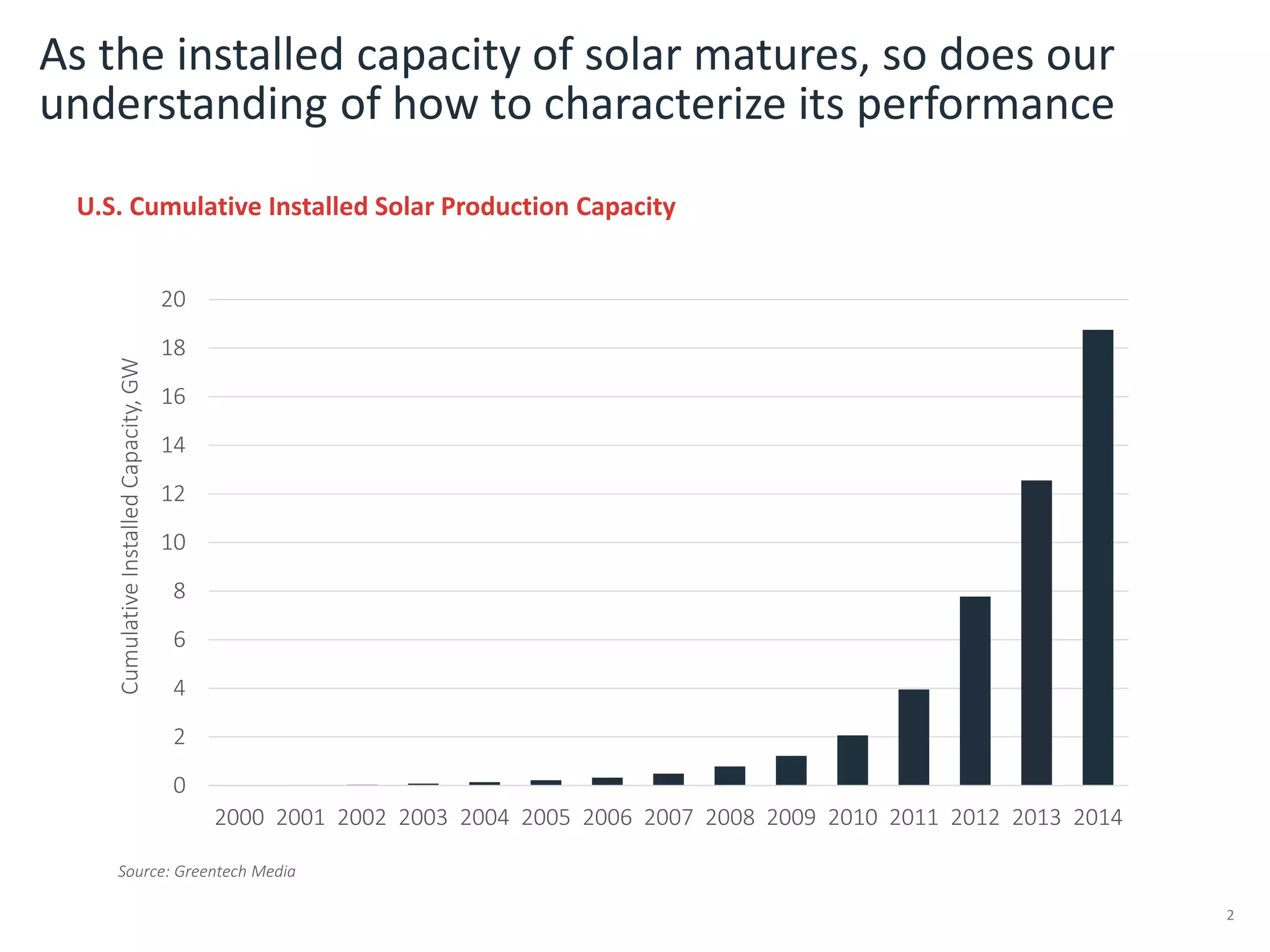
As the installed capacity of solar matures, so does our
understanding of how to characterize its performance
2
U.S. Cumulative Installed Solar Production Capacity
0
2
4
6
8
10
12
14
16
18
20
2000 2001 2002 2003 2004 2005 2006 2007 2008 2009 2010 2011 2012 2013 2014
CumulativeInstalledCapacity,GW
Source: Greentech Media
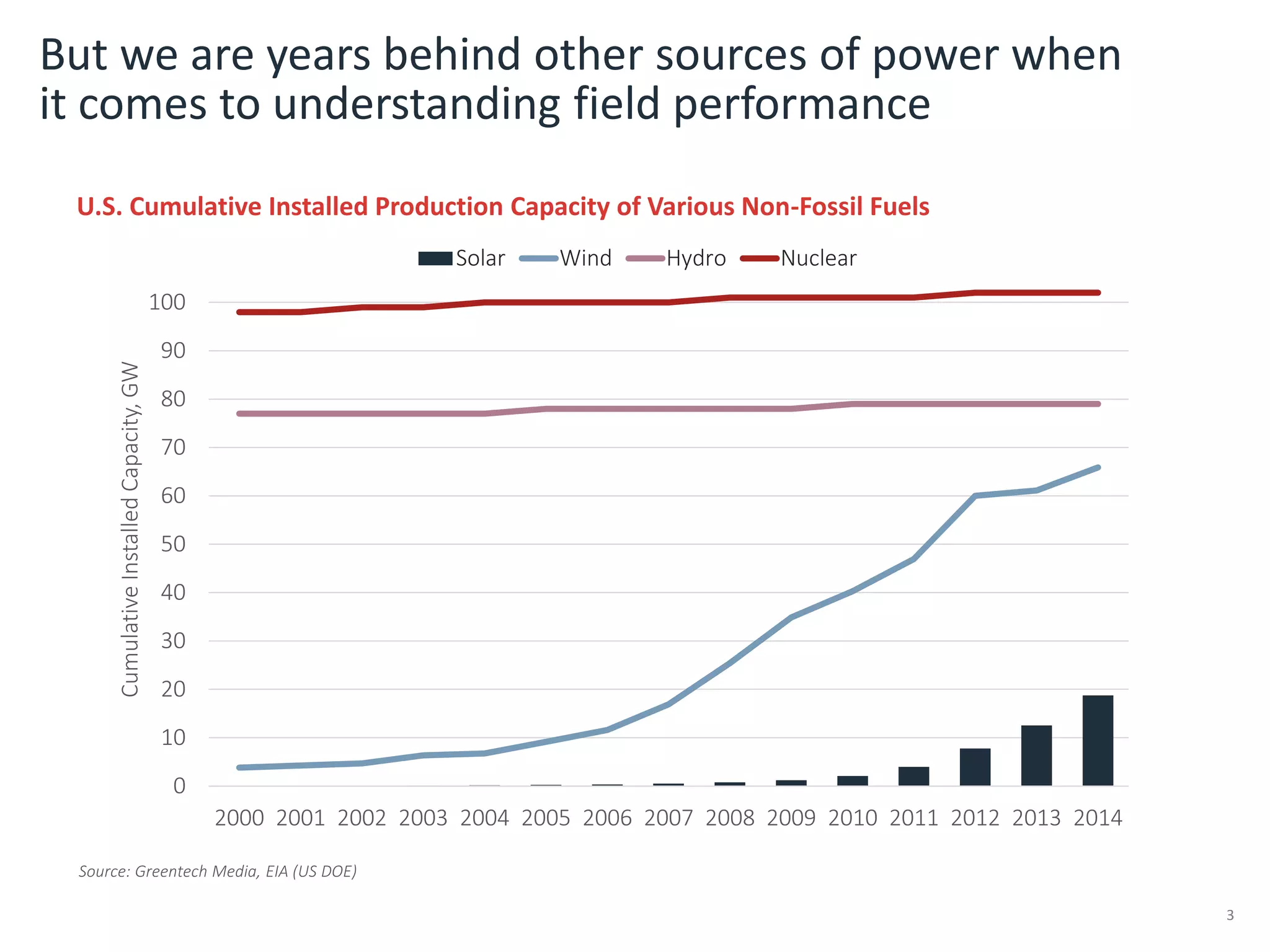
But we are years behind other sources of power when
it comes to understanding field performance
3
U.S. Cumulative Installed Production Capacity of Various Non-Fossil Fuels
Source: Greentech Media, EIA (US DOE)
0
10
20
30
40
50
60
70
80
90
100
2000 2001 2002 2003 2004 2005 2006 2007 2008 2009 2010 2011 2012 2013 2014
CumulativeInstalledCapacity,GW
Solar Wind Hydro Nuclear
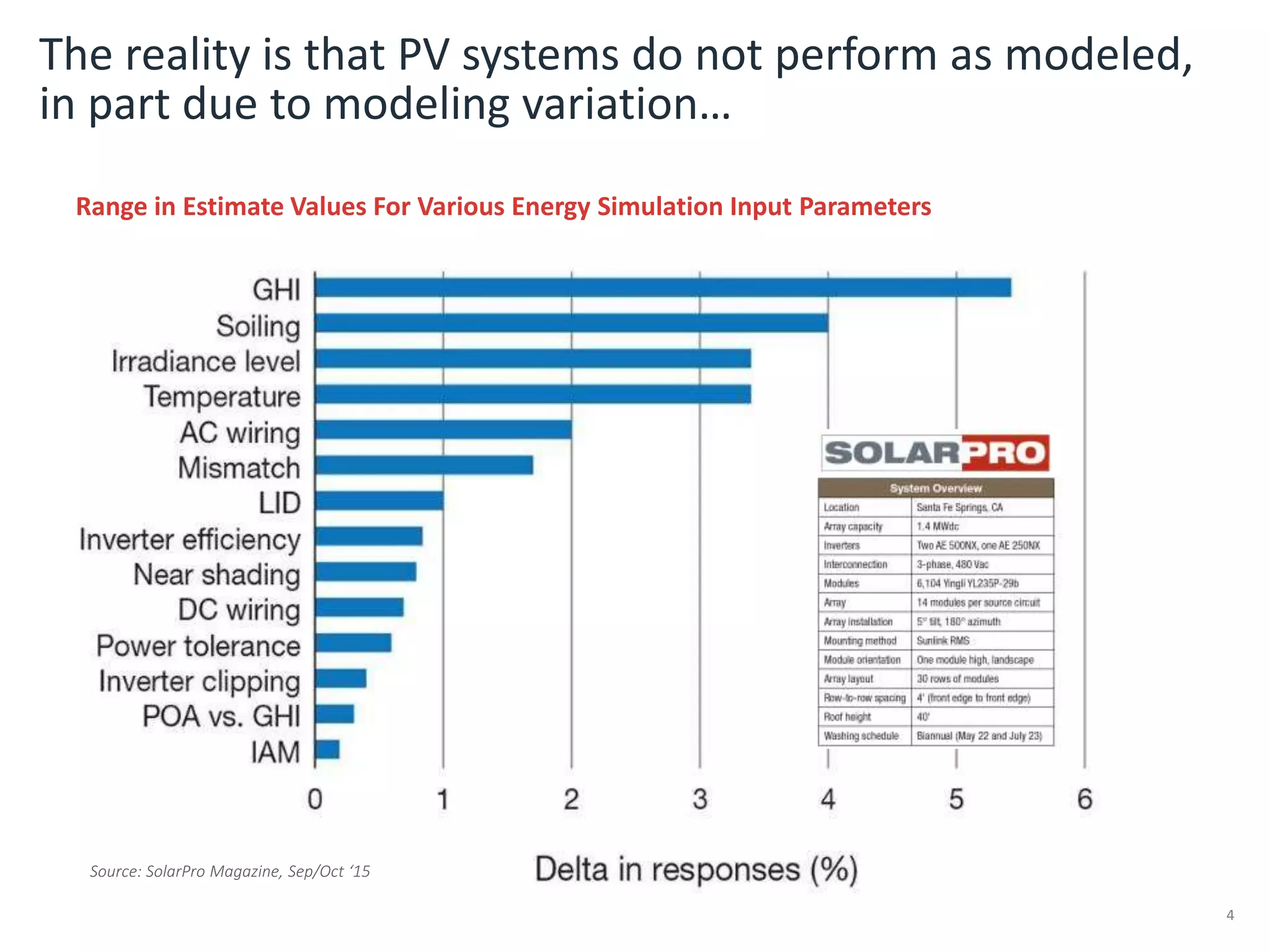
The reality is that PV systems do not perform as modeled,
in part due to modeling variation…
4
Range in Estimate Values For Various Energy Simulation Input Parameters
Source: SolarPro Magazine, Sep/Oct ‘15
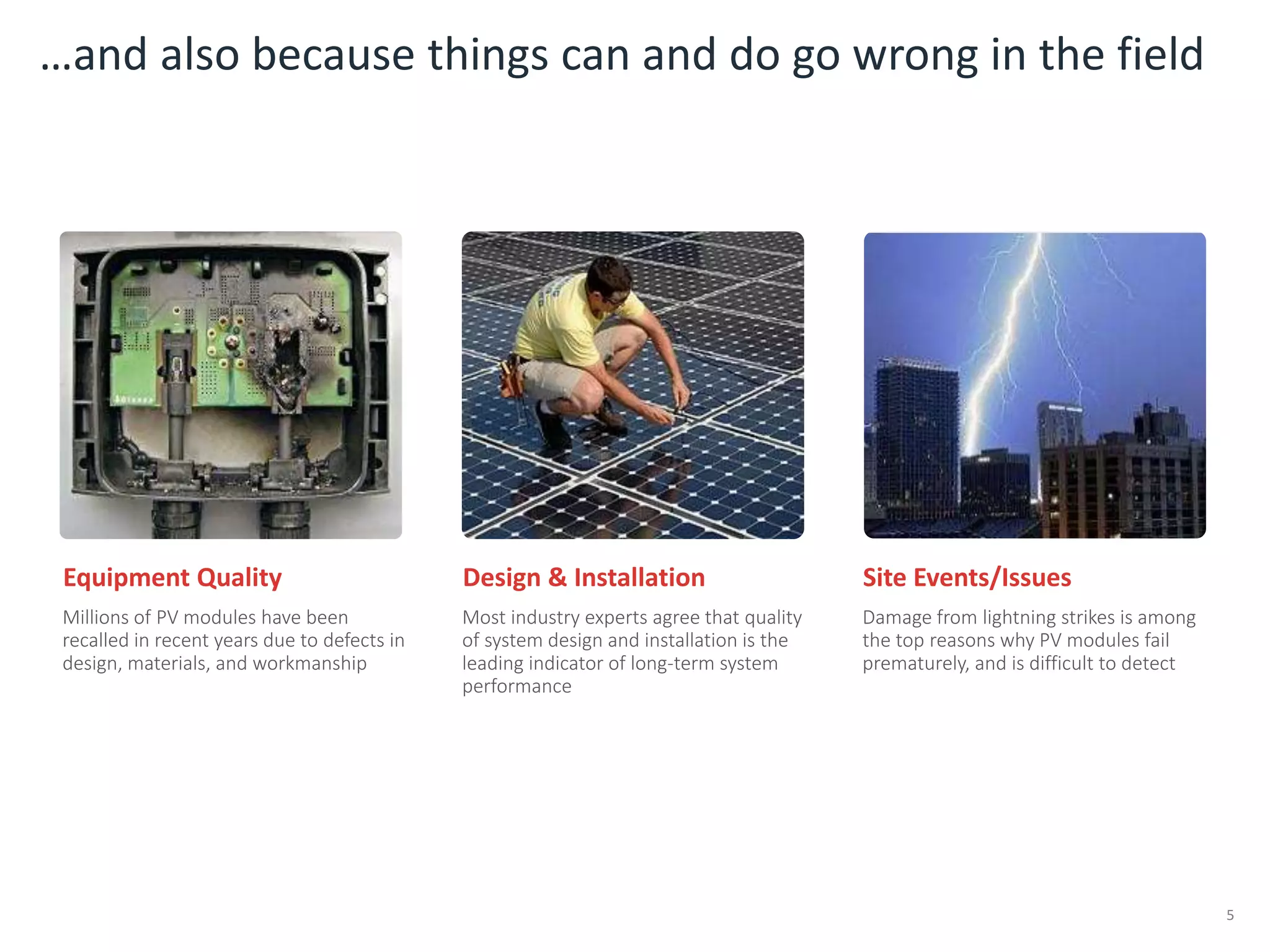
Millions of PV modules have been
recalled in recent years due to defects in
design, materials, and workmanship
…and also because things can and do go wrong in the field
Equipment Quality
Most industry experts agree that quality
of system design and installation is the
leading indicator of long-term system
performance
Design & Installation
Damage from lightning strikes is among
the top reasons why PV modules fail
prematurely, and is difficult to detect
Site Events/Issues
5
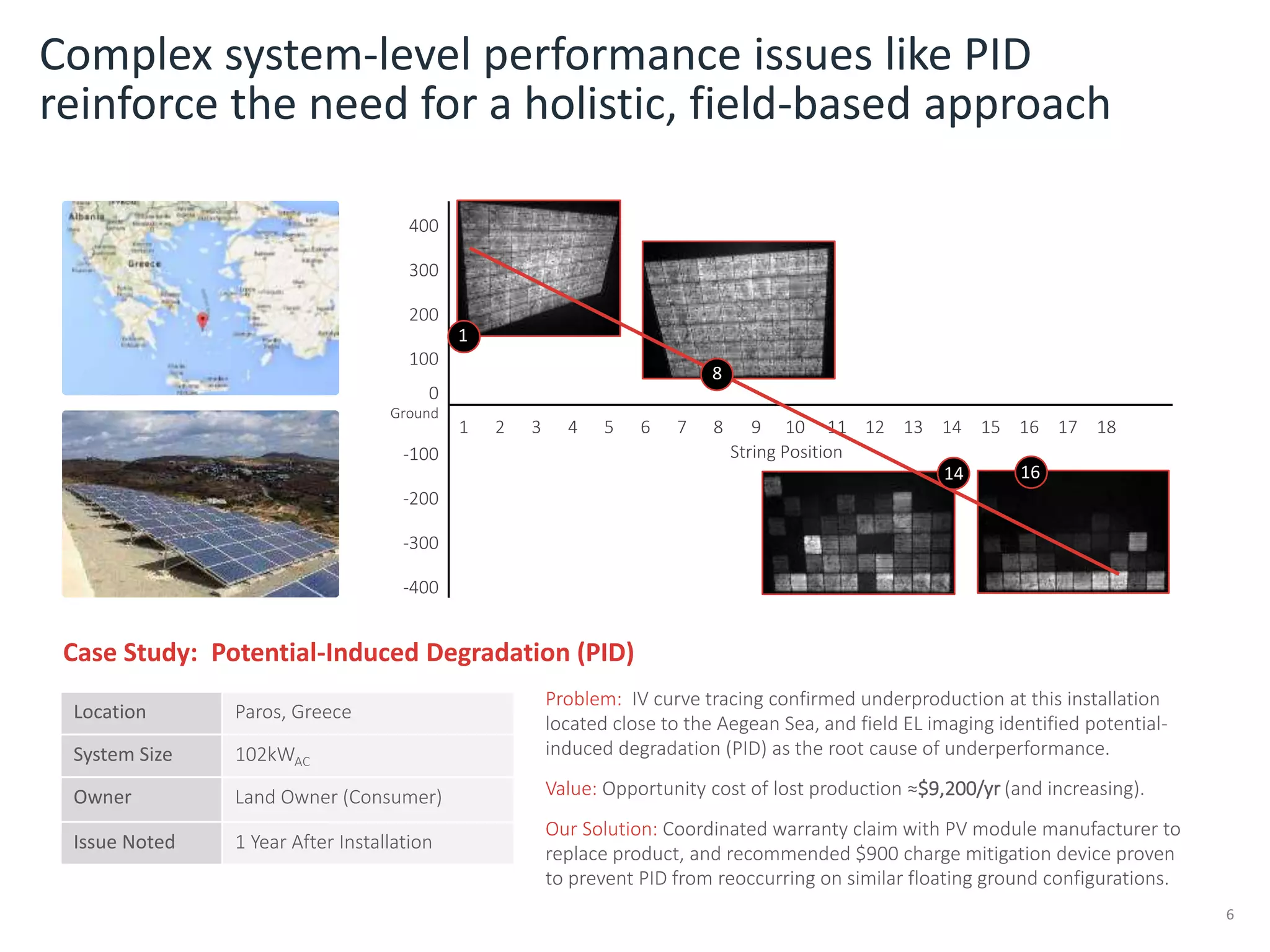
Problem: IV curve tracing confirmed underproduction at this installation
located close to the Aegean Sea, and field EL imaging identified potential-
induced degradation (PID) as the root cause of underperformance.
Value: Opportunity cost of lost production ≈$9,200/yr (and increasing).
Our Solution: Coordinated warranty claim with PV module manufacturer to
replace product, and recommended $900 charge mitigation device proven
to prevent PID from reoccurring on similar floating ground configurations.
Complex system-level performance issues like PID
reinforce the need for a holistic, field-based approach
6
Case Study: Potential-Induced Degradation (PID)
Location Paros, Greece
System Size 102kWAC
Owner Land Owner (Consumer)
Issue Noted 1 Year After Installation
400
300
200
100
0
Ground
-100
-200
-300
-400
1 2 3 4 5 6 7 8 9 10 11 12 13 14 15 16 17 18
String Position
16
8
14
1
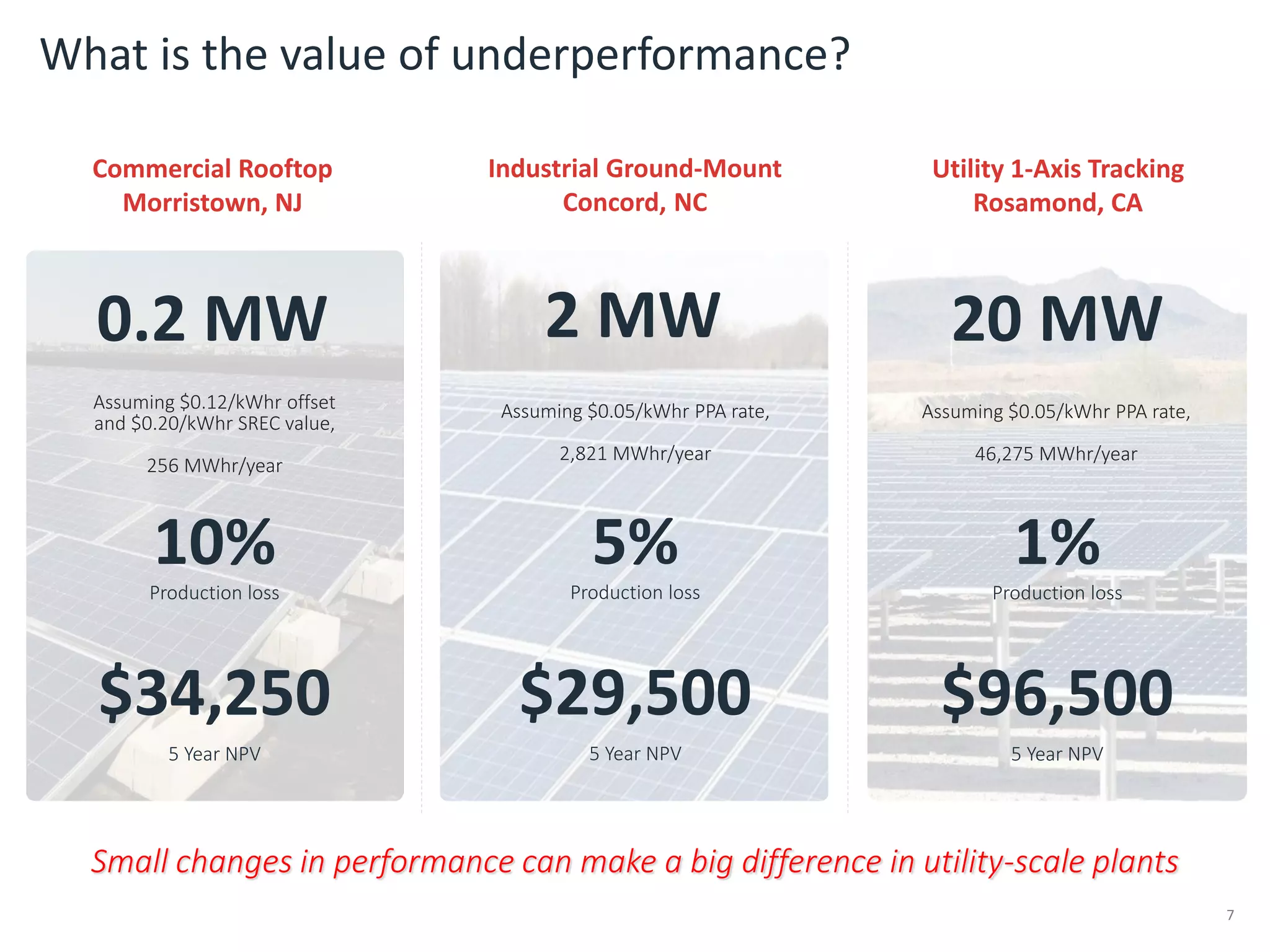
What is the value of underperformance?
7
Commercial Rooftop
Morristown, NJ
Assuming $0.12/kWhr offset
and $0.20/kWhr SREC value,
256 MWhr/year
10%
Production loss
$34,250
5 Year NPV
0.2 MW
Industrial Ground-Mount
Concord, NC
Assuming $0.05/kWhr PPA rate,
2,821 MWhr/year
5%
Production loss
$29,500
5 Year NPV
2 MW
Utility 1-Axis Tracking
Rosamond, CA
Assuming $0.05/kWhr PPA rate,
46,275 MWhr/year
1%
Production loss
$96,500
5 Year NPV
20 MW
Small changes in performance can make a big difference in utility-scale plants
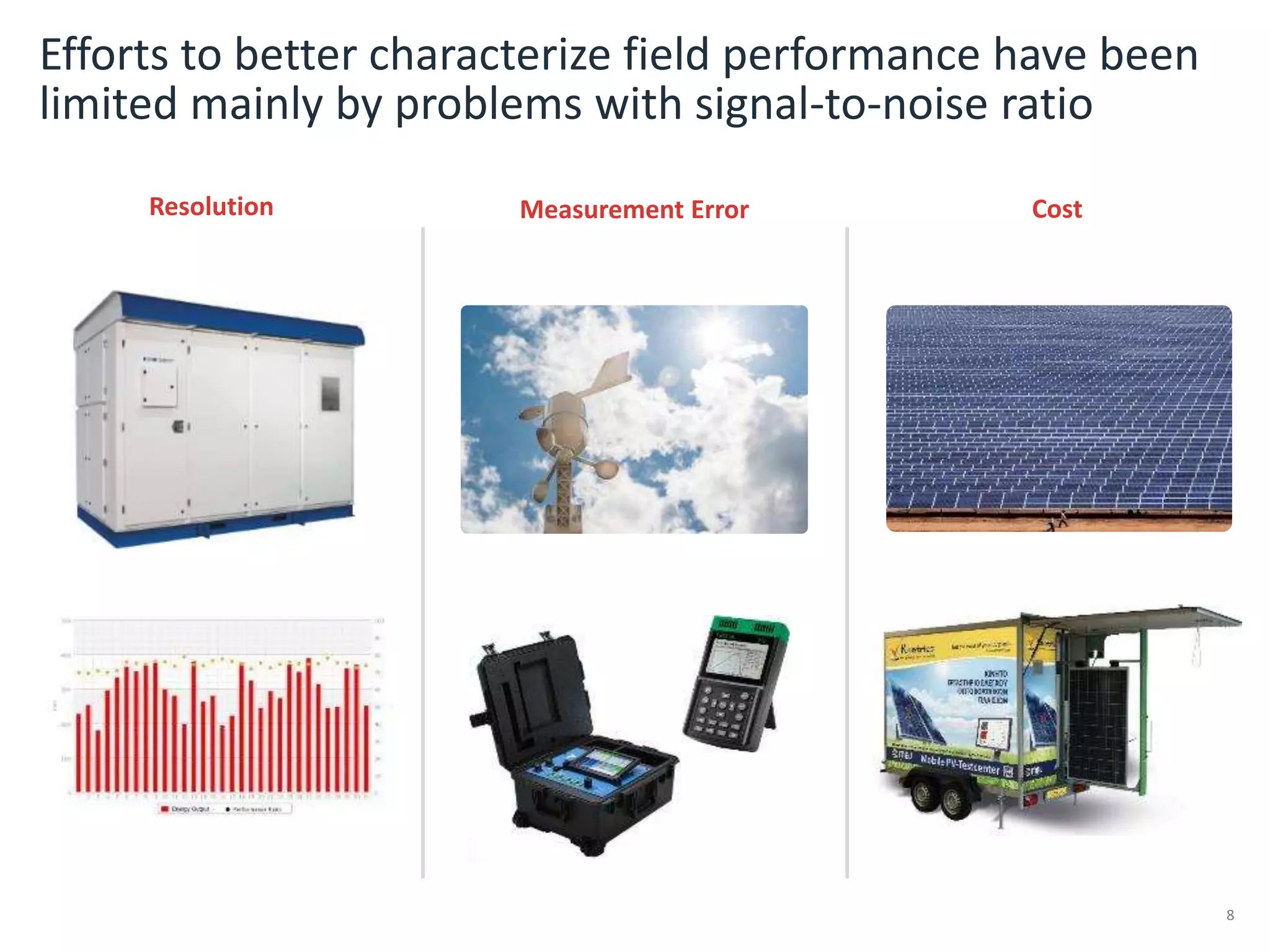
Efforts to better characterize field performance have been
limited mainly by problems with signal-to-noise ratio
8
Resolution Measurement Error Cost
9
What are some novel ways to address these challenges?
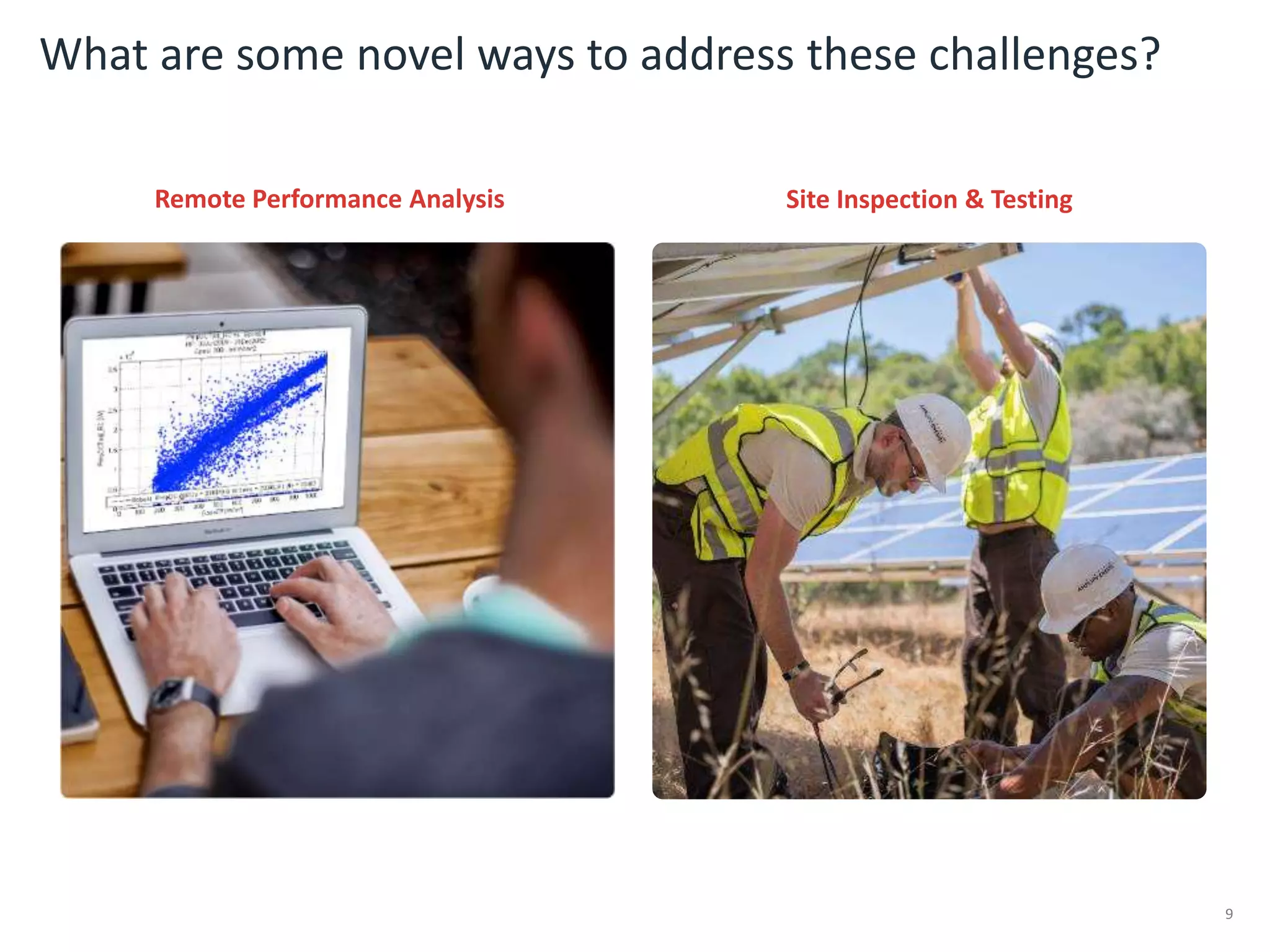
Remote Performance Analysis Site Inspection & Testing
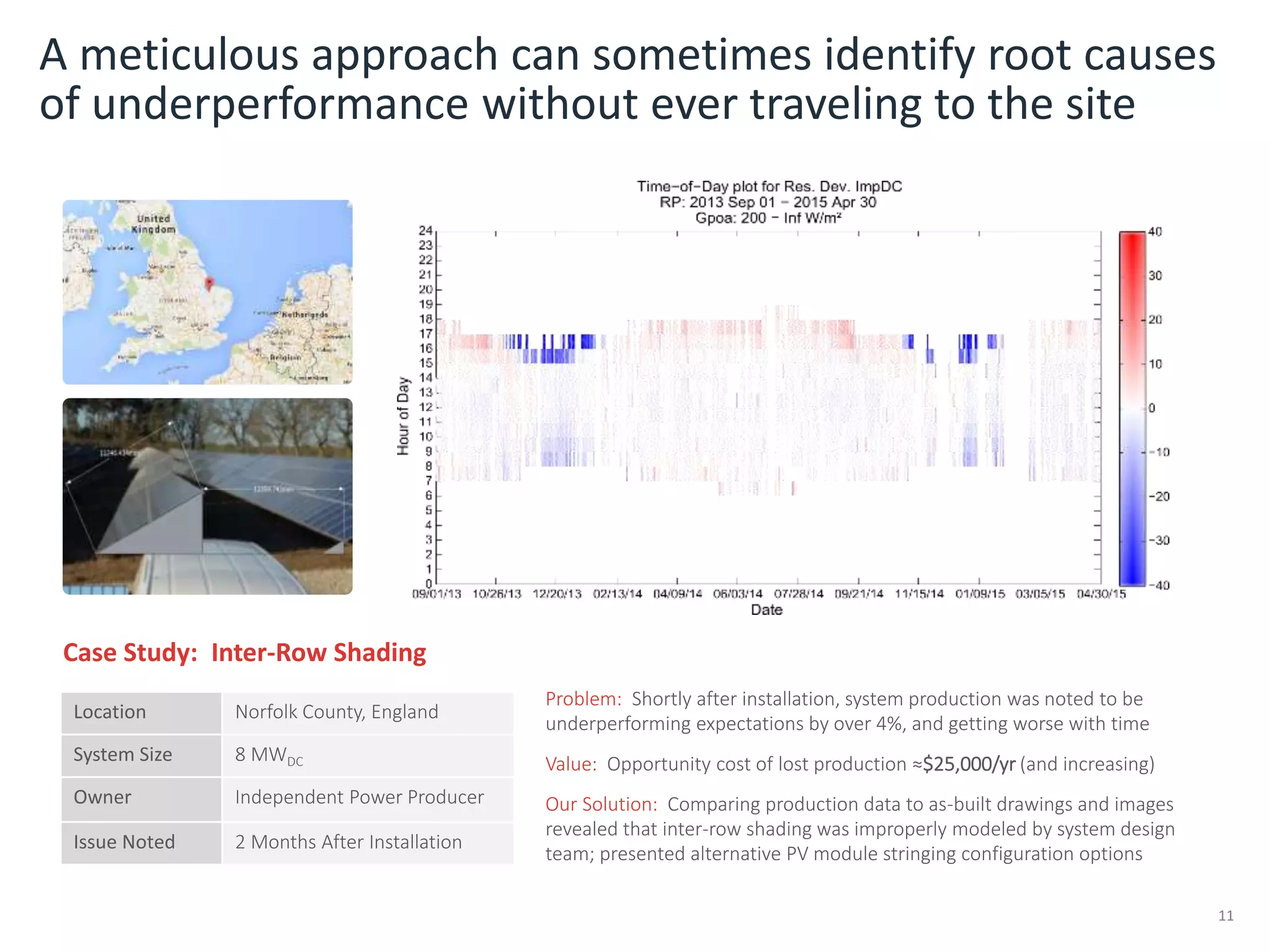
Performance audits can be done remotely but require
good data and a methodical approach to data processing
10
Scrubbing: Before key performance indicators
can be calculated, production and weather data
must be processed to account for:
• Bad data (duplicates, time shifts, errors)
• Downtime events (full and partial)
• Met station issues (drift, shading, error)
• Filtration (irradiance, variation, etc.)
Insights: Analysis of residuals, among other
methods, helps to visualize problems that may
otherwise go undetected
• Correlation coefficients
• Modeled/measured run charts
• Frequency distribution
True Up: Based on actual performance results,
Proforma energy simulation input parameters
can be corrected for more accurate forecasting
• Tilt and azimuth
• Thermal and IAM values
• .PAN file
Software should be able to analyze data at any sampling frequency or time period
Full System Downtime
Partial
Downtime
Pyranometer
Shading
Array
Shading
Problem: Shortly after installation, system production was noted to be
underperforming expectations by over 4%, and getting worse with time
Value: Opportunity cost of lost production ≈$25,000/yr (and increasing)
Our Solution: Comparing production data to as-built drawings and images
revealed that inter-row shading was improperly modeled by system design
team; presented alternative PV module stringing configuration options
A meticulous approach can sometimes identify root causes
of underperformance without ever traveling to the site
11
Case Study: Inter-Row Shading
Location Norfolk County, England
System Size 8 MWDC
Owner Independent Power Producer
Issue Noted 2 Months After Installation
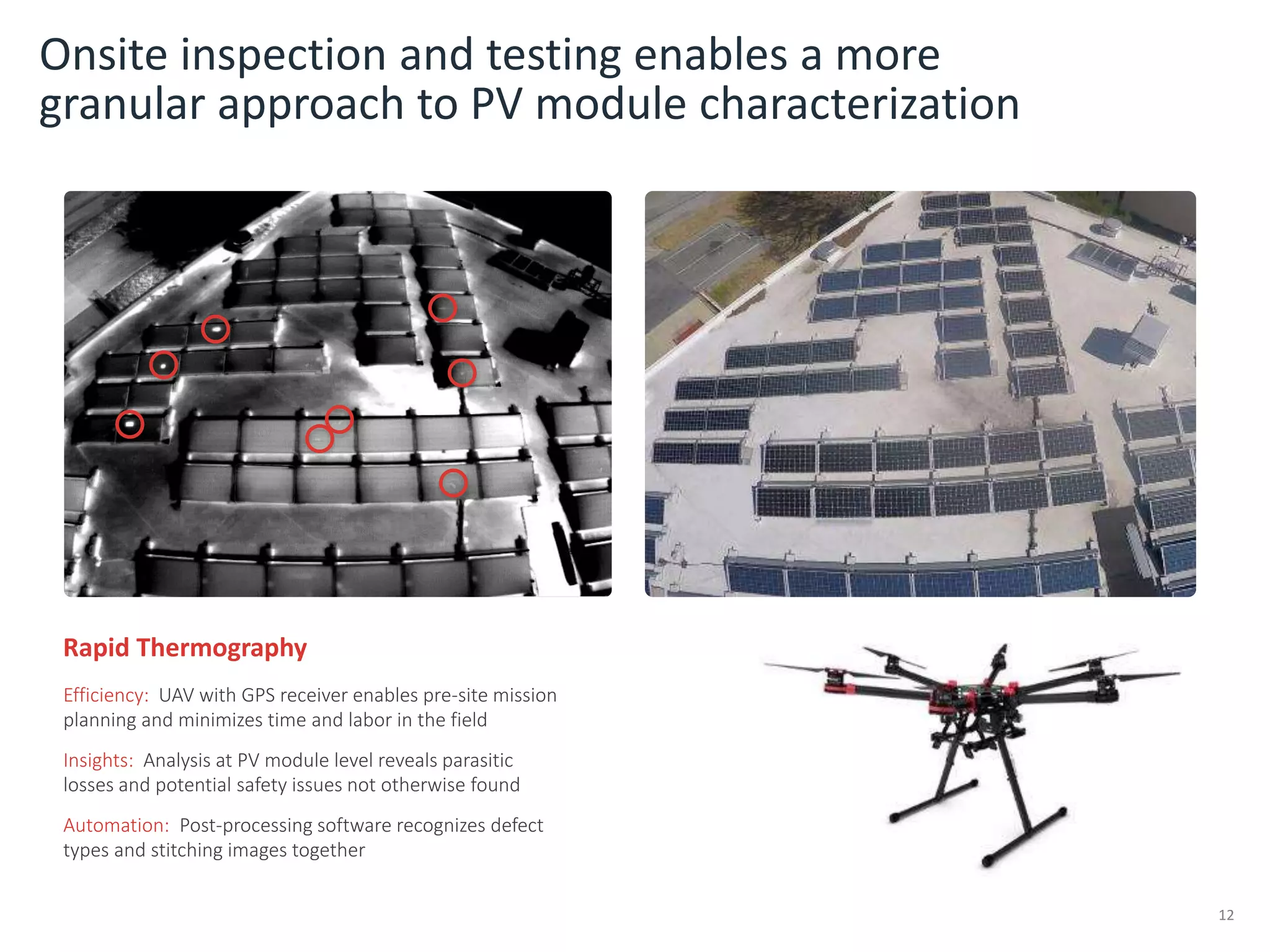
Onsite inspection and testing enables a more
granular approach to PV module characterization
12
Rapid Thermography
Efficiency: UAV with GPS receiver enables pre-site mission
planning and minimizes time and labor in the field
Insights: Analysis at PV module level reveals parasitic
losses and potential safety issues not otherwise found
Automation: Post-processing software recognizes defect
types and stitching images together
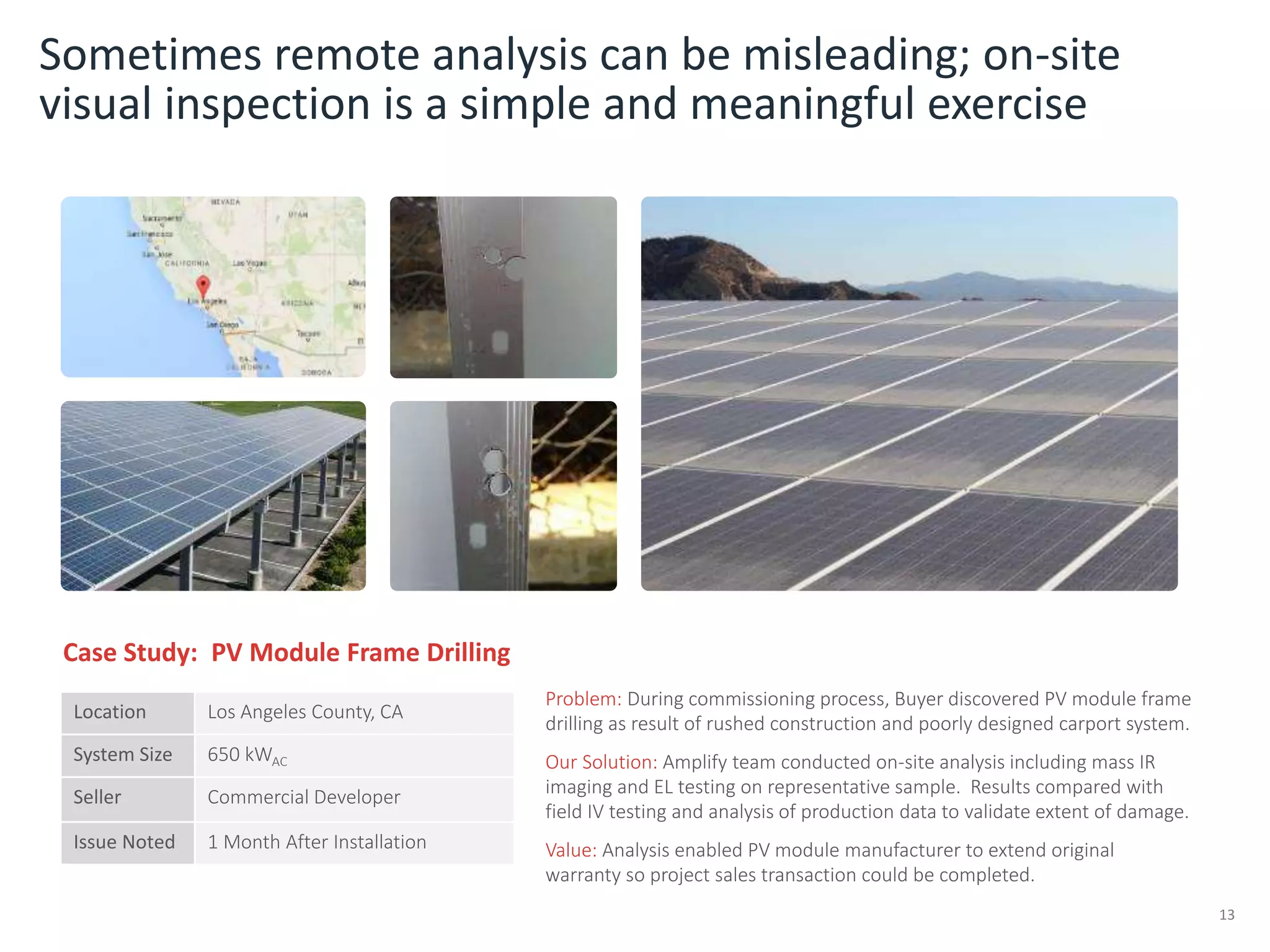
Problem: During commissioning process, Buyer discovered PV module frame
drilling as result of rushed construction and poorly designed carport system.
Our Solution: Amplify team conducted on-site analysis including mass IR
imaging and EL testing on representative sample. Results compared with
field IV testing and analysis of production data to validate extent of damage.
Value: Analysis enabled PV module manufacturer to extend original
warranty so project sales transaction could be completed.
Sometimes remote analysis can be misleading; on-site
visual inspection is a simple and meaningful exercise
13
Case Study: PV Module Frame Drilling
Location Los Angeles County, CA
System Size 650 kWAC
Seller Commercial Developer
Issue Noted 1 Month After Installation
4/25/2016
- Solar is still young
- PV Modules often don’t perform as expected
- Even small improvements can mean big savings
- A proper diagnosis requires the proper tools
14
4/25/2016
15
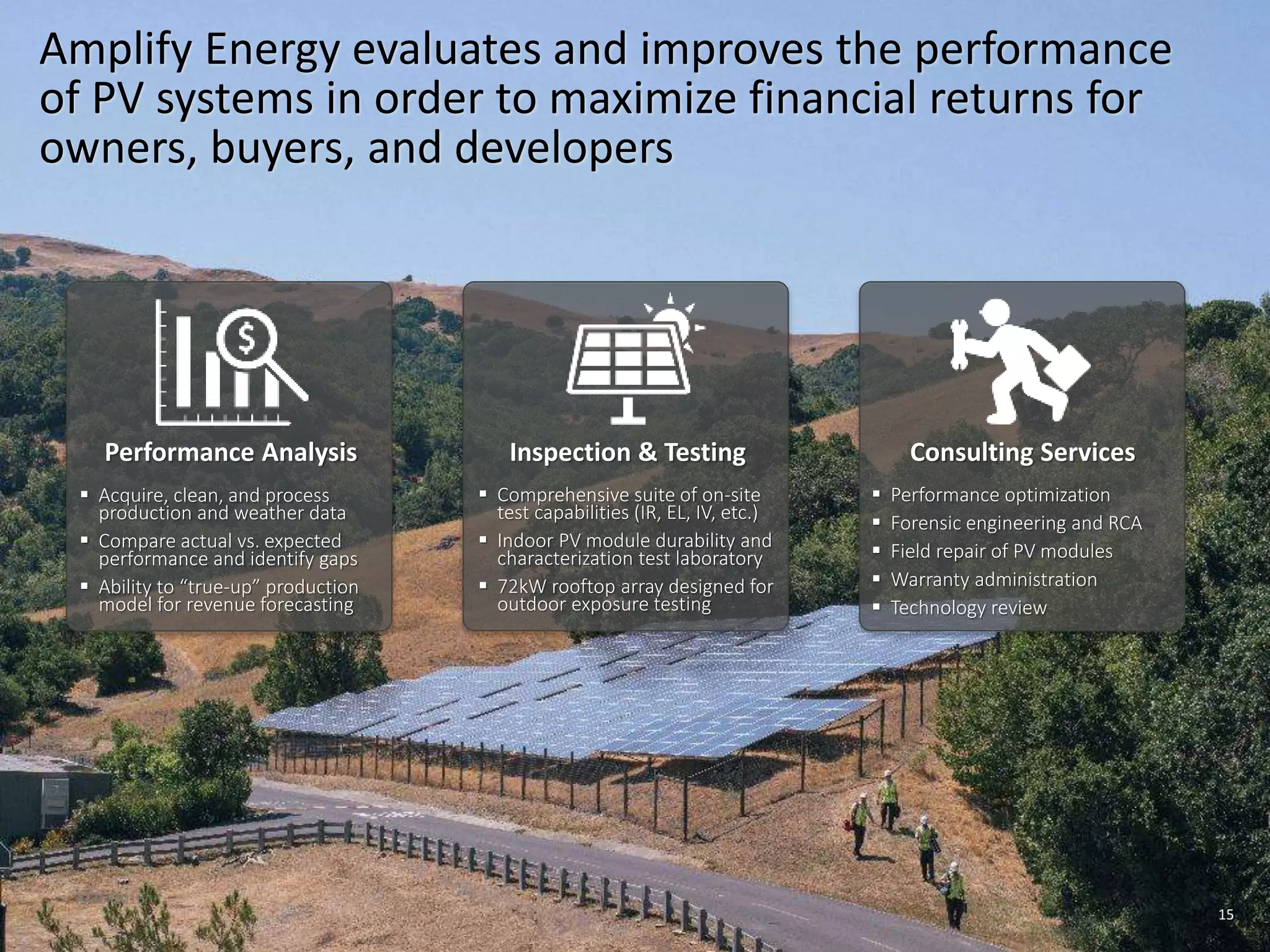
Amplify Energy evaluates and improves the performance
of PV systems in order to maximize financial returns for
owners, buyers, and developers
Inspection & Testing Consulting Services
 Acquire, clean, and process
production and weather data
 Compare actual vs. expected
performance and identify gaps
 Ability to “true-up” production
model for revenue forecasting
Performance Analysis
 Comprehensive suite of on-site
test capabilities (IR, EL, IV, etc.)
 Indoor PV module durability and
characterization test laboratory
 72kW rooftop array designed for
outdoor exposure testing
 Performance optimization
 Forensic engineering and RCA
 Field repair of PV modules
 Warranty administration
 Technology review
Thank you!
Follow us on social media
Join our newsletter
www.amplifyenergy.com

20151009 Amplify PVInsider

  • 1.
    Novel Methods forCharacterizing the Performance of Operating PV Systems Brian Grenko Chief Executive Officer October 20, 2015
  • 2.
    As the installedcapacity of solar matures, so does our understanding of how to characterize its performance 2 U.S. Cumulative Installed Solar Production Capacity 0 2 4 6 8 10 12 14 16 18 20 2000 2001 2002 2003 2004 2005 2006 2007 2008 2009 2010 2011 2012 2013 2014 CumulativeInstalledCapacity,GW Source: Greentech Media
  • 3.
    But we areyears behind other sources of power when it comes to understanding field performance 3 U.S. Cumulative Installed Production Capacity of Various Non-Fossil Fuels Source: Greentech Media, EIA (US DOE) 0 10 20 30 40 50 60 70 80 90 100 2000 2001 2002 2003 2004 2005 2006 2007 2008 2009 2010 2011 2012 2013 2014 CumulativeInstalledCapacity,GW Solar Wind Hydro Nuclear
  • 4.
    The reality isthat PV systems do not perform as modeled, in part due to modeling variation… 4 Range in Estimate Values For Various Energy Simulation Input Parameters Source: SolarPro Magazine, Sep/Oct ‘15
  • 5.
    Millions of PVmodules have been recalled in recent years due to defects in design, materials, and workmanship …and also because things can and do go wrong in the field Equipment Quality Most industry experts agree that quality of system design and installation is the leading indicator of long-term system performance Design & Installation Damage from lightning strikes is among the top reasons why PV modules fail prematurely, and is difficult to detect Site Events/Issues 5
  • 6.
    Problem: IV curvetracing confirmed underproduction at this installation located close to the Aegean Sea, and field EL imaging identified potential- induced degradation (PID) as the root cause of underperformance. Value: Opportunity cost of lost production ≈$9,200/yr (and increasing). Our Solution: Coordinated warranty claim with PV module manufacturer to replace product, and recommended $900 charge mitigation device proven to prevent PID from reoccurring on similar floating ground configurations. Complex system-level performance issues like PID reinforce the need for a holistic, field-based approach 6 Case Study: Potential-Induced Degradation (PID) Location Paros, Greece System Size 102kWAC Owner Land Owner (Consumer) Issue Noted 1 Year After Installation 400 300 200 100 0 Ground -100 -200 -300 -400 1 2 3 4 5 6 7 8 9 10 11 12 13 14 15 16 17 18 String Position 16 8 14 1
  • 7.
    What is thevalue of underperformance? 7 Commercial Rooftop Morristown, NJ Assuming $0.12/kWhr offset and $0.20/kWhr SREC value, 256 MWhr/year 10% Production loss $34,250 5 Year NPV 0.2 MW Industrial Ground-Mount Concord, NC Assuming $0.05/kWhr PPA rate, 2,821 MWhr/year 5% Production loss $29,500 5 Year NPV 2 MW Utility 1-Axis Tracking Rosamond, CA Assuming $0.05/kWhr PPA rate, 46,275 MWhr/year 1% Production loss $96,500 5 Year NPV 20 MW Small changes in performance can make a big difference in utility-scale plants
  • 8.
    Efforts to bettercharacterize field performance have been limited mainly by problems with signal-to-noise ratio 8 Resolution Measurement Error Cost
  • 9.
    9 What are somenovel ways to address these challenges? Remote Performance Analysis Site Inspection & Testing
  • 10.
    Performance audits canbe done remotely but require good data and a methodical approach to data processing 10 Scrubbing: Before key performance indicators can be calculated, production and weather data must be processed to account for: • Bad data (duplicates, time shifts, errors) • Downtime events (full and partial) • Met station issues (drift, shading, error) • Filtration (irradiance, variation, etc.) Insights: Analysis of residuals, among other methods, helps to visualize problems that may otherwise go undetected • Correlation coefficients • Modeled/measured run charts • Frequency distribution True Up: Based on actual performance results, Proforma energy simulation input parameters can be corrected for more accurate forecasting • Tilt and azimuth • Thermal and IAM values • .PAN file Software should be able to analyze data at any sampling frequency or time period Full System Downtime Partial Downtime Pyranometer Shading Array Shading
  • 11.
    Problem: Shortly afterinstallation, system production was noted to be underperforming expectations by over 4%, and getting worse with time Value: Opportunity cost of lost production ≈$25,000/yr (and increasing) Our Solution: Comparing production data to as-built drawings and images revealed that inter-row shading was improperly modeled by system design team; presented alternative PV module stringing configuration options A meticulous approach can sometimes identify root causes of underperformance without ever traveling to the site 11 Case Study: Inter-Row Shading Location Norfolk County, England System Size 8 MWDC Owner Independent Power Producer Issue Noted 2 Months After Installation
  • 12.
    Onsite inspection andtesting enables a more granular approach to PV module characterization 12 Rapid Thermography Efficiency: UAV with GPS receiver enables pre-site mission planning and minimizes time and labor in the field Insights: Analysis at PV module level reveals parasitic losses and potential safety issues not otherwise found Automation: Post-processing software recognizes defect types and stitching images together
  • 13.
    Problem: During commissioningprocess, Buyer discovered PV module frame drilling as result of rushed construction and poorly designed carport system. Our Solution: Amplify team conducted on-site analysis including mass IR imaging and EL testing on representative sample. Results compared with field IV testing and analysis of production data to validate extent of damage. Value: Analysis enabled PV module manufacturer to extend original warranty so project sales transaction could be completed. Sometimes remote analysis can be misleading; on-site visual inspection is a simple and meaningful exercise 13 Case Study: PV Module Frame Drilling Location Los Angeles County, CA System Size 650 kWAC Seller Commercial Developer Issue Noted 1 Month After Installation
  • 14.
    4/25/2016 - Solar isstill young - PV Modules often don’t perform as expected - Even small improvements can mean big savings - A proper diagnosis requires the proper tools 14
  • 15.
    4/25/2016 15 Amplify Energy evaluatesand improves the performance of PV systems in order to maximize financial returns for owners, buyers, and developers Inspection & Testing Consulting Services  Acquire, clean, and process production and weather data  Compare actual vs. expected performance and identify gaps  Ability to “true-up” production model for revenue forecasting Performance Analysis  Comprehensive suite of on-site test capabilities (IR, EL, IV, etc.)  Indoor PV module durability and characterization test laboratory  72kW rooftop array designed for outdoor exposure testing  Performance optimization  Forensic engineering and RCA  Field repair of PV modules  Warranty administration  Technology review
  • 16.
    Thank you! Follow uson social media Join our newsletter www.amplifyenergy.com