Mainstreaming DRM in Plan’s Development Work
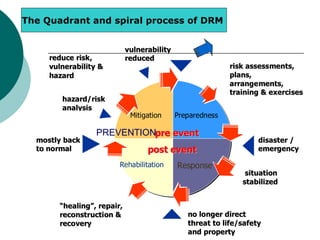
The Quadrant and spiral process of DRM
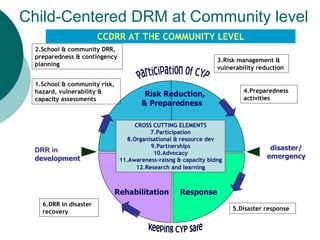
Child-Centered DRM at Community level
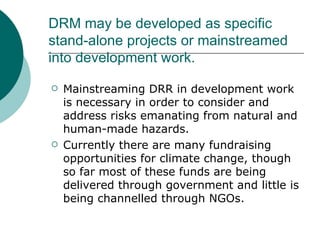
DRM may be developed as specific stand-alone projects or mainstreamed into development work. Mainstreaming DRR in development work is necessary in order to consider and address risks emanating from natural and human-made hazards.  Currently there are many fundraising opportunities for climate change, though so far most of these funds are being delivered through government and little is being channelled through NGOs.
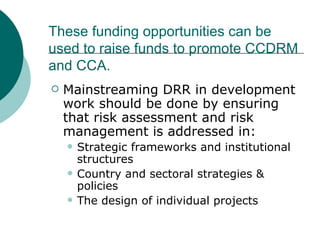
These funding opportunities can be used to raise funds to promote CCDRM and CCA. Mainstreaming DRR in development work should be done by ensuring that risk assessment and risk management is addressed in:  Strategic frameworks and institutional structures Country and sectoral strategies & policies The design of individual projects
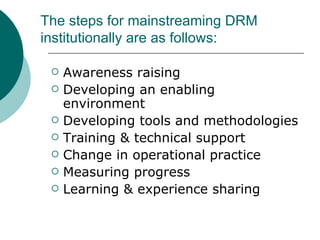
The steps for mainstreaming DRM institutionally are as follows:  Awareness raising Developing an enabling environment Developing tools and methodologies Training & technical support Change in operational practice Measuring progress Learning & experience sharing
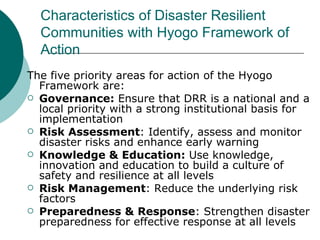
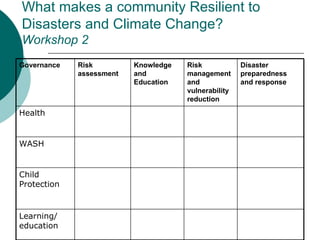
Characteristics of Disaster Resilient Communities with Hyogo Framework of Action The five priority areas for action of the Hyogo Framework are: Governance:  Ensure that DRR is a national and a local priority with a strong institutional basis for implementation Risk Assessment : Identify, assess and monitor disaster risks and enhance early warning Knowledge & Education:  Use knowledge, innovation and education to build a culture of safety and resilience at all levels Risk Management : Reduce the underlying risk factors Preparedness & Response : Strengthen disaster preparedness for effective response at all levels
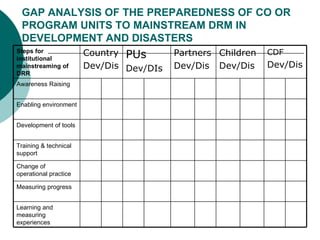
GAP ANALYSIS OF THE PREPAREDNESS OF CO OR PROGRAM UNITS TO MAINSTREAM DRM IN DEVELOPMENT AND DISASTERS Learning and measuring experiences Measuring progress Change of operational practice Training & technical support Development of tools Enabling environment Awareness Raising CDF  Dev/Dis Children Dev/Dis Partners Dev/Dis PUs Dev/DIs Country Dev/Dis Steps for institutional mainstreaming of DRR
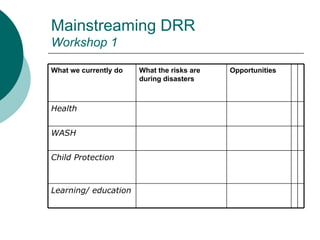
Mainstreaming DRR Workshop 1 Learning/ education  Child Protection WASH Health Opportunities  What the risks are during disasters What we currently do
What makes a community Resilient to Disasters and Climate Change? Workshop 2 Learning/ education  Child Protection WASH Health Disaster preparedness and response Risk management and vulnerability reduction Knowledge and Education Risk assessment Governance
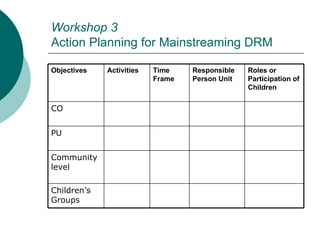
Workshop 3 Action Planning for Mainstreaming DRM Children’s Groups  Community level  PU CO  Roles or Participation of Children  Responsible Person Unit Time Frame Activities  Objectives
 

Mainstreaming drr in plan’s development work nepal

  • 1.
    Mainstreaming DRM inPlan’s Development Work
  • 2.
    The Quadrant andspiral process of DRM
  • 3.
    Child-Centered DRM atCommunity level
  • 4.
    DRM may bedeveloped as specific stand-alone projects or mainstreamed into development work. Mainstreaming DRR in development work is necessary in order to consider and address risks emanating from natural and human-made hazards. Currently there are many fundraising opportunities for climate change, though so far most of these funds are being delivered through government and little is being channelled through NGOs.
  • 5.
    These funding opportunitiescan be used to raise funds to promote CCDRM and CCA. Mainstreaming DRR in development work should be done by ensuring that risk assessment and risk management is addressed in: Strategic frameworks and institutional structures Country and sectoral strategies & policies The design of individual projects
  • 6.
    The steps formainstreaming DRM institutionally are as follows: Awareness raising Developing an enabling environment Developing tools and methodologies Training & technical support Change in operational practice Measuring progress Learning & experience sharing
  • 7.
    Characteristics of DisasterResilient Communities with Hyogo Framework of Action The five priority areas for action of the Hyogo Framework are: Governance: Ensure that DRR is a national and a local priority with a strong institutional basis for implementation Risk Assessment : Identify, assess and monitor disaster risks and enhance early warning Knowledge & Education: Use knowledge, innovation and education to build a culture of safety and resilience at all levels Risk Management : Reduce the underlying risk factors Preparedness & Response : Strengthen disaster preparedness for effective response at all levels
  • 8.
    GAP ANALYSIS OFTHE PREPAREDNESS OF CO OR PROGRAM UNITS TO MAINSTREAM DRM IN DEVELOPMENT AND DISASTERS Learning and measuring experiences Measuring progress Change of operational practice Training & technical support Development of tools Enabling environment Awareness Raising CDF Dev/Dis Children Dev/Dis Partners Dev/Dis PUs Dev/DIs Country Dev/Dis Steps for institutional mainstreaming of DRR
  • 9.
    Mainstreaming DRR Workshop1 Learning/ education Child Protection WASH Health Opportunities What the risks are during disasters What we currently do
  • 10.
    What makes acommunity Resilient to Disasters and Climate Change? Workshop 2 Learning/ education Child Protection WASH Health Disaster preparedness and response Risk management and vulnerability reduction Knowledge and Education Risk assessment Governance
  • 11.
    Workshop 3 ActionPlanning for Mainstreaming DRM Children’s Groups Community level PU CO Roles or Participation of Children Responsible Person Unit Time Frame Activities Objectives
  • 12.