Cygnus Satellite LLC Design Report
Aman Sharma | John Gehrke | Brandon Keeber
Eduardo Asuaje | Jacob Korinko | Vaibhav Menon
Ira A. Fulton Schools of Engineering
1
Contents
List of Figures 4
List of Tables 6
1 Nomenclature 7
2 Introduction 9
2.1 Executive Overview . . . . . . . . . . . . . . . . . . . . . . . . . . . . 9
3 Preliminary Design 10
3.1 Potential Approaches . . . . . . . . . . . . . . . . . . . . . . . . . . . 10
3.2 Stakeholders . . . . . . . . . . . . . . . . . . . . . . . . . . . . . . . . 11
3.2.1 Mission Objective Stakeholders . . . . . . . . . . . . . . . . . 11
3.3 Top-Level Requirements . . . . . . . . . . . . . . . . . . . . . . . . . 11
3.3.1 Mission Overview . . . . . . . . . . . . . . . . . . . . . . . . . 11
3.3.2 Sizing . . . . . . . . . . . . . . . . . . . . . . . . . . . . . . . 12
3.3.3 Orbit . . . . . . . . . . . . . . . . . . . . . . . . . . . . . . . . 12
3.3.4 Structure . . . . . . . . . . . . . . . . . . . . . . . . . . . . . 12
3.3.5 Thermal . . . . . . . . . . . . . . . . . . . . . . . . . . . . . . 12
3.3.6 Attitude Determination and Control (ADCS) . . . . . . . . . 12
3.3.7 Telemetry, Tracking, and Control (TT&C) . . . . . . . . . . . 12
3.3.8 Propulsion . . . . . . . . . . . . . . . . . . . . . . . . . . . . . 12
3.3.9 Command and Data Handling (C&DH) . . . . . . . . . . . . . 12
3.3.10 Power . . . . . . . . . . . . . . . . . . . . . . . . . . . . . . . 13
3.3.11 Risk . . . . . . . . . . . . . . . . . . . . . . . . . . . . . . . . 13
4 Mission Analysis 13
4.1 Concept of Operations . . . . . . . . . . . . . . . . . . . . . . . . . . 13
4.1.1 Overview . . . . . . . . . . . . . . . . . . . . . . . . . . . . . 13
4.1.2 Mission Phases . . . . . . . . . . . . . . . . . . . . . . . . . . 13
4.2 Orbit . . . . . . . . . . . . . . . . . . . . . . . . . . . . . . . . . . . . 16
4.2.1 Orbit Design . . . . . . . . . . . . . . . . . . . . . . . . . . . 16
4.2.2 Orbit Analysis . . . . . . . . . . . . . . . . . . . . . . . . . . . 17
5 Payload Design 19
5.1 Gain . . . . . . . . . . . . . . . . . . . . . . . . . . . . . . . . . . . . 19
5.2 Beam Trade Study . . . . . . . . . . . . . . . . . . . . . . . . . . . . 19
5.3 Antenna Trade Study . . . . . . . . . . . . . . . . . . . . . . . . . . . 20
5.4 Frequency Band . . . . . . . . . . . . . . . . . . . . . . . . . . . . . . 22
5.5 Link Budget Analysis . . . . . . . . . . . . . . . . . . . . . . . . . . . 23
5.6 Hardware and Bandwidth . . . . . . . . . . . . . . . . . . . . . . . . 25
6 Subsystems 27
6.1 Structure . . . . . . . . . . . . . . . . . . . . . . . . . . . . . . . . . 27
6.2 Thermal . . . . . . . . . . . . . . . . . . . . . . . . . . . . . . . . . . 32
6.3 Attitude Control . . . . . . . . . . . . . . . . . . . . . . . . . . . . . 39
6.3.1 Star Tracker . . . . . . . . . . . . . . . . . . . . . . . . . . . . 39
6.3.2 Reaction Wheels . . . . . . . . . . . . . . . . . . . . . . . . . 40
2
6.3.3 Inertial Measurement Unit (IMU) . . . . . . . . . . . . . . . . 41
6.3.4 Disturbance Torques . . . . . . . . . . . . . . . . . . . . . . . 42
6.4 Telemetry, Tracking, and Command . . . . . . . . . . . . . . . . . . . 44
6.4.1 Introduction . . . . . . . . . . . . . . . . . . . . . . . . . . . . 44
6.4.2 Assumptions . . . . . . . . . . . . . . . . . . . . . . . . . . . . 44
6.4.3 System Interfacing . . . . . . . . . . . . . . . . . . . . . . . . 44
6.4.4 Cygnus TT&C . . . . . . . . . . . . . . . . . . . . . . . . . . 46
6.5 Propulsion System . . . . . . . . . . . . . . . . . . . . . . . . . . . . 49
6.5.1 Selection . . . . . . . . . . . . . . . . . . . . . . . . . . . . . . 49
6.5.2 Sizing . . . . . . . . . . . . . . . . . . . . . . . . . . . . . . . 49
6.5.3 Apogee Kick Motor . . . . . . . . . . . . . . . . . . . . . . . . 50
6.5.4 Reaction Control System (RCS) Thrusters . . . . . . . . . . . 51
6.5.5 Propellant Manifold . . . . . . . . . . . . . . . . . . . . . . . 52
6.6 Power System . . . . . . . . . . . . . . . . . . . . . . . . . . . . . . . 55
7 Risk and Cost Analysis 62
7.1 Risk and Reliability Analysis . . . . . . . . . . . . . . . . . . . . . . . 62
7.2 Cost . . . . . . . . . . . . . . . . . . . . . . . . . . . . . . . . . . . . 64
8 Gallery 66
References 79
3
List of Figures
1 Cost Summary of Satellite . . . . . . . . . . . . . . . . . . . . . . . . 9
2 Power Summary of Satellite . . . . . . . . . . . . . . . . . . . . . . . 10
3 Concept of Operations . . . . . . . . . . . . . . . . . . . . . . . . . . 15
4 Orbit Trade Study . . . . . . . . . . . . . . . . . . . . . . . . . . . . 17
5 LEO . . . . . . . . . . . . . . . . . . . . . . . . . . . . . . . . . . . . 18
6 GTO . . . . . . . . . . . . . . . . . . . . . . . . . . . . . . . . . . . . 18
7 Launch Characteristics . . . . . . . . . . . . . . . . . . . . . . . . . . 19
8 Spot Beam vs. Broad Beam[12] . . . . . . . . . . . . . . . . . . . . . 20
9 Parabolic Reflector Dish . . . . . . . . . . . . . . . . . . . . . . . . . 21
10 Shaped Reflector Antenna . . . . . . . . . . . . . . . . . . . . . . . . 21
11 Range of Frequency Bands . . . . . . . . . . . . . . . . . . . . . . . . 22
12 Cost vs. Availability . . . . . . . . . . . . . . . . . . . . . . . . . . . 23
13 Link Budget . . . . . . . . . . . . . . . . . . . . . . . . . . . . . . . . 24
14 Amplifier Trade Study[23] . . . . . . . . . . . . . . . . . . . . . . . . 25
15 TWTA Amplifier [10] . . . . . . . . . . . . . . . . . . . . . . . . . . . 26
16 Polarization Architecture . . . . . . . . . . . . . . . . . . . . . . . . . 26
17 Static Stress Analysis . . . . . . . . . . . . . . . . . . . . . . . . . . . 28
18 Deformation . . . . . . . . . . . . . . . . . . . . . . . . . . . . . . . . 29
19 Side View of Satellite Structure . . . . . . . . . . . . . . . . . . . . . 30
20 Structure Mass Summary . . . . . . . . . . . . . . . . . . . . . . . . . 31
21 Temperature Range . . . . . . . . . . . . . . . . . . . . . . . . . . . . 32
22 Temperature Variation for Satellite’s Antennas . . . . . . . . . . . . . 33
23 Temperature Variation for Satellite’s Solar Arrays . . . . . . . . . . . 34
24 Temperature Variation for Satellite’s Main Structure . . . . . . . . . 35
25 Temperature Variation for Satellite’s Batteries . . . . . . . . . . . . . 36
26 Temperature Variation for Satellites Transponders . . . . . . . . . . . 37
27 Temperature Variation for Satellite’s Propellant Tanks . . . . . . . . 38
28 ADCS Summary . . . . . . . . . . . . . . . . . . . . . . . . . . . . . 39
29 Trade Study between Attitude Determination Systems . . . . . . . . 39
30 Jena-Optronik Astro APS . . . . . . . . . . . . . . . . . . . . . . . . 40
31 Honeywell HR12s Reaction Wheel . . . . . . . . . . . . . . . . . . . . 41
32 ASTRIX 1090 . . . . . . . . . . . . . . . . . . . . . . . . . . . . . . . 41
33 Angle Perturbation due to Solar Torque . . . . . . . . . . . . . . . . 42
34 Wheel Properties . . . . . . . . . . . . . . . . . . . . . . . . . . . . . 43
35 System Interfaces [23] . . . . . . . . . . . . . . . . . . . . . . . . . . . 45
36 TT&C Requirements . . . . . . . . . . . . . . . . . . . . . . . . . . . 46
37 TT&C Block Diagram [23] . . . . . . . . . . . . . . . . . . . . . . . . 47
38 TT&C Parameters . . . . . . . . . . . . . . . . . . . . . . . . . . . . 47
39 TT&C Sizing . . . . . . . . . . . . . . . . . . . . . . . . . . . . . . . 48
40 Propulsion System . . . . . . . . . . . . . . . . . . . . . . . . . . . . 50
41 Apogee Kick Motor (AKM) . . . . . . . . . . . . . . . . . . . . . . . 50
42 Apogee Kick Motor Specs[2] . . . . . . . . . . . . . . . . . . . . . . . 51
43 RCS Thrusters . . . . . . . . . . . . . . . . . . . . . . . . . . . . . . 51
44 RCS Thruster Specs[3] . . . . . . . . . . . . . . . . . . . . . . . . . . 52
45 Propellant Manifold Block Diagram . . . . . . . . . . . . . . . . . . . 53
46 Propulsion Subsystem Weight and Power . . . . . . . . . . . . . . . . 54
47 Sum of all Subsystem Power Requirements . . . . . . . . . . . . . . . 55
4
48 Candidate Solar Cell Properties[23] . . . . . . . . . . . . . . . . . . . 56
49 Triple Junction GaAs Cell [26] . . . . . . . . . . . . . . . . . . . . . . 57
50 Solar Array Exploded View . . . . . . . . . . . . . . . . . . . . . . . 57
51 Calculation of Solar Array . . . . . . . . . . . . . . . . . . . . . . . . 57
52 Single DOF Solar Gimbal Motor [27] . . . . . . . . . . . . . . . . . . 58
53 PCDU [28] . . . . . . . . . . . . . . . . . . . . . . . . . . . . . . . . . 59
54 Depth of Discharge vs. Cycle [23] . . . . . . . . . . . . . . . . . . . . 60
55 Trade Study of Battery Characteristics . . . . . . . . . . . . . . . . . 60
56 Lithium Cobalt Oxide Battery Unit [18] . . . . . . . . . . . . . . . . 60
57 Cost of Solar Cell Technologies [23] . . . . . . . . . . . . . . . . . . . 61
58 Cost Calculation of Carbon Fiber Cloth [15] . . . . . . . . . . . . . . 61
59 Cost of Various Types of Batteries . . . . . . . . . . . . . . . . . . . 61
60 Battery Capacity . . . . . . . . . . . . . . . . . . . . . . . . . . . . . 61
61 Failure Graphs [8] . . . . . . . . . . . . . . . . . . . . . . . . . . . . . 62
62 Probability . . . . . . . . . . . . . . . . . . . . . . . . . . . . . . . . 62
63 Impact . . . . . . . . . . . . . . . . . . . . . . . . . . . . . . . . . . . 63
64 Impact . . . . . . . . . . . . . . . . . . . . . . . . . . . . . . . . . . . 63
65 Impact . . . . . . . . . . . . . . . . . . . . . . . . . . . . . . . . . . . 63
66 USCMB Non-Recurring . . . . . . . . . . . . . . . . . . . . . . . . . 64
67 USCMB Recurring . . . . . . . . . . . . . . . . . . . . . . . . . . . . 65
68 Application of USCMB . . . . . . . . . . . . . . . . . . . . . . . . . . 65
69 Side Exploded View . . . . . . . . . . . . . . . . . . . . . . . . . . . 66
70 Isometric Packed Payload . . . . . . . . . . . . . . . . . . . . . . . . 66
71 Side Packed Payload . . . . . . . . . . . . . . . . . . . . . . . . . . . 67
72 Space Side Assembly . . . . . . . . . . . . . . . . . . . . . . . . . . . 67
73 Communications Compartment . . . . . . . . . . . . . . . . . . . . . 68
74 Power Compartment . . . . . . . . . . . . . . . . . . . . . . . . . . . 68
75 Packed Upper Compartment . . . . . . . . . . . . . . . . . . . . . . . 69
76 Emergency and Launch Antenna . . . . . . . . . . . . . . . . . . . . 69
77 Battery Assembly . . . . . . . . . . . . . . . . . . . . . . . . . . . . . 70
78 Antenna Assembly . . . . . . . . . . . . . . . . . . . . . . . . . . . . 70
79 Computer . . . . . . . . . . . . . . . . . . . . . . . . . . . . . . . . . 71
80 Propulsion Compartment . . . . . . . . . . . . . . . . . . . . . . . . . 71
81 Transmitter & Receiver Antennae . . . . . . . . . . . . . . . . . . . . 72
82 Thrust and Interlock ESPA Manifold . . . . . . . . . . . . . . . . . . 72
83 Gyroscope . . . . . . . . . . . . . . . . . . . . . . . . . . . . . . . . . 73
84 Input/Output Multiplexer . . . . . . . . . . . . . . . . . . . . . . . . 73
85 Power Condition and Distribution Unit . . . . . . . . . . . . . . . . . 73
86 RCS Thruster . . . . . . . . . . . . . . . . . . . . . . . . . . . . . . . 74
87 Reaction Wheels . . . . . . . . . . . . . . . . . . . . . . . . . . . . . 74
88 Star Tracker . . . . . . . . . . . . . . . . . . . . . . . . . . . . . . . . 75
89 TT&C Antenna . . . . . . . . . . . . . . . . . . . . . . . . . . . . . . 75
90 Emergency Antenna . . . . . . . . . . . . . . . . . . . . . . . . . . . 76
91 Battery Array . . . . . . . . . . . . . . . . . . . . . . . . . . . . . . . 76
92 Apogee Kick Motor . . . . . . . . . . . . . . . . . . . . . . . . . . . . 77
93 Solar Array Gimbal . . . . . . . . . . . . . . . . . . . . . . . . . . . . 77
94 Transponder . . . . . . . . . . . . . . . . . . . . . . . . . . . . . . . . 78
95 Travelling Wave Tube Amplifier Array . . . . . . . . . . . . . . . . . 78
5
List of Tables
1 Frequency Band Trade Study . . . . . . . . . . . . . . . . . . . . . . 22
6
1 Nomenclature
Aeff = Effective Area
λ = Wavelength
η = Efficiency
D = Diameter of Antenna
Psa = Solar Array Power Output Requirement
Pe = Spacecraft Power Requirement during Eclipse
Pd = Spacecraft Power Requirement during Daylight
Te = Eclipse Period
Td = Daylight Period
Xe = Power System Path Efficiency during Eclipse
Xd = Power System Path Efficiency during Daylight
Po = Solar Array Power Output at Beginning of Life
PBOL = Solar Array Power Output at Beginning of Life
PEOL = Solar Array Power Output at End of Life
Id = Inherent Degradation
I = Current
R = Resistance
Vbus = Selected Bus Voltage
DOD = Depth of Discharge
ηb = Efficiency Between Battery and Load
ηcell = Efficiency of Gallium Arsenide Solar Cell
Nbat = Number of Batteries Required
Cbat = Battery Energy Capacity Required
Cactual = Actual Capacity of Selected Battery
Ue = Exhaust Speed
Isp = Specific Impulse
go = Gravitational acceleration of Earth at Sea Level
Mp = Propellant mass
OF = Oxidizer to Fuel Ratio
Mox = Oxidizer Mass
Mfu = Fuel Mass
Vp = Propellant Tank Volume
ρp = density of propellant at 323 K
ρox = density of oxidizer at 323 K
ρfu = density of fuel at 323 K
MT = Tank Mass
Mgas = Mass of Pressurant Gas
P = End of Life Tank Pressure
Rgas = Specific gas constant of Pressurant Gas
T = End of Life Tank Temperature
ρ = Density of Pressurant Gas
Vpres = Volume of pressurant gas
TF = Thrust
∆V = Change in velocity
mo = Beginning of Life Mass of Satellite
mf = End of Life Mass of Satellite
fn = Fundamental Frequency
7
do = Outer Diameter
di = Inner Diameter
E = Modulus of Elasticity
Ls = Structure Length
Ms = Structure Mass
IA = Area Moment of Inertia
8
2 Introduction
The objective of this mission was to design, analyze, and build a direct broadcast
satellite (DBS) for a primary customer. The satellite had to be capable of providing
broadcast television to specific end users situated anywhere within the contiguous
United States. It was necessary to design robust electronic and mechanical compo-
nents capable of surviving the harsh space environment for a designated number of
years. Additionally and most importantly, the satellite needed to provide dependable
and consistent service to the end user in order to remain a competitive consumer op-
tion. This report was written from the perspective of Cygnus Satellite LLC, tasked
with the responsibility of performing all necessary trade studies and analyses regard-
ing orbit and payloads, in addition to cost, risk, and schedule analysis. By utilizing
computer software such as, SolidWorks, Thermica, MATLAB etc., the company was
able to design a sophisticated satellite and assemble a comprehensive report detailing
subsystem configurations and other essential pertinent information.
2.1 Executive Overview
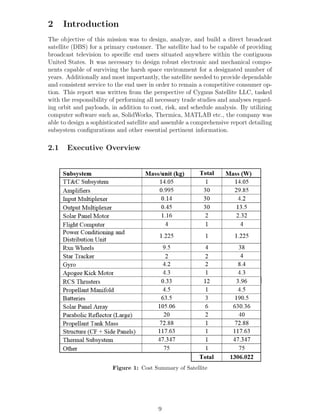
Figure 1: Cost Summary of Satellite
9
Figure 2: Power Summary of Satellite
3 Preliminary Design
3.1 Potential Approaches
The first step of the initial analysis was to decide the functionality of the satellite.
This depended on the stakeholders of the satellite and the consumer market. The first
option was to create a satellite to broadcast internet. These satellites are typically
put into a geosynchronous orbit in a constellation configuration. This orbit allows
for greater coverage but it also increases the signals latency to roughly 20 times that
of a terrestrial internet network. Operating at this orbit also significantly increases
the delay to receive the data. This data speed can be on the order of two magnitudes
slower than current high speed internet services. To overcome this problem a large
low earth orbit constellation would be needed to provide coverage to the entire United
States. Creating a constellation like this would be expensive and not practical for
this mission.
The next option was a telephone satellite. Similar to satellites that provide
internet access, a large constellation at LEO or GEO would be needed to provide
complete coverage across the country. This type of satellite also required a significant
amount of ground based stations and other infrastructure to work properly. In
addition, there was a significant amount of competition already in this space with
large constellations that provide coverage to the entire planet.
The last option was to broadcast television. There are two types of television
satellites, fixed satellite service (FSS) and direct broadcast service (DBS). FSS pro-
vides service either directly to a home satellite dish or to a ground station. This
technology has been in use since the 1970s and has since been replaced by DBS. FSS
satellites require much larger satellite dishes than their DBS counterpart and are
less widely used by satellite television providers. In some cases, television providers
receive data using a fixed satellite service but then re-broadcast the data using a
direct broadcast satellite. Based on this, a direct broadcast satellite was the best
option.
10
Currently, most satellite television providers use direct broadcast satellites. DBS
requires a significantly smaller satellite dish than FSS which makes it easier for the
consumer to have at their home. This cuts down on infrastructure costs of having
an Earth based station and increases access to consumers. Direct broadcast satel-
lites currently operate on the Ku band but there have been experimental satellites
provided by NASA and DirecTV that operate on the Ka band. This research and
advancement could open up a wide range of bandwidths in which to broadcast data
in the future. Recently, there have been advancements in providing mobile reception
for airlines, recreational vehicles and multiple military applications. These markets
provide potential markets for future company growth. Overall, the design of a direct
broadcast satellite was the best option due to reduced infrastructure needed, a wide
unsaturated consumer market, and the potential for future company expansion.
3.2 Stakeholders
The stakeholders for a communication satellite include the primary customer, sec-
ondary customer, operator, and end user. In most cases, the primary customer is the
stakeholder that finances and owns the communication satellite, and facilitates the
transmission of data to it. The secondary customer is a stakeholder that may have
financed or launched the communication satellite, and benefits from it. The operator
is responsible for overseeing most or all functions of the communication satellite, and
is held responsible if the satellite fails. The operator is therefore also considered a
stakeholder. The end user is the final stakeholder because they receive the data from
the primary customer.
3.2.1 Mission Objective Stakeholders
In this paper, a scenario is considered in which DirecTV has requested Cygnus Satel-
lite LLC to build a state of the art communication satellite that is capable of receiving
and transmitting television broadcast to its customers in the 48 contiguous United
States. While DirecTV will need Cygnus to operate the satellite in geosynchronous
orbit (GEO), a third party will be employed to provide launch services.
For this scenario, the stakeholders will include DirecTV which is the Primary
customer, with Cygnus Satellite LLC acting as the Operator. For the secondary
user, SpaceX has been selected to act as the launch provider, and television-watching
customers will play the role of end users.
3.3 Top-Level Requirements
3.3.1 Mission Overview
The satellite shall provide 552 stations of uninterrupted High-Definition Television
(HDTV) via direct broadcast downlink to customers in the Contiguous United States
(CONUS). The mission duration shall not exceed 15 years from final orbit acquisition.
All electronic systems aboard the satellite shall be radiation hardened and have the
capability to function fully in the space environment for the entirety of the mission
duration.
11
3.3.2 Sizing
In terms of physical restraints, the satellite shall not exceed the allowable mass
determined by the launch vehicle capabilities. The dimensions of the satellite shall
also not exceed the dimensional constraints determined by the launch vehicle fairing
geometry.
3.3.3 Orbit
The mission orbit for the satellite shall be kept at a geosynchronous equatorial orbit.
The inclination of the satellite shall be 0 degrees with an allowable error of plus/minus
0.05 degrees, measured from the center of Earth. Longitudinal drift shall not exceed
plus/minus 0.05 degrees. Disposal of the satellite at EOL shall consist of a graveyard
re-orbiting maneuver of at least 300 km.
3.3.4 Structure
The structure of the satellite shall be capable of withstanding all loadings during
launch, deployment, and nominal operations.
3.3.5 Thermal
The thermal subsystem of the satellite shall be able to regulate and collect/transmit
data for the thermal environment aboard the satellite. All subsystems shall be kept
within their respective operating limits.
3.3.6 Attitude Determination and Control (ADCS)
The attitude of the satellite shall be determined and controlled by a three-axis stabi-
lization system consisting of reaction wheels and RCS thrusters. A pointing accuracy
of a TBD amount shall be set to meet communications payload and TT&C require-
ments.
3.3.7 Telemetry, Tracking, and Control (TT&C)
Telemetry, tracking, and control of the satellite shall be handled via a single ground
station during nominal operations, accessible 24/7. TT&C during launch operations
shall be handled by a capable third-party satellite tracking network.
3.3.8 Propulsion
The satellite propulsion system shall be capable of delivering the spacecraft to mission
orbit and be able to maintain this station for the entirety of the mission duration.
3.3.9 Command and Data Handling (C&DH)
The spacecraft computer shall have the capability to collect, interpret, and transmit
all necessary data aboard the satellite.
12
3.3.10 Power
The power subsystem shall be able to provide constant power needed to keep the
satellite active during both nominal operations and eclipse periods. Onboard bat-
teries shall be capable of sustaining satellite systems through the duration of the
mission without exceeding an acceptable depth of discharge. Solar panels shall be
capable of recharging the batteries and supplying power to the satellite during non-
eclipse periods. The choice for solar panels shall be made with the consideration of
degradation in such a way that the EOL power does not fall below acceptable levels
at any point during the mission.
3.3.11 Risk
Risk shall be mitigated effectively in all aspects of the satellite system. Factors of
safety, budget limits, and redundancy shall be investigated in order to minimize the
possibility of system or mission failure.
4 Mission Analysis
4.1 Concept of Operations
4.1.1 Overview
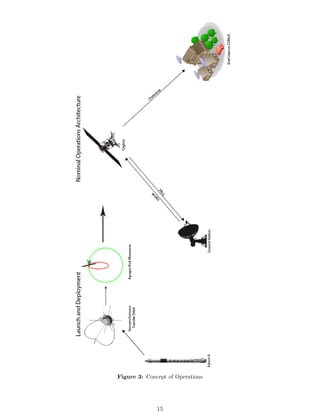
The Cygnus Satellite Concept of Operations consists of four mission phases. Pre-
launch operations includes all functions up to the actual launch of the satellite system.
Launch and deployment of the satellite system includes all functions and operations
up to the deployment of the system to geosynchronous equatorial orbit (GEO). The
on-orbit portion is by far the most important part of the mission, as it includes all
nominal operations of the system, and is crucial to achieving the mission objective.
Finally, the end-of-life (EOL) phase of the mission is a small but necessary part of
the operations, and includes the steps that will be taken to ensure compliance with
all mandates regarding spacecraft disposal.
4.1.2 Mission Phases
4.1.2.1 Pre-Launch Operations The Cygnus Satellite system shall be assem-
bled and shipped in such a way that it will require minimal handling and mainte-
nance prior to launch. The batteries will be charged and a check of all subsystem
functionality must be performed. Solar panels should be folded into their launch con-
figurations, and the explosive bolt system for the deployment of the solar panels will
be primed, with the torsional springs already installed and tensioned. The satellite
will be attached to the launch vehicle fairing, along with six other small cube-sat sys-
tems from groups that will share the launch cost. The launch vehicle payload fairing
will be attached to the main body and prepared for launch. All Cygnus subsystems
will be inert during launch.
4.1.2.2 Launch and Deployment The spacecraft will be deployed into geosyn-
chronous transfer orbit (GTO) by the launch vehicle via an ejection system integrated
into the launch vehicle coupler. During this time, a third party spacecraft tracking
network will be tracking the system. At the time of Cygnus deployment, the six
13
cube-sats will also deploy and carry out their various missions separately; the pay-
load fairing will separate, and the solar panels will deploy. When the system detects
separation from the launch vehicle, all TT&C components will come online, and the
ADCS system will autonomously attempt to orient the antennas to open ground
station communication. Once a stable orientation is found and the satellite is able
to establish TT&C communication, the system will be ready to initiate the apogee
kick maneuver to circularize and obtain the required mission orbit. Following the
apogee kick maneuver, the system will be ready to proceed with on-orbit operations.
4.1.2.3 On-Orbit Operations The Cygnus Satellite payload will begin nom-
inal operations once antenna pointing is verified. The ground station will uplink
data to the satellite where it is processed and then transmitted to the user (down-
link). During this time, the ADCS and TT&C systems will be working to ensure
proper attitude, altitude, and health of the spacecraft. The power subsystem will en-
sure power distribution throughout the life of the satellite, including solar array use
during nominal operations and battery use during eclipse periods, and the thermal
subsystem will regulate the thermal environment during these periods.
4.1.2.4 End of Life Operations After 15 years of nominal operations, the satel-
lite system will be re-orbited to a graveyard orbit. Once the satellite is re-orbited,
Cygnus will end operations with this specific spacecraft.
14
Figure 3: Concept of Operations
15
4.2 Orbit
4.2.1 Orbit Design
In choosing which type of orbit to place a communications satellite (comsat) in, a
number of factors needed to be considered in light of the desired mission objectives.
Factors such as inclination, altitude, eccentricity, perigee, and ascending node all
interdependently affect the structure of the comsat program and must be considered
when making all major design decisions.
Deciding the basic mission profile is a direct antecedent to the orbit design. An
alternative mission profile to the one assigned was considered in which a comsat would
be placed in orbit around the Earth-Moon L2 Lagrange point, and act as a targeted
repeater station for high-bandwidth signals between the Earth and a hypothetical
lunar colony. The trajectory necessary to place such a satellite in the required orbit
would be highly advanced, consisting of a unique parabolic Earth escape-trajectory
and a complex series course alterations. Based on the highly time-limited nature of
this class, this mission will not be attempted at this time.
In the case of a communication satellite providing HD TV coverage to the con-
tiguous United States, orbit type can be either Low Earth Orbit (LEO), MEO, GEO,
or Elliptical. Each orbit has distinct advantages and disadvantages. In the case of a
LEO or MEO orbit, the decreased distance between the ground stations and satellite
is ideal for applications with a low tolerance for signal delay. Decreased signal lag
would of course also increase the efficiency of an HD TV broadcast, but due to the
modern practice of introducing a censor delay into TV broadcasts, it would be rather
unnecessary. In addition, by placing a comsat in LEO, the decreased Earth surface
covered per satellite necessitates that a constellation (fleet) of satellites be employed
in order to ensure continuous coverage, a vastly more expensive and high-risk option.
For these reasons, the most cost-effective and efficient orbit to place Cygnus into
would be a geostationary one. One positive implication this has on the mission
profile is a reduced orbital maintenance cost, reducing the need for large amounts of
maneuvering propellant. At the altitude required for GEO ( 35,000 km), atmospheric
density nears that of a perfect vacuum, imparting a negligible drag force, even over
long periods of time. The 0◦
latitude of the GEOs equatorial orbit minimizes the
J2 anomalys perturbing effects on the satellite, leaving only solar radiation pressure
and 3-body perturbations to account for.
16
Figure 4: Orbit Trade Study
4.2.2 Orbit Analysis
Presented in fig. 5. are the ∆V estimates for the satellite transfer from a parking
low Earth orbit of 555.6km to a geosynchronous orbit of 35,789km. In order to
make the decision for a final launch site we investigated six different launch locations
around the world. The initial mass of the satellite is assumed to be 2669.0 kg with the
apogee kick motor operating at an Isp of 315 sec. For the trade study presented in the
following figures an analysis was conducted using several different launch locations
at various inclinations. The selection of the launch site depends upon the launch
provider and the amount of propellant and ∆V that is needed.
17
Figure 5: LEO
The second option is to use the launch provider to place the satellite into geosyn-
chronous transfer orbit (GTO) where we would then only be responsible for con-
ducting the final burn once the satellite reaches the desired orbit and to make the
inclination plane change. This option is more expensive in terms of cost for the
launch but it provides many other benefits. Using a GTO provided by the launch
vehicle we can use a significantly less amount of fuel which will reduce cost and
weight of the satellite. In addition, this method is very reliable. Outlined in Figure 6
is the propellant mass estimate and the ∆V required for the transfer.
Figure 6: GTO
In both of the figures above, the ∆V estimates are based on a combined second
burn and inclination change in one maneuver. One option to change the inclination
of the satellites orbit is to conduct the first burn to place the satellite in the desired
orbit and then conduct another burn to place it into the right inclination of 0 degrees.
The other option is combine these two maneuvers into a single burn. This technique
proves to be more efficient by using less ∆V which in turn reduces the amount of
propellant that is needed.
Based upon these results several conclusions can be made. For the most efficient
transfer, based upon the amount of ∆V required, using a launch location such as
French Guiana and India would be the most beneficial. However this provides several
challenges that must be overcome to launch from these locations. Due to the location
of these sites it would be very expensive and would contain a large amount of risk
shipping the completed satellite to these locations. Launching the satellite from
the Cosmodrome in Kazakhstan would not be a good option because of its large
inherent inclination and its distance from the United States. The final two options
are to launch from Vandenberg California or Cape Canaveral Florida. These two
locations provide very similar characteristics and must be decided based upon the
facility the launch provider uses.
Based upon the mass requirements and finding a launch provider that can place
the satellite into a geosynchronous transfer orbit, SpaceX’s Falcon 9 launch vehicle
18
will be used. This launch meets every criteria necessary to place the satellite into
the desired orbit. The launch will take place from Cape Canaveral Florida with the
final characteristics outlined in fig. 7.
Figure 7: Launch Characteristics
5 Payload Design
5.1 Gain
Gain is the measure of directivity of an antenna. Gain is proportional to effective area
given by eq. (1) and eq. (2). For large antennas, the effective area is approximately
equal to the real area of the antenna.
G =
4 ∗ π ∗ Aeff
λ2
(1)
G = η ∗
π ∗ D
λ
2
(2)
Standard antenna efficiency (η) is usually between 55% to 70% and the standard
ground satellite antenna diameter is 0.5334 m but can range in size depending on the
need [5]. Typical LNB noise of satellite antenna is 1 dB, and as the EIRP increases,
the area of the antenna decreases [11]. It is important to know that EIRP helps
shape the coverage area when designing the antenna. At a bandwidth of 6 GHz,
the gain of a 10 m antenna will approximately equal 53.3 dB [20]. Also, for the
communication satellite to be most efficient, it is best to have an EIRP no less than
40 dBW.
5.2 Beam Trade Study
According to Tech-FAQ [9], a spot beam is a signal that is directed towards a specific
area on the surface. The advantage of using spot beams is that is allows a satellite
to target a specific area, which averts data interception and minimizes the power
utilized. Another advantage of spot beams is the capability to reuse a frequency
for different locations without interference at the receiver. This allows for more
channels to be carried on the same frequency which is then operated in several areas.
However, using spot beams to cover too many areas such as the entire continental
United States is not recommended because it take up too much power and may cause
data interference because the beams are grouped closely.
On the other hand, wide beams cover large geographical areas and a wide beam
over the continental United States is also known as CONUS [12]. An advantage of
wide beam is that it is more omni-directional than spot beams. This means that
19
Figure 8: Spot Beam vs. Broad Beam[12]
an antenna does not need to be pointed accurately in order to create a connection.
CONUS is also much simpler and more reliable than spot beams.
Cygnus Satellite LLC. will use CONUS for its communication satellite, which
means that it is necessary to choose between installing parabolic reflector dish and
shaped reflector antenna.
5.3 Antenna Trade Study
In order to use a parabolic reflector dish for CONUS it would be essential to adjust
the pointing and operating point of the reflector so that the gain at the edges of the
coverage area is within the requirements [23]. However, this means that gain over
most of the coverage will be greater than the minimum requirement, which requires a
lot of power. Another disadvantage of utilizing a parabolic reflector dish for a broad
beam is that covers areas that are not in the continental United States. Non-essential
coverage areas include oceans, Canada, or Mexico.
The above mentioned disadvantages of utilizing a parabolic reflector dish for
broad beam can be fixed creating a shaped reflector antenna specific to cover CONUS.
Shaped reflector antenna produces a broad beam that conforms more closely to
the coverage area by limiting transmitted power, which is why a a shaped reflector
antenna is better. Examples of the parabolic reflector dish and shaped reflector
antenna are observed in fig. 9 and fig. 10, respectively.
20
Figure 9: Parabolic Reflector Dish
Figure 10: Shaped Reflector Antenna
21
5.4 Frequency Band
Although Ku-band systems are more abundantly used today, Ka-band systems are
an up and coming competitors. With both systems offering certain advantages, it is
beneficial to compare the two bands in order to ensure an optimal design. The figure
below [7] shows the ranges of both the Ku and the Ka-band along with the effects
of rain on signal dissipation. The table and figures below show a more in-depth
Figure 11: Range of Frequency Bands
comparison of Ku-band systems and Ka-band systems. After being introduced in
the 1980s, the coverage of Ku-band systems has significantly increased over the past
30 years [16]. However, this has resulted in less carrier frequencies being available for
new systems. The new Ka-band systems are able to offer higher downlink data rates
but fall short in regions with high rain weather [1]. As can be seen in the figures
below, for harsh regions, cost for Ka-band systems drive-up exponentially which can
cause problems when providing service to areas in CONUS where this type of weather
is common. Even in temperate regions the cost drives up exponentially as higher
availability is demanded. In conclusion, Ku-band systems are superior due to being
a well-established system and due to its higher overall reliability.
Criteria Band Ku Ka
Cost per BPS (bits
per second)
Offer competitive cost per BPS
compared to same spot beam size
Ka-band systems
Provide same cost per BPS for
smaller spot beam systems. Link
performance deteriorates as spot
beam coverage increases
Coverage Provide same coverage as Ku-
band large spot beams. EIRP is
the same for both bands, but Ku-
band systems have high signal
gain. Frequency reuse increases
coverage
Ka-band small spot beams pro-
vide significantly less coverage
than Ku-band systems. Lower
signal gain for similar size anten-
nas. Lack of frequency reuse lim-
its coverage
In Case of System
Failure
The existence of a large-number
of Ku-band satellites allows for
reallocation of service to other
satellites
The scarcity of Ka-band satel-
lites denies Ka-band systems the
same benefits as the Ku-band
systems
Weather Less energy dissipation due to
rain. Less overall cost vs avail-
ability in most regions (see fig-
ures below)
High signal loss due to rain. Cost
are escalated as higher availabil-
ity is demanded (see figures be-
low)
Table 1: Frequency Band Trade Study
22
(a) Temperate
(b) Tropical
Figure 12: Cost vs. Availability
5.5 Link Budget Analysis
In order to conduct the link budget analysis several parameters and assumptions
needed to be made. In order to accommodate the high bandwidth nature of receiving
a HD television broadcast, a home satellite dish size of 0.5 meters was used. This
small home dish was deemed a reasonable sized product for consumers to be expected
23
to buy. In addition, the receiving and transmitting dishes on the satellite were sized
to be 1.5 meters in diameter each, with a gateway dish size of 10 meters in diameter.
All dishes were sized to allow for a greater link margin, which helped account for any
attenuations due to signal losses or inclement weather conditions. Beyond bandwidth
considerations, the home dish size was influenced by the volatile nature of weather-
induced signal attenuations, which if made too small would prevent clear broadcast
at the specified data rate. The link budget analysis can be seen in fig. 13
Figure 13: Link Budget
In order to conduct the analysis, assumptions also had to be made about the losses
involved in the system, which were assumed to be worst case scenario values [23].
Incorporated losses included those due to the antenna, circular depolarization losses,
atmospheric losses, pointing losses, and freespace losses from a geosynchronous orbit.
In addition, each antenna was assumed to operate at an efficiency of 70% for the
satellite antennas and the worst case efficiency for the uplink ground antenna and the
home receiver of 55%. For further investigation into the equations and assumptions
made, refer to the source code in the appendix section.
These results from the analysis are very reasonable when compared to other
communication satellites. From this analysis we can see that we have a link margin
of 14.1038 dB which provides an additional tolerance for any attenuations between
the transmitter and the receiver. This high link margin allows for indirect signals
to be able to bounce off of any other surfaces and still be received by the ground
dish. To some companies this link margin may be considered to be too large but we
want to ensure that the link is made between the satellite and the user under any
circumstance.
24
5.6 Hardware and Bandwidth
In satellites, back-end amplifiers are used to increase the strength of processed signals.
Signals received through the antenna are filtered from the array, and passed through
the transponder with the appropriate bandwidth allocation. The transponder multi-
plexes the signal frequency by shifting (translating) its center frequency down to the
frequency necessary for downlink, then passes the signal through a power amplifier,
which increases the signal strength. Finally, the signal is passed to the downlink
antenna, where it is transmitted to the end user. Traditionally used in satellites,
vacuum tubes amplify signals into the Ultra-High-Frequency (UHF) or even the Mi-
crowave frequency range via a generally analogous principle. A series of resonators
are resonated with the signal of interest, and the energy from an electron beam pass-
ing through the resonators is transferred to the signal, increasing its strength. In
solid state amplifiers, this same effect is accomplished through careful manipulation
of electron flow via control of the semiconductor pathways within the material itself.
There are a number of drawbacks to the use of vacuum tubes in satellites, the most
problematic of which being an inherently low durability due to the fragile nature of
their construction. Additionally, amplified signals suffer from non-linear distortions
outside of a very narrow bandwidth, severely limiting their transmission capability
and therefore increasing the number of amplifiers/transponder pairs needed. Solid-
state devices in general are smaller, more reliable, and cheaper than their tubular
ancestors, seemingly making them the ideal candidate for future Cygnus satellites.
It is worth noting that a number of experts on the subject still to this day
prefer vacuum tube amplifiers due to a measurably higher quality thermionic energy
conversion than can be achieved in solid-state amplifiers. This slight increase in
efficiency however is offset by the non-linear wide-band distortions introduced into
signals amplified by vacuum tubes. In order to make the decision between Solid State
Power Amplifiers (SSPA) and Travelling Wave Tube Amplifiers (TWTA), a number
of traits had to be considered (Figure 14). Despite the increased mass, TWTAs
exhibit a significant increase in efficiency over SSPAs in applications which require a
high data rate and satellite altitude. TWTAs are however less durable, bulkier, and
introduce more signal distortion at the ends of their bandwidth range than SSPAs.
Despite all of these drawbacks, the extremely limited power available ultimately plays
the largest role, resulting in the decision to use TWTAs in our satellite. Increased
power consumption, as will later be shown, has a cascading effect on mass, cost, and
risk.
Figure 14: Amplifier Trade Study[23]
In the Ku band, bandwidth allocations are typically 500 MHz wide. In the
Cygnus satellite being designed, a circular polarization scheme was chosen in order to
increase the amount of stations being broadcast to the end user by utilizing the both
the vertical and horizontal electromagnetic wave components. Research into power
system aboard the Horizons-1 satellite yielded power and bandwidth information on
its TWTA transponders. We have therefore assumed a 36 MHz bandwidth, and
108 Watt power consumption per transponder [21]. Transponder mass values were
25
attained from the product page of the L-3 transponders which were chosen for this
system (fig. 15).
Figure 15: TWTA Amplifier [10]
In accordance with SMAD values, an inter-channel gap bandwidth and station-
keeping bandwidth of 4 MHz each was assumed. fig. 16 displays the architecture
of signal polarization. A Matlab Script incorporating all these values yielded the
following results:
• Total number of channels = 23
• Total number of stations per channel = 24
• Total number of digital TV stations transmittable = 552
• Total number of transponders including spares = 30
• Total mass of transponders and amplifiers including spares and power convert-
ers = 153.9 [kg]
• Total power of transponders and amplifiers including = 2484.0 [W]
Figure 16: Polarization Architecture
26
6 Subsystems
6.1 Structure
The space environment is very demanding on materials. The combination of huge
swings in temperature from thermal cycling, exposure to large amounts of radiation,
oxidation, outgassing, and large forces during launch make for a difficult materials
problem. In addition, the structure needs to act as a skeleton for the assembly of
the subsystems so it must be easily integrated with all other systems. For the cost
of the structure to remain low, the structure needed to be made out of components
that are compatible with current manufacturing processes.
In order to combat the wide range in thermal cycling it was important to use a
material with a very small thermal expansion. The temperature the spacecraft would
face can range from -160 C to +180 C which demanded the material to be able to
withstand extremely hot and cold temperatures. In addition, electromagnetic and
particle radiation from the radiation belts, solar emissions and other cosmic radiation
had to be taken into effect. However, these effects were considered negligible due
to the small impact they had on the structure. In addition, the material needed
to be strong to overcome the accelerations, acoustic effects and thermal effects from
launch. The loads at launch proved to be the largest strain on the structure during its
mission lifetime. While the material needed to be strong, almost more importantly,
it also needed to be very lightweight to reduce the costs associated with launch.
There were several possible materials that met these requirements. Currently,
the majority of spacecraft structures are made out of aluminum alloys. Some alloys
meet most of the requirements as outlined above. They have a high stiffness, mod-
erate thermal expansion, moderate cost and are readily available in many forms. In
addition, their stiffness to density ratio is very high which results in high strength
for relatively low mass. Titanium also presented another good option because it
surpasses the properties of aluminum in most areas. Titanium is extremely strong,
has an even higher stiffness to density ratio than aluminum and also has a moderate
thermal expansion coefficient. However, titanium is very expensive, hard to machine
and not as readily available as aluminum [6].
In addition to aluminum and titanium there were several other exotic metals
that could be used, the first option being beryllium. With a stiffness to density
ratio much higher than titanium it could be a very light and useful material for the
structure. However, beryllium is very brittle and does not maintain its properties
well at low temperatures. In addition, the material is very expensive to purchase and
extremely expensive to machine due to the toxicity of the dust created during the
manufacturing process. Another option was magnesium. This metal has a similar
stiffness to density ratio as aluminum but operates poorly at low temperatures.
The final and best option were composite materials. With a stiffness to density
ratio far exceeding any metal, composite materials are significantly stronger and
lighter than any other options. In addition, composite materials have a negative
thermal expansion coefficient making it suitable to operate in the thermal extremes
of space. However, rapid temperature changes can cause strains in the material
meaning there would have to be insulated with another material [13].
There are many different types of composite materials but the best for this ap-
plication was carbon fiber. Carbon fiber has high strength and stiffness, fatigue
insensitive, very light and relatively low cost [17]. Currently, there are many carbon
fiber manufactures that can provide the structural members that would be necessary
27
for the main structure of the satellite. It was therefore decided that the structure
would be made out of carbon fiber reinforced polymer square tubes. The structure
consisted of 1 inch square tubing with a wall thickness of 0.022 inches.
The carbon fiber structure was encapsulated in 5 mm thick aluminum 6061 panels
that served as additional structural support and a surface for attachments. At the
bottom of the satellite a thrust cone was used to house the main apogee kick thruster.
This cone consisted of the same carbon fiber as the main structure with a heat-
resistant lining to help isolate internal components from the massive amounts of
heat given off by the main apogee burn. The entire structure, including the antenna
bus structure, the back of the antennas and the back of the solar panels, were then
covered in multi-layer insulation (MLI) for thermal insulation. MLI reduces heat
losses due to thermal radiation by increasing thermal resistance and reducing the
rate of heat transfer.
A structural analysis of the structure was conducted using the SolidWorks sim-
ulation tools. Using the Falcon 9 user guide, a design load factor of 6 was applied
to the center of gravity of the structure [19]. A load factor of 6 was then applied in
the axial direction to account for the worst case scenario the structure will face upon
launch. The results of the stress analysis and the displacement can be seen in fig. 17
and fig. 18 respectively.
Figure 17: Static Stress Analysis
28
Figure 18: Deformation
From these results the greatest displacement of 0.6244mm was seen to occur at
the center apex of the structure. This displacement was an acceptable result is it was
insufficient of causing any problems for the integrity of the structure. In addition,
the stress distribution would not have a significant impact on the structure as the
maximum stress on the structure was found to be 8.502 ∗ 106 N
m2 . This resulted
in a factor of safety margin of 24. This structural analysis demonstrated that the
structure was well within safety margins and would easily withstand any forces it
encountered upon launch.
The satellite was designed to connect to the Falcon 9 fairing using the EELV
secondary payload adapter (ESPA). This adapter not only mated the Cygnus satellite
to the fairing but allowed for the addition of up to six small satellites with a maximum
mass of 180 kg to be attached to the adapter [14]. By including this capability, it
allowed for launch costs to be shared with other consumers in order to minimize cost.
The ESPA adapter has become a standard in the industry and is a notably reliable
system. The antenna bus structure was then constructed using carbon fiber, and
attached to its motorized antenna deployment mechanism (ATM) made by Airbus
Defense and Space. This technology is a proven and reliable deployment system. It is
critical that the ATM does not fail due to the mission critical role that the antennas
play.
In fig. 19 the general configuration of the subsystems inside the satellite are
visible. All of power components for the solar panels as well as the housing for the
apogee kick motor were fixed to the the bottom platform. Attached to the second
platform were the propellant tanks for all of the RCS thrusters and the main apogee
kick motor. The top section included all of the other components associated with
29
the communication system, TT&C, attitude, and thermal subsystems. At the very
bottom of the spacecraft the ESPA adapter was attached to six small satellites. The
ESPA will remain attached to the Falcon 9 fairing while the satellite is safely deployed
away from the system. Once the satellite is away from the fairing the cube-sats will
deploy from the fairing, leaving behind the ESPA adapter ring forever attached to
the launch vehicle.
Figure 19: Side View of Satellite Structure
In addition to withstanding static loads, the structure required the ability to
retain its stiffness in its launch environment. Stiffness is often measured by the
natural fundamental frequency of a given structure. The fundamental frequency
of the satellite was required to be greater than the launch vehicles fundamental
frequency to prevent dynamic coupling. Dynamic coupling can result in catastrophic
deconstruction, stemming from amplification of launch vehicle input loads, and is to
be avoided at all costs. A preliminary frequency analysis was done using equations
eq. (3) and eq. (4).
IA =
π ∗ (d4
o − d4
i )
64
(3)
fn =
1
2 ∗ π
∗
3 ∗ E ∗ I
Ms ∗ L3
s
(4)
The area moment of inertia value was based on the circular ESPA launch vehi-
cle interface. This assumption was made because a structure will typically have its
30
largest strain energy at the launch vehicle interface site [23]. One difficulty encoun-
tered in performing frequency analysis is due to the fact that area moment of inertia
varies throughout the entire structure. Therefore, it was assumed that bending stiff-
ness was based upon the launch vehicle interface. One major constraint that dictated
the fundamental frequency was the length of the payload, due to the cubed length
term in eq. (4). The light carbon fiber frame and the large modulus of elasticity did
however act to mitigate the effects of this mathematical result.
The ESPA had an outer diameter and inner diameter of .9609m and .9394m
respectively, and a modulus of elasticity of 1.75 ∗ 101
1. The length of the payload is
3m and the mass of the structure is assumed to be 128.94kg. At a payload length
of 3 meters and 128.94 kilogram, the area moment of inertia was estimated to be
.0036216m4
, resulting in a final fundamental frequency of 117.618Hz. This value
is a reasonable preliminary estimation for the fundamental frequency as it is larger
than the fundamental frequency of the launch vehicle. However, further frequency
analysis should be done using current software in order to better simulate the launch
environment and structural properties. The final mass estimates can be seen in
fig. 20. The fastener estimate was based on 15% of the dry mass of the structure
[23].
Figure 20: Structure Mass Summary
31
6.2 Thermal
Satellites in orbit are required to operate in an environment with constant and ex-
treme temperature changes. The spacecraft absorbs heat through sunlight, albedo,
and planet emitted radiation. It also produces heat internally through power dissi-
pation, mainly from electrical components. The thermal subsystem is responsible for
setting and maintaining the temperature range for the satellite and its components.
This thermal control is important because all of the components require a specific
operating temperature range. These operating temperatures are maintained by ac-
tive systems such as radiators and heaters, and passively by coating components with
specific emissivity and absorptivity properties [4, 23].
The thermal analysis was done using Thermica in order to analyze temperature
changes undergone by components throughout the satellite. This information was
then used to design thermal maintenance systems This analysis included a rough
model of the overall design of the spacecraft. The model included a main struc-
ture, antennas, solar arrays, radiators, electronic components, batteries, and the
propellant tanks. Although only two electronic components and three batteries were
created, their properties and parameters were modeled to represent the overall num-
ber of each component. Each of the satellites main components were modeled to its
unique physical and thermal parameters. The physical properties included materi-
als, thickness, dimensions, density, and coatings. The thermal properties included
specific heat, conductivity, emissivity, and absorptivity. The electronic components
such as transponders, radiators, and batteries also included their own power dissi-
pations which represented the heat they radiated inside the satellite. After running
the simulation, preliminary results were obtained which provided an estimate of the
satellites maximum and minimum temperatures as well as the temperature gradients
for the components. These results needed to be compared to the operating tempera-
tures of the components, and the design was modified in cases where the temperature
reached temperatures below or above the operating range.
Figure 21: Temperature Range
Figure 21 represents the preliminary results for maximum and the minimum tem-
peratures the components experienced during one orbit. The orbit used in the sim-
ulation was a geostationary orbit during the spring equinox. This orbit was unique
since during this time the satellite had to travel through Earth’s shadow. This eclipse
had a duration of 72 minutes and the satellite experienced its lowest overall temper-
ature. All the main components fit into two distinct outcomes depending on their
temperature variations. The antennas, solar arrays, and the main body experienced
a wide range of temperatures both positive and negative. The batteries, transpon-
ders, and propellant tanks had a more compact temperature difference. The main
32
difference between these two outcomes was due to the fact that the components with
greater change did not have active thermal controls since their operating range was
broader. Under this configuration, all satellite components experienced temperature
ranges that fell within their operating limits.
Figure 22: Temperature Variation for Satellite’s Antennas
Figure 22 represents the temperature of both the antennas throughout a 24 hr
period. From the plots we observed where the maximum and minimum temperatures
occurred. For the antennas, the minimum temperature of −148.5◦
C occurred when
the satellite was directly in Earth’s shadow. The maximum temperature of 35.6◦
C
happened when the backside of the antennas faced the Sun and the satellite was at
its point in orbit closest to the Sun.
33
(a) Complete
(b) 72 min Eclipse
Figure 23: Temperature Variation for Satellite’s Solar Arrays
Both of these plots demonstrate the temperature range undergone by the solar
arrays. From the top plot we observed that the six main solar panels experienced
almost identical temperature distributions. Similarly to the antennas, the lowest
temperature was measured during the eclipse. The bottom plots display the time it
took for the solar arrays to go from their maximum temperature of 48.2◦
C to their
lowest, at −179.7◦
C. It took 72 minutes, the entire duration of the eclipse, for the
solar panels to cool down and another 72 minutes to heat up again. The solar arrays
showed an almost constant temperature for the rest of their orbit due to the fact that
they tracked the sun as they orbited earth. As the Sun’s incidence angle changed
throughout the geostationary orbit, the solar panels closest to the main structure of
the satellite had different temperature profiles than the rest of the panels as a result
34
of the satellite’s shadow.
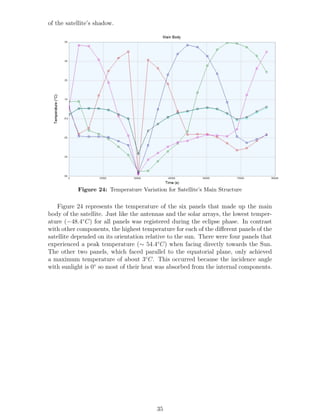
Figure 24: Temperature Variation for Satellite’s Main Structure
Figure 24 represents the temperature of the six panels that made up the main
body of the satellite. Just like the antennas and the solar arrays, the lowest temper-
ature (−48.4◦
C) for all panels was registered during the eclipse phase. In contrast
with other components, the highest temperature for each of the different panels of the
satellite depended on its orientation relative to the sun. There were four panels that
experienced a peak temperature (∼ 54.4◦
C) when facing directly towards the Sun.
The other two panels, which faced parallel to the equatorial plane, only achieved
a maximum temperature of about 3◦
C. This occurred because the incidence angle
with sunlight is 0◦
so most of their heat was absorbed from the internal components.
35
Figure 25: Temperature Variation for Satellite’s Batteries
The batteries of a communication satellite have different requisites than the other
components. Batteries generate internal heat through power dissipation and generate
most of this heat when they are providing the satellite’s power rather than being
recharged. Batteries are also only used at very particular points during a mission.
They are only required during eclipses, where the solar panels are not able to provide
the necessary power for system functions. At most, batteries will be required to
operate for 72 minutes which represent the largest eclipse the satellite will experience.
In order to maintain the batteries at an adequate temperature, the batteries were
also modeled as heaters for the propellant tanks.
36
(a) Complete
(b) 72 min Eclipse
Figure 26: Temperature Variation for Satellites Transponders
These graphs represent the temperature of the transponders inside the satellite.
Although there were only two elements, it was possible to represent all the necessary
transponders. From this plot, it is clear that these components experienced a much
different environment than the rest of the sections. The overall temperature of
these components remained within a 17◦
C range. This was due to the fact that
electronic systems generated internal heat by power dissipation and were kept inside
the satellite, which provided a certain amount of insulation. Since these elements
also had a very limited operating temperature range, active thermal controls were
required. Radiators were used to dissipate excess heat and prevent temperatures from
reaching higher values which could affect the performance of the communication
system. Similar to the solar arrays, the transponders experienced their greatest
change during the 72 minutes during which the satellite was in Earth’s shadow.
37
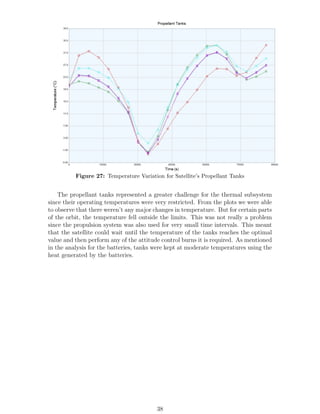
Figure 27: Temperature Variation for Satellite’s Propellant Tanks
The propellant tanks represented a greater challenge for the thermal subsystem
since their operating temperatures were very restricted. From the plots we were able
to observe that there weren’t any major changes in temperature. But for certain parts
of the orbit, the temperature fell outside the limits. This was not really a problem
since the propulsion system was also used for very small time intervals. This meant
that the satellite could wait until the temperature of the tanks reaches the optimal
value and then perform any of the attitude control burns it is required. As mentioned
in the analysis for the batteries, tanks were kept at moderate temperatures using the
heat generated by the batteries.
38
6.3 Attitude Control
Due to the presence of disturbances while the satellite was in operation, the orienta-
tion, or attitude, of the satellite was perturbed from a desired or optimal location.
This was where an attitude control system was implemented in order to ensure that
the satellite was oriented properly. The attitude was adjusted by using utilizing a
combination of star trackers, gyroscopes, momentum wheels, reaction wheels, and re-
action control thrusters. In addition, the satellite was capable of being spin-stabilized
or three-axis stabilized each of which required a different combination of the afore-
mentioned hardware.
Figure 28: ADCS Summary
For this mission, Cygnus LLC decided to design a satellite that was three-axis
stabilized using a combination star trackers, reaction wheels, and thrusters.
6.3.1 Star Tracker
A star tracker utilizes a camera to measure the position of star(s) and is able provide
three-axis stabilization using the acquired data. The figure below [22] shows a trade
study that was performed in order to choose between Star Tracker, Earth Sensors,
and Sun Sensors. For this mission, the star tracker utilized was provided by Jena-
Optronik.
Figure 29: Trade Study between Attitude Determination Systems
39
Figure 30: Jena-Optronik Astro APS
6.3.2 Reaction Wheels
Reaction wheels were utilized in order to change the orientation of the satellite by
spinning the wheels along a specified axis. Reaction wheels are also capable of
being utilized as momentum wheels by spinning them at a constant angular speed
which builds up angular momentum and greatly reduces any disturbance torques
that operating on an axis parallel to the rotational axis of the reaction wheel. For
this mission, four reaction wheels were utilized to provide accurate control. The
orientation of the wheels was determined by analyzing the results of a study done
by University Putra Malaysia [29]. In the study, three and four reaction wheel
orientations were analyzed and the chosen orientation produced the lowest amount
of torque. The reaction wheels chosen for this mission were Honeywells HR-12. Their
design and orientation is shown below. These wheels have a maximum momentum
of 50 N-m-s. The saturation rate was conservatively approximated to be 5 days per
momentum unloading. This gave a propellant mass of ∼ 47kg that will be utilized
throughout the lifetime of the satellite in order to unload momentum. This was
calculated using the saturation rate of the reaction wheels, which is once every 5
days, and the duration the thrusters will be fired, which is 1 second [24].
40
Figure 31: Honeywell HR12s Reaction Wheel
6.3.3 Inertial Measurement Unit (IMU)
An inertial measurement unit (IMU) combines several different sensors such as ac-
celerometer, gyroscope, and magnetometers in order to obtain orientation data and
even data on gravitational forces. The IMU used for this mission was the Airbus De-
fence & Spaces Astrix 1090. This unit had a very low rate drift rate 0.01 degrees/hour
over one hour and 0.10 degrees/hour till end of life. This helped in providing accu-
rate data and reduced software complexity as it had to account for less error. This
unit was also capable of providing three-axis data. The satellite contained two of
these units, one as a main unit, and one as a backup. The figure below shows the
Astrix 1090.
Figure 32: ASTRIX 1090
41
6.3.4 Disturbance Torques
The Gravity Gradient Torques occur when the center of gravity of a spacecraft is
not aligned with its center of mass. For our satellite, the center of gravity was
only perturbed in the z-direction by 1.375m. This combined with Ixx and Iyy values
and a worst case θ value of 45◦
produced a torque that approximately equaled to
7.6 ∗ 10−6
N − m.
The Solar Pressure torque occurs due to the momentum in the sunlight that heats
a specific area of the satellite. The effect of the solar pressure torque depends on the
type of material used and the location of the solar radiation pressure. By using a
reflectance factor of 0.6 and a surface area of 4.5m2
, the solar pressure torque was
approximately 4.51∗10−5
N −m. Using a single-axis model applied in MATLAB, the
change in angle, the required wheel torque, and required wheel angular momentum
due to this solar radiation torque were calculated over a period of two days. They
are shown in fig. 33 and fig. 34.
Figure 33: Angle Perturbation due to Solar Torque
42
(a) Wheel Torque due to Solar Radiation Torque
43
6.4 Telemetry, Tracking, and Command
6.4.1 Introduction
The telemetry, tracking, and command (TT&C) subsystem is a vital part of the
satellite system. Nearly all onboard subsystems interface with the TT&C subsystem
in some way. Information regarding satellite health, tracking, and performance is
communicated from the spacecraft to the ground facilities, where they are interpreted
and analyzed to ensure that the mission is going as planned. Command functions are
generated based on telemetry and ranging readings, and are uplinked to the satellite
where these commands are executed. There are five main subsystem functions of
TT&C [23]:
• Carrier tracking (lock onto the ground station signal)
• Command reception and detection (receive the uplink signal and process it)
• Telemetry modulation and transmission (accept data from spacecraft systems,
process them, and transmit them)
• Ranging (receive, process, and transmit ranging signals to determine the satel-
lites position)
• Subsystem operations (process subsystem data, maintain its own health and
status, point the antennas, detect and recover faults)
6.4.2 Assumptions
For both the uplink and downlink analyses during normal operations, it was assumed
that the antennas are pointed perfectly towards each other (boresight pointing).
During the launch phase and subsequent transfer, near-perfect pointing for the anti-
Earth-facing antenna was assumed for the sake of simplicity. It was also assumed
that no more than one TT&C transponder/antenna will fail. All dimensioning, mass,
and power assumptions were made from handbook references. Cygnus assumed single
ground station control during nominal satellite operations, and a capable third-party
tracking network during launch operations.
6.4.3 System Interfacing
The TT&C subsystem interfaces with every subsystem on the spacecraft with the
exception of the propulsion subsystem, and must reliably pass information back and
forth. A table displaying this interfacing is displayed below in fig. 35:
44
Figure 35: System Interfaces [23]
45
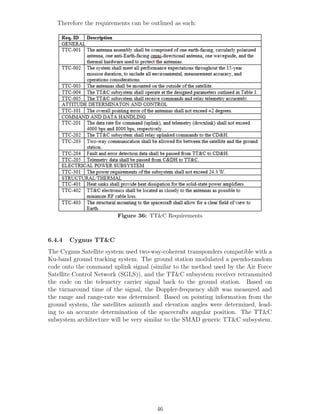
Therefore the requirements can be outlined as such:
Figure 36: TT&C Requirements
6.4.4 Cygnus TT&C
The Cygnus Satellite system used two-way-coherent transponders compatible with a
Ku-band ground tracking system. The ground station modulated a pseudo-random
code onto the command uplink signal (similar to the method used by the Air Force
Satellite Control Network (SGLS)), and the TT&C subsystem receiver retransmited
the code on the telemetry carrier signal back to the ground station. Based on
the turnaround time of the signal, the Doppler-frequency shift was measured and
the range and range-rate was determined. Based on pointing information from the
ground system, the satellites azimuth and elevation angles were determined, lead-
ing to an accurate determination of the spacecrafts angular position. The TT&C
subsystem architecture will be very similar to the SMAD generic TT&C subsystem.
46
Figure 37: TT&C Block Diagram [23]
Two-layer redundancy ensured mission continuation in the event of a single
TT&C transponder failure. Use of a diplexer allowed the use of one antenna for
both transmitting and receiving. While not shown on the block diagram, a low-gain
hemispherical omni-directional antenna mounted on the anti-Earth-facing side of the
satellite was used during the launch phase of the mission, and during emergency op-
erations. This provided a final third layer of redundancy for the Cygnus TT&C
subsystem. The modulation method used by the TT&C subsystem was BPSK/PM
modulation, where the carrier and data were transmitted at frequencies separated by
the subcarrier frequency. Data rates were taken from the suggested values in SMAD
(Table 11-19) [23]. The parameters for the Cygnus TT&C system are as follows:
Figure 38: TT&C Parameters
Sizing for the TT&C subsystem was also performed via the SMAD handbook.
Table 11-26 [23] lists typical parameters for TT&C subsystems; Cygnus used a Ku-
band communications subsystem for TT&C, and therefore used these parameters:
47
Figure 39: TT&C Sizing
48
6.5 Propulsion System
6.5.1 Selection
Cygnus Satellite LLC will utilize a regulated hybrid propulsion system which will
contain a bipropellant NTO/MMH system for the apogee kick motor and a mono-
propellant MMH system for the Reaction Control System (RCS) thrusters. MMH is
a more volatile type of hydrazine, and is a capable of igniting without an oxidizer.
However, an oxidizer such as NTO is utilized in addition to increase thrust. A cata-
lyst is necessary in order to react with MMH for the monopropellant MMH system.
Cygnus chose the industry standard S-405 as the catalyst, which must be heated
in order to be efficient. A pressurant tank containing Helium will also be used to
regulate the propellant subsystem.
A regulated hybrid propulsion system is ideal for the proposed satellite because
it provides the necessary thrust, while using less Mp than a bipropellant system. A
full bipropellant system would utilize oxidizer for both the apogee kick motor and
the RCS thrusters. The potential benefits of reducing Mp as much as possible is why
the regulated hybrid system was chosen.
6.5.2 Sizing
In order to size the propellant tanks, it is was first necessary to determine the ∆V nec-
essary for Geosynchronous Transfer Orbit (GTO) to Geosynchronous Orbit (GEO)
transfer and then add it to the several ∆V ’s necessary for station-keeping and at-
titude control. An oxidizer-fuel (OF) ratio of 1.64 for the NTO/MMH system was
used, which allowed manufacturing companies to size the oxidizer and fuel tanks to
similar sizes.
Since fuel is needed for both the apogee kick motor and the RCS thruster, the
fuel tank needed to be larger than the oxidizer tank. In order to size the oxidizer,
eq. (7) was utilized to find the mass of the propellant, where 1.2 represents a 20%
safety margin, and a ∆V = 1.8144km/s is required for a transfer between GTO
and GEO. Next, the mass of the oxidizer and fuel were calculated using eq. (8) and
eq. (9), respectively. Equation (10) was then used to calculate oxidizer (NTO) tank
volume where the ρp of NTO = 1.38 g
cm3 at 323 K. Sizing the fuel tank required a
∆V = 0.704534km
s
and ρp of MMH = 0.847 g
cm3 at 323 K and was substituted into
eq. (7). The resulting mass represented the fuel necessary for the RCS thrusters over
a 15 year span and must be added to the calculated mass of the fuel necessary for the
apogee kick motor to determine the total fuel tank volume. Equation (11) was used to
find the volume of the pressurant tank Vpres by and dividing mass of helium (Mgas)
by the density of helium (ρ). Figure 40 illustrates the data utilized to construct
a preliminary design of propellant tank assembly. Tank mass was dependent on
material used and thickness. Tanks will be constructed with 316 annealed stainless
steel because it is less expensive than titanium and easier to wield.
Ue = Isp ∗ go (5)
Mp = 1.2 ∗ mo ∗ (1 − e
−∆V
Ue ) (6)
Mox =
(OF ∗ Mp)
(1 + OF)
(7)
49
Mfu =
Mp
(1 + OF)
(8)
Vp =
Mp
ρp
=
Mox
ρox
=
Mfu
ρfu
(9)
Mgas =
(P ∗ Vp)
(Rgas ∗ T − P
ρp)
(10)
Vpres =
Mgas
ρ
(11)
(a) Propulsion System Data (b) Propellant Tank Design
Figure 40: Propulsion System
6.5.3 Apogee Kick Motor
For the transfer orbit between GTO and GEO, Cygnus Satellite LLC chose Aero-
jet/Rocketdynes R-4D 490 N (110-lbf) Bipropellant Rocket Engine. This motor met
all the requirements of the satellite seen in fig. 41.
(a) Propulsion System Data (b) AKM System Design
Figure 41: Apogee Kick Motor (AKM)
50
Figure 42: Apogee Kick Motor Specs[2]
6.5.4 Reaction Control System (RCS) Thrusters
In all satellites, some form of a reaction control system is necessary for attitude
control and station-keeping. In the case of the Cygnus satellite, this role will be
fulfilled by a system of RCS thrusters and reaction wheels. Figure 43 shows the
requirements Cygnus Satellite considered before choosing its RCS thrusters. Cygnus
Satellite LLC chose the MR-111C 4N (1.0-lbf) Rocket Engine Assembly which is
a monopropellant system that utilizes hydrazine, however, since MMH is a more
volatile type of hydrazine, it was decided to use MMH instead. This will reduce the
number of propellant tanks, which greatly reduced the mass of the satellite.
(a) RCS Info (b) RCS Thruster Assembly
Figure 43: RCS Thrusters
51
Figure 44: RCS Thruster Specs[3]
6.5.5 Propellant Manifold
The last part of the propulsion subsystem was the propellant manifold, which encom-
passed all the hardware required to regulate propellant flow between the propellant
tanks and the thrusters. The propellant manifold consisted of thruster valves, lines
and fittings, isolation valves, pyro valves, filters, fill and drain valves, pressure trans-
ducers, and flow control orifices.
The materials most commonly used to construct the lines and fittings in satellites
are titanium and stainless steel. Titanium is lighter and more compatible with
oxidizers, however stainless steel is less expensive and easier to handle [23]. It was
decided to utilize titanium for its lines and fittings in an effort to keep the satellite
as efficient as possible.
The two essential valve types utilized in the propellant manifold included isolation
valves and pyro valves. Isolation valves have the capability to permanently open
or close without a continuous power supply. This property allows isolation valves
to serve multiple functions, one of which includes isolating a group of thrusters in
the event of system failure. Isolation valves may also control spacecraft mass by
containing a specific tank in multi-tank system. On the other hand, pyro valves are
one-time use valves, which means that these valves are either normally opened or
closed. Pyro valves may serve the same function as isolation valves, however they
can only be operated once. The advantage of utilizing pyro valves include lower leak
rates, decreased pressure drops, and smaller mass. Pyro valves may be used to isolate
components in order to satisfy safety and reliability issues, and isolate components
after use. A system of both types of valves must be utilized in order to create the
most efficient propellant manifold.
52
It is standard practice to install filters downstream of tanks and fill/drain valves,
because this is where the most particulates can be captured. The size of the fil-
ter depends on the amount propellant required to pass through the filter, size of
particulate filtration, and allowable steady state pressure drop [23].
Fill and drain valves were next installed on a manifold, and had to remain ac-
cessible at all times to allow for emergency offloading. The addition of pressure
transducers allowed for the pressure monitoring required for propellant loading and
pressurization. Pressures transducers were also utilized to evaluate the performance
of the system. Finally, flow control orifices were installed to equalize pressure drops
between the feed lines between the oxidizer and fuel lines, which ensured a stable
oxidizer to fuel ratio. Flow control orifices were also used to minimize transient flow,
which can cause dangerous pressure spikes. Figure 45 illustrates the basic block di-
agram of the 4.5 kg propellant manifold that Cygnus Satellite LLC plans to install
in its new satellite.
Figure 45: Propellant Manifold Block Diagram
53
The below fig. 46 shows the weight and power the individual components of the
propulsion subsystem. There will be 12 RCS thrusters for this satellite.
Figure 46: Propulsion Subsystem Weight and Power
54
6.6 Power System
Figure 47: Sum of all Subsystem Power Requirements
Once all of a spacecrafts power requirements are accounted for, its power source
must be designed to meet those demands, which in this case will be a solar ar-
ray. While satellites that provide internet and telephone services have a fluctuating
demand for communication system power, this apply to direct broadcast television
satellites. While the content of the television programming is subject to change based
on the time of day, the power requirement of the Cygnus satellites communication
will remain constant 24 hours a day until the day it is de-orbited. Therefore, the
solar arrays must be sized to provide enough power in the daylight hours to both
supply the normal daylight power requirements, as well as charge the batteries which
provide the spacecraft with power during eclipses. The necessary power generated
by the solar array during daylight is given by eq. (12)
Psa =
PeTe
Xe
+ PdTd
Xd
Td
(12)
Pd = Pe +
Cbat[W − hr]
(Td[hr])
(13)
In this case, the power requirement during eclipse is simply the sum of all subsys-
tem power requirements (minus battery charging). The daylight power also includes
these standard operating values, as well as the power required to charge the battery
array (eq. (13)). Based on the wobble of Earth’s polar axis with respect to the plane
of the Ecliptic, the amount of time spent by Cygnus eclipsed in Earth’s shadow each
revolution changes throughout the year. It is at the height of these eclipse seasons
that the solar array needed to be sized, in order to ensure adequate power production
55
at this point of highest energy storage demand. Thus, an eclipse period of 72 minutes
was used.
In order to determine which type of solar cell to use, a trade study between the
properties of various materials was analyzed (fig. 48) As can be seen from fig. 48,
Figure 48: Candidate Solar Cell Properties[23]
there are a number of major differences between the cell types. Cost is always a
driving factor, though not of higher priority than product quality in the case of the
Cygnus satellite. This company policy meshes well with the recent advances in solar
cell manufacturing which have made Triple Junction GaAs cells an affordable, high-
quality option. Their high efficiency and impressive EOL properties also make them
a desirable candidate for the solar arrays on our satellite. Once the solar cell type
was chosen, its efficiency was used to calculate the maximum power output per area
with the Sun normal to the array (eq. (15)). This value was then multiplied by a
nominal inherent degradation value of 0.72, and the normal component of sunlight at
the worst-case Sun incidence angle of 23.7◦
, present during the summer and winter
solstice to find the Beginning Of Life (BOL) power output per area of the solar array
(eq. (15)).
Po = 0.30 ∗ 1369
W
m2
(14)
PBOL = PoId cos(θ) (15)
Next, the GaAs Triple Junction cell degradation rate of 0.5%/yr was used along
with a mission duration of 15 years in order to find lifetime cell degradation (eq. (16)).
End of life power per area was then calculated (eq. (17)), and used to calculate the
necessary solar array area to provide the Cygnus satellite with adequate power for
the entirety of its missions duration (eq. (18)).
Ld = (1 − D)L
(16)
PBOL = PBOLLd (17)
Asa =
Psa
PBOL
(18)
Using a preliminary total power value of 4.846 kW, a necessary solar array area
of 31.03m2
was calculated. A Triple Junction GaAs cell manufactured and marketed
by Azur Space was used as a model for this project (fig. 49). The surface features
visible are integrated power leads and bypass diodes, necessary to connect and elec-
trically isolate the cell in case of damage or structural shadowing. Bypass diodes
are necessary due to an increased resistance solar cells inherit when partially or fully
shadowed. Construction of the solar array began with an aluminum honeycomb sup-
port structure. Next, a layer of carbon fiber cloth was added to provide thermal and
impact insulation to the solar cells. A mounting structure was attached to the top of
56
this layer, in which all cells were installed. The anti-sun facing side was then covered
in a layer of MLI in order to help regulated thermal dumping. All layers are fixed
together via an aerospace adhesive. The exploded view of this design is visible in
fig. 50. The mass of a given solar array segment was tracked by adding the mass of
all of its components (fig. 51).
Figure 49: Triple Junction GaAs Cell [26]
Figure 50: Solar Array Exploded View
Figure 51: Calculation of Solar Array
57
In order to maximize power generation, a 1 Degree of Freedom (DoF) configu-
ration was chosen. In a 1-DOF system, the sun incidence angle decreases by 23.5◦
at the Winter and Summer solstices, an acceptable loss in avoiding the added struc-
tural complexity associated with a 2-DOF system. A low-power, high-torque gimbal
motor manufactured and distributed by MOOG [27] was therefore chosen to provide
solar array rotation (Figure 52). During the launch phase of the satellites life, the
solar array will be folded up and secured against the side of the satellite by explosive
bolts. Once the apogee burn is complete, the explosive bolts will detonate, and the
torsional springs fixed to the inter-segment hinges will provide torque which extends
the solar array fully. The next step in the power system sizing was the determination
of the Bus Voltage, an important step in the selection of a Power Conditioning and
Distribution Unit (PCDU). Power losses increase as resistance and current increases,
and as result of Ohms Law, power losses increases proportional to the square of
current (eq. (19)).
P = I2
R (19)
Figure 52: Single DOF Solar Gimbal Motor [27]
Therefore, minimizing power loss is a matter of increasing operating voltage (De-
sign of Geosynchronous Satellites). Power distributors which operate at higher volt-
ages are ideal, thus the Thales Group Power Conditioning and Distribution Unit
Medium Power Unit [28] was selected (Figure 53). This unit has the capability to
operate in both unregulated and regulated voltage modes. In an unregulated system,
individual loaded components require their own voltage regulation circuitry. Reg-
ulated systems eliminate this need for redundant circuitry at the price of slightly
reduced power efficiency (Agrawal). In order to decrease overall system complex-
ity, a regulated bus voltage of 50 Volts was decided upon despite the nominal drop
in efficiency. The Thales Group PCDU is ideal due to its high bus voltage, which
corresponds well with the maximum voltage produced by solar panels at the point
which the satellite reemerges from the eclipse. In order for these values to match, the
individual Gallium Arsenide half-cells (Figure 48) which have an EOL open-circuit
voltage 2.522 Volts each will be wired in 19-cell series to produce a voltage of 47.918
Volts. A total of 537 series will then be wired in parallel and connected to the
58
Figure 53: PCDU [28]
PCDU in order to encompass all cells. In order to ensure that power losses stay at
a minimum, components further away from the conditioning and distributing unit
will have power transferred to them via smaller gauge wires in order to ensure that
localized bus voltage never drops below too far below 50 V. Next came the design
of the battery array, which provides power to the spacecraft during eclipses. This
process began by finding the necessary battery capacity, which was a function of
worst case eclipse energy required, and EOL battery Depth of Discharge (eq. (20)).
CBat =
CbatTe
DOD ∗ ηb
= 2854.4 kW − hr = 571.49 A − hr (20)
A batterys Depth of Discharge (DOD) is defined as the total battery capacity avail-
able for discharge, and varies from battery to battery based on chemistry (Figure 54)
After multiple charge/discharge cycles, a batterys DOD drops, decreasing the effec-
tive energy available to the subsystems.
Other pros and cons associated with the various battery chemistries also had
to be considered, important factors included energy density, energy efficiency and
temperature range, a general trade study of which was analyzed (Figure 55). Since
required energy capacity is independent of battery chemistry, energy density of a
given battery will affect both the mass and proportions of the power subsystem. En-
ergy efficiency will affect the available battery capacity required, also affecting mass
and size of the battery array. Temperature range will affect the complexity of ther-
mal regulation systems, a smaller range corresponding to a more precise regulation
of battery temperature.
For a 15 year mission, the battery system will undergo 1350 charge/discharge cy-
cles due to the two annual 45 day eclipse seasons. Nickel-Cadmium batteries undergo
a significant degradation in depth of discharge over this many cycles, disqualifying
them from consideration in this mission. At the other end of the spectrum, Nickel
Hydrogen batteries undergo no DOD losses in a mission of this duration, making
them ideal. Lithium-ion batteries do suffer from DOD loss, but only nominally.
In considering all these factors, the decision was made to utilize a Lithium-ion
battery, with the only drawbacks being a slight DOD loss at EOL, and an increase in
complexity in the battery thermal regulation system. Searching for a viable candi-
date product yielded few results however, as it is apparently not common practice for
aerospace battery companies to publish their product specifications online. Eventu-
ally, a viable Lithium Cobalt Oxide battery was found, designed and manufactured
59
by the American company Eagle-Picher (Figure 56) [18]. In order to determine
the number of necessary batteries, the actual battery capacity was divided by the
published available battery capacity per unit (200 A-hr), and rounded up (eq. (21)).
Nbat =
CBat[Whr])
Vbus
Cactual
= 3 (21)
Figure 54: Depth of Discharge vs. Cycle [23]
Figure 55: Trade Study of Battery Characteristics
Figure 56: Lithium Cobalt Oxide Battery Unit [18]
Final results yielded an array consisting of 3 Lithium Cobalt Oxide batteries, each
with an available capacity of 200 Amp hours and a mass of 63.5 Kilograms. Due
to the singular nature of the product selection, the total available battery capacity
ended up being 15.48% beyond requirements. This generous excess in energy will
provide a comfortable margin of safety in the event that one or two cells fail during
the duration of the mission.
In order to estimate the cost of the power system, the solar cells were first exam-
ined. An approximate value of various solar cell technologies provided was examined
60
(fig. 57) [23]. The Gallium Arsenide Multijunction price per watt of $617
Watt
was multi-
plied by required total EOL normal power of 5.89 KW. The resulting price was $3.63
million.
Figure 57: Cost of Solar Cell Technologies [23]
Next, the aluminum used in the honeycomb structure was analyzed. SolidWorks
mass properties was used to determine the mass of an individual honeycomb struc-
ture. This was then multiplied by the number of structures, and the most recent
high-estimate cost-per-kilogram of Aluminum 6061 [25]. Based on the small mass of
aluminum subsisting the honeycomb structures combined with the relatively cheap
price of wholesale Aluminum 6061, its price was deemed negligible.
In order to calculate cost of the carbon fiber cloth, its total square footage was
multiplied by number of segments and the current cost per unit area of carbon fiber
cost fig. 58 [15].
Figure 58: Cost Calculation of Carbon Fiber Cloth [15]
In order to calculate battery cost, cost per Kilowatt-hour for a Lithium-ion bat-
tery (fig. 59) was multiplied by battery capacity (fig. 60).
Figure 59: Cost of Various Types of Batteries
Figure 60: Battery Capacity
61
7 Risk and Cost Analysis
7.1 Risk and Reliability Analysis
The risk analysis was performed using a qualitative/quantitative fever chart assess-
ment scheme. First, a set of probabilities were defined for each bin (1 through 5);
these cut-offs were assigned with guidance from the exhaustive study of 1584 Earth-
orbiting satellites:
Figure 61: Failure Graphs [8]
Over a 15-year mission duration, the study found that the contributions of each
subsystem to total satellite failure did not exceed 25% (with a small exception to
BOL TT&C systems). Therefore, the upper bound of 25% was set for the highest
Probability bin. The other subsets are described as follows:
Figure 62: Probability
The ”Impact” metrics were more difficult to set. A complete failure of the speci-
fied subsystem is highly unlikely, as redundancy is built into every subsystem on the
Cygnus spacecraft. For the sake of analysis, however, this situation was evaluated.
The quantitative mission impact metrics are described in the figure below, with the
highest bin of 5 being a total mission failure.
62
Figure 63: Impact
With the ”Probability” and Impact bins defined, bin values can be assigned
to each subsystem, and the results can be displayed on the fever chart. The bin
assignments are displayed in the following figure:
Figure 64: Impact
Figure 65: Impact
63
It is apparent that the TT&C subsystem poses the largest risk to the mission.
Aside from the ADCS system, the TT&C subsystem is the largest contributor for
total satellite failure; therefore efforts must be made to ensure that a high-quality
and robust TT&C subsystem is acquired, and that redundancy is maximized. For
this reason, the Cygnus TT&C subsystem applies two layers of redundancy; two
separate transponders ensure that, even if one were to fail or perform poorly, the other
could function properly. Multiple antennas also mitigate the effects of pointing error
due to ADCS system malfunction, and the system includes an emergency/back-up
hemispherical aft antenna that could function during an uncontrolled spin or reverse
in direction. The details of the TT&C subsystem are outlined in section 6.4.
7.2 Cost
Cygnus Satellite LLC. will utilize the Unmanned Space Vehicle Cost Model, version
8, (USCM8) in order to approximate the cost to build a state-of-the-art satellite.
USCM8 estimates cost of satellite based on non-recurring cost and recurring cost.
Non-recurring Cost Estimate Relationship (CER) predicts the cost of design and
development, manufacturing, testing, and support equipment. Recurring CER pre-
dicts the cost of fabrication, manufacturing, integration, assembly, and test of space
vehicle flight hardware.
The equations used to calculate the non-recurring and recurring CER are observed
in fig. 66 and fig. 67 , respectively.
Figure 66: USCMB Non-Recurring
64
Figure 67: USCMB Recurring
Figure 68 Figure 68 shows the application of both USCM8 methods. The total
estimated or approximated cost of Cygnus-1 is $798,970,688.42.
Figure 68: Application of USCMB
65
8 Gallery
Figure 69: Side Exploded View
Figure 70: Isometric Packed Payload
66
Figure 71: Side Packed Payload
Figure 72: Space Side Assembly
67
Figure 73: Communications Compartment
Figure 74: Power Compartment
68
Figure 75: Packed Upper Compartment
Figure 76: Emergency and Launch Antenna
69
Figure 77: Battery Assembly
Figure 78: Antenna Assembly
70
Figure 79: Computer
Figure 80: Propulsion Compartment
71
Figure 81: Transmitter & Receiver Antennae
Figure 82: Thrust and Interlock ESPA Manifold
72
Figure 83: Gyroscope
Figure 84: Input/Output Multiplexer
Figure 85: Power Condition and Distribution Unit
73
Figure 86: RCS Thruster
Figure 87: Reaction Wheels
74
Figure 88: Star Tracker
Figure 89: TT&C Antenna
75
Figure 90: Emergency Antenna
Figure 91: Battery Array
76
Figure 92: Apogee Kick Motor
Figure 93: Solar Array Gimbal
77
Figure 94: Transponder
Figure 95: Travelling Wave Tube Amplifier Array
78
References
[1] Level 421. The c band myth. 22
[2] Aerojet/Rocketdyne. Bipropellant Rocket Engine. https://www.rocket.com/
files/aerojet/documents/Capabilities/PDFs/BipropellantDataSheets.
pdf, May 2006. 4, 51
[3] Aerojet/Rocketdyne. Monopropellant Rocket Engine. https:
//www.rocket.com/files/aerojet/documents/Capabilities/PDFs/
MonopropellantDataSheets.pdf, April 2006. 4, 52
[4] Brij N. Agrawal. Design of Geosynchronous Spacecraft. Prentice-Hall, 1986. 32
[5] H. Anderson. Fixed broadband wireless system design. John Wiley and Sons,
2003. 19
[6] Cyril Annarella. Spacecraft structures, April 2015. 27
[7] Harris CapRock. Not all bands are created equal. http://www.harriscaprock.
com/downloads/HarrisCapRock_WhitePaper-Ka-Ku_Analysis.pdfl. 22
[8] J.F. Castet and J.H. Saleh. Satellite reliability: Statistical data analysis and
modeling, October 2009. 5, 62
[9] Spot beam. http://www.tech-faq.com/spot-beam.html, October 2014. 19
[10] L-3 Communications. K-band communications twt. http://www2.l-3com.com/
eti/downloads/k_quad.pdf. 4, 26
[11] Antennas for satellite communication. http://www.geosats.com/antennas.
html. 19
[12] Wide beam vs narrow beam on bgan inmarsat satellites. http://www.
groundcontrol.com/BGAN_Inmarsat_Wide-Beam_Narrow-Beam.htm. 4, 19, 20
[13] National Research Council. High-temperature oxidation-resistant coatings.
Print, January 1970. 27
[14] Csaengineering.com. Espa, or the eelv secondary payload adapter, April 2015.
29
[15] Light weight carbon fiber fabric. http://www.cstsales.com/carbon_fabric.
html. 5, 61
[16] Samir Patel Cesar Suarez Ling-Bing Kung David Brunnenmeyer, Scott Mills.
Ka and ku operational considerations for military satcom applications. 22
[17] Mina Dawood. Fundamental characteristics of new high modulus cfrp materials
for strengthening steel bridges and structures, April 2015. 27
[18] Sar-10197 aerospace battery. http://www.eaglepicher.com/images/Li-Ion/
EP-SAR-10197-DATA-SHEET.pdf. 5, 60
[19] Falcon 9 user guide, April 2015. 28
79
[20] Howard Hausman. Fundamentals of satellite communications.
http://www.ieee.li/pdf/viewgraphs/fundamentals_satellite_
communication_part_2.pdf, January 2009. 19
[21] Jsat International. Transponders. http://www.jsati.com/
why-satellite-how-Spacesegment4.asp. 25
[22] C.C. Grant Geoff McVittie Tom Dzamba John Enright, Doug Sinclair. Toward
star tracker only attitude estimation. 39
[23] Wiley J. Larson and James R. Wertz. Space Mission Analysis and Design.
Microcosm Press, 1999. 4, 5, 20, 24, 25, 31, 32, 44, 45, 47, 52, 53, 56, 60, 61
[24] Bill Nadir. Design module for a spacecraft attitude control system, October
2003. 40
[25] Metal Prices. Aluminum 6061 extrusion billet pre-
mium. http://www.metalprices.com/metal/aluminum/
aluminum-6061-extrusion-billet-premium. 61
[26] Azur Space. Triple junction GaAs solar cell. http://www.azurspace.com/
images/products/0003384-01-01_DB_3G30C_advanced.pdf. 5, 57
[27] MOOG Space and Defense Group. Type 1 solar array drive assem-
bly (sada). http://www.moog.com/literature/Space_Defense/Spacecraft/
Spacecraft_Mechanisms/500-612_Type_1_SADA.pdf. 5, 58
[28] Power conditioning and distribution unit medium power. http://www.
azurspace.com/images/products/0003384-01-01_DB_3G30C_advanced.pdf.
5, 58, 59
[29] Renuganth Varatharajoo Zuliana Ismail. A study of reaction wheel configura-
tions for a 3-axis satellite attitude control, March 2010. 40
80

Capstone Final Report

  • 1.
    Cygnus Satellite LLCDesign Report Aman Sharma | John Gehrke | Brandon Keeber Eduardo Asuaje | Jacob Korinko | Vaibhav Menon Ira A. Fulton Schools of Engineering 1
  • 2.
    Contents List of Figures4 List of Tables 6 1 Nomenclature 7 2 Introduction 9 2.1 Executive Overview . . . . . . . . . . . . . . . . . . . . . . . . . . . . 9 3 Preliminary Design 10 3.1 Potential Approaches . . . . . . . . . . . . . . . . . . . . . . . . . . . 10 3.2 Stakeholders . . . . . . . . . . . . . . . . . . . . . . . . . . . . . . . . 11 3.2.1 Mission Objective Stakeholders . . . . . . . . . . . . . . . . . 11 3.3 Top-Level Requirements . . . . . . . . . . . . . . . . . . . . . . . . . 11 3.3.1 Mission Overview . . . . . . . . . . . . . . . . . . . . . . . . . 11 3.3.2 Sizing . . . . . . . . . . . . . . . . . . . . . . . . . . . . . . . 12 3.3.3 Orbit . . . . . . . . . . . . . . . . . . . . . . . . . . . . . . . . 12 3.3.4 Structure . . . . . . . . . . . . . . . . . . . . . . . . . . . . . 12 3.3.5 Thermal . . . . . . . . . . . . . . . . . . . . . . . . . . . . . . 12 3.3.6 Attitude Determination and Control (ADCS) . . . . . . . . . 12 3.3.7 Telemetry, Tracking, and Control (TT&C) . . . . . . . . . . . 12 3.3.8 Propulsion . . . . . . . . . . . . . . . . . . . . . . . . . . . . . 12 3.3.9 Command and Data Handling (C&DH) . . . . . . . . . . . . . 12 3.3.10 Power . . . . . . . . . . . . . . . . . . . . . . . . . . . . . . . 13 3.3.11 Risk . . . . . . . . . . . . . . . . . . . . . . . . . . . . . . . . 13 4 Mission Analysis 13 4.1 Concept of Operations . . . . . . . . . . . . . . . . . . . . . . . . . . 13 4.1.1 Overview . . . . . . . . . . . . . . . . . . . . . . . . . . . . . 13 4.1.2 Mission Phases . . . . . . . . . . . . . . . . . . . . . . . . . . 13 4.2 Orbit . . . . . . . . . . . . . . . . . . . . . . . . . . . . . . . . . . . . 16 4.2.1 Orbit Design . . . . . . . . . . . . . . . . . . . . . . . . . . . 16 4.2.2 Orbit Analysis . . . . . . . . . . . . . . . . . . . . . . . . . . . 17 5 Payload Design 19 5.1 Gain . . . . . . . . . . . . . . . . . . . . . . . . . . . . . . . . . . . . 19 5.2 Beam Trade Study . . . . . . . . . . . . . . . . . . . . . . . . . . . . 19 5.3 Antenna Trade Study . . . . . . . . . . . . . . . . . . . . . . . . . . . 20 5.4 Frequency Band . . . . . . . . . . . . . . . . . . . . . . . . . . . . . . 22 5.5 Link Budget Analysis . . . . . . . . . . . . . . . . . . . . . . . . . . . 23 5.6 Hardware and Bandwidth . . . . . . . . . . . . . . . . . . . . . . . . 25 6 Subsystems 27 6.1 Structure . . . . . . . . . . . . . . . . . . . . . . . . . . . . . . . . . 27 6.2 Thermal . . . . . . . . . . . . . . . . . . . . . . . . . . . . . . . . . . 32 6.3 Attitude Control . . . . . . . . . . . . . . . . . . . . . . . . . . . . . 39 6.3.1 Star Tracker . . . . . . . . . . . . . . . . . . . . . . . . . . . . 39 6.3.2 Reaction Wheels . . . . . . . . . . . . . . . . . . . . . . . . . 40 2
  • 3.
    6.3.3 Inertial MeasurementUnit (IMU) . . . . . . . . . . . . . . . . 41 6.3.4 Disturbance Torques . . . . . . . . . . . . . . . . . . . . . . . 42 6.4 Telemetry, Tracking, and Command . . . . . . . . . . . . . . . . . . . 44 6.4.1 Introduction . . . . . . . . . . . . . . . . . . . . . . . . . . . . 44 6.4.2 Assumptions . . . . . . . . . . . . . . . . . . . . . . . . . . . . 44 6.4.3 System Interfacing . . . . . . . . . . . . . . . . . . . . . . . . 44 6.4.4 Cygnus TT&C . . . . . . . . . . . . . . . . . . . . . . . . . . 46 6.5 Propulsion System . . . . . . . . . . . . . . . . . . . . . . . . . . . . 49 6.5.1 Selection . . . . . . . . . . . . . . . . . . . . . . . . . . . . . . 49 6.5.2 Sizing . . . . . . . . . . . . . . . . . . . . . . . . . . . . . . . 49 6.5.3 Apogee Kick Motor . . . . . . . . . . . . . . . . . . . . . . . . 50 6.5.4 Reaction Control System (RCS) Thrusters . . . . . . . . . . . 51 6.5.5 Propellant Manifold . . . . . . . . . . . . . . . . . . . . . . . 52 6.6 Power System . . . . . . . . . . . . . . . . . . . . . . . . . . . . . . . 55 7 Risk and Cost Analysis 62 7.1 Risk and Reliability Analysis . . . . . . . . . . . . . . . . . . . . . . . 62 7.2 Cost . . . . . . . . . . . . . . . . . . . . . . . . . . . . . . . . . . . . 64 8 Gallery 66 References 79 3
  • 4.
    List of Figures 1Cost Summary of Satellite . . . . . . . . . . . . . . . . . . . . . . . . 9 2 Power Summary of Satellite . . . . . . . . . . . . . . . . . . . . . . . 10 3 Concept of Operations . . . . . . . . . . . . . . . . . . . . . . . . . . 15 4 Orbit Trade Study . . . . . . . . . . . . . . . . . . . . . . . . . . . . 17 5 LEO . . . . . . . . . . . . . . . . . . . . . . . . . . . . . . . . . . . . 18 6 GTO . . . . . . . . . . . . . . . . . . . . . . . . . . . . . . . . . . . . 18 7 Launch Characteristics . . . . . . . . . . . . . . . . . . . . . . . . . . 19 8 Spot Beam vs. Broad Beam[12] . . . . . . . . . . . . . . . . . . . . . 20 9 Parabolic Reflector Dish . . . . . . . . . . . . . . . . . . . . . . . . . 21 10 Shaped Reflector Antenna . . . . . . . . . . . . . . . . . . . . . . . . 21 11 Range of Frequency Bands . . . . . . . . . . . . . . . . . . . . . . . . 22 12 Cost vs. Availability . . . . . . . . . . . . . . . . . . . . . . . . . . . 23 13 Link Budget . . . . . . . . . . . . . . . . . . . . . . . . . . . . . . . . 24 14 Amplifier Trade Study[23] . . . . . . . . . . . . . . . . . . . . . . . . 25 15 TWTA Amplifier [10] . . . . . . . . . . . . . . . . . . . . . . . . . . . 26 16 Polarization Architecture . . . . . . . . . . . . . . . . . . . . . . . . . 26 17 Static Stress Analysis . . . . . . . . . . . . . . . . . . . . . . . . . . . 28 18 Deformation . . . . . . . . . . . . . . . . . . . . . . . . . . . . . . . . 29 19 Side View of Satellite Structure . . . . . . . . . . . . . . . . . . . . . 30 20 Structure Mass Summary . . . . . . . . . . . . . . . . . . . . . . . . . 31 21 Temperature Range . . . . . . . . . . . . . . . . . . . . . . . . . . . . 32 22 Temperature Variation for Satellite’s Antennas . . . . . . . . . . . . . 33 23 Temperature Variation for Satellite’s Solar Arrays . . . . . . . . . . . 34 24 Temperature Variation for Satellite’s Main Structure . . . . . . . . . 35 25 Temperature Variation for Satellite’s Batteries . . . . . . . . . . . . . 36 26 Temperature Variation for Satellites Transponders . . . . . . . . . . . 37 27 Temperature Variation for Satellite’s Propellant Tanks . . . . . . . . 38 28 ADCS Summary . . . . . . . . . . . . . . . . . . . . . . . . . . . . . 39 29 Trade Study between Attitude Determination Systems . . . . . . . . 39 30 Jena-Optronik Astro APS . . . . . . . . . . . . . . . . . . . . . . . . 40 31 Honeywell HR12s Reaction Wheel . . . . . . . . . . . . . . . . . . . . 41 32 ASTRIX 1090 . . . . . . . . . . . . . . . . . . . . . . . . . . . . . . . 41 33 Angle Perturbation due to Solar Torque . . . . . . . . . . . . . . . . 42 34 Wheel Properties . . . . . . . . . . . . . . . . . . . . . . . . . . . . . 43 35 System Interfaces [23] . . . . . . . . . . . . . . . . . . . . . . . . . . . 45 36 TT&C Requirements . . . . . . . . . . . . . . . . . . . . . . . . . . . 46 37 TT&C Block Diagram [23] . . . . . . . . . . . . . . . . . . . . . . . . 47 38 TT&C Parameters . . . . . . . . . . . . . . . . . . . . . . . . . . . . 47 39 TT&C Sizing . . . . . . . . . . . . . . . . . . . . . . . . . . . . . . . 48 40 Propulsion System . . . . . . . . . . . . . . . . . . . . . . . . . . . . 50 41 Apogee Kick Motor (AKM) . . . . . . . . . . . . . . . . . . . . . . . 50 42 Apogee Kick Motor Specs[2] . . . . . . . . . . . . . . . . . . . . . . . 51 43 RCS Thrusters . . . . . . . . . . . . . . . . . . . . . . . . . . . . . . 51 44 RCS Thruster Specs[3] . . . . . . . . . . . . . . . . . . . . . . . . . . 52 45 Propellant Manifold Block Diagram . . . . . . . . . . . . . . . . . . . 53 46 Propulsion Subsystem Weight and Power . . . . . . . . . . . . . . . . 54 47 Sum of all Subsystem Power Requirements . . . . . . . . . . . . . . . 55 4
  • 5.
    48 Candidate SolarCell Properties[23] . . . . . . . . . . . . . . . . . . . 56 49 Triple Junction GaAs Cell [26] . . . . . . . . . . . . . . . . . . . . . . 57 50 Solar Array Exploded View . . . . . . . . . . . . . . . . . . . . . . . 57 51 Calculation of Solar Array . . . . . . . . . . . . . . . . . . . . . . . . 57 52 Single DOF Solar Gimbal Motor [27] . . . . . . . . . . . . . . . . . . 58 53 PCDU [28] . . . . . . . . . . . . . . . . . . . . . . . . . . . . . . . . . 59 54 Depth of Discharge vs. Cycle [23] . . . . . . . . . . . . . . . . . . . . 60 55 Trade Study of Battery Characteristics . . . . . . . . . . . . . . . . . 60 56 Lithium Cobalt Oxide Battery Unit [18] . . . . . . . . . . . . . . . . 60 57 Cost of Solar Cell Technologies [23] . . . . . . . . . . . . . . . . . . . 61 58 Cost Calculation of Carbon Fiber Cloth [15] . . . . . . . . . . . . . . 61 59 Cost of Various Types of Batteries . . . . . . . . . . . . . . . . . . . 61 60 Battery Capacity . . . . . . . . . . . . . . . . . . . . . . . . . . . . . 61 61 Failure Graphs [8] . . . . . . . . . . . . . . . . . . . . . . . . . . . . . 62 62 Probability . . . . . . . . . . . . . . . . . . . . . . . . . . . . . . . . 62 63 Impact . . . . . . . . . . . . . . . . . . . . . . . . . . . . . . . . . . . 63 64 Impact . . . . . . . . . . . . . . . . . . . . . . . . . . . . . . . . . . . 63 65 Impact . . . . . . . . . . . . . . . . . . . . . . . . . . . . . . . . . . . 63 66 USCMB Non-Recurring . . . . . . . . . . . . . . . . . . . . . . . . . 64 67 USCMB Recurring . . . . . . . . . . . . . . . . . . . . . . . . . . . . 65 68 Application of USCMB . . . . . . . . . . . . . . . . . . . . . . . . . . 65 69 Side Exploded View . . . . . . . . . . . . . . . . . . . . . . . . . . . 66 70 Isometric Packed Payload . . . . . . . . . . . . . . . . . . . . . . . . 66 71 Side Packed Payload . . . . . . . . . . . . . . . . . . . . . . . . . . . 67 72 Space Side Assembly . . . . . . . . . . . . . . . . . . . . . . . . . . . 67 73 Communications Compartment . . . . . . . . . . . . . . . . . . . . . 68 74 Power Compartment . . . . . . . . . . . . . . . . . . . . . . . . . . . 68 75 Packed Upper Compartment . . . . . . . . . . . . . . . . . . . . . . . 69 76 Emergency and Launch Antenna . . . . . . . . . . . . . . . . . . . . 69 77 Battery Assembly . . . . . . . . . . . . . . . . . . . . . . . . . . . . . 70 78 Antenna Assembly . . . . . . . . . . . . . . . . . . . . . . . . . . . . 70 79 Computer . . . . . . . . . . . . . . . . . . . . . . . . . . . . . . . . . 71 80 Propulsion Compartment . . . . . . . . . . . . . . . . . . . . . . . . . 71 81 Transmitter & Receiver Antennae . . . . . . . . . . . . . . . . . . . . 72 82 Thrust and Interlock ESPA Manifold . . . . . . . . . . . . . . . . . . 72 83 Gyroscope . . . . . . . . . . . . . . . . . . . . . . . . . . . . . . . . . 73 84 Input/Output Multiplexer . . . . . . . . . . . . . . . . . . . . . . . . 73 85 Power Condition and Distribution Unit . . . . . . . . . . . . . . . . . 73 86 RCS Thruster . . . . . . . . . . . . . . . . . . . . . . . . . . . . . . . 74 87 Reaction Wheels . . . . . . . . . . . . . . . . . . . . . . . . . . . . . 74 88 Star Tracker . . . . . . . . . . . . . . . . . . . . . . . . . . . . . . . . 75 89 TT&C Antenna . . . . . . . . . . . . . . . . . . . . . . . . . . . . . . 75 90 Emergency Antenna . . . . . . . . . . . . . . . . . . . . . . . . . . . 76 91 Battery Array . . . . . . . . . . . . . . . . . . . . . . . . . . . . . . . 76 92 Apogee Kick Motor . . . . . . . . . . . . . . . . . . . . . . . . . . . . 77 93 Solar Array Gimbal . . . . . . . . . . . . . . . . . . . . . . . . . . . . 77 94 Transponder . . . . . . . . . . . . . . . . . . . . . . . . . . . . . . . . 78 95 Travelling Wave Tube Amplifier Array . . . . . . . . . . . . . . . . . 78 5
  • 6.
    List of Tables 1Frequency Band Trade Study . . . . . . . . . . . . . . . . . . . . . . 22 6
  • 7.
    1 Nomenclature Aeff =Effective Area λ = Wavelength η = Efficiency D = Diameter of Antenna Psa = Solar Array Power Output Requirement Pe = Spacecraft Power Requirement during Eclipse Pd = Spacecraft Power Requirement during Daylight Te = Eclipse Period Td = Daylight Period Xe = Power System Path Efficiency during Eclipse Xd = Power System Path Efficiency during Daylight Po = Solar Array Power Output at Beginning of Life PBOL = Solar Array Power Output at Beginning of Life PEOL = Solar Array Power Output at End of Life Id = Inherent Degradation I = Current R = Resistance Vbus = Selected Bus Voltage DOD = Depth of Discharge ηb = Efficiency Between Battery and Load ηcell = Efficiency of Gallium Arsenide Solar Cell Nbat = Number of Batteries Required Cbat = Battery Energy Capacity Required Cactual = Actual Capacity of Selected Battery Ue = Exhaust Speed Isp = Specific Impulse go = Gravitational acceleration of Earth at Sea Level Mp = Propellant mass OF = Oxidizer to Fuel Ratio Mox = Oxidizer Mass Mfu = Fuel Mass Vp = Propellant Tank Volume ρp = density of propellant at 323 K ρox = density of oxidizer at 323 K ρfu = density of fuel at 323 K MT = Tank Mass Mgas = Mass of Pressurant Gas P = End of Life Tank Pressure Rgas = Specific gas constant of Pressurant Gas T = End of Life Tank Temperature ρ = Density of Pressurant Gas Vpres = Volume of pressurant gas TF = Thrust ∆V = Change in velocity mo = Beginning of Life Mass of Satellite mf = End of Life Mass of Satellite fn = Fundamental Frequency 7
  • 8.
    do = OuterDiameter di = Inner Diameter E = Modulus of Elasticity Ls = Structure Length Ms = Structure Mass IA = Area Moment of Inertia 8
  • 9.
    2 Introduction The objectiveof this mission was to design, analyze, and build a direct broadcast satellite (DBS) for a primary customer. The satellite had to be capable of providing broadcast television to specific end users situated anywhere within the contiguous United States. It was necessary to design robust electronic and mechanical compo- nents capable of surviving the harsh space environment for a designated number of years. Additionally and most importantly, the satellite needed to provide dependable and consistent service to the end user in order to remain a competitive consumer op- tion. This report was written from the perspective of Cygnus Satellite LLC, tasked with the responsibility of performing all necessary trade studies and analyses regard- ing orbit and payloads, in addition to cost, risk, and schedule analysis. By utilizing computer software such as, SolidWorks, Thermica, MATLAB etc., the company was able to design a sophisticated satellite and assemble a comprehensive report detailing subsystem configurations and other essential pertinent information. 2.1 Executive Overview Figure 1: Cost Summary of Satellite 9
  • 10.
    Figure 2: PowerSummary of Satellite 3 Preliminary Design 3.1 Potential Approaches The first step of the initial analysis was to decide the functionality of the satellite. This depended on the stakeholders of the satellite and the consumer market. The first option was to create a satellite to broadcast internet. These satellites are typically put into a geosynchronous orbit in a constellation configuration. This orbit allows for greater coverage but it also increases the signals latency to roughly 20 times that of a terrestrial internet network. Operating at this orbit also significantly increases the delay to receive the data. This data speed can be on the order of two magnitudes slower than current high speed internet services. To overcome this problem a large low earth orbit constellation would be needed to provide coverage to the entire United States. Creating a constellation like this would be expensive and not practical for this mission. The next option was a telephone satellite. Similar to satellites that provide internet access, a large constellation at LEO or GEO would be needed to provide complete coverage across the country. This type of satellite also required a significant amount of ground based stations and other infrastructure to work properly. In addition, there was a significant amount of competition already in this space with large constellations that provide coverage to the entire planet. The last option was to broadcast television. There are two types of television satellites, fixed satellite service (FSS) and direct broadcast service (DBS). FSS pro- vides service either directly to a home satellite dish or to a ground station. This technology has been in use since the 1970s and has since been replaced by DBS. FSS satellites require much larger satellite dishes than their DBS counterpart and are less widely used by satellite television providers. In some cases, television providers receive data using a fixed satellite service but then re-broadcast the data using a direct broadcast satellite. Based on this, a direct broadcast satellite was the best option. 10
  • 11.
    Currently, most satellitetelevision providers use direct broadcast satellites. DBS requires a significantly smaller satellite dish than FSS which makes it easier for the consumer to have at their home. This cuts down on infrastructure costs of having an Earth based station and increases access to consumers. Direct broadcast satel- lites currently operate on the Ku band but there have been experimental satellites provided by NASA and DirecTV that operate on the Ka band. This research and advancement could open up a wide range of bandwidths in which to broadcast data in the future. Recently, there have been advancements in providing mobile reception for airlines, recreational vehicles and multiple military applications. These markets provide potential markets for future company growth. Overall, the design of a direct broadcast satellite was the best option due to reduced infrastructure needed, a wide unsaturated consumer market, and the potential for future company expansion. 3.2 Stakeholders The stakeholders for a communication satellite include the primary customer, sec- ondary customer, operator, and end user. In most cases, the primary customer is the stakeholder that finances and owns the communication satellite, and facilitates the transmission of data to it. The secondary customer is a stakeholder that may have financed or launched the communication satellite, and benefits from it. The operator is responsible for overseeing most or all functions of the communication satellite, and is held responsible if the satellite fails. The operator is therefore also considered a stakeholder. The end user is the final stakeholder because they receive the data from the primary customer. 3.2.1 Mission Objective Stakeholders In this paper, a scenario is considered in which DirecTV has requested Cygnus Satel- lite LLC to build a state of the art communication satellite that is capable of receiving and transmitting television broadcast to its customers in the 48 contiguous United States. While DirecTV will need Cygnus to operate the satellite in geosynchronous orbit (GEO), a third party will be employed to provide launch services. For this scenario, the stakeholders will include DirecTV which is the Primary customer, with Cygnus Satellite LLC acting as the Operator. For the secondary user, SpaceX has been selected to act as the launch provider, and television-watching customers will play the role of end users. 3.3 Top-Level Requirements 3.3.1 Mission Overview The satellite shall provide 552 stations of uninterrupted High-Definition Television (HDTV) via direct broadcast downlink to customers in the Contiguous United States (CONUS). The mission duration shall not exceed 15 years from final orbit acquisition. All electronic systems aboard the satellite shall be radiation hardened and have the capability to function fully in the space environment for the entirety of the mission duration. 11
  • 12.
    3.3.2 Sizing In termsof physical restraints, the satellite shall not exceed the allowable mass determined by the launch vehicle capabilities. The dimensions of the satellite shall also not exceed the dimensional constraints determined by the launch vehicle fairing geometry. 3.3.3 Orbit The mission orbit for the satellite shall be kept at a geosynchronous equatorial orbit. The inclination of the satellite shall be 0 degrees with an allowable error of plus/minus 0.05 degrees, measured from the center of Earth. Longitudinal drift shall not exceed plus/minus 0.05 degrees. Disposal of the satellite at EOL shall consist of a graveyard re-orbiting maneuver of at least 300 km. 3.3.4 Structure The structure of the satellite shall be capable of withstanding all loadings during launch, deployment, and nominal operations. 3.3.5 Thermal The thermal subsystem of the satellite shall be able to regulate and collect/transmit data for the thermal environment aboard the satellite. All subsystems shall be kept within their respective operating limits. 3.3.6 Attitude Determination and Control (ADCS) The attitude of the satellite shall be determined and controlled by a three-axis stabi- lization system consisting of reaction wheels and RCS thrusters. A pointing accuracy of a TBD amount shall be set to meet communications payload and TT&C require- ments. 3.3.7 Telemetry, Tracking, and Control (TT&C) Telemetry, tracking, and control of the satellite shall be handled via a single ground station during nominal operations, accessible 24/7. TT&C during launch operations shall be handled by a capable third-party satellite tracking network. 3.3.8 Propulsion The satellite propulsion system shall be capable of delivering the spacecraft to mission orbit and be able to maintain this station for the entirety of the mission duration. 3.3.9 Command and Data Handling (C&DH) The spacecraft computer shall have the capability to collect, interpret, and transmit all necessary data aboard the satellite. 12
  • 13.
    3.3.10 Power The powersubsystem shall be able to provide constant power needed to keep the satellite active during both nominal operations and eclipse periods. Onboard bat- teries shall be capable of sustaining satellite systems through the duration of the mission without exceeding an acceptable depth of discharge. Solar panels shall be capable of recharging the batteries and supplying power to the satellite during non- eclipse periods. The choice for solar panels shall be made with the consideration of degradation in such a way that the EOL power does not fall below acceptable levels at any point during the mission. 3.3.11 Risk Risk shall be mitigated effectively in all aspects of the satellite system. Factors of safety, budget limits, and redundancy shall be investigated in order to minimize the possibility of system or mission failure. 4 Mission Analysis 4.1 Concept of Operations 4.1.1 Overview The Cygnus Satellite Concept of Operations consists of four mission phases. Pre- launch operations includes all functions up to the actual launch of the satellite system. Launch and deployment of the satellite system includes all functions and operations up to the deployment of the system to geosynchronous equatorial orbit (GEO). The on-orbit portion is by far the most important part of the mission, as it includes all nominal operations of the system, and is crucial to achieving the mission objective. Finally, the end-of-life (EOL) phase of the mission is a small but necessary part of the operations, and includes the steps that will be taken to ensure compliance with all mandates regarding spacecraft disposal. 4.1.2 Mission Phases 4.1.2.1 Pre-Launch Operations The Cygnus Satellite system shall be assem- bled and shipped in such a way that it will require minimal handling and mainte- nance prior to launch. The batteries will be charged and a check of all subsystem functionality must be performed. Solar panels should be folded into their launch con- figurations, and the explosive bolt system for the deployment of the solar panels will be primed, with the torsional springs already installed and tensioned. The satellite will be attached to the launch vehicle fairing, along with six other small cube-sat sys- tems from groups that will share the launch cost. The launch vehicle payload fairing will be attached to the main body and prepared for launch. All Cygnus subsystems will be inert during launch. 4.1.2.2 Launch and Deployment The spacecraft will be deployed into geosyn- chronous transfer orbit (GTO) by the launch vehicle via an ejection system integrated into the launch vehicle coupler. During this time, a third party spacecraft tracking network will be tracking the system. At the time of Cygnus deployment, the six 13
  • 14.
    cube-sats will alsodeploy and carry out their various missions separately; the pay- load fairing will separate, and the solar panels will deploy. When the system detects separation from the launch vehicle, all TT&C components will come online, and the ADCS system will autonomously attempt to orient the antennas to open ground station communication. Once a stable orientation is found and the satellite is able to establish TT&C communication, the system will be ready to initiate the apogee kick maneuver to circularize and obtain the required mission orbit. Following the apogee kick maneuver, the system will be ready to proceed with on-orbit operations. 4.1.2.3 On-Orbit Operations The Cygnus Satellite payload will begin nom- inal operations once antenna pointing is verified. The ground station will uplink data to the satellite where it is processed and then transmitted to the user (down- link). During this time, the ADCS and TT&C systems will be working to ensure proper attitude, altitude, and health of the spacecraft. The power subsystem will en- sure power distribution throughout the life of the satellite, including solar array use during nominal operations and battery use during eclipse periods, and the thermal subsystem will regulate the thermal environment during these periods. 4.1.2.4 End of Life Operations After 15 years of nominal operations, the satel- lite system will be re-orbited to a graveyard orbit. Once the satellite is re-orbited, Cygnus will end operations with this specific spacecraft. 14
  • 15.
    Figure 3: Conceptof Operations 15
  • 16.
    4.2 Orbit 4.2.1 OrbitDesign In choosing which type of orbit to place a communications satellite (comsat) in, a number of factors needed to be considered in light of the desired mission objectives. Factors such as inclination, altitude, eccentricity, perigee, and ascending node all interdependently affect the structure of the comsat program and must be considered when making all major design decisions. Deciding the basic mission profile is a direct antecedent to the orbit design. An alternative mission profile to the one assigned was considered in which a comsat would be placed in orbit around the Earth-Moon L2 Lagrange point, and act as a targeted repeater station for high-bandwidth signals between the Earth and a hypothetical lunar colony. The trajectory necessary to place such a satellite in the required orbit would be highly advanced, consisting of a unique parabolic Earth escape-trajectory and a complex series course alterations. Based on the highly time-limited nature of this class, this mission will not be attempted at this time. In the case of a communication satellite providing HD TV coverage to the con- tiguous United States, orbit type can be either Low Earth Orbit (LEO), MEO, GEO, or Elliptical. Each orbit has distinct advantages and disadvantages. In the case of a LEO or MEO orbit, the decreased distance between the ground stations and satellite is ideal for applications with a low tolerance for signal delay. Decreased signal lag would of course also increase the efficiency of an HD TV broadcast, but due to the modern practice of introducing a censor delay into TV broadcasts, it would be rather unnecessary. In addition, by placing a comsat in LEO, the decreased Earth surface covered per satellite necessitates that a constellation (fleet) of satellites be employed in order to ensure continuous coverage, a vastly more expensive and high-risk option. For these reasons, the most cost-effective and efficient orbit to place Cygnus into would be a geostationary one. One positive implication this has on the mission profile is a reduced orbital maintenance cost, reducing the need for large amounts of maneuvering propellant. At the altitude required for GEO ( 35,000 km), atmospheric density nears that of a perfect vacuum, imparting a negligible drag force, even over long periods of time. The 0◦ latitude of the GEOs equatorial orbit minimizes the J2 anomalys perturbing effects on the satellite, leaving only solar radiation pressure and 3-body perturbations to account for. 16
  • 17.
    Figure 4: OrbitTrade Study 4.2.2 Orbit Analysis Presented in fig. 5. are the ∆V estimates for the satellite transfer from a parking low Earth orbit of 555.6km to a geosynchronous orbit of 35,789km. In order to make the decision for a final launch site we investigated six different launch locations around the world. The initial mass of the satellite is assumed to be 2669.0 kg with the apogee kick motor operating at an Isp of 315 sec. For the trade study presented in the following figures an analysis was conducted using several different launch locations at various inclinations. The selection of the launch site depends upon the launch provider and the amount of propellant and ∆V that is needed. 17
  • 18.
    Figure 5: LEO Thesecond option is to use the launch provider to place the satellite into geosyn- chronous transfer orbit (GTO) where we would then only be responsible for con- ducting the final burn once the satellite reaches the desired orbit and to make the inclination plane change. This option is more expensive in terms of cost for the launch but it provides many other benefits. Using a GTO provided by the launch vehicle we can use a significantly less amount of fuel which will reduce cost and weight of the satellite. In addition, this method is very reliable. Outlined in Figure 6 is the propellant mass estimate and the ∆V required for the transfer. Figure 6: GTO In both of the figures above, the ∆V estimates are based on a combined second burn and inclination change in one maneuver. One option to change the inclination of the satellites orbit is to conduct the first burn to place the satellite in the desired orbit and then conduct another burn to place it into the right inclination of 0 degrees. The other option is combine these two maneuvers into a single burn. This technique proves to be more efficient by using less ∆V which in turn reduces the amount of propellant that is needed. Based upon these results several conclusions can be made. For the most efficient transfer, based upon the amount of ∆V required, using a launch location such as French Guiana and India would be the most beneficial. However this provides several challenges that must be overcome to launch from these locations. Due to the location of these sites it would be very expensive and would contain a large amount of risk shipping the completed satellite to these locations. Launching the satellite from the Cosmodrome in Kazakhstan would not be a good option because of its large inherent inclination and its distance from the United States. The final two options are to launch from Vandenberg California or Cape Canaveral Florida. These two locations provide very similar characteristics and must be decided based upon the facility the launch provider uses. Based upon the mass requirements and finding a launch provider that can place the satellite into a geosynchronous transfer orbit, SpaceX’s Falcon 9 launch vehicle 18
  • 19.
    will be used.This launch meets every criteria necessary to place the satellite into the desired orbit. The launch will take place from Cape Canaveral Florida with the final characteristics outlined in fig. 7. Figure 7: Launch Characteristics 5 Payload Design 5.1 Gain Gain is the measure of directivity of an antenna. Gain is proportional to effective area given by eq. (1) and eq. (2). For large antennas, the effective area is approximately equal to the real area of the antenna. G = 4 ∗ π ∗ Aeff λ2 (1) G = η ∗ π ∗ D λ 2 (2) Standard antenna efficiency (η) is usually between 55% to 70% and the standard ground satellite antenna diameter is 0.5334 m but can range in size depending on the need [5]. Typical LNB noise of satellite antenna is 1 dB, and as the EIRP increases, the area of the antenna decreases [11]. It is important to know that EIRP helps shape the coverage area when designing the antenna. At a bandwidth of 6 GHz, the gain of a 10 m antenna will approximately equal 53.3 dB [20]. Also, for the communication satellite to be most efficient, it is best to have an EIRP no less than 40 dBW. 5.2 Beam Trade Study According to Tech-FAQ [9], a spot beam is a signal that is directed towards a specific area on the surface. The advantage of using spot beams is that is allows a satellite to target a specific area, which averts data interception and minimizes the power utilized. Another advantage of spot beams is the capability to reuse a frequency for different locations without interference at the receiver. This allows for more channels to be carried on the same frequency which is then operated in several areas. However, using spot beams to cover too many areas such as the entire continental United States is not recommended because it take up too much power and may cause data interference because the beams are grouped closely. On the other hand, wide beams cover large geographical areas and a wide beam over the continental United States is also known as CONUS [12]. An advantage of wide beam is that it is more omni-directional than spot beams. This means that 19
  • 20.
    Figure 8: SpotBeam vs. Broad Beam[12] an antenna does not need to be pointed accurately in order to create a connection. CONUS is also much simpler and more reliable than spot beams. Cygnus Satellite LLC. will use CONUS for its communication satellite, which means that it is necessary to choose between installing parabolic reflector dish and shaped reflector antenna. 5.3 Antenna Trade Study In order to use a parabolic reflector dish for CONUS it would be essential to adjust the pointing and operating point of the reflector so that the gain at the edges of the coverage area is within the requirements [23]. However, this means that gain over most of the coverage will be greater than the minimum requirement, which requires a lot of power. Another disadvantage of utilizing a parabolic reflector dish for a broad beam is that covers areas that are not in the continental United States. Non-essential coverage areas include oceans, Canada, or Mexico. The above mentioned disadvantages of utilizing a parabolic reflector dish for broad beam can be fixed creating a shaped reflector antenna specific to cover CONUS. Shaped reflector antenna produces a broad beam that conforms more closely to the coverage area by limiting transmitted power, which is why a a shaped reflector antenna is better. Examples of the parabolic reflector dish and shaped reflector antenna are observed in fig. 9 and fig. 10, respectively. 20
  • 21.
    Figure 9: ParabolicReflector Dish Figure 10: Shaped Reflector Antenna 21
  • 22.
    5.4 Frequency Band AlthoughKu-band systems are more abundantly used today, Ka-band systems are an up and coming competitors. With both systems offering certain advantages, it is beneficial to compare the two bands in order to ensure an optimal design. The figure below [7] shows the ranges of both the Ku and the Ka-band along with the effects of rain on signal dissipation. The table and figures below show a more in-depth Figure 11: Range of Frequency Bands comparison of Ku-band systems and Ka-band systems. After being introduced in the 1980s, the coverage of Ku-band systems has significantly increased over the past 30 years [16]. However, this has resulted in less carrier frequencies being available for new systems. The new Ka-band systems are able to offer higher downlink data rates but fall short in regions with high rain weather [1]. As can be seen in the figures below, for harsh regions, cost for Ka-band systems drive-up exponentially which can cause problems when providing service to areas in CONUS where this type of weather is common. Even in temperate regions the cost drives up exponentially as higher availability is demanded. In conclusion, Ku-band systems are superior due to being a well-established system and due to its higher overall reliability. Criteria Band Ku Ka Cost per BPS (bits per second) Offer competitive cost per BPS compared to same spot beam size Ka-band systems Provide same cost per BPS for smaller spot beam systems. Link performance deteriorates as spot beam coverage increases Coverage Provide same coverage as Ku- band large spot beams. EIRP is the same for both bands, but Ku- band systems have high signal gain. Frequency reuse increases coverage Ka-band small spot beams pro- vide significantly less coverage than Ku-band systems. Lower signal gain for similar size anten- nas. Lack of frequency reuse lim- its coverage In Case of System Failure The existence of a large-number of Ku-band satellites allows for reallocation of service to other satellites The scarcity of Ka-band satel- lites denies Ka-band systems the same benefits as the Ku-band systems Weather Less energy dissipation due to rain. Less overall cost vs avail- ability in most regions (see fig- ures below) High signal loss due to rain. Cost are escalated as higher availabil- ity is demanded (see figures be- low) Table 1: Frequency Band Trade Study 22
  • 23.
    (a) Temperate (b) Tropical Figure12: Cost vs. Availability 5.5 Link Budget Analysis In order to conduct the link budget analysis several parameters and assumptions needed to be made. In order to accommodate the high bandwidth nature of receiving a HD television broadcast, a home satellite dish size of 0.5 meters was used. This small home dish was deemed a reasonable sized product for consumers to be expected 23
  • 24.
    to buy. Inaddition, the receiving and transmitting dishes on the satellite were sized to be 1.5 meters in diameter each, with a gateway dish size of 10 meters in diameter. All dishes were sized to allow for a greater link margin, which helped account for any attenuations due to signal losses or inclement weather conditions. Beyond bandwidth considerations, the home dish size was influenced by the volatile nature of weather- induced signal attenuations, which if made too small would prevent clear broadcast at the specified data rate. The link budget analysis can be seen in fig. 13 Figure 13: Link Budget In order to conduct the analysis, assumptions also had to be made about the losses involved in the system, which were assumed to be worst case scenario values [23]. Incorporated losses included those due to the antenna, circular depolarization losses, atmospheric losses, pointing losses, and freespace losses from a geosynchronous orbit. In addition, each antenna was assumed to operate at an efficiency of 70% for the satellite antennas and the worst case efficiency for the uplink ground antenna and the home receiver of 55%. For further investigation into the equations and assumptions made, refer to the source code in the appendix section. These results from the analysis are very reasonable when compared to other communication satellites. From this analysis we can see that we have a link margin of 14.1038 dB which provides an additional tolerance for any attenuations between the transmitter and the receiver. This high link margin allows for indirect signals to be able to bounce off of any other surfaces and still be received by the ground dish. To some companies this link margin may be considered to be too large but we want to ensure that the link is made between the satellite and the user under any circumstance. 24
  • 25.
    5.6 Hardware andBandwidth In satellites, back-end amplifiers are used to increase the strength of processed signals. Signals received through the antenna are filtered from the array, and passed through the transponder with the appropriate bandwidth allocation. The transponder multi- plexes the signal frequency by shifting (translating) its center frequency down to the frequency necessary for downlink, then passes the signal through a power amplifier, which increases the signal strength. Finally, the signal is passed to the downlink antenna, where it is transmitted to the end user. Traditionally used in satellites, vacuum tubes amplify signals into the Ultra-High-Frequency (UHF) or even the Mi- crowave frequency range via a generally analogous principle. A series of resonators are resonated with the signal of interest, and the energy from an electron beam pass- ing through the resonators is transferred to the signal, increasing its strength. In solid state amplifiers, this same effect is accomplished through careful manipulation of electron flow via control of the semiconductor pathways within the material itself. There are a number of drawbacks to the use of vacuum tubes in satellites, the most problematic of which being an inherently low durability due to the fragile nature of their construction. Additionally, amplified signals suffer from non-linear distortions outside of a very narrow bandwidth, severely limiting their transmission capability and therefore increasing the number of amplifiers/transponder pairs needed. Solid- state devices in general are smaller, more reliable, and cheaper than their tubular ancestors, seemingly making them the ideal candidate for future Cygnus satellites. It is worth noting that a number of experts on the subject still to this day prefer vacuum tube amplifiers due to a measurably higher quality thermionic energy conversion than can be achieved in solid-state amplifiers. This slight increase in efficiency however is offset by the non-linear wide-band distortions introduced into signals amplified by vacuum tubes. In order to make the decision between Solid State Power Amplifiers (SSPA) and Travelling Wave Tube Amplifiers (TWTA), a number of traits had to be considered (Figure 14). Despite the increased mass, TWTAs exhibit a significant increase in efficiency over SSPAs in applications which require a high data rate and satellite altitude. TWTAs are however less durable, bulkier, and introduce more signal distortion at the ends of their bandwidth range than SSPAs. Despite all of these drawbacks, the extremely limited power available ultimately plays the largest role, resulting in the decision to use TWTAs in our satellite. Increased power consumption, as will later be shown, has a cascading effect on mass, cost, and risk. Figure 14: Amplifier Trade Study[23] In the Ku band, bandwidth allocations are typically 500 MHz wide. In the Cygnus satellite being designed, a circular polarization scheme was chosen in order to increase the amount of stations being broadcast to the end user by utilizing the both the vertical and horizontal electromagnetic wave components. Research into power system aboard the Horizons-1 satellite yielded power and bandwidth information on its TWTA transponders. We have therefore assumed a 36 MHz bandwidth, and 108 Watt power consumption per transponder [21]. Transponder mass values were 25
  • 26.
    attained from theproduct page of the L-3 transponders which were chosen for this system (fig. 15). Figure 15: TWTA Amplifier [10] In accordance with SMAD values, an inter-channel gap bandwidth and station- keeping bandwidth of 4 MHz each was assumed. fig. 16 displays the architecture of signal polarization. A Matlab Script incorporating all these values yielded the following results: • Total number of channels = 23 • Total number of stations per channel = 24 • Total number of digital TV stations transmittable = 552 • Total number of transponders including spares = 30 • Total mass of transponders and amplifiers including spares and power convert- ers = 153.9 [kg] • Total power of transponders and amplifiers including = 2484.0 [W] Figure 16: Polarization Architecture 26
  • 27.
    6 Subsystems 6.1 Structure Thespace environment is very demanding on materials. The combination of huge swings in temperature from thermal cycling, exposure to large amounts of radiation, oxidation, outgassing, and large forces during launch make for a difficult materials problem. In addition, the structure needs to act as a skeleton for the assembly of the subsystems so it must be easily integrated with all other systems. For the cost of the structure to remain low, the structure needed to be made out of components that are compatible with current manufacturing processes. In order to combat the wide range in thermal cycling it was important to use a material with a very small thermal expansion. The temperature the spacecraft would face can range from -160 C to +180 C which demanded the material to be able to withstand extremely hot and cold temperatures. In addition, electromagnetic and particle radiation from the radiation belts, solar emissions and other cosmic radiation had to be taken into effect. However, these effects were considered negligible due to the small impact they had on the structure. In addition, the material needed to be strong to overcome the accelerations, acoustic effects and thermal effects from launch. The loads at launch proved to be the largest strain on the structure during its mission lifetime. While the material needed to be strong, almost more importantly, it also needed to be very lightweight to reduce the costs associated with launch. There were several possible materials that met these requirements. Currently, the majority of spacecraft structures are made out of aluminum alloys. Some alloys meet most of the requirements as outlined above. They have a high stiffness, mod- erate thermal expansion, moderate cost and are readily available in many forms. In addition, their stiffness to density ratio is very high which results in high strength for relatively low mass. Titanium also presented another good option because it surpasses the properties of aluminum in most areas. Titanium is extremely strong, has an even higher stiffness to density ratio than aluminum and also has a moderate thermal expansion coefficient. However, titanium is very expensive, hard to machine and not as readily available as aluminum [6]. In addition to aluminum and titanium there were several other exotic metals that could be used, the first option being beryllium. With a stiffness to density ratio much higher than titanium it could be a very light and useful material for the structure. However, beryllium is very brittle and does not maintain its properties well at low temperatures. In addition, the material is very expensive to purchase and extremely expensive to machine due to the toxicity of the dust created during the manufacturing process. Another option was magnesium. This metal has a similar stiffness to density ratio as aluminum but operates poorly at low temperatures. The final and best option were composite materials. With a stiffness to density ratio far exceeding any metal, composite materials are significantly stronger and lighter than any other options. In addition, composite materials have a negative thermal expansion coefficient making it suitable to operate in the thermal extremes of space. However, rapid temperature changes can cause strains in the material meaning there would have to be insulated with another material [13]. There are many different types of composite materials but the best for this ap- plication was carbon fiber. Carbon fiber has high strength and stiffness, fatigue insensitive, very light and relatively low cost [17]. Currently, there are many carbon fiber manufactures that can provide the structural members that would be necessary 27
  • 28.
    for the mainstructure of the satellite. It was therefore decided that the structure would be made out of carbon fiber reinforced polymer square tubes. The structure consisted of 1 inch square tubing with a wall thickness of 0.022 inches. The carbon fiber structure was encapsulated in 5 mm thick aluminum 6061 panels that served as additional structural support and a surface for attachments. At the bottom of the satellite a thrust cone was used to house the main apogee kick thruster. This cone consisted of the same carbon fiber as the main structure with a heat- resistant lining to help isolate internal components from the massive amounts of heat given off by the main apogee burn. The entire structure, including the antenna bus structure, the back of the antennas and the back of the solar panels, were then covered in multi-layer insulation (MLI) for thermal insulation. MLI reduces heat losses due to thermal radiation by increasing thermal resistance and reducing the rate of heat transfer. A structural analysis of the structure was conducted using the SolidWorks sim- ulation tools. Using the Falcon 9 user guide, a design load factor of 6 was applied to the center of gravity of the structure [19]. A load factor of 6 was then applied in the axial direction to account for the worst case scenario the structure will face upon launch. The results of the stress analysis and the displacement can be seen in fig. 17 and fig. 18 respectively. Figure 17: Static Stress Analysis 28
  • 29.
    Figure 18: Deformation Fromthese results the greatest displacement of 0.6244mm was seen to occur at the center apex of the structure. This displacement was an acceptable result is it was insufficient of causing any problems for the integrity of the structure. In addition, the stress distribution would not have a significant impact on the structure as the maximum stress on the structure was found to be 8.502 ∗ 106 N m2 . This resulted in a factor of safety margin of 24. This structural analysis demonstrated that the structure was well within safety margins and would easily withstand any forces it encountered upon launch. The satellite was designed to connect to the Falcon 9 fairing using the EELV secondary payload adapter (ESPA). This adapter not only mated the Cygnus satellite to the fairing but allowed for the addition of up to six small satellites with a maximum mass of 180 kg to be attached to the adapter [14]. By including this capability, it allowed for launch costs to be shared with other consumers in order to minimize cost. The ESPA adapter has become a standard in the industry and is a notably reliable system. The antenna bus structure was then constructed using carbon fiber, and attached to its motorized antenna deployment mechanism (ATM) made by Airbus Defense and Space. This technology is a proven and reliable deployment system. It is critical that the ATM does not fail due to the mission critical role that the antennas play. In fig. 19 the general configuration of the subsystems inside the satellite are visible. All of power components for the solar panels as well as the housing for the apogee kick motor were fixed to the the bottom platform. Attached to the second platform were the propellant tanks for all of the RCS thrusters and the main apogee kick motor. The top section included all of the other components associated with 29
  • 30.
    the communication system,TT&C, attitude, and thermal subsystems. At the very bottom of the spacecraft the ESPA adapter was attached to six small satellites. The ESPA will remain attached to the Falcon 9 fairing while the satellite is safely deployed away from the system. Once the satellite is away from the fairing the cube-sats will deploy from the fairing, leaving behind the ESPA adapter ring forever attached to the launch vehicle. Figure 19: Side View of Satellite Structure In addition to withstanding static loads, the structure required the ability to retain its stiffness in its launch environment. Stiffness is often measured by the natural fundamental frequency of a given structure. The fundamental frequency of the satellite was required to be greater than the launch vehicles fundamental frequency to prevent dynamic coupling. Dynamic coupling can result in catastrophic deconstruction, stemming from amplification of launch vehicle input loads, and is to be avoided at all costs. A preliminary frequency analysis was done using equations eq. (3) and eq. (4). IA = π ∗ (d4 o − d4 i ) 64 (3) fn = 1 2 ∗ π ∗ 3 ∗ E ∗ I Ms ∗ L3 s (4) The area moment of inertia value was based on the circular ESPA launch vehi- cle interface. This assumption was made because a structure will typically have its 30
  • 31.
    largest strain energyat the launch vehicle interface site [23]. One difficulty encoun- tered in performing frequency analysis is due to the fact that area moment of inertia varies throughout the entire structure. Therefore, it was assumed that bending stiff- ness was based upon the launch vehicle interface. One major constraint that dictated the fundamental frequency was the length of the payload, due to the cubed length term in eq. (4). The light carbon fiber frame and the large modulus of elasticity did however act to mitigate the effects of this mathematical result. The ESPA had an outer diameter and inner diameter of .9609m and .9394m respectively, and a modulus of elasticity of 1.75 ∗ 101 1. The length of the payload is 3m and the mass of the structure is assumed to be 128.94kg. At a payload length of 3 meters and 128.94 kilogram, the area moment of inertia was estimated to be .0036216m4 , resulting in a final fundamental frequency of 117.618Hz. This value is a reasonable preliminary estimation for the fundamental frequency as it is larger than the fundamental frequency of the launch vehicle. However, further frequency analysis should be done using current software in order to better simulate the launch environment and structural properties. The final mass estimates can be seen in fig. 20. The fastener estimate was based on 15% of the dry mass of the structure [23]. Figure 20: Structure Mass Summary 31
  • 32.
    6.2 Thermal Satellites inorbit are required to operate in an environment with constant and ex- treme temperature changes. The spacecraft absorbs heat through sunlight, albedo, and planet emitted radiation. It also produces heat internally through power dissi- pation, mainly from electrical components. The thermal subsystem is responsible for setting and maintaining the temperature range for the satellite and its components. This thermal control is important because all of the components require a specific operating temperature range. These operating temperatures are maintained by ac- tive systems such as radiators and heaters, and passively by coating components with specific emissivity and absorptivity properties [4, 23]. The thermal analysis was done using Thermica in order to analyze temperature changes undergone by components throughout the satellite. This information was then used to design thermal maintenance systems This analysis included a rough model of the overall design of the spacecraft. The model included a main struc- ture, antennas, solar arrays, radiators, electronic components, batteries, and the propellant tanks. Although only two electronic components and three batteries were created, their properties and parameters were modeled to represent the overall num- ber of each component. Each of the satellites main components were modeled to its unique physical and thermal parameters. The physical properties included materi- als, thickness, dimensions, density, and coatings. The thermal properties included specific heat, conductivity, emissivity, and absorptivity. The electronic components such as transponders, radiators, and batteries also included their own power dissi- pations which represented the heat they radiated inside the satellite. After running the simulation, preliminary results were obtained which provided an estimate of the satellites maximum and minimum temperatures as well as the temperature gradients for the components. These results needed to be compared to the operating tempera- tures of the components, and the design was modified in cases where the temperature reached temperatures below or above the operating range. Figure 21: Temperature Range Figure 21 represents the preliminary results for maximum and the minimum tem- peratures the components experienced during one orbit. The orbit used in the sim- ulation was a geostationary orbit during the spring equinox. This orbit was unique since during this time the satellite had to travel through Earth’s shadow. This eclipse had a duration of 72 minutes and the satellite experienced its lowest overall temper- ature. All the main components fit into two distinct outcomes depending on their temperature variations. The antennas, solar arrays, and the main body experienced a wide range of temperatures both positive and negative. The batteries, transpon- ders, and propellant tanks had a more compact temperature difference. The main 32
  • 33.
    difference between thesetwo outcomes was due to the fact that the components with greater change did not have active thermal controls since their operating range was broader. Under this configuration, all satellite components experienced temperature ranges that fell within their operating limits. Figure 22: Temperature Variation for Satellite’s Antennas Figure 22 represents the temperature of both the antennas throughout a 24 hr period. From the plots we observed where the maximum and minimum temperatures occurred. For the antennas, the minimum temperature of −148.5◦ C occurred when the satellite was directly in Earth’s shadow. The maximum temperature of 35.6◦ C happened when the backside of the antennas faced the Sun and the satellite was at its point in orbit closest to the Sun. 33
  • 34.
    (a) Complete (b) 72min Eclipse Figure 23: Temperature Variation for Satellite’s Solar Arrays Both of these plots demonstrate the temperature range undergone by the solar arrays. From the top plot we observed that the six main solar panels experienced almost identical temperature distributions. Similarly to the antennas, the lowest temperature was measured during the eclipse. The bottom plots display the time it took for the solar arrays to go from their maximum temperature of 48.2◦ C to their lowest, at −179.7◦ C. It took 72 minutes, the entire duration of the eclipse, for the solar panels to cool down and another 72 minutes to heat up again. The solar arrays showed an almost constant temperature for the rest of their orbit due to the fact that they tracked the sun as they orbited earth. As the Sun’s incidence angle changed throughout the geostationary orbit, the solar panels closest to the main structure of the satellite had different temperature profiles than the rest of the panels as a result 34
  • 35.
    of the satellite’sshadow. Figure 24: Temperature Variation for Satellite’s Main Structure Figure 24 represents the temperature of the six panels that made up the main body of the satellite. Just like the antennas and the solar arrays, the lowest temper- ature (−48.4◦ C) for all panels was registered during the eclipse phase. In contrast with other components, the highest temperature for each of the different panels of the satellite depended on its orientation relative to the sun. There were four panels that experienced a peak temperature (∼ 54.4◦ C) when facing directly towards the Sun. The other two panels, which faced parallel to the equatorial plane, only achieved a maximum temperature of about 3◦ C. This occurred because the incidence angle with sunlight is 0◦ so most of their heat was absorbed from the internal components. 35
  • 36.
    Figure 25: TemperatureVariation for Satellite’s Batteries The batteries of a communication satellite have different requisites than the other components. Batteries generate internal heat through power dissipation and generate most of this heat when they are providing the satellite’s power rather than being recharged. Batteries are also only used at very particular points during a mission. They are only required during eclipses, where the solar panels are not able to provide the necessary power for system functions. At most, batteries will be required to operate for 72 minutes which represent the largest eclipse the satellite will experience. In order to maintain the batteries at an adequate temperature, the batteries were also modeled as heaters for the propellant tanks. 36
  • 37.
    (a) Complete (b) 72min Eclipse Figure 26: Temperature Variation for Satellites Transponders These graphs represent the temperature of the transponders inside the satellite. Although there were only two elements, it was possible to represent all the necessary transponders. From this plot, it is clear that these components experienced a much different environment than the rest of the sections. The overall temperature of these components remained within a 17◦ C range. This was due to the fact that electronic systems generated internal heat by power dissipation and were kept inside the satellite, which provided a certain amount of insulation. Since these elements also had a very limited operating temperature range, active thermal controls were required. Radiators were used to dissipate excess heat and prevent temperatures from reaching higher values which could affect the performance of the communication system. Similar to the solar arrays, the transponders experienced their greatest change during the 72 minutes during which the satellite was in Earth’s shadow. 37
  • 38.
    Figure 27: TemperatureVariation for Satellite’s Propellant Tanks The propellant tanks represented a greater challenge for the thermal subsystem since their operating temperatures were very restricted. From the plots we were able to observe that there weren’t any major changes in temperature. But for certain parts of the orbit, the temperature fell outside the limits. This was not really a problem since the propulsion system was also used for very small time intervals. This meant that the satellite could wait until the temperature of the tanks reaches the optimal value and then perform any of the attitude control burns it is required. As mentioned in the analysis for the batteries, tanks were kept at moderate temperatures using the heat generated by the batteries. 38
  • 39.
    6.3 Attitude Control Dueto the presence of disturbances while the satellite was in operation, the orienta- tion, or attitude, of the satellite was perturbed from a desired or optimal location. This was where an attitude control system was implemented in order to ensure that the satellite was oriented properly. The attitude was adjusted by using utilizing a combination of star trackers, gyroscopes, momentum wheels, reaction wheels, and re- action control thrusters. In addition, the satellite was capable of being spin-stabilized or three-axis stabilized each of which required a different combination of the afore- mentioned hardware. Figure 28: ADCS Summary For this mission, Cygnus LLC decided to design a satellite that was three-axis stabilized using a combination star trackers, reaction wheels, and thrusters. 6.3.1 Star Tracker A star tracker utilizes a camera to measure the position of star(s) and is able provide three-axis stabilization using the acquired data. The figure below [22] shows a trade study that was performed in order to choose between Star Tracker, Earth Sensors, and Sun Sensors. For this mission, the star tracker utilized was provided by Jena- Optronik. Figure 29: Trade Study between Attitude Determination Systems 39
  • 40.
    Figure 30: Jena-OptronikAstro APS 6.3.2 Reaction Wheels Reaction wheels were utilized in order to change the orientation of the satellite by spinning the wheels along a specified axis. Reaction wheels are also capable of being utilized as momentum wheels by spinning them at a constant angular speed which builds up angular momentum and greatly reduces any disturbance torques that operating on an axis parallel to the rotational axis of the reaction wheel. For this mission, four reaction wheels were utilized to provide accurate control. The orientation of the wheels was determined by analyzing the results of a study done by University Putra Malaysia [29]. In the study, three and four reaction wheel orientations were analyzed and the chosen orientation produced the lowest amount of torque. The reaction wheels chosen for this mission were Honeywells HR-12. Their design and orientation is shown below. These wheels have a maximum momentum of 50 N-m-s. The saturation rate was conservatively approximated to be 5 days per momentum unloading. This gave a propellant mass of ∼ 47kg that will be utilized throughout the lifetime of the satellite in order to unload momentum. This was calculated using the saturation rate of the reaction wheels, which is once every 5 days, and the duration the thrusters will be fired, which is 1 second [24]. 40
  • 41.
    Figure 31: HoneywellHR12s Reaction Wheel 6.3.3 Inertial Measurement Unit (IMU) An inertial measurement unit (IMU) combines several different sensors such as ac- celerometer, gyroscope, and magnetometers in order to obtain orientation data and even data on gravitational forces. The IMU used for this mission was the Airbus De- fence & Spaces Astrix 1090. This unit had a very low rate drift rate 0.01 degrees/hour over one hour and 0.10 degrees/hour till end of life. This helped in providing accu- rate data and reduced software complexity as it had to account for less error. This unit was also capable of providing three-axis data. The satellite contained two of these units, one as a main unit, and one as a backup. The figure below shows the Astrix 1090. Figure 32: ASTRIX 1090 41
  • 42.
    6.3.4 Disturbance Torques TheGravity Gradient Torques occur when the center of gravity of a spacecraft is not aligned with its center of mass. For our satellite, the center of gravity was only perturbed in the z-direction by 1.375m. This combined with Ixx and Iyy values and a worst case θ value of 45◦ produced a torque that approximately equaled to 7.6 ∗ 10−6 N − m. The Solar Pressure torque occurs due to the momentum in the sunlight that heats a specific area of the satellite. The effect of the solar pressure torque depends on the type of material used and the location of the solar radiation pressure. By using a reflectance factor of 0.6 and a surface area of 4.5m2 , the solar pressure torque was approximately 4.51∗10−5 N −m. Using a single-axis model applied in MATLAB, the change in angle, the required wheel torque, and required wheel angular momentum due to this solar radiation torque were calculated over a period of two days. They are shown in fig. 33 and fig. 34. Figure 33: Angle Perturbation due to Solar Torque 42
  • 43.
    (a) Wheel Torquedue to Solar Radiation Torque 43
  • 44.
    6.4 Telemetry, Tracking,and Command 6.4.1 Introduction The telemetry, tracking, and command (TT&C) subsystem is a vital part of the satellite system. Nearly all onboard subsystems interface with the TT&C subsystem in some way. Information regarding satellite health, tracking, and performance is communicated from the spacecraft to the ground facilities, where they are interpreted and analyzed to ensure that the mission is going as planned. Command functions are generated based on telemetry and ranging readings, and are uplinked to the satellite where these commands are executed. There are five main subsystem functions of TT&C [23]: • Carrier tracking (lock onto the ground station signal) • Command reception and detection (receive the uplink signal and process it) • Telemetry modulation and transmission (accept data from spacecraft systems, process them, and transmit them) • Ranging (receive, process, and transmit ranging signals to determine the satel- lites position) • Subsystem operations (process subsystem data, maintain its own health and status, point the antennas, detect and recover faults) 6.4.2 Assumptions For both the uplink and downlink analyses during normal operations, it was assumed that the antennas are pointed perfectly towards each other (boresight pointing). During the launch phase and subsequent transfer, near-perfect pointing for the anti- Earth-facing antenna was assumed for the sake of simplicity. It was also assumed that no more than one TT&C transponder/antenna will fail. All dimensioning, mass, and power assumptions were made from handbook references. Cygnus assumed single ground station control during nominal satellite operations, and a capable third-party tracking network during launch operations. 6.4.3 System Interfacing The TT&C subsystem interfaces with every subsystem on the spacecraft with the exception of the propulsion subsystem, and must reliably pass information back and forth. A table displaying this interfacing is displayed below in fig. 35: 44
  • 45.
    Figure 35: SystemInterfaces [23] 45
  • 46.
    Therefore the requirementscan be outlined as such: Figure 36: TT&C Requirements 6.4.4 Cygnus TT&C The Cygnus Satellite system used two-way-coherent transponders compatible with a Ku-band ground tracking system. The ground station modulated a pseudo-random code onto the command uplink signal (similar to the method used by the Air Force Satellite Control Network (SGLS)), and the TT&C subsystem receiver retransmited the code on the telemetry carrier signal back to the ground station. Based on the turnaround time of the signal, the Doppler-frequency shift was measured and the range and range-rate was determined. Based on pointing information from the ground system, the satellites azimuth and elevation angles were determined, lead- ing to an accurate determination of the spacecrafts angular position. The TT&C subsystem architecture will be very similar to the SMAD generic TT&C subsystem. 46
  • 47.
    Figure 37: TT&CBlock Diagram [23] Two-layer redundancy ensured mission continuation in the event of a single TT&C transponder failure. Use of a diplexer allowed the use of one antenna for both transmitting and receiving. While not shown on the block diagram, a low-gain hemispherical omni-directional antenna mounted on the anti-Earth-facing side of the satellite was used during the launch phase of the mission, and during emergency op- erations. This provided a final third layer of redundancy for the Cygnus TT&C subsystem. The modulation method used by the TT&C subsystem was BPSK/PM modulation, where the carrier and data were transmitted at frequencies separated by the subcarrier frequency. Data rates were taken from the suggested values in SMAD (Table 11-19) [23]. The parameters for the Cygnus TT&C system are as follows: Figure 38: TT&C Parameters Sizing for the TT&C subsystem was also performed via the SMAD handbook. Table 11-26 [23] lists typical parameters for TT&C subsystems; Cygnus used a Ku- band communications subsystem for TT&C, and therefore used these parameters: 47
  • 48.
    Figure 39: TT&CSizing 48
  • 49.
    6.5 Propulsion System 6.5.1Selection Cygnus Satellite LLC will utilize a regulated hybrid propulsion system which will contain a bipropellant NTO/MMH system for the apogee kick motor and a mono- propellant MMH system for the Reaction Control System (RCS) thrusters. MMH is a more volatile type of hydrazine, and is a capable of igniting without an oxidizer. However, an oxidizer such as NTO is utilized in addition to increase thrust. A cata- lyst is necessary in order to react with MMH for the monopropellant MMH system. Cygnus chose the industry standard S-405 as the catalyst, which must be heated in order to be efficient. A pressurant tank containing Helium will also be used to regulate the propellant subsystem. A regulated hybrid propulsion system is ideal for the proposed satellite because it provides the necessary thrust, while using less Mp than a bipropellant system. A full bipropellant system would utilize oxidizer for both the apogee kick motor and the RCS thrusters. The potential benefits of reducing Mp as much as possible is why the regulated hybrid system was chosen. 6.5.2 Sizing In order to size the propellant tanks, it is was first necessary to determine the ∆V nec- essary for Geosynchronous Transfer Orbit (GTO) to Geosynchronous Orbit (GEO) transfer and then add it to the several ∆V ’s necessary for station-keeping and at- titude control. An oxidizer-fuel (OF) ratio of 1.64 for the NTO/MMH system was used, which allowed manufacturing companies to size the oxidizer and fuel tanks to similar sizes. Since fuel is needed for both the apogee kick motor and the RCS thruster, the fuel tank needed to be larger than the oxidizer tank. In order to size the oxidizer, eq. (7) was utilized to find the mass of the propellant, where 1.2 represents a 20% safety margin, and a ∆V = 1.8144km/s is required for a transfer between GTO and GEO. Next, the mass of the oxidizer and fuel were calculated using eq. (8) and eq. (9), respectively. Equation (10) was then used to calculate oxidizer (NTO) tank volume where the ρp of NTO = 1.38 g cm3 at 323 K. Sizing the fuel tank required a ∆V = 0.704534km s and ρp of MMH = 0.847 g cm3 at 323 K and was substituted into eq. (7). The resulting mass represented the fuel necessary for the RCS thrusters over a 15 year span and must be added to the calculated mass of the fuel necessary for the apogee kick motor to determine the total fuel tank volume. Equation (11) was used to find the volume of the pressurant tank Vpres by and dividing mass of helium (Mgas) by the density of helium (ρ). Figure 40 illustrates the data utilized to construct a preliminary design of propellant tank assembly. Tank mass was dependent on material used and thickness. Tanks will be constructed with 316 annealed stainless steel because it is less expensive than titanium and easier to wield. Ue = Isp ∗ go (5) Mp = 1.2 ∗ mo ∗ (1 − e −∆V Ue ) (6) Mox = (OF ∗ Mp) (1 + OF) (7) 49
  • 50.
    Mfu = Mp (1 +OF) (8) Vp = Mp ρp = Mox ρox = Mfu ρfu (9) Mgas = (P ∗ Vp) (Rgas ∗ T − P ρp) (10) Vpres = Mgas ρ (11) (a) Propulsion System Data (b) Propellant Tank Design Figure 40: Propulsion System 6.5.3 Apogee Kick Motor For the transfer orbit between GTO and GEO, Cygnus Satellite LLC chose Aero- jet/Rocketdynes R-4D 490 N (110-lbf) Bipropellant Rocket Engine. This motor met all the requirements of the satellite seen in fig. 41. (a) Propulsion System Data (b) AKM System Design Figure 41: Apogee Kick Motor (AKM) 50
  • 51.
    Figure 42: ApogeeKick Motor Specs[2] 6.5.4 Reaction Control System (RCS) Thrusters In all satellites, some form of a reaction control system is necessary for attitude control and station-keeping. In the case of the Cygnus satellite, this role will be fulfilled by a system of RCS thrusters and reaction wheels. Figure 43 shows the requirements Cygnus Satellite considered before choosing its RCS thrusters. Cygnus Satellite LLC chose the MR-111C 4N (1.0-lbf) Rocket Engine Assembly which is a monopropellant system that utilizes hydrazine, however, since MMH is a more volatile type of hydrazine, it was decided to use MMH instead. This will reduce the number of propellant tanks, which greatly reduced the mass of the satellite. (a) RCS Info (b) RCS Thruster Assembly Figure 43: RCS Thrusters 51
  • 52.
    Figure 44: RCSThruster Specs[3] 6.5.5 Propellant Manifold The last part of the propulsion subsystem was the propellant manifold, which encom- passed all the hardware required to regulate propellant flow between the propellant tanks and the thrusters. The propellant manifold consisted of thruster valves, lines and fittings, isolation valves, pyro valves, filters, fill and drain valves, pressure trans- ducers, and flow control orifices. The materials most commonly used to construct the lines and fittings in satellites are titanium and stainless steel. Titanium is lighter and more compatible with oxidizers, however stainless steel is less expensive and easier to handle [23]. It was decided to utilize titanium for its lines and fittings in an effort to keep the satellite as efficient as possible. The two essential valve types utilized in the propellant manifold included isolation valves and pyro valves. Isolation valves have the capability to permanently open or close without a continuous power supply. This property allows isolation valves to serve multiple functions, one of which includes isolating a group of thrusters in the event of system failure. Isolation valves may also control spacecraft mass by containing a specific tank in multi-tank system. On the other hand, pyro valves are one-time use valves, which means that these valves are either normally opened or closed. Pyro valves may serve the same function as isolation valves, however they can only be operated once. The advantage of utilizing pyro valves include lower leak rates, decreased pressure drops, and smaller mass. Pyro valves may be used to isolate components in order to satisfy safety and reliability issues, and isolate components after use. A system of both types of valves must be utilized in order to create the most efficient propellant manifold. 52
  • 53.
    It is standardpractice to install filters downstream of tanks and fill/drain valves, because this is where the most particulates can be captured. The size of the fil- ter depends on the amount propellant required to pass through the filter, size of particulate filtration, and allowable steady state pressure drop [23]. Fill and drain valves were next installed on a manifold, and had to remain ac- cessible at all times to allow for emergency offloading. The addition of pressure transducers allowed for the pressure monitoring required for propellant loading and pressurization. Pressures transducers were also utilized to evaluate the performance of the system. Finally, flow control orifices were installed to equalize pressure drops between the feed lines between the oxidizer and fuel lines, which ensured a stable oxidizer to fuel ratio. Flow control orifices were also used to minimize transient flow, which can cause dangerous pressure spikes. Figure 45 illustrates the basic block di- agram of the 4.5 kg propellant manifold that Cygnus Satellite LLC plans to install in its new satellite. Figure 45: Propellant Manifold Block Diagram 53
  • 54.
    The below fig.46 shows the weight and power the individual components of the propulsion subsystem. There will be 12 RCS thrusters for this satellite. Figure 46: Propulsion Subsystem Weight and Power 54
  • 55.
    6.6 Power System Figure47: Sum of all Subsystem Power Requirements Once all of a spacecrafts power requirements are accounted for, its power source must be designed to meet those demands, which in this case will be a solar ar- ray. While satellites that provide internet and telephone services have a fluctuating demand for communication system power, this apply to direct broadcast television satellites. While the content of the television programming is subject to change based on the time of day, the power requirement of the Cygnus satellites communication will remain constant 24 hours a day until the day it is de-orbited. Therefore, the solar arrays must be sized to provide enough power in the daylight hours to both supply the normal daylight power requirements, as well as charge the batteries which provide the spacecraft with power during eclipses. The necessary power generated by the solar array during daylight is given by eq. (12) Psa = PeTe Xe + PdTd Xd Td (12) Pd = Pe + Cbat[W − hr] (Td[hr]) (13) In this case, the power requirement during eclipse is simply the sum of all subsys- tem power requirements (minus battery charging). The daylight power also includes these standard operating values, as well as the power required to charge the battery array (eq. (13)). Based on the wobble of Earth’s polar axis with respect to the plane of the Ecliptic, the amount of time spent by Cygnus eclipsed in Earth’s shadow each revolution changes throughout the year. It is at the height of these eclipse seasons that the solar array needed to be sized, in order to ensure adequate power production 55
  • 56.
    at this pointof highest energy storage demand. Thus, an eclipse period of 72 minutes was used. In order to determine which type of solar cell to use, a trade study between the properties of various materials was analyzed (fig. 48) As can be seen from fig. 48, Figure 48: Candidate Solar Cell Properties[23] there are a number of major differences between the cell types. Cost is always a driving factor, though not of higher priority than product quality in the case of the Cygnus satellite. This company policy meshes well with the recent advances in solar cell manufacturing which have made Triple Junction GaAs cells an affordable, high- quality option. Their high efficiency and impressive EOL properties also make them a desirable candidate for the solar arrays on our satellite. Once the solar cell type was chosen, its efficiency was used to calculate the maximum power output per area with the Sun normal to the array (eq. (15)). This value was then multiplied by a nominal inherent degradation value of 0.72, and the normal component of sunlight at the worst-case Sun incidence angle of 23.7◦ , present during the summer and winter solstice to find the Beginning Of Life (BOL) power output per area of the solar array (eq. (15)). Po = 0.30 ∗ 1369 W m2 (14) PBOL = PoId cos(θ) (15) Next, the GaAs Triple Junction cell degradation rate of 0.5%/yr was used along with a mission duration of 15 years in order to find lifetime cell degradation (eq. (16)). End of life power per area was then calculated (eq. (17)), and used to calculate the necessary solar array area to provide the Cygnus satellite with adequate power for the entirety of its missions duration (eq. (18)). Ld = (1 − D)L (16) PBOL = PBOLLd (17) Asa = Psa PBOL (18) Using a preliminary total power value of 4.846 kW, a necessary solar array area of 31.03m2 was calculated. A Triple Junction GaAs cell manufactured and marketed by Azur Space was used as a model for this project (fig. 49). The surface features visible are integrated power leads and bypass diodes, necessary to connect and elec- trically isolate the cell in case of damage or structural shadowing. Bypass diodes are necessary due to an increased resistance solar cells inherit when partially or fully shadowed. Construction of the solar array began with an aluminum honeycomb sup- port structure. Next, a layer of carbon fiber cloth was added to provide thermal and impact insulation to the solar cells. A mounting structure was attached to the top of 56
  • 57.
    this layer, inwhich all cells were installed. The anti-sun facing side was then covered in a layer of MLI in order to help regulated thermal dumping. All layers are fixed together via an aerospace adhesive. The exploded view of this design is visible in fig. 50. The mass of a given solar array segment was tracked by adding the mass of all of its components (fig. 51). Figure 49: Triple Junction GaAs Cell [26] Figure 50: Solar Array Exploded View Figure 51: Calculation of Solar Array 57
  • 58.
    In order tomaximize power generation, a 1 Degree of Freedom (DoF) configu- ration was chosen. In a 1-DOF system, the sun incidence angle decreases by 23.5◦ at the Winter and Summer solstices, an acceptable loss in avoiding the added struc- tural complexity associated with a 2-DOF system. A low-power, high-torque gimbal motor manufactured and distributed by MOOG [27] was therefore chosen to provide solar array rotation (Figure 52). During the launch phase of the satellites life, the solar array will be folded up and secured against the side of the satellite by explosive bolts. Once the apogee burn is complete, the explosive bolts will detonate, and the torsional springs fixed to the inter-segment hinges will provide torque which extends the solar array fully. The next step in the power system sizing was the determination of the Bus Voltage, an important step in the selection of a Power Conditioning and Distribution Unit (PCDU). Power losses increase as resistance and current increases, and as result of Ohms Law, power losses increases proportional to the square of current (eq. (19)). P = I2 R (19) Figure 52: Single DOF Solar Gimbal Motor [27] Therefore, minimizing power loss is a matter of increasing operating voltage (De- sign of Geosynchronous Satellites). Power distributors which operate at higher volt- ages are ideal, thus the Thales Group Power Conditioning and Distribution Unit Medium Power Unit [28] was selected (Figure 53). This unit has the capability to operate in both unregulated and regulated voltage modes. In an unregulated system, individual loaded components require their own voltage regulation circuitry. Reg- ulated systems eliminate this need for redundant circuitry at the price of slightly reduced power efficiency (Agrawal). In order to decrease overall system complex- ity, a regulated bus voltage of 50 Volts was decided upon despite the nominal drop in efficiency. The Thales Group PCDU is ideal due to its high bus voltage, which corresponds well with the maximum voltage produced by solar panels at the point which the satellite reemerges from the eclipse. In order for these values to match, the individual Gallium Arsenide half-cells (Figure 48) which have an EOL open-circuit voltage 2.522 Volts each will be wired in 19-cell series to produce a voltage of 47.918 Volts. A total of 537 series will then be wired in parallel and connected to the 58
  • 59.
    Figure 53: PCDU[28] PCDU in order to encompass all cells. In order to ensure that power losses stay at a minimum, components further away from the conditioning and distributing unit will have power transferred to them via smaller gauge wires in order to ensure that localized bus voltage never drops below too far below 50 V. Next came the design of the battery array, which provides power to the spacecraft during eclipses. This process began by finding the necessary battery capacity, which was a function of worst case eclipse energy required, and EOL battery Depth of Discharge (eq. (20)). CBat = CbatTe DOD ∗ ηb = 2854.4 kW − hr = 571.49 A − hr (20) A batterys Depth of Discharge (DOD) is defined as the total battery capacity avail- able for discharge, and varies from battery to battery based on chemistry (Figure 54) After multiple charge/discharge cycles, a batterys DOD drops, decreasing the effec- tive energy available to the subsystems. Other pros and cons associated with the various battery chemistries also had to be considered, important factors included energy density, energy efficiency and temperature range, a general trade study of which was analyzed (Figure 55). Since required energy capacity is independent of battery chemistry, energy density of a given battery will affect both the mass and proportions of the power subsystem. En- ergy efficiency will affect the available battery capacity required, also affecting mass and size of the battery array. Temperature range will affect the complexity of ther- mal regulation systems, a smaller range corresponding to a more precise regulation of battery temperature. For a 15 year mission, the battery system will undergo 1350 charge/discharge cy- cles due to the two annual 45 day eclipse seasons. Nickel-Cadmium batteries undergo a significant degradation in depth of discharge over this many cycles, disqualifying them from consideration in this mission. At the other end of the spectrum, Nickel Hydrogen batteries undergo no DOD losses in a mission of this duration, making them ideal. Lithium-ion batteries do suffer from DOD loss, but only nominally. In considering all these factors, the decision was made to utilize a Lithium-ion battery, with the only drawbacks being a slight DOD loss at EOL, and an increase in complexity in the battery thermal regulation system. Searching for a viable candi- date product yielded few results however, as it is apparently not common practice for aerospace battery companies to publish their product specifications online. Eventu- ally, a viable Lithium Cobalt Oxide battery was found, designed and manufactured 59
  • 60.
    by the Americancompany Eagle-Picher (Figure 56) [18]. In order to determine the number of necessary batteries, the actual battery capacity was divided by the published available battery capacity per unit (200 A-hr), and rounded up (eq. (21)). Nbat = CBat[Whr]) Vbus Cactual = 3 (21) Figure 54: Depth of Discharge vs. Cycle [23] Figure 55: Trade Study of Battery Characteristics Figure 56: Lithium Cobalt Oxide Battery Unit [18] Final results yielded an array consisting of 3 Lithium Cobalt Oxide batteries, each with an available capacity of 200 Amp hours and a mass of 63.5 Kilograms. Due to the singular nature of the product selection, the total available battery capacity ended up being 15.48% beyond requirements. This generous excess in energy will provide a comfortable margin of safety in the event that one or two cells fail during the duration of the mission. In order to estimate the cost of the power system, the solar cells were first exam- ined. An approximate value of various solar cell technologies provided was examined 60
  • 61.
    (fig. 57) [23].The Gallium Arsenide Multijunction price per watt of $617 Watt was multi- plied by required total EOL normal power of 5.89 KW. The resulting price was $3.63 million. Figure 57: Cost of Solar Cell Technologies [23] Next, the aluminum used in the honeycomb structure was analyzed. SolidWorks mass properties was used to determine the mass of an individual honeycomb struc- ture. This was then multiplied by the number of structures, and the most recent high-estimate cost-per-kilogram of Aluminum 6061 [25]. Based on the small mass of aluminum subsisting the honeycomb structures combined with the relatively cheap price of wholesale Aluminum 6061, its price was deemed negligible. In order to calculate cost of the carbon fiber cloth, its total square footage was multiplied by number of segments and the current cost per unit area of carbon fiber cost fig. 58 [15]. Figure 58: Cost Calculation of Carbon Fiber Cloth [15] In order to calculate battery cost, cost per Kilowatt-hour for a Lithium-ion bat- tery (fig. 59) was multiplied by battery capacity (fig. 60). Figure 59: Cost of Various Types of Batteries Figure 60: Battery Capacity 61
  • 62.
    7 Risk andCost Analysis 7.1 Risk and Reliability Analysis The risk analysis was performed using a qualitative/quantitative fever chart assess- ment scheme. First, a set of probabilities were defined for each bin (1 through 5); these cut-offs were assigned with guidance from the exhaustive study of 1584 Earth- orbiting satellites: Figure 61: Failure Graphs [8] Over a 15-year mission duration, the study found that the contributions of each subsystem to total satellite failure did not exceed 25% (with a small exception to BOL TT&C systems). Therefore, the upper bound of 25% was set for the highest Probability bin. The other subsets are described as follows: Figure 62: Probability The ”Impact” metrics were more difficult to set. A complete failure of the speci- fied subsystem is highly unlikely, as redundancy is built into every subsystem on the Cygnus spacecraft. For the sake of analysis, however, this situation was evaluated. The quantitative mission impact metrics are described in the figure below, with the highest bin of 5 being a total mission failure. 62
  • 63.
    Figure 63: Impact Withthe ”Probability” and Impact bins defined, bin values can be assigned to each subsystem, and the results can be displayed on the fever chart. The bin assignments are displayed in the following figure: Figure 64: Impact Figure 65: Impact 63
  • 64.
    It is apparentthat the TT&C subsystem poses the largest risk to the mission. Aside from the ADCS system, the TT&C subsystem is the largest contributor for total satellite failure; therefore efforts must be made to ensure that a high-quality and robust TT&C subsystem is acquired, and that redundancy is maximized. For this reason, the Cygnus TT&C subsystem applies two layers of redundancy; two separate transponders ensure that, even if one were to fail or perform poorly, the other could function properly. Multiple antennas also mitigate the effects of pointing error due to ADCS system malfunction, and the system includes an emergency/back-up hemispherical aft antenna that could function during an uncontrolled spin or reverse in direction. The details of the TT&C subsystem are outlined in section 6.4. 7.2 Cost Cygnus Satellite LLC. will utilize the Unmanned Space Vehicle Cost Model, version 8, (USCM8) in order to approximate the cost to build a state-of-the-art satellite. USCM8 estimates cost of satellite based on non-recurring cost and recurring cost. Non-recurring Cost Estimate Relationship (CER) predicts the cost of design and development, manufacturing, testing, and support equipment. Recurring CER pre- dicts the cost of fabrication, manufacturing, integration, assembly, and test of space vehicle flight hardware. The equations used to calculate the non-recurring and recurring CER are observed in fig. 66 and fig. 67 , respectively. Figure 66: USCMB Non-Recurring 64
  • 65.
    Figure 67: USCMBRecurring Figure 68 Figure 68 shows the application of both USCM8 methods. The total estimated or approximated cost of Cygnus-1 is $798,970,688.42. Figure 68: Application of USCMB 65
  • 66.
    8 Gallery Figure 69:Side Exploded View Figure 70: Isometric Packed Payload 66
  • 67.
    Figure 71: SidePacked Payload Figure 72: Space Side Assembly 67
  • 68.
    Figure 73: CommunicationsCompartment Figure 74: Power Compartment 68
  • 69.
    Figure 75: PackedUpper Compartment Figure 76: Emergency and Launch Antenna 69
  • 70.
    Figure 77: BatteryAssembly Figure 78: Antenna Assembly 70
  • 71.
    Figure 79: Computer Figure80: Propulsion Compartment 71
  • 72.
    Figure 81: Transmitter& Receiver Antennae Figure 82: Thrust and Interlock ESPA Manifold 72
  • 73.
    Figure 83: Gyroscope Figure84: Input/Output Multiplexer Figure 85: Power Condition and Distribution Unit 73
  • 74.
    Figure 86: RCSThruster Figure 87: Reaction Wheels 74
  • 75.
    Figure 88: StarTracker Figure 89: TT&C Antenna 75
  • 76.
    Figure 90: EmergencyAntenna Figure 91: Battery Array 76
  • 77.
    Figure 92: ApogeeKick Motor Figure 93: Solar Array Gimbal 77
  • 78.
    Figure 94: Transponder Figure95: Travelling Wave Tube Amplifier Array 78
  • 79.
    References [1] Level 421.The c band myth. 22 [2] Aerojet/Rocketdyne. Bipropellant Rocket Engine. https://www.rocket.com/ files/aerojet/documents/Capabilities/PDFs/BipropellantDataSheets. pdf, May 2006. 4, 51 [3] Aerojet/Rocketdyne. Monopropellant Rocket Engine. https: //www.rocket.com/files/aerojet/documents/Capabilities/PDFs/ MonopropellantDataSheets.pdf, April 2006. 4, 52 [4] Brij N. Agrawal. Design of Geosynchronous Spacecraft. Prentice-Hall, 1986. 32 [5] H. Anderson. Fixed broadband wireless system design. John Wiley and Sons, 2003. 19 [6] Cyril Annarella. Spacecraft structures, April 2015. 27 [7] Harris CapRock. Not all bands are created equal. http://www.harriscaprock. com/downloads/HarrisCapRock_WhitePaper-Ka-Ku_Analysis.pdfl. 22 [8] J.F. Castet and J.H. Saleh. Satellite reliability: Statistical data analysis and modeling, October 2009. 5, 62 [9] Spot beam. http://www.tech-faq.com/spot-beam.html, October 2014. 19 [10] L-3 Communications. K-band communications twt. http://www2.l-3com.com/ eti/downloads/k_quad.pdf. 4, 26 [11] Antennas for satellite communication. http://www.geosats.com/antennas. html. 19 [12] Wide beam vs narrow beam on bgan inmarsat satellites. http://www. groundcontrol.com/BGAN_Inmarsat_Wide-Beam_Narrow-Beam.htm. 4, 19, 20 [13] National Research Council. High-temperature oxidation-resistant coatings. Print, January 1970. 27 [14] Csaengineering.com. Espa, or the eelv secondary payload adapter, April 2015. 29 [15] Light weight carbon fiber fabric. http://www.cstsales.com/carbon_fabric. html. 5, 61 [16] Samir Patel Cesar Suarez Ling-Bing Kung David Brunnenmeyer, Scott Mills. Ka and ku operational considerations for military satcom applications. 22 [17] Mina Dawood. Fundamental characteristics of new high modulus cfrp materials for strengthening steel bridges and structures, April 2015. 27 [18] Sar-10197 aerospace battery. http://www.eaglepicher.com/images/Li-Ion/ EP-SAR-10197-DATA-SHEET.pdf. 5, 60 [19] Falcon 9 user guide, April 2015. 28 79
  • 80.
    [20] Howard Hausman.Fundamentals of satellite communications. http://www.ieee.li/pdf/viewgraphs/fundamentals_satellite_ communication_part_2.pdf, January 2009. 19 [21] Jsat International. Transponders. http://www.jsati.com/ why-satellite-how-Spacesegment4.asp. 25 [22] C.C. Grant Geoff McVittie Tom Dzamba John Enright, Doug Sinclair. Toward star tracker only attitude estimation. 39 [23] Wiley J. Larson and James R. Wertz. Space Mission Analysis and Design. Microcosm Press, 1999. 4, 5, 20, 24, 25, 31, 32, 44, 45, 47, 52, 53, 56, 60, 61 [24] Bill Nadir. Design module for a spacecraft attitude control system, October 2003. 40 [25] Metal Prices. Aluminum 6061 extrusion billet pre- mium. http://www.metalprices.com/metal/aluminum/ aluminum-6061-extrusion-billet-premium. 61 [26] Azur Space. Triple junction GaAs solar cell. http://www.azurspace.com/ images/products/0003384-01-01_DB_3G30C_advanced.pdf. 5, 57 [27] MOOG Space and Defense Group. Type 1 solar array drive assem- bly (sada). http://www.moog.com/literature/Space_Defense/Spacecraft/ Spacecraft_Mechanisms/500-612_Type_1_SADA.pdf. 5, 58 [28] Power conditioning and distribution unit medium power. http://www. azurspace.com/images/products/0003384-01-01_DB_3G30C_advanced.pdf. 5, 58, 59 [29] Renuganth Varatharajoo Zuliana Ismail. A study of reaction wheel configura- tions for a 3-axis satellite attitude control, March 2010. 40 80