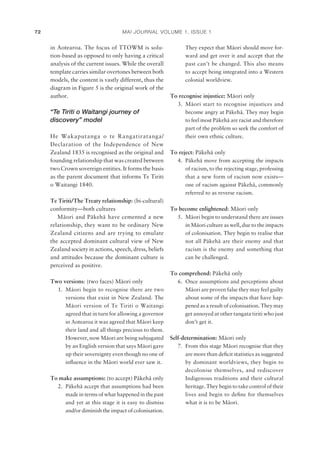
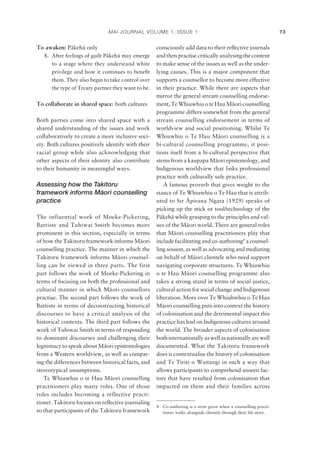
TAKITORU: FROM PARALLEL TO
PARTNERSHIP
A ritual of engagement based on Te Tiriti o
Waitangi for implementing safe cultural practice
in Mäori counselling and social science
Rawiri (David) Waretini Karena*
Abstract
Takitoru is a framework developed to support Mäori counselling students to understand the
impacts of historical intergenerational trauma across generations. The focus of this framework
examines unseen contributing factors supporting deficit statistics that continue to dominate Mäori
communities. Essentially students are invited to participate and interpret personal genealogy
in the context of colonisation to explore influences and effects. This paper addresses training
Indigenous counselling students simultaneously in affirmative Indigenous worldviews, as well
as critiquing the impact of colonisation on themselves, their clients and their wider community.
The overall goal is to give students an insight into historical intergenerational trauma so that
when they engage with Mäori clientele they also understand some of the historical contexts that
underpin working with Mäori.
Keywords
colonization, counselling, trauma, redress, Te Tiriti o Waitangi, decolonization, cultural safety
* The Centre for Health and Social Practice, Waikato Institute of Technology.
Email: David.Waretini-Karena@wintec.ac.nz
MAI JOURNAL VOLUME 1, ISSUE 162
Introduction
Initially this paper will outline the historical
development of the Takitoru1
framework and
discuss how the concept came into being. Then
it will examine some of the founding influ-
ences and philosophies that contribute to the
underlying theories that form the framework.
Meanwhile there will be a brief overview of Te
Tiriti o Waitangi (the Treaty of Waitangi), as
well as discussion on historical intergenerational
trauma resulting from Te Tiriti o Waitangi vio-
lations. Moreover, this paper will describe how
the framework is constructed and highlight
some of the authors whose ideas have informed
the framework. Accordingly, this paper will
then discuss safety procedures that are put in
place to support students who participate in
the Takitoru framework. The next part of this
paper will discuss participant’s preparation
prior to commencing the Takitoru framework.
Following that it will briefly describe the series
of models that make up the framework, and
how it is applied. Finally the paper will discuss
how the Takitoru framework informs Mäori
counselling practice.
Impetus for the historical
development of Takitoru the
framework
The Takitoru framework was formally crafted
in 2009, yet its origins date back to the early
1990s with the formation of Te Whiuwhiu o te
Hau2
Mäori counselling programme and from
its inauguration grew into an international
education programme that was introduced to
education facilities both in Hawai‘i and Canada.
1 The name Takitoru comes from a tukutuku pattern called
Roimata Takitoru. The underlying philosophies behind the
tukutuku pattern depict communication, identification and
personal relationships (Taumata o te Ra, 2007).
2 Te Whiuwhiu o te Hau is the name given to the Mäori
counselling programme by Werewere Maaka, kaumätua
of the Waikato Institute of Technology in 1989.
In New Zealand, Te Whiuwhiu o te Hau
Mäori counselling programme was originally
located as a separate programme for the first
17 years in the Mäori Department that in turn
changed its name to Te Toi-a-Kiwa: School
of Mäori, Pacifika and Indigenous Studies at
the Waikato Institute of Technology (Wintec)
until it was disbanded in 2008. The programme
ended up relocating from an Indigenous envi-
ronment to a mainstream setting where the
culture and practices were of a predominant
Western environment that created challenges as
a result of different worldviews, ideologies and
cultural practices. Initially, there were misun-
derstandings and a divergence of thinking and
as an educator it raised a sense of feeling that
Mäori counselling ideologies were underval-
ued and largely ignored when engaging with
mainstream colleagues in shared space. Thus,
while Te Whiuwhiu o te Hau Mäori counsel-
ling programme was moving into its 20th year
at Wintec, by virtue of it being in a mainstream
environment it could be argued that the pro-
gramme was on the verge of being subsumed
into the mainstream counselling programme
and at the most cynical of claims likely to only
supply Indigenous content to bolster the general
stream knowledge base, so that the mainstream
counselling endorsement could legitimately
claim to come from a bi-cultural position.
This “crisis” position therefore became the
impetus for the construction of the Takitoru
framework. After much debate and counter
discussion, common ground began to form
in “shared space” between mainstream coun-
selling and Te Whiuwhiu o te Hau Mäori
counselling endorsements of the degree pro-
gramme. The journey of Takitoru began to take
shape initially under a commitment dubbed
“from parallel to partnership”. There was a
recognised need to collaborate and develop a
parallel to partnership concept that allows both
programmes to exist in shared space as both are
considered Treaty partners and offer uniquely
different perspectives. While this paper has
mentioned the parallel to partnership concept,
MAI JOURNAL VOLUME 1, ISSUE 1 63
the emphasis of this paper is only focused on
how the Takitoru framework critically analyses
historical intergenerational trauma. Another
aspect to take into consideration is that at this
stage only Mäori counselling students have
been invited to participate in the Takitoru
framework. Under the current climate now
situated within the Centre for Health and Social
Practice, Te Whiuwhiu o te Hau Mäori counsel-
ling programme is re-defining and re-developing
itself and the Takitoru framework is an integral
part of that re-development.
Founding influences
The founding influences in the construction
of the Takitoru framework include the work
of three influential women academics and
practitioners. These women are Dr Taima
Moeke-Pickering, Dr Marie Battiste, and Dr
Linda Tuhiwai Smith. All three women advo-
cate three distinctive philosophical standpoints
that have significantly informed the author’s
thinking as an educator and as such are reflected
in the underpinning philosophies behind the
Takitoru framework.
Dr Taima Moeke-Pickering advocates
teaching professionals about racism and the
important role that cultural safety plays, stating:
“an assumption is that by training profession-
als to learn about racism they would then be
equipped to practise in a culturally appropriate
way. The cultural safety example is one model
that works toward unlearning racist practices”
(Moeke-Pickering, 2010, p. 39). The way in
which Te Whiuwhiu o te Hau Mäori coun-
selling programme advocates practising in a
culturally appropriate way includes educating
students from a bi-cultural position, thus the
focus of the Takitoru framework strives to
develop a conscious practice around cultural
safety. It also seeks to design strategies so that
Mäori counselling students can utilise culturally
safe methods that enable them to effectively
facilitate a culturally safe environment while
engaging with clientele in shared space. Another
aspect of culturally safe practice requires Mäori
counselling students to learn competency in
using culturally appropriate protocols to engage
with Mäori, so that they are able to create a
rapport in an appropriate manner, that students
are establishing a relationship using appropriate
language that is sensitive, respectful, non-judge-
mental, non-interpretive and non-directing.
Dr Marie Battiste asserts that “educa-
tors must reject colonial curricula that offer
students a fragmented and distorted picture
of Indigenous peoples, and offer students a
critical perspective of the historical context
that created that fragmentation” (2005,
p. 225). This second ideology from Battiste is
informative around deconstructing Western
epistemologies whose notions subjugate/sup-
press Indigenous contexts to inferior positions.
It therefore prompted a focus on affirmative
Indigenous worldviews that legitimise and vali-
date Indigenous positions while simultaneously
critiquing colonial discourse and historical
contexts.
The third significant influence came from
Smith (1999) who sets standards from which
to articulate and challenge how Indigenous
narratives and bodies of knowledge should
be represented within Western societal con-
structs. She advocates a position that recognises
that Indigenous peoples have their own codes
of ethics. Native ethics and seeking permis-
sion to conduct research with native peoples is
considered important and respectful (p. 120).
Smith brings to the fore affirmative Indigenous
positioning that recognises two integral con-
texts. The first is an acknowledgement that
Indigenous ways of knowing come with their
own principles, values and codes of ethics and
secondly, that it is the Indigenous voice that
sets the standards from which to determine how
Indigenous narratives are represented within
Western ways of knowing.
Although these founding influences may
not seem to directly relate to how the Takitoru
framework is implemented, they form the
MAI JOURNAL VOLUME 1, ISSUE 164
backbone to the framework both in terms of
the way it positions itself as well as the way in
which it informs the students.
The Takitoru framework is a decolonising
model that has three underlying philosophies.
1. The first makes the assumption that if
Mäori counselling students learn about
racism, then they can become equipped to
practise in a culturally appropriate way. It
recognises that the cultural safety model
unlearns racist practices.
2. The second seeks to inform Mäori counsel-
ling students about the impact of historical
intergenerational trauma by deconstruct-
ing historical contexts. The second
philosophy also analyses the historical
context and highlights any mechanisms
that portray their intergenerational time-
line in a fragmented and distorted manner.
The framework then seeks to counter this
by offering students a critical perspective
of the colonial constructs that created the
fragmentation.
3. The third informs Mäori counselling
students that Mäori culture has its own
epistemologies, principles and codes of
ethics. The third phase also acknowledges
that it is the Indigenous voice that sets
the standards from which to determine
how Indigenous narratives and bodies of
knowledge should be represented within
Western ways of thinking.
Te Tiriti o Waitangi
The preamble of Te Tiriti o Waitangi Mäori
text discusses securing Mäori tino rangatira-
tanga (self-determination) and securing Mäori
land ownership (Waitangi Tribunal, n.d.). The
Treaty document was signed between Governor
HobsonandTheUnitedConfederationofTribes
on 6 February 1840. Both the Treaty document
and the legislative violations that stem from it
are pinnacle aspects that the Takitoru frame-
work analyses.
While the document clearly highlights what
Mäori agreed to share and what they agreed to
keep, it is acknowledged that interpretations as
a result of the document created controversial
situations. One of the controversial situations
that stem from The Treaty document is that
two versions exist. The Mäori version that is
signed by all parties and the English version that
is not. Contra preferentum under international
law makes the English version null and void;
however, that still has not changed the position
of the New Zealand settler Government.
Trauma resulting from Te Tiriti o
Waitangi violations
One of the leading scholars in research into
historical intergenerational trauma, Dr Karina
Walters, states: “Historical intergenerational
trauma can be defined as an event or series of
events perpetrated on a group of people includ-
ing their environment who share a specific group
identity with genocidal or ethnocidal intent to
systematically eradicate them as a people or
eradicate their cultural ways of life” (Walters,
2012). The definition given by Walters carries
undertones around the Indigenous world in that
it also supports the impacts suffered by Mäori
as a direct result of legislative violations of Te
Tiriti o Waitangi.
Mechanisms including prejudicial legisla-
tion were utilised to attack and undermine
Mäori societal infrastructure; examples include
the Native Lands Act 1862, the Suppression
of Rebellion Act 1863, the Waikato inva-
sion 1863, the Native Schools Act 1867, the
Tohunga Suppression Act 1908 and the Native
Health Act 1909.
These illegal legislative violations were uti-
lised to take land and resources; to block all
forms of accountability by throwing those who
may challenge their colonial stance into prison;
to make false flag allegations to invade the
Waikato and confiscate millions of acres of
land; to assimilate Mäori children to Western
ideologies, Western culture and language at
MAI JOURNAL VOLUME 1, ISSUE 1 65
the expense of their Indigenous culture; and
to ban the traditional holders and experts of
Indigenous knowledge from teaching future
generations their cultural traditions.
The final legislative example known as the
Native Health Act 1909 was a form of legalised
genocide as it became illegal for Mäori women
to breastfeed their babies and whängai (adopt)
children. A Treaty training resource developed
by Dr Jenny Ritchie (2010) documents that a
large majority of Mäori women began feeding
their children flour and water. The implications
from that practice highlights that many Mäori
babies died as a direct result of this legislative
act. Other scholars in New Zealand have also
done a critical analysis on the impacts of the
legislative violations.
Dr Rawiri Taonui (2010) stated that Mäori
faced systematic economic, political, social
and cultural marginalisation, cultural aliena-
tion, forced assimilation, demonisation, racism,
structural prejudice and intergenerational
impoverishment. The Mäori language was
banned, their culture, heritage and identity deci-
mated. The number of speakers of the Mäori
language declined from 95% in 1900 to 5% in
1980 (Waitangi Tribunal, 1986).
The Takitoru framework
The Takitoru framework is based on a series
of models that work in a sequential order for
the purpose of developing student awareness
about historical intergenerational trauma.
This section will give a brief overview of the
sequence to describe how the process works.
The next aspect will identify components of
each model and discuss theorising in practice
as a means that was utilised to develop the
Takitoru framework.
The Takitoru framework has five phases:
1. The first phase contextualises Te Tiriti o
Waitangi violations.
2. The second phase is an invitation to
research four generations of their family
dating back to 1840. The students then
superimpose Te Tiriti o Waitangi viola-
tions over the top of each generation.
3. The third phase identifies symptoms of
historical intergenerational trauma that
trickle from one generation to the next.
4. The fourth phase identifies personal trans-
forming power to move beyond historical
trauma.
5. The fifth phase examines Te Tiriti o
Waitangi journey of discovery model that
seeks to identify how both Mäori and
Päkehä culture utilise historical contexts to
rediscover aspects about themselves, and
as each culture reaches each new level, they
begin to comprehend new understand-
ings about themselves and each other. The
objective is to discuss each stage and level
of awareness so that Mäori and Päkehä
both gain an understanding of the issues,
so that when it is time to move into shared
space with each other they create mean-
ingful relationships that foster conscious
collaborative efforts that work towards
benefiting both cultures and therefore
Aotearoa New Zealand.
These series of models have been developed
over 8 years of teaching Te Tiriti o Waitangi.
Other data that has informed the position of
the author as an educator to develop models
of wellness and awareness also stem from the
works of other authors such as Brofenbrenner
(in Addison, 1992), Elkington (2006), and
Helms (1990). This paper acknowledges that
some of the underlying theoretical background
to the Takitoru framework comes from uncon-
ventional means. Dr Ingrid Huygens called
the unconventional means concept “theorising
through practice/praxis” (personal communica-
tion, 2012).
Phil Hine discusses Pierre Bourdieu’s
approach to practice by stating: “not all learn-
ing is explicit and gained through discourse…
he stresses actions that are also unconscious
improvisations. This capacity to improvise is
MAI JOURNAL VOLUME 1, ISSUE 166
the product of the social learning process…”
(Hine, 2010, p. 1).
The development of the Takitoru frame-
work also has improvisations that stem from
unconventional means that examined models
developed by other authors, and theorised how
those other models could be expanded upon,
or utilised within the context of Te Tiriti o
Waitangi.
Creating a safe environment for
participants
What is most important for students taking
part in the Takitoru framework is that a safe
environment is maintained for those partici-
pating and that strategies are put in place for
students who may become impacted upon as a
result. The Takitoru framework is voluntary to
participate in and not part of the marking cri-
teria. Students are informed as to what aspects
the Takitoru framework will examine so that
they can make an informed choice whether
to participate, or do the generic Te Tiriti o
Waitangi version. Te Whiuwhiu o te Hau Mäori
counselling students are also advised to have
counselling sessions outside of the classroom
to support with any ongoing issues. On top of
that, students also have a robust resource net-
work at their disposal in the form of Mäori and
mainstream counsellors, as well as chaplains
and the kaumätua of Wintec. These avenues
are regularly utilised by the students because
from year one Te Whiuwhiu o te Hau students
go on a journey of rediscovering their cultural
identity. The underpinning philosophy behind
this context recognises that Mäori counsellors
cannot empower others to heal until they have
healed or worked through their own issues.
Eduardo Duran (2006) states that:
Some healers and therapists also are living
and working with their own intergenerational
trauma, which remains unresolved in many
instances. When therapists and healers do
not deal with their own history, they bring
unconscious contents into the therapeutic
setting. The natural consequence of this pro-
jection of unconscious fantasies and ideas
transfers onto the patient. This process is
known as transference. (p. 29)
Eduardo Duran’s quote clearly highlights the
impact of transference and counter-transference
due to unresolved historical issues. One of the
underlying philosophies of Te Whiuwhiu o te
Hau Mäori counselling is to support students
to reconnect to their cultural identity so they
may have a standpoint from which to effec-
tively engage with Mäori clientele in a manner
that is culturally appropriate. The Takitoru
framework is one means that may highlight
unresolved issues so that appropriate measures
can be put in place to support students to work
through them.
Student preparation for Takitoru
framework
The Takitoru framework is a decolonising
workshop that navigates participants through
a series of exercises. The first aspect sets the
guidelines for commencing the Takitoru frame-
work. Ethics including protection and safety,
sensitivity and confidentiality are raised to be
accepted by the participants. Other guidelines
are negotiated with the group so that guidelines
then become agreements.
Participants need pens, pencils and a book to
write notes in. All participants are invited to keep
a reflective journal to practise doing a critical
analysis of issues. The journal is the confidential
property of the participant and is kept to analyse
learnings that have manifested as a result of the
Takitoru framework. There is no expectation
for participants to share their personal history;
however, they will be invited to share some of the
learnings gained from the workshop.
The facilitator presents the models through
PowerPoint as well as gives participants hand-
outs to fill out the data. Participation will
include discussion, peer work, group work
MAI JOURNAL VOLUME 1, ISSUE 1 67
and reflective journals.
“Contextualising Te Tiriti o Waitangi
violations” exercise
The first model Te Whiuwhiu o te Hau Mäori
counselling students are invited to participate
in is the “Contextualising Te Tiriti o Waitangi
violations” exercise (Figure 1). The original
concept behind this model stems from Urie
Brofenbrenner’s ecology model based on the
micro-system, macro-system and exo-system
(Addison, 1992). The interest of the author
lay more in changing the perspectives set in
Brofenbrenner’s ecology model to focus on
a contextual perspective when examining Te
Tiriti o Waitangi violations.
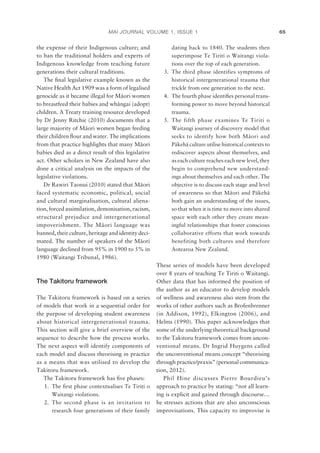
The exercise asks historically what Te Tiriti
o Waitangi violations mean to participants. It
then asks socially what it means to participants.
Then it asks from an institutional context what
it means for participants. Finally it asks, from
a personal context, what Te Tiriti o Waitangi
violations mean to participants. Once they have
answered these questions it is recorded in their
reflective journal and the learning becomes open
to discussion.
“Contextualising historical
intergeneration trauma in genealogy”
exercise
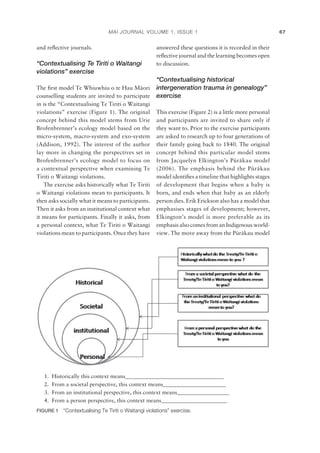
This exercise (Figure 2) is a little more personal
and participants are invited to share only if
they want to. Prior to the exercise participants
are asked to research up to four generations of
their family going back to 1840. The original
concept behind this particular model stems
from Jacquelyn Elkington’s Püräkau model
(2006). The emphasis behind the Püräkau
model identifies a timeline that highlights stages
of development that begins when a baby is
born, and ends when that baby as an elderly
person dies. Erik Erickson also has a model that
emphasises stages of development; however,
Elkington’s model is more preferable as its
emphasis also comes from an Indigenous world-
view. The move away from the Püräkau model
1. Historically this context means____________________________________
2. From a societal perspective, this context means_______________________
3. From an institutional perspective, this context means___________________
4. From a person perspective, this context means________________________
FIGURE 1 “Contextualising Te Tiriti o Waitangi violations” exercise.
MAI JOURNAL VOLUME 1, ISSUE 168
came as a result of applying the concept to a
collective as opposed to an individual. The next
move away from the Püräkau model came from
changing the emphasis of Elkington’s model
of inviting students to describe their personal
timeline from ages 15 to 25, into applying the
timeline concept to an entire generation. Once
the concept was applied to an entire generation,
then three other generations were added to
take the timeline back to 1840 when Te Tiriti
o Waitangi was signed.
1. The participants are invited to study their
ancestors across the four generations to
understand the environmental context.
2. The participants are then invited to super-
impose Te Tiriti o Waitangi violations over
the top of all four generations and then
critically study the data to determine the
impact on the environment.
The model may highlight examples of trauma
that arise as a result of looking through the
data. The participants are then invited to sift
through the colonial version of history to ascer-
tain and describe in their reflective journals how
these impacts affected their ancestors spiritu-
ally, cognitively, emotionally, physically and
environmentally.
Participants are then asked to measure
for themselves if historical intergenerational
trauma exists, and if it does what type of impact
has it had on them personally. Dr Maria Yellow
Horse Brave Heart supports the learning of
historical intergenerational trauma by stat-
ing: “understanding the legacy of trauma is
helpful for participants, and that the impor-
tance of sharing and talking about the trauma
allows sufferers to focus on a common identity”
(Yellow Horse Brave Heart, 2000).
Dr Karina Walters also brings to the fore
new data that states: “epigenetic research has
discovered that at a cellular level, stress from
one generation can be carried to the next gen-
eration” (Walters, 2012).
Dr Bruce Lipton, a cellular biologist in stem
cell research supports Dr Karina Walters by
FIGURE 2 “Contextualising historical intergeneration trauma in genealogy” exercise.
MAI JOURNAL VOLUME 1, ISSUE 1 69
stating that when he began stem cell research
in 1967:
In one of my experiments I put stem cells in
three petri dishes. I then changed the growth
medium, the constituents of the environment
in each dish…. In one dish it formed bone, in
the next it formed muscle and in the final dish
it formed fat cells…. All of a sudden I’m like
oh my gosh, I realised that here I am teaching
at University that genes control the environ-
ment, while the cells are telling me that genes
respond to the environment. (Stewart, 2009)3
3 Bruce Lipton’s quote can be found from 1:20:19 through
to 1:21:52 in Ben Stewart’s Kymatica DVD.
“Contextualising symptoms of
historical intergenerational trauma”
exercise
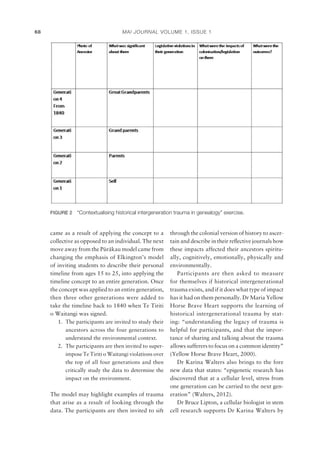
In this next exercise (Figure 3) participants are
invited to use a diagram that highlights their
genealogy on a page. The participants then
fill in symbolic data based on four generations
of their family back to 1840. Once they have
completed that task they fill in the key section
at the left hand side of the picture.
Participants are invited to put a symbol
beside all those in their genealogy who have
lost their land, who have been impacted by
alcohol, domestic violence, drugs, gangs, unem-
ployment, all who have been to prison, all those
who have issues with gambling, all members
that smoke cigarettes, all members who have
fought in wars.
Participants are then asked to develop their
FIGURE 3 “Contextualising symptoms of historical intergenerational trauma” exercise.
MAI JOURNAL VOLUME 1, ISSUE 170
own symbols and place them beside members
of their family those symbols signify. Students
are asked to study the data and take note of any
patterns that may arise from doing the exercise.
Participants are then invited to do a critical
analysis of their findings and when they have
finished doing a critical analysis, they are then
invited to write a reflective analysis in their
journals.
“Personal transformation” exercise
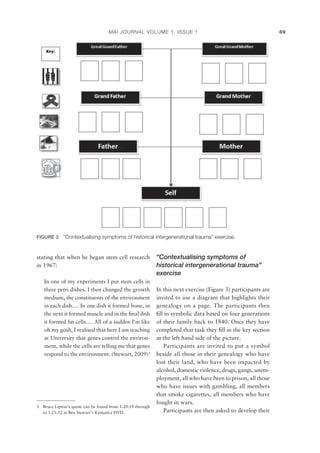
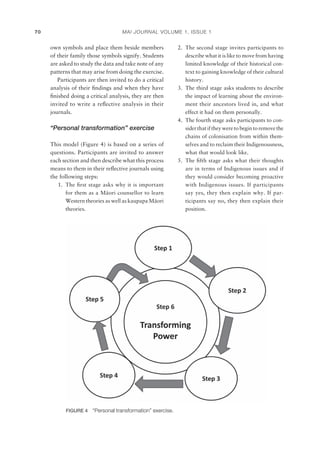
This model (Figure 4) is based on a series of
questions. Participants are invited to answer
each section and then describe what this process
means to them in their reflective journals using
the following steps:
1. The first stage asks why it is important
for them as a Mäori counsellor to learn
Western theories as well as kaupapa Mäori
theories.
2. The second stage invites participants to
describe what it is like to move from having
limited knowledge of their historical con-
text to gaining knowledge of their cultural
history.
3. The third stage asks students to describe
the impact of learning about the environ-
ment their ancestors lived in, and what
effect it had on them personally.
4. The fourth stage asks participants to con-
siderthatiftheyweretobegintoremovethe
chains of colonisation from within them-
selves and to reclaim their Indigenousness,
what that would look like.
5. The fifth stage asks what their thoughts
are in terms of Indigenous issues and if
they would consider becoming proactive
with Indigenous issues. If participants
say yes, they then explain why. If par-
ticipants say no, they then explain their
position.
FIGURE 4 “Personal transformation” exercise.
MAI JOURNAL VOLUME 1, ISSUE 1 71
6. The sixth stage asks participants, if they
wanted to personally transform historical
trauma, what processes they would use
to transform themselves, their family and
their community.
Transforming broader relationships
between stakeholders
Te Tiriti o Waitangi journey of discovery
model (TTOWM) highlights difficulties in
establishing meaningful relationships between
Mäori and Päkehä culture in Aotearoa New
Zealand. Moreover, it highlights issues such as
lack of trust, and fears based on assumptions.
Participants are put into groups and invited
to have a group brainstorming session about
how to transform the current climate and cre-
ate shared space. The group of participants
are then invited to take a piece of paper and
as a group design how they would transform
and design their ideal society and describe how
they would create shared space under Te Tiriti
o Waitangi. Once the groups have finished they
are invited to present their ideal society to the
rest of the class. The brainstorming and ideal
community sessions are valuable tools as they
measure where student thinking is in regard to
transforming communities.
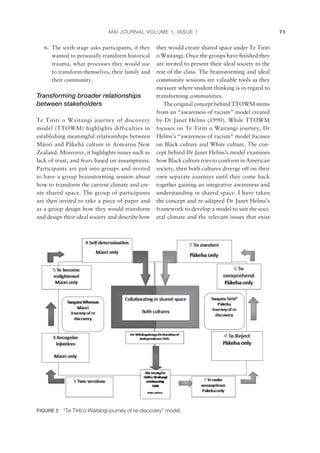
The original concept behind TTOWM stems
from an “awareness of racism” model created
by Dr Janet Helms (1990). While TTOWM
focuses on Te Tiriti o Waitangi journey, Dr
Helms’s “awareness of racism” model focuses
on Black culture and White culture. The con-
cept behind Dr Janet Helms’s model examines
how Black culture tries to conform in American
society, then both cultures diverge off on their
own separate journeys until they come back
together gaining an integrative awareness and
understanding in shared space. I have taken
the concept and re-adapted Dr Janet Helms’s
framework to develop a model to suit the soci-
etal climate and the relevant issues that exist
FIGURE 5 “Te Tiriti o Waitangi journey of re-discovery” model.
MAI JOURNAL VOLUME 1, ISSUE 172
in Aotearoa. The focus of TTOWM is solu-
tion-based as opposed to only having a critical
analysis of the current issues. While the overall
template carries similar overtones between both
models, the content is vastly different, thus the
diagram in Figure 5 is the original work of the
author.
“Te Tiriti o Waitangi journey of
discovery” model
He Wakaputanga o te Rangatiratanga/
Declaration of the Independence of New
Zealand 1835 is recognised as the original and
founding relationship that was created between
two Crown sovereign entities. It forms the basis
as the parent document that informs Te Tiriti
o Waitangi 1840.
Te Tiriti/The Treaty relationship: (bi-cultural)
conformity—both cultures
Mäori and Päkehä have cemented a new
relationship, they want to be ordinary New
Zealand citizens and are trying to emulate
the accepted dominant cultural view of New
Zealand society in actions, speech, dress, beliefs
and attitudes because the dominant culture is
perceived as positive.
Two versions: (two faces) Mäori only
1. Mäori begin to recognise there are two
versions that exist in New Zealand. The
Mäori version of Te Tiriti o Waitangi
agreed that in turn for allowing a governor
in Aotearoa it was agreed that Mäori keep
their land and all things precious to them.
However, now Mäori are being subjugated
by an English version that says Mäori gave
up their sovereignty even though no one of
influence in the Mäori world ever saw it.
To make assumptions: (to accept) Päkehä only
2. Päkehä accept that assumptions had been
made in terms of what happened in the past
and yet at this stage it is easy to dismiss
and/or diminish the impact of colonisation.
They expect that Mäori should move for-
ward and get over it and accept that the
past can’t be changed. This also means
to accept being integrated into a Western
colonial worldview.
To recognise injustice: Mäori only
3. Mäori start to recognise injustices and
become angry at Päkehä. They may begin
to feel most Päkehä are racist and therefore
part of the problem so seek the comfort of
their own ethnic culture.
To reject: Päkehä only
4. Päkehä move from accepting the impacts
of racism, to the rejecting stage, professing
that a new form of racism now exists—
one of racism against Päkehä, commonly
referred to as reverse racism.
To become enlightened: Mäori only
5. Mäori begin to understand there are issues
in Mäori culture as well, due to the impacts
of colonisation. They begin to realise that
not all Päkehä are their enemy and that
racism is the enemy and something that
can be challenged.
To comprehend: Päkehä only
6. Once assumptions and perceptions about
Mäori are proven false they may feel guilty
about some of the impacts that have hap-
pened as a result of colonisation. They may
get annoyed at other tangata tiriti who just
don’t get it.
Self-determination: Mäori only
7. From this stage Mäori recognise that they
are more than deficit statistics as suggested
by dominant worldviews, they begin to
decolonise themselves, and rediscover
Indigenous traditions and their cultural
heritage. They begin to take control of their
lives and begin to define for themselves
what it is to be Mäori.
MAI JOURNAL VOLUME 1, ISSUE 1 73
To awaken: Päkehä only
8. After feelings of guilt Päkehä may emerge
to a stage where they understand white
privilege and how it continues to benefit
them. They also begin to take control over
the type of Treaty partner they want to be.
To collaborate in shared space: both cultures
Both parties come into shared space with a
shared understanding of the issues and work
collaboratively to create a more inclusive soci-
ety. Both cultures positively identify with their
racial group while also acknowledging that
other aspects of their identity also contribute
to their humanity in meaningful ways.
Assessing how the Takitoru
framework informs Ma¯ ori counselling
practice
The influential work of Moeke-Pickering,
Battiste and Tuhiwai Smith becomes more
prominent in this section, especially in terms
of how the Takitoru framework informs Mäori
counselling practice. The manner in which the
Takitoru framework informs Mäori counsel-
ling can be viewed in three parts. The first
part follows the work of Moeke-Pickering in
terms of focusing on both the professional and
cultural manner in which Mäori counsellors
practise. The second part follows the work of
Battiste in terms of deconstructing historical
discourses to have a critical analysis of the
historical contexts. The third part follows the
work of Tuhiwai Smith in terms of responding
to dominant discourses and challenging their
legitimacy to speak about Mäori epistemologies
from a Western worldview, as well as compar-
ing the differences between historical facts, and
stereotypical assumptions.
Te Whiuwhiu o te Hau Mäori counselling
practitioners play many roles. One of those
roles includes becoming a reflective practi-
tioner. Takitoru focuses on reflective journaling
so that participants of the Takitoru framework
consciously add data to their reflective journals
and then practise critically analysing the content
to make sense of the issues as well as the under-
lying causes. This is a major component that
supports a counsellor to become more effective
in their practice. While there are aspects that
mirror the general stream counselling endorse-
ment, Te Whiuwhiu o te Hau Mäori counselling
programme differs somewhat from the general
stream counselling endorsement in terms of
worldview and social positioning. Whilst Te
Whiuwhiu o Te Hau Mäori counselling is a
bi-cultural counselling programme, it posi-
tions itself from a bi-cultural perspective that
stems from a kaupapa Mäori epistemology, and
Indigenous worldview that links professional
practice with culturally safe practice.
A famous proverb that gives weight to the
stance of Te Whiuwhiu o Te Hau that is attrib-
uted to Sir Äpirana Ngata (1929) speaks of
picking up the stick or tool/technology of the
Päkehä while grasping to the principles and val-
ues of the Mäori world. There are general roles
that Mäori counselling practitioners play that
include facilitating and co-authoring4
a counsel-
ling session, as well as advocating and mediating
on behalf of Mäori clientele who need support
navigating corporate structures. Te Whiuwhiu
o te Hau Mäori counselling programme also
takes a strong stand in terms of social justice,
cultural action for social change and Indigenous
liberation. More over Te Whiuhwhiu o Te Hau
Mäori counselling puts into context the history
of colonisation and the detrimental impact this
practice has had on Indigenous cultures around
the world. The broader aspects of colonisation
bothinternationallyaswellasnationallyarewell
documented. What the Takitoru framework
does is contextualise the history of colonisation
and Te Tiriti o Waitangi in such a way that
allows participants to comprehend unseen fac-
tors that have resulted from colonisation that
impacted on them and their families across
4 Co-authoring is a term given when a counselling practi-
tioner walks alongside clientele through their life story.
MAI JOURNAL VOLUME 1, ISSUE 174
generations. This supports Mäori counsellors to
have a comprehensive understanding of the cur-
rent issues Mäori clientele face, as well as some
of the historical discourses that Mäori clientele
have been subjected to inter-generationally.
Decolonising workshops such as the
Takitoru framework are also invaluable in
terms of responding to critique from Western
discourse. Recent articles written by European
personalities such as Paul Holmes, Michael
Laws and David Round, who are deemed to
hold positions of authority in New Zealand
society, seem to attack, marginalise and disen-
franchise Mäori, while at the same time, use
the media to assert their own dominant world-
views which are expressed in one medium or
another on a regular basis. What the Takitoru
framework brings to the fore are two points.
The first point analyses their language and
perceptions of things Mäori and then counters
their legitimacy in being able to speak about
those issues from a position of authority. The
second point implements a comparative analy-
sis between historically documented facts, and
stereotypical labels based on perceptions of
a Western epistemology and therefore work
towards demystifying perceptions by bringing
clarity to the discussion.
The information above brings to light some
of the varied ways that the Takitoru framework
can be of value. What has also been highlighted
is the framework’s ability to assist Mäori coun-
selling practitioners in terms of best practice.
The framework also assists in deconstructing
and critically analysing historical discourses,
and responding to dominant worldviews.
While this paper has only focused on histori-
cal intergenerational trauma, there are other
parts to Takitoru that focuses on “parallel to
partnership”.
Conclusion
In summary, this paper outlined the historical
development of the Takitoru framework and
discussed how the concept came into being.
It then examined some of the founding influ-
ences and philosophies that contributed to the
underlying theories that formed the frame-
work. There was a brief overview of Te Tiriti
o Waitangi, as well as discussion on historical
intergenerational trauma resulting from Te
Tiriti o Waitangi violations. This paper dis-
cussed safety procedures put in place to support
students who participate in the Takitoru frame-
work. It then discussed participant preparation
prior to commencing the Takitoru framework.
This paper described how the framework was
constructed and highlighted authors whose
ideas have informed the framework. It briefly
described the series of models that make up the
framework, and how they are applied. Finally,
this paper discussed how the Takitoru frame-
work informs Mäori counselling practice. The
objective of this article has been to create dis-
cussion and resources that contribute to Mäori
development and Indigenous advancement.
There is recognition that some of the concepts
within the Takitoru framework can be trans-
ferred across other educational, industry and
decolonising programmes. There is also an
acknowledgement that these concepts can also
be transferable across other Indigenous cultures
around the globe.
Nö reira tënä koutou katoa.
MAI JOURNAL VOLUME 1, ISSUE 1 75
Reference
Addison, J. T. (1992). Urie Bronfenbrenner. Human
Ecology, 20(2), 16–20.
Battiste, M. (2005). Post-colonial remedies for preserv-
ing Indigenous knowledge and heritage. In P.
Tripp & L. Muzzin (Eds.), Teaching as activism:
Equity meets environmentalism (pp. 224–232).
Montreal, Canada: McGill-Queen’s University
Press.
Duran, E. (2006). Healing the soul wound: Counselling
with American Indians and other native peoples.
New York, NY: Teachers College Press.
Elkington, J. (2006). The Püräkau model. A counsel-
ling training resource for Te Whiuwhiu o Te
Hau Mäori counselling programme. Hamilton:
Waikato Institute of Technology, the Centre for
Health and Social Practice.
Helms, J. E. (Ed.). (1990). Black and white racial iden-
tity: Theory, research and practice. Westport,
CT: Greenwood Press.
Hine, P. (2010). Theorising practice II. Retrieved
from http://enfolding.org/theorising-practice-
ii-habitushexis/
Lipton, B.(2009). Stem cell research and genetics.
Timeframe: 1:20-19sec- 121:52secs. [Motion
picture]. Retrieved March 28 2012 from: http://
www.youtube.com/watch?v=AanQ2mY2jjc&fe
ature=player_embedded
Moeke-Pickering, T. M. (2010). Decolonisation as
a social change framework and its impact on
the development of Indigenous-based curricula
for helping professionals in mainstream tertiary
education organisations. Unpublished doctoral
thesis, University of Waikato, Hamilton.
Ngata, A. T. (1929). The genealogical method as
applied to the early history of New Zealand.
Paper presented at a meeting of the Wellington
branch of the Historical Association, Wellington.
[Alexandra Turnbull Library: qMS NGA]
Ritchie, J. (2010). Legislative violations of the Treaty.
In Te Ara Tika Tuatahi, Treaty training resource
for Waikato District Health Board. Hamilton:
University of Waikato, School of Mäori and
Pacific Development.
Smith, L. T. (1999). Decolonizing methodologies:
Research and indigenous peoples. Dunedin:
University of Otago Press.
Stewart, B. (Producer). (2009). Kymatica. [DVD].
Retrieved from http://www.youtube.com/
watch?v=AanQ2mY2jjc&feature=player_
embedded
Treaty Educations for Migrant Groups. (2006).
Tangata tiriti- Treaty people: An interactive
workbook on the Treaty of Waitangi. Auckland:
New Zealand. Auckland Workers Educational
Association.
Taonui, R. (2010). Mana tamariki: Cultural alienation.
AlterNative, 6(3), 187–202.
Taumata o te Ra. (2007). Roimata Takitoru (tuk-
tuku pattern). Retrieved from http://www.
naumaiplace.com/site/taumata-o-te-ra/home/
page/1006/ng-tukutuku/
Waitangi Tribunal. (1986). Wai 11 Te Reo Mäori
report. Wellington.
WaitangiTribunal.(n.d.).TreatyofWaitangipreamble.
Retrieved from: http://www.waitangi-tribunal.
govt.nz/treaty/meaning.aspWalters, K. (2012).
Embodiment of historical trauma and micro-
aggression distress [Video]. Retrieved from http://
www.youtube.com/watch?v=WzPNWTD56S8
Yellow Horse Brave Heart, M. (2000). Wakiksuyapi:
Carrying the historical trauma of the
Lakota. Retrieved from http://discoveringour
story.wisdomoftheelders.org/ht_and_grief/
Wakiksuyapi-HT.pdf

Takitoru From Parallel to Partnership Mai journal

  • 1.
    TAKITORU: FROM PARALLELTO PARTNERSHIP A ritual of engagement based on Te Tiriti o Waitangi for implementing safe cultural practice in Mäori counselling and social science Rawiri (David) Waretini Karena* Abstract Takitoru is a framework developed to support Mäori counselling students to understand the impacts of historical intergenerational trauma across generations. The focus of this framework examines unseen contributing factors supporting deficit statistics that continue to dominate Mäori communities. Essentially students are invited to participate and interpret personal genealogy in the context of colonisation to explore influences and effects. This paper addresses training Indigenous counselling students simultaneously in affirmative Indigenous worldviews, as well as critiquing the impact of colonisation on themselves, their clients and their wider community. The overall goal is to give students an insight into historical intergenerational trauma so that when they engage with Mäori clientele they also understand some of the historical contexts that underpin working with Mäori. Keywords colonization, counselling, trauma, redress, Te Tiriti o Waitangi, decolonization, cultural safety * The Centre for Health and Social Practice, Waikato Institute of Technology. Email: David.Waretini-Karena@wintec.ac.nz
  • 2.
    MAI JOURNAL VOLUME1, ISSUE 162 Introduction Initially this paper will outline the historical development of the Takitoru1 framework and discuss how the concept came into being. Then it will examine some of the founding influ- ences and philosophies that contribute to the underlying theories that form the framework. Meanwhile there will be a brief overview of Te Tiriti o Waitangi (the Treaty of Waitangi), as well as discussion on historical intergenerational trauma resulting from Te Tiriti o Waitangi vio- lations. Moreover, this paper will describe how the framework is constructed and highlight some of the authors whose ideas have informed the framework. Accordingly, this paper will then discuss safety procedures that are put in place to support students who participate in the Takitoru framework. The next part of this paper will discuss participant’s preparation prior to commencing the Takitoru framework. Following that it will briefly describe the series of models that make up the framework, and how it is applied. Finally the paper will discuss how the Takitoru framework informs Mäori counselling practice. Impetus for the historical development of Takitoru the framework The Takitoru framework was formally crafted in 2009, yet its origins date back to the early 1990s with the formation of Te Whiuwhiu o te Hau2 Mäori counselling programme and from its inauguration grew into an international education programme that was introduced to education facilities both in Hawai‘i and Canada. 1 The name Takitoru comes from a tukutuku pattern called Roimata Takitoru. The underlying philosophies behind the tukutuku pattern depict communication, identification and personal relationships (Taumata o te Ra, 2007). 2 Te Whiuwhiu o te Hau is the name given to the Mäori counselling programme by Werewere Maaka, kaumätua of the Waikato Institute of Technology in 1989. In New Zealand, Te Whiuwhiu o te Hau Mäori counselling programme was originally located as a separate programme for the first 17 years in the Mäori Department that in turn changed its name to Te Toi-a-Kiwa: School of Mäori, Pacifika and Indigenous Studies at the Waikato Institute of Technology (Wintec) until it was disbanded in 2008. The programme ended up relocating from an Indigenous envi- ronment to a mainstream setting where the culture and practices were of a predominant Western environment that created challenges as a result of different worldviews, ideologies and cultural practices. Initially, there were misun- derstandings and a divergence of thinking and as an educator it raised a sense of feeling that Mäori counselling ideologies were underval- ued and largely ignored when engaging with mainstream colleagues in shared space. Thus, while Te Whiuwhiu o te Hau Mäori counsel- ling programme was moving into its 20th year at Wintec, by virtue of it being in a mainstream environment it could be argued that the pro- gramme was on the verge of being subsumed into the mainstream counselling programme and at the most cynical of claims likely to only supply Indigenous content to bolster the general stream knowledge base, so that the mainstream counselling endorsement could legitimately claim to come from a bi-cultural position. This “crisis” position therefore became the impetus for the construction of the Takitoru framework. After much debate and counter discussion, common ground began to form in “shared space” between mainstream coun- selling and Te Whiuwhiu o te Hau Mäori counselling endorsements of the degree pro- gramme. The journey of Takitoru began to take shape initially under a commitment dubbed “from parallel to partnership”. There was a recognised need to collaborate and develop a parallel to partnership concept that allows both programmes to exist in shared space as both are considered Treaty partners and offer uniquely different perspectives. While this paper has mentioned the parallel to partnership concept,
  • 3.
    MAI JOURNAL VOLUME1, ISSUE 1 63 the emphasis of this paper is only focused on how the Takitoru framework critically analyses historical intergenerational trauma. Another aspect to take into consideration is that at this stage only Mäori counselling students have been invited to participate in the Takitoru framework. Under the current climate now situated within the Centre for Health and Social Practice, Te Whiuwhiu o te Hau Mäori counsel- ling programme is re-defining and re-developing itself and the Takitoru framework is an integral part of that re-development. Founding influences The founding influences in the construction of the Takitoru framework include the work of three influential women academics and practitioners. These women are Dr Taima Moeke-Pickering, Dr Marie Battiste, and Dr Linda Tuhiwai Smith. All three women advo- cate three distinctive philosophical standpoints that have significantly informed the author’s thinking as an educator and as such are reflected in the underpinning philosophies behind the Takitoru framework. Dr Taima Moeke-Pickering advocates teaching professionals about racism and the important role that cultural safety plays, stating: “an assumption is that by training profession- als to learn about racism they would then be equipped to practise in a culturally appropriate way. The cultural safety example is one model that works toward unlearning racist practices” (Moeke-Pickering, 2010, p. 39). The way in which Te Whiuwhiu o te Hau Mäori coun- selling programme advocates practising in a culturally appropriate way includes educating students from a bi-cultural position, thus the focus of the Takitoru framework strives to develop a conscious practice around cultural safety. It also seeks to design strategies so that Mäori counselling students can utilise culturally safe methods that enable them to effectively facilitate a culturally safe environment while engaging with clientele in shared space. Another aspect of culturally safe practice requires Mäori counselling students to learn competency in using culturally appropriate protocols to engage with Mäori, so that they are able to create a rapport in an appropriate manner, that students are establishing a relationship using appropriate language that is sensitive, respectful, non-judge- mental, non-interpretive and non-directing. Dr Marie Battiste asserts that “educa- tors must reject colonial curricula that offer students a fragmented and distorted picture of Indigenous peoples, and offer students a critical perspective of the historical context that created that fragmentation” (2005, p. 225). This second ideology from Battiste is informative around deconstructing Western epistemologies whose notions subjugate/sup- press Indigenous contexts to inferior positions. It therefore prompted a focus on affirmative Indigenous worldviews that legitimise and vali- date Indigenous positions while simultaneously critiquing colonial discourse and historical contexts. The third significant influence came from Smith (1999) who sets standards from which to articulate and challenge how Indigenous narratives and bodies of knowledge should be represented within Western societal con- structs. She advocates a position that recognises that Indigenous peoples have their own codes of ethics. Native ethics and seeking permis- sion to conduct research with native peoples is considered important and respectful (p. 120). Smith brings to the fore affirmative Indigenous positioning that recognises two integral con- texts. The first is an acknowledgement that Indigenous ways of knowing come with their own principles, values and codes of ethics and secondly, that it is the Indigenous voice that sets the standards from which to determine how Indigenous narratives are represented within Western ways of knowing. Although these founding influences may not seem to directly relate to how the Takitoru framework is implemented, they form the
  • 4.
    MAI JOURNAL VOLUME1, ISSUE 164 backbone to the framework both in terms of the way it positions itself as well as the way in which it informs the students. The Takitoru framework is a decolonising model that has three underlying philosophies. 1. The first makes the assumption that if Mäori counselling students learn about racism, then they can become equipped to practise in a culturally appropriate way. It recognises that the cultural safety model unlearns racist practices. 2. The second seeks to inform Mäori counsel- ling students about the impact of historical intergenerational trauma by deconstruct- ing historical contexts. The second philosophy also analyses the historical context and highlights any mechanisms that portray their intergenerational time- line in a fragmented and distorted manner. The framework then seeks to counter this by offering students a critical perspective of the colonial constructs that created the fragmentation. 3. The third informs Mäori counselling students that Mäori culture has its own epistemologies, principles and codes of ethics. The third phase also acknowledges that it is the Indigenous voice that sets the standards from which to determine how Indigenous narratives and bodies of knowledge should be represented within Western ways of thinking. Te Tiriti o Waitangi The preamble of Te Tiriti o Waitangi Mäori text discusses securing Mäori tino rangatira- tanga (self-determination) and securing Mäori land ownership (Waitangi Tribunal, n.d.). The Treaty document was signed between Governor HobsonandTheUnitedConfederationofTribes on 6 February 1840. Both the Treaty document and the legislative violations that stem from it are pinnacle aspects that the Takitoru frame- work analyses. While the document clearly highlights what Mäori agreed to share and what they agreed to keep, it is acknowledged that interpretations as a result of the document created controversial situations. One of the controversial situations that stem from The Treaty document is that two versions exist. The Mäori version that is signed by all parties and the English version that is not. Contra preferentum under international law makes the English version null and void; however, that still has not changed the position of the New Zealand settler Government. Trauma resulting from Te Tiriti o Waitangi violations One of the leading scholars in research into historical intergenerational trauma, Dr Karina Walters, states: “Historical intergenerational trauma can be defined as an event or series of events perpetrated on a group of people includ- ing their environment who share a specific group identity with genocidal or ethnocidal intent to systematically eradicate them as a people or eradicate their cultural ways of life” (Walters, 2012). The definition given by Walters carries undertones around the Indigenous world in that it also supports the impacts suffered by Mäori as a direct result of legislative violations of Te Tiriti o Waitangi. Mechanisms including prejudicial legisla- tion were utilised to attack and undermine Mäori societal infrastructure; examples include the Native Lands Act 1862, the Suppression of Rebellion Act 1863, the Waikato inva- sion 1863, the Native Schools Act 1867, the Tohunga Suppression Act 1908 and the Native Health Act 1909. These illegal legislative violations were uti- lised to take land and resources; to block all forms of accountability by throwing those who may challenge their colonial stance into prison; to make false flag allegations to invade the Waikato and confiscate millions of acres of land; to assimilate Mäori children to Western ideologies, Western culture and language at
  • 5.
    MAI JOURNAL VOLUME1, ISSUE 1 65 the expense of their Indigenous culture; and to ban the traditional holders and experts of Indigenous knowledge from teaching future generations their cultural traditions. The final legislative example known as the Native Health Act 1909 was a form of legalised genocide as it became illegal for Mäori women to breastfeed their babies and whängai (adopt) children. A Treaty training resource developed by Dr Jenny Ritchie (2010) documents that a large majority of Mäori women began feeding their children flour and water. The implications from that practice highlights that many Mäori babies died as a direct result of this legislative act. Other scholars in New Zealand have also done a critical analysis on the impacts of the legislative violations. Dr Rawiri Taonui (2010) stated that Mäori faced systematic economic, political, social and cultural marginalisation, cultural aliena- tion, forced assimilation, demonisation, racism, structural prejudice and intergenerational impoverishment. The Mäori language was banned, their culture, heritage and identity deci- mated. The number of speakers of the Mäori language declined from 95% in 1900 to 5% in 1980 (Waitangi Tribunal, 1986). The Takitoru framework The Takitoru framework is based on a series of models that work in a sequential order for the purpose of developing student awareness about historical intergenerational trauma. This section will give a brief overview of the sequence to describe how the process works. The next aspect will identify components of each model and discuss theorising in practice as a means that was utilised to develop the Takitoru framework. The Takitoru framework has five phases: 1. The first phase contextualises Te Tiriti o Waitangi violations. 2. The second phase is an invitation to research four generations of their family dating back to 1840. The students then superimpose Te Tiriti o Waitangi viola- tions over the top of each generation. 3. The third phase identifies symptoms of historical intergenerational trauma that trickle from one generation to the next. 4. The fourth phase identifies personal trans- forming power to move beyond historical trauma. 5. The fifth phase examines Te Tiriti o Waitangi journey of discovery model that seeks to identify how both Mäori and Päkehä culture utilise historical contexts to rediscover aspects about themselves, and as each culture reaches each new level, they begin to comprehend new understand- ings about themselves and each other. The objective is to discuss each stage and level of awareness so that Mäori and Päkehä both gain an understanding of the issues, so that when it is time to move into shared space with each other they create mean- ingful relationships that foster conscious collaborative efforts that work towards benefiting both cultures and therefore Aotearoa New Zealand. These series of models have been developed over 8 years of teaching Te Tiriti o Waitangi. Other data that has informed the position of the author as an educator to develop models of wellness and awareness also stem from the works of other authors such as Brofenbrenner (in Addison, 1992), Elkington (2006), and Helms (1990). This paper acknowledges that some of the underlying theoretical background to the Takitoru framework comes from uncon- ventional means. Dr Ingrid Huygens called the unconventional means concept “theorising through practice/praxis” (personal communica- tion, 2012). Phil Hine discusses Pierre Bourdieu’s approach to practice by stating: “not all learn- ing is explicit and gained through discourse… he stresses actions that are also unconscious improvisations. This capacity to improvise is
  • 6.
    MAI JOURNAL VOLUME1, ISSUE 166 the product of the social learning process…” (Hine, 2010, p. 1). The development of the Takitoru frame- work also has improvisations that stem from unconventional means that examined models developed by other authors, and theorised how those other models could be expanded upon, or utilised within the context of Te Tiriti o Waitangi. Creating a safe environment for participants What is most important for students taking part in the Takitoru framework is that a safe environment is maintained for those partici- pating and that strategies are put in place for students who may become impacted upon as a result. The Takitoru framework is voluntary to participate in and not part of the marking cri- teria. Students are informed as to what aspects the Takitoru framework will examine so that they can make an informed choice whether to participate, or do the generic Te Tiriti o Waitangi version. Te Whiuwhiu o te Hau Mäori counselling students are also advised to have counselling sessions outside of the classroom to support with any ongoing issues. On top of that, students also have a robust resource net- work at their disposal in the form of Mäori and mainstream counsellors, as well as chaplains and the kaumätua of Wintec. These avenues are regularly utilised by the students because from year one Te Whiuwhiu o te Hau students go on a journey of rediscovering their cultural identity. The underpinning philosophy behind this context recognises that Mäori counsellors cannot empower others to heal until they have healed or worked through their own issues. Eduardo Duran (2006) states that: Some healers and therapists also are living and working with their own intergenerational trauma, which remains unresolved in many instances. When therapists and healers do not deal with their own history, they bring unconscious contents into the therapeutic setting. The natural consequence of this pro- jection of unconscious fantasies and ideas transfers onto the patient. This process is known as transference. (p. 29) Eduardo Duran’s quote clearly highlights the impact of transference and counter-transference due to unresolved historical issues. One of the underlying philosophies of Te Whiuwhiu o te Hau Mäori counselling is to support students to reconnect to their cultural identity so they may have a standpoint from which to effec- tively engage with Mäori clientele in a manner that is culturally appropriate. The Takitoru framework is one means that may highlight unresolved issues so that appropriate measures can be put in place to support students to work through them. Student preparation for Takitoru framework The Takitoru framework is a decolonising workshop that navigates participants through a series of exercises. The first aspect sets the guidelines for commencing the Takitoru frame- work. Ethics including protection and safety, sensitivity and confidentiality are raised to be accepted by the participants. Other guidelines are negotiated with the group so that guidelines then become agreements. Participants need pens, pencils and a book to write notes in. All participants are invited to keep a reflective journal to practise doing a critical analysis of issues. The journal is the confidential property of the participant and is kept to analyse learnings that have manifested as a result of the Takitoru framework. There is no expectation for participants to share their personal history; however, they will be invited to share some of the learnings gained from the workshop. The facilitator presents the models through PowerPoint as well as gives participants hand- outs to fill out the data. Participation will include discussion, peer work, group work
  • 7.
    MAI JOURNAL VOLUME1, ISSUE 1 67 and reflective journals. “Contextualising Te Tiriti o Waitangi violations” exercise The first model Te Whiuwhiu o te Hau Mäori counselling students are invited to participate in is the “Contextualising Te Tiriti o Waitangi violations” exercise (Figure 1). The original concept behind this model stems from Urie Brofenbrenner’s ecology model based on the micro-system, macro-system and exo-system (Addison, 1992). The interest of the author lay more in changing the perspectives set in Brofenbrenner’s ecology model to focus on a contextual perspective when examining Te Tiriti o Waitangi violations. The exercise asks historically what Te Tiriti o Waitangi violations mean to participants. It then asks socially what it means to participants. Then it asks from an institutional context what it means for participants. Finally it asks, from a personal context, what Te Tiriti o Waitangi violations mean to participants. Once they have answered these questions it is recorded in their reflective journal and the learning becomes open to discussion. “Contextualising historical intergeneration trauma in genealogy” exercise This exercise (Figure 2) is a little more personal and participants are invited to share only if they want to. Prior to the exercise participants are asked to research up to four generations of their family going back to 1840. The original concept behind this particular model stems from Jacquelyn Elkington’s Püräkau model (2006). The emphasis behind the Püräkau model identifies a timeline that highlights stages of development that begins when a baby is born, and ends when that baby as an elderly person dies. Erik Erickson also has a model that emphasises stages of development; however, Elkington’s model is more preferable as its emphasis also comes from an Indigenous world- view. The move away from the Püräkau model 1. Historically this context means____________________________________ 2. From a societal perspective, this context means_______________________ 3. From an institutional perspective, this context means___________________ 4. From a person perspective, this context means________________________ FIGURE 1 “Contextualising Te Tiriti o Waitangi violations” exercise.
  • 8.
    MAI JOURNAL VOLUME1, ISSUE 168 came as a result of applying the concept to a collective as opposed to an individual. The next move away from the Püräkau model came from changing the emphasis of Elkington’s model of inviting students to describe their personal timeline from ages 15 to 25, into applying the timeline concept to an entire generation. Once the concept was applied to an entire generation, then three other generations were added to take the timeline back to 1840 when Te Tiriti o Waitangi was signed. 1. The participants are invited to study their ancestors across the four generations to understand the environmental context. 2. The participants are then invited to super- impose Te Tiriti o Waitangi violations over the top of all four generations and then critically study the data to determine the impact on the environment. The model may highlight examples of trauma that arise as a result of looking through the data. The participants are then invited to sift through the colonial version of history to ascer- tain and describe in their reflective journals how these impacts affected their ancestors spiritu- ally, cognitively, emotionally, physically and environmentally. Participants are then asked to measure for themselves if historical intergenerational trauma exists, and if it does what type of impact has it had on them personally. Dr Maria Yellow Horse Brave Heart supports the learning of historical intergenerational trauma by stat- ing: “understanding the legacy of trauma is helpful for participants, and that the impor- tance of sharing and talking about the trauma allows sufferers to focus on a common identity” (Yellow Horse Brave Heart, 2000). Dr Karina Walters also brings to the fore new data that states: “epigenetic research has discovered that at a cellular level, stress from one generation can be carried to the next gen- eration” (Walters, 2012). Dr Bruce Lipton, a cellular biologist in stem cell research supports Dr Karina Walters by FIGURE 2 “Contextualising historical intergeneration trauma in genealogy” exercise.
  • 9.
    MAI JOURNAL VOLUME1, ISSUE 1 69 stating that when he began stem cell research in 1967: In one of my experiments I put stem cells in three petri dishes. I then changed the growth medium, the constituents of the environment in each dish…. In one dish it formed bone, in the next it formed muscle and in the final dish it formed fat cells…. All of a sudden I’m like oh my gosh, I realised that here I am teaching at University that genes control the environ- ment, while the cells are telling me that genes respond to the environment. (Stewart, 2009)3 3 Bruce Lipton’s quote can be found from 1:20:19 through to 1:21:52 in Ben Stewart’s Kymatica DVD. “Contextualising symptoms of historical intergenerational trauma” exercise In this next exercise (Figure 3) participants are invited to use a diagram that highlights their genealogy on a page. The participants then fill in symbolic data based on four generations of their family back to 1840. Once they have completed that task they fill in the key section at the left hand side of the picture. Participants are invited to put a symbol beside all those in their genealogy who have lost their land, who have been impacted by alcohol, domestic violence, drugs, gangs, unem- ployment, all who have been to prison, all those who have issues with gambling, all members that smoke cigarettes, all members who have fought in wars. Participants are then asked to develop their FIGURE 3 “Contextualising symptoms of historical intergenerational trauma” exercise.
  • 10.
    MAI JOURNAL VOLUME1, ISSUE 170 own symbols and place them beside members of their family those symbols signify. Students are asked to study the data and take note of any patterns that may arise from doing the exercise. Participants are then invited to do a critical analysis of their findings and when they have finished doing a critical analysis, they are then invited to write a reflective analysis in their journals. “Personal transformation” exercise This model (Figure 4) is based on a series of questions. Participants are invited to answer each section and then describe what this process means to them in their reflective journals using the following steps: 1. The first stage asks why it is important for them as a Mäori counsellor to learn Western theories as well as kaupapa Mäori theories. 2. The second stage invites participants to describe what it is like to move from having limited knowledge of their historical con- text to gaining knowledge of their cultural history. 3. The third stage asks students to describe the impact of learning about the environ- ment their ancestors lived in, and what effect it had on them personally. 4. The fourth stage asks participants to con- siderthatiftheyweretobegintoremovethe chains of colonisation from within them- selves and to reclaim their Indigenousness, what that would look like. 5. The fifth stage asks what their thoughts are in terms of Indigenous issues and if they would consider becoming proactive with Indigenous issues. If participants say yes, they then explain why. If par- ticipants say no, they then explain their position. FIGURE 4 “Personal transformation” exercise.
  • 11.
    MAI JOURNAL VOLUME1, ISSUE 1 71 6. The sixth stage asks participants, if they wanted to personally transform historical trauma, what processes they would use to transform themselves, their family and their community. Transforming broader relationships between stakeholders Te Tiriti o Waitangi journey of discovery model (TTOWM) highlights difficulties in establishing meaningful relationships between Mäori and Päkehä culture in Aotearoa New Zealand. Moreover, it highlights issues such as lack of trust, and fears based on assumptions. Participants are put into groups and invited to have a group brainstorming session about how to transform the current climate and cre- ate shared space. The group of participants are then invited to take a piece of paper and as a group design how they would transform and design their ideal society and describe how they would create shared space under Te Tiriti o Waitangi. Once the groups have finished they are invited to present their ideal society to the rest of the class. The brainstorming and ideal community sessions are valuable tools as they measure where student thinking is in regard to transforming communities. The original concept behind TTOWM stems from an “awareness of racism” model created by Dr Janet Helms (1990). While TTOWM focuses on Te Tiriti o Waitangi journey, Dr Helms’s “awareness of racism” model focuses on Black culture and White culture. The con- cept behind Dr Janet Helms’s model examines how Black culture tries to conform in American society, then both cultures diverge off on their own separate journeys until they come back together gaining an integrative awareness and understanding in shared space. I have taken the concept and re-adapted Dr Janet Helms’s framework to develop a model to suit the soci- etal climate and the relevant issues that exist FIGURE 5 “Te Tiriti o Waitangi journey of re-discovery” model.
  • 12.
    MAI JOURNAL VOLUME1, ISSUE 172 in Aotearoa. The focus of TTOWM is solu- tion-based as opposed to only having a critical analysis of the current issues. While the overall template carries similar overtones between both models, the content is vastly different, thus the diagram in Figure 5 is the original work of the author. “Te Tiriti o Waitangi journey of discovery” model He Wakaputanga o te Rangatiratanga/ Declaration of the Independence of New Zealand 1835 is recognised as the original and founding relationship that was created between two Crown sovereign entities. It forms the basis as the parent document that informs Te Tiriti o Waitangi 1840. Te Tiriti/The Treaty relationship: (bi-cultural) conformity—both cultures Mäori and Päkehä have cemented a new relationship, they want to be ordinary New Zealand citizens and are trying to emulate the accepted dominant cultural view of New Zealand society in actions, speech, dress, beliefs and attitudes because the dominant culture is perceived as positive. Two versions: (two faces) Mäori only 1. Mäori begin to recognise there are two versions that exist in New Zealand. The Mäori version of Te Tiriti o Waitangi agreed that in turn for allowing a governor in Aotearoa it was agreed that Mäori keep their land and all things precious to them. However, now Mäori are being subjugated by an English version that says Mäori gave up their sovereignty even though no one of influence in the Mäori world ever saw it. To make assumptions: (to accept) Päkehä only 2. Päkehä accept that assumptions had been made in terms of what happened in the past and yet at this stage it is easy to dismiss and/or diminish the impact of colonisation. They expect that Mäori should move for- ward and get over it and accept that the past can’t be changed. This also means to accept being integrated into a Western colonial worldview. To recognise injustice: Mäori only 3. Mäori start to recognise injustices and become angry at Päkehä. They may begin to feel most Päkehä are racist and therefore part of the problem so seek the comfort of their own ethnic culture. To reject: Päkehä only 4. Päkehä move from accepting the impacts of racism, to the rejecting stage, professing that a new form of racism now exists— one of racism against Päkehä, commonly referred to as reverse racism. To become enlightened: Mäori only 5. Mäori begin to understand there are issues in Mäori culture as well, due to the impacts of colonisation. They begin to realise that not all Päkehä are their enemy and that racism is the enemy and something that can be challenged. To comprehend: Päkehä only 6. Once assumptions and perceptions about Mäori are proven false they may feel guilty about some of the impacts that have hap- pened as a result of colonisation. They may get annoyed at other tangata tiriti who just don’t get it. Self-determination: Mäori only 7. From this stage Mäori recognise that they are more than deficit statistics as suggested by dominant worldviews, they begin to decolonise themselves, and rediscover Indigenous traditions and their cultural heritage. They begin to take control of their lives and begin to define for themselves what it is to be Mäori.
  • 13.
    MAI JOURNAL VOLUME1, ISSUE 1 73 To awaken: Päkehä only 8. After feelings of guilt Päkehä may emerge to a stage where they understand white privilege and how it continues to benefit them. They also begin to take control over the type of Treaty partner they want to be. To collaborate in shared space: both cultures Both parties come into shared space with a shared understanding of the issues and work collaboratively to create a more inclusive soci- ety. Both cultures positively identify with their racial group while also acknowledging that other aspects of their identity also contribute to their humanity in meaningful ways. Assessing how the Takitoru framework informs Ma¯ ori counselling practice The influential work of Moeke-Pickering, Battiste and Tuhiwai Smith becomes more prominent in this section, especially in terms of how the Takitoru framework informs Mäori counselling practice. The manner in which the Takitoru framework informs Mäori counsel- ling can be viewed in three parts. The first part follows the work of Moeke-Pickering in terms of focusing on both the professional and cultural manner in which Mäori counsellors practise. The second part follows the work of Battiste in terms of deconstructing historical discourses to have a critical analysis of the historical contexts. The third part follows the work of Tuhiwai Smith in terms of responding to dominant discourses and challenging their legitimacy to speak about Mäori epistemologies from a Western worldview, as well as compar- ing the differences between historical facts, and stereotypical assumptions. Te Whiuwhiu o te Hau Mäori counselling practitioners play many roles. One of those roles includes becoming a reflective practi- tioner. Takitoru focuses on reflective journaling so that participants of the Takitoru framework consciously add data to their reflective journals and then practise critically analysing the content to make sense of the issues as well as the under- lying causes. This is a major component that supports a counsellor to become more effective in their practice. While there are aspects that mirror the general stream counselling endorse- ment, Te Whiuwhiu o te Hau Mäori counselling programme differs somewhat from the general stream counselling endorsement in terms of worldview and social positioning. Whilst Te Whiuwhiu o Te Hau Mäori counselling is a bi-cultural counselling programme, it posi- tions itself from a bi-cultural perspective that stems from a kaupapa Mäori epistemology, and Indigenous worldview that links professional practice with culturally safe practice. A famous proverb that gives weight to the stance of Te Whiuwhiu o Te Hau that is attrib- uted to Sir Äpirana Ngata (1929) speaks of picking up the stick or tool/technology of the Päkehä while grasping to the principles and val- ues of the Mäori world. There are general roles that Mäori counselling practitioners play that include facilitating and co-authoring4 a counsel- ling session, as well as advocating and mediating on behalf of Mäori clientele who need support navigating corporate structures. Te Whiuwhiu o te Hau Mäori counselling programme also takes a strong stand in terms of social justice, cultural action for social change and Indigenous liberation. More over Te Whiuhwhiu o Te Hau Mäori counselling puts into context the history of colonisation and the detrimental impact this practice has had on Indigenous cultures around the world. The broader aspects of colonisation bothinternationallyaswellasnationallyarewell documented. What the Takitoru framework does is contextualise the history of colonisation and Te Tiriti o Waitangi in such a way that allows participants to comprehend unseen fac- tors that have resulted from colonisation that impacted on them and their families across 4 Co-authoring is a term given when a counselling practi- tioner walks alongside clientele through their life story.
  • 14.
    MAI JOURNAL VOLUME1, ISSUE 174 generations. This supports Mäori counsellors to have a comprehensive understanding of the cur- rent issues Mäori clientele face, as well as some of the historical discourses that Mäori clientele have been subjected to inter-generationally. Decolonising workshops such as the Takitoru framework are also invaluable in terms of responding to critique from Western discourse. Recent articles written by European personalities such as Paul Holmes, Michael Laws and David Round, who are deemed to hold positions of authority in New Zealand society, seem to attack, marginalise and disen- franchise Mäori, while at the same time, use the media to assert their own dominant world- views which are expressed in one medium or another on a regular basis. What the Takitoru framework brings to the fore are two points. The first point analyses their language and perceptions of things Mäori and then counters their legitimacy in being able to speak about those issues from a position of authority. The second point implements a comparative analy- sis between historically documented facts, and stereotypical labels based on perceptions of a Western epistemology and therefore work towards demystifying perceptions by bringing clarity to the discussion. The information above brings to light some of the varied ways that the Takitoru framework can be of value. What has also been highlighted is the framework’s ability to assist Mäori coun- selling practitioners in terms of best practice. The framework also assists in deconstructing and critically analysing historical discourses, and responding to dominant worldviews. While this paper has only focused on histori- cal intergenerational trauma, there are other parts to Takitoru that focuses on “parallel to partnership”. Conclusion In summary, this paper outlined the historical development of the Takitoru framework and discussed how the concept came into being. It then examined some of the founding influ- ences and philosophies that contributed to the underlying theories that formed the frame- work. There was a brief overview of Te Tiriti o Waitangi, as well as discussion on historical intergenerational trauma resulting from Te Tiriti o Waitangi violations. This paper dis- cussed safety procedures put in place to support students who participate in the Takitoru frame- work. It then discussed participant preparation prior to commencing the Takitoru framework. This paper described how the framework was constructed and highlighted authors whose ideas have informed the framework. It briefly described the series of models that make up the framework, and how they are applied. Finally, this paper discussed how the Takitoru frame- work informs Mäori counselling practice. The objective of this article has been to create dis- cussion and resources that contribute to Mäori development and Indigenous advancement. There is recognition that some of the concepts within the Takitoru framework can be trans- ferred across other educational, industry and decolonising programmes. There is also an acknowledgement that these concepts can also be transferable across other Indigenous cultures around the globe. Nö reira tënä koutou katoa.
  • 15.
    MAI JOURNAL VOLUME1, ISSUE 1 75 Reference Addison, J. T. (1992). Urie Bronfenbrenner. Human Ecology, 20(2), 16–20. Battiste, M. (2005). Post-colonial remedies for preserv- ing Indigenous knowledge and heritage. In P. Tripp & L. Muzzin (Eds.), Teaching as activism: Equity meets environmentalism (pp. 224–232). Montreal, Canada: McGill-Queen’s University Press. Duran, E. (2006). Healing the soul wound: Counselling with American Indians and other native peoples. New York, NY: Teachers College Press. Elkington, J. (2006). The Püräkau model. A counsel- ling training resource for Te Whiuwhiu o Te Hau Mäori counselling programme. Hamilton: Waikato Institute of Technology, the Centre for Health and Social Practice. Helms, J. E. (Ed.). (1990). Black and white racial iden- tity: Theory, research and practice. Westport, CT: Greenwood Press. Hine, P. (2010). Theorising practice II. Retrieved from http://enfolding.org/theorising-practice- ii-habitushexis/ Lipton, B.(2009). Stem cell research and genetics. Timeframe: 1:20-19sec- 121:52secs. [Motion picture]. Retrieved March 28 2012 from: http:// www.youtube.com/watch?v=AanQ2mY2jjc&fe ature=player_embedded Moeke-Pickering, T. M. (2010). Decolonisation as a social change framework and its impact on the development of Indigenous-based curricula for helping professionals in mainstream tertiary education organisations. Unpublished doctoral thesis, University of Waikato, Hamilton. Ngata, A. T. (1929). The genealogical method as applied to the early history of New Zealand. Paper presented at a meeting of the Wellington branch of the Historical Association, Wellington. [Alexandra Turnbull Library: qMS NGA] Ritchie, J. (2010). Legislative violations of the Treaty. In Te Ara Tika Tuatahi, Treaty training resource for Waikato District Health Board. Hamilton: University of Waikato, School of Mäori and Pacific Development. Smith, L. T. (1999). Decolonizing methodologies: Research and indigenous peoples. Dunedin: University of Otago Press. Stewart, B. (Producer). (2009). Kymatica. [DVD]. Retrieved from http://www.youtube.com/ watch?v=AanQ2mY2jjc&feature=player_ embedded Treaty Educations for Migrant Groups. (2006). Tangata tiriti- Treaty people: An interactive workbook on the Treaty of Waitangi. Auckland: New Zealand. Auckland Workers Educational Association. Taonui, R. (2010). Mana tamariki: Cultural alienation. AlterNative, 6(3), 187–202. Taumata o te Ra. (2007). Roimata Takitoru (tuk- tuku pattern). Retrieved from http://www. naumaiplace.com/site/taumata-o-te-ra/home/ page/1006/ng-tukutuku/ Waitangi Tribunal. (1986). Wai 11 Te Reo Mäori report. Wellington. WaitangiTribunal.(n.d.).TreatyofWaitangipreamble. Retrieved from: http://www.waitangi-tribunal. govt.nz/treaty/meaning.aspWalters, K. (2012). Embodiment of historical trauma and micro- aggression distress [Video]. Retrieved from http:// www.youtube.com/watch?v=WzPNWTD56S8 Yellow Horse Brave Heart, M. (2000). Wakiksuyapi: Carrying the historical trauma of the Lakota. Retrieved from http://discoveringour story.wisdomoftheelders.org/ht_and_grief/ Wakiksuyapi-HT.pdf