MALAYSIAN ARMED FORCES STAFF COLLEGE
NATIONAL CENTRE FOR DEFENCE STUDIES
TUTORIAL GROUP 4
STRATEGIC STUDIES AND SECURITY AFFAIRS IN ASIA REGION, TOPIC 5
IS ALFRED THAYER MAHAN’S
GEOPOLITICAL THINKING STILL
RELEVANT TODAY
MEJ AHMAD FAROUQ BIN AMIR (8233033)
MEJ GEORGE TAN HONG SHEN (8233062)
MALAYSIAN ARMED FORCES STAFF COLLEGE
NATIONAL CENTRE FOR DEFENCE STUDIES
AIM
To evaluate the relevancy of Mahan’s geopolitical
thinking in 21st century through
global trade and naval power
and a comparison using DIME analysis tool
2
MALAYSIAN ARMED FORCES STAFF COLLEGE
NATIONAL CENTRE FOR DEFENCE STUDIES
SCOPE
• Introduction
• Mahan’s Geopolitical Tenets
• Global Trade Form
• Naval Power Comparison
• DIME Analysis
• Mahan’s Weaknesses
• Conclusion
3
MALAYSIAN ARMED FORCES STAFF COLLEGE
NATIONAL CENTRE FOR DEFENCE STUDIES
INTRODUCTION
4
Who
 Classical Geopolitical Thinkers:
• Alfred Thayer Mahan, Halford Mackinder, Nicholas J Spykman
What  Sea power
Why  Grand strategy – military strategy elements – sea power
When  Late 19th century
Where
 US – applied by German during WW2.
 21st century?
How  DIME analysis
MALAYSIAN ARMED FORCES STAFF COLLEGE
NATIONAL CENTRE FOR DEFENCE STUDIES
INTRODUCTION
5
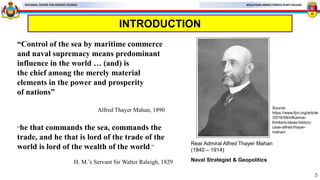
“Control of the sea by maritime commerce
and naval supremacy means predominant
influence in the world … (and) is
the chief among the merely material
elements in the power and prosperity
of nations”
Alfred Thayer Mahan, 1890
Rear Admiral Alfred Thayer Mahan
(1840 – 1914)
Naval Strategist & Geopolitics
Source:
https://www.fpri.org/article
/2016/08/influence-
thinkers-ideas-history-
case-alfred-thayer-
mahan/
“he that commands the sea, commands the
trade, and he that is lord of the trade of the
world is lord of the wealth of the world.”
H. M.’s Servant Sir Walter Raleigh, 1829
MALAYSIAN ARMED FORCES STAFF COLLEGE
NATIONAL CENTRE FOR DEFENCE STUDIES
MAHAN’S GEOPOLITICAL TENETS
6
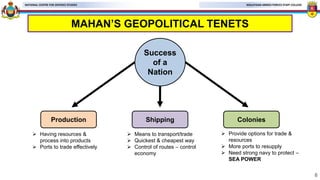
Success
of a
Nation
Production Shipping Colonies
 Having resources &
process into products
 Ports to trade effectively
 Means to transport/trade
 Quickest & cheapest way
 Control of routes – control
economy
 Provide options for trade &
resources
 More ports to resupply
 Need strong navy to protect –
SEA POWER
MALAYSIAN ARMED FORCES STAFF COLLEGE
NATIONAL CENTRE FOR DEFENCE STUDIES
MAHAN’S GEOPOLITICAL TENETS
7
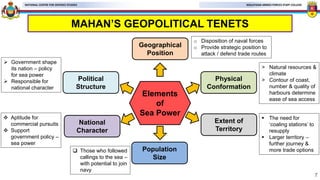
Elements
of
Sea Power
Political
Structure
Geographical
Position
Physical
Conformation
Extent of
Territory
Population
Size
National
Character
 Government shape
its nation – policy
for sea power
 Responsible for
national character
o Disposition of naval forces
o Provide strategic position to
attack / defend trade routes
 Aptitude for
commercial pursuits
 Support
government policy –
sea power
> Natural resources &
climate
> Contour of coast,
number & quality of
harbours determine
ease of sea access
 Those who followed
callings to the sea –
with potential to join
navy
 The need for
‘coaling stations’ to
resupply
 Larger territory –
further journey &
more trade options
MALAYSIAN ARMED FORCES STAFF COLLEGE
NATIONAL CENTRE FOR DEFENCE STUDIES
GLOBAL TRADE FORM
8
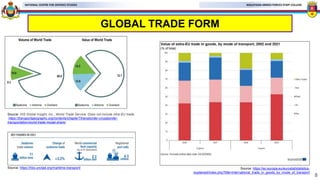
Source: IHS Global Insight, Inc., World Trade Service. Does not include intra-EU trade.
https://transportgeography.org/contents/chapter7/transborder-crossborder-
transportation/world-trade-modal-share/
Source: https://ec.europa.eu/eurostat/statistics-
explained/index.php?title=International_trade_in_goods_by_mode_of_transport
Source: https://hbs.unctad.org/maritime-transport/
MALAYSIAN ARMED FORCES STAFF COLLEGE
NATIONAL CENTRE FOR DEFENCE STUDIES
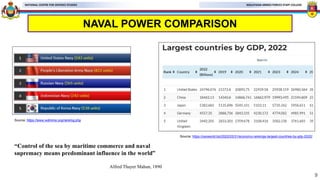
NAVAL POWER COMPARISON
9
Source: https://www.wdmmw.org/ranking.php
Source: https://ceoworld.biz/2022/03/31/economy-rankings-largest-countries-by-gdp-2022/
“Control of the sea by maritime commerce and naval
supremacy means predominant influence in the world”
Alfred Thayer Mahan, 1890
MALAYSIAN ARMED FORCES STAFF COLLEGE
NATIONAL CENTRE FOR DEFENCE STUDIES
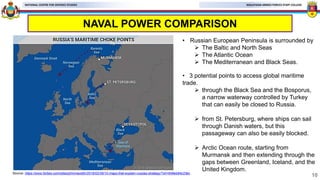
NAVAL POWER COMPARISON
10
Source: https://www.forbes.com/sites/johnmauldin/2016/02/26/10-maps-that-explain-russias-strategy/?sh=649eb94c23ec
• Russian European Peninsula is surrounded by
 The Baltic and North Seas
 The Atlantic Ocean
 The Mediterranean and Black Seas.
• 3 potential points to access global maritime
trade.
 through the Black Sea and the Bosporus,
a narrow waterway controlled by Turkey
that can easily be closed to Russia.
 from St. Petersburg, where ships can sail
through Danish waters, but this
passageway can also be easily blocked.
 Arctic Ocean route, starting from
Murmansk and then extending through the
gaps between Greenland, Iceland, and the
United Kingdom.
MALAYSIAN ARMED FORCES STAFF COLLEGE
NATIONAL CENTRE FOR DEFENCE STUDIES
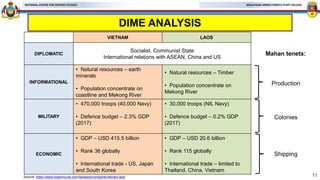
DIME ANALYSIS
11
VIETNAM LAOS
DIPLOMATIC
Socialist, Communist State
International relations with ASEAN, China and US
INFORMATIONAL
• Natural resources – earth
minerals
• Population concentrate on
coastline and Mekong River
• Natural resources – Timber
• Population concentrate on
Mekong River
MILITARY
• 470,000 troops (40,000 Navy)
• Defence budget – 2.3% GDP
(2017)
• 30,000 troops (NIL Navy)
• Defence budget – 0.2% GDP
(2017)
ECONOMIC
• GDP – USD 415.5 billion
• Rank 36 globally
• International trade - US, Japan
and South Korea
• GDP – USD 20.6 billion
• Rank 115 globally
• International trade – limited to
Thailand, China, Vietnam
Mahan tenets:
Production
Colonies
Shipping
Source: https://www.indexmundi.com/factbook/compare/vietnam.laos
MALAYSIAN ARMED FORCES STAFF COLLEGE
NATIONAL CENTRE FOR DEFENCE STUDIES
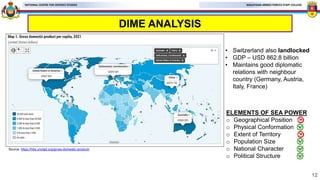
DIME ANALYSIS
12
Source: https://hbs.unctad.org/gross-domestic-product/
• Switzerland also landlocked
• GDP – USD 862.8 billion
• Maintains good diplomatic
relations with neighbour
country (Germany, Austria,
Italy, France)
ELEMENTS OF SEA POWER
o Geographical Position
o Physical Conformation
o Extent of Territory
o Population Size
o National Character
o Political Structure
MALAYSIAN ARMED FORCES STAFF COLLEGE
NATIONAL CENTRE FOR DEFENCE STUDIES
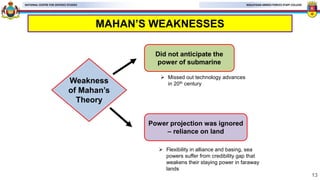
MAHAN’S WEAKNESSES
13
Weakness
of Mahan’s
Theory
Power projection was ignored
– reliance on land
Did not anticipate the
power of submarine
 Flexibility in alliance and basing, sea
powers suffer from credibility gap that
weakens their staying power in faraway
lands
 Missed out technology advances
in 20th century
MALAYSIAN ARMED FORCES STAFF COLLEGE
NATIONAL CENTRE FOR DEFENCE STUDIES
RECAP - MAHAN THEORY
14
Success of a
Nation
Production
Shipping
Colonies
Elements of
Sea Power
Political
Structure
Geographical
Position
Physical
Conformation
Extent of
Territory
Population
Size
National
Character
• Alfred Thayer Mahan, published The Influence of Sea Power upon History, 1660–1783 in 1890.
• Mahan’s writings and lectures greatly influenced Theodore Roosevelt, Henry Cabot Lodge, and other world
leaders, including German Emperor Wilhelm II, shaping global policy based on sea power at the beginning of
the 20th century.
MALAYSIAN ARMED FORCES STAFF COLLEGE
NATIONAL CENTRE FOR DEFENCE STUDIES
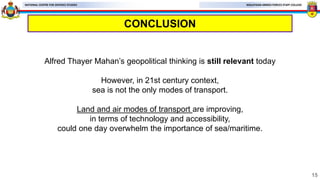
CONCLUSION
15
Alfred Thayer Mahan’s geopolitical thinking is still relevant today
However, in 21st century context,
sea is not the only modes of transport.
Land and air modes of transport are improving,
in terms of technology and accessibility,
could one day overwhelm the importance of sea/maritime.
MALAYSIAN ARMED FORCES STAFF COLLEGE
NATIONAL CENTRE FOR DEFENCE STUDIES
REFERENCES
1. A. Dimitropoulou. (2022, March 31). Economy Rankings: Largest countries by GDP, 2022. CEOWORLD
Magazine. https://ceoworld.biz/2022/03/31/economy-rankings-largest-countries-by-gdp-2022/
2. G. Friedman. (2016, February 26). 10 Maps That Explain Russia’s Strategy. Forbes.
https://www.forbes.com/sites/johnmauldin/2016/02/26/10-maps-that-explain-russias-strategy/?sh=649eb94c23ec
3. Global Naval Powers Ranking (2023). (n.d.). Retrieved 18 February 2023, from
https://www.wdmmw.org/ranking.php
4. Iliopoulos, I. (2009). Strategy and Geopolitics of Sea Power throughout History. International trade in goods
by mode of transport - Statistics Explained. (n.d.). Retrieved 18 February 2023, from
https://ec.europa.eu/eurostat/statistics-
explained/index.php?title=International_trade_in_goods_by_mode_of_transport
5. J.P Rodrigue. (2020). Modal Shares of World Trade by Volume and Value, 2008 | The Geography of
Transport Systems. Routledge. https://doi.org/https://doi.org/10.4324/9780429346323
16
MALAYSIAN ARMED FORCES STAFF COLLEGE
NATIONAL CENTRE FOR DEFENCE STUDIES
REFERENCES
6. Parker, R. D. (2003). 3. ADA526258. Mahan for the Twenty First Century: His Principles Still Apply to
National Power. https://apps.dtic.mil/sti/pdfs/ADA526258.pdf
7. Sumida, J. (1999). Alfred Thayer Mahan, geopolitician. Journal of Strategic Studies, 22(2–3), 39–62.
https://doi.org/10.1080/01402399908437753
8. Vietnam vs. Laos - Country Comparison. (n.d.). Retrieved 18 February 2023, from
https://www.indexmundi.com/factbook/compare/vietnam.laos
17
MALAYSIAN ARMED FORCES STAFF COLLEGE
NATIONAL CENTRE FOR DEFENCE STUDIES
BACKDROP
THANK YOU
18

Mahan Sea Power

  • 1.
    MALAYSIAN ARMED FORCESSTAFF COLLEGE NATIONAL CENTRE FOR DEFENCE STUDIES TUTORIAL GROUP 4 STRATEGIC STUDIES AND SECURITY AFFAIRS IN ASIA REGION, TOPIC 5 IS ALFRED THAYER MAHAN’S GEOPOLITICAL THINKING STILL RELEVANT TODAY MEJ AHMAD FAROUQ BIN AMIR (8233033) MEJ GEORGE TAN HONG SHEN (8233062)
  • 2.
    MALAYSIAN ARMED FORCESSTAFF COLLEGE NATIONAL CENTRE FOR DEFENCE STUDIES AIM To evaluate the relevancy of Mahan’s geopolitical thinking in 21st century through global trade and naval power and a comparison using DIME analysis tool 2
  • 3.
    MALAYSIAN ARMED FORCESSTAFF COLLEGE NATIONAL CENTRE FOR DEFENCE STUDIES SCOPE • Introduction • Mahan’s Geopolitical Tenets • Global Trade Form • Naval Power Comparison • DIME Analysis • Mahan’s Weaknesses • Conclusion 3
  • 4.
    MALAYSIAN ARMED FORCESSTAFF COLLEGE NATIONAL CENTRE FOR DEFENCE STUDIES INTRODUCTION 4 Who  Classical Geopolitical Thinkers: • Alfred Thayer Mahan, Halford Mackinder, Nicholas J Spykman What  Sea power Why  Grand strategy – military strategy elements – sea power When  Late 19th century Where  US – applied by German during WW2.  21st century? How  DIME analysis
  • 5.
    MALAYSIAN ARMED FORCESSTAFF COLLEGE NATIONAL CENTRE FOR DEFENCE STUDIES INTRODUCTION 5 “Control of the sea by maritime commerce and naval supremacy means predominant influence in the world … (and) is the chief among the merely material elements in the power and prosperity of nations” Alfred Thayer Mahan, 1890 Rear Admiral Alfred Thayer Mahan (1840 – 1914) Naval Strategist & Geopolitics Source: https://www.fpri.org/article /2016/08/influence- thinkers-ideas-history- case-alfred-thayer- mahan/ “he that commands the sea, commands the trade, and he that is lord of the trade of the world is lord of the wealth of the world.” H. M.’s Servant Sir Walter Raleigh, 1829
  • 6.
    MALAYSIAN ARMED FORCESSTAFF COLLEGE NATIONAL CENTRE FOR DEFENCE STUDIES MAHAN’S GEOPOLITICAL TENETS 6 Success of a Nation Production Shipping Colonies  Having resources & process into products  Ports to trade effectively  Means to transport/trade  Quickest & cheapest way  Control of routes – control economy  Provide options for trade & resources  More ports to resupply  Need strong navy to protect – SEA POWER
  • 7.
    MALAYSIAN ARMED FORCESSTAFF COLLEGE NATIONAL CENTRE FOR DEFENCE STUDIES MAHAN’S GEOPOLITICAL TENETS 7 Elements of Sea Power Political Structure Geographical Position Physical Conformation Extent of Territory Population Size National Character  Government shape its nation – policy for sea power  Responsible for national character o Disposition of naval forces o Provide strategic position to attack / defend trade routes  Aptitude for commercial pursuits  Support government policy – sea power > Natural resources & climate > Contour of coast, number & quality of harbours determine ease of sea access  Those who followed callings to the sea – with potential to join navy  The need for ‘coaling stations’ to resupply  Larger territory – further journey & more trade options
  • 8.
    MALAYSIAN ARMED FORCESSTAFF COLLEGE NATIONAL CENTRE FOR DEFENCE STUDIES GLOBAL TRADE FORM 8 Source: IHS Global Insight, Inc., World Trade Service. Does not include intra-EU trade. https://transportgeography.org/contents/chapter7/transborder-crossborder- transportation/world-trade-modal-share/ Source: https://ec.europa.eu/eurostat/statistics- explained/index.php?title=International_trade_in_goods_by_mode_of_transport Source: https://hbs.unctad.org/maritime-transport/
  • 9.
    MALAYSIAN ARMED FORCESSTAFF COLLEGE NATIONAL CENTRE FOR DEFENCE STUDIES NAVAL POWER COMPARISON 9 Source: https://www.wdmmw.org/ranking.php Source: https://ceoworld.biz/2022/03/31/economy-rankings-largest-countries-by-gdp-2022/ “Control of the sea by maritime commerce and naval supremacy means predominant influence in the world” Alfred Thayer Mahan, 1890
  • 10.
    MALAYSIAN ARMED FORCESSTAFF COLLEGE NATIONAL CENTRE FOR DEFENCE STUDIES NAVAL POWER COMPARISON 10 Source: https://www.forbes.com/sites/johnmauldin/2016/02/26/10-maps-that-explain-russias-strategy/?sh=649eb94c23ec • Russian European Peninsula is surrounded by  The Baltic and North Seas  The Atlantic Ocean  The Mediterranean and Black Seas. • 3 potential points to access global maritime trade.  through the Black Sea and the Bosporus, a narrow waterway controlled by Turkey that can easily be closed to Russia.  from St. Petersburg, where ships can sail through Danish waters, but this passageway can also be easily blocked.  Arctic Ocean route, starting from Murmansk and then extending through the gaps between Greenland, Iceland, and the United Kingdom.
  • 11.
    MALAYSIAN ARMED FORCESSTAFF COLLEGE NATIONAL CENTRE FOR DEFENCE STUDIES DIME ANALYSIS 11 VIETNAM LAOS DIPLOMATIC Socialist, Communist State International relations with ASEAN, China and US INFORMATIONAL • Natural resources – earth minerals • Population concentrate on coastline and Mekong River • Natural resources – Timber • Population concentrate on Mekong River MILITARY • 470,000 troops (40,000 Navy) • Defence budget – 2.3% GDP (2017) • 30,000 troops (NIL Navy) • Defence budget – 0.2% GDP (2017) ECONOMIC • GDP – USD 415.5 billion • Rank 36 globally • International trade - US, Japan and South Korea • GDP – USD 20.6 billion • Rank 115 globally • International trade – limited to Thailand, China, Vietnam Mahan tenets: Production Colonies Shipping Source: https://www.indexmundi.com/factbook/compare/vietnam.laos
  • 12.
    MALAYSIAN ARMED FORCESSTAFF COLLEGE NATIONAL CENTRE FOR DEFENCE STUDIES DIME ANALYSIS 12 Source: https://hbs.unctad.org/gross-domestic-product/ • Switzerland also landlocked • GDP – USD 862.8 billion • Maintains good diplomatic relations with neighbour country (Germany, Austria, Italy, France) ELEMENTS OF SEA POWER o Geographical Position o Physical Conformation o Extent of Territory o Population Size o National Character o Political Structure
  • 13.
    MALAYSIAN ARMED FORCESSTAFF COLLEGE NATIONAL CENTRE FOR DEFENCE STUDIES MAHAN’S WEAKNESSES 13 Weakness of Mahan’s Theory Power projection was ignored – reliance on land Did not anticipate the power of submarine  Flexibility in alliance and basing, sea powers suffer from credibility gap that weakens their staying power in faraway lands  Missed out technology advances in 20th century
  • 14.
    MALAYSIAN ARMED FORCESSTAFF COLLEGE NATIONAL CENTRE FOR DEFENCE STUDIES RECAP - MAHAN THEORY 14 Success of a Nation Production Shipping Colonies Elements of Sea Power Political Structure Geographical Position Physical Conformation Extent of Territory Population Size National Character • Alfred Thayer Mahan, published The Influence of Sea Power upon History, 1660–1783 in 1890. • Mahan’s writings and lectures greatly influenced Theodore Roosevelt, Henry Cabot Lodge, and other world leaders, including German Emperor Wilhelm II, shaping global policy based on sea power at the beginning of the 20th century.
  • 15.
    MALAYSIAN ARMED FORCESSTAFF COLLEGE NATIONAL CENTRE FOR DEFENCE STUDIES CONCLUSION 15 Alfred Thayer Mahan’s geopolitical thinking is still relevant today However, in 21st century context, sea is not the only modes of transport. Land and air modes of transport are improving, in terms of technology and accessibility, could one day overwhelm the importance of sea/maritime.
  • 16.
    MALAYSIAN ARMED FORCESSTAFF COLLEGE NATIONAL CENTRE FOR DEFENCE STUDIES REFERENCES 1. A. Dimitropoulou. (2022, March 31). Economy Rankings: Largest countries by GDP, 2022. CEOWORLD Magazine. https://ceoworld.biz/2022/03/31/economy-rankings-largest-countries-by-gdp-2022/ 2. G. Friedman. (2016, February 26). 10 Maps That Explain Russia’s Strategy. Forbes. https://www.forbes.com/sites/johnmauldin/2016/02/26/10-maps-that-explain-russias-strategy/?sh=649eb94c23ec 3. Global Naval Powers Ranking (2023). (n.d.). Retrieved 18 February 2023, from https://www.wdmmw.org/ranking.php 4. Iliopoulos, I. (2009). Strategy and Geopolitics of Sea Power throughout History. International trade in goods by mode of transport - Statistics Explained. (n.d.). Retrieved 18 February 2023, from https://ec.europa.eu/eurostat/statistics- explained/index.php?title=International_trade_in_goods_by_mode_of_transport 5. J.P Rodrigue. (2020). Modal Shares of World Trade by Volume and Value, 2008 | The Geography of Transport Systems. Routledge. https://doi.org/https://doi.org/10.4324/9780429346323 16
  • 17.
    MALAYSIAN ARMED FORCESSTAFF COLLEGE NATIONAL CENTRE FOR DEFENCE STUDIES REFERENCES 6. Parker, R. D. (2003). 3. ADA526258. Mahan for the Twenty First Century: His Principles Still Apply to National Power. https://apps.dtic.mil/sti/pdfs/ADA526258.pdf 7. Sumida, J. (1999). Alfred Thayer Mahan, geopolitician. Journal of Strategic Studies, 22(2–3), 39–62. https://doi.org/10.1080/01402399908437753 8. Vietnam vs. Laos - Country Comparison. (n.d.). Retrieved 18 February 2023, from https://www.indexmundi.com/factbook/compare/vietnam.laos 17
  • 18.
    MALAYSIAN ARMED FORCESSTAFF COLLEGE NATIONAL CENTRE FOR DEFENCE STUDIES BACKDROP THANK YOU 18