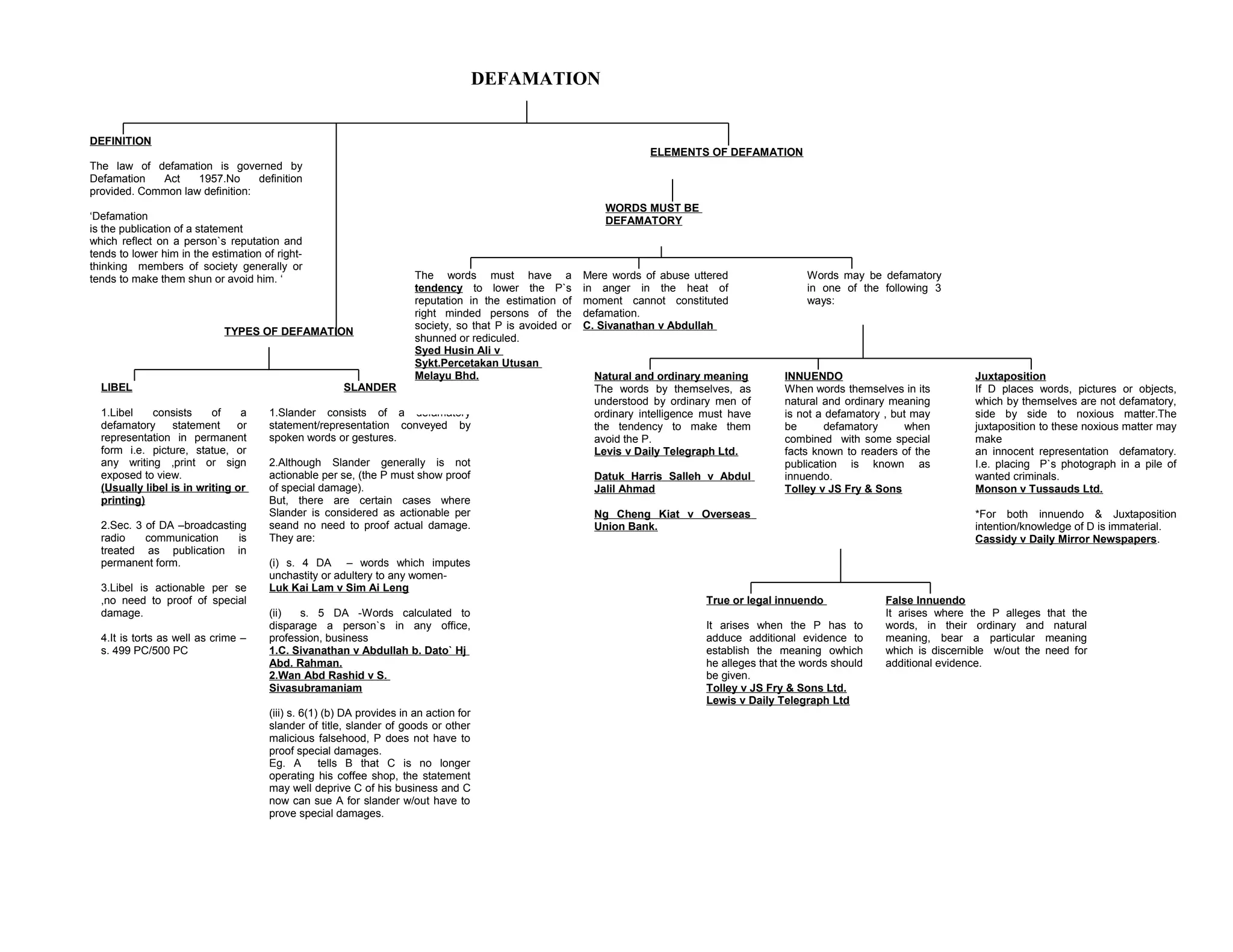
DEFAMATION
DEFINITION
The law of defamation is governed by
Defamation Act 1957.No definition
provided. Common law definition:
‘Defamation
is the publication of a statement
which reflect on a person`s reputation and
tends to lower him in the estimation of right-
thinking members of society generally or
tends to make them shun or avoid him. ‘
TYPES OF DEFAMATION
ELEMENTS OF DEFAMATION
WORDS MUST BE
DEFAMATORY
Mere words of abuse uttered
in anger in the heat of
moment cannot constituted
defamation.
C. Sivanathan v Abdullah
Natural and ordinary meaning
The words by themselves, as
understood by ordinary men of
ordinary intelligence must have
the tendency to make them
avoid the P.
Levis v Daily Telegraph Ltd.
Datuk Harris Salleh v Abdul
Jalil Ahmad
Ng Cheng Kiat v Overseas
Union Bank.
LIBEL
1.Libel consists of a
defamatory statement or
representation in permanent
form i.e. picture, statue, or
any writing ,print or sign
exposed to view.
(Usually libel is in writing or
printing)
2.Sec. 3 of DA –broadcasting
radio communication is
treated as publication in
permanent form.
3.Libel is actionable per se
,no need to proof of special
damage.
4.It is torts as well as crime –
s. 499 PC/500 PC
SLANDER
1.Slander consists of a defamatory
statement/representation conveyed by
spoken words or gestures.
2.Although Slander generally is not
actionable per se, (the P must show proof
of special damage).
But, there are certain cases where
Slander is considered as actionable per
seand no need to proof actual damage.
They are:
(i) s. 4 DA – words which imputes
unchastity or adultery to any women-
Luk Kai Lam v Sim Ai Leng
(ii) s. 5 DA -Words calculated to
disparage a person`s in any office,
profession, business
1.C. Sivanathan v Abdullah b. Dato` Hj
Abd. Rahman.
2.Wan Abd Rashid v S.
Sivasubramaniam
(iii) s. 6(1) (b) DA provides in an action for
slander of title, slander of goods or other
malicious falsehood, P does not have to
proof special damages.
Eg. A tells B that C is no longer
operating his coffee shop, the statement
may well deprive C of his business and C
now can sue A for slander w/out have to
prove special damages.
The words must have a
tendency to lower the P`s
reputation in the estimation of
right minded persons of the
society, so that P is avoided or
shunned or rediculed.
Syed Husin Ali v
Sykt.Percetakan Utusan
Melayu Bhd.
Words may be defamatory
in one of the following 3
ways:
INNUENDO
When words themselves in its
natural and ordinary meaning
is not a defamatory , but may
be defamatory when
combined with some special
facts known to readers of the
publication is known as
innuendo.
Tolley v JS Fry & Sons
False Innuendo
It arises where the P alleges that the
words, in their ordinary and natural
meaning, bear a particular meaning
which is discernible w/out the need for
additional evidence.
True or legal innuendo
It arises when the P has to
adduce additional evidence to
establish the meaning owhich
he alleges that the words should
be given.
Tolley v JS Fry & Sons Ltd.
Lewis v Daily Telegraph Ltd
Juxtaposition
If D places words, pictures or objects,
which by themselves are not defamatory,
side by side to noxious matter.The
juxtaposition to these noxious matter may
make
an innocent representation defamatory.
I.e. placing P`s photograph in a pile of
wanted criminals.
Monson v Tussauds Ltd.
*For both innuendo & Juxtaposition
intention/knowledge of D is immaterial.
Cassidy v Daily Mirror Newspapers.

Torts defamation i

  • 1.
    DEFAMATION DEFINITION The law ofdefamation is governed by Defamation Act 1957.No definition provided. Common law definition: ‘Defamation is the publication of a statement which reflect on a person`s reputation and tends to lower him in the estimation of right- thinking members of society generally or tends to make them shun or avoid him. ‘ TYPES OF DEFAMATION ELEMENTS OF DEFAMATION WORDS MUST BE DEFAMATORY Mere words of abuse uttered in anger in the heat of moment cannot constituted defamation. C. Sivanathan v Abdullah Natural and ordinary meaning The words by themselves, as understood by ordinary men of ordinary intelligence must have the tendency to make them avoid the P. Levis v Daily Telegraph Ltd. Datuk Harris Salleh v Abdul Jalil Ahmad Ng Cheng Kiat v Overseas Union Bank. LIBEL 1.Libel consists of a defamatory statement or representation in permanent form i.e. picture, statue, or any writing ,print or sign exposed to view. (Usually libel is in writing or printing) 2.Sec. 3 of DA –broadcasting radio communication is treated as publication in permanent form. 3.Libel is actionable per se ,no need to proof of special damage. 4.It is torts as well as crime – s. 499 PC/500 PC SLANDER 1.Slander consists of a defamatory statement/representation conveyed by spoken words or gestures. 2.Although Slander generally is not actionable per se, (the P must show proof of special damage). But, there are certain cases where Slander is considered as actionable per seand no need to proof actual damage. They are: (i) s. 4 DA – words which imputes unchastity or adultery to any women- Luk Kai Lam v Sim Ai Leng (ii) s. 5 DA -Words calculated to disparage a person`s in any office, profession, business 1.C. Sivanathan v Abdullah b. Dato` Hj Abd. Rahman. 2.Wan Abd Rashid v S. Sivasubramaniam (iii) s. 6(1) (b) DA provides in an action for slander of title, slander of goods or other malicious falsehood, P does not have to proof special damages. Eg. A tells B that C is no longer operating his coffee shop, the statement may well deprive C of his business and C now can sue A for slander w/out have to prove special damages. The words must have a tendency to lower the P`s reputation in the estimation of right minded persons of the society, so that P is avoided or shunned or rediculed. Syed Husin Ali v Sykt.Percetakan Utusan Melayu Bhd. Words may be defamatory in one of the following 3 ways: INNUENDO When words themselves in its natural and ordinary meaning is not a defamatory , but may be defamatory when combined with some special facts known to readers of the publication is known as innuendo. Tolley v JS Fry & Sons False Innuendo It arises where the P alleges that the words, in their ordinary and natural meaning, bear a particular meaning which is discernible w/out the need for additional evidence. True or legal innuendo It arises when the P has to adduce additional evidence to establish the meaning owhich he alleges that the words should be given. Tolley v JS Fry & Sons Ltd. Lewis v Daily Telegraph Ltd Juxtaposition If D places words, pictures or objects, which by themselves are not defamatory, side by side to noxious matter.The juxtaposition to these noxious matter may make an innocent representation defamatory. I.e. placing P`s photograph in a pile of wanted criminals. Monson v Tussauds Ltd. *For both innuendo & Juxtaposition intention/knowledge of D is immaterial. Cassidy v Daily Mirror Newspapers.