MALAYSIAN ARMED FORCESSTAFF COLLEGE
HEARTLAND THEORY
“Heartland Theory emphasizes control of Eurasian landmass as the key to global power”
Presented by:
1
2.
MALAYSIAN ARMED FORCESSTAFF COLLEGE
HEARTLAND
THEORY
Mackinder’s
Geopolitical Vision
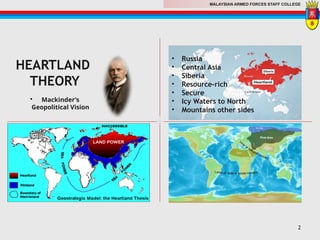
• Russia
• Central Asia
• Siberia
• Resource-rich
• Secure
• Icy Waters to North
• Mountains other sides
2
3.
MALAYSIAN ARMED FORCESSTAFF COLLEGE
1 2 3 4
UNDERSTANDING THE TIMELINES AND CONTEXT
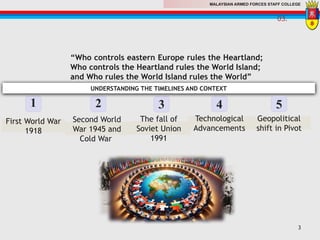
“Who controls eastern Europe rules the Heartland;
Who controls the Heartland rules the World Island;
and Who rules the World Island rules the World”
First World War
1918
Second World
War 1945 and
Cold War
The fall of
Soviet Union
1991
Technological
Advancements
5
Geopolitical
shift in Pivot
03.
3
4.
MALAYSIAN ARMED FORCESSTAFF COLLEGE
CHANGE IN OUTLOOK
• Physical reach through Railroad network
• The advent of Air Power
• Cyber space and connected world
• Global trade
• The Naval might and Sea Routes
• Development of NATO and Alliances
SHORTCOMINGS
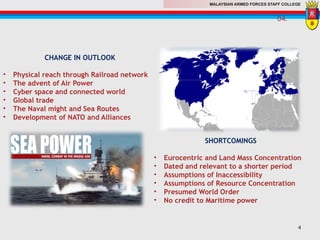
• Eurocentric and Land Mass Concentration
• Dated and relevant to a shorter period
• Assumptions of Inaccessibility
• Assumptions of Resource Concentration
• Presumed World Order
• No credit to Maritime power
04.
4
5.
MALAYSIAN ARMED FORCESSTAFF COLLEGE
Why it matters
5
The theory proves that:
• Geography limits and enables
power
• Landmass, distance, climate, and
terrain still matter
• Not all power comes from
technology or economy
Highlights the Importance of
Geography
This is useful for:
• Strategic planning
• Risk assessment
• Defence policy analysis
.
HELPS UNDERSTAND
MILITARY STRATEGY
Despite being old, it helps explain:
• Russia’s actions in Eastern Europe
• China’s Belt and Road Initiative
• US & NATO presence around
Eurasia
.
Still Relevant in Today’s
World • Cold War strategies
• Containment policy
• Military and security planning
Foundation of Modern
Geopolitics
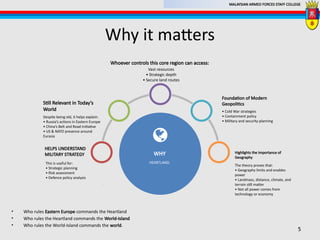
Vast resources
• Strategic depth
• Secure land routes
.
Whoever controls this core region can access:
HEARTLAND.
WHY
• Who rules Eastern Europe commands the Heartland
• Who rules the Heartland commands the World-Island
• Who rules the World-Island commands the world.
6.
MALAYSIAN ARMED FORCESSTAFF COLLEGE
Criticism
Ignores air & cyber power
Underestimates naval power
Still useful conceptually
6
7.
MALAYSIAN ARMED FORCESSTAFF COLLEGE
Conclusion
• Heartland Theory shows how geography
shapes global power
7
Editor's Notes
#2 The Heartland Theory, developed by Sir Halford Mackinder in 1904, suggests that control of Eastern Europes central region—or the "Heartland"—could lead to global dominance. "The Geographical Pivot of History" is an article submitted by Halford John Mackinder in 1904 to the Royal Geographical Society that advances his heartland theory.[1][2][3] In this article, Mackinder extended the scope of geopolitical analysis to encompass the entire globe. He defined Afro-Eurasia as the "world island" and its "heartland" as the area east of the Volga, south of the Arctic, west of the Yangtze, and north of the Himalayas. Due to its strategic location and natural resources, Mackinder argued that whoever controlled the "heartland" could control the world.
The World Island, comprising the interlinked continents of Africa, Asia, and Europe (Afro-Eurasia). This was the largest, most populous, and richest of all possible land combinations.
The Offshore Islands, including the British Isles, Hainan, the Japanese Archipelago, Madagascar, the Malay Archipelago, Sri Lanka, and Formosa.
The Outlying Islands, including the interlinked continents of North America and South America (the Americas), as well as Oceania.
The Heartland lies at the centre of the World Island, stretching from the Volga to the Yangtze and from the Arctic to the Himalayas. Mackinder's Heartland was the area then ruled by the Russian Empire and after that by the Soviet Union, minus the Kamchatka Peninsula region, which is located in the easternmost part of Russia, near the Aleutian Islands and the Kuril Islands.