KANGGALANA:
Maguindanaon
Dyeing Methods
By Norolayn K. Said, MST
2
Kanggalana (Dyeing)
 method of
applying colors
to textile
products such
as yarns,
fabrics, and
fibers (cotton,
rayon, linen,
etc.)
1/10/2017 Maguindanaon Dyeing Methods
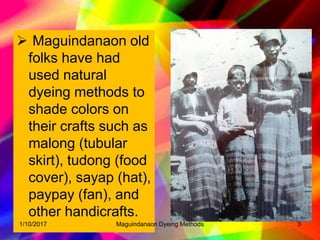
 Maguindanaon old
folks have had
used natural
dyeing methods to
shade colors on
their crafts such as
malong (tubular
skirt), tudong (food
cover), sayap (hat),
paypay (fan), and
other handicrafts.
31/10/2017 Maguindanaon Dyeing Methods
 However, the
present-day
craftsmen already
used synthetic
dyes and
commercially
available thread for
malong due to
costs and
production.
41/10/2017 Maguindanaon Dyeing Methods
Vat Dyeing
 the most common
method of dyeing
known as kanggalana.
The fabrics are
immersed into the pot
or vat of natural dyes
brought to a boil.
51/10/2017 Maguindanaon Dyeing Methods
 In preparing the
dyebath, Maguindanaon
craftsperson collected
dye-yielding plants. He
made use of those
plants (leaves, fruits,
seeds, flowers, bark)
available in his
environment.
1/10/2017 6Maguindanaon Dyeing Methods
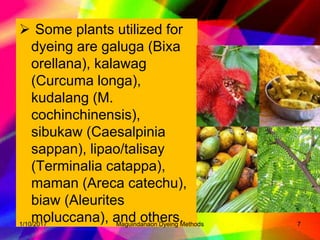
 Some plants utilized for
dyeing are galuga (Bixa
orellana), kalawag
(Curcuma longa),
kudalang (M.
cochinchinensis),
sibukaw (Caesalpinia
sappan), lipao/talisay
(Terminalia catappa),
maman (Areca catechu),
biaw (Aleurites
moluccana), and others.1/10/2017 7Maguindanaon Dyeing Methods
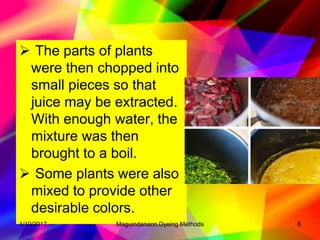
 The parts of plants
were then chopped into
small pieces so that
juice may be extracted.
With enough water, the
mixture was then
brought to a boil.
 Some plants were also
mixed to provide other
desirable colors.
1/10/2017 8Maguindanaon Dyeing Methods
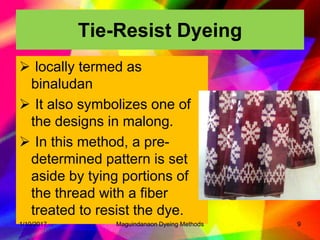
Tie-Resist Dyeing
 locally termed as
binaludan
 It also symbolizes one of
the designs in malong.
 In this method, a pre-
determined pattern is set
aside by tying portions of
the thread with a fiber
treated to resist the dye.
1/10/2017 9Maguindanaon Dyeing Methods
 Then the fabric is soaked
into a dyebath. This is
repeated until the threads
are penetrated with the
desired shades.
 The Maguindanaon
weavers may tie either
the warp or weft threads,
or both.
1/10/2017 10Maguindanaon Dyeing Methods
Mud Dyeing
 is commonly known as
kapetina.
 It is a process in which the
fabric is buried into the
muddy soil to give it a black
color.
 Some plants such as
balansuit (Ludwigia
hyssopifolia) are added to
the soil.1/10/2017 11Maguindanaon Dyeing Methods
Acknowledgement to:
 Madam Raquela Pendatun-Magalona
(Maguindanao Tourism Officer)
 Madam Monina Macarongon (Maguindanao
HRMO)
 Madam Lourdes Mastura (School Admin. Sultan
Kudarat Islamic Academy)
 Madam Huddah Salendab (Datu-Piang Tourism
Staff)
 Madam Albaya Balabaran (Al-Jameela Weaving
Center Founder)
1/10/2017 Maguindanaon Dyeing Methods 12

Maguindanaon Dyeing Methods

  • 1.
  • 2.
    2 Kanggalana (Dyeing)  methodof applying colors to textile products such as yarns, fabrics, and fibers (cotton, rayon, linen, etc.) 1/10/2017 Maguindanaon Dyeing Methods
  • 3.
     Maguindanaon old folkshave had used natural dyeing methods to shade colors on their crafts such as malong (tubular skirt), tudong (food cover), sayap (hat), paypay (fan), and other handicrafts. 31/10/2017 Maguindanaon Dyeing Methods
  • 4.
     However, the present-day craftsmenalready used synthetic dyes and commercially available thread for malong due to costs and production. 41/10/2017 Maguindanaon Dyeing Methods
  • 5.
    Vat Dyeing  themost common method of dyeing known as kanggalana. The fabrics are immersed into the pot or vat of natural dyes brought to a boil. 51/10/2017 Maguindanaon Dyeing Methods
  • 6.
     In preparingthe dyebath, Maguindanaon craftsperson collected dye-yielding plants. He made use of those plants (leaves, fruits, seeds, flowers, bark) available in his environment. 1/10/2017 6Maguindanaon Dyeing Methods
  • 7.
     Some plantsutilized for dyeing are galuga (Bixa orellana), kalawag (Curcuma longa), kudalang (M. cochinchinensis), sibukaw (Caesalpinia sappan), lipao/talisay (Terminalia catappa), maman (Areca catechu), biaw (Aleurites moluccana), and others.1/10/2017 7Maguindanaon Dyeing Methods
  • 8.
     The partsof plants were then chopped into small pieces so that juice may be extracted. With enough water, the mixture was then brought to a boil.  Some plants were also mixed to provide other desirable colors. 1/10/2017 8Maguindanaon Dyeing Methods
  • 9.
    Tie-Resist Dyeing  locallytermed as binaludan  It also symbolizes one of the designs in malong.  In this method, a pre- determined pattern is set aside by tying portions of the thread with a fiber treated to resist the dye. 1/10/2017 9Maguindanaon Dyeing Methods
  • 10.
     Then thefabric is soaked into a dyebath. This is repeated until the threads are penetrated with the desired shades.  The Maguindanaon weavers may tie either the warp or weft threads, or both. 1/10/2017 10Maguindanaon Dyeing Methods
  • 11.
    Mud Dyeing  iscommonly known as kapetina.  It is a process in which the fabric is buried into the muddy soil to give it a black color.  Some plants such as balansuit (Ludwigia hyssopifolia) are added to the soil.1/10/2017 11Maguindanaon Dyeing Methods
  • 12.
    Acknowledgement to:  MadamRaquela Pendatun-Magalona (Maguindanao Tourism Officer)  Madam Monina Macarongon (Maguindanao HRMO)  Madam Lourdes Mastura (School Admin. Sultan Kudarat Islamic Academy)  Madam Huddah Salendab (Datu-Piang Tourism Staff)  Madam Albaya Balabaran (Al-Jameela Weaving Center Founder) 1/10/2017 Maguindanaon Dyeing Methods 12