This is
Magento 2 Theming
KSS (Knowledge sharing session) by Suman KC
I am Suman KC
Magento developer
www.linkedin.com/in/sumankc
www.sumankc.com
Hello!
Topics
◉Introduction
◉Themes
◉Layout
◉Templates
◉CSS
Introduction
Magento & Magento 2 intro leading to theming
aspects
1
◉eCommerce platform
◉Huge
◉Unique
◉Poor documentation
◉Edition(Community & enterprise)
Magento in general
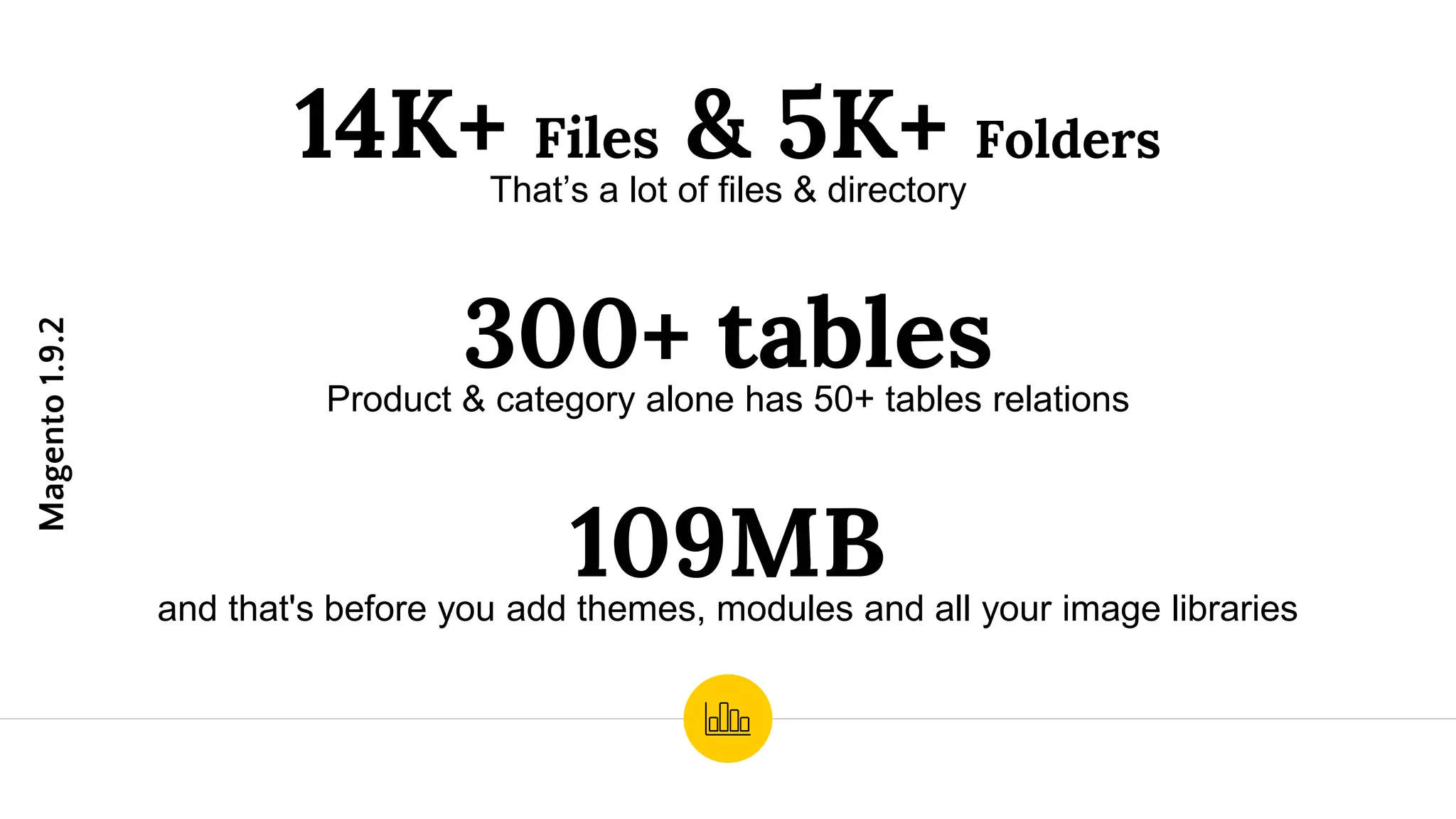
14K+ Files & 5K+ Folders
That’s a lot of files & directory
109MBand that's before you add themes, modules and all your image libraries
300+ tablesProduct & category alone has 50+ tables relations
Magento1.9.2
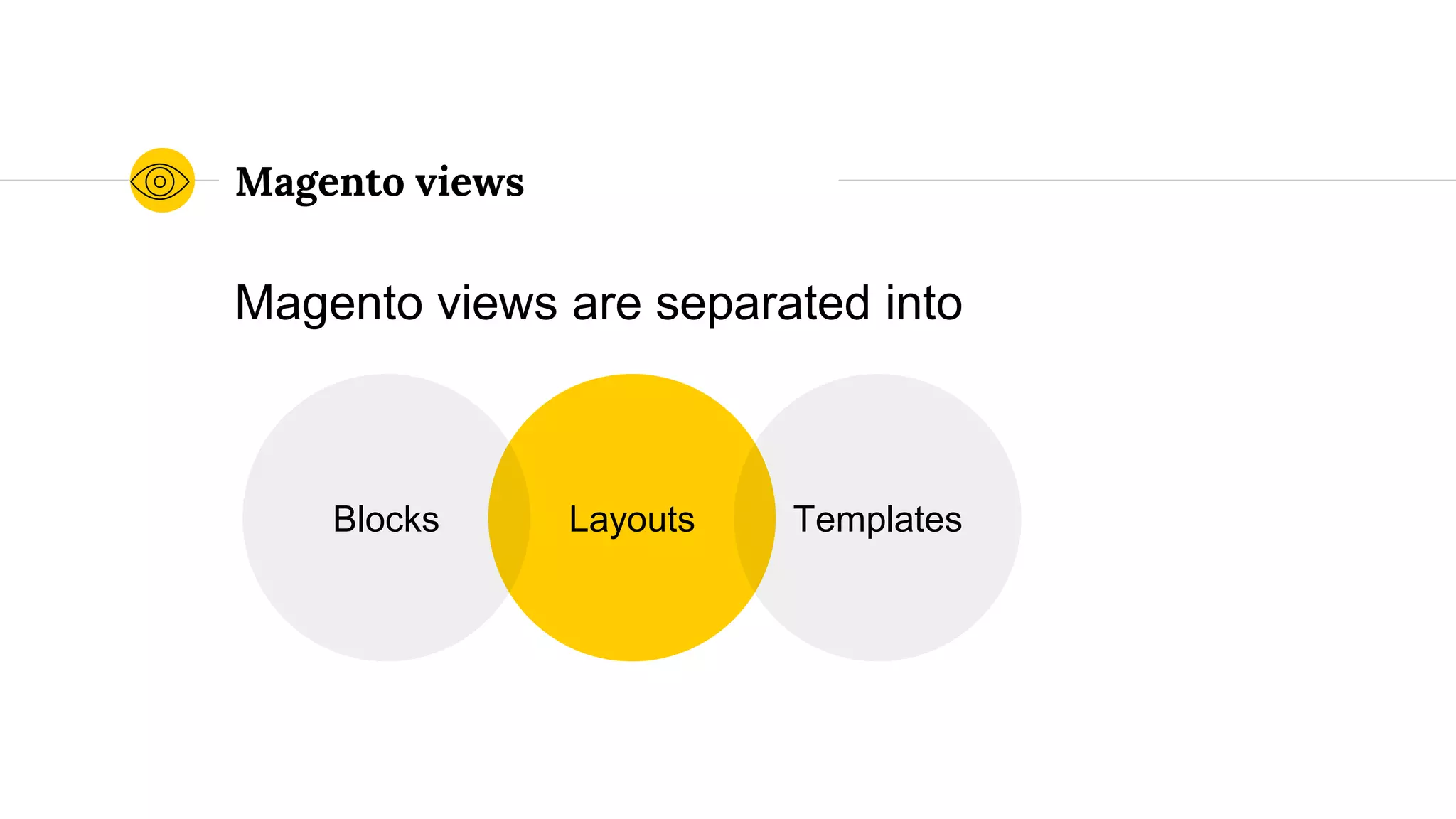
Magento views are separated into
Magento views
LayoutsBlocks Templates
Themes
Creation, Structure, Configuration & Inheritance
2
1. Prerequisites
◉ Not modify out of box Magento themes
[Compatibility,upgradability & easy maintenance]
◉ Set magento application to developer mode
[mode influences the way static files are cached]
Creating a theme
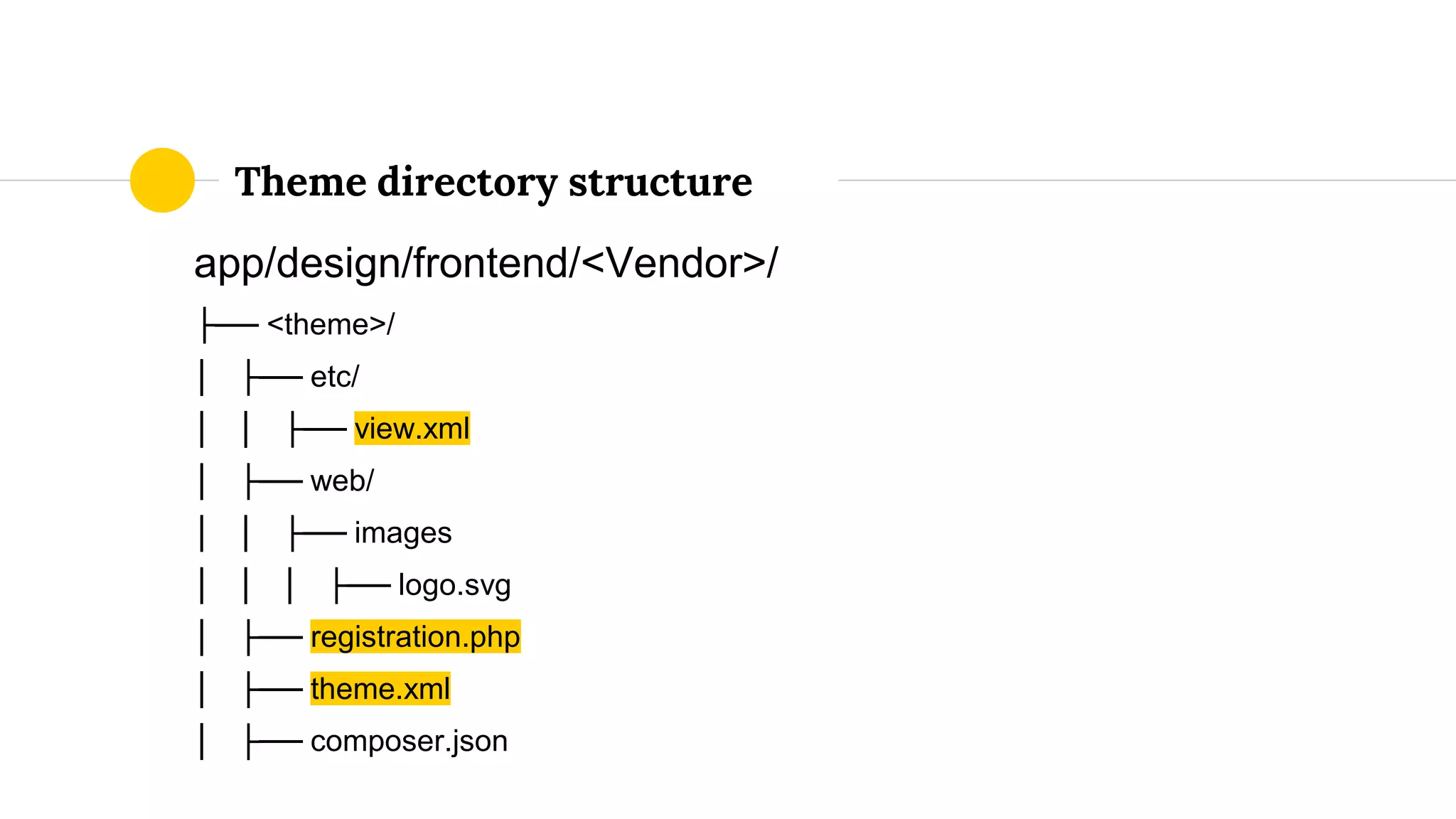
app/design/frontend/<Vendor>/
├── <theme>/
│ ├── etc/
│ │ ├── view.xml
│ ├── web/
│ │ ├── images
│ │ │ ├── logo.svg
│ ├── registration.php
│ ├── theme.xml
│ ├── composer.json
Theme directory structure
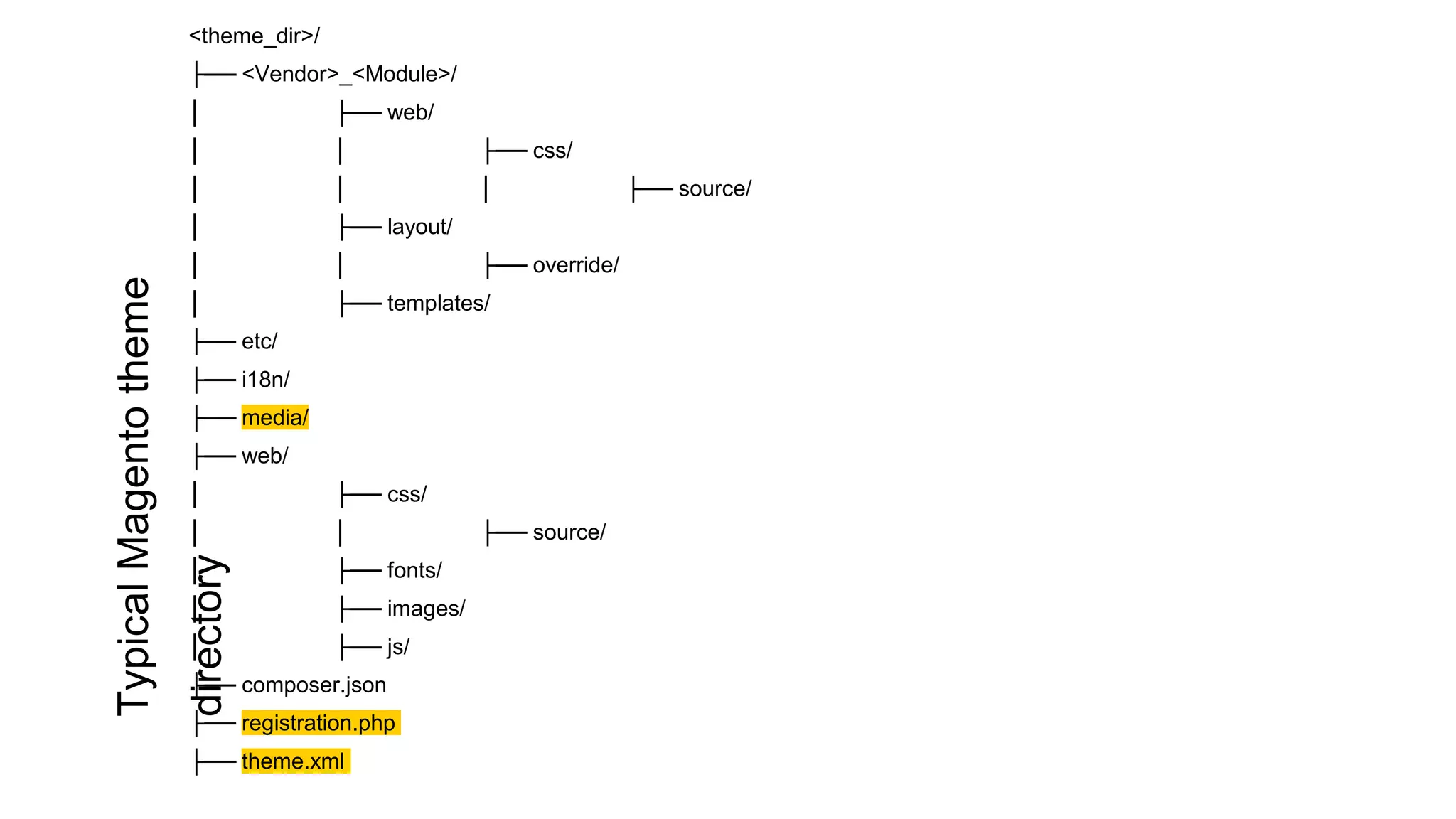
<theme_dir>/
├── <Vendor>_<Module>/
│ ├── web/
│ │ ├── css/
│ │ │ ├── source/
│ ├── layout/
│ │ ├── override/
│ ├── templates/
├── etc/
├── i18n/
├── media/
├── web/
│ ├── css/
│ │ ├── source/
│ ├── fonts/
│ ├── images/
│ ├── js/
├── composer.json
├── registration.php
├── theme.xml
TypicalMagentotheme
directory
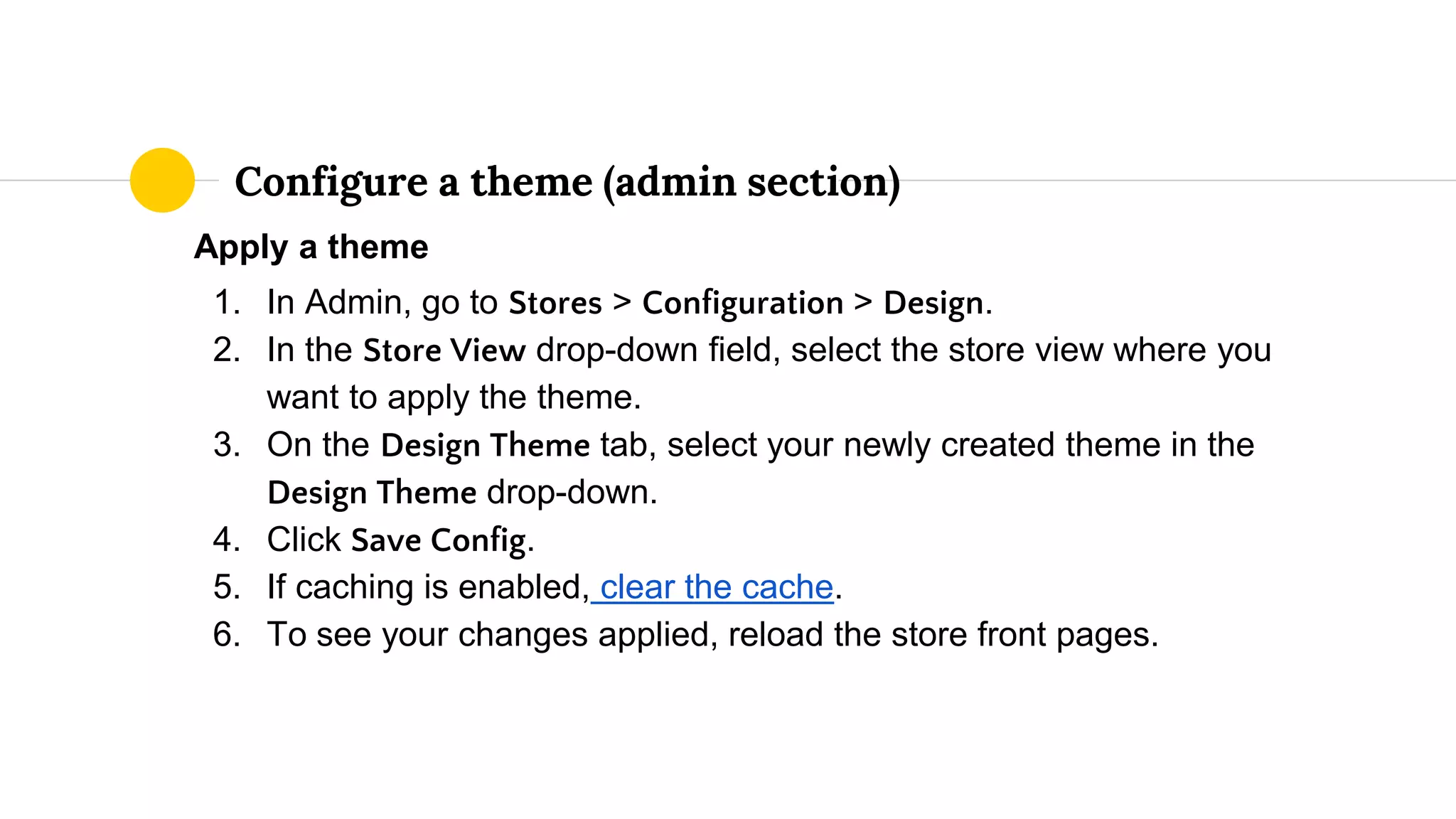
Apply a theme
1. In Admin, go to Stores > Configuration > Design.
2. In the Store View drop-down field, select the store view where you
want to apply the theme.
3. On the Design Theme tab, select your newly created theme in the
Design Theme drop-down.
4. Click Save Config.
5. If caching is enabled, clear the cache.
6. To see your changes applied, reload the store front pages.
Configure a theme (admin section)
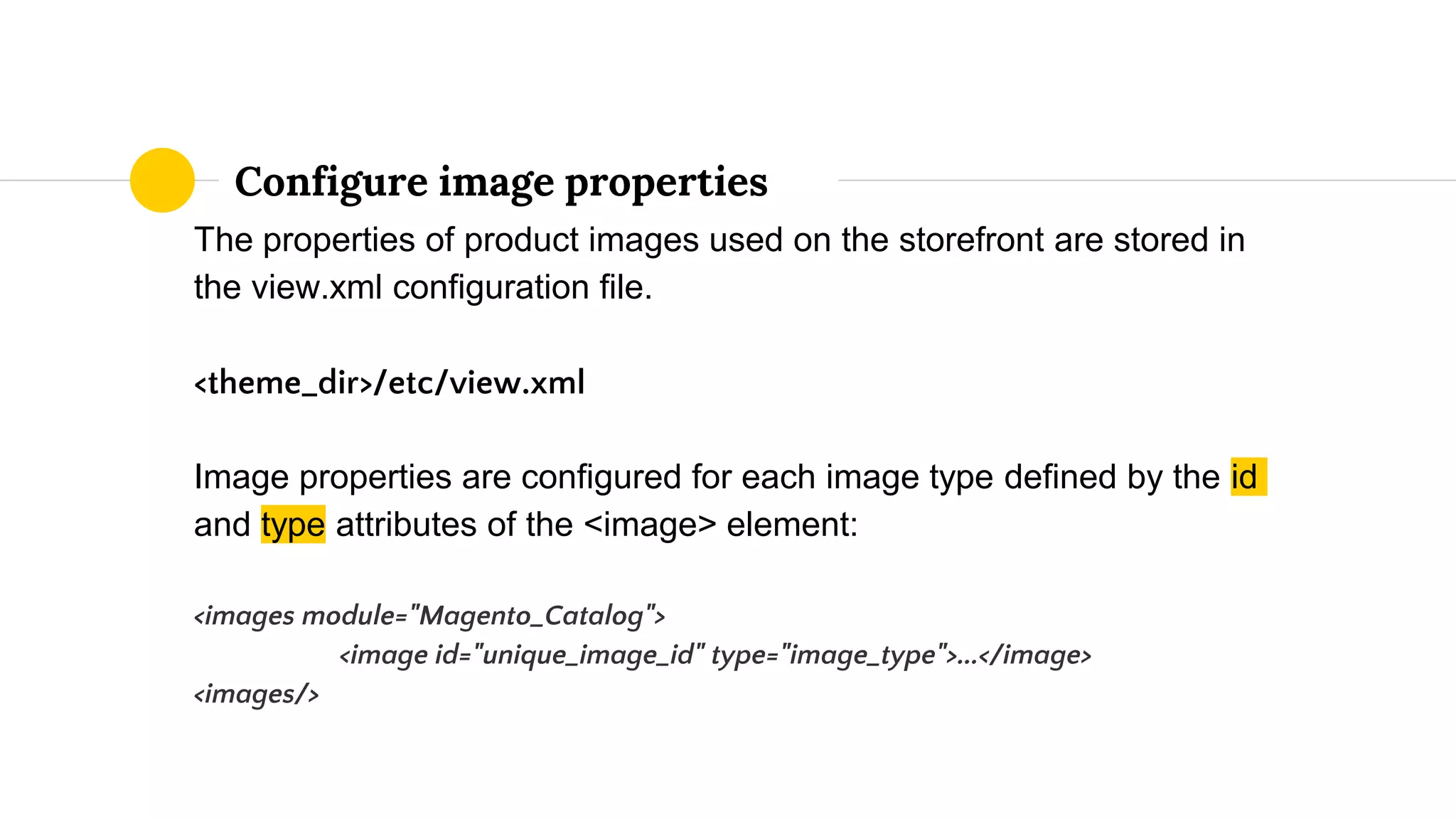
The properties of product images used on the storefront are stored in
the view.xml configuration file.
<theme_dir>/etc/view.xml
Image properties are configured for each image type defined by the id
and type attributes of the <image> element:
<images module="Magento_Catalog">
<image id="unique_image_id" type="image_type">...</image>
<images/>
Configure image properties
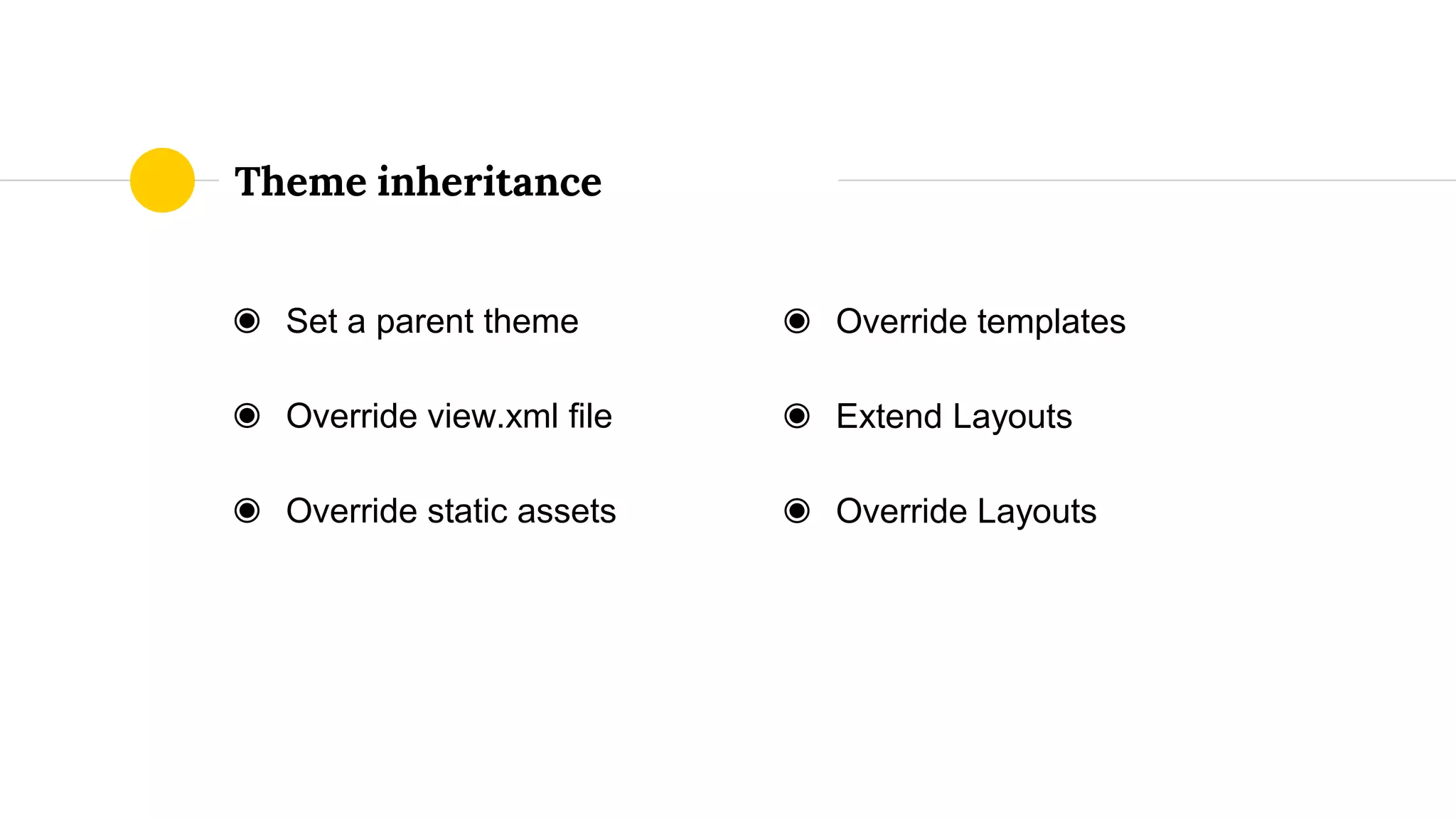
◉ Set a parent theme
◉ Override view.xml file
◉ Override static assets
Theme inheritance
◉ Override templates
◉ Extend Layouts
◉ Override Layouts
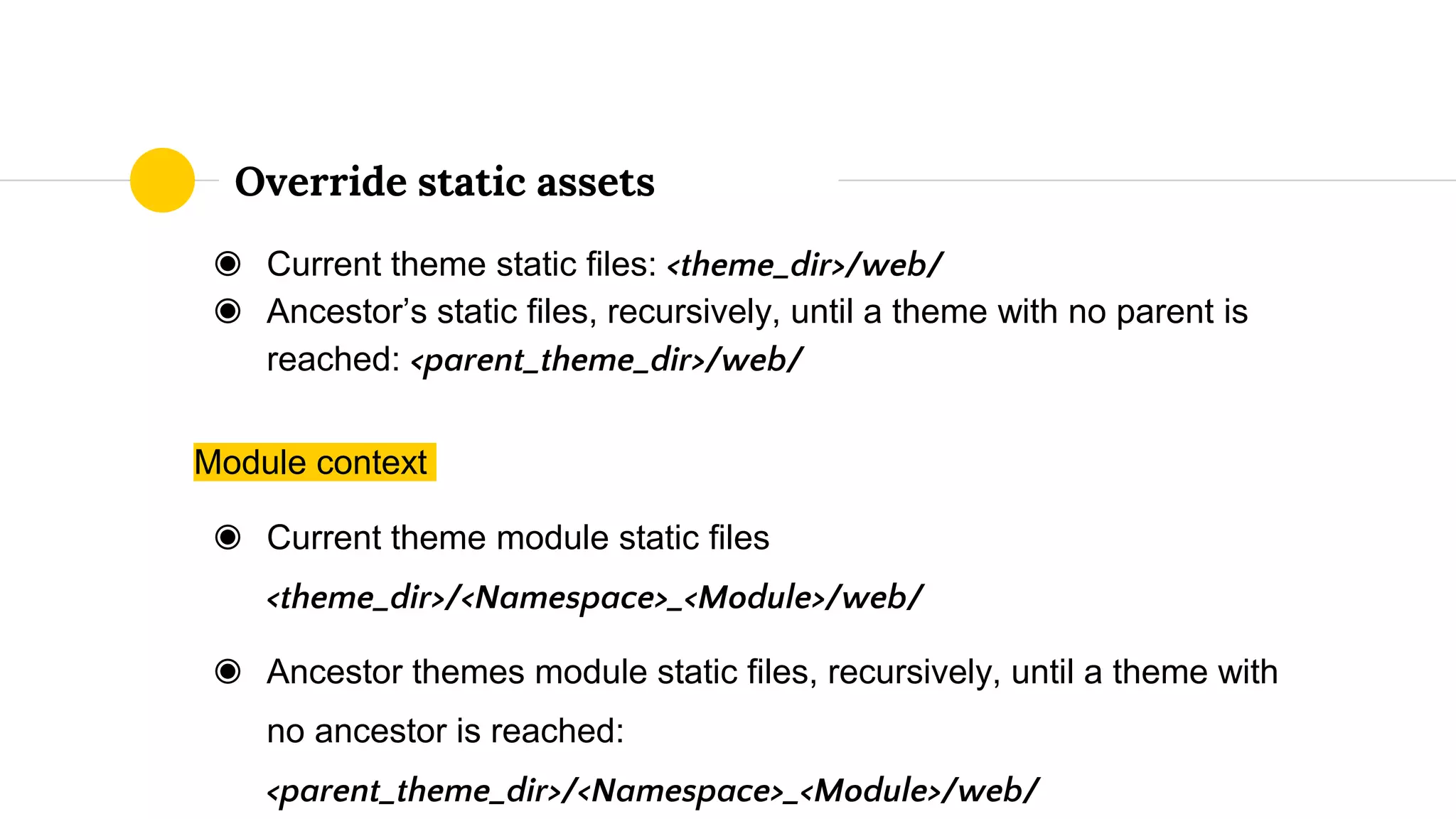
◉ Current theme static files: <theme_dir>/web/
◉ Ancestor’s static files, recursively, until a theme with no parent is
reached: <parent_theme_dir>/web/
Module context
◉ Current theme module static files
<theme_dir>/<Namespace>_<Module>/web/
◉ Ancestor themes module static files, recursively, until a theme with
no ancestor is reached:
<parent_theme_dir>/<Namespace>_<Module>/web/
Override static assets
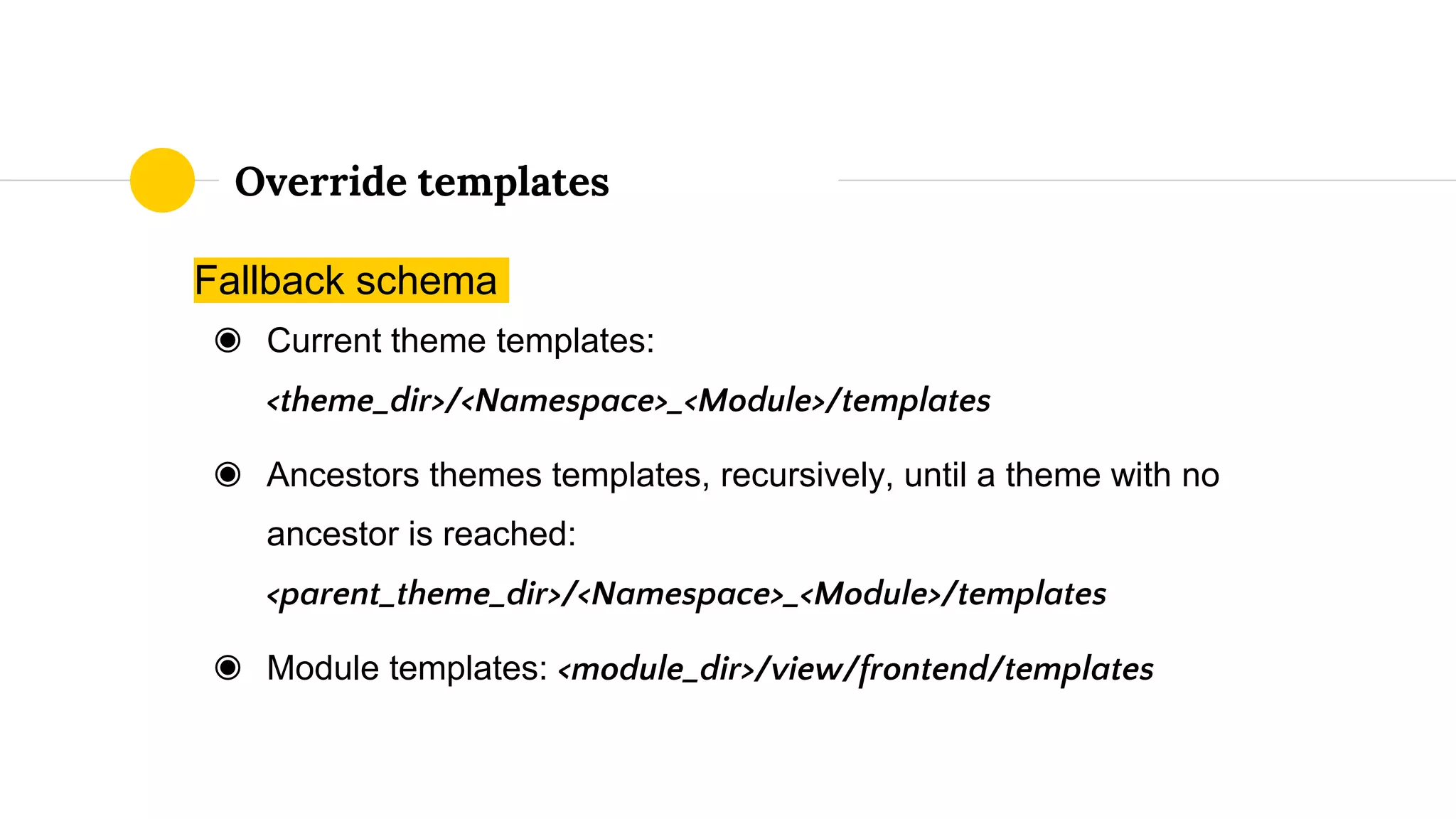
Fallback schema
◉ Current theme templates:
<theme_dir>/<Namespace>_<Module>/templates
◉ Ancestors themes templates, recursively, until a theme with no
ancestor is reached:
<parent_theme_dir>/<Namespace>_<Module>/templates
◉ Module templates: <module_dir>/view/frontend/templates
Override templates
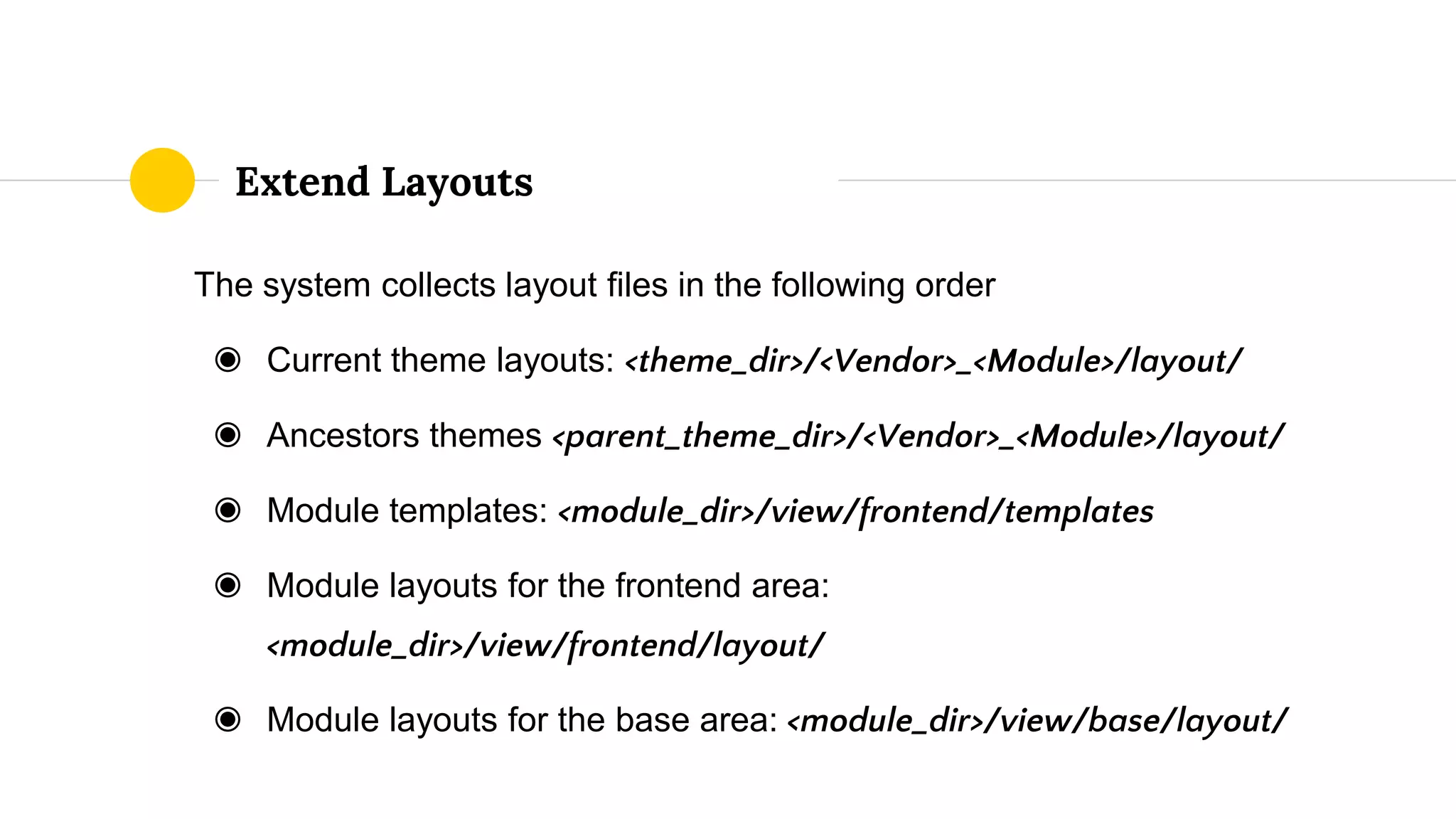
The system collects layout files in the following order
◉ Current theme layouts: <theme_dir>/<Vendor>_<Module>/layout/
◉ Ancestors themes <parent_theme_dir>/<Vendor>_<Module>/layout/
◉ Module templates: <module_dir>/view/frontend/templates
◉ Module layouts for the frontend area:
<module_dir>/view/frontend/layout/
◉ Module layouts for the base area: <module_dir>/view/base/layout/
Extend Layouts
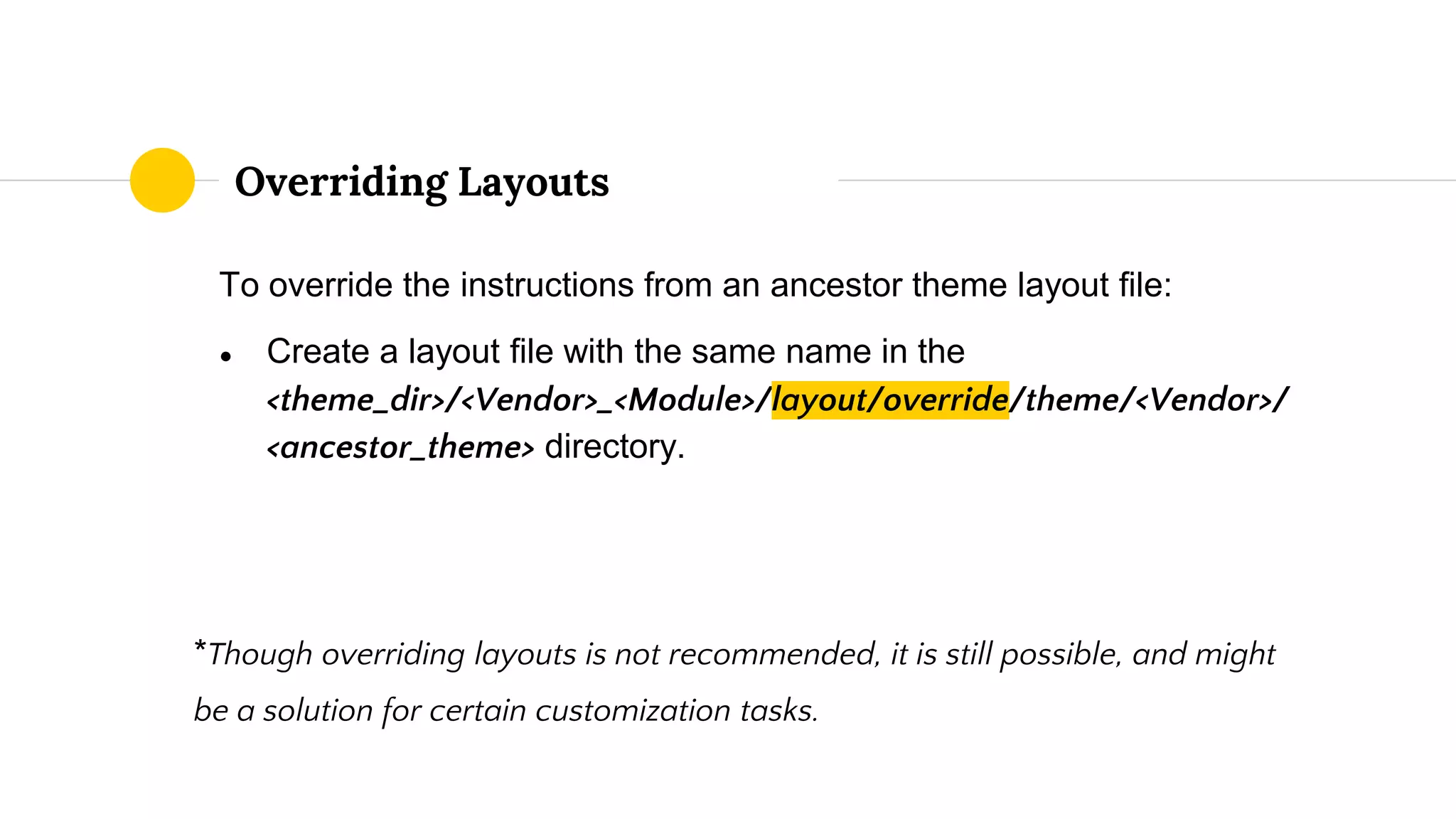
To override the instructions from an ancestor theme layout file:
● Create a layout file with the same name in the
<theme_dir>/<Vendor>_<Module>/layout/override/theme/<Vendor>/
<ancestor_theme> directory.
*Though overriding layouts is not recommended, it is still possible, and might
be a solution for certain customization tasks.
Overriding Layouts
Layout
Instruction, extending, overriding and Customizations
3
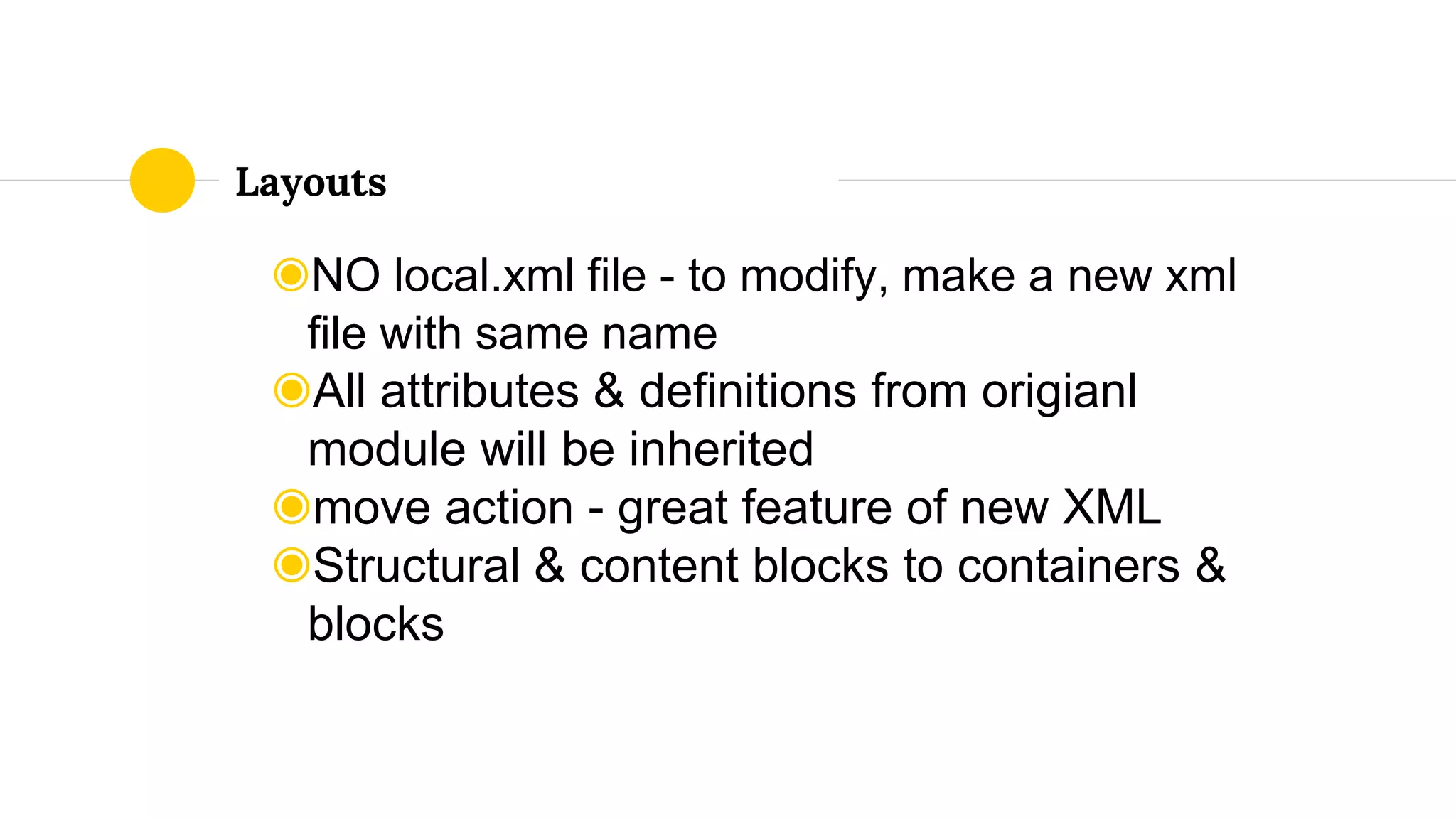
◉NO local.xml file - to modify, make a new xml
file with same name
◉All attributes & definitions from origianl
module will be inherited
◉move action - great feature of new XML
◉Structural & content blocks to containers &
blocks
Layouts
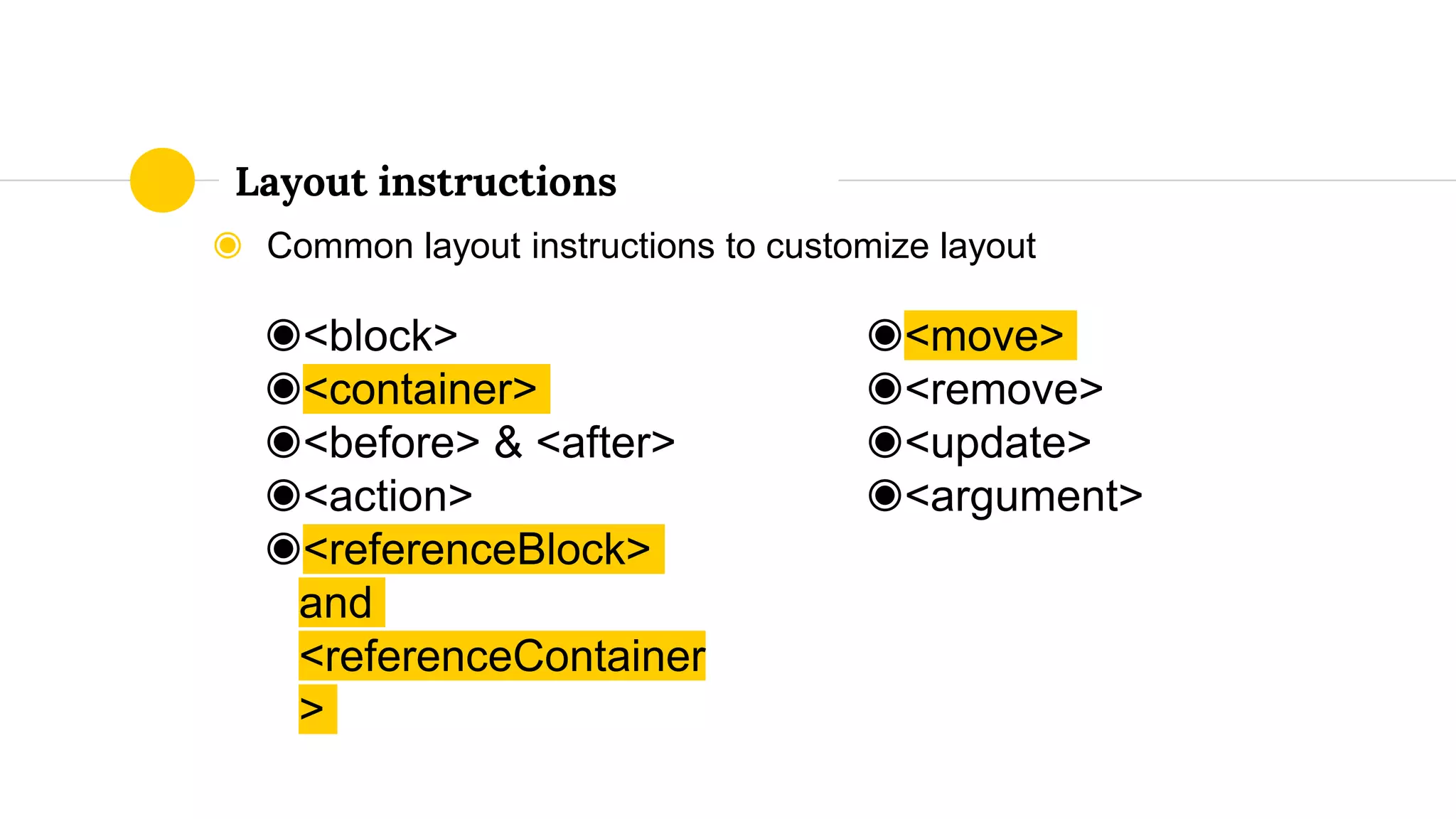
◉ Common layout instructions to customize layout
Layout instructions
◉<block>
◉<container>
◉<before> & <after>
◉<action>
◉<referenceBlock>
and
<referenceContainer
>
◉<move>
◉<remove>
◉<update>
◉<argument>
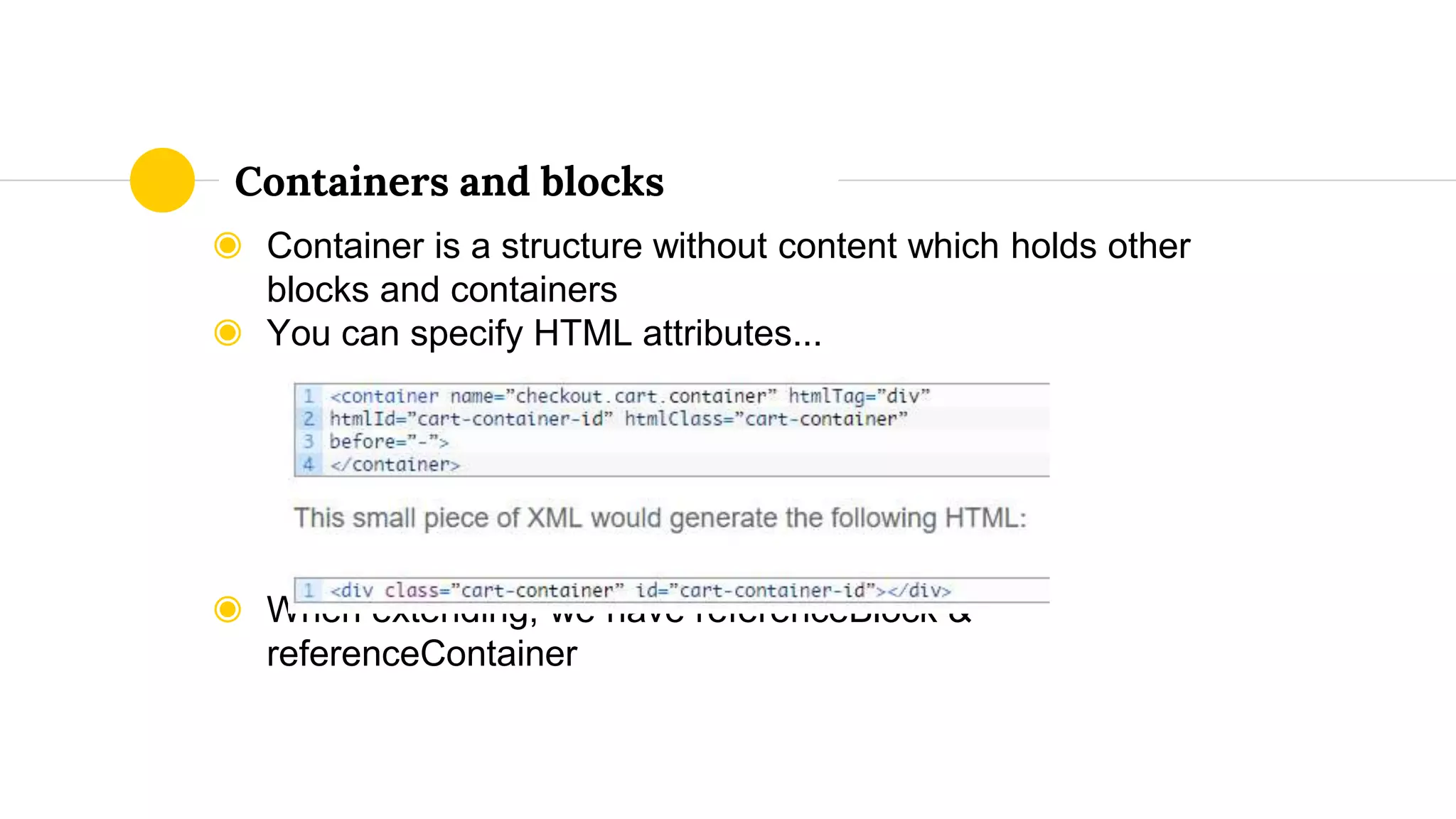
◉ Container is a structure without content which holds other
blocks and containers
◉ You can specify HTML attributes...
◉ When extending, we have referenceBlock &
referenceContainer
Containers and blocks
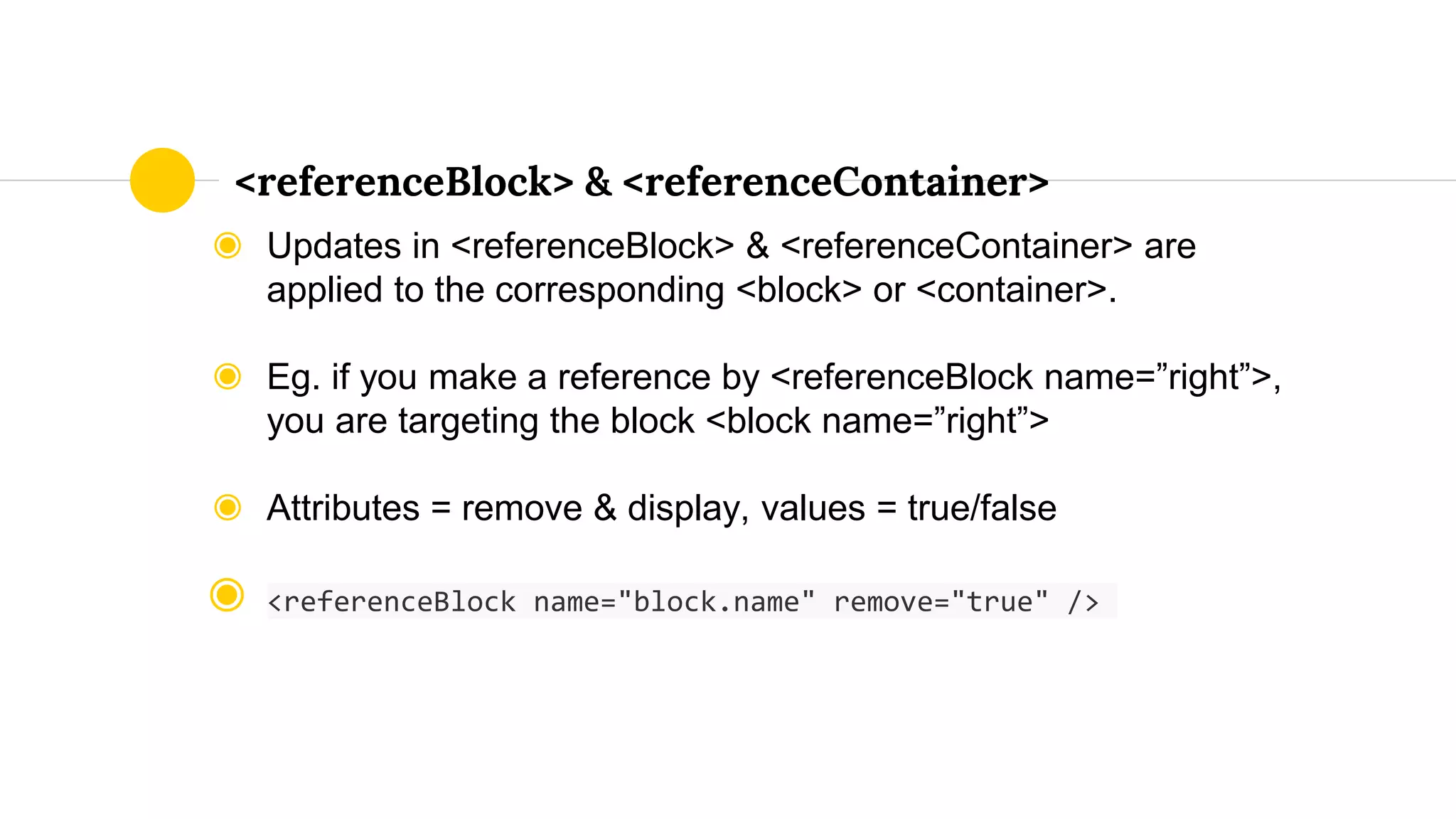
◉ Updates in <referenceBlock> & <referenceContainer> are
applied to the corresponding <block> or <container>.
◉ Eg. if you make a reference by <referenceBlock name=”right”>,
you are targeting the block <block name=”right”>
◉ Attributes = remove & display, values = true/false
◉ <referenceBlock name="block.name" remove="true" />
<referenceBlock> & <referenceContainer>
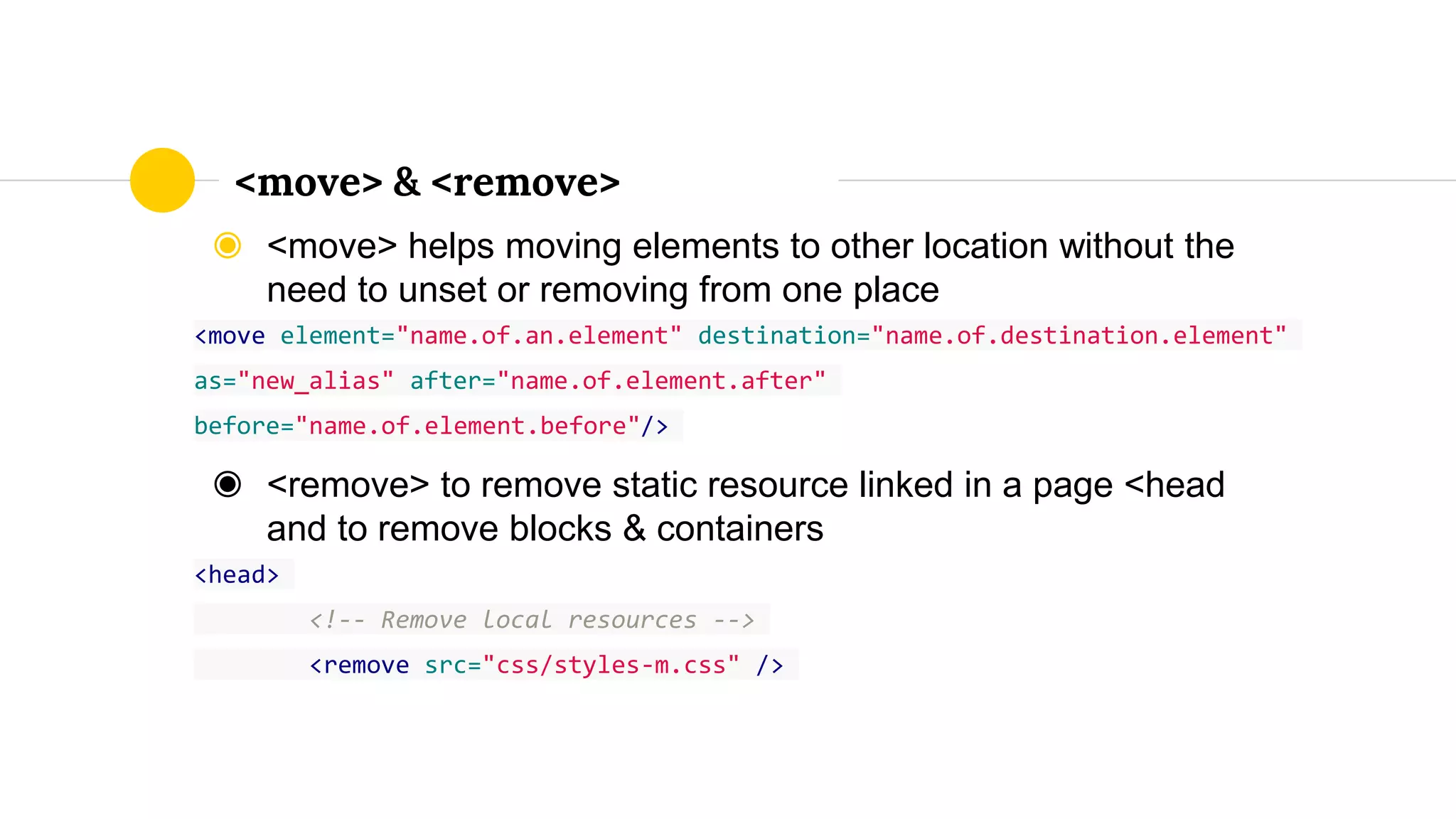
◉ <move> helps moving elements to other location without the
need to unset or removing from one place
<move element="name.of.an.element" destination="name.of.destination.element"
as="new_alias" after="name.of.element.after"
before="name.of.element.before"/>
◉ <remove> to remove static resource linked in a page <head
and to remove blocks & containers
<head>
<!-- Remove local resources -->
<remove src="css/styles-m.css" />
<move> & <remove>
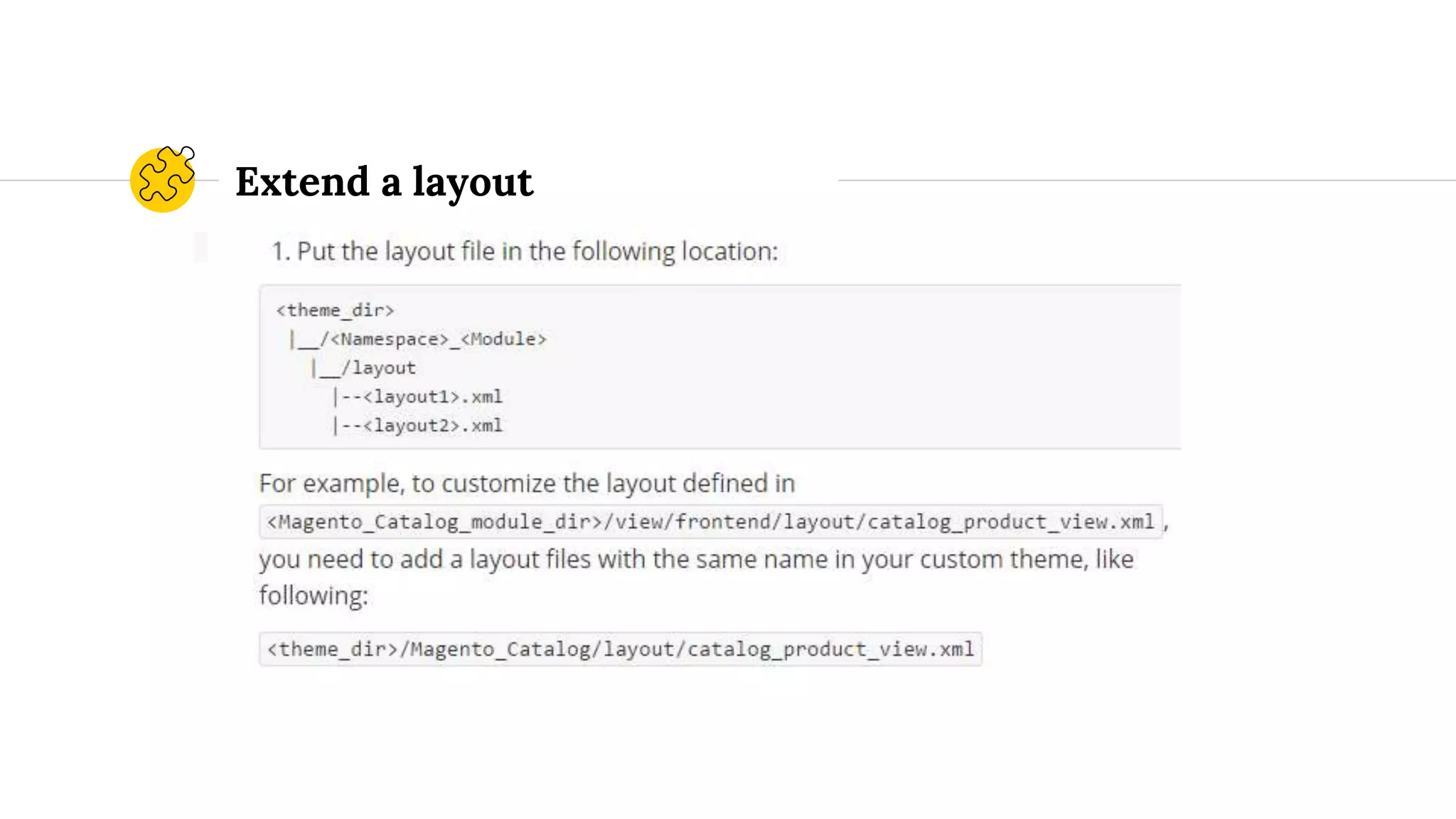
Extend a layout
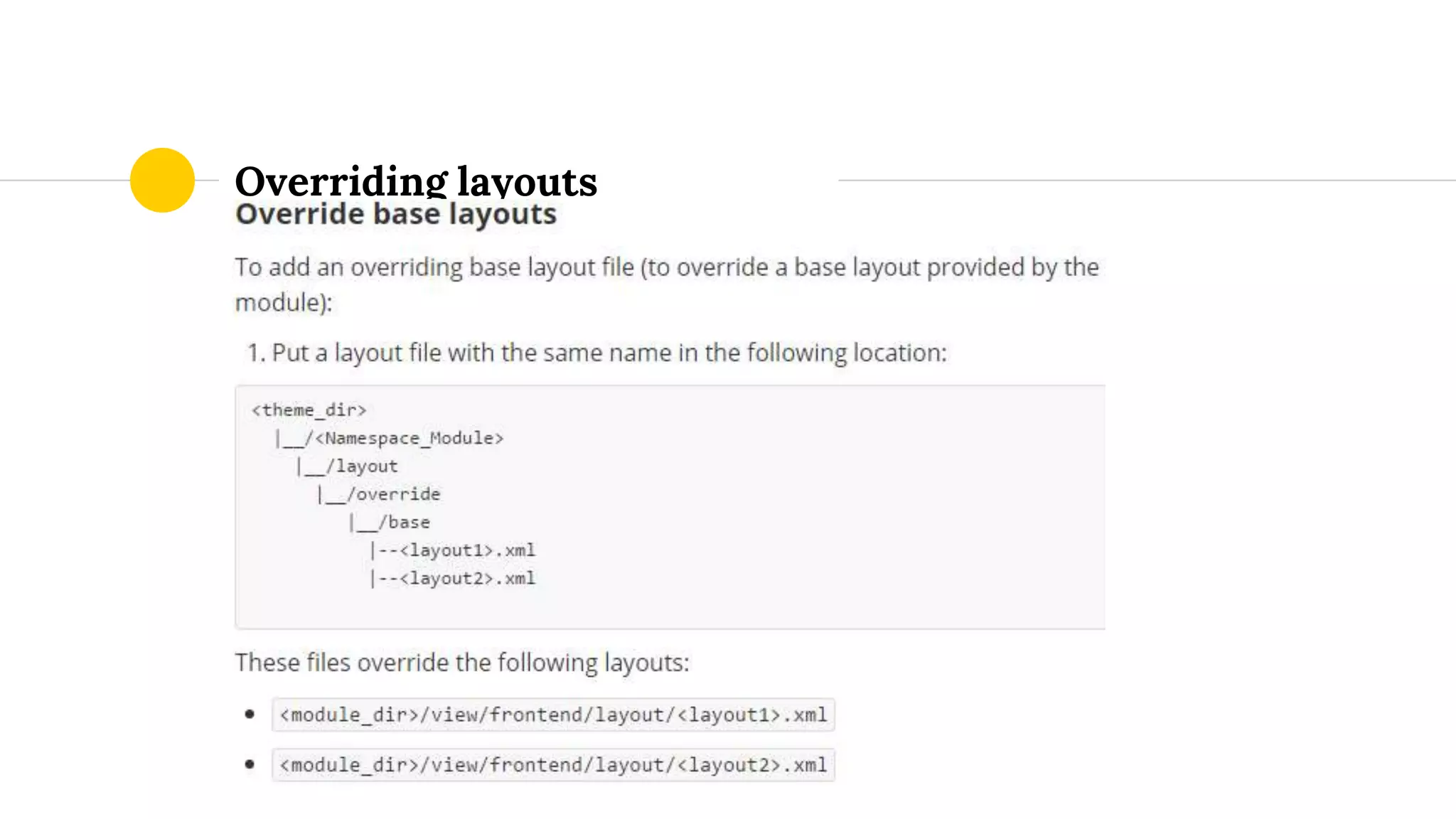
Overriding layouts
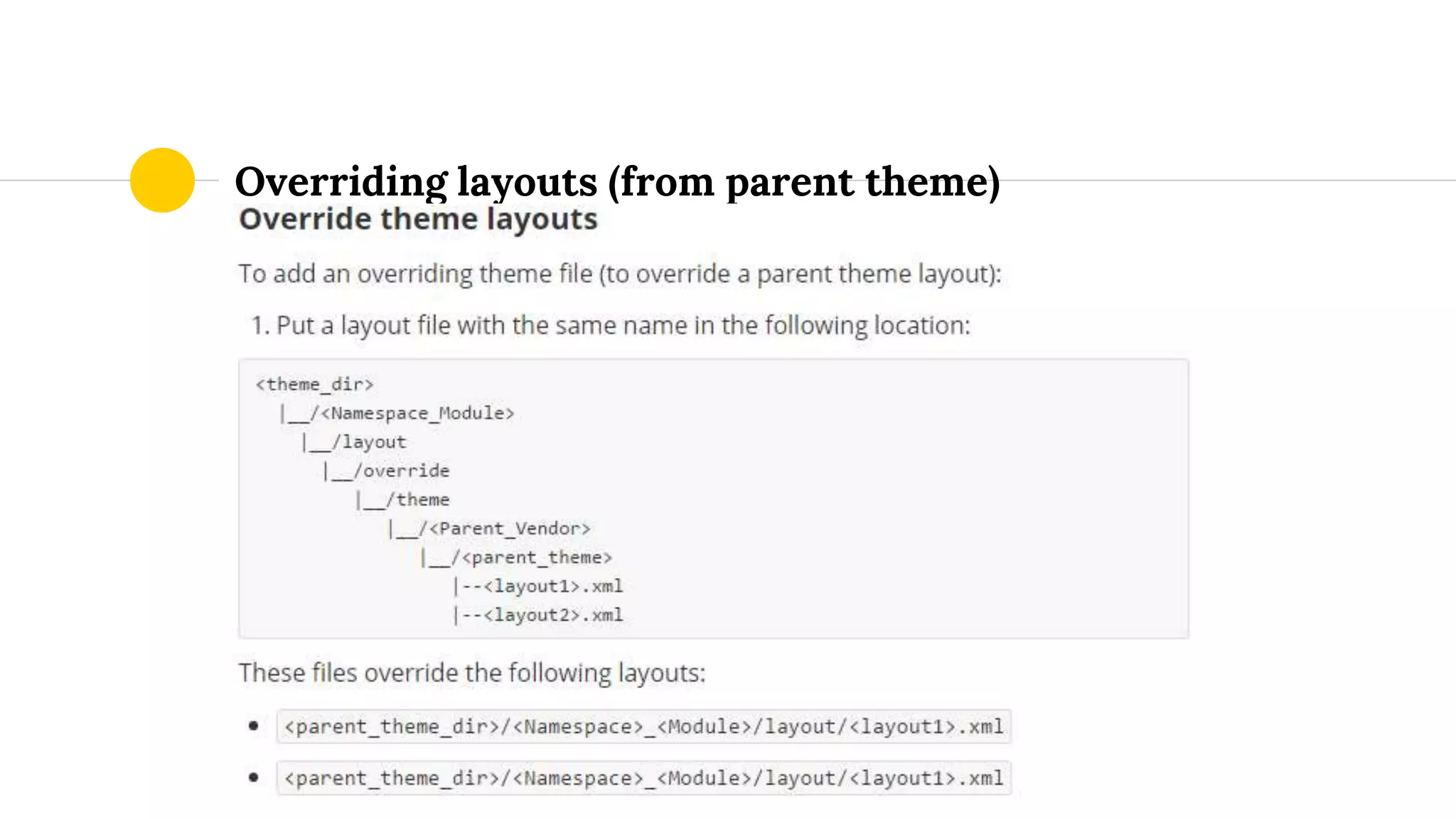
Overriding layouts (from parent theme)
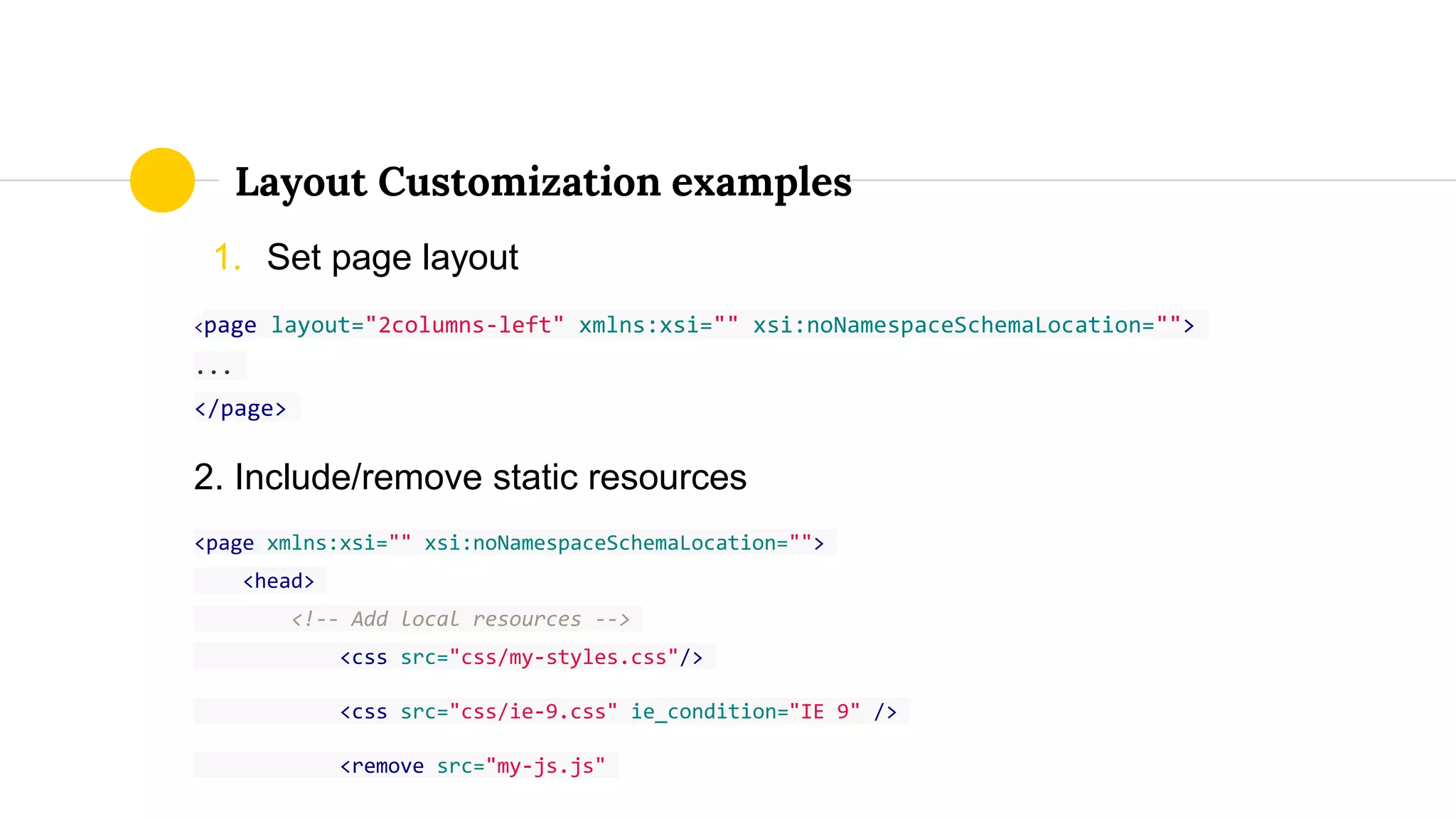
1. Set page layout
<page layout="2columns-left" xmlns:xsi="" xsi:noNamespaceSchemaLocation="">
...
</page>
2. Include/remove static resources
<page xmlns:xsi="" xsi:noNamespaceSchemaLocation="">
<head>
<!-- Add local resources -->
<css src="css/my-styles.css"/>
<css src="css/ie-9.css" ie_condition="IE 9" />
<remove src="my-js.js"
Layout Customization examples
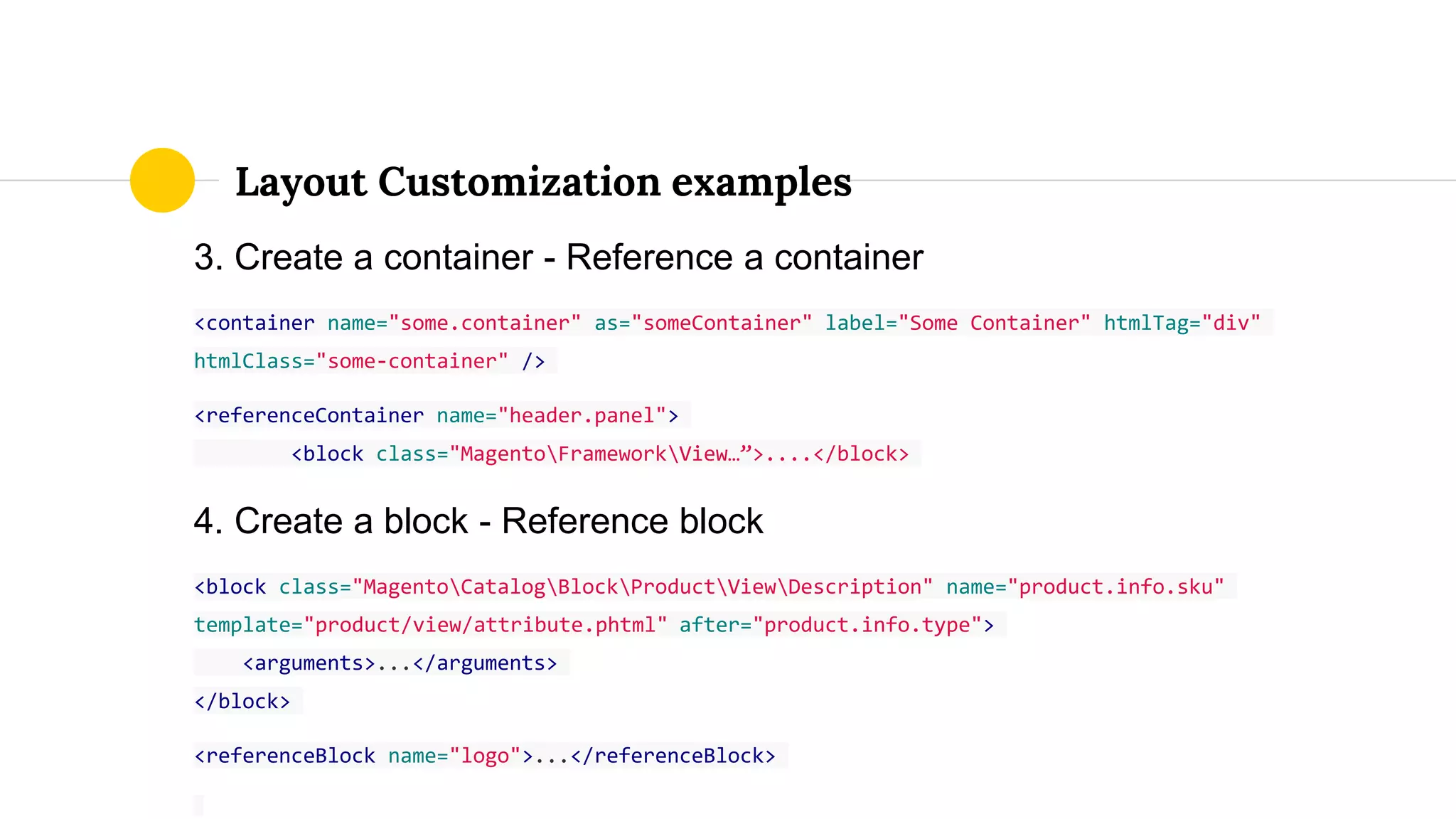
3. Create a container - Reference a container
<container name="some.container" as="someContainer" label="Some Container" htmlTag="div"
htmlClass="some-container" />
<referenceContainer name="header.panel">
<block class="MagentoFrameworkView…”>....</block>
4. Create a block - Reference block
<block class="MagentoCatalogBlockProductViewDescription" name="product.info.sku"
template="product/view/attribute.phtml" after="product.info.type">
<arguments>...</arguments>
</block>
<referenceBlock name="logo">...</referenceBlock>
Layout Customization examples
Templates
Basic concepts, customizations & overriding
4
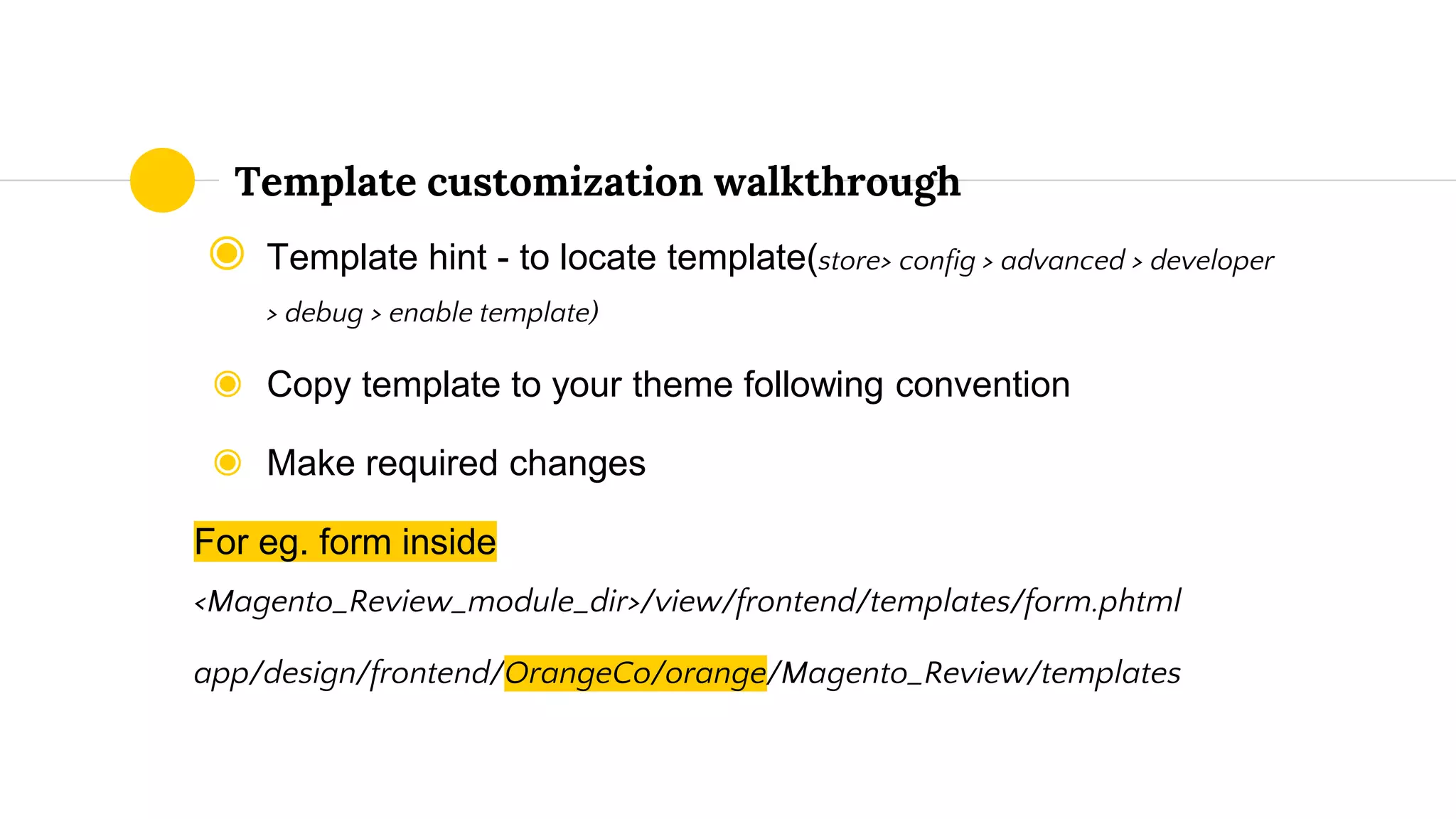
◉ Template hint - to locate template(store> config > advanced > developer
> debug > enable template)
◉ Copy template to your theme following convention
◉ Make required changes
For eg. form inside
<Magento_Review_module_dir>/view/frontend/templates/form.phtml
app/design/frontend/OrangeCo/orange/Magento_Review/templates
Template customization walkthrough
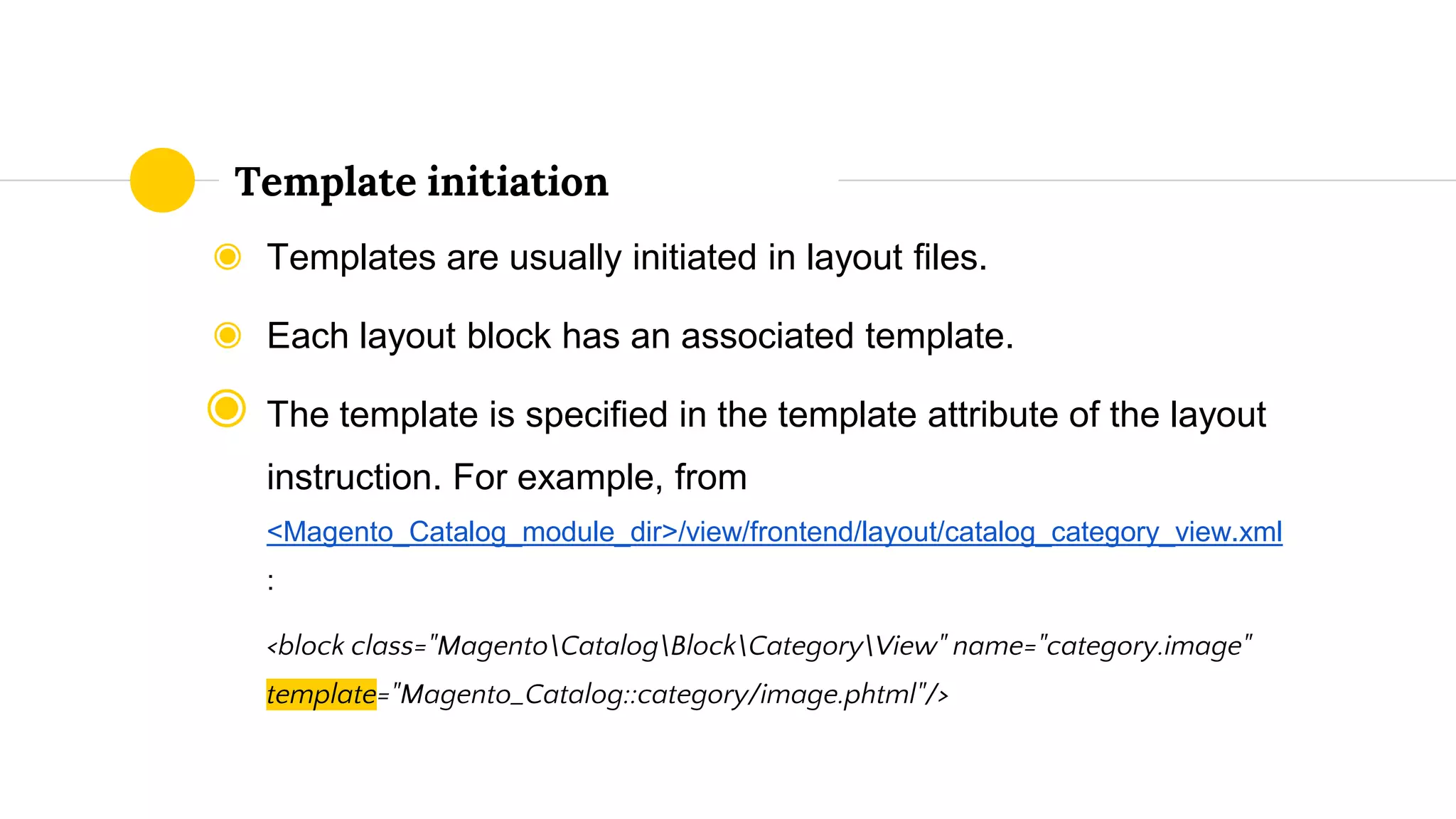
◉ Templates are usually initiated in layout files.
◉ Each layout block has an associated template.
◉ The template is specified in the template attribute of the layout
instruction. For example, from
<Magento_Catalog_module_dir>/view/frontend/layout/catalog_category_view.xml
:
<block class="MagentoCatalogBlockCategoryView" name="category.image"
template="Magento_Catalog::category/image.phtml"/>
Template initiation
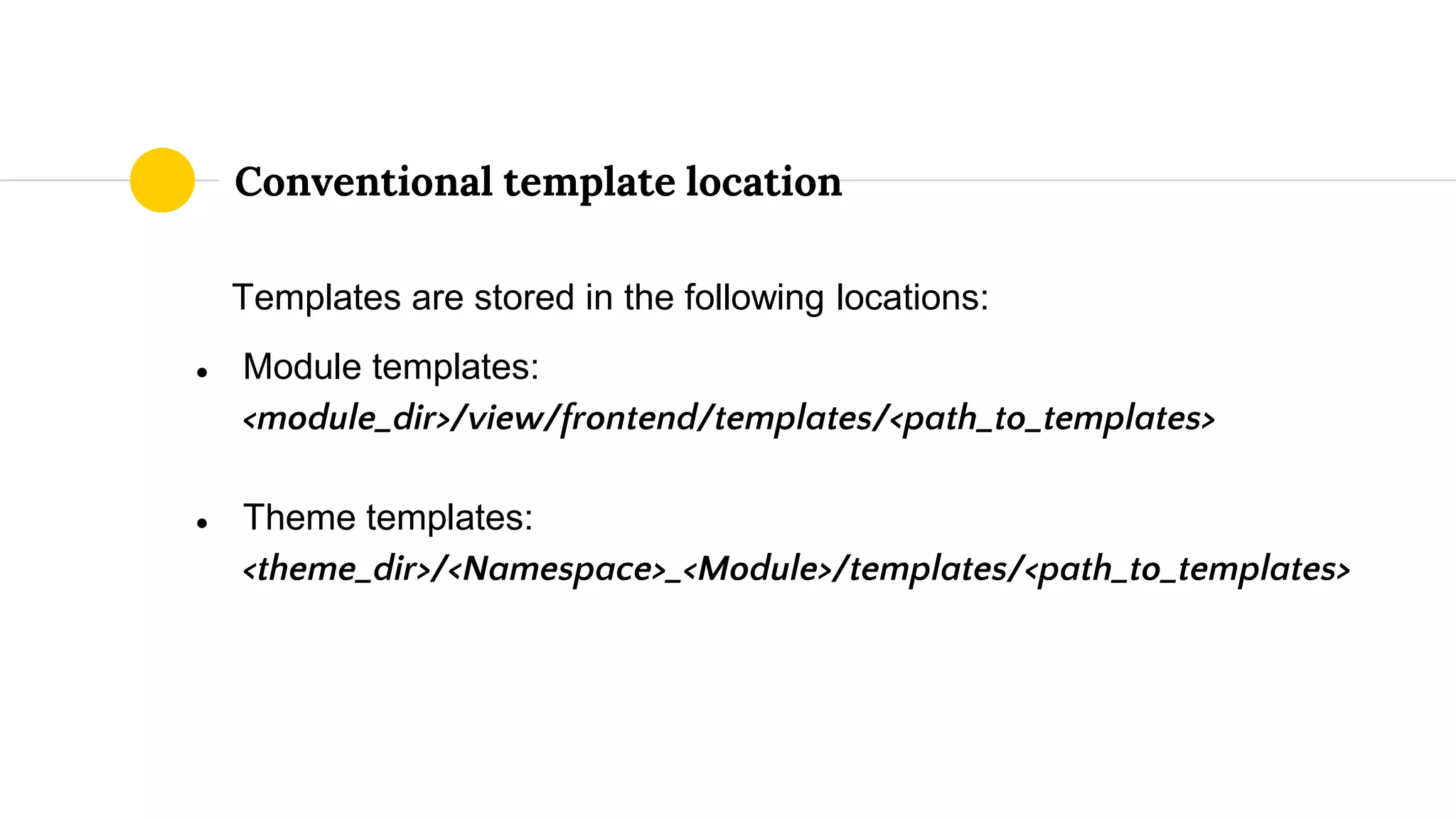
Templates are stored in the following locations:
● Module templates:
<module_dir>/view/frontend/templates/<path_to_templates>
● Theme templates:
<theme_dir>/<Namespace>_<Module>/templates/<path_to_templates>
Conventional template location
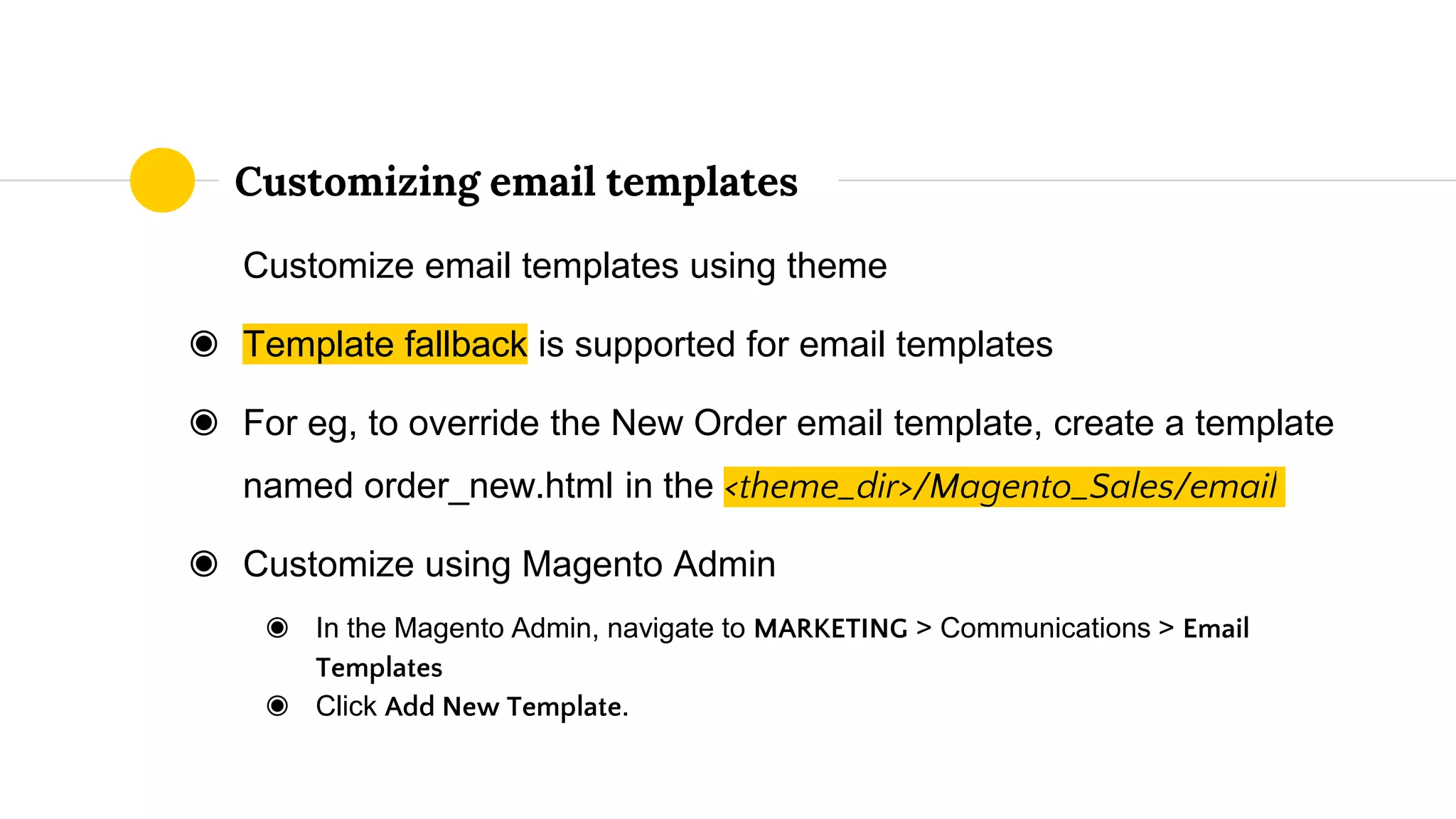
Customize email templates using theme
◉ Template fallback is supported for email templates
◉ For eg, to override the New Order email template, create a template
named order_new.html in the <theme_dir>/Magento_Sales/email
◉ Customize using Magento Admin
◉ In the Magento Admin, navigate to MARKETING > Communications > Email
Templates
◉ Click Add New Template.
Customizing email templates
CSS
Include, preprocessor & Magento UI Library
5
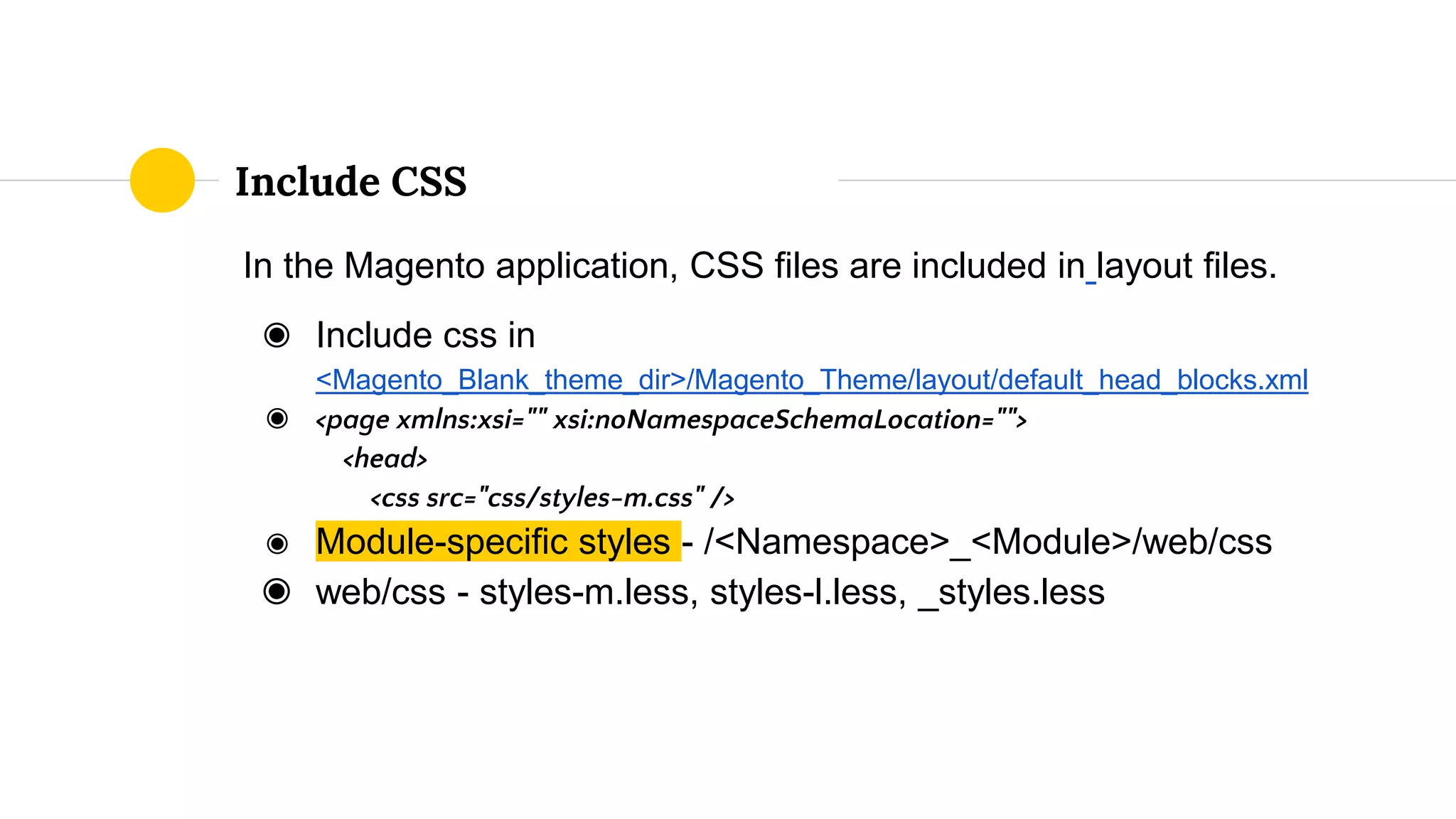
In the Magento application, CSS files are included in layout files.
◉ Include css in
<Magento_Blank_theme_dir>/Magento_Theme/layout/default_head_blocks.xml
◉ <page xmlns:xsi="" xsi:noNamespaceSchemaLocation="">
<head>
<css src="css/styles-m.css" />
◉ Module-specific styles - /<Namespace>_<Module>/web/css
◉ web/css - styles-m.less, styles-l.less, _styles.less
Include CSS
how stylesheets are preprocessed and compiled to CSS
◉ Server-side LESS compilation
default compilation mode, only option for production mode, Compilation
performed server, using the LESS PHP library.
◉ Client-side LESS compilation
When your application is not in the production mode, you can set Magento
to compile .less files in a browse
Backend : Stores > Configuration > ADVANCED > Developer [Store View drop-down field,
select Default Config.] Front-end development workflow, in the Workflow type
Preprocessor (LESS)
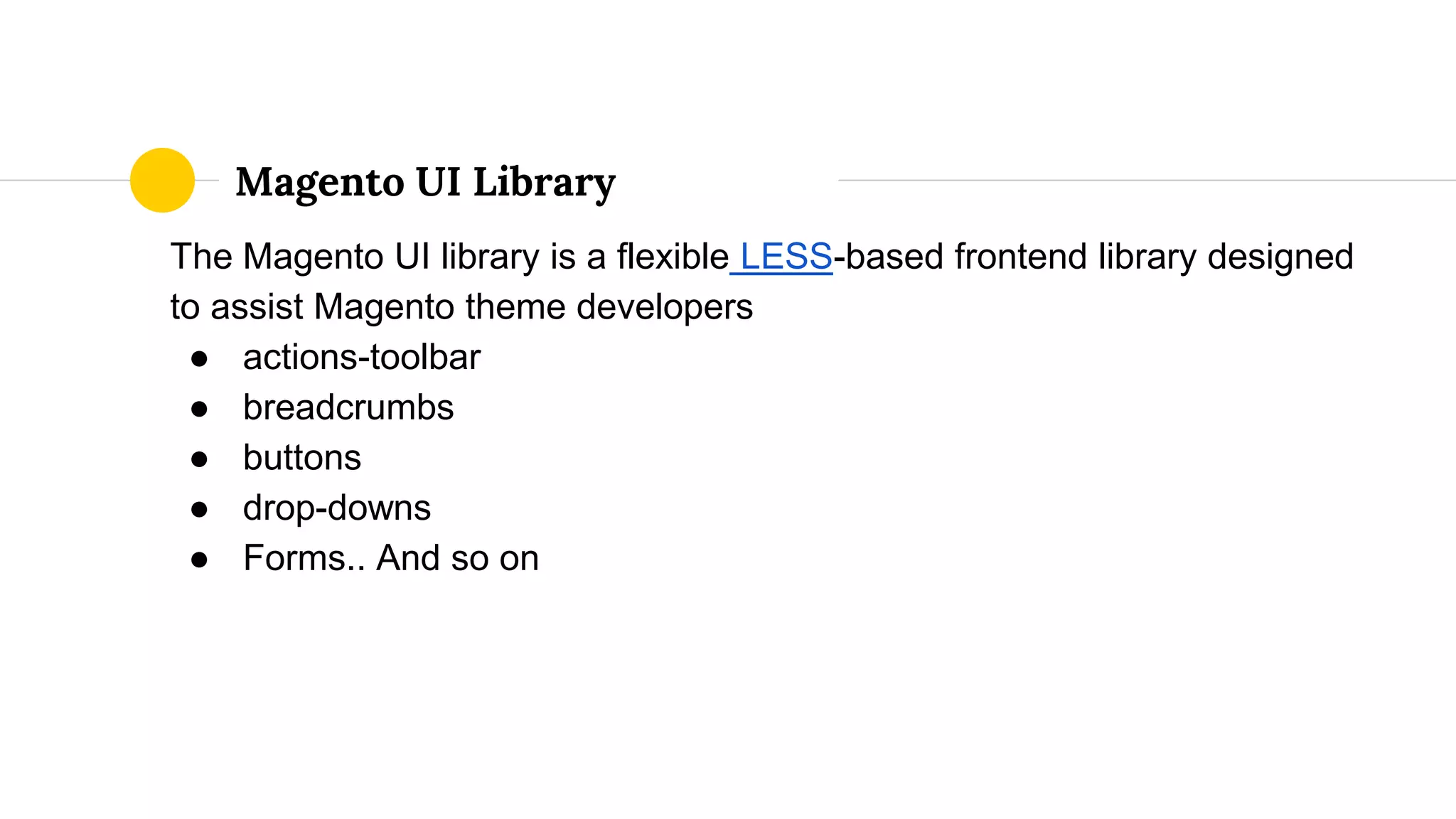
The Magento UI library is a flexible LESS-based frontend library designed
to assist Magento theme developers
● actions-toolbar
● breadcrumbs
● buttons
● drop-downs
● Forms.. And so on
Magento UI Library
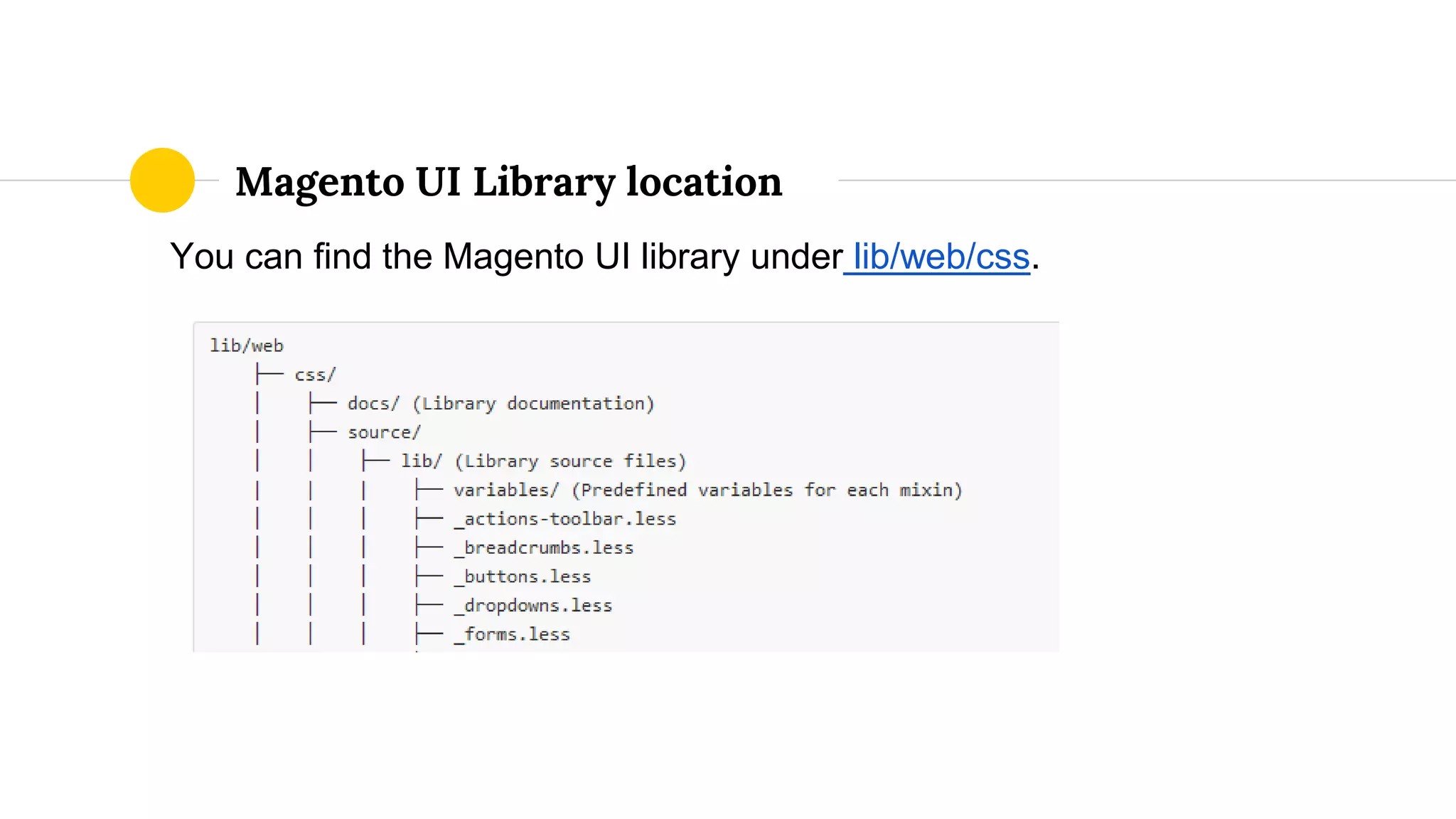
You can find the Magento UI library under lib/web/css.
Magento UI Library location
Any questions ?
Appreciate your participation !!
Thanks!
◉ Magento 2 frontend developers guide
◉ Sessiondigital & Inchoo articles
Credit
◉Presentation template by SlidesCarnival
◉Prepared slides using Google Slides
Frontend Demo: https://iwdagency.com/magento2/
Backend Demo: https://iwdagency.com/magento2/admin/
User: demo
Pass: demo123
Reference

Magento 2 theming - knowledge sharing session by suman kc

  • 1.
    This is Magento 2Theming KSS (Knowledge sharing session) by Suman KC
  • 2.
    I am SumanKC Magento developer www.linkedin.com/in/sumankc www.sumankc.com Hello!
  • 3.
  • 4.
    Introduction Magento & Magento2 intro leading to theming aspects 1
  • 5.
  • 6.
    14K+ Files &5K+ Folders That’s a lot of files & directory 109MBand that's before you add themes, modules and all your image libraries 300+ tablesProduct & category alone has 50+ tables relations Magento1.9.2
  • 7.
    Magento views areseparated into Magento views LayoutsBlocks Templates
  • 8.
  • 9.
    1. Prerequisites ◉ Notmodify out of box Magento themes [Compatibility,upgradability & easy maintenance] ◉ Set magento application to developer mode [mode influences the way static files are cached] Creating a theme
  • 10.
    app/design/frontend/<Vendor>/ ├── <theme>/ │ ├──etc/ │ │ ├── view.xml │ ├── web/ │ │ ├── images │ │ │ ├── logo.svg │ ├── registration.php │ ├── theme.xml │ ├── composer.json Theme directory structure
  • 11.
    <theme_dir>/ ├── <Vendor>_<Module>/ │ ├──web/ │ │ ├── css/ │ │ │ ├── source/ │ ├── layout/ │ │ ├── override/ │ ├── templates/ ├── etc/ ├── i18n/ ├── media/ ├── web/ │ ├── css/ │ │ ├── source/ │ ├── fonts/ │ ├── images/ │ ├── js/ ├── composer.json ├── registration.php ├── theme.xml TypicalMagentotheme directory
  • 12.
    Apply a theme 1.In Admin, go to Stores > Configuration > Design. 2. In the Store View drop-down field, select the store view where you want to apply the theme. 3. On the Design Theme tab, select your newly created theme in the Design Theme drop-down. 4. Click Save Config. 5. If caching is enabled, clear the cache. 6. To see your changes applied, reload the store front pages. Configure a theme (admin section)
  • 13.
    The properties ofproduct images used on the storefront are stored in the view.xml configuration file. <theme_dir>/etc/view.xml Image properties are configured for each image type defined by the id and type attributes of the <image> element: <images module="Magento_Catalog"> <image id="unique_image_id" type="image_type">...</image> <images/> Configure image properties
  • 14.
    ◉ Set aparent theme ◉ Override view.xml file ◉ Override static assets Theme inheritance ◉ Override templates ◉ Extend Layouts ◉ Override Layouts
  • 15.
    ◉ Current themestatic files: <theme_dir>/web/ ◉ Ancestor’s static files, recursively, until a theme with no parent is reached: <parent_theme_dir>/web/ Module context ◉ Current theme module static files <theme_dir>/<Namespace>_<Module>/web/ ◉ Ancestor themes module static files, recursively, until a theme with no ancestor is reached: <parent_theme_dir>/<Namespace>_<Module>/web/ Override static assets
  • 16.
    Fallback schema ◉ Currenttheme templates: <theme_dir>/<Namespace>_<Module>/templates ◉ Ancestors themes templates, recursively, until a theme with no ancestor is reached: <parent_theme_dir>/<Namespace>_<Module>/templates ◉ Module templates: <module_dir>/view/frontend/templates Override templates
  • 17.
    The system collectslayout files in the following order ◉ Current theme layouts: <theme_dir>/<Vendor>_<Module>/layout/ ◉ Ancestors themes <parent_theme_dir>/<Vendor>_<Module>/layout/ ◉ Module templates: <module_dir>/view/frontend/templates ◉ Module layouts for the frontend area: <module_dir>/view/frontend/layout/ ◉ Module layouts for the base area: <module_dir>/view/base/layout/ Extend Layouts
  • 18.
    To override theinstructions from an ancestor theme layout file: ● Create a layout file with the same name in the <theme_dir>/<Vendor>_<Module>/layout/override/theme/<Vendor>/ <ancestor_theme> directory. *Though overriding layouts is not recommended, it is still possible, and might be a solution for certain customization tasks. Overriding Layouts
  • 19.
  • 20.
    ◉NO local.xml file- to modify, make a new xml file with same name ◉All attributes & definitions from origianl module will be inherited ◉move action - great feature of new XML ◉Structural & content blocks to containers & blocks Layouts
  • 21.
    ◉ Common layoutinstructions to customize layout Layout instructions ◉<block> ◉<container> ◉<before> & <after> ◉<action> ◉<referenceBlock> and <referenceContainer > ◉<move> ◉<remove> ◉<update> ◉<argument>
  • 22.
    ◉ Container isa structure without content which holds other blocks and containers ◉ You can specify HTML attributes... ◉ When extending, we have referenceBlock & referenceContainer Containers and blocks
  • 23.
    ◉ Updates in<referenceBlock> & <referenceContainer> are applied to the corresponding <block> or <container>. ◉ Eg. if you make a reference by <referenceBlock name=”right”>, you are targeting the block <block name=”right”> ◉ Attributes = remove & display, values = true/false ◉ <referenceBlock name="block.name" remove="true" /> <referenceBlock> & <referenceContainer>
  • 24.
    ◉ <move> helpsmoving elements to other location without the need to unset or removing from one place <move element="name.of.an.element" destination="name.of.destination.element" as="new_alias" after="name.of.element.after" before="name.of.element.before"/> ◉ <remove> to remove static resource linked in a page <head and to remove blocks & containers <head> <!-- Remove local resources --> <remove src="css/styles-m.css" /> <move> & <remove>
  • 25.
  • 26.
  • 27.
  • 28.
    1. Set pagelayout <page layout="2columns-left" xmlns:xsi="" xsi:noNamespaceSchemaLocation=""> ... </page> 2. Include/remove static resources <page xmlns:xsi="" xsi:noNamespaceSchemaLocation=""> <head> <!-- Add local resources --> <css src="css/my-styles.css"/> <css src="css/ie-9.css" ie_condition="IE 9" /> <remove src="my-js.js" Layout Customization examples
  • 29.
    3. Create acontainer - Reference a container <container name="some.container" as="someContainer" label="Some Container" htmlTag="div" htmlClass="some-container" /> <referenceContainer name="header.panel"> <block class="MagentoFrameworkView…”>....</block> 4. Create a block - Reference block <block class="MagentoCatalogBlockProductViewDescription" name="product.info.sku" template="product/view/attribute.phtml" after="product.info.type"> <arguments>...</arguments> </block> <referenceBlock name="logo">...</referenceBlock> Layout Customization examples
  • 30.
  • 31.
    ◉ Template hint- to locate template(store> config > advanced > developer > debug > enable template) ◉ Copy template to your theme following convention ◉ Make required changes For eg. form inside <Magento_Review_module_dir>/view/frontend/templates/form.phtml app/design/frontend/OrangeCo/orange/Magento_Review/templates Template customization walkthrough
  • 32.
    ◉ Templates areusually initiated in layout files. ◉ Each layout block has an associated template. ◉ The template is specified in the template attribute of the layout instruction. For example, from <Magento_Catalog_module_dir>/view/frontend/layout/catalog_category_view.xml : <block class="MagentoCatalogBlockCategoryView" name="category.image" template="Magento_Catalog::category/image.phtml"/> Template initiation
  • 33.
    Templates are storedin the following locations: ● Module templates: <module_dir>/view/frontend/templates/<path_to_templates> ● Theme templates: <theme_dir>/<Namespace>_<Module>/templates/<path_to_templates> Conventional template location
  • 34.
    Customize email templatesusing theme ◉ Template fallback is supported for email templates ◉ For eg, to override the New Order email template, create a template named order_new.html in the <theme_dir>/Magento_Sales/email ◉ Customize using Magento Admin ◉ In the Magento Admin, navigate to MARKETING > Communications > Email Templates ◉ Click Add New Template. Customizing email templates
  • 35.
    CSS Include, preprocessor &Magento UI Library 5
  • 36.
    In the Magentoapplication, CSS files are included in layout files. ◉ Include css in <Magento_Blank_theme_dir>/Magento_Theme/layout/default_head_blocks.xml ◉ <page xmlns:xsi="" xsi:noNamespaceSchemaLocation=""> <head> <css src="css/styles-m.css" /> ◉ Module-specific styles - /<Namespace>_<Module>/web/css ◉ web/css - styles-m.less, styles-l.less, _styles.less Include CSS
  • 37.
    how stylesheets arepreprocessed and compiled to CSS ◉ Server-side LESS compilation default compilation mode, only option for production mode, Compilation performed server, using the LESS PHP library. ◉ Client-side LESS compilation When your application is not in the production mode, you can set Magento to compile .less files in a browse Backend : Stores > Configuration > ADVANCED > Developer [Store View drop-down field, select Default Config.] Front-end development workflow, in the Workflow type Preprocessor (LESS)
  • 38.
    The Magento UIlibrary is a flexible LESS-based frontend library designed to assist Magento theme developers ● actions-toolbar ● breadcrumbs ● buttons ● drop-downs ● Forms.. And so on Magento UI Library
  • 39.
    You can findthe Magento UI library under lib/web/css. Magento UI Library location
  • 40.
    Any questions ? Appreciateyour participation !! Thanks!
  • 41.
    ◉ Magento 2frontend developers guide ◉ Sessiondigital & Inchoo articles Credit ◉Presentation template by SlidesCarnival ◉Prepared slides using Google Slides Frontend Demo: https://iwdagency.com/magento2/ Backend Demo: https://iwdagency.com/magento2/admin/ User: demo Pass: demo123 Reference

Editor's Notes

  • #16 Eg. of background image override app/design/frontend/OrangeCo/orange/web/images/background.jpg
  • #17 Eg. of background image override app/design/frontend/OrangeCo/orange/web/images/background.jpg
  • #18 Eg. of background image override app/design/frontend/OrangeCo/orange/web/images/background.jpg
  • #19 Eg. of background image override app/design/frontend/OrangeCo/orange/web/images/background.jpg