Magazines Codes & Conventions
Brief annotation
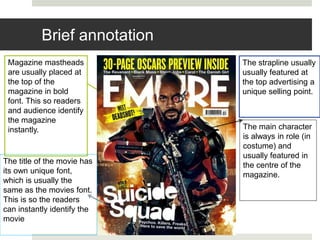
Magazine mastheads
are usually placed at
the top of the
magazine in bold
font. This so readers
and audience identify
the magazine
instantly. The main character
is always in role (in
costume) and
usually featured in
the centre of the
magazine.
The title of the movie has
its own unique font,
which is usually the
same as the movies font.
This is so the readers
can instantly identify the
movie
The strapline usually
usually featured at
the top advertising a
unique selling point.
Straplines & Main image
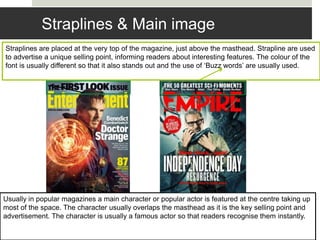
Usually in popular magazines a main character or popular actor is featured at the centre taking up
most of the space. The character usually overlaps the masthead as it is the key selling point and
advertisement. The character is usually a famous actor so that readers recognise them instantly.
Straplines are placed at the very top of the magazine, just above the masthead. Strapline are used
to advertise a unique selling point, informing readers about interesting features. The colour of the
font is usually different so that it also stands out and the use of ‘Buzz words’ are usually used.
Puffs & Barcodes
Barcodes are mostly featured on
the front cover of the magazine.
In Film magazines puffs
usually include
information about other
famous franchises.
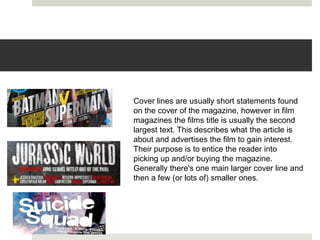
Cover lines are usually short statements found
on the cover of the magazine, however in film
magazines the films title is usually the second
largest text. This describes what the article is
about and advertises the film to gain interest.
Their purpose is to entice the reader into
picking up and/or buying the magazine.
Generally there's one main larger cover line and
then a few (or lots of) smaller ones.
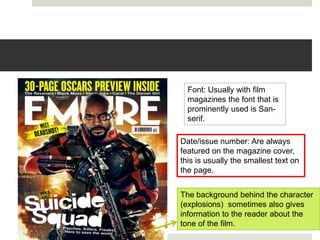
Font: Usually with film
magazines the font that is
prominently used is San-
serif.
The background behind the character
(explosions) sometimes also gives
information to the reader about the
tone of the film.
Date/issue number: Are always
featured on the magazine cover,
this is usually the smallest text on
the page.

Magazine annotation

  • 1.
    Magazines Codes &Conventions
  • 2.
    Brief annotation Magazine mastheads areusually placed at the top of the magazine in bold font. This so readers and audience identify the magazine instantly. The main character is always in role (in costume) and usually featured in the centre of the magazine. The title of the movie has its own unique font, which is usually the same as the movies font. This is so the readers can instantly identify the movie The strapline usually usually featured at the top advertising a unique selling point.
  • 3.
    Straplines & Mainimage Usually in popular magazines a main character or popular actor is featured at the centre taking up most of the space. The character usually overlaps the masthead as it is the key selling point and advertisement. The character is usually a famous actor so that readers recognise them instantly. Straplines are placed at the very top of the magazine, just above the masthead. Strapline are used to advertise a unique selling point, informing readers about interesting features. The colour of the font is usually different so that it also stands out and the use of ‘Buzz words’ are usually used.
  • 4.
    Puffs & Barcodes Barcodesare mostly featured on the front cover of the magazine. In Film magazines puffs usually include information about other famous franchises.
  • 5.
    Cover lines areusually short statements found on the cover of the magazine, however in film magazines the films title is usually the second largest text. This describes what the article is about and advertises the film to gain interest. Their purpose is to entice the reader into picking up and/or buying the magazine. Generally there's one main larger cover line and then a few (or lots of) smaller ones.
  • 6.
    Font: Usually withfilm magazines the font that is prominently used is San- serif. The background behind the character (explosions) sometimes also gives information to the reader about the tone of the film. Date/issue number: Are always featured on the magazine cover, this is usually the smallest text on the page.