Student Copy
What you get on front covers
Web-links?                                        8. Selling Line
   Ears?                                                 or Banner


    1. Masthead


                                                  10. Feature
           13. Flash
                                                      Article Photo

4. Secondary Lead                               11. Headline
  2. Kicker
  3. Cover Line                               12. Anchorage

    7. Caption
                                                  16. Date Line

  6. Graphic
     Feature or                                   15. Bar Code
     Puff

                 5. Plug   9. Tagline   14. Menu Strip
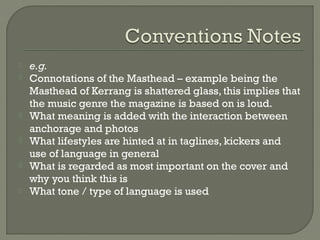
   e.g.
   Connotations of the Masthead – example being the
    Masthead of Kerrang is shattered glass, this implies that
    the music genre the magazine is based on is loud.
   What meaning is added with the interaction between
    anchorage and photos
   What lifestyles are hinted at in taglines, kickers and
    use of language in general
   What is regarded as most important on the cover and
    why you think this is
   What tone / type of language is used
How front covers are conceived and laid out
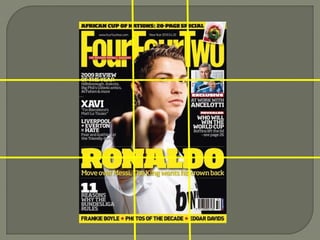
Note that using the grid system, we can see that covers which contain
photographs of just one person are very consistent with placement. The
magazine Four Four Two consistently places photos with the grid system so
that the top third ends at eye level with any of the photographs – this
meaning that the rest of the person in the photograph’s face envelops the
centre of the magazine and is therefore the main focus point.

On top of this, the headline for each magazine from this company is around
the lower third of the grid, this means that the audience will see the
photograph first and then the headline as they look down the page.

Finally, the grid is used for placement of text, consistently the left-hand third
of the magazine contains a vast majority of the secondary leads and kickers
– this is because when magazines are placed on sale in stores, most of the
cover is normally hidden behind other magazines leaving on the most left
third on display. The secondary leads and kickers are located on this third
so that even when on display, a potential buyer can see what articles the
issue of the magazine contains.
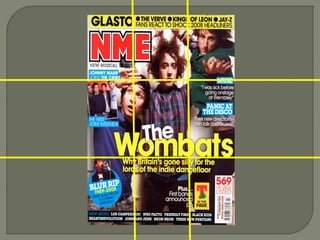
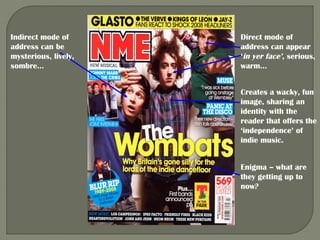
Indirect mode of      Direct mode of
address can be        address can appear
mysterious, lively,   ‘in yer face’, serious,
sombre…               warm…


                      Creates a wacky, fun
                      image, sharing an
                      identity with the
                      reader that offers the
                      ‘independence’ of
                      indie music.


                      Enigma – what are
                      they getting up to
                      now?
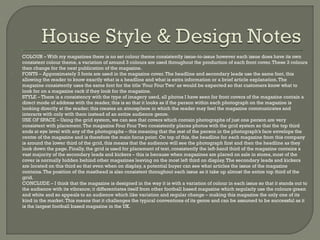
   COLOUR – With my magazines there is no set colour theme consistently issue-to-issue however each issue does have its own
    consistent colour theme, a variation of around 3 colours are used throughout the production of each front cover. These 3 colours
    then change for the next publication of the magazine.
   FONTS – Approximately 3 fonts are used in the magazine cover. The headline and secondary leads use the same font, this
    allowing the reader to know exactly what is a headline and what is extra information or a brief article explanation. The
    magazine consistently uses the same font for the title ‘Four Four Two’ as would be expected so that customers know what to
    look for on a magazine rack if they look for the magazine.
   STYLE – There is a consistency with the type of imagery used, all photos I have seen for front covers of the magazine contain a
    direct mode of address with the reader, this is so that it looks as if the person within each photograph on the magazine is
    looking directly at the reader; this creates an atmosphere in which the reader may feel the magazine communicates and
    interacts with only with them instead of an entire audience genre.
   USE OF SPACE – Using the grid system, we can see that covers which contain photographs of just one person are very
    consistent with placement. The magazine Four Four Two consistently places photos with the grid system so that the top third
    ends at eye level with any of the photographs – this meaning that the rest of the person in the photograph’s face envelops the
    centre of the magazine and is therefore the main focus point. On top of this, the headline for each magazine from this company
    is around the lower third of the grid, this means that the audience will see the photograph first and then the headline as they
    look down the page. Finally, the grid is used for placement of text, consistently the left-hand third of the magazine contains a
    vast majority of the secondary leads and kickers – this is because when magazines are placed on sale in stores, most of the
    cover is normally hidden behind other magazines leaving on the most left third on display. The secondary leads and kickers
    are located on this third so that even when on display, a potential buyer can see what articles the issue of the magazine
    contains. The position of the masthead is also consistent throughout each issue as it take up almost the entire top third of the
    grid.
   CONCLUDE – I think that the magazine is designed in the way it is with a variation of colour in each issue so that it stands out to
    the audience with its vibrance; it differentiates itself from other football based magazine which regularly use the colours green
    and white and so appeals to an audience which like variation and regular change – making this magazine the only one of its
    kind in the market. This means that it challenges the typical conventions of its genre and can be assumed to be successful as it
    is the largest football based magazine in the UK.

Magazine conventions

  • 1.
  • 2.
    What you geton front covers
  • 3.
    Web-links? 8. Selling Line Ears? or Banner 1. Masthead 10. Feature 13. Flash Article Photo 4. Secondary Lead 11. Headline 2. Kicker 3. Cover Line 12. Anchorage 7. Caption 16. Date Line 6. Graphic Feature or 15. Bar Code Puff 5. Plug 9. Tagline 14. Menu Strip
  • 4.
    e.g.  Connotations of the Masthead – example being the Masthead of Kerrang is shattered glass, this implies that the music genre the magazine is based on is loud.  What meaning is added with the interaction between anchorage and photos  What lifestyles are hinted at in taglines, kickers and use of language in general  What is regarded as most important on the cover and why you think this is  What tone / type of language is used
  • 5.
    How front coversare conceived and laid out
  • 10.
    Note that usingthe grid system, we can see that covers which contain photographs of just one person are very consistent with placement. The magazine Four Four Two consistently places photos with the grid system so that the top third ends at eye level with any of the photographs – this meaning that the rest of the person in the photograph’s face envelops the centre of the magazine and is therefore the main focus point. On top of this, the headline for each magazine from this company is around the lower third of the grid, this means that the audience will see the photograph first and then the headline as they look down the page. Finally, the grid is used for placement of text, consistently the left-hand third of the magazine contains a vast majority of the secondary leads and kickers – this is because when magazines are placed on sale in stores, most of the cover is normally hidden behind other magazines leaving on the most left third on display. The secondary leads and kickers are located on this third so that even when on display, a potential buyer can see what articles the issue of the magazine contains.
  • 11.
    Indirect mode of Direct mode of address can be address can appear mysterious, lively, ‘in yer face’, serious, sombre… warm… Creates a wacky, fun image, sharing an identity with the reader that offers the ‘independence’ of indie music. Enigma – what are they getting up to now?
  • 12.
    COLOUR – With my magazines there is no set colour theme consistently issue-to-issue however each issue does have its own consistent colour theme, a variation of around 3 colours are used throughout the production of each front cover. These 3 colours then change for the next publication of the magazine.  FONTS – Approximately 3 fonts are used in the magazine cover. The headline and secondary leads use the same font, this allowing the reader to know exactly what is a headline and what is extra information or a brief article explanation. The magazine consistently uses the same font for the title ‘Four Four Two’ as would be expected so that customers know what to look for on a magazine rack if they look for the magazine.  STYLE – There is a consistency with the type of imagery used, all photos I have seen for front covers of the magazine contain a direct mode of address with the reader, this is so that it looks as if the person within each photograph on the magazine is looking directly at the reader; this creates an atmosphere in which the reader may feel the magazine communicates and interacts with only with them instead of an entire audience genre.  USE OF SPACE – Using the grid system, we can see that covers which contain photographs of just one person are very consistent with placement. The magazine Four Four Two consistently places photos with the grid system so that the top third ends at eye level with any of the photographs – this meaning that the rest of the person in the photograph’s face envelops the centre of the magazine and is therefore the main focus point. On top of this, the headline for each magazine from this company is around the lower third of the grid, this means that the audience will see the photograph first and then the headline as they look down the page. Finally, the grid is used for placement of text, consistently the left-hand third of the magazine contains a vast majority of the secondary leads and kickers – this is because when magazines are placed on sale in stores, most of the cover is normally hidden behind other magazines leaving on the most left third on display. The secondary leads and kickers are located on this third so that even when on display, a potential buyer can see what articles the issue of the magazine contains. The position of the masthead is also consistent throughout each issue as it take up almost the entire top third of the grid.  CONCLUDE – I think that the magazine is designed in the way it is with a variation of colour in each issue so that it stands out to the audience with its vibrance; it differentiates itself from other football based magazine which regularly use the colours green and white and so appeals to an audience which like variation and regular change – making this magazine the only one of its kind in the market. This means that it challenges the typical conventions of its genre and can be assumed to be successful as it is the largest football based magazine in the UK.