macvlan and ipvlan
- Suraj Deshmukh @surajd_
Introduction
● macvlan and ipvlan exposes the underlying host's interfaces directly to VMs
or Containers.
● Both do not use bridge.
● Both are implicitly namespace aware.
● Traditionally we have been using Linux Bridge to get VM access to the outside
network or default gateway, now you don't need that extra NATing overhead.
● Lightweight and Fast.
● There are two ways normally to
connect VMs or Containers to
external network overlay and
underlay:
○ Overlay is using VXLAN or NVGRE, etc.,
with extra encapsulation.
○ Underlay is using Linux Bridge, ipvlan or
macvlan by directly exposing it to host's
external network.
○ These implementations are extremely
lightweight than the traditional linux
bridge.
Linux Bridge
● Acts similar to the physical layer 2 switch.
● It has learning capabilities.
● All the VMs or containers connect to this bridge/switch.
● For external connectivity all these are NATed.
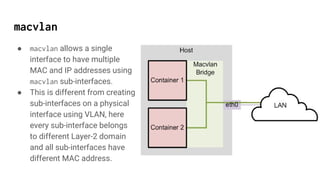
macvlan
● macvlan allows a single
interface to have multiple
MAC and IP addresses using
macvlan sub-interfaces.
● This is different from creating
sub-interfaces on a physical
interface using VLAN, here
every sub-interface belongs
to different Layer-2 domain
and all sub-interfaces have
different MAC address.
● macvlan has been in use with lxc
containers before docker support was
introduced.
● Each interface will have different MAC
address and will be exposed directly in the
underlay network.
● This will help people who wanna use the
existing network infrastructure with
Containers and VMs.
● macvlan will only see traffic that has MAC address that matches interface’s
MAC address.
● macvlan has 4 types (private, bridge, passthrough, VEPA(Virtual Ethernet Port
Aggregator))
○ Commonly used is a macvlan bridge because it allows the Container or VMs on the same host
to talk to each other without packet leaving the host.
○ Bridge mode works like traditional bridge and removes the requirement of learning and STP,
learning not needed because it already knows what MAC addresses.
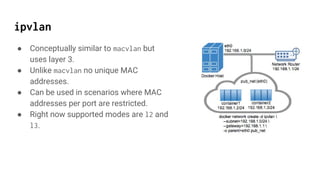
ipvlan
● Conceptually similar to macvlan but
uses layer 3.
● Unlike macvlan no unique MAC
addresses.
● Can be used in scenarios where MAC
addresses per port are restricted.
● Right now supported modes are l2 and
l3.
When to use ipvlan over macvlan?
● These two are very similar in many regards and the specific use case could
very well define which device to choose.
○ The Linux host that is connected to the external switch / router has policy configured that
allows only one mac per port.
○ No of virtual devices created on a master exceed the MAC capacity and puts the NIC in
promiscuous mode and degraded performance is a concern.
○ If the slave device is to be put into the hostile / untrusted network namespace where l2 on the
slave could be changed / misused.
When to use macvlan over ipvlan?
● When you have a common DHCP server, then macvlan should be used,
because DHCP would need unique MAC address for each IP address.
Demo
Steps a.k.a. Cheatsheet: https://github.
com/surajssd/blog_post/tree/master/talks2/20160708DockerBangalore
Ref:
● Macvlan and IPvlan basics https://sreeninet.wordpress.com/2016/05/29/macvlan-and-ipvlan/
● Macvlan and Ipvlan Network Drivers https://github.com/docker/docker/blob/master/experimental/vlan-networks.md
● Experimental Docker https://sreeninet.wordpress.com/2016/05/29/experimental-docker-with-docker-machine/ and https:
//github.com/docker/docker/tree/master/experimental
● Some notes on macvlan/macvtap http://backreference.org/2014/03/20/some-notes-on-macvlanmacvtap/
● Configuring Macvlan and Ipvlan Linux Networking http://networkstatic.net/configuring-macvlan-ipvlan-linux-networking/
● About Veth and Macvlan https://docs.oracle.com/cd/E37670_01/E37355/html/ol_mcvnbr_lxc.html
● LXC Macvlan networking https://www.flockport.com/lxc-macvlan-networking/
● MacVTap http://virt.kernelnewbies.org/MacVTap
● IPVLAN Driver HOWTO https://www.kernel.org/doc/Documentation/networking/ipvlan.txt
● Linux Networking: MAC VLANs and Virtual Ethernets http://www.pocketnix.org/posts/Linux%20Networking:%20MAC%
20VLANs%20and%20Virtual%20Ethernets
● macvlan: implement bridge, VEPA and private mode https://git.kernel.org/cgit/linux/kernel/git/torvalds/linux.git/commit/?
id=618e1b7482f7a8a4c6c6e8ccbe140e4c331df4e9
● IPVLAN – The beginning http://people.netfilter.org/pablo/netdev0.1/papers/IPVLAN-The-beginning.pdf
● Integrating Overlay Networking and the Physical Network http://etherealmind.com/integrating-overlay-networking-and-the-
physical-network/

macvlan and ipvlan

  • 1.
    macvlan and ipvlan -Suraj Deshmukh @surajd_
  • 2.
    Introduction ● macvlan andipvlan exposes the underlying host's interfaces directly to VMs or Containers. ● Both do not use bridge. ● Both are implicitly namespace aware. ● Traditionally we have been using Linux Bridge to get VM access to the outside network or default gateway, now you don't need that extra NATing overhead. ● Lightweight and Fast.
  • 3.
    ● There aretwo ways normally to connect VMs or Containers to external network overlay and underlay: ○ Overlay is using VXLAN or NVGRE, etc., with extra encapsulation. ○ Underlay is using Linux Bridge, ipvlan or macvlan by directly exposing it to host's external network. ○ These implementations are extremely lightweight than the traditional linux bridge.
  • 4.
    Linux Bridge ● Actssimilar to the physical layer 2 switch. ● It has learning capabilities. ● All the VMs or containers connect to this bridge/switch. ● For external connectivity all these are NATed.
  • 5.
    macvlan ● macvlan allowsa single interface to have multiple MAC and IP addresses using macvlan sub-interfaces. ● This is different from creating sub-interfaces on a physical interface using VLAN, here every sub-interface belongs to different Layer-2 domain and all sub-interfaces have different MAC address.
  • 6.
    ● macvlan hasbeen in use with lxc containers before docker support was introduced. ● Each interface will have different MAC address and will be exposed directly in the underlay network. ● This will help people who wanna use the existing network infrastructure with Containers and VMs.
  • 7.
    ● macvlan willonly see traffic that has MAC address that matches interface’s MAC address. ● macvlan has 4 types (private, bridge, passthrough, VEPA(Virtual Ethernet Port Aggregator)) ○ Commonly used is a macvlan bridge because it allows the Container or VMs on the same host to talk to each other without packet leaving the host. ○ Bridge mode works like traditional bridge and removes the requirement of learning and STP, learning not needed because it already knows what MAC addresses.
  • 8.
    ipvlan ● Conceptually similarto macvlan but uses layer 3. ● Unlike macvlan no unique MAC addresses. ● Can be used in scenarios where MAC addresses per port are restricted. ● Right now supported modes are l2 and l3.
  • 9.
    When to useipvlan over macvlan? ● These two are very similar in many regards and the specific use case could very well define which device to choose. ○ The Linux host that is connected to the external switch / router has policy configured that allows only one mac per port. ○ No of virtual devices created on a master exceed the MAC capacity and puts the NIC in promiscuous mode and degraded performance is a concern. ○ If the slave device is to be put into the hostile / untrusted network namespace where l2 on the slave could be changed / misused.
  • 10.
    When to usemacvlan over ipvlan? ● When you have a common DHCP server, then macvlan should be used, because DHCP would need unique MAC address for each IP address.
  • 11.
    Demo Steps a.k.a. Cheatsheet:https://github. com/surajssd/blog_post/tree/master/talks2/20160708DockerBangalore
  • 12.
    Ref: ● Macvlan andIPvlan basics https://sreeninet.wordpress.com/2016/05/29/macvlan-and-ipvlan/ ● Macvlan and Ipvlan Network Drivers https://github.com/docker/docker/blob/master/experimental/vlan-networks.md ● Experimental Docker https://sreeninet.wordpress.com/2016/05/29/experimental-docker-with-docker-machine/ and https: //github.com/docker/docker/tree/master/experimental ● Some notes on macvlan/macvtap http://backreference.org/2014/03/20/some-notes-on-macvlanmacvtap/ ● Configuring Macvlan and Ipvlan Linux Networking http://networkstatic.net/configuring-macvlan-ipvlan-linux-networking/ ● About Veth and Macvlan https://docs.oracle.com/cd/E37670_01/E37355/html/ol_mcvnbr_lxc.html ● LXC Macvlan networking https://www.flockport.com/lxc-macvlan-networking/ ● MacVTap http://virt.kernelnewbies.org/MacVTap ● IPVLAN Driver HOWTO https://www.kernel.org/doc/Documentation/networking/ipvlan.txt ● Linux Networking: MAC VLANs and Virtual Ethernets http://www.pocketnix.org/posts/Linux%20Networking:%20MAC% 20VLANs%20and%20Virtual%20Ethernets ● macvlan: implement bridge, VEPA and private mode https://git.kernel.org/cgit/linux/kernel/git/torvalds/linux.git/commit/? id=618e1b7482f7a8a4c6c6e8ccbe140e4c331df4e9 ● IPVLAN – The beginning http://people.netfilter.org/pablo/netdev0.1/papers/IPVLAN-The-beginning.pdf ● Integrating Overlay Networking and the Physical Network http://etherealmind.com/integrating-overlay-networking-and-the- physical-network/