Macromolecules Structure and Function Mr. Hunter Biology IB Biochemistry 12/14/2009
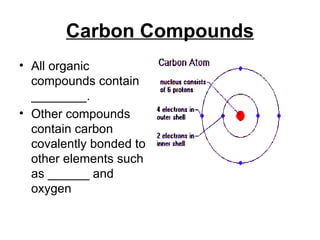
Carbon Compounds All organic compounds contain ________. Other compounds contain carbon covalently bonded to other elements such as ______ and oxygen
Carbohydrates Carbohydrates are compounds made of carbon ______ and _______ atoms The ratio of these atoms are ___ 2 ___. The building blocks of larger molecules are called __________. They are linked together by a _______ synthesis to form larger polymers. The monomer units of sugars are called monosaccharides.
Monosaccharides Glucose is a monosaccharide of _______. The formula for glucose is C 6 H 12 O 6 Glucose is a major source of ______ in cells. Fructose is also a monosaccharide. ________ are double sugars from the joining of  2 monosaccharides via. Dehydration synthesis.
Energy Storage Some polysaccharides function as storehouses for energy. Glycogen and _______ are examples of energy storing polysaccharides. Both are composed of hundreds of linked ________ molecules. ________ is a polysaccharide that provides structural support for plants.
Lipids ______ polar molecules that are not soluble in water. They include fats, phospholipids, steroids and ________ Steroids include cholesterol which is found in animal cell _________. Phospholipids make of the _______ bilayer of the cell _________
Lipids and Fats The plant pigment, _________ is also a lipid. Fats are lipids that store energy. A typical fat molecule contains three fatty acids bonded to a ______ molecule. Glycerol is an alcohol with three _____ atoms. A fatty acid consists of a long chain of carbon and ______ atoms.
Lipids and Fats Saturated fatty acids do not contain _____ bonds. They are _______ at room temperature. Examples are butter, lard etc. Unsaturated fatty acids contain double bonds. They are liquid at room temperature. Examples are olive oil, corn oil etc.
Review Questions Page. 37 Green, Holt Text Book. Review 2-3 1-5

Macromolecules Structure And Function

  • 1.
    Macromolecules Structure andFunction Mr. Hunter Biology IB Biochemistry 12/14/2009
  • 2.
    Carbon Compounds Allorganic compounds contain ________. Other compounds contain carbon covalently bonded to other elements such as ______ and oxygen
  • 3.
    Carbohydrates Carbohydrates arecompounds made of carbon ______ and _______ atoms The ratio of these atoms are ___ 2 ___. The building blocks of larger molecules are called __________. They are linked together by a _______ synthesis to form larger polymers. The monomer units of sugars are called monosaccharides.
  • 4.
    Monosaccharides Glucose isa monosaccharide of _______. The formula for glucose is C 6 H 12 O 6 Glucose is a major source of ______ in cells. Fructose is also a monosaccharide. ________ are double sugars from the joining of 2 monosaccharides via. Dehydration synthesis.
  • 5.
    Energy Storage Somepolysaccharides function as storehouses for energy. Glycogen and _______ are examples of energy storing polysaccharides. Both are composed of hundreds of linked ________ molecules. ________ is a polysaccharide that provides structural support for plants.
  • 6.
    Lipids ______ polarmolecules that are not soluble in water. They include fats, phospholipids, steroids and ________ Steroids include cholesterol which is found in animal cell _________. Phospholipids make of the _______ bilayer of the cell _________
  • 7.
    Lipids and FatsThe plant pigment, _________ is also a lipid. Fats are lipids that store energy. A typical fat molecule contains three fatty acids bonded to a ______ molecule. Glycerol is an alcohol with three _____ atoms. A fatty acid consists of a long chain of carbon and ______ atoms.
  • 8.
    Lipids and FatsSaturated fatty acids do not contain _____ bonds. They are _______ at room temperature. Examples are butter, lard etc. Unsaturated fatty acids contain double bonds. They are liquid at room temperature. Examples are olive oil, corn oil etc.
  • 9.
    Review Questions Page.37 Green, Holt Text Book. Review 2-3 1-5