THYROID HORMONES & THYROID INHIBITORS
The thyroid gland secretes 3 hormones—thyroxine (T4), triiodothyronine (T3) and calcitonin.
The former two are produced by thyroid follicles, have similar biological activity and the
term ‘thyroid hormone’ is restricted to these only.
Calcitonin produced by interfollicular ‘C’ cells is chemically and biologically entirely
different. It is considered along with parathormone, with which it regulates calcium
metabolism.
CHEMISTRY AND SYNTHESIS
 Both T4 and T3 are iodine containing derivatives of thyronine which is a condensation
product of two molecules of the amino acid tyrosine.
 Thyroxine; is 3, 5, 3´, 5´–tetraiodothyronine while T3 is 3, 5, 3´ triiodothyronine.
 The thyroid hormones are synthesized and stored in the thyroid follicles as part of
thyroglobulin molecule—which is a glycoprotein synthesized by thyroid cells, MW 660
KDa, contains 10% sugar.
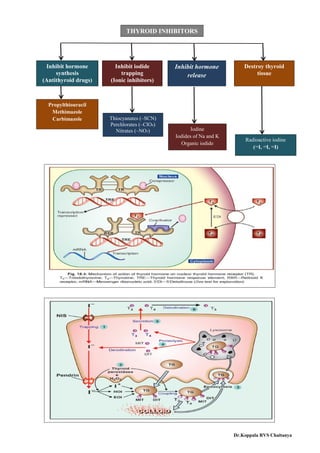
 The synthesis, storage and release of T4 and T3 is summarized in Fig. 18.1 and involves
the following processes.
1. Iodide uptake
2. Oxidation and iodination
3. Coupling
4. Storage and release
5. Peripheral conversion of T4 to T3
TRANSPORT, METABOLISM AND EXCRETION
 Thyroid hormones are avidly bound to plasma proteins—only 0.03–0.08% of T4 and 0.2–
0.5% of T3 are in the free form.
 Almost all protein bound iodine (PBI) in plasma is thyroid hormone, of which 90–95% is
T4 and the rest T3. Binding occurs to 3 plasma proteins in the following decreasing order
of affinity for T4:
1. Thyroxine binding globulin (TBG)
2. Thyroxine binding prealbumin (transthyretin)
3. Albumin the normal concentration of PBI is 4–10 μg/ dl; only 0.1–0.2 μg/dl of
this is T3, rest is T4.
 During pregnancy thyroxine binding globulin is increased—PBI levels are elevated, but
there is no effect on thyroid status because the concentration of free hormone remains
unaltered.
 Only the free hormone is available for action as well as for metabolism and excretion.
Metabolic inactivation of T4 and T3 occurs by deiodination and glucuronide/sulfate
conjugation of the hormones as well as that of their deiodinated products.
 Liver is the primary site (also salivary glands and kidneys).
 The conjugates are excreted in bile, of which a significant fraction is deconjugated in
intestines and reabsorbed (enterohepatic circulation) to be finally excreted in urine.
Dr.Koppala RVS Chaitanya
 Plasma t½ of T4 is 6–7 days, while that of T3 is 1–2 days.
 The half-lives are shortened in hyperthyroidism and prolonged in hypothyroidism due
respectively to faster and slower metabolism.
REGULATION OF SECRETION
 The secretion of hormones from the thyroid is controlled by anterior pituitary by the
elaboration of Thyrotropin, while TSH secretion itself is regulated by TRH produced in
hypothalamus.
 Somatostatin elaborated by hypothalamus inhibits not only GH and prolactin, but also
TSH secretion from pituitary.
 The negative feedback by the thyroid hormones is exercised directly on the pituitary as
well as through hypothalamus.
 The action of TRH on pituitary and that of TSH on thyroid cells is mediated by enhanced
Camp synthesis.
 High concentration of TSH also acts via IP3/DAG–increased intracellular Ca2+ pathway
in the thyroid cells.
PHARMACOLOGICAL ACTIONS
1. Growth and development
 T4 and T3 are essential for normal
growth and development.
 The greatest sufferer, however, is the
nervous system.
 Retardation and nervous deficit is a
consequence of paucity of axonal and
dendritic ramification, synapse formation
and impaired myelination.
 In adult hypothyroidism also, intelligence
is impaired and movements are slow.
2. Intermediary metabolism
Lipid
 T4 and T3 indirectly enhance lipolysis by
potentiating the action of catecholamine’s
and other lipolytic hormones.
 As a result plasma free fatty acid levels
are elevated. Lipogenesis is also
stimulated.
 Hyperthyroidism is characterized by
hypocholesterolemia. LDL levels in
blood are reduced.
Carbohydrate
Pharmacokinetics and interactions
 Oral bioavailability of l-thyroxine is ~
75%, but severe hypothyroidism can
reduce oral absorption.
 It should be administered in empty
stomach to avoid interference by food.
Sucralfate, iron, calcium and proton
pump inhibitors also reduce l-thyroxine
absorption.
 CYP3A4 inducers like rifampin,
phenytoin and carbamazepine accelerate
metabolism of T4; dose of l-thyroxine
may need enhancement.
Uses
1. Cretinism
2. Adult hypothyroidism (Myxoedema)
3. Myxoedema coma
4. Nontoxic goitre
5. Thyroid nodule
6. Papillary carcinoma of thyroid
7. Empirical uses
Refractory anaemia.
Mental depression
Menstrual disorders,
Infertility not corrected by usual
treatment.
Chronic/non-healing ulcers.
Obstinate constipation.
Dr.Koppala RVS Chaitanya
 Carbohydrate metabolism is also
stimulated.
 Though utilization of sugar by tissues is
increased (mainly secondary to increased
BMR),
 Glycogenolysis and gluconeogenesis in
liver as well as faster absorption of
glucose from intestines
Protein
 Synthesis of certain proteins is increased,
but the overall effect of T3 is catabolic.
 Prolonged action results in negative
nitrogen balance and tissue wasting.
 Weight loss is a feature of
hyperthyroidism.
3. Calorigenesis
 T3 and T4 increase BMR by stimulation
of cellular metabolism and resetting of
the energy stat.
 This is important for maintaining body
temperature. However, metabolic rate in
brain, gonads, uterus, spleen and lymph
nodes is not significantly affected.
 The mechanism of Calorigenesis was
believed to be uncoupling of oxidative
phosphorylation: excess energy being
released as heat.
4. CVS
 T3 and T4 cause a hyper dynamic state of
circulation which is partly secondary to
increased peripheral demand and partly
due to direct cardiac actions.
 Heart rate, contractility and output are
increased resulting in a fast, bounding
pulse.
10. Reproduction
 Thyroid has an indirect effect on
reproduction. Fertility is impaired in
hypothyroidism and women suffer from
oligomenorrhoea.
5. Nervous system
 Mental retardation is the hallmark of
cretinism
 Sluggishness and other behavioral
features are seen in myxoedema.
 Hyperthyroid individuals are anxious,
nervous, excitable, exhibit tremors and
hyperreflexia.
6. Skeletal muscle
 Muscles are flabby and weak in
myxoedema
 While thyrotoxicosis produces increased
muscle tone, tremor and weakness due to
myopathy.
7. GIT
 Propulsive activity of gut is increased by
T3/T4.
 Hypothyroid patients are often
constipated
 While diarrhoea is common in
hyperthyroidism.
8. Kidney
 T3 and T4 do not cause diuresis in
euthyroid individuals, but the rate of
urine flow is often increased when
myxoedematous patients are treated with
it.
9. Haemopoiesis
 Hypothyroid patients suffer from some
degree of anaemia which is restored only
by T4 treatment.
Dr.Koppala RVS Chaitanya
Inhibit hormone
synthesis
(Antithyroid drugs)
Inhibit iodide
trapping
(Ionic inhibitors)
Inhibit hormone
release
Destroy thyroid
tissue
Propylthiouracil
Methimazole
Carbimazole Thiocyanates (–SCN)
Perchlorates (–ClO4)
Nitrates (–NO3) Iodine
Iodides of Na and K
Organic iodide
Radioactive iodine
(131
I, 125
I, 123
I)
THYROID INHIBITORS
Dr.Koppala RVS Chaitanya
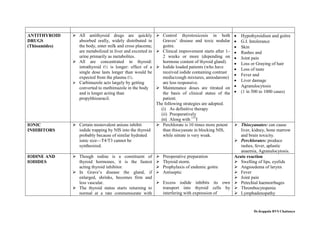
ANTITHYROID
DRUGS
(Thioamides)
 All antithyroid drugs are quickly
absorbed orally, widely distributed in
the body, enter milk and cross placenta;
are metabolized in liver and excreted in
urine primarily as metabolites.
 All are concentrated in thyroid:
intrathyroid t½ is longer: effect of a
single dose lasts longer than would be
expected from the plasma t½.
 Carbimazole acts largely by getting
converted to methimazole in the body
and is longer acting than
propylthiouracil.
 Control thyrotoxicosis in both
Graves’ disease and toxic nodular
goitre.
 Clinical improvement starts after 1–
2 weeks or more (depending on
hormone content of thyroid gland).
 Iodide loaded patients (who have
received iodide containing contrast
media/cough mixtures, amiodarone)
are less responsive.
 Maintenance doses are titrated on
the basis of clinical status of the
patient.
The following strategies are adopted.
(i) As definitive therapy
(ii) Preoperatively
(iii) Along with 131
I
 Hypothyroidism and goitre
 G.I. Intolerance
 Skin
 Rashes and
 Joint pain
 Loss or Graying of hair
 Loss of taste
 Fever and
 Liver damage
 Agranulocytosis
 (1 in 500 to 1000 cases)
IONIC
INHIBITORS
 Certain monovalent anions inhibit
iodide trapping by NIS into the thyroid
probably because of similar hydrated
ionic size—T4/T3 cannot be
synthesized.
 Perchlorate is 10 times more potent
than thiocyanate in blocking NIS,
while nitrate is very weak.
 Thiocyanates: can cause
liver, kidney, bone marrow
and brain toxicity.
 Perchlorates: produce
rashes, fever, aplastic
anaemia, Agranulocytosis.
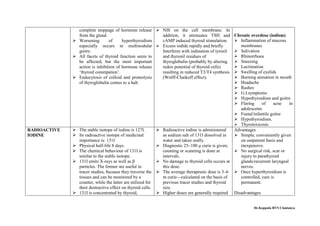
IODINE AND
IODIDES
 Though iodine is a constituent of
thyroid hormones, it is the fastest
acting thyroid inhibitor.
 In Grave’s disease the gland, if
enlarged, shrinks, becomes firm and
less vascular.
 The thyroid status starts returning to
normal at a rate commensurate with
 Preoperative preparation
 Thyroid storm.
 Prophylaxis of endemic goitre
 Antiseptic
 Excess iodide inhibits its own
transport into thyroid cells by
interfering with expression of
Acute reaction
 Swelling of lips, eyelids
 Angioedema of larynx
 Fever
 Joint pain
 Petechial haemorrhages
 Thrombocytopenia
 Lymphadenopathy
Dr.Koppala RVS Chaitanya
complete stoppage of hormone release
from the gland.
 Worsening of hyperthyroidism
especially occurs in multinodular
goitre.
 All facets of thyroid function seem to
be affected, but the most important
action is inhibition of hormone release
‘thyroid constipation’.
 Endocytosis of colloid and proteolysis
of thyroglobulin comes to a halt.
 NIS on the cell membrane. In
addition, it attenuates TSH and
cAMP induced thyroid stimulation.
 Excess iodide rapidly and briefly
Interferes with iodination of tyrosil
and thyronil residues of
thyroglobulin (probably by altering
redox potential of thyroid cells)
resulting in reduced T3/T4 synthesis
(Wolff-Chaikoff effect).
Chronic overdose (iodism)
 Inflammation of mucous
membranes
 Salivation
 Rhinorrhoea
 Sneezing
 Lacrimation
 Swelling of eyelids
 Burning sensation in mouth
 Headache
 Rashes
 G.I.symptoms
 Hypothyroidism and goitre
 Flaring of acne in
adolescents
 Foetal/infantile goitre
 Hypothyroidism.
 Thyrotoxicosis
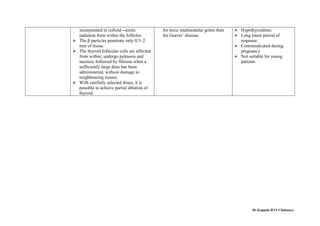
RADIOACTIVE
IODINE
 The stable isotope of iodine is 127I.
 Its radioactive isotope of medicinal
importance is: 131I
 Physical half-life 8 days.
 The chemical behaviour of 131I is
similar to the stable isotope.
 131I emits X-rays as well as β
particles. The former are useful in
tracer studies, because they traverse the
tissues and can be monitored by a
counter, while the latter are utilized for
their destructive effect on thyroid cells.
 131I is concentrated by thyroid,
 Radioactive iodine is administered
as sodium salt of 131I dissolved in
water and taken orally.
 Diagnostic 25–100 μ curie is given;
counting or scanning is done at
intervals.
 No damage to thyroid cells occurs at
this dose.
 The average therapeutic dose is 3–6
m curie—calculated on the basis of
previous tracer studies and thyroid
size.
 Higher doses are generally required
Advantages
 Simple, conveniently given
on outpatient basis and
inexpensive.
 No surgical risk, scar or
injury to parathyroid
glands/recurrent laryngeal
nerves.
 Once hyperthyroidism is
controlled, cure is
permanent.
Disadvantages
Dr.Koppala RVS Chaitanya
incorporated in colloid—emits
radiation from within the follicles.
 The β particles penetrate only 0.5–2
mm of tissue.
 The thyroid follicular cells are affected
from within; undergo pyknosis and
necrosis followed by fibrosis when a
sufficiently large dose has been
administered, without damage to
neighbouring tissues.
 With carefully selected doses, it is
possible to achieve partial ablation of
thyroid.
for toxic multinodular goitre than
for Graves’ disease.
 Hypothyroidism:
 Long latent period of
response.
 Contraindicated during
pregnancy
 Not suitable for young
patients
Dr.Koppala RVS Chaitanya

THYROID HORMONES AND THYROID INHIBITORS.pdf

  • 1.
    THYROID HORMONES &THYROID INHIBITORS The thyroid gland secretes 3 hormones—thyroxine (T4), triiodothyronine (T3) and calcitonin. The former two are produced by thyroid follicles, have similar biological activity and the term ‘thyroid hormone’ is restricted to these only. Calcitonin produced by interfollicular ‘C’ cells is chemically and biologically entirely different. It is considered along with parathormone, with which it regulates calcium metabolism. CHEMISTRY AND SYNTHESIS  Both T4 and T3 are iodine containing derivatives of thyronine which is a condensation product of two molecules of the amino acid tyrosine.  Thyroxine; is 3, 5, 3´, 5´–tetraiodothyronine while T3 is 3, 5, 3´ triiodothyronine.  The thyroid hormones are synthesized and stored in the thyroid follicles as part of thyroglobulin molecule—which is a glycoprotein synthesized by thyroid cells, MW 660 KDa, contains 10% sugar.  The synthesis, storage and release of T4 and T3 is summarized in Fig. 18.1 and involves the following processes. 1. Iodide uptake 2. Oxidation and iodination 3. Coupling 4. Storage and release 5. Peripheral conversion of T4 to T3 TRANSPORT, METABOLISM AND EXCRETION  Thyroid hormones are avidly bound to plasma proteins—only 0.03–0.08% of T4 and 0.2– 0.5% of T3 are in the free form.  Almost all protein bound iodine (PBI) in plasma is thyroid hormone, of which 90–95% is T4 and the rest T3. Binding occurs to 3 plasma proteins in the following decreasing order of affinity for T4: 1. Thyroxine binding globulin (TBG) 2. Thyroxine binding prealbumin (transthyretin) 3. Albumin the normal concentration of PBI is 4–10 μg/ dl; only 0.1–0.2 μg/dl of this is T3, rest is T4.  During pregnancy thyroxine binding globulin is increased—PBI levels are elevated, but there is no effect on thyroid status because the concentration of free hormone remains unaltered.  Only the free hormone is available for action as well as for metabolism and excretion. Metabolic inactivation of T4 and T3 occurs by deiodination and glucuronide/sulfate conjugation of the hormones as well as that of their deiodinated products.  Liver is the primary site (also salivary glands and kidneys).  The conjugates are excreted in bile, of which a significant fraction is deconjugated in intestines and reabsorbed (enterohepatic circulation) to be finally excreted in urine. Dr.Koppala RVS Chaitanya
  • 2.
     Plasma t½of T4 is 6–7 days, while that of T3 is 1–2 days.  The half-lives are shortened in hyperthyroidism and prolonged in hypothyroidism due respectively to faster and slower metabolism. REGULATION OF SECRETION  The secretion of hormones from the thyroid is controlled by anterior pituitary by the elaboration of Thyrotropin, while TSH secretion itself is regulated by TRH produced in hypothalamus.  Somatostatin elaborated by hypothalamus inhibits not only GH and prolactin, but also TSH secretion from pituitary.  The negative feedback by the thyroid hormones is exercised directly on the pituitary as well as through hypothalamus.  The action of TRH on pituitary and that of TSH on thyroid cells is mediated by enhanced Camp synthesis.  High concentration of TSH also acts via IP3/DAG–increased intracellular Ca2+ pathway in the thyroid cells. PHARMACOLOGICAL ACTIONS 1. Growth and development  T4 and T3 are essential for normal growth and development.  The greatest sufferer, however, is the nervous system.  Retardation and nervous deficit is a consequence of paucity of axonal and dendritic ramification, synapse formation and impaired myelination.  In adult hypothyroidism also, intelligence is impaired and movements are slow. 2. Intermediary metabolism Lipid  T4 and T3 indirectly enhance lipolysis by potentiating the action of catecholamine’s and other lipolytic hormones.  As a result plasma free fatty acid levels are elevated. Lipogenesis is also stimulated.  Hyperthyroidism is characterized by hypocholesterolemia. LDL levels in blood are reduced. Carbohydrate Pharmacokinetics and interactions  Oral bioavailability of l-thyroxine is ~ 75%, but severe hypothyroidism can reduce oral absorption.  It should be administered in empty stomach to avoid interference by food. Sucralfate, iron, calcium and proton pump inhibitors also reduce l-thyroxine absorption.  CYP3A4 inducers like rifampin, phenytoin and carbamazepine accelerate metabolism of T4; dose of l-thyroxine may need enhancement. Uses 1. Cretinism 2. Adult hypothyroidism (Myxoedema) 3. Myxoedema coma 4. Nontoxic goitre 5. Thyroid nodule 6. Papillary carcinoma of thyroid 7. Empirical uses Refractory anaemia. Mental depression Menstrual disorders, Infertility not corrected by usual treatment. Chronic/non-healing ulcers. Obstinate constipation. Dr.Koppala RVS Chaitanya
  • 3.
     Carbohydrate metabolismis also stimulated.  Though utilization of sugar by tissues is increased (mainly secondary to increased BMR),  Glycogenolysis and gluconeogenesis in liver as well as faster absorption of glucose from intestines Protein  Synthesis of certain proteins is increased, but the overall effect of T3 is catabolic.  Prolonged action results in negative nitrogen balance and tissue wasting.  Weight loss is a feature of hyperthyroidism. 3. Calorigenesis  T3 and T4 increase BMR by stimulation of cellular metabolism and resetting of the energy stat.  This is important for maintaining body temperature. However, metabolic rate in brain, gonads, uterus, spleen and lymph nodes is not significantly affected.  The mechanism of Calorigenesis was believed to be uncoupling of oxidative phosphorylation: excess energy being released as heat. 4. CVS  T3 and T4 cause a hyper dynamic state of circulation which is partly secondary to increased peripheral demand and partly due to direct cardiac actions.  Heart rate, contractility and output are increased resulting in a fast, bounding pulse. 10. Reproduction  Thyroid has an indirect effect on reproduction. Fertility is impaired in hypothyroidism and women suffer from oligomenorrhoea. 5. Nervous system  Mental retardation is the hallmark of cretinism  Sluggishness and other behavioral features are seen in myxoedema.  Hyperthyroid individuals are anxious, nervous, excitable, exhibit tremors and hyperreflexia. 6. Skeletal muscle  Muscles are flabby and weak in myxoedema  While thyrotoxicosis produces increased muscle tone, tremor and weakness due to myopathy. 7. GIT  Propulsive activity of gut is increased by T3/T4.  Hypothyroid patients are often constipated  While diarrhoea is common in hyperthyroidism. 8. Kidney  T3 and T4 do not cause diuresis in euthyroid individuals, but the rate of urine flow is often increased when myxoedematous patients are treated with it. 9. Haemopoiesis  Hypothyroid patients suffer from some degree of anaemia which is restored only by T4 treatment. Dr.Koppala RVS Chaitanya
  • 4.
    Inhibit hormone synthesis (Antithyroid drugs) Inhibitiodide trapping (Ionic inhibitors) Inhibit hormone release Destroy thyroid tissue Propylthiouracil Methimazole Carbimazole Thiocyanates (–SCN) Perchlorates (–ClO4) Nitrates (–NO3) Iodine Iodides of Na and K Organic iodide Radioactive iodine (131 I, 125 I, 123 I) THYROID INHIBITORS Dr.Koppala RVS Chaitanya
  • 5.
    ANTITHYROID DRUGS (Thioamides)  All antithyroiddrugs are quickly absorbed orally, widely distributed in the body, enter milk and cross placenta; are metabolized in liver and excreted in urine primarily as metabolites.  All are concentrated in thyroid: intrathyroid t½ is longer: effect of a single dose lasts longer than would be expected from the plasma t½.  Carbimazole acts largely by getting converted to methimazole in the body and is longer acting than propylthiouracil.  Control thyrotoxicosis in both Graves’ disease and toxic nodular goitre.  Clinical improvement starts after 1– 2 weeks or more (depending on hormone content of thyroid gland).  Iodide loaded patients (who have received iodide containing contrast media/cough mixtures, amiodarone) are less responsive.  Maintenance doses are titrated on the basis of clinical status of the patient. The following strategies are adopted. (i) As definitive therapy (ii) Preoperatively (iii) Along with 131 I  Hypothyroidism and goitre  G.I. Intolerance  Skin  Rashes and  Joint pain  Loss or Graying of hair  Loss of taste  Fever and  Liver damage  Agranulocytosis  (1 in 500 to 1000 cases) IONIC INHIBITORS  Certain monovalent anions inhibit iodide trapping by NIS into the thyroid probably because of similar hydrated ionic size—T4/T3 cannot be synthesized.  Perchlorate is 10 times more potent than thiocyanate in blocking NIS, while nitrate is very weak.  Thiocyanates: can cause liver, kidney, bone marrow and brain toxicity.  Perchlorates: produce rashes, fever, aplastic anaemia, Agranulocytosis. IODINE AND IODIDES  Though iodine is a constituent of thyroid hormones, it is the fastest acting thyroid inhibitor.  In Grave’s disease the gland, if enlarged, shrinks, becomes firm and less vascular.  The thyroid status starts returning to normal at a rate commensurate with  Preoperative preparation  Thyroid storm.  Prophylaxis of endemic goitre  Antiseptic  Excess iodide inhibits its own transport into thyroid cells by interfering with expression of Acute reaction  Swelling of lips, eyelids  Angioedema of larynx  Fever  Joint pain  Petechial haemorrhages  Thrombocytopenia  Lymphadenopathy Dr.Koppala RVS Chaitanya
  • 6.
    complete stoppage ofhormone release from the gland.  Worsening of hyperthyroidism especially occurs in multinodular goitre.  All facets of thyroid function seem to be affected, but the most important action is inhibition of hormone release ‘thyroid constipation’.  Endocytosis of colloid and proteolysis of thyroglobulin comes to a halt.  NIS on the cell membrane. In addition, it attenuates TSH and cAMP induced thyroid stimulation.  Excess iodide rapidly and briefly Interferes with iodination of tyrosil and thyronil residues of thyroglobulin (probably by altering redox potential of thyroid cells) resulting in reduced T3/T4 synthesis (Wolff-Chaikoff effect). Chronic overdose (iodism)  Inflammation of mucous membranes  Salivation  Rhinorrhoea  Sneezing  Lacrimation  Swelling of eyelids  Burning sensation in mouth  Headache  Rashes  G.I.symptoms  Hypothyroidism and goitre  Flaring of acne in adolescents  Foetal/infantile goitre  Hypothyroidism.  Thyrotoxicosis RADIOACTIVE IODINE  The stable isotope of iodine is 127I.  Its radioactive isotope of medicinal importance is: 131I  Physical half-life 8 days.  The chemical behaviour of 131I is similar to the stable isotope.  131I emits X-rays as well as β particles. The former are useful in tracer studies, because they traverse the tissues and can be monitored by a counter, while the latter are utilized for their destructive effect on thyroid cells.  131I is concentrated by thyroid,  Radioactive iodine is administered as sodium salt of 131I dissolved in water and taken orally.  Diagnostic 25–100 μ curie is given; counting or scanning is done at intervals.  No damage to thyroid cells occurs at this dose.  The average therapeutic dose is 3–6 m curie—calculated on the basis of previous tracer studies and thyroid size.  Higher doses are generally required Advantages  Simple, conveniently given on outpatient basis and inexpensive.  No surgical risk, scar or injury to parathyroid glands/recurrent laryngeal nerves.  Once hyperthyroidism is controlled, cure is permanent. Disadvantages Dr.Koppala RVS Chaitanya
  • 7.
    incorporated in colloid—emits radiationfrom within the follicles.  The β particles penetrate only 0.5–2 mm of tissue.  The thyroid follicular cells are affected from within; undergo pyknosis and necrosis followed by fibrosis when a sufficiently large dose has been administered, without damage to neighbouring tissues.  With carefully selected doses, it is possible to achieve partial ablation of thyroid. for toxic multinodular goitre than for Graves’ disease.  Hypothyroidism:  Long latent period of response.  Contraindicated during pregnancy  Not suitable for young patients Dr.Koppala RVS Chaitanya