Lesson 6
Support vector machine (SVM)
Support vector machine
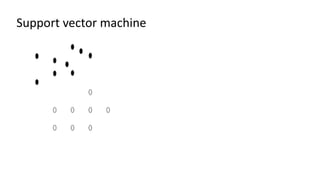
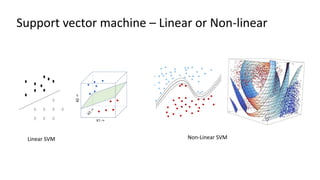
Support vector machine – Linear or Non-linear
Linear SVM Non-Linear SVM
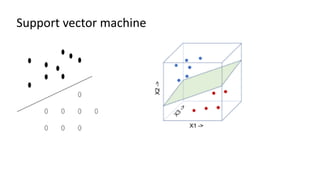
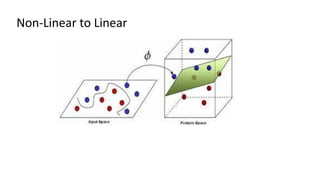
Non-Linear to Linear
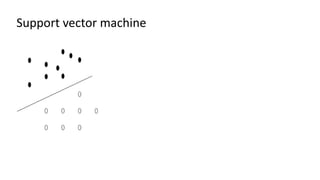
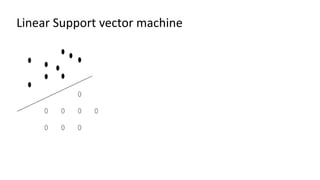
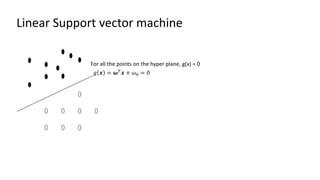
Linear Support vector machine
𝑔 𝒙 = 𝝎𝑇
𝒙 + 𝜔0 = 0
For all the points on the hyper plane, g(x) = 0
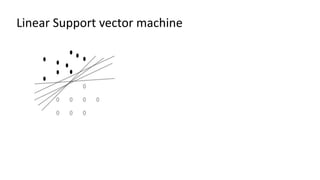
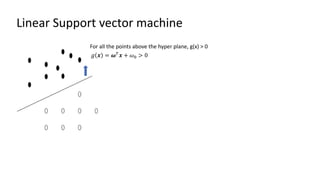
Linear Support vector machine
𝑔 𝒙 = 𝝎𝑇
𝒙 + 𝜔0 > 0
For all the points above the hyper plane, g(x) > 0
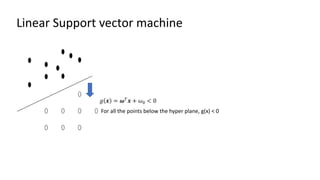
Linear Support vector machine
𝑔 𝒙 = 𝝎𝑇
𝒙 + 𝜔0 < 0
For all the points below the hyper plane, g(x) < 0
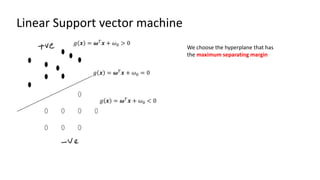
Linear Support vector machine
𝑔 𝒙 = 𝝎𝑇
𝒙 + 𝜔0 = 0
𝑔 𝒙 = 𝝎𝑇
𝒙 + 𝜔0 < 0
𝑔 𝒙 = 𝝎𝑇
𝒙 + 𝜔0 > 0
We choose the hyperplane that has
the maximum separating margin
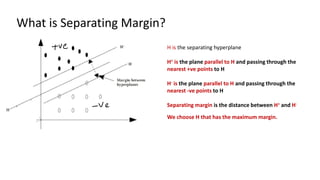
What is Separating Margin?
H is the separating hyperplane
H+ is the plane parallel to H and passing through the
nearest +ve points to H
H- is the plane parallel to H and passing through the
nearest -ve points to H
Separating margin is the distance between H+ and H-
We choose H that has the maximum margin.
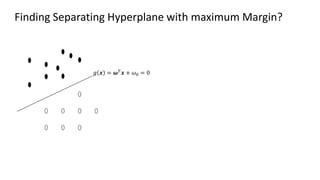
Finding Separating Hyperplane with maximum Margin?
𝑔 𝒙 = 𝝎𝑇
𝒙 + 𝜔0 = 0
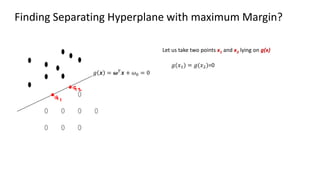
Finding Separating Hyperplane with maximum Margin?
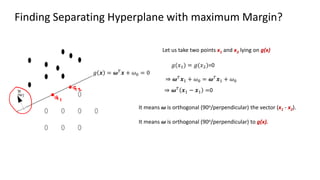
Let us take two points x1 and x2 lying on g(x)
𝑔 𝒙 = 𝝎𝑇
𝒙 + 𝜔0 = 0
𝑔(𝑥1) = 𝑔(𝑥2)=0
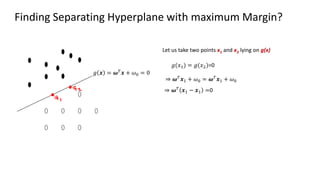
Finding Separating Hyperplane with maximum Margin?
Let us take two points x1 and x2 lying on g(x)
𝑔 𝒙 = 𝝎𝑇
𝒙 + 𝜔0 = 0
𝑔(𝑥1) = 𝑔(𝑥2)=0
⇒ 𝝎𝑇
𝒙1 + 𝜔0 = 𝝎𝑇
𝒙1 + 𝜔0
⇒ 𝝎𝑇 𝒙1 − 𝒙1 =0
Finding Separating Hyperplane with maximum Margin?
Let us take two points x1 and x2 lying on g(x)
𝑔 𝒙 = 𝝎𝑇
𝒙 + 𝜔0 = 0
𝑔(𝑥1) = 𝑔(𝑥2)=0
⇒ 𝝎𝑇
𝒙1 + 𝜔0 = 𝝎𝑇
𝒙1 + 𝜔0
⇒ 𝝎𝑇 𝒙1 − 𝒙1 =0
It means 𝝎 is orthogonal (90o/perpendicular) the vector (x1 - x2).
It means 𝝎 is orthogonal (90o/perpendicular) to g(x).
Finding Separating Hyperplane with maximum Margin?
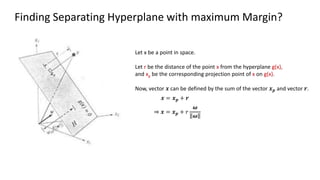
Let x be a point in space.
Let r be the distance of the point x from the hyperplane g(x),
and xp be the corresponding projection point of x on g(x).
Now, vector 𝒙 can be defined by the sum of the vector 𝒙𝒑 and vector 𝒓.
𝒙 = 𝒙𝒑 + 𝒓
⇒ 𝒙 = 𝒙𝒑 + 𝑟
𝝎
𝝎
Finding Separating Hyperplane with maximum Margin?
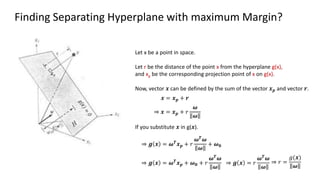
Let x be a point in space.
Let r be the distance of the point x from the hyperplane g(x),
and xp be the corresponding projection point of x on g(x).
Now, vector 𝒙 can be defined by the sum of the vector 𝒙𝒑 and vector 𝒓.
𝒙 = 𝒙𝒑 + 𝒓
⇒ 𝒙 = 𝒙𝒑 + 𝑟
𝝎
𝝎
If you substitute 𝒙 in g(𝒙).
⇒ 𝒈 𝒙 = 𝝎𝑻
𝒙𝒑 + 𝑟
𝝎𝑻𝝎
𝝎
+ 𝝎𝟎
⇒ 𝒈 𝒙 = 𝝎𝑻𝒙𝒑 + 𝝎𝟎 + 𝑟
𝝎𝑻
𝝎
𝝎
⇒ 𝒈 𝒙 = 𝑟
𝝎𝑻
𝝎
𝝎
⇒ 𝑟 =
𝑔(𝒙)
𝝎
Finding Separating Hyperplane with maximum Margin?
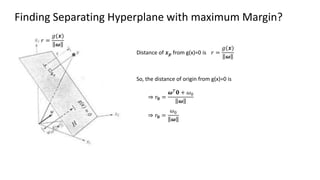
Distance of 𝒙𝒑 from g(x)=0 is
⇒ 𝑟𝟎 =
𝝎𝑇
𝟎 + 𝜔0
𝝎
𝑟 =
𝑔(𝒙)
𝝎
𝑟 =
𝑔(𝒙)
𝝎
So, the distance of origin from g(x)=0 is
⇒ 𝑟𝟎 =
𝜔0
𝝎
Finding Separating Hyperplane with maximum Margin?
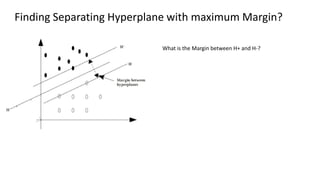
What is the Margin between H+ and H-?
Finding Separating Hyperplane with maximum Margin?
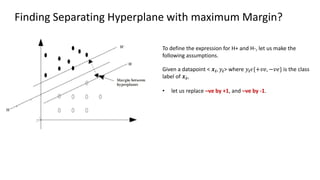
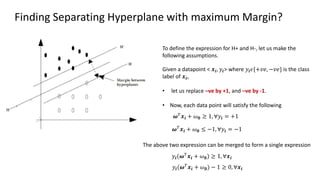
To define the expression for H+ and H-, let us make the
following assumptions.
Given a datapoint < 𝒙𝒊, 𝑦𝒊> where 𝑦𝒊𝜖{+𝑣𝑒, −𝑣𝑒} is the class
label of 𝒙𝒊,
• let us replace –ve by +1, and –ve by -1.
Finding Separating Hyperplane with maximum Margin?
𝝎𝑇
𝒙𝒊 + 𝜔𝟎 ≥ 1, ∀𝑦𝒊 = +1
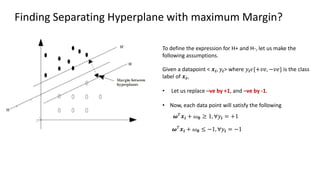
To define the expression for H+ and H-, let us make the
following assumptions.
Given a datapoint < 𝒙𝒊, 𝑦𝒊> where 𝑦𝒊𝜖{+𝑣𝑒, −𝑣𝑒} is the class
label of 𝒙𝒊,
• Let us replace –ve by +1, and –ve by -1.
• Now, each data point will satisfy the following
𝝎𝑇
𝒙𝒊 + 𝜔𝟎 ≤ −1, ∀𝑦𝒊 = −1
Finding Separating Hyperplane with maximum Margin?
𝝎𝑇
𝒙𝒊 + 𝜔𝟎 ≥ 1, ∀𝑦𝒊 = +1
To define the expression for H+ and H-, let us make the
following assumptions.
Given a datapoint < 𝒙𝒊, 𝑦𝒊> where 𝑦𝒊𝜖{+𝑣𝑒, −𝑣𝑒} is the class
label of 𝒙𝒊,
• let us replace –ve by +1, and –ve by -1.
• Now, each data point will satisfy the following
𝝎𝑇
𝒙𝒊 + 𝜔𝟎 ≤ −1, ∀𝑦𝒊 = −1
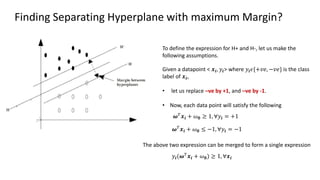
The above two expression can be merged to form a single expression
𝑦𝒊(𝝎𝑇
𝒙𝒊 + 𝜔𝟎) ≥ 1, ∀𝒙𝒊
Finding Separating Hyperplane with maximum Margin?
𝝎𝑇
𝒙𝒊 + 𝜔𝟎 ≥ 1, ∀𝑦𝒊 = +1
To define the expression for H+ and H-, let us make the
following assumptions.
Given a datapoint < 𝒙𝒊, 𝑦𝒊> where 𝑦𝒊𝜖{+𝑣𝑒, −𝑣𝑒} is the class
label of 𝒙𝒊,
• let us replace –ve by +1, and –ve by -1.
• Now, each data point will satisfy the following
𝝎𝑇
𝒙𝒊 + 𝜔𝟎 ≤ −1, ∀𝑦𝒊 = −1
The above two expression can be merged to form a single expression
𝑦𝒊(𝝎𝑇
𝒙𝒊 + 𝜔𝟎) ≥ 1, ∀𝒙𝒊
𝑦𝒊(𝝎𝑇
𝒙𝒊 + 𝜔𝟎) − 1 ≥ 0, ∀𝒙𝒊
Finding Separating Hyperplane with maximum Margin?
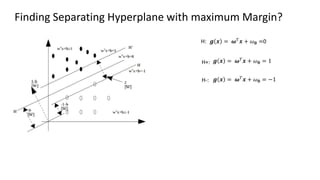
𝒈 𝒙 = 𝝎𝑇𝒙 + 𝜔𝟎 = 1
𝒈 𝒙 = 𝝎𝑇
𝒙 + 𝜔𝟎 = −1
𝒈 𝒙 = 𝝎𝑇𝒙 + 𝜔𝟎 =0
H+:
H-:
H:
Finding Separating Hyperplane with maximum Margin?
𝒈 𝒙 = 𝝎𝑇𝒙 + 𝜔𝟎 = 1
𝒈 𝒙 = 𝝎𝑇
𝒙 + 𝜔𝟎 = −1
𝒈 𝒙 = 𝝎𝑇𝒙 + 𝜔𝟎 =0
H+:
H-:
H:
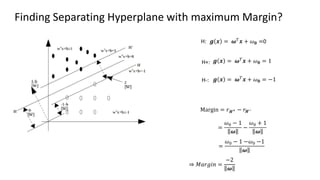
Margin = 𝑟𝑯+ − 𝑟𝑯−
=
𝜔0 − 1
𝝎
−
𝜔0 + 1
𝝎
=
𝜔0 − 1 −𝜔0 −1
𝝎
⇒ 𝑀𝑎𝑟𝑔𝑖𝑛 =
−2
𝝎
Finding Separating Hyperplane with maximum Margin?
𝒈 𝒙 = 𝝎𝑇𝒙 + 𝜔𝟎 = 1
𝒈 𝒙 = 𝝎𝑇
𝒙 + 𝜔𝟎 = −1
𝒈 𝒙 = 𝝎𝑇𝒙 + 𝜔𝟎 =0
H+:
H-:
H:
Margin = 𝑟𝑯+ − 𝑟𝑯−
=
𝜔0 − 1
𝝎
−
𝜔0 + 1
𝝎
=
𝜔0 − 1 −𝜔0 −1
𝝎
⇒ 𝑀𝑎𝑟𝑔𝑖𝑛 =
−2
𝝎
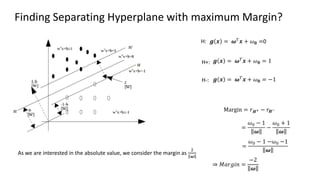
As we are interested in the absolute value, we consider the margin as
2
𝝎
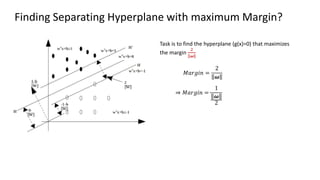
Finding Separating Hyperplane with maximum Margin?
𝑀𝑎𝑟𝑔𝑖𝑛 =
2
𝝎
⇒ 𝑀𝑎𝑟𝑔𝑖𝑛 =
1
𝝎
2
Task is to find the hyperplane (g(x)=0) that maximizes
the margin
2
𝝎
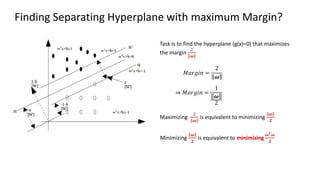
Finding Separating Hyperplane with maximum Margin?
𝑀𝑎𝑟𝑔𝑖𝑛 =
2
𝝎
⇒ 𝑀𝑎𝑟𝑔𝑖𝑛 =
1
𝝎
2
Task is to find the hyperplane (g(x)=0) that maximizes
the margin
2
𝝎
Maximizing
2
𝝎
is equivalent to minimizing
𝝎
𝟐
Minimizing
𝝎
𝟐
is equivalent to minimizing
𝝎𝑻𝝎
𝟐
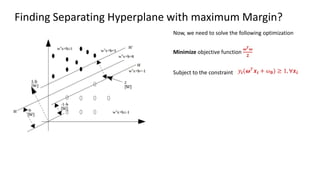
Finding Separating Hyperplane with maximum Margin?
Minimize objective function
𝝎𝑻𝝎
𝟐
Subject to the constraint 𝑦𝒊(𝝎𝑇𝒙𝒊 + 𝜔𝟎) ≥ 1, ∀𝒙𝒊
Now, we need to solve the following optimization
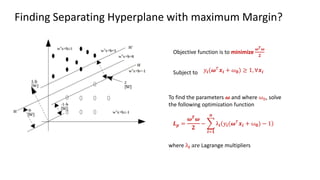
Finding Separating Hyperplane with maximum Margin?
Objective function is to minimize
𝝎𝑻𝝎
𝟐
Subject to 𝑦𝒊(𝝎𝑇
𝒙𝒊 + 𝜔𝟎) ≥ 1, ∀𝒙𝒊
𝑳𝒑 =
𝝎𝑻
𝝎
𝟐
− ෍
𝒊=𝟏
𝒏
λ𝒊 𝑦𝒊(𝝎𝑇
𝒙𝒊 + 𝜔𝟎) − 1
where λ𝒊 are Lagrange multipliers
To find the parameters 𝝎 and where 𝜔0, solve
the following optimization function
What are the support vectors?
𝑳𝒑 =
𝝎𝑻
𝝎
𝟐
− ෍
𝒊=𝟏
𝒏
λ𝒊 𝑦𝒊(𝝎𝑇𝒙𝒊 + 𝜔𝟎) − 1
[
In order to find the parameters, we need to solve this objective function.
]
Summary
• What is separating hyperplane?
• How to define separating hyperplane?
• What are Support Vector Machine?
• How to classify a new example using SVM

Machine learning Support vector Machine case study which implies

  • 2.
  • 3.
  • 4.
  • 5.
  • 6.
  • 7.
    Support vector machine– Linear or Non-linear Linear SVM Non-Linear SVM
  • 8.
  • 9.
  • 10.
  • 11.
    Linear Support vectormachine 𝑔 𝒙 = 𝝎𝑇 𝒙 + 𝜔0 = 0 For all the points on the hyper plane, g(x) = 0
  • 12.
    Linear Support vectormachine 𝑔 𝒙 = 𝝎𝑇 𝒙 + 𝜔0 > 0 For all the points above the hyper plane, g(x) > 0
  • 13.
    Linear Support vectormachine 𝑔 𝒙 = 𝝎𝑇 𝒙 + 𝜔0 < 0 For all the points below the hyper plane, g(x) < 0
  • 14.
    Linear Support vectormachine 𝑔 𝒙 = 𝝎𝑇 𝒙 + 𝜔0 = 0 𝑔 𝒙 = 𝝎𝑇 𝒙 + 𝜔0 < 0 𝑔 𝒙 = 𝝎𝑇 𝒙 + 𝜔0 > 0 We choose the hyperplane that has the maximum separating margin
  • 15.
    What is SeparatingMargin? H is the separating hyperplane H+ is the plane parallel to H and passing through the nearest +ve points to H H- is the plane parallel to H and passing through the nearest -ve points to H Separating margin is the distance between H+ and H- We choose H that has the maximum margin.
  • 16.
    Finding Separating Hyperplanewith maximum Margin? 𝑔 𝒙 = 𝝎𝑇 𝒙 + 𝜔0 = 0
  • 17.
    Finding Separating Hyperplanewith maximum Margin? Let us take two points x1 and x2 lying on g(x) 𝑔 𝒙 = 𝝎𝑇 𝒙 + 𝜔0 = 0 𝑔(𝑥1) = 𝑔(𝑥2)=0
  • 18.
    Finding Separating Hyperplanewith maximum Margin? Let us take two points x1 and x2 lying on g(x) 𝑔 𝒙 = 𝝎𝑇 𝒙 + 𝜔0 = 0 𝑔(𝑥1) = 𝑔(𝑥2)=0 ⇒ 𝝎𝑇 𝒙1 + 𝜔0 = 𝝎𝑇 𝒙1 + 𝜔0 ⇒ 𝝎𝑇 𝒙1 − 𝒙1 =0
  • 19.
    Finding Separating Hyperplanewith maximum Margin? Let us take two points x1 and x2 lying on g(x) 𝑔 𝒙 = 𝝎𝑇 𝒙 + 𝜔0 = 0 𝑔(𝑥1) = 𝑔(𝑥2)=0 ⇒ 𝝎𝑇 𝒙1 + 𝜔0 = 𝝎𝑇 𝒙1 + 𝜔0 ⇒ 𝝎𝑇 𝒙1 − 𝒙1 =0 It means 𝝎 is orthogonal (90o/perpendicular) the vector (x1 - x2). It means 𝝎 is orthogonal (90o/perpendicular) to g(x).
  • 20.
    Finding Separating Hyperplanewith maximum Margin? Let x be a point in space. Let r be the distance of the point x from the hyperplane g(x), and xp be the corresponding projection point of x on g(x). Now, vector 𝒙 can be defined by the sum of the vector 𝒙𝒑 and vector 𝒓. 𝒙 = 𝒙𝒑 + 𝒓 ⇒ 𝒙 = 𝒙𝒑 + 𝑟 𝝎 𝝎
  • 21.
    Finding Separating Hyperplanewith maximum Margin? Let x be a point in space. Let r be the distance of the point x from the hyperplane g(x), and xp be the corresponding projection point of x on g(x). Now, vector 𝒙 can be defined by the sum of the vector 𝒙𝒑 and vector 𝒓. 𝒙 = 𝒙𝒑 + 𝒓 ⇒ 𝒙 = 𝒙𝒑 + 𝑟 𝝎 𝝎 If you substitute 𝒙 in g(𝒙). ⇒ 𝒈 𝒙 = 𝝎𝑻 𝒙𝒑 + 𝑟 𝝎𝑻𝝎 𝝎 + 𝝎𝟎 ⇒ 𝒈 𝒙 = 𝝎𝑻𝒙𝒑 + 𝝎𝟎 + 𝑟 𝝎𝑻 𝝎 𝝎 ⇒ 𝒈 𝒙 = 𝑟 𝝎𝑻 𝝎 𝝎 ⇒ 𝑟 = 𝑔(𝒙) 𝝎
  • 22.
    Finding Separating Hyperplanewith maximum Margin? Distance of 𝒙𝒑 from g(x)=0 is ⇒ 𝑟𝟎 = 𝝎𝑇 𝟎 + 𝜔0 𝝎 𝑟 = 𝑔(𝒙) 𝝎 𝑟 = 𝑔(𝒙) 𝝎 So, the distance of origin from g(x)=0 is ⇒ 𝑟𝟎 = 𝜔0 𝝎
  • 23.
    Finding Separating Hyperplanewith maximum Margin? What is the Margin between H+ and H-?
  • 24.
    Finding Separating Hyperplanewith maximum Margin? To define the expression for H+ and H-, let us make the following assumptions. Given a datapoint < 𝒙𝒊, 𝑦𝒊> where 𝑦𝒊𝜖{+𝑣𝑒, −𝑣𝑒} is the class label of 𝒙𝒊, • let us replace –ve by +1, and –ve by -1.
  • 25.
    Finding Separating Hyperplanewith maximum Margin? 𝝎𝑇 𝒙𝒊 + 𝜔𝟎 ≥ 1, ∀𝑦𝒊 = +1 To define the expression for H+ and H-, let us make the following assumptions. Given a datapoint < 𝒙𝒊, 𝑦𝒊> where 𝑦𝒊𝜖{+𝑣𝑒, −𝑣𝑒} is the class label of 𝒙𝒊, • Let us replace –ve by +1, and –ve by -1. • Now, each data point will satisfy the following 𝝎𝑇 𝒙𝒊 + 𝜔𝟎 ≤ −1, ∀𝑦𝒊 = −1
  • 26.
    Finding Separating Hyperplanewith maximum Margin? 𝝎𝑇 𝒙𝒊 + 𝜔𝟎 ≥ 1, ∀𝑦𝒊 = +1 To define the expression for H+ and H-, let us make the following assumptions. Given a datapoint < 𝒙𝒊, 𝑦𝒊> where 𝑦𝒊𝜖{+𝑣𝑒, −𝑣𝑒} is the class label of 𝒙𝒊, • let us replace –ve by +1, and –ve by -1. • Now, each data point will satisfy the following 𝝎𝑇 𝒙𝒊 + 𝜔𝟎 ≤ −1, ∀𝑦𝒊 = −1 The above two expression can be merged to form a single expression 𝑦𝒊(𝝎𝑇 𝒙𝒊 + 𝜔𝟎) ≥ 1, ∀𝒙𝒊
  • 27.
    Finding Separating Hyperplanewith maximum Margin? 𝝎𝑇 𝒙𝒊 + 𝜔𝟎 ≥ 1, ∀𝑦𝒊 = +1 To define the expression for H+ and H-, let us make the following assumptions. Given a datapoint < 𝒙𝒊, 𝑦𝒊> where 𝑦𝒊𝜖{+𝑣𝑒, −𝑣𝑒} is the class label of 𝒙𝒊, • let us replace –ve by +1, and –ve by -1. • Now, each data point will satisfy the following 𝝎𝑇 𝒙𝒊 + 𝜔𝟎 ≤ −1, ∀𝑦𝒊 = −1 The above two expression can be merged to form a single expression 𝑦𝒊(𝝎𝑇 𝒙𝒊 + 𝜔𝟎) ≥ 1, ∀𝒙𝒊 𝑦𝒊(𝝎𝑇 𝒙𝒊 + 𝜔𝟎) − 1 ≥ 0, ∀𝒙𝒊
  • 28.
    Finding Separating Hyperplanewith maximum Margin? 𝒈 𝒙 = 𝝎𝑇𝒙 + 𝜔𝟎 = 1 𝒈 𝒙 = 𝝎𝑇 𝒙 + 𝜔𝟎 = −1 𝒈 𝒙 = 𝝎𝑇𝒙 + 𝜔𝟎 =0 H+: H-: H:
  • 29.
    Finding Separating Hyperplanewith maximum Margin? 𝒈 𝒙 = 𝝎𝑇𝒙 + 𝜔𝟎 = 1 𝒈 𝒙 = 𝝎𝑇 𝒙 + 𝜔𝟎 = −1 𝒈 𝒙 = 𝝎𝑇𝒙 + 𝜔𝟎 =0 H+: H-: H: Margin = 𝑟𝑯+ − 𝑟𝑯− = 𝜔0 − 1 𝝎 − 𝜔0 + 1 𝝎 = 𝜔0 − 1 −𝜔0 −1 𝝎 ⇒ 𝑀𝑎𝑟𝑔𝑖𝑛 = −2 𝝎
  • 30.
    Finding Separating Hyperplanewith maximum Margin? 𝒈 𝒙 = 𝝎𝑇𝒙 + 𝜔𝟎 = 1 𝒈 𝒙 = 𝝎𝑇 𝒙 + 𝜔𝟎 = −1 𝒈 𝒙 = 𝝎𝑇𝒙 + 𝜔𝟎 =0 H+: H-: H: Margin = 𝑟𝑯+ − 𝑟𝑯− = 𝜔0 − 1 𝝎 − 𝜔0 + 1 𝝎 = 𝜔0 − 1 −𝜔0 −1 𝝎 ⇒ 𝑀𝑎𝑟𝑔𝑖𝑛 = −2 𝝎 As we are interested in the absolute value, we consider the margin as 2 𝝎
  • 31.
    Finding Separating Hyperplanewith maximum Margin? 𝑀𝑎𝑟𝑔𝑖𝑛 = 2 𝝎 ⇒ 𝑀𝑎𝑟𝑔𝑖𝑛 = 1 𝝎 2 Task is to find the hyperplane (g(x)=0) that maximizes the margin 2 𝝎
  • 32.
    Finding Separating Hyperplanewith maximum Margin? 𝑀𝑎𝑟𝑔𝑖𝑛 = 2 𝝎 ⇒ 𝑀𝑎𝑟𝑔𝑖𝑛 = 1 𝝎 2 Task is to find the hyperplane (g(x)=0) that maximizes the margin 2 𝝎 Maximizing 2 𝝎 is equivalent to minimizing 𝝎 𝟐 Minimizing 𝝎 𝟐 is equivalent to minimizing 𝝎𝑻𝝎 𝟐
  • 33.
    Finding Separating Hyperplanewith maximum Margin? Minimize objective function 𝝎𝑻𝝎 𝟐 Subject to the constraint 𝑦𝒊(𝝎𝑇𝒙𝒊 + 𝜔𝟎) ≥ 1, ∀𝒙𝒊 Now, we need to solve the following optimization
  • 34.
    Finding Separating Hyperplanewith maximum Margin? Objective function is to minimize 𝝎𝑻𝝎 𝟐 Subject to 𝑦𝒊(𝝎𝑇 𝒙𝒊 + 𝜔𝟎) ≥ 1, ∀𝒙𝒊 𝑳𝒑 = 𝝎𝑻 𝝎 𝟐 − ෍ 𝒊=𝟏 𝒏 λ𝒊 𝑦𝒊(𝝎𝑇 𝒙𝒊 + 𝜔𝟎) − 1 where λ𝒊 are Lagrange multipliers To find the parameters 𝝎 and where 𝜔0, solve the following optimization function
  • 35.
    What are thesupport vectors? 𝑳𝒑 = 𝝎𝑻 𝝎 𝟐 − ෍ 𝒊=𝟏 𝒏 λ𝒊 𝑦𝒊(𝝎𝑇𝒙𝒊 + 𝜔𝟎) − 1 [ In order to find the parameters, we need to solve this objective function. ]
  • 36.
    Summary • What isseparating hyperplane? • How to define separating hyperplane? • What are Support Vector Machine? • How to classify a new example using SVM