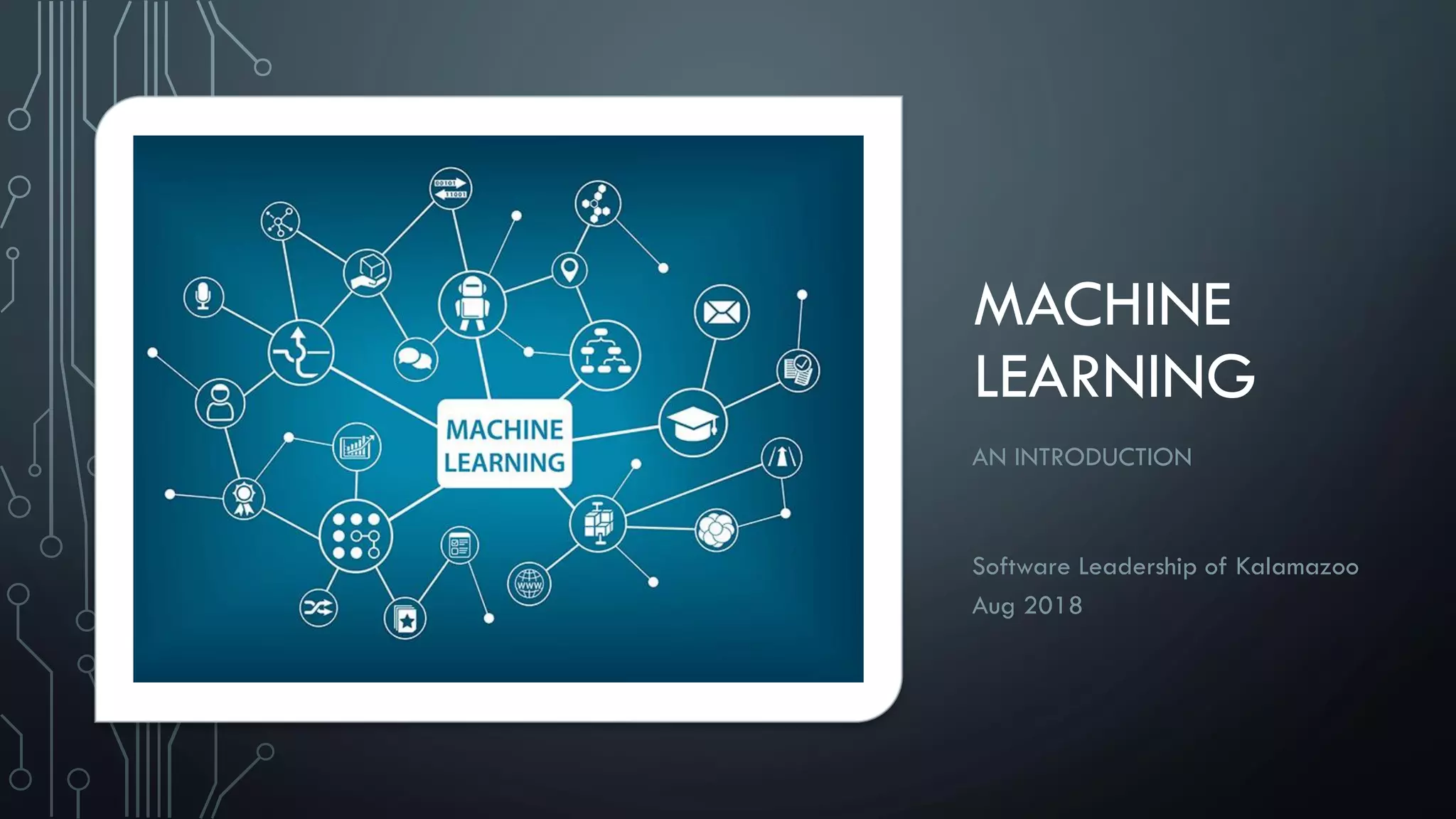
MACHINE
LEARNING
AN INTRODUCTION
Software Leadership of Kalamazoo
Aug 2018
SLOK ADMINISTRATION
• Peer to Peer Mentoring presentation moved to September (Brian White)
• Standardize Meetings on the last Tuesday of Every Month?
• SLoK Facebook Page
• Meetups name change to SLoK Talks
• Marketing
• Goal is to have 30 average attendees
• Need ~ 140 members
• We’re all marketers for this group
• Need New Presenters
FEEDBACK
• What do you think Machine Learning is?
• Terminator or Ex Machina?
• Clothes folding robot?
• Artificial Intelligence ≠ Robotics
• Robotics commonly employ AI logic, but the two are not the same
• Despite what Hollywood is trying to tell us
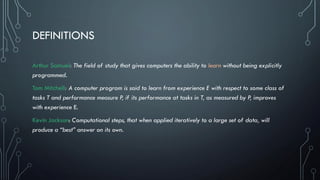
DEFINITIONS
Arthur Samuel: The field of study that gives computers the ability to learn without being explicitly
programmed.
Tom Mitchell: A computer program is said to learn from experience E with respect to some class of
tasks T and performance measure P, if its performance at tasks in T, as measured by P, improves
with experience E.
Kevin Jackson: Computational steps, that when applied iteratively to a large set of data, will
produce a “best” answer on its own.
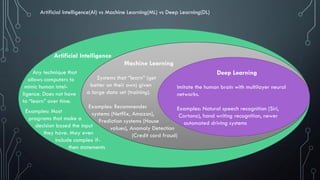
Deep Learning
Imitate the human brain with multilayer neural
networks.
Examples: Natural speech recognition (Siri,
Cortana), hand writing recognition, newer
automated driving systems
Machine Learning
Systems that “learn” (get
better on their own) given
a large data set (training).
Examples: Recommender
systems (Netflix, Amazon),
Prediction systems (House
values), Anomaly Detection
(Credit card fraud)
Artificial Intelligence
Any technique that
allows computers to
mimic human intel-
ligence. Does not have
to “learn” over time.
Examples: Most
programs that make a
decision based the input
they have. May even
include complex if-
then statements
Artificial Intelligence(AI) vs Machine Learning(ML) vs Deep Learning(DL)
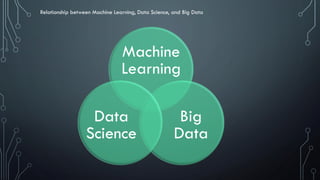
Machine
Learning
Big
Data
Data
Science
Relationship between Machine Learning, Data Science, and Big Data
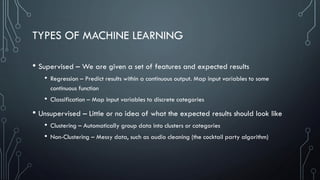
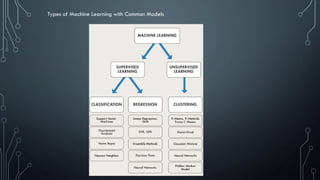
TYPES OF MACHINE LEARNING
• Supervised – We are given a set of features and expected results
• Regression – Predict results within a continuous output. Map input variables to some
continuous function
• Classification – Map input variables to discrete categories
• Unsupervised – Little or no idea of what the expected results should look like
• Clustering – Automatically group data into clusters or categories
• Non-Clustering – Messy data, such as audio cleaning (the cocktail party algorithm)
Types of Machine Learning with Common Models
IMPLEMENTING MACHINE LEARNING SOLUTIONS
• Gradient Descent, Mean Squared Errors, and the Cost Function
• Review
• For each feature x, with an expected result y, we “train” a variable Ɵ
• MatLab (example)
• The math gets involved quickly (linear algebra, calculus derivatives)
• Luckily, platforms are being created to make this much less complex
• Tensorflow, PyTorch, etc
• Azure ML Studio (example)
• Programming language libraries
• Python, R, others catching up
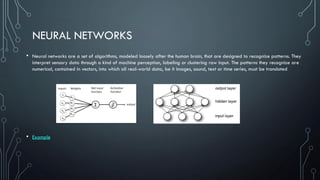
NEURAL NETWORKS
• Neural networks are a set of algorithms, modeled loosely after the human brain, that are designed to recognize patterns. They
interpret sensory data through a kind of machine perception, labeling or clustering raw input. The patterns they recognize are
numerical, contained in vectors, into which all real-world data, be it images, sound, text or time series, must be translated
• Example
FURTHER RESEARCH
• Types of Machine Learning
• Discussion of Gradient Descent and basic math used in regression analysis
• Examples of how Machine Learning is being used in industry
• Excellent Machine Learning course through Stanford on Coursera
• Microsoft Azure Machine Learning Studio (free subscription)
• Neural Network overview

Machine learning introduction

  • 1.
  • 2.
    SLOK ADMINISTRATION • Peerto Peer Mentoring presentation moved to September (Brian White) • Standardize Meetings on the last Tuesday of Every Month? • SLoK Facebook Page • Meetups name change to SLoK Talks • Marketing • Goal is to have 30 average attendees • Need ~ 140 members • We’re all marketers for this group • Need New Presenters
  • 3.
    FEEDBACK • What doyou think Machine Learning is? • Terminator or Ex Machina? • Clothes folding robot? • Artificial Intelligence ≠ Robotics • Robotics commonly employ AI logic, but the two are not the same • Despite what Hollywood is trying to tell us
  • 4.
    DEFINITIONS Arthur Samuel: Thefield of study that gives computers the ability to learn without being explicitly programmed. Tom Mitchell: A computer program is said to learn from experience E with respect to some class of tasks T and performance measure P, if its performance at tasks in T, as measured by P, improves with experience E. Kevin Jackson: Computational steps, that when applied iteratively to a large set of data, will produce a “best” answer on its own.
  • 5.
    Deep Learning Imitate thehuman brain with multilayer neural networks. Examples: Natural speech recognition (Siri, Cortana), hand writing recognition, newer automated driving systems Machine Learning Systems that “learn” (get better on their own) given a large data set (training). Examples: Recommender systems (Netflix, Amazon), Prediction systems (House values), Anomaly Detection (Credit card fraud) Artificial Intelligence Any technique that allows computers to mimic human intel- ligence. Does not have to “learn” over time. Examples: Most programs that make a decision based the input they have. May even include complex if- then statements Artificial Intelligence(AI) vs Machine Learning(ML) vs Deep Learning(DL)
  • 6.
  • 7.
    TYPES OF MACHINELEARNING • Supervised – We are given a set of features and expected results • Regression – Predict results within a continuous output. Map input variables to some continuous function • Classification – Map input variables to discrete categories • Unsupervised – Little or no idea of what the expected results should look like • Clustering – Automatically group data into clusters or categories • Non-Clustering – Messy data, such as audio cleaning (the cocktail party algorithm)
  • 8.
    Types of MachineLearning with Common Models
  • 9.
    IMPLEMENTING MACHINE LEARNINGSOLUTIONS • Gradient Descent, Mean Squared Errors, and the Cost Function • Review • For each feature x, with an expected result y, we “train” a variable Ɵ • MatLab (example) • The math gets involved quickly (linear algebra, calculus derivatives) • Luckily, platforms are being created to make this much less complex • Tensorflow, PyTorch, etc • Azure ML Studio (example) • Programming language libraries • Python, R, others catching up
  • 10.
    NEURAL NETWORKS • Neuralnetworks are a set of algorithms, modeled loosely after the human brain, that are designed to recognize patterns. They interpret sensory data through a kind of machine perception, labeling or clustering raw input. The patterns they recognize are numerical, contained in vectors, into which all real-world data, be it images, sound, text or time series, must be translated • Example
  • 11.
    FURTHER RESEARCH • Typesof Machine Learning • Discussion of Gradient Descent and basic math used in regression analysis • Examples of how Machine Learning is being used in industry • Excellent Machine Learning course through Stanford on Coursera • Microsoft Azure Machine Learning Studio (free subscription) • Neural Network overview