Machine learning developments
beyond Facebook, Google,
Microsoft and Twitter
Rudradeb Mitra
https://www.linkedin.com/in/mitrar
Briefly about myself
• AI researcher. Published 10 paper on Document
understanding, Semantic web, 5th generation
programming languages
• Masters from University of Cambridge, UK
• Entrepreneur for last 5 years. Currently 3
startups using machine learning algorithms.
• Mentor of Founders Institute, MIT Enterprise.
What I am going to talk
about?
Objective: Focus more on the application of machine
learning and show the huge opportunities that lie ahead.
• 5 startups from 3 verticals using machine learning.
• Are current approaches really intelligent?
• 2 startups that are doing things differently
• Future
5 startups in 3 verticals
across 4 countries
• Directly spoke with the founders / Senior
management of these companies
References:

http://thinkapps.com/blog/tag/machine-intelligence/
Vertical I:
Using machine learning to
identify Human emotions
Affectiva - Understanding
human emotions through face
• Recently raised $14M and was
featured in Tech Crunch.
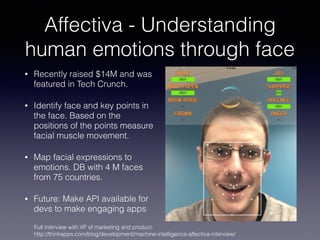
• Identify face and key points in
the face. Based on the
positions of the points measure
facial muscle movement.
• Map facial expressions to
emotions. DB with 4 M faces
from 75 countries.
• Future: Make API available for
devs to make engaging apps
Full interview with VP of marketing and product:
http://thinkapps.com/blog/development/machine-intelligence-affectiva-interview/
Beyond verbal - Understanding
human emotions through voice
• From Israel. Uses 1.61 M voice
samples from 170 countries. Have
8 granted patents.
• Have pre-labelled voice data and
then identify patterns. Magic
sauce: High quality data
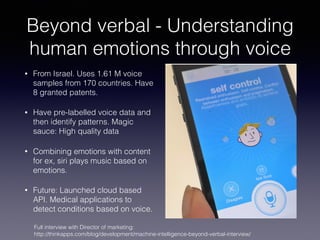
• Combining emotions with content
for ex, siri plays music based on
emotions.
• Future: Launched cloud based
API. Medical applications to
detect conditions based on voice.
Full interview with Director of marketing:
http://thinkapps.com/blog/development/machine-intelligence-beyond-verbal-interview/
Vertical II: Cars/
Vehicles
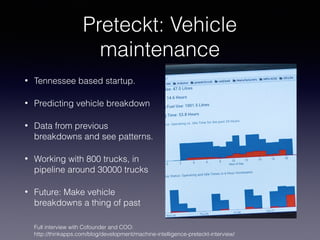
Preteckt: Vehicle
maintenance
• Tennessee based startup.
• Predicting vehicle breakdown
• Data from previous
breakdowns and see patterns.
• Working with 800 trucks, in
pipeline around 30000 trucks
• Future: Make vehicle
breakdowns a thing of past
Full interview with Cofounder and COO:

http://thinkapps.com/blog/development/machine-intelligence-preteckt-interview/
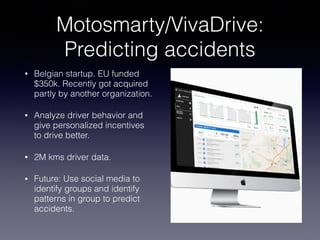
Motosmarty/VivaDrive:
Predicting accidents
• Belgian startup. EU funded
$350k. Recently got acquired
partly by another organization.
• Analyze driver behavior and
give personalized incentives
to drive better.
• 2M kms driver data.
• Future: Use social media to
identify groups and identify
patterns in group to predict
accidents.
Vertical III: Document
understanding
Beagle - Non lawyers
navigate complex contract
• One of the most innovative
Canadian startup - featured in
SXSW.
• Learns patterns in things you
are looking in a contract
• Identifies parts of contract that
are of your interest and highlight
those in a new contract
• Future: Expand to document
understandability. Medical,
engineering reports etc.
Full interview with founder and CEO :
http://thinkapps.com/blog/development/machine-intelligence-beagle-interview/
What is common in all the
previous approaches?
Are current approaches
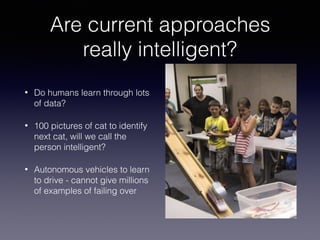
really intelligent?
• Do humans learn through lots
of data?
• 100 pictures of cat to identify
next cat, will we call the
person intelligent?
• Autonomous vehicles to learn
to drive - cannot give millions
of examples of failing over
2 startups taking
approach similar to how
humans learn
Geometric intelligence
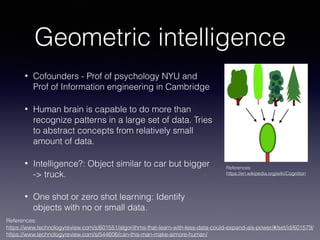
• Cofounders - Prof of psychology NYU and
Prof of Information engineering in Cambridge
• Human brain is capable to do more than
recognize patterns in a large set of data. Tries
to abstract concepts from relatively small
amount of data.
• Intelligence?: Object similar to car but bigger 

-> truck.
• One shot or zero shot learning: Identify
objects with no or small data.
References:

https://www.technologyreview.com/s/601551/algorithms-that-learn-with-less-data-could-expand-ais-power/#/set/id/601579/

https://www.technologyreview.com/s/544606/can-this-man-make-aimore-human/
References:

https://en.wikipedia.org/wiki/Cognition
Vicarious: The secretive AI startup
• SV based startup raised in total $75M from very impressive investors.
Using cognitive sciences to develop new ways of processing data
• Broke human captcha 2 years ago.
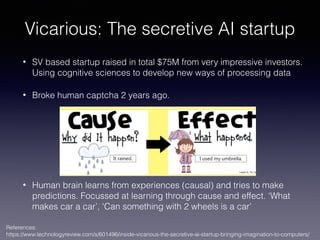
• Human brain learns from experiences (causal) and tries to make
predictions. Focussed at learning through cause and effect. ‘What
makes car a car’, ‘Can something with 2 wheels is a car’
References:

https://www.technologyreview.com/s/601496/inside-vicarious-the-secretive-ai-startup-bringing-imagination-to-computers/
Future
• In 2-3 years. Opportunities in every single vertical.
Pick any vertical and use existing machine learning
algorithms to add intelligence on top of existing tools.
• In 4-5 years. New AI algorithms based on cognitive
sciences which will have imagination and able to
learn like humans.
• In 10 years. A world with autonomous vehicles,
softwares exactly know what you feel and want,
predicts what will happen.
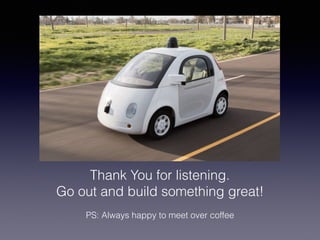
Thank You for listening.
Go out and build something great!
PS: Always happy to meet over coffee

Machine learning beyond the tech giants

  • 1.
    Machine learning developments beyondFacebook, Google, Microsoft and Twitter Rudradeb Mitra https://www.linkedin.com/in/mitrar
  • 2.
    Briefly about myself •AI researcher. Published 10 paper on Document understanding, Semantic web, 5th generation programming languages • Masters from University of Cambridge, UK • Entrepreneur for last 5 years. Currently 3 startups using machine learning algorithms. • Mentor of Founders Institute, MIT Enterprise.
  • 3.
    What I amgoing to talk about? Objective: Focus more on the application of machine learning and show the huge opportunities that lie ahead. • 5 startups from 3 verticals using machine learning. • Are current approaches really intelligent? • 2 startups that are doing things differently • Future
  • 4.
    5 startups in3 verticals across 4 countries • Directly spoke with the founders / Senior management of these companies References:
 http://thinkapps.com/blog/tag/machine-intelligence/
  • 5.
    Vertical I: Using machinelearning to identify Human emotions
  • 6.
    Affectiva - Understanding humanemotions through face • Recently raised $14M and was featured in Tech Crunch. • Identify face and key points in the face. Based on the positions of the points measure facial muscle movement. • Map facial expressions to emotions. DB with 4 M faces from 75 countries. • Future: Make API available for devs to make engaging apps Full interview with VP of marketing and product: http://thinkapps.com/blog/development/machine-intelligence-affectiva-interview/
  • 7.
    Beyond verbal -Understanding human emotions through voice • From Israel. Uses 1.61 M voice samples from 170 countries. Have 8 granted patents. • Have pre-labelled voice data and then identify patterns. Magic sauce: High quality data • Combining emotions with content for ex, siri plays music based on emotions. • Future: Launched cloud based API. Medical applications to detect conditions based on voice. Full interview with Director of marketing: http://thinkapps.com/blog/development/machine-intelligence-beyond-verbal-interview/
  • 8.
  • 9.
    Preteckt: Vehicle maintenance • Tennesseebased startup. • Predicting vehicle breakdown • Data from previous breakdowns and see patterns. • Working with 800 trucks, in pipeline around 30000 trucks • Future: Make vehicle breakdowns a thing of past Full interview with Cofounder and COO:
 http://thinkapps.com/blog/development/machine-intelligence-preteckt-interview/
  • 10.
    Motosmarty/VivaDrive: Predicting accidents • Belgianstartup. EU funded $350k. Recently got acquired partly by another organization. • Analyze driver behavior and give personalized incentives to drive better. • 2M kms driver data. • Future: Use social media to identify groups and identify patterns in group to predict accidents.
  • 11.
  • 12.
    Beagle - Nonlawyers navigate complex contract • One of the most innovative Canadian startup - featured in SXSW. • Learns patterns in things you are looking in a contract • Identifies parts of contract that are of your interest and highlight those in a new contract • Future: Expand to document understandability. Medical, engineering reports etc. Full interview with founder and CEO : http://thinkapps.com/blog/development/machine-intelligence-beagle-interview/
  • 13.
    What is commonin all the previous approaches?
  • 14.
    Are current approaches reallyintelligent? • Do humans learn through lots of data? • 100 pictures of cat to identify next cat, will we call the person intelligent? • Autonomous vehicles to learn to drive - cannot give millions of examples of failing over
  • 15.
    2 startups taking approachsimilar to how humans learn
  • 16.
    Geometric intelligence • Cofounders- Prof of psychology NYU and Prof of Information engineering in Cambridge • Human brain is capable to do more than recognize patterns in a large set of data. Tries to abstract concepts from relatively small amount of data. • Intelligence?: Object similar to car but bigger 
 -> truck. • One shot or zero shot learning: Identify objects with no or small data. References:
 https://www.technologyreview.com/s/601551/algorithms-that-learn-with-less-data-could-expand-ais-power/#/set/id/601579/
 https://www.technologyreview.com/s/544606/can-this-man-make-aimore-human/ References:
 https://en.wikipedia.org/wiki/Cognition
  • 17.
    Vicarious: The secretiveAI startup • SV based startup raised in total $75M from very impressive investors. Using cognitive sciences to develop new ways of processing data • Broke human captcha 2 years ago. • Human brain learns from experiences (causal) and tries to make predictions. Focussed at learning through cause and effect. ‘What makes car a car’, ‘Can something with 2 wheels is a car’ References:
 https://www.technologyreview.com/s/601496/inside-vicarious-the-secretive-ai-startup-bringing-imagination-to-computers/
  • 18.
    Future • In 2-3years. Opportunities in every single vertical. Pick any vertical and use existing machine learning algorithms to add intelligence on top of existing tools. • In 4-5 years. New AI algorithms based on cognitive sciences which will have imagination and able to learn like humans. • In 10 years. A world with autonomous vehicles, softwares exactly know what you feel and want, predicts what will happen.
  • 19.
    Thank You forlistening. Go out and build something great! PS: Always happy to meet over coffee