Department of Computer Science 
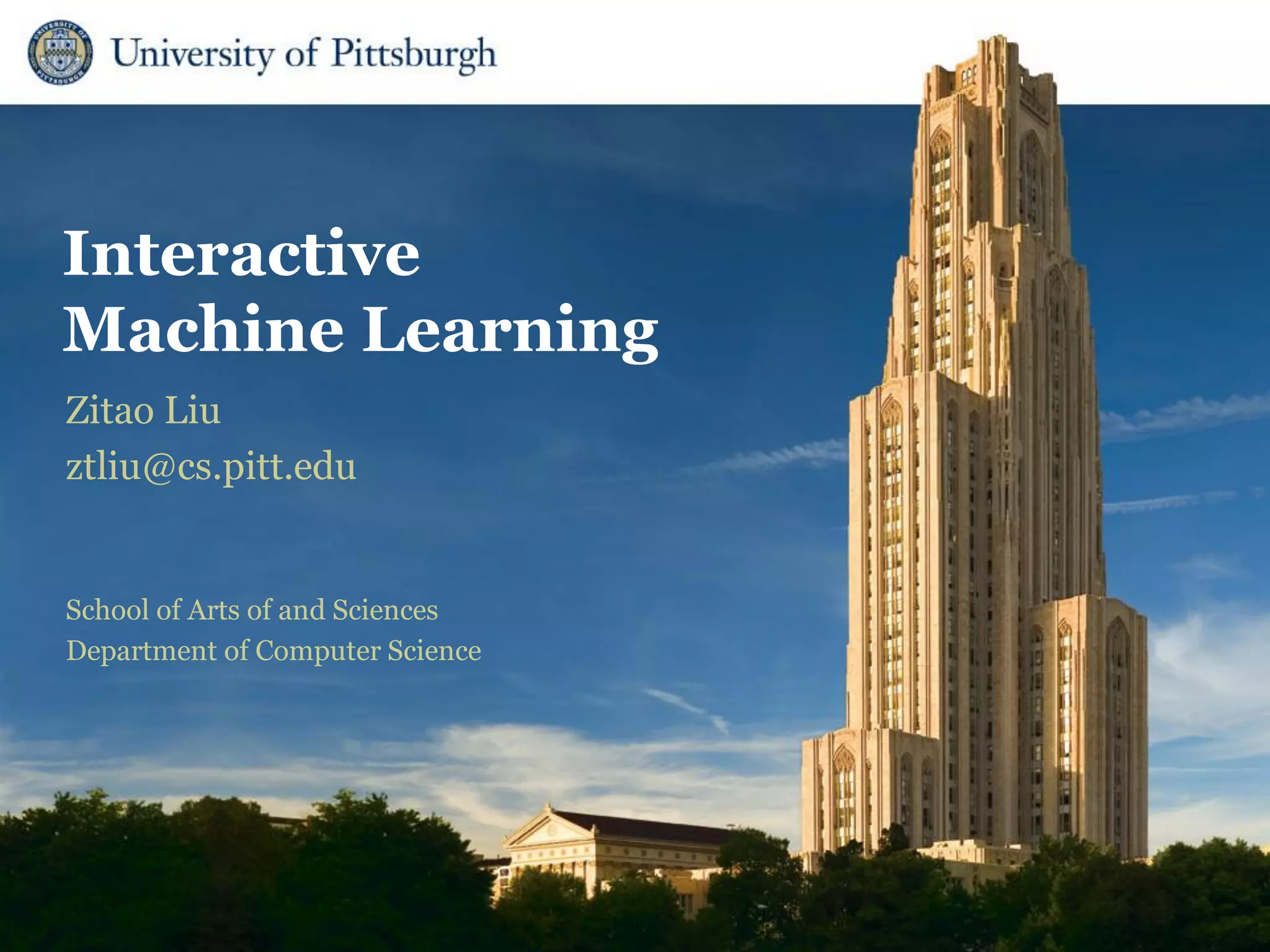
Interactive Machine Learning 
Zitao Liu 
ztliu@cs.pitt.edu 
School of Arts of and Sciences 
Department of Computer Science
Department of Computer Science 
Outline 
β€’What is Interactive Machine Learning(IML): 
–Motivation & Goal 
–Classical Machine Learning V.S Interactive Machine Learning 
–Design Principle of IML 
β€’Applications of IML: 
–IML Categories 
–Existing IML Applications (CHI, UIST, IUI, KDD)
Department of Computer Science 
Motivation & Goal 
β€’β€œβ€¦We believe that trying to fully automate tasks is extremely difficult and even undesirable, but instead there exists a computational design methodology which allows us to gracefully combine automated services with direct user manipulation…” 
β€”β€” from Microsoft Research
Department of Computer Science 
Motivation & Goal 
β€’The complexity of machine learning has largely restricted its use to experts and skilled developers. 
β€’Solving real world problems can benefit from end- user’s interaction. 
β€’A better understanding/assessment of a model’s performance. 
‒… …
Department of Computer Science 
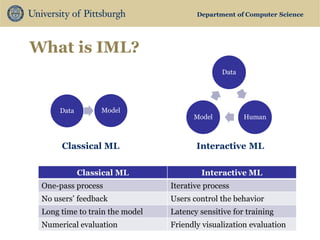
What is IML? 
Data 
Human 
Model 
Data 
Model 
Classical ML 
Interactive ML 
Classical ML 
Interactive ML 
One-pass process 
Iterative process 
No users’ feedback 
Users control the behavior 
Long time to train the model 
Latency sensitive for training 
Numerical evaluation 
Friendly visualization evaluation
Department of Computer Science 
How to design effective end-user interaction with interactive ML system? 
β€’Questions: 
–Which examples should a person provide to efficiently train the system? 
–How should the system illustrate its current understanding? 
–How can a person evaluate the quality of the system’s current understanding in order to better guide it towards the desired behavior?
Department of Computer Science 
Design Principle 
Fast and Focused 
β€’Fast: 
–Takes seconds or minutes rather than weeks or months to train an effective model. 
–User can quickly refine the classifier by adding more manual info. 
–User can get feedback as quickly as possible. 
β€’Focused: 
–UI component needs to be simple so the user can remain focused on the ML problem at hand.
Department of Computer Science 
IML Research Groups 
Brigham Young University 
And so on…
Department of Computer Science 
IML Categories 
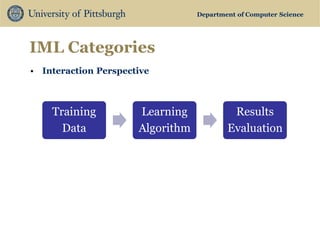
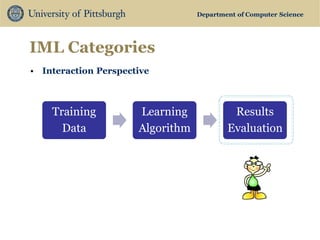
β€’Interaction Perspective 
β€’Data Perspective 
β€’Learning Perspective
Department of Computer Science 
IML Categories 
Training Data 
Learning 
Algorithm 
Results 
Evaluation 
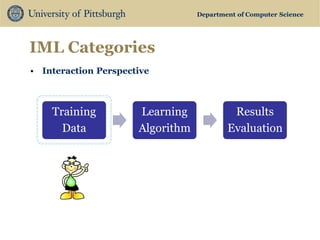
β€’Interaction Perspective
Department of Computer Science 
IML Categories 
Training Data 
Learning 
Algorithm 
Results Evaluation 
β€’Interaction Perspective
Department of Computer Science 
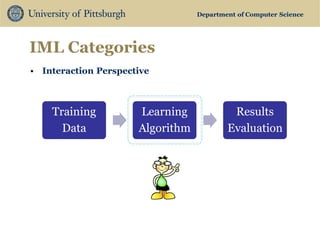
IML Categories 
Training Data 
Learning Algorithm 
Results Evaluation 
β€’Interaction Perspective
Department of Computer Science 
IML Categories 
Training Data 
Learning 
Algorithm 
Results Evaluation 
β€’Interaction Perspective
Department of Computer Science 
IML Categories 
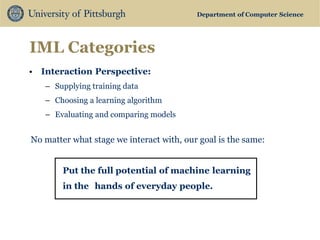
β€’Interaction Perspective: 
–Supplying training data 
–Choosing a learning algorithm 
–Evaluating and comparing models 
No matter what stage we interact with, our goal is the same: 
Put the full potential of machine learning 
in the hands of everyday people.
Department of Computer Science 
IML Categories 
β€’Date Perspective: 
–Stream-based IML 
–Pool-based IML 
β€’Learning Perspective: 
–Concept Learning 
–Supervised Learning 
–Unsupervised Learning
Department of Computer Science 
IML Categories 
β€’Date Perspective: 
–Stream-based IML 
–Pool-based IML 
β€’Learning Perspective: 
–Concept Learning 
–Supervised Learning 
–Unsupervised Learning 
Focus on Interaction Perspective
Department of Computer Science 
IML Categories 
β€’Interaction Perspective: 
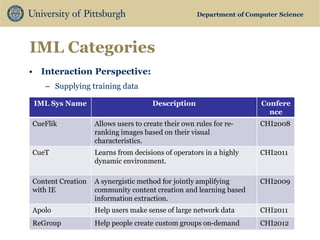
–Supplying training data 
IML Sys Name 
Description 
Conference 
CueFlik 
Allows users to create their own rules for re- ranking images based on their visual characteristics. 
CHI2008 
CueT 
Learns from decisions of operators in a highly dynamic environment. 
CHI2011 
Content Creation with IE 
A synergistic method for jointly amplifying community content creation and learning based information extraction. 
CHI2009 
Apolo 
Help users make sense of large network data 
CHI2011 
ReGroup 
Help people create custom groups on-demand 
CHI2012
Department of Computer Science 
IML Categories 
β€’Interaction Perspective: 
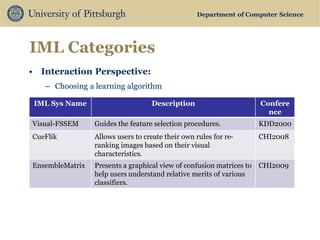
–Choosing a learning algorithm 
IML Sys Name 
Description 
Conference 
Visual-FSSEM 
Guides the feature selection procedures. 
KDD2000 
CueFlik 
Allows users to create their own rules for re- ranking images based on their visual characteristics. 
CHI2008 
EnsembleMatrix 
Presents a graphical view of confusion matrices to help users understand relative merits of various classifiers. 
CHI2009
Department of Computer Science 
IML Categories 
β€’Interaction Perspective: 
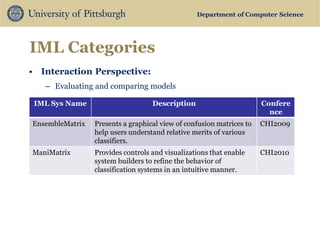
–Evaluating and comparing models 
IML Sys Name 
Description 
Conference 
EnsembleMatrix 
Presents a graphical view of confusion matrices to help users understand relative merits of various classifiers. 
CHI2009 
ManiMatrix 
Provides controls and visualizations that enable system builders to refine the behavior of classification systems in an intuitive manner. 
CHI2010
Department of Computer Science 
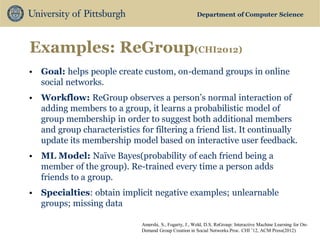
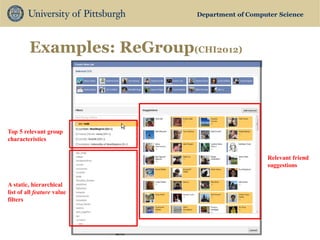
Examples: ReGroup(CHI2012) 
β€’Goal: helps people create custom, on-demand groups in online social networks. 
β€’Workflow: ReGroup observes a person’s normal interaction of adding members to a group, it learns a probabilistic model of group membership in order to suggest both additional members and group characteristics for filtering a friend list. It continually update its membership model based on interactive user feedback. 
β€’ML Model: NaΓ―ve Bayes(probability of each friend being a member of the group). Re-trained every time a person adds friends to a group. 
β€’Specialties: obtain implicit negative examples; unlearnable groups; missing data 
Amershi, S., Fogarty, J., Weld, D.S. ReGroup: Interactive Machine Learning for On- Demand Group Creation in Social Networks.Proc. CHI ’12, ACM Press(2012)
Department of Computer Science 
Examples: ReGroup(CHI2012) 
Top 5 relevant group characteristics 
Relevant friend suggestions 
A static, hierarchical list of all feature value filters
Department of Computer Science 
Reference 
β€’Html: 
–http://www.cs.pitt.edu/~ztliu/comp/iml.html 
β€’Bib: 
–http://www.cs.pitt.edu/~ztliu/comp/iml.bib
Department of Computer Science 
Q & A 
Thank you!

Interactive Machine Learning

  • 1.
    Department of ComputerScience Interactive Machine Learning Zitao Liu ztliu@cs.pitt.edu School of Arts of and Sciences Department of Computer Science
  • 2.
    Department of ComputerScience Outline β€’What is Interactive Machine Learning(IML): –Motivation & Goal –Classical Machine Learning V.S Interactive Machine Learning –Design Principle of IML β€’Applications of IML: –IML Categories –Existing IML Applications (CHI, UIST, IUI, KDD)
  • 3.
    Department of ComputerScience Motivation & Goal β€’β€œβ€¦We believe that trying to fully automate tasks is extremely difficult and even undesirable, but instead there exists a computational design methodology which allows us to gracefully combine automated services with direct user manipulation…” β€”β€” from Microsoft Research
  • 4.
    Department of ComputerScience Motivation & Goal β€’The complexity of machine learning has largely restricted its use to experts and skilled developers. β€’Solving real world problems can benefit from end- user’s interaction. β€’A better understanding/assessment of a model’s performance. ‒… …
  • 5.
    Department of ComputerScience What is IML? Data Human Model Data Model Classical ML Interactive ML Classical ML Interactive ML One-pass process Iterative process No users’ feedback Users control the behavior Long time to train the model Latency sensitive for training Numerical evaluation Friendly visualization evaluation
  • 6.
    Department of ComputerScience How to design effective end-user interaction with interactive ML system? β€’Questions: –Which examples should a person provide to efficiently train the system? –How should the system illustrate its current understanding? –How can a person evaluate the quality of the system’s current understanding in order to better guide it towards the desired behavior?
  • 7.
    Department of ComputerScience Design Principle Fast and Focused β€’Fast: –Takes seconds or minutes rather than weeks or months to train an effective model. –User can quickly refine the classifier by adding more manual info. –User can get feedback as quickly as possible. β€’Focused: –UI component needs to be simple so the user can remain focused on the ML problem at hand.
  • 8.
    Department of ComputerScience IML Research Groups Brigham Young University And so on…
  • 9.
    Department of ComputerScience IML Categories β€’Interaction Perspective β€’Data Perspective β€’Learning Perspective
  • 10.
    Department of ComputerScience IML Categories Training Data Learning Algorithm Results Evaluation β€’Interaction Perspective
  • 11.
    Department of ComputerScience IML Categories Training Data Learning Algorithm Results Evaluation β€’Interaction Perspective
  • 12.
    Department of ComputerScience IML Categories Training Data Learning Algorithm Results Evaluation β€’Interaction Perspective
  • 13.
    Department of ComputerScience IML Categories Training Data Learning Algorithm Results Evaluation β€’Interaction Perspective
  • 14.
    Department of ComputerScience IML Categories β€’Interaction Perspective: –Supplying training data –Choosing a learning algorithm –Evaluating and comparing models No matter what stage we interact with, our goal is the same: Put the full potential of machine learning in the hands of everyday people.
  • 15.
    Department of ComputerScience IML Categories β€’Date Perspective: –Stream-based IML –Pool-based IML β€’Learning Perspective: –Concept Learning –Supervised Learning –Unsupervised Learning
  • 16.
    Department of ComputerScience IML Categories β€’Date Perspective: –Stream-based IML –Pool-based IML β€’Learning Perspective: –Concept Learning –Supervised Learning –Unsupervised Learning Focus on Interaction Perspective
  • 17.
    Department of ComputerScience IML Categories β€’Interaction Perspective: –Supplying training data IML Sys Name Description Conference CueFlik Allows users to create their own rules for re- ranking images based on their visual characteristics. CHI2008 CueT Learns from decisions of operators in a highly dynamic environment. CHI2011 Content Creation with IE A synergistic method for jointly amplifying community content creation and learning based information extraction. CHI2009 Apolo Help users make sense of large network data CHI2011 ReGroup Help people create custom groups on-demand CHI2012
  • 18.
    Department of ComputerScience IML Categories β€’Interaction Perspective: –Choosing a learning algorithm IML Sys Name Description Conference Visual-FSSEM Guides the feature selection procedures. KDD2000 CueFlik Allows users to create their own rules for re- ranking images based on their visual characteristics. CHI2008 EnsembleMatrix Presents a graphical view of confusion matrices to help users understand relative merits of various classifiers. CHI2009
  • 19.
    Department of ComputerScience IML Categories β€’Interaction Perspective: –Evaluating and comparing models IML Sys Name Description Conference EnsembleMatrix Presents a graphical view of confusion matrices to help users understand relative merits of various classifiers. CHI2009 ManiMatrix Provides controls and visualizations that enable system builders to refine the behavior of classification systems in an intuitive manner. CHI2010
  • 20.
    Department of ComputerScience Examples: ReGroup(CHI2012) β€’Goal: helps people create custom, on-demand groups in online social networks. β€’Workflow: ReGroup observes a person’s normal interaction of adding members to a group, it learns a probabilistic model of group membership in order to suggest both additional members and group characteristics for filtering a friend list. It continually update its membership model based on interactive user feedback. β€’ML Model: NaΓ―ve Bayes(probability of each friend being a member of the group). Re-trained every time a person adds friends to a group. β€’Specialties: obtain implicit negative examples; unlearnable groups; missing data Amershi, S., Fogarty, J., Weld, D.S. ReGroup: Interactive Machine Learning for On- Demand Group Creation in Social Networks.Proc. CHI ’12, ACM Press(2012)
  • 21.
    Department of ComputerScience Examples: ReGroup(CHI2012) Top 5 relevant group characteristics Relevant friend suggestions A static, hierarchical list of all feature value filters
  • 22.
    Department of ComputerScience Reference β€’Html: –http://www.cs.pitt.edu/~ztliu/comp/iml.html β€’Bib: –http://www.cs.pitt.edu/~ztliu/comp/iml.bib
  • 23.
    Department of ComputerScience Q & A Thank you!