Recent Trends
• Digital Transformation
• COVID-19 Impact
• Remote Working
• E-Naira based on Blockchains and
Cryptocurrencies Technology–Web
3.0
• Low Carbon emission
• Natural Language Processing
• Driverless Vehicles ~ Elon Musk
• Disruptive Tech - Quantum Physics
• Fiasco/Disasters/failures
- CBN war against AbokiFX Online
platform – Sahara Reporters, 19
Sept, 2021.
- FG Approves N30bn for roads to
Niger Republic – vanguardng, 2
Feb, 2020
Topic: Exploring the Machine Learning
Techniques
Name: Emmanuel Ayeni
Data Scientist
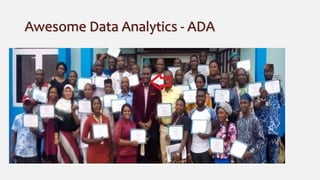
Awesome Data Analytics - ADA
Know What to Learn
Data
Science
Programming
(R or Python or
SQL)
Databases
Data
Structure &
Algorithms Fundamental
Math & Stats
Data Analysis
Data Wrangling
Exploration data
Analysis & Data
Visualization
Data
Scraping &
Data APIs
Software
Development
& Deployment
Machine Learning
Supervised/Unsupervised
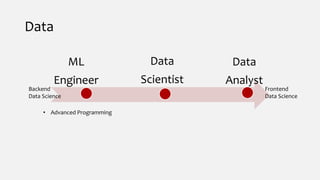
Data
ML
Engineer
Data
Scientist
Data
Analyst
Backend
Data Science
Frontend
Data Science
• Advanced Programming
Targets
• Points to Cover
• Introduction
• The Application of Unsupervised Machine Learning (ML)
Models
• DEMO: How to Fit a Machine Learning Model to Data sets
• Stages & Steps
• Results
• Evaluation & Conclusions
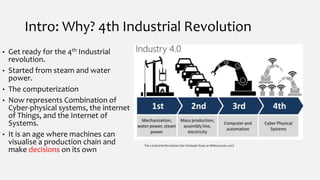
Intro: Why? 4th Industrial Revolution
• Get ready for the 4th Industrial
revolution.
• Started from steam and water
power.
• The computerization
• Now represents Combination of
Cyber-physical systems, the internet
of Things, and the Internet of
Systems.
• It is an age where machines can
visualise a production chain and
make decisions on its own
The 4 Industrial Revolutions (by Christoph Roser at AllAboutLean.com)
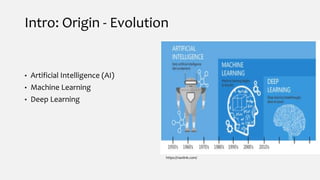
Intro: Origin - Evolution
• Artificial Intelligence (AI)
• Machine Learning
• Deep Learning
https://naolink.com/
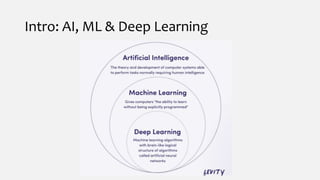
Intro: AI, ML & Deep Learning
Intro: Focus of Our Learning
*** For Every Machine Learning application, the
chief question is,
“ Which Machine Learning algorithm should we
use? “
That's to provide the best prediction data upon
a similar new data through a selected.***
Intro: What is Machine Learning
• ML is a field of study that gives computers
the ability to learn without being explicitly
programmed. (Arthur Samuel)
• Traditionally, programmers have to design
and code logic programming functions in a
clear and detailed manner, leaving no room
for confusion or doubts.
• ML is an advanced decision-making process
- aim is to have a deep understanding of
ways of making decisions based strongly on
data and information.
• Also ML can be considered as an
intersection between statistics and
computer science.
Intro: Data Dimensions
• Data has now grown to become
• Data As A Service
• Digital Transformation
• New Oil
• Data is more like sunshine, abundant
and unlimited in its potential ~ Zhiwei
Jiang, CEO of Insight & Data GBL
• Urbanization
• Tech Cities
• Key to Sustainable future
• Improved Customer Satisfaction
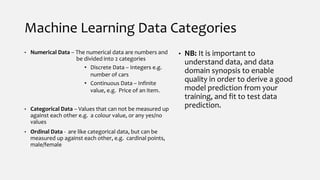
Machine Learning Data Categories
• Numerical Data – The numerical data are numbers and
be divided into 2 categories
• Discrete Data – Integers e.g.
number of cars
• Continuous Data – Infinite
value, e.g. Price of an item.
• Categorical Data – Values that can not be measured up
against each other e.g. a colour value, or any yes/no
values
• Ordinal Data - are like categorical data, but can be
measured up against each other, e.g. cardinal points,
male/female
• NB: It is important to
understand data, and data
domain synopsis to enable
quality in order to derive a good
model prediction from your
training, and fit to test data
prediction.
Machine Learning Applications
ML Applications
Manufacturing
HealthCare
Insurance
Customer Service
Transportation
Commerce
Automobile
educba
Overview of fields related to learning from data.
AI, artificial intelligence
KJIM
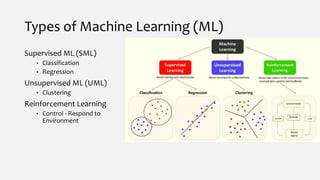
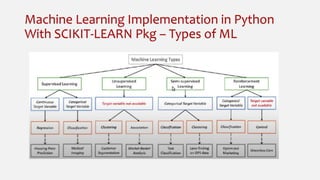
Types of Machine Learning (ML)
Supervised ML (SML)
• Classification
• Regression
Unsupervised ML (UML)
• Clustering
Reinforcement Learning
• Control - Respond to
Environment
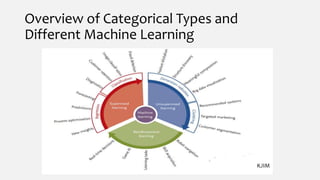
Overview of Categorical Types and
Different Machine Learning
KJIM
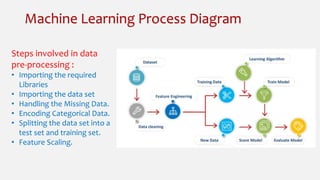
Machine Learning Process Diagram
Steps involved in data
pre-processing :
• Importing the required
Libraries
• Importing the data set
• Handling the Missing Data.
• Encoding Categorical Data.
• Splitting the data set into a
test set and training set.
• Feature Scaling.
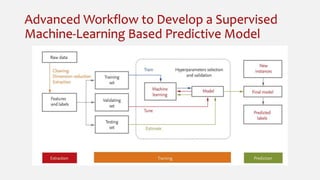
Advanced Workflow to Develop a Supervised
Machine-Learning Based Predictive Model
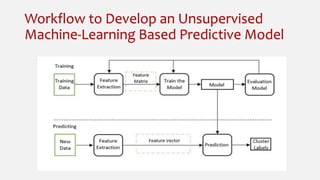
Workflow to Develop an Unsupervised
Machine-Learning Based Predictive Model
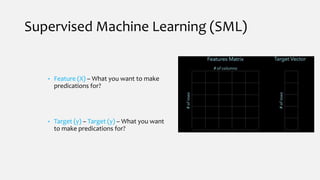
Supervised Machine Learning (SML)
• Feature (X) – What you want to make
predications for?
• Target (y) – Target (y) – What you want
to make predications for?
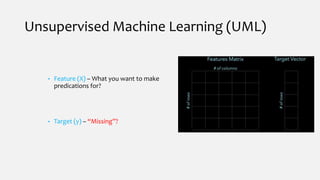
Unsupervised Machine Learning (UML)
• Feature (X) – What you want to make
predications for?
• Target (y) – “Missing”?
Machine Learning Implementation in Python
With SCIKIT-LEARN Pkg – Types of ML
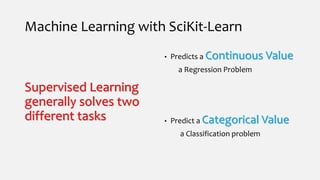
Machine Learning with SciKit-Learn
Supervised Learning
generally solves two
different tasks
• Predicts a Continuous Value
a Regression Problem
• Predict a Categorical Value
a Classification problem
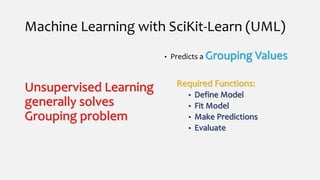
Machine Learning with SciKit-Learn (UML)
Unsupervised Learning
generally solves
Grouping problem
• Predicts a Grouping Values
Required Functions:
• Define Model
• Fit Model
• Make Predictions
• Evaluate
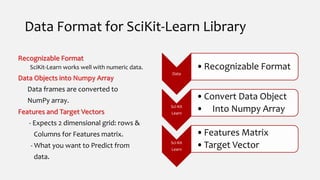
Data Format for SciKit-Learn Library
Recognizable Format
SciKit-Learn works well with numeric data.
Data Objects into Numpy Array
Data frames are converted to
NumPy array.
Features and Target Vectors
- Expects 2 dimensional grid: rows &
Columns for Features matrix.
- What you want to Predict from
data.
Data
•Recognizable Format
Sci-Kit
Learn
•Convert Data Object
• Into Numpy Array
Sci-Kit
Learn
•Features Matrix
•Target Vector
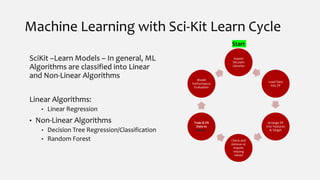
Machine Learning with Sci-Kit Learn Cycle
Import
SKLearn
Libraries
Load Data
into DF
Arrange DF
into Features
& Target
Check and
remove or
impute
missing
values
Train & Fit
Data to
Models
Model
Performance
Evaluation
SciKit –Learn Models – In general, ML
Algorithms are classified into Linear
and Non-Linear Algorithms
Linear Algorithms:
• Linear Regression
• Non-Linear Algorithms
• Decision Tree Regression/Classification
• Random Forest
Start
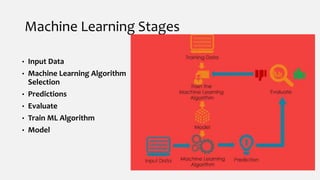
Machine Learning Stages
• Input Data
• Machine Learning Algorithm
Selection
• Predictions
• Evaluate
• Train ML Algorithm
• Model
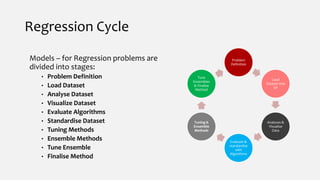
Regression Cycle
Problem
Definition
Load
Dataset into
DF
Analyses &
Visualise
Data
Evaluate &
standardise
with
Algorithms
Tuning &
Ensemble
Methods
Tune
Ensembles
& Finalise
Method
Models – for Regression problems are
divided into stages:
• Problem Definition
• Load Dataset
• Analyse Dataset
• Visualize Dataset
• Evaluate Algorithms
• Standardise Dataset
• Tuning Methods
• Ensemble Methods
• Tune Ensemble
• Finalise Method
Conclusion
• With ML it is easy to get drowned in the procedures and
techniques, however, the message is about data visualisation
and in turn predicting target variables no matter the objects that
include time units.
• Machine learning is at the intersection of computer science and
statistics through which computers receive the ability to learn
without being explicitly programmed.
• There are two broad categories of machine learning problems:
supervised and unsupervised learning.
• We managed to paint the picture of the reasons and
demonstrated UML application of group countries under the
correct continents.
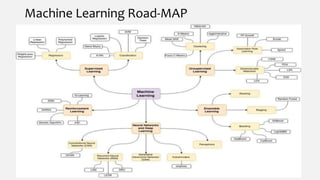
Machine Learning Road-MAP
Credits
• Michael Galarnyk
• Springer
• KJIM

MLIntro_ADA.pptx

  • 1.
    Recent Trends • DigitalTransformation • COVID-19 Impact • Remote Working • E-Naira based on Blockchains and Cryptocurrencies Technology–Web 3.0 • Low Carbon emission • Natural Language Processing • Driverless Vehicles ~ Elon Musk • Disruptive Tech - Quantum Physics • Fiasco/Disasters/failures - CBN war against AbokiFX Online platform – Sahara Reporters, 19 Sept, 2021. - FG Approves N30bn for roads to Niger Republic – vanguardng, 2 Feb, 2020
  • 2.
    Topic: Exploring theMachine Learning Techniques Name: Emmanuel Ayeni Data Scientist
  • 3.
  • 4.
    Know What toLearn Data Science Programming (R or Python or SQL) Databases Data Structure & Algorithms Fundamental Math & Stats Data Analysis Data Wrangling Exploration data Analysis & Data Visualization Data Scraping & Data APIs Software Development & Deployment Machine Learning Supervised/Unsupervised
  • 5.
  • 6.
    Targets • Points toCover • Introduction • The Application of Unsupervised Machine Learning (ML) Models • DEMO: How to Fit a Machine Learning Model to Data sets • Stages & Steps • Results • Evaluation & Conclusions
  • 7.
    Intro: Why? 4thIndustrial Revolution • Get ready for the 4th Industrial revolution. • Started from steam and water power. • The computerization • Now represents Combination of Cyber-physical systems, the internet of Things, and the Internet of Systems. • It is an age where machines can visualise a production chain and make decisions on its own The 4 Industrial Revolutions (by Christoph Roser at AllAboutLean.com)
  • 8.
    Intro: Origin -Evolution • Artificial Intelligence (AI) • Machine Learning • Deep Learning https://naolink.com/
  • 9.
    Intro: AI, ML& Deep Learning
  • 10.
    Intro: Focus ofOur Learning *** For Every Machine Learning application, the chief question is, “ Which Machine Learning algorithm should we use? “ That's to provide the best prediction data upon a similar new data through a selected.***
  • 11.
    Intro: What isMachine Learning • ML is a field of study that gives computers the ability to learn without being explicitly programmed. (Arthur Samuel) • Traditionally, programmers have to design and code logic programming functions in a clear and detailed manner, leaving no room for confusion or doubts. • ML is an advanced decision-making process - aim is to have a deep understanding of ways of making decisions based strongly on data and information. • Also ML can be considered as an intersection between statistics and computer science.
  • 12.
    Intro: Data Dimensions •Data has now grown to become • Data As A Service • Digital Transformation • New Oil • Data is more like sunshine, abundant and unlimited in its potential ~ Zhiwei Jiang, CEO of Insight & Data GBL • Urbanization • Tech Cities • Key to Sustainable future • Improved Customer Satisfaction
  • 13.
    Machine Learning DataCategories • Numerical Data – The numerical data are numbers and be divided into 2 categories • Discrete Data – Integers e.g. number of cars • Continuous Data – Infinite value, e.g. Price of an item. • Categorical Data – Values that can not be measured up against each other e.g. a colour value, or any yes/no values • Ordinal Data - are like categorical data, but can be measured up against each other, e.g. cardinal points, male/female • NB: It is important to understand data, and data domain synopsis to enable quality in order to derive a good model prediction from your training, and fit to test data prediction.
  • 14.
    Machine Learning Applications MLApplications Manufacturing HealthCare Insurance Customer Service Transportation Commerce Automobile educba
  • 15.
    Overview of fieldsrelated to learning from data. AI, artificial intelligence KJIM
  • 16.
    Types of MachineLearning (ML) Supervised ML (SML) • Classification • Regression Unsupervised ML (UML) • Clustering Reinforcement Learning • Control - Respond to Environment
  • 17.
    Overview of CategoricalTypes and Different Machine Learning KJIM
  • 18.
    Machine Learning ProcessDiagram Steps involved in data pre-processing : • Importing the required Libraries • Importing the data set • Handling the Missing Data. • Encoding Categorical Data. • Splitting the data set into a test set and training set. • Feature Scaling.
  • 19.
    Advanced Workflow toDevelop a Supervised Machine-Learning Based Predictive Model
  • 20.
    Workflow to Developan Unsupervised Machine-Learning Based Predictive Model
  • 21.
    Supervised Machine Learning(SML) • Feature (X) – What you want to make predications for? • Target (y) – Target (y) – What you want to make predications for?
  • 22.
    Unsupervised Machine Learning(UML) • Feature (X) – What you want to make predications for? • Target (y) – “Missing”?
  • 23.
    Machine Learning Implementationin Python With SCIKIT-LEARN Pkg – Types of ML
  • 24.
    Machine Learning withSciKit-Learn Supervised Learning generally solves two different tasks • Predicts a Continuous Value a Regression Problem • Predict a Categorical Value a Classification problem
  • 25.
    Machine Learning withSciKit-Learn (UML) Unsupervised Learning generally solves Grouping problem • Predicts a Grouping Values Required Functions: • Define Model • Fit Model • Make Predictions • Evaluate
  • 26.
    Data Format forSciKit-Learn Library Recognizable Format SciKit-Learn works well with numeric data. Data Objects into Numpy Array Data frames are converted to NumPy array. Features and Target Vectors - Expects 2 dimensional grid: rows & Columns for Features matrix. - What you want to Predict from data. Data •Recognizable Format Sci-Kit Learn •Convert Data Object • Into Numpy Array Sci-Kit Learn •Features Matrix •Target Vector
  • 27.
    Machine Learning withSci-Kit Learn Cycle Import SKLearn Libraries Load Data into DF Arrange DF into Features & Target Check and remove or impute missing values Train & Fit Data to Models Model Performance Evaluation SciKit –Learn Models – In general, ML Algorithms are classified into Linear and Non-Linear Algorithms Linear Algorithms: • Linear Regression • Non-Linear Algorithms • Decision Tree Regression/Classification • Random Forest Start
  • 28.
    Machine Learning Stages •Input Data • Machine Learning Algorithm Selection • Predictions • Evaluate • Train ML Algorithm • Model
  • 29.
    Regression Cycle Problem Definition Load Dataset into DF Analyses& Visualise Data Evaluate & standardise with Algorithms Tuning & Ensemble Methods Tune Ensembles & Finalise Method Models – for Regression problems are divided into stages: • Problem Definition • Load Dataset • Analyse Dataset • Visualize Dataset • Evaluate Algorithms • Standardise Dataset • Tuning Methods • Ensemble Methods • Tune Ensemble • Finalise Method
  • 30.
    Conclusion • With MLit is easy to get drowned in the procedures and techniques, however, the message is about data visualisation and in turn predicting target variables no matter the objects that include time units. • Machine learning is at the intersection of computer science and statistics through which computers receive the ability to learn without being explicitly programmed. • There are two broad categories of machine learning problems: supervised and unsupervised learning. • We managed to paint the picture of the reasons and demonstrated UML application of group countries under the correct continents.
  • 31.
  • 32.