

Mach Kernel


4/9/2013     arifch2009@gmail.com
• Mach is object-oriented system.

• Data and the operations that manipulate that data are
  encapsulated into an abstract object..

• The details of how these operations are implemented are
  hidden, as are the internal data structures.

• Use of an object is done by invoking its defined

• It allows objects to reside anywhere in a network of Mach
  systems, transparent to the user.

4/9/2013                arifch2009@gmail.com
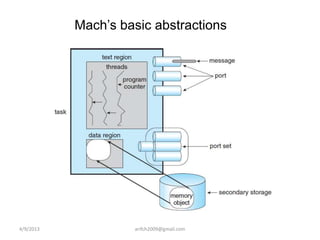
Mach’s basic abstractions


4/9/2013            arifch2009@gmail.com
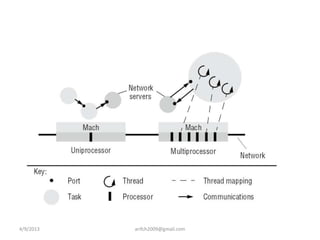
• Task : A task is an execution environment , a traditional
  process would be implemented as a task with a single thread
  of control.
    – May have multiple thread.
    – Resources : Address Spaces, Threads, Port rights, ports sets, local
      name spaces.
    – task_create(parent_task, inherit_memory, child_task)


• Thread : is the basic unit of execution and must run in the
  context of a task (which provides the address space).
    – All threads within a task share the tasks’ resources (ports, memory,
      and so on).
    – The threads belonging to a single task can execute in parallel at
      different processors in a shared-memory multiprocessor.
    – thread_create(parent_task, child_thread)
    – thread_set_state(thread, flavour, new_state, count)
    – Thread_resume(thread)
  4/9/2013                      arifch2009@gmail.com
• Port : is a unicast, unidirectional communication channel
  with an associated message queue.
    – a task must have a port right to send a message to a port.
    – Communication is accomplished by sending messages to ports.
    – messages are queued at the destination port if no thread is
      immediately ready to receive them.


• Port Set : Set of ports treated as a single unit when
  receiving a message.
    – They share a common message queue.
    – Each received message identifies the individual port


  4/9/2013                     arifch2009@gmail.com
• Messages : is the basic method of communication
  between threads in Mach.
    – Contain Message header.
    – It is a typed collection of data objects.
    – Port rights are passed in messages;


• Memory object : is a source of memory; tasks can
  access it by mapping portions of an object (or the entire
  object) into their address spaces.


 4/9/2013                        arifch2009@gmail.com
Communication Model
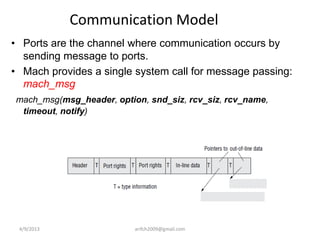
• Ports are the channel where communication occurs by
  sending message to ports.
• Mach provides a single system call for message passing:
  mach_msg
mach_msg(msg_header, option, snd_siz, rcv_siz, rcv_name,
 timeout, notify)


 4/9/2013                 arifch2009@gmail.com
• The header is composed of:
      – Port destination.
      – Answer port.
      – Operation identifier.
      – Size of the data list.


4/9/2013                   arifch2009@gmail.com
4/9/2013   arifch2009@gmail.com

Mach Kernel

  • 1.
    Mach Kernel 4/9/2013 arifch2009@gmail.com
  • 2.
    • Mach isobject-oriented system. • Data and the operations that manipulate that data are encapsulated into an abstract object.. • The details of how these operations are implemented are hidden, as are the internal data structures. • Use of an object is done by invoking its defined • It allows objects to reside anywhere in a network of Mach systems, transparent to the user. 4/9/2013 arifch2009@gmail.com
  • 3.
  • 4.
    • Task :A task is an execution environment , a traditional process would be implemented as a task with a single thread of control. – May have multiple thread. – Resources : Address Spaces, Threads, Port rights, ports sets, local name spaces. – task_create(parent_task, inherit_memory, child_task) • Thread : is the basic unit of execution and must run in the context of a task (which provides the address space). – All threads within a task share the tasks’ resources (ports, memory, and so on). – The threads belonging to a single task can execute in parallel at different processors in a shared-memory multiprocessor. – thread_create(parent_task, child_thread) – thread_set_state(thread, flavour, new_state, count) – Thread_resume(thread) 4/9/2013 arifch2009@gmail.com
  • 5.
    • Port :is a unicast, unidirectional communication channel with an associated message queue. – a task must have a port right to send a message to a port. – Communication is accomplished by sending messages to ports. – messages are queued at the destination port if no thread is immediately ready to receive them. • Port Set : Set of ports treated as a single unit when receiving a message. – They share a common message queue. – Each received message identifies the individual port 4/9/2013 arifch2009@gmail.com
  • 6.
    • Messages :is the basic method of communication between threads in Mach. – Contain Message header. – It is a typed collection of data objects. – Port rights are passed in messages; • Memory object : is a source of memory; tasks can access it by mapping portions of an object (or the entire object) into their address spaces. 4/9/2013 arifch2009@gmail.com
  • 7.
    Communication Model • Portsare the channel where communication occurs by sending message to ports. • Mach provides a single system call for message passing: mach_msg mach_msg(msg_header, option, snd_siz, rcv_siz, rcv_name, timeout, notify) 4/9/2013 arifch2009@gmail.com
  • 8.
    • The headeris composed of: – Port destination. – Answer port. – Operation identifier. – Size of the data list. 4/9/2013 arifch2009@gmail.com
  • 9.
    4/9/2013 arifch2009@gmail.com

Editor's Notes

  • #8 In a request/response messaging pattern, one party sends a request message and the receiving party returns a response message. Two typical examples of request/response processing are the interaction that a browser has with a Web server using the HTTP adapter, and Web service processing using the Simple Object Access Protocol (SOAP) adapter