MAC 212: Live Radio
          & Commercial
          Production
Introduction to Radio Advertising
What is advertising?
• Sold in 10 second stages
  – 30” 40” or 50” usually
• Core funding element of Commercial radio
• All about….
  – Changing the behaviour of the audience
  – Advertisements
    inform, persuade, remind, influence, change
    opinions; they may even alter attitudes and feelings”
  – (White, 2000, P42)
Why advertise?
• Solving a business or social need
• Lack of business? Wrong sort of business?
  Perception? Demand? Expansion or start-up?
• Building (or rebuilding) a brand
• Share of mind
• Establish the why…
  – Before the “how”
Why Radio?
• Radio is….
   – Intimate
   – Intrusive (it Invades Private Space)
   – Imaginative
   – Cost Effective
   – Less avoidable
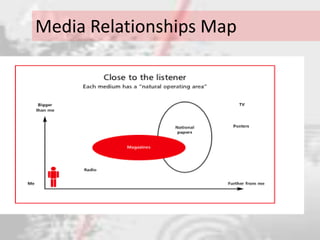
Media Relationships Map
Establish…
• A compelling offer…
   – There‟s gotta be a reason to act
• Your USP…
   – What does the business/product offer uniquely?
• The call to action…
   – What does the listener need to do NOW?
The brief
• All good ads have a good brief!
• Who are we talking to…
   – A person who…
• What do we want them to do…
   – Make a clear point
• Why should they do it…
   – The incentive!
When writing…
• Don‟t be too creative
   – Is the message still obvious?
• Don‟t over-write
   – Don‟t cram too much into the time
• Think about comedy carefully
   – Is it funny? Will the humour wear off?
• Make sure it SELLS!!!
Approaches?
• THERE IS NO SET WAY TO MAKE A RADIO COMMERCIAL…
• But you could use…
   – A slice of life?
   – Radio to animate objects
   – Music
   – Comedy
   – A straight „read‟

• Think RADIO!
Some Techniques…
• A good brief will help (A LOT!)
• “Pace and Lead”
   – Find common experiences, pace them and lead the listener to the
     sales message
• Emotion
   – Powerful weapons!
• Anticipation and Comedy
   – Can we look forward to the punchline?
• Use sound
   – Do we jump to conclusions?
Consider…
• The best ads are often very simple…
• Find the right voices for the commercials and the audience
• Is it a campaign?
   – Common themes, styles or “tag-line”
• Is it effective?
   – Does it work? Might the audience misinterpret the content?
The 7 deadly sins of radio advertising

•   Failure to attract the listeners attention
•   Failure to appeal to the listeners self-interest
•   Failure to use words that paint pictures
•   Being so „clever‟ or „creative‟ that you fail to sell
•   Failure to give the listener a reason to act NOW
•   Cliché-ridden copy
•   Too much copy


                                   From www.danoday.com
The RAB Guidelines
•   1. Understand the environment
•   2. Speak the listeners language
•   3. Engage and entertain the listener
•   4. Keep it simple
•   5. Judge what you hear, not what you read
•   6. Production values are important
•   7. Plan your production
•   8. Dare to be different
•   9. Take it seriously
Listening to Radio Ads….
•   Listen for…
•   The techniques
•   How is the product being sold to you?
•   Can you work out what the brief is?
•   Is it effective?
What can you make?
•   3 Commercials for a the same real client
•   Minimum 30 seconds long each
•   Must be either 30” 40” 50” or 60” long
•   Must be compliant
•   Think about: brand values, incentives, USP‟s, etc
You need to hand in
•   The 3 commercials on CD
•   Your brief
•   Typed scripts
•   Copyright details
    – Permissions letters
• Compliance notes
    – RACC clearance request
• Research notes etc
An Exercise – 1 hour


• Grab a copy of the Metro Newspaper
• Pick an advert
• Turn it into a 30” radio commercial

Mac212 adverts - week 1 for web

  • 1.
    MAC 212: LiveRadio & Commercial Production Introduction to Radio Advertising
  • 2.
    What is advertising? •Sold in 10 second stages – 30” 40” or 50” usually • Core funding element of Commercial radio • All about…. – Changing the behaviour of the audience – Advertisements inform, persuade, remind, influence, change opinions; they may even alter attitudes and feelings” – (White, 2000, P42)
  • 3.
    Why advertise? • Solvinga business or social need • Lack of business? Wrong sort of business? Perception? Demand? Expansion or start-up? • Building (or rebuilding) a brand • Share of mind • Establish the why… – Before the “how”
  • 4.
    Why Radio? • Radiois…. – Intimate – Intrusive (it Invades Private Space) – Imaginative – Cost Effective – Less avoidable
  • 5.
  • 6.
    Establish… • A compellingoffer… – There‟s gotta be a reason to act • Your USP… – What does the business/product offer uniquely? • The call to action… – What does the listener need to do NOW?
  • 7.
    The brief • Allgood ads have a good brief! • Who are we talking to… – A person who… • What do we want them to do… – Make a clear point • Why should they do it… – The incentive!
  • 8.
    When writing… • Don‟tbe too creative – Is the message still obvious? • Don‟t over-write – Don‟t cram too much into the time • Think about comedy carefully – Is it funny? Will the humour wear off? • Make sure it SELLS!!!
  • 9.
    Approaches? • THERE ISNO SET WAY TO MAKE A RADIO COMMERCIAL… • But you could use… – A slice of life? – Radio to animate objects – Music – Comedy – A straight „read‟ • Think RADIO!
  • 10.
    Some Techniques… • Agood brief will help (A LOT!) • “Pace and Lead” – Find common experiences, pace them and lead the listener to the sales message • Emotion – Powerful weapons! • Anticipation and Comedy – Can we look forward to the punchline? • Use sound – Do we jump to conclusions?
  • 11.
    Consider… • The bestads are often very simple… • Find the right voices for the commercials and the audience • Is it a campaign? – Common themes, styles or “tag-line” • Is it effective? – Does it work? Might the audience misinterpret the content?
  • 12.
    The 7 deadlysins of radio advertising • Failure to attract the listeners attention • Failure to appeal to the listeners self-interest • Failure to use words that paint pictures • Being so „clever‟ or „creative‟ that you fail to sell • Failure to give the listener a reason to act NOW • Cliché-ridden copy • Too much copy From www.danoday.com
  • 13.
    The RAB Guidelines • 1. Understand the environment • 2. Speak the listeners language • 3. Engage and entertain the listener • 4. Keep it simple • 5. Judge what you hear, not what you read • 6. Production values are important • 7. Plan your production • 8. Dare to be different • 9. Take it seriously
  • 14.
    Listening to RadioAds…. • Listen for… • The techniques • How is the product being sold to you? • Can you work out what the brief is? • Is it effective?
  • 16.
    What can youmake? • 3 Commercials for a the same real client • Minimum 30 seconds long each • Must be either 30” 40” 50” or 60” long • Must be compliant • Think about: brand values, incentives, USP‟s, etc
  • 17.
    You need tohand in • The 3 commercials on CD • Your brief • Typed scripts • Copyright details – Permissions letters • Compliance notes – RACC clearance request • Research notes etc
  • 18.
    An Exercise –1 hour • Grab a copy of the Metro Newspaper • Pick an advert • Turn it into a 30” radio commercial