

MAC 273:
Professional Media Practice
Week 3: Professional practice and „what the
             industries want‟
    Planning for CV’s and Placement
Placement
• Can be taken anywhere –
  – but you need to find it.
• Ask for help
  – Join the facebook group
• Fill in the tracking form
What does industry want from you?
Media Graduate Skills
• critical analysis;
• Research;
• a broad commercial and cultural awareness of the
  media and creative industries;
• Teamwork;
• initiation and development of creative work in
  writing, audio-visual or other electronic media;
• a flexible, creative and independent approach to
  tasks;
  the ability to work to a brief and meet deadlines
• Persistence and motivation are vital due to the
  popularity of this sector.
  – Prospects.ac.uk
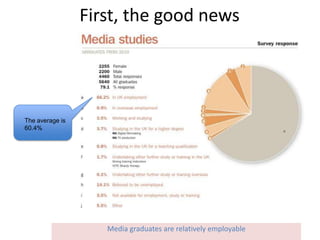
First, the good news


The average is
60.4%


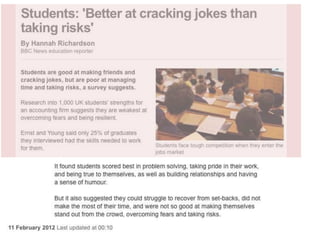
                    Media graduates are relatively employable
Media Studies
                (Prospects.ac.uk)


• Graduates from this discipline were amongst those
  most likely to go straight into employment (67.1%).
  However, over a quarter of those were in retail and
  catering. This highlights some of the challenges
  involved in securing a career in the media and the
  need for early career planning and work experience.
  Nonetheless almost one in five (18.1%) did secure
  degree related employment in arts, design and
  culture occupations and many more became
  business, marketing and management professionals
  (21.7%).
It’s not going to be easy…

•Most sectors of the industry have long been characterised by highly
motivated individuals wanting to work in an industry commonly seen as
glamorous and exciting.

• In terms of outcomes, 10% of all Skillset relevant students who have gained
employment 6 months after graduating have done so within Skillset
industries.

• It should nevertheless be noted that Skillset relevant students make up over
half (51%) of all the students to be subsequently employed in a Skillset
industry, indicating that Skillset relevant students are more likely to find
employment in Skillset industries than those studying non-Skillset relevant
courses
Media, Skills, Training & the Industry

   • Skillset: the Sector Skills Council for the Audio Visual
     Industries
      – Sector guides and role/skills descriptors.
      – National Occupational Standards
      – www.skillset.org
   • Broadcast Equality and Training Regulator
      – www.betr.org.uk
Skills for Tomorrow's Media
    The Report of the Skillset and DCMS Audio
         Visual Industries Training Group

•Considered the future skills and training needs
of our industry sectors
•Identified trends
•Highlighted skills gaps
•Made recommendations for improvements in
training and good practice
•http://www.skillset.org/research/skills/article_511_1.asp
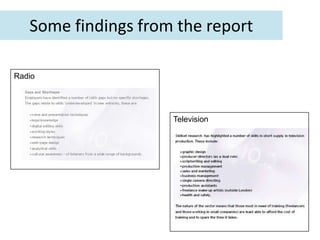
Some findings from the report

Radio


                     Television
Skillset census
• 60% of the workforce entered the industries since 1994
• 30% are media graduates
• 30% have a post-graduate qualification (certificate, diploma,
  Masters – not necessarily in a media subject)
• 50% of the workforce is freelance
• Asked industries what they are looking for when recruiting
  staff
   – Skillset Census: 2006
   – Workforce Report: 2005
Skills Gap 2011
• Multi-skilling – impact of tech on content
• Multi-platform – understand / exploit
    – How to monetise it
•   Management, leadership, entrepreneurship
•   Broadcast engineering
•   Sales and marketing
•   “Diagonal Thinking”
How do you stand
out from the crowd
Clive Jones: postscript of report
         (Chief Executive of Skillset)

• “The only certainty is uncertainty.”
• “Arrive with a wonderful enthusiasm and a mad
  flexibility.
• “In the workplace, group-work is hierarchical, not
  equal as in University.”
Getting On
    • Research
• Grab Opportunities
    • Network
   • Experience
    • Network
   • Have a plan
Skillset standards
• “Standards are also a great tool to help you
  focus your mind and compile a CV which will
  highlight your competence and present
  yourself more effectively as well as ensuring
  you are using the correct terminology”
  – http://www.skillset.org/standards/article_5839_1.
    asp
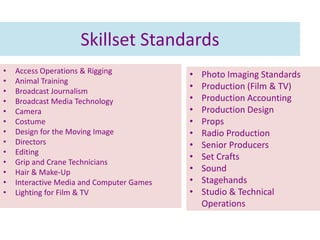
Skillset Standards
•   Access Operations & Rigging            •   Photo Imaging Standards
•   Animal Training
•   Broadcast Journalism
                                           •   Production (Film & TV)
•   Broadcast Media Technology             •   Production Accounting
•   Camera                                 •   Production Design
•   Costume                                •   Props
•   Design for the Moving Image            •   Radio Production
•   Directors                              •   Senior Producers
•   Editing
                                           •   Set Crafts
•   Grip and Crane Technicians
•   Hair & Make-Up                         •   Sound
•   Interactive Media and Computer Games   •   Stagehands
•   Lighting for Film & TV                 •   Studio & Technical
                                               Operations
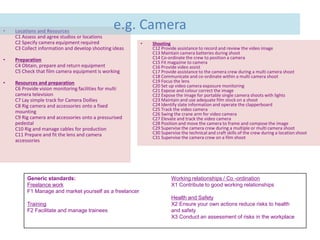
•   Locations and Resources
                                                 e.g. Camera
    C1 Assess and agree studios or locations
    C2 Specify camera equipment required                 •   Shooting
    C3 Collect information and develop shooting ideas        C12 Provide assistance to record and review the video image
                                                             C13 Maintain camera batteries during shoot
•   Preparation                                              C14 Co-ordinate the crew to position a camera
                                                             C15 Fit magazine to camera
    C4 Obtain, prepare and return equipment                  C16 Provide video assist
    C5 Check that film camera equipment is working           C17 Provide assistance to the camera crew during a multi camera shoot
                                                             C18 Communicate and co-ordinate within a multi camera shoot
•   Resources and preparation                                C19 Focus the lens
                                                             C20 Set up video camera exposure monitoring
    C6 Provide vision monitoring facilities for multi        C21 Expose and colour correct the image
    camera television                                        C22 Expose the image for portable single camera shoots with lights
    C7 Lay simple track for Camera Dollies                   C23 Maintain and use adequate film stock on a shoot
    C8 Rig camera and accessories onto a fixed               C24 Identify slate information and operate the clapperboard
    mounting                                                 C25 Track the video camera
                                                             C26 Swing the crane arm for video camera
    C9 Rig camera and accessories onto a pressurised         C27 Elevate and track the video camera
    pedestal                                                 C28 Position and move the camera to frame and compose the image
    C10 Rig and manage cables for production                 C29 Supervise the camera crew during a multiple or multi camera shoot
    C11 Prepare and fit the lens and camera                  C30 Supervise the technical and craft skills of the crew during a location shoot
                                                             C31 Supervise the camera crew on a film shoot
    accessories


         Generic standards:                                           Working relationships / Co -ordination
         Freelance work                                               X1 Contribute to good working relationships
         F1 Manage and market yourself as a freelancer
                                                                      Health and Safety
         Training                                                     X2 Ensure your own actions reduce risks to health
         F2 Facilitate and manage trainees                            and safety
                                                                      X3 Conduct an assessment of risks in the workplace
Writing a CV
•   Keep it relevant
•   Keep it concise
•    Ask yourself "So what?”
•   Keep it factual
•   List achievements
•   Talk positively and enthusiastically
•   if you are proud of what you have achieved get it on your CV
•   Don’t presume people know what you have done - spell it out
•   http://bbc.in/bbc-cv-tips
http://bbc.in/more-cv-tips
•   Be concise and ensure your information has an impact
•   Keep it simple and clear –Analyse the job description –
•   Identify which relevant skills, experience and competencies you have.
•   What might the employer be looking for?
•   Summarise your key achievements at the top of your CV
•   Don’t have any unexplained gaps on your application.
•   Academic and professional qualifications should flow in a logical order
•   Check your application before submitting.
•   Use the right language (Use Skillset NOS as a guide)


                                             http://bbc.in/media-job-
                                             interviews

Mac273 week 3 -2011

  • 1.
    MAC 273: Professional MediaPractice Week 3: Professional practice and „what the industries want‟ Planning for CV’s and Placement
  • 2.
    Placement • Can betaken anywhere – – but you need to find it. • Ask for help – Join the facebook group • Fill in the tracking form
  • 3.
    What does industrywant from you?
  • 5.
    Media Graduate Skills •critical analysis; • Research; • a broad commercial and cultural awareness of the media and creative industries; • Teamwork; • initiation and development of creative work in writing, audio-visual or other electronic media; • a flexible, creative and independent approach to tasks; the ability to work to a brief and meet deadlines • Persistence and motivation are vital due to the popularity of this sector. – Prospects.ac.uk
  • 6.
    First, the goodnews The average is 60.4% Media graduates are relatively employable
  • 7.
    Media Studies (Prospects.ac.uk) • Graduates from this discipline were amongst those most likely to go straight into employment (67.1%). However, over a quarter of those were in retail and catering. This highlights some of the challenges involved in securing a career in the media and the need for early career planning and work experience. Nonetheless almost one in five (18.1%) did secure degree related employment in arts, design and culture occupations and many more became business, marketing and management professionals (21.7%).
  • 8.
    It’s not goingto be easy… •Most sectors of the industry have long been characterised by highly motivated individuals wanting to work in an industry commonly seen as glamorous and exciting. • In terms of outcomes, 10% of all Skillset relevant students who have gained employment 6 months after graduating have done so within Skillset industries. • It should nevertheless be noted that Skillset relevant students make up over half (51%) of all the students to be subsequently employed in a Skillset industry, indicating that Skillset relevant students are more likely to find employment in Skillset industries than those studying non-Skillset relevant courses
  • 9.
    Media, Skills, Training& the Industry • Skillset: the Sector Skills Council for the Audio Visual Industries – Sector guides and role/skills descriptors. – National Occupational Standards – www.skillset.org • Broadcast Equality and Training Regulator – www.betr.org.uk
  • 10.
    Skills for Tomorrow'sMedia The Report of the Skillset and DCMS Audio Visual Industries Training Group •Considered the future skills and training needs of our industry sectors •Identified trends •Highlighted skills gaps •Made recommendations for improvements in training and good practice •http://www.skillset.org/research/skills/article_511_1.asp
  • 11.
    Some findings fromthe report Radio Television
  • 12.
    Skillset census • 60%of the workforce entered the industries since 1994 • 30% are media graduates • 30% have a post-graduate qualification (certificate, diploma, Masters – not necessarily in a media subject) • 50% of the workforce is freelance • Asked industries what they are looking for when recruiting staff – Skillset Census: 2006 – Workforce Report: 2005
  • 13.
    Skills Gap 2011 •Multi-skilling – impact of tech on content • Multi-platform – understand / exploit – How to monetise it • Management, leadership, entrepreneurship • Broadcast engineering • Sales and marketing • “Diagonal Thinking”
  • 14.
    How do youstand out from the crowd
  • 15.
    Clive Jones: postscriptof report (Chief Executive of Skillset) • “The only certainty is uncertainty.” • “Arrive with a wonderful enthusiasm and a mad flexibility. • “In the workplace, group-work is hierarchical, not equal as in University.”
  • 16.
    Getting On • Research • Grab Opportunities • Network • Experience • Network • Have a plan
  • 17.
    Skillset standards • “Standardsare also a great tool to help you focus your mind and compile a CV which will highlight your competence and present yourself more effectively as well as ensuring you are using the correct terminology” – http://www.skillset.org/standards/article_5839_1. asp
  • 18.
    Skillset Standards • Access Operations & Rigging • Photo Imaging Standards • Animal Training • Broadcast Journalism • Production (Film & TV) • Broadcast Media Technology • Production Accounting • Camera • Production Design • Costume • Props • Design for the Moving Image • Radio Production • Directors • Senior Producers • Editing • Set Crafts • Grip and Crane Technicians • Hair & Make-Up • Sound • Interactive Media and Computer Games • Stagehands • Lighting for Film & TV • Studio & Technical Operations
  • 19.
    Locations and Resources e.g. Camera C1 Assess and agree studios or locations C2 Specify camera equipment required • Shooting C3 Collect information and develop shooting ideas C12 Provide assistance to record and review the video image C13 Maintain camera batteries during shoot • Preparation C14 Co-ordinate the crew to position a camera C15 Fit magazine to camera C4 Obtain, prepare and return equipment C16 Provide video assist C5 Check that film camera equipment is working C17 Provide assistance to the camera crew during a multi camera shoot C18 Communicate and co-ordinate within a multi camera shoot • Resources and preparation C19 Focus the lens C20 Set up video camera exposure monitoring C6 Provide vision monitoring facilities for multi C21 Expose and colour correct the image camera television C22 Expose the image for portable single camera shoots with lights C7 Lay simple track for Camera Dollies C23 Maintain and use adequate film stock on a shoot C8 Rig camera and accessories onto a fixed C24 Identify slate information and operate the clapperboard mounting C25 Track the video camera C26 Swing the crane arm for video camera C9 Rig camera and accessories onto a pressurised C27 Elevate and track the video camera pedestal C28 Position and move the camera to frame and compose the image C10 Rig and manage cables for production C29 Supervise the camera crew during a multiple or multi camera shoot C11 Prepare and fit the lens and camera C30 Supervise the technical and craft skills of the crew during a location shoot C31 Supervise the camera crew on a film shoot accessories Generic standards: Working relationships / Co -ordination Freelance work X1 Contribute to good working relationships F1 Manage and market yourself as a freelancer Health and Safety Training X2 Ensure your own actions reduce risks to health F2 Facilitate and manage trainees and safety X3 Conduct an assessment of risks in the workplace
  • 20.
    Writing a CV • Keep it relevant • Keep it concise • Ask yourself "So what?” • Keep it factual • List achievements • Talk positively and enthusiastically • if you are proud of what you have achieved get it on your CV • Don’t presume people know what you have done - spell it out • http://bbc.in/bbc-cv-tips
  • 21.
    http://bbc.in/more-cv-tips • Be concise and ensure your information has an impact • Keep it simple and clear –Analyse the job description – • Identify which relevant skills, experience and competencies you have. • What might the employer be looking for? • Summarise your key achievements at the top of your CV • Don’t have any unexplained gaps on your application. • Academic and professional qualifications should flow in a logical order • Check your application before submitting. • Use the right language (Use Skillset NOS as a guide) http://bbc.in/media-job- interviews