Specific learning objectives
Afterstudying this section, you should be able to:
Describe the parts and functions of lymphatic
system
Describe the composition of lymph
Explain the lymphatic circulation
Identify the locations and
functions lymphatic vessels of the
body.
of the
main
4.
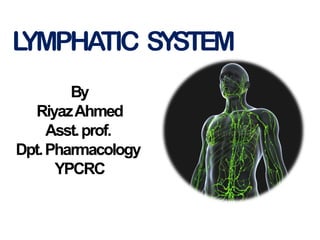
Lymphatic System
Thelymphatic system is a major part of the body's
immune system
The lymphatic system is a subset of the circulatory
system, with a number of actions.
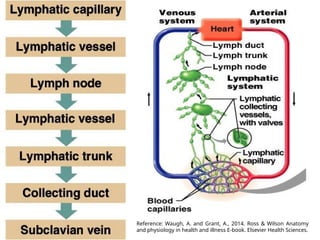
The lymphatic system is a network of organs, lymph
nodes, lymph ducts and lymph vessels that make and
move lymph from tissues of the blood stream.
Lymphatic system is a specialized form of reticular
connective tissue that consists of tissues and organs that
produce, mature and store lymphocytes and
macrophages, for the body's defence purposes.
5.
It actsas a transport channel that carries white blood
cells to and from the lymph nodes into the bones
and antigen presenting cells to the lymph nodes.
Lymphatic capillaries reabsorb excessive tissue fluid
and transport the fluid through the lymphatic
pathway, and ultimately dispose it into the blood.
Lymphatic vessels carry lipid and lipid soluble
vitamins absorbed by the gastrointestinal tract to
blood.
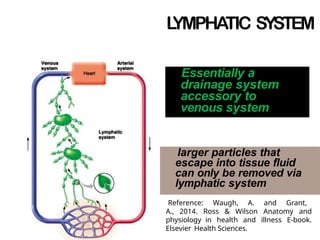
Essentially a
drainage system
accessoryto
venous system
larger particles that
escape into tissue fluid
can only be removed via
lymphatic system
Reference: Waugh, A. and Grant,
A., 2014. Ross & Wilson Anatomy and
physiology in health and illness E-book.
Elsevier Health Sciences.
L
YMPHATIC SYSTEM
8.
Functions of theLymphatic System
24-
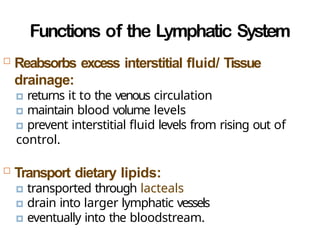
Reabsorbs excess interstitial fluid/ Tissue
drainage:
🞑 returns it to the venous circulation
🞑 maintain blood volume levels
🞑 prevent interstitial fluid levels from rising out of
control.
Transport dietary lipids:
🞑 transported through lacteals
🞑 drain into larger lymphatic vessels
🞑 eventually into the bloodstream.
9.
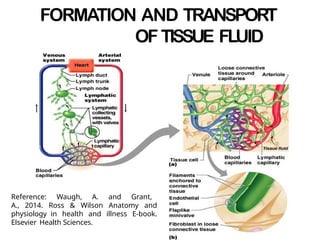
FORMATION AND TRANSPORT
OFTISSUE FLUID
Reference: Waugh, A. and Grant,
A., 2014. Ross & Wilson Anatomy and
physiology in health and illness E-book.
Elsevier Health Sciences.
10.
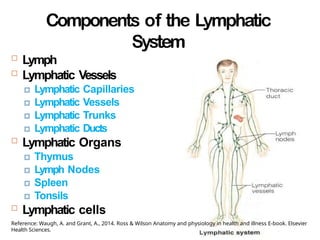
Components of theLymphatic
System
24
Lymph
Lymphatic Vessels
🞑 Lymphatic Capillaries
🞑 Lymphatic Vessels
🞑 Lymphatic Trunks
🞑 Lymphatic Ducts
Lymphatic Organs
🞑 Thymus
🞑 Lymph Nodes
🞑 Spleen
🞑 Tonsils
Lymphatic cells
Reference: Waugh, A. and Grant, A., 2014. Ross & Wilson Anatomy and physiology in health and illness E-book. Elsevier
Health Sciences.
11.
A. Lymph
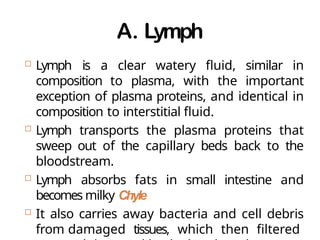
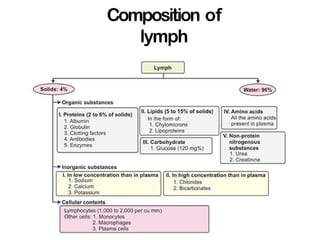
Lymphis a clear watery fluid, similar in
composition to plasma, with the important
exception of plasma proteins, and identical in
composition to interstitial fluid.
Lymph transports the plasma proteins that
sweep out of the capillary beds back to the
bloodstream.
Lymph absorbs fats in small intestine and
becomes milky Chyle
It also carries away bacteria and cell debris
from damaged tissues, which then filtered
Reference: Waugh, A.and Grant, A., 2014. Ross & Wilson Anatomy
and physiology in health and illness E-book. Elsevier Health Sciences.
15.
1. Lymphatic Capillaries
24-
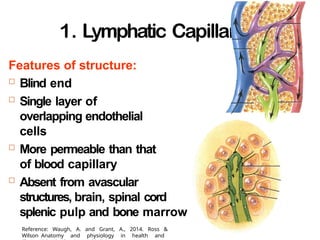
Featuresof structure:
Blind end
Single layer of
overlapping endothelial
cells
More permeable than that
of blood capillary
Absent from avascular
structures, brain, spinal cord
splenic pulp and bone marrow
Reference: Waugh, A. and Grant, A., 2014. Ross &
Wilson Anatomy and physiology in health and
16.
Lymphatic Capillaries –Lacteals
24-
The small intestine contains special types
of lymphatic capillaries called lacteals.
Lacteals pick up not only interstitial fluid,
but also dietary lipids and lipid-soluble
vitamins.
The lymph of this area has a milky color
due to the lipid and is also called chyle.
17.
2. Lymphatic Vessels
24-
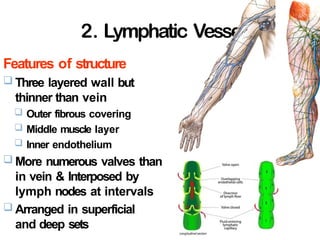
Featuresof structure
Three layered wall but
thinner than vein
Outer fibrous covering
Middle muscle layer
Inner endothelium
More numerous valves than
in vein & Interposed by
lymph nodes at intervals
Arranged in superficial
and deep sets
18.
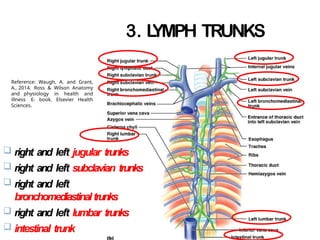
3. L
YMPH TRUNKS
right and left jugular trunks
right and left subclavian trunks
right and left
bronchomediastinaltrunks
right and left lumbar trunks
intestinal trunk
Reference: Waugh, A. and Grant,
A., 2014. Ross & Wilson Anatomy
and physiology in health and
illness E- book. Elsevier Health
Sciences.
19.
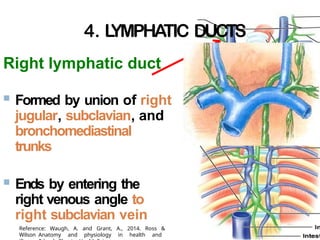
4. L
YMPHATIC DUCTS
24-
Rightlymphatic duct
Formed by union of right
jugular, subclavian, and
bronchomediastinal
trunks
Ends by entering the
right venous angle to
right subclavian vein
Reference: Waugh, A. and Grant, A., 2014. Ross &
Wilson Anatomy and physiology in health and
20.
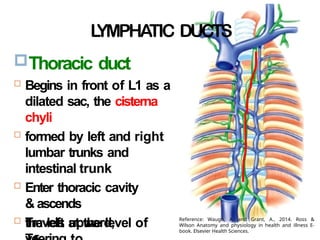
,
Thoracic duct
Beginsin front of L1 as a
dilated sac, the cisterna
chyli
formed by left and right
lumbar trunks and
intestinal trunk
Enter thoracic cavity
& ascends
Travels upward,
the left at the level of
L
YMPHA
TIC DUCTS
Reference: Waugh, A. and Grant, A., 2014. Ross &
Wilson Anatomy and physiology in health and illness E-
book. Elsevier Health Sciences.
21.
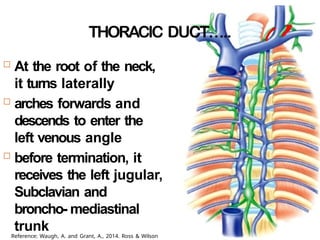
THORACIC DUCT…..
Atthe root of the neck,
it turns laterally
arches forwards and
descends to enter the
left venous angle
before termination, it
receives the left jugular,
Subclavian and
broncho- mediastinal
trunk
Reference: Waugh, A. and Grant, A., 2014. Ross & Wilson
22.
DRAINAGE P
A
TTERN
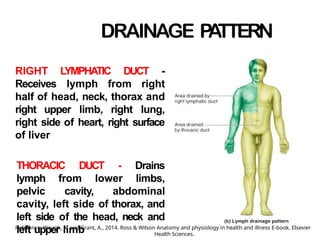
RIGHT L
YMPHATICDUCT -
Receives lymph from right
half of head, neck, thorax and
right upper limb, right lung,
right side of heart, right surface
of liver
THORACIC DUCT - Drains
lymph from lower limbs,
pelvic cavity, abdominal
cavity, left side of thorax, and
left side of the head, neck and
left upper limb
Reference: Waugh, A. and Grant, A., 2014. Ross & Wilson Anatomy and physiology in health and illness E-book. Elsevier
Health Sciences.
23.
Lymphatic Cells
24-
Alsocalled lymphoid cells.
Located in both the lymphatic system and
the cardiovascular system.
Work together to elicit an immune response.
Types of lymphatic cells are:
🞑 macrophages
🞑 epithelial cells
🞑 dendritic cells
🞑 lymphocytes
24.
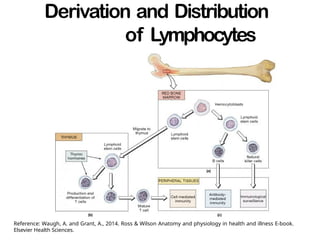
Derivation and Distribution
ofLymphocytes
Reference: Waugh, A. and Grant, A., 2014. Ross & Wilson Anatomy and physiology in health and illness E-book.
Elsevier Health Sciences.
25.
Summary
Lymph isa colourless fluid derived from the ECF
It is circulates through lymphatic
capillaries, lymphatic vessels, lymph
nodes, lymphatic trunks
and lymphatic ducts and
finally reaches heart
through venecava.
It mainly helps in the maintenance of ECF
volume, absorption of nutrients from food in
intestines and in maturation of T and B cells
26.
References
Waugh, A.and Grant, A., 2014. Ross &
Wilson Anatomy and physiology in health
and illness E-book. Elsevier Health
Sciences.
Tortora, G.J. and Derrickson, B.H., 2018.
Principles of anatomy and physiology.
John Wiley & Sons.
Sembulingam, K. and Sembulingam, P
.,
2012. Essentials of medical physiology. JP
Medical Ltd.
26
#24 Presenter
2022-11-30 07:19:55
-------------------------------------------- FG23_07.JPG
Title: Derivation and Distribution of Lymphocytes
Notes: Hemocytoblast divisions produce lymphocytic stem cells with two different fates. One group remains in the bone marrow, producing B cells and NK cells. The second group migrates to the thymus, producing T cells. All three types circulate in the bloodstream Keywords: lymphocytes, derivation, distribution, hemocytoblast, lymphoid stem cells, B cells, NK cells, migratory lymphoid stem, thymus, T cells, red bone marrow, peripheral tissue