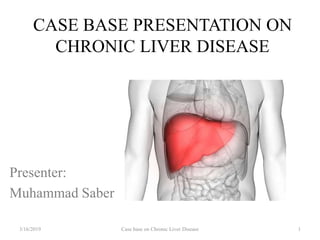
CASE BASE PRESENTATION ON
CHRONIC LIVER DISEASE
Presenter:
Muhammad Saber
3/16/2019 Case base on Chronic Liver Disease 1
Objectives
• Discus the scenario of my case base selective
patient
• Explain the patient’s present and previous health
history
• Discus the chronic liver disease
• Explain the causes of chronic liver disease
• Review the pathophysiology of chronic liver
disease
• Prepare the nursing management
3/16/2019 Case base on Chronic Liver Disease 2
Case base Scenario
• A male 53 Y old patient admitted in Hospital
with Diagnosis of Chronic Liver Disease,
known case of hepatitis C from one year, came
in ER with complain of abdominal distention
and swelling on feet's from one week and
umbilicus hernia on admitting day.
3/16/2019 Case base on Chronic Liver Disease 3
Physical assessment Findings
• Inspection:
General condition sunken eyes, abdominal
distention, palmer erythema , bruises, lower
extremities, confused status, jaundice, ascites
(fluid), dilated veins and vascular spiders present.
edema grade +2, umbilical hernia.
• Auscultation:
Bowl sounds present 14, bruits not heard due to
abdominal distention
3/16/2019 Case base on Chronic Liver Disease 4
Cont.….
• Palpation:
fluid wave/ fluid thrill sign positive, no any mass
tenderness palpable, hepatomegaly present.
• Percussion
• Enlarge liver size , dull sound present in
abdominal area
3/16/2019 Case base on Chronic Liver Disease 5
Past Medical History (PMH)
• Patient is non diabetic, non asthmatic, non
hypertensive and no any other previous history
of surgery
• Patient frequent visit general practitioner
monthly 2 to 3 times in a month they inject i.m
Injections due to body and back pain.
3/16/2019 Case base on Chronic Liver Disease 6
Cont.…
• Patient have no know any allergy
• Patient Smoking daily 2 pack form last 38
Years
• No any history alcoholism and drug abuse
• No any history of genetic disorders in family
3/16/2019 Case base on Chronic Liver Disease 7
Cirrhosis of liver
Cirrhosis is a chronic disease characterized by
replacement of normal liver tissue with diffuse
fibrosis that disrupts the structure and function of
the liver.
Late stage progressive hepatic fibrosis
characterized by the destruction of the hepatic
architecture and formation of regenerative
nodules.
3/16/2019 Case base on Chronic Liver Disease 8
Causes
Common Causes Less common causes
• Autoimmune
Hepatitis
• Wilson’s Disease
• Medications
• Celiac disease
• Prolong viral
hepatitis
• Alcoholic liver
disease
• Hematoma
chromatosis
3/16/2019 Case base on Chronic Liver Disease 9
Sign and Symptoms
• Earlier sign asymptomatic
• Hepatomegaly
• Splenomegaly
• Ascites
• Hepatic encephalopathy
• Browsing
• Spider nevi
• Jaundice
• Gynecomastia
3/16/2019 Case base on Chronic Liver Disease 10
Prevalence
Liver cirrhosis has many possible causes:
• Globally, 57% of cirrhosis is attributable to
either hepatitis B (30%) or hepatitis C (27%).
• Alcohol consumption is another major cause,
accounting for about 20% .
• Primary biliary cholangitis
• Autoimmune hepatitis.
3/16/2019 Case base on Chronic Liver Disease 11
Infection/alcohol/other long time hepatocytes
It form scared tissue
Cells become fibrotic and thickened with protein
Linen become scaring and damage
It doesn't reversible changes become fibrotic
Called Liver Cirrhosis (End stage of Liver damage)
Pathophysiology
3/16/2019 Case base on Chronic Liver Disease 12
Diagnosis
• Liver function tests
Serum Alkaline Phosphatase, Aspartate
Aminotransferase
• ALT
Serum Glutamic Pyruvic Transaminase
• ABGs
• Biopsy
• Ultrasound Abdomen
• CT scan
3/16/2019 Case base on Chronic Liver Disease 13
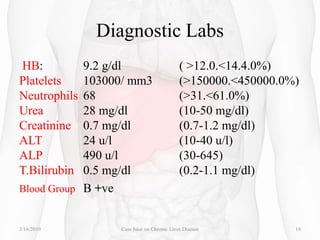
Diagnostic Labs
HB: 9.2 g/dl ( >12.0.<14.4.0%)
Platelets 103000/ mm3 (>150000.<450000.0%)
Neutrophils 68 (>31.<61.0%)
Urea 28 mg/dl (10-50 mg/dl)
Creatinine 0.7 mg/dl (0.7-1.2 mg/dl)
ALT 24 u/l (10-40 u/l)
ALP 490 u/l (30-645)
T.Bilirubin 0.5 mg/dl (0.2-1.1 mg/dl)
Blood Group B +ve
3/16/2019 Case base on Chronic Liver Disease 14
Diagnostic Procedures
• Ultrasound abdomen
Findings are of coarse liver with nodular margins and
enlarged spleen with gross ascites, features are likely
chronic liver disease
• Asiatic R/E
White Cell 199/ mm3, Neutrophils 59%, Mononuclear
Cells 41%
Albumin 2.5g/dl
3/16/2019 Case base on Chronic Liver Disease 15
Risk Factors for Hepatitis C
• Recipient of blood products or organ transplant
before1992 or clotting factor concentrates before 1987
• Health care and public safety workers after needle
stick injuries or mucosal exposure to blood
• Children born to women infected with hepatitis C
virus
• Past/current illicit IV/injection drug use
• Past treatment with chronic hemodialysis
• Multiple sex partners, history of sexually transmitted
disease, unprotected sex
3/16/2019 Case base on Chronic Liver Disease 16
Treatment
• Preventing further liver damage
• Treat the underlying cause.
• Transplantation
• Decompensated cirrhosis
3/16/2019 Case base on Chronic Liver Disease 17
Medication
• Inj Rocepin 1g x BID x I/V
– (Ceftriaxone)
• Inj Risek 40mg x OD x I/V
– (Omeprazole)
• Syp Lilac 2TSF x TDS x P/O
– (lactulose)
• Cap Rifaxa 550mg x BID x P/O
– (Rifaximin)
• Tab Carvida 3.12mg x BID x P/O
– (Carvidalol)
• Tab Lasix 80mg x OD x P/O
– (Furosmide)
• Tab Aldactone 200mg x OD x P/O
– (Spironolactone)
3/16/2019 Case base on Chronic Liver Disease 18
Complications
• Portal Hypertension
• Ascites
• Hepatic encephalopathy
• Bacterial peritonitis
• Hepatorenal Syndrome
• Varsial hemorrhage
• Encephalopathy
3/16/2019 Case base on Chronic Liver Disease 19
Nursing management
Ineffective breathing pattern related to intra abdomen
fluid collection as evidence by ascites:
i. Daily weight and abdomen girth.
ii. Keep head elevated, position on side
iii. Encourage frequent repositioning and deep breath
exercise.
iv. Monitor SpO2 and ABG’s
v. Educate and assist the innovative spirometry.
3/16/2019 Case base on Chronic Liver Disease 20
Nursing management
Excessive fluid volume related to excessive sodium
and fluid intake as evidence by edema:
i. Measure intake, out put and daily weight.
ii. Monitor BP and abdominal veins distention.
iii. Monitor for cardio arrhythmias.
iv. Assess degree of peripheral edema.
v. Monitor the electrolyte balance.
3/16/2019 Case base on Chronic Liver Disease 21
Nursing management
• Imbalance nutrition less their body requirements
related to inadequate diet as evidence by weight
loss and poor muscle tone:
i. Measure the datary intake by calories count.
ii. Tell the patient diet and encourage to eat food as
body requirement.
iii. Restrict intake of coffee, spicy food and drinks.
iv. Monitor laboratory labs
3/16/2019 Case base on Chronic Liver Disease 22
Nursing management
• Deficit knowledge related to lack of exposure as
evidence request for information:
i. Review the disease process and future
expectations.
ii. Emphasize the importance of good nutrition
recommend avoid of high protein diet.
iii. Discus sodium and salt substitute rustication.
iv. Encourage to follow schedule activities and
Ceducate
v. Provide mind devotion activitied
3/16/2019 Case base on Chronic Liver Disease 23
Reference:
• Handbook for Brunner and Suddarth's Textbook of Medical-
Surgical Nursing, 12th Edition-Suzann
• Brunner and Suddarth's Textbook of Med.-Surg. Nursing 12th
ed. (2 vols) - S. Smeltzer, et al., (Lippincott, 2010) BBS
• Perz JF, Armstrong GL, Farrington LA, Hutin YJ, Bell BP
(October 2006). "The contributions of hepatitis B virus and
hepatitis C virus infections to cirrhosis and primary liver
cancer worldwide". J. Hepatol. 45 (4): 529–38.
doi:10.1016/j.jhep.2006.05.013. PMID 16879891.
• Nursing Diagnosis Application to Clinical Practice 14th
edition Lynda JUALL Carpenito, RN, MSN, CRNP
3/16/2019 Case base on Chronic Liver Disease 24
Thank You
3/16/2019 Case base on Chronic Liver Disease 25

Case base presentation on chronic liver disease

  • 1.
    CASE BASE PRESENTATIONON CHRONIC LIVER DISEASE Presenter: Muhammad Saber 3/16/2019 Case base on Chronic Liver Disease 1
  • 2.
    Objectives • Discus thescenario of my case base selective patient • Explain the patient’s present and previous health history • Discus the chronic liver disease • Explain the causes of chronic liver disease • Review the pathophysiology of chronic liver disease • Prepare the nursing management 3/16/2019 Case base on Chronic Liver Disease 2
  • 3.
    Case base Scenario •A male 53 Y old patient admitted in Hospital with Diagnosis of Chronic Liver Disease, known case of hepatitis C from one year, came in ER with complain of abdominal distention and swelling on feet's from one week and umbilicus hernia on admitting day. 3/16/2019 Case base on Chronic Liver Disease 3
  • 4.
    Physical assessment Findings •Inspection: General condition sunken eyes, abdominal distention, palmer erythema , bruises, lower extremities, confused status, jaundice, ascites (fluid), dilated veins and vascular spiders present. edema grade +2, umbilical hernia. • Auscultation: Bowl sounds present 14, bruits not heard due to abdominal distention 3/16/2019 Case base on Chronic Liver Disease 4
  • 5.
    Cont.…. • Palpation: fluid wave/fluid thrill sign positive, no any mass tenderness palpable, hepatomegaly present. • Percussion • Enlarge liver size , dull sound present in abdominal area 3/16/2019 Case base on Chronic Liver Disease 5
  • 6.
    Past Medical History(PMH) • Patient is non diabetic, non asthmatic, non hypertensive and no any other previous history of surgery • Patient frequent visit general practitioner monthly 2 to 3 times in a month they inject i.m Injections due to body and back pain. 3/16/2019 Case base on Chronic Liver Disease 6
  • 7.
    Cont.… • Patient haveno know any allergy • Patient Smoking daily 2 pack form last 38 Years • No any history alcoholism and drug abuse • No any history of genetic disorders in family 3/16/2019 Case base on Chronic Liver Disease 7
  • 8.
    Cirrhosis of liver Cirrhosisis a chronic disease characterized by replacement of normal liver tissue with diffuse fibrosis that disrupts the structure and function of the liver. Late stage progressive hepatic fibrosis characterized by the destruction of the hepatic architecture and formation of regenerative nodules. 3/16/2019 Case base on Chronic Liver Disease 8
  • 9.
    Causes Common Causes Lesscommon causes • Autoimmune Hepatitis • Wilson’s Disease • Medications • Celiac disease • Prolong viral hepatitis • Alcoholic liver disease • Hematoma chromatosis 3/16/2019 Case base on Chronic Liver Disease 9
  • 10.
    Sign and Symptoms •Earlier sign asymptomatic • Hepatomegaly • Splenomegaly • Ascites • Hepatic encephalopathy • Browsing • Spider nevi • Jaundice • Gynecomastia 3/16/2019 Case base on Chronic Liver Disease 10
  • 11.
    Prevalence Liver cirrhosis hasmany possible causes: • Globally, 57% of cirrhosis is attributable to either hepatitis B (30%) or hepatitis C (27%). • Alcohol consumption is another major cause, accounting for about 20% . • Primary biliary cholangitis • Autoimmune hepatitis. 3/16/2019 Case base on Chronic Liver Disease 11
  • 12.
    Infection/alcohol/other long timehepatocytes It form scared tissue Cells become fibrotic and thickened with protein Linen become scaring and damage It doesn't reversible changes become fibrotic Called Liver Cirrhosis (End stage of Liver damage) Pathophysiology 3/16/2019 Case base on Chronic Liver Disease 12
  • 13.
    Diagnosis • Liver functiontests Serum Alkaline Phosphatase, Aspartate Aminotransferase • ALT Serum Glutamic Pyruvic Transaminase • ABGs • Biopsy • Ultrasound Abdomen • CT scan 3/16/2019 Case base on Chronic Liver Disease 13
  • 14.
    Diagnostic Labs HB: 9.2g/dl ( >12.0.<14.4.0%) Platelets 103000/ mm3 (>150000.<450000.0%) Neutrophils 68 (>31.<61.0%) Urea 28 mg/dl (10-50 mg/dl) Creatinine 0.7 mg/dl (0.7-1.2 mg/dl) ALT 24 u/l (10-40 u/l) ALP 490 u/l (30-645) T.Bilirubin 0.5 mg/dl (0.2-1.1 mg/dl) Blood Group B +ve 3/16/2019 Case base on Chronic Liver Disease 14
  • 15.
    Diagnostic Procedures • Ultrasoundabdomen Findings are of coarse liver with nodular margins and enlarged spleen with gross ascites, features are likely chronic liver disease • Asiatic R/E White Cell 199/ mm3, Neutrophils 59%, Mononuclear Cells 41% Albumin 2.5g/dl 3/16/2019 Case base on Chronic Liver Disease 15
  • 16.
    Risk Factors forHepatitis C • Recipient of blood products or organ transplant before1992 or clotting factor concentrates before 1987 • Health care and public safety workers after needle stick injuries or mucosal exposure to blood • Children born to women infected with hepatitis C virus • Past/current illicit IV/injection drug use • Past treatment with chronic hemodialysis • Multiple sex partners, history of sexually transmitted disease, unprotected sex 3/16/2019 Case base on Chronic Liver Disease 16
  • 17.
    Treatment • Preventing furtherliver damage • Treat the underlying cause. • Transplantation • Decompensated cirrhosis 3/16/2019 Case base on Chronic Liver Disease 17
  • 18.
    Medication • Inj Rocepin1g x BID x I/V – (Ceftriaxone) • Inj Risek 40mg x OD x I/V – (Omeprazole) • Syp Lilac 2TSF x TDS x P/O – (lactulose) • Cap Rifaxa 550mg x BID x P/O – (Rifaximin) • Tab Carvida 3.12mg x BID x P/O – (Carvidalol) • Tab Lasix 80mg x OD x P/O – (Furosmide) • Tab Aldactone 200mg x OD x P/O – (Spironolactone) 3/16/2019 Case base on Chronic Liver Disease 18
  • 19.
    Complications • Portal Hypertension •Ascites • Hepatic encephalopathy • Bacterial peritonitis • Hepatorenal Syndrome • Varsial hemorrhage • Encephalopathy 3/16/2019 Case base on Chronic Liver Disease 19
  • 20.
    Nursing management Ineffective breathingpattern related to intra abdomen fluid collection as evidence by ascites: i. Daily weight and abdomen girth. ii. Keep head elevated, position on side iii. Encourage frequent repositioning and deep breath exercise. iv. Monitor SpO2 and ABG’s v. Educate and assist the innovative spirometry. 3/16/2019 Case base on Chronic Liver Disease 20
  • 21.
    Nursing management Excessive fluidvolume related to excessive sodium and fluid intake as evidence by edema: i. Measure intake, out put and daily weight. ii. Monitor BP and abdominal veins distention. iii. Monitor for cardio arrhythmias. iv. Assess degree of peripheral edema. v. Monitor the electrolyte balance. 3/16/2019 Case base on Chronic Liver Disease 21
  • 22.
    Nursing management • Imbalancenutrition less their body requirements related to inadequate diet as evidence by weight loss and poor muscle tone: i. Measure the datary intake by calories count. ii. Tell the patient diet and encourage to eat food as body requirement. iii. Restrict intake of coffee, spicy food and drinks. iv. Monitor laboratory labs 3/16/2019 Case base on Chronic Liver Disease 22
  • 23.
    Nursing management • Deficitknowledge related to lack of exposure as evidence request for information: i. Review the disease process and future expectations. ii. Emphasize the importance of good nutrition recommend avoid of high protein diet. iii. Discus sodium and salt substitute rustication. iv. Encourage to follow schedule activities and Ceducate v. Provide mind devotion activitied 3/16/2019 Case base on Chronic Liver Disease 23
  • 24.
    Reference: • Handbook forBrunner and Suddarth's Textbook of Medical- Surgical Nursing, 12th Edition-Suzann • Brunner and Suddarth's Textbook of Med.-Surg. Nursing 12th ed. (2 vols) - S. Smeltzer, et al., (Lippincott, 2010) BBS • Perz JF, Armstrong GL, Farrington LA, Hutin YJ, Bell BP (October 2006). "The contributions of hepatitis B virus and hepatitis C virus infections to cirrhosis and primary liver cancer worldwide". J. Hepatol. 45 (4): 529–38. doi:10.1016/j.jhep.2006.05.013. PMID 16879891. • Nursing Diagnosis Application to Clinical Practice 14th edition Lynda JUALL Carpenito, RN, MSN, CRNP 3/16/2019 Case base on Chronic Liver Disease 24
  • 25.
    Thank You 3/16/2019 Casebase on Chronic Liver Disease 25

Editor's Notes