200
7
J.B. ColeJ.B. Cole
Animal Improvement Programs Laboratory
Agricultural Research Service, USDA, Beltsville, MD
john.cole@ars.usda.gov
Genetic Evaluation of CalvingGenetic Evaluation of Calving
Traits in US HolsteinsTraits in US Holsteins
LSU 2007 – Animal Sciences Seminar (2) Cole
200
7
IntroductionIntroduction
 National evaluations were introduced for
Holstein calving ease (CE) in August 2002
and for stillbirth (SB) in August 2006.
 A calving ability index (CA$) which
includes SB and calving ease (CE) was
developed.
 Relationships among calving traits and
other diseases are being studied.
LSU 2007 – Animal Sciences Seminar (3) Cole
200
7
Why the concern?Why the concern?
 Calving difficulty and stillbirth are
expensive (Dematawewa and Berger,
1997; Meyer et al., 2001)
 There is concern that rates of dystocia
and stillbirth are increasing
 Lactations initiated with dystocia have
higher risks for other diseases (Cole et
al., unpublished data).
LSU 2007 – Animal Sciences Seminar (4) Cole
200
7
How do the evaluations work?How do the evaluations work?
 Funded by the National Association
of Animal Breeders
 Data are collected from multiple
sources:
• Pedigree from breed associations
• Calving data from DRPC
 Evaluated using a sire-maternal
grandsire threshold model
LSU 2007 – Animal Sciences Seminar (6) Cole
200
7
Calving ease definitionCalving ease definition
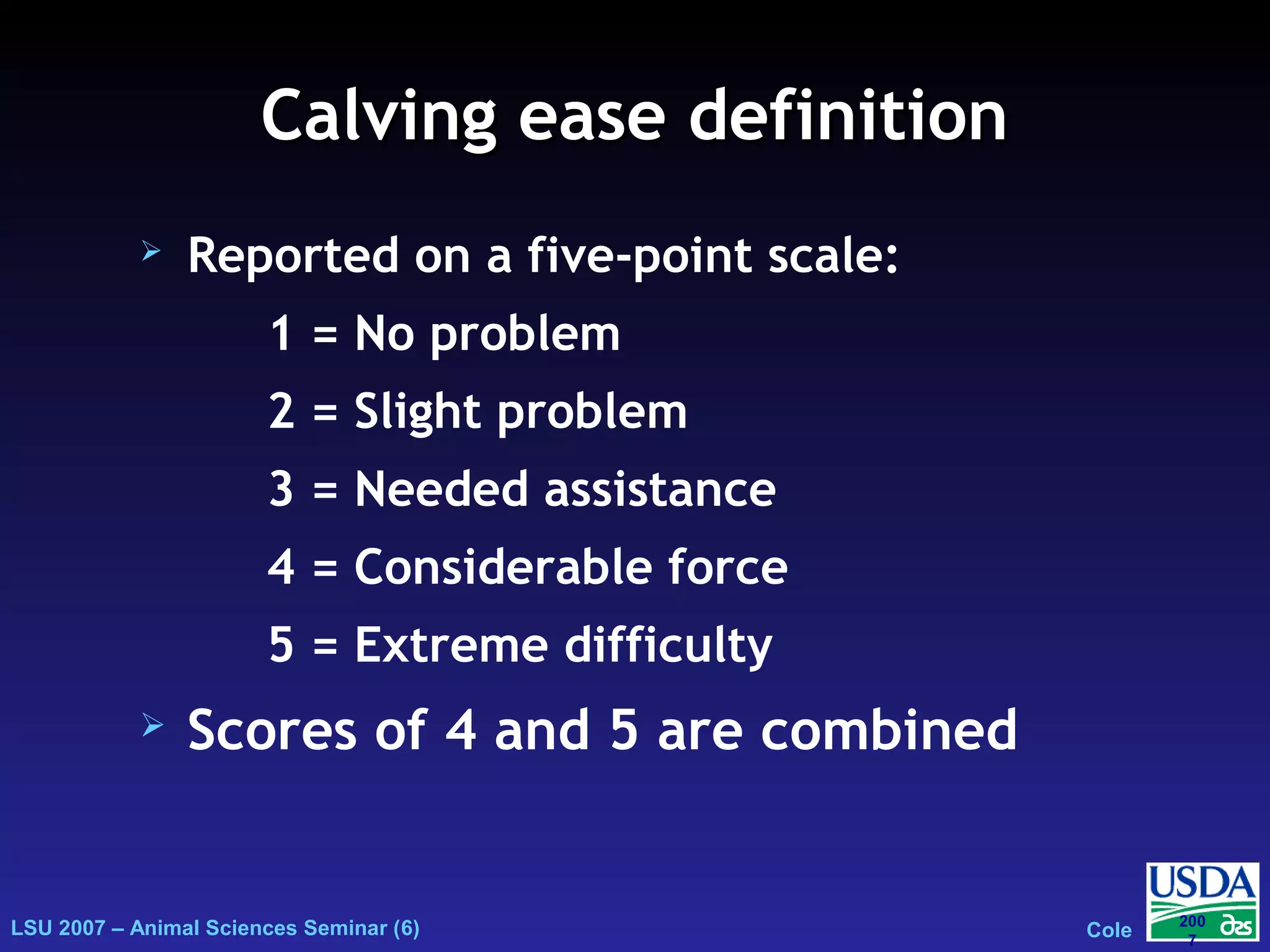
 Reported on a five-point scale:
1 = No problem
2 = Slight problem
3 = Needed assistance
4 = Considerable force
5 = Extreme difficulty
 Scores of 4 and 5 are combined
LSU 2007 – Animal Sciences Seminar (7) Cole
200
7
Stillbirth definitionStillbirth definition
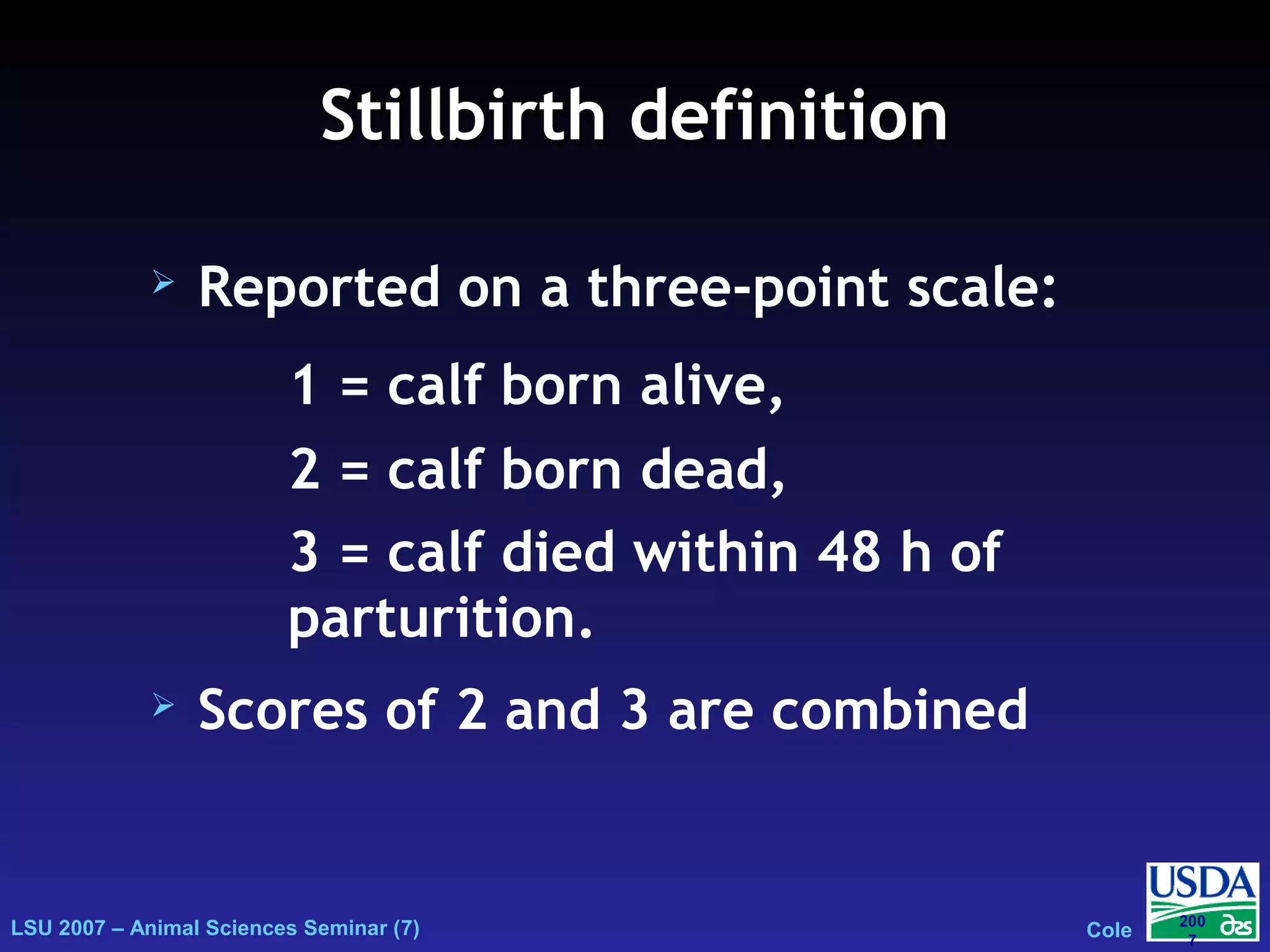
 Reported on a three-point scale:
 Scores of 2 and 3 are combined
1 = calf born alive,
2 = calf born dead,
3 = calf died within 48 h of
parturition.
LSU 2007 – Animal Sciences Seminar (8) Cole
200
7
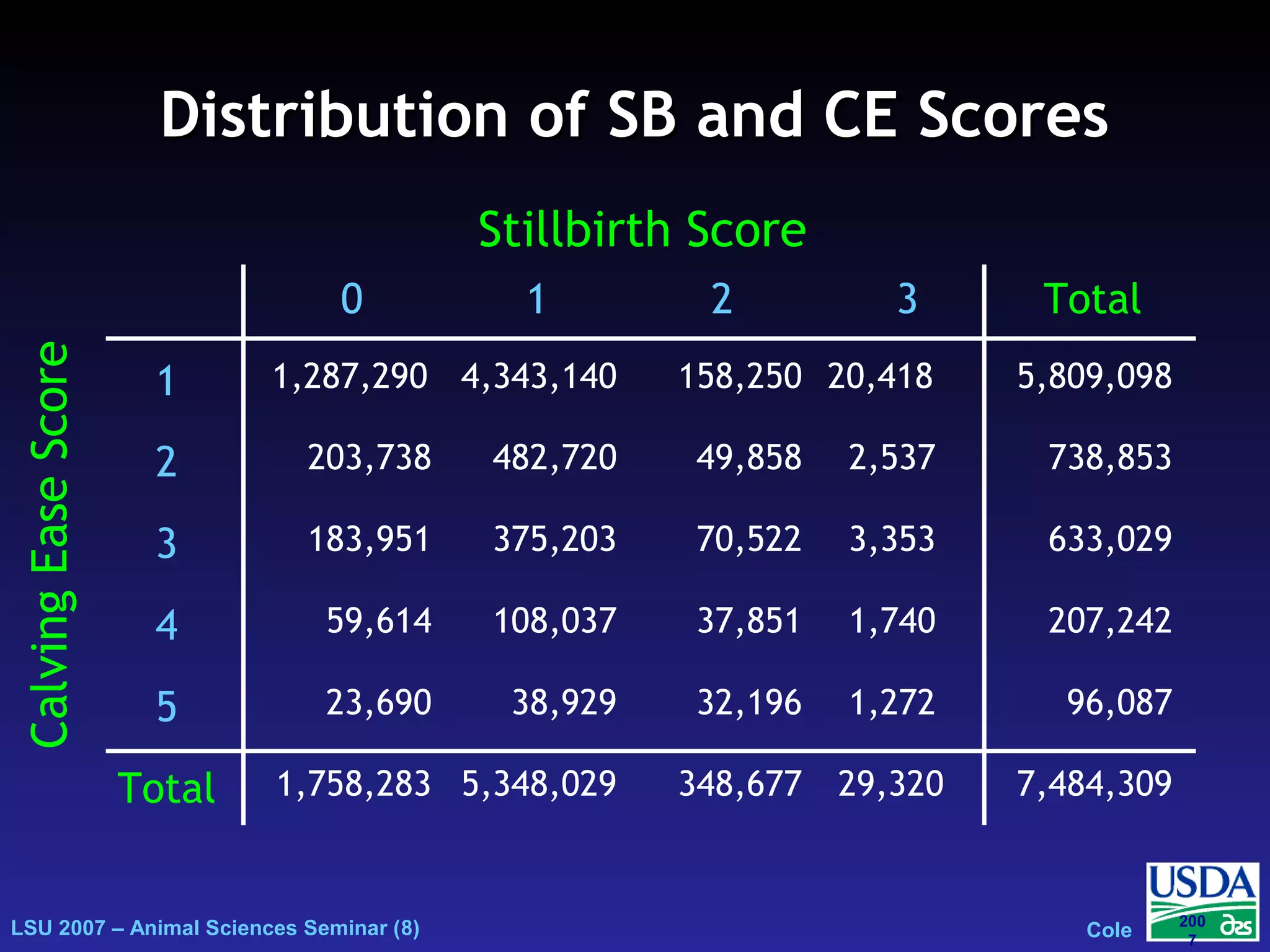
Distribution of SB and CE ScoresDistribution of SB and CE Scores
7,484,30929,320348,6775,348,0291,758,283Total
96,0871,27232,19638,92923,6905
207,2421,74037,851108,03759,6144
633,0293,35370,522375,203183,9513
738,8532,53749,858482,720203,7382
5,809,09820,418158,2504,343,1401,287,2901
Total3210
CalvingEaseScore
Stillbirth Score
LSU 2007 – Animal Sciences Seminar (9) Cole
200
7
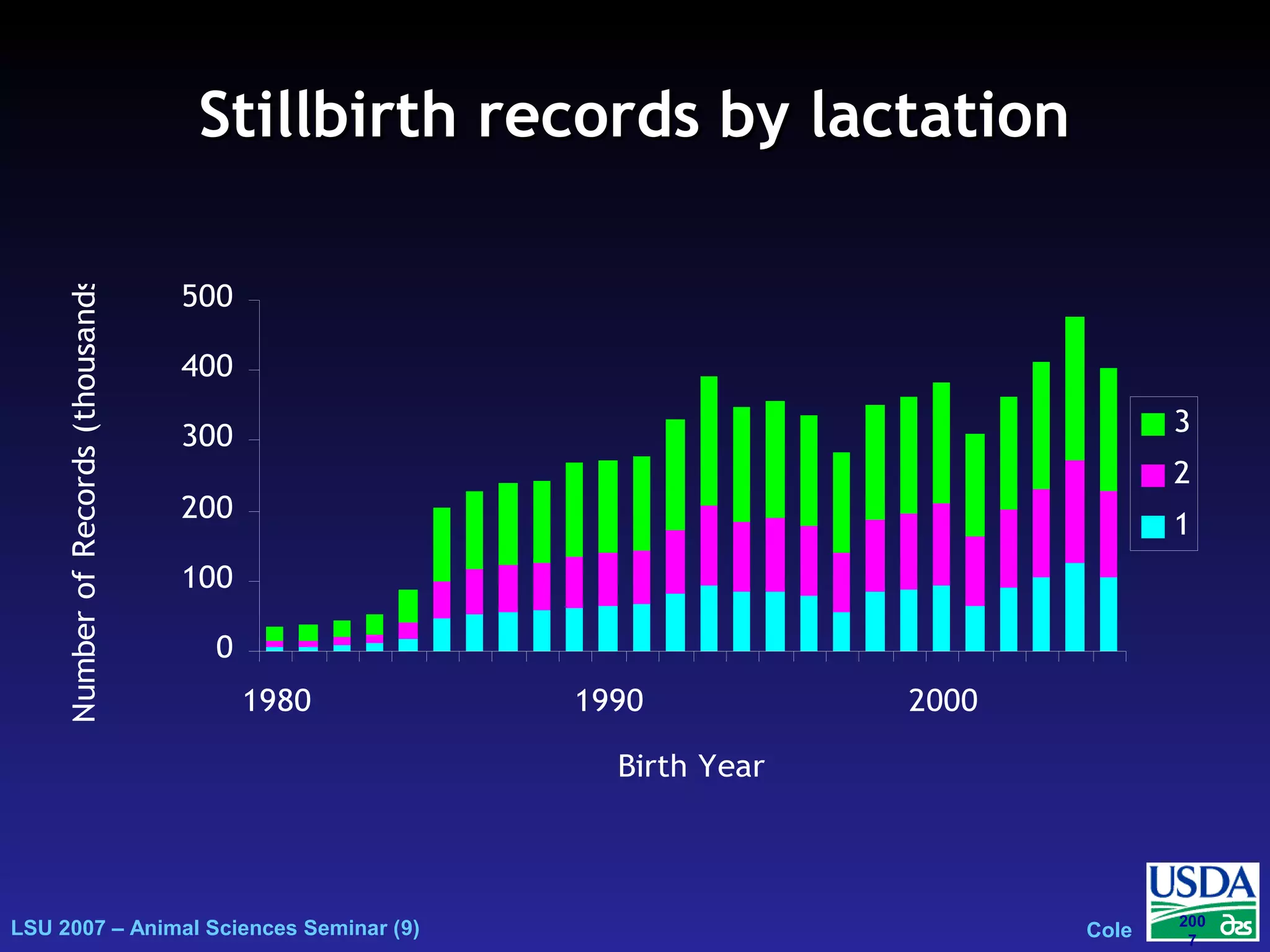
Stillbirth records by lactationStillbirth records by lactation
0
100
200
300
400
500
1980 1990 2000
Birth Year
NumberofRecords(thousands)
3
2
1
LSU 2007 – Animal Sciences Seminar (10) Cole
200
7
Data and editsData and edits
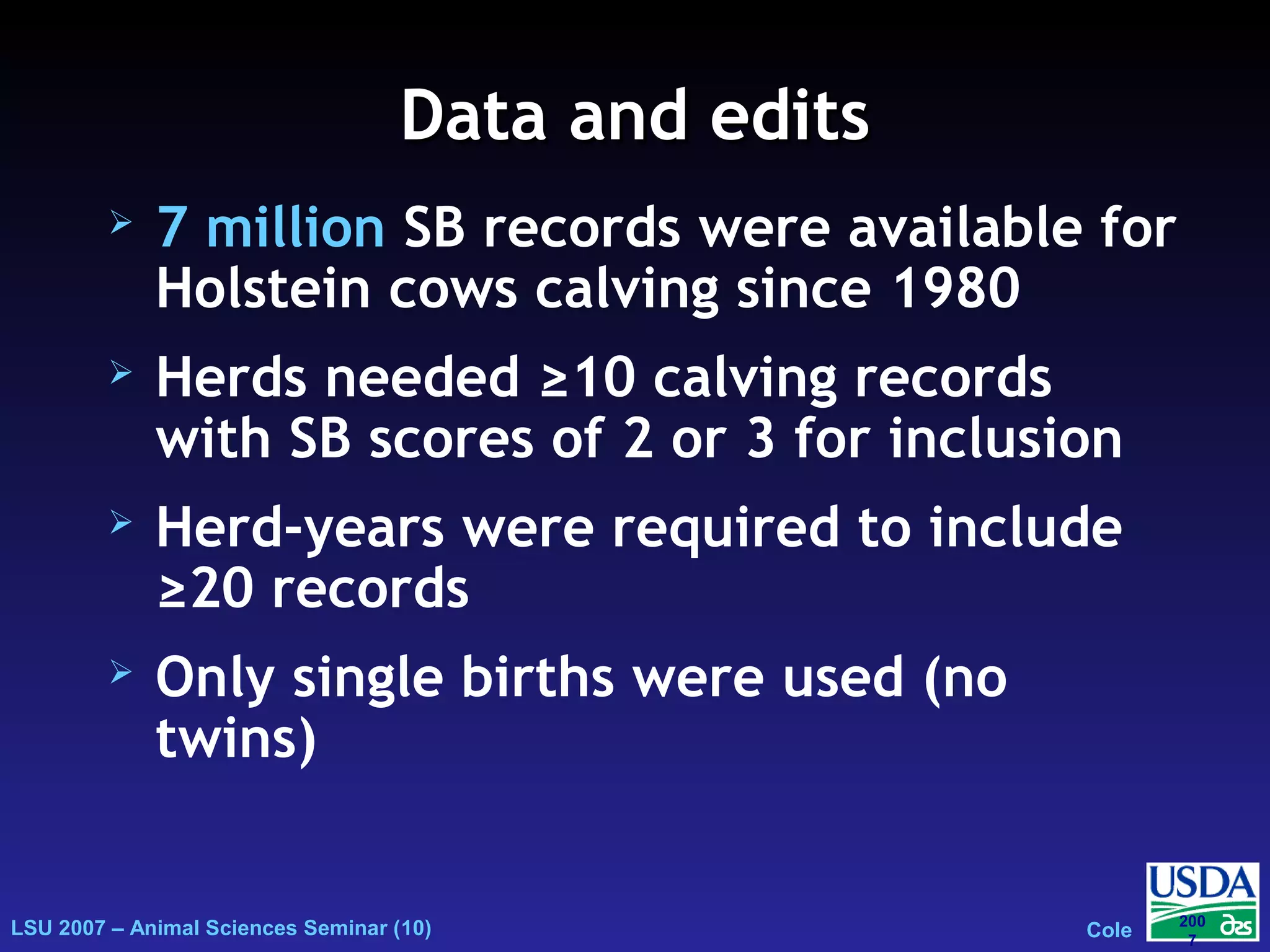
 7 million SB records were available for
Holstein cows calving since 1980
 Herds needed ≥10 calving records
with SB scores of 2 or 3 for inclusion
 Herd-years were required to include
≥20 records
 Only single births were used (no
twins)
LSU 2007 – Animal Sciences Seminar (11) Cole
200
7
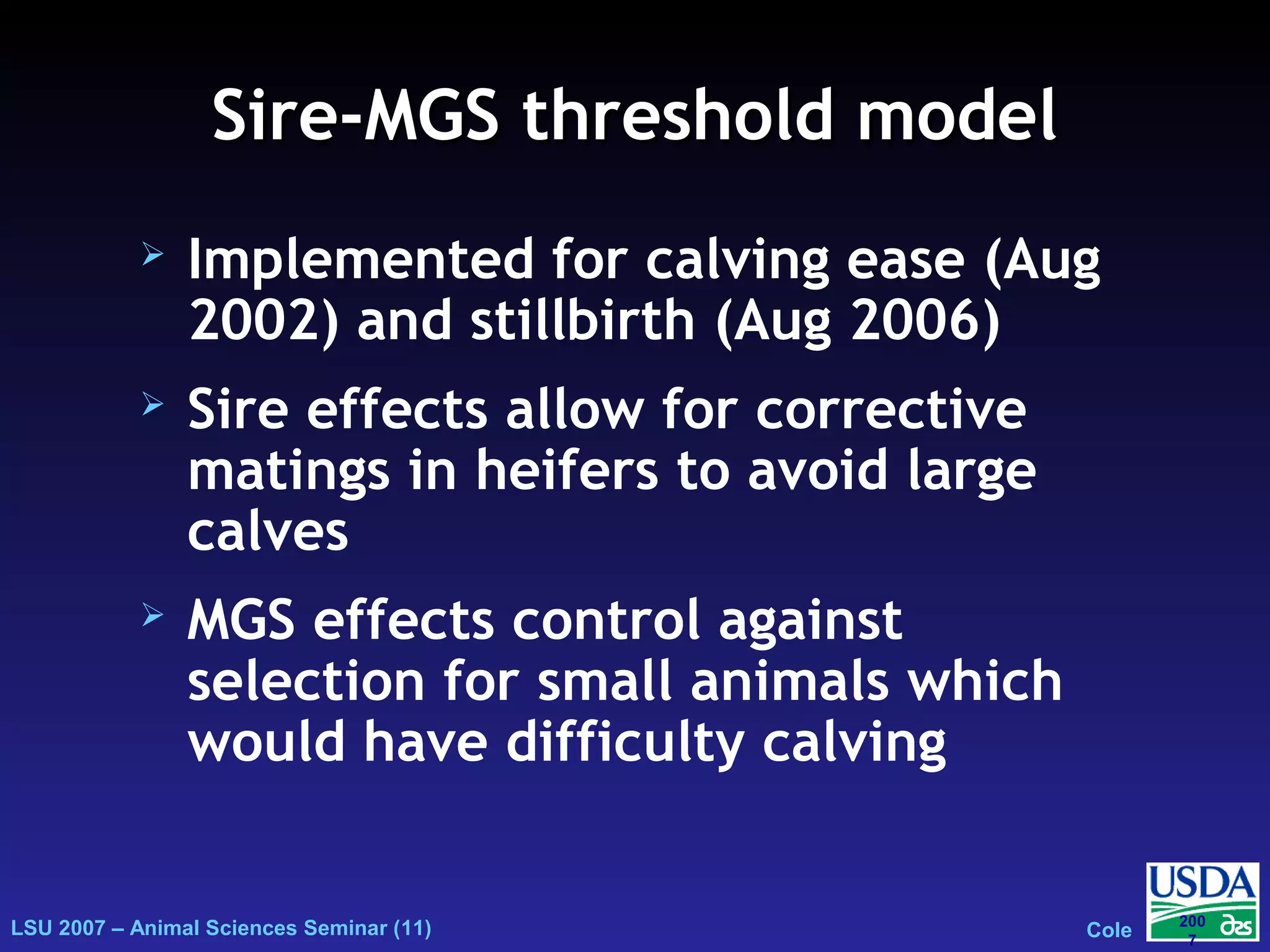
Sire-MGS threshold modelSire-MGS threshold model
 Implemented for calving ease (Aug
2002) and stillbirth (Aug 2006)
 Sire effects allow for corrective
matings in heifers to avoid large
calves
 MGS effects control against
selection for small animals which
would have difficulty calving
LSU 2007 – Animal Sciences Seminar (12) Cole
200
7
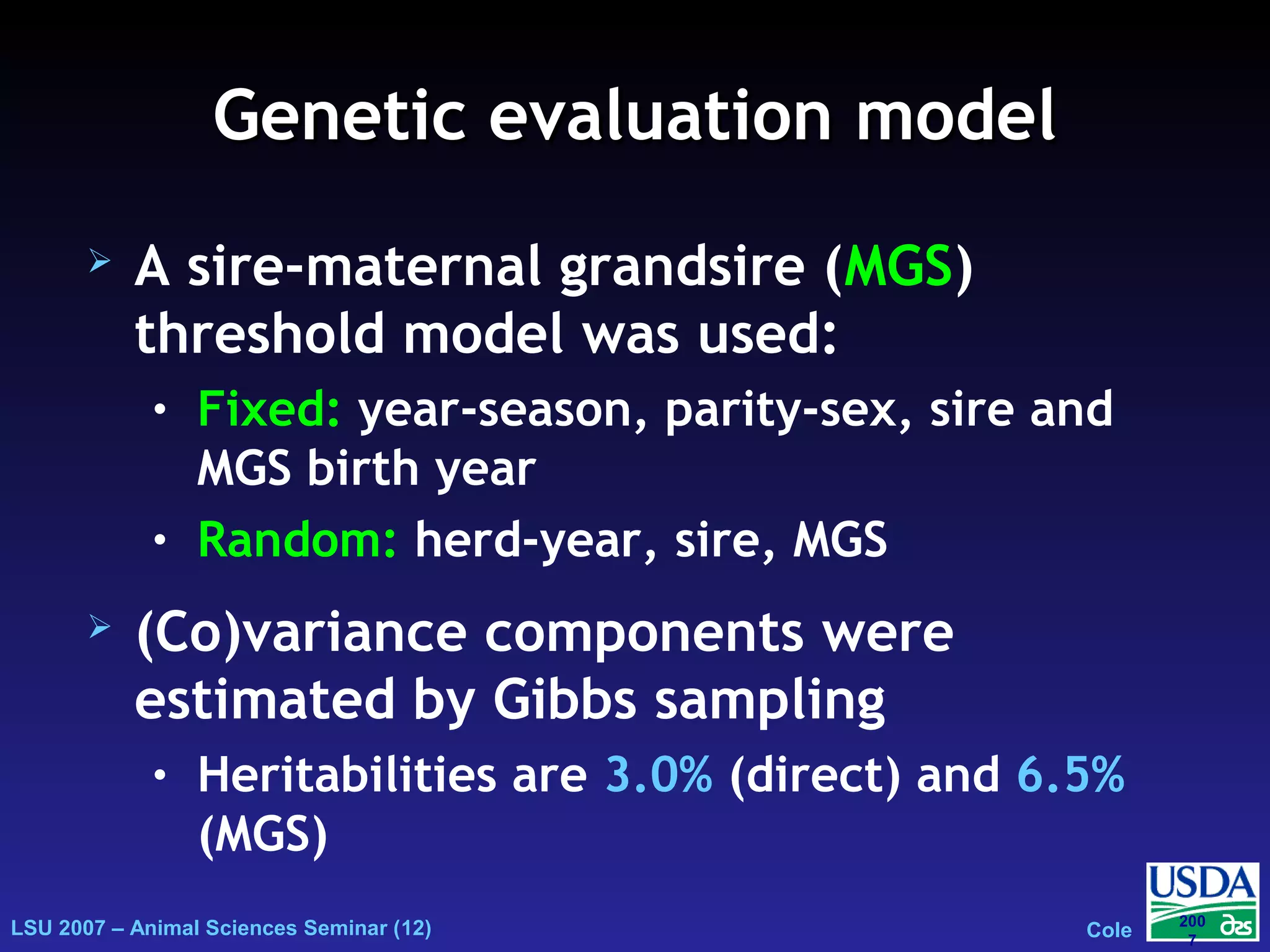
Genetic evaluation modelGenetic evaluation model
 A sire-maternal grandsire (MGS)
threshold model was used:
• Fixed: year-season, parity-sex, sire and
MGS birth year
• Random: herd-year, sire, MGS
 (Co)variance components were
estimated by Gibbs sampling
• Heritabilities are 3.0% (direct) and 6.5%
(MGS)
ijklnoprnplonlkjiijklnopr emsBMBSPSYShyy +++++++= ijklnoprnplonlkjiijklnopr emsBMBSPSYShyy +++++++= ijklnoprnplonlkjiijklnopr emsBMBSPSYShyy +++++++=
LSU 2007 – Animal Sciences Seminar (13) Cole
200
7
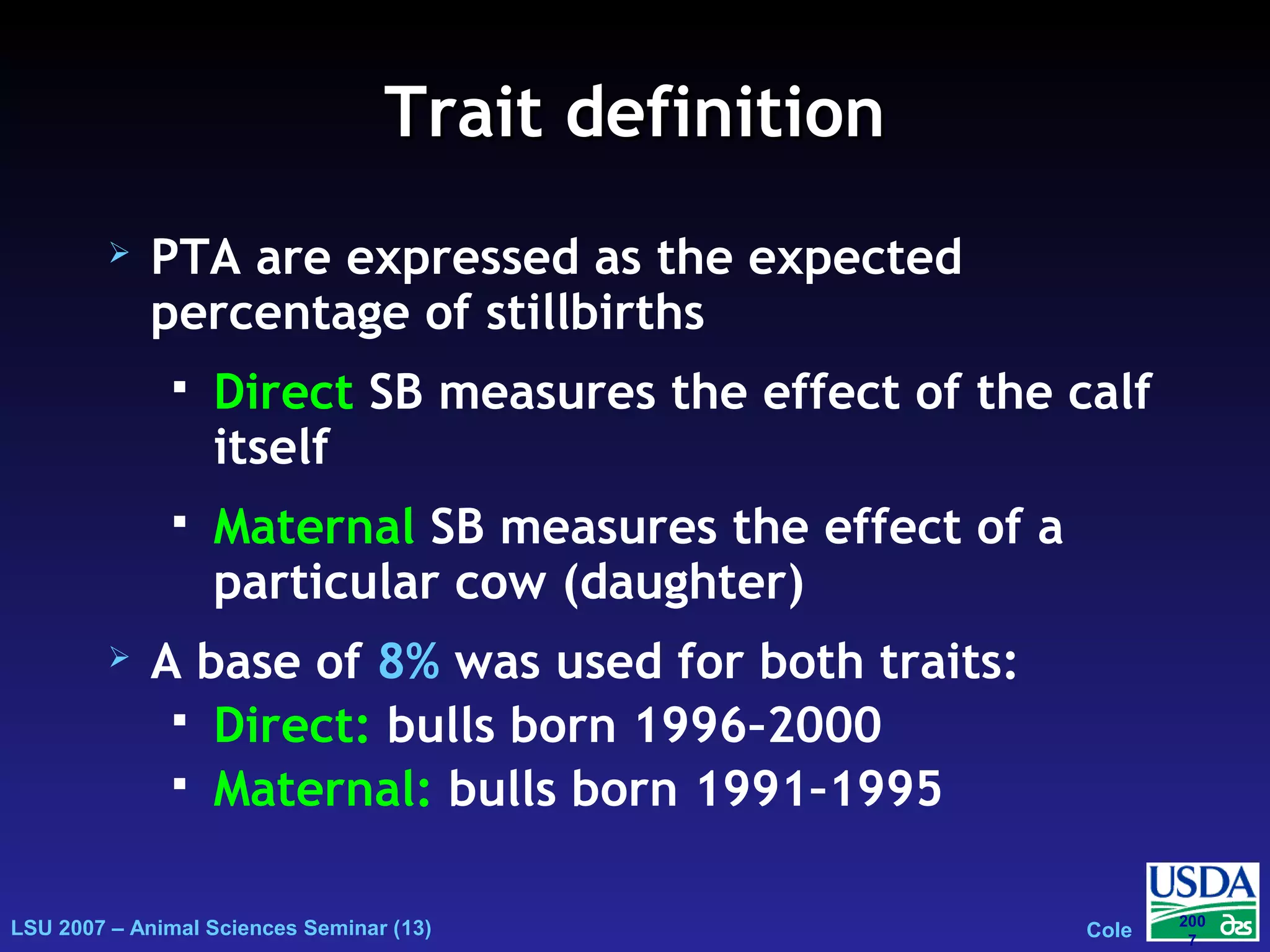
Trait definitionTrait definition
 PTA are expressed as the expected
percentage of stillbirths
 Direct SB measures the effect of the calf
itself
 Maternal SB measures the effect of a
particular cow (daughter)
 A base of 8% was used for both traits:
 Direct: bulls born 1996–2000
 Maternal: bulls born 1991–1995
LSU 2007 – Animal Sciences Seminar (14) Cole
200
7
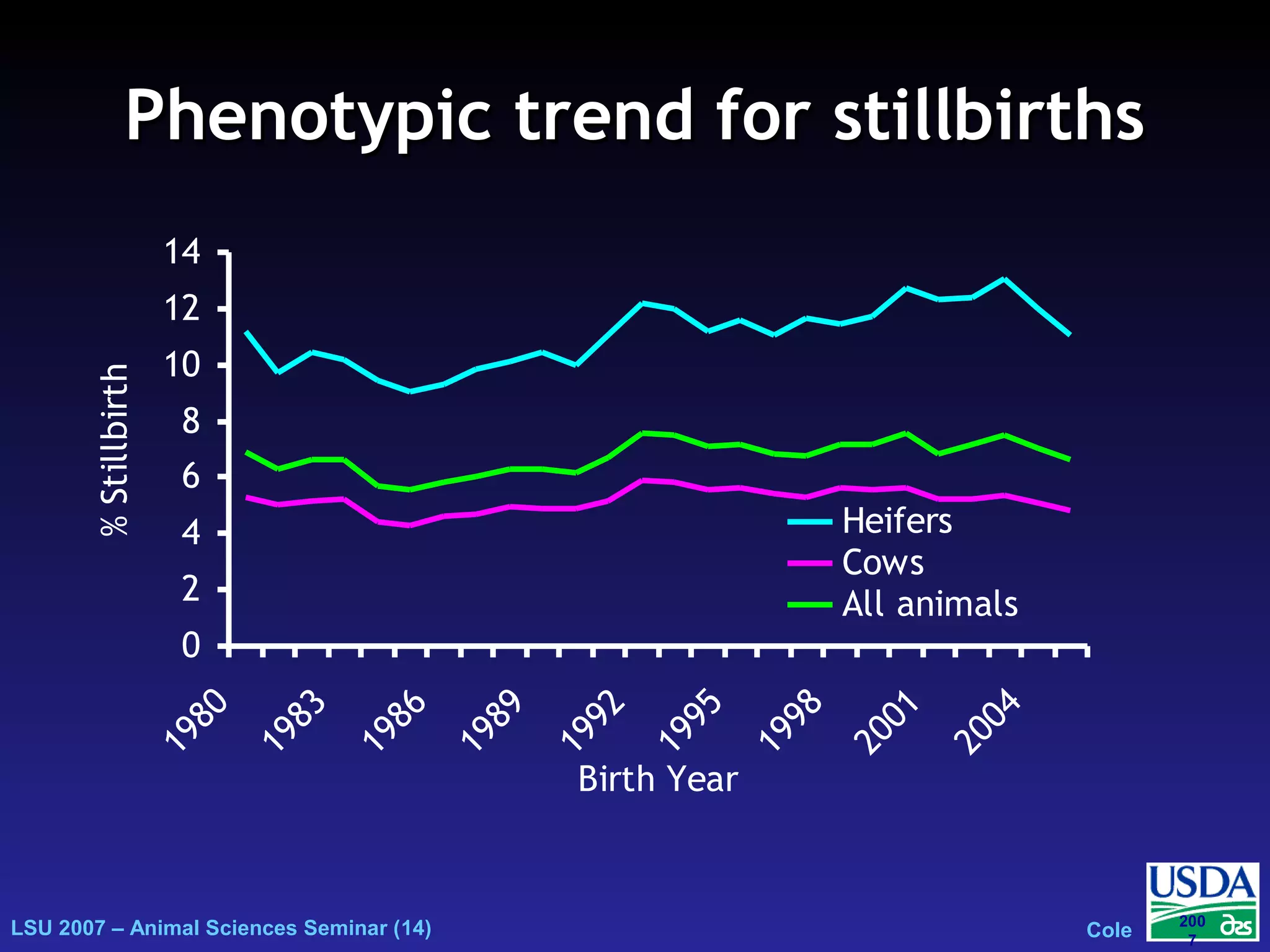
Phenotypic trend for stillbirthsPhenotypic trend for stillbirths
0
2
4
6
8
10
12
14
1980
1983
1986
1989
1992
1995
1998
2001
2004
Birth Year
%Stillbirth
Heifers
Cows
All animals
LSU 2007 – Animal Sciences Seminar (15) Cole
200
7
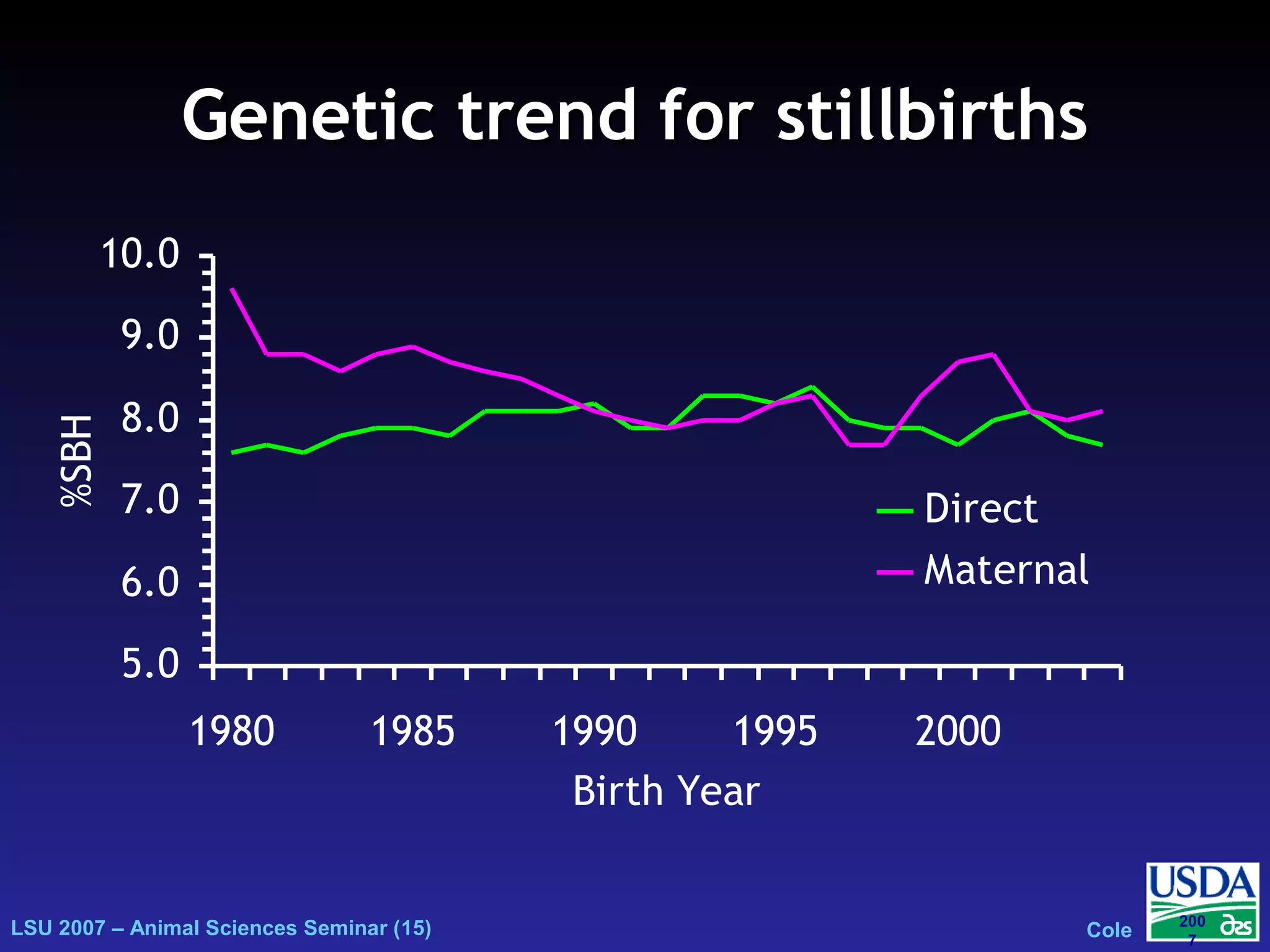
Genetic trend for stillbirthsGenetic trend for stillbirths
5.0
6.0
7.0
8.0
9.0
10.0
1980 1985 1990 1995 2000
Birth Year
%SBH
Direct
Maternal
LSU 2007 – Animal Sciences Seminar (16) Cole
200
7
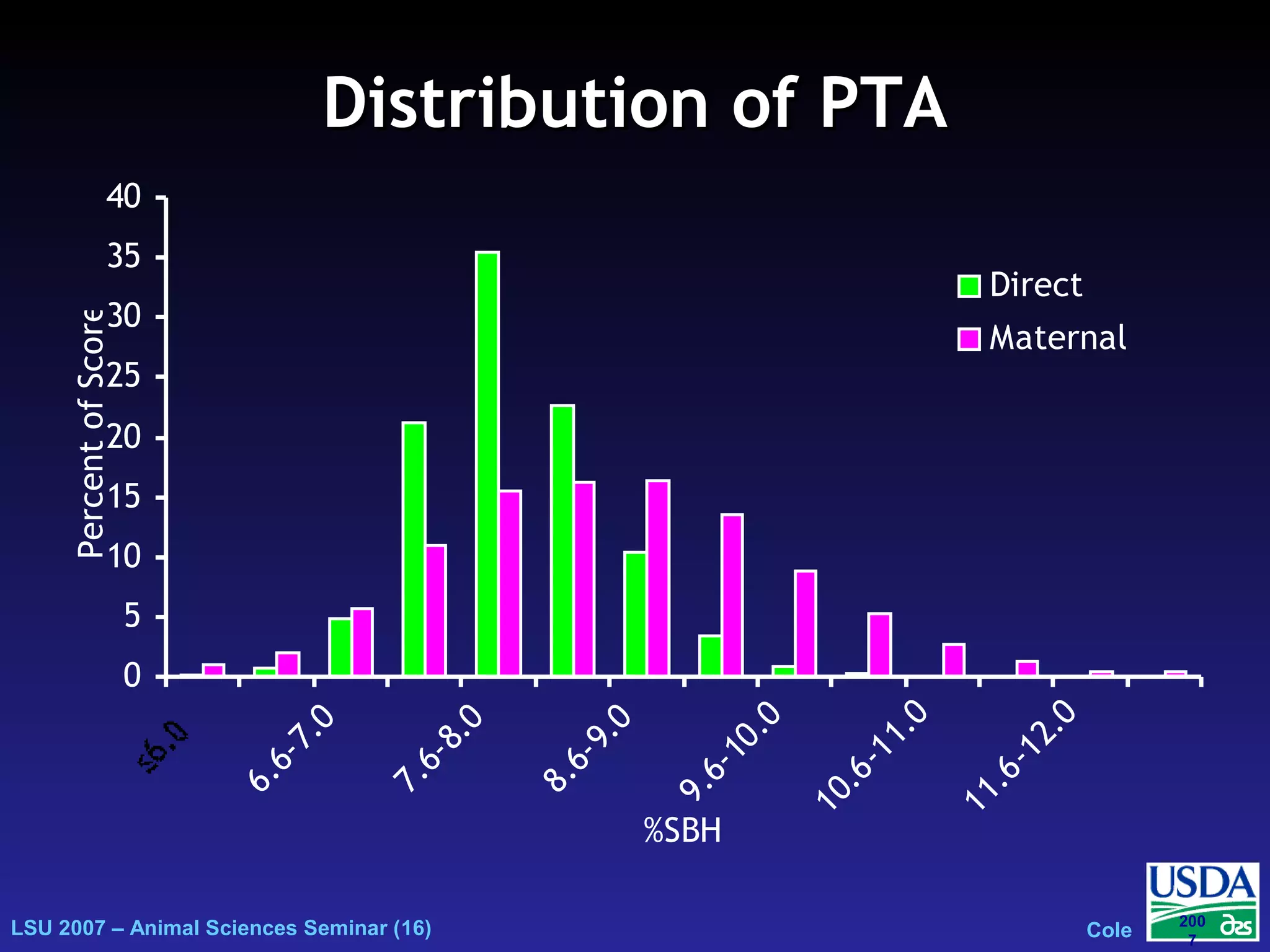
Distribution of PTADistribution of PTA
0
5
10
15
20
25
30
35
40
6.6-7.0
7.6-8.0
8.6-9.0
9.6-10.0
10.6-11.0
11.6-12.0
%SBH
PercentofScoress
Direct
Maternal
LSU 2007 – Animal Sciences Seminar (17) Cole
200
7
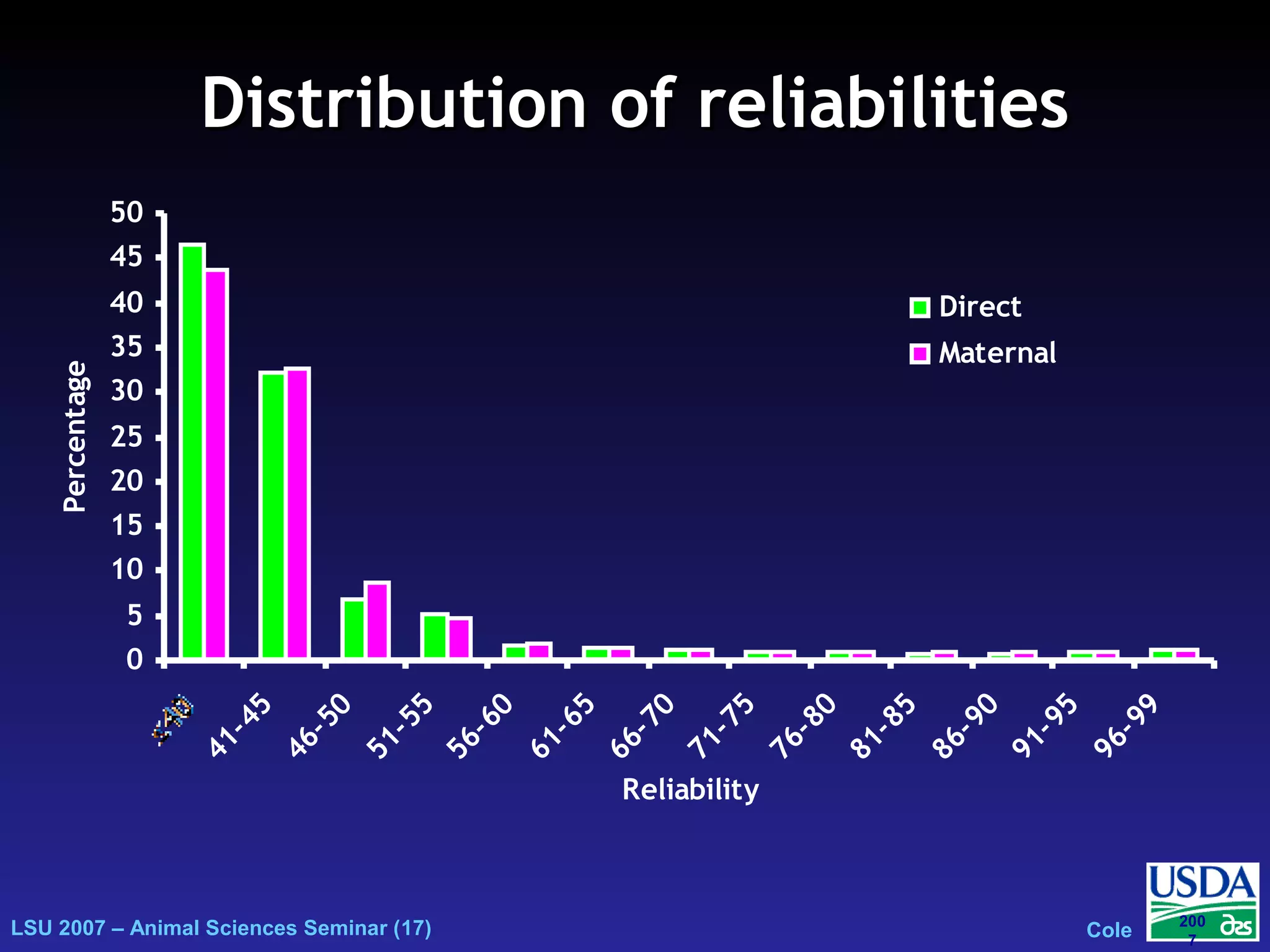
Distribution of reliabilitiesDistribution of reliabilities
0
5
10
15
20
25
30
35
40
45
50 41-45
46-50
51-55
56-60
61-65
66-70
71-75
76-80
81-85
86-90
91-95
96-99
Reliability
Percentage
Direct
Maternal
LSU 2007 – Animal Sciences Seminar (18) Cole
200
7
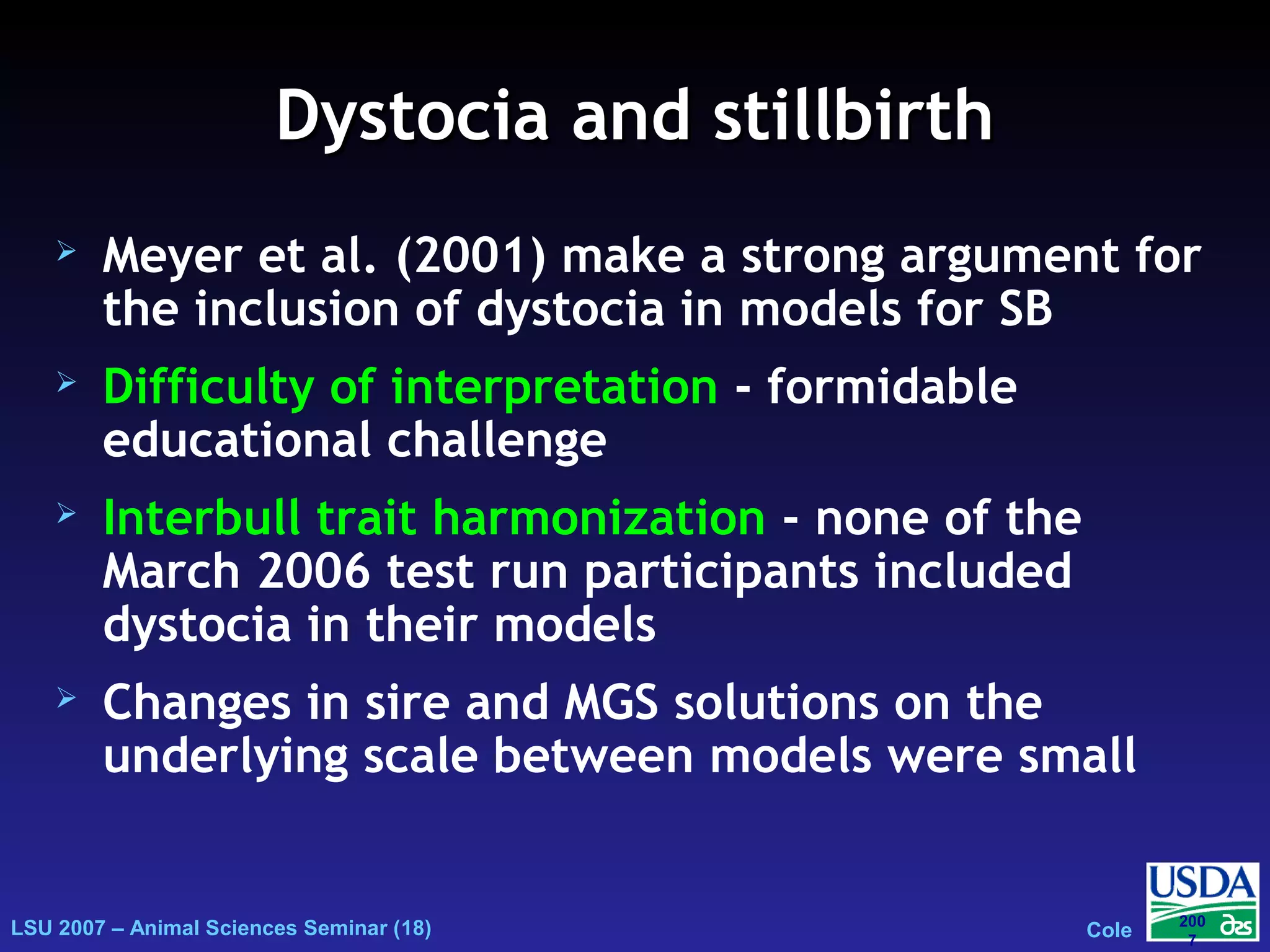
Dystocia and stillbirthDystocia and stillbirth
 Meyer et al. (2001) make a strong argument for
the inclusion of dystocia in models for SB
 Difficulty of interpretation - formidable
educational challenge
 Interbull trait harmonization - none of the
March 2006 test run participants included
dystocia in their models
 Changes in sire and MGS solutions on the
underlying scale between models were small
LSU 2007 – Animal Sciences Seminar (19) Cole
200
7
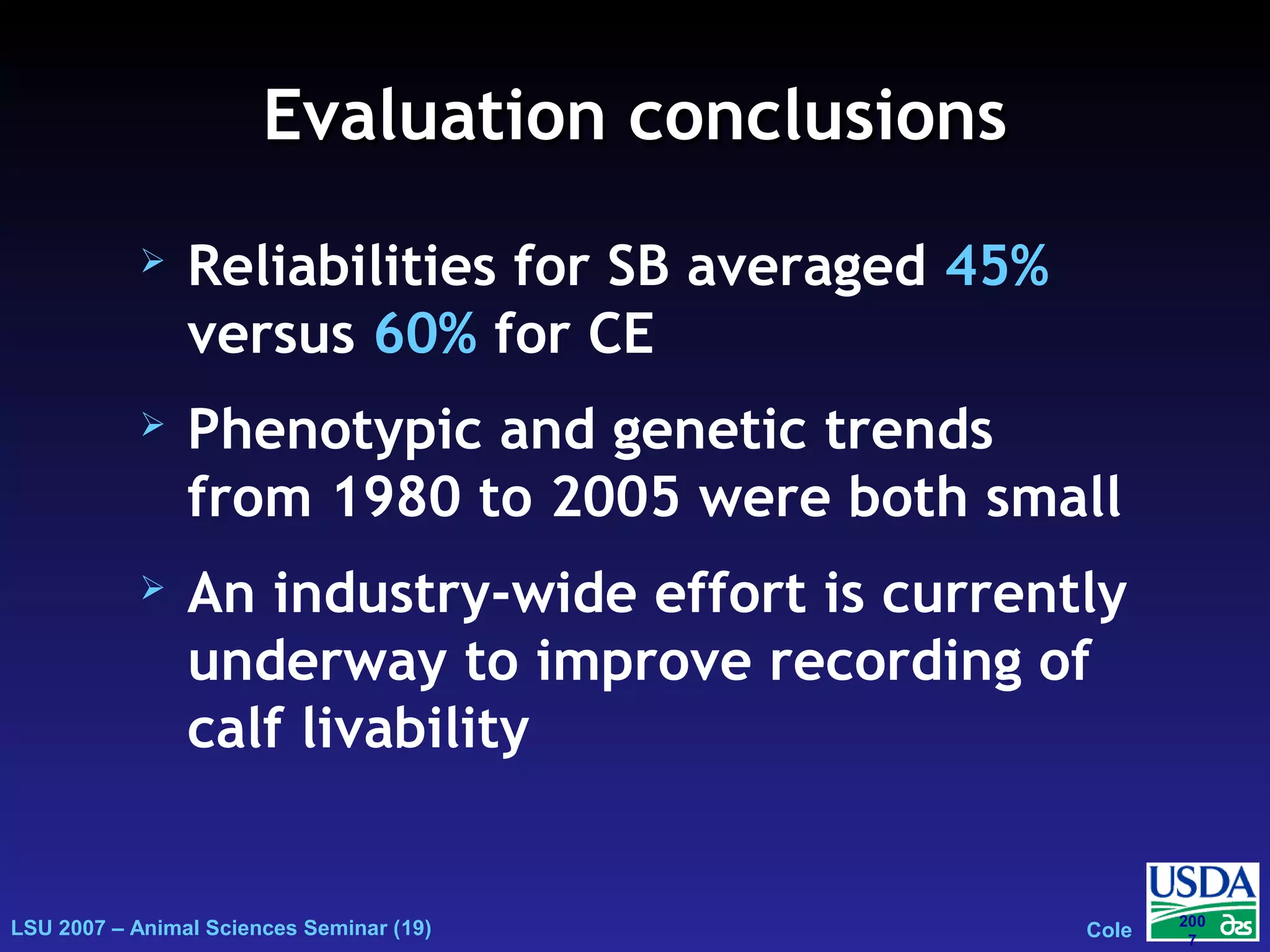
Evaluation conclusionsEvaluation conclusions
 Reliabilities for SB averaged 45%
versus 60% for CE
 Phenotypic and genetic trends
from 1980 to 2005 were both small
 An industry-wide effort is currently
underway to improve recording of
calf livability
LSU 2007 – Animal Sciences Seminar (20) Cole
200
7
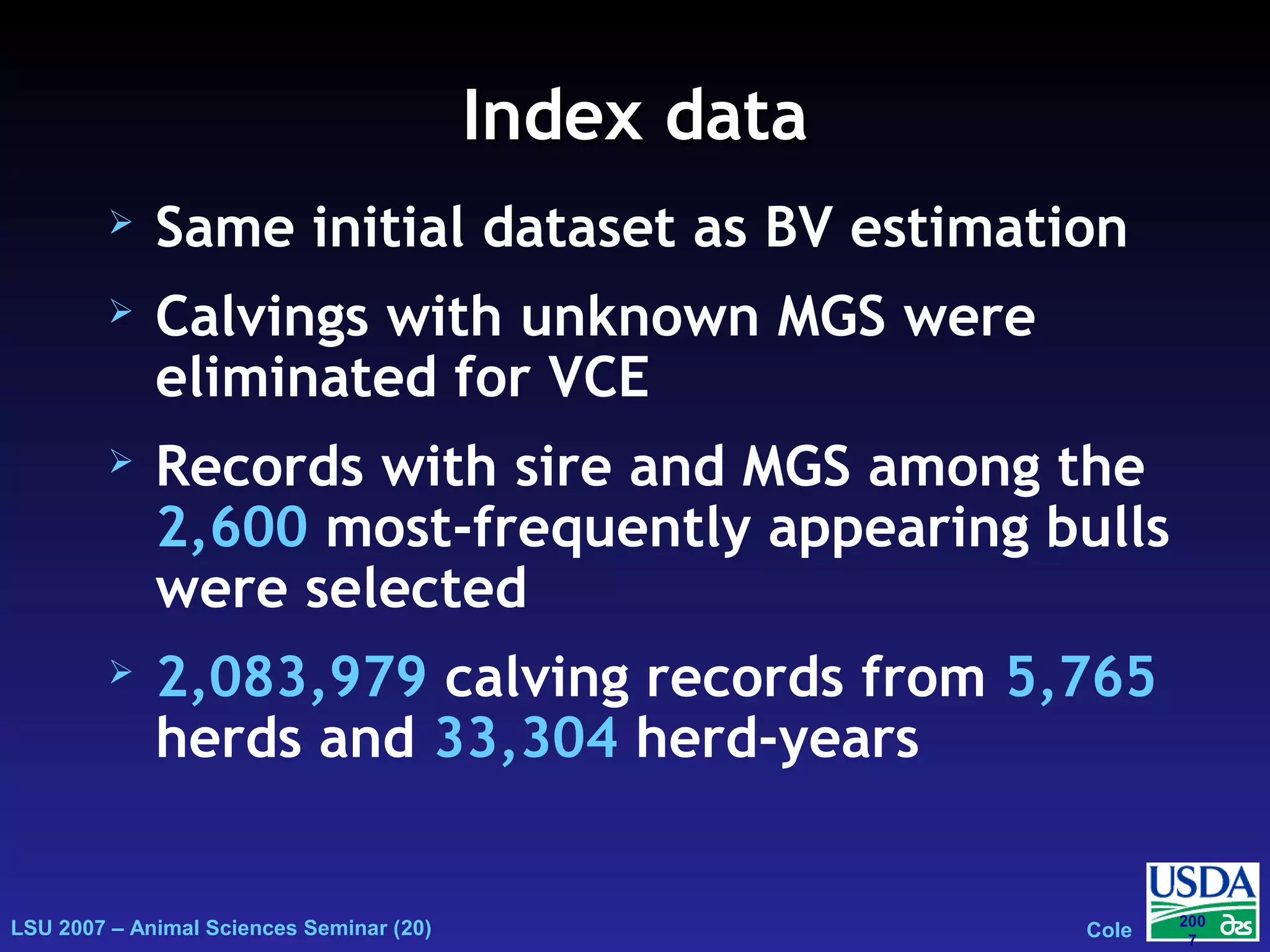
Index dataIndex data
 Same initial dataset as BV estimation
 Calvings with unknown MGS were
eliminated for VCE
 Records with sire and MGS among the
2,600 most-frequently appearing bulls
were selected
 2,083,979 calving records from 5,765
herds and 33,304 herd-years
LSU 2007 – Animal Sciences Seminar (21) Cole
200
7
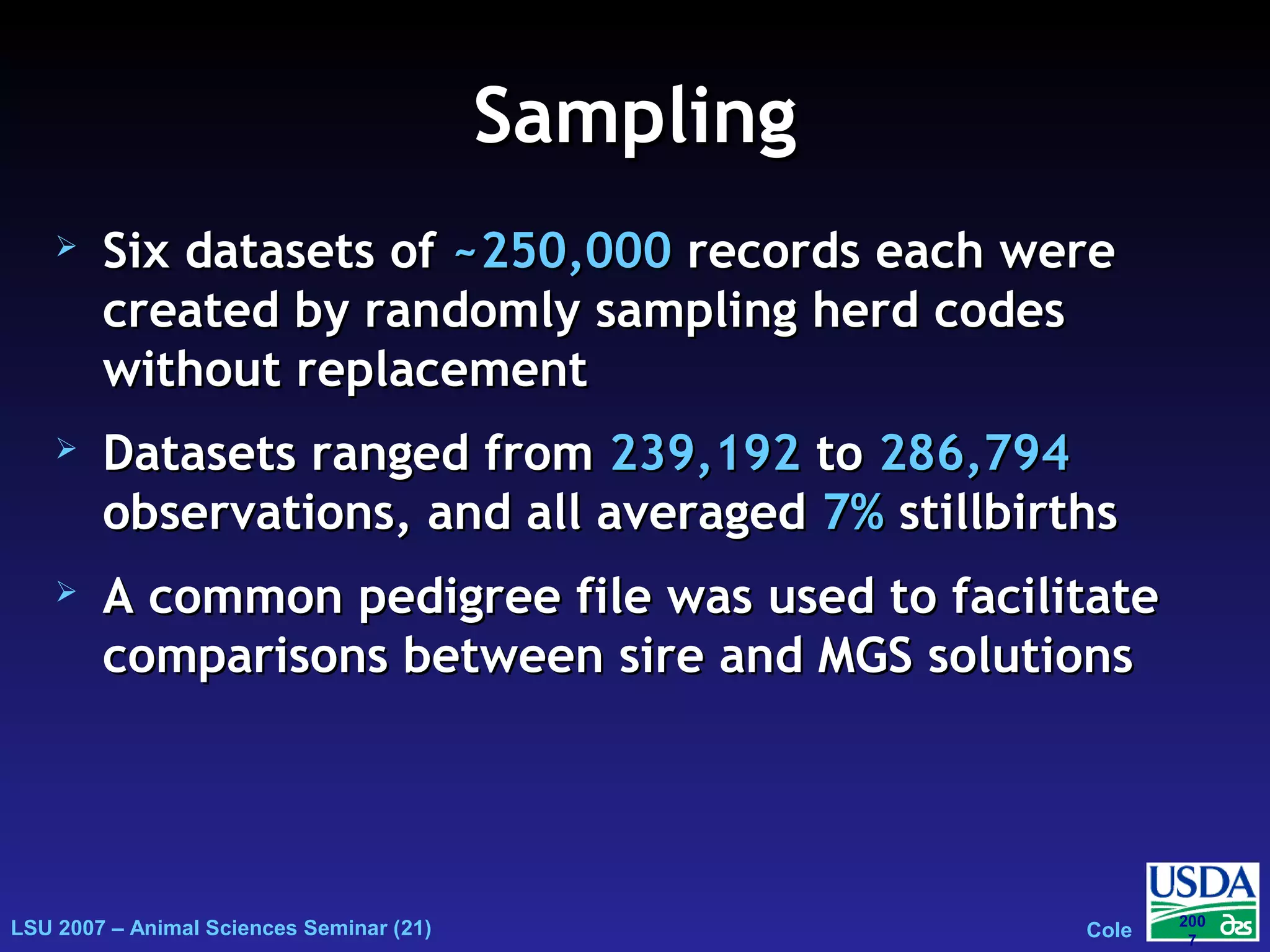
SamplingSampling
 Six datasets ofSix datasets of ~250,000~250,000 records each wererecords each were
created by randomly sampling herd codescreated by randomly sampling herd codes
without replacementwithout replacement
 Datasets ranged fromDatasets ranged from 239,192239,192 toto 286,794286,794
observations, and all averagedobservations, and all averaged 7%7% stillbirthsstillbirths
 A common pedigree file was used to facilitateA common pedigree file was used to facilitate
comparisons between sire and MGS solutionscomparisons between sire and MGS solutions
LSU 2007 – Animal Sciences Seminar (22) Cole
200
7
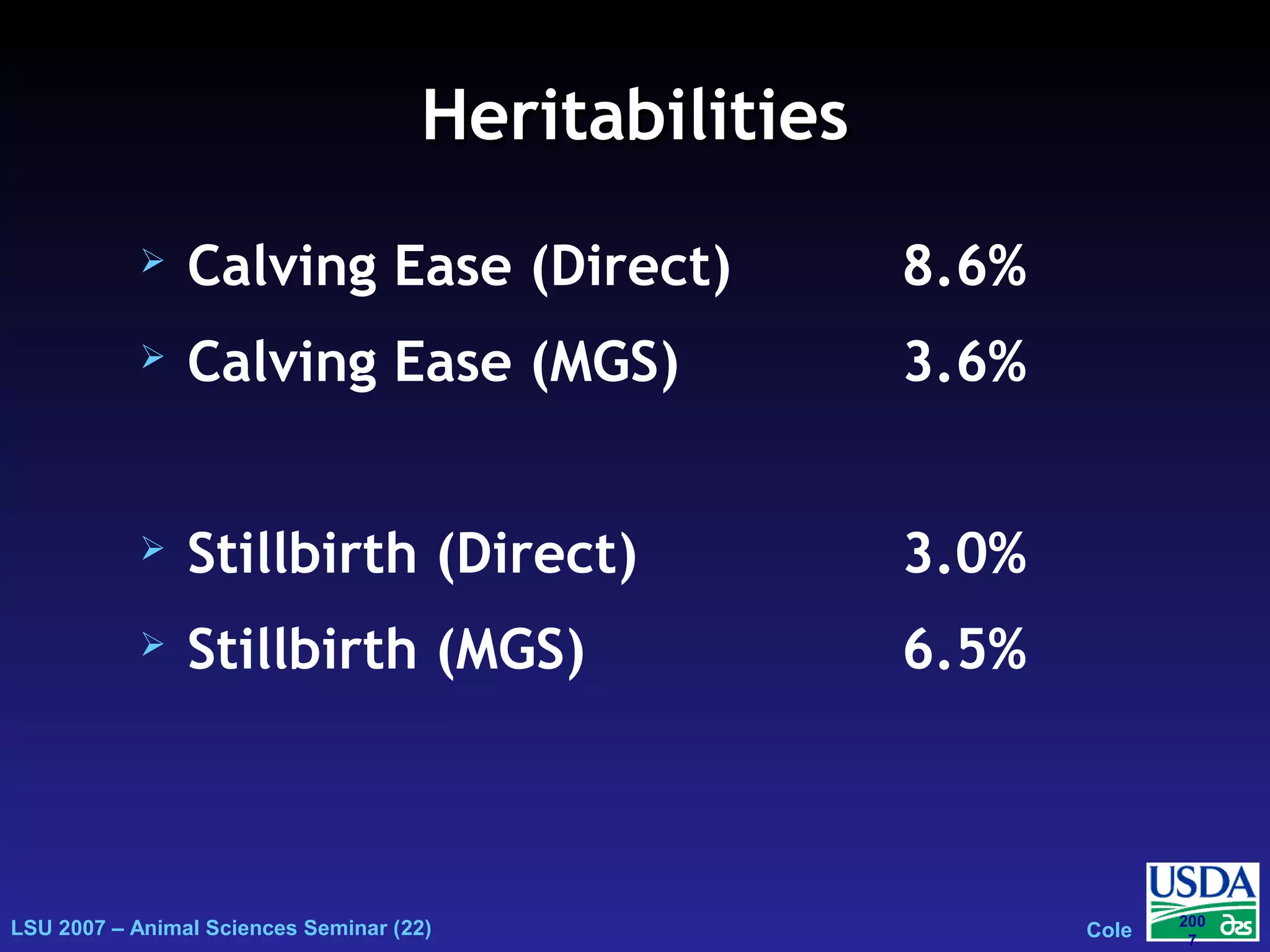
HeritabilitiesHeritabilities
 Calving Ease (Direct) 8.6%
 Calving Ease (MGS) 3.6%
 Stillbirth (Direct) 3.0%
 Stillbirth (MGS) 6.5%
LSU 2007 – Animal Sciences Seminar (23) Cole
200
7
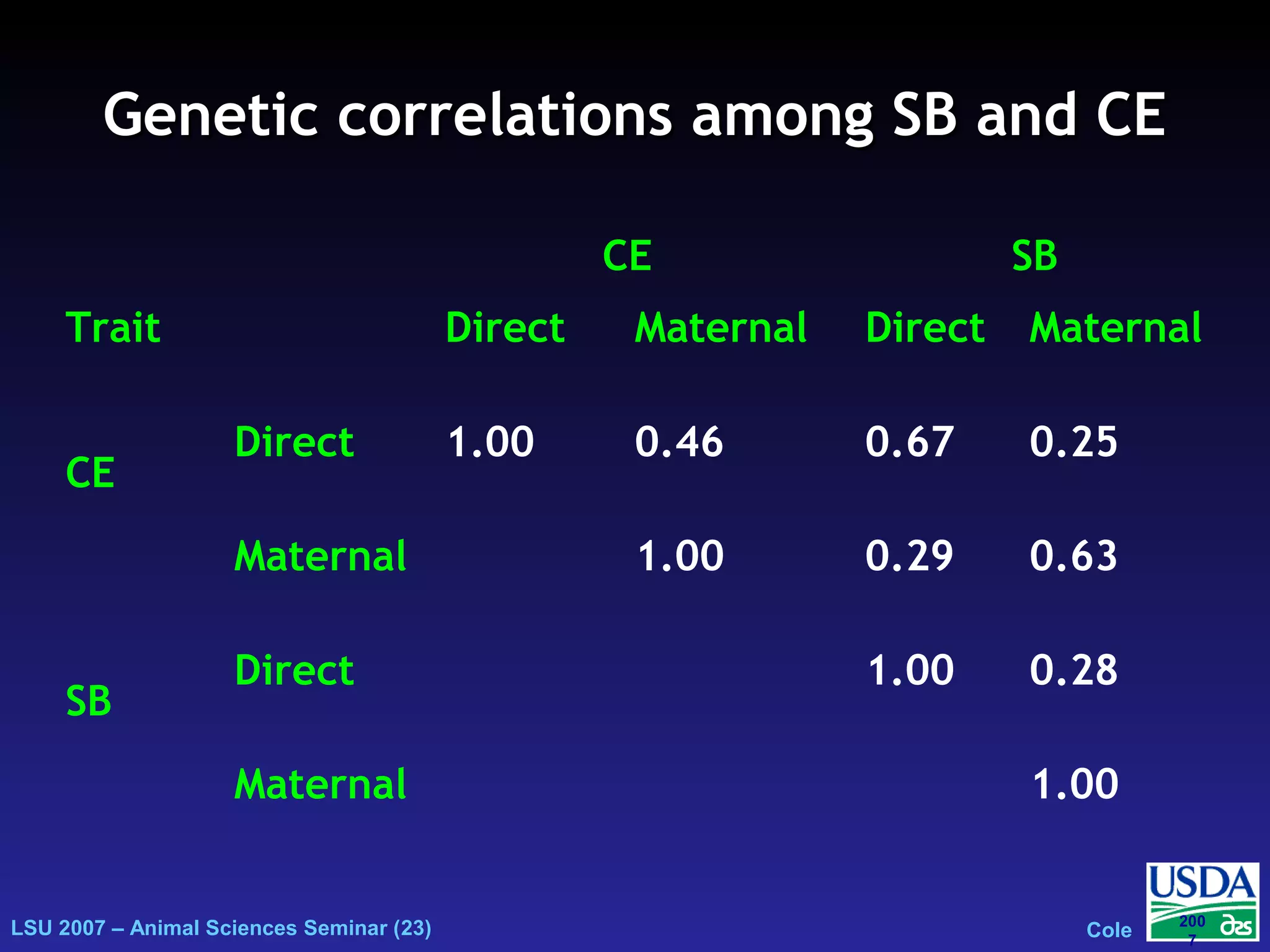
Genetic correlations among SB and CEGenetic correlations among SB and CE
Trait
CE SB
Direct Maternal Direct Maternal
CE
Direct 1.00 0.46 0.67 0.25
Maternal 1.00 0.29 0.63
SB
Direct 1.00 0.28
Maternal 1.00
LSU 2007 – Animal Sciences Seminar (24) Cole
200
7
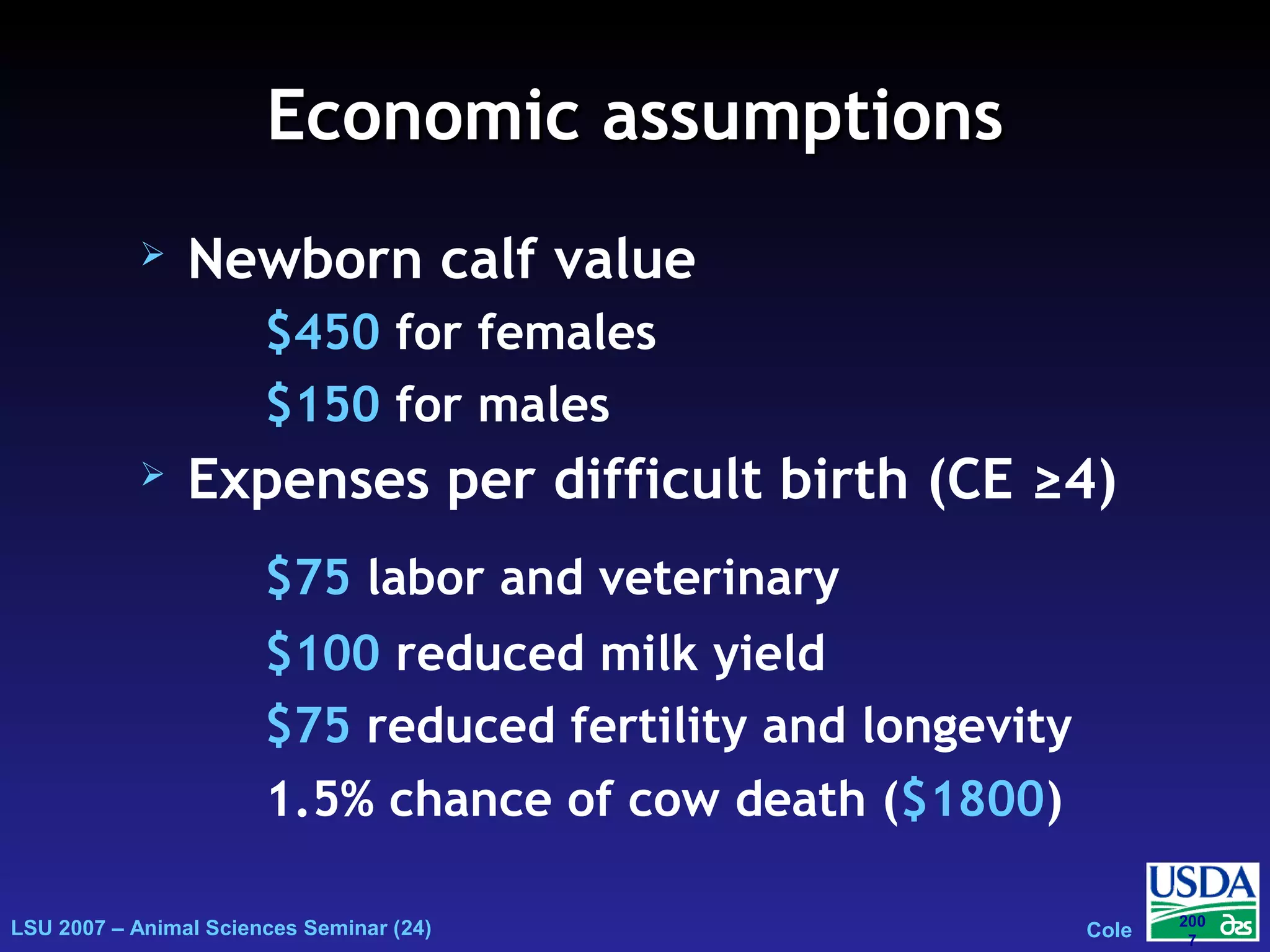
Economic assumptionsEconomic assumptions
 Newborn calf value
 Expenses per difficult birth (CE ≥4)
$450 for females
$150 for males
$75 labor and veterinary
$100 reduced milk yield
$75 reduced fertility and longevity
1.5% chance of cow death ($1800)
LSU 2007 – Animal Sciences Seminar (25) Cole
200
7
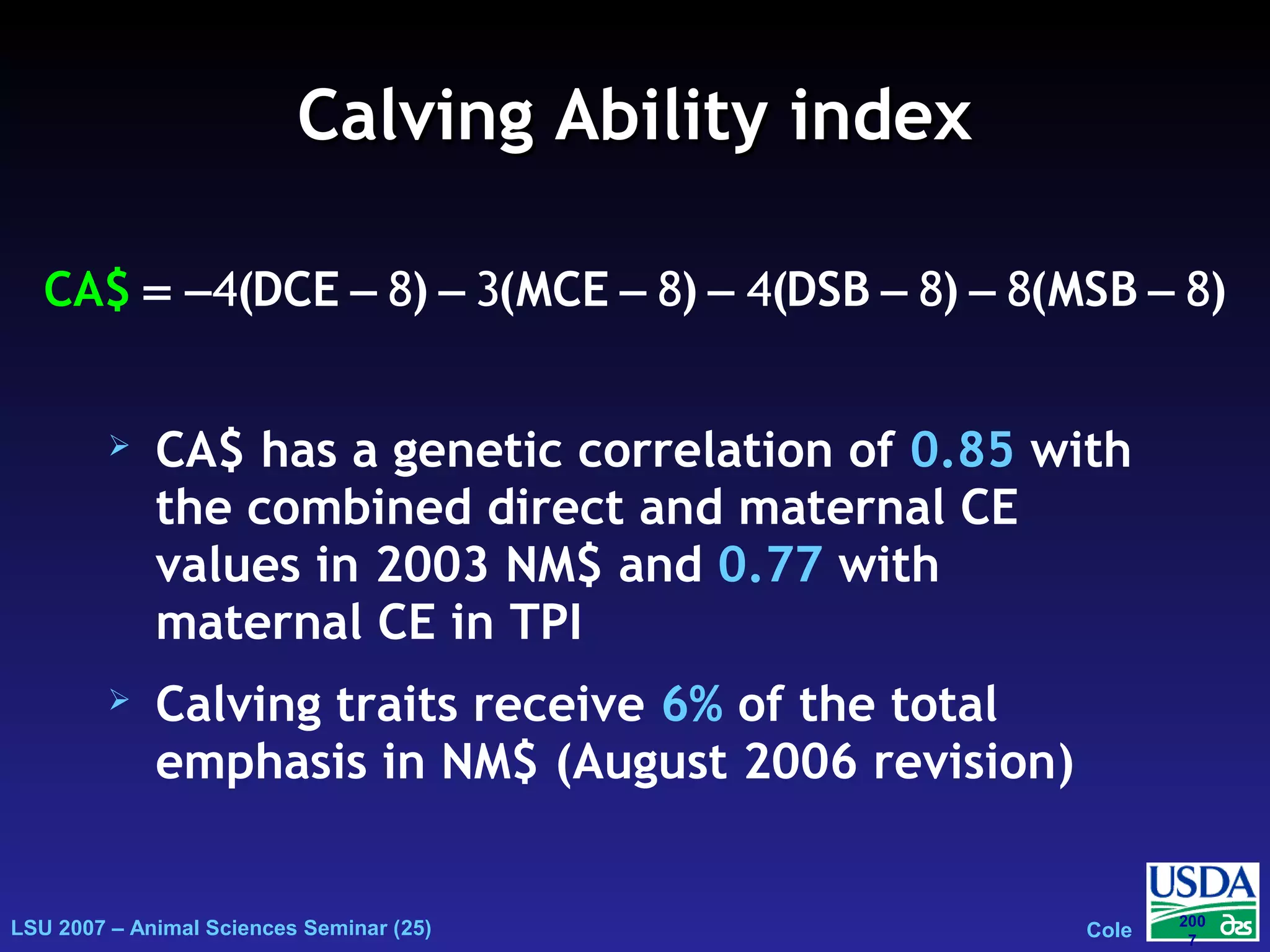
Calving Ability indexCalving Ability index
 CA$ has a genetic correlation of 0.85 with
the combined direct and maternal CE
values in 2003 NM$ and 0.77 with
maternal CE in TPI
 Calving traits receive 6% of the total
emphasis in NM$ (August 2006 revision)
(DCE ) (MCE ) (DSB ) (MSCA$ B )= − − − − − − − −4 8 3 8 4 8 8 8
LSU 2007 – Animal Sciences Seminar (26) Cole
200
7
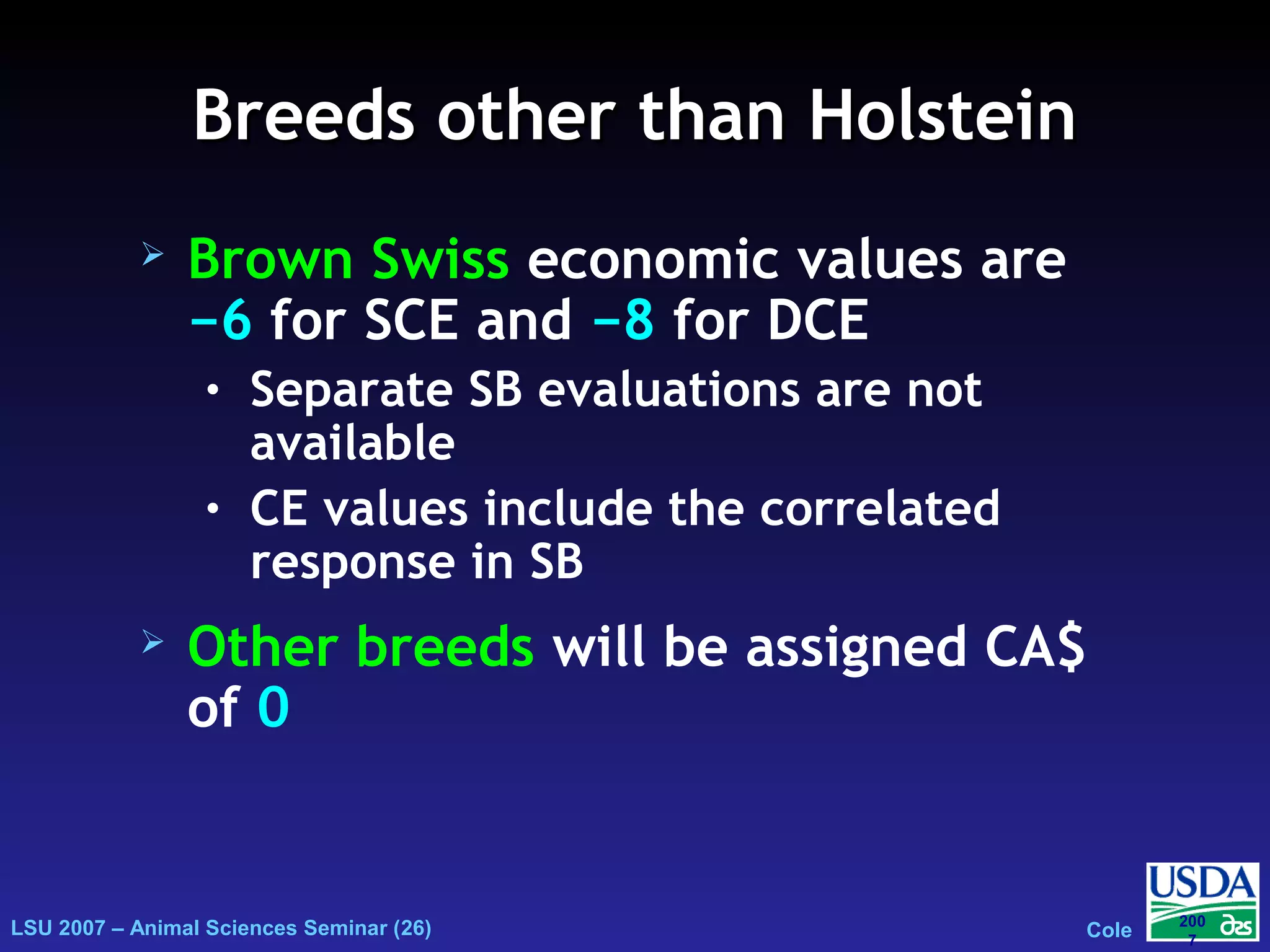
Breeds other than HolsteinBreeds other than Holstein
 Brown Swiss economic values are
−6 for SCE and −8 for DCE
• Separate SB evaluations are not
available
• CE values include the correlated
response in SB
 Other breeds will be assigned CA$
of 0
LSU 2007 – Animal Sciences Seminar (27) Cole
200
7
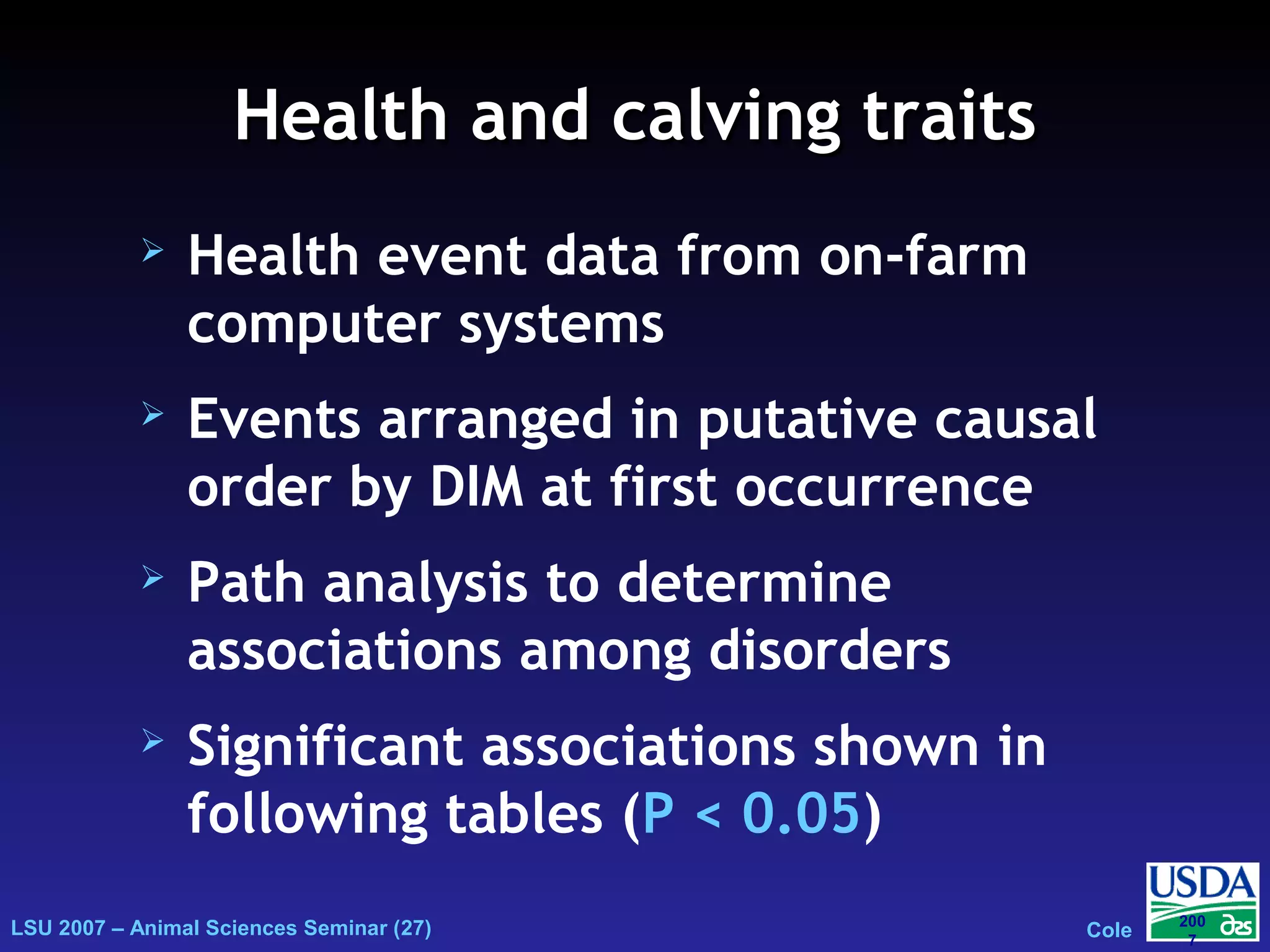
Health and calving traitsHealth and calving traits
 Health event data from on-farm
computer systems
 Events arranged in putative causal
order by DIM at first occurrence
 Path analysis to determine
associations among disorders
 Significant associations shown in
following tables (P < 0.05)
LSU 2007 – Animal Sciences Seminar (28) Cole
200
7
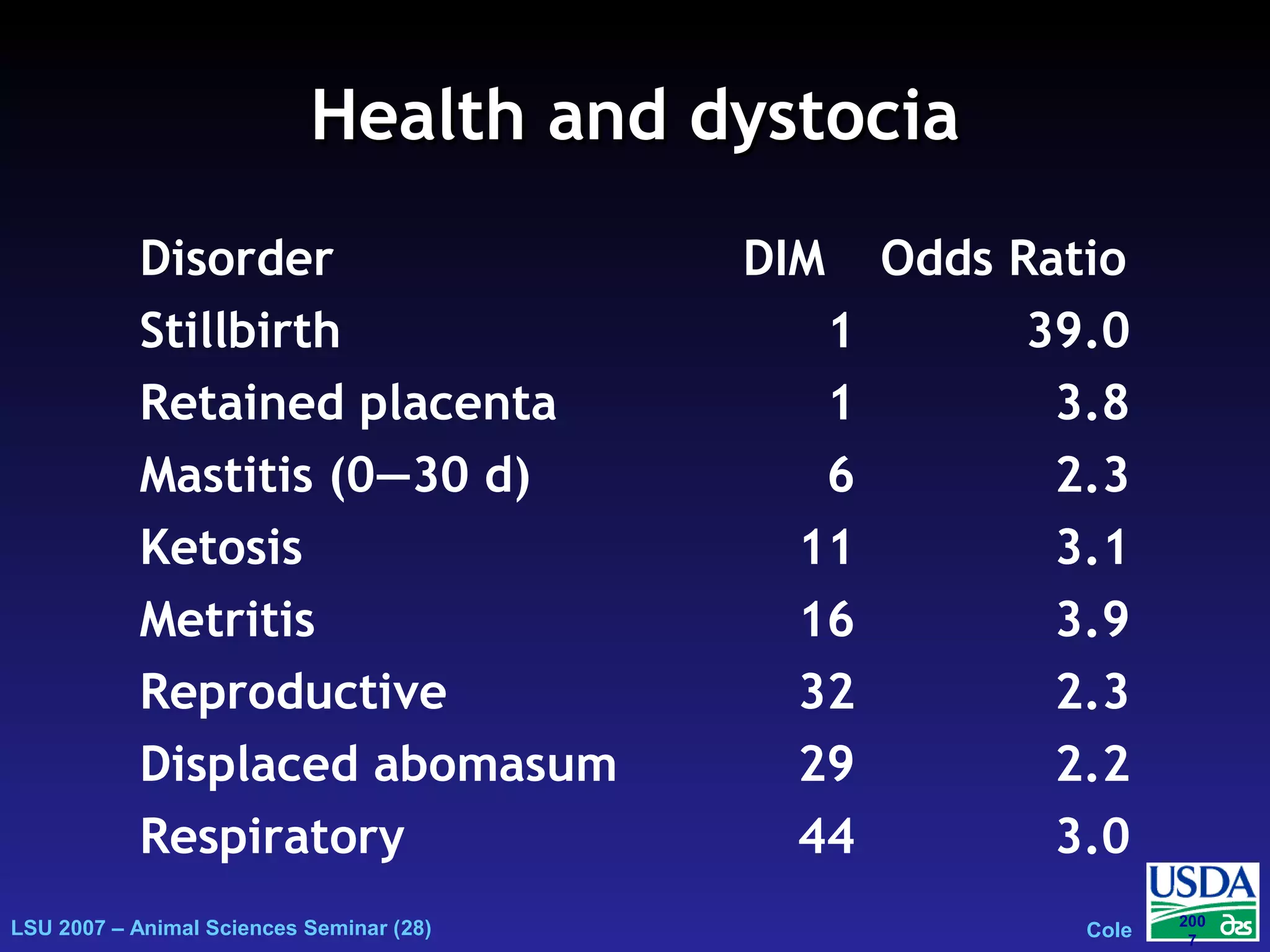
Health and dystociaHealth and dystocia
Disorder DIM Odds Ratio
Stillbirth 1 39.0
Retained placenta 1 3.8
Mastitis (0—30 d) 6 2.3
Ketosis 11 3.1
Metritis 16 3.9
Reproductive 32 2.3
Displaced abomasum 29 2.2
Respiratory 44 3.0
LSU 2007 – Animal Sciences Seminar (29) Cole
200
7
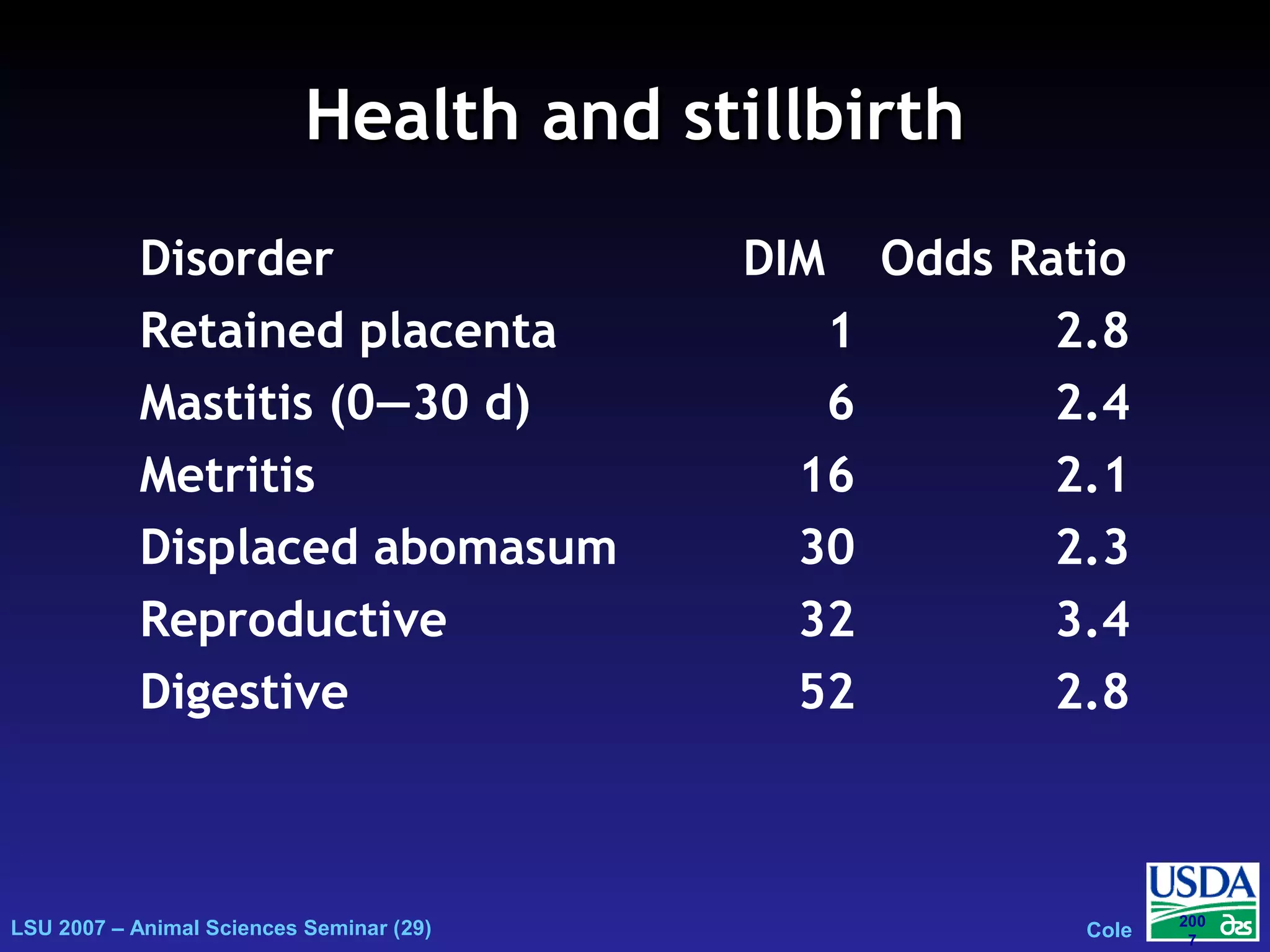
Health and stillbirthHealth and stillbirth
Disorder DIM Odds Ratio
Retained placenta 1 2.8
Mastitis (0—30 d) 6 2.4
Metritis 16 2.1
Displaced abomasum 30 2.3
Reproductive 32 3.4
Digestive 52 2.8
LSU 2007 – Animal Sciences Seminar (30) Cole
200
7
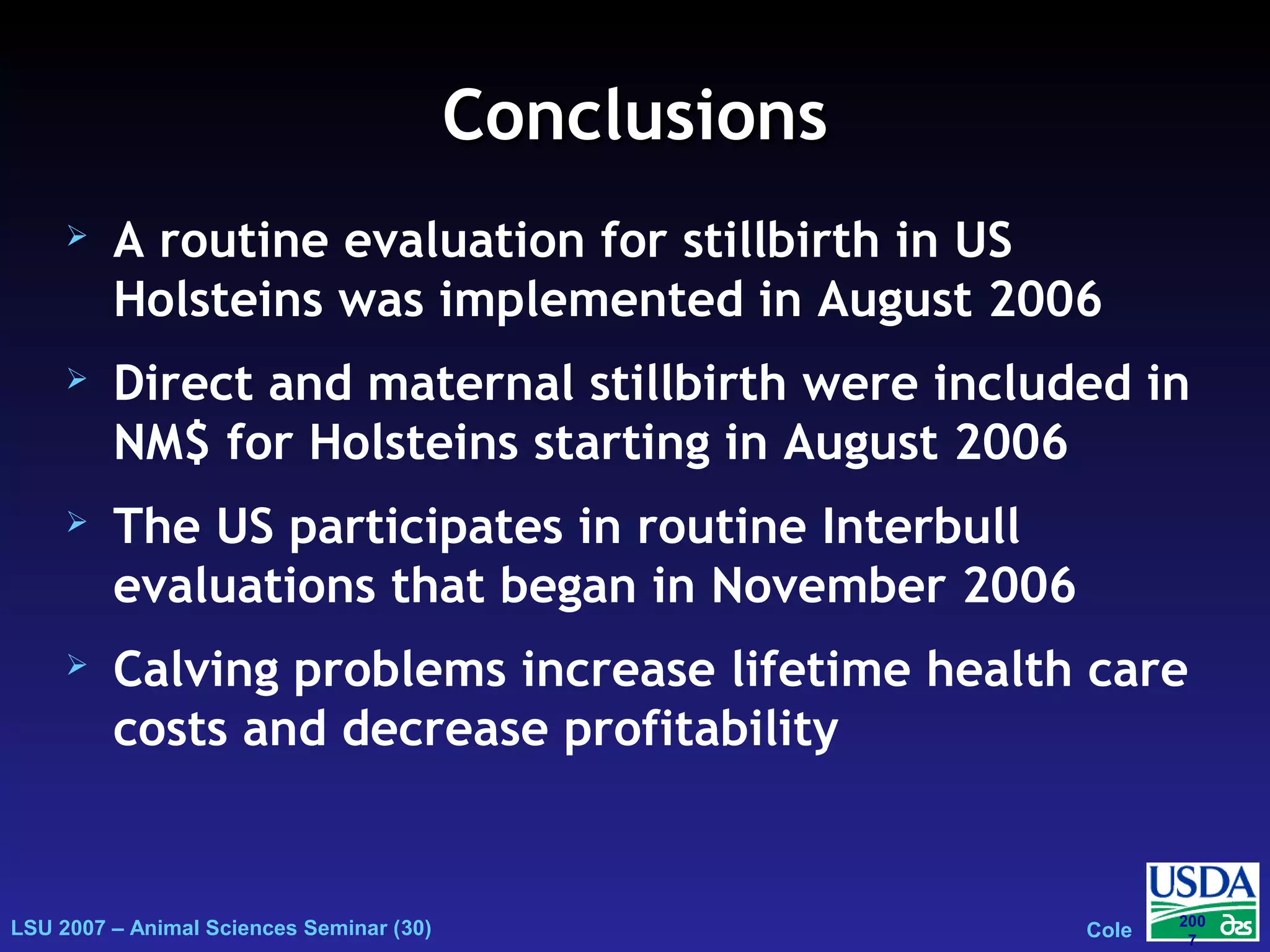
ConclusionsConclusions
 A routine evaluation for stillbirth in US
Holsteins was implemented in August 2006
 Direct and maternal stillbirth were included in
NM$ for Holsteins starting in August 2006
 The US participates in routine Interbull
evaluations that began in November 2006
 Calving problems increase lifetime health care
costs and decrease profitability
LSU 2007 – Animal Sciences Seminar (31) Cole
200
7
AcknowledgmentsAcknowledgments
 Jeff Berger, Iowa State University
 John Clay, Dairy Records Management
Systems
 Ignacy Misztal and Shogo Tsuruta,
University of Georgia
 National Association of Animal Breeders

Genetic Evaluation of Calving Traits in US Holsteins

  • 1.
    200 7 J.B. ColeJ.B. Cole AnimalImprovement Programs Laboratory Agricultural Research Service, USDA, Beltsville, MD john.cole@ars.usda.gov Genetic Evaluation of CalvingGenetic Evaluation of Calving Traits in US HolsteinsTraits in US Holsteins
  • 2.
    LSU 2007 –Animal Sciences Seminar (2) Cole 200 7 IntroductionIntroduction  National evaluations were introduced for Holstein calving ease (CE) in August 2002 and for stillbirth (SB) in August 2006.  A calving ability index (CA$) which includes SB and calving ease (CE) was developed.  Relationships among calving traits and other diseases are being studied.
  • 3.
    LSU 2007 –Animal Sciences Seminar (3) Cole 200 7 Why the concern?Why the concern?  Calving difficulty and stillbirth are expensive (Dematawewa and Berger, 1997; Meyer et al., 2001)  There is concern that rates of dystocia and stillbirth are increasing  Lactations initiated with dystocia have higher risks for other diseases (Cole et al., unpublished data).
  • 4.
    LSU 2007 –Animal Sciences Seminar (4) Cole 200 7 How do the evaluations work?How do the evaluations work?  Funded by the National Association of Animal Breeders  Data are collected from multiple sources: • Pedigree from breed associations • Calving data from DRPC  Evaluated using a sire-maternal grandsire threshold model
  • 5.
    LSU 2007 –Animal Sciences Seminar (6) Cole 200 7 Calving ease definitionCalving ease definition  Reported on a five-point scale: 1 = No problem 2 = Slight problem 3 = Needed assistance 4 = Considerable force 5 = Extreme difficulty  Scores of 4 and 5 are combined
  • 6.
    LSU 2007 –Animal Sciences Seminar (7) Cole 200 7 Stillbirth definitionStillbirth definition  Reported on a three-point scale:  Scores of 2 and 3 are combined 1 = calf born alive, 2 = calf born dead, 3 = calf died within 48 h of parturition.
  • 7.
    LSU 2007 –Animal Sciences Seminar (8) Cole 200 7 Distribution of SB and CE ScoresDistribution of SB and CE Scores 7,484,30929,320348,6775,348,0291,758,283Total 96,0871,27232,19638,92923,6905 207,2421,74037,851108,03759,6144 633,0293,35370,522375,203183,9513 738,8532,53749,858482,720203,7382 5,809,09820,418158,2504,343,1401,287,2901 Total3210 CalvingEaseScore Stillbirth Score
  • 8.
    LSU 2007 –Animal Sciences Seminar (9) Cole 200 7 Stillbirth records by lactationStillbirth records by lactation 0 100 200 300 400 500 1980 1990 2000 Birth Year NumberofRecords(thousands) 3 2 1
  • 9.
    LSU 2007 –Animal Sciences Seminar (10) Cole 200 7 Data and editsData and edits  7 million SB records were available for Holstein cows calving since 1980  Herds needed ≥10 calving records with SB scores of 2 or 3 for inclusion  Herd-years were required to include ≥20 records  Only single births were used (no twins)
  • 10.
    LSU 2007 –Animal Sciences Seminar (11) Cole 200 7 Sire-MGS threshold modelSire-MGS threshold model  Implemented for calving ease (Aug 2002) and stillbirth (Aug 2006)  Sire effects allow for corrective matings in heifers to avoid large calves  MGS effects control against selection for small animals which would have difficulty calving
  • 11.
    LSU 2007 –Animal Sciences Seminar (12) Cole 200 7 Genetic evaluation modelGenetic evaluation model  A sire-maternal grandsire (MGS) threshold model was used: • Fixed: year-season, parity-sex, sire and MGS birth year • Random: herd-year, sire, MGS  (Co)variance components were estimated by Gibbs sampling • Heritabilities are 3.0% (direct) and 6.5% (MGS) ijklnoprnplonlkjiijklnopr emsBMBSPSYShyy +++++++= ijklnoprnplonlkjiijklnopr emsBMBSPSYShyy +++++++= ijklnoprnplonlkjiijklnopr emsBMBSPSYShyy +++++++=
  • 12.
    LSU 2007 –Animal Sciences Seminar (13) Cole 200 7 Trait definitionTrait definition  PTA are expressed as the expected percentage of stillbirths  Direct SB measures the effect of the calf itself  Maternal SB measures the effect of a particular cow (daughter)  A base of 8% was used for both traits:  Direct: bulls born 1996–2000  Maternal: bulls born 1991–1995
  • 13.
    LSU 2007 –Animal Sciences Seminar (14) Cole 200 7 Phenotypic trend for stillbirthsPhenotypic trend for stillbirths 0 2 4 6 8 10 12 14 1980 1983 1986 1989 1992 1995 1998 2001 2004 Birth Year %Stillbirth Heifers Cows All animals
  • 14.
    LSU 2007 –Animal Sciences Seminar (15) Cole 200 7 Genetic trend for stillbirthsGenetic trend for stillbirths 5.0 6.0 7.0 8.0 9.0 10.0 1980 1985 1990 1995 2000 Birth Year %SBH Direct Maternal
  • 15.
    LSU 2007 –Animal Sciences Seminar (16) Cole 200 7 Distribution of PTADistribution of PTA 0 5 10 15 20 25 30 35 40 6.6-7.0 7.6-8.0 8.6-9.0 9.6-10.0 10.6-11.0 11.6-12.0 %SBH PercentofScoress Direct Maternal
  • 16.
    LSU 2007 –Animal Sciences Seminar (17) Cole 200 7 Distribution of reliabilitiesDistribution of reliabilities 0 5 10 15 20 25 30 35 40 45 50 41-45 46-50 51-55 56-60 61-65 66-70 71-75 76-80 81-85 86-90 91-95 96-99 Reliability Percentage Direct Maternal
  • 17.
    LSU 2007 –Animal Sciences Seminar (18) Cole 200 7 Dystocia and stillbirthDystocia and stillbirth  Meyer et al. (2001) make a strong argument for the inclusion of dystocia in models for SB  Difficulty of interpretation - formidable educational challenge  Interbull trait harmonization - none of the March 2006 test run participants included dystocia in their models  Changes in sire and MGS solutions on the underlying scale between models were small
  • 18.
    LSU 2007 –Animal Sciences Seminar (19) Cole 200 7 Evaluation conclusionsEvaluation conclusions  Reliabilities for SB averaged 45% versus 60% for CE  Phenotypic and genetic trends from 1980 to 2005 were both small  An industry-wide effort is currently underway to improve recording of calf livability
  • 19.
    LSU 2007 –Animal Sciences Seminar (20) Cole 200 7 Index dataIndex data  Same initial dataset as BV estimation  Calvings with unknown MGS were eliminated for VCE  Records with sire and MGS among the 2,600 most-frequently appearing bulls were selected  2,083,979 calving records from 5,765 herds and 33,304 herd-years
  • 20.
    LSU 2007 –Animal Sciences Seminar (21) Cole 200 7 SamplingSampling  Six datasets ofSix datasets of ~250,000~250,000 records each wererecords each were created by randomly sampling herd codescreated by randomly sampling herd codes without replacementwithout replacement  Datasets ranged fromDatasets ranged from 239,192239,192 toto 286,794286,794 observations, and all averagedobservations, and all averaged 7%7% stillbirthsstillbirths  A common pedigree file was used to facilitateA common pedigree file was used to facilitate comparisons between sire and MGS solutionscomparisons between sire and MGS solutions
  • 21.
    LSU 2007 –Animal Sciences Seminar (22) Cole 200 7 HeritabilitiesHeritabilities  Calving Ease (Direct) 8.6%  Calving Ease (MGS) 3.6%  Stillbirth (Direct) 3.0%  Stillbirth (MGS) 6.5%
  • 22.
    LSU 2007 –Animal Sciences Seminar (23) Cole 200 7 Genetic correlations among SB and CEGenetic correlations among SB and CE Trait CE SB Direct Maternal Direct Maternal CE Direct 1.00 0.46 0.67 0.25 Maternal 1.00 0.29 0.63 SB Direct 1.00 0.28 Maternal 1.00
  • 23.
    LSU 2007 –Animal Sciences Seminar (24) Cole 200 7 Economic assumptionsEconomic assumptions  Newborn calf value  Expenses per difficult birth (CE ≥4) $450 for females $150 for males $75 labor and veterinary $100 reduced milk yield $75 reduced fertility and longevity 1.5% chance of cow death ($1800)
  • 24.
    LSU 2007 –Animal Sciences Seminar (25) Cole 200 7 Calving Ability indexCalving Ability index  CA$ has a genetic correlation of 0.85 with the combined direct and maternal CE values in 2003 NM$ and 0.77 with maternal CE in TPI  Calving traits receive 6% of the total emphasis in NM$ (August 2006 revision) (DCE ) (MCE ) (DSB ) (MSCA$ B )= − − − − − − − −4 8 3 8 4 8 8 8
  • 25.
    LSU 2007 –Animal Sciences Seminar (26) Cole 200 7 Breeds other than HolsteinBreeds other than Holstein  Brown Swiss economic values are −6 for SCE and −8 for DCE • Separate SB evaluations are not available • CE values include the correlated response in SB  Other breeds will be assigned CA$ of 0
  • 26.
    LSU 2007 –Animal Sciences Seminar (27) Cole 200 7 Health and calving traitsHealth and calving traits  Health event data from on-farm computer systems  Events arranged in putative causal order by DIM at first occurrence  Path analysis to determine associations among disorders  Significant associations shown in following tables (P < 0.05)
  • 27.
    LSU 2007 –Animal Sciences Seminar (28) Cole 200 7 Health and dystociaHealth and dystocia Disorder DIM Odds Ratio Stillbirth 1 39.0 Retained placenta 1 3.8 Mastitis (0—30 d) 6 2.3 Ketosis 11 3.1 Metritis 16 3.9 Reproductive 32 2.3 Displaced abomasum 29 2.2 Respiratory 44 3.0
  • 28.
    LSU 2007 –Animal Sciences Seminar (29) Cole 200 7 Health and stillbirthHealth and stillbirth Disorder DIM Odds Ratio Retained placenta 1 2.8 Mastitis (0—30 d) 6 2.4 Metritis 16 2.1 Displaced abomasum 30 2.3 Reproductive 32 3.4 Digestive 52 2.8
  • 29.
    LSU 2007 –Animal Sciences Seminar (30) Cole 200 7 ConclusionsConclusions  A routine evaluation for stillbirth in US Holsteins was implemented in August 2006  Direct and maternal stillbirth were included in NM$ for Holsteins starting in August 2006  The US participates in routine Interbull evaluations that began in November 2006  Calving problems increase lifetime health care costs and decrease profitability
  • 30.
    LSU 2007 –Animal Sciences Seminar (31) Cole 200 7 AcknowledgmentsAcknowledgments  Jeff Berger, Iowa State University  John Clay, Dairy Records Management Systems  Ignacy Misztal and Shogo Tsuruta, University of Georgia  National Association of Animal Breeders