InfluenceofWeanAgeandDisease
ChallengeonProgenyLife-timePerformance
D.S.Rosero*,T.DonovanandR.D.Boyd
TheHanorCompany,Franklin,KYUSA
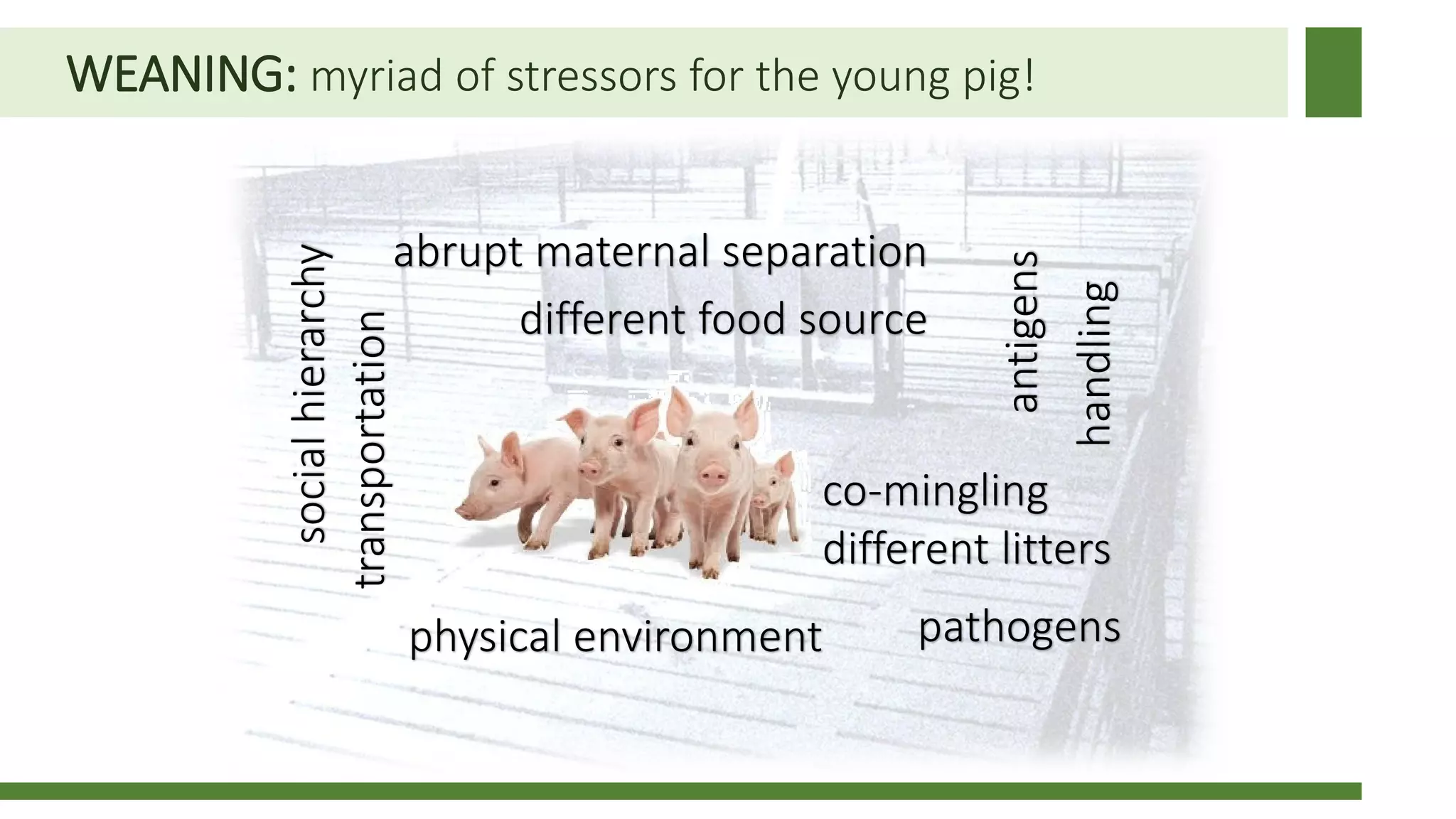
WEANING: myriad of stressors for the young pig!
abrupt maternal separation
socialhierarchy
transportation
handling
different food source
co-mingling
different litters
physical environment pathogens
antigens
WEANING: Disruption of GI structure and function
0
200
400
600
800
1000
1200
1400
-1 0 1 2 3 4 5 6 7 8 9 10 11 12
Villousheight,µm
Days after weaning
Unweaned
Weaned
Hampson, 1986; Res Vet Sci 40:32-40; Lindemann et al., 1986; J Anim Sci 62:1298-1307
0
2
4
6
8
10
12
14
16
-8 -6 -4 -2 0 2 4 6 8 10 12 14 16
Enzymeactivity(X10000)
Days after weaning
Unweaned Unweaned
Weaned Weaned
Amylase
Reduced digestive enzyme activityVilli atrophy
Lipase
(hypothetical)
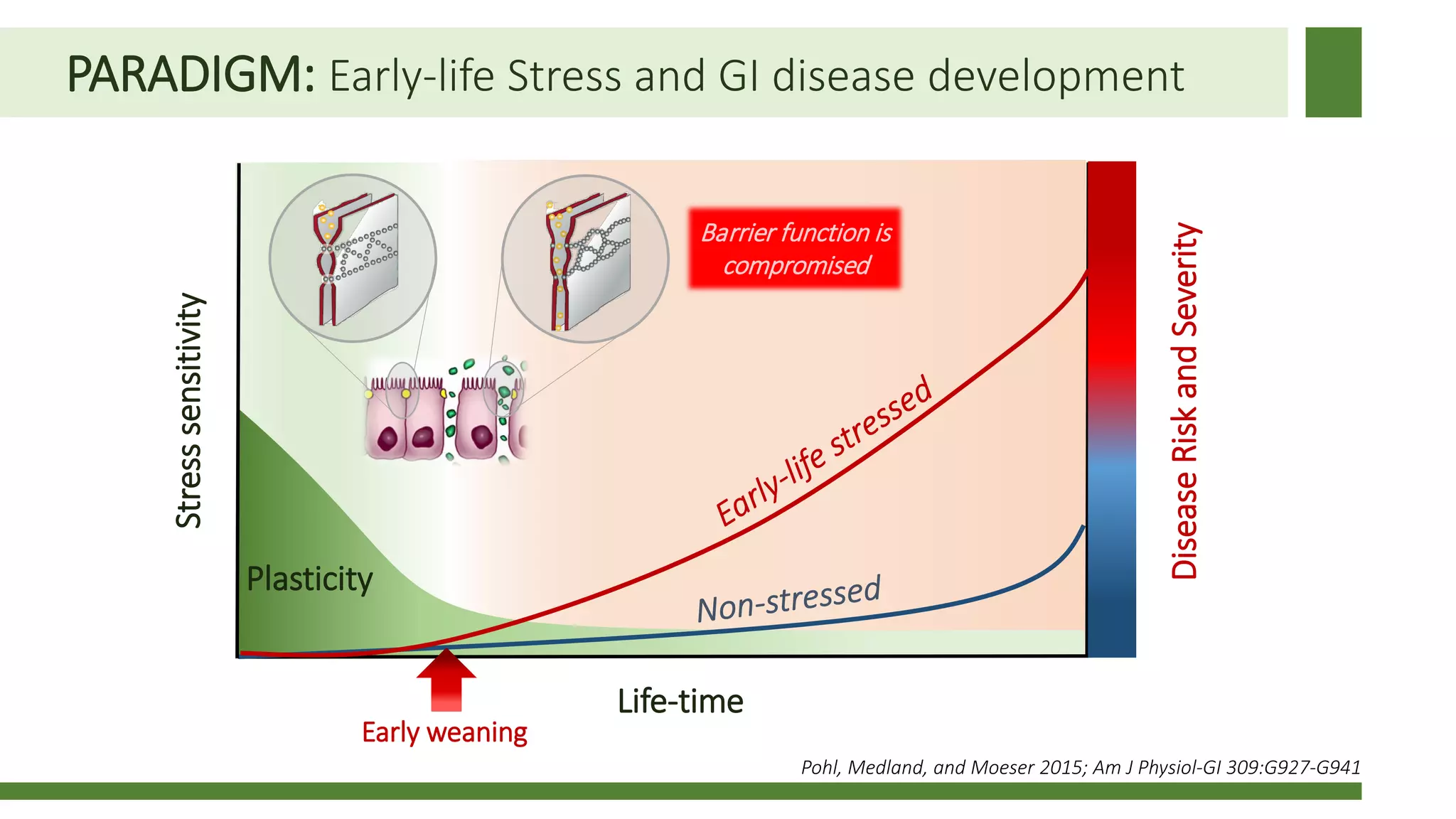
PARADIGM: Early-life Stress and GI disease development
Early weaning
Plasticity
Stresssensitivity
DiseaseRiskandSeverity
Pohl, Medland, and Moeser 2015; Am J Physiol-GI 309:G927-G941
Life-time
Barrier function is
compromised
EARLY-WEANING STRESS: disruption of intestinal barrier
Ussing Chamber Technique
3H-Mannitol
14C-Inulin Supernatant
↑ Flux = ↓ barrier function
a
b
b
c
c
0
0.1
0.2
0.3
0.4
0.5
0.6
0.7
0.8
0.9
15 18 21 23 28
3H-Mannitolflux,µmol-cm2h
Weaning Age
Smith et al., 2010; Am J Physiol GI 298: G352–G363
EARLY-WEANING STRESS: long-lasting impact on barrier function
Ussing Chamber Technique
3H-Mannitol
14C-Inulin Supernatant
↑ Flux = ↓ barrier function
Smith et al., 2010; Am J Physiol GI 298: G352–G363
*
*
*
*
0
1
2
3
4
5
6
0 20 40 60 80 100 120 140 160 180
3H-Mannitolflux,µmol-cm2h(x10-3)
Days after weaning
Early weaning
Late weaning
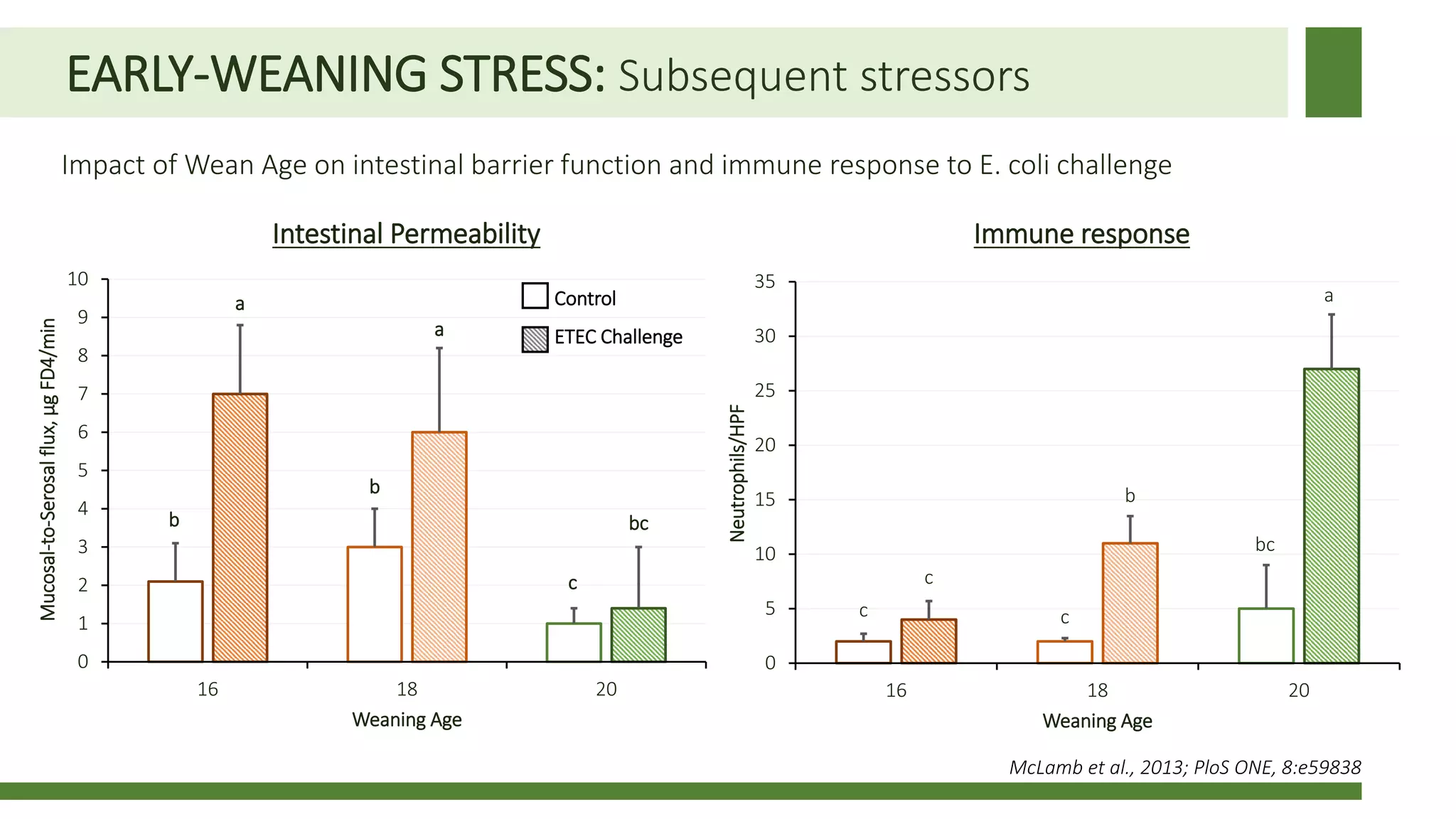
EARLY-WEANING STRESS: Subsequent stressors
Impact of Wean Age on intestinal barrier function and immune response to E. coli challenge
McLamb et al., 2013; PloS ONE, 8:e59838
b
b
c
a
a
bc
0
1
2
3
4
5
6
7
8
9
10
16 18 20
Mucosal-to-Serosalflux,µgFD4/min
Weaning Age
Control
ETEC Challenge
c c
bc
c
b
a
0
5
10
15
20
25
30
35
16 18 20
Neutrophils/HPF
Weaning Age
Intestinal Permeability Immune response
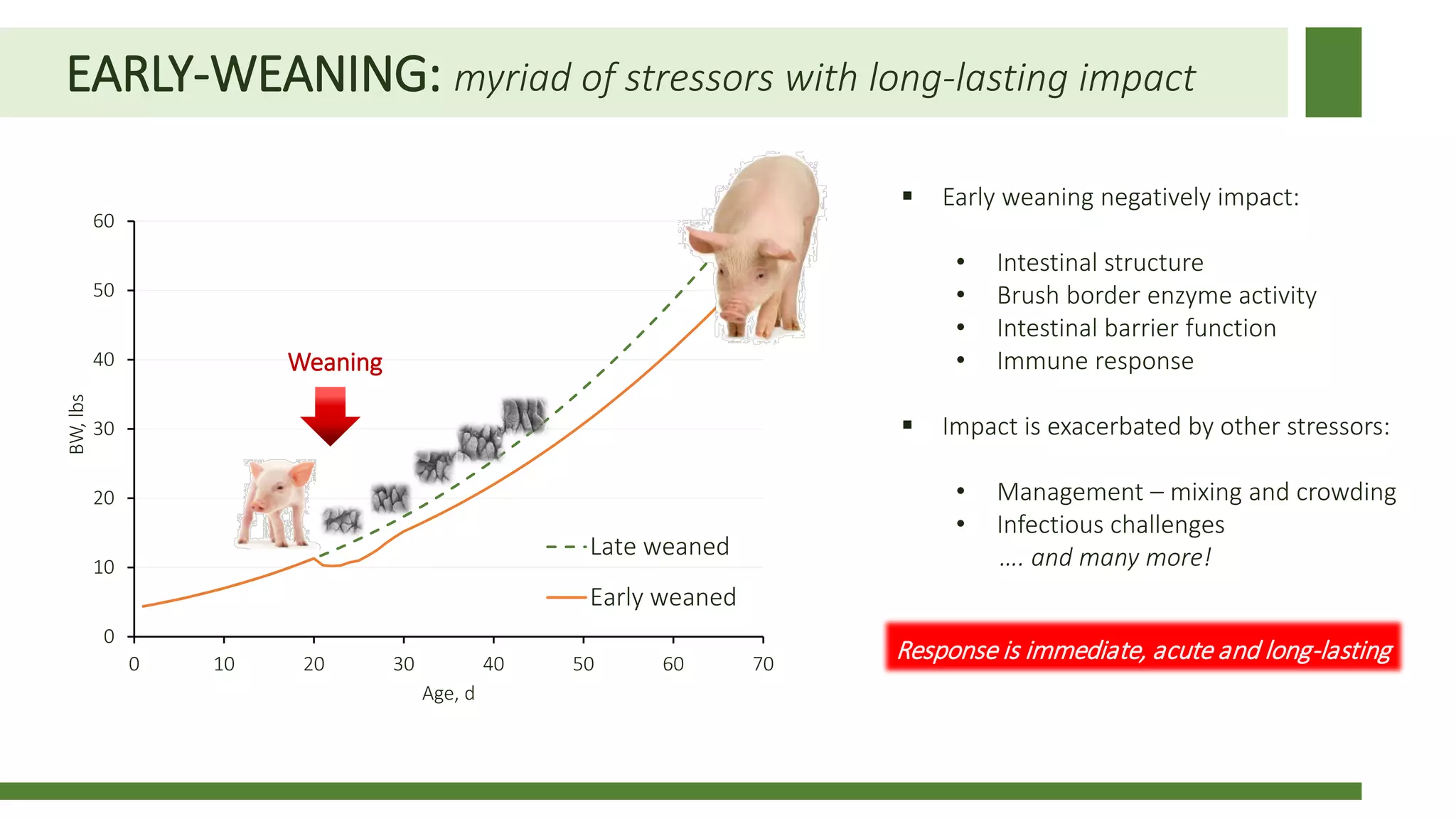
EARLY-WEANING: myriad of stressors with long-lasting impact
0
10
20
30
40
50
60
0 10 20 30 40 50 60 70
BW,lbs
Age, d
Late weaned
Early weaned
Weaning
 Early weaning negatively impact:
• Intestinal structure
• Brush border enzyme activity
• Intestinal barrier function
• Immune response
 Impact is exacerbated by other stressors:
• Management – mixing and crowding
• Infectious challenges
…. and many more!
Response is immediate, acute and long-lasting
Impact of weaning age on performance of pigs
500
550
600
650
700
750
12 15 18 21 15.5 18.5 21.5
ADG(weaningtod153-156),g
Weaning Age
Linear, P < 0.001
Linear, P < 0.001
0
2
4
6
8
10
12
12 15 18 21 15.5 18.5 21.5
Wean-FinishMortality,%
Weaning Age
Linear, P < 0.001
Linear, P = 0.03
Main et al., 2004; J Anim Sci 82:1499-1507
Growth rate Mortality
n = 1,920 & 3,000 pigs
Trial 1 Trial 2 Trial 1 Trial 2
n = 1,920 & 3,000 pigs
PURPOSE
 To investigate and quantify the impact of weaning age on pig performance within a
multisite production system
• Impact of weaning age during health challenge events
15
16
17
18
19
20
21
22
23
24
25
26
1/1/2010 7/20/2010 2/5/2011 8/24/2011 3/11/2012 9/27/2012 4/15/2013 11/1/2013 5/20/2014 12/6/2014
AverageWeaningAgeperweek
Wean Date
Active PRRS Active PEDV
Weaning Age of Groups of Pigs by Weaning Date
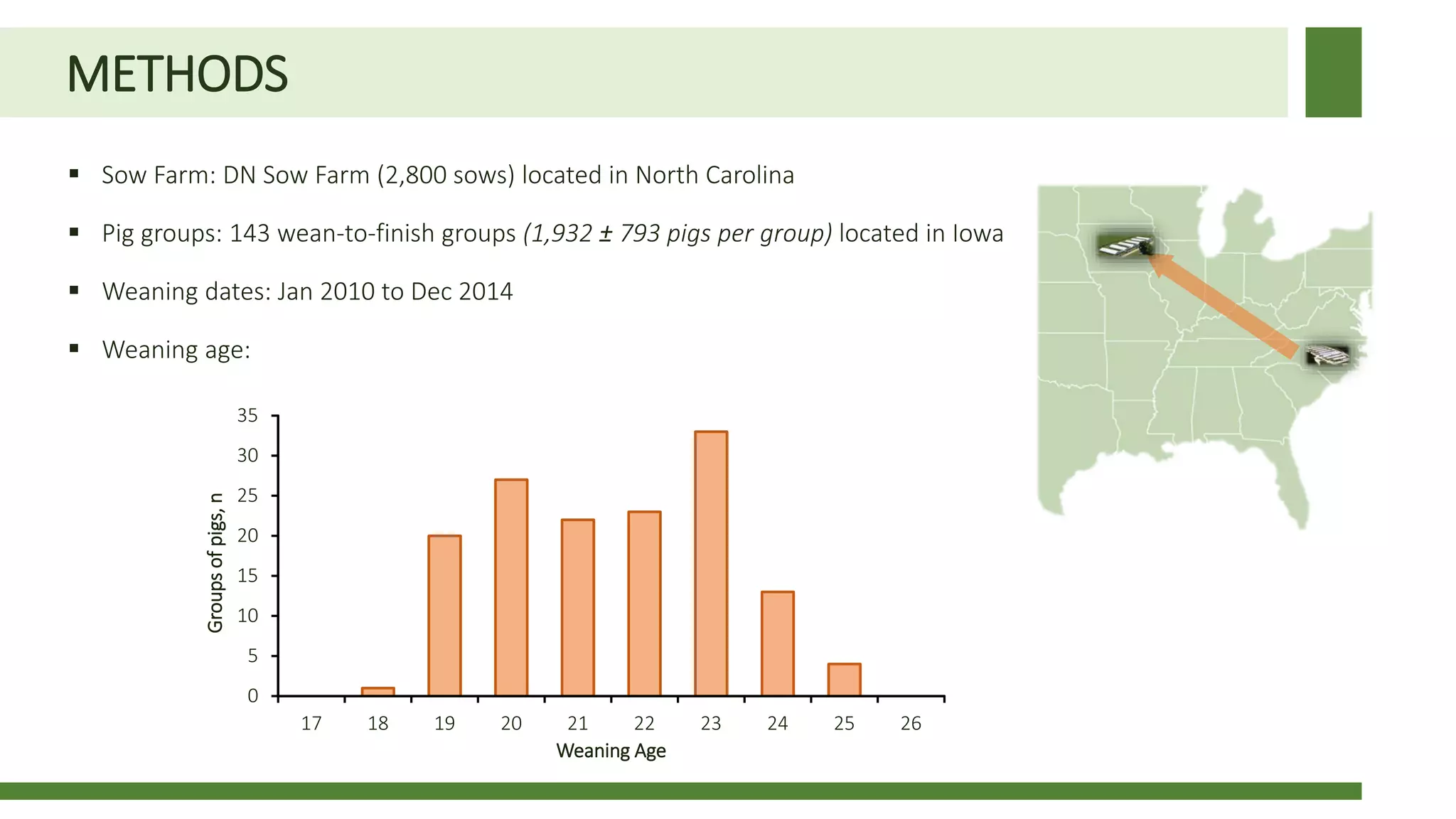
METHODS
 Sow Farm: DN Sow Farm (2,800 sows) located in North Carolina
 Pig groups: 143 wean-to-finish groups (1,932 ± 793 pigs per group) located in Iowa
 Weaning dates: Jan 2010 to Dec 2014
 Weaning age:
0
5
10
15
20
25
30
35
17 18 19 20 21 22 23 24 25 26
Groupsofpigs,n
Weaning Age
METHODS (Cont.)
 Calculations:
• Growth performance data (ADG, ADFI, FCR)
were standardized to a final weight of 136 kg
 Production records:
• Sow farm: weekly wean age distribution, monthly performance
• Close-outs: placement and end dates, start and end weights, feed per head, mortality, off-grade pigs
 Health Status records:
• PRRS, Jan to March of 2010
• PEDV, Jan and Feb of 2014
0
20
40
60
80
100
120
140
0 50 100 150 200 250
Finalbodyweight,kg
Age, days
136 kg
METHODS (Cont.)
 Statistics Description
• Models: linear and non-linear regressions
• Close-out group was the experimental unit.
• Normally distributed and fitted linear models: ADG, FCR and days to final weight
• Non-normally distributed and non-linear models: mortality and off-grade pigs
• Goodness of fit of models
o Linear: RMSE and R-square
o Non-linear: Pearson test and the corrected Akaike Information Criterion (AICc)
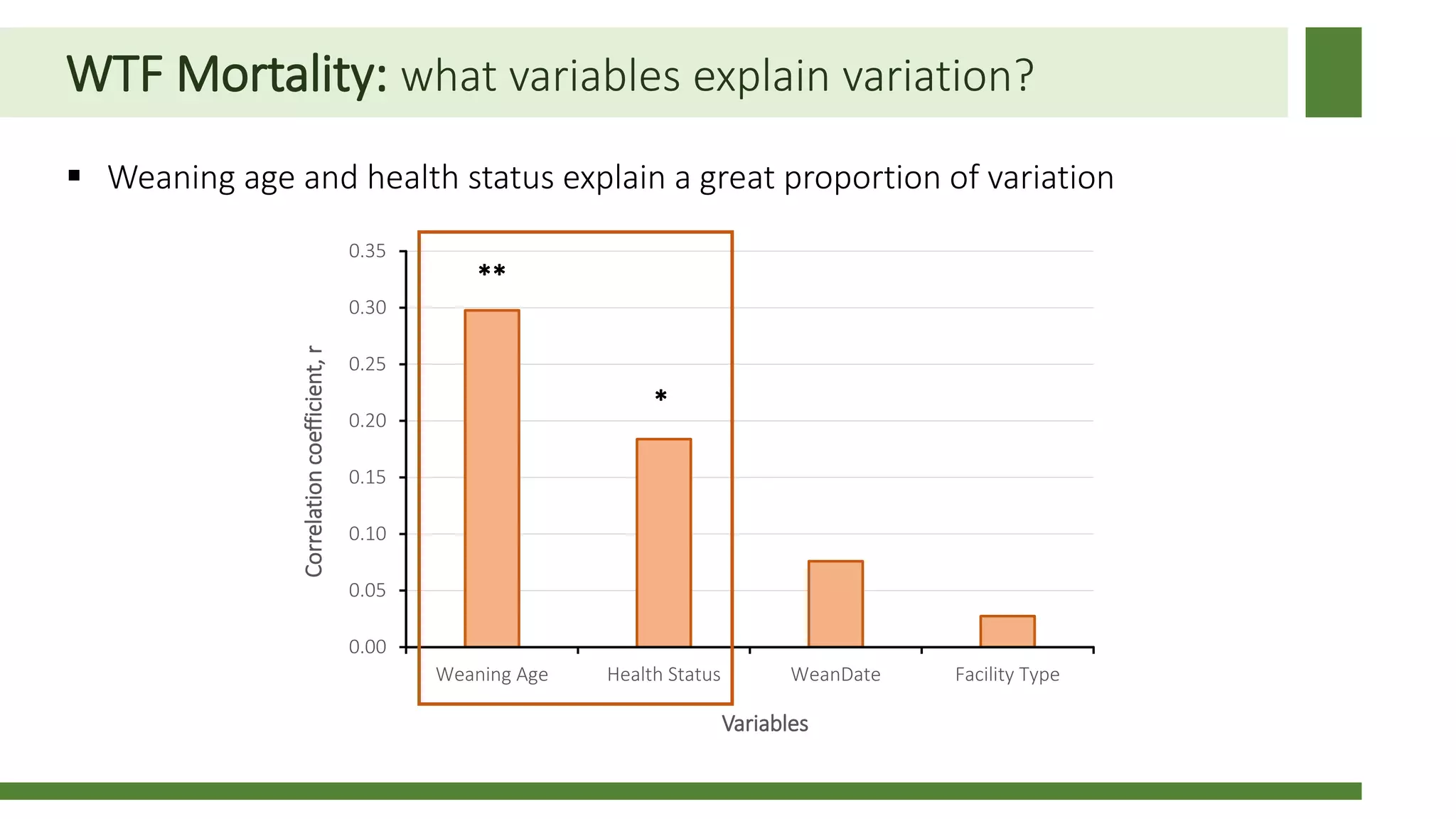
WTF Mortality: what variables explain variation?
 Weaning age and health status explain a great proportion of variation
0.00
0.05
0.10
0.15
0.20
0.25
0.30
0.35
Weaning Age Health Status WeanDate Facility Type
Correlationcoefficient,r
Variables
**
*
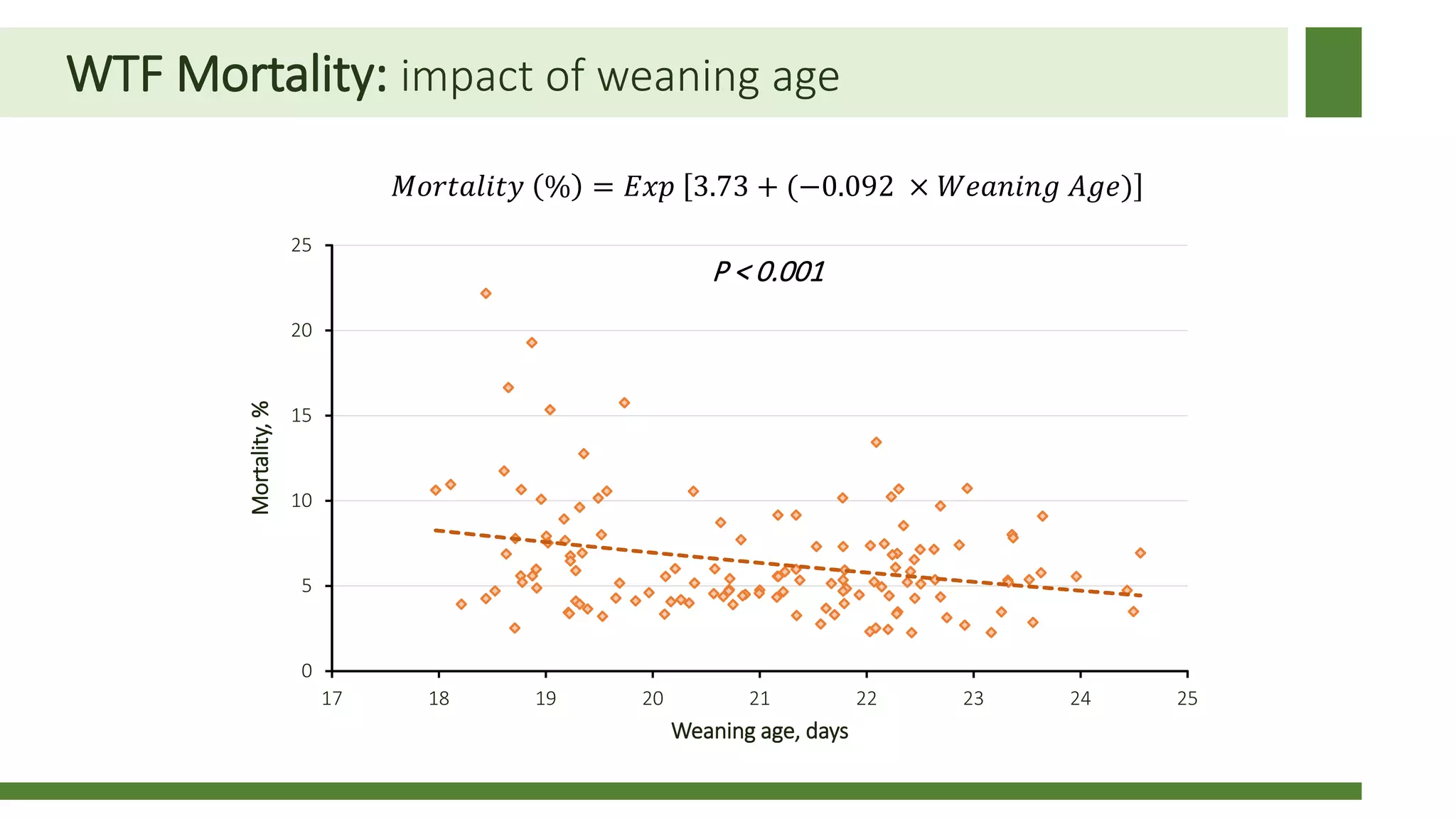
WTF Mortality: impact of weaning age
0
5
10
15
20
25
17 18 19 20 21 22 23 24 25
Mortality,%
Weaning age, days
𝑀𝑀𝑀𝑀𝑀𝑀𝑀𝑀𝑀𝑀𝑀𝑀𝑀𝑀𝑀𝑀𝑀𝑀 % = 𝐸𝐸𝐸𝐸𝐸𝐸 3.73 + (−0.092 × 𝑊𝑊𝑊𝑊𝑊𝑊𝑊𝑊𝑊𝑊𝑊𝑊 𝑊𝑊 𝐴𝐴𝐴𝐴𝐴𝐴)
P < 0.001
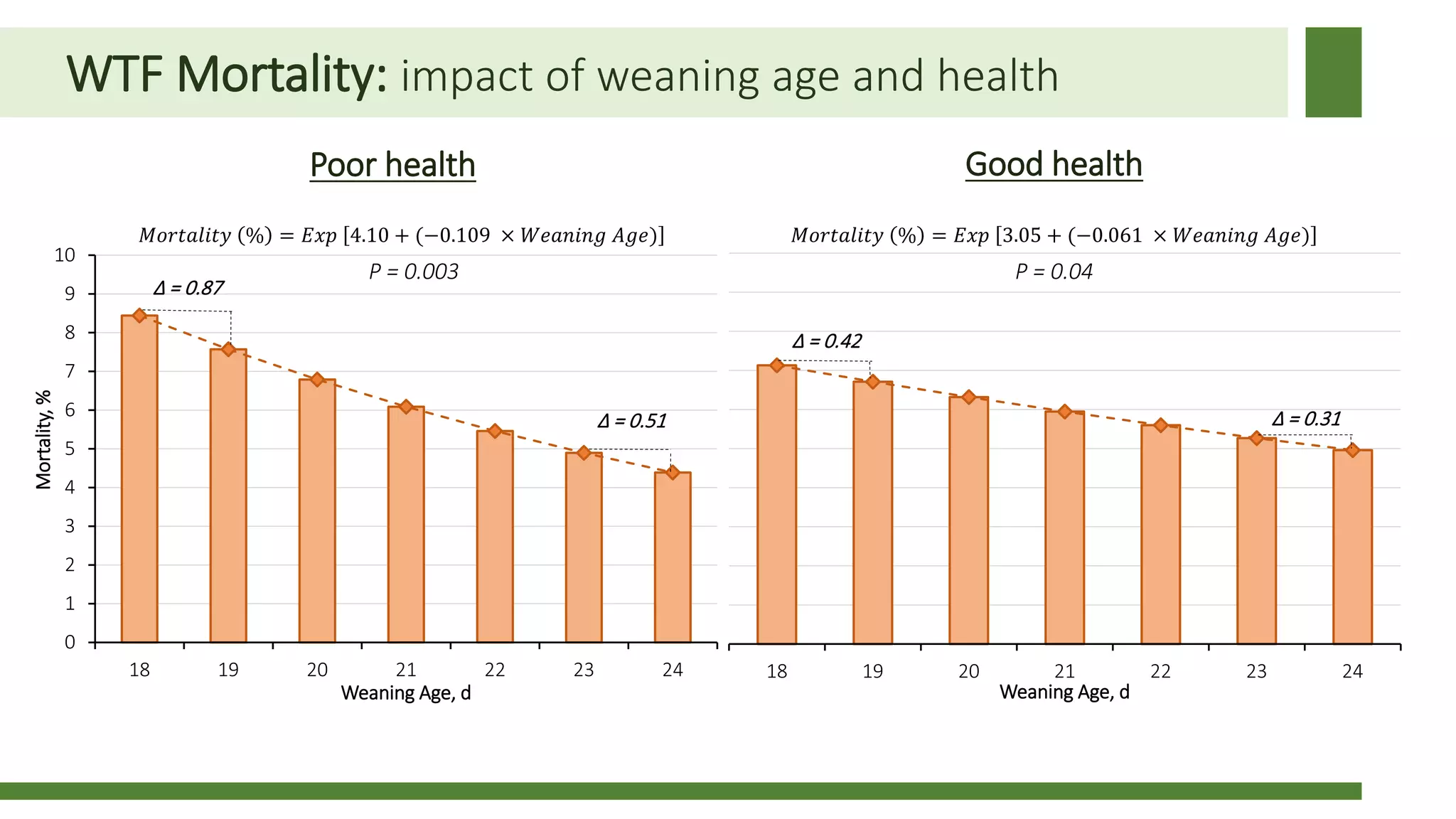
WTF Mortality: impact of weaning age and health
0
1
2
3
4
5
6
7
8
9
10
18 19 20 21 22 23 24
Mortality,%
Weaning Age, d
18 19 20 21 22 23 24
Weaning Age, d
𝑀𝑀𝑀𝑀𝑀𝑀𝑀𝑀𝑀𝑀𝑀𝑀𝑀𝑀𝑀𝑀𝑀𝑀 % = 𝐸𝐸𝐸𝐸𝐸𝐸 4.10 + (−0.109 × 𝑊𝑊𝑊𝑊𝑊𝑊𝑊𝑊𝑊𝑊𝑊𝑊𝑊𝑊 𝐴𝐴𝐴𝐴𝐴𝐴) 𝑀𝑀𝑀𝑀𝑀𝑀𝑀𝑀𝑀𝑀𝑀𝑀𝑀𝑀𝑀𝑀𝑀𝑀 % = 𝐸𝐸𝐸𝐸𝐸𝐸 3.05 + (−0.061 × 𝑊𝑊𝑊𝑊𝑊𝑊𝑊𝑊𝑊𝑊𝑊𝑊𝑊𝑊 𝐴𝐴𝐴𝐴𝐴𝐴)
P = 0.003 P = 0.04
Poor health Good health
Δ = 0.87
Δ = 0.51
Δ = 0.42
Δ = 0.31
Growth rate: impact of weaning age
𝐴𝐴𝐴𝐴𝐴𝐴 𝑔𝑔 = 535.3 + (7.8 × 𝑊𝑊𝑊𝑊𝑊𝑊𝑊𝑊𝑊𝑊𝑊𝑊 𝑊𝑊 𝑎𝑎𝑎𝑎𝑎𝑎)
P < 0.001
500
550
600
650
700
750
800
17 18 19 20 21 22 23 24 25
ADG,g
Weaning age, d
18 19 20 21 22 23 24
Weaning Age, d
620
640
660
680
700
720
740
760
18 19 20 21 22 23 24
ADG,g
Weaning Age, d
Growth rate: impact of weaning age and health
𝐴𝐴𝐴𝐴𝐴𝐴 𝑔𝑔 = 504.2 + (9.3 × 𝑊𝑊𝑊𝑊𝑊𝑊𝑊𝑊𝑊𝑊𝑊𝑊𝑊𝑊 𝑎𝑎𝑎𝑎𝑎𝑎) 𝐴𝐴𝐴𝐴𝐴𝐴 𝑔𝑔 = 545.8 + (7.4 × 𝑊𝑊𝑊𝑊𝑊𝑊𝑊𝑊𝑊𝑊𝑊𝑊 𝑊𝑊 𝑎𝑎𝑎𝑎𝑎𝑎)
P = 0.003 P = 0.04
Poor health Good health
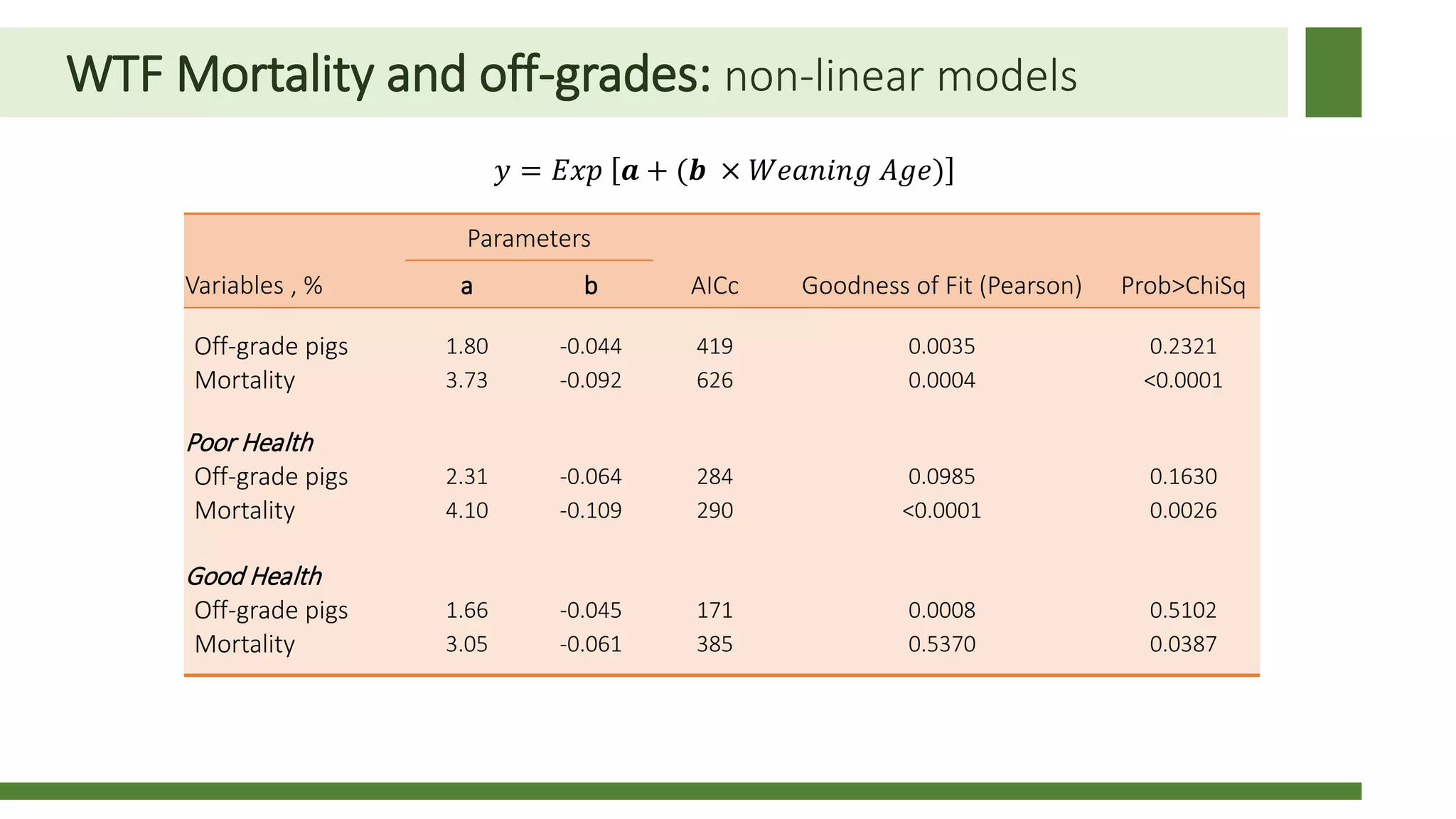
WTF Mortality and off-grades: non-linear models
Parameters
Variables , % a b AICc Goodness of Fit (Pearson) Prob>ChiSq
Off-grade pigs 1.80 -0.044 419 0.0035 0.2321
Mortality 3.73 -0.092 626 0.0004 <0.0001
Poor Health
Off-grade pigs 2.31 -0.064 284 0.0985 0.1630
Mortality 4.10 -0.109 290 <0.0001 0.0026
Good Health
Off-grade pigs 1.66 -0.045 171 0.0008 0.5102
Mortality 3.05 -0.061 385 0.5370 0.0387
𝑦𝑦 = 𝐸𝐸𝐸𝐸𝐸𝐸 𝒂𝒂 + (𝒃𝒃 × 𝑊𝑊𝑊𝑊𝑊𝑊𝑊𝑊𝑊𝑊𝑊𝑊 𝑊𝑊 𝐴𝐴𝐴𝐴𝐴𝐴)
Growth performance: linear models
𝑦𝑦 = 𝒂𝒂 + (𝒃𝒃 × 𝑊𝑊𝑊𝑊𝑊𝑊𝑊𝑊𝑊𝑊𝑊𝑊 𝑊𝑊 𝐴𝐴𝐴𝐴𝐴𝐴)
Parameters
Variables a b RMSE R-square P-value
Days to 136 kg 249.8 -2.0 10.139 0.1020 0.0006
ADG, g 535.3 7.8 0.083 0.1083 0.0004
FCR 2.854 -0.015 0.116 0.0437 0.0276
Poor Health
Days to 136 kg 259.0 -2.5 9.312 0.1445 0.0109
ADG, g 504.2 9.3 0.075 0.1528 0.0087
FCR 2.788 -0.011 0.140 0.0137 0.4495
Good Health
Days to 136 kg 246.2 -1.9 10.677 0.069 0.0211
ADG, g 545.8 7.4 0.089 0.0756 0.0162
FCR 2.701 -0.008 0.103 0.0139 0.3104
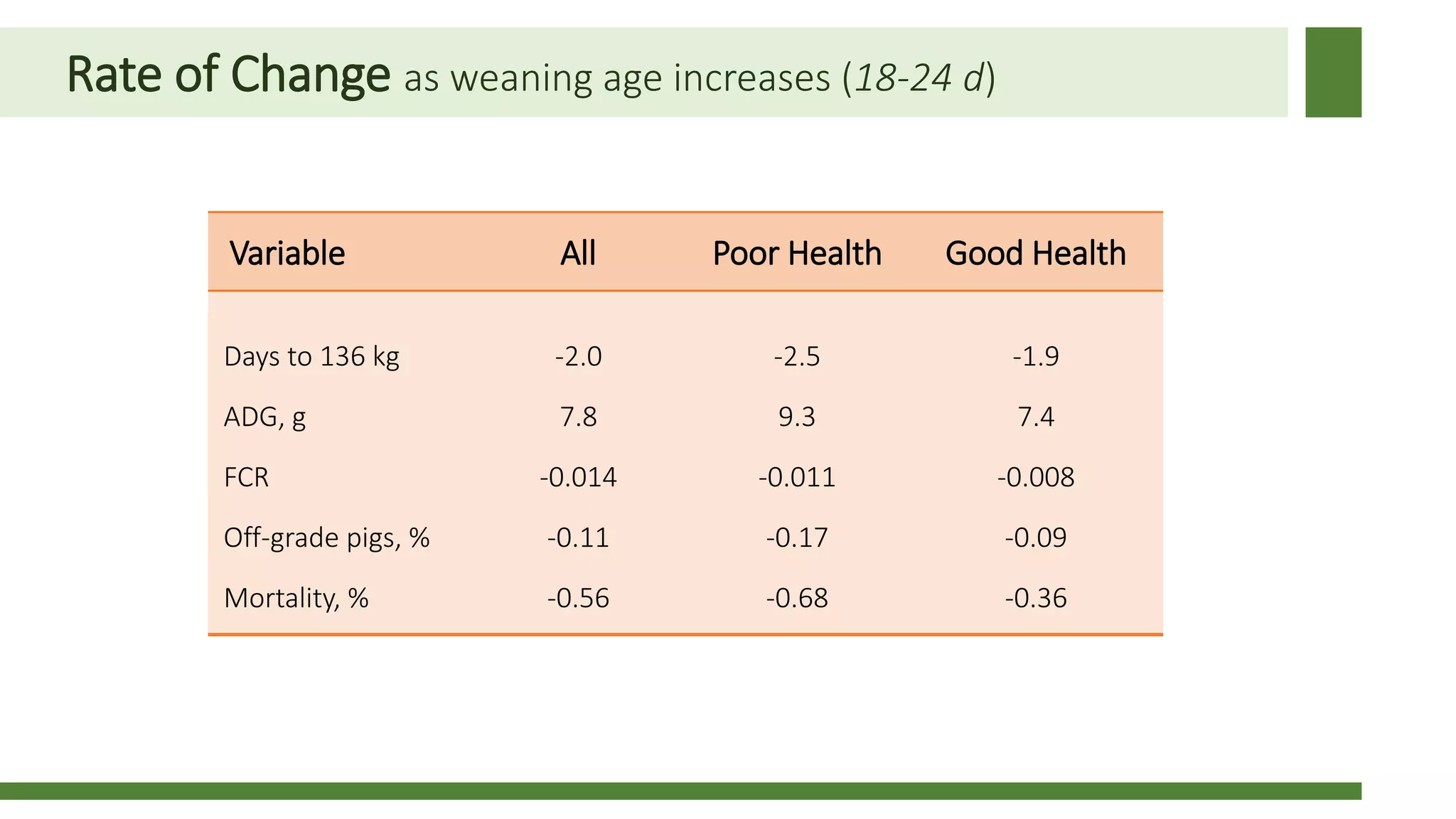
Rate of Change as weaning age increases (18-24 d)
Variable All Poor Health Good Health
Days to 136 kg -2.0 -2.5 -1.9
ADG, g 7.8 9.3 7.4
FCR -0.014 -0.011 -0.008
Off-grade pigs, % -0.11 -0.17 -0.09
Mortality, % -0.56 -0.68 -0.36
CONCLUSIONS
 Weaning age and health status of the sow farm greatly impacted the life-time
performance of pigs overtime (2010 - 2014)
 The negative impact of early weaning was more profound under health
challenge conditions (poor health)
 On this “healthy” sow farm (few health challenge events) every additional
weaning day (18 to 24 d) reduced the mortality by 0.56% and improved the
growth rate of pigs by 7.8 g/d
THANK YOU!

Dr. Dave Rosero - Influence of Wean Age and Disease Challenge on Progeny Lifetime Performance

  • 1.
  • 2.
    WEANING: myriad ofstressors for the young pig! abrupt maternal separation socialhierarchy transportation handling different food source co-mingling different litters physical environment pathogens antigens
  • 3.
    WEANING: Disruption ofGI structure and function 0 200 400 600 800 1000 1200 1400 -1 0 1 2 3 4 5 6 7 8 9 10 11 12 Villousheight,µm Days after weaning Unweaned Weaned Hampson, 1986; Res Vet Sci 40:32-40; Lindemann et al., 1986; J Anim Sci 62:1298-1307 0 2 4 6 8 10 12 14 16 -8 -6 -4 -2 0 2 4 6 8 10 12 14 16 Enzymeactivity(X10000) Days after weaning Unweaned Unweaned Weaned Weaned Amylase Reduced digestive enzyme activityVilli atrophy Lipase (hypothetical)
  • 4.
    PARADIGM: Early-life Stressand GI disease development Early weaning Plasticity Stresssensitivity DiseaseRiskandSeverity Pohl, Medland, and Moeser 2015; Am J Physiol-GI 309:G927-G941 Life-time Barrier function is compromised
  • 5.
    EARLY-WEANING STRESS: disruptionof intestinal barrier Ussing Chamber Technique 3H-Mannitol 14C-Inulin Supernatant ↑ Flux = ↓ barrier function a b b c c 0 0.1 0.2 0.3 0.4 0.5 0.6 0.7 0.8 0.9 15 18 21 23 28 3H-Mannitolflux,µmol-cm2h Weaning Age Smith et al., 2010; Am J Physiol GI 298: G352–G363
  • 6.
    EARLY-WEANING STRESS: long-lastingimpact on barrier function Ussing Chamber Technique 3H-Mannitol 14C-Inulin Supernatant ↑ Flux = ↓ barrier function Smith et al., 2010; Am J Physiol GI 298: G352–G363 * * * * 0 1 2 3 4 5 6 0 20 40 60 80 100 120 140 160 180 3H-Mannitolflux,µmol-cm2h(x10-3) Days after weaning Early weaning Late weaning
  • 7.
    EARLY-WEANING STRESS: Subsequentstressors Impact of Wean Age on intestinal barrier function and immune response to E. coli challenge McLamb et al., 2013; PloS ONE, 8:e59838 b b c a a bc 0 1 2 3 4 5 6 7 8 9 10 16 18 20 Mucosal-to-Serosalflux,µgFD4/min Weaning Age Control ETEC Challenge c c bc c b a 0 5 10 15 20 25 30 35 16 18 20 Neutrophils/HPF Weaning Age Intestinal Permeability Immune response
  • 8.
    EARLY-WEANING: myriad ofstressors with long-lasting impact 0 10 20 30 40 50 60 0 10 20 30 40 50 60 70 BW,lbs Age, d Late weaned Early weaned Weaning  Early weaning negatively impact: • Intestinal structure • Brush border enzyme activity • Intestinal barrier function • Immune response  Impact is exacerbated by other stressors: • Management – mixing and crowding • Infectious challenges …. and many more! Response is immediate, acute and long-lasting
  • 9.
    Impact of weaningage on performance of pigs 500 550 600 650 700 750 12 15 18 21 15.5 18.5 21.5 ADG(weaningtod153-156),g Weaning Age Linear, P < 0.001 Linear, P < 0.001 0 2 4 6 8 10 12 12 15 18 21 15.5 18.5 21.5 Wean-FinishMortality,% Weaning Age Linear, P < 0.001 Linear, P = 0.03 Main et al., 2004; J Anim Sci 82:1499-1507 Growth rate Mortality n = 1,920 & 3,000 pigs Trial 1 Trial 2 Trial 1 Trial 2 n = 1,920 & 3,000 pigs
  • 10.
    PURPOSE  To investigateand quantify the impact of weaning age on pig performance within a multisite production system • Impact of weaning age during health challenge events 15 16 17 18 19 20 21 22 23 24 25 26 1/1/2010 7/20/2010 2/5/2011 8/24/2011 3/11/2012 9/27/2012 4/15/2013 11/1/2013 5/20/2014 12/6/2014 AverageWeaningAgeperweek Wean Date Active PRRS Active PEDV Weaning Age of Groups of Pigs by Weaning Date
  • 11.
    METHODS  Sow Farm:DN Sow Farm (2,800 sows) located in North Carolina  Pig groups: 143 wean-to-finish groups (1,932 ± 793 pigs per group) located in Iowa  Weaning dates: Jan 2010 to Dec 2014  Weaning age: 0 5 10 15 20 25 30 35 17 18 19 20 21 22 23 24 25 26 Groupsofpigs,n Weaning Age
  • 12.
    METHODS (Cont.)  Calculations: •Growth performance data (ADG, ADFI, FCR) were standardized to a final weight of 136 kg  Production records: • Sow farm: weekly wean age distribution, monthly performance • Close-outs: placement and end dates, start and end weights, feed per head, mortality, off-grade pigs  Health Status records: • PRRS, Jan to March of 2010 • PEDV, Jan and Feb of 2014 0 20 40 60 80 100 120 140 0 50 100 150 200 250 Finalbodyweight,kg Age, days 136 kg
  • 13.
    METHODS (Cont.)  StatisticsDescription • Models: linear and non-linear regressions • Close-out group was the experimental unit. • Normally distributed and fitted linear models: ADG, FCR and days to final weight • Non-normally distributed and non-linear models: mortality and off-grade pigs • Goodness of fit of models o Linear: RMSE and R-square o Non-linear: Pearson test and the corrected Akaike Information Criterion (AICc)
  • 14.
    WTF Mortality: whatvariables explain variation?  Weaning age and health status explain a great proportion of variation 0.00 0.05 0.10 0.15 0.20 0.25 0.30 0.35 Weaning Age Health Status WeanDate Facility Type Correlationcoefficient,r Variables ** *
  • 15.
    WTF Mortality: impactof weaning age 0 5 10 15 20 25 17 18 19 20 21 22 23 24 25 Mortality,% Weaning age, days 𝑀𝑀𝑀𝑀𝑀𝑀𝑀𝑀𝑀𝑀𝑀𝑀𝑀𝑀𝑀𝑀𝑀𝑀 % = 𝐸𝐸𝐸𝐸𝐸𝐸 3.73 + (−0.092 × 𝑊𝑊𝑊𝑊𝑊𝑊𝑊𝑊𝑊𝑊𝑊𝑊 𝑊𝑊 𝐴𝐴𝐴𝐴𝐴𝐴) P < 0.001
  • 16.
    WTF Mortality: impactof weaning age and health 0 1 2 3 4 5 6 7 8 9 10 18 19 20 21 22 23 24 Mortality,% Weaning Age, d 18 19 20 21 22 23 24 Weaning Age, d 𝑀𝑀𝑀𝑀𝑀𝑀𝑀𝑀𝑀𝑀𝑀𝑀𝑀𝑀𝑀𝑀𝑀𝑀 % = 𝐸𝐸𝐸𝐸𝐸𝐸 4.10 + (−0.109 × 𝑊𝑊𝑊𝑊𝑊𝑊𝑊𝑊𝑊𝑊𝑊𝑊𝑊𝑊 𝐴𝐴𝐴𝐴𝐴𝐴) 𝑀𝑀𝑀𝑀𝑀𝑀𝑀𝑀𝑀𝑀𝑀𝑀𝑀𝑀𝑀𝑀𝑀𝑀 % = 𝐸𝐸𝐸𝐸𝐸𝐸 3.05 + (−0.061 × 𝑊𝑊𝑊𝑊𝑊𝑊𝑊𝑊𝑊𝑊𝑊𝑊𝑊𝑊 𝐴𝐴𝐴𝐴𝐴𝐴) P = 0.003 P = 0.04 Poor health Good health Δ = 0.87 Δ = 0.51 Δ = 0.42 Δ = 0.31
  • 17.
    Growth rate: impactof weaning age 𝐴𝐴𝐴𝐴𝐴𝐴 𝑔𝑔 = 535.3 + (7.8 × 𝑊𝑊𝑊𝑊𝑊𝑊𝑊𝑊𝑊𝑊𝑊𝑊 𝑊𝑊 𝑎𝑎𝑎𝑎𝑎𝑎) P < 0.001 500 550 600 650 700 750 800 17 18 19 20 21 22 23 24 25 ADG,g Weaning age, d
  • 18.
    18 19 2021 22 23 24 Weaning Age, d 620 640 660 680 700 720 740 760 18 19 20 21 22 23 24 ADG,g Weaning Age, d Growth rate: impact of weaning age and health 𝐴𝐴𝐴𝐴𝐴𝐴 𝑔𝑔 = 504.2 + (9.3 × 𝑊𝑊𝑊𝑊𝑊𝑊𝑊𝑊𝑊𝑊𝑊𝑊𝑊𝑊 𝑎𝑎𝑎𝑎𝑎𝑎) 𝐴𝐴𝐴𝐴𝐴𝐴 𝑔𝑔 = 545.8 + (7.4 × 𝑊𝑊𝑊𝑊𝑊𝑊𝑊𝑊𝑊𝑊𝑊𝑊 𝑊𝑊 𝑎𝑎𝑎𝑎𝑎𝑎) P = 0.003 P = 0.04 Poor health Good health
  • 19.
    WTF Mortality andoff-grades: non-linear models Parameters Variables , % a b AICc Goodness of Fit (Pearson) Prob>ChiSq Off-grade pigs 1.80 -0.044 419 0.0035 0.2321 Mortality 3.73 -0.092 626 0.0004 <0.0001 Poor Health Off-grade pigs 2.31 -0.064 284 0.0985 0.1630 Mortality 4.10 -0.109 290 <0.0001 0.0026 Good Health Off-grade pigs 1.66 -0.045 171 0.0008 0.5102 Mortality 3.05 -0.061 385 0.5370 0.0387 𝑦𝑦 = 𝐸𝐸𝐸𝐸𝐸𝐸 𝒂𝒂 + (𝒃𝒃 × 𝑊𝑊𝑊𝑊𝑊𝑊𝑊𝑊𝑊𝑊𝑊𝑊 𝑊𝑊 𝐴𝐴𝐴𝐴𝐴𝐴)
  • 20.
    Growth performance: linearmodels 𝑦𝑦 = 𝒂𝒂 + (𝒃𝒃 × 𝑊𝑊𝑊𝑊𝑊𝑊𝑊𝑊𝑊𝑊𝑊𝑊 𝑊𝑊 𝐴𝐴𝐴𝐴𝐴𝐴) Parameters Variables a b RMSE R-square P-value Days to 136 kg 249.8 -2.0 10.139 0.1020 0.0006 ADG, g 535.3 7.8 0.083 0.1083 0.0004 FCR 2.854 -0.015 0.116 0.0437 0.0276 Poor Health Days to 136 kg 259.0 -2.5 9.312 0.1445 0.0109 ADG, g 504.2 9.3 0.075 0.1528 0.0087 FCR 2.788 -0.011 0.140 0.0137 0.4495 Good Health Days to 136 kg 246.2 -1.9 10.677 0.069 0.0211 ADG, g 545.8 7.4 0.089 0.0756 0.0162 FCR 2.701 -0.008 0.103 0.0139 0.3104
  • 21.
    Rate of Changeas weaning age increases (18-24 d) Variable All Poor Health Good Health Days to 136 kg -2.0 -2.5 -1.9 ADG, g 7.8 9.3 7.4 FCR -0.014 -0.011 -0.008 Off-grade pigs, % -0.11 -0.17 -0.09 Mortality, % -0.56 -0.68 -0.36
  • 22.
    CONCLUSIONS  Weaning ageand health status of the sow farm greatly impacted the life-time performance of pigs overtime (2010 - 2014)  The negative impact of early weaning was more profound under health challenge conditions (poor health)  On this “healthy” sow farm (few health challenge events) every additional weaning day (18 to 24 d) reduced the mortality by 0.56% and improved the growth rate of pigs by 7.8 g/d
  • 23.