Chad
Dechow
Penn State
University
SIRE SELECTION
CONSIDERATIONS FOR
DAIRY PRODUCERS
Adoption of genomics
Progress versus lag
Selection indexes
Breeding for healthier cows
OUTLINE
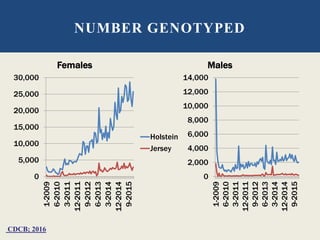
NUMBER GENOTYPED
0
5,000
10,000
15,000
20,000
25,000
30,000
1-2009
6-2010
3-2011
12-2011
9-2012
6-2013
3-2014
12-2014
9-2015
Females
0
2,000
4,000
6,000
8,000
10,000
12,000
14,000
1-2009
6-2010
3-2011
12-2011
9-2012
6-2013
3-2014
12-2014
9-2015
Males
Holstein
Jersey
CDCB; 2016
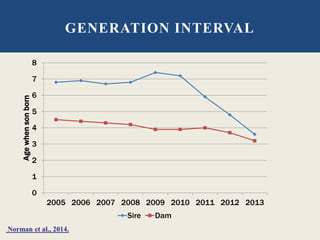
GENERATION INTERVAL
0
1
2
3
4
5
6
7
8
2005 2006 2007 2008 2009 2010 2011 2012 2013
Agewhensonborn
Sire Dam
Norman et al., 2014.
GENOMIC EFFECT
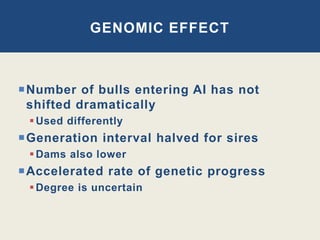
Number of bulls entering AI has not
shifted dramatically
Used differently
Generation interval halved for sires
Dams also lower
Accelerated rate of genetic progress
Degree is uncertain
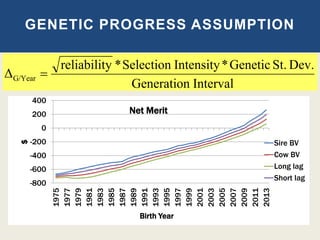
GENETIC PROGRESS ASSUMPTION
IntervalGeneration
Dev.St.Genetic*IntensitySelection*yreliabilit
ΔG/Year 
-800
-600
-400
-200
0
200
400
1975
1977
1979
1981
1983
1985
1987
1989
1991
1993
1995
1997
1999
2001
2003
2005
2007
2009
2011
2013
$
Birth Year
Net Merit
Sire BV
Cow BV
Long lag
Short lag
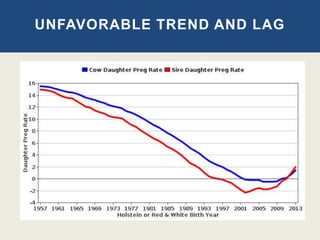
UNFAVORABLE TREND AND LAG
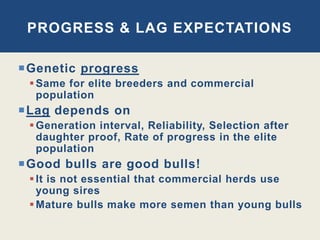
PROGRESS & LAG EXPECTATIONS
Genetic progress
Same for elite breeders and commercial
population
Lag depends on
Generation interval, Reliability, Selection after
daughter proof, Rate of progress in the elite
population
Good bulls are good bulls!
It is not essential that commercial herds use
young sires
Mature bulls make more semen than young bulls
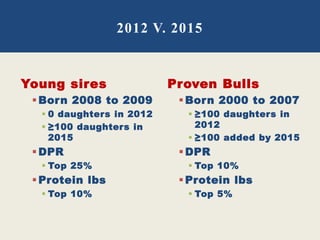
Young sires
Born 2008 to 2009
 0 daughters in 2012
 ≥100 daughters in
2015
DPR
 Top 25%
Protein lbs
 Top 10%
Proven Bulls
Born 2000 to 2007
 ≥100 daughters in
2012
 ≥100 added by 2015
DPR
 Top 10%
Protein lbs
 Top 5%
2012 V. 2015
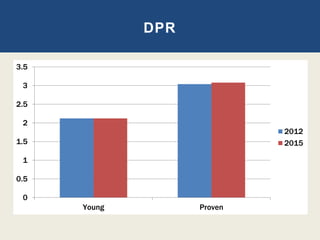
0
0.5
1
1.5
2
2.5
3
3.5
Young Proven
2012
2015
DPR
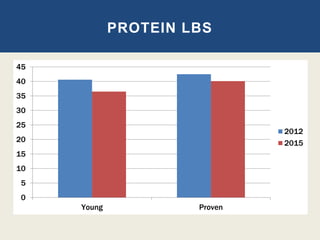
0
5
10
15
20
25
30
35
40
45
Young Proven
2012
2015
PROTEIN LBS
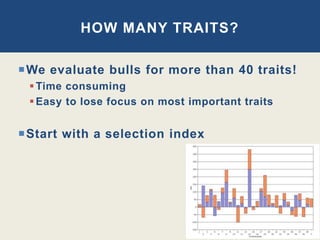
We evaluate bulls for more than 40 traits!
Time consuming
Easy to lose focus on most important traits
Start with a selection index
HOW MANY TRAITS?
Protein yield example
Protein price projection = $2.48/pound
Increased feed required = $0.90/pound
Health costs = $0.09/pound
 [$2.48/pound - $0.90 additional feed -
$0.09 additional health] * 2.78 lactations
= $4.14/pound
HOW IS AN INDEX VALUE DERIVED?
"Parmigiano reggiano factory". CC BY-
SA 3.0 via Wikimedia Commons
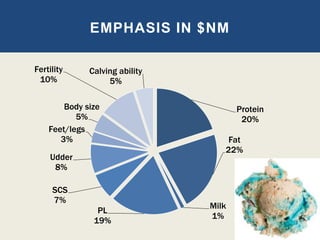
Protein
20%
Fat
22%
Milk
1%
PL
19%
SCS
7%
Udder
8%
Feet/legs
3%
Body size
5%
Fertility
10%
Calving ability
5%
EMPHASIS IN $NM
0%
20%
40%
60%
80%
100%
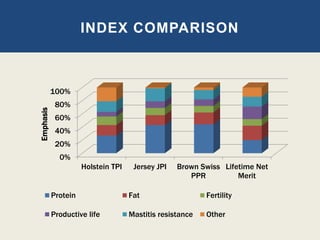
Holstein TPI Jersey JPI Brown Swiss
PPR
Lifetime Net
Merit
Emphasis
Protein Fat Fertility
Productive life Mastitis resistance Other
INDEX COMPARISON
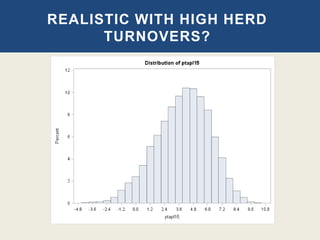
REALISTIC WITH HIGH HERD
TURNOVERS?
0
1
2
3
4
5
6
7
8
9
10
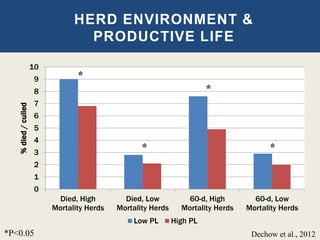
Died, High
Mortality Herds
Died, Low
Mortality Herds
60-d, High
Mortality Herds
60-d, Low
Mortality Herds
%died/culled
Low PL High PL
HERD ENVIRONMENT &
PRODUCTIVE LIFE
*
*
*P<0.05 Dechow et al., 2012
*
*
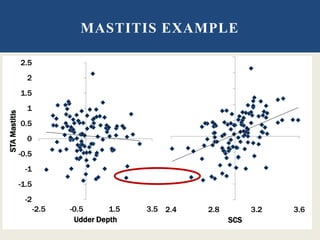
MASTITIS EXAMPLE
-2
-1.5
-1
-0.5
0
0.5
1
1.5
2
2.5
-2.5 -0.5 1.5 3.5
STAMastitis
Udder Depth
2.4 2.8 3.2 3.6
SCS
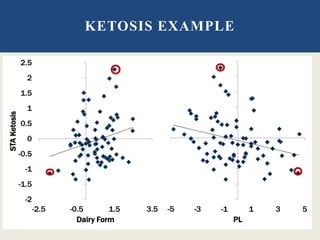
KETOSIS EXAMPLE
-2
-1.5
-1
-0.5
0
0.5
1
1.5
2
2.5
-2.5 -0.5 1.5 3.5
STAKetosis
Dairy Form
-5 -3 -1 1 3 5
PL
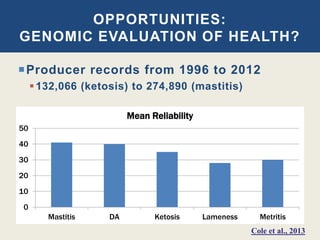
OPPORTUNITIES:
GENOMIC EVALUATION OF HEALTH?
Producer records from 1996 to 2012
132,066 (ketosis) to 274,890 (mastitis)
0
10
20
30
40
50
Mastitis DA Ketosis Lameness Metritis
Mean Reliability
Cole et al., 2013
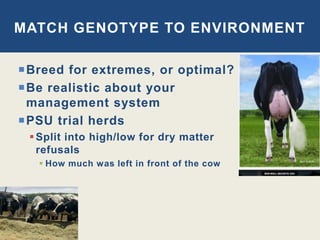
Breed for extremes, or optimal?
Be realistic about your
management system
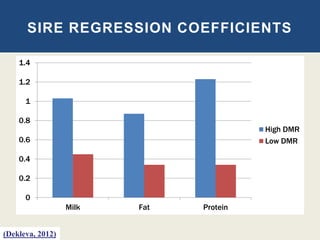
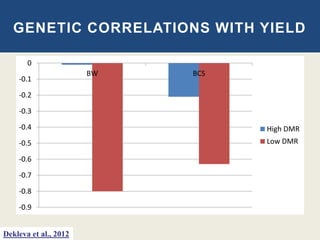
PSU trial herds
Split into high/low for dry matter
refusals
 How much was left in front of the cow
MATCH GENOTYPE TO ENVIRONMENT
SIRE REGRESSION COEFFICIENTS
0
0.2
0.4
0.6
0.8
1
1.2
1.4
Milk Fat Protein
High DMR
Low DMR
(Dekleva, 2012)
GENETIC CORRELATIONS WITH YIELD
-0.9
-0.8
-0.7
-0.6
-0.5
-0.4
-0.3
-0.2
-0.1
0
BW BCS
High DMR
Low DMR
Dekleva et al., 2012
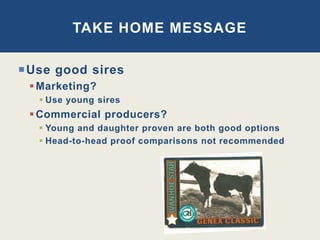
Use good sires
Marketing?
 Use young sires
Commercial producers?
 Young and daughter proven are both good options
 Head-to-head proof comparisons not recommended
TAKE HOME MESSAGE
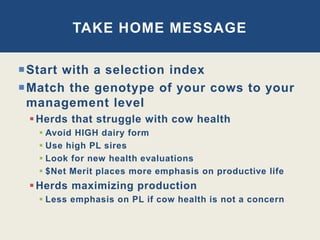
Start with a selection index
Match the genotype of your cows to your
management level
Herds that struggle with cow health
 Avoid HIGH dairy form
 Use high PL sires
 Look for new health evaluations
 $Net Merit places more emphasis on productive life
Herds maximizing production
 Less emphasis on PL if cow health is not a concern
TAKE HOME MESSAGE
Thanks for joining us today!
QUESTIONS?

Sire Selection Considerations for Dairy Producers