Uterine Health and Potential Connection
with Genetic Variation
Klibs N. A. Galvão, DVM, MPVM, PhD, Dipl. ACT
College of Veterinary Medicine
University of Florida
galvaok@ufl.edu
• Genomic selection for fertility-USDA project
• Effects of disease on fertility
• Preliminary work on genomics (Courtesy of F.
Peñagaricano)
• Conclusion
Outline
Pinedo PJ, Santos JE, Galvao K, Seabury C, Rosa JM,
Bicalho RC, Gilbert RO, Schuenemann G, Chebel R,
Thatcher W, Rodriguez-Zas S, Fetrow J
Award # 2012-02115
NIFA AFRI Translational Genomics for Improved Fertility of
Animals
Genomic Selection for Improved Fertility of Dairy
Cows with Emphasis on Cyclicity and Pregnancy
1. To identify genetic markers (SNPs) of fertility in
Holstein cows
2. To obtain genomic-estimated breeding values for
selection for improved fertility
Specific Objectives
USDA Project
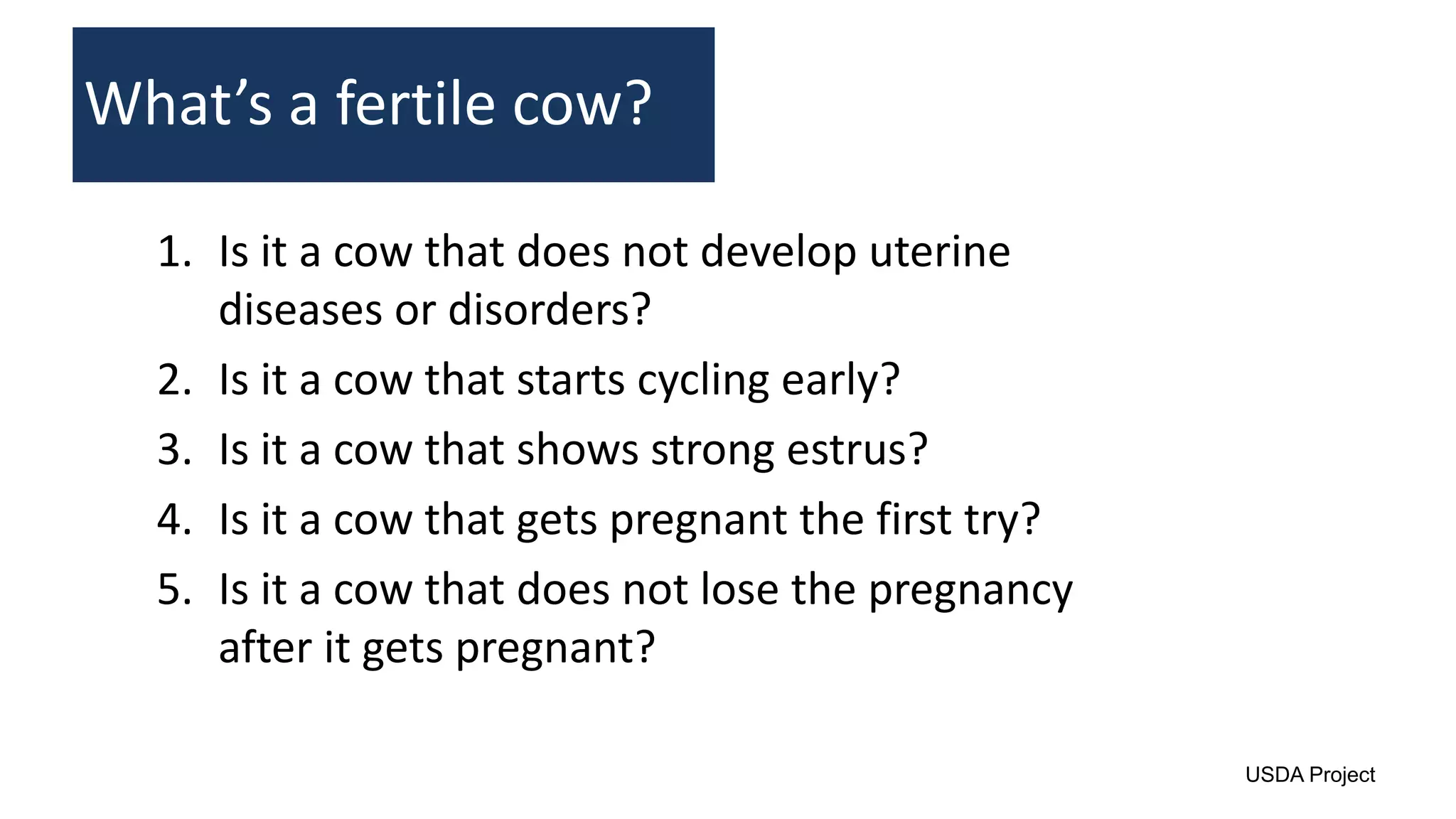
1. Is it a cow that does not develop uterine
diseases or disorders?
2. Is it a cow that starts cycling early?
3. Is it a cow that shows strong estrus?
4. Is it a cow that gets pregnant the first try?
5. Is it a cow that does not lose the pregnancy
after it gets pregnant?
What’s a fertile cow?
USDA Project
Our Approach
• 12,000 cows
• 2,400 cows/state
• 3 - 6 farms/state
• Cool / hot
season
Our Approach
• Uterine health
• Resumption of postpartum ovulation
• Pregnancy per artificial insemination (AI)
• Maintenance of pregnancy
• Other health disorders
Phenotypes:
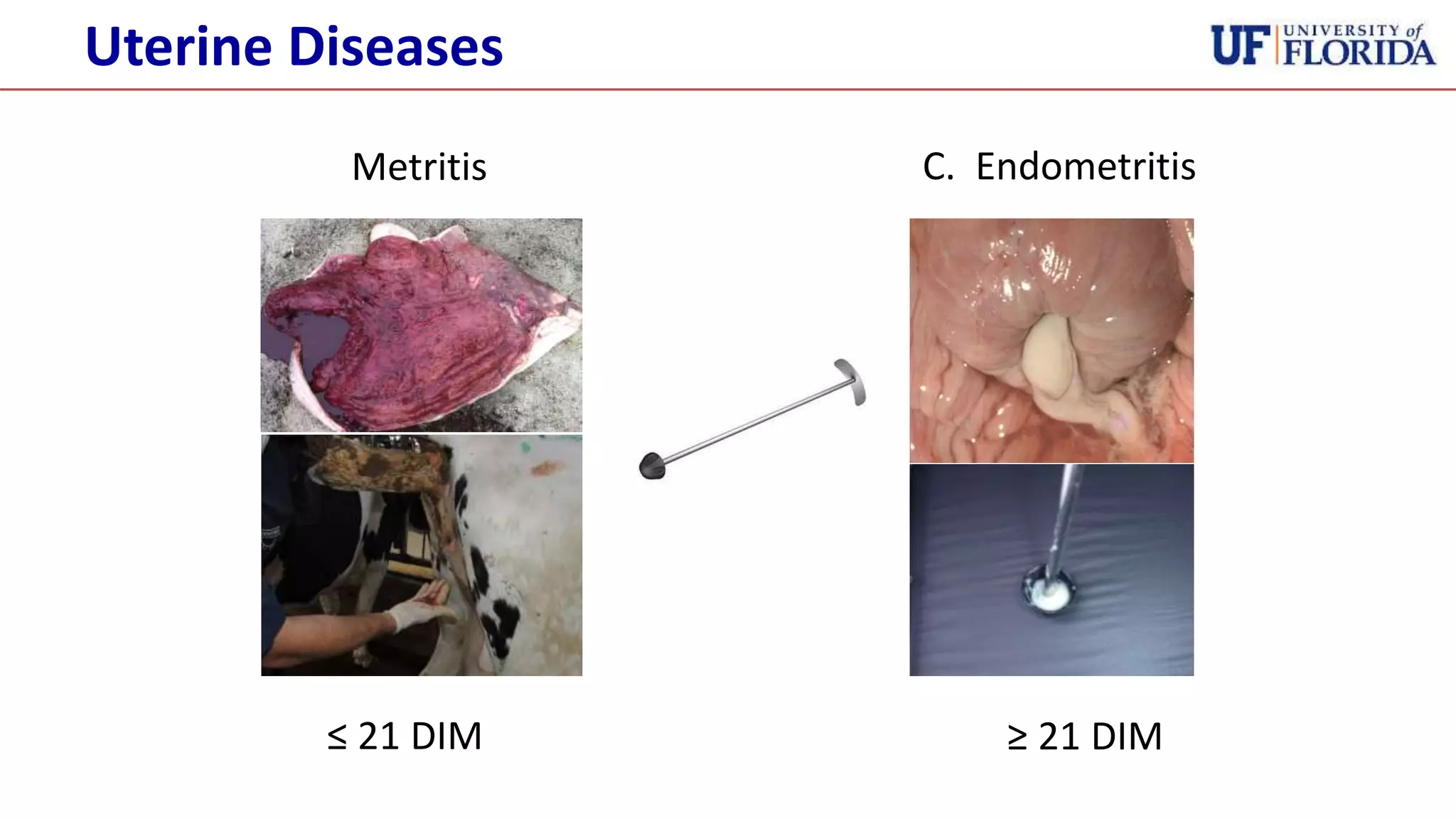
Metritis
≤ 21 DIM
C. Endometritis
≥ 21 DIM
Uterine Diseases
0 5 10 15 20 25 30
Pneumonia
DA
Lameness
Mastitis
S. Ketosis
Calv. Prob.
C. Endom.
Metritis
Summer Cool
Variable CR,% P
Healthy 42.2 < 0.01
Metritis 33.2 < 0.01
C. Endometritis 30.0 < 0.01
Calv. Prob. 34.1 < 0.01
S. Ketosis 32.3 < 0.01
Mastitis 34.6 0.09
Lameness 31.8 < 0.01
DA 24.0 < 0.01
Pneumonia 32.4 < 0.01
USDA Project
Factors Affecting the Risk of Pregnancy
Variable PL,% P
Healthy 8.5
Metritis 12.7 <0.05
C. Endometritis 13.1 <0.05
Calv. Prob. 11.0 0.36
S. Ketosis 12.8 <0.05
Mastitis 7.8 0.09
Lameness 10.4 0.88
DA 16.2 0.22
Pneumonia 14.9 0.19
USDA Project
Factors Affecting the Risk of Pregnancy Loss
USDA Project
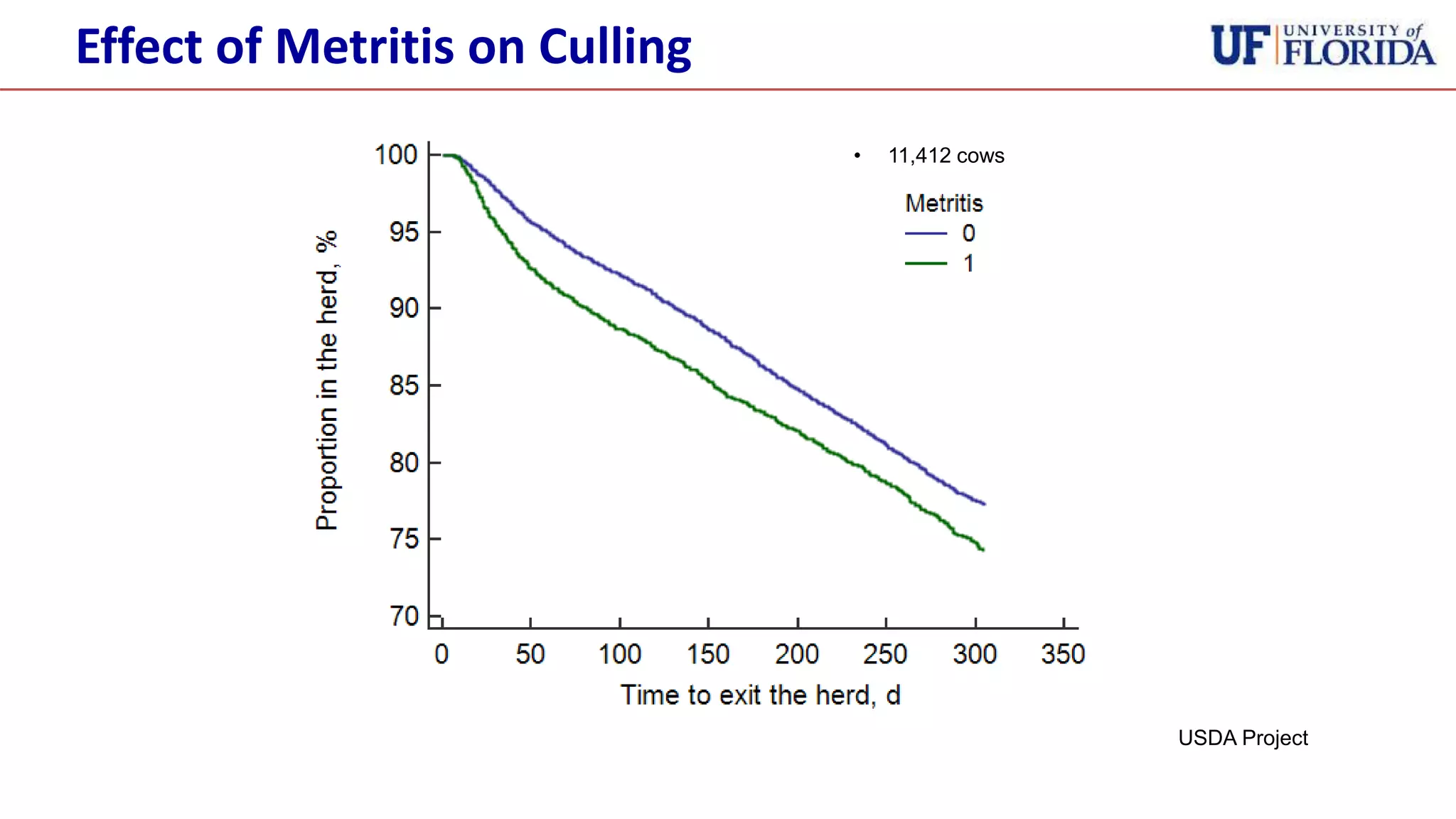
• 11,412 cows
Effect of Metritis on Culling
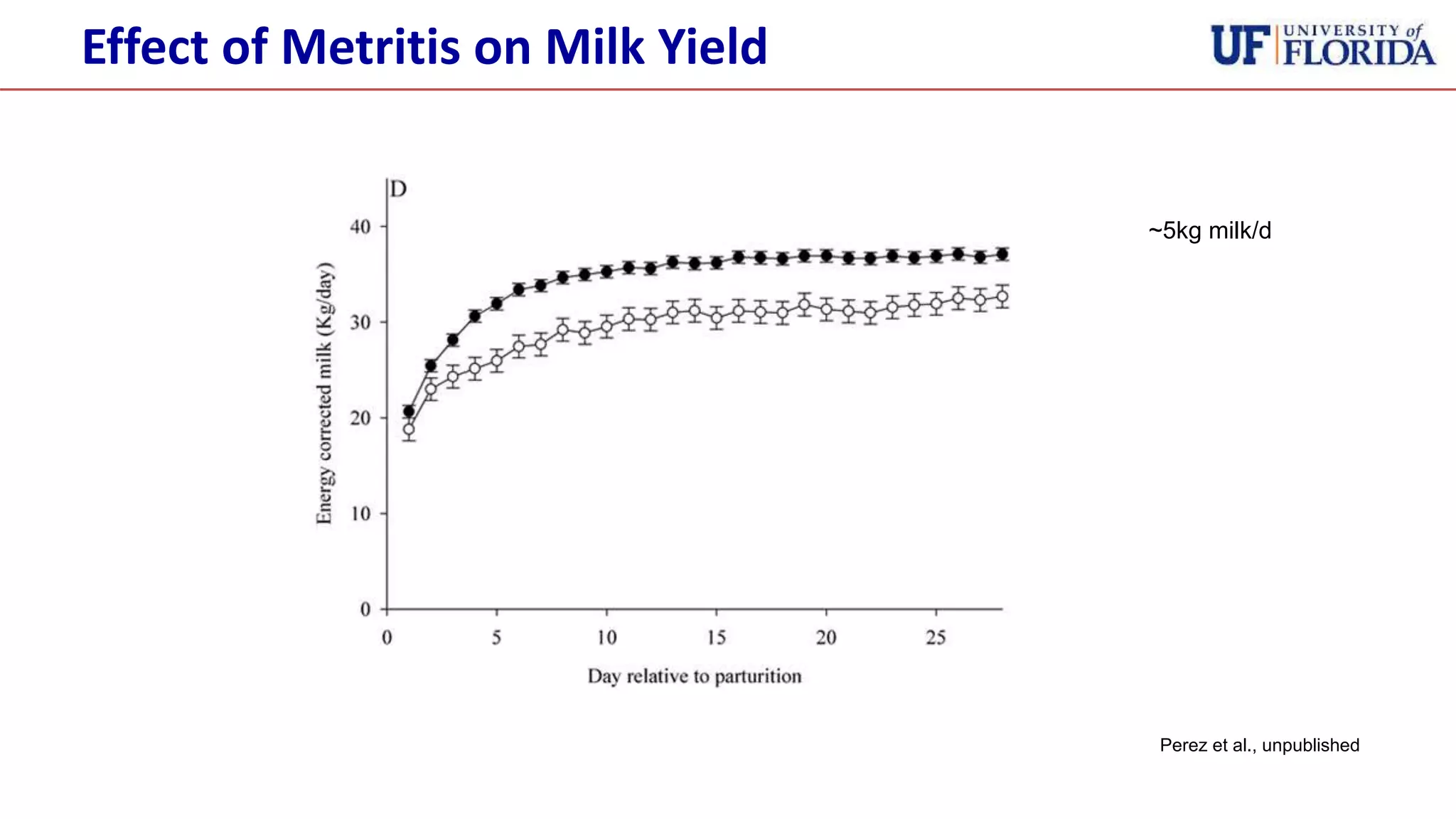
Perez et al., unpublished
~5kg milk/d
Effect of Metritis on Milk Yield
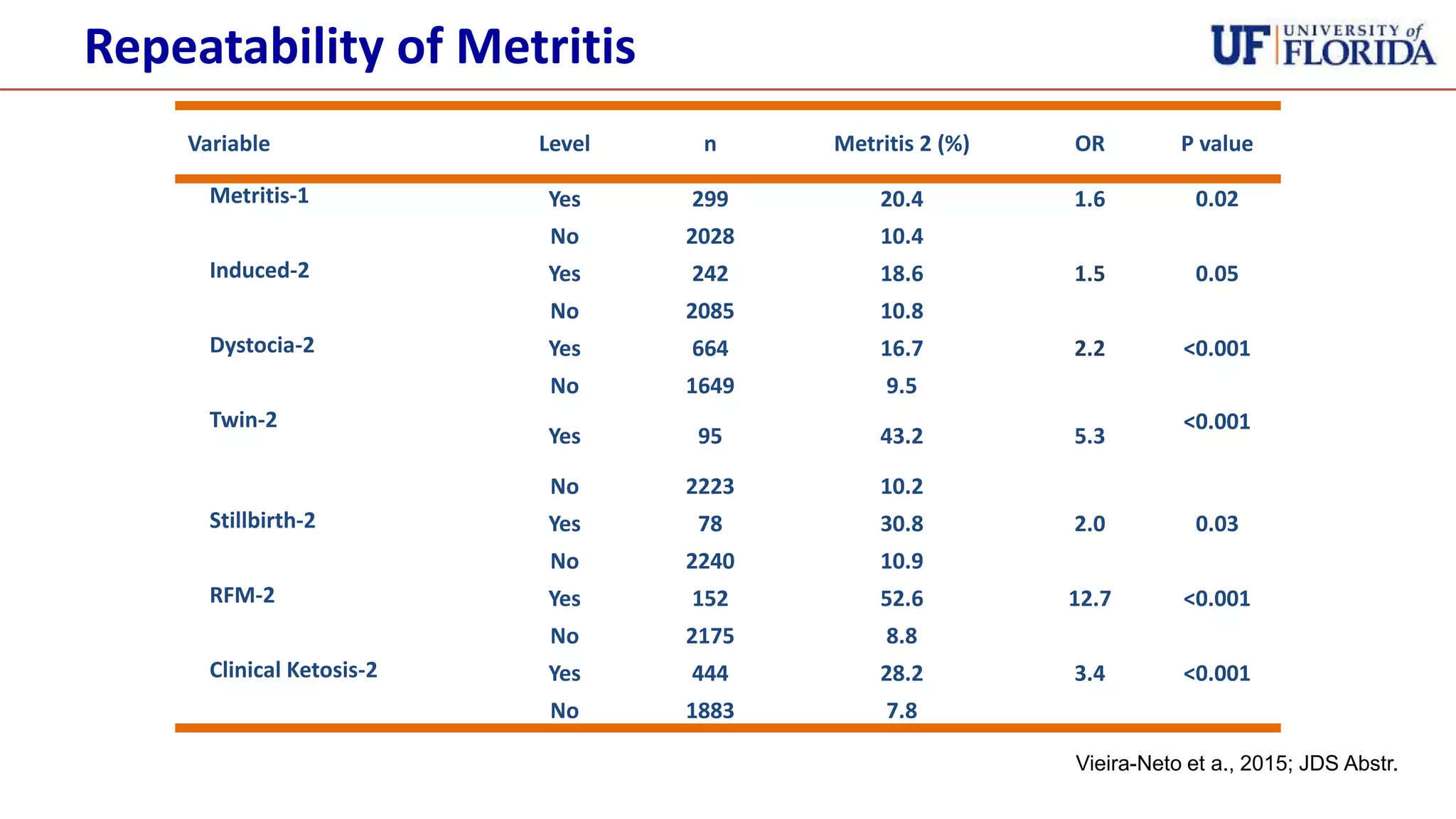
Variable Level n Metritis 2 (%) OR P value
Metritis-1 Yes 299 20.4 1.6 0.02
No 2028 10.4
Induced-2 Yes 242 18.6 1.5 0.05
No 2085 10.8
Dystocia-2 Yes 664 16.7 2.2 <0.001
No 1649 9.5
Twin-2
Yes 95 43.2 5.3
<0.001
No 2223 10.2
Stillbirth-2 Yes 78 30.8 2.0 0.03
No 2240 10.9
RFM-2 Yes 152 52.6 12.7 <0.001
No 2175 8.8
Clinical Ketosis-2 Yes 444 28.2 3.4 <0.001
No 1883 7.8
Vieira-Neto et a., 2015; JDS Abstr.
Repeatability of Metritis
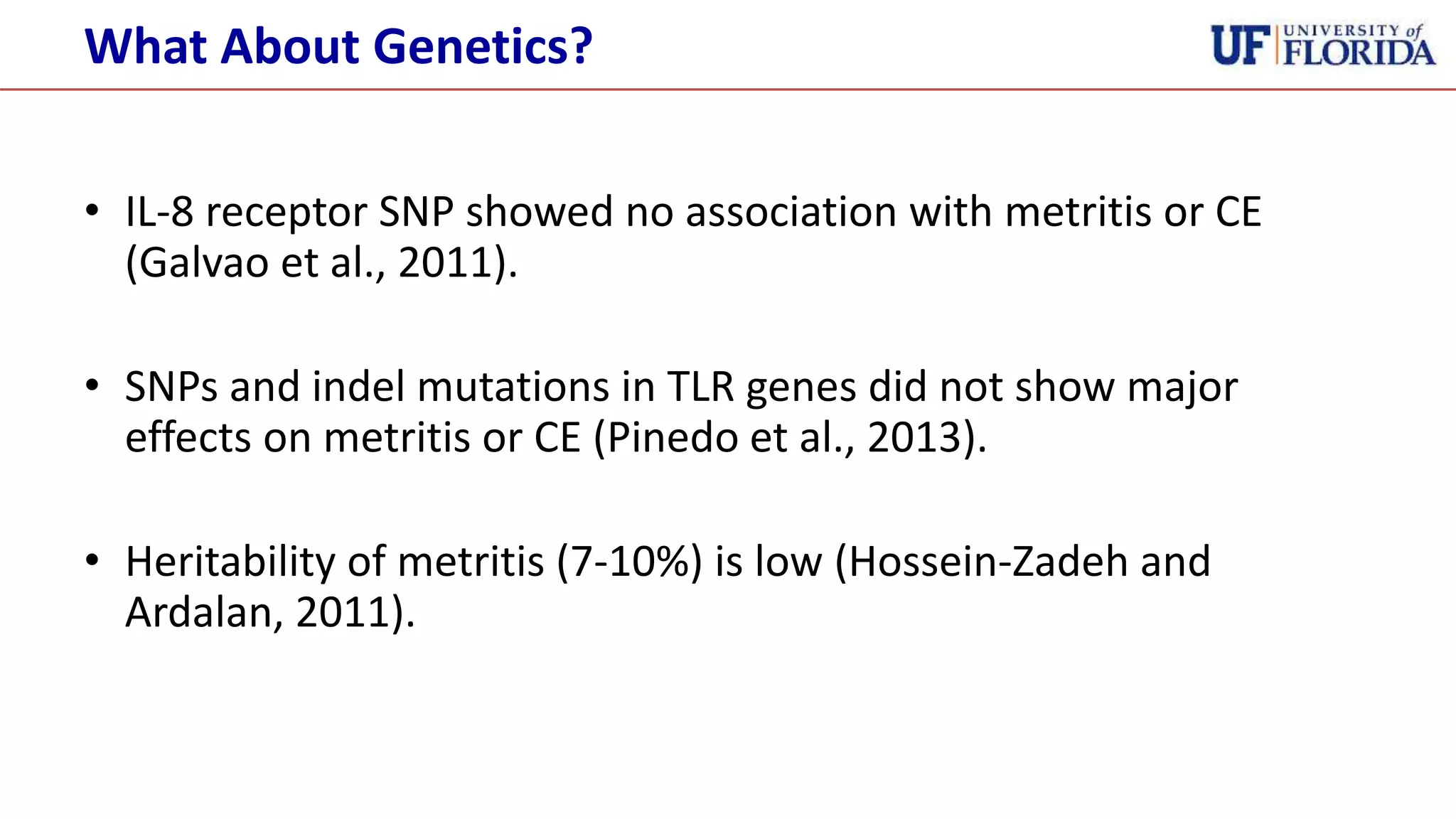
• IL-8 receptor SNP showed no association with metritis or CE
(Galvao et al., 2011).
• SNPs and indel mutations in TLR genes did not show major
effects on metritis or CE (Pinedo et al., 2013).
• Heritability of metritis (7-10%) is low (Hossein-Zadeh and
Ardalan, 2011).
What About Genetics?
• Phenotype: 28k health data records of 14k Holstein cows across lactations
binary trait (0 = no case, 1 = at least one case of metritis)
• Genotype: 8k animals (60k SNP across the genome)
• Pedigree: 28k animals (5-gen pedigree from Council on Dairy Cow Breeding)
Summary statistics of health data records
Events Number of Records %
Sick (1) Healthy (0)
Metritis 2,721 25,662 9.6
Courtesy of F. Peñagaricano
GWAS
𝐇−𝟏
= 𝐀−𝟏
+
𝟎 𝟎
𝟎 𝐆−𝟏
− 𝐀 𝟐𝟐
−𝟏
𝐀−𝟏
𝐇−𝟏
• In single-step genomic best linear unbiased prediction:
G matrix based on 8k animals
A matrix based on 28k animals (5 generation pedigree)
Results: genetic variance explained by 2.0 Mb window of adjacent SNPs
Courtesy of F. Peñagaricano
GWAS
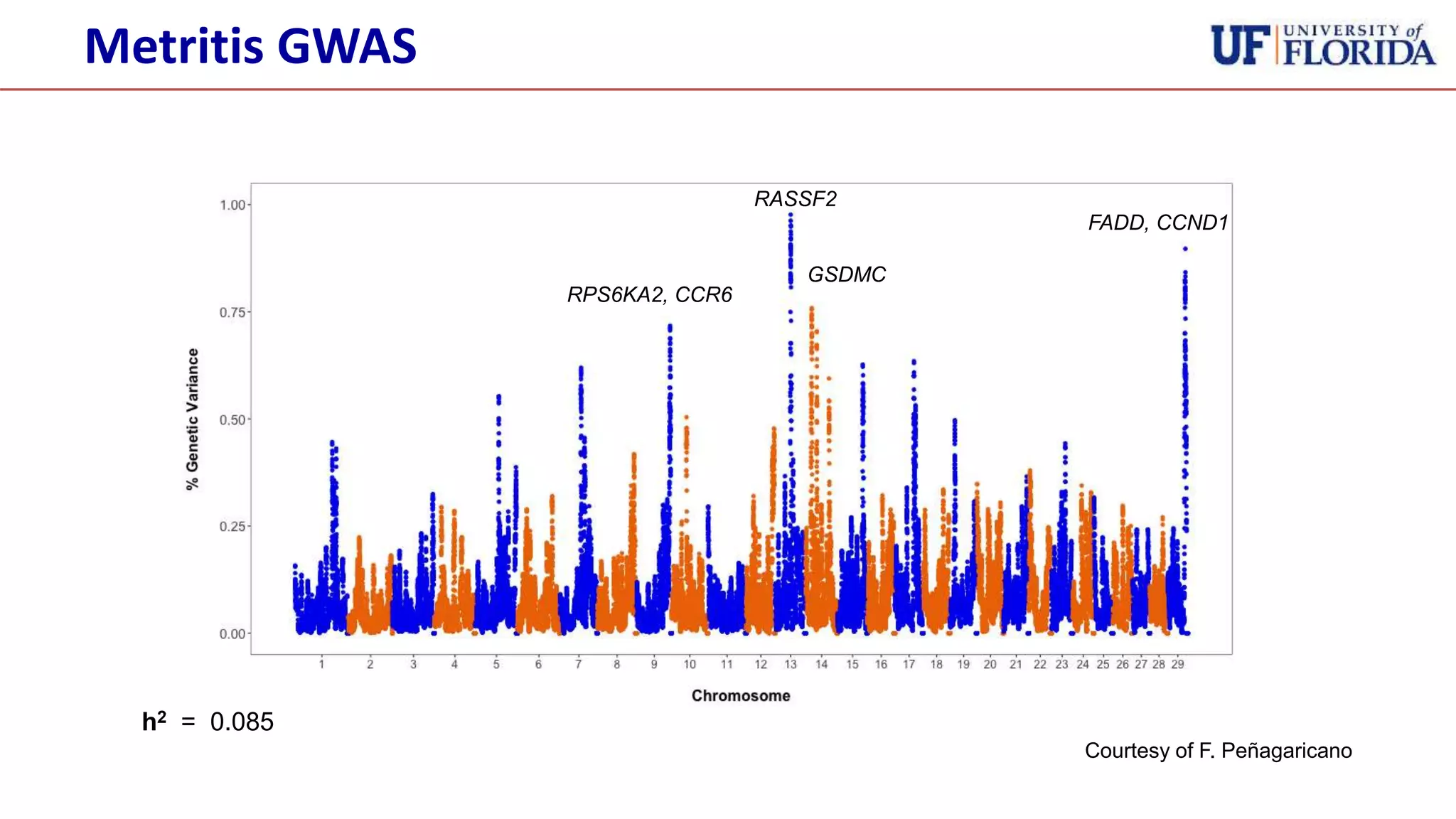
h2 = 0.085
RASSF2
RPS6KA2, CCR6
GSDMC
FADD, CCND1
Courtesy of F. Peñagaricano
Metritis GWAS
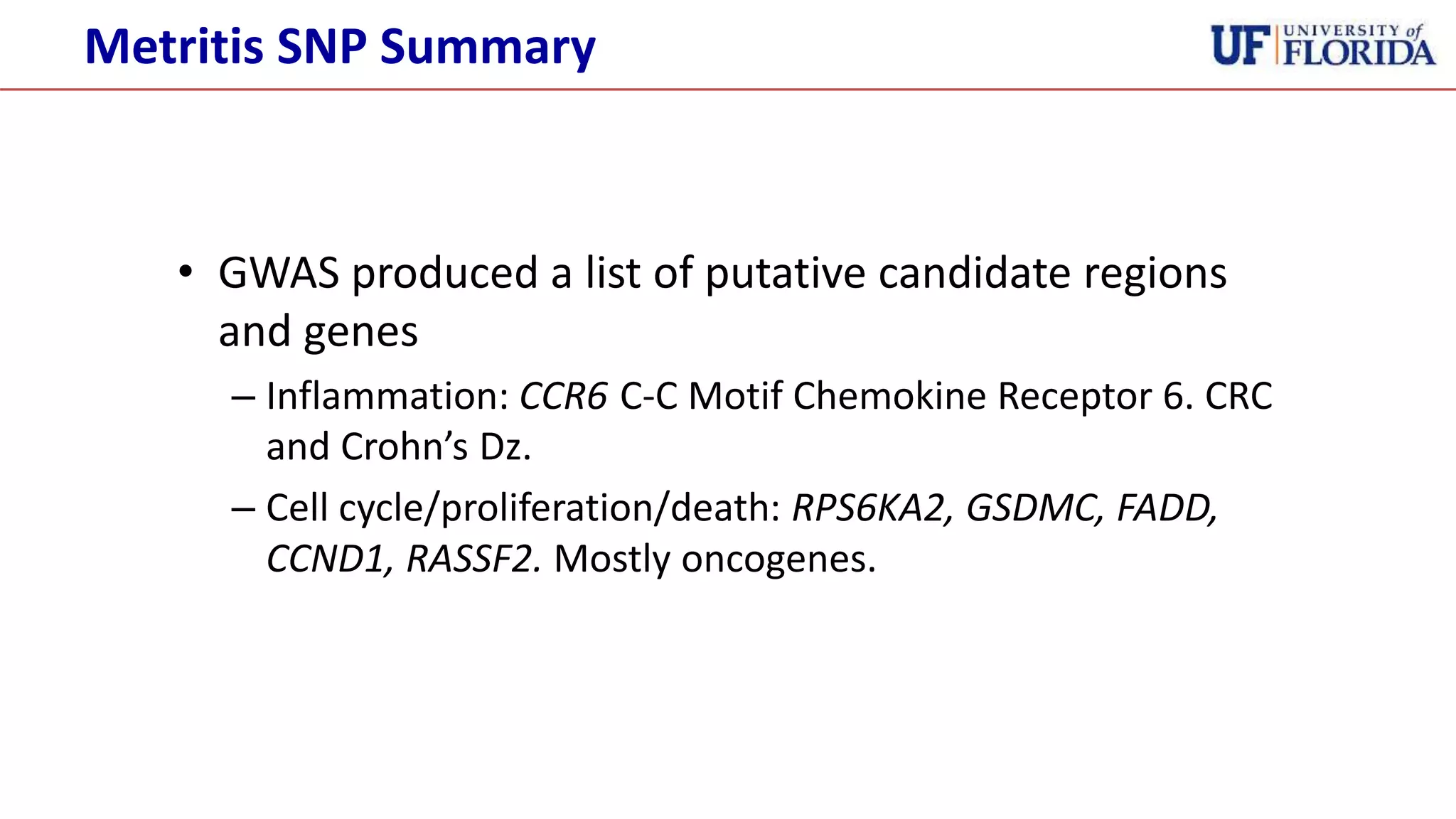
• GWAS produced a list of putative candidate regions
and genes
– Inflammation: CCR6 C-C Motif Chemokine Receptor 6. CRC
and Crohn’s Dz.
– Cell cycle/proliferation/death: RPS6KA2, GSDMC, FADD,
CCND1, RASSF2. Mostly oncogenes.
Metritis SNP Summary
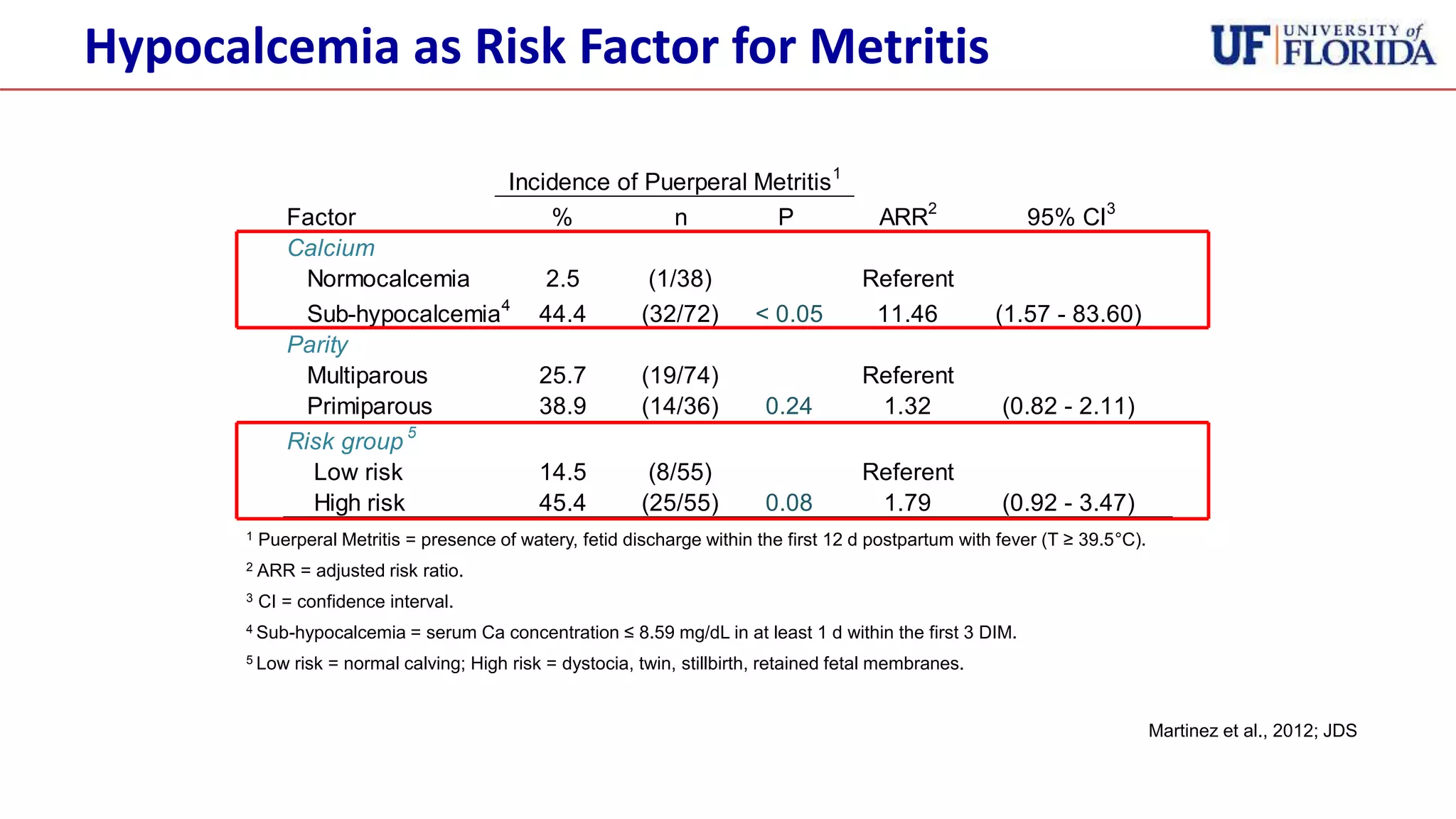
Factor % n P ARR2
95% CI3
Calcium
Normocalcemia 2.5 (1/38) Referent
Sub-hypocalcemia4
44.4 (32/72) < 0.05 11.46 (1.57 - 83.60)
Parity
Multiparous 25.7 (19/74) Referent
Primiparous 38.9 (14/36) 0.24 1.32 (0.82 - 2.11)
Risk group 5
Low risk 14.5 (8/55) Referent
High risk 45.4 (25/55) 0.08 1.79 (0.92 - 3.47)
Incidence of Puerperal Metritis1
1 Puerperal Metritis = presence of watery, fetid discharge within the first 12 d postpartum with fever (T ≥ 39.5°C).
2 ARR = adjusted risk ratio.
3 CI = confidence interval.
4 Sub-hypocalcemia = serum Ca concentration ≤ 8.59 mg/dL in at least 1 d within the first 3 DIM.
5 Low risk = normal calving; High risk = dystocia, twin, stillbirth, retained fetal membranes.
Martinez et al., 2012; JDS
Hypocalcemia as Risk Factor for Metritis
Whole Genome Scan
GWAS
CYP27A1
CYP2J2
GC
SNAI2
PIM1
Courtesy of F. Peñagaricano
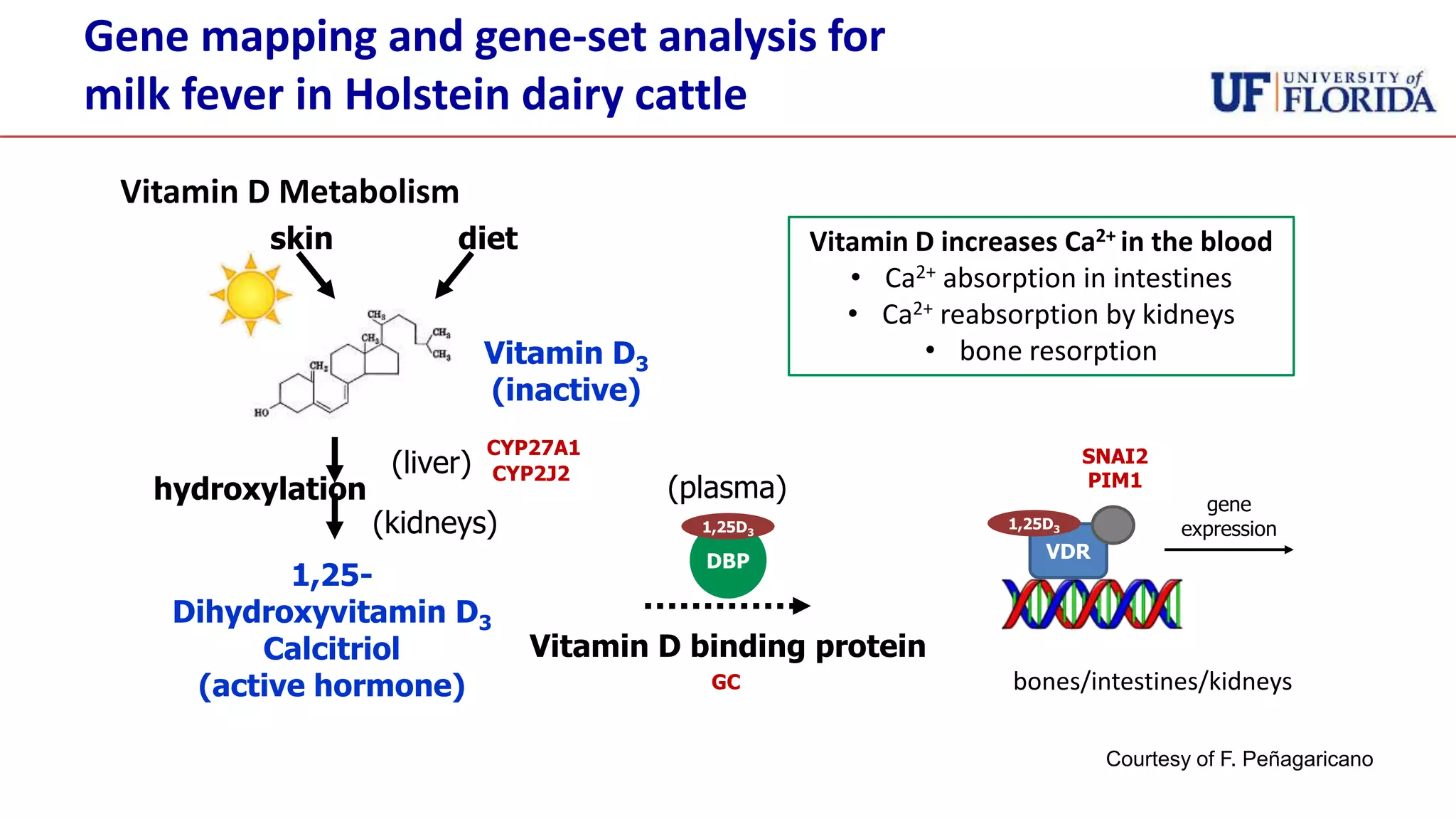
Gene mapping and gene-set analysis for
milk fever in Holstein dairy cattle
Vitamin D Metabolism
dietskin
Vitamin D3
(inactive)
1,25-
Dihydroxyvitamin D3
Calcitriol
(active hormone)
hydroxylation
(liver)
(kidneys)
(plasma)
Vitamin D binding protein
VDRDBP
1,25D3
1,25D3
gene
expression
Vitamin D increases Ca2+ in the blood
• Ca2+ absorption in intestines
• Ca2+ reabsorption by kidneys
• bone resorption
bones/intestines/kidneys
CYP27A1
CYP2J2
GC
SNAI2
PIM1
Courtesy of F. Peñagaricano
• Uterine diseases are highly prevalent and deleterious to fertility.
• Genetic variation for metritis exists
• Selection for improved health is possible, although progress will
be slow because of low heritability
• GWAS produced a list of putative candidate regions and genes
– Inflammation: CCR6
– Cell cycle/proliferation/death: RPS6KA2, GSDMC, FADD, CCND1,
RASSF2
• Several genomic regions associated with milk fever
• Major candidate genes closely related to Vitamin D metabolism
• Gene-set analysis revealed mechanisms and biological
processes associated with milk fever such as calcium
homeostasis and immune response
Conclusion

Uterine Health and Potential Connection with Genetic Variation

  • 1.
    Uterine Health andPotential Connection with Genetic Variation Klibs N. A. Galvão, DVM, MPVM, PhD, Dipl. ACT College of Veterinary Medicine University of Florida galvaok@ufl.edu
  • 2.
    • Genomic selectionfor fertility-USDA project • Effects of disease on fertility • Preliminary work on genomics (Courtesy of F. Peñagaricano) • Conclusion Outline
  • 3.
    Pinedo PJ, SantosJE, Galvao K, Seabury C, Rosa JM, Bicalho RC, Gilbert RO, Schuenemann G, Chebel R, Thatcher W, Rodriguez-Zas S, Fetrow J Award # 2012-02115 NIFA AFRI Translational Genomics for Improved Fertility of Animals Genomic Selection for Improved Fertility of Dairy Cows with Emphasis on Cyclicity and Pregnancy
  • 4.
    1. To identifygenetic markers (SNPs) of fertility in Holstein cows 2. To obtain genomic-estimated breeding values for selection for improved fertility Specific Objectives USDA Project
  • 5.
    1. Is ita cow that does not develop uterine diseases or disorders? 2. Is it a cow that starts cycling early? 3. Is it a cow that shows strong estrus? 4. Is it a cow that gets pregnant the first try? 5. Is it a cow that does not lose the pregnancy after it gets pregnant? What’s a fertile cow? USDA Project
  • 6.
    Our Approach • 12,000cows • 2,400 cows/state • 3 - 6 farms/state • Cool / hot season
  • 7.
    Our Approach • Uterinehealth • Resumption of postpartum ovulation • Pregnancy per artificial insemination (AI) • Maintenance of pregnancy • Other health disorders Phenotypes:
  • 8.
    Metritis ≤ 21 DIM C.Endometritis ≥ 21 DIM Uterine Diseases
  • 9.
    0 5 1015 20 25 30 Pneumonia DA Lameness Mastitis S. Ketosis Calv. Prob. C. Endom. Metritis Summer Cool
  • 10.
    Variable CR,% P Healthy42.2 < 0.01 Metritis 33.2 < 0.01 C. Endometritis 30.0 < 0.01 Calv. Prob. 34.1 < 0.01 S. Ketosis 32.3 < 0.01 Mastitis 34.6 0.09 Lameness 31.8 < 0.01 DA 24.0 < 0.01 Pneumonia 32.4 < 0.01 USDA Project Factors Affecting the Risk of Pregnancy
  • 11.
    Variable PL,% P Healthy8.5 Metritis 12.7 <0.05 C. Endometritis 13.1 <0.05 Calv. Prob. 11.0 0.36 S. Ketosis 12.8 <0.05 Mastitis 7.8 0.09 Lameness 10.4 0.88 DA 16.2 0.22 Pneumonia 14.9 0.19 USDA Project Factors Affecting the Risk of Pregnancy Loss
  • 12.
    USDA Project • 11,412cows Effect of Metritis on Culling
  • 13.
    Perez et al.,unpublished ~5kg milk/d Effect of Metritis on Milk Yield
  • 14.
    Variable Level nMetritis 2 (%) OR P value Metritis-1 Yes 299 20.4 1.6 0.02 No 2028 10.4 Induced-2 Yes 242 18.6 1.5 0.05 No 2085 10.8 Dystocia-2 Yes 664 16.7 2.2 <0.001 No 1649 9.5 Twin-2 Yes 95 43.2 5.3 <0.001 No 2223 10.2 Stillbirth-2 Yes 78 30.8 2.0 0.03 No 2240 10.9 RFM-2 Yes 152 52.6 12.7 <0.001 No 2175 8.8 Clinical Ketosis-2 Yes 444 28.2 3.4 <0.001 No 1883 7.8 Vieira-Neto et a., 2015; JDS Abstr. Repeatability of Metritis
  • 15.
    • IL-8 receptorSNP showed no association with metritis or CE (Galvao et al., 2011). • SNPs and indel mutations in TLR genes did not show major effects on metritis or CE (Pinedo et al., 2013). • Heritability of metritis (7-10%) is low (Hossein-Zadeh and Ardalan, 2011). What About Genetics?
  • 16.
    • Phenotype: 28khealth data records of 14k Holstein cows across lactations binary trait (0 = no case, 1 = at least one case of metritis) • Genotype: 8k animals (60k SNP across the genome) • Pedigree: 28k animals (5-gen pedigree from Council on Dairy Cow Breeding) Summary statistics of health data records Events Number of Records % Sick (1) Healthy (0) Metritis 2,721 25,662 9.6 Courtesy of F. Peñagaricano GWAS
  • 17.
    𝐇−𝟏 = 𝐀−𝟏 + 𝟎 𝟎 𝟎𝐆−𝟏 − 𝐀 𝟐𝟐 −𝟏 𝐀−𝟏 𝐇−𝟏 • In single-step genomic best linear unbiased prediction: G matrix based on 8k animals A matrix based on 28k animals (5 generation pedigree) Results: genetic variance explained by 2.0 Mb window of adjacent SNPs Courtesy of F. Peñagaricano GWAS
  • 18.
    h2 = 0.085 RASSF2 RPS6KA2,CCR6 GSDMC FADD, CCND1 Courtesy of F. Peñagaricano Metritis GWAS
  • 19.
    • GWAS produceda list of putative candidate regions and genes – Inflammation: CCR6 C-C Motif Chemokine Receptor 6. CRC and Crohn’s Dz. – Cell cycle/proliferation/death: RPS6KA2, GSDMC, FADD, CCND1, RASSF2. Mostly oncogenes. Metritis SNP Summary
  • 20.
    Factor % nP ARR2 95% CI3 Calcium Normocalcemia 2.5 (1/38) Referent Sub-hypocalcemia4 44.4 (32/72) < 0.05 11.46 (1.57 - 83.60) Parity Multiparous 25.7 (19/74) Referent Primiparous 38.9 (14/36) 0.24 1.32 (0.82 - 2.11) Risk group 5 Low risk 14.5 (8/55) Referent High risk 45.4 (25/55) 0.08 1.79 (0.92 - 3.47) Incidence of Puerperal Metritis1 1 Puerperal Metritis = presence of watery, fetid discharge within the first 12 d postpartum with fever (T ≥ 39.5°C). 2 ARR = adjusted risk ratio. 3 CI = confidence interval. 4 Sub-hypocalcemia = serum Ca concentration ≤ 8.59 mg/dL in at least 1 d within the first 3 DIM. 5 Low risk = normal calving; High risk = dystocia, twin, stillbirth, retained fetal membranes. Martinez et al., 2012; JDS Hypocalcemia as Risk Factor for Metritis
  • 21.
  • 22.
    Gene mapping andgene-set analysis for milk fever in Holstein dairy cattle Vitamin D Metabolism dietskin Vitamin D3 (inactive) 1,25- Dihydroxyvitamin D3 Calcitriol (active hormone) hydroxylation (liver) (kidneys) (plasma) Vitamin D binding protein VDRDBP 1,25D3 1,25D3 gene expression Vitamin D increases Ca2+ in the blood • Ca2+ absorption in intestines • Ca2+ reabsorption by kidneys • bone resorption bones/intestines/kidneys CYP27A1 CYP2J2 GC SNAI2 PIM1 Courtesy of F. Peñagaricano
  • 23.
    • Uterine diseasesare highly prevalent and deleterious to fertility. • Genetic variation for metritis exists • Selection for improved health is possible, although progress will be slow because of low heritability • GWAS produced a list of putative candidate regions and genes – Inflammation: CCR6 – Cell cycle/proliferation/death: RPS6KA2, GSDMC, FADD, CCND1, RASSF2 • Several genomic regions associated with milk fever • Major candidate genes closely related to Vitamin D metabolism • Gene-set analysis revealed mechanisms and biological processes associated with milk fever such as calcium homeostasis and immune response Conclusion