LSAT Study Session 1Wednesday  November 3 ,2010Created by: Phi Nguyen
Today’s AgendaOverview of the LSATMyths and TipsThe Logical Reasoning SectionSteps to answer these questionsComponents of LR questionsArgumentsComponents of an argumentWeak vs. Strong argumentsPractice exercises
The LSAT TestRequired by most law schools for admissionSecond most important deciding factor after CGPAAdministered 4 times a year (February, June, September and December)Deadline to apply for law school in Ontario November  1stSchools in other provinces vary5 timed sections: 3 that are scored  1 that is not scored Writing sample section (not scored but used by some law school admissions boards)Average score needed to get accepted 165 	(80th percentile)
The LSAT TestCategories of scored sections: Logical ReasoningLogic PuzzlesReading ComprehensionOne of the above sections will appear twice but will not be graded because it is used as an experimental section for newly developed questions.
The LSAT Test – Myths and TipsMyths:Reading the question first helpsHaving a law-related academic background helpsTips:Time yourself while you practice doing questionsRead the information for each question in the order presentedUnderline and use symbols to organize your thoughts
Our Focus: Logical ReasoningWhy Logical Reasoning?What about the other sections?What resources are useful?The PowerScore seriesThe Logical Reasoning BibleThe Logic Games BibleThe Reading Comprehension Bible
About Logical ReasoningWhat is it?Critical thinkingTaking in information Identifying exactly what is askedSeparating what is important information from what is not Analyzing the important information using the appropriate method based on what is asked24-26 questions, 35 minutesAverage of 1 minute 20 seconds per questionTIME MANAGEMENT IS CRUCIAL
Logical Reasoning Question ComponentsPresented in the following order:StimulusQuestionAnswer Choices
Sample QuestionMuscular strength is a limited resource, and athletic techniques help to use this resource efficiently. Since top athletes do not differ greatly from each other in muscular strength, it follows that a requirement for an athlete to become a champion is a superior mastery of athletic techniques.	Which one of the following most accurately expresses the conclusion of the argument?	(A) Only champion athletes have a superior mastery of athletic techniques.	(B) Superior muscular strength is a requirement for an athlete to become a champion.	(C) No athlete can become a champion without a superior mastery of athletic techniques.	(D) The differences in muscular strength between top athletes are not great.	(E) Athletic techniques help athletes use limited resources efficiently.
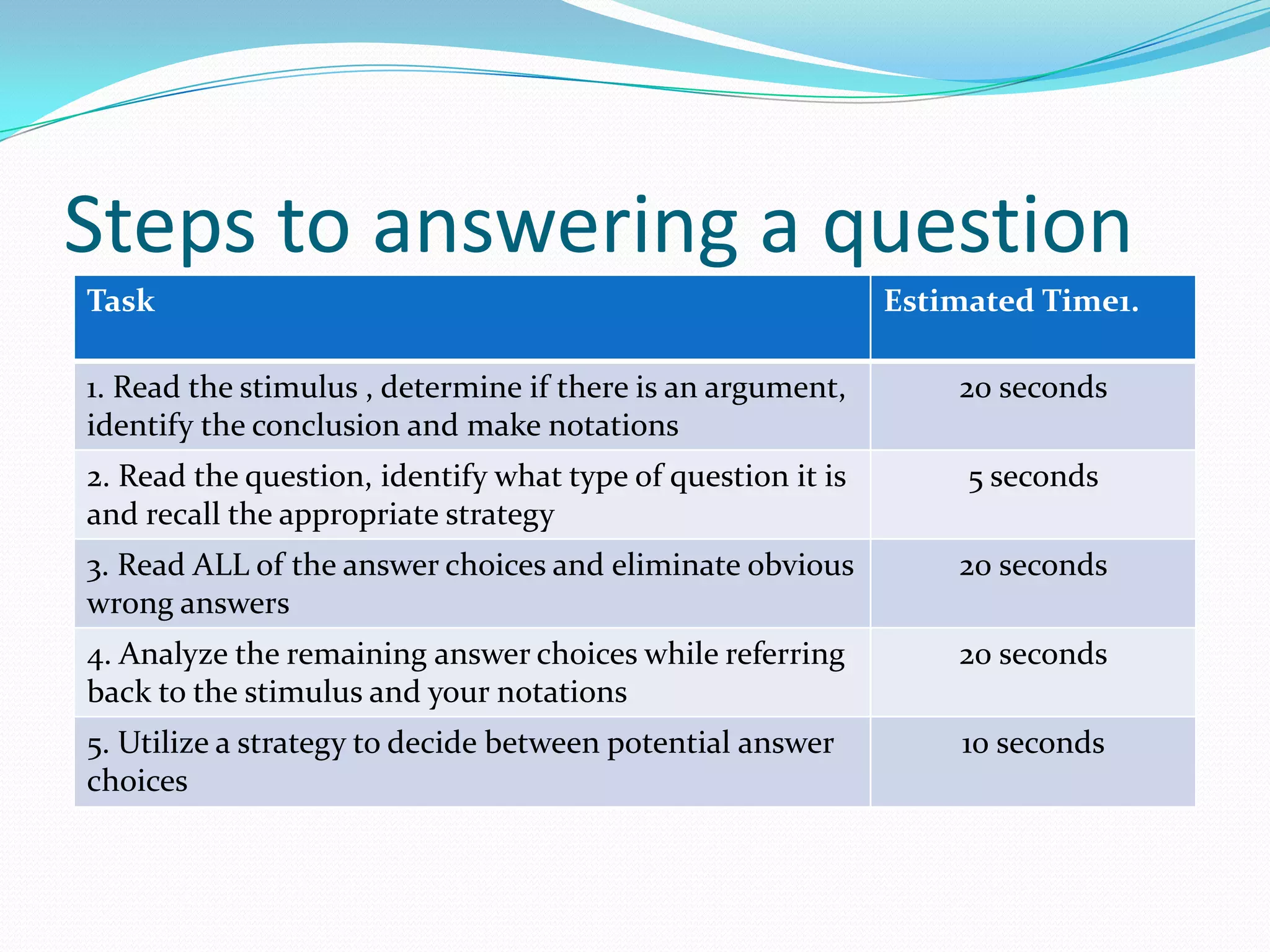
Steps to answering a question
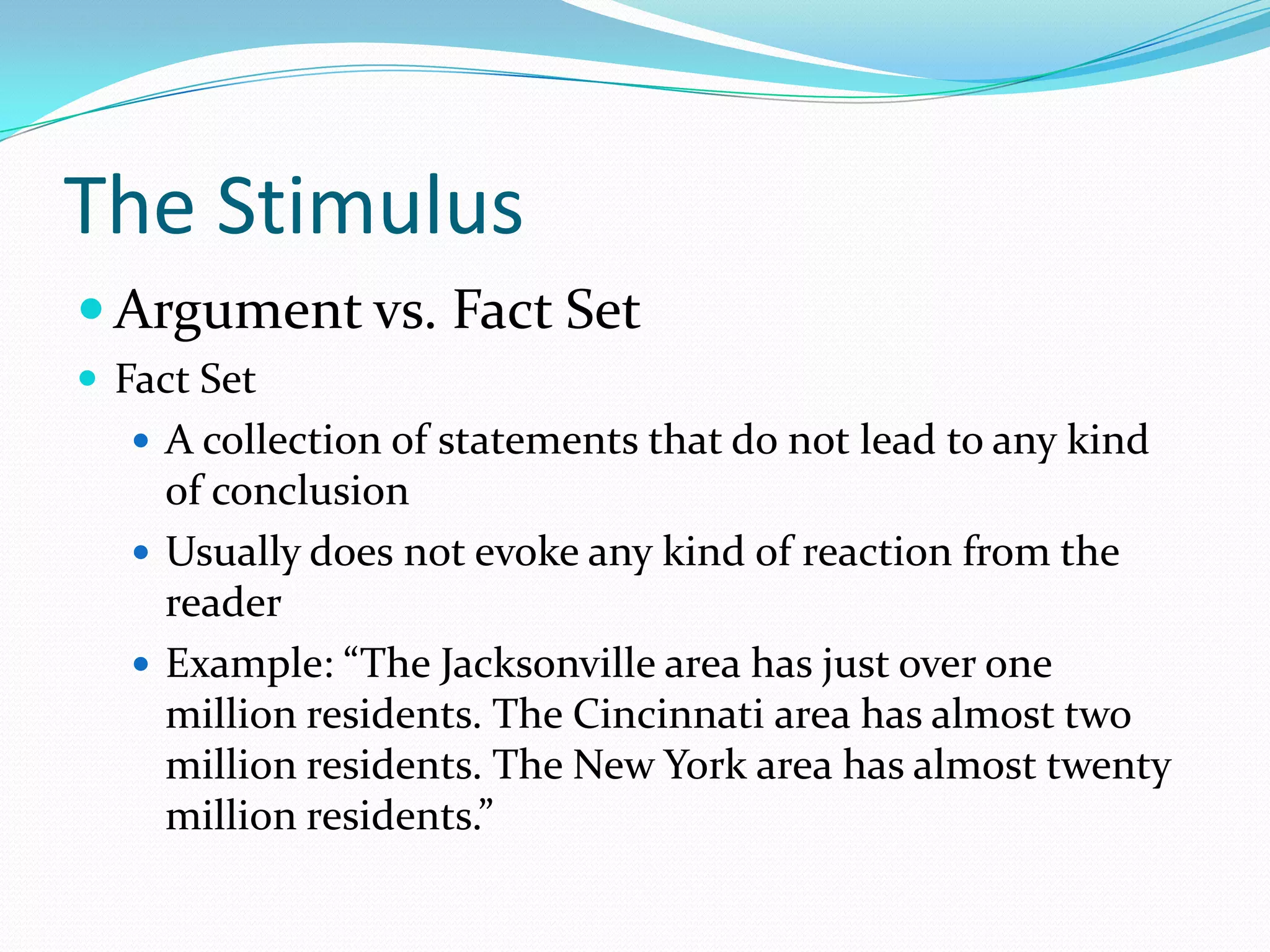
The StimulusArgument vs. Fact SetFact SetA collection of statements that do not lead to any kind of conclusionUsually does not evoke any kind of reaction from the readerExample: “The Jacksonville area has just over one million residents. The Cincinnati area has almost two million residents. The New York area has almost twenty million residents.”
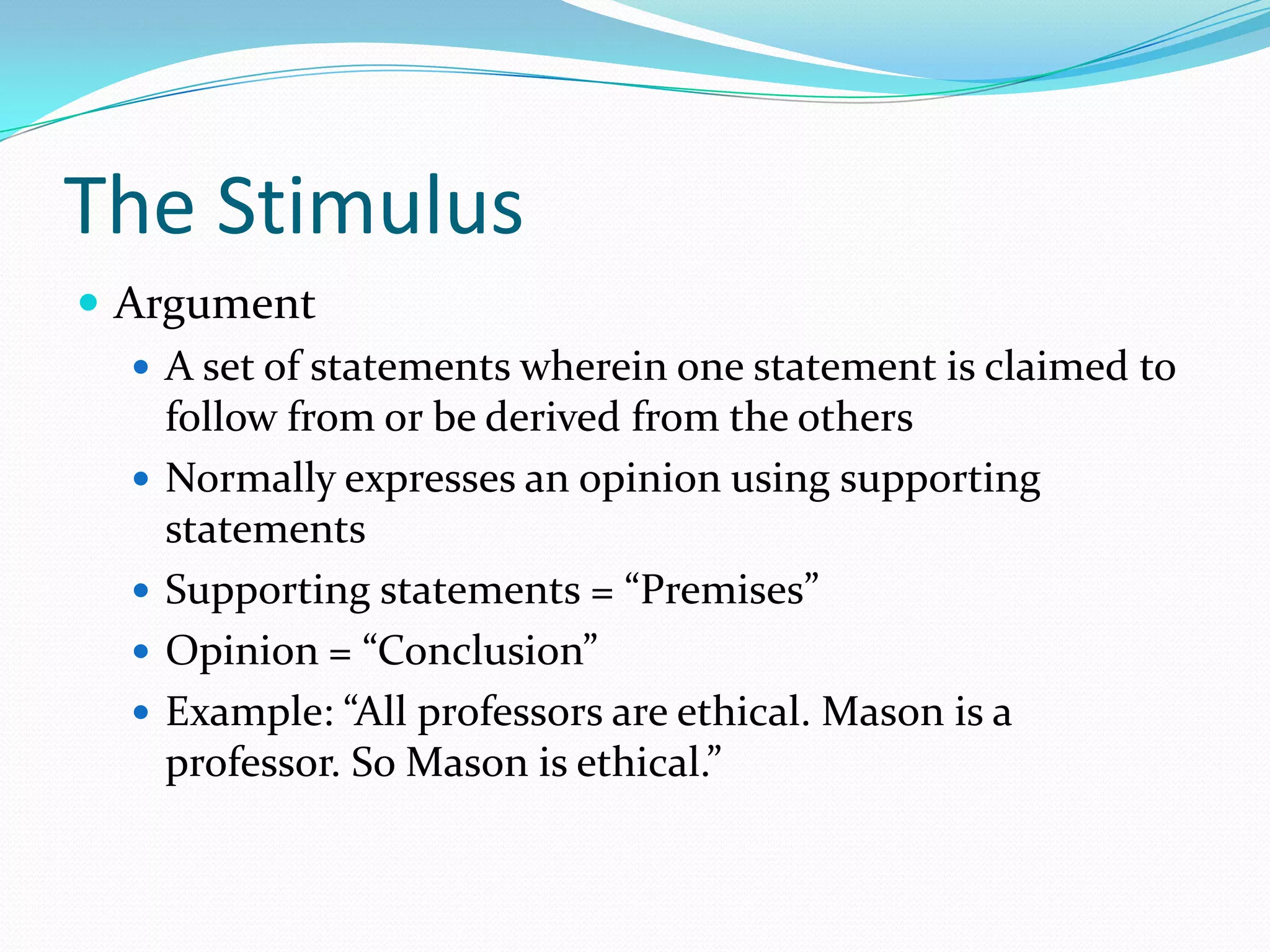
The StimulusArgumentA set of statements wherein one statement is claimed to follow from or be derived from the othersNormally expresses an opinion using supporting statementsSupporting statements = “Premises”Opinion = “Conclusion”Example: “All professors are ethical. Mason is a professor. So Mason is ethical.”
Identifying a ConclusionA statement or judgment that follows from one or more reasonsWhat is the author driving at?What does the author want me to believe?What point follows from the others?
Identifying PremisesA fact, proposition, or statement from which a conclusion can be made.What reasons has the author used to persuade me?Why should I believe this statement?What evidence exists?
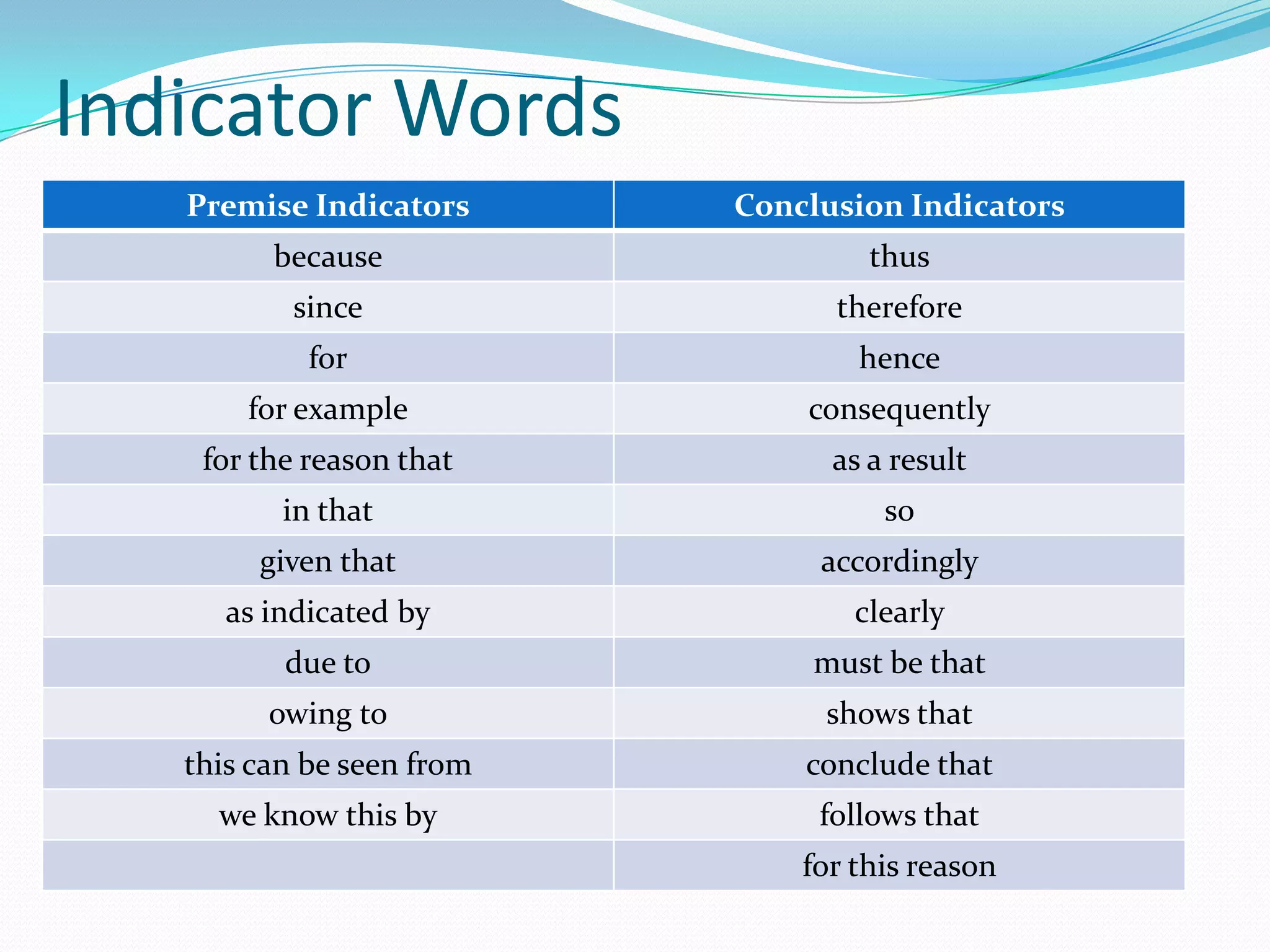
Indicator Words
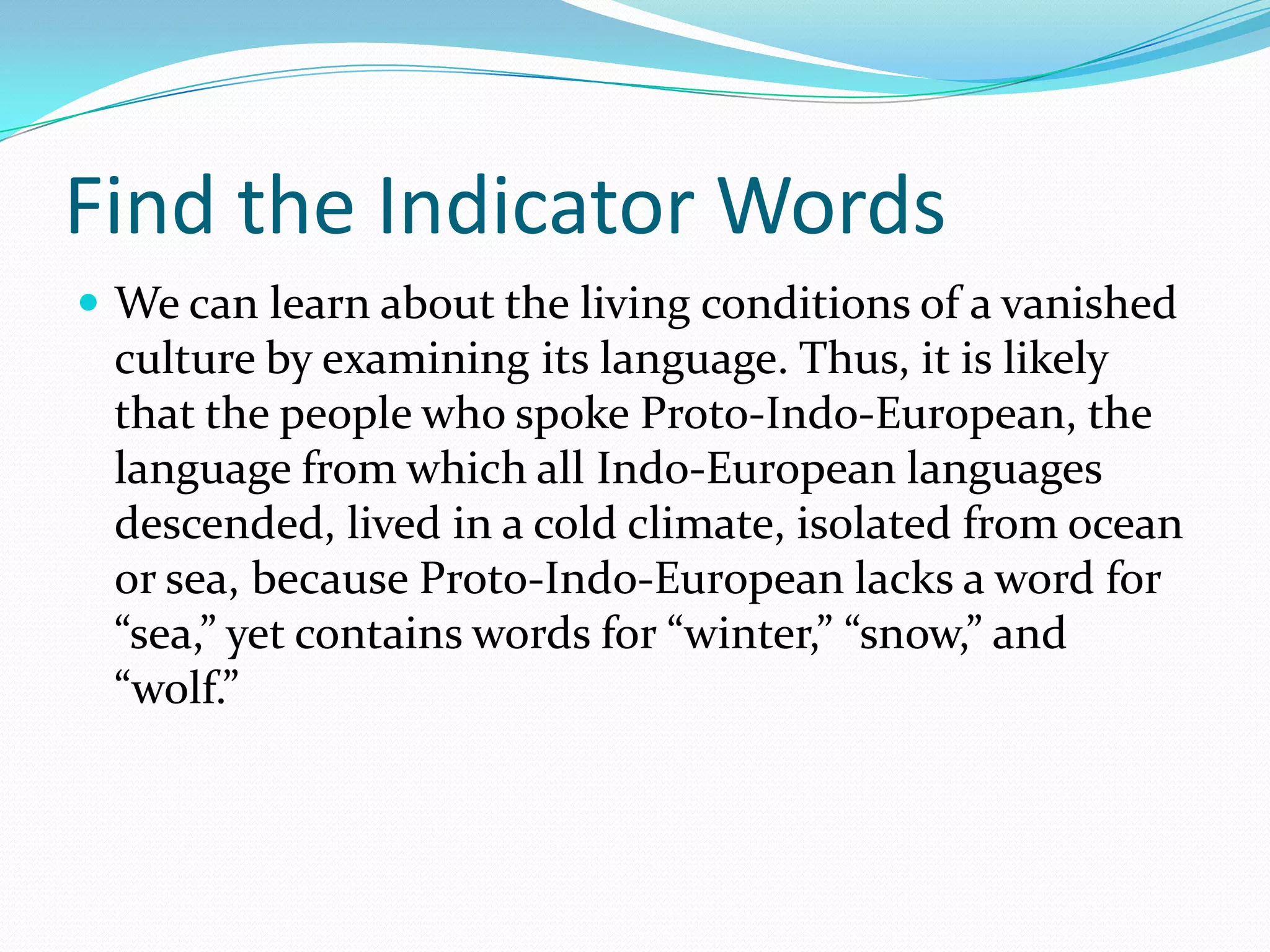
Find the Indicator WordsWe can learn about the living conditions of a vanished culture by examining its language. Thus, it is likely that the people who spoke Proto-Indo-European, the language from which all Indo-European languages descended, lived in a cold climate, isolated from ocean or sea, because Proto-Indo-European lacks a word for “sea,” yet contains words for “winter,” “snow,” and “wolf.”
Identify the conclusion and premisesPremise #1: We can learn about the living conditions of a vanished culture by examining its language. Premise #2: Proto-Indo-European lacks a word for “sea,” yet contains words for “winter,” “snow,” and “wolf.”Conclusion: It is likely that the people who spoke Proto-Indo-European, the language from which all Indo-European languages descended, lived in a cold climate, isolated from ocean or sea.
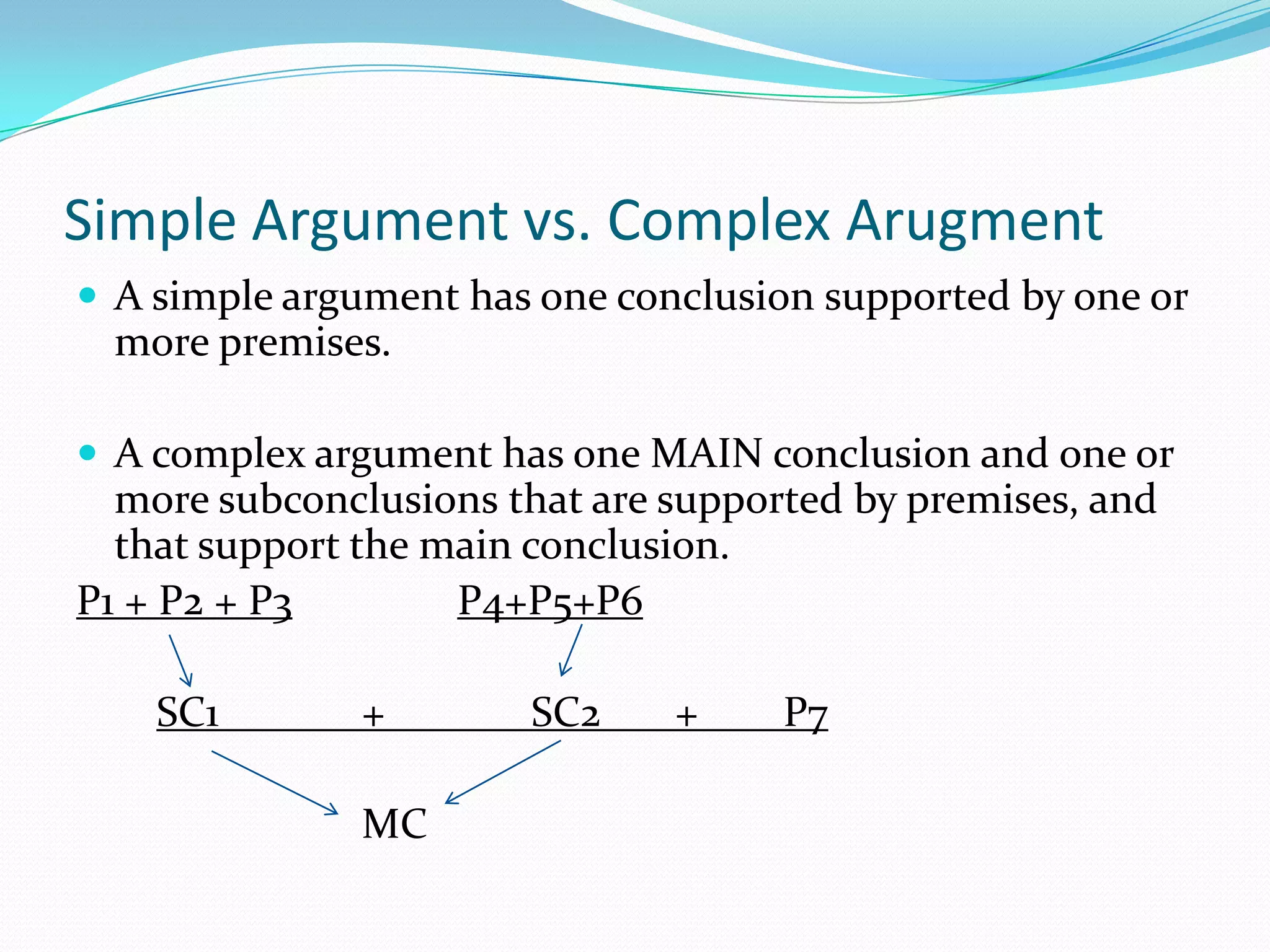
Simple Argument vs. Complex ArugmentA simple argument has one conclusion supported by one or more premises.A complex argument has one MAIN conclusion and one or more subconclusions that are supported by premises, and that support the main conclusion.P1 + P2 + P3P4+P5+P6SC1	   +	       SC2       +        P7                           MC
How to tackle Complex ArgumentsMake notations on the test booklet to make the main conclusion and sub conclusions more easily identifiable. If you can’t keep track of which premises support which sub conclusions, create a diagram like the one on the previous slide to help you organize your thoughts. Get in the habit of visualizing the diagram in your head because there is not enough time to write it all down. (1 minute 20 seconds per question!)
Strong vs. Weak ArgumentDo the premises necessarily lead to the conclusion?Always take the premises as true. You are not trying to determine the TRUTH of the argument, you are trying to determine VALIDITY.Validity = The conclusion makes sense given the facts stated.
Ex: Weak ArgumentThe Jacksonville area has just over one million residents. The Cincinnati area has almost two million residents. The New York area has almost twenty million residents. We should move to Jacksonville.Why is this a weak argument?
Ex: Strong ArgumentThe Jacksonville area has just over one million residents. The Cincinnati area has almost two million residents. The New York area has almost twenty million residents.  Highly populated areas often have a high crime rate. We should move to Jacksonville.
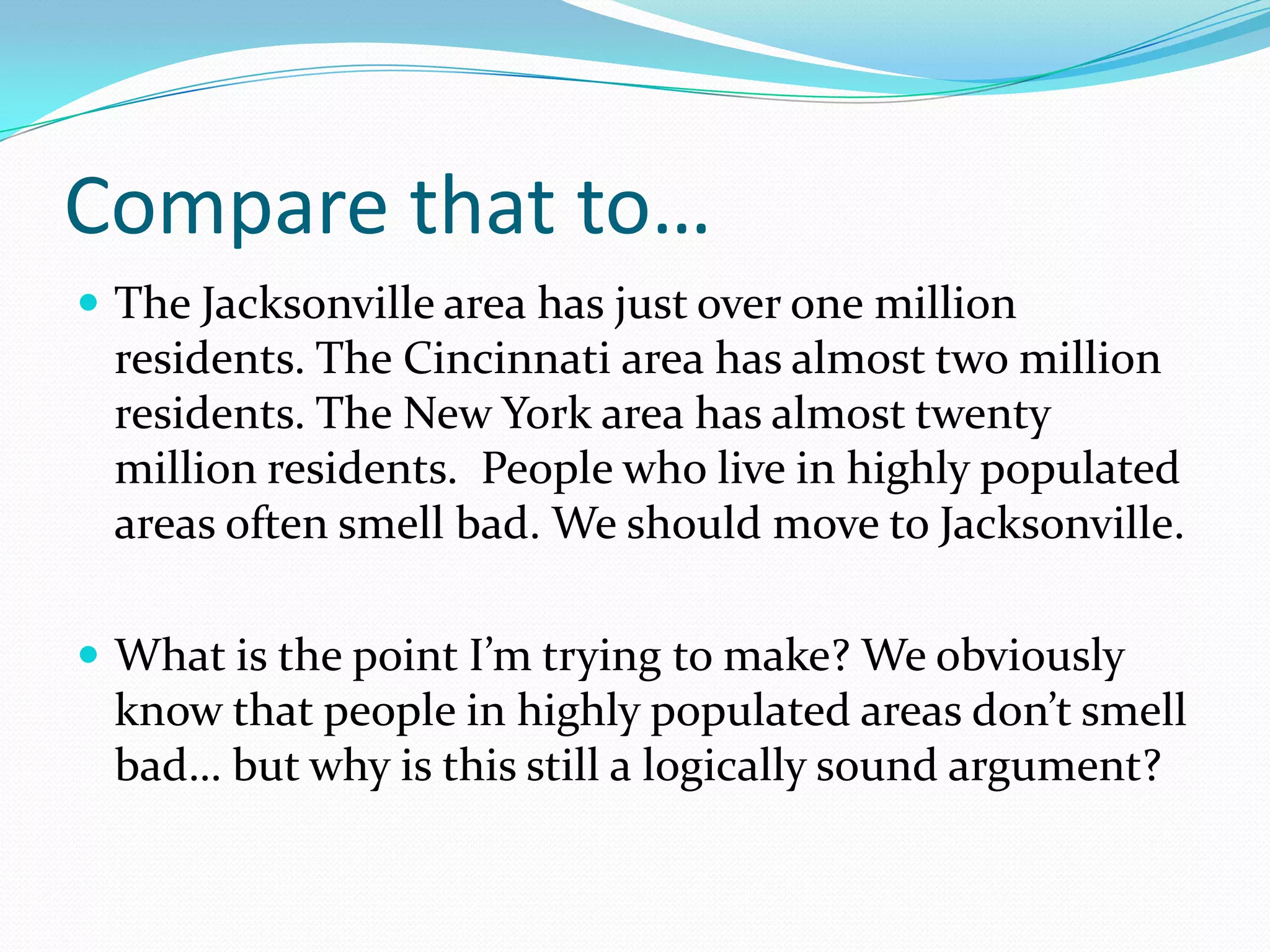
Compare that to…The Jacksonville area has just over one million residents. The Cincinnati area has almost two million residents. The New York area has almost twenty million residents.  People who live in highly populated areas often smell bad. We should move to Jacksonville.What is the point I’m trying to make? We obviously know that people in highly populated areas don’t smell bad… but why is this still a logically sound argument?
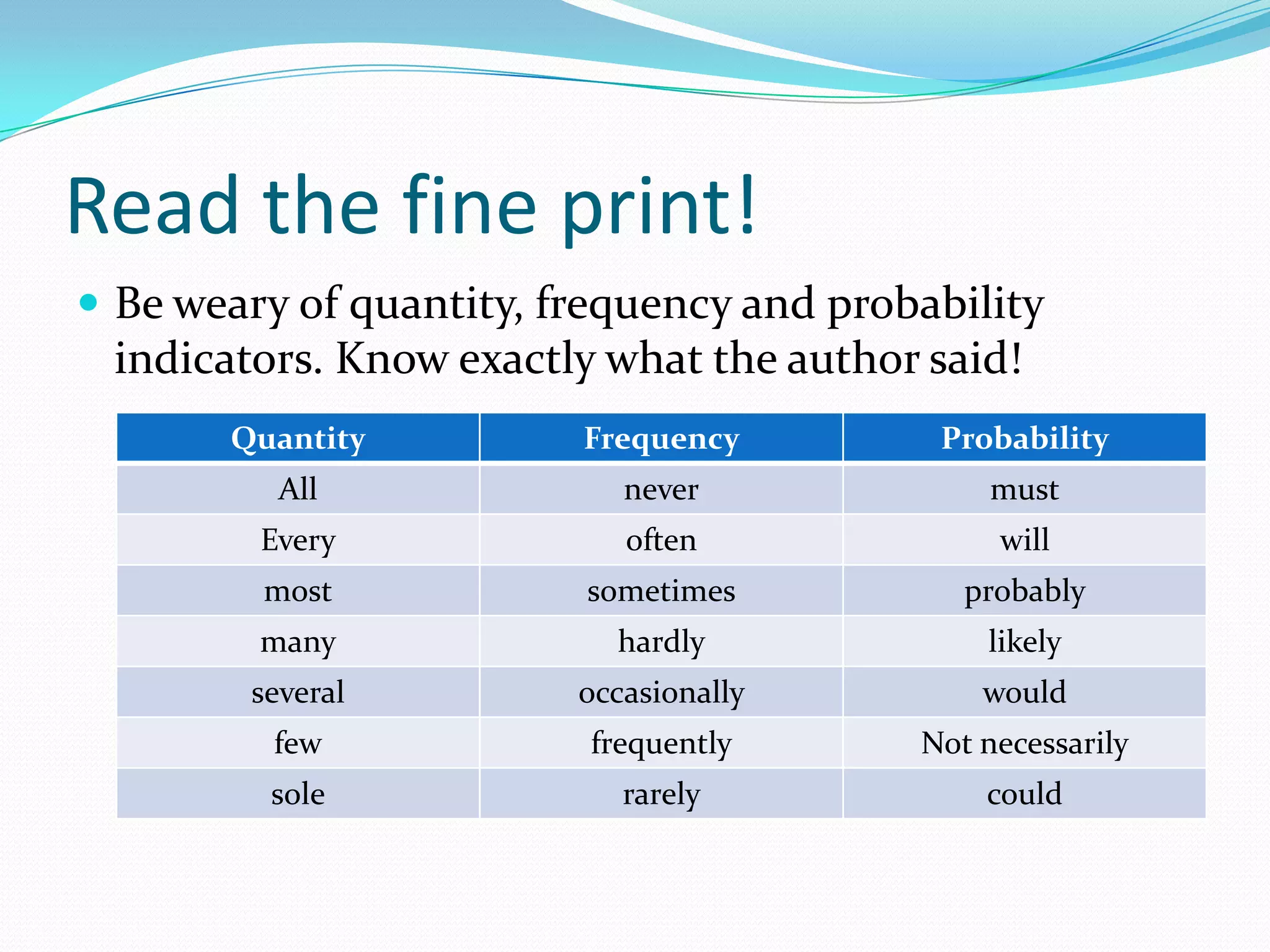
Read the fine print!Be weary of quantity, frequency and probability indicators. Know exactly what the author said!
Quantity, Frequency & Probability IndicatorsWhy are they important? They can determine the strength or weakness of an argument. Example: Some people in the U.S. eat McDonald’s on a daily basis. Thus, the U.S. population is far more unhealthy than the Canadian population.Just because SOME people eat McDonald’s everyday in the U.S. does not mean that the entire American population is less healthy than the Canadian population.
Scope of the argumentUnderstand the scope of the argument in order to eliminate answer choices that are outside of the scopeScope = The range to which the premises and conclusion encompass certain ideas.For example, if an argument is discussing a surgical procedure or technique, then the ideas of surgery and medicine are within the scope. But any ideas pertaining to federal monetary policy relating to healthcare is not.
Notating the StimulusThings to notate/mark:The main conclusion (MC)Quantity, frequency and probability indicator wordsTo notate the MC, use brackets [    ]To notate Q, F and P indicators, underline
Exercise 1Identify the conclusion and determine if the argument is strong or  weak. Some teachers claim that students would not learn curricular content without the incentive of grades. But students with intense interest in the material would learn it without this incentive, while the behaviour of students lacking all interest in the material is unaffected by such an incentive. The incentive of grades, therefore, serves no essential academic purpose.
Exercise 1 AnswerSome teachers claim that students would not learn curricular content without the incentive of grades. But students with intense interest in the material would learn it without this incentive, while the behaviour of students lacking all interest in the material is unaffected by such an incentive. [The incentive of grades, therefore, serves no essential academic purpose.]
Exercise 2Identify the conclusion and determine if the argument is strong or weak.While it was once believed that the sort of psychotherapy appropriate for treatment of neuroses caused by environmental factors is also appropriate for schizophrenia and other psychoses, it is now known that these latter , more serious forms of mental disturbance are best treated by biochemical – that is, medicinal – means. This is conclusive evidence that psychoses, unlike neuroses, have nothing to do with environmental factors but rather are caused by some sort of purely organic condition, such as abnormal brain chemistry or brain malformations.
Exercise 2 AnswerWhile it was once believed that the sort of psychotherapy appropriate for treatment of neuroses caused by environmental factors is also appropriate for schizophrenia and other psychoses, it is now known that these latter , more serious forms of mental disturbance are best treated by biochemical – that is, medicinal – means. This is conclusive evidence that [psychoses, unlike neuroses, have nothing to do with environmental factors but rather are caused by some sort of purely organic condition], such as abnormal brain chemistry or brain malformations.
Exercise 3 (TIMED: 45 seconds)Identify the conclusion and determine if the argument is strong or weak.If relativity theory is correct, no object can travel forward in time at a speed greater than the speed of light. Yet quantum mechanics predicts that the tachyon, a hypothetical subatomic particle, travels faster than light. Thus, if relativity theory is correct, either quantum mechanics’ prediction about tachyons is erroneous or tachyons travel backwards in time.
Exercise 3 AnswerIf relativity theory is correct, no object can travel forward in time at a speed greater than the speed of light. Yet quantum mechanics predicts that the tachyon, a hypothetical subatomic particle, travels faster than light. Thus, if relativity theory is correct, [either quantum mechanics’ prediction about tachyons is erroneous or tachyons travel backwards in time.]
Why determine strong vs. weak?This is the essence of critical thinking and logical reasoning. Most logical reasoning questions that are asked will require you to make this kind of analysis.
Next Session:The Question StemThe 4 question family groupsThe 13 question typesMust Be True QuestionsMain Point QuestionsPoint at IssueMethod of Reasoning Flaw in the ReasoningParallel Reasoning

Lsat prep session 1

  • 1.
    LSAT Study Session1Wednesday November 3 ,2010Created by: Phi Nguyen
  • 2.
    Today’s AgendaOverview ofthe LSATMyths and TipsThe Logical Reasoning SectionSteps to answer these questionsComponents of LR questionsArgumentsComponents of an argumentWeak vs. Strong argumentsPractice exercises
  • 3.
    The LSAT TestRequiredby most law schools for admissionSecond most important deciding factor after CGPAAdministered 4 times a year (February, June, September and December)Deadline to apply for law school in Ontario November 1stSchools in other provinces vary5 timed sections: 3 that are scored 1 that is not scored Writing sample section (not scored but used by some law school admissions boards)Average score needed to get accepted 165 (80th percentile)
  • 4.
    The LSAT TestCategoriesof scored sections: Logical ReasoningLogic PuzzlesReading ComprehensionOne of the above sections will appear twice but will not be graded because it is used as an experimental section for newly developed questions.
  • 5.
    The LSAT Test– Myths and TipsMyths:Reading the question first helpsHaving a law-related academic background helpsTips:Time yourself while you practice doing questionsRead the information for each question in the order presentedUnderline and use symbols to organize your thoughts
  • 6.
    Our Focus: LogicalReasoningWhy Logical Reasoning?What about the other sections?What resources are useful?The PowerScore seriesThe Logical Reasoning BibleThe Logic Games BibleThe Reading Comprehension Bible
  • 7.
    About Logical ReasoningWhatis it?Critical thinkingTaking in information Identifying exactly what is askedSeparating what is important information from what is not Analyzing the important information using the appropriate method based on what is asked24-26 questions, 35 minutesAverage of 1 minute 20 seconds per questionTIME MANAGEMENT IS CRUCIAL
  • 8.
    Logical Reasoning QuestionComponentsPresented in the following order:StimulusQuestionAnswer Choices
  • 9.
    Sample QuestionMuscular strengthis a limited resource, and athletic techniques help to use this resource efficiently. Since top athletes do not differ greatly from each other in muscular strength, it follows that a requirement for an athlete to become a champion is a superior mastery of athletic techniques. Which one of the following most accurately expresses the conclusion of the argument? (A) Only champion athletes have a superior mastery of athletic techniques. (B) Superior muscular strength is a requirement for an athlete to become a champion. (C) No athlete can become a champion without a superior mastery of athletic techniques. (D) The differences in muscular strength between top athletes are not great. (E) Athletic techniques help athletes use limited resources efficiently.
  • 10.
  • 11.
    The StimulusArgument vs.Fact SetFact SetA collection of statements that do not lead to any kind of conclusionUsually does not evoke any kind of reaction from the readerExample: “The Jacksonville area has just over one million residents. The Cincinnati area has almost two million residents. The New York area has almost twenty million residents.”
  • 12.
    The StimulusArgumentA setof statements wherein one statement is claimed to follow from or be derived from the othersNormally expresses an opinion using supporting statementsSupporting statements = “Premises”Opinion = “Conclusion”Example: “All professors are ethical. Mason is a professor. So Mason is ethical.”
  • 13.
    Identifying a ConclusionAstatement or judgment that follows from one or more reasonsWhat is the author driving at?What does the author want me to believe?What point follows from the others?
  • 14.
    Identifying PremisesA fact,proposition, or statement from which a conclusion can be made.What reasons has the author used to persuade me?Why should I believe this statement?What evidence exists?
  • 15.
  • 16.
    Find the IndicatorWordsWe can learn about the living conditions of a vanished culture by examining its language. Thus, it is likely that the people who spoke Proto-Indo-European, the language from which all Indo-European languages descended, lived in a cold climate, isolated from ocean or sea, because Proto-Indo-European lacks a word for “sea,” yet contains words for “winter,” “snow,” and “wolf.”
  • 17.
    Find the IndicatorWordsWe can learn about the living conditions of a vanished culture by examining its language. Thus, it is likely that the people who spoke Proto-Indo-European, the language from which all Indo-European languages descended, lived in a cold climate, isolated from ocean or sea, because Proto-Indo-European lacks a word for “sea,” yet contains words for “winter,” “snow,” and “wolf.”
  • 18.
    Identify the conclusionand premisesPremise #1: We can learn about the living conditions of a vanished culture by examining its language. Premise #2: Proto-Indo-European lacks a word for “sea,” yet contains words for “winter,” “snow,” and “wolf.”Conclusion: It is likely that the people who spoke Proto-Indo-European, the language from which all Indo-European languages descended, lived in a cold climate, isolated from ocean or sea.
  • 19.
    Simple Argument vs.Complex ArugmentA simple argument has one conclusion supported by one or more premises.A complex argument has one MAIN conclusion and one or more subconclusions that are supported by premises, and that support the main conclusion.P1 + P2 + P3P4+P5+P6SC1 + SC2 + P7 MC
  • 20.
    How to tackleComplex ArgumentsMake notations on the test booklet to make the main conclusion and sub conclusions more easily identifiable. If you can’t keep track of which premises support which sub conclusions, create a diagram like the one on the previous slide to help you organize your thoughts. Get in the habit of visualizing the diagram in your head because there is not enough time to write it all down. (1 minute 20 seconds per question!)
  • 21.
    Strong vs. WeakArgumentDo the premises necessarily lead to the conclusion?Always take the premises as true. You are not trying to determine the TRUTH of the argument, you are trying to determine VALIDITY.Validity = The conclusion makes sense given the facts stated.
  • 22.
    Ex: Weak ArgumentTheJacksonville area has just over one million residents. The Cincinnati area has almost two million residents. The New York area has almost twenty million residents. We should move to Jacksonville.Why is this a weak argument?
  • 23.
    Ex: Strong ArgumentTheJacksonville area has just over one million residents. The Cincinnati area has almost two million residents. The New York area has almost twenty million residents. Highly populated areas often have a high crime rate. We should move to Jacksonville.
  • 24.
    Compare that to…TheJacksonville area has just over one million residents. The Cincinnati area has almost two million residents. The New York area has almost twenty million residents. People who live in highly populated areas often smell bad. We should move to Jacksonville.What is the point I’m trying to make? We obviously know that people in highly populated areas don’t smell bad… but why is this still a logically sound argument?
  • 25.
    Read the fineprint!Be weary of quantity, frequency and probability indicators. Know exactly what the author said!
  • 26.
    Quantity, Frequency &Probability IndicatorsWhy are they important? They can determine the strength or weakness of an argument. Example: Some people in the U.S. eat McDonald’s on a daily basis. Thus, the U.S. population is far more unhealthy than the Canadian population.Just because SOME people eat McDonald’s everyday in the U.S. does not mean that the entire American population is less healthy than the Canadian population.
  • 27.
    Scope of theargumentUnderstand the scope of the argument in order to eliminate answer choices that are outside of the scopeScope = The range to which the premises and conclusion encompass certain ideas.For example, if an argument is discussing a surgical procedure or technique, then the ideas of surgery and medicine are within the scope. But any ideas pertaining to federal monetary policy relating to healthcare is not.
  • 28.
    Notating the StimulusThingsto notate/mark:The main conclusion (MC)Quantity, frequency and probability indicator wordsTo notate the MC, use brackets [ ]To notate Q, F and P indicators, underline
  • 29.
    Exercise 1Identify theconclusion and determine if the argument is strong or weak. Some teachers claim that students would not learn curricular content without the incentive of grades. But students with intense interest in the material would learn it without this incentive, while the behaviour of students lacking all interest in the material is unaffected by such an incentive. The incentive of grades, therefore, serves no essential academic purpose.
  • 30.
    Exercise 1 AnswerSometeachers claim that students would not learn curricular content without the incentive of grades. But students with intense interest in the material would learn it without this incentive, while the behaviour of students lacking all interest in the material is unaffected by such an incentive. [The incentive of grades, therefore, serves no essential academic purpose.]
  • 31.
    Exercise 2Identify theconclusion and determine if the argument is strong or weak.While it was once believed that the sort of psychotherapy appropriate for treatment of neuroses caused by environmental factors is also appropriate for schizophrenia and other psychoses, it is now known that these latter , more serious forms of mental disturbance are best treated by biochemical – that is, medicinal – means. This is conclusive evidence that psychoses, unlike neuroses, have nothing to do with environmental factors but rather are caused by some sort of purely organic condition, such as abnormal brain chemistry or brain malformations.
  • 32.
    Exercise 2 AnswerWhileit was once believed that the sort of psychotherapy appropriate for treatment of neuroses caused by environmental factors is also appropriate for schizophrenia and other psychoses, it is now known that these latter , more serious forms of mental disturbance are best treated by biochemical – that is, medicinal – means. This is conclusive evidence that [psychoses, unlike neuroses, have nothing to do with environmental factors but rather are caused by some sort of purely organic condition], such as abnormal brain chemistry or brain malformations.
  • 33.
    Exercise 3 (TIMED:45 seconds)Identify the conclusion and determine if the argument is strong or weak.If relativity theory is correct, no object can travel forward in time at a speed greater than the speed of light. Yet quantum mechanics predicts that the tachyon, a hypothetical subatomic particle, travels faster than light. Thus, if relativity theory is correct, either quantum mechanics’ prediction about tachyons is erroneous or tachyons travel backwards in time.
  • 34.
    Exercise 3 AnswerIfrelativity theory is correct, no object can travel forward in time at a speed greater than the speed of light. Yet quantum mechanics predicts that the tachyon, a hypothetical subatomic particle, travels faster than light. Thus, if relativity theory is correct, [either quantum mechanics’ prediction about tachyons is erroneous or tachyons travel backwards in time.]
  • 35.
    Why determine strongvs. weak?This is the essence of critical thinking and logical reasoning. Most logical reasoning questions that are asked will require you to make this kind of analysis.
  • 36.
    Next Session:The QuestionStemThe 4 question family groupsThe 13 question typesMust Be True QuestionsMain Point QuestionsPoint at IssueMethod of Reasoning Flaw in the ReasoningParallel Reasoning

Editor's Notes

  • #23 Simply telling us the population of each city does not compel us to move there for any logical reason.
  • #24 This is a strong argument because avoiding areas with high crime rates logically compels us to move to a city with a lower population.
  • #25 Ans: It doesn’t matter whether the premises are true! You are searching for validity.
  • #30 Is the argument strong or weak?
  • #31 The conclusion states that grades serve no essential academic purpose but the author only mentions the students sitting at extremes – those who have an intense interest in the material and those who have no interest at all. What about all the students that fall inbetween? They might feel motivated to do well because they want to get a good grade report.
  • #33 The conclusion states that psychoses has nothing to do with environmental factors. But the premises only provide one unrelated difference between neuroses and psychoses – different treatment methods. That does not necessarily mean that psychoses has nothing to do with environmental factors.
  • #35 The argument is strong.The author defends against the possibility that relativity theory might be incorrect by saying “If relativity theory is correct…” Had the author simply stated that relativity theory IS correct, the conclusion would not be applicable because there would be no reason to believe that there are two plausible options. The only plausible option would be that quantum mechanics’ prediction is wrong. Also, relativity theory states that “no object can travel forward in time…” and the author includes the possibility of an object travelling backwards in time in his conclusion in order to strengthen the argument. Simply stating that quantum mechanics’ prediction must be wrong would have made the argument slightly weaker because one could have counterargued that the object travelled backwards in time.