Tone in Sherpa  (Sino-Tibetan) Joyce McDonough 1,  Rebecca Baier 2  and  Michelle Gregory 3 1 University of Rochester,  2 University of Maryland,  3 Pacific Northwest National Lab
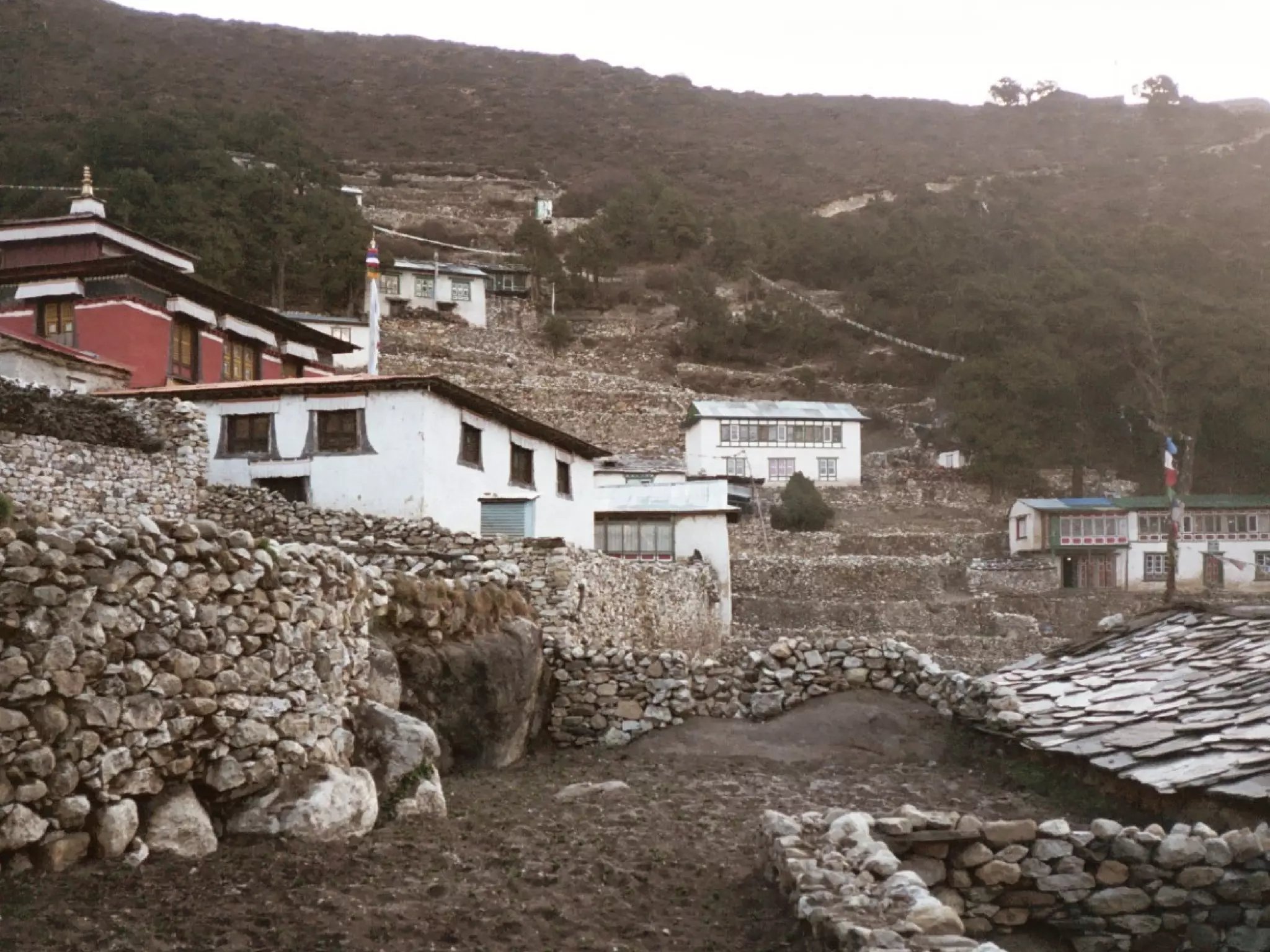
Goal:   To examine a claim about Sherpa tone. An instrumental study of pitch contrasts in the  Sherpa (Sino-Tibetan) spoken in the Solo-Khumbu valley in Nepal.  The data in this study is from the upper Khumbu valley, in the high altitude villages below the Everest range.  While tonal contrasts in Sherpa have been observed, characterizing the tonal patterns in Sherpa has been elusive,  known to be confounded by the complex interaction of several factors including:  intonation stress accent
In a recent monograph, Kelly (2004) states that tone is contrastive in Sherpa:  a word level contrast between two falling tones, one which begins higher than the other, overlaid with a stress system.   Goal of this study is to find instrumental support for this observation. We used Kelly’s word list of the tonal contrasts  in  mono- and bi-syllabic  words.   Note: Kelly’s study was done in the lower Solo-Khumbu valley. We expect differences.
DATA: 4 native speakers (3 male, 1 female) (a 5 th  speaker’s data was not used) isolated words in citation forms (4 speakers)  short conversational utterances (1 speaker (female))  we recorded citation forms from native speakers by working with a Sherpa consultant who facilitated the elicitation of the contrasts  ( ser  meaning ‘cloud’, versus  ser  meaning ‘cough’) short descriptions of activities that included particular lexical items were elicited (How do you make  chang ?)
We found evidence for two contrastive pitch contours in citation forms showing a  clear bimodal distribution pattern-  even in a speaker with a very narrow pitch range (Sp3). Both contours were falling, one beginning higher than the other, as Kelly noted.   This bi-modal pattern was the same in both mono- and bi-syllabic citation forms. The two forms show slightly different timing patterns, indicating the tone target was aligned to the syllable. Indicating the domain of the fall was larger than word level. Additionally, the fall was not present in utterance medial position.  We also found evidence for canonical intonational marking, a fall and a rise, which interacted with the tonal patterns.
 
Contrast between H and L toned marked words in citation forms. The forms exhibit the falling contour reported by Kelly (2003): H starts higher than the L toned words. It’s a word level phenomena. Both mono- and bi- syllabic tokens showed the same pitch contours: falling over the course of the word  H tone associated to the 1 st  syllable L drop at end timing differences between mono- and bi- syllablic tokens indicate a syllable affiliation of tone Note the pitch contour for the  1 st  syllable  of a L toned word [ lola ] ‘wall’ [ß´rwa]  ‘sherpa’ vs ‘blind’
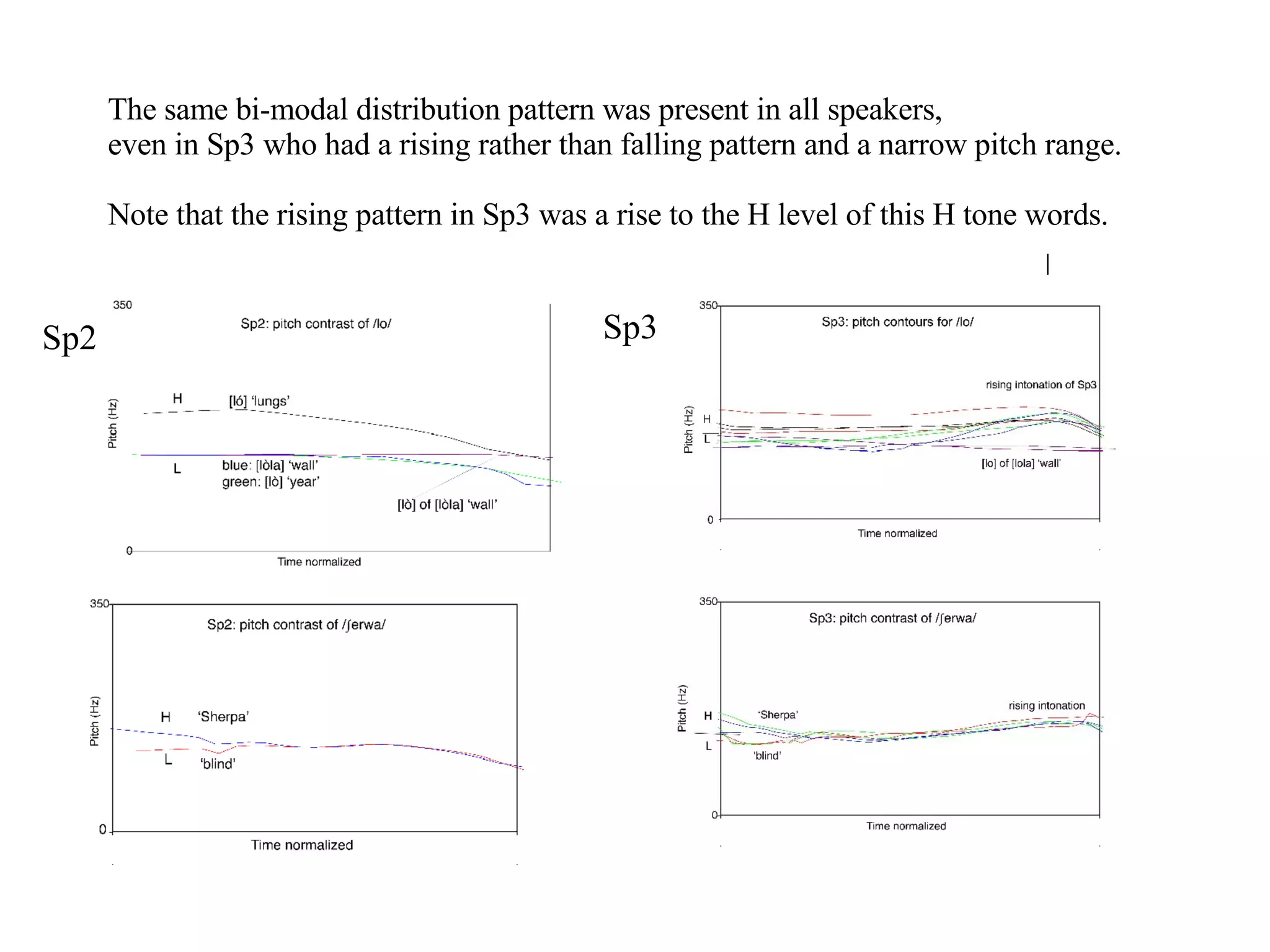
The same bi-modal distribution pattern was present in all speakers,  even in Sp3 who had a rising rather than falling pattern and a narrow pitch range.  Note that the rising pattern in Sp3 was a rise to the H level of this H tone words. Sp2 Sp3
Sp 4 produced words in citation forms and in short utterances. She had the  same bi-model distribution patterns  on the accented syllable with a falling contour in citation forms. However, the falling pitch contour was not always present.  Sp4 produced H tone forms within sentences. In these forms there was no fall. Sp4 also produced rises, like Sp3. Sp4: pitch contours of [ ß ´rwå]
The force of the pattern is apparent in these graphs of tokens showing the contrast between a H and L tone marked [ s ´r ].  As before, Sp4 tokens are taken from both isolation and citation forms, the two patterns are present. Sp3 has three tokens, two H tone, one L (blue), in citation forms. Sp4 Sp3 [s ´r] :  H vs L
L Black: / dˆ  lo `la /  “This is a wall”  Red:  / tßore  lo ` måln /  “How old are you?” H Blue:  / ˜a  lo’  jeno /  “I have a cough” Sp4: [lo] contrast in utterances H We see a rise to the  H tone /lo/  then a drop vs a  falling contour  of utterances with the  L tone /lo/ . This suggests a pitch accent type system.  Words are marked for accent or not. Those with an accent have a  H pitch target .    * [ lo ]   vs  [ lo ] H/L contrast in utterances
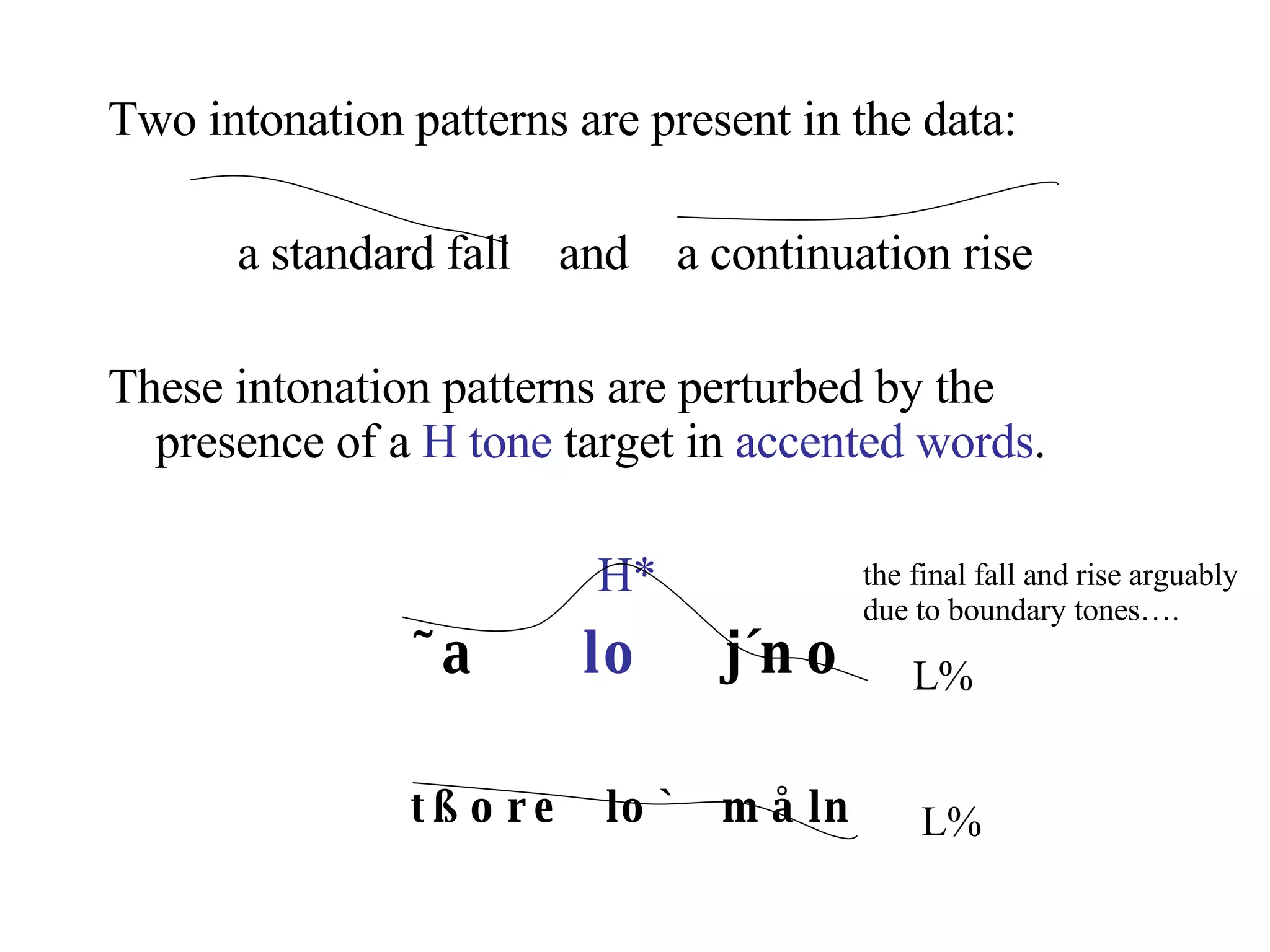
Two intonation patterns are present in the data: a standard fall  and  a continuation rise These intonation patterns are perturbed by the presence of a  H tone  target in  accented words .   H* ˜a   lo  j´no tßore  lo`  måln L% L% the final fall and rise arguably  due to boundary tones….
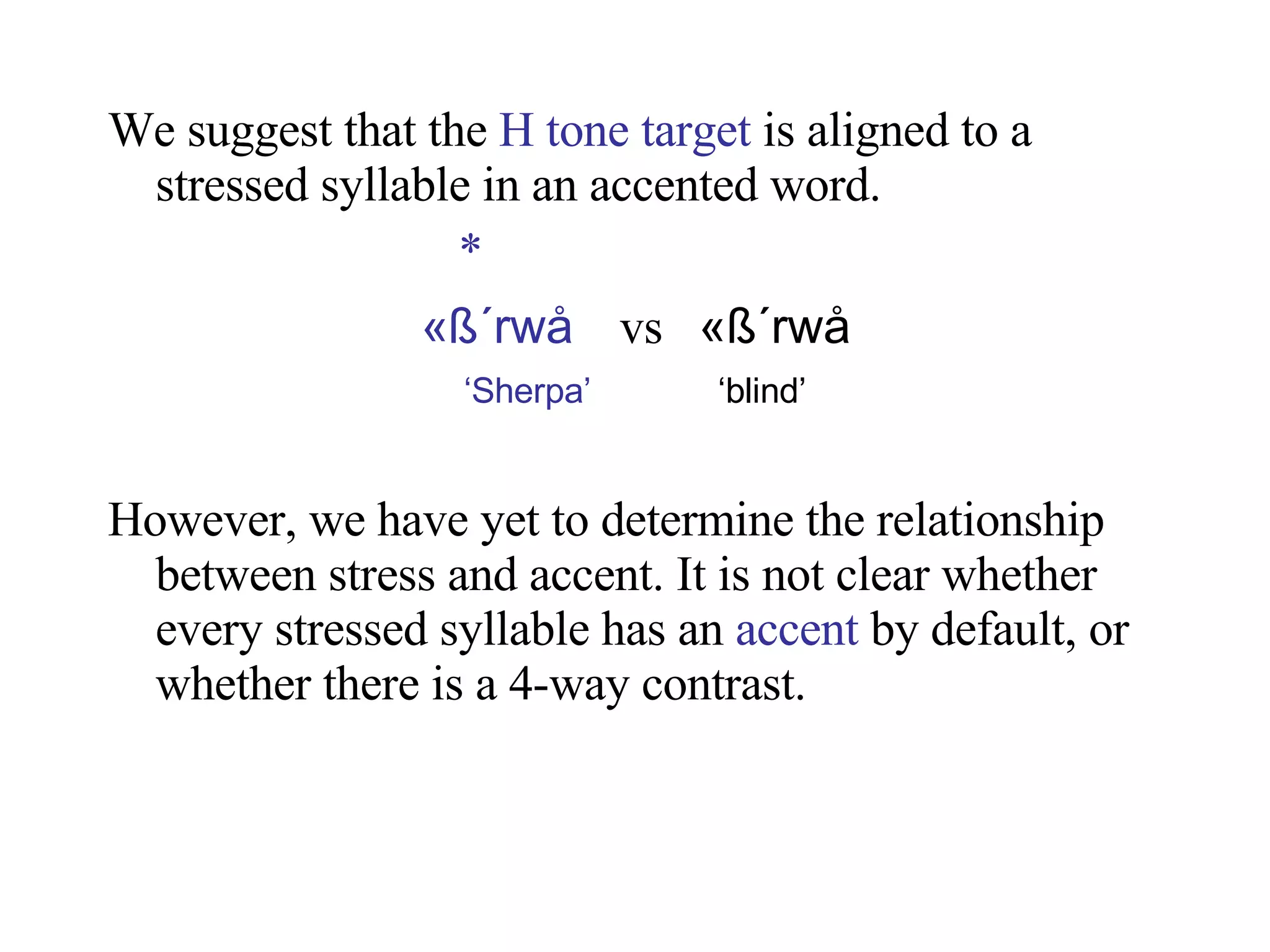
We suggest that the  H tone target  is aligned to a stressed syllable in an accented word.   * «ß ´rwå   vs  «ß ´rwå ‘ Sherpa’   ‘blind’ However, we have yet to determine the relationship between stress and accent. It is not clear whether every stressed syllable has an  accent  by default, or whether there is a 4-way contrast.
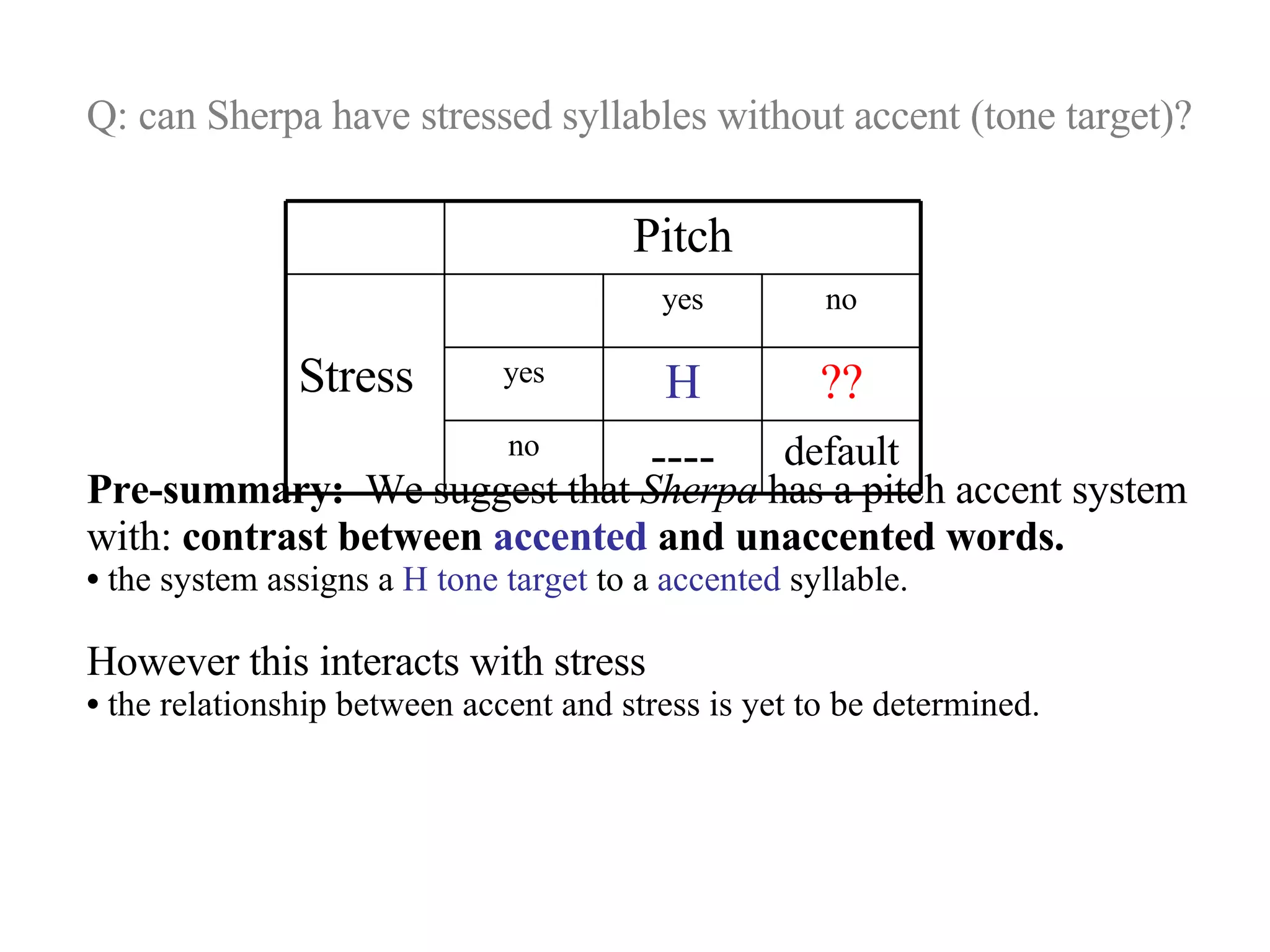
Q: can Sherpa have stressed syllables without accent (tone target)? Pre-summary:   We suggest that  Sherpa  has a pitch accent system with:  contrast between  accented  and unaccented words.  the system assigns a  H tone target  to a  accented  syllable. However this interacts with stress the relationship between accent and stress is yet to be determined. default ---- no ?? H yes no yes Stress Pitch
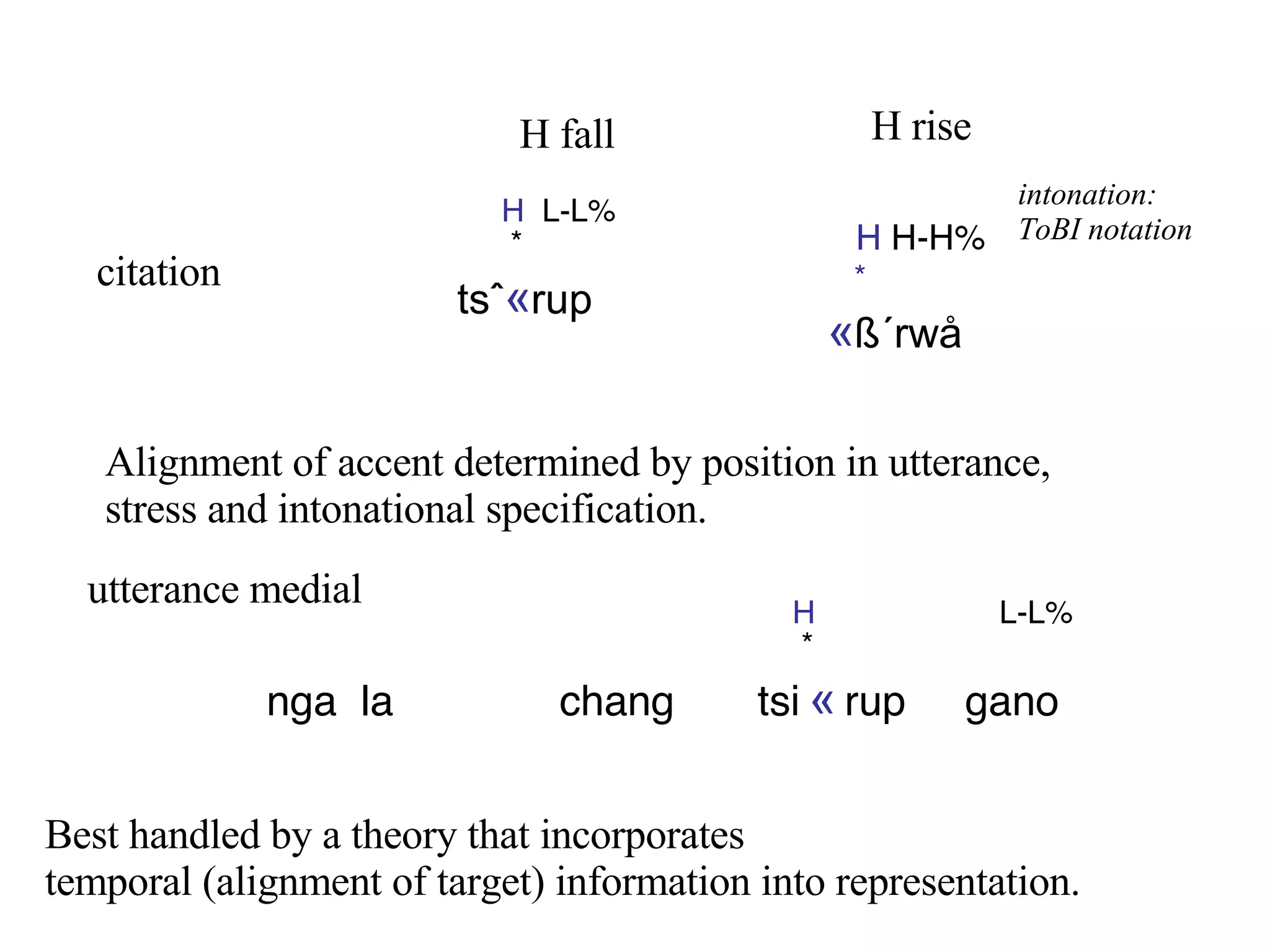
These ex’s show the first confound: between accent and stress in bisyllables: In all 3 forms: audible stress on the second syllable of accented /tsi « rup/.    * [ t߈`«rup ]  ‘squeeze’ Note contrast between  citation  and  IP medial  contours The stress distinction is also lexical. Gordon et. al. identify a  ‘high rising contour’ , contrasting with a ‘ low rising contour’ .   as well as  high  &  low falling contours . The tokens differ in the alignment/realization of the H tone target:  cit  vs  medial . ‘ High rising contour’ [  t߈  « rup ] *   3x Sp4 citation  (L%)   medial nga  la  chang  tsirup  gano  L% L%
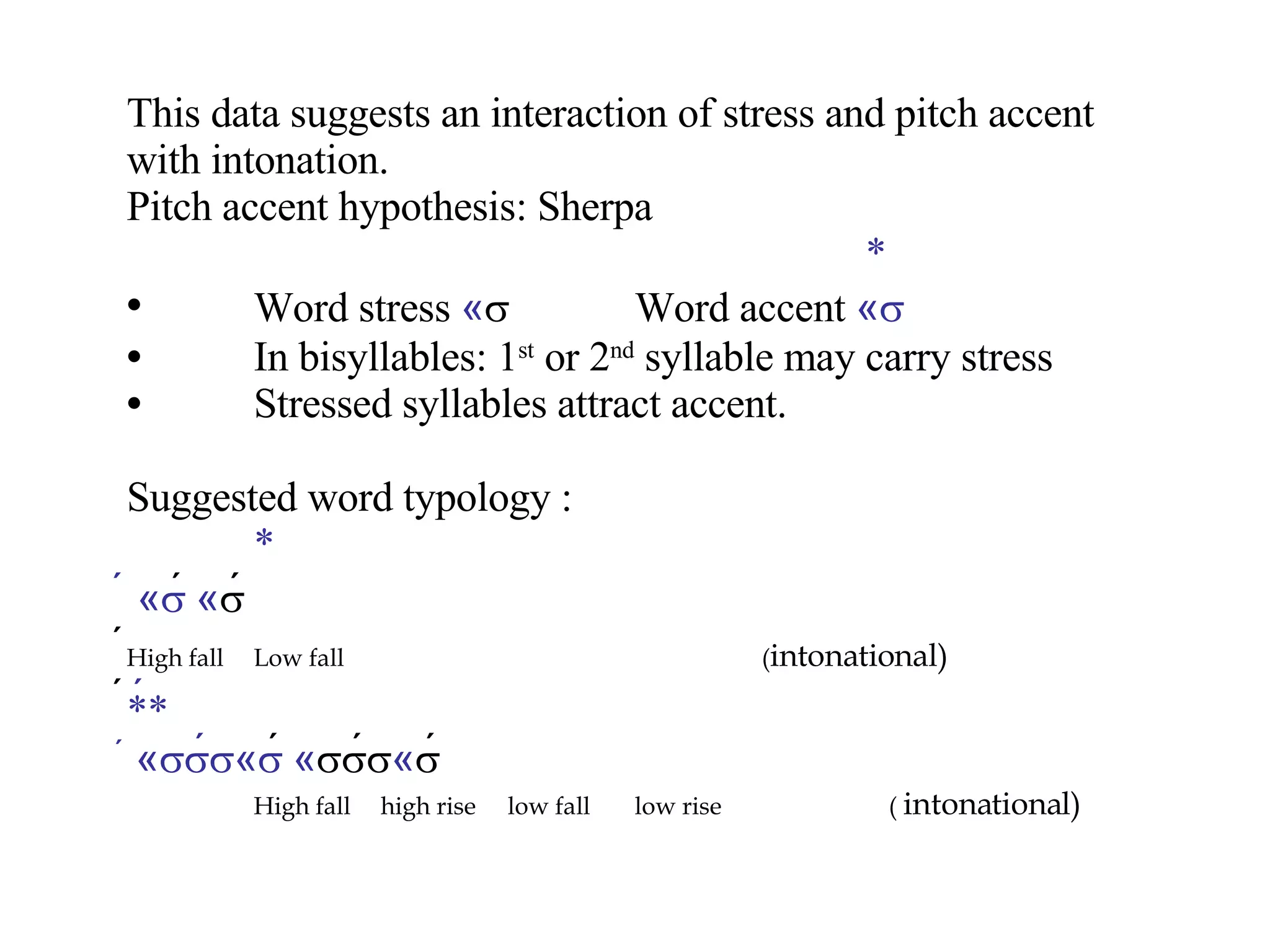
This data suggests an interaction of stress and pitch accent with intonation.  Pitch accent hypothesis: Sherpa   * Word stress  «    Word accent  «  In bisyllables: 1 st  or 2 nd  syllable may carry stress Stressed syllables attract accent. Suggested word typology : *  «   «   High fall Low fall   ( intonational)    «  «   «  «  High fall high rise low fall low rise (  intonational)
    H   L-L%     * nga  la  chang  tsi   «   rup  gano H  L-L% * tsˆ « rup citation utterance medial H  H-H%   * « ß´rwå H fall H rise Alignment of accent determined by position in utterance,  stress and intonational specification. intonation: ToBI notation Best handled by a theory that incorporates  temporal (alignment of target) information into representation.
The falling contours (‘high falling’) of /tsirup/ in citation  are due to the presence of  L boundary tones. All examples of ‘high rising’ will be IP medial. The data we collected were not set up to examine this  phenomena. Further study of Sherpa might best include the development of a set of elicitation materials to examine  accent ,  stress  and  intonation  in a broad set of carefully controlled lexical and prosodic contexts.  Modeling to support these hypotheses. With extension to the examination of natural speech in dialogue/storytelling and the development of spoken language corpora.

Lsa2+Sherpa+06

  • 1.
    Tone in Sherpa (Sino-Tibetan) Joyce McDonough 1, Rebecca Baier 2 and Michelle Gregory 3 1 University of Rochester, 2 University of Maryland, 3 Pacific Northwest National Lab
  • 2.
    Goal: To examine a claim about Sherpa tone. An instrumental study of pitch contrasts in the Sherpa (Sino-Tibetan) spoken in the Solo-Khumbu valley in Nepal. The data in this study is from the upper Khumbu valley, in the high altitude villages below the Everest range. While tonal contrasts in Sherpa have been observed, characterizing the tonal patterns in Sherpa has been elusive, known to be confounded by the complex interaction of several factors including: intonation stress accent
  • 3.
    In a recentmonograph, Kelly (2004) states that tone is contrastive in Sherpa: a word level contrast between two falling tones, one which begins higher than the other, overlaid with a stress system. Goal of this study is to find instrumental support for this observation. We used Kelly’s word list of the tonal contrasts in mono- and bi-syllabic words. Note: Kelly’s study was done in the lower Solo-Khumbu valley. We expect differences.
  • 4.
    DATA: 4 nativespeakers (3 male, 1 female) (a 5 th speaker’s data was not used) isolated words in citation forms (4 speakers) short conversational utterances (1 speaker (female)) we recorded citation forms from native speakers by working with a Sherpa consultant who facilitated the elicitation of the contrasts ( ser meaning ‘cloud’, versus ser meaning ‘cough’) short descriptions of activities that included particular lexical items were elicited (How do you make chang ?)
  • 5.
    We found evidencefor two contrastive pitch contours in citation forms showing a clear bimodal distribution pattern- even in a speaker with a very narrow pitch range (Sp3). Both contours were falling, one beginning higher than the other, as Kelly noted. This bi-modal pattern was the same in both mono- and bi-syllabic citation forms. The two forms show slightly different timing patterns, indicating the tone target was aligned to the syllable. Indicating the domain of the fall was larger than word level. Additionally, the fall was not present in utterance medial position. We also found evidence for canonical intonational marking, a fall and a rise, which interacted with the tonal patterns.
  • 6.
  • 7.
    Contrast between Hand L toned marked words in citation forms. The forms exhibit the falling contour reported by Kelly (2003): H starts higher than the L toned words. It’s a word level phenomena. Both mono- and bi- syllabic tokens showed the same pitch contours: falling over the course of the word H tone associated to the 1 st syllable L drop at end timing differences between mono- and bi- syllablic tokens indicate a syllable affiliation of tone Note the pitch contour for the 1 st syllable of a L toned word [ lola ] ‘wall’ [ß´rwa] ‘sherpa’ vs ‘blind’
  • 8.
    The same bi-modaldistribution pattern was present in all speakers, even in Sp3 who had a rising rather than falling pattern and a narrow pitch range. Note that the rising pattern in Sp3 was a rise to the H level of this H tone words. Sp2 Sp3
  • 9.
    Sp 4 producedwords in citation forms and in short utterances. She had the same bi-model distribution patterns on the accented syllable with a falling contour in citation forms. However, the falling pitch contour was not always present. Sp4 produced H tone forms within sentences. In these forms there was no fall. Sp4 also produced rises, like Sp3. Sp4: pitch contours of [ ß ´rwå]
  • 10.
    The force ofthe pattern is apparent in these graphs of tokens showing the contrast between a H and L tone marked [ s ´r ]. As before, Sp4 tokens are taken from both isolation and citation forms, the two patterns are present. Sp3 has three tokens, two H tone, one L (blue), in citation forms. Sp4 Sp3 [s ´r] : H vs L
  • 11.
    L Black: /dˆ lo `la / “This is a wall” Red: / tßore lo ` måln / “How old are you?” H Blue: / ˜a lo’ jeno / “I have a cough” Sp4: [lo] contrast in utterances H We see a rise to the H tone /lo/ then a drop vs a falling contour of utterances with the L tone /lo/ . This suggests a pitch accent type system. Words are marked for accent or not. Those with an accent have a H pitch target . * [ lo ] vs [ lo ] H/L contrast in utterances
  • 12.
    Two intonation patternsare present in the data: a standard fall and a continuation rise These intonation patterns are perturbed by the presence of a H tone target in accented words . H* ˜a lo j´no tßore lo` måln L% L% the final fall and rise arguably due to boundary tones….
  • 13.
    We suggest thatthe H tone target is aligned to a stressed syllable in an accented word. * «ß ´rwå vs «ß ´rwå ‘ Sherpa’ ‘blind’ However, we have yet to determine the relationship between stress and accent. It is not clear whether every stressed syllable has an accent by default, or whether there is a 4-way contrast.
  • 14.
    Q: can Sherpahave stressed syllables without accent (tone target)? Pre-summary: We suggest that Sherpa has a pitch accent system with: contrast between accented and unaccented words. the system assigns a H tone target to a accented syllable. However this interacts with stress the relationship between accent and stress is yet to be determined. default ---- no ?? H yes no yes Stress Pitch
  • 15.
    These ex’s showthe first confound: between accent and stress in bisyllables: In all 3 forms: audible stress on the second syllable of accented /tsi « rup/. * [ t߈`«rup ] ‘squeeze’ Note contrast between citation and IP medial contours The stress distinction is also lexical. Gordon et. al. identify a ‘high rising contour’ , contrasting with a ‘ low rising contour’ . as well as high & low falling contours . The tokens differ in the alignment/realization of the H tone target: cit vs medial . ‘ High rising contour’ [ t߈ « rup ] * 3x Sp4 citation (L%) medial nga la chang tsirup gano L% L%
  • 16.
    This data suggestsan interaction of stress and pitch accent with intonation. Pitch accent hypothesis: Sherpa * Word stress «  Word accent «  In bisyllables: 1 st or 2 nd syllable may carry stress Stressed syllables attract accent. Suggested word typology : *  «   «   High fall Low fall ( intonational)    «  «   «  «  High fall high rise low fall low rise ( intonational)
  • 17.
    H L-L% * nga la chang tsi « rup gano H L-L% * tsˆ « rup citation utterance medial H H-H% * « ß´rwå H fall H rise Alignment of accent determined by position in utterance, stress and intonational specification. intonation: ToBI notation Best handled by a theory that incorporates temporal (alignment of target) information into representation.
  • 18.
    The falling contours(‘high falling’) of /tsirup/ in citation are due to the presence of L boundary tones. All examples of ‘high rising’ will be IP medial. The data we collected were not set up to examine this phenomena. Further study of Sherpa might best include the development of a set of elicitation materials to examine accent , stress and intonation in a broad set of carefully controlled lexical and prosodic contexts. Modeling to support these hypotheses. With extension to the examination of natural speech in dialogue/storytelling and the development of spoken language corpora.