Coring & Drilling
PART 1: DISCUSSION
April 2017
OPENING STATEMENT
This presentation is designed to serve as a stand-alone
training piece, as well as act as a companion piece to
Lackmond’s hands on diamond training program.
Classroom instruction is important, but there is no
substitute for hands on training to reinforce academic
concepts. Contact your Lackmond representative to
schedule hands-on training: 800-850-2044.
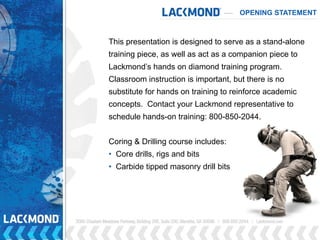
Coring & Drilling course includes:
• Core drills, rigs and bits
• Carbide tipped masonry drill bits
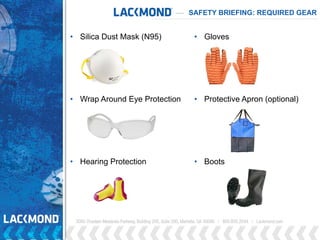
• Gloves
• Protective Apron (optional)
• Boots
SAFETY BRIEFING: REQUIRED GEAR
• Silica Dust Mask (N95)
• Wrap Around Eye Protection
• Hearing Protection
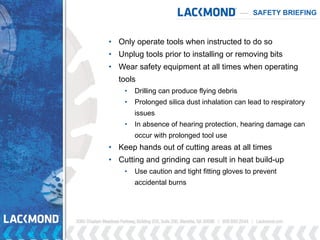
SAFETY BRIEFING
• Only operate tools when instructed to do so
• Unplug tools prior to installing or removing bits
• Wear safety equipment at all times when operating
tools
• Drilling can produce flying debris
• Prolonged silica dust inhalation can lead to respiratory
issues
• In absence of hearing protection, hearing damage can
occur with prolonged tool use
• Keep hands out of cutting areas at all times
• Cutting and grinding can result in heat build-up
• Use caution and tight fitting gloves to prevent
accidental burns
COURSE OVERVIEW
• Diamond
• Tool familiarity
• General core bit features and uses
• Proper mounting and removal from tool
• Proper drilling techniques
• Hands on demonstration during Lackmond PK
training when applicable
• Carbide
• Tool familiarity
• General carbide drill bit features and uses
• Proper mounting and removal from tool
• Proper drilling techniques
• Hands on demonstration during Lackmond PK
training when applicable
KEY CONCEPTS
• Proper drilling techniques
• Diamond Blades, Carbide Drill Bits and Core Drill
& Rigs
• Proper application diagnosis
• So many options, which one is right?
• In what applications are these products used?
• Understanding of tool features / terms
• Discussion of jobsite applications for various products
• Field tips and tricks
Coring & Drilling
PART 2: THE TOOLS
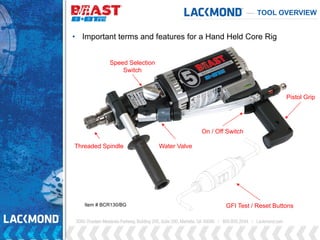
TOOL OVERVIEW
Speed Selection
Switch
On / Off Switch
GFI Test / Reset Buttons
Water ValveThreaded Spindle
• Important terms and features for a Hand Held Core Rig
Pistol Grip
Item # BCR130/BG
TOOL OVERVIEW
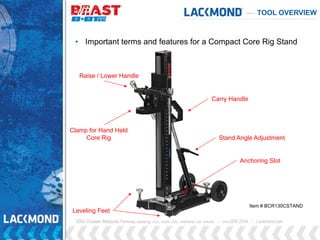
Clamp for Hand Held
Core Rig
Raise / Lower Handle
Leveling Feet
Anchoring Slot
Carry Handle
• Important terms and features for a Compact Core Rig Stand
Stand Angle Adjustment
Item # BCR130CSTAND
TOOL OVERVIEW
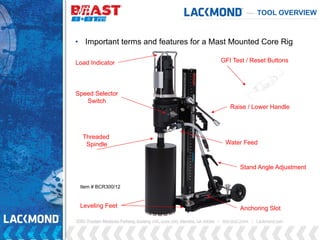
Speed Selector
Switch
Raise / Lower Handle
Leveling Feet Anchoring Slot
• Important terms and features for a Mast Mounted Core Rig
GFI Test / Reset Buttons
Stand Angle Adjustment
Threaded
Spindle
Load Indicator
Water Feed
Item # BCR300/12
TOOL OVERVIEW
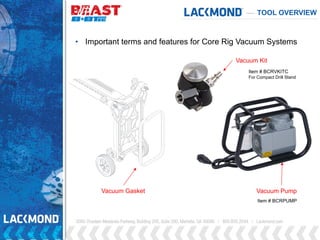
Vacuum Gasket Vacuum Pump
Vacuum Kit
• Important terms and features for Core Rig Vacuum Systems
Item # BCRVKITC
For Compact Drill Stand
Item # BCRPUMP
TOOL OVERVIEW
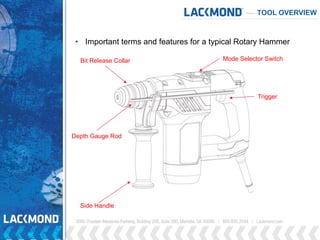
Depth Gauge Rod
Trigger
Side Handle
• Important terms and features for a typical Rotary Hammer
Mode Selector SwitchBit Release Collar
Coring & Drilling
PART 3: DIAMOND CORE BITS
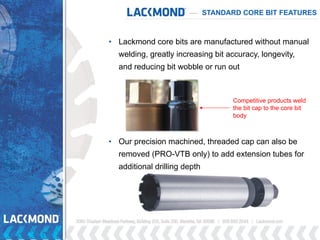
• Lackmond core bits are manufactured without manual
welding, greatly increasing bit accuracy, longevity,
and reducing bit wobble or run out
• Our precision machined, threaded cap can also be
removed (PRO-VTB only) to add extension tubes for
additional drilling depth
STANDARD CORE BIT FEATURES
Competitive products weld
the bit cap to the core bit
body
• Proprietary fast sintering technology results the
industry’s fastest drilling core bits
• Standard threading allows use with any core drill
machine
• Greatly reduce drilling time and eliminate bit failure in
heavily reinforced concrete
• Watch video on the next slide
BEAST HISPEED CORE BITS
NEW PRODUCT FOR 2017
PRO HISPEED CORE BITS
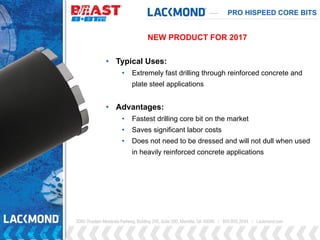
• Typical Uses:
• Extremely fast drilling through reinforced concrete and
plate steel applications
• Advantages:
• Fastest drilling core bit on the market
• Saves significant labor costs
• Does not need to be dressed and will not dull when used
in heavily reinforced concrete applications
NEW PRODUCT FOR 2017
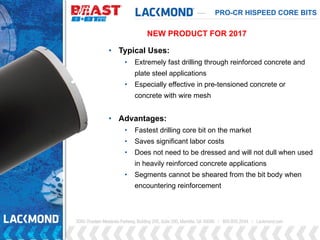
PRO-CR HISPEED CORE BITS
• Typical Uses:
• Extremely fast drilling through reinforced concrete and
plate steel applications
• Especially effective in pre-tensioned concrete or
concrete with wire mesh
• Advantages:
• Fastest drilling core bit on the market
• Saves significant labor costs
• Does not need to be dressed and will not dull when used
in heavily reinforced concrete applications
• Segments cannot be sheared from the bit body when
encountering reinforcement
NEW PRODUCT FOR 2017
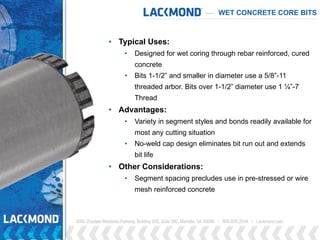
WET CONCRETE CORE BITS
• Typical Uses:
• Designed for wet coring through rebar reinforced, cured
concrete
• Bits 1-1/2” and smaller in diameter use a 5/8”-11
threaded arbor. Bits over 1-1/2” diameter use 1 ¼”-7
Thread
• Advantages:
• Variety in segment styles and bonds readily available for
most any cutting situation
• No-weld cap design eliminates bit run out and extends
bit life
• Other Considerations:
• Segment spacing precludes use in pre-stressed or wire
mesh reinforced concrete
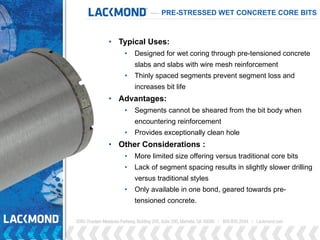
PRE-STRESSED WET CONCRETE CORE BITS
• Typical Uses:
• Designed for wet coring through pre-tensioned concrete
slabs and slabs with wire mesh reinforcement
• Thinly spaced segments prevent segment loss and
increases bit life
• Advantages:
• Segments cannot be sheared from the bit body when
encountering reinforcement
• Provides exceptionally clean hole
• Other Considerations :
• More limited size offering versus traditional core bits
• Lack of segment spacing results in slightly slower drilling
versus traditional styles
• Only available in one bond, geared towards pre-
tensioned concrete.
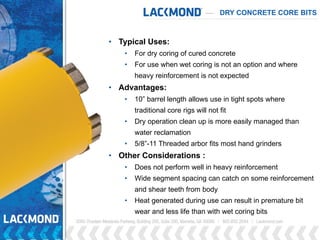
DRY CONCRETE CORE BITS
• Typical Uses:
• For dry coring of cured concrete
• For use when wet coring is not an option and where
heavy reinforcement is not expected
• Advantages:
• 10” barrel length allows use in tight spots where
traditional core rigs will not fit
• Dry operation clean up is more easily managed than
water reclamation
• 5/8”-11 Threaded arbor fits most hand grinders
• Other Considerations :
• Does not perform well in heavy reinforcement
• Wide segment spacing can catch on some reinforcement
and shear teeth from body
• Heat generated during use can result in premature bit
wear and less life than with wet coring bits
DRY MASONRY CORE BITS
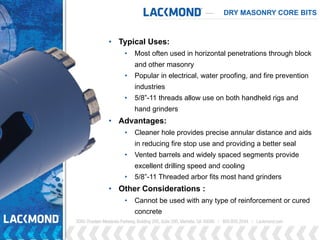
• Typical Uses:
• Most often used in horizontal penetrations through block
and other masonry
• Popular in electrical, water proofing, and fire prevention
industries
• 5/8”-11 threads allow use on both handheld rigs and
hand grinders
• Advantages:
• Cleaner hole provides precise annular distance and aids
in reducing fire stop use and providing a better seal
• Vented barrels and widely spaced segments provide
excellent drilling speed and cooling
• 5/8”-11 Threaded arbor fits most hand grinders
• Other Considerations :
• Cannot be used with any type of reinforcement or cured
concrete
CORE RIG EXTENSIONS & ADAPTORS
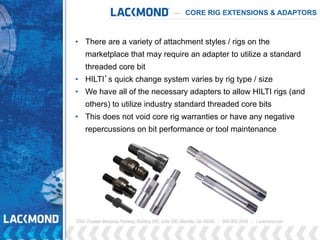
• There are a variety of attachment styles / rigs on the
marketplace that may require an adapter to utilize a standard
threaded core bit
• HILTI’s quick change system varies by rig type / size
• We have all of the necessary adapters to allow HILTI rigs (and
others) to utilize industry standard threaded core bits
• This does not void core rig warranties or have any negative
repercussions on bit performance or tool maintenance
Coring & Drilling
PART 4: CARBIDE DRILL BITS
CARBIDE MASONRY DRILL BITS: BASICS
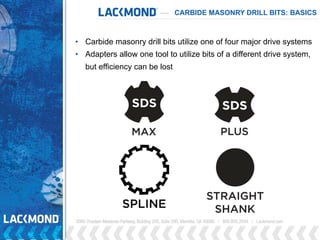
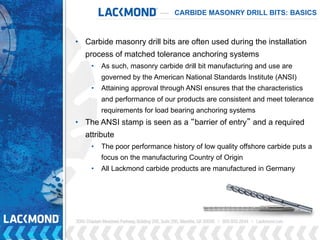
• Carbide masonry drill bits utilize one of four major drive systems
• Adapters allow one tool to utilize bits of a different drive system,
but efficiency can be lost
CARBIDE MASONRY DRILL BITS: BASICS
• Carbide masonry drill bits are often used during the installation
process of matched tolerance anchoring systems
• As such, masonry carbide drill bit manufacturing and use are
governed by the American National Standards Institute (ANSI)
• Attaining approval through ANSI ensures that the characteristics
and performance of our products are consistent and meet tolerance
requirements for load bearing anchoring systems
• The ANSI stamp is seen as a “barrier of entry” and a required
attribute
• The poor performance history of low quality offshore carbide puts a
focus on the manufacturing Country of Origin
• All Lackmond carbide products are manufactured in Germany
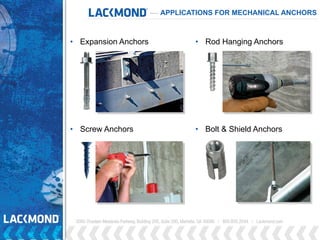
• Rod Hanging Anchors
• Bolt & Shield Anchors
• Expansion Anchors
• Screw Anchors
APPLICATIONS FOR MECHANICAL ANCHORS
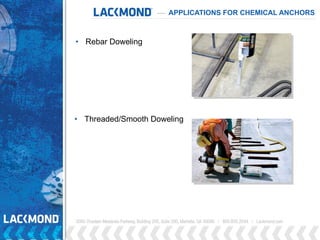
• Rebar Doweling
APPLICATIONS FOR CHEMICAL ANCHORS
• Threaded/Smooth Doweling
ANCHOR INSTALLATION: DISCUSSION
• Mechanical Anchoring Systems
• Mechanical anchors utilize friction to generate holding power,
expanding or engaging a metal clip in to the hole in which an
anchor is installed
• The technical term for this process is Mechanical Interlock
• Relies on precise tolerances between the hole and anchor
• Chemical Anchoring Systems
• Holding power is attained when the chemical is absorbed in to the
concrete base material, forming a chemical bond (Chemical
Interlock) between the base material and anchoring product
• A slightly oversized hole provides space for the chemical anchor to
bond with both anchoring product and base material
• Drilled holes require cleaning / dust removal prior to using any
chemical anchoring product
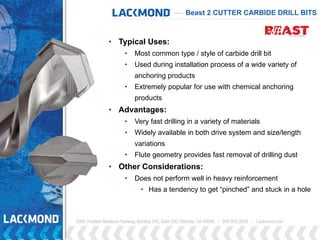
• Typical Uses:
• Most common type / style of carbide drill bit
• Used during installation process of a wide variety of
anchoring products
• Extremely popular for use with chemical anchoring
products
• Advantages:
• Very fast drilling in a variety of materials
• Widely available in both drive system and size/length
variations
• Flute geometry provides fast removal of drilling dust
• Other Considerations:
• Does not perform well in heavy reinforcement
• Has a tendency to get “pinched” and stuck in a hole
Beast 2 CUTTER CARBIDE DRILL BITS
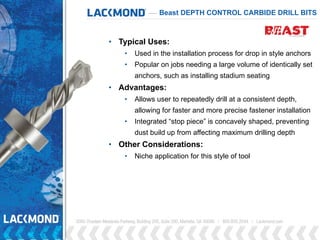
• Typical Uses:
• Used in the installation process for drop in style anchors
• Popular on jobs needing a large volume of identically set
anchors, such as installing stadium seating
• Advantages:
• Allows user to repeatedly drill at a consistent depth,
allowing for faster and more precise fastener installation
• Integrated “stop piece” is concavely shaped, preventing
dust build up from affecting maximum drilling depth
• Other Considerations:
• Niche application for this style of tool
Beast DEPTH CONTROL CARBIDE DRILL BITS
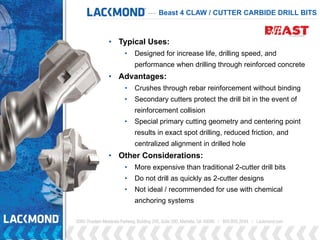
Beast 4 CLAW / CUTTER CARBIDE DRILL BITS
• Typical Uses:
• Designed for increase life, drilling speed, and
performance when drilling through reinforced concrete
• Advantages:
• Crushes through rebar reinforcement without binding
• Secondary cutters protect the drill bit in the event of
reinforcement collision
• Special primary cutting geometry and centering point
results in exact spot drilling, reduced friction, and
centralized alignment in drilled hole
• Other Considerations:
• More expensive than traditional 2-cutter drill bits
• Do not drill as quickly as 2-cutter designs
• Not ideal / recommended for use with chemical
anchoring systems
Coring & Drilling
PART 5: HANDS ON
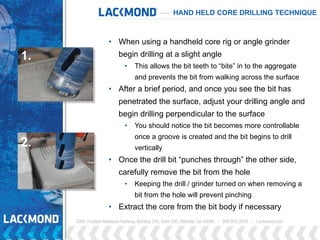
• When using a handheld core rig or angle grinder
begin drilling at a slight angle
• This allows the bit teeth to “bite” in to the aggregate
and prevents the bit from walking across the surface
• After a brief period, and once you see the bit has
penetrated the surface, adjust your drilling angle and
begin drilling perpendicular to the surface
• You should notice the bit becomes more controllable
once a groove is created and the bit begins to drill
vertically
• Once the drill bit “punches through” the other side,
carefully remove the bit from the hole
• Keeping the drill / grinder turned on when removing a
bit from the hole will prevent pinching
• Extract the core from the bit body if necessary
1.
2.
HAND HELD CORE DRILLING TECHNIQUE
DIAMOND CORE BITS HANDS ON
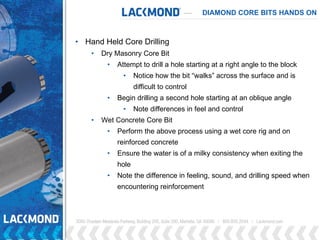
• Hand Held Core Drilling
• Dry Masonry Core Bit
• Attempt to drill a hole starting at a right angle to the block
• Notice how the bit “walks” across the surface and is
difficult to control
• Begin drilling a second hole starting at an oblique angle
• Note differences in feel and control
• Wet Concrete Core Bit
• Perform the above process using a wet core rig and on
reinforced concrete
• Ensure the water is of a milky consistency when exiting the
hole
• Note the difference in feeling, sound, and drilling speed when
encountering reinforcement
• Engage vacuum or install mechanical anchor through
anchoring slot, adjust leveling feet as needed
• Drilling rig should be firmly anchored in place prior to
drilling, ensuring a straight and accurate core
• Many contractors simply stand on the anchor base; this
is NOT recommended and can lead to pinched / stuck
bits or broken segments
• Set machine speed to match bit diameter
• Drilling speed is inversely related to core bit diameter
• Open water flow valve as needed
• Provide even downward pressure and begin drilling
• Many drill rigs have a load indicator that can help
identify proper downward pressure
• Experienced users listen to the rig and stop applying
pressure when the motor “gears down”
MAST MOUNTED CORE DRILLING TECHNIQUE
DIAMOND CORE BITS HANDS ON
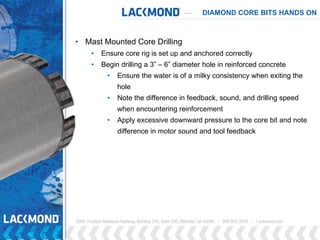
• Mast Mounted Core Drilling
• Ensure core rig is set up and anchored correctly
• Begin drilling a 3” – 6” diameter hole in reinforced concrete
• Ensure the water is of a milky consistency when exiting the
hole
• Note the difference in feedback, sound, and drilling speed
when encountering reinforcement
• Apply excessive downward pressure to the core bit and note
difference in motor sound and tool feedback
TIPS AND TRICKS
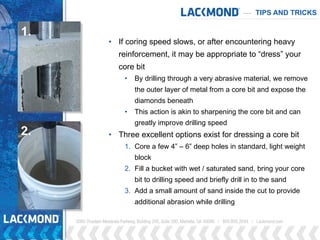
• If coring speed slows, or after encountering heavy
reinforcement, it may be appropriate to “dress” your
core bit
• By drilling through a very abrasive material, we remove
the outer layer of metal from a core bit and expose the
diamonds beneath
• This action is akin to sharpening the core bit and can
greatly improve drilling speed
• Three excellent options exist for dressing a core bit
1. Core a few 4” – 6” deep holes in standard, light weight
block
2. Fill a bucket with wet / saturated sand, bring your core
bit to drilling speed and briefly drill in to the sand
3. Add a small amount of sand inside the cut to provide
additional abrasion while drilling
1.
2.
• Set the drill to the Rotary-Hammer setting
• Orient the drill bit perpendicular to the work surface
• Do not apply excessive pressure; allow the bit to do
the work
• In vertical drilling applications, the weight of the
tool is often enough to provide sufficient
downward force
• Begin drilling a vertical hole with the 2-cutter bit
• Make note of tool feedback, speed, and feedback
change if encountering reinforcement
• Repeat the above process with the 4-cutter bit
• Make note of tool feedback, speed, and feedback
change if encountering reinforcement
CARBIDE DRILLING TECHNIQUE
• Proper drilling techniques
• Proper application diagnosis
• So many options, which one is right?
• Understanding of tool features / terms
• Discussion of jobsite applications for various products
• Field tips and tricks
CLOSING DISCUSSION
THE END
THANK YOU!
Thank you for completing the Coring & Drilling training
module.
For any questions on this and other products offered by
Lackmond Products, Inc. please contact our customer service
department at 1-800-850-2044.
Also, please see all these products and more on our website:
Lackmond.com.
LPI Coring & Drilling Training Module- 0717

LPI Coring & Drilling Training Module- 0717

  • 1.
    Coring & Drilling PART1: DISCUSSION April 2017
  • 2.
    OPENING STATEMENT This presentationis designed to serve as a stand-alone training piece, as well as act as a companion piece to Lackmond’s hands on diamond training program. Classroom instruction is important, but there is no substitute for hands on training to reinforce academic concepts. Contact your Lackmond representative to schedule hands-on training: 800-850-2044. Coring & Drilling course includes: • Core drills, rigs and bits • Carbide tipped masonry drill bits
  • 3.
    • Gloves • ProtectiveApron (optional) • Boots SAFETY BRIEFING: REQUIRED GEAR • Silica Dust Mask (N95) • Wrap Around Eye Protection • Hearing Protection
  • 4.
    SAFETY BRIEFING • Onlyoperate tools when instructed to do so • Unplug tools prior to installing or removing bits • Wear safety equipment at all times when operating tools • Drilling can produce flying debris • Prolonged silica dust inhalation can lead to respiratory issues • In absence of hearing protection, hearing damage can occur with prolonged tool use • Keep hands out of cutting areas at all times • Cutting and grinding can result in heat build-up • Use caution and tight fitting gloves to prevent accidental burns
  • 5.
    COURSE OVERVIEW • Diamond •Tool familiarity • General core bit features and uses • Proper mounting and removal from tool • Proper drilling techniques • Hands on demonstration during Lackmond PK training when applicable • Carbide • Tool familiarity • General carbide drill bit features and uses • Proper mounting and removal from tool • Proper drilling techniques • Hands on demonstration during Lackmond PK training when applicable
  • 6.
    KEY CONCEPTS • Properdrilling techniques • Diamond Blades, Carbide Drill Bits and Core Drill & Rigs • Proper application diagnosis • So many options, which one is right? • In what applications are these products used? • Understanding of tool features / terms • Discussion of jobsite applications for various products • Field tips and tricks
  • 7.
  • 8.
    TOOL OVERVIEW Speed Selection Switch On/ Off Switch GFI Test / Reset Buttons Water ValveThreaded Spindle • Important terms and features for a Hand Held Core Rig Pistol Grip Item # BCR130/BG
  • 9.
    TOOL OVERVIEW Clamp forHand Held Core Rig Raise / Lower Handle Leveling Feet Anchoring Slot Carry Handle • Important terms and features for a Compact Core Rig Stand Stand Angle Adjustment Item # BCR130CSTAND
  • 10.
    TOOL OVERVIEW Speed Selector Switch Raise/ Lower Handle Leveling Feet Anchoring Slot • Important terms and features for a Mast Mounted Core Rig GFI Test / Reset Buttons Stand Angle Adjustment Threaded Spindle Load Indicator Water Feed Item # BCR300/12
  • 11.
    TOOL OVERVIEW Vacuum GasketVacuum Pump Vacuum Kit • Important terms and features for Core Rig Vacuum Systems Item # BCRVKITC For Compact Drill Stand Item # BCRPUMP
  • 12.
    TOOL OVERVIEW Depth GaugeRod Trigger Side Handle • Important terms and features for a typical Rotary Hammer Mode Selector SwitchBit Release Collar
  • 13.
    Coring & Drilling PART3: DIAMOND CORE BITS
  • 14.
    • Lackmond corebits are manufactured without manual welding, greatly increasing bit accuracy, longevity, and reducing bit wobble or run out • Our precision machined, threaded cap can also be removed (PRO-VTB only) to add extension tubes for additional drilling depth STANDARD CORE BIT FEATURES Competitive products weld the bit cap to the core bit body
  • 15.
    • Proprietary fastsintering technology results the industry’s fastest drilling core bits • Standard threading allows use with any core drill machine • Greatly reduce drilling time and eliminate bit failure in heavily reinforced concrete • Watch video on the next slide BEAST HISPEED CORE BITS NEW PRODUCT FOR 2017
  • 16.
    PRO HISPEED COREBITS • Typical Uses: • Extremely fast drilling through reinforced concrete and plate steel applications • Advantages: • Fastest drilling core bit on the market • Saves significant labor costs • Does not need to be dressed and will not dull when used in heavily reinforced concrete applications NEW PRODUCT FOR 2017
  • 17.
    PRO-CR HISPEED COREBITS • Typical Uses: • Extremely fast drilling through reinforced concrete and plate steel applications • Especially effective in pre-tensioned concrete or concrete with wire mesh • Advantages: • Fastest drilling core bit on the market • Saves significant labor costs • Does not need to be dressed and will not dull when used in heavily reinforced concrete applications • Segments cannot be sheared from the bit body when encountering reinforcement NEW PRODUCT FOR 2017
  • 18.
    WET CONCRETE COREBITS • Typical Uses: • Designed for wet coring through rebar reinforced, cured concrete • Bits 1-1/2” and smaller in diameter use a 5/8”-11 threaded arbor. Bits over 1-1/2” diameter use 1 ¼”-7 Thread • Advantages: • Variety in segment styles and bonds readily available for most any cutting situation • No-weld cap design eliminates bit run out and extends bit life • Other Considerations: • Segment spacing precludes use in pre-stressed or wire mesh reinforced concrete
  • 19.
    PRE-STRESSED WET CONCRETECORE BITS • Typical Uses: • Designed for wet coring through pre-tensioned concrete slabs and slabs with wire mesh reinforcement • Thinly spaced segments prevent segment loss and increases bit life • Advantages: • Segments cannot be sheared from the bit body when encountering reinforcement • Provides exceptionally clean hole • Other Considerations : • More limited size offering versus traditional core bits • Lack of segment spacing results in slightly slower drilling versus traditional styles • Only available in one bond, geared towards pre- tensioned concrete.
  • 20.
    DRY CONCRETE COREBITS • Typical Uses: • For dry coring of cured concrete • For use when wet coring is not an option and where heavy reinforcement is not expected • Advantages: • 10” barrel length allows use in tight spots where traditional core rigs will not fit • Dry operation clean up is more easily managed than water reclamation • 5/8”-11 Threaded arbor fits most hand grinders • Other Considerations : • Does not perform well in heavy reinforcement • Wide segment spacing can catch on some reinforcement and shear teeth from body • Heat generated during use can result in premature bit wear and less life than with wet coring bits
  • 21.
    DRY MASONRY COREBITS • Typical Uses: • Most often used in horizontal penetrations through block and other masonry • Popular in electrical, water proofing, and fire prevention industries • 5/8”-11 threads allow use on both handheld rigs and hand grinders • Advantages: • Cleaner hole provides precise annular distance and aids in reducing fire stop use and providing a better seal • Vented barrels and widely spaced segments provide excellent drilling speed and cooling • 5/8”-11 Threaded arbor fits most hand grinders • Other Considerations : • Cannot be used with any type of reinforcement or cured concrete
  • 22.
    CORE RIG EXTENSIONS& ADAPTORS • There are a variety of attachment styles / rigs on the marketplace that may require an adapter to utilize a standard threaded core bit • HILTI’s quick change system varies by rig type / size • We have all of the necessary adapters to allow HILTI rigs (and others) to utilize industry standard threaded core bits • This does not void core rig warranties or have any negative repercussions on bit performance or tool maintenance
  • 23.
    Coring & Drilling PART4: CARBIDE DRILL BITS
  • 24.
    CARBIDE MASONRY DRILLBITS: BASICS • Carbide masonry drill bits utilize one of four major drive systems • Adapters allow one tool to utilize bits of a different drive system, but efficiency can be lost
  • 25.
    CARBIDE MASONRY DRILLBITS: BASICS • Carbide masonry drill bits are often used during the installation process of matched tolerance anchoring systems • As such, masonry carbide drill bit manufacturing and use are governed by the American National Standards Institute (ANSI) • Attaining approval through ANSI ensures that the characteristics and performance of our products are consistent and meet tolerance requirements for load bearing anchoring systems • The ANSI stamp is seen as a “barrier of entry” and a required attribute • The poor performance history of low quality offshore carbide puts a focus on the manufacturing Country of Origin • All Lackmond carbide products are manufactured in Germany
  • 26.
    • Rod HangingAnchors • Bolt & Shield Anchors • Expansion Anchors • Screw Anchors APPLICATIONS FOR MECHANICAL ANCHORS
  • 27.
    • Rebar Doweling APPLICATIONSFOR CHEMICAL ANCHORS • Threaded/Smooth Doweling
  • 28.
    ANCHOR INSTALLATION: DISCUSSION •Mechanical Anchoring Systems • Mechanical anchors utilize friction to generate holding power, expanding or engaging a metal clip in to the hole in which an anchor is installed • The technical term for this process is Mechanical Interlock • Relies on precise tolerances between the hole and anchor • Chemical Anchoring Systems • Holding power is attained when the chemical is absorbed in to the concrete base material, forming a chemical bond (Chemical Interlock) between the base material and anchoring product • A slightly oversized hole provides space for the chemical anchor to bond with both anchoring product and base material • Drilled holes require cleaning / dust removal prior to using any chemical anchoring product
  • 29.
    • Typical Uses: •Most common type / style of carbide drill bit • Used during installation process of a wide variety of anchoring products • Extremely popular for use with chemical anchoring products • Advantages: • Very fast drilling in a variety of materials • Widely available in both drive system and size/length variations • Flute geometry provides fast removal of drilling dust • Other Considerations: • Does not perform well in heavy reinforcement • Has a tendency to get “pinched” and stuck in a hole Beast 2 CUTTER CARBIDE DRILL BITS
  • 30.
    • Typical Uses: •Used in the installation process for drop in style anchors • Popular on jobs needing a large volume of identically set anchors, such as installing stadium seating • Advantages: • Allows user to repeatedly drill at a consistent depth, allowing for faster and more precise fastener installation • Integrated “stop piece” is concavely shaped, preventing dust build up from affecting maximum drilling depth • Other Considerations: • Niche application for this style of tool Beast DEPTH CONTROL CARBIDE DRILL BITS
  • 31.
    Beast 4 CLAW/ CUTTER CARBIDE DRILL BITS • Typical Uses: • Designed for increase life, drilling speed, and performance when drilling through reinforced concrete • Advantages: • Crushes through rebar reinforcement without binding • Secondary cutters protect the drill bit in the event of reinforcement collision • Special primary cutting geometry and centering point results in exact spot drilling, reduced friction, and centralized alignment in drilled hole • Other Considerations: • More expensive than traditional 2-cutter drill bits • Do not drill as quickly as 2-cutter designs • Not ideal / recommended for use with chemical anchoring systems
  • 32.
  • 33.
    • When usinga handheld core rig or angle grinder begin drilling at a slight angle • This allows the bit teeth to “bite” in to the aggregate and prevents the bit from walking across the surface • After a brief period, and once you see the bit has penetrated the surface, adjust your drilling angle and begin drilling perpendicular to the surface • You should notice the bit becomes more controllable once a groove is created and the bit begins to drill vertically • Once the drill bit “punches through” the other side, carefully remove the bit from the hole • Keeping the drill / grinder turned on when removing a bit from the hole will prevent pinching • Extract the core from the bit body if necessary 1. 2. HAND HELD CORE DRILLING TECHNIQUE
  • 34.
    DIAMOND CORE BITSHANDS ON • Hand Held Core Drilling • Dry Masonry Core Bit • Attempt to drill a hole starting at a right angle to the block • Notice how the bit “walks” across the surface and is difficult to control • Begin drilling a second hole starting at an oblique angle • Note differences in feel and control • Wet Concrete Core Bit • Perform the above process using a wet core rig and on reinforced concrete • Ensure the water is of a milky consistency when exiting the hole • Note the difference in feeling, sound, and drilling speed when encountering reinforcement
  • 35.
    • Engage vacuumor install mechanical anchor through anchoring slot, adjust leveling feet as needed • Drilling rig should be firmly anchored in place prior to drilling, ensuring a straight and accurate core • Many contractors simply stand on the anchor base; this is NOT recommended and can lead to pinched / stuck bits or broken segments • Set machine speed to match bit diameter • Drilling speed is inversely related to core bit diameter • Open water flow valve as needed • Provide even downward pressure and begin drilling • Many drill rigs have a load indicator that can help identify proper downward pressure • Experienced users listen to the rig and stop applying pressure when the motor “gears down” MAST MOUNTED CORE DRILLING TECHNIQUE
  • 36.
    DIAMOND CORE BITSHANDS ON • Mast Mounted Core Drilling • Ensure core rig is set up and anchored correctly • Begin drilling a 3” – 6” diameter hole in reinforced concrete • Ensure the water is of a milky consistency when exiting the hole • Note the difference in feedback, sound, and drilling speed when encountering reinforcement • Apply excessive downward pressure to the core bit and note difference in motor sound and tool feedback
  • 37.
    TIPS AND TRICKS •If coring speed slows, or after encountering heavy reinforcement, it may be appropriate to “dress” your core bit • By drilling through a very abrasive material, we remove the outer layer of metal from a core bit and expose the diamonds beneath • This action is akin to sharpening the core bit and can greatly improve drilling speed • Three excellent options exist for dressing a core bit 1. Core a few 4” – 6” deep holes in standard, light weight block 2. Fill a bucket with wet / saturated sand, bring your core bit to drilling speed and briefly drill in to the sand 3. Add a small amount of sand inside the cut to provide additional abrasion while drilling 1. 2.
  • 38.
    • Set thedrill to the Rotary-Hammer setting • Orient the drill bit perpendicular to the work surface • Do not apply excessive pressure; allow the bit to do the work • In vertical drilling applications, the weight of the tool is often enough to provide sufficient downward force • Begin drilling a vertical hole with the 2-cutter bit • Make note of tool feedback, speed, and feedback change if encountering reinforcement • Repeat the above process with the 4-cutter bit • Make note of tool feedback, speed, and feedback change if encountering reinforcement CARBIDE DRILLING TECHNIQUE
  • 39.
    • Proper drillingtechniques • Proper application diagnosis • So many options, which one is right? • Understanding of tool features / terms • Discussion of jobsite applications for various products • Field tips and tricks CLOSING DISCUSSION
  • 40.
    THE END THANK YOU! Thankyou for completing the Coring & Drilling training module. For any questions on this and other products offered by Lackmond Products, Inc. please contact our customer service department at 1-800-850-2044. Also, please see all these products and more on our website: Lackmond.com.