August 15th, 2012
                                                                                                                  Bulletin # 01-12


PRODUCT BULLETIN
                                                   PRODUCT APPLICATION: CORE DRILLS
                                                   How to Drill Through Concrete & Masonry
                                                   Fast and Efficiently
                                                   A core drill is a power tool for boring holes through concrete, reinforced
                                                   concrete, brick, block, stone and masonry. Specialized core bits - hollow
                                                   steel cylinders fitted with segmented diamond teeth - grind away the
                                                   surface to create a hole. Popular core bits range in size from 3/8” to 14”
                                                   diameter. Most drill 12” deep, but longer bits are available
                                                   as well as extensions and threaded barrels.
                                                   Read on to learn how to properly drill through brick,
                                                   block, stone, and concrete with a core drill. By following
                                                   these suggestions, you will save time, money and
                                                   improve your results.
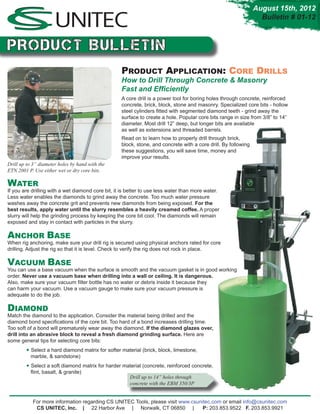
Drill up to 3” diameter holes by hand with the
ETN 2001 P. Use either wet or dry core bits.

WATER
If you are drilling with a wet diamond core bit, it is better to use less water than more water.
Less water enables the diamonds to grind away the concrete. Too much water pressure
washes away the concrete grit and prevents new diamonds from being exposed. For the
best results, apply water until the slurry resembles a heavily creamed coffee. A proper
slurry will help the grinding process by keeping the core bit cool. The diamonds will remain
exposed and stay in contact with particles in the slurry.

ANCHOR BASE
When rig anchoring, make sure your drill rig is secured using physical anchors rated for core
drilling. Adjust the rig so that it is level. Check to verify the rig does not rock in place.

VACUUM BASE
You can use a base vacuum when the surface is smooth and the vacuum gasket is in good working
order. Never use a vacuum base when drilling into a wall or ceiling. It is dangerous.
Also, make sure your vacuum filter bottle has no water or debris inside it because they
can harm your vacuum. Use a vacuum gauge to make sure your vacuum pressure is
adequate to do the job.

DIAMOND
Match the diamond to the application. Consider the material being drilled and the
diamond bond specifications of the core bit. Too hard of a bond increases drilling time.
Too soft of a bond will prematurely wear away the diamond. If the diamond glazes over,
drill into an abrasive block to reveal a fresh diamond grinding surface. Here are
some general tips for selecting core bits:

        • Select a hard diamond matrix for softer material (brick, block, limestone,
          marble, & sandstone)

        • Select a soft diamond matrix for harder material (concrete, reinforced concrete,
          flint, basalt, & granite)
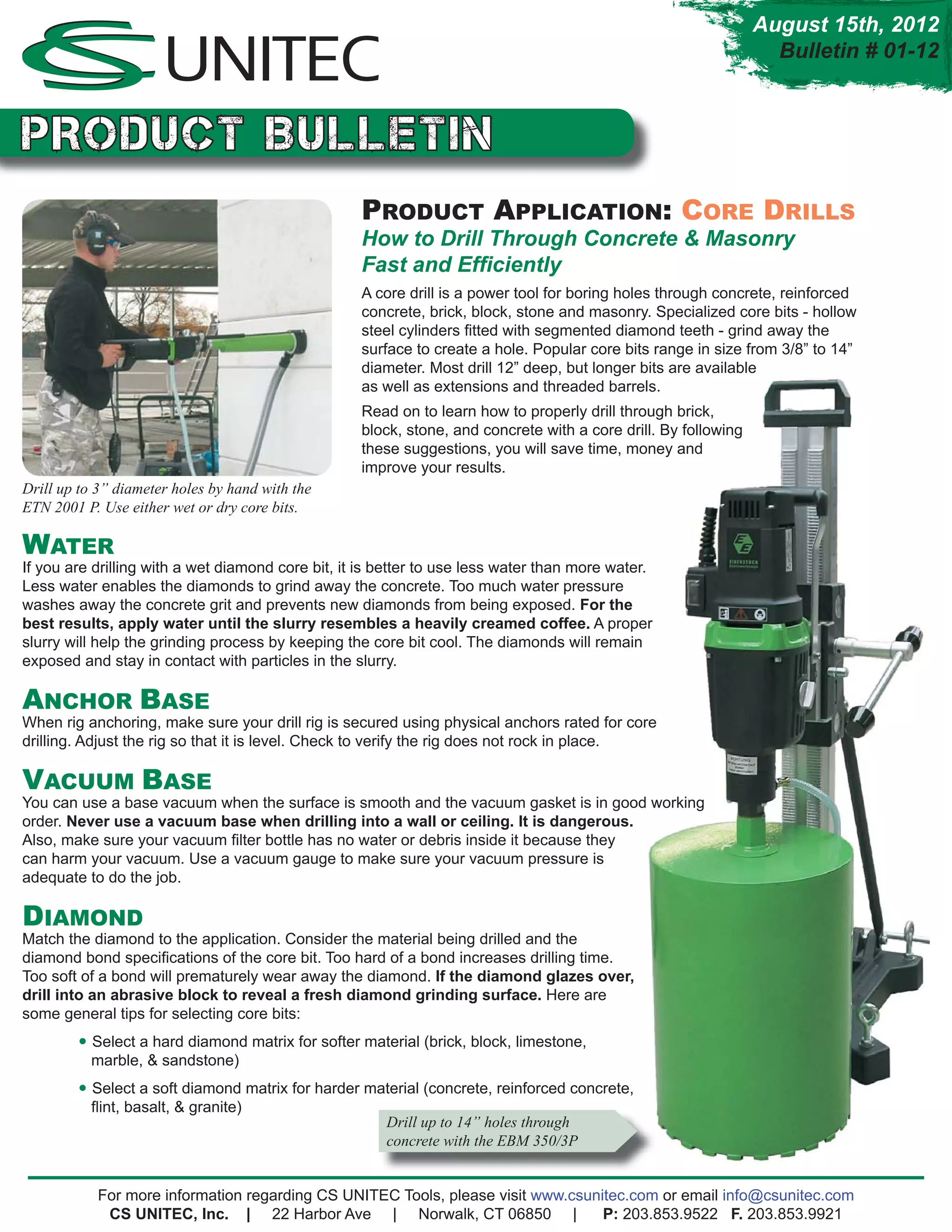
                                                       Drill up to 14” holes through
                                                       concrete with the EBM 350/3P


            For more information regarding CS UNITEC Tools, please visit www.csunitec.com or email info@csunitec.com
             CS UNITEC, Inc. | 22 Harbor Ave | Norwalk, CT 06850 |                P: 203.853.9522 F. 203.853.9921
August 15th, 2012
                                                                                                      Bulletin # 01-12


PRESSURE                                                                                 CHART A
It is very important to maintain steady, even pressure. Correct          Core Bit             Recommended RPMs
pressure will achieve maximum core bit life. Too little pressure
                                                                         Diameter    Minimum         Ideal      Maximum
can cause the diamonds to glaze over. Inconsistent pressure or
pecking will cause the drill to glaze over. Too much pressure will          1”         2400          3200            4000
overload the drill causing damage to both the core bit and the drill        2”         1200          1600            2000
motor.
                                                                            3”          800          1050            1300
                                                                            4”          600          800             1000
SPEED                                                                       5”          475          640             800
Set your motor to the appropriate revolutions per minute (rpm) to
                                                                            6”          400          530             665
grind properly and prevent glazing the diamond segments. When
set at the ideal surface speed, the core bit will cut efficiently. For       7”          340          450             600
example, smaller core bits require higher RPMs. If set too                  8”          300          400             500
slow, the job will take too long and the drill may glaze. See chart A
                                                                           10”          240          320             400
to the right for recommended speeds.
                                                                           12”          200          265             330

POWER
                                                                           14”          170          225             285

To sustain the correct drilling speed, you need adequate power.
Larger core bits require more power. If the drill is under-
powered, it will overheat during operation and damage the tool.
                                                                                         CHART B
See Chart B for recommended power for electric, pneumatic, and           Core Bit             Recommended Power
hydraulic drills.                                                        Diameter   Amps Min.      HP Min.     GPM Min.
Most core drills are electric-powered. When drilling, listen to the        1”-4”        13           1-2              6
electric motor. When in use, the pitch of the motor will lower. If the      5”          15            2               6
motor begins screeching or the mechanical clutch slips, reduce              6”          15            2               6
feed pressure immediately.
                                                                            7”          15           2-3              7
Core drills are also available in pneumatic and hydraulic versions          8”          15           2-3              7
for special applications in a variety of environments including            10”          18           2-3              7
underwater.                                                                12”          18            3               8
                                                                           14”          20            3               8
SAFETY
Increase safety on the job site by using a core drill with a ground-
fault circuit interrupter (GFCI) when drilling in wet conditions. A
GFCI monitors the flow of current and will trip the electrical
circuit if it detects a dangerous imbalance.

Always excerise caution when operating core drills and refer to
user manual for proper maintenance and safety procedures.


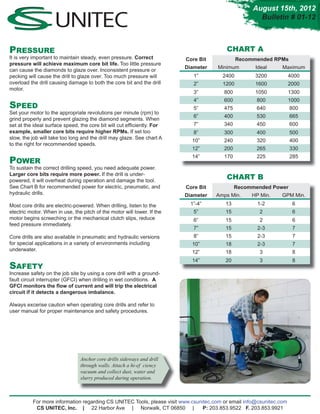
                                Anchor core drills sideways and drill
                                through walls. Attach a hi-ef ciency
                                vacuum and collect dust, water and
                                slurry produced during operation.


          For more information regarding CS UNITEC Tools, please visit www.csunitec.com or email info@csunitec.com
           CS UNITEC, Inc. | 22 Harbor Ave | Norwalk, CT 06850 |                P: 203.853.9522 F. 203.853.9921

CS Unitec Product Application: Core Drills

  • 1.
    August 15th, 2012 Bulletin # 01-12 PRODUCT BULLETIN PRODUCT APPLICATION: CORE DRILLS How to Drill Through Concrete & Masonry Fast and Efficiently A core drill is a power tool for boring holes through concrete, reinforced concrete, brick, block, stone and masonry. Specialized core bits - hollow steel cylinders fitted with segmented diamond teeth - grind away the surface to create a hole. Popular core bits range in size from 3/8” to 14” diameter. Most drill 12” deep, but longer bits are available as well as extensions and threaded barrels. Read on to learn how to properly drill through brick, block, stone, and concrete with a core drill. By following these suggestions, you will save time, money and improve your results. Drill up to 3” diameter holes by hand with the ETN 2001 P. Use either wet or dry core bits. WATER If you are drilling with a wet diamond core bit, it is better to use less water than more water. Less water enables the diamonds to grind away the concrete. Too much water pressure washes away the concrete grit and prevents new diamonds from being exposed. For the best results, apply water until the slurry resembles a heavily creamed coffee. A proper slurry will help the grinding process by keeping the core bit cool. The diamonds will remain exposed and stay in contact with particles in the slurry. ANCHOR BASE When rig anchoring, make sure your drill rig is secured using physical anchors rated for core drilling. Adjust the rig so that it is level. Check to verify the rig does not rock in place. VACUUM BASE You can use a base vacuum when the surface is smooth and the vacuum gasket is in good working order. Never use a vacuum base when drilling into a wall or ceiling. It is dangerous. Also, make sure your vacuum filter bottle has no water or debris inside it because they can harm your vacuum. Use a vacuum gauge to make sure your vacuum pressure is adequate to do the job. DIAMOND Match the diamond to the application. Consider the material being drilled and the diamond bond specifications of the core bit. Too hard of a bond increases drilling time. Too soft of a bond will prematurely wear away the diamond. If the diamond glazes over, drill into an abrasive block to reveal a fresh diamond grinding surface. Here are some general tips for selecting core bits: • Select a hard diamond matrix for softer material (brick, block, limestone, marble, & sandstone) • Select a soft diamond matrix for harder material (concrete, reinforced concrete, flint, basalt, & granite) Drill up to 14” holes through concrete with the EBM 350/3P For more information regarding CS UNITEC Tools, please visit www.csunitec.com or email info@csunitec.com CS UNITEC, Inc. | 22 Harbor Ave | Norwalk, CT 06850 | P: 203.853.9522 F. 203.853.9921
  • 2.
    August 15th, 2012 Bulletin # 01-12 PRESSURE CHART A It is very important to maintain steady, even pressure. Correct Core Bit Recommended RPMs pressure will achieve maximum core bit life. Too little pressure Diameter Minimum Ideal Maximum can cause the diamonds to glaze over. Inconsistent pressure or pecking will cause the drill to glaze over. Too much pressure will 1” 2400 3200 4000 overload the drill causing damage to both the core bit and the drill 2” 1200 1600 2000 motor. 3” 800 1050 1300 4” 600 800 1000 SPEED 5” 475 640 800 Set your motor to the appropriate revolutions per minute (rpm) to 6” 400 530 665 grind properly and prevent glazing the diamond segments. When set at the ideal surface speed, the core bit will cut efficiently. For 7” 340 450 600 example, smaller core bits require higher RPMs. If set too 8” 300 400 500 slow, the job will take too long and the drill may glaze. See chart A 10” 240 320 400 to the right for recommended speeds. 12” 200 265 330 POWER 14” 170 225 285 To sustain the correct drilling speed, you need adequate power. Larger core bits require more power. If the drill is under- powered, it will overheat during operation and damage the tool. CHART B See Chart B for recommended power for electric, pneumatic, and Core Bit Recommended Power hydraulic drills. Diameter Amps Min. HP Min. GPM Min. Most core drills are electric-powered. When drilling, listen to the 1”-4” 13 1-2 6 electric motor. When in use, the pitch of the motor will lower. If the 5” 15 2 6 motor begins screeching or the mechanical clutch slips, reduce 6” 15 2 6 feed pressure immediately. 7” 15 2-3 7 Core drills are also available in pneumatic and hydraulic versions 8” 15 2-3 7 for special applications in a variety of environments including 10” 18 2-3 7 underwater. 12” 18 3 8 14” 20 3 8 SAFETY Increase safety on the job site by using a core drill with a ground- fault circuit interrupter (GFCI) when drilling in wet conditions. A GFCI monitors the flow of current and will trip the electrical circuit if it detects a dangerous imbalance. Always excerise caution when operating core drills and refer to user manual for proper maintenance and safety procedures. Anchor core drills sideways and drill through walls. Attach a hi-ef ciency vacuum and collect dust, water and slurry produced during operation. For more information regarding CS UNITEC Tools, please visit www.csunitec.com or email info@csunitec.com CS UNITEC, Inc. | 22 Harbor Ave | Norwalk, CT 06850 | P: 203.853.9522 F. 203.853.9921