GET TO KNOW THE BROWN ACT
DISCLAIMER The following information is designed to be a general guide to the Brown Act and should NOT be considered legal advice. For questions about specific situations concerning the Brown Act please consult  an attorney.
WHO MUST COMPLY? Legislative Bodies: Governing body of a local agency  Advisory committees (with exceptions) Citizen volunteer groups, task forces, etc.  Standing committees of legislative body continuing subject matter jurisdiction or schedule fixed by resolution or other formal action
WHAT IS A MEETING? Congregation of a majority of a legislative body same time and place to hear, discuss or deliberate agency business TECHNOLOGY COUNTS! Retreats Are Meetings (the interaction among board members is the public’s business)
WHAT IS NOT A MEETING? Individual Contacts and Conversations Attendance at: conferences other agency meetings Ad hoc committee meetings social/ceremonial events DON’T DISCUSS AGENCY BUSINESS
TYPES OF MEETINGS Regular Special Adjourned Emergency
GENERAL MEETING REQUIREMENTS Open and Public No Conditions on Attendance Accessible  Video/Audio & Broadcasting
MEETING REQUIREMENTS, PART 2 Teleconferencing Location  Public Opportunity to Address Board Agendas
REGULAR MEETINGS Time and Place Set by Ordinance, etc. 72 Hours Notice Required
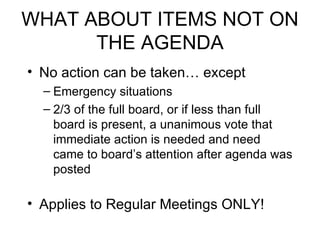
WHAT ABOUT ITEMS NOT ON THE AGENDA No action can be taken… except Emergency situations 2/3 of the full board, or if less than full board is present, a unanimous vote that immediate action is needed and need came to board’s attention after agenda was posted Applies to Regular Meetings ONLY!
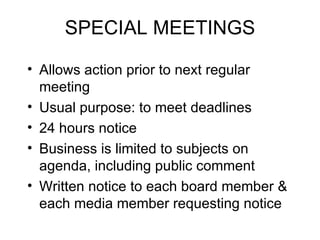
SPECIAL MEETINGS Allows action prior to next regular meeting Usual purpose: to meet deadlines 24 hours notice Business is limited to subjects on agenda, including public comment Written notice to each board member & each media member requesting notice
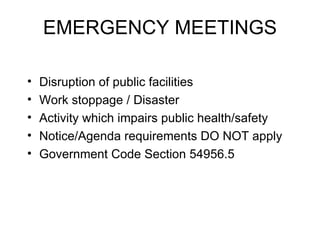
EMERGENCY MEETINGS Disruption of public facilities Work stoppage / Disaster Activity which impairs public health/safety Notice/Agenda requirements DO NOT apply Government Code Section 54956.5
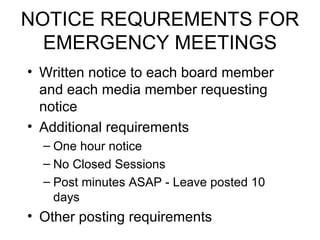
NOTICE REQUREMENTS FOR EMERGENCY MEETINGS Written notice to each board member and each media member requesting notice Additional requirements One hour notice  No Closed Sessions Post minutes ASAP - Leave posted 10 days Other posting requirements
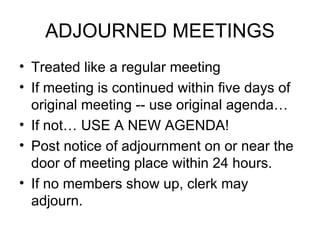
ADJOURNED MEETINGS Treated like a regular meeting If meeting is continued within five days of original meeting -- use original agenda…  If not… USE A NEW AGENDA! Post notice of adjournment on or near the door of meeting place within 24 hours. If no members show up, clerk may adjourn.
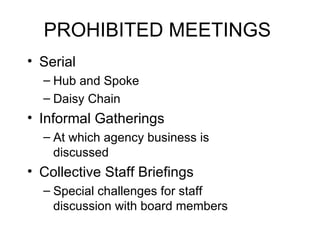
PROHIBITED MEETINGS Serial Hub and Spoke Daisy Chain Informal Gatherings At which agency business is discussed Collective Staff Briefings Special challenges for staff discussion with board members
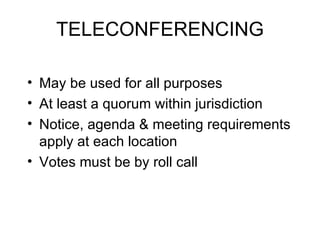
TELECONFERENCING May be used for all purposes At least a quorum within jurisdiction Notice, agenda & meeting requirements apply at each location Votes must be by roll call
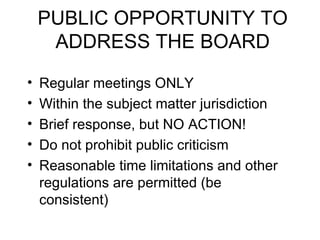
PUBLIC OPPORTUNITY TO ADDRESS THE BOARD Regular meetings ONLY Within the subject matter jurisdiction Brief response, but NO ACTION! Do not prohibit public criticism Reasonable time limitations and other regulations are permitted (be consistent)
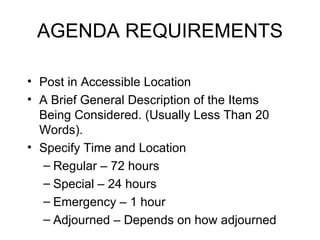
AGENDA REQUIREMENTS Post in Accessible Location A Brief General Description of the Items Being Considered. (Usually Less Than 20 Words). Specify Time and Location  Regular – 72 hours Special – 24 hours Emergency – 1 hour Adjourned – Depends on how adjourned
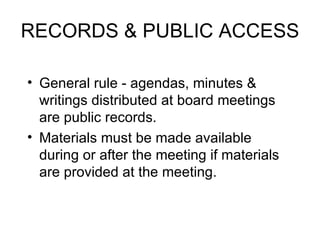
RECORDS & PUBLIC ACCESS General rule - agendas, minutes & writings distributed at board meetings are public records. Materials must be made available during or after the meeting if materials are provided at the meeting.
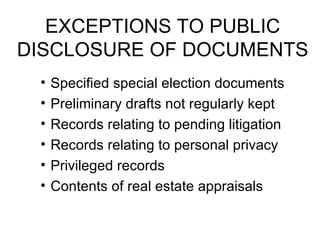
EXCEPTIONS TO PUBLIC DISCLOSURE OF DOCUMENTS Specified special election documents Preliminary drafts not regularly kept Records relating to pending litigation Records relating to personal privacy Privileged records Contents of real estate appraisals
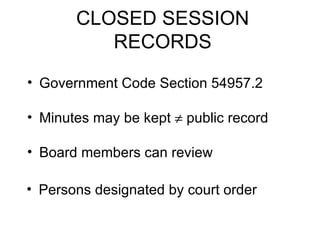
CLOSED SESSION RECORDS Government Code Section 54957.2 Minutes may be kept    public record  Board members can review Persons designated by court order
ENFORCEMENT, PENALTIES & REMEDIES Civil Action Stop or prevent violations   Review board rules/actions or determine applicability   Compel taping of closed sessions Criminal Action (Misdemeanor) Need intent and overt act Invalidation Lawsuit filed to declare action null and void  Board given “cure and correct” opportunity
PENALTIES FOR BROWN ACT VIOLATIONS Court costs Reasonable attorneys’ fees  Misdemeanor is punishable by imprisonment in county jail for six months or less and/or fine not exceeding $1000

Brown act

  • 1.
    GET TO KNOWTHE BROWN ACT
  • 2.
    DISCLAIMER The followinginformation is designed to be a general guide to the Brown Act and should NOT be considered legal advice. For questions about specific situations concerning the Brown Act please consult an attorney.
  • 3.
    WHO MUST COMPLY?Legislative Bodies: Governing body of a local agency Advisory committees (with exceptions) Citizen volunteer groups, task forces, etc. Standing committees of legislative body continuing subject matter jurisdiction or schedule fixed by resolution or other formal action
  • 4.
    WHAT IS AMEETING? Congregation of a majority of a legislative body same time and place to hear, discuss or deliberate agency business TECHNOLOGY COUNTS! Retreats Are Meetings (the interaction among board members is the public’s business)
  • 5.
    WHAT IS NOTA MEETING? Individual Contacts and Conversations Attendance at: conferences other agency meetings Ad hoc committee meetings social/ceremonial events DON’T DISCUSS AGENCY BUSINESS
  • 6.
    TYPES OF MEETINGSRegular Special Adjourned Emergency
  • 7.
    GENERAL MEETING REQUIREMENTSOpen and Public No Conditions on Attendance Accessible Video/Audio & Broadcasting
  • 8.
    MEETING REQUIREMENTS, PART2 Teleconferencing Location Public Opportunity to Address Board Agendas
  • 9.
    REGULAR MEETINGS Timeand Place Set by Ordinance, etc. 72 Hours Notice Required
  • 10.
    WHAT ABOUT ITEMSNOT ON THE AGENDA No action can be taken… except Emergency situations 2/3 of the full board, or if less than full board is present, a unanimous vote that immediate action is needed and need came to board’s attention after agenda was posted Applies to Regular Meetings ONLY!
  • 11.
    SPECIAL MEETINGS Allowsaction prior to next regular meeting Usual purpose: to meet deadlines 24 hours notice Business is limited to subjects on agenda, including public comment Written notice to each board member & each media member requesting notice
  • 12.
    EMERGENCY MEETINGS Disruptionof public facilities Work stoppage / Disaster Activity which impairs public health/safety Notice/Agenda requirements DO NOT apply Government Code Section 54956.5
  • 13.
    NOTICE REQUREMENTS FOREMERGENCY MEETINGS Written notice to each board member and each media member requesting notice Additional requirements One hour notice No Closed Sessions Post minutes ASAP - Leave posted 10 days Other posting requirements
  • 14.
    ADJOURNED MEETINGS Treatedlike a regular meeting If meeting is continued within five days of original meeting -- use original agenda… If not… USE A NEW AGENDA! Post notice of adjournment on or near the door of meeting place within 24 hours. If no members show up, clerk may adjourn.
  • 15.
    PROHIBITED MEETINGS SerialHub and Spoke Daisy Chain Informal Gatherings At which agency business is discussed Collective Staff Briefings Special challenges for staff discussion with board members
  • 16.
    TELECONFERENCING May beused for all purposes At least a quorum within jurisdiction Notice, agenda & meeting requirements apply at each location Votes must be by roll call
  • 17.
    PUBLIC OPPORTUNITY TOADDRESS THE BOARD Regular meetings ONLY Within the subject matter jurisdiction Brief response, but NO ACTION! Do not prohibit public criticism Reasonable time limitations and other regulations are permitted (be consistent)
  • 18.
    AGENDA REQUIREMENTS Postin Accessible Location A Brief General Description of the Items Being Considered. (Usually Less Than 20 Words). Specify Time and Location Regular – 72 hours Special – 24 hours Emergency – 1 hour Adjourned – Depends on how adjourned
  • 19.
    RECORDS & PUBLICACCESS General rule - agendas, minutes & writings distributed at board meetings are public records. Materials must be made available during or after the meeting if materials are provided at the meeting.
  • 20.
    EXCEPTIONS TO PUBLICDISCLOSURE OF DOCUMENTS Specified special election documents Preliminary drafts not regularly kept Records relating to pending litigation Records relating to personal privacy Privileged records Contents of real estate appraisals
  • 21.
    CLOSED SESSION RECORDSGovernment Code Section 54957.2 Minutes may be kept  public record Board members can review Persons designated by court order
  • 22.
    ENFORCEMENT, PENALTIES &REMEDIES Civil Action Stop or prevent violations Review board rules/actions or determine applicability Compel taping of closed sessions Criminal Action (Misdemeanor) Need intent and overt act Invalidation Lawsuit filed to declare action null and void Board given “cure and correct” opportunity
  • 23.
    PENALTIES FOR BROWNACT VIOLATIONS Court costs Reasonable attorneys’ fees Misdemeanor is punishable by imprisonment in county jail for six months or less and/or fine not exceeding $1000