LOWER LIMB
STRETCHING
05
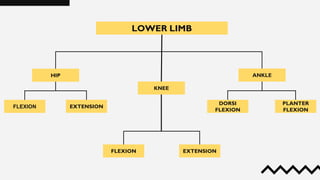
LOWER LIMB
HIP ANKLE
PLANTER
FLEXION
DORSI
FLEXION
EXTENSION
FLEXION
FLEXION EXTENSION
KNEE
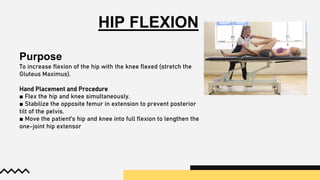
HIP FLEXION
Purpose
To increase flexion of the hip with the knee flexed (stretch the
Gluteus Maximus).
Hand Placement and Procedure
■ Flex the hip and knee simultaneously.
■ Stabilize the opposite femur in extension to prevent posterior
tilt of the pelvis.
■ Move the patient’s hip and knee into full flexion to lengthen the
one-joint hip extensor
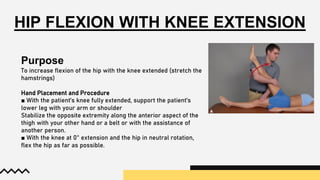
HIP FLEXION WITH KNEE EXTENSION
Purpose
To increase flexion of the hip with the knee extended (stretch the
hamstrings)
Hand Placement and Procedure
■ With the patient’s knee fully extended, support the patient’s
lower leg with your arm or shoulder
Stabilize the opposite extremity along the anterior aspect of the
thigh with your other hand or a belt or with the assistance of
another person.
■ With the knee at 0° extension and the hip in neutral rotation,
flex the hip as far as possible.
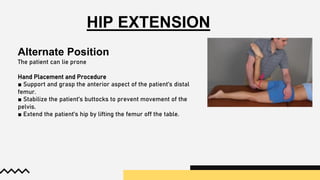
HIP EXTENSION
Purpose
To increase hip extension (stretch the iliopsoas)
Patient Position
Have the patient positioned close to the edge of the treatment table
so the hip being stretched can be extended beyond neutral.
The opposite hip and knee are flexed toward the patient’s chest to stabilize the pelvis
and spine.
Hand Placement and Procedure
■ Stabilize the opposite leg against the patient’s chest with one hand, or if possible,
have the patient assist by grasping around the thigh and holding it to the chest to
prevent an anterior tilt of the pelvis during stretching.
■ Move the hip to be stretched into extension or hyperextension by placing downward
pressure on the anterior aspect of the distal thigh with your other hand. Allow the knee
to extend so the two-joint rectus femoris does not restrict the range.
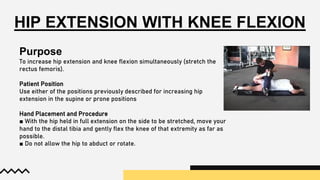
HIP EXTENSION
Alternate Position
The patient can lie prone
Hand Placement and Procedure
■ Support and grasp the anterior aspect of the patient’s distal
femur.
■ Stabilize the patient’s buttocks to prevent movement of the
pelvis.
■ Extend the patient’s hip by lifting the femur off the table.
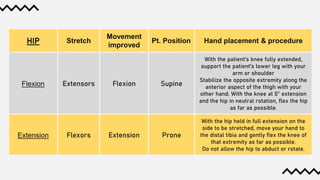
HIP EXTENSION WITH KNEE FLEXION
Purpose
To increase hip extension and knee flexion simultaneously (stretch the
rectus femoris).
Patient Position
Use either of the positions previously described for increasing hip
extension in the supine or prone positions
Hand Placement and Procedure
■ With the hip held in full extension on the side to be stretched, move your
hand to the distal tibia and gently flex the knee of that extremity as far as
possible.
■ Do not allow the hip to abduct or rotate.
HIP Stretch
Movement
improved
Pt. Position Hand placement & procedure
Flexion Extensors Flexion Supine
With the patient’s knee fully extended,
support the patient’s lower leg with your
arm or shoulder
Stabilize the opposite extremity along the
anterior aspect of the thigh with your
other hand. With the knee at 0° extension
and the hip in neutral rotation, flex the hip
as far as possible.
Extension Flexors Extension Prone
With the hip held in full extension on the
side to be stretched, move your hand to
the distal tibia and gently flex the knee of
that extremity as far as possible.
Do not allow the hip to abduct or rotate.
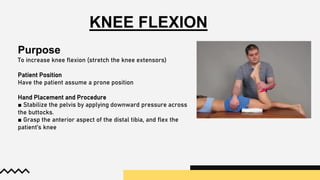
KNEE FLEXION
Purpose
To increase knee flexion (stretch the knee extensors)
Patient Position
Have the patient assume a prone position
Hand Placement and Procedure
■ Stabilize the pelvis by applying downward pressure across
the buttocks.
■ Grasp the anterior aspect of the distal tibia, and flex the
patient’s knee
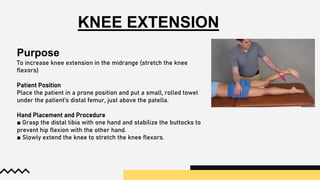
KNEE EXTENSION
Purpose
To increase knee extension in the midrange (stretch the knee
flexors)
Patient Position
Place the patient in a prone position and put a small, rolled towel
under the patient’s distal femur, just above the patella.
Hand Placement and Procedure
■ Grasp the distal tibia with one hand and stabilize the buttocks to
prevent hip flexion with the other hand.
■ Slowly extend the knee to stretch the knee flexors.
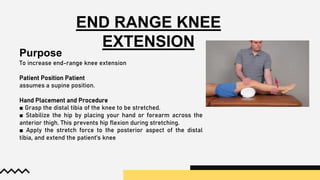
END RANGE KNEE
EXTENSION
Purpose
To increase end-range knee extension
Patient Position Patient
assumes a supine position.
Hand Placement and Procedure
■ Grasp the distal tibia of the knee to be stretched.
■ Stabilize the hip by placing your hand or forearm across the
anterior thigh. This prevents hip flexion during stretching.
■ Apply the stretch force to the posterior aspect of the distal
tibia, and extend the patient’s knee
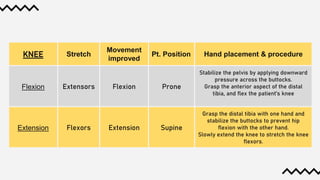
KNEE Stretch
Movement
improved
Pt. Position Hand placement & procedure
Flexion Extensors Flexion Prone
Stabilize the pelvis by applying downward
pressure across the buttocks.
Grasp the anterior aspect of the distal
tibia, and flex the patient’s knee
Extension Flexors Extension Supine
Grasp the distal tibia with one hand and
stabilize the buttocks to prevent hip
flexion with the other hand.
Slowly extend the knee to stretch the knee
flexors.
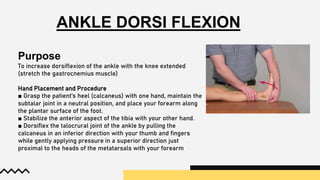
ANKLE DORSI FLEXION
Purpose
To increase dorsiflexion of the ankle with the knee extended
(stretch the gastrocnemius muscle)
Hand Placement and Procedure
■ Grasp the patient’s heel (calcaneus) with one hand, maintain the
subtalar joint in a neutral position, and place your forearm along
the plantar surface of the foot.
■ Stabilize the anterior aspect of the tibia with your other hand.
■ Dorsiflex the talocrural joint of the ankle by pulling the
calcaneus in an inferior direction with your thumb and fingers
while gently applying pressure in a superior direction just
proximal to the heads of the metatarsals with your forearm
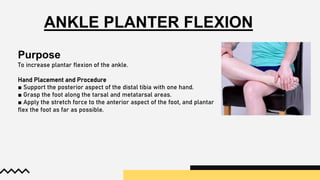
ANKLE PLANTER FLEXION
Purpose
To increase plantar flexion of the ankle.
Hand Placement and Procedure
■ Support the posterior aspect of the distal tibia with one hand.
■ Grasp the foot along the tarsal and metatarsal areas.
■ Apply the stretch force to the anterior aspect of the foot, and plantar
flex the foot as far as possible.
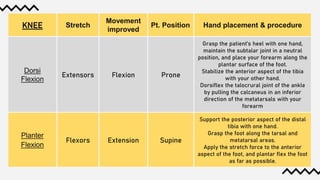
KNEE Stretch
Movement
improved
Pt. Position Hand placement & procedure
Dorsi
Flexion
Extensors Flexion Prone
Grasp the patient’s heel with one hand,
maintain the subtalar joint in a neutral
position, and place your forearm along the
plantar surface of the foot.
Stabilize the anterior aspect of the tibia
with your other hand.
Dorsiflex the talocrural joint of the ankle
by pulling the calcaneus in an inferior
direction of the metatarsals with your
forearm
Planter
Flexion
Flexors Extension Supine
Support the posterior aspect of the distal
tibia with one hand.
Grasp the foot along the tarsal and
metatarsal areas.
Apply the stretch force to the anterior
aspect of the foot, and plantar flex the foot
as far as possible.
STRETCHING OF SCM,
TRAPEZIUS, ROMBOIDS,
QUAD. LUMBORUM
06
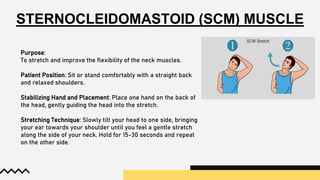
STERNOCLEIDOMASTOID (SCM) MUSCLE
Purpose:
To stretch and improve the flexibility of the neck muscles.
Patient Position: Sit or stand comfortably with a straight back
and relaxed shoulders.
Stabilizing Hand and Placement: Place one hand on the back of
the head, gently guiding the head into the stretch.
Stretching Technique: Slowly tilt your head to one side, bringing
your ear towards your shoulder until you feel a gentle stretch
along the side of your neck. Hold for 15-30 seconds and repeat
on the other side.
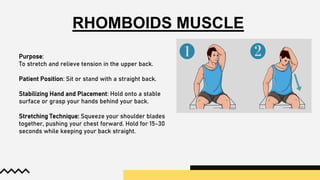
Purpose:
To stretch and relieve tension in the upper back.
Patient Position: Sit or stand with a straight back.
Stabilizing Hand and Placement: Hold onto a stable
surface or grasp your hands behind your back.
Stretching Technique: Squeeze your shoulder blades
together, pushing your chest forward. Hold for 15-30
seconds while keeping your back straight.
RHOMBOIDS MUSCLE
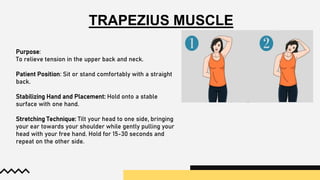
TRAPEZIUS MUSCLE
Purpose:
To relieve tension in the upper back and neck.
Patient Position: Sit or stand comfortably with a straight
back.
Stabilizing Hand and Placement: Hold onto a stable
surface with one hand.
Stretching Technique: Tilt your head to one side, bringing
your ear towards your shoulder while gently pulling your
head with your free hand. Hold for 15-30 seconds and
repeat on the other side.
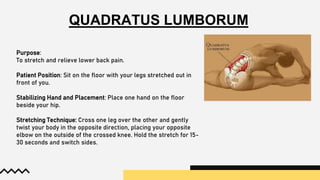
Purpose:
To stretch and relieve lower back pain.
Patient Position: Sit on the floor with your legs stretched out in
front of you.
Stabilizing Hand and Placement: Place one hand on the floor
beside your hip.
Stretching Technique: Cross one leg over the other and gently
twist your body in the opposite direction, placing your opposite
elbow on the outside of the crossed knee. Hold the stretch for 15-
30 seconds and switch sides.
QUADRATUS LUMBORUM
CREDITS: This presentation template was created by Slidesgo, and
includes icons by Flaticon, and infographics & images by Freepik
Thanks!

Lower Limb Stretching (1).pdf flexio n

  • 2.
  • 3.
  • 4.
    HIP FLEXION Purpose To increaseflexion of the hip with the knee flexed (stretch the Gluteus Maximus). Hand Placement and Procedure ■ Flex the hip and knee simultaneously. ■ Stabilize the opposite femur in extension to prevent posterior tilt of the pelvis. ■ Move the patient’s hip and knee into full flexion to lengthen the one-joint hip extensor
  • 5.
    HIP FLEXION WITHKNEE EXTENSION Purpose To increase flexion of the hip with the knee extended (stretch the hamstrings) Hand Placement and Procedure ■ With the patient’s knee fully extended, support the patient’s lower leg with your arm or shoulder Stabilize the opposite extremity along the anterior aspect of the thigh with your other hand or a belt or with the assistance of another person. ■ With the knee at 0° extension and the hip in neutral rotation, flex the hip as far as possible.
  • 6.
    HIP EXTENSION Purpose To increasehip extension (stretch the iliopsoas) Patient Position Have the patient positioned close to the edge of the treatment table so the hip being stretched can be extended beyond neutral. The opposite hip and knee are flexed toward the patient’s chest to stabilize the pelvis and spine. Hand Placement and Procedure ■ Stabilize the opposite leg against the patient’s chest with one hand, or if possible, have the patient assist by grasping around the thigh and holding it to the chest to prevent an anterior tilt of the pelvis during stretching. ■ Move the hip to be stretched into extension or hyperextension by placing downward pressure on the anterior aspect of the distal thigh with your other hand. Allow the knee to extend so the two-joint rectus femoris does not restrict the range.
  • 7.
    HIP EXTENSION Alternate Position Thepatient can lie prone Hand Placement and Procedure ■ Support and grasp the anterior aspect of the patient’s distal femur. ■ Stabilize the patient’s buttocks to prevent movement of the pelvis. ■ Extend the patient’s hip by lifting the femur off the table.
  • 8.
    HIP EXTENSION WITHKNEE FLEXION Purpose To increase hip extension and knee flexion simultaneously (stretch the rectus femoris). Patient Position Use either of the positions previously described for increasing hip extension in the supine or prone positions Hand Placement and Procedure ■ With the hip held in full extension on the side to be stretched, move your hand to the distal tibia and gently flex the knee of that extremity as far as possible. ■ Do not allow the hip to abduct or rotate.
  • 9.
    HIP Stretch Movement improved Pt. PositionHand placement & procedure Flexion Extensors Flexion Supine With the patient’s knee fully extended, support the patient’s lower leg with your arm or shoulder Stabilize the opposite extremity along the anterior aspect of the thigh with your other hand. With the knee at 0° extension and the hip in neutral rotation, flex the hip as far as possible. Extension Flexors Extension Prone With the hip held in full extension on the side to be stretched, move your hand to the distal tibia and gently flex the knee of that extremity as far as possible. Do not allow the hip to abduct or rotate.
  • 10.
    KNEE FLEXION Purpose To increaseknee flexion (stretch the knee extensors) Patient Position Have the patient assume a prone position Hand Placement and Procedure ■ Stabilize the pelvis by applying downward pressure across the buttocks. ■ Grasp the anterior aspect of the distal tibia, and flex the patient’s knee
  • 11.
    KNEE EXTENSION Purpose To increaseknee extension in the midrange (stretch the knee flexors) Patient Position Place the patient in a prone position and put a small, rolled towel under the patient’s distal femur, just above the patella. Hand Placement and Procedure ■ Grasp the distal tibia with one hand and stabilize the buttocks to prevent hip flexion with the other hand. ■ Slowly extend the knee to stretch the knee flexors.
  • 12.
    END RANGE KNEE EXTENSION Purpose Toincrease end-range knee extension Patient Position Patient assumes a supine position. Hand Placement and Procedure ■ Grasp the distal tibia of the knee to be stretched. ■ Stabilize the hip by placing your hand or forearm across the anterior thigh. This prevents hip flexion during stretching. ■ Apply the stretch force to the posterior aspect of the distal tibia, and extend the patient’s knee
  • 13.
    KNEE Stretch Movement improved Pt. PositionHand placement & procedure Flexion Extensors Flexion Prone Stabilize the pelvis by applying downward pressure across the buttocks. Grasp the anterior aspect of the distal tibia, and flex the patient’s knee Extension Flexors Extension Supine Grasp the distal tibia with one hand and stabilize the buttocks to prevent hip flexion with the other hand. Slowly extend the knee to stretch the knee flexors.
  • 14.
    ANKLE DORSI FLEXION Purpose Toincrease dorsiflexion of the ankle with the knee extended (stretch the gastrocnemius muscle) Hand Placement and Procedure ■ Grasp the patient’s heel (calcaneus) with one hand, maintain the subtalar joint in a neutral position, and place your forearm along the plantar surface of the foot. ■ Stabilize the anterior aspect of the tibia with your other hand. ■ Dorsiflex the talocrural joint of the ankle by pulling the calcaneus in an inferior direction with your thumb and fingers while gently applying pressure in a superior direction just proximal to the heads of the metatarsals with your forearm
  • 15.
    ANKLE PLANTER FLEXION Purpose Toincrease plantar flexion of the ankle. Hand Placement and Procedure ■ Support the posterior aspect of the distal tibia with one hand. ■ Grasp the foot along the tarsal and metatarsal areas. ■ Apply the stretch force to the anterior aspect of the foot, and plantar flex the foot as far as possible.
  • 16.
    KNEE Stretch Movement improved Pt. PositionHand placement & procedure Dorsi Flexion Extensors Flexion Prone Grasp the patient’s heel with one hand, maintain the subtalar joint in a neutral position, and place your forearm along the plantar surface of the foot. Stabilize the anterior aspect of the tibia with your other hand. Dorsiflex the talocrural joint of the ankle by pulling the calcaneus in an inferior direction of the metatarsals with your forearm Planter Flexion Flexors Extension Supine Support the posterior aspect of the distal tibia with one hand. Grasp the foot along the tarsal and metatarsal areas. Apply the stretch force to the anterior aspect of the foot, and plantar flex the foot as far as possible.
  • 17.
    STRETCHING OF SCM, TRAPEZIUS,ROMBOIDS, QUAD. LUMBORUM 06
  • 18.
    STERNOCLEIDOMASTOID (SCM) MUSCLE Purpose: Tostretch and improve the flexibility of the neck muscles. Patient Position: Sit or stand comfortably with a straight back and relaxed shoulders. Stabilizing Hand and Placement: Place one hand on the back of the head, gently guiding the head into the stretch. Stretching Technique: Slowly tilt your head to one side, bringing your ear towards your shoulder until you feel a gentle stretch along the side of your neck. Hold for 15-30 seconds and repeat on the other side.
  • 19.
    Purpose: To stretch andrelieve tension in the upper back. Patient Position: Sit or stand with a straight back. Stabilizing Hand and Placement: Hold onto a stable surface or grasp your hands behind your back. Stretching Technique: Squeeze your shoulder blades together, pushing your chest forward. Hold for 15-30 seconds while keeping your back straight. RHOMBOIDS MUSCLE
  • 20.
    TRAPEZIUS MUSCLE Purpose: To relievetension in the upper back and neck. Patient Position: Sit or stand comfortably with a straight back. Stabilizing Hand and Placement: Hold onto a stable surface with one hand. Stretching Technique: Tilt your head to one side, bringing your ear towards your shoulder while gently pulling your head with your free hand. Hold for 15-30 seconds and repeat on the other side.
  • 21.
    Purpose: To stretch andrelieve lower back pain. Patient Position: Sit on the floor with your legs stretched out in front of you. Stabilizing Hand and Placement: Place one hand on the floor beside your hip. Stretching Technique: Cross one leg over the other and gently twist your body in the opposite direction, placing your opposite elbow on the outside of the crossed knee. Hold the stretch for 15- 30 seconds and switch sides. QUADRATUS LUMBORUM
  • 22.
    CREDITS: This presentationtemplate was created by Slidesgo, and includes icons by Flaticon, and infographics & images by Freepik Thanks!