Low Key Studio Lighting
Low key lighting is a form of studio photography that balances high contrast lighting and shade, to
create a dramatic, serious and sometimes moody effect on the images. This style of lighting is
used to accentuate shadows using lighting to create the contrast between lighting and darkness.
Images that use this lighting technique are mainly black and white, however sometimes include
one solid colour that stands out and contrasts the monochromatic palette. There are many dark
tones used in this type of lighting due to the shadows created by the lighting.
Due to the dark tones and use of contrast in the lighting, this lighting technique has quite negative
connotations and created a dramatic, gloomy and mysterious atmosphere. The images that use
colour however are not always gloomy but are still dramatic and serious.
Quentin Arnaud
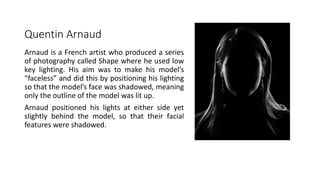
Arnaud is a French artist who produced a series
of photography called Shape where he used low
key lighting. His aim was to make his model’s
“faceless” and did this by positioning his lighting
so that the model’s face was shadowed, meaning
only the outline of the model was lit up.
Arnaud positioned his lights at either side yet
slightly behind the model, so that their facial
features were shadowed.
Damien Lovegrove
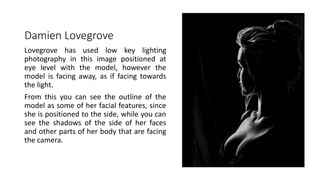
Lovegrove has used low key lighting
photography in this image positioned at
eye level with the model, however the
model is facing away, as if facing towards
the light.
From this you can see the outline of the
model as some of her facial features, since
she is positioned to the side, while you can
see the shadows of the side of her faces
and other parts of her body that are facing
the camera.
Marek Wójciak
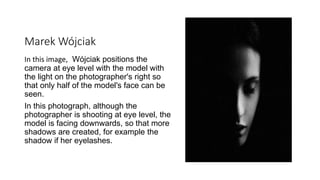
In this image, Wójciak positions the
camera at eye level with the model with
the light on the photographer's right so
that only half of the model's face can be
seen.
In this photograph, although the
photographer is shooting at eye level, the
model is facing downwards, so that more
shadows are created, for example the
shadow if her eyelashes.
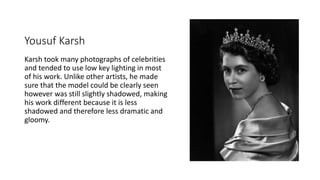
Yousuf Karsh
Karsh took many photographs of celebrities
and tended to use low key lighting in most
of his work. Unlike other artists, he made
sure that the model could be clearly seen
however was still slightly shadowed, making
his work different because it is less
shadowed and therefore less dramatic and
gloomy.
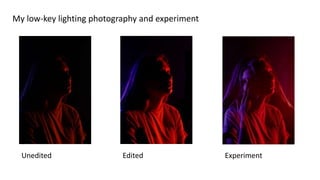
My low-key lighting photography and experiment
Unedited Edited Experiment

Low key lighting

  • 1.
    Low Key StudioLighting Low key lighting is a form of studio photography that balances high contrast lighting and shade, to create a dramatic, serious and sometimes moody effect on the images. This style of lighting is used to accentuate shadows using lighting to create the contrast between lighting and darkness. Images that use this lighting technique are mainly black and white, however sometimes include one solid colour that stands out and contrasts the monochromatic palette. There are many dark tones used in this type of lighting due to the shadows created by the lighting. Due to the dark tones and use of contrast in the lighting, this lighting technique has quite negative connotations and created a dramatic, gloomy and mysterious atmosphere. The images that use colour however are not always gloomy but are still dramatic and serious.
  • 2.
    Quentin Arnaud Arnaud isa French artist who produced a series of photography called Shape where he used low key lighting. His aim was to make his model’s “faceless” and did this by positioning his lighting so that the model’s face was shadowed, meaning only the outline of the model was lit up. Arnaud positioned his lights at either side yet slightly behind the model, so that their facial features were shadowed.
  • 3.
    Damien Lovegrove Lovegrove hasused low key lighting photography in this image positioned at eye level with the model, however the model is facing away, as if facing towards the light. From this you can see the outline of the model as some of her facial features, since she is positioned to the side, while you can see the shadows of the side of her faces and other parts of her body that are facing the camera.
  • 4.
    Marek Wójciak In thisimage, Wójciak positions the camera at eye level with the model with the light on the photographer's right so that only half of the model's face can be seen. In this photograph, although the photographer is shooting at eye level, the model is facing downwards, so that more shadows are created, for example the shadow if her eyelashes.
  • 5.
    Yousuf Karsh Karsh tookmany photographs of celebrities and tended to use low key lighting in most of his work. Unlike other artists, he made sure that the model could be clearly seen however was still slightly shadowed, making his work different because it is less shadowed and therefore less dramatic and gloomy.
  • 6.
    My low-key lightingphotography and experiment Unedited Edited Experiment