Low-Code
Development
Revolutionizing Software
Development
Shantanu Dharekar
Introduction to Low-Code
•What is Low-Code?
Low-code is a software development approach that requires
minimal coding to build applications.
•Key Features:
•Visual development interfaces
•Drag-and-drop components
•Pre-built templates and connectors
•Purpose: Simplify app development and reduce time-to-
market.
Importance of
Low-Code
•Accelerates app development by up to
70%.
•Reduces dependency on skilled
developers.
•Promotes collaboration between business
and IT teams.
•Enables faster prototyping and iteration.
How Low-Code
Works
• Components : Visual Editors: For UI and
workflow design.
• Integrations: Built-in APIs and
connectors.
• Deployment: One-click publishing.
1.Development Process : Define app
requirements.
2.Design using drag-and-drop tools.
3.Configure integrations and workflows.
4.Test and deploy.
Advantages of
Low-Code
• Faster Development: Build apps quickly.
• Cost-Effective: Reduce development
costs.
• Flexibility: Easily modify applications.
• Scalability: Supports enterprise-level
needs.
• User-Friendly: Designed for both
developers and non-developers.
Challenges of
Low-Code
•Limited customization for
complex applications.
•Vendor lock-in risks.
•Security and compliance
concerns.
•Requires training for non-
technical users.
Popular Low-Code
Platforms
Mendix : Enterprise-grade platform
for app development.
OutSystems : Known for robust
integrations and scalability.
Microsoft PowerApps: Seamless
integration with Microsoft 365.
Appian: Focused on workflow
automation.
Zoho Creator: Ideal for SMBs.
Use Cases
•Industries:
•Healthcare: Patient management
systems.
•Finance: Automated workflows.
•Retail: Inventory and sales
tracking.
•Education: Learning
management systems.
The Future of
Low-Code
•Integration with AI and machine
learning.
•Enhanced security frameworks.
•Increased adoption in enterprise
environments.
•Democratization of software
development
Career & Job Opportunities
•Growing Demand:
•High demand for developers familiar with low-code
platforms.
•Roles include Low-Code Developer, Business
Analyst, and Citizen Developer.
•Top Skills Required:
•Knowledge of low-code platforms like Mendix,
OutSystems, or PowerApps.
•Understanding of business processes and workflows.
Products Made
Using Low-Code
•Industry-Specific Examples:
•Healthcare: Patient portals, telemedicine apps.
•Finance: Expense tracking, loan approval systems.
•Retail: Inventory management, customer loyalty programs.
•Education: Learning management systems (LMS).
•Popular Products Built Using Low-Code:
•Mobile Banking Apps
•E-Commerce Platforms
•CRM Tools (Customer Relationship Management)
•Employee Self-Service Portals
Growth Statistics
•Global Growth:
•Low-code market expected to grow at a
CAGR of 26.1% (2022–2028).
•Estimated to reach $65 billion by 2027
globally.
•India’s Growth:
•India is among the fastest-growing
markets, with a CAGR of 30%.
•Major adoption in IT services and BFSI
(Banking, Financial Services, and
Insurance).
•Increasing use in government digital
transformation projects.
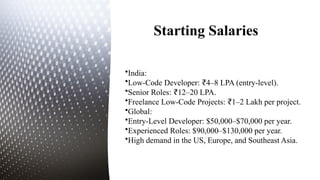
Starting Salaries
•India:
•Low-Code Developer: 4–8 LPA (entry-level).
₹
•Senior Roles: 12–20 LPA.
₹
•Freelance Low-Code Projects: 1–2 Lakh per project.
₹
•Global:
•Entry-Level Developer: $50,000–$70,000 per year.
•Experienced Roles: $90,000–$130,000 per year.
•High demand in the US, Europe, and Southeast Asia.
Conclusion
• Summary:
Low-code platforms are
transforming the way software is
developed by empowering users
of all skill levels.
• Closing Thought:
"Low-code is not just a tool; it's a
mindset for innovation."
Thank You

Low-Code Development presentation ppt.pptx

  • 1.
  • 2.
    Introduction to Low-Code •Whatis Low-Code? Low-code is a software development approach that requires minimal coding to build applications. •Key Features: •Visual development interfaces •Drag-and-drop components •Pre-built templates and connectors •Purpose: Simplify app development and reduce time-to- market.
  • 3.
    Importance of Low-Code •Accelerates appdevelopment by up to 70%. •Reduces dependency on skilled developers. •Promotes collaboration between business and IT teams. •Enables faster prototyping and iteration.
  • 4.
    How Low-Code Works • Components: Visual Editors: For UI and workflow design. • Integrations: Built-in APIs and connectors. • Deployment: One-click publishing. 1.Development Process : Define app requirements. 2.Design using drag-and-drop tools. 3.Configure integrations and workflows. 4.Test and deploy.
  • 5.
    Advantages of Low-Code • FasterDevelopment: Build apps quickly. • Cost-Effective: Reduce development costs. • Flexibility: Easily modify applications. • Scalability: Supports enterprise-level needs. • User-Friendly: Designed for both developers and non-developers.
  • 6.
    Challenges of Low-Code •Limited customizationfor complex applications. •Vendor lock-in risks. •Security and compliance concerns. •Requires training for non- technical users.
  • 7.
    Popular Low-Code Platforms Mendix :Enterprise-grade platform for app development. OutSystems : Known for robust integrations and scalability. Microsoft PowerApps: Seamless integration with Microsoft 365. Appian: Focused on workflow automation. Zoho Creator: Ideal for SMBs.
  • 8.
    Use Cases •Industries: •Healthcare: Patientmanagement systems. •Finance: Automated workflows. •Retail: Inventory and sales tracking. •Education: Learning management systems.
  • 9.
    The Future of Low-Code •Integrationwith AI and machine learning. •Enhanced security frameworks. •Increased adoption in enterprise environments. •Democratization of software development
  • 10.
    Career & JobOpportunities •Growing Demand: •High demand for developers familiar with low-code platforms. •Roles include Low-Code Developer, Business Analyst, and Citizen Developer. •Top Skills Required: •Knowledge of low-code platforms like Mendix, OutSystems, or PowerApps. •Understanding of business processes and workflows.
  • 11.
    Products Made Using Low-Code •Industry-SpecificExamples: •Healthcare: Patient portals, telemedicine apps. •Finance: Expense tracking, loan approval systems. •Retail: Inventory management, customer loyalty programs. •Education: Learning management systems (LMS). •Popular Products Built Using Low-Code: •Mobile Banking Apps •E-Commerce Platforms •CRM Tools (Customer Relationship Management) •Employee Self-Service Portals
  • 12.
    Growth Statistics •Global Growth: •Low-codemarket expected to grow at a CAGR of 26.1% (2022–2028). •Estimated to reach $65 billion by 2027 globally. •India’s Growth: •India is among the fastest-growing markets, with a CAGR of 30%. •Major adoption in IT services and BFSI (Banking, Financial Services, and Insurance). •Increasing use in government digital transformation projects.
  • 13.
    Starting Salaries •India: •Low-Code Developer:4–8 LPA (entry-level). ₹ •Senior Roles: 12–20 LPA. ₹ •Freelance Low-Code Projects: 1–2 Lakh per project. ₹ •Global: •Entry-Level Developer: $50,000–$70,000 per year. •Experienced Roles: $90,000–$130,000 per year. •High demand in the US, Europe, and Southeast Asia.
  • 14.
    Conclusion • Summary: Low-code platformsare transforming the way software is developed by empowering users of all skill levels. • Closing Thought: "Low-code is not just a tool; it's a mindset for innovation."
  • 15.