Waterless Skin Care
By: Paige LaBrie
MKT9716- Consumer Behavior
Why Go Waterless?
Products formulated without water are:
• More powerful
• Less drying
• More environmentally friendly
• Have an extended shelf life
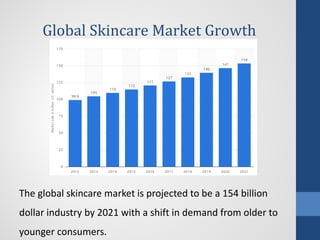
Global Skincare Market Growth
The global skincare market is projected to be a 154 billion
dollar industry by 2021 with a shift in demand from older to
younger consumers.
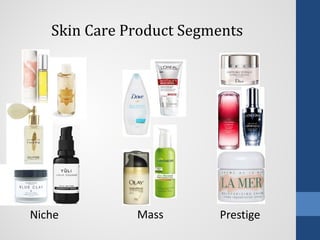
Skin Care Product Segments
Niche Mass Prestige
Trends Affecting Skin Care
• Increased demand for natural skin care
• Sustainably sourced ingredients and practices are
more desirable to consumers
• Salon level beauty treatments at home
• Beauty products that work from the inside out
• Interesting ingredients such as probiotics and
superfoods
• Customizable skin care routines
•
Category Consumer Perceptions
• Consumers are becoming more conscious of what they put
on their skin and paying more attention to ingredient labels
• More brand loyalty towards brands that demonstrate social
responsibility
• Increased interest in smart devices that enhance the value or
benefit of products
According to Mintel:
“Marketers need to show that they understand consumers’
modern perceptions of gender, namely that consumers are
much more complex than the social constraints built around
them”
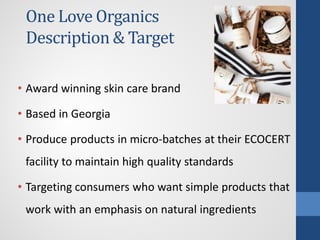
One Love Organics
Description & Target
• Award winning skin care brand
• Based in Georgia
• Produce products in micro-batches at their ECOCERT
facility to maintain high quality standards
• Targeting consumers who want simple products that
work with an emphasis on natural ingredients
One Love Organics
Positioning
• Embrace the simplistic knowledge that you can
achieve more with less ingredients
• Believe in the power of the beauty ritual
• Only use high quality, effective ingredients
One Love Organics
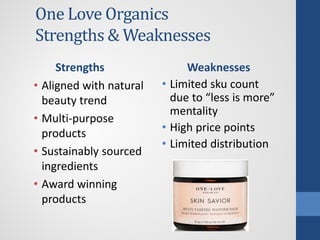
Strengths & Weaknesses
Strengths
• Aligned with natural
beauty trend
• Multi-purpose
products
• Sustainably sourced
ingredients
• Award winning
products
Weaknesses
• Limited sku count
due to “less is more”
mentality
• High price points
• Limited distribution
Whamsia
Description & Target
• Natural and organic skin care brand
• Utilizes fermentation process to preserve the
potency of their ingredients
• Based in Korea
• Targeting women looking for a natural beauty
routine with multiple steps
Whamsia
Positioning
• Built around the belief that concentrated formulas
are more powerful
• Key to their brand identity is their natural
fermentation process which preserves the potency
of their natural ingredients
• All products are 95% organic and 100% natural
Whamsia
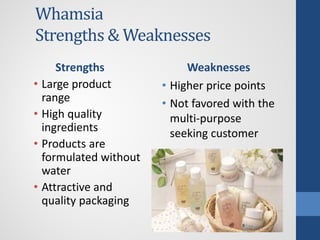
Strengths & Weaknesses
Strengths
• Large product
range
• High quality
ingredients
• Products are
formulated without
water
• Attractive and
quality packaging
Weaknesses
• Higher price points
• Not favored with the
multi-purpose
seeking customer
Pinch of Colour
Description & Target
• Eco-friendly beauty that supports sustainable living
• Based in New York, NY
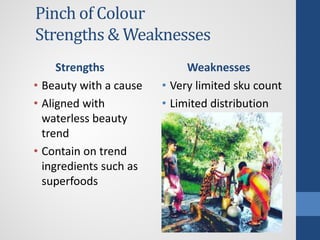
• Part of proceeds are donated to support charities
that improve access to clean drinking water in third
world countries
• Targeting women looking to support beauty with a
cause
Pinch of Colour
Positioning
• Beauty with a cause
• Believe that beauty should not come at the expense
of others or the planet
• Less is more way of thinking
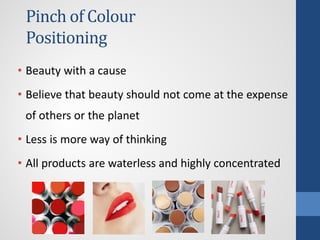
• All products are waterless and highly concentrated
Pinch of Colour
Strengths & Weaknesses
Strengths
• Beauty with a cause
• Aligned with
waterless beauty
trend
• Contain on trend
ingredients such as
superfoods
Weaknesses
• Very limited sku count
• Limited distribution
Closing Remarks
• The global skincare market is a multi-billion dollar
industry that continues to grow year over year
Conclusions from qualitative research:
• Consumers interested in skin care want products that
work
• Consumers are willing to spend upwards of $50 on skin
care products
• Consumers are brand loyal once a product proves itself
SOURCES
All products require an annual contract. Prices do not include sales tax (New York residents only). "Skin
care industry: global skincare market size 2012-2021." Statista. N.p., n.d. Web. 13 Mar. 2017.
Barrionuevo, Adrianna. "Waterless Skincare Products." TheFashionSpot. Evolve Media, 26 June 2015. Web. 13
Mar. 2017.
"Beauty With A Cause." Pinch of Colour. N.p., 2016. Web. 13 Mar. 2017.
D'Adamo, Ann. "Skin Care Industry Trends: What Women Want | WMI." Digital & Integrated Marketing
Agency. N.p., 23 Oct. 2015. Web. 13 Mar. 2017.
Kim, Stella. "Big In Korea: Waterless Skin Care." Into The Gloss. N.p., n.d. Web. 13 Mar. 2017.
Korn, Gabrielle, and Beauty • Skin Care. "These Small Beauty Brands Are Game Changers." Best Small-Batch
Beauty Brands - All Natural Skin Care. N.p., 19 Nov. 2015. Web. 13 Mar. 2017.
Kruse, Annika. "[Brand Profile]: Whamisa – Organic beauty from Korea." TRENDS. TRAVELS. AND BERLIN.
WordPress.com, 02 Feb. 2017. Web. 13 Mar. 2017.
Speculations, Great. "Some Of The Key Trends That Will Drive Sales In The Skincare Segment In 2017." Forbes.
Forbes Magazine, 02 Feb. 2017. Web. 13 Mar. 2017.
Utroske, Deanna. "US consumer trends to influence beauty and skin care brands in
2015." CosmeticsDesign.com USA. William Reed Media Ltd., 29 Oct. 2014. Web. 13 Mar. 2017.
Waterless Skin Care: Phase B
By: Paige LaBrie
MKT9716- Consumer Behavior
CONSUMER TARGET
SEGMENTS
Major Customer Segments
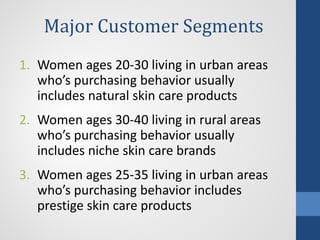
1. Women ages 20-30 living in urban areas
who’s purchasing behavior usually
includes natural skin care products
2. Women ages 30-40 living in rural areas
who’s purchasing behavior usually
includes niche skin care brands
3. Women ages 25-35 living in urban areas
who’s purchasing behavior includes
prestige skin care products
Recommended Consumer Segment
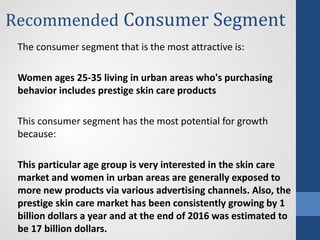
The consumer segment that is the most attractive is:
Women ages 25-35 living in urban areas who's purchasing
behavior includes prestige skin care products
This consumer segment has the most potential for growth
because:
This particular age group is very interested in the skin care
market and women in urban areas are generally exposed to
more new products via various advertising channels. Also, the
prestige skin care market has been consistently growing by 1
billion dollars a year and at the end of 2016 was estimated to
be 17 billion dollars.
CONSUMER TARGET
SEGMENT ANALYSIS
CONSUMER
CHARACTERISTICS
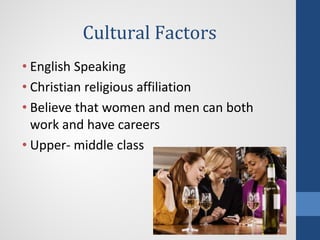
Cultural Factors
• English Speaking
• Christian religious affiliation
• Believe that women and men can both
work and have careers
• Upper- middle class
Social Factors
• Well educated with at least a Bachelor’s
degree
• Lives with domestic partner
• Career focused woman
• Reference Group:
• Primary- family, friends and coworkers
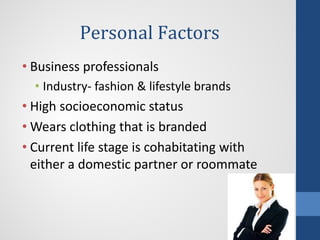
Personal Factors
• Business professionals
• Industry- fashion & lifestyle brands
• High socioeconomic status
• Wears clothing that is branded
• Current life stage is cohabitating with
either a domestic partner or roommate
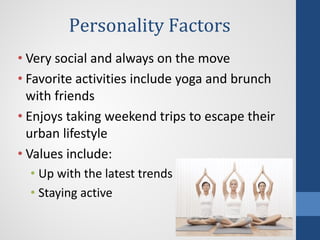
Personality Factors
• Very social and always on the move
• Favorite activities include yoga and brunch
with friends
• Enjoys taking weekend trips to escape their
urban lifestyle
• Values include:
• Up with the latest trends
• Staying active
DECISION
MAKING
PROCESS
How They Search for Information
• The internet
• Fashion & lifestyle magazines
• Social media platforms
• Primary research groups
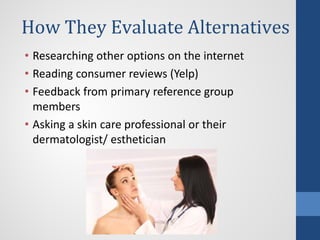
How They Evaluate Alternatives
• Researching other options on the internet
• Reading consumer reviews (Yelp)
• Feedback from primary reference group
members
• Asking a skin care professional or their
dermatologist/ esthetician
How They Make Purchase
Decisions
• Gravitate towards their favorite brands
• Read customer reviews and analyze against
other available products
• Look for latest and greatest at their go to
retailers for skin care (Sephora & Ulta)
• Based on advice from primary reference
group members
Does Innovation Matter?
• Always looking for the next best skincare
product or ingredient
• Frequent social media users so they are
exposed to lots of products
• Work in the industry so they are always up on
the latest trends
• Knowledgeable consumers who's purchasing
habits are largely based on the latest trends
and buzz
NEW PRODUCT
CONCEPT
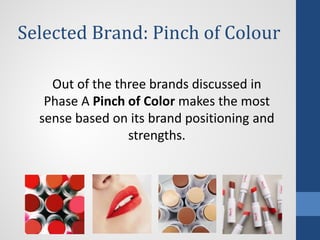
Selected Brand: Pinch of Colour
Out of the three brands discussed in
Phase A Pinch of Color makes the most
sense based on its brand positioning and
strengths.
New Product Concept
Anti-Wrinkle Precious Face Oil
What is it?
• Waterless balm made from high quality ingredients
including:
• Retinol
• Squalene
• Fair Trade Rose Oil
What does it do?
• Works with the skins natural lipid barrier to increase
hydration plumping the skin from within as well as
smoothing fine lines and wrinkles with the active
ingredient retinol
New Product Concept Rationale
• Based on my qualitative research I found out the
following about my target audience:
• Sustainability is not a priority
• The biggest common concern seems to be anti-
aging
• Most people are willing to spend money on
something as long as it works
My product concept stays true to the mission of the
brand (waterless and supports a good cause) but
also adapts to the wants and needs of my target
consumer segment.
Positioning Statement
For women ages 25-35 living in urban areas
who purchase prestige skin care products
Pinch of Colour’s Anti-Wrinkle Face Oil
satisfies the desire for a targeted prestige
skin care product because it contains
powerful actives along with high quality skin
care ingredients that work.
CONSUMER
PSYCHOLOGY
Motivation & Perception
• Our target consumer segment is motivated by:
• Self-improvement
• Esteem
• Hedonic
• Our target consumer segment has selective
perception
• They look for ads that will satisfy their needs
• Respond better to ads with a pleasant message
Beliefs and Attitudes
• Our target consumer segment:
• Holds positive beliefs towards prestige skin care
products that work
• Holds neutral beliefs towards sustainable skincare
• Is aligned closely with the knowledge function of
attitude because they want skin care products that
work for them
Approach to Learning
• Our target consumer segment learns about skin
care through:
• Primary research groups
• Friends
• Family
• Coworkers
• Print ads
• Magazines
• Work
• Online research
APPENDIX(Attached)
SOURCES
"Cultural Factors." Encyclopedia of Public Health. . Encyclopedia.com. 13 May.
2017<http://www.encyclopedia.com>.
Group, The NPD. "U.S. Prestige Beauty Industry Adds $1 Billion in Sales, Grows 6 Percent in 2016." NPD Group.
The NPD Group, 07 Feb. 2017. Web. 14 May 2017.
"MSG Management Study Guide." Psychological Factors affecting Consumer Behaviour. Management Study
Guide, 2017. Web. 14 May 2017.
"Yo! Welcome to our Guide to American Culture, Customs & Etiquette." USA - Language, Culture, Customs and
Etiquette. Commisceo Global Consultancy Ltd, 2017. Web. 14 May 2017.

Waterless Skin Care

  • 1.
    Waterless Skin Care By:Paige LaBrie MKT9716- Consumer Behavior
  • 2.
    Why Go Waterless? Productsformulated without water are: • More powerful • Less drying • More environmentally friendly • Have an extended shelf life
  • 3.
    Global Skincare MarketGrowth The global skincare market is projected to be a 154 billion dollar industry by 2021 with a shift in demand from older to younger consumers.
  • 4.
    Skin Care ProductSegments Niche Mass Prestige
  • 5.
    Trends Affecting SkinCare • Increased demand for natural skin care • Sustainably sourced ingredients and practices are more desirable to consumers • Salon level beauty treatments at home • Beauty products that work from the inside out • Interesting ingredients such as probiotics and superfoods • Customizable skin care routines •
  • 6.
    Category Consumer Perceptions •Consumers are becoming more conscious of what they put on their skin and paying more attention to ingredient labels • More brand loyalty towards brands that demonstrate social responsibility • Increased interest in smart devices that enhance the value or benefit of products According to Mintel: “Marketers need to show that they understand consumers’ modern perceptions of gender, namely that consumers are much more complex than the social constraints built around them”
  • 7.
    One Love Organics Description& Target • Award winning skin care brand • Based in Georgia • Produce products in micro-batches at their ECOCERT facility to maintain high quality standards • Targeting consumers who want simple products that work with an emphasis on natural ingredients
  • 8.
    One Love Organics Positioning •Embrace the simplistic knowledge that you can achieve more with less ingredients • Believe in the power of the beauty ritual • Only use high quality, effective ingredients
  • 9.
    One Love Organics Strengths& Weaknesses Strengths • Aligned with natural beauty trend • Multi-purpose products • Sustainably sourced ingredients • Award winning products Weaknesses • Limited sku count due to “less is more” mentality • High price points • Limited distribution
  • 10.
    Whamsia Description & Target •Natural and organic skin care brand • Utilizes fermentation process to preserve the potency of their ingredients • Based in Korea • Targeting women looking for a natural beauty routine with multiple steps
  • 11.
    Whamsia Positioning • Built aroundthe belief that concentrated formulas are more powerful • Key to their brand identity is their natural fermentation process which preserves the potency of their natural ingredients • All products are 95% organic and 100% natural
  • 12.
    Whamsia Strengths & Weaknesses Strengths •Large product range • High quality ingredients • Products are formulated without water • Attractive and quality packaging Weaknesses • Higher price points • Not favored with the multi-purpose seeking customer
  • 13.
    Pinch of Colour Description& Target • Eco-friendly beauty that supports sustainable living • Based in New York, NY • Part of proceeds are donated to support charities that improve access to clean drinking water in third world countries • Targeting women looking to support beauty with a cause
  • 14.
    Pinch of Colour Positioning •Beauty with a cause • Believe that beauty should not come at the expense of others or the planet • Less is more way of thinking • All products are waterless and highly concentrated
  • 15.
    Pinch of Colour Strengths& Weaknesses Strengths • Beauty with a cause • Aligned with waterless beauty trend • Contain on trend ingredients such as superfoods Weaknesses • Very limited sku count • Limited distribution
  • 16.
    Closing Remarks • Theglobal skincare market is a multi-billion dollar industry that continues to grow year over year Conclusions from qualitative research: • Consumers interested in skin care want products that work • Consumers are willing to spend upwards of $50 on skin care products • Consumers are brand loyal once a product proves itself
  • 17.
    SOURCES All products requirean annual contract. Prices do not include sales tax (New York residents only). "Skin care industry: global skincare market size 2012-2021." Statista. N.p., n.d. Web. 13 Mar. 2017. Barrionuevo, Adrianna. "Waterless Skincare Products." TheFashionSpot. Evolve Media, 26 June 2015. Web. 13 Mar. 2017. "Beauty With A Cause." Pinch of Colour. N.p., 2016. Web. 13 Mar. 2017. D'Adamo, Ann. "Skin Care Industry Trends: What Women Want | WMI." Digital & Integrated Marketing Agency. N.p., 23 Oct. 2015. Web. 13 Mar. 2017. Kim, Stella. "Big In Korea: Waterless Skin Care." Into The Gloss. N.p., n.d. Web. 13 Mar. 2017. Korn, Gabrielle, and Beauty • Skin Care. "These Small Beauty Brands Are Game Changers." Best Small-Batch Beauty Brands - All Natural Skin Care. N.p., 19 Nov. 2015. Web. 13 Mar. 2017. Kruse, Annika. "[Brand Profile]: Whamisa – Organic beauty from Korea." TRENDS. TRAVELS. AND BERLIN. WordPress.com, 02 Feb. 2017. Web. 13 Mar. 2017. Speculations, Great. "Some Of The Key Trends That Will Drive Sales In The Skincare Segment In 2017." Forbes. Forbes Magazine, 02 Feb. 2017. Web. 13 Mar. 2017. Utroske, Deanna. "US consumer trends to influence beauty and skin care brands in 2015." CosmeticsDesign.com USA. William Reed Media Ltd., 29 Oct. 2014. Web. 13 Mar. 2017.
  • 18.
    Waterless Skin Care:Phase B By: Paige LaBrie MKT9716- Consumer Behavior
  • 19.
  • 20.
    Major Customer Segments 1.Women ages 20-30 living in urban areas who’s purchasing behavior usually includes natural skin care products 2. Women ages 30-40 living in rural areas who’s purchasing behavior usually includes niche skin care brands 3. Women ages 25-35 living in urban areas who’s purchasing behavior includes prestige skin care products
  • 21.
    Recommended Consumer Segment Theconsumer segment that is the most attractive is: Women ages 25-35 living in urban areas who's purchasing behavior includes prestige skin care products This consumer segment has the most potential for growth because: This particular age group is very interested in the skin care market and women in urban areas are generally exposed to more new products via various advertising channels. Also, the prestige skin care market has been consistently growing by 1 billion dollars a year and at the end of 2016 was estimated to be 17 billion dollars.
  • 22.
  • 23.
  • 24.
    Cultural Factors • EnglishSpeaking • Christian religious affiliation • Believe that women and men can both work and have careers • Upper- middle class
  • 25.
    Social Factors • Welleducated with at least a Bachelor’s degree • Lives with domestic partner • Career focused woman • Reference Group: • Primary- family, friends and coworkers
  • 26.
    Personal Factors • Businessprofessionals • Industry- fashion & lifestyle brands • High socioeconomic status • Wears clothing that is branded • Current life stage is cohabitating with either a domestic partner or roommate
  • 27.
    Personality Factors • Verysocial and always on the move • Favorite activities include yoga and brunch with friends • Enjoys taking weekend trips to escape their urban lifestyle • Values include: • Up with the latest trends • Staying active
  • 28.
  • 29.
    How They Searchfor Information • The internet • Fashion & lifestyle magazines • Social media platforms • Primary research groups
  • 30.
    How They EvaluateAlternatives • Researching other options on the internet • Reading consumer reviews (Yelp) • Feedback from primary reference group members • Asking a skin care professional or their dermatologist/ esthetician
  • 31.
    How They MakePurchase Decisions • Gravitate towards their favorite brands • Read customer reviews and analyze against other available products • Look for latest and greatest at their go to retailers for skin care (Sephora & Ulta) • Based on advice from primary reference group members
  • 32.
    Does Innovation Matter? •Always looking for the next best skincare product or ingredient • Frequent social media users so they are exposed to lots of products • Work in the industry so they are always up on the latest trends • Knowledgeable consumers who's purchasing habits are largely based on the latest trends and buzz
  • 33.
  • 34.
    Selected Brand: Pinchof Colour Out of the three brands discussed in Phase A Pinch of Color makes the most sense based on its brand positioning and strengths.
  • 35.
    New Product Concept Anti-WrinklePrecious Face Oil What is it? • Waterless balm made from high quality ingredients including: • Retinol • Squalene • Fair Trade Rose Oil What does it do? • Works with the skins natural lipid barrier to increase hydration plumping the skin from within as well as smoothing fine lines and wrinkles with the active ingredient retinol
  • 36.
    New Product ConceptRationale • Based on my qualitative research I found out the following about my target audience: • Sustainability is not a priority • The biggest common concern seems to be anti- aging • Most people are willing to spend money on something as long as it works My product concept stays true to the mission of the brand (waterless and supports a good cause) but also adapts to the wants and needs of my target consumer segment.
  • 37.
    Positioning Statement For womenages 25-35 living in urban areas who purchase prestige skin care products Pinch of Colour’s Anti-Wrinkle Face Oil satisfies the desire for a targeted prestige skin care product because it contains powerful actives along with high quality skin care ingredients that work.
  • 38.
  • 39.
    Motivation & Perception •Our target consumer segment is motivated by: • Self-improvement • Esteem • Hedonic • Our target consumer segment has selective perception • They look for ads that will satisfy their needs • Respond better to ads with a pleasant message
  • 40.
    Beliefs and Attitudes •Our target consumer segment: • Holds positive beliefs towards prestige skin care products that work • Holds neutral beliefs towards sustainable skincare • Is aligned closely with the knowledge function of attitude because they want skin care products that work for them
  • 41.
    Approach to Learning •Our target consumer segment learns about skin care through: • Primary research groups • Friends • Family • Coworkers • Print ads • Magazines • Work • Online research
  • 42.
  • 43.
    SOURCES "Cultural Factors." Encyclopediaof Public Health. . Encyclopedia.com. 13 May. 2017<http://www.encyclopedia.com>. Group, The NPD. "U.S. Prestige Beauty Industry Adds $1 Billion in Sales, Grows 6 Percent in 2016." NPD Group. The NPD Group, 07 Feb. 2017. Web. 14 May 2017. "MSG Management Study Guide." Psychological Factors affecting Consumer Behaviour. Management Study Guide, 2017. Web. 14 May 2017. "Yo! Welcome to our Guide to American Culture, Customs & Etiquette." USA - Language, Culture, Customs and Etiquette. Commisceo Global Consultancy Ltd, 2017. Web. 14 May 2017.