Are you sure that
your site is secure?
             secure
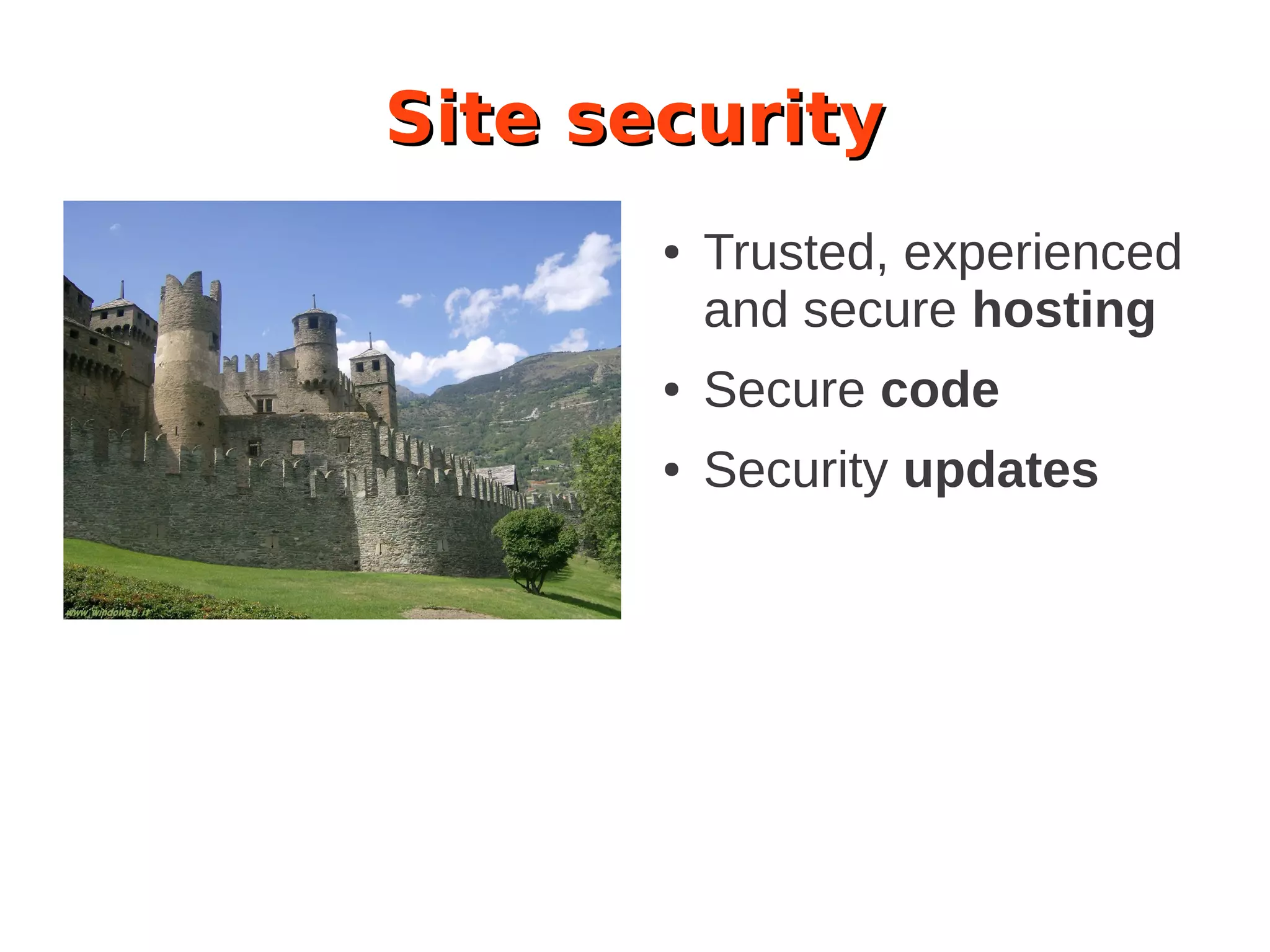
Site security
       ●   Trusted, experienced
           and secure hosting
       ●   Secure code
       ●   Security updates
Security Updates
●   Subscribe to Security-news
    http://lists.drupal.org/mailman/listinfo/security-news
●   Use Drupal 7 core module Update Manager.
How secure is Drupal code?
                     code
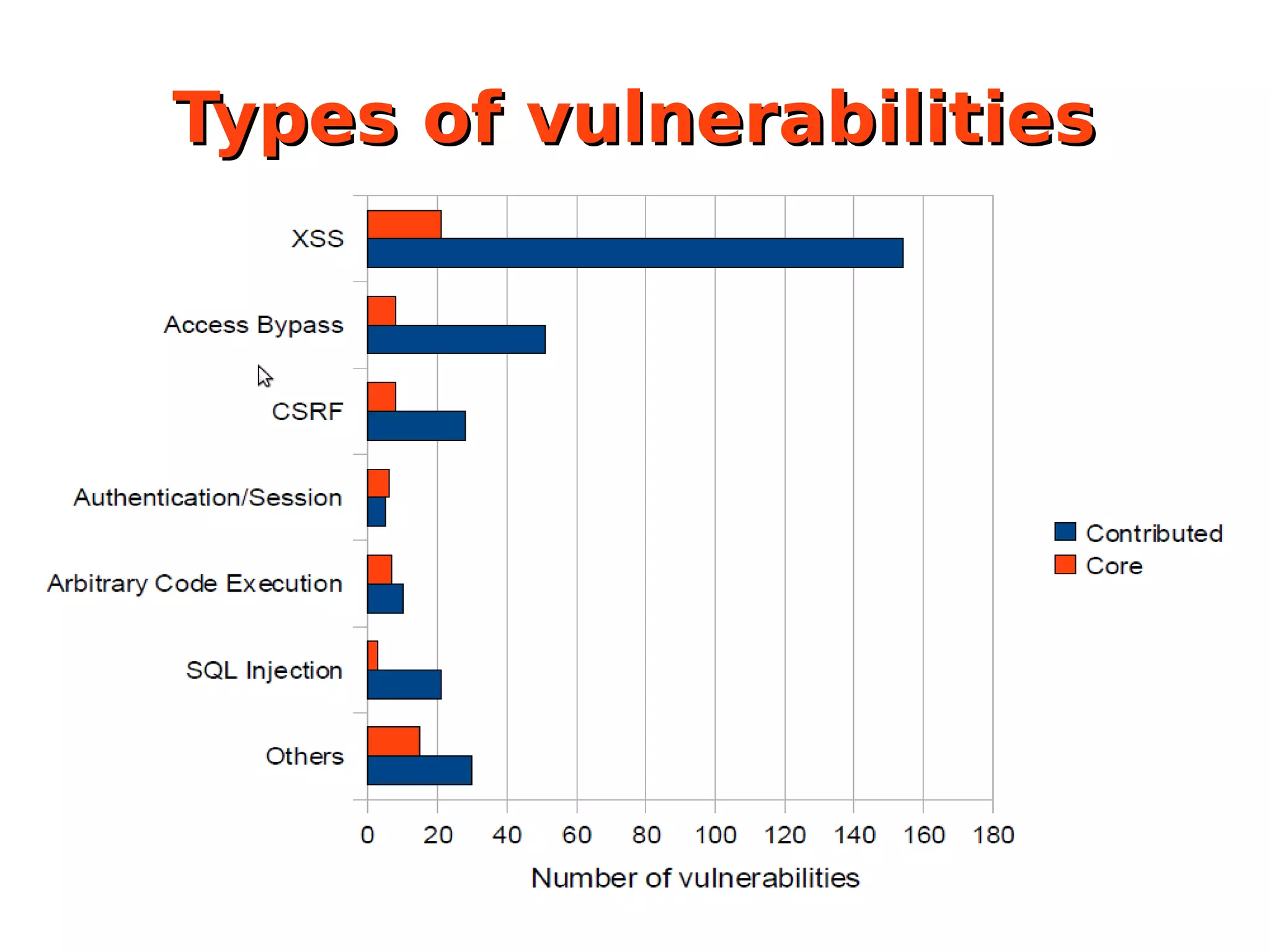
Types of vulnerabilities
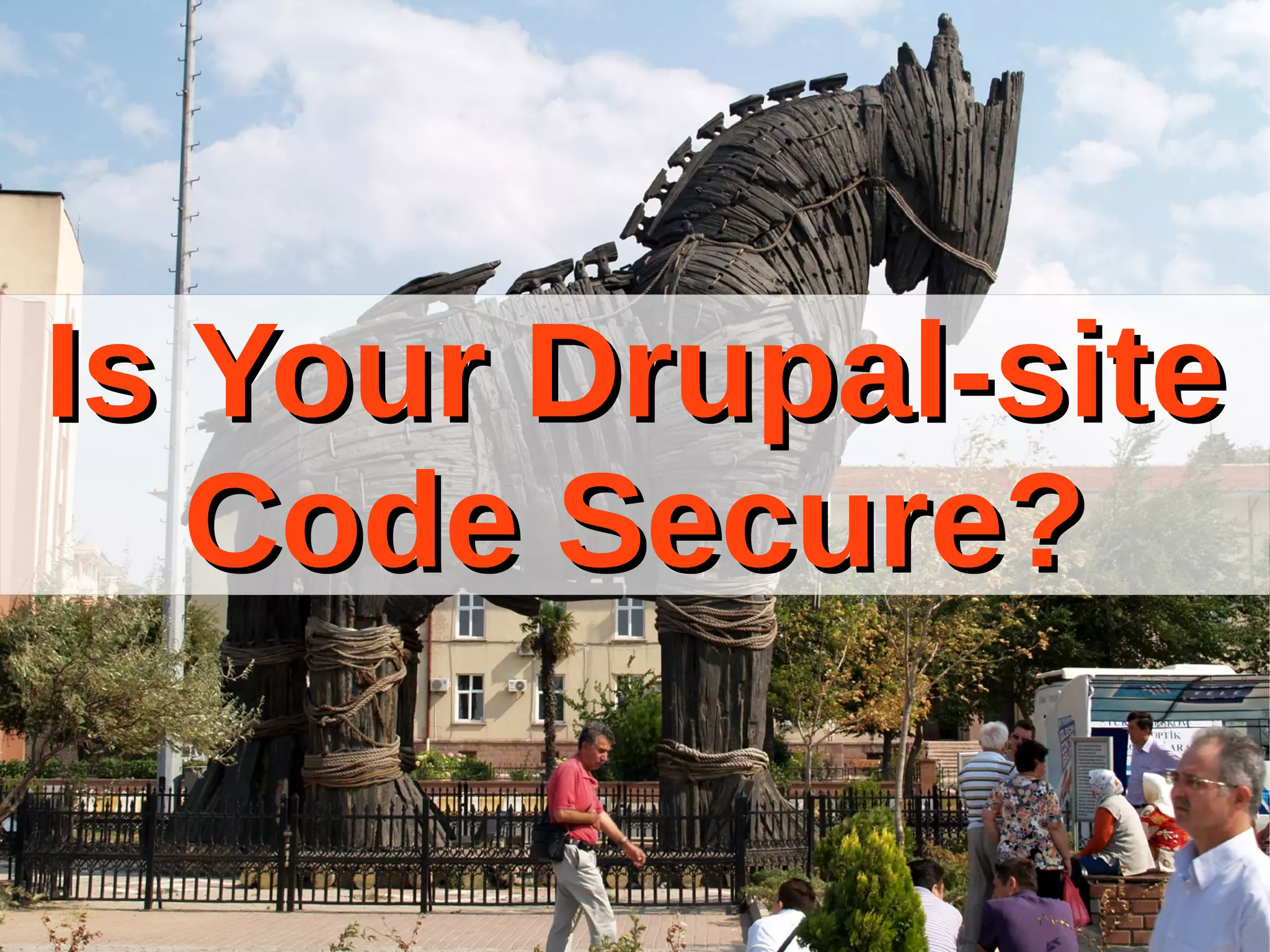
Is Your Drupal-site
   Code Secure?
Speaker: Vlad Savitsky
          Working at


          Skype: vlad_savitsky
          ICQ: 205535814
          vlad.savitsky@gmail.com
          +38096 530 27 12
Challenge
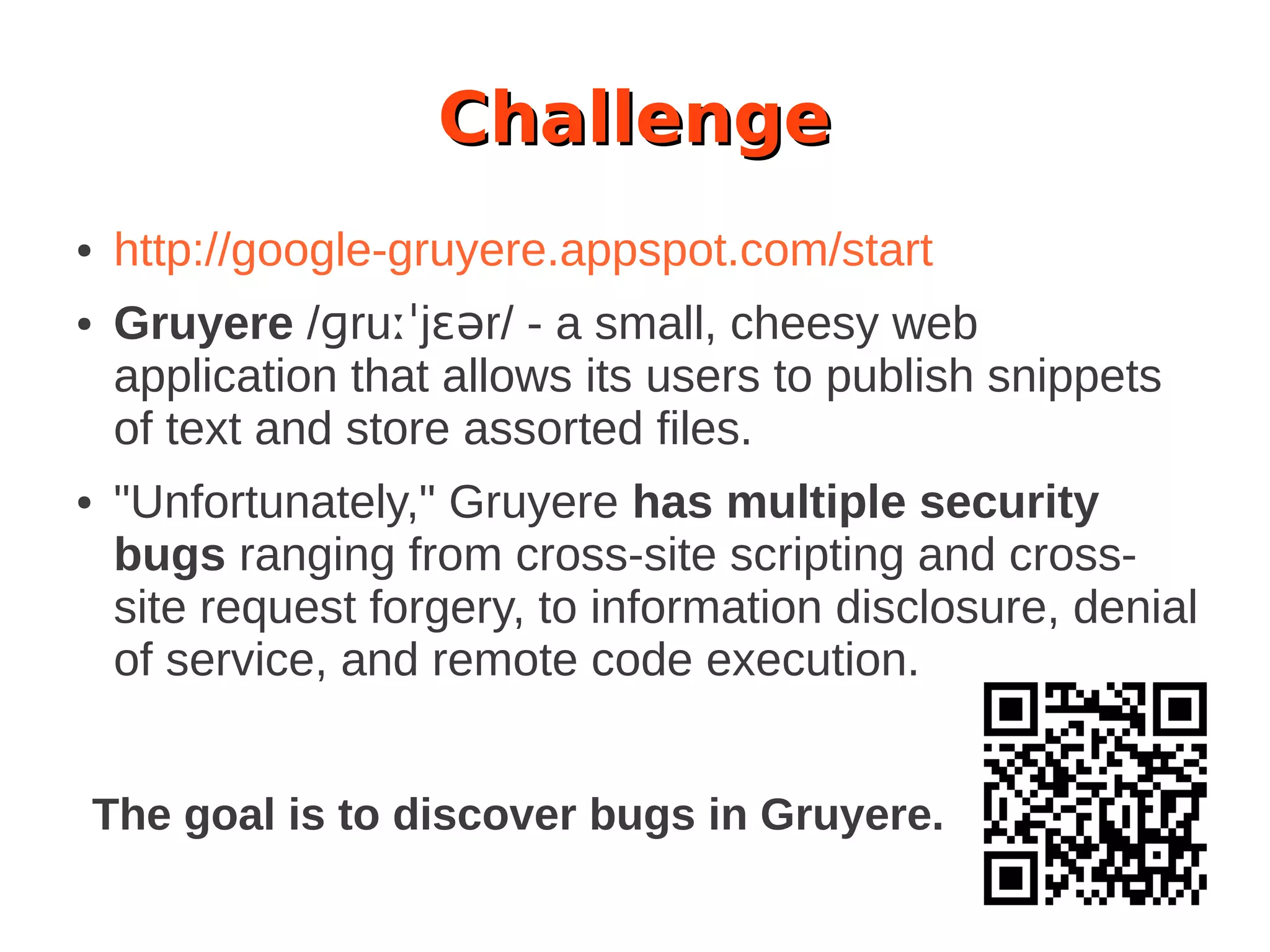
●   http://google-gruyere.appspot.com/start
●   Gruyere /ɡruːˈjɛər/ - a small, cheesy web
    application that allows its users to publish snippets
    of text and store assorted files.
●   "Unfortunately," Gruyere has multiple security
    bugs ranging from cross-site scripting and cross-
    site request forgery, to information disclosure, denial
    of service, and remote code execution.


The goal is to discover bugs in Gruyere.
Cross-site scripting (XSS)
●   Allows attackers to inject script into Web pages
    viewed by other users.
●   http://en.wikipedia.org/wiki/Cross-site_scripting
Handling Data
               Golden Rule
●   Store exactly what the user typed.
●   When handling and outputting text in HTML,
    you need to be careful that proper filtering or
    escaping is done.
1. User sends some data

       User Input
                        Drupal
User
       Invalid Input    Code
                       Validated
                       User Input


                        Database
2. Attacker sends code

       1. Input
                  JS
                         Drupal
User
                         Code
                       2. Not Well
                        Validated
                          Input
                                     JS
                        Database
3. User request a page

       1. Request
                      Drupal
User          JS
       3. Not Well    Code
       Escaped Data
            2. SQL-Query

                               JS
                      Database
4. User runs Attacker's code
                         Browser
         1. View page
  User                  HTML page


                        Attacker's
         2. Send data   JavaScript
                          Code
  User
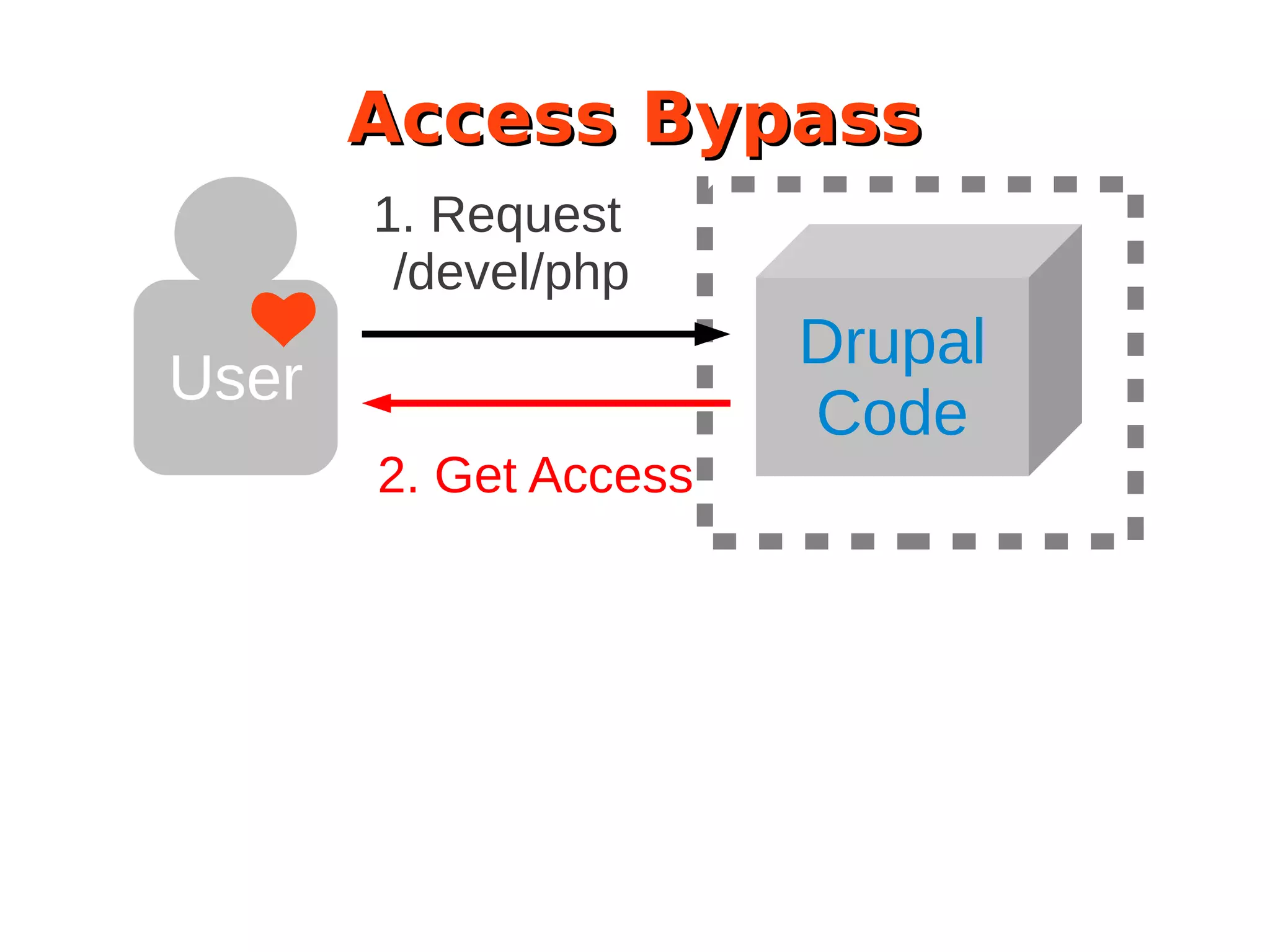
Access Bypass
       1. Request
        /devel/php
                       Drupal
User
                       Code
       2. Get Access
Cross-site request forgery
●   Ability to run some actions at server accessing
    some URL.
●   Also known as a one-click attack or session
    riding and abbreviated as CSRF (pronounced
    sea-surf) or XSRF.
●   http://en.wikipedia.org/wiki/Cross-site_request_forgery
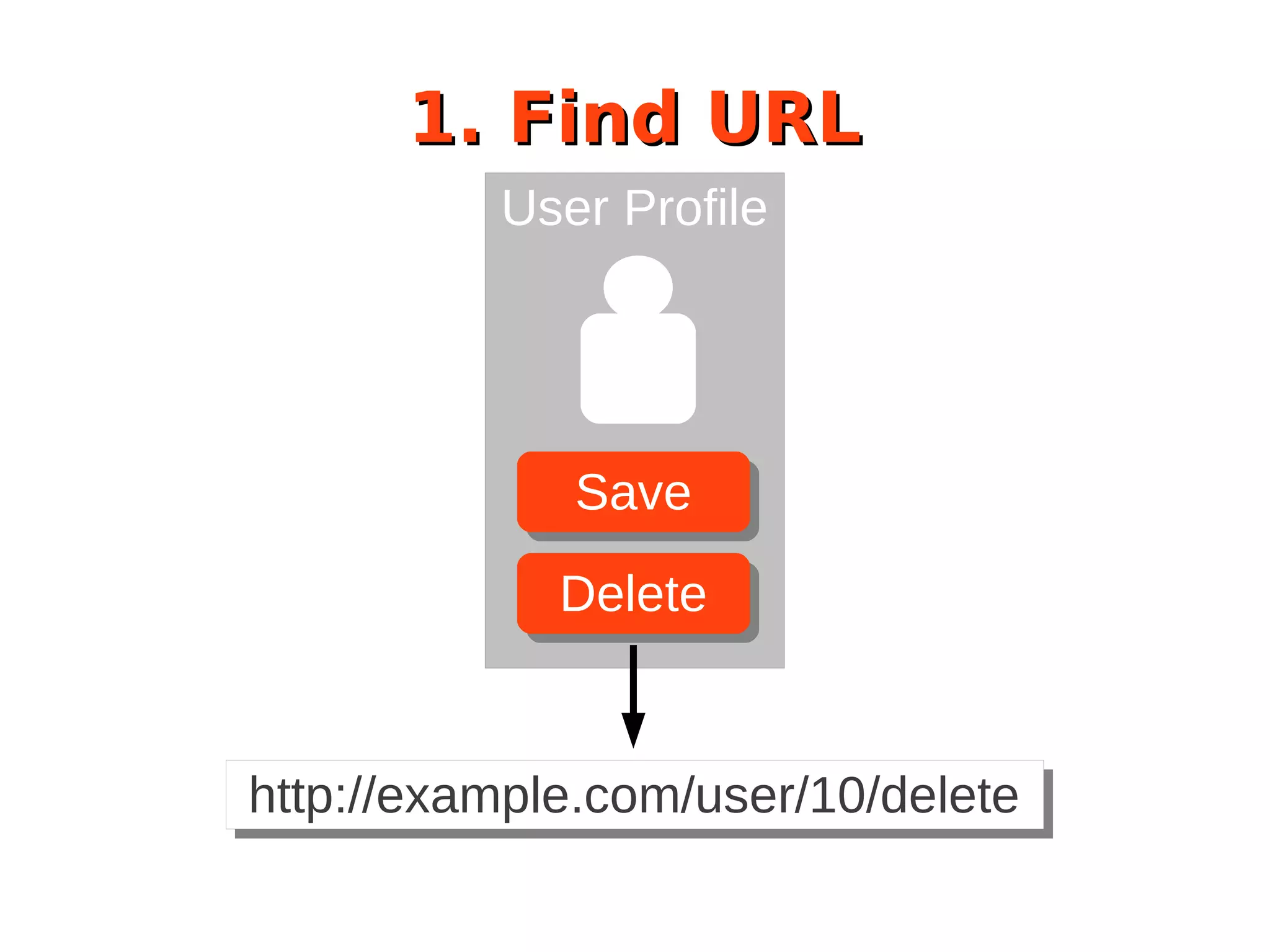
1. Find URL
          User Profile


             Save
             Save
             Delete
             Delete


http://example.com/user/10/delete
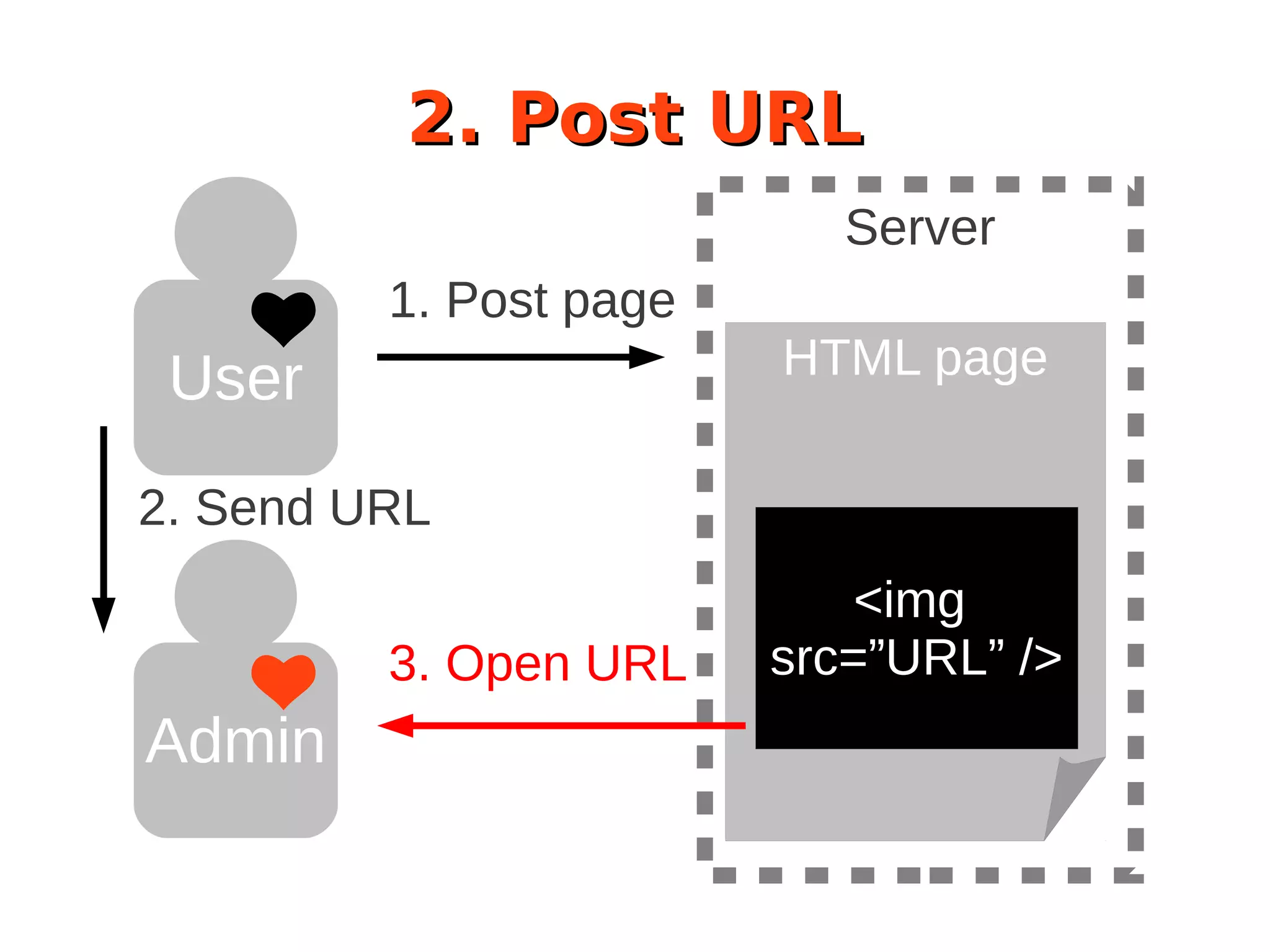
2. Post URL
                           Server
         1. Post page
 User                   HTML page

2. Send URL
                            <img
         3. Open URL    src=”URL” />
Admin
Arbitrary code execution
●   Ability to execute any commands of the
    attacker's choice on a target machine or in a
    target process.
●   http://en.wikipedia.org/wiki/Arbitrary_code_execution
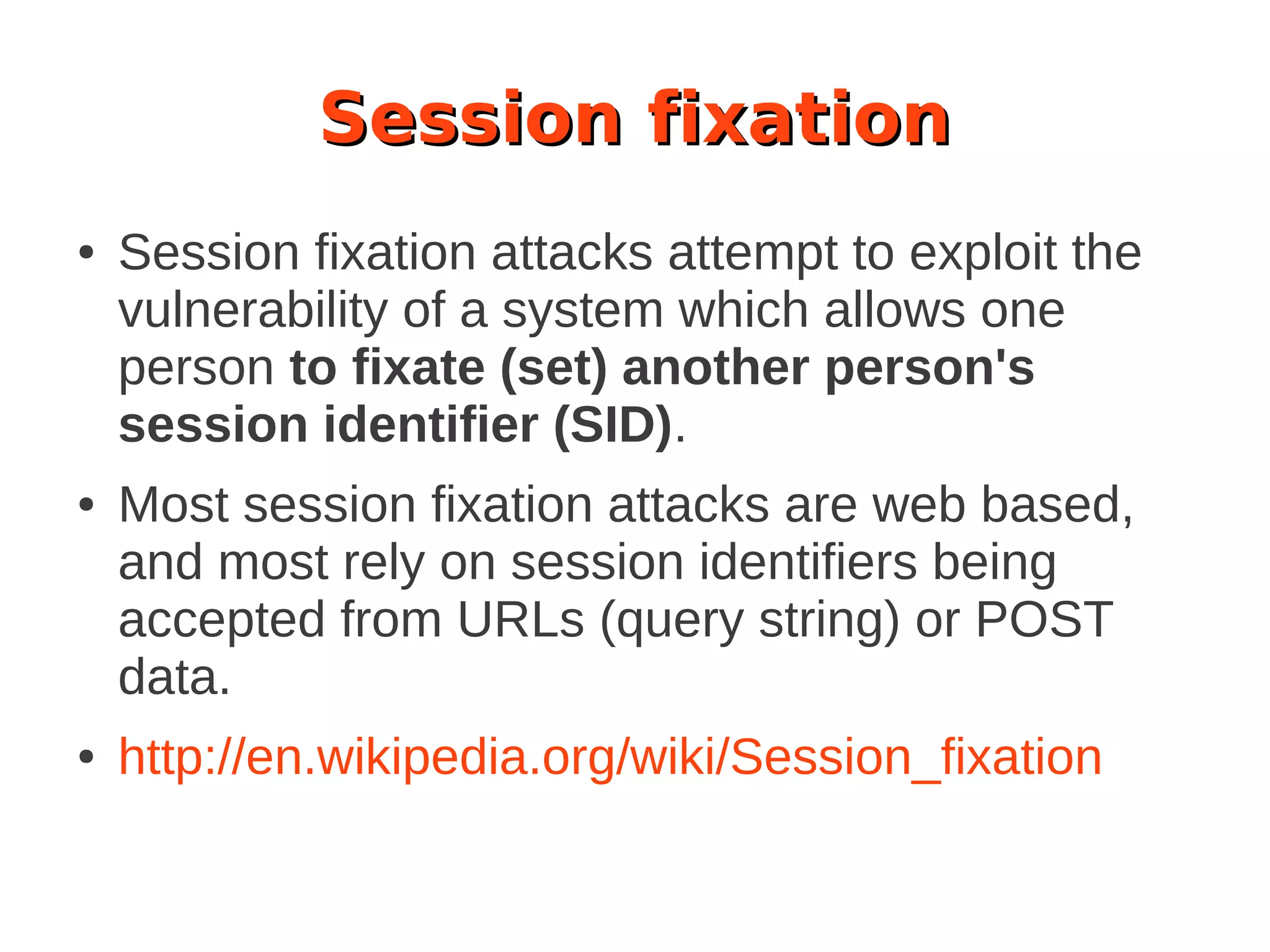
Session fixation
●   Session fixation attacks attempt to exploit the
    vulnerability of a system which allows one
    person to fixate (set) another person's
    session identifier (SID).
●   Most session fixation attacks are web based,
    and most rely on session identifiers being
    accepted from URLs (query string) or POST
    data.
●   http://en.wikipedia.org/wiki/Session_fixation
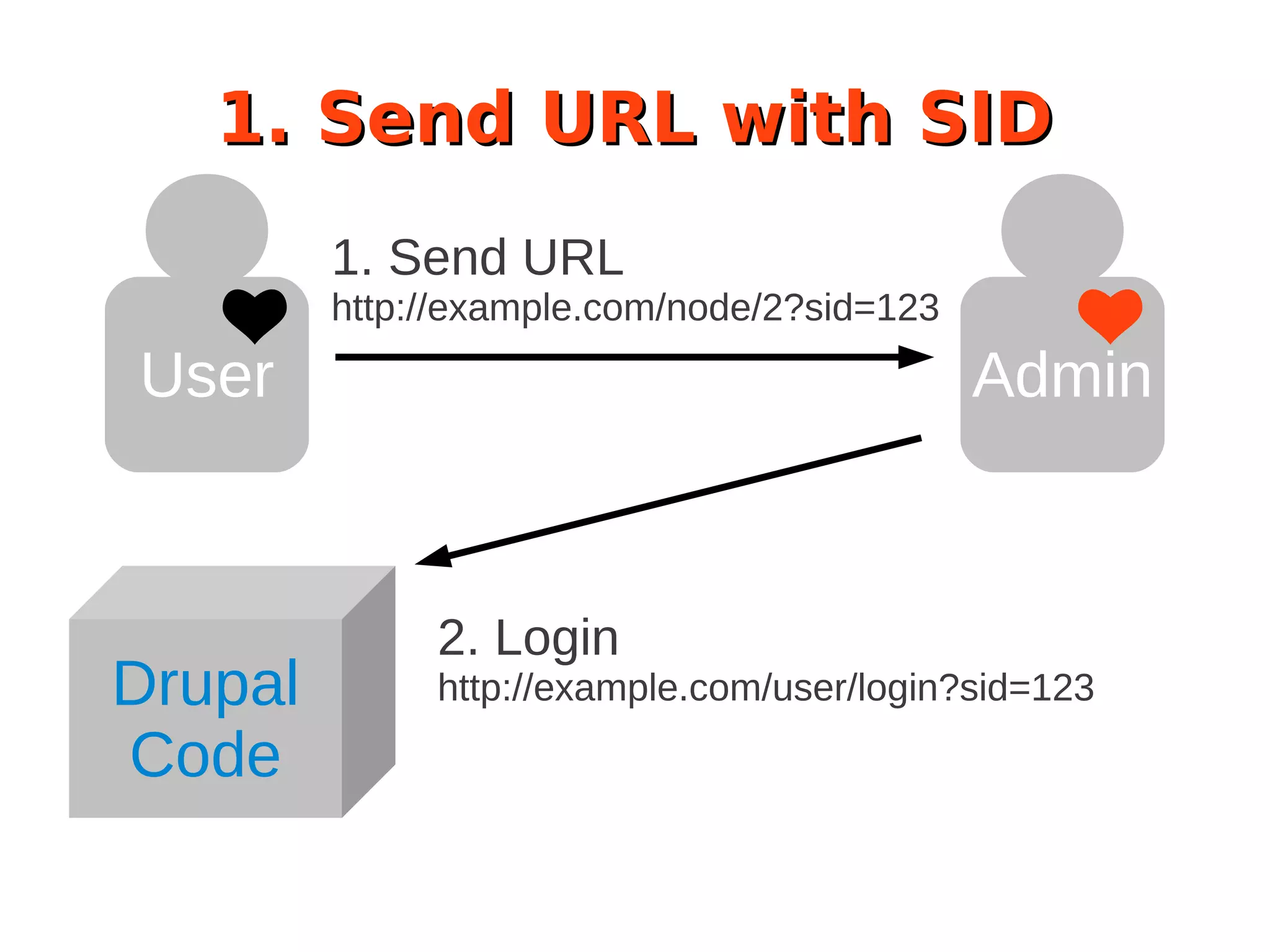
1. Send URL with SID
         1. Send URL
         http://example.com/node/2?sid=123
User                                         Admin


              2. Login
Drupal        http://example.com/user/login?sid=123
Code
2. Get Admin's session

       3. Login as admin URL
       http://example.com/user/login?sid=123
User


                              Drupal
                              Code
http://drupal.org/project/sharedsignon
http://drupal.org/node/592488
How to find a vulnerability?
XSS high-risk zones
●   theme().                ●   Templates (.tpl.php).
●   t() and l().            ●   Theme's code.
●   dpm().                  ●   Preprocess functions.
●   echo().                 ●   $form_state values.
●   var_dump().             ●   Validation messages
●   console.log().              and default values.
●   watchdog().             ●   Field type 'select' and
                                'options' attribute.
●   drupal_set_message().
                            ●   drupal_set_title().
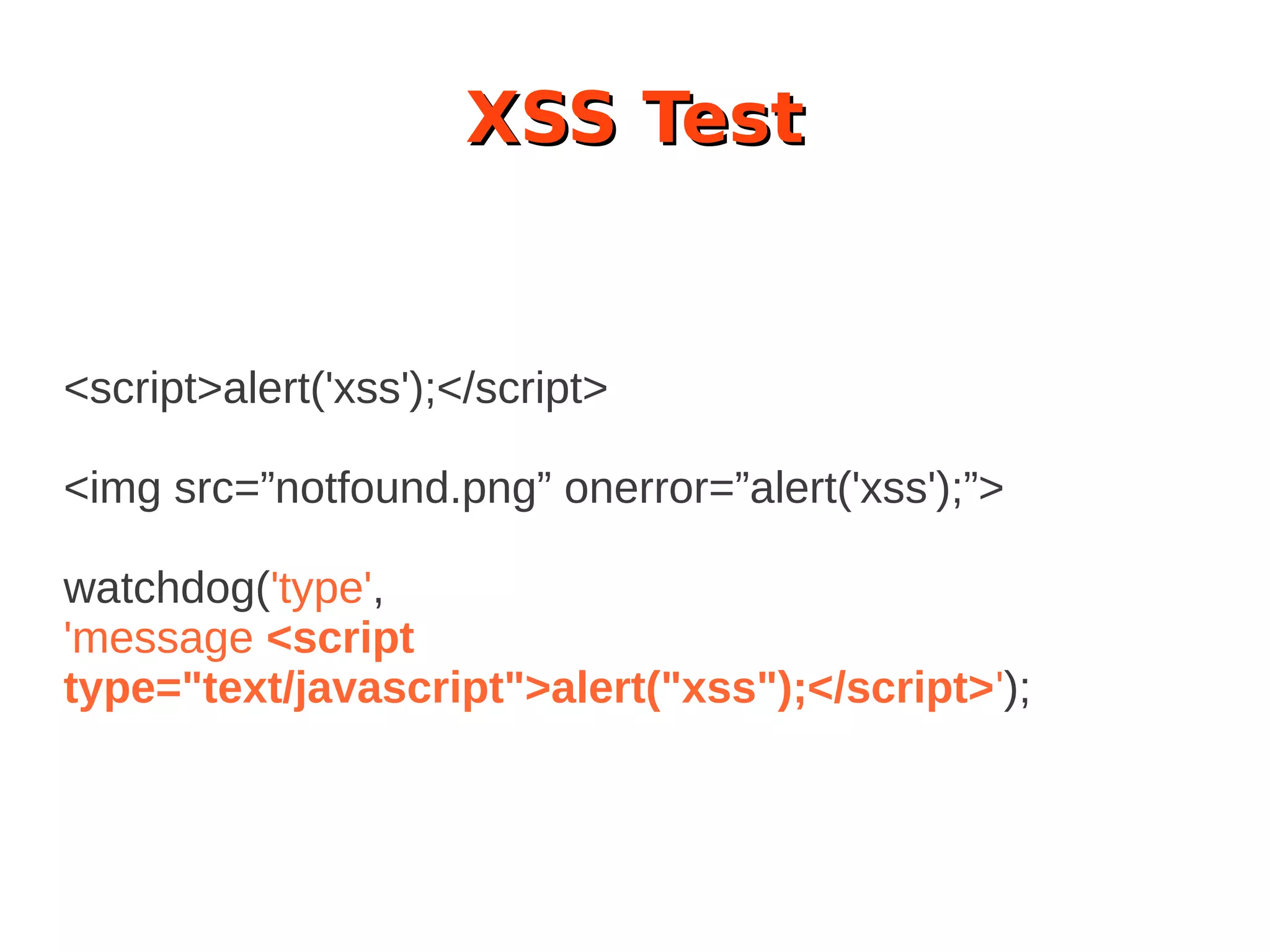
XSS Test


<script>alert('xss');</script>

<img src=”notfound.png” onerror=”alert('xss');”>

watchdog('type',
'message <script
type="text/javascript">alert("xss");</script>');
How to find XSRF?
●   Inspect hook_menu().
●   Inspect AJAX callbacks.
●   If secure tokens not used used then XSRF is
    possible
●   See drupal_get_token().
Access bypass
●   Check hook_permissions().
●   Search for permission names.
●   Check 'access_callback's in hook_menu().
●   Check if code works correctly with other
    contributed modules and respects their
    access restrictions.
Code Execution
●   Search for 'eval', 'system' and etc.
●   Check code includes.
●   Check if files with code could be executed.
●   Search for php input format for blocks, nodes,
    fields and etc.
●   Check if modules like devel, php and etc.
    enabled.
●   Check if uploading files with php-code is
    possible.
SQL injection
●   Static queries.
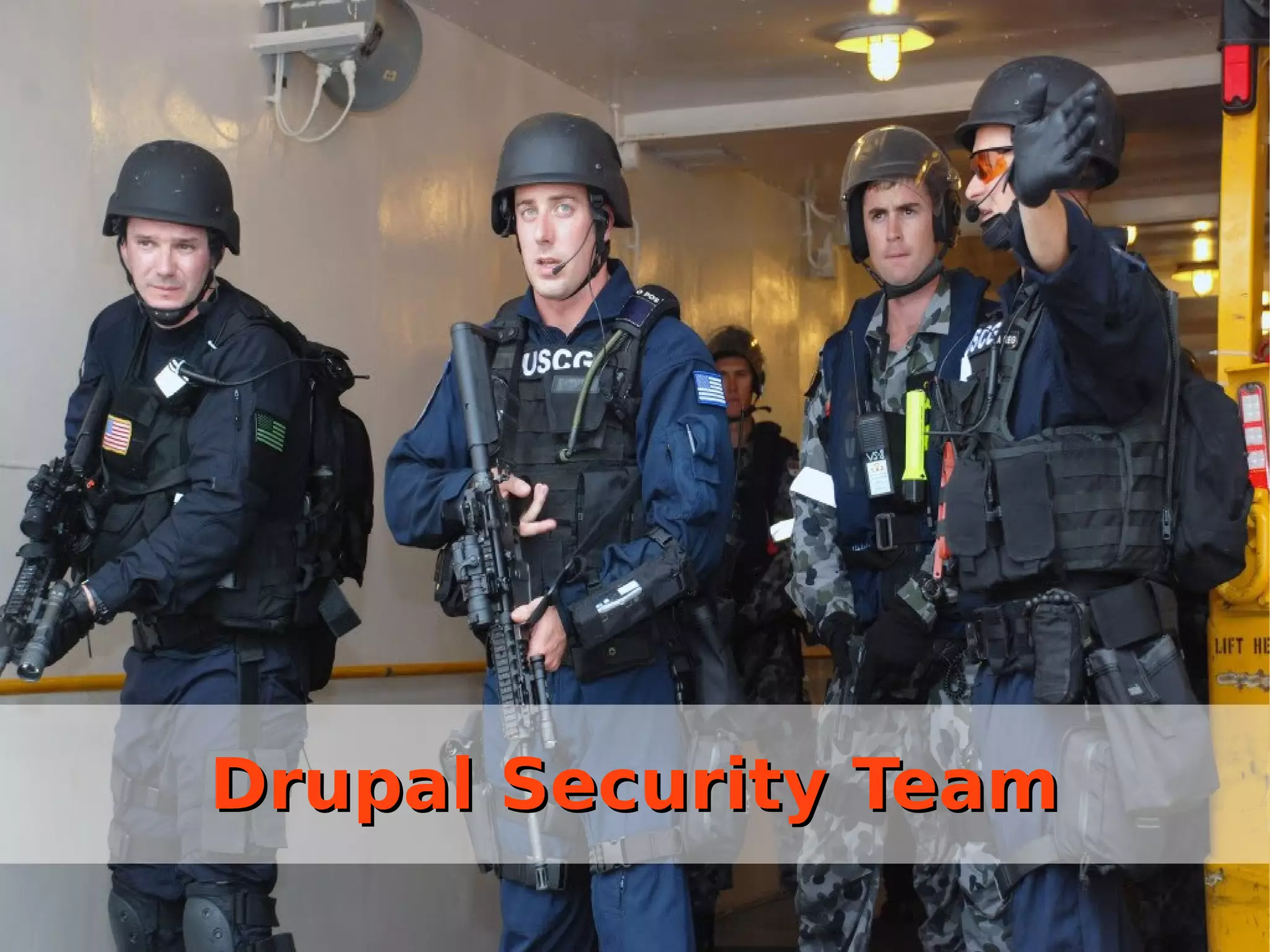
Drupal Security Team
Goals of the security team
●   Resolve reported security issues.
●   Provide assistance for contributed module
    maintainers in resolving security issues.
●   Provide documentation on how to write
    secure code.
●   Provide documentation on securing your site.
How to report
                a security issue
●   Do not post in the issue tracker or discuss it in IRC.
●   Mail to security@drupal.org
●   Provide as many details as you can. At least:
    ●   Drupal version and/or module version.
    ●   Steps to reproduce the problem.
●   Do not disclose the vulnerability to anyone before
    the advisory is issued.
●   You will be credited in the security announcement.
How the security team
        works with issues?
●   Review the issue and evaluate the potential
    impact on all supported releases of Drupal.
●   If it is indeed a valid problem, the security team is
    mobilized to eliminate it.
●   New versions are created and tested.
●   New packages are created and uploaded to
    Drupal.org.
●   When an issue has been fixed, use all available
    communication channels to inform users of steps
    that must be taken to protect themselves.
Issues with
        contributed modules
●   The module maintainer is contacted with a
    deadline.
●   When the maintainer fixes the problem, the
    security team issues an advisory.
●   If the maintainer does not fix the problem
    within the deadline, an advisory is issued,
    recommending disabling the module and the
    project on Drupal.org is unpublished.
Additional Reading
●   Core Security Advisories
    http://drupal.org/security
●   Contributed Project Security Advisories
    http://drupal.org/security/contrib
●   The Drupal Security Team
    http://drupal.org/security-team
●   Secure confguration of your Drupal site
    http://drupal.org/security/secure-confguration
●   Writing secure code
    http://drupal.org/writing-secure-code
●   Cracking Drupal – The Drupal security book
    http://crackingdrupal.com/
●   This paper's website
    http://drupalsecurityreport.org
●   OWASP Top Ten Project
    http://www.owasp.org/index.php/Category:OWASP_Top_Ten_Project
Questions to speaker

         Vlad Savitsky
         http://shvetsgroup.com
         Skype: vlad_savitsky
         ICQ: 205535814
         vlad.savitsky@gmail.com
         +38 096 530 27 12

Looking for Vulnerable Code. Vlad Savitsky

  • 2.
    Are you surethat your site is secure? secure
  • 3.
    Site security ● Trusted, experienced and secure hosting ● Secure code ● Security updates
  • 4.
    Security Updates ● Subscribe to Security-news http://lists.drupal.org/mailman/listinfo/security-news ● Use Drupal 7 core module Update Manager.
  • 5.
    How secure isDrupal code? code
  • 6.
  • 7.
  • 8.
    Speaker: Vlad Savitsky Working at Skype: vlad_savitsky ICQ: 205535814 vlad.savitsky@gmail.com +38096 530 27 12
  • 9.
    Challenge ● http://google-gruyere.appspot.com/start ● Gruyere /ɡruːˈjɛər/ - a small, cheesy web application that allows its users to publish snippets of text and store assorted files. ● "Unfortunately," Gruyere has multiple security bugs ranging from cross-site scripting and cross- site request forgery, to information disclosure, denial of service, and remote code execution. The goal is to discover bugs in Gruyere.
  • 10.
    Cross-site scripting (XSS) ● Allows attackers to inject script into Web pages viewed by other users. ● http://en.wikipedia.org/wiki/Cross-site_scripting
  • 11.
    Handling Data Golden Rule ● Store exactly what the user typed. ● When handling and outputting text in HTML, you need to be careful that proper filtering or escaping is done.
  • 12.
    1. User sendssome data User Input Drupal User Invalid Input Code Validated User Input Database
  • 13.
    2. Attacker sendscode 1. Input JS Drupal User Code 2. Not Well Validated Input JS Database
  • 14.
    3. User requesta page 1. Request Drupal User JS 3. Not Well Code Escaped Data 2. SQL-Query JS Database
  • 15.
    4. User runsAttacker's code Browser 1. View page User HTML page Attacker's 2. Send data JavaScript Code User
  • 16.
    Access Bypass 1. Request /devel/php Drupal User Code 2. Get Access
  • 17.
    Cross-site request forgery ● Ability to run some actions at server accessing some URL. ● Also known as a one-click attack or session riding and abbreviated as CSRF (pronounced sea-surf) or XSRF. ● http://en.wikipedia.org/wiki/Cross-site_request_forgery
  • 18.
    1. Find URL User Profile Save Save Delete Delete http://example.com/user/10/delete http://example.com/user/10/delete
  • 19.
    2. Post URL Server 1. Post page User HTML page 2. Send URL <img 3. Open URL src=”URL” /> Admin
  • 20.
    Arbitrary code execution ● Ability to execute any commands of the attacker's choice on a target machine or in a target process. ● http://en.wikipedia.org/wiki/Arbitrary_code_execution
  • 22.
    Session fixation ● Session fixation attacks attempt to exploit the vulnerability of a system which allows one person to fixate (set) another person's session identifier (SID). ● Most session fixation attacks are web based, and most rely on session identifiers being accepted from URLs (query string) or POST data. ● http://en.wikipedia.org/wiki/Session_fixation
  • 23.
    1. Send URLwith SID 1. Send URL http://example.com/node/2?sid=123 User Admin 2. Login Drupal http://example.com/user/login?sid=123 Code
  • 24.
    2. Get Admin'ssession 3. Login as admin URL http://example.com/user/login?sid=123 User Drupal Code
  • 25.
  • 26.
  • 27.
    How to finda vulnerability?
  • 28.
    XSS high-risk zones ● theme(). ● Templates (.tpl.php). ● t() and l(). ● Theme's code. ● dpm(). ● Preprocess functions. ● echo(). ● $form_state values. ● var_dump(). ● Validation messages ● console.log(). and default values. ● watchdog(). ● Field type 'select' and 'options' attribute. ● drupal_set_message(). ● drupal_set_title().
  • 29.
    XSS Test <script>alert('xss');</script> <img src=”notfound.png”onerror=”alert('xss');”> watchdog('type', 'message <script type="text/javascript">alert("xss");</script>');
  • 31.
    How to findXSRF? ● Inspect hook_menu(). ● Inspect AJAX callbacks. ● If secure tokens not used used then XSRF is possible ● See drupal_get_token().
  • 32.
    Access bypass ● Check hook_permissions(). ● Search for permission names. ● Check 'access_callback's in hook_menu(). ● Check if code works correctly with other contributed modules and respects their access restrictions.
  • 33.
    Code Execution ● Search for 'eval', 'system' and etc. ● Check code includes. ● Check if files with code could be executed. ● Search for php input format for blocks, nodes, fields and etc. ● Check if modules like devel, php and etc. enabled. ● Check if uploading files with php-code is possible.
  • 34.
    SQL injection ● Static queries.
  • 35.
  • 36.
    Goals of thesecurity team ● Resolve reported security issues. ● Provide assistance for contributed module maintainers in resolving security issues. ● Provide documentation on how to write secure code. ● Provide documentation on securing your site.
  • 37.
    How to report a security issue ● Do not post in the issue tracker or discuss it in IRC. ● Mail to security@drupal.org ● Provide as many details as you can. At least: ● Drupal version and/or module version. ● Steps to reproduce the problem. ● Do not disclose the vulnerability to anyone before the advisory is issued. ● You will be credited in the security announcement.
  • 38.
    How the securityteam works with issues? ● Review the issue and evaluate the potential impact on all supported releases of Drupal. ● If it is indeed a valid problem, the security team is mobilized to eliminate it. ● New versions are created and tested. ● New packages are created and uploaded to Drupal.org. ● When an issue has been fixed, use all available communication channels to inform users of steps that must be taken to protect themselves.
  • 39.
    Issues with contributed modules ● The module maintainer is contacted with a deadline. ● When the maintainer fixes the problem, the security team issues an advisory. ● If the maintainer does not fix the problem within the deadline, an advisory is issued, recommending disabling the module and the project on Drupal.org is unpublished.
  • 40.
    Additional Reading ● Core Security Advisories http://drupal.org/security ● Contributed Project Security Advisories http://drupal.org/security/contrib ● The Drupal Security Team http://drupal.org/security-team ● Secure confguration of your Drupal site http://drupal.org/security/secure-confguration ● Writing secure code http://drupal.org/writing-secure-code ● Cracking Drupal – The Drupal security book http://crackingdrupal.com/ ● This paper's website http://drupalsecurityreport.org ● OWASP Top Ten Project http://www.owasp.org/index.php/Category:OWASP_Top_Ten_Project
  • 41.
    Questions to speaker Vlad Savitsky http://shvetsgroup.com Skype: vlad_savitsky ICQ: 205535814 vlad.savitsky@gmail.com +38 096 530 27 12