LOA	
  Alterna+ves:	
  
A	
  Modest	
  Proposal	
  
Jim	
  Fenton	
  
IIW	
  XX	
  
April	
  2015	
  
Background	
  
•  LOA	
  is	
  defined	
  in	
  OMB	
  Memo	
  M-­‐04-­‐04,	
  “E-­‐
Authen+ca+on	
  Guidance	
  for	
  Federal	
  
Agencies”	
  
•  Technical	
  means	
  to	
  sa+sfy	
  are	
  defined	
  in	
  NIST	
  
SP	
  800-­‐63-­‐*	
  
•  Federal	
  authen+ca+on	
  requirements	
  are	
  
changing	
  due	
  to	
  Execu+ve	
  Order	
  13681	
  
EO	
  13681	
  
“…all	
  agencies	
  making	
  personal	
  data	
  accessible	
  to	
  ci+zens	
  
through	
  digital	
  applica+ons	
  require	
  the	
  use	
  of	
  mul+ple	
  factors	
  of	
  
authen+ca+on	
  and	
  an	
  effec+ve	
  iden+ty	
  proofing	
  process,	
  as	
  
appropriate.”	
  
-­‐-­‐	
  Execu+ve	
  Order	
  13681	
  
October	
  17,	
  2014	
  
Ø Current	
  LOA	
  1	
  and	
  2	
  are	
  going	
  to	
  be	
  a	
  lot	
  less	
  useful	
  
Three	
  Alterna+ves	
  for	
  OMB	
  
•  (1)	
  Keep	
  current	
  LOA	
  structure,	
  change	
  impact	
  
– Increase	
  impact	
  of	
  personal	
  data	
  disclosure	
  
– Drives	
  more	
  things	
  to	
  LOA	
  3	
  
•  (2)	
  Keep	
  LOA	
  structure,	
  change	
  800-­‐63	
  
– Likely	
  to	
  confuse	
  agencies	
  and	
  industry	
  
•  (2)	
  Change	
  the	
  LOA	
  structure	
  somehow	
  
– Let’s	
  discuss	
  this	
  more	
  
Some	
  principles	
  
•  Avoid	
  current	
  LOA	
  problems	
  
– LOA	
  2	
  both	
  proofed	
  and	
  pseudonymous	
  
– No	
  strong	
  pseudonymous	
  authen+ca+on	
  
– Lower	
  LOA	
  geeng	
  less	
  useful	
  
•  Keep	
  it	
  simple	
  
– Emphasize	
  meaningful	
  dis+nc+ons	
  between	
  levels	
  
– Minimize	
  dimensionality	
  (of	
  vector)	
  
Meaningful	
  dis+nc+ons?	
  
•  As	
  mul+-­‐factor	
  authen+ca+on	
  becomes	
  more	
  widely	
  used,	
  dis+nc+ons	
  in	
  
single-­‐factor	
  become	
  less	
  important	
  
Authen'ca'on	
   LOA	
   Proofing	
  
Single	
  factor	
   1	
   None	
  
Single	
  factor	
   2	
  pseudonymous	
   None	
  
Single	
  factor	
   2	
   Remote	
  
Mul+-­‐factor	
   3	
   Remote	
  
Mul+-­‐factor	
  w/	
  
hardware	
  token	
  
4	
   In-­‐person	
  only	
  
{	
  Similar	
  (though	
  
not	
  iden+cal)	
  
requirements	
  
}	
  
Similar	
  (though	
  
not	
  iden+cal)	
  
requirements	
  
A	
  New	
  Model	
  
•  Separate	
  Level	
  of	
  Assurance	
  into	
  two	
  parts:	
  
–  Level	
  of	
  Strength	
  (of	
  authen+ca+on)	
  
–  Level	
  of	
  Confidence	
  (of	
  akributes)	
  
•  Emphasis	
  on	
  meaningful	
  dis+nc+ons	
  
–  Significant	
  differences	
  in	
  usability,	
  availability	
  
–  Require	
  good	
  prac+ces	
  internally	
  (e.g.,	
  use	
  of	
  crypto	
  rather	
  than	
  
shared	
  secrets)	
  
•  Emphasis	
  on	
  expressing	
  the	
  relying	
  party’s	
  requirements	
  to	
  
the	
  user	
  and	
  authen+ca+on	
  and	
  akribute	
  providers	
  
Level	
  of	
  Strength	
  (LoS)	
  
•  Measures	
  the	
  strength	
  of	
  the	
  authen+ca+on	
  
process	
  
•  Candidate	
  levels:	
  
•  Detailed	
  requirements	
  per	
  level	
  to	
  be	
  defined	
  in	
  
SP	
  800-­‐63-­‐2	
  successor	
  
Level	
   Descrip'on	
  
1	
   Single-­‐factor	
  authen+ca+on	
  (cf.	
  LOA	
  2)	
  
2	
   Two-­‐factor	
  authen+ca+on	
  (cf.	
  LOA	
  3)	
  
3	
   Two-­‐factor	
  authen+ca+on	
  with	
  hardware	
  token	
  (cf.	
  LOA	
  4)	
  
Level	
  of	
  Confidence	
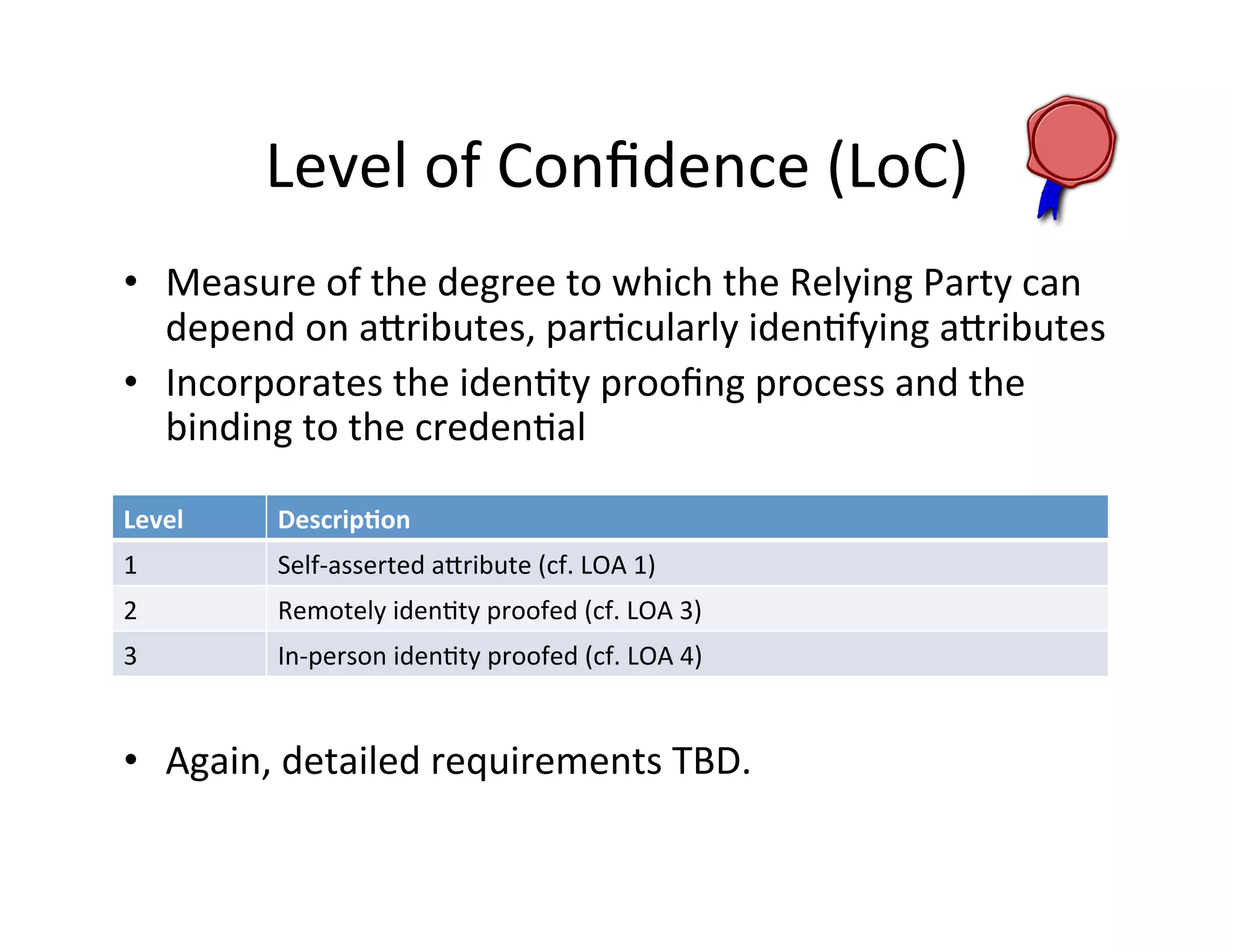
  (LoC)	
  
•  Measure	
  of	
  the	
  degree	
  to	
  which	
  the	
  Relying	
  Party	
  can	
  
depend	
  on	
  akributes,	
  par+cularly	
  iden+fying	
  akributes	
  
•  Incorporates	
  the	
  iden+ty	
  proofing	
  process	
  and	
  the	
  
binding	
  to	
  the	
  creden+al	
  
•  Again,	
  detailed	
  requirements	
  TBD.	
  
Level	
   Descrip'on	
  
1	
   Self-­‐asserted	
  akribute	
  (cf.	
  LOA	
  1)	
  
2	
   Remotely	
  iden+ty	
  proofed	
  (cf.	
  LOA	
  3)	
  
3	
   In-­‐person	
  iden+ty	
  proofed	
  (cf.	
  LOA	
  4)	
  
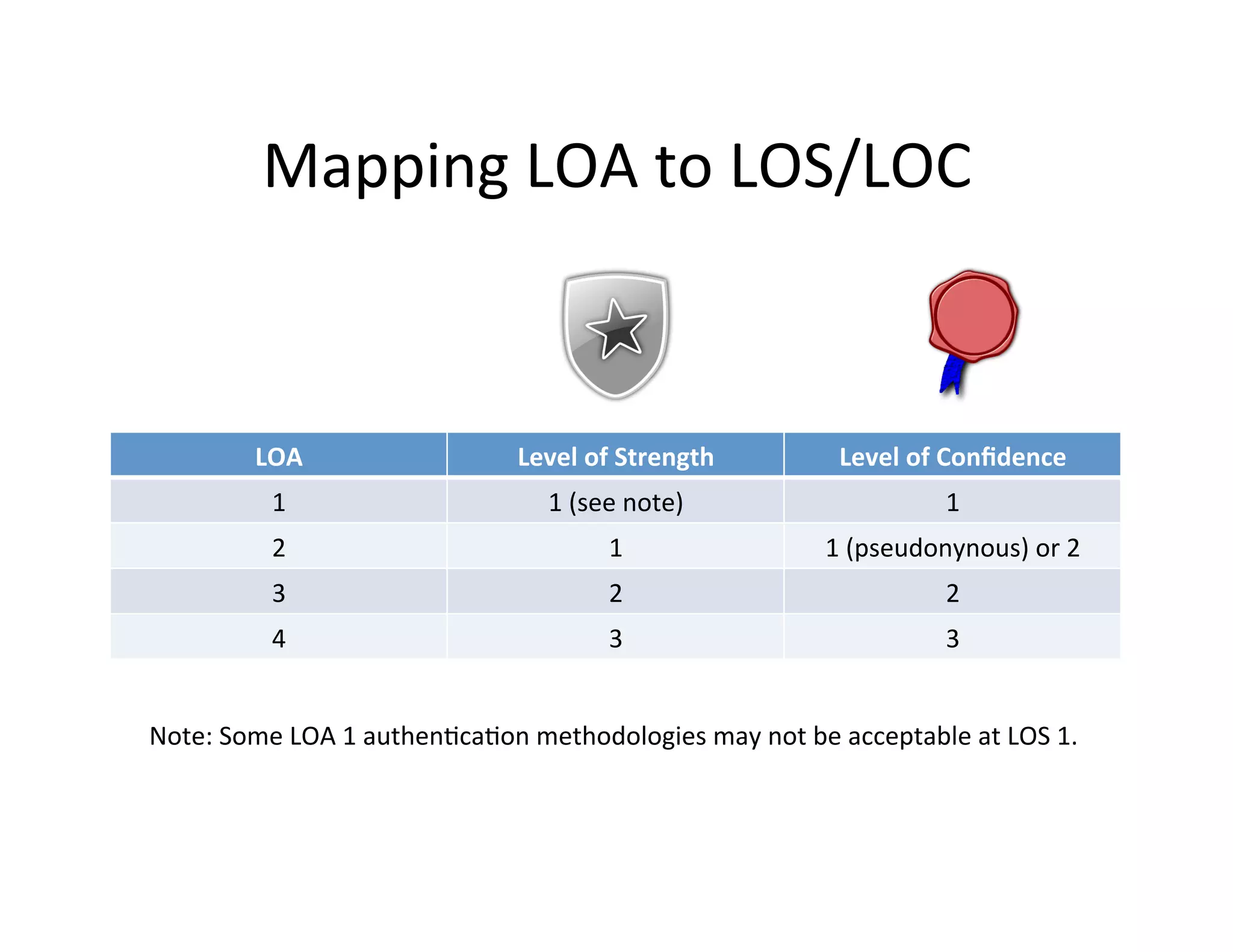
Mapping	
  LOA	
  to	
  LOS/LOC	
  
LOA	
   Level	
  of	
  Strength	
   Level	
  of	
  Confidence	
  
1	
   1	
  (see	
  note)	
   1	
  
2	
   1	
   1	
  (pseudonynous)	
  or	
  2	
  
3	
   2	
   2	
  
4	
   3	
   3	
  
Note:	
  Some	
  LOA	
  1	
  authen+ca+on	
  methodologies	
  may	
  not	
  be	
  acceptable	
  at	
  LOS	
  1.	
  
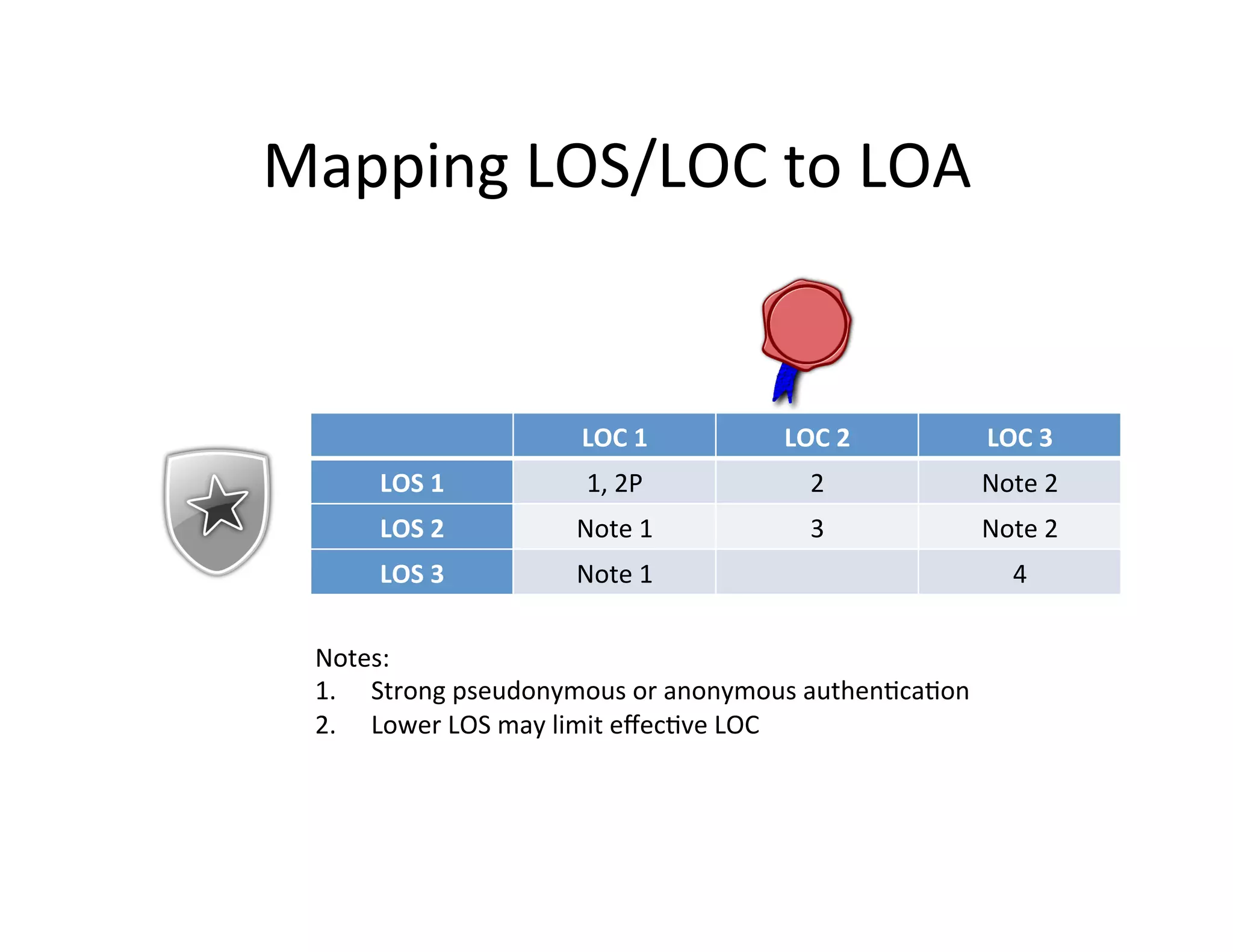
Mapping	
  LOS/LOC	
  to	
  LOA	
  
LOC	
  1	
   LOC	
  2	
   LOC	
  3	
  
LOS	
  1	
   1,	
  2P	
   2	
   Note	
  2	
  
LOS	
  2	
   Note	
  1	
   3	
   Note	
  2	
  
LOS	
  3	
   Note	
  1	
   4	
  
Notes:	
  
1.  	
   Strong	
  pseudonymous	
  or	
  anonymous	
  authen+ca+on	
  
2.  	
   Lower	
  LOS	
  may	
  limit	
  effec+ve	
  LOC	
  
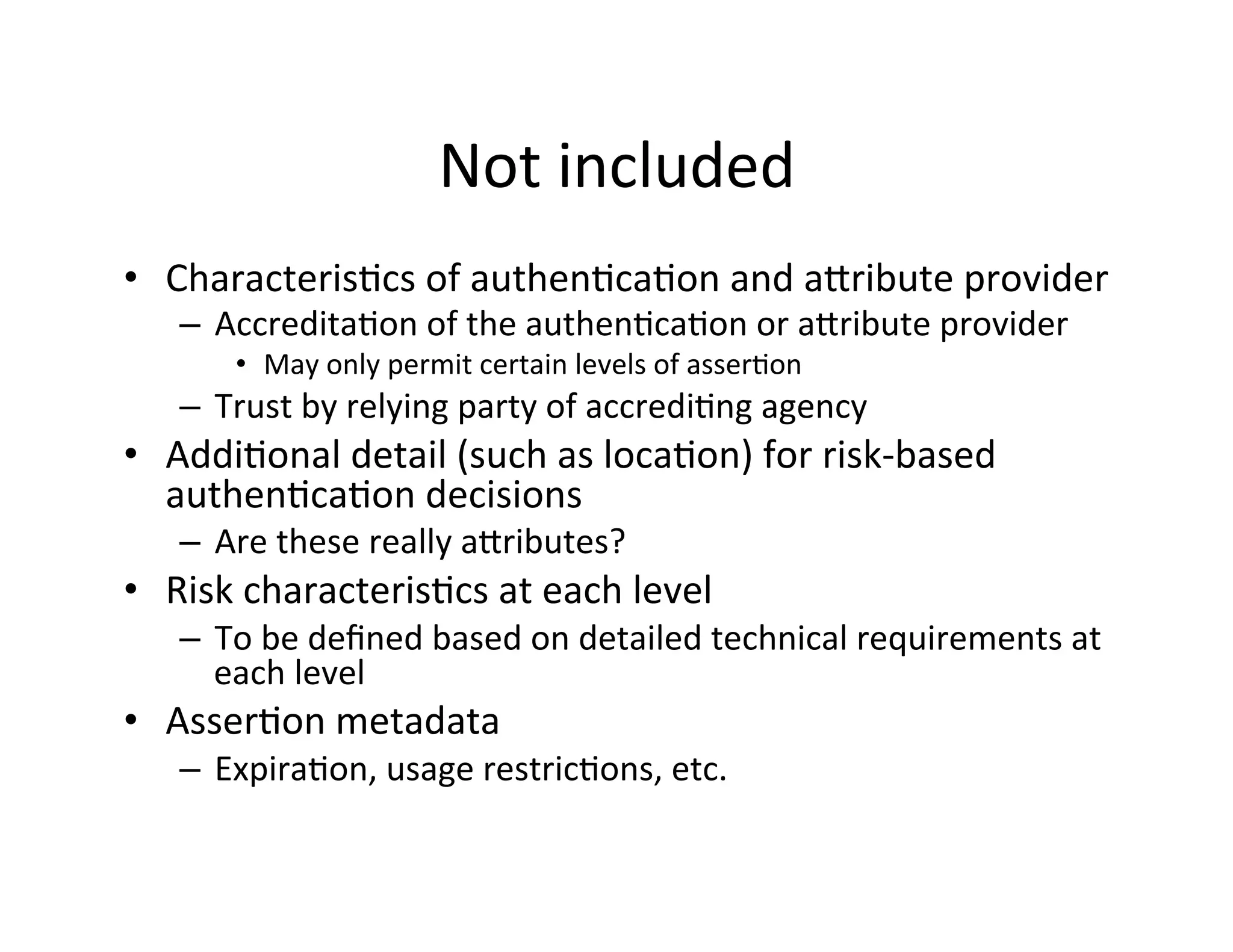
Not	
  included	
  
•  Characteris+cs	
  of	
  authen+ca+on	
  and	
  akribute	
  provider	
  
–  Accredita+on	
  of	
  the	
  authen+ca+on	
  or	
  akribute	
  provider	
  
•  May	
  only	
  permit	
  certain	
  levels	
  of	
  asser+on	
  
–  Trust	
  by	
  relying	
  party	
  of	
  accredi+ng	
  agency	
  
•  Addi+onal	
  detail	
  (such	
  as	
  loca+on)	
  for	
  risk-­‐based	
  
authen+ca+on	
  decisions	
  
–  Are	
  these	
  really	
  akributes?	
  
•  Risk	
  characteris+cs	
  at	
  each	
  level	
  
–  To	
  be	
  defined	
  based	
  on	
  detailed	
  technical	
  requirements	
  at	
  
each	
  level	
  
•  Asser+on	
  metadata	
  
–  Expira+on,	
  usage	
  restric+ons,	
  etc.	
  

LOA Alternatives - A Modest Proposal

  • 1.
    LOA  Alterna+ves:   A  Modest  Proposal   Jim  Fenton   IIW  XX   April  2015  
  • 2.
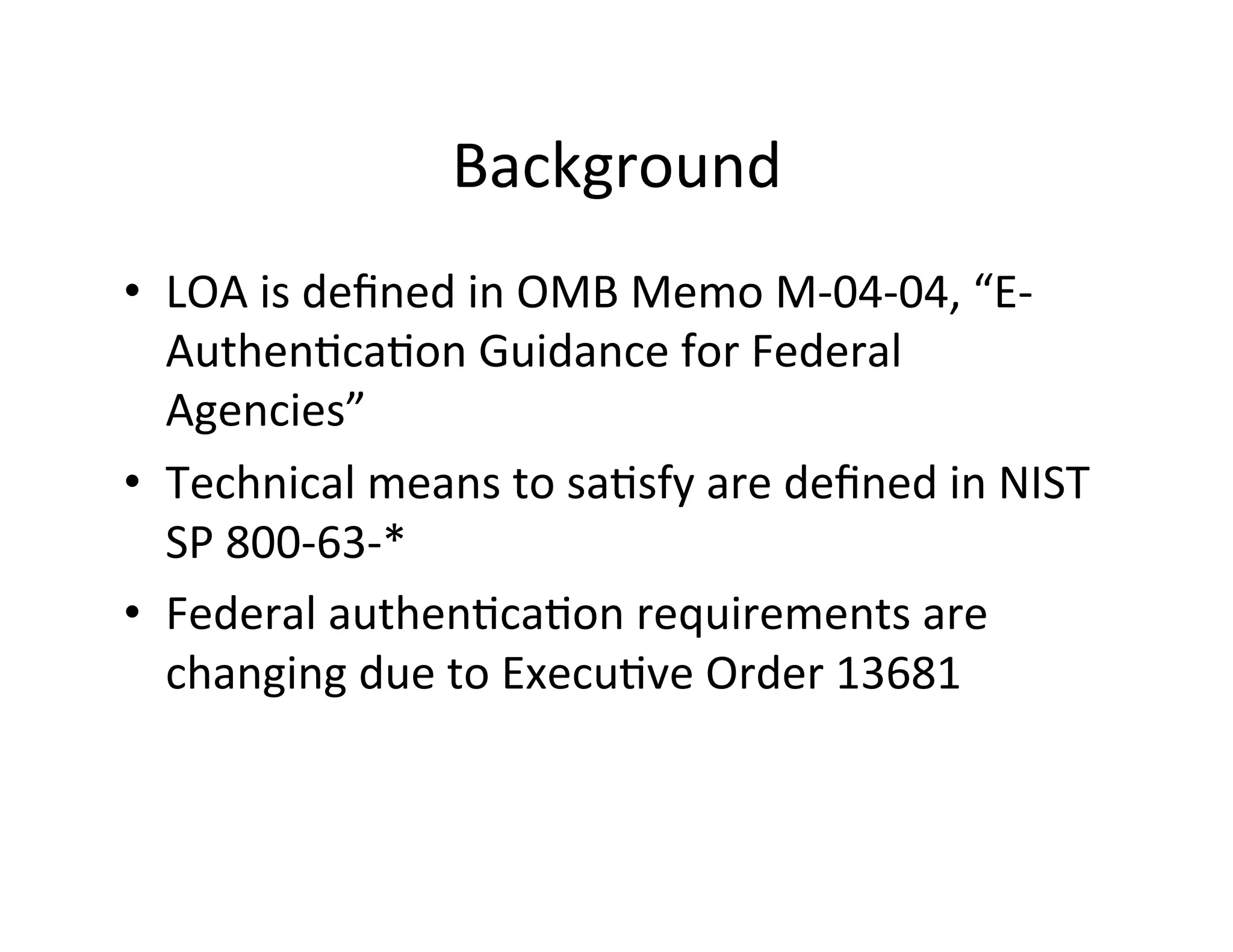
    Background   •  LOA  is  defined  in  OMB  Memo  M-­‐04-­‐04,  “E-­‐ Authen+ca+on  Guidance  for  Federal   Agencies”   •  Technical  means  to  sa+sfy  are  defined  in  NIST   SP  800-­‐63-­‐*   •  Federal  authen+ca+on  requirements  are   changing  due  to  Execu+ve  Order  13681  
  • 3.
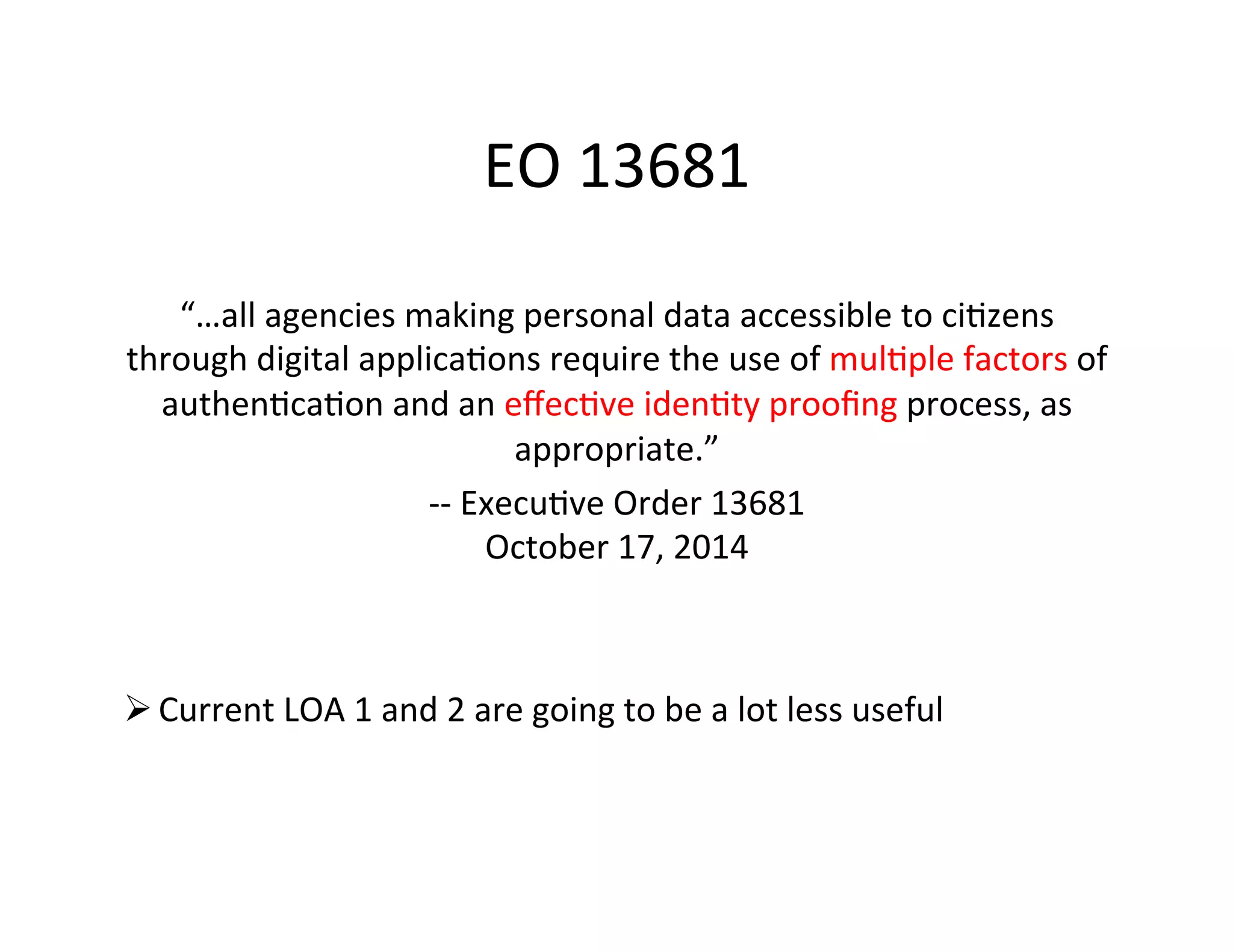
    EO  13681   “…all  agencies  making  personal  data  accessible  to  ci+zens   through  digital  applica+ons  require  the  use  of  mul+ple  factors  of   authen+ca+on  and  an  effec+ve  iden+ty  proofing  process,  as   appropriate.”   -­‐-­‐  Execu+ve  Order  13681   October  17,  2014   Ø Current  LOA  1  and  2  are  going  to  be  a  lot  less  useful  
  • 4.
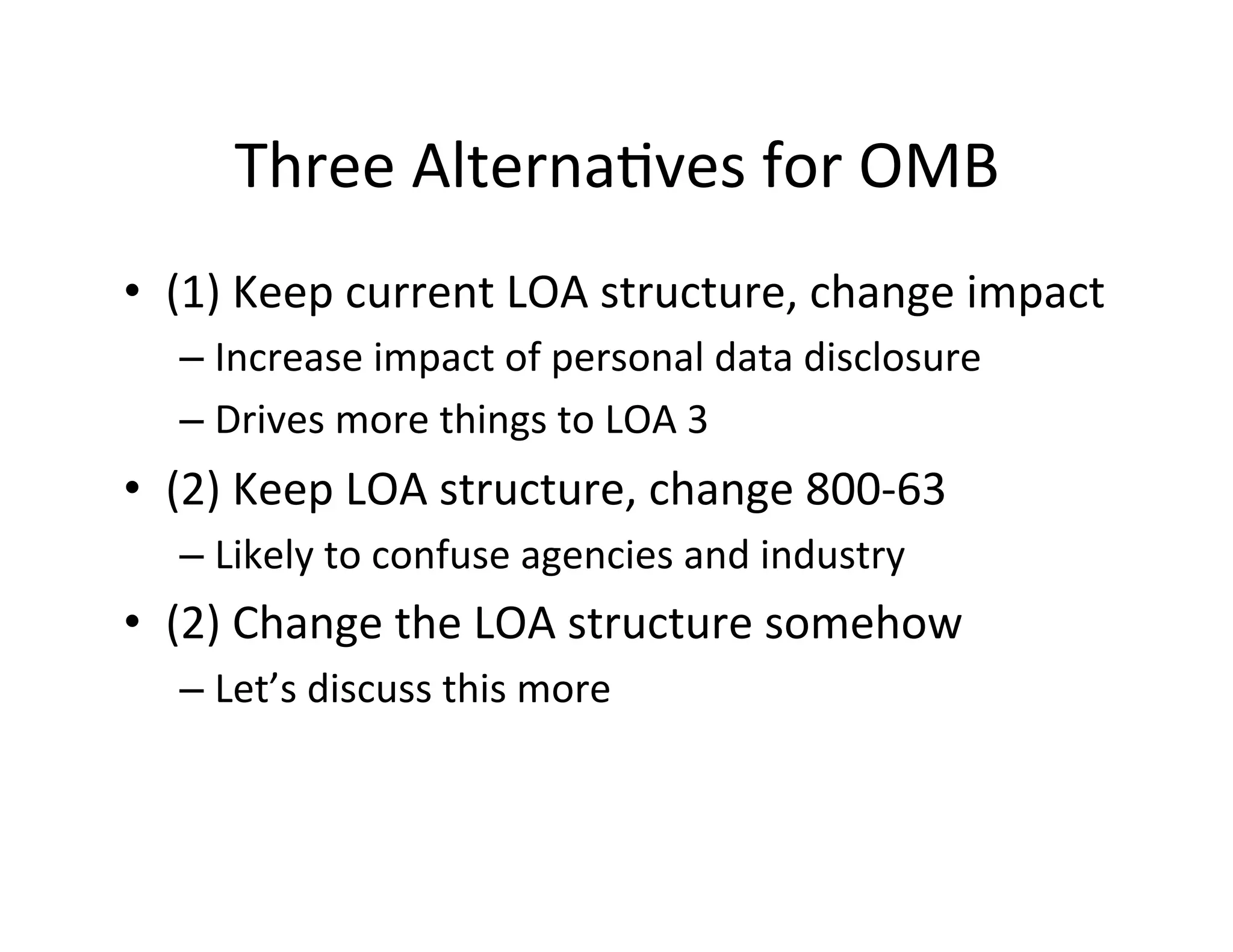
    Three  Alterna+ves  for  OMB   •  (1)  Keep  current  LOA  structure,  change  impact   – Increase  impact  of  personal  data  disclosure   – Drives  more  things  to  LOA  3   •  (2)  Keep  LOA  structure,  change  800-­‐63   – Likely  to  confuse  agencies  and  industry   •  (2)  Change  the  LOA  structure  somehow   – Let’s  discuss  this  more  
  • 5.
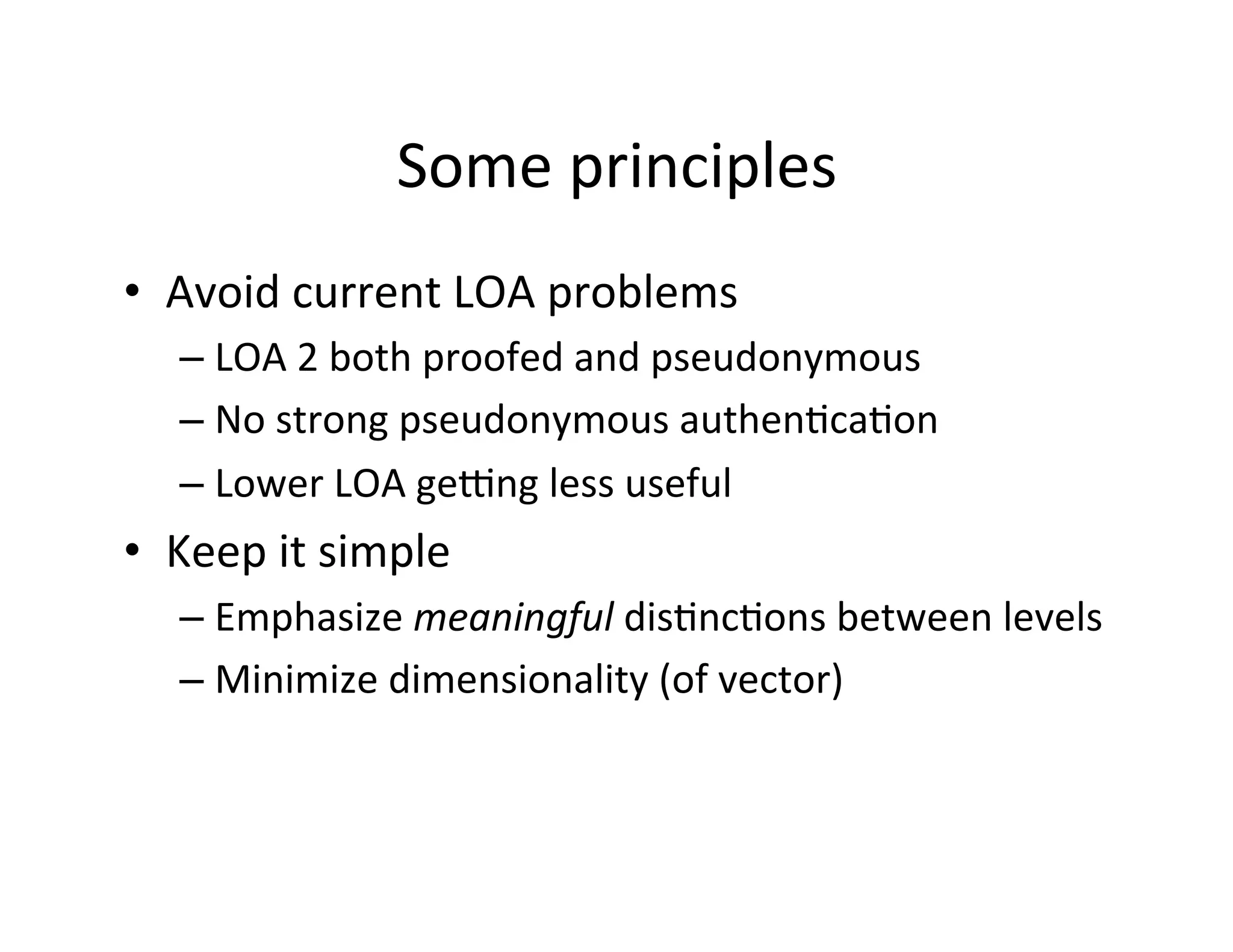
    Some  principles   • Avoid  current  LOA  problems   – LOA  2  both  proofed  and  pseudonymous   – No  strong  pseudonymous  authen+ca+on   – Lower  LOA  geeng  less  useful   •  Keep  it  simple   – Emphasize  meaningful  dis+nc+ons  between  levels   – Minimize  dimensionality  (of  vector)  
  • 6.
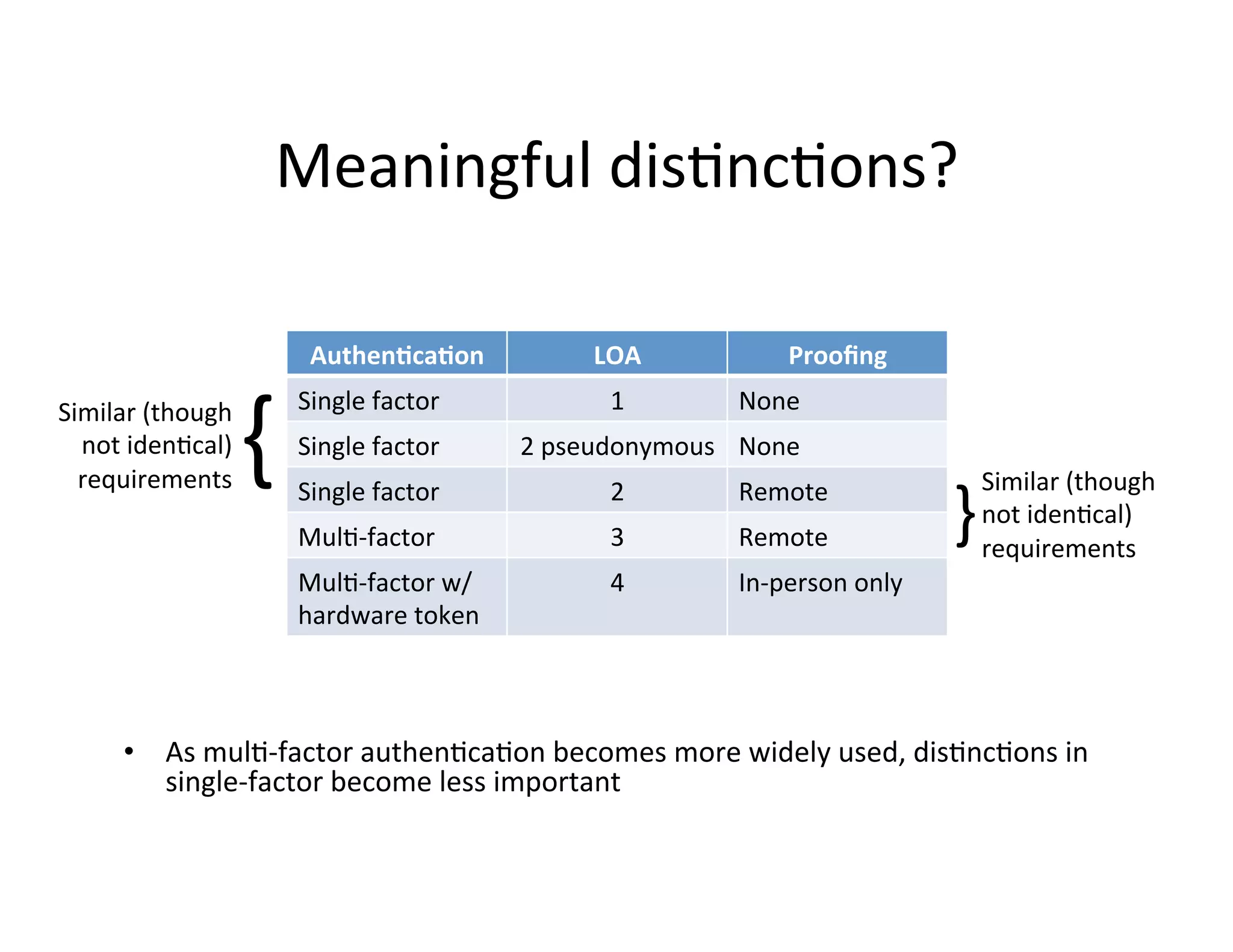
    Meaningful  dis+nc+ons?   • As  mul+-­‐factor  authen+ca+on  becomes  more  widely  used,  dis+nc+ons  in   single-­‐factor  become  less  important   Authen'ca'on   LOA   Proofing   Single  factor   1   None   Single  factor   2  pseudonymous   None   Single  factor   2   Remote   Mul+-­‐factor   3   Remote   Mul+-­‐factor  w/   hardware  token   4   In-­‐person  only   {  Similar  (though   not  iden+cal)   requirements   }   Similar  (though   not  iden+cal)   requirements  
  • 7.
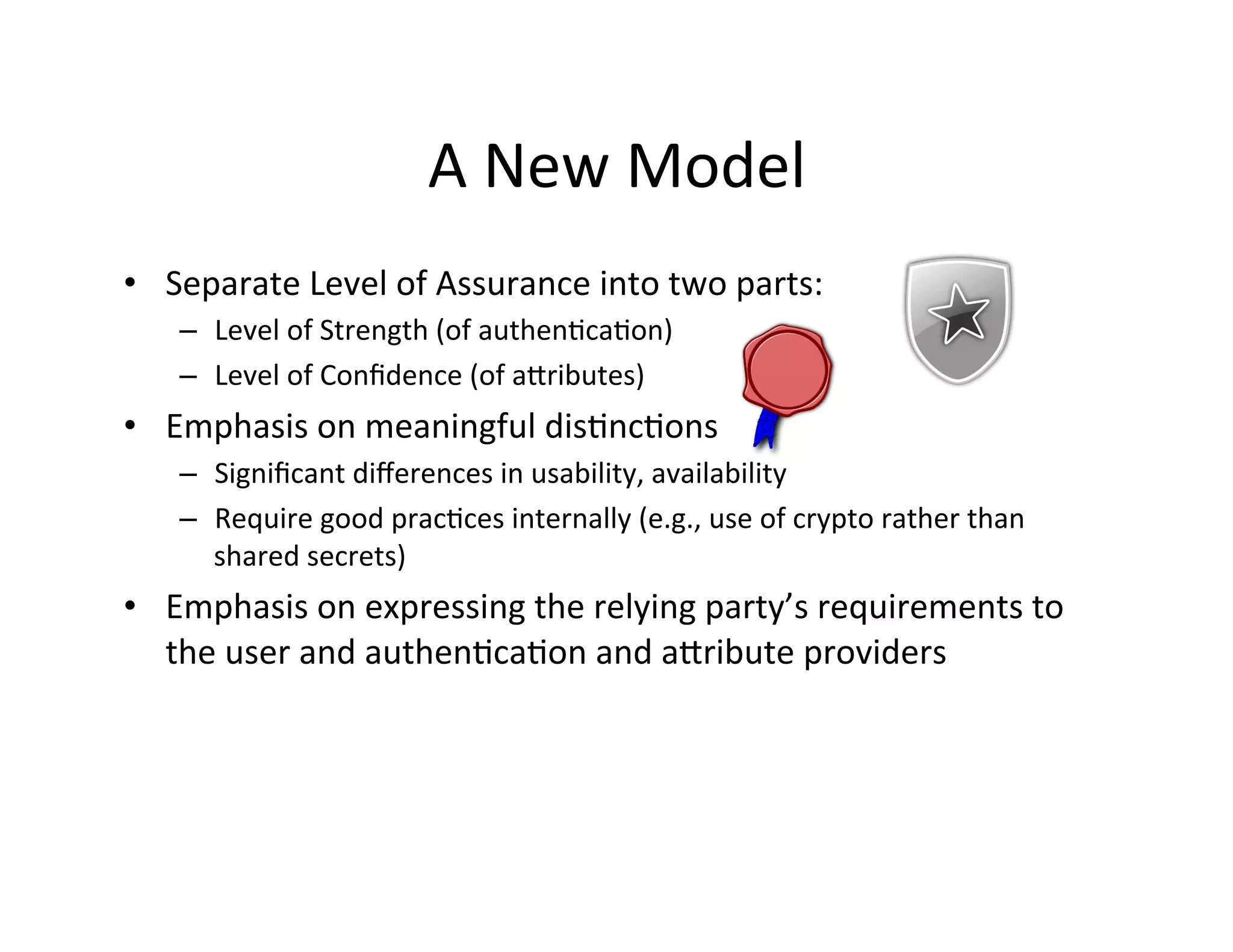
    A  New  Model   •  Separate  Level  of  Assurance  into  two  parts:   –  Level  of  Strength  (of  authen+ca+on)   –  Level  of  Confidence  (of  akributes)   •  Emphasis  on  meaningful  dis+nc+ons   –  Significant  differences  in  usability,  availability   –  Require  good  prac+ces  internally  (e.g.,  use  of  crypto  rather  than   shared  secrets)   •  Emphasis  on  expressing  the  relying  party’s  requirements  to   the  user  and  authen+ca+on  and  akribute  providers  
  • 8.
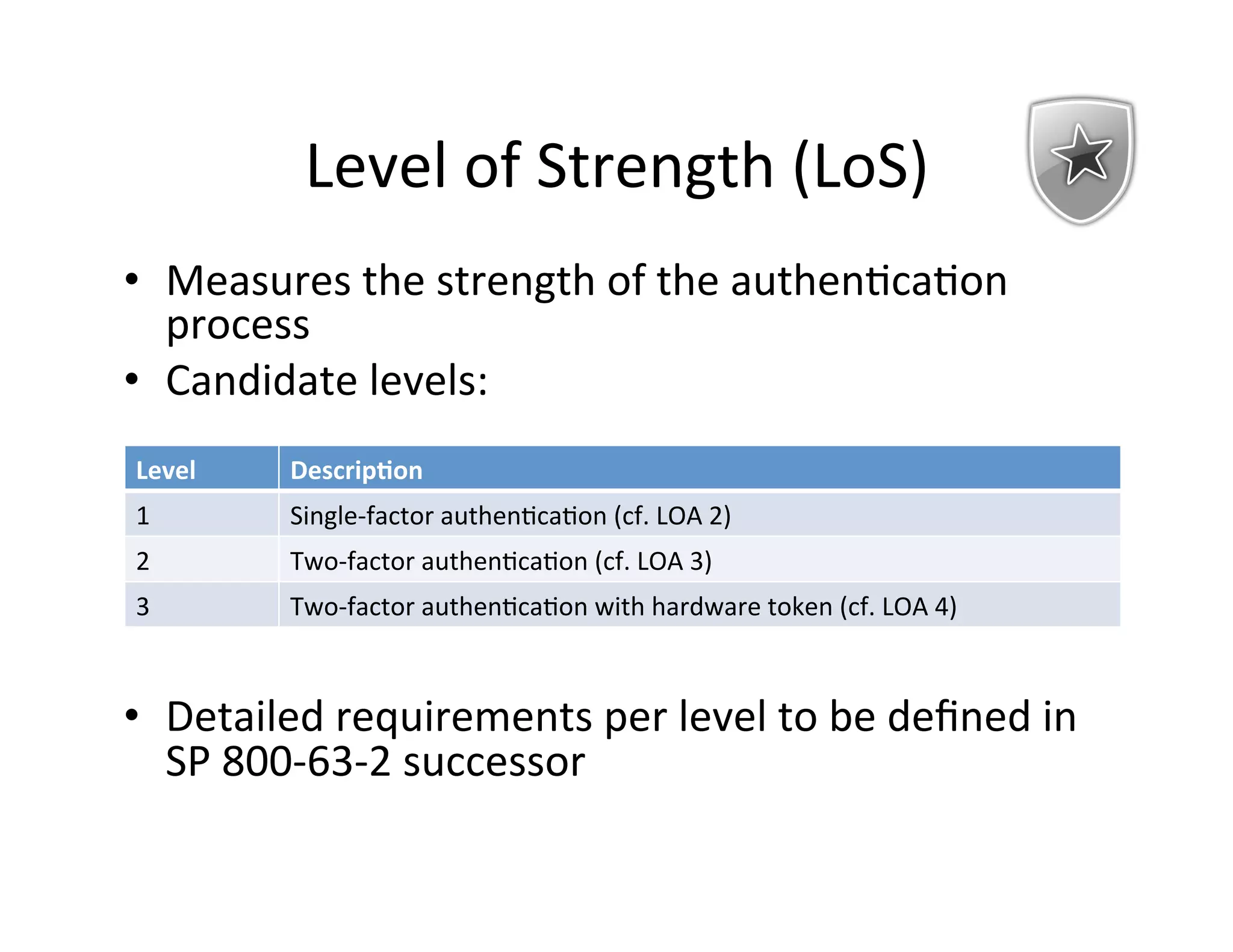
    Level  of  Strength  (LoS)   •  Measures  the  strength  of  the  authen+ca+on   process   •  Candidate  levels:   •  Detailed  requirements  per  level  to  be  defined  in   SP  800-­‐63-­‐2  successor   Level   Descrip'on   1   Single-­‐factor  authen+ca+on  (cf.  LOA  2)   2   Two-­‐factor  authen+ca+on  (cf.  LOA  3)   3   Two-­‐factor  authen+ca+on  with  hardware  token  (cf.  LOA  4)  
  • 9.
    Level  of  Confidence  (LoC)   •  Measure  of  the  degree  to  which  the  Relying  Party  can   depend  on  akributes,  par+cularly  iden+fying  akributes   •  Incorporates  the  iden+ty  proofing  process  and  the   binding  to  the  creden+al   •  Again,  detailed  requirements  TBD.   Level   Descrip'on   1   Self-­‐asserted  akribute  (cf.  LOA  1)   2   Remotely  iden+ty  proofed  (cf.  LOA  3)   3   In-­‐person  iden+ty  proofed  (cf.  LOA  4)  
  • 10.
    Mapping  LOA  to  LOS/LOC   LOA   Level  of  Strength   Level  of  Confidence   1   1  (see  note)   1   2   1   1  (pseudonynous)  or  2   3   2   2   4   3   3   Note:  Some  LOA  1  authen+ca+on  methodologies  may  not  be  acceptable  at  LOS  1.  
  • 11.
    Mapping  LOS/LOC  to  LOA   LOC  1   LOC  2   LOC  3   LOS  1   1,  2P   2   Note  2   LOS  2   Note  1   3   Note  2   LOS  3   Note  1   4   Notes:   1.    Strong  pseudonymous  or  anonymous  authen+ca+on   2.    Lower  LOS  may  limit  effec+ve  LOC  
  • 12.
    Not  included   • Characteris+cs  of  authen+ca+on  and  akribute  provider   –  Accredita+on  of  the  authen+ca+on  or  akribute  provider   •  May  only  permit  certain  levels  of  asser+on   –  Trust  by  relying  party  of  accredi+ng  agency   •  Addi+onal  detail  (such  as  loca+on)  for  risk-­‐based   authen+ca+on  decisions   –  Are  these  really  akributes?   •  Risk  characteris+cs  at  each  level   –  To  be  defined  based  on  detailed  technical  requirements  at   each  level   •  Asser+on  metadata   –  Expira+on,  usage  restric+ons,  etc.