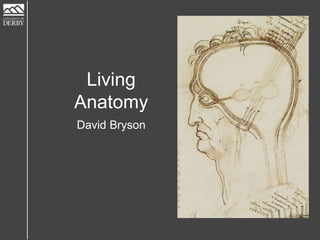
Living
Anatomy
David Bryson
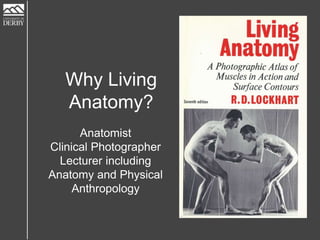
Why Living
Anatomy?
Anatomist
Clinical Photographer
Lecturer including
Anatomy and Physical
Anthropology
Living anatomy
•Looking at our own bodies termed
“Surface Anatomy”.
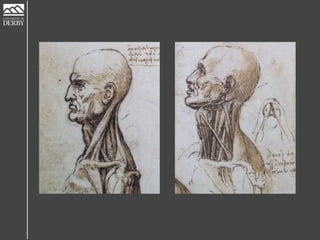
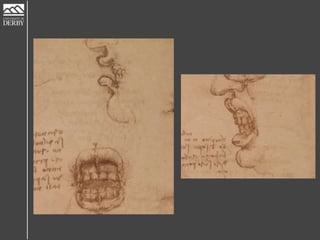
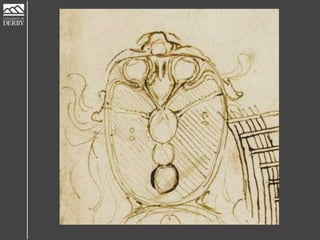
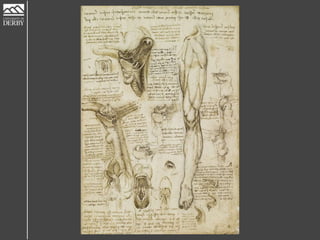
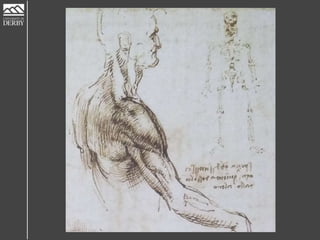
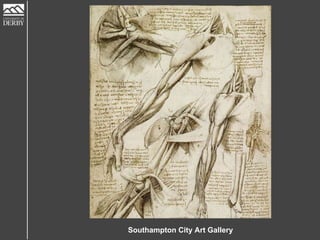
•Leonardo’s anatomical dissection
drawings.
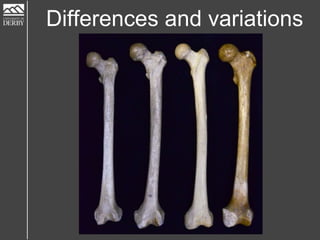
•Differences and variations in our
bodies and the way they work and
look.
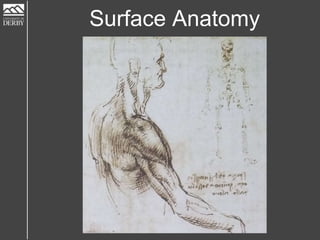
Surface Anatomy
“I have dissected more than ten human
bodies, destroying all the various
members and removing the minutest
particles of flesh which surround these
veins without causing any effusion of
blood . . . . .”
Leonardo Da Vinci
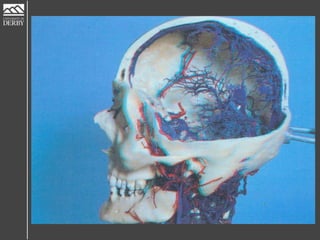
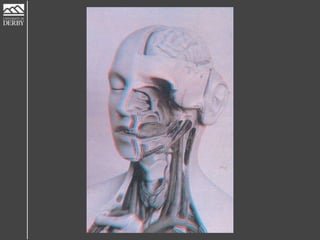
Optical system of the eyes
Retinal disparity
What we see out of each eye is slightly different so we
have stereoscopic vision
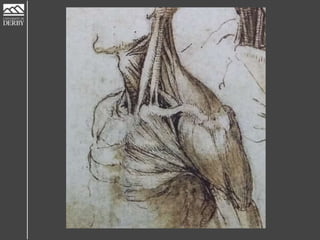
Deltoid
𝚫
Not in Leonardo exhibition
Southampton City Art Gallery
Birmingham Museum and Art Gallery
National Museum of Wales, Cardiff
Dorsal view of the bones of the foot Plantar view of the bones of the foot
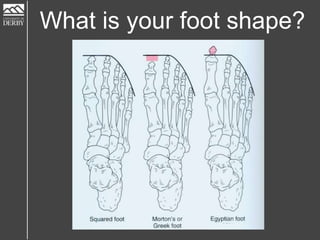
Differences and variations
Variations in anatomy
“And as one single body did not suffice
for so long a time, it was necessary to
proceed by stages with so many bodies
as would render my knowledge complete;
this is repeated twice in order to achieve
the differences.”
Leonardo Da Vinci
What is your foot shape?
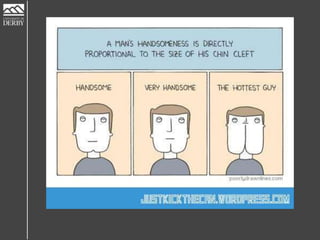
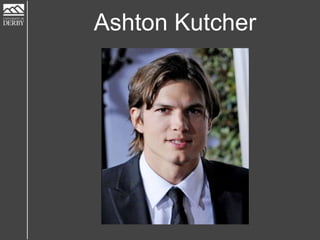
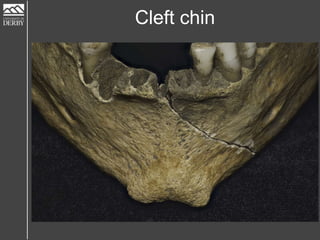
Cleft chin
Ashton Kutcher
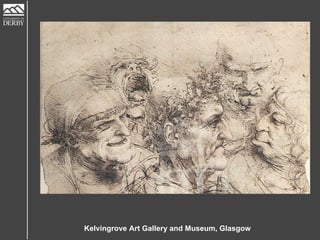
Kelvingrove Art Gallery and Museum, Glasgow
Impacted 3rd molar
Occipital
protuberance
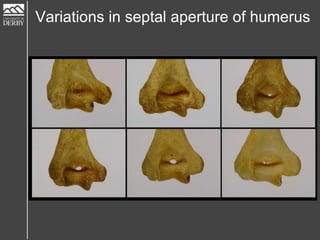
Variations in septal aperture of humerus
https://www.rct.uk/collection/themes/exhibitions/leonardo-da-vinci-a-life-in-drawing-0
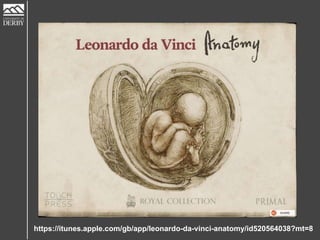
https://itunes.apple.com/gb/app/leonardo-da-vinci-anatomy/id520564038?mt=8
David Bryson
d.bryson@derby.ac.uk

Living anatomy: Curious adventures around the Human Body

Editor's Notes

  • #4 This lecture weaves together three strands looking at our own bodies, what is termed surface anatomy, Leonardo Da Vinci as an anatomist and artist and variations in how our bodies are put together. From the top of our heads down to our toes we can see and feel how our bodies work. Leonardo’s drawings show his work on a range of anatomical parts as he explored how we function.
  • #5 Aspects of latin and greek names for aspects of the body.
  • #9 Skull Parietals at top of head to occipital protuberence at back of head round to front for mastoid process behind the ear and then to the temperomandibular joint and how that works and functions
  • #10 Sternomastoid or as used to be called Sternocleidomastoid muscle turn head to right or left and feel muscle on the opposite side. Feeling the clavicle
  • #14 Leonardo was the first anatomist to accurately describe the optic chiasma and the olfactory nerves.
  • #16 Sausages and appearing to look through your hand
  • #18 More about what mean by seeing in stereo
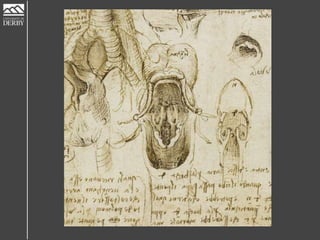
  • #21 Larynx in the neck and hyoid bone the only bone in the body not attached to any other bone it is purely held in pace by the glossal muscles which form the tongue so get myoglossus, hyoglossus etc.
  • #22 Larynx in the neck and hyoid bone the only bone in the body not attached to any other bone it is purely held in pace by the glossal muscles which form the tongue so get myoglossus, hyoglossus etc.
  • #23 Larynx in the neck and hyoid bone the only bone in the body not attached to any other bone it is purely held in pace by the glossal muscles which form the tongue so get myoglossus, hyoglossus etc.
  • #24 Larynx in the neck and hyoid bone the only bone in the body not attached to any other bone it is purely held in pace by the glossal muscles which form the tongue so get myoglossus, hyoglossus etc.
  • #25 Larynx in the neck and hyoid bone the only bone in the body not attached to any other bone it is purely held in pace by the glossal muscles which form the tongue so get myoglossus, hyoglossus etc.
  • #26 Deltoid
  • #28 Deltoid Three parts to the deltoid for moving the shoulder forward (medially rotate), lifting the arm (abduction) and moving the shoulder back (laterally rotate) one muscle but three actions. Leonardo delineates these muscles first with surface anatomy and then via dissection.
  • #29 Lifting the arm only so far and then if rotate the humerus it is possible to lift the arm higher
  • #30 Can feel the movement of your scapula if put your arm behind your back and as you move your arm up and down you can feel the scapula moving.
  • #31 What is the biceps for? Opening doors arms up and feel the biceps if rotate the hand/wrist the biceps gets larger and smaller.
  • #33 Function of the wrist in flexion and extension Lifting fingers and depending on how your tendons are linked will depend on which fingers lift when you move each finger individually.
  • #34 Moving down the body can feel the ziphoid process in middle and at sides of ribs can feel the floating ribs that don’t attach to the sternum at front can feel the ziphoid process. Further down by your hips you can feel the pelvis and the iliac crest then sideways to feel your femur and hip as rotates in the acetabulum Patella can feel that moves when you leg is straight but if start to bend your knee it moves up and becomes fixed in place. Knee as it is tricompartmental Femur/Tibia and Patellofemoral joint. Patella
  • #35 Moving down the body can feel the ziphoid process in middle and at sides of ribs can feel the floating ribs that don’t attach to the sternum at front can feel the ziphoid process. Further down by your hips you can feel the pelvis and the iliac crest then sideways to feel your femur and hip as rotates in the acetabulum Patella can feel that moves when you leg is straight but if start to bend your knee it moves up and becomes fixed in place. Knee as it is tricompartmental Femur/Tibia and Patellofemoral joint. Patella
  • #36 Ankle The medial side i.e. towards your middle is part of the tibia called the medial malleolus and the lateral part is part of the fibula. These then fit on to the talus. Bones are named for how they look and function.
  • #39 What is your foot shape?