LITTER LESS - RECYCLE MORE
COLLABORATIVE LEARNING IN E-TWINNING - CLASSROOM 6
ARVANITIDOU MARIANTHI, CARME PELLICER, DESPOINA AMARANTIDOU, DIANA GETTE, LIGIA
OLIVEIRA, LUISELLA BIANCO, AFRODITI NTINOU, MARIA ANGELA ZANETTI
ABOUT THE PROJECT
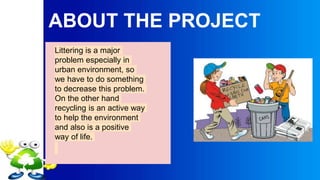
Littering is a major
problem especially in
urban environment, so
we have to do something
to decrease this problem.
On the other hand
recycling is an active way
to help the environment
and also is a positive
way of life.
AIMS AND GOALS
The main goal is to educate and activate students to manage littering issues
and encourage them to have a positive attitude towards protection of the
environment.
In the side goals we can count:
• The knowledge of how to recycle the different materials,
• The creative ideas of group work about ways and action pro - nature
• Being conscious that a little change will lead to more powerful changes.
• Increasing the competence to communicate in different languages.
• Behaving in autonomous and responsible way.
• Being respectful towards peers and their opinions
WORKING PROCESS
1- Introduction:
meet your partners using a
2- Organize transnational work groups
who meet on line in a googledoc or a
tricider
WORKING PROCESS
3- Share the tasks: a different task for each group (paper recycling, organizing
a litter campaign (tidy up campaign), Publishing a news bulletin containing
the activities held during the project and the distribution of this bulletin to the
parents, teachers and people ; organize an art competition of How do we
benefit filing the scrap materials, make art from recyclable materials
4- Decide and declare the ways that your group will work for the task
collaboratively (we are going to use e-mail, google docs, padlet, titanpad,
StickyMoose, answergarden, on line meeting in e-twinning live or skype,
project forum)
SHARING RESULTS
Presentations (each group
choose a way to present its
work, children try to write a
european fairy tale about
recycling with illustration and
also they can write a song or
poem, role play with recycling
materials, video etc)
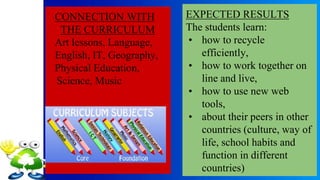
CONNECTION WITH
THE CURRICULUM
Art lessons, Language,
English, IT, Geography,
Physical Education,
Science, Music
EXPECTED RESULTS
The students learn:
• how to recycle
efficiently,
• how to work together on
line and live,
• how to use new web
tools,
• about their peers in other
countries (culture, way of
life, school habits and
function in different
countries)
CONCLUSIONS - EVALUATION
Evaluation will be conduct for each step of this project.
Tools to be used: Rubric of assessement, Survey with Google sheets,
Dotstorming,
Display of children’s works of art, photos of posters and our opinions about the
project in the blog
We use storyjumber for the tale, moviemaker for the campaign, poll-maker for
a questionnaire
We use Quizizz as initial evaluation, Tricider or Padlet for the campaing and
SurveyMonkey for a final assessment

Litter less Recycle more

  • 1.
    LITTER LESS -RECYCLE MORE COLLABORATIVE LEARNING IN E-TWINNING - CLASSROOM 6 ARVANITIDOU MARIANTHI, CARME PELLICER, DESPOINA AMARANTIDOU, DIANA GETTE, LIGIA OLIVEIRA, LUISELLA BIANCO, AFRODITI NTINOU, MARIA ANGELA ZANETTI
  • 2.
    ABOUT THE PROJECT Litteringis a major problem especially in urban environment, so we have to do something to decrease this problem. On the other hand recycling is an active way to help the environment and also is a positive way of life.
  • 3.
    AIMS AND GOALS Themain goal is to educate and activate students to manage littering issues and encourage them to have a positive attitude towards protection of the environment. In the side goals we can count: • The knowledge of how to recycle the different materials, • The creative ideas of group work about ways and action pro - nature • Being conscious that a little change will lead to more powerful changes. • Increasing the competence to communicate in different languages. • Behaving in autonomous and responsible way. • Being respectful towards peers and their opinions
  • 4.
    WORKING PROCESS 1- Introduction: meetyour partners using a 2- Organize transnational work groups who meet on line in a googledoc or a tricider
  • 5.
    WORKING PROCESS 3- Sharethe tasks: a different task for each group (paper recycling, organizing a litter campaign (tidy up campaign), Publishing a news bulletin containing the activities held during the project and the distribution of this bulletin to the parents, teachers and people ; organize an art competition of How do we benefit filing the scrap materials, make art from recyclable materials 4- Decide and declare the ways that your group will work for the task collaboratively (we are going to use e-mail, google docs, padlet, titanpad, StickyMoose, answergarden, on line meeting in e-twinning live or skype, project forum)
  • 6.
    SHARING RESULTS Presentations (eachgroup choose a way to present its work, children try to write a european fairy tale about recycling with illustration and also they can write a song or poem, role play with recycling materials, video etc)
  • 7.
    CONNECTION WITH THE CURRICULUM Artlessons, Language, English, IT, Geography, Physical Education, Science, Music EXPECTED RESULTS The students learn: • how to recycle efficiently, • how to work together on line and live, • how to use new web tools, • about their peers in other countries (culture, way of life, school habits and function in different countries)
  • 8.
    CONCLUSIONS - EVALUATION Evaluationwill be conduct for each step of this project. Tools to be used: Rubric of assessement, Survey with Google sheets, Dotstorming, Display of children’s works of art, photos of posters and our opinions about the project in the blog We use storyjumber for the tale, moviemaker for the campaign, poll-maker for a questionnaire We use Quizizz as initial evaluation, Tricider or Padlet for the campaing and SurveyMonkey for a final assessment